

IEC 60310:2004
(Main)Railway applications - Traction transformers and inductors on board rolling stock
General Information
- Abstract
Applies to traction transformers installed on board rolling stock and to the various types of inductors inserted in the power and auxiliary circuits of electric vehicles.
- Status
- Published
- Publication Date
- 08-Feb-2004
- Technical Committee
- TC 9 - Electrical equipment and systems for railways
- Drafting Committee
- MT 38 - TC 17/SC 17A/MT 38
- Current Stage
- DELPUB - Deleted Publication
- Start Date
- 28-Jan-2016
- Completion Date
- 28-Aug-2026
Overview
IEC 60310:2004 is an international standard developed by the International Electrotechnical Commission (IEC) specifically for railway applications. The standard focuses on traction transformers and inductors installed on board rolling stock-key electrical components used in electric railway vehicles. It provides comprehensive technical requirements, testing procedures, and classification guidelines to ensure the reliable operation, safety, and efficiency of traction transformers and inductors used in power and auxiliary circuits of electric trains.
Published as the third edition in 2004, IEC 60310:2004 updates and replaces the previous edition, incorporating significant technical revisions and aligning with newer generic railway standards such as IEC 60077-1 and IEC 61373, particularly concerning operating conditions including shock and vibration resistance.
Key Topics
- Scope and Application: Defines the types of transformers and inductors covered, specifically those installed on rolling stock used in railway traction power systems and auxiliary circuits.
- Definitions and Terminology: Clarifies essential terms relating to traction transformers, inductors, and inductance to ensure uniform understanding across manufacturers and operators.
- Rated Voltages and Power: Specifies the rated voltages for primary (line side) and secondary windings, as well as the rated power of transformers to ensure proper sizing and compatibility with railway power systems.
- Cooling Methods: Details classifications for transformers and inductors according to their cooling techniques, which affect performance and safety.
- Temperature Rise Limits: Provides limits on allowable temperature rises for insulating materials to safeguard durability and performance under operating conditions.
- Tappings and Connections: Defines requirements for transformer tap changers, which allow voltage adjustments to optimize performance.
- Labeling and Rating Plates: Specifies information that must be displayed on transformer and inductor rating plates for clear identification and traceability.
- Testing Procedures: Outlines categories of type and routine tests for both transformers and inductors, including dielectric strength, temperature rise, and mechanical integrity assessments.
- User-Manufacturer Agreements: Includes annexes outlining points requiring mutual understanding between rolling stock operators and equipment manufacturers to tailor devices to specific service conditions.
Applications
IEC 60310:2004 serves as a critical reference for:
- Rolling Stock Manufacturers: Assisting with the selection, design, testing, and certification of traction transformers and inductors to meet international railway safety and performance standards.
- Railway Operators and Maintenance Providers: Guiding procurement, installation, operation, and maintenance practices for onboard electrical equipment, ensuring compatibility and reliability in service.
- Component Suppliers: Ensuring compliance with stringent voltage, power, temperature, and environmental requirements crucial for traction power equipment used in electric trains.
- Safety and Compliance Auditors: Verifying that traction transformers and inductors meet IEC-defined safety margins, temperature limits, and withstand tests for the specific demands of railway environments.
- Standardization Bodies and Technical Committees: Providing a framework for harmonizing related national and international standards in railway electrification and rolling stock systems.
Related Standards
- IEC 60077-1: Electrical equipment for rolling stock - General service conditions and shock and vibration requirements-referenced in IEC 60310 for environmental and mechanical endurance criteria.
- IEC 61373: Railway applications - Rolling stock equipment - Shock and vibration tests-provides detailed testing frameworks that complement IEC 60310's environmental durability requirements.
- IEC 60034-1: Rotating electrical machines, which may relate to electrical components used in traction systems.
- National and regional railway standards that adapt IEC 60310 specifications for localized requirements and operational conditions.
Keywords: IEC 60310, traction transformers, inductor coils, rolling stock, railway applications, electric trains, traction power equipment, electrical standards, temperature rise limits, voltage ratings, IEC railway standards, transformer cooling, electrical tests, railway electrical equipment.
Relations
- Revised
IEC 60310:2016 - Railway applications - Traction transformers and inductors on board rolling stock - Effective Date
- 05-Sep-2023
Get Certified
Connect with accredited certification bodies for this standard

IRIS Certification (UNIFE)
International Railway Industry Standard certification.

TÜV SÜD Rail GmbH
TÜV SÜD railway certification services.

Bureau Veritas Railway Certification
Railway and transportation certification.
Sponsored listings
Frequently Asked Questions
IEC 60310:2004 is a standard published by the International Electrotechnical Commission (IEC). Its full title is "Railway applications - Traction transformers and inductors on board rolling stock". This standard covers: Applies to traction transformers installed on board rolling stock and to the various types of inductors inserted in the power and auxiliary circuits of electric vehicles.
Applies to traction transformers installed on board rolling stock and to the various types of inductors inserted in the power and auxiliary circuits of electric vehicles.
IEC 60310:2004 is classified under the following ICS (International Classification for Standards) categories: 45.060.01 - Railway rolling stock in general. The ICS classification helps identify the subject area and facilitates finding related standards.
IEC 60310:2004 has the following relationships with other standards: It is inter standard links to IEC 60310:2016. Understanding these relationships helps ensure you are using the most current and applicable version of the standard.
IEC 60310:2004 is available in PDF format for immediate download after purchase. The document can be added to your cart and obtained through the secure checkout process. Digital delivery ensures instant access to the complete standard document.
Standards Content (Sample)
NORME CEI
INTERNATIONALE IEC
INTERNATIONAL
Troisième édition
STANDARD
Third edition
2004-02
Applications ferroviaires –
Transformateurs de traction et bobines
d'inductance à bord du matériel roulant
Railway applications –
Traction transformers and inductors
on board rolling stock
Numéro de référence
Reference number
CEI/IEC 60310:2004
Numérotation des publications Publication numbering
Depuis le 1er janvier 1997, les publications de la CEI As from 1 January 1997 all IEC publications are
sont numérotées à partir de 60000. Ainsi, la CEI 34-1 issued with a designation in the 60000 series. For
devient la CEI 60034-1. example, IEC 34-1 is now referred to as IEC 60034-1.
Editions consolidées Consolidated editions
Les versions consolidées de certaines publications de la The IEC is now publishing consolidated versions of its
CEI incorporant les amendements sont disponibles. Par publications. For example, edition numbers 1.0, 1.1
exemple, les numéros d’édition 1.0, 1.1 et 1.2 indiquent and 1.2 refer, respectively, to the base publication,
respectivement la publication de base, la publication de the base publication incorporating amendment 1 and
base incorporant l’amendement 1, et la publication de the base publication incorporating amendments 1
base incorporant les amendements 1 et 2. and 2.
Informations supplémentaires Further information on IEC publications
sur les publications de la CEI
Le contenu technique des publications de la CEI est The technical content of IEC publications is kept
constamment revu par la CEI afin qu'il reflète l'état under constant review by the IEC, thus ensuring that
actuel de la technique. Des renseignements relatifs à the content reflects current technology. Information
cette publication, y compris sa validité, sont dispo- relating to this publication, including its validity, is
nibles dans le Catalogue des publications de la CEI available in the IEC Catalogue of publications
(voir ci-dessous) en plus des nouvelles éditions, (see below) in addition to new editions, amendments
amendements et corrigenda. Des informations sur les and corrigenda. Information on the subjects under
sujets à l’étude et l’avancement des travaux entrepris consideration and work in progress undertaken by the
par le comité d’études qui a élaboré cette publication, technical committee which has prepared this
ainsi que la liste des publications parues, sont publication, as well as the list of publications issued,
également disponibles par l’intermédiaire de: is also available from the following:
• Site web de la CEI (www.iec.ch) • IEC Web Site (www.iec.ch)
• Catalogue des publications de la CEI • Catalogue of IEC publications
Le catalogue en ligne sur le site web de la CEI The on-line catalogue on the IEC web site
(http://www.iec.ch/searchpub/cur_fut.htm) vous permet (http://www.iec.ch/searchpub/cur_fut.htm) enables
de faire des recherches en utilisant de nombreux you to search by a variety of criteria including text
critères, comprenant des recherches textuelles, par searches, technical committees and date of
comité d’études ou date de publication. Des publication. On-line information is also available
informations en ligne sont également disponibles sur on recently issued publications, withdrawn and
les nouvelles publications, les publications rempla- replaced publications, as well as corrigenda.
cées ou retirées, ainsi que sur les corrigenda.
• IEC Just Published • IEC Just Published
Ce résumé des dernières publications parues This summary of recently issued publications
(http://www.iec.ch/online_news/justpub/jp_entry.htm) (http://www.iec.ch/online_news/justpub/jp_entry.htm)
est aussi disponible par courrier électronique. is also available by email. Please contact the
Veuillez prendre contact avec le Service client Customer Service Centre (see below) for further
(voir ci-dessous) pour plus d’informations. information.
• Service clients • Customer Service Centre
Si vous avez des questions au sujet de cette If you have any questions regarding this
publication ou avez besoin de renseignements publication or need further assistance, please
supplémentaires, prenez contact avec le Service contact the Customer Service Centre:
clients:
Email: custserv@iec.ch Email: custserv@iec.ch
Tél: +41 22 919 02 11 Tel: +41 22 919 02 11
Fax: +41 22 919 03 00 Fax: +41 22 919 03 00
.
NORME CEI
INTERNATIONALE IEC
INTERNATIONAL
Troisième édition
STANDARD
Third edition
2004-02
Applications ferroviaires –
Transformateurs de traction et bobines
d'inductance à bord du matériel roulant
Railway applications –
Traction transformers and inductors
on board rolling stock
IEC 2004 Droits de reproduction réservés Copyright - all rights reserved
Aucune partie de cette publication ne peut être reproduite ni No part of this publication may be reproduced or utilized in any
utilisée sous quelque forme que ce soit et par aucun procédé, form or by any means, electronic or mechanical, including
électronique ou mécanique, y compris la photocopie et les photocopying and microfilm, without permission in writing from
microfilms, sans l'accord écrit de l'éditeur. the publisher.
International Electrotechnical Commission, 3, rue de Varembé, PO Box 131, CH-1211 Geneva 20, Switzerland
Telephone: +41 22 919 02 11 Telefax: +41 22 919 03 00 E-mail: inmail@iec.ch Web: www.iec.ch
CODE PRIX
U
PRICE CODE
Commission Electrotechnique Internationale
International Electrotechnical Commission
МеждународнаяЭлектротехническаяКомиссия
Pour prix, voir catalogue en vigueur
For price, see current catalogue
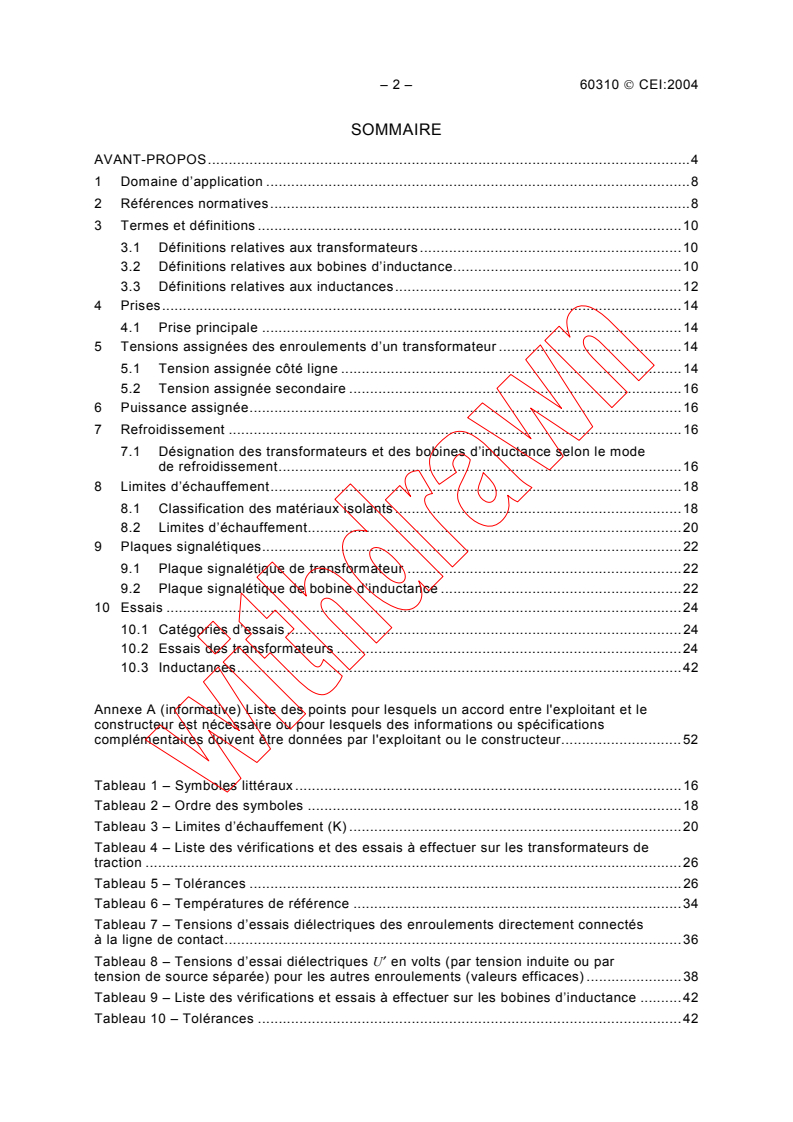
– 2 – 60310 CEI:2004
SOMMAIRE
AVANT-PROPOS.4
1 Domaine d’application .8
2 Références normatives.8
3 Termes et définitions .10
3.1 Définitions relatives aux transformateurs .10
3.2 Définitions relatives aux bobines d’inductance.10
3.3 Définitions relatives aux inductances.12
4 Prises.14
4.1 Prise principale .14
5 Tensions assignées des enroulements d’un transformateur .14
5.1 Tension assignée côté ligne .14
5.2 Tension assignée secondaire .16
6 Puissance assignée.16
7 Refroidissement .16
7.1 Désignation des transformateurs et des bobines d’inductance selon le mode
de refroidissement.16
8 Limites d’échauffement.18
8.1 Classification des matériaux isolants .18
8.2 Limites d’échauffement.20
9 Plaques signalétiques.22
9.1 Plaque signalétique de transformateur .22
9.2 Plaque signalétique de bobine d’inductance .22
10 Essais .24
10.1 Catégories d’essais .24
10.2 Essais des transformateurs .24
10.3 Inductances.42
Annexe A (informative) Liste des points pour lesquels un accord entre l'exploitant et le
constructeur est nécessaire ou pour lesquels des informations ou spécifications
complémentaires doivent être données par l'exploitant ou le constructeur.52
Tableau 1 – Symboles littéraux .16
Tableau 2 – Ordre des symboles .18
Tableau 3 – Limites d’échauffement (K) .20
Tableau 4 – Liste des vérifications et des essais à effectuer sur les transformateurs de
traction .26
Tableau 5 – Tolérances .26
Tableau 6 – Températures de référence .34
Tableau 7 – Tensions d’essais diélectriques des enroulements directement connectés
à la ligne de contact.36
Tableau 8 – Tensions d’essai diélectriques U′ en volts (par tension induite ou par
tension de source séparée) pour les autres enroulements (valeurs efficaces) .38
Tableau 9 – Liste des vérifications et essais à effectuer sur les bobines d’inductance .42
Tableau 10 – Tolérances .42
60310 IEC:2004 – 3 –
CONTENTS
FOREWORD.5
1 Scope.9
2 Normative references .9
3 Terms and definitions .11
3.1 Definitions for transformers .11
3.2 Definitions for inductors.11
3.3 Definitions for inductance .13
4 Tappings .15
4.1 Principal tapping .15
5 Rated voltages of transformer windings .15
5.1 Rated line-side voltage.15
5.2 Rated secondary voltage .17
6 Rated power .17
7 Cooling.17
7.1 Identification of transformers and inductors according to cooling method.17
8 Limits of temperature rise .19
8.1 Classification of insulating materials.19
8.2 Limits of temperature-rise.21
9 Rating plates .23
9.1 Transformer rating plate .23
9.2 Inductor rating plate .23
10 Tests .25
10.1 Categories of tests .25
10.2 Tests on transformers .25
10.3 Tests on inductors.43
Annex A (informative) List of items for which an agreement between user and
manufacturer is needed or for which further information or specifications shall be given
by the user or by the manufacturer .53
Table 1 – Letter symbols.17
Table 2 – Order of symbols.19
Table 3 – Limits of temperature-rise (K) .21
Table 4 – List of checks and tests to be made on traction transformers.27
Table 5 – Tolerances .27
Table 6 – Reference temperatures .35
Table 7 – Dielectric test voltages for windings directly connected to the contact line.37
Table 8 – Dielectric test voltage U’ in volts (induced voltage or separate source
voltage withstand test) for other windings (r.m.s.) .39
Table 9 – List of checks and tests to be made on inductors.43
Table 10 – Tolerances .43
– 4 – 60310 CEI:2004
COMMISSION ÉLECTROTECHNIQUE INTERNATIONALE
____________
APPLICATIONS FERROVIAIRES –
TRANSFORMATEURS DE TRACTION ET BOBINES D’INDUCTANCE
À BORD DU MATÉRIEL ROULANT
AVANT-PROPOS
1) La Commission Electrotechnique Internationale (CEI) est une organisation mondiale de normalisation
composée de l'ensemble des comités électrotechniques nationaux (Comités nationaux de la CEI). La CEI a
pour objet de favoriser la coopération internationale pour toutes les questions de normalisation dans les
domaines de l'électricité et de l'électronique. A cet effet, la CEI – entre autres activités – publie des Normes
internationales, des Spécifications techniques, des Rapports techniques, des Spécifications accessibles au
public (PAS) et des Guides (ci-après dénommés "Publication(s) de la CEI"). Leur élaboration est confiée à des
comités d'études, aux travaux desquels tout Comité national intéressé par le sujet traité peut participer. Les
organisations internationales, gouvernementales et non gouvernementales, en liaison avec la CEI, participent
également aux travaux. La CEI collabore étroitement avec l'Organisation Internationale de Normalisation (ISO),
selon des conditions fixées par accord entre les deux organisations.
2) Les décisions ou accords officiels de la CEI concernant les questions techniques représentent, dans la mesure
du possible, un accord international sur les sujets étudiés, étant donné que les Comités nationaux de la CEI
intéressés sont représentés dans chaque comité d’études.
3) Les Publications de la CEI se présentent sous la forme de recommandations internationales et sont agréées
comme telles par les Comités nationaux de la CEI. Tous les efforts raisonnables sont entrepris afin que la CEI
s'assure de l'exactitude du contenu technique de ses publications; la CEI ne peut pas être tenue responsable
de l'éventuelle mauvaise utilisation ou interprétation qui en est faite par un quelconque utilisateur final.
4) Dans le but d'encourager l'uniformité internationale, les Comités nationaux de la CEI s'engagent, dans toute la
mesure possible, à appliquer de façon transparente les Publications de la CEI dans leurs publications
nationales et régionales. Toutes divergences entre toutes Publications de la CEI et toutes publications
nationales ou régionales correspondantes doivent être indiquées en termes clairs dans ces dernières.
5) La CEI n’a prévu aucune procédure de marquage valant indication d’approbation et n'engage pas sa
responsabilité pour les équipements déclarés conformes à une de ses Publications.
6) Tous les utilisateurs doivent s'assurer qu'ils sont en possession de la dernière édition de cette publication.
7) Aucune responsabilité ne doit être imputée à la CEI, à ses administrateurs, employés, auxiliaires ou
mandataires, y compris ses experts particuliers et les membres de ses comités d'études et des Comités
nationaux de la CEI, pour tout préjudice causé en cas de dommages corporels et matériels, ou de tout autre
dommage de quelque nature que ce soit, directe ou indirecte, ou pour supporter les coûts (y compris les frais
de justice) et les dépenses découlant de la publication ou de l'utilisation de cette Publication de la CEI ou de
toute autre Publication de la CEI, ou au crédit qui lui est accordé.
8) L'attention est attirée sur les références normatives citées dans cette publication. L'utilisation de publications
référencées est obligatoire pour une application correcte de la présente publication.
9) L’attention est attirée sur le fait que certains des éléments de la présente Publication de la CEI peuvent faire
l’objet de droits de propriété intellectuelle ou de droits analogues. La CEI ne saurait être tenue pour
responsable de ne pas avoir identifié de tels droits de propriété et de ne pas avoir signalé leur existence.
La Norme internationale CEI 60310 a été établie par le comité d’études 9 de la CEI: Matériels
et systèmes électriques ferroviaires.
Cette troisième édition annule et remplace la deuxième édition parue en 1991, dont elle
constitue une révision technique. Cette édition inclut les modifications techniques majeures
suivantes par rapport à l’édition précédente: elle tient compte des nouvelles normes
génériques ferroviaires, en particulier en ce qui concerne les conditions générales de service
et les considérations de chocs et vibrations en faisant référence à la CEI 60077-1 et à la
CEI 61373.
60310 IEC:2004 – 5 –
INTERNATIONAL ELECTROTECHNICAL COMMISSION
___________
RAILWAY APPLICATIONS –
TRACTION TRANSFORMERS AND INDUCTORS
ON BOARD ROLLING STOCK
FOREWORD
1) The International Electrotechnical Commission (IEC) is a worldwide organization for standardization comprising
all national electrotechnical committees (IEC National Committees). The object of IEC is to promote
international co-operation on all questions concerning standardization in the electrical and electronic fields. To
this end and in addition to other activities, IEC publishes International Standards, Technical Specifications,
Technical Reports, Publicly Available Specifications (PAS) and Guides (hereafter referred to as
“IEC Publication(s)”). Their preparation is entrusted to technical committees; any IEC National Committee
interested in the subject dealt with may participate in this preparatory work. International, governmental and
non-governmental organizations liaising with the IEC also participate in this preparation. IEC collaborates
closely with the International Organization for Standardization (ISO) in accordance with conditions determined
by agreement between the two organizations.
2) The formal decisions or agreements of IEC on technical matters express, as nearly as possible, an international
consensus of opinion on the relevant subjects since each technical committee has representation from all
interested IEC National Committees.
3) IEC Publications have the form of recommendations for international use and are accepted by IEC National
Committees in that sense. While all reasonable efforts are made to ensure that the technical content of
IEC Publications is accurate, IEC cannot be held responsible for the way in which they are used or for any
misinterpretation by any end user.
4) In order to promote international uniformity, IEC National Committees undertake to apply IEC Publications
transparently to the maximum extent possible in their national and regional publications. Any divergence
between any IEC Publication and the corresponding national or regional publication shall be clearly indicated in
the latter.
5) IEC provides no marking procedure to indicate its approval and cannot be rendered responsible for any
equipment declared to be in conformity with an IEC Publication.
6) All users should ensure that they have the latest edition of this publication.
7) No liability shall attach to IEC or its directors, employees, servants or agents including individual experts and
members of its technical committees and IEC National Committees for any personal injury, property damage or
other damage of any nature whatsoever, whether direct or indirect, or for costs (including legal fees) and
expenses arising out of the publication, use of, or reliance upon, this IEC Publication or any other
IEC Publications.
8) Attention is drawn to the Normative references cited in this publication. Use of the referenced publications is
indispensable for the correct application of this publication.
9) Attention is drawn to the possibility that some of the elements of this IEC Publication may be the subject of
patent rights. IEC shall not be held responsible for identifying any or all such patent rights.
International Standard IEC 60310 has been prepared by IEC technical committee 9: Electrical
equipment and systems for railways.
This third edition cancels and replaces the second edition issued in 1991 and constitutes a
technical revision. This edition includes the following significant technical changes from the
previous edition: it takes into account the new generic railway standards, more specifically
general service conditions and shock and vibration considerations, referring to IEC 60077-1
and IEC 61373.
– 6 – 60310 CEI:2004
Le texte de cette norme est issu des documents suivants:
FDIS Rapport de vote
9/780/FDIS 9/784/RVD
Le rapport de vote indiqué dans le tableau ci-dessus donne toute information sur le vote ayant
abouti à l'approbation de cette norme.
Cette publication a été rédigée selon les Directives ISO/CEI, Partie 2.
Le comité a décidé que le contenu de cette publication ne sera pas modifié avant 2009.
A cette date, la publication sera
• reconduite;
• supprimée;
• remplacée par une édition révisée, ou
• amendée.
60310 IEC:2004 – 7 –
The text of this standard is based on the following documents:
FDIS Report on voting
9/780/FDIS 9/784/RVD
Full information on the voting for the approval of this standard can be found in the report on
voting indicated in the above table.
This publication has been drafted in accordance with the ISO/IEC Directives, Part 2.
The committee has decided that the contents of this publication will remain unchanged until
2009. At this date, the publication will be
• reconfirmed;
• withdrawn;
• replaced by a revised edition, or
• amended.
– 8 – 60310 CEI:2004
APPLICATIONS FERROVIAIRES –
TRANSFORMATEURS DE TRACTION ET BOBINES D’INDUCTANCE
À BORD DU MATÉRIEL ROULANT
1 Domaine d’application
La présente Norme internationale s'applique aux transformateurs de traction à bord des
matériels roulants et aux divers types de bobines d'inductances insérées dans les circuits de
puissance ou auxiliaires des véhicules à moteurs électriques.
NOTE 1 Le terme «bobine d’inductance» est utilisé dans la présente norme avec la signification du terme anglais
«reactor» dans la CEI 60050(421), la CEI 60050(811) et la CEI 60289.
Les bobines d’inductance mentionnées au premier alinéa peuvent être:
– des bobines d’inductance de filtrage;
– des bobines d’inductance de lissage;
– des bobines d’inductance de commutation;
– des bobines d’inductance de protection des convertisseurs statiques de puissance;
– les shunts inductifs des moteurs de traction;
– des bobines d’inductance utilisées pour les transitions entre crans des graduateurs;
– des bobines d’inductance des circuits de freinage;
– des bobines d’inductance d'antiparasitage.
NOTE 2 Les prescriptions de la CEI 60076 sont applicables aux transformateurs de traction dans la mesure où
elles ne sont pas en contradiction avec la présente norme ou avec les publications CEI spécialisées traitant des
applications de traction.
NOTE 3 Pour les transformateurs et les bobines d’inductance des convertisseurs statiques de puissance, il
convient de se reporter également à la CEI 61287.
La présente norme peut également être appliquée, après accord entre exploitant et construc-
teur, aux transformateurs de traction des véhicules à courant alternatif triphasé côté ligne et
aux transformateurs insérés dans les circuits auxiliaires monophasés ou polyphasés des
véhicules, exception faite des transformateurs de mesure et des transformateurs de
puissance assignée inférieure à 1 kVA en monophasé ou à 5 kVA en polyphasé.
La présente norme ne couvre pas les accessoires tels que graduateurs, résistances,
échangeurs de chaleur, ventilateurs, etc., destinés à être montés sur les transformateurs ou
les bobines d’inductance et qui doivent être essayés séparément suivant les règles les
concernant.
Lorsque les graduateurs font partie intégrante des transformateurs, ils ne peuvent en être
séparés lorsqu'on essaie ces derniers.
Pour les conditions de service, se référer à la CEI 60077-1, Article 7.
2 Références normatives
Les documents de référence suivants sont indispensables pour l'application du présent
document. Pour les références datées, seule l'édition citée s'applique. Pour les références
non datées, la dernière édition du document de référence s'applique (y compris les éventuels
amendements).
60310 IEC:2004 – 9 –
INTERNATIONAL ELECTROTECHNICAL COMMISSION
___________
RAILWAY APPLICATIONS –
TRACTION TRANSFORMERS AND INDUCTORS
ON BOARD ROLLING STOCK
1 Scope
This International Standard applies to traction transformers installed on board rolling stock
and to the various types of inductors inserted in the power and auxiliary circuits of electric
vehicles.
NOTE 1 The term “inductor” is used in this standard with the same meaning as the term “reactor” mentioned in
IEC 60050(421), IEC 60050(811) and IEC 60289.
The inductors mentioned in the first paragraph may be:
– filter inductors;
– smoothing inductors;
– commutation inductors;
– protection inductors in static power convertors;
– inductive shunts for traction motors;
– inductors used for transition between tap changer notches;
– braking circuit inductors;
– interference suppression inductors.
NOTE 2 The requirements of IEC 60076 are applicable to traction transformers where they do not conflict with
this standard, or with the specialized IEC publications dealing with traction applications.
NOTE 3 For transformers and inductors for static power convertors, reference should also be made to IEC 61287.
This standard can also be applied, after agreement between user and manufacturer, to the
traction transformers of three-phase a.c. line-side powered vehicles and to the transformers
inserted in the single-phase or polyphase auxiliary circuits of vehicles, except for instrument
transformers and transformers of a rated output below 1 kVA single-phase or 5 kVA
polyphase.
This standard does not cover accessories such as tap changers, resistors, heat exchangers,
fans, etc., intended for mounting on the transformers or inductors, which shall be tested
separately according to relevant rules.
When tap changers are an integral part of the transformers, they cannot be separated while
the latter are tested.
For service conditions, refer to IEC 60077-1, Clause 7.
2 Normative references
The following referenced documents are indispensable for the application of this document.
For dated references, only the edition cited applies. For undated references, the latest edition
of the referenced document (including any amendments) applies.
– 10 – 60310 CEI:2004
CEI 60076-1:1993, Transformateurs de puissance – Partie 1: Généralités
CEI 60076-2:1993, Transformateurs de puissance – Partie 2: Echauffement
CEI 60076-3:2000, Transformateurs de puissance – Partie 3: Niveaux d'isolement, essais
diélectriques et distances d’isolement dans l’air
CEI 60076-5:2000, Transformateurs de puissance – Partie 5: Tenue au court-circuit
CEI 60077-1:1999, Applications ferroviaires – Equipements électriques du matériel roulant –
Partie 1: Conditions générales de service et règles générales
CEI 60085:1984, Evaluation et classification thermiques de l'isolation électrique
CEI 60289:1988, Bobines d’inductance
CEI 60850:2000, Applications ferroviaires – Tensions d'alimentation des systèmes de traction
CEI 61133:1992, Traction électrique – Matériel roulant – Méthodes d’essai des véhicules
ferroviaires électriques et thermo-électriques après achèvement et avant mise en service
CEI 61287-1:1995, Convertisseurs de puissance embarqués sur le matériel roulant
ferroviaire – Partie 1: Caractéristiques et méthodes d’essai
CEI 61373:1999, Applications ferroviaires – Matériel roulant – Essais de chocs et
vibrations
3 Termes et définitions
Pour les besoins du présent document, les termes et définitions de la CEI 60076 et de la
CEI 60289, ainsi que les suivants s’appliquent.
3.1 Définitions relatives aux transformateurs
3.1.1
classification des transformateurs
selon les dispositions prévues pour le réglage en charge de la tension secondaire d'alimen-
tation des circuits de traction, les transformateurs de traction peuvent être classés en:
– transformateurs à rapport fixe;
– transformateurs à réglage basse tension;
– transformateurs à réglage haute tension.
3.2 Définitions relatives aux bobines d’inductance
3.2.1
classification des bobines d’inductance
selon leur utilisation, les bobines d’inductance peuvent être classées comme suit:
– Bobines d’inductance à courant alternatif
Bobines d’inductance traversées par des courants alternatifs, telles que les bobines
d’inductance de transition entre prises de graduateurs, les bobines d’inductance des
circuits de freinage des moteurs à courant alternatif à collecteur, les bobines d’inductance
d'antiparasitage, etc.
60310 IEC:2004 – 11 –
IEC 60076-1:1993, Power transformers – Part 1: General
IEC 60076-2:1993, Power transformers – Part 2: Temperature rise
IEC 60076-3:2000, Power transformers – Part 3: Insulation levels, dielectric tests and
external clearances in air
IEC 60076-5:2000, Power transformers – Part 5: Ability to withstand short circuit
IEC 60077-1:1999, Railway applications – Electric equipment for rolling stock – Part 1:
General service conditions and general rules
IEC 60085:1984, Thermal evaluation and classification of electrical insulation
IEC 60289:1988, Reactors
IEC 60850:2000, Railway applications – Supply voltage of traction systems
IEC 61133:1992, Electric traction – Rolling stock – Test methods for electric and
thermal/electric rolling stock on completion of construction and before entry into service
IEC 61287-1:1995, Power convertors installed on board rolling stock – Part 1:
Characteristics and test methods
IEC 61373:1999, Railway applications – Rolling stock equipment – Shock and vibration
tests
3 Terms and definitions
For the purposes of this document, the terms and definitions given in IEC 60076 and
IEC 60289 together with the following definitions apply.
3.1 Definitions for transformers
3.1.1
classification of transformers
depending on arrangements made for on-load variation of the secondary voltage of the
traction circuits, traction transformers can be classified as:
– fixed ratio transformers;
– transformers with low-voltage tapping;
– transformers with high-voltage tapping.
3.2 Definitions for inductors
3.2.1
classification of inductors
according to their utilisation, inductors can be classified as follows:
– Inductors for alternating current
Inductors that carry alternating current, such as transition inductors used for transition
between tappings of tap changers, inductors for a.c. commutator motor braking circuits,
interference suppression inductors, etc.
– 12 – 60310 CEI:2004
– Bobines d’inductance à courant continu
Bobines d’inductance traversées par des courants continus avec une composante
alternative faible ou négligeable, telles que les bobines d’inductance de filtrage en courant
continu, les shunts inductifs de moteurs de traction, les bobines d’inductance de circuits
de freinage en courant continu, etc.
– Bobines d’inductance à courant pulsatoire
Bobines d’inductance traversées par des courants continus présentant une ondulation
périodique notable, telles les bobines d’inductance de lissage de moteurs de traction, etc.
– Bobines d’inductance de convertisseur
Bobines d’inductance insérées dans les convertisseurs de puissance pour assurer la
commutation, la protection ou le filtrage.
3.3 Définitions relatives aux inductances
Les valeurs de l'inductance des bobines d'inductance dépendent des différentes catégories
d'utilisation et sont définies comme suit, étant entendu qu'elles doivent comporter l'indication
de la nature et de la valeur du courant utilisé pour leur mesure.
3.3.1
inductance en courant alternatif
se déduit de la mesure du courant alternatif traversant la bobine d'inductance alimentée par
une tension alternative sinusoïdale de valeur et de fréquence spécifiées
3.3.2
inductance transitoire
se déduit du relevé oscilloscopique du courant dans l'inductance ou de la mesure de la
variation du flux magnétique; par exemple, les essais pourraient être effectués en courant
continu, en opérant soit par fermeture brusque du circuit, soit par mise en court-circuit
brusque de l'inductance
3.3.3
inductance en courant pulsatoire
se déduit d’un relevé de la tension aux bornes de l'inductance traversée par un courant
pulsatoire spécifié
NOTE Il convient de mentionner que le taux d’ondulation d’un courant pulsatoire, exprimé en pourcentage, est
défini par convention par la formule:
I −I
max min
× 100
I + I
max min
dans laquelle I et I représentent respectivement la valeur maximale et la valeur minimale de l’onde de
max min
courant.
3.3.4
valeurs assignées des bobines d’inductance
les valeurs assignées et les conditions d'exploitation (courant, tension, fréquence, durée,
cycle de service, ventilation, etc.) doivent soit être garanties par le constructeur, soit
soumises par celui-ci à l'accord de l'exploitant avant l'exécution des essais
3.3.5
tension assignée U
N
tension à la fréquence assignée, assignée pour être appliquée aux bornes d’un bobinage
60310 IEC:2004 – 13 –
– Inductors for direct current
Inductors that carry direct current with small or negligible a.c. components, such as d.c.
filter inductors, inductive shunts for traction motors, inductors for d.c. motor braking
circuits, etc.
– Inductors for pulsating current
Inductors that carry direct current with a significant periodic ripple, such as smoothing
inductors for traction motors, etc.
– Inductors for convertors
Inductors inserted inside electronic power convertors for purposes of commutation,
protection or filtering.
3.3 Definitions for inductance
Values of inductance for inductors are related to the different classes of utilisation and are
defined as follows, with the understanding that they shall include an indication of the nature
and value of the current used in their measurement.
3.3.1
a.c. inductance
derived from the measurement of the alternating current carried by the inductor when it is
supplied by a sinusoidal alternating voltage of specified value and frequency
3.3.2
transient inductance
derived from the oscillographic record of current in the inductor or from the measurement of
the variation of magnetic flux; for example, the test could be carried out with direct current
either by means of a sudden closing of the circuit or by a sudden short-circuiting of the
inductor
3.3.3
incremental inductance
derived from a record of the terminal voltage when a specified pulsating current is passing
through the inductor
NOTE It should be mentioned that the ripple factor of a pulsating current, expressed as a percentage, is
conventionally defined by the formula:
I − I
max min
× 100
I + I
max min
where I and I respectively represent the maximum and minimum values of the current wave.
max min
3.3.4
rated values of inductors
the rated values and service conditions (current, voltage, frequency, duration, duty cycle,
ventilation, etc.) shall be either guaranteed by the manufacturer, or submitted by the
manufacturer for the agreement of the user, before execution of the tests
3.3.5
rated voltage U
N
the voltage at rated frequency assigned to be applied between the line terminals of a winding
– 14 – 60310 CEI:2004
3.3.6
tension maximale de fonctionnement U
max
tension la plus élevée à la fréquence assignée à laquelle la bobine d’inductance doit être
capable de fonctionner de manière continue sans dépasser les échauffements spécifiés
3.3.7
tension assignée d’isolement U
Nm
tension à la fréquence assignée, assignée pour être appliquée entre l’une des bornes de la
bobine et n’importe quel circuit ou partie conductrice extérieure au bobinage
3.3.8
puissance assignée Q
N
puissance réactive spécifiée pour le fonctionnement à la tension et à la fréquence assignées
3.3.9
courant assigné I
N
courant de la bobine d’inductance déduit de la puissance assignée et de la tension assignée
4 Prises
En vue de permettre de modifier le rapport de transformation du transformateur, un ou
plusieurs de ses enroulements peuvent être munis de prises intermédiaires qui doivent être
indiquées sur le schéma et dans la spécification en précisant leurs caractéristiques limites
d'utilisation.
4.1 Prise principale
La prise principale est celle qui permet d'obtenir aux bornes des moteurs de traction la
tension assignée de ces moteurs lorsqu'ils absorbent leur courant assigné, l'enroulement côté
ligne du transformateur étant alimenté sous sa tension assignée et à la fréquence assignée.
Lorsque des prises intermédiaires sont placées à la fois sur les enroulements côté ligne et sur
les enroulements de traction, les prises principales doivent être indiquées.
Pour les véhicules à moteurs polycourant, les prises principales peuvent être différentes pour
chaque système d'alimentation.
Le rapport de transformation à vide doit être défini pour la prise principale et pour les autres
prises.
5 Tensions assignées des enroulements d’un transformateur
5.1 Tension assignée côté ligne
La tension assignée côté ligne est la valeur efficace de la tension applicable à l'ensemble de
l'enroulement côté ligne dans les conditions normales de fonctionnement. Si cet enroulement
est muni de prises, la tension assignée doit se référer à la prise principale.
Sauf accord particulier entre exploitant et constructeur, la tension assignée côté ligne est
spécifiée comme étant égale à la tension nominale du réseau.
NOTE La CEI 60850 donne la liste des tensions nominales des réseaux de traction.
60310 IEC:2004 – 15 –
3.3.6
maximum operating voltage U
max
the highest voltage at rated frequency at which the inductor shall be capable of operating
continuously without exceeding the specified temperature rises
3.3.7
rated insulation voltage U
Nm
the voltage at rated frequency assigned to be applied between either terminal of a winding
and any other circuit or conductive part external to the winding
3.3.8
rated power Q
N
the reactive power specified for operation at rated voltage and frequency
3.3.9
rated current I
N
the current of the inductor derived from rated power and rated voltage.
4 Tappings
In order to permit variation of the voltage ratio of the transformer, one or more of its windings
may be equipped with intermediate tappings, which shall be indicated on the diagram and in
the specification, with a statement of their maximum operating characteristics.
4.1 Principal tapping
The principal tapping is that which enables the rated traction motor voltage to be obtained
at the terminals of the motors when they are taking their rated current, the transformer
line-side winding being supplied at rated voltage and frequency.
When both line-side windings and traction windings have intermediate tappings, the
principal tappings shall be indicated.
For multi-system vehicles, the principal tappings may be different for each system.
The no-load voltage ratio shall be defined for the principal tapping and for other tappings.
5 Rated voltages of transformer windings
5.1 Rated line-side voltage
The rated line-side voltage is the r.m.s. voltage applicable in normal operating conditions to
the line-side winding group. If this winding has tappings, the rated voltage shall be referred to
the principal tapping.
Unless otherwise agreed between user and manufacturer, the rated line-side voltage is
specified as being equal to the nominal voltage of the traction system.
NOTE IEC 60850 gives the list of the nominal voltages of traction systems.
– 16 – 60310 CEI:2004
5.2 Tension assignée secondaire
La tension assignée d’un enroulement secondaire d’un transformateur est la valeur efficace
de la tension à vide aux bornes de l'enroulement lorsque la prise principale de l’enroulement
côté ligne du transformateur est alimentée en tension et fréquence assignées.
6 Puissance assignée
Les transformateurs de traction comportent en général plusieurs enroulements secondaires
(par exemple traction, auxiliaires, chauffage du train). La spécification du transformateur doit
indiquer la puissance assignée de chacun de ses enroulements, exprimée en kilovoltampères,
et définie comme étant le produit de la tension assignée de cet enroulement par son courant
assigné.
Le régime assigné d'un transformateur est son régime continu.
Le courant assigné d'un enroulement est le courant que cet enroulement peut supporter en
régime permanent sans que son échauffement dépasse la limite indiquée à l'Article 8. Pour un
enroulement de traction, le courant assigné doit correspondre à la prise principale. Cette
définition du courant assigné s'applique dans l'hypothèse où les autres enroulements
normalement chargés fournissent leur charge assignée.
NOTE La puissance assignée de l'enroulement côté ligne d'un transformateur peut être inférieure à la somme des
puissances assignées des divers enroulements secondaires; cela est admissible par exemple pour le
transformateur d'un convertisseur statique avec montage à simple voie ou pour un transformateur de traction
comportant un secondaire pour le chauffage du train utilisé seulement durant la saison froide.
7 Refroidissement
7.1 Désignation des transformateurs et des bobines d’inductance selon le mode de
re
...