

IEC 62985:2019
(Main)Methods for calculating size specific dose estimates (SSDE) for computed tomography
General Information
- Abstract
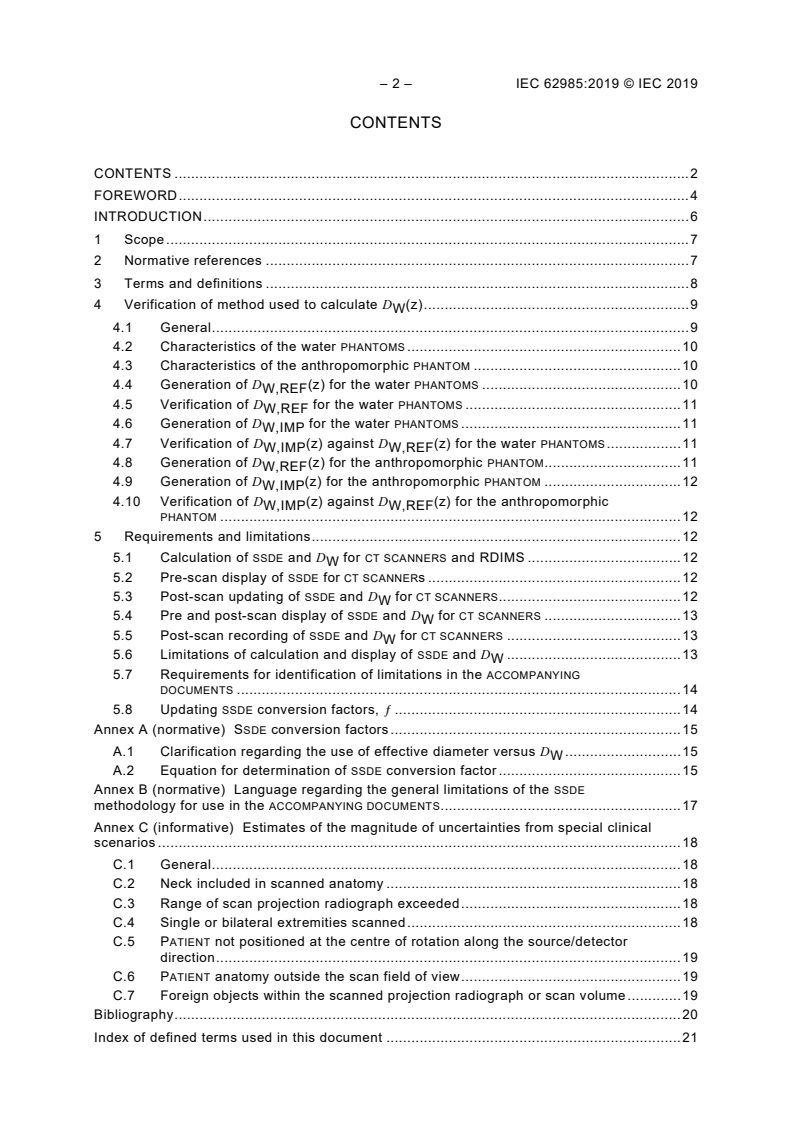
IEC 62985:2019 applies to
– CT SCANNERS that are able to display and report CTDIVOL in accordance with
IEC 60601-2-44, and
– RADIATION dose index monitoring software (RDIMS)
for the purpose of calculating, displaying and recording the SIZE SPECIFIC DOSE ESTIMATE (SSDE) and its associated components.
Specifically, this document provides standardized methods and requirements for calculating, displaying, or recording of SSDE, SSDE(z), WATER EQUIVALENT DIAMETER (DW), and DW(z), where z represents a specific longitudinal position of the scanned object.
This document provides a method of determining a reference WATER EQUIVALENT DIAMETER, DW,REF(z), using CT scans of two cylindrical water PHANTOMS and one or more anthropomorphic PHANTOM(S), which conform to the specifications defined in this document. The method of calculating the WATER EQUIVALENT DIAMETER that is implemented by the MANUFACTURER, DW,IMP(z), is tested and validated against DW,REF(z) using the TEST OBJECTS and methods defined within this document. This document also describes the methods for calculating SSDE and DW, which represent the average values of SSDE(z) and DW(z) over the RECONSTRUCTION LENGTH.
The contents of the corrigendum of June 2022 have been included in this copy.
- Status
- Published
- Publication Date
- 12-Sep-2019
- Technical Committee
- SC 62B - Medical imaging equipment, software, and systems
- Drafting Committee
- PT 62985 - TC 62/SC 62B/PT 62985
- Current Stage
- PPUB - Publication issued
- Start Date
- 13-Sep-2019
- Completion Date
- 13-Sep-2019
Buy Documents
IEC 62985:2019 - Methods for calculating size specific dose estimates (SSDE) for computed tomography Released:9/13/2019
IEC 62985:2019 - Methods for calculating size specific dose estimates (SSDE) for computed tomography Released:9/13/2019
Overview
IEC 62985:2019 - Methods for calculating size specific dose estimates (SSDE) for computed tomography (CT) provides internationally standardized methods and requirements for calculating, displaying and recording SSDE and related components. Applicable to CT scanners that report CTDIvol in accordance with IEC 60601-2-44 and to radiation dose index monitoring software (RDIMS), the standard ensures consistent, comparable estimates of patient absorbed dose across device manufacturers and dose‑monitoring systems. The June 2022 corrigendum has been incorporated into this edition.
Key topics and requirements
- Scope: Defines requirements for SSDE, SSDE(z), water equivalent diameter (DW) and DW(z) (z = longitudinal position).
- Validation method: Specifies a reference DW,REF(z) determined using CT scans of two cylindrical water phantoms and one or more anthropomorphic phantoms. Manufacturer-implemented DW,IMP(z) must be tested and validated against DW,REF(z) using the document’s test objects and methods.
- Calculation and reporting:
- Methods for computing SSDE from CTDIvol and DW(z) using SSDE conversion factors (normative Annex A).
- Procedures to calculate average SSDE and DW over the reconstruction length.
- Display and recording:
- Requirements for pre-scan display, post-scan updating and post-scan recording of SSDE and DW for CT scanners.
- Guidance for RDIMS to calculate, display and archive SSDE data.
- Limitations and uncertainty:
- Clauses on practical limitations, required identification of limitations in accompanying documents, and Annex C examples estimating uncertainties in special clinical scenarios (e.g., anatomy outside FOV, off‑centre patients).
- Normative references: Links to IEC 60601-2-44, IEC 60601-1 series and IEC TR 60788.
Applications and users
Who benefits from IEC 62985:2019:
- CT scanner manufacturers - to implement, test and validate DW computation and SSDE reporting.
- RDIMS and PACS vendors - to compute and integrate SSDE/ DW into dose monitoring workflows.
- Medical physicists and clinical engineers - for QA, validation and conformity checks.
- Radiology departments and dose registries - to standardize dose reporting, establish diagnostic reference levels by patient size, and implement dose notification/alert policies.
- Regulators and conformity assessors - to evaluate device compliance with international dose‑reporting practice.
Practical uses:
- Quality assurance and inter‑vendor comparability of patient dose estimates
- Pediatric and adult dose assessment using size‑adjusted metrics
- Population dose tracking via DICOM RDSR and dose registries
- Improved dose alerts and diagnostic reference levels that account for patient size
Related standards
- IEC 60601-2-44 (CT equipment requirements; CTDIvol reporting)
- IEC 60601-1 and amendments (general medical electrical equipment safety)
- IEC TR 60788 (glossary of defined terms)
Relations
- Effective Date
- 05-Sep-2023
Buy Documents
IEC 62985:2019 - Methods for calculating size specific dose estimates (SSDE) for computed tomography Released:9/13/2019
IEC 62985:2019 - Methods for calculating size specific dose estimates (SSDE) for computed tomography Released:9/13/2019
Get Certified
Connect with accredited certification bodies for this standard

BSI Group
BSI (British Standards Institution) is the business standards company that helps organizations make excellence a habit.

TÜV Rheinland
TÜV Rheinland is a leading international provider of technical services.

TÜV SÜD
TÜV SÜD is a trusted partner of choice for safety, security and sustainability solutions.
Sponsored listings
Frequently Asked Questions
IEC 62985:2019 is a standard published by the International Electrotechnical Commission (IEC). Its full title is "Methods for calculating size specific dose estimates (SSDE) for computed tomography". This standard covers: IEC 62985:2019 applies to – CT SCANNERS that are able to display and report CTDIVOL in accordance with IEC 60601-2-44, and – RADIATION dose index monitoring software (RDIMS) for the purpose of calculating, displaying and recording the SIZE SPECIFIC DOSE ESTIMATE (SSDE) and its associated components. Specifically, this document provides standardized methods and requirements for calculating, displaying, or recording of SSDE, SSDE(z), WATER EQUIVALENT DIAMETER (DW), and DW(z), where z represents a specific longitudinal position of the scanned object. This document provides a method of determining a reference WATER EQUIVALENT DIAMETER, DW,REF(z), using CT scans of two cylindrical water PHANTOMS and one or more anthropomorphic PHANTOM(S), which conform to the specifications defined in this document. The method of calculating the WATER EQUIVALENT DIAMETER that is implemented by the MANUFACTURER, DW,IMP(z), is tested and validated against DW,REF(z) using the TEST OBJECTS and methods defined within this document. This document also describes the methods for calculating SSDE and DW, which represent the average values of SSDE(z) and DW(z) over the RECONSTRUCTION LENGTH. The contents of the corrigendum of June 2022 have been included in this copy.
IEC 62985:2019 applies to – CT SCANNERS that are able to display and report CTDIVOL in accordance with IEC 60601-2-44, and – RADIATION dose index monitoring software (RDIMS) for the purpose of calculating, displaying and recording the SIZE SPECIFIC DOSE ESTIMATE (SSDE) and its associated components. Specifically, this document provides standardized methods and requirements for calculating, displaying, or recording of SSDE, SSDE(z), WATER EQUIVALENT DIAMETER (DW), and DW(z), where z represents a specific longitudinal position of the scanned object. This document provides a method of determining a reference WATER EQUIVALENT DIAMETER, DW,REF(z), using CT scans of two cylindrical water PHANTOMS and one or more anthropomorphic PHANTOM(S), which conform to the specifications defined in this document. The method of calculating the WATER EQUIVALENT DIAMETER that is implemented by the MANUFACTURER, DW,IMP(z), is tested and validated against DW,REF(z) using the TEST OBJECTS and methods defined within this document. This document also describes the methods for calculating SSDE and DW, which represent the average values of SSDE(z) and DW(z) over the RECONSTRUCTION LENGTH. The contents of the corrigendum of June 2022 have been included in this copy.
IEC 62985:2019 is classified under the following ICS (International Classification for Standards) categories: 11.040.50 - Radiographic equipment. The ICS classification helps identify the subject area and facilitates finding related standards.
IEC 62985:2019 has the following relationships with other standards: It is inter standard links to IEC 62985:2019/COR1:2022. Understanding these relationships helps ensure you are using the most current and applicable version of the standard.
IEC 62985:2019 is available in PDF format for immediate download after purchase. The document can be added to your cart and obtained through the secure checkout process. Digital delivery ensures instant access to the complete standard document.
Standards Content (Sample)
IEC 62985 ®
Edition 1.0 2019-09
INTERNATIONAL
STANDARD
Methods for calculating size specific dose estimates (SSDE) for computed
tomography
All rights reserved. Unless otherwise specified, no part of this publication may be reproduced or utilized in any form
or by any means, electronic or mechanical, including photocopying and microfilm, without permission in writing from
either IEC or IEC's member National Committee in the country of the requester. If you have any questions about IEC
copyright or have an enquiry about obtaining additional rights to this publication, please contact the address below or
your local IEC member National Committee for further information.
IEC Central Office Tel.: +41 22 919 02 11
3, rue de Varembé info@iec.ch
CH-1211 Geneva 20 www.iec.ch
Switzerland
About the IEC
The International Electrotechnical Commission (IEC) is the leading global organization that prepares and publishes
International Standards for all electrical, electronic and related technologies.
About IEC publications
The technical content of IEC publications is kept under constant review by the IEC. Please make sure that you have the
latest edition, a corrigendum or an amendment might have been published.
IEC publications search - webstore.iec.ch/advsearchform Electropedia - www.electropedia.org
The advanced search enables to find IEC publications by a The world's leading online dictionary on electrotechnology,
variety of criteria (reference number, text, technical containing more than 22 000 terminological entries in English
committee,…). It also gives information on projects, replaced and French, with equivalent terms in 16 additional languages.
and withdrawn publications. Also known as the International Electrotechnical Vocabulary
(IEV) online.
IEC Just Published - webstore.iec.ch/justpublished
Stay up to date on all new IEC publications. Just Published IEC Glossary - std.iec.ch/glossary
details all new publications released. Available online and 67 000 electrotechnical terminology entries in English and
once a month by email. French extracted from the Terms and Definitions clause of
IEC publications issued since 2002. Some entries have been
IEC Customer Service Centre - webstore.iec.ch/csc collected from earlier publications of IEC TC 37, 77, 86 and
If you wish to give us your feedback on this publication or CISPR.
need further assistance, please contact the Customer Service
Centre: sales@iec.ch.
IEC 62985 ®
Edition 1.0 2019-09
INTERNATIONAL
STANDARD
Methods for calculating size specific dose estimates (SSDE) for computed
tomography
INTERNATIONAL
ELECTROTECHNICAL
COMMISSION
ICS 11.040.50 ISBN 978-2-8322-7290-9
– 2 – IEC 62985:2019 © IEC 2019
CONTENTS
FOREWORD . 4
INTRODUCTION . 6
1 Scope . 7
2 Normative references . 7
3 Terms and definitions . 7
4 Verification of method used to calculate D (z) . 9
W
4.1 General . 9
4.2 Characteristics of the water PHANTOMS . 9
4.3 Characteristics of the anthropomorphic PHANTOM . 10
4.4 Generation of D (z) for the water PHANTOMS . 10
W,REF
4.5 Verification of D for the water PHANTOMS . 10
W,REF
4.6 Generation of D for the water PHANTOMS . 10
W,IMP
4.7 Verification of D (z) against D (z) for the water PHANTOMS . 11
W,IMP W,REF
4.8 Generation of D (z) for the anthropomorphic PHANTOM. 11
W,REF
4.9 Generation of D (z) for the anthropomorphic PHANTOM . 12
W,IMP
4.10 Verification of D (z) against D (z) for the anthropomorphic
W,IMP W,REF
PHANTOM . 12
5 Requirements and limitations . 12
5.1 Calculation of SSDE and D for CT SCANNERS and RDIMS . 12
W
5.2 Pre-scan display of SSDE for CT SCANNERs . 12
5.3 Post-scan updating of SSDE and D for CT SCANNERS . 12
W
5.4 Pre and post-scan display of SSDE and D for CT SCANNERS . 13
W
5.5 Post-scan recording of SSDE and D for CT SCANNERS . 13
W
5.6 Limitations of calculation and display of SSDE and D . 13
W
5.7 Requirements for identification of limitations in the ACCOMPANYING
DOCUMENTS . 13
5.8 Updating SSDE conversion factors, ƒ . 14
Annex A (normative) SSDE conversion factors . 15
A.1 Clarification regarding the use of effective diameter versus D . 15
W
A.2 Equation for determination of SSDE conversion factor . 15
Annex B (normative) Language regarding the general limitations of the SSDE
methodology for use in the ACCOMPANYING DOCUMENTS . 17
Annex C (informative) Estimates of the magnitude of uncertainties from special clinical
scenarios . 18
C.1 General . 18
C.2 Neck included in scanned anatomy . 18
C.3 Range of scan projection radiograph exceeded . 18
C.4 Single or bilateral extremities scanned . 18
C.5 PATIENT not positioned at the centre of rotation along the source/detector
direction . 19
C.6 PATIENT anatomy outside the scan field of view . 19
C.7 Foreign objects within the scanned projection radiograph or scan volume . 19
Bibliography . 20
Index of defined terms used in this document . 21
Figure A.1 – Visualization of ƒ(D ) versus D for the body and head parameters
w W
provided in Table A.1 . 16
Table 1 – Anthropomorphic PHANTOM regions to be scanned . 11
Table A.1 – SSDE Conversion factor as a function of D . 15
W
– 4 – IEC 62985:2019 © IEC 2019
INTERNATIONAL ELECTROTECHNICAL COMMISSION
____________
METHODS FOR CALCULATING SIZE SPECIFIC DOSE
ESTIMATES (SSDE) FOR COMPUTED TOMOGRAPHY
FOREWORD
1) The International Electrotechnical Commission (IEC) is a worldwide organization for standardization comprising
all national electrotechnical committees (IEC National Committees). The object of IEC is to promote
international co-operation on all questions concerning standardization in the electrical and electronic fields. To
this end and in addition to other activities, IEC publishes International Standards, Technical Specifications,
Technical Reports, Publicly Available Specifications (PAS) and Guides (hereafter referred to as "IEC
Publication(s)"). Their preparation is entrusted to technical committees; any IEC National Committee interested
in the subject dealt with may participate in this preparatory work. International, governmental and non-
governmental organizations liaising with the IEC also participate in this preparation. IEC collaborates closely
with the International Organization for Standardization (ISO) in accordance with conditions determined by
agreement between the two organizations.
2) The formal decisions or agreements of IEC on technical matters express, as nearly as possible, an international
consensus of opinion on the relevant subjects since each technical committee has representation from all
interested IEC National Committees.
3) IEC Publications have the form of recommendations for international use and are accepted by IEC National
Committees in that sense. While all reasonable efforts are made to ensure that the technical content of IEC
Publications is accurate, IEC cannot be held responsible for the way in which they are used or for any
misinterpretation by any end user.
4) In order to promote international uniformity, IEC National Committees undertake to apply IEC Publications
transparently to the maximum extent possible in their national and regional publications. Any divergence
between any IEC Publication and the corresponding national or regional publication shall be clearly indicated in
the latter.
5) IEC itself does not provide any attestation of conformity. Independent certification bodies provide conformity
assessment services and, in some areas, access to IEC marks of conformity. IEC is not responsible for any
services carried out by independent certification bodies.
6) All users should ensure that they have the latest edition of this publication.
7) No liability shall attach to IEC or its directors, employees, servants or agents including individual experts and
members of its technical committees and IEC National Committees for any personal injury, property damage or
other damage of any nature whatsoever, whether direct or indirect, or for costs (including legal fees) and
expenses arising out of the publication, use of, or reliance upon, this IEC Publication or any other IEC
Publications.
8) Attention is drawn to the Normative references cited in this publication. Use of the referenced publications is
indispensable for the correct application of this publication.
9) Attention is drawn to the possibility that some of the elements of this IEC Publication may be the subject of
patent rights. IEC shall not be held responsible for identifying any or all such patent rights.
International Standard IEC 62985 has been prepared by subcommittee 62B: Diagnostic
imaging equipment, of IEC technical committee 62: Electrical equipment in medical practice.
The text of this International Standard is based on the following documents:
FDIS Report on voting
62B/1133/FDIS 62B/1144/RVD
Full information on the voting for the approval of this International Standard can be found in
the report on voting indicated in the above table.
This document has been drafted in accordance with the ISO/IEC Directives, Part 2.
In this document, the following print types are used:
– requirements and definitions: roman type;
– informative material appearing outside of tables, such as notes, examples and references: in smaller type.
Normative text of tables is also in a smaller type;
– TERMS DEFINED IN CLAUSE 3, IN CLAUSE 3 OF IEC 60601-1:2005 AND
IEC 60601-1:2005/AMD1:2012, OF THE COLLATERAL STANDARDS, OF IEC TR 60788:2004 OR
AS NOTED: SMALL CAPITALS.
The committee has decided that the contents of this document will remain unchanged until the
stability date indicated on the IEC website under "http://webstore.iec.ch" in the data related to
the specific document. At this date, the document will be
• reconfirmed,
• withdrawn,
• replaced by a revised edition, or
• amended.
NOTE The attention of the user of this document is drawn to the fact that equipment MANUFACTURERS and testing
organizations may need a transitional period following publication of a new, amended or revised IEC publication in
which to make products in accordance with the new requirements and to equip themselves for conducting new or
revised tests. It is the recommendation of the committee that the content of this publication be adopted for
implementation nationally not earlier than 3 years from the date of publication.
The contents of the corrigendum 1 (2022-06) have been included in this copy.
– 6 – IEC 62985:2019 © IEC 2019
INTRODUCTION
The SIZE SPECIFIC DOSE ESTIMATE (SSDE) is an estimate of the average ABSORBED DOSE to the
scan volume that takes into account the ATTENUATION of the anatomy being scanned (using
the WATER EQUIVALENT DIAMETER D ) and the RADIATION OUTPUT of the CT SCANNER (using
W
CTDI ).
VOL
SSDE is intended to provide a dose estimate for PATIENTs of all sizes. SSDE, which is given in
units of mGy, is especially important for small paediatric PATIENTS since the corresponding
applied level of RADIATION (CTDI , also given in units of mGy) does not adequately indicate
VOL
the absorbed RADIATION DOSE.
SSDE is calculated using a SSDE CONVERSION FACTOR AT LONGITUDINAL POSITION Z (ƒ) and the
CTDI AT LONGITUDINAL POSITION Z, CTDI (z), where ƒ is a function of the WATER
VOL VOL
EQUIVALENT DIAMETER AT LONGITUDINAL POSITION Z, D (z), and the size of the CTDI PHANTOM
W
used to report CTDI . ƒ is given in normative Annex A.
VOL
This document provides a methodology (in Clause 4) for a MANUFACTURER to validate their
method for calculating D (z), which is used for the determination of 𝑓𝑓 and the calculation of
W
SSDE. This method calculates a reference WATER EQUIVALENT DIAMETER AT LONGITUDINAL
POSITION Z, D (z), and compares it against a known PHANTOM dimension and the
W,REF
implemented values of WATER EQUIVALENT DIAMETER AT LONGITUDINAL POSITION Z, D (z).
W,IMP
PHANTOM types and tolerances are also specified.
NOTE 1 The definition of SSDE used in this document differs from that of AAPM Report No. 204 [1] in that
AAPM Report No. 204 estimates the average dose at the centre of the scan volume, whereas in this document,
SSDE estimates the average dose across the whole scan volume.
NOTE 2 CTDI is a dose index that allows quantitation of the RADIATION OUTPUT of CT SCANNERS in terms of one
VOL
of two PMMA test objects. These test objects are 16 cm and 32 cm in diameter. SSDE is calculated by conversion
of one of these PHANTOM-based dose indices to an estimate of the RADIATION dose absorbed by a PATIENT of a
specific size. The magnitude of the difference between SSDE and CTDI values increases as the difference
VOL
between the PATIENT size and the size of the CTDI PHANTOM used to measure the CTDI increases. For infants, the
VOL
calculated SSDE value may be 3 times as much as the corresponding CTDI dose index value. Conversely, the
VOL
CTDI value for large PATIENTs overestimates SSDE, which is representative of the PATIENT's actual absorbed
VOL
RADIATION DOSE. For extra-large adult PATIENTs, the CTDI dose index can overestimate the SSDE by as much as
VOL
40 % [1].
Potential uses of SSDE include the following:
1) evaluating PATIENT ABSORBED DOSE for quality assurance programs;
2) establishing diagnostic reference levels across PATIENT sizes;
3) displaying to the OPERATOR an estimate of PATIENT ABSORBED DOSE prior to initiation of the
CT scan;
4) providing an estimate of ABSORBED DOSE for the DICOM RDSR;
5) developing DOSE NOTIFICATION VALUE and DOSE ALERT VALUES that better take into account
PATIENT size;
6) providing an estimate of PATIENT ABSORBED DOSE for dose registries.
_____________
Numbers in square brackets refer to the Bibliography.
METHODS FOR CALCULATING SIZE SPECIFIC DOSE
ESTIMATES (SSDE) FOR COMPUTED TOMOGRAPHY
1 Scope
This document applies to
– CT SCANNERS that are able to display and report CTDI in accordance with
VOL
IEC 60601-2-44, and
– RADIATION dose index monitoring software (RDIMS)
SIZE SPECIFIC DOSE ESTIMATE
for the purpose of calculating, displaying and recording the
(SSDE) and its associated components.
Specifically, this document provides standardized methods and requirements for calculating,
displaying, or recording of SSDE, SSDE(z), WATER EQUIVALENT DIAMETER (D ), and D (z), where
W W
z represents a specific longitudinal position of the scanned object.
This document provides a method of determining a reference WATER EQUIVALENT DIAMETER,
D (z), using CT scans of two cylindrical water PHANTOMS and one or more
W,REF
anthropomorphic PHANTOM(S), which conform to the specifications defined in this document.
The method of calculating the WATER EQUIVALENT DIAMETER that is implemented by the
MANUFACTURER, D (z), is tested and validated against D (z) using the TEST OBJECTS
W,IMP W,REF
and methods defined within this document. This document also describes the methods for
calculating SSDE and D which represent the average values of SSDE(z) and D (z) over the
W, W
RECONSTRUCTION LENGTH.
NOTE This standardization is important to ensure that comparisons between reported SSDEs are valid.
2 Normative references
The following documents are referred to in the text in such a way that some or all of their
content constitutes requirements of this document. For dated references, only the edition
cited applies. For undated references, the latest edition of the referenced document (including
any amendments) applies.
IEC TR 60788:2004, Medical electrical equipment – Glossary of defined terms
IEC 60601-1:2005, Medical electrical equipment – Part 1: General requirements for basic
safety and essential performance
IEC 60601-1:2005/AMD1:2012
IEC 60601-1-3:2008, Medical electrical equipment – Part 1-3: General requirements for basic
safety and essential performance – Collateral Standard: Radiation protection in diagnostic X-
ray equipment
IEC 60601-2-44:2009, Medical electrical equipment – Part 2-44: Particular requirements for
the basic safety and essential performance of X-ray equipment for computed tomography
3 Terms and definitions
For the purposes of this document, the terms and definitions of IEC TR 60788, IEC 60601-1,
IEC 60601-1-3, IEC 60601-2-44, and the following apply.
– 8 – IEC 62985:2019 © IEC 2019
ISO and IEC maintain terminological databases for use in standardization at the following
addresses:
• IEC Electropedia: available at http://www.electropedia.org/
• ISO Online browsing platform: available at http://www.iso.org/obp
3.1
CTDI AT LONGITUDINAL POSITION Z
VOL
CTDI (z)
VOL
value quantifying the RADIATION OUTPUT at position z for the selected CT CONDITIONS OF
OPERATION
3.2
RECONSTRUCTION LENGTH
distance between the centre of the first reconstructed image and the centre of the last
reconstructed image, where the centres of the first and last reconstructed images are spaced
as far apart as possible given the CT CONDITIONS OF OPERATION for the PROTOCOL ELEMENT and
the width of the reconstructed images, being essentially the maximum range of reconstructed
images over the scan range for a given reconstruction section thickness
3.3
WATER EQUIVALENT DIAMETER AT LONGITUDINAL POSITION Z
D (z)
W
diameter, in cm, of a cylinder of water having the same averaged ABSORBED DOSE as the
material contained in an axial plane at longitudinal position z of the object scanned, calculable
for a material of any composition, and quantifying the ATTENUATION of any material in terms of
the ATTENUATION of water
Note 1 to entry: The average ABSORBED DOSE correlates with the average X-ray ATTENUATION. See [2].
Note 2 to entry: If it is not feasible for the RADIATION dose index monitoring software (RDIMS) devices to access
the ATTENUATION-based D (z) from the CT SCANNER or to calculate D (z) from the available reconstructed images,
W W
then estimates of D (z) can be made from the scanned projection radiograph using alternate methods [2] [3].
W
However, validation of the D (z) implemented by the RDIMS device can be performed according to Clause 4.
W,IMP
3.4
WATER EQUIVALENT DIAMETER
D
W
arithmetic average of D (z) values at equally spaced z position intervals of ≤ 5 mm,
W
calculated over the RECONSTRUCTION LENGTH, for RDIMS systems or PROTOCOL ELEMENTS in
the CT SCANNER where it is not possible to achieve ≤ 5 mm z position intervals, the smallest
available image interval
3.5
REFERENCE WATER EQUIVALENT DIAMETER AT LONGITUDINAL POSITION Z
D (z)
W,REF
D (z) calculated using the following equation and being calculated for each of the
w
reconstructed images for all pixels in the image corresponding to the PHANTOM being scanned
by means of the following equation:
A
CT(x,y,z)
pixel
D (z) = 2 +1 ×
W,REF
∑
1 000 π
x,y
where
CT(x,y,z) is the CT number of the pixel at cross-sectional position x,y and longitudinal
position z;
A is the area of the image pixel
pixel
Note 1 to entry: The D (z) is used to validate the suitability of the method implemented by the MANUFACTURER
W,REF
to calculate D (z).
W
3.6
IMPLEMENTED WATER EQUIVALENT DIAMETER AT LONGITUDINAL POSITION Z
(z)
D
W,IMP
D (z) calculated with the method implemented by MANUFACTURER for the calculation of SSDE
W
3.7
SSDE CONVERSION FACTOR AT LONGITUDINAL POSITION Z
f(D (z))
W
unitless, empirically-derived value relating the RADIATION OUTPUT delivered by the scanner (as
quantified using CTDI ) to the ABSORBED DOSE to soft tissue for a specific size PATIENT or
VOL
PHANTOM, determined for a specific-size CTDI PHANTOM, a specific anatomic region (i.e., head
or body), and a specific z-position within the scanned PATIENT or object, the calculation of
which is performed using the equations provided in Annex A
3.8
SIZE SPECIFIC DOSE ESTIMATE AT LONGITUDINAL POSITION Z
SSDE(z)
estimate of the average ABSORBED DOSE to the material contained in an axial plane at
longitudinal position z within the RECONSTRUCTION LENGTH, expressed in units of mGy:
SSDE(z) f (D (z))×CTDI (z)
w vol
3.9
SIZE SPECIFIC DOSE ESTIMATE
SSDE
arithmetic average of SSDE(z), calculated over the RECONSTRUCTION LENGTH at the same
z-positions as the corresponding D (z) values used to calculate D
W W:
1 n
SSDE × SSDE(z )
∑ i
i=1
n
where
n is the number of z positions (z , i = 1, 2, …, n) (within the RECONSTRUCTION LENGTH
i
4 Verification of method used to calculate D (z)
W
4.1 General
The purpose of Clause 4 is to provide a method to verify a MANUFACTURER's IMPLEMENTED
WATER EQUIVALENT DIAMETER AT LONGITUDINAL POSITION Z, D (z), against the REFERENCE
W,IMP
WATER EQUIVALENT DIAMETER AT LONGITUDINAL POSITION Z D (z). This verification compares
W,REF
a set of D (z) values calculated for water PHANTOMs and an anthropomorphic PHANTOM to
W,IMP
the corresponding set of D (z) values calculated for the same PHANTOMs.
W,REF
4.2 Characteristics of the water PHANTOMS
Each PHANTOM'S structural material thickness shall be the minimum practicable and shall have
a length of at least 10 cm:
• Small water PHANTOM
The small water PHANTOM shall be cylindrical and have an inner water diameter (d) of
14 cm ≤ d ≤ 20 cm.
• Large water PHANTOM
=
=
– 10 – IEC 62985:2019 © IEC 2019
The larger water PHANTOM shall be cylindrical and have an inner water diameter (d) of
28 cm ≤ d ≤ 34 cm.
These PHANTOM specifications shall apply unless otherwise stated in the ACCOMPANYING
DOCUMENTS, in order to accommodate minor variations from these specifications.
4.3 Characteristics of the anthropomorphic PHANTOM
The anthropomorphic PHANTOM shall be a representative of an average adult human from the
top of the head to the bottom of the pelvis. It shall have a comprehensive set of simulated
internal organs and bones designed to yield the CT NUMBERS of their anatomical counterparts.
The PHANTOM shall include a minimum of simulated soft tissue, lung, and bone.
PHANTOM may be utilized if, as a set, they are representative
More than one anthropomorphic
of average a
...
IEC 62985 ®
Edition 1.0 2019-09
INTERNATIONAL
STANDARD
NORME
INTERNATIONALE
Methods for calculating size specific dose estimates (SSDE) for computed
tomography
Méthodes de calcul de l’estimateur de dose morphologique (SSDE) en
tomodensitométrie
All rights reserved. Unless otherwise specified, no part of this publication may be reproduced or utilized in any form
or by any means, electronic or mechanical, including photocopying and microfilm, without permission in writing from
either IEC or IEC's member National Committee in the country of the requester. If you have any questions about IEC
copyright or have an enquiry about obtaining additional rights to this publication, please contact the address below or
your local IEC member National Committee for further information.
Droits de reproduction réservés. Sauf indication contraire, aucune partie de cette publication ne peut être reproduite
ni utilisée sous quelque forme que ce soit et par aucun procédé, électronique ou mécanique, y compris la photocopie
et les microfilms, sans l'accord écrit de l'IEC ou du Comité national de l'IEC du pays du demandeur. Si vous avez des
questions sur le copyright de l'IEC ou si vous désirez obtenir des droits supplémentaires sur cette publication, utilisez
les coordonnées ci-après ou contactez le Comité national de l'IEC de votre pays de résidence.
IEC Central Office Tel.: +41 22 919 02 11
3, rue de Varembé info@iec.ch
CH-1211 Geneva 20 www.iec.ch
Switzerland
About the IEC
The International Electrotechnical Commission (IEC) is the leading global organization that prepares and publishes
International Standards for all electrical, electronic and related technologies.
About IEC publications
The technical content of IEC publications is kept under constant review by the IEC. Please make sure that you have the
latest edition, a corrigendum or an amendment might have been published.
IEC publications search - webstore.iec.ch/advsearchform Electropedia - www.electropedia.org
The advanced search enables to find IEC publications by a The world's leading online dictionary on electrotechnology,
variety of criteria (reference number, text, technical containing more than 22 000 terminological entries in English
committee,…). It also gives information on projects, replaced and French, with equivalent terms in 16 additional languages.
and withdrawn publications. Also known as the International Electrotechnical Vocabulary
(IEV) online.
IEC Just Published - webstore.iec.ch/justpublished
Stay up to date on all new IEC publications. Just Published IEC Glossary - std.iec.ch/glossary
details all new publications released. Available online and 67 000 electrotechnical terminology entries in English and
once a month by email. French extracted from the Terms and Definitions clause of
IEC publications issued since 2002. Some entries have been
IEC Customer Service Centre - webstore.iec.ch/csc collected from earlier publications of IEC TC 37, 77, 86 and
If you wish to give us your feedback on this publication or CISPR.
need further assistance, please contact the Customer Service
Centre: sales@iec.ch.
A propos de l'IEC
La Commission Electrotechnique Internationale (IEC) est la première organisation mondiale qui élabore et publie des
Normes internationales pour tout ce qui a trait à l'électricité, à l'électronique et aux technologies apparentées.
A propos des publications IEC
Le contenu technique des publications IEC est constamment revu. Veuillez vous assurer que vous possédez l’édition la
plus récente, un corrigendum ou amendement peut avoir été publié.
Recherche de publications IEC - Electropedia - www.electropedia.org
webstore.iec.ch/advsearchform Le premier dictionnaire d'électrotechnologie en ligne au
La recherche avancée permet de trouver des publications IEC monde, avec plus de 22 000 articles terminologiques en
en utilisant différents critères (numéro de référence, texte, anglais et en français, ainsi que les termes équivalents dans
comité d’études,…). Elle donne aussi des informations sur les 16 langues additionnelles. Egalement appelé Vocabulaire
projets et les publications remplacées ou retirées. Electrotechnique International (IEV) en ligne.
IEC Just Published - webstore.iec.ch/justpublished Glossaire IEC - std.iec.ch/glossary
Restez informé sur les nouvelles publications IEC. Just 67 000 entrées terminologiques électrotechniques, en anglais
Published détaille les nouvelles publications parues. et en français, extraites des articles Termes et Définitions des
Disponible en ligne et une fois par mois par email. publications IEC parues depuis 2002. Plus certaines entrées
antérieures extraites des publications des CE 37, 77, 86 et
Service Clients - webstore.iec.ch/csc CISPR de l'IEC.
Si vous désirez nous donner des commentaires sur cette
publication ou si vous avez des questions contactez-nous:
sales@iec.ch.
IEC 62985 ®
Edition 1.0 2019-09
INTERNATIONAL
STANDARD
NORME
INTERNATIONALE
Methods for calculating size specific dose estimates (SSDE) for computed
tomography
Méthodes de calcul de l’estimateur de dose morphologique (SSDE) en
tomodensitométrie
INTERNATIONAL
ELECTROTECHNICAL
COMMISSION
COMMISSION
ELECTROTECHNIQUE
INTERNATIONALE
ICS 11.040.50 ISBN 978-2-8322-7950-2
– 2 – IEC 62985:2019 © IEC 2019
CONTENTS
CONTENTS . 2
FOREWORD . 4
INTRODUCTION . 6
1 Scope . 7
2 Normative references . 7
3 Terms and definitions . 8
4 Verification of method used to calculate D (z) . 9
W
4.1 General . 9
4.2 Characteristics of the water PHANTOMS . 10
4.3 Characteristics of the anthropomorphic PHANTOM . 10
4.4 Generation of D (z) for the water PHANTOMS . 10
W,REF
4.5 Verification of D for the water PHANTOMS . 11
W,REF
4.6 Generation of D for the water PHANTOMS . 11
W,IMP
4.7 Verification of D (z) against D (z) for the water PHANTOMS . 11
W,IMP W,REF
4.8 Generation of D (z) for the anthropomorphic PHANTOM. 11
W,REF
4.9 Generation of D (z) for the anthropomorphic PHANTOM . 12
W,IMP
4.10 Verification of D (z) against D (z) for the anthropomorphic
W,IMP W,REF
PHANTOM . 12
5 Requirements and limitations . 12
5.1 Calculation of SSDE and D for CT SCANNERS and RDIMS . 12
W
5.2 Pre-scan display of SSDE for CT SCANNERs . 12
5.3 Post-scan updating of SSDE and D for CT SCANNERS . 12
W
5.4 Pre and post-scan display of SSDE and D for CT SCANNERS . 13
W
5.5 Post-scan recording of SSDE and D for CT SCANNERS . 13
W
5.6 Limitations of calculation and display of SSDE and D . 13
W
5.7 Requirements for identification of limitations in the ACCOMPANYING
DOCUMENTS . 14
5.8 Updating SSDE conversion factors, ƒ . 14
Annex A (normative) SSDE conversion factors . 15
A.1 Clarification regarding the use of effective diameter versus D . 15
W
A.2 Equation for determination of SSDE conversion factor . 15
Annex B (normative) Language regarding the general limitations of the SSDE
methodology for use in the ACCOMPANYING DOCUMENTS . 17
Annex C (informative) Estimates of the magnitude of uncertainties from special clinical
scenarios . 18
C.1 General . 18
C.2 Neck included in scanned anatomy . 18
C.3 Range of scan projection radiograph exceeded . 18
C.4 Single or bilateral extremities scanned . 18
C.5 PATIENT not positioned at the centre of rotation along the source/detector
direction . 19
C.6 PATIENT anatomy outside the scan field of view . 19
C.7 Foreign objects within the scanned projection radiograph or scan volume . 19
Bibliography . 20
Index of defined terms used in this document . 21
Figure A.1 – Visualization of ƒ(D ) versus D for the body and head parameters
w W
provided in Table A.1 . 16
Table 1 – Anthropomorphic PHANTOM regions to be scanned . 11
Table A.1 – SSDE Conversion factor as a function of D . 15
W
– 4 – IEC 62985:2019 © IEC 2019
INTERNATIONAL ELECTROTECHNICAL COMMISSION
____________
METHODS FOR CALCULATING SIZE SPECIFIC DOSE
ESTIMATES (SSDE) FOR COMPUTED TOMOGRAPHY
FOREWORD
1) The International Electrotechnical Commission (IEC) is a worldwide organization for standardization comprising
all national electrotechnical committees (IEC National Committees). The object of IEC is to promote
international co-operation on all questions concerning standardization in the electrical and electronic fields. To
this end and in addition to other activities, IEC publishes International Standards, Technical Specifications,
Technical Reports, Publicly Available Specifications (PAS) and Guides (hereafter referred to as "IEC
Publication(s)"). Their preparation is entrusted to technical committees; any IEC National Committee interested
in the subject dealt with may participate in this preparatory work. International, governmental and non-
governmental organizations liaising with the IEC also participate in this preparation. IEC collaborates closely
with the International Organization for Standardization (ISO) in accordance with conditions determined by
agreement between the two organizations.
2) The formal decisions or agreements of IEC on technical matters express, as nearly as possible, an international
consensus of opinion on the relevant subjects since each technical committee has representation from all
interested IEC National Committees.
3) IEC Publications have the form of recommendations for international use and are accepted by IEC National
Committees in that sense. While all reasonable efforts are made to ensure that the technical content of IEC
Publications is accurate, IEC cannot be held responsible for the way in which they are used or for any
misinterpretation by any end user.
4) In order to promote international uniformity, IEC National Committees undertake to apply IEC Publications
transparently to the maximum extent possible in their national and regional publications. Any divergence
between any IEC Publication and the corresponding national or regional publication shall be clearly indicated in
the latter.
5) IEC itself does not provide any attestation of conformity. Independent certification bodies provide conformity
assessment services and, in some areas, access to IEC marks of conformity. IEC is not responsible for any
services carried out by independent certification bodies.
6) All users should ensure that they have the latest edition of this publication.
7) No liability shall attach to IEC or its directors, employees, servants or agents including individual experts and
members of its technical committees and IEC National Committees for any personal injury, property damage or
other damage of any nature whatsoever, whether direct or indirect, or for costs (including legal fees) and
expenses arising out of the publication, use of, or reliance upon, this IEC Publication or any other IEC
Publications.
8) Attention is drawn to the Normative references cited in this publication. Use of the referenced publications is
indispensable for the correct application of this publication.
9) Attention is drawn to the possibility that some of the elements of this IEC Publication may be the subject of
patent rights. IEC shall not be held responsible for identifying any or all such patent rights.
International Standard IEC 62985 has been prepared by subcommittee 62B: Diagnostic
imaging equipment, of IEC technical committee 62: Electrical equipment in medical practice.
This bilingual version (2020-03) corresponds to the monolingual English version, published in
2019-09.
The text of this International Standard is based on the following documents:
FDIS Report on voting
62B/1133/FDIS 62B/1144/RVD
Full information on the voting for the approval of this International Standard can be found in
the report on voting indicated in the above table.
The French version of this standard has not been voted upon.
This document has been drafted in accordance with the ISO/IEC Directives, Part 2.
In this document, the following print types are used:
– requirements and definitions: roman type;
– informative material appearing outside of tables, such as notes, examples and references: in smaller type.
Normative text of tables is also in a smaller type;
– TERMS DEFINED IN CLAUSE 3, IN CLAUSE 3 OF IEC 60601-1:2005 AND
IEC 60601-1:2005/AMD1:2012, OF THE COLLATERAL STANDARDS, OF IEC TR 60788:2004 OR
AS NOTED: SMALL CAPITALS.
The committee has decided that the contents of this document will remain unchanged until the
stability date indicated on the IEC website under "http://webstore.iec.ch" in the data related to
the specific document. At this date, the document will be
• reconfirmed,
• withdrawn,
• replaced by a revised edition, or
• amended.
NOTE The attention of the user of this document is drawn to the fact that equipment MANUFACTURERS and testing
organizations may need a transitional period following publication of a new, amended or revised IEC publication in
which to make products in accordance with the new requirements and to equip themselves for conducting new or
revised tests. It is the recommendation of the committee that the content of this publication be adopted for
implementation nationally not earlier than 3 years from the date of publication.
– 6 – IEC 62985:2019 © IEC 2019
INTRODUCTION
The SIZE SPECIFIC DOSE ESTIMATE (SSDE) is an estimate of the average ABSORBED DOSE to the
scan volume that takes into account the ATTENUATION of the anatomy being scanned (using
the WATER EQUIVALENT DIAMETER D ) and the RADIATION OUTPUT of the CT SCANNER (using
W
CTDI ).
VOL
SSDE is intended to provide a dose estimate for PATIENTs of all sizes. SSDE, which is given in
units of mGy, is especially important for small paediatric PATIENTS since the corresponding
applied level of RADIATION (CTDI , also given in units of mGy) does not adequately indicate
VOL
the absorbed RADIATION DOSE.
SSDE is calculated using a SSDE CONVERSION FACTOR AT LONGITUDINAL POSITION Z (ƒ) and the
CTDI AT LONGITUDINAL POSITION Z, CTDI (z), where ƒ is a function of the WATER
VOL VOL
EQUIVALENT DIAMETER AT LONGITUDINAL POSITION Z, D (z), and the size of the CTDI PHANTOM
W
used to report CTDI . ƒ is given in normative Annex A.
VOL
This document provides a methodology (in Clause 4) for a MANUFACTURER to validate their
method for calculating D (z), which is used for the determination of 𝑓𝑓 and the calculation of
W
SSDE. This method calculates a reference WATER EQUIVALENT DIAMETER AT LONGITUDINAL
POSITION Z, D (z), and compares it against a known PHANTOM dimension and the
W,REF
implemented values of WATER EQUIVALENT DIAMETER AT LONGITUDINAL POSITION Z, D (z).
W,IMP
PHANTOM types and tolerances are also specified.
NOTE 1 The definition of SSDE used in this document differs from that of AAPM Report No. 204 [1] in that AAPM
Report No. 204 estimates the average dose at the centre of the scan volume, whereas in this document, SSDE
estimates the average dose across the whole scan volume.
NOTE 2 CTDI is a dose index that allows quantitation of the RADIATION OUTPUT of CT SCANNERS in terms of one
VOL
of two PMMA test objects. These test objects are 16 cm and 32 cm in diameter. SSDE is calculated by conversion
of one of these PHANTOM-based dose indices to an estimate of the RADIATION dose absorbed by a PATIENT of a
specific size. The magnitude of the difference between SSDE and CTDI values increases as the difference
VOL
between the PATIENT size and the size of the CTDI PHANTOM used to measure the CTDI increases. For infants, the
VOL
calculated SSDE value may be 3 times as much as the corresponding CTDI dose index value. Conversely, the
VOL
CTDI value for large PATIENTs overestimates SSDE, which is representative of the PATIENT's actual absorbed
VOL
RADIATION DOSE. For extra-large adult PATIENTs, the CTDI dose index can overestimate the SSDE by as much as
VOL
40 % [1].
Potential uses of SSDE include the following:
1) evaluating PATIENT ABSORBED DOSE for quality assurance programs;
2) establishing diagnostic reference levels across PATIENT sizes;
3) displaying to the OPERATOR an estimate of PATIENT ABSORBED DOSE prior to initiation of the
CT scan;
4) providing an estimate of ABSORBED DOSE for the DICOM RDSR;
5) developing DOSE NOTIFICATION VALUE and DOSE ALERT VALUES that better take into account
PATIENT size;
6) providing an estimate of PATIENT ABSORBED DOSE for dose registries.
_____________
Numbers in square brackets refer to the Bibliography.
METHODS FOR CALCULATING SIZE SPECIFIC DOSE
ESTIMATES (SSDE) FOR COMPUTED TOMOGRAPHY
1 Scope
This document applies to
– CT SCANNERS that are able to display and report CTDI in accordance with
VOL
IEC 60601-2-44, and
– RADIATION dose index monitoring software (RDIMS)
SIZE SPECIFIC DOSE ESTIMATE
for the purpose of calculating, displaying and recording the
(SSDE) and its associated components.
Specifically, this document provides standardized methods and requirements for calculating,
displaying, or recording of SSDE, SSDE(z), WATER EQUIVALENT DIAMETER (D ), and D (z), where
W W
z represents a specific longitudinal position of the scanned object.
This document provides a method of determining a reference WATER EQUIVALENT DIAMETER,
D (z), using CT scans of two cylindrical water PHANTOMS and one or more
W,REF
anthropomorphic PHANTOM(S), which conform to the specifications defined in this document.
The method of calculating the WATER EQUIVALENT DIAMETER that is implemented by the
MANUFACTURER, D (z), is tested and validated against D (z) using the TEST OBJECTS
W,IMP W,REF
and methods defined within this document. This document also describes the methods for
calculating SSDE and D which represent the average values of SSDE(z) and D (z) over the
W, W
RECONSTRUCTION LENGTH.
NOTE This standardization is important to ensure that comparisons between reported SSDEs are valid.
2 Normative references
The following documents are referred to in the text in such a way that some or all of their
content constitutes requirements of this document. For dated references, only the edition
cited applies. For undated references, the latest edition of the referenced document (including
any amendments) applies.
IEC TR 60788:2004, Medical electrical equipment – Glossary of defined terms
IEC 60601-1:2005, Medical electrical equipment – Part 1: General requirements for basic
safety and essential performance
IEC 60601-1:2005/AMD1:2012
IEC 60601-1-3:2008, Medical electrical equipment – Part 1-3: General requirements for basic
safety and essential performance – Collateral Standard: Radiation protection in diagnostic X-
ray equipment
IEC 60601-2-44:2009, Medical electrical equipment – Part 2-44: Particular requirements for
the basic safety and essential performance of X-ray equipment for computed tomography
– 8 – IEC 62985:2019 © IEC 2019
3 Terms and definitions
For the purposes of this document, the terms and definitions of IEC TR 60788, IEC 60601-1,
IEC 60601-1-3, IEC 60601-2-44, and the following apply.
ISO and IEC maintain terminological databases for use in standardization at the following
addresses:
• IEC Electropedia: available at http://www.electropedia.org/
• ISO Online browsing platform: available at http://www.iso.org/obp
3.1
CTDI AT LONGITUDINAL POSITION Z
VOL
CTDI (z)
VOL
value quantifying the RADIATION OUTPUT at position z for the selected CT CONDITIONS OF
OPERATION
3.2
RECONSTRUCTION LENGTH
distance between the centre of the first reconstructed image and the centre of the last
reconstructed image, where the centres of the first and last reconstructed images are spaced
as far apart as possible given the CT CONDITIONS OF OPERATION for the PROTOCOL ELEMENT and
the width of the reconstructed images, being essentially the maximum range of reconstructed
images over the scan range for a given reconstruction section thickness
3.3
WATER EQUIVALENT DIAMETER AT LONGITUDINAL POSITION Z
D (z)
W
diameter, in cm, of a cylinder of water having the same averaged ABSORBED DOSE as the
material contained in an axial plane at longitudinal position z of the object scanned, calculable
ATTENUATION of any material in terms of
for a material of any composition, and quantifying the
the ATTENUATION of water
Note 1 to entry: The average ABSORBED DOSE correlates with the average X-ray ATTENUATION. See [2].
Note 2 to entry: If it is not feasible for the RADIATION dose index monitoring software (RDIMS) devices to access
the ATTENUATION-based D (z) from the CT SCANNER or to calculate D (z) from the available reconstructed images,
W W
then estimates of D (z) can be made from the scanned projection radiograph using alternate methods [2] [3].
W
However, validation of the D (z) implemented by the RDIMS device shall be performed according to Clause 4.
W,IMP
3.4
WATER EQUIVALENT DIAMETER
D
W
arithmetic average of D (z) values at equally spaced z position intervals of ≤ 5 mm,
W
calculated over the RECONSTRUCTION LENGTH, for RDIMS systems or PROTOCOL ELEMENTS in
the CT SCANNER where it is not possible to achieve ≤ 5 mm z position intervals, the smallest
available image interval
3.5
REFERENCE WATER EQUIVALENT DIAMETER AT LONGITUDINAL POSITION Z
D (z)
W,REF
D (z) calculated using the following equation and being calculated for each of the
w
reconstructed images for all pixels in the image corresponding to the PHANTOM being scanned
by means of the following equation:
A
CT(x,y,z)
pixel
D (z) = 2 +1 ×
W,REF ∑
1 000 π
x,y
where
CT(x,y,z) is the CT number of the pixel at cross-sectional position x,y and longitudinal
position z;
A is the area of the image pixel
pixel
Note 1 to entry: The D (z) is used to validate the suitability of the method implemented by the MANUFACTURER
W,REF
to calculate D (z).
W
3.6
IMPLEMENTED WATER EQUIVALENT DIAMETER AT LONGITUDINAL POSITION Z
D (z)
W,IMP
D (z) calculated with the method implemented by MANUFACTURER for the calculation of SSDE
W
3.7
SSDE CONVERSION FACTOR AT LONGITUDINAL POSITION Z
f(D (z))
W
unitless, empirically-derived value relating the RADIATION OUTPUT delivered by the scanner (as
quantified using CTDI ) to the ABSORBED DOSE to soft tissue for a specific size PATIENT or
VOL
PHANTOM, determined for a specific-size CTDI PHANTOM, a specific anatomic region (i.e., head
or body), and a specific z-position within the scanned PATIENT or object, the calculation of
which is performed using the equations provided in Annex A
3.8
SIZE SPECIFIC DOSE ESTIMATE AT LONGITUDINAL POSITION Z
SSDE(z)
estimate of the average ABSORBED DOSE to the material contained in an axial plane at
longitudinal position z within the RECONSTRUCTION LENGTH, expressed in units of mGy:
SSDE(z) f (D (z))×CTDI (z)
w vol
3.9
SIZE SPECIFIC DOSE ESTIMATE
SSDE
arithmetic average of SSDE(z), calculated over the RECONSTRUCTION LENGTH at the same
z-positions as the corresponding D (z) values used to calculate D
W W:
1 n
SSDE × SSDE(z )
i
∑
i=1
n
where
n is the number of z positions (z , i = 1, 2, …, n) (within the RECONSTRUCTION LENGTH
i
4 Verification of method used to calculate D (z)
W
4.1 General
The purpose of Clause 4 is to provide a method to verify a MANUFACTURER's IMPLEMENTED
WATER EQUIVALENT DIAMETER AT LONGITUDINAL POSITION Z, D (z), against the REFERENCE
W,IMP
WATER EQUIVALENT DIAMETER AT LONGITUDINAL POSITION Z D (z). This verification compares
W,REF
a set of D (z) values calculated for water PHANTOMs and an anthropomorphic PHANTOM to
W,IMP
the corresponding set of D (z) values calculated for the same PHANTOMs.
W,REF
=
=
– 10 – IEC 62985:2019 © IEC 2019
4.2 Characteristics of the water PHANTOMS
Each PHANTOM'S structural material thickness shall be the minimum practicable and shall have
a length of at least 10 cm:
• Small water PHANTOM
The small water PHANTOM shall be cylindrical and have an inner water diameter (d) of
14 cm ≤ d ≤ 20 cm.
• Large water PHANTOM
The larger water PHANTOM shall be cylindrical and have an inner water diameter (d) of
28 cm ≤ d ≤ 34 cm.
These PHANTOM specifications shall apply unless otherwise stated in the ACCOMPANYING
DOCUMENTS, in order to accommodate minor variations from these specifications.
4.3 Characteristics of the anthropomorphic PHANTOM
The anthropomorphic PHANTOM shall be a representative of an average adult human from the
top of the head to the bottom of the pelvis. It shall have a comprehensive set of simulated
internal organs and bones designed to yield the CT NUMBERS of their anatomical counterparts.
The PHANTOM shall include a minimum of simulated soft tissue, lung, and bone.
More than one anthropomorphic PHANTOM may be utilized if, as a set, they are representative
of average adult head, chest, abdomen and pelvis regions. In addition, verification with a
paediatric PHANTOM(S) may also be performed.
A description of the anthropomorphic PHANTOMS(S) used shall be provided in the
ACCOMPANYING DOCUMENTS.
NOTE If an end user is evaluating the accuracy of D (z) values, differences between D (z) and D (z)
W,IMP W,IMP W,REF
that are larger than the allowed tolerances (4.10) can occur if different PHANTOMS are used compared to those used
by the MANUFACTURER.
4.4 Generation of D (z) for the water PHANTOMS
W,REF
Scans of each water PHANTOM shall be used to obtain the axial images for the calculation of
D (z), generated using 120 kV (or the closest available kV setting). The PHANTOMS shall
W,REF
be placed on the PATIENT SUPPORT (including pad) and positioned in a clinically relevant-
manner without additional material in the scan field.
The CT CONDITIONS OF OPERATION and reconstruction parameters shall be suitable for
– a small water PHANTOM, and
– a large water PHANTOM.
Cardiac acquisitions, acquisitions without table movement, and shuttle mode acquisitions
shall not be used. The use of AUTOMATIC EXPOSURE CONTROL shall correspond to its use in the
clinical protocol selected. The reconstructed field of view shall be large enough to fully
encompass the PHANTOMS.
The scan(s) shall be at least 5 cm in length and centred cross-sectionally and longitudinally
on the PHANTOM. Contiguous images of approximately 5 mm nominal reconstruction thickness
shall be reconstructed.
The CT CONDITIONS OF OPERATION, scan positioning, and reconstruction parameters for the
scanning of each PHANTOM shall be included in the ACCOMPANYING DOCUMENTS.
NOTE Image reconstruction kernels, such as those for edge enhancement, with a non-linear relationship between
the CT NUMBER and the linear ATTENUATION coefficients can adversely affect the determination of D .
W
4.5 Verification of D for the water PHANTOMS
W,REF
(z) shall be calculated at each longitudinal position z. The set of D (z) values
D
W,REF W,REF
shall be compared to the corresponding outer diameter of each water PHANTOM. The two
values at each position shall agree to within 7 %, for each PHANTOM size.
4.6 Generation of D for the water PHANTOMS
W,IMP
D (z) shall be calculated at each of the z positions where D (z) values were
W,IMP W, REF
obtained.
The CT CONDITIONS OF OPERATION, and reconstruction parameters for the scanning of each
water PHANTOM shall be included in the ACCOMPANYING DOCUMENTS.
4.7 Verification of D (z) against D (z) for the water PHANTOMS
W,IMP W,REF
The set of D (z) values shall be compared to the corresponding set of D (z) values
W,IMP W,REF
at each z position and evaluated for both water PHANTOMS.
The absolute value of the relative difference Δ (z) shall be calculated at each z location for
REL
PHANTOM according to the following equation:
each
Δ (z) = | (D (z) – D (z)) / D (z) |
REL W,IMP W,REF W,REF
The maximum of Δ (z) calculated for each water PHANTOM size shall be less than 0,12.
REL
4.8 Generation of D (z) for the anthropomorphic PHANTOM
W,REF
Scans of the anthropomorphic PHANTOM(S) shall be used to obtain axial images for the
calculation of D (z). The PHANTOMS shall be placed on the PATIENT SUPPORT (including
W,REF
pad) and positioned in a clinically relevant-manner without additional material in the scan
field. The head region of the PHANTOM shall be positioned either in the head holder or on top
of the PATIENT SUPPORT. If the head region of the PHANTOM is an individual PHANTOM, it should
be placed in the head holder.
The CT CONDITIONS OF OPERATION and reconstruction parameters shall correspond to the
clinical protocol typically used for the relevant anatomical region; cardiac acquisitions,
acquisitions without table movement, and shuttle mode acquisitions shall not be used. The
use of AUTOMATIC EXPOSURE CONTROL shall correspond to its use in the clinical protocol
selected. The reconstructed field of view shall be large enough to fully encompass the
PHANTOM region scanned.
One continuous scan may be used to cover the entire range in the torso and its data divided
accordingly.
Each of the following anatomical regions in Table 1 shall have at least 5 cm of scan coverage.
The scan(s) field of view shall be centred cross-sectionally and the scan range centred
longitudinally in each anatomic region. Contiguous images of approximately 5 mm nominal
reconstruction thickness shall be reconstructed.
Table 1 – Anthropomorphic PHANTOM regions to be scanned
Anatomical region Anatomy at centre of scan range
Head Centre of brain region
Lung Lung field superior to the heart
Heart and Lung Centre of the heart
Abdomen Umbilicus
Pelvis Centre between iliac crest and the acetabulum
– 12 – IEC 62985:2019 © IEC 2019
The CT CONDITIONS OF OPERATION, scan positioning, and reconstruction parameters for the
scanning of each anatomical region shall be included in the ACCOMPANYING DOCUMENTS.
NOTE Image reconstruction kernels, such as those for edge enhancement, with a non-linear relationship between
the CT NUMBER and the linear ATTENUATION coefficients can adversely affect the determination of D .
W
4.9 Generation of D (z) for the anthropomorphic PHANTOM
W,IMP
D (z) shall be calculated at each of the z positions where the D (z) values were
W,IMP W, REF
obtained.
The CT CONDITIONS OF OPERATION, scan positioning, and reconstruction parameters for the
scanning of each anatomical region shall be included in the ACCOMPANYING DOCUMENTS.
4.10 Verification of D (z) against D (z) for the anthropomorphic PHANTOM
W,IMP W,REF
The set of D (z) values shall be compared to the corresponding set of D (z) values
W,IMP W,REF
at each z location and evaluated for each of the five anatomical regions.
The absolute value of the relative difference Δ (z) shall be calculated at each z location for
REL
each anatomical region according to the following equation:
Δ (z) = | (D (z) – D (z)) / D (z) |
REL W,IMP W,REF W,REF
The median value of the set of Δ (z) values calculated for each anatomical region shall be
REL
less than 0,1.
5 Requirements and limitations
5.1 Calculation of SSDE and D for CT SCANNERS and RDIMS
W
The SSDE and the D shall be determined over the RECONSTRUCTION LENGTH containing
W
PATIENT anatomy.
SSDE and D values are not required to be calculated, displayed, or recorded, either pre- or
W
post-scan when a scanned projection radiograph does not exist for the given PROTOCOL
ELEMENTS or does not exist within the RECONSTRUCTION LENGTH.
NOTE One method to help ensure there is anatomy at a particular z-location is to use D of > 5 cm as an
W
indicator.
5.2 Pre-scan display of SSDE for CT SCANNERs
Except as identified in 5.1, the SSDE value, expressed in units of mGy, for the PROTOCOL
ELEMENT selected shall be displayed on the CONTROL PANEL prior to initiation of a scanning
sequence on the same screen and in proximity to the displayed CTDI . However, this display
VOL
location may be made configurable, as long as it is delivered to the USER with the
configuration set such that the display is on the same screen and in proximity to CTDI .
VOL
This requirement only applies to CT SCANNERS.
5.3 Post-scan updating of SSDE and D for CT SCANNERS
W
Following a sequence of scanning,
– the pre-scan SSDE and SIZE SPECIFIC DOSE ESTIMATE AT LONGITUDINAL POSITION Z, SSDE(z),
values shall be updated to account for any changes between the pre-scan CTDI and the
VOL
post-scan CTDI , and
VOL
– the pre-scan D and D (z) values may be updated.
W W
This requirement only applies to CT SCANNERS.
5.4 Pre and post-scan display of SSDE and D for CT SCANNERS
W
For each PROTOCOL ELEMENT the pre- and post-scan SSDE, and the pre- and post-scan D
W
shall be displayed on the CONTROL PANEL, on the same screen and in proximity to the CTDI .
VOL
Alternatively, the pre- and post-scan SSDE, and the pre- and post-scan D may be provided on
W
a single window on the CONTROL PANEL that is directly accessible from the window on which
the CTDI is displayed. However, if this alternative is implemented, the following dose
VOL
metrics shall also be displayed in the same window:
– pre- and post-scan CTDI ;
VOL
– pre- and post-scan DLP;
– PHANTOM diameter on which the CTDI is based;
VOL
– DOSE NOTIFICATION VALUE;
– DOSE ALERT VALUE.
This requirement only applies to CT SCANNERS.
5.5 Post-scan recording of SSDE and D for CT SCANNERS
W
If the DICOM RADIATION dose structured report has the necessary fields, the post-scan values
of SSDE and D , as well as SSDE(z) and D (z) at the interval used, shall be recorded in the
W W
DICOM CT RADIATION dose structured report.
If a DICOM RADIATION dose structured report does not have the necessary fields for the
recording of SSDE and/or D , the corresponding post-scan value(s) shall be recorded as part
W
of a dose report saved as an image.
If a DICOM RADIATION dose structured report does not have the necessary fields for the
recording of SSDE(z) and/or D (z) at the interval used, the corresponding post-scan value(s)
W
do not need to be recorded.
This requirement only applies to CT SCANNERS.
5.6 Limitations of calculation and display of SSDE and D
W
For axial scanning with a total table travel much less than N × T, or where the PATIENT support
is manually moved or remains stationary, CTDI , as defined in IEC 60601-2-44,
VOL
overestimates the average ABSORBED DOSE that would accrue in the PHANTOM'S central
section. SSDE will propagate this error.
For helical scanning, when the product of a small number of rotations times the table travel
per rotation is much less than N × T, CTDI , as defined in IEC 60601-2-44, overestimates
VOL
the average ABSORBED DOSE that would accrue in the PHANTOM'S central section. SSDE will
propagate this error.
NOTE Across a broad range of PATIENT sizes (infant to obese PATIENTS), D and SSDE show only a small
W
dependence on X-RAY tube potential or the presence of bone or iodine. The average percent differences between
SSDE at 120 kV and at tube potentials between 70 kV and 150 kV were within approximately the ±20 % uncertainty
range in SSDE specified in AAPM Reports No. 204 and No. 293. However, low kV in combination with a small
bowtie FILTER may result in larger uncertainties.
– 14 – IEC 62985:2019 © IEC 2019
5.7 Requirements for identification of limitations in the ACCOMPANYING DOCUMENTS
Annex B contains common language regarding the general limitations of the SSDE
methodology that shall be used in the ACCOMPANYING DOCUMENTS. This common language
shall only be modified if the MANUFACTURER has design characteristics that necessitate
modification.
Limitations to the implemented technique used by the MANUFACTURER shall be described in the
ACCOMPANYING DOCUMENTS that address a minimum of the following clinical scenarios:
– scanned anatomy includes the neck;
– actual scan length exceeds the range of the scanned projection radiograph;
– single or bilateral extremities are scanned;
– PATIENT is not positioned at the centre of rotation along the source/detector direction,
which will affect the D (z) values calculated from the scanned projection radiograph;
W,IMP
– PATIENT anatomy is outside of the scan field of view;
– foreign objects are within the scanned projection radiograph or scan volume (e.g., metal
implants, shrapnel, RADIATION therapy planning hardware, life support devices, bismuth
shields).
Annex C provides additional information about the estimated magnitude of errors from these
special clinical scenarios.
5.8 Updating SSDE conversion factors, ƒ
If the CT MANUFACTURER, or other entity, chooses to develop and use their own device-specific
SSDE CONVERSION FACTORS, their resultant "SSDE" shall be identified as "SSDE ". The subscript
X
"x" shall be determined by the CT MANUFACTURER, or other entity. However, in order to conform
to this document, the SSDE, D , SSDE(z) and D (z) as defined by this document shall also be
W W
provided according to this document.
Annex A
(normative)
SSDE conversion factors
A.1 Clarification regarding the use of effective diameter versus D
W
The conversion factors in AAPM Report No. 204 were derived for water or tissue-equivalent
materials. This implies that the effective diameter referred to in AAPM Report No. 204 is
equivalent to D , as defined in AAPM Report No. 220 D values should be used in place of
w . w
effective diameter in Equation A-1 of Report No. 204:2011; no additional corrections are
required when substituting D for effective diameter. Knowledge of both cross-sectional area
w
and PATIENT ATTENUATION allows the most accurate calculation of D and hence the most
w
accurate calculation of SSDE.
A.2 Equation for determination of SSDE conversion factor
Equation A-1 of AAPM Report No. 204:2011 and Equation A-1 of AAPM Report No. 293:2019,
which describe the best fit to the data for CT exams of the body and head, are expressed as
follows in terms of D (z):
w
−bD (z)
w
f (D (z)) a×e
w
where D (z) is in cm and with the coefficients as given in Table 1. Figure A.1 shows graph of
w
the ƒ(D ) using the equation and the coefficients.
w
Table A.1 – SSDE Conversion factor as a function of D
W
a b
Body exam and CTDI measured 3,704 369 0,036 719 37
VOL
with the 32 cm CTDI PHANTOM [1]
Body exam and CTDI measured 1,874 799 0,038 713 13
VOL
with the 16 cm CTDI PHANTOM [1]
Head exam and CTDI measured 1,9852 0,0486
VOL
with the 16 cm CTDI PHANTOM [4]
=
– 16 – IEC 62985:2019 © IEC 2019
Figure A.1 – Visualization of ƒ(D ) versus D for the body
w W
and head parameters provided in Table A.1
Annex B
(normative)
Language regarding the general limitations of the SSDE methodology
for use in the ACCOMPANYING DOCUMENTS
The SSDE is an estimate of the average ABSORBED DOSE to the scan volume that takes into
account the ATTENUATION of the anatomy being scanned and the RADIATION OUTPUT of the CT
SCANNER (using CTDI ).
VOL
SSDE is intended to provide a dose estimate for PATIENTs of all sizes. SSDE, which is given in
units of mGy, is especially important for small paediatric PATIENTS since the corresponding
RADIATION (CTDI , also given in units of mGy) does not adequately indicate
applied level of
VOL
the absorbed RADIATION dose.
SSDE is calculated using a SSDE conversion factor and CTDI .
VOL
The data used to determine the SSDE conversion factor covered PATIENT diameters ranging
from approximately 8 cm to 40 cm. Because the data exhibited smooth behaviour, SSDE is
calculated and displayed for PATIENT diameters outside of this range by extrapolation of the
SSDE conversion factors.
The concept of SSDE was developed by a task group of the American Association of Physicists
in Medicine (AAPM). Initially, SSDE was defined only for scans of the thorax, abdomen, and
pelvis [1]. More recently, conversion factors to calculate SSDE for the head were published [4].
It is important to recognize that SSDE is an estimate of the ABSORBED DOSE to the scan volume
that takes into account PATIENT size. The accuracy of this estimate, compared to the actual
ABSORBED DOSE to the scan volume, is approximately ±20 % [1]. However, to put th
...