

IEC 60352-2:2024
(Main)Solderless connections - Part 2: Crimped connections - General requirements, test methods and practical guidance
General Information
- Abstract
IEC 60352-2:2024 is applicable to solderless crimped connections made with:
- appropriately designed uninsulated or pre-insulated crimp barrels as parts of crimp contacts, terminal ends or splices, and
- stranded wires of 0,05 mm2 to 10 mm2 cross-section or
- solid wires of 0,25 mm to 3,6 mm diameter;
for use in electrical and electronic equipment.
Information on the materials and data from industrial experience is included in addition to the test procedures to provide electrically stable connections under prescribed environmental conditions.
This part of IEC 60352 is not applicable to crimping of coaxial cables.
This part of IEC 60352 determines the suitability of solderless crimped connections as described above, under specified mechanical, electrical and atmospheric conditions and provides a means of comparing test results when the tools used to make the connections are of different designs or manufacture.
- Status
- Published
- Publication Date
- 29-Oct-2024
- Technical Committee
- SC 48B - Electrical connectors
- Drafting Committee
- WG 6 - TC 48/SC 48B/WG 6
- Current Stage
- PPUB - Publication issued
- Start Date
- 30-Oct-2024
- Completion Date
- 22-Nov-2024
Overview
IEC 60352-2:2024 is the latest international standard published by the International Electrotechnical Commission (IEC), covering solderless crimped connections used in electrical and electronic equipment. This standard addresses crimped connections made with uninsulated or pre-insulated crimp barrels and stranded or solid wires within specified size ranges. It establishes general requirements, test methods, and practical guidance to ensure electrically stable and mechanically reliable solderless crimped connections under various environmental conditions.
This third edition focuses on providing a comprehensive framework for producing and evaluating crimped connections, ensuring compatibility of components, proper workmanship, and consistent testing procedures. It is specifically designed for cross-sectional wire sizes from 0.05 mm² to 10 mm² (stranded wires) and diameters of 0.25 mm to 3.6 mm (solid wires). The standard excludes crimping of coaxial cables.
Key Topics
Scope and Applicability
IEC 60352-2:2024 applies to crimped connections formed with appropriately designed crimp barrels as parts of crimp contacts, terminal ends, or splices. It defines mechanical, electrical, and atmospheric test conditions to verify connection stability.Workmanship and Prerequisites
Guidance on proper preparation of wires (cutting, stripping), use of tools, and selection of crimp barrels by material, design, and surface finish is emphasized to maintain quality and performance.Classification by Product Class
The standard classifies end-products into Class A (general electrical/electronics), Class B (dedicated service), and Class C (high-performance), tailoring test requirements accordingly.Test Methods and Requirements
Detailed mechanical, electrical, climatic, and miscellaneous tests assess parameters such as tensile strength, crimp resistance, insulation grip effectiveness, temperature cycling, vibration, and corrosion resistance.Test Schedules
Both basic and full test schedules are provided including specimen preparation and the number of specimens required. These facilitate repeatability and comparability of results from different tools and manufacturing processes.Practical Guidance
An informative annex offers practical advice on crimping techniques, tool usage, current-carrying capacity, and general best practices for achieving reliable solderless crimped connections.
Applications
Electrical Equipment Manufacturing
Ensuring consistent quality in industrial and consumer electrical products by following standardized crimping procedures and tests.Electronic Assembly and Wiring
Application in assembly lines for connectors, terminal ends, and splices within electronic systems requiring robust electrical continuity without solder.Automotive and Aerospace Wiring Harnesses
Facilitating reliable solderless connection technologies in critical environments where mechanical and environmental stresses are prevalent.Renewable Energy Systems
Use in photovoltaic and energy storage equipment wiring, where durable electrical connections improve system longevity.Industrial Automation and Control Systems
Assuring stable crimped connections in control panels and machinery subject to vibrations and temperature changes.
Related Standards
- IEC 60352-1 - Solderless connections – Part 1: Terms, definitions, and general requirements
- IEC 60352-3 - Solderless connections – Part 3: Connections by welding
- IEC 60999 series - Connecting devices for low-voltage circuits
- IEC 61076 series - Connectors for electronic equipment
These related standards complement IEC 60352-2:2024 by covering other solderless connection techniques, connector specifications, and overall electrical connection safety and performance requirements.
Keywords: IEC 60352-2:2024, solderless crimps, crimped connections standard, electrical connections testing, crimp barrels, wire crimping guide, mechanical and electrical test methods, solderless wiring, crimping quality assurance, IEC standards for electrical connectors
Relations
- Effective Date
- 05-Sep-2023
- Effective Date
- 05-Sep-2023
Get Certified
Connect with accredited certification bodies for this standard

IMQ S.p.A. (Certification)
Italian electrical product certification.

SLG Prüf- und Zertifizierungs GmbH
German testing and certification body.

UL Solutions
Global safety science company with testing, inspection and certification.
Sponsored listings
Frequently Asked Questions
IEC 60352-2:2024 is a standard published by the International Electrotechnical Commission (IEC). Its full title is "Solderless connections - Part 2: Crimped connections - General requirements, test methods and practical guidance". This standard covers: IEC 60352-2:2024 is applicable to solderless crimped connections made with: - appropriately designed uninsulated or pre-insulated crimp barrels as parts of crimp contacts, terminal ends or splices, and - stranded wires of 0,05 mm2 to 10 mm2 cross-section or - solid wires of 0,25 mm to 3,6 mm diameter; for use in electrical and electronic equipment. Information on the materials and data from industrial experience is included in addition to the test procedures to provide electrically stable connections under prescribed environmental conditions. This part of IEC 60352 is not applicable to crimping of coaxial cables. This part of IEC 60352 determines the suitability of solderless crimped connections as described above, under specified mechanical, electrical and atmospheric conditions and provides a means of comparing test results when the tools used to make the connections are of different designs or manufacture.
IEC 60352-2:2024 is applicable to solderless crimped connections made with: - appropriately designed uninsulated or pre-insulated crimp barrels as parts of crimp contacts, terminal ends or splices, and - stranded wires of 0,05 mm2 to 10 mm2 cross-section or - solid wires of 0,25 mm to 3,6 mm diameter; for use in electrical and electronic equipment. Information on the materials and data from industrial experience is included in addition to the test procedures to provide electrically stable connections under prescribed environmental conditions. This part of IEC 60352 is not applicable to crimping of coaxial cables. This part of IEC 60352 determines the suitability of solderless crimped connections as described above, under specified mechanical, electrical and atmospheric conditions and provides a means of comparing test results when the tools used to make the connections are of different designs or manufacture.
IEC 60352-2:2024 is classified under the following ICS (International Classification for Standards) categories: 29.120.20 - Connecting devices. The ICS classification helps identify the subject area and facilitates finding related standards.
IEC 60352-2:2024 has the following relationships with other standards: It is inter standard links to IEC 60352-2:2006, IEC 60352-2:2006/AMD1:2013. Understanding these relationships helps ensure you are using the most current and applicable version of the standard.
IEC 60352-2:2024 is available in PDF format for immediate download after purchase. The document can be added to your cart and obtained through the secure checkout process. Digital delivery ensures instant access to the complete standard document.
Standards Content (Sample)
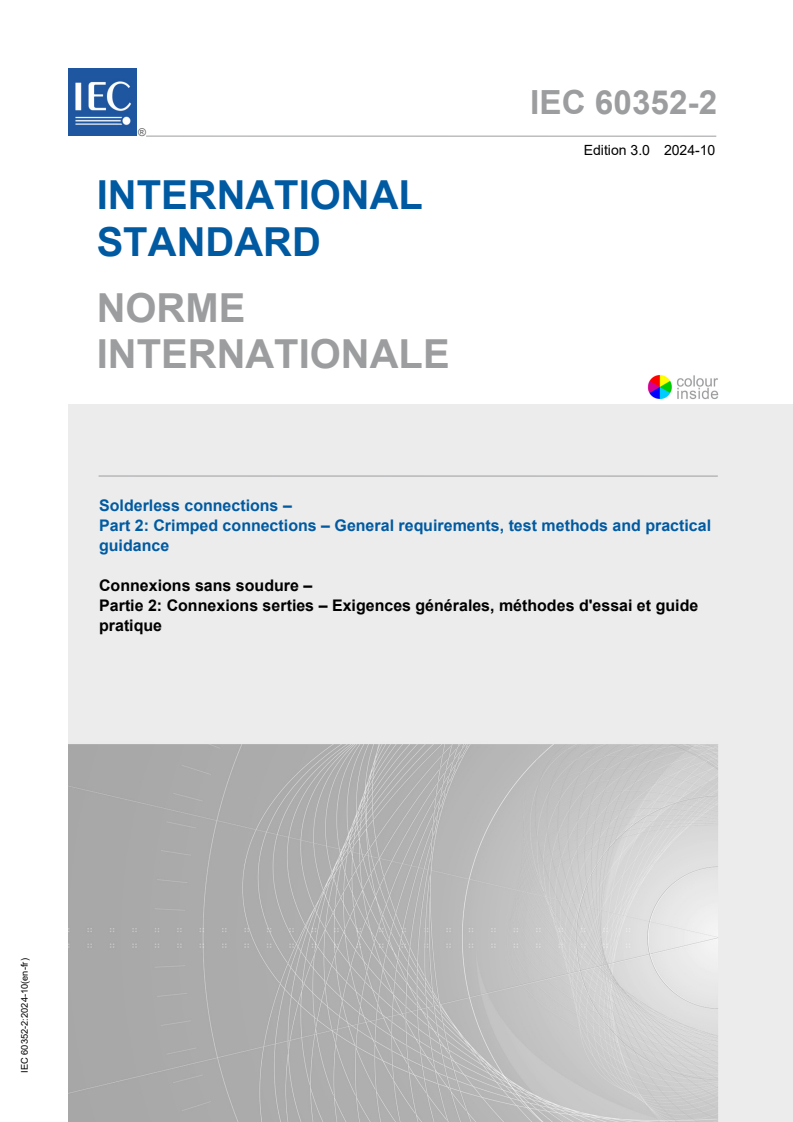
IEC 60352-2 ®
Edition 3.0 2024-10
INTERNATIONAL
STANDARD
NORME
INTERNATIONALE
Solderless connections –
Part 2: Crimped connections – General requirements, test methods and practical
guidance
Connexions sans soudure –
Partie 2: Connexions serties – Exigences générales, méthodes d'essai et guide
pratique
All rights reserved. Unless otherwise specified, no part of this publication may be reproduced or utilized in any form
or by any means, electronic or mechanical, including photocopying and microfilm, without permission in writing from
either IEC or IEC's member National Committee in the country of the requester. If you have any questions about IEC
copyright or have an enquiry about obtaining additional rights to this publication, please contact the address below or
your local IEC member National Committee for further information.
Droits de reproduction réservés. Sauf indication contraire, aucune partie de cette publication ne peut être reproduite ni
utilisée sous quelque forme que ce soit et par aucun procédé, électronique ou mécanique, y compris la photocopie et
les microfilms, sans l'accord écrit de l'IEC ou du Comité national de l'IEC du pays du demandeur. Si vous avez des
questions sur le copyright de l'IEC ou si vous désirez obtenir des droits supplémentaires sur cette publication, utilisez
les coordonnées ci-après ou contactez le Comité national de l'IEC de votre pays de résidence.
IEC Secretariat Tel.: +41 22 919 02 11
3, rue de Varembé info@iec.ch
CH-1211 Geneva 20 www.iec.ch
Switzerland
About the IEC
The International Electrotechnical Commission (IEC) is the leading global organization that prepares and publishes
International Standards for all electrical, electronic and related technologies.
About IEC publications
The technical content of IEC publications is kept under constant review by the IEC. Please make sure that you have the
latest edition, a corrigendum or an amendment might have been published.
IEC publications search - webstore.iec.ch/advsearchform IEC Products & Services Portal - products.iec.ch
The advanced search enables to find IEC publications by a Discover our powerful search engine and read freely all the
variety of criteria (reference number, text, technical publications previews, graphical symbols and the glossary.
committee, …). It also gives information on projects, replaced With a subscription you will always have access to up to date
and withdrawn publications. content tailored to your needs.
IEC Just Published - webstore.iec.ch/justpublished
Electropedia - www.electropedia.org
Stay up to date on all new IEC publications. Just Published
The world's leading online dictionary on electrotechnology,
details all new publications released. Available online and once
containing more than 22 500 terminological entries in English
a month by email.
and French, with equivalent terms in 25 additional languages.
Also known as the International Electrotechnical Vocabulary
IEC Customer Service Centre - webstore.iec.ch/csc
(IEV) online.
If you wish to give us your feedback on this publication or need
further assistance, please contact the Customer Service
Centre: sales@iec.ch.
A propos de l'IEC
La Commission Electrotechnique Internationale (IEC) est la première organisation mondiale qui élabore et publie des
Normes internationales pour tout ce qui a trait à l'électricité, à l'électronique et aux technologies apparentées.
A propos des publications IEC
Le contenu technique des publications IEC est constamment revu. Veuillez vous assurer que vous possédez l’édition la
plus récente, un corrigendum ou amendement peut avoir été publié.
Recherche de publications IEC - IEC Products & Services Portal - products.iec.ch
webstore.iec.ch/advsearchform Découvrez notre puissant moteur de recherche et consultez
La recherche avancée permet de trouver des publications IEC gratuitement tous les aperçus des publications, symboles
en utilisant différents critères (numéro de référence, texte, graphiques et le glossaire. Avec un abonnement, vous aurez
comité d’études, …). Elle donne aussi des informations sur les toujours accès à un contenu à jour adapté à vos besoins.
projets et les publications remplacées ou retirées.
Electropedia - www.electropedia.org
IEC Just Published - webstore.iec.ch/justpublished
Le premier dictionnaire d'électrotechnologie en ligne au monde,
Restez informé sur les nouvelles publications IEC. Just
avec plus de 22 500 articles terminologiques en anglais et en
Published détaille les nouvelles publications parues.
français, ainsi que les termes équivalents dans 25 langues
Disponible en ligne et une fois par mois par email.
additionnelles. Egalement appelé Vocabulaire
Electrotechnique International (IEV) en ligne.
Service Clients - webstore.iec.ch/csc
Si vous désirez nous donner des commentaires sur cette
publication ou si vous avez des questions contactez-nous:
sales@iec.ch.
IEC 60352-2 ®
Edition 3.0 2024-10
INTERNATIONAL
STANDARD
NORME
INTERNATIONALE
Solderless connections –
Part 2: Crimped connections – General requirements, test methods and
practical guidance
Connexions sans soudure –
Partie 2: Connexions serties – Exigences générales, méthodes d'essai et guide
pratique
INTERNATIONAL
ELECTROTECHNICAL
COMMISSION
COMMISSION
ELECTROTECHNIQUE
INTERNATIONALE
ICS 29.120.20 ISBN 978-2-8322-9903-6
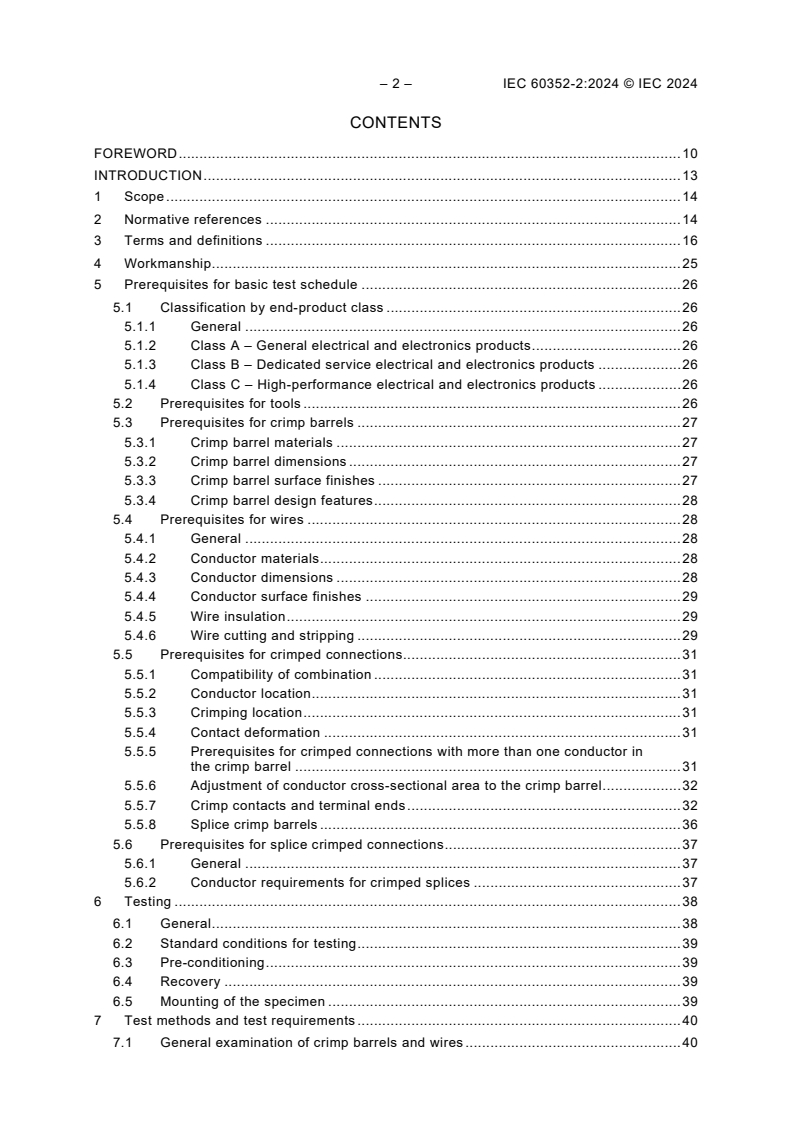
– 2 – IEC 60352-2:2024 © IEC 2024
CONTENTS
FOREWORD . 10
INTRODUCTION . 13
1 Scope . 14
2 Normative references . 14
3 Terms and definitions . 16
4 Workmanship . 25
5 Prerequisites for basic test schedule . 26
5.1 Classification by end-product class . 26
5.1.1 General . 26
5.1.2 Class A – General electrical and electronics products . 26
5.1.3 Class B – Dedicated service electrical and electronics products . 26
5.1.4 Class C – High-performance electrical and electronics products . 26
5.2 Prerequisites for tools . 26
5.3 Prerequisites for crimp barrels . 27
5.3.1 Crimp barrel materials . 27
5.3.2 Crimp barrel dimensions . 27
5.3.3 Crimp barrel surface finishes . 27
5.3.4 Crimp barrel design features . 28
5.4 Prerequisites for wires . 28
5.4.1 General . 28
5.4.2 Conductor materials. 28
5.4.3 Conductor dimensions . 28
5.4.4 Conductor surface finishes . 29
5.4.5 Wire insulation . 29
5.4.6 Wire cutting and stripping . 29
5.5 Prerequisites for crimped connections. 31
5.5.1 Compatibility of combination . 31
5.5.2 Conductor location . 31
5.5.3 Crimping location . 31
5.5.4 Contact deformation . 31
5.5.5 Prerequisites for crimped connections with more than one conductor in
the crimp barrel . 31
5.5.6 Adjustment of conductor cross-sectional area to the crimp barrel . 32
5.5.7 Crimp contacts and terminal ends . 32
5.5.8 Splice crimp barrels . 36
5.6 Prerequisites for splice crimped connections . 37
5.6.1 General . 37
5.6.2 Conductor requirements for crimped splices . 37
6 Testing . 38
6.1 General . 38
6.2 Standard conditions for testing . 39
6.3 Pre-conditioning . 39
6.4 Recovery . 39
6.5 Mounting of the specimen . 39
7 Test methods and test requirements . 40
7.1 General examination of crimp barrels and wires . 40
7.2 Examination of crimp dimensions . 40
7.2.1 Crimp height C , crimp width C and measurable crimp width C . 40
h w wm
7.2.2 Contact deformation after crimping . 42
7.2.3 Visual examination of insulation distance and conductor overhang . 43
7.2.4 Visual examination of splice crimped connections . 44
7.2.5 Visual examination of crimped connections on closed (machined) crimp
barrels . 44
7.2.6 Visual examination of crimped connections on B-crimp open crimp
barrels . 44
7.2.7 Visual examination of crimped connections with open crimp barrel with
insulation grip . 44
7.3 Mechanical tests . 46
7.3.1 Tensile strength . 46
7.3.2 Microsection . 48
7.3.3 Insulation grip effectiveness . 49
7.3.4 Bending test (uninsulated crimp barrels with insulation grip) . 50
7.3.5 Bending test (pre-insulated crimp barrels with insulation grip) . 51
7.3.6 Bending test on splice crimped connections . 52
7.3.7 Vibration test . 52
7.4 Electrical tests . 53
7.4.1 Crimp resistance. 53
7.4.2 Voltage proof (crimped connection with pre-insulated crimp barrels) . 58
7.4.3 Current-carrying capacity test with temperature rise . 58
7.5 Climatic tests . 60
7.5.1 General . 60
7.5.2 Rapid change of temperature . 60
7.5.3 Dry heat . 61
7.5.4 Climatic sequence . 61
7.5.5 Current loading, cyclic . 62
7.5.6 Crimping at low temperature (crimped connections with pre-insulated
crimp barrels) . 66
7.6 Miscellaneous tests . 67
7.6.1 Fluid resistance of pre-insulated crimp barrels . 67
7.6.2 Flowing mixed gas corrosion test . 67
8 Test schedules . 68
8.1 Preparation and type of test specimens . 68
8.1.1 Preparation of test specimens. 68
8.1.2 Type A specimen (for testing according to 8.2, 8.2.3.3 if required, 8.3.2,
8.3.4 if required) . 68
8.1.3 Type B specimen (for tests according to 8.2.3.1 and 8.3.3.2) . 68
8.1.4 Type C specimen (for insulation grip effectiveness tests, see 8.2.3.3
and 8.3.4) . 69
8.1.5 Type D specimen (for testing of pre-insulated crimp barrels only, see
8.2.3.4, 8.3.9.2 and 8.3.9.3) . 70
8.1.6 Type E specimen (for tests according to 8.2.3.2, 8.2.3.4, 8.3.3.5) . 70
8.1.7 Type F specimen (for testing of pre-insulated crimp barrels according to
8.3.9.4) . 71
8.1.8 Type G specimen (for testing according to 8.2.3.2, 8.3.3.4, 8.3.3.5 and
8.3.6) . 72
8.1.9 Type H specimen (for testing according to 8.2.2, 8.2.3.1, 8.2.3.3, 8.3.2,
8.3.3.2, 8.3.3.3 and 8.3.4) . 72
– 4 – IEC 60352-2:2024 © IEC 2024
8.1.10 Number of specimens required . 73
8.2 Basic test schedule . 74
8.2.1 General . 74
8.2.2 Initial examination . 74
8.2.3 Testing of crimped connections . 75
8.3 Full test schedule . 77
8.3.1 General . 77
8.3.2 Initial examination . 78
8.3.3 Testing of crimped connections . 78
8.3.4 Testing of insulation grip effectiveness, test group F5 . 80
8.3.5 Testing of stability of splice crimped connections under bending . 81
8.3.6 Test group F7, if required . 81
8.3.7 Test group F8, if required . 81
8.3.8 Test group F9, if required . 81
8.3.9 Testing of crimped connections with pre-insulated crimp barrels . 82
8.4 Flow charts . 83
Annex A (informative) Practical guidance . 86
A.1 General information on crimped connections . 86
A.1.1 General . 86
A.1.2 Advantages of crimped connections . 86
A.1.3 Current-carrying capacity considerations . 86
A.2 Tool information . 87
A.3 Crimp barrel information . 88
A.3.1 General . 88
A.3.2 Materials . 89
A.3.3 Surface finishes . 89
A.3.4 Shapes of crimped connections . 89
A.4 Wire information. 91
A.4.1 General . 91
A.4.2 Conductor materials. 92
A.4.3 Conductor surface finishes . 92
A.4.4 Wire stripping information . 92
A.5 Crimped connection information . 95
A.5.1 General . 95
A.5.2 Additional information . 96
A.5.3 Crimped connections made with more than one wire in a crimp barrel . 99
A.5.4 Dimensions after crimping . 100
A.5.5 Conductor and crimp barrel materials and finishes selection . 100
A.6 Crimping process . 100
A.6.1 Crimping of contacts with open crimp barrel . 100
A.6.2 Crimping of contacts with open crimp barrel, loose piece contacts . 100
A.6.3 Processing instruction . 101
A.7 Correct crimped connections (additional information) . 102
A.7.1 Correct crimped connections of contacts with open crimp barrel . 102
A.7.2 Measuring of crimp height or depth . 103
A.7.3 Pull-out force . 104
A.8 Examination by microsection . 110
A.8.1 Microsection image creation . 110
A.8.2 Graphical representation of the microsection image requirements . 111
A.8.3 Microsection terminology . 112
A.8.4 Porosity ratio of crimped connections in microsections . 114
A.8.5 Crimp compression ratio of the crimped connection in the microsection . 115
A.8.6 Ratio of crimp height to crimp width in the microsection . 115
A.8.7 Requirements for B-crimped connections in the microsection . 116
A.8.8 Condition of microsections . 117
A.8.9 Insulation grip . 119
A.9 Faults with crimped contacts having open crimp barrels . 121
A.10 Splices . 121
A.11 Crimp resistance test . 121
A.11.1 General . 121
A.11.2 Notes on specimen preparation and measurement . 125
A.12 General information about crimp contacts as part of a multipole connector . 125
A.12.1 Insertion of crimped contacts into the contact cavities of the connector
insert . 125
A.12.2 Removal of inserted contacts . 126
A.12.3 Mounting and bending of wire bundles or cables with crimped contacts . 126
A.12.4 Mating and unmating of multipole connectors with crimped contacts . 127
A.13 Final remarks . 127
Bibliography . 128
Figure 1 – Examples of crimp contact . 17
Figure 2 – Examples of splice . 18
Figure 3 – Example of insulation support . 18
Figure 4 – Examples of insulation grip . 19
Figure 5 – Examples of crimping tool . 19
Figure 6 – Example of positioner holding the crimp barrel . 20
Figure 7 – Example of positioner holding the stripped wire . 20
Figure 8 – Open crimp barrel . 22
Figure 9 – Closed crimp barrels . 22
Figure 10 – Pre-insulated crimp barrel . 23
Figure 11 – Crimping zones . 23
Figure 12 – Example of crimp funnel . 24
Figure 13 – Concentricity of wire insulation . 29
Figure 14 – Diameter ratio when crimping wires with different individual strand
diameters . 32
Figure 15 – Examples of open stamped crimp contacts for automatic production . 32
Figure 16 – Stamped open B-crimp contact with anvil and punch shapes . 33
Figure 17 – Designations on open B-crimp contact . 33
Figure 18 – Examples of crimping dies (press dies) . 33
Figure 19 – Stamped closed crimp barrel (crimp cable lug) . 34
Figure 20 – Different crimp shapes . 34
Figure 21 – Examples of crimping dies for closed crimp barrels . 34
Figure 22 – Tubular cable lugs for class 5 conductors . 35
Figure 23 – Tubular cable lugs for class 6 conductors . 35
Figure 24 – Crimping process of 4-indent crimping with adjustable tools . 35
– 6 – IEC 60352-2:2024 © IEC 2024
Figure 25 – Pre-insulated stamped close crimp barrel, area definitions . 36
Figure 26 – Pre-insulated closed crimp barrels of various designs . 36
Figure 27 – Examples of pre-insulated crimp cable lugs as strip parts . 36
Figure 28 – Uninsulated splice variants . 37
Figure 29 – Diameter ratio when crimping wires with different individual strand
diameters in splices . 38
Figure 30 – Crimp height measurement on open crimp barrel (B-crimp) . 41
Figure 31 – Crimp height measurement on closed crimp barrel (mandrel crimping) . 41
Figure 32 – Crimp height measurement on closed crimp barrel (4-indent crimping) . 42
Figure 33 – Example of holding and measuring points for contact deformation . 43
Figure 34 – Insulation distance and conductor overhang . 43
Figure 35 – Examples of insulation grip die shapes . 45
Figure 36 – Examples of insulation grip . 45
Figure 37 – Test arrangement . 50
Figure 38 – Bending test of crimped connections with uninsulated crimp barrels . 50
Figure 39 – Bending test of crimped connections with pre-insulated crimp barrels . 51
Figure 40 – Bending test on splice crimped connections . 52
Figure 41 – Arrangement for vibration test . 53
Figure 42 – Test arrangement for measurement of crimp resistance of single-conductor
crimped connection . 54
Figure 43 – Measuring of crimp resistance of splices or multiple-conductor crimp
connections . 54
Figure 44 – Crimp resistance R of crimped connections with copper barrels and
C
copper conductor (K = 1) . 56
Figure 45 – Test setup for temperature rise measurements under current load . 58
Figure 46 – Temperature chamber with ventilation opening for current-temperature
derating measurements . 60
Figure 47 – Examples of test arrangements . 64
Figure 48 – Test current for crimped connections . 65
Figure 49 – Examples of type A specimens . 68
Figure 50 – Examples of type B specimens . 69
Figure 51 – Examples of type C specimens . 70
Figure 52 – Example of type D specimen (pre-insulated) . 70
Figure 53 – Examples of type E specimen. 71
Figure 54 – Example of type F specimen . 72
Figure 55 – Type G specimen (splice) . 72
Figure 56 – Type H specimen (splice) . 73
Figure 57 – Basic test schedule (see 8.2) . 84
Figure 58 – Full test schedule (see 8.3) . 85
Figure A.1 – Open crimp barrels . 88
Figure A.2 – Closed crimp barrels . 89
Figure A.3 – Crimping shape in the wire axis . 90
Figure A.4 – Crimping shape 90° angled to the wire axis . 90
Figure A.5 – Crimping shape without insulation grip . 90
Figure A.6 – Crimping shape with pre-insulated crimp barrel . 91
Figure A.7 – Crimping shape without pre-insulated crimp barrel . 91
Figure A.8 – Crimped connections using solid round conductors . 92
Figure A.9 – Stripping length . 93
Figure A.10 – Example of parallel (in-line) process crimping and angled crimping
process . 101
Figure A.11 – Crimping process of an open crimp barrel (B-crimp) . 102
Figure A.12 – Correct crimped connections of contacts with open crimp barrel . 102
Figure A.13 – Measuring instructions . 103
Figure A.14 – Crimp height measuring procedure . 104
Figure A.15 – Pull-out force test for crimped connections with pull speed 50 mm/min . 105
Figure A.16 – Determination of the intrinsic tensile strength of the conductor
(50 mm/min) . 107
Figure A.17 – Relationships between crimp height (C ), pull-out force, crimp force
h
(indentation depth), and electrical conductivity . 109
Figure A.18 – Pull-out force test of splice crimp connections (50 mm/min) . 110
Figure A.19 – Illustration of the parting plane on the crimp barrel centred in the
crimping zone (X). 111
Figure A.20 – Example of end-feed (length feed) open barrel crimp contacts . 111
Figure A.21 – Cutting the crimped connection . 111
Figure A.22 – Dimensions on the microsection for B-crimp barrels . 112
Figure A.23 – Dimensions on the microsection for closed tube and crimped cable lugs . 113
Figure A.24 – Dimensions on the microsection for 4-indent closed crimp barrels . 113
Figure A.25 – Dimensions on the microsection for hexagonal crimp barrels . 113
Figure A.26 – Dimensions on the microsection for crimp barrels (also pre-insulated) . 114
Figure A.27 – Examples of microsections of crimp barrels . 114
Figure A.28 – Ratio of crimp height C to crimp width C . 115
h w
Figure A.29 – Ratio of distance between crimp face ends CFE and base material
thickness S . 116
Figure A.30 – Support angle α of the crimp flanks . 116
w
Figure A.31 – Support height L of the crimp flanks . 116
a
Figure A.32 – Crimp edge distance to floor (F ) . 116
a
Figure A.33 – Resulting bottom thickness S after crimping . 117
b
Figure A.34 – Requirements for the acceptance of a burr formation . 117
Figure A.35 – Diagrams for resistance values (A and B) for electrolytic copper
conductors (K = 1) and for material with K = 3,8. 122
Figure A.36 – Replacement circuit diagram for the crimp resistance . 123
Figure A.37 – Insertion of crimped contacts into contact cavities . 126
Figure A.38 – Mounting of wire bundles/cables with crimped contacts . 126
Figure A.39 – Bending of wire bundles of connectors . 127
Figure A.40 – Mating and unmating of multipole connectors . 127
Table 1 – Allowable strand damage . 30
Table 2 – Prerequisites of 5.3 for crimp barrels to access the basic test schedule of 8.2 . 38
– 8 – IEC 60352-2:2024 © IEC 2024
Table 3 – Prerequisites of 5.4 for wires to access the basic test schedule of 8.2 . 39
Table 4 – Magnification aids for visual examination . 40
Table 5 – Example of permissible tolerances for crimp height measurements . 42
Table 6 – Insulation distance and conductor overhang on closed crimp barrels . 44
Table 7 – Pull-out force of crimped connections . 47
Table 8 – Vibration, preferred test severities . 53
Table 9 – Example of other materials . 57
Table 10 – Minimum wire length L as a function of conductor cross-sectional area S . 59
Table 11 – Current values (tentative) – alternative current loading, cyclic method . 66
Table 12 – Number of specimens . 73
Table 13 – Test group B0 . 75
Table 14 – Test group B1 . 75
Table 15 – Test group B2 . 76
Table 16 – Test group B3 . 76
Table 17 – Test group B4 . 77
Table 18 – Test group B5 . 77
Table 19 – Test group F0 . 78
Table 20 – Test group F1 . 79
Table 21 – Test group F2 . 79
Table 22 – Test group F3 . 79
Table 23 – Test group F4 . 80
Table 24 – Test group F5 . 80
Table 25 – Test group F6 . 81
Table 26 – Test group F7 . 81
Table 27 – Test group F8 . 81
Table 28 – Test group F9 . 82
Table 29 – Test group F10 . 82
Table 30 – Test group F11 . 83
Table 31 – Test group F12 . 83
Table A.1 – Stripping of stranded conductors (good to sufficient requirements) . 94
Table A.2 – Stripping of stranded conductors (faults or conditions according to Table 1) . 95
Table A.3 – Condition of closed machined crimp barrels . 97
Table A.4 – Condition of open crimp barrels (B-crimp) . 98
Table A.5 – Minimum dimensions and tolerances for input funnel on a B-crimping zone . 99
Table A.6 – Condition of position of wire insulation in the insulation grip . 99
Table A.7 – Pull-out force recommended minimum values for electrolytic copper
conductors with tensile strength 200 N/mm (e.g. according to EN 13602) . 106
Table A.8 – Examples of pull-out force values (break) of commercially available
European stranded conductors . 107
Table A.9 – Examples of pull-out force values (break) of commercially available
American stranded conductors . 107
Table A.10 – Determination of the minimum pull-out forces in relation to the respective
cross-sectional area and the intrinsic tensile strength of the conductor . 108
Table A.11 – Pull-out force values for butt splice crimped connections . 110
Table A.12 – Values for the support height L . 116
a
Table A.13 – Condition of microsections . 118
Table A.14 – Condition "Good" of insulation grip for B-crimp and O-crimp
(asymmetrical and symmetrical overlap and enclosure crimp) . 119
Table A.15 – Condition "PID" of insulation grip for B-crimp and O-crimp (asymmetrical
and symmetrical overlap and enclosure crimp) . 120
Table A.16 – Condition "Fault" of insulation grip for B-crimp, O-crimp (asymmetrical
and symmetrical overlap and enclosure crimp) . 120
Table A.17 – Features of splice crimp barrels . 121
Table A.18 – Crimp resistance (maximum allowed initial values A) for K = 1
(electrolytic copper) . 124
Table A.19 – Crimp resistance (after loading, R ) for K = 1 (electrolytic copper) . 124
CR
Table A.20 – Crimp resistance (maximum allowed initial values A) for K ≈ 3,8 (nickel-
brass, bright) . 124
Table A.21 – Crimp resistance (after loading, R ) for K
...