

IEC 60404-8-1:2023
(Main)Magnetic materials - Part 8-1: Specifications for individual materials - Permanent magnet (magnetically hard) materials
General Information
- Abstract
IEC 60404-8-1:2023 specifies minimum values for the principal magnetic properties of, and dimensional tolerances for, technically important permanent magnet (magnetically hard) materials.
For information purposes only, this document provides values for the densities of the materials and the ranges of their chemical compositions.
This fourth edition includes the following significant technical changes with respect to the previous edition:
a) recently developed anisotropic REFeB hot deformed magnets and anisotropic HDDR REFeB bonded magnets are included;
b) high energy Ca-La-Co ferrites stabilized by La and Co substitution are included;
c) new and high-performance grades of REFeB and RE2Co17 sintered magnets and isotropic REFeN bonded magnets are added.
- Status
- Published
- Publication Date
- 19-Sep-2023
- Technical Committee
- TC 68 - Magnetic alloys and steels
- Drafting Committee
- WG 5 - TC 68/WG 5
- Current Stage
- PPUB - Publication issued
- Start Date
- 20-Sep-2023
- Completion Date
- 12-Oct-2023
Overview
IEC 60404-8-1:2023 is the fourth edition of the international standard developed by the International Electrotechnical Commission (IEC), focusing on permanent magnet (magnetically hard) materials. This standard establishes the minimum required values for the principal magnetic properties and dimensional tolerances of technically significant permanent magnet materials. Additionally, it provides information on densities and chemical composition ranges to support quality and consistency in manufacturing and application.
The 2023 edition reflects important technical updates that encompass advancements in rare earth magnet technologies, including newly developed anisotropic neodymium-iron-boron (REFeB) materials and high-energy ferrites stabilized by chemical substitutions. These specifications ensure that manufacturers and users adhere to internationally recognized benchmarks, enhancing interoperability and performance predictability.
Key Topics
- Magnetic Property Specifications: Defines minimum values for critical magnetic parameters such as coercivity, remanence, and magnetic energy product for various permanent magnet materials.
- Material Classification: Covers different material families including aluminium-nickel-cobalt (AlNiCo), chromium-iron-cobalt (CrFeCo), iron-cobalt-vanadium-chromium (FeCoVCr), rare earth-cobalt (RECo), rare earth-iron-boron (REFeB) magnets, as well as hard ferrites and bonded magnets.
- Chemical Compositions: Provides indicative mass fraction ranges for key alloying elements across magnetic materials to guide quality control and material selection.
- Dimensional Tolerances: Specifies dimensional standards for as-cast, sintered, cold-rolled, or bonded magnet forms to ensure compatibility in manufacturing and assembly.
- Testing Protocols: Details the extent and methods of magnetic property testing and criteria for rejection to maintain product reliability.
- Advanced Materials Inclusion: Incorporates recently developed anisotropic REFeB hot deformed magnets and anisotropic HDDR REFeB bonded magnets, as well as improved grades of REFeB and RE2Co17 sintered magnets.
- Demagnetization Behavior: Defines and clarifies irreversible demagnetization field strengths essential for magnetic circuit design and stability analysis.
Applications
IEC 60404-8-1:2023 serves as a fundamental reference for industries and professionals involved with magnetic materials, including:
- Electric Motors and Generators: Ensuring reliable performance by selecting magnets with appropriate coercivity and energy products.
- Sensor Technologies: Standardized magnetic materials for sensors require predictable magnetic responses.
- Magnetic Assemblies and Actuators: Proper tolerance and magnetic strength specifications facilitate precise assembly and operation.
- Electronics and Telecommunications: High-performance permanent magnets play critical roles in compact, efficient device designs.
- Renewable Energy Equipment: In wind turbines and hybrid electric vehicles, adherence to standards ensures durability and efficiency.
- Research and Development: Material scientists and engineers use the standard as a baseline for innovation in magnetic materials and processes.
Related Standards
- IEC 60404 Series: Covers broader magnetic materials topics including magnetic testing methods, measurement techniques, and magnetic circuit design.
- ISO/IEC Standards: Coordinate with other international standards that cover electronic components and materials testing for a unified quality framework.
- National Material Standards: Many countries adopt IEC 60404-8-1 as part of their regulatory frameworks, allowing for regional adaptation while maintaining global compatibility.
Keywords: IEC 60404-8-1:2023, permanent magnet materials, magnetically hard materials, magnetic properties specification, REFeB magnets, anisotropic magnets, magnetic material standards, AlNiCo magnets, ferrite magnets, dimensional tolerances, magnetic testing, IEC magnetic standards, rare earth magnet specifications.
Relations
- Effective Date
- 05-Sep-2023
Get Certified
Connect with accredited certification bodies for this standard

IMQ S.p.A. (Certification)
Italian electrical product certification.

SLG Prüf- und Zertifizierungs GmbH
German testing and certification body.

UL Solutions
Global safety science company with testing, inspection and certification.
Sponsored listings
Frequently Asked Questions
IEC 60404-8-1:2023 is a standard published by the International Electrotechnical Commission (IEC). Its full title is "Magnetic materials - Part 8-1: Specifications for individual materials - Permanent magnet (magnetically hard) materials". This standard covers: IEC 60404-8-1:2023 specifies minimum values for the principal magnetic properties of, and dimensional tolerances for, technically important permanent magnet (magnetically hard) materials. For information purposes only, this document provides values for the densities of the materials and the ranges of their chemical compositions. This fourth edition includes the following significant technical changes with respect to the previous edition: a) recently developed anisotropic REFeB hot deformed magnets and anisotropic HDDR REFeB bonded magnets are included; b) high energy Ca-La-Co ferrites stabilized by La and Co substitution are included; c) new and high-performance grades of REFeB and RE2Co17 sintered magnets and isotropic REFeN bonded magnets are added.
IEC 60404-8-1:2023 specifies minimum values for the principal magnetic properties of, and dimensional tolerances for, technically important permanent magnet (magnetically hard) materials. For information purposes only, this document provides values for the densities of the materials and the ranges of their chemical compositions. This fourth edition includes the following significant technical changes with respect to the previous edition: a) recently developed anisotropic REFeB hot deformed magnets and anisotropic HDDR REFeB bonded magnets are included; b) high energy Ca-La-Co ferrites stabilized by La and Co substitution are included; c) new and high-performance grades of REFeB and RE2Co17 sintered magnets and isotropic REFeN bonded magnets are added.
IEC 60404-8-1:2023 is classified under the following ICS (International Classification for Standards) categories: 17.220.20 - Measurement of electrical and magnetic quantities; 29.030 - Magnetic materials. The ICS classification helps identify the subject area and facilitates finding related standards.
IEC 60404-8-1:2023 has the following relationships with other standards: It is inter standard links to IEC 60404-8-1:2015. Understanding these relationships helps ensure you are using the most current and applicable version of the standard.
IEC 60404-8-1:2023 is available in PDF format for immediate download after purchase. The document can be added to your cart and obtained through the secure checkout process. Digital delivery ensures instant access to the complete standard document.
Standards Content (Sample)
IEC 60404-8-1 ®
Edition 4.0 2023-09
INTERNATIONAL
STANDARD
NORME
INTERNATIONALE
Magnetic materials –
Part 8-1: Specifications for individual materials – Permanent magnet
(magnetically hard) materials
Matériaux magnétiques –
Partie 8-1: Spécifications pour matériaux particuliers – Matériaux (magnétiques
durs) pour aimants permanents
All rights reserved. Unless otherwise specified, no part of this publication may be reproduced or utilized in any form
or by any means, electronic or mechanical, including photocopying and microfilm, without permission in writing from
either IEC or IEC's member National Committee in the country of the requester. If you have any questions about IEC
copyright or have an enquiry about obtaining additional rights to this publication, please contact the address below or
your local IEC member National Committee for further information.
Droits de reproduction réservés. Sauf indication contraire, aucune partie de cette publication ne peut être reproduite ni
utilisée sous quelque forme que ce soit et par aucun procédé, électronique ou mécanique, y compris la photocopie et
les microfilms, sans l'accord écrit de l'IEC ou du Comité national de l'IEC du pays du demandeur. Si vous avez des
questions sur le copyright de l'IEC ou si vous désirez obtenir des droits supplémentaires sur cette publication, utilisez
les coordonnées ci-après ou contactez le Comité national de l'IEC de votre pays de résidence.
IEC Secretariat Tel.: +41 22 919 02 11
3, rue de Varembé info@iec.ch
CH-1211 Geneva 20 www.iec.ch
Switzerland
About the IEC
The International Electrotechnical Commission (IEC) is the leading global organization that prepares and publishes
International Standards for all electrical, electronic and related technologies.
About IEC publications
The technical content of IEC publications is kept under constant review by the IEC. Please make sure that you have the
latest edition, a corrigendum or an amendment might have been published.
IEC publications search - webstore.iec.ch/advsearchform IEC Products & Services Portal - products.iec.ch
The advanced search enables to find IEC publications by a Discover our powerful search engine and read freely all the
variety of criteria (reference number, text, technical publications previews. With a subscription you will always have
committee, …). It also gives information on projects, replaced access to up to date content tailored to your needs.
and withdrawn publications.
Electropedia - www.electropedia.org
IEC Just Published - webstore.iec.ch/justpublished
The world's leading online dictionary on electrotechnology,
Stay up to date on all new IEC publications. Just Published
containing more than 22 300 terminological entries in English
details all new publications released. Available online and once
and French, with equivalent terms in 19 additional languages.
a month by email.
Also known as the International Electrotechnical Vocabulary
(IEV) online.
IEC Customer Service Centre - webstore.iec.ch/csc
If you wish to give us your feedback on this publication or need
further assistance, please contact the Customer Service
Centre: sales@iec.ch.
A propos de l'IEC
La Commission Electrotechnique Internationale (IEC) est la première organisation mondiale qui élabore et publie des
Normes internationales pour tout ce qui a trait à l'électricité, à l'électronique et aux technologies apparentées.
A propos des publications IEC
Le contenu technique des publications IEC est constamment revu. Veuillez vous assurer que vous possédez l’édition la
plus récente, un corrigendum ou amendement peut avoir été publié.
Recherche de publications IEC - IEC Products & Services Portal - products.iec.ch
webstore.iec.ch/advsearchform Découvrez notre puissant moteur de recherche et consultez
La recherche avancée permet de trouver des publications IEC gratuitement tous les aperçus des publications. Avec un
en utilisant différents critères (numéro de référence, texte, abonnement, vous aurez toujours accès à un contenu à jour
comité d’études, …). Elle donne aussi des informations sur les adapté à vos besoins.
projets et les publications remplacées ou retirées.
Electropedia - www.electropedia.org
IEC Just Published - webstore.iec.ch/justpublished
Le premier dictionnaire d'électrotechnologie en ligne au monde,
Restez informé sur les nouvelles publications IEC. Just
avec plus de 22 300 articles terminologiques en anglais et en
Published détaille les nouvelles publications parues.
français, ainsi que les termes équivalents dans 19 langues
Disponible en ligne et une fois par mois par email.
additionnelles. Egalement appelé Vocabulaire
Electrotechnique International (IEV) en ligne.
Service Clients - webstore.iec.ch/csc
Si vous désirez nous donner des commentaires sur cette
publication ou si vous avez des questions contactez-nous:
sales@iec.ch.
IEC 60404-8-1 ®
Edition 4.0 2023-09
INTERNATIONAL
STANDARD
NORME
INTERNATIONALE
Magnetic materials –
Part 8-1: Specifications for individual materials – Permanent magnet
(magnetically hard) materials
Matériaux magnétiques –
Partie 8-1: Spécifications pour matériaux particuliers – Matériaux (magnétiques
durs) pour aimants permanents
INTERNATIONAL
ELECTROTECHNICAL
COMMISSION
COMMISSION
ELECTROTECHNIQUE
INTERNATIONALE
ICS 17.220.20, 29.030 ISBN 978-2-8322-7503-0
– 2 – IEC 60404-8-1:2023 © IEC 2023
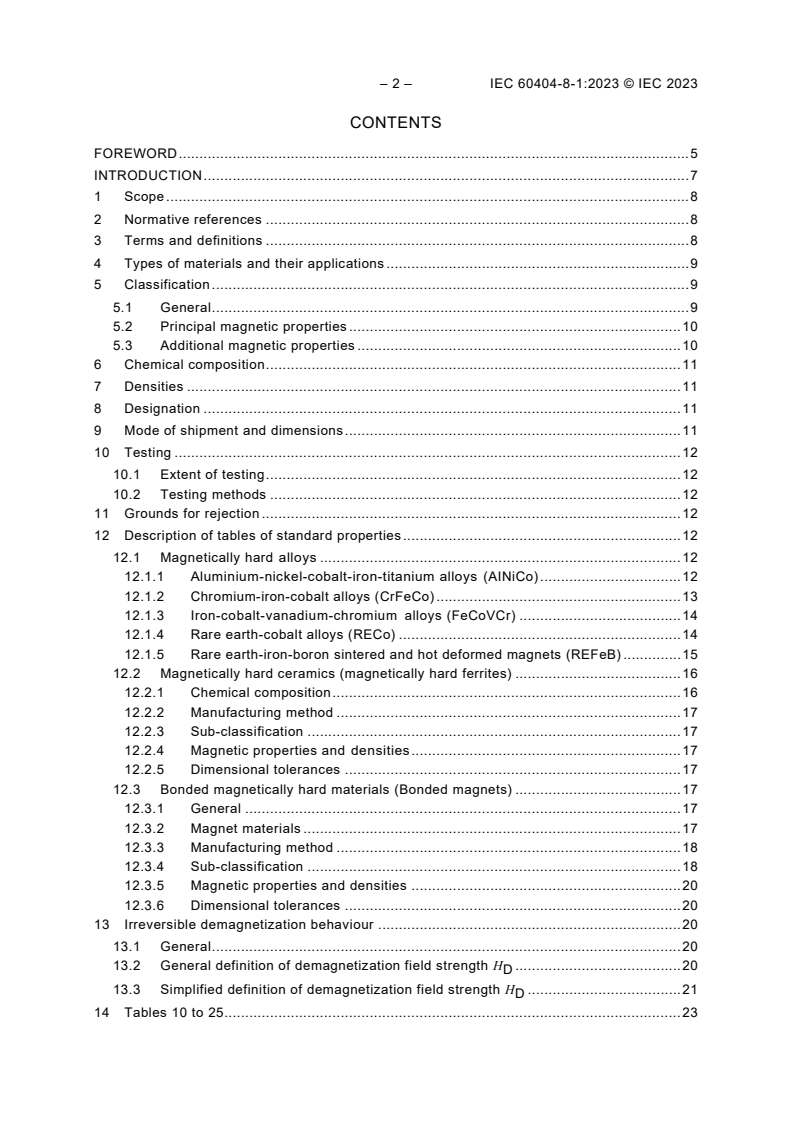
CONTENTS
FOREWORD . 5
INTRODUCTION . 7
1 Scope . 8
2 Normative references . 8
3 Terms and definitions . 8
4 Types of materials and their applications . 9
5 Classification . 9
5.1 General . 9
5.2 Principal magnetic properties . 10
5.3 Additional magnetic properties . 10
6 Chemical composition . 11
7 Densities . 11
8 Designation . 11
9 Mode of shipment and dimensions . 11
10 Testing . 12
10.1 Extent of testing . 12
10.2 Testing methods . 12
11 Grounds for rejection . 12
12 Description of tables of standard properties . 12
12.1 Magnetically hard alloys . 12
12.1.1 Aluminium-nickel-cobalt-iron-titanium alloys (AINiCo) . 12
12.1.2 Chromium-iron-cobalt alloys (CrFeCo) . 13
12.1.3 Iron-cobalt-vanadium-chromium alloys (FeCoVCr) . 14
12.1.4 Rare earth-cobalt alloys (RECo) . 14
12.1.5 Rare earth-iron-boron sintered and hot deformed magnets (REFeB) . 15
12.2 Magnetically hard ceramics (magnetically hard ferrites) . 16
12.2.1 Chemical composition . 16
12.2.2 Manufacturing method . 17
12.2.3 Sub-classification . 17
12.2.4 Magnetic properties and densities . 17
12.2.5 Dimensional tolerances . 17
12.3 Bonded magnetically hard materials (Bonded magnets) . 17
12.3.1 General . 17
12.3.2 Magnet materials . 17
12.3.3 Manufacturing method . 18
12.3.4 Sub-classification . 18
12.3.5 Magnetic properties and densities . 20
12.3.6 Dimensional tolerances . 20
13 Irreversible demagnetization behaviour . 20
13.1 General . 20
13.2 General definition of demagnetization field strength H . 20
D
13.3 Simplified definition of demagnetization field strength H . 21
D
14 Tables 10 to 25 . 23
Annex A (informative) Physical data and mechanical reference values of AINiCo,
CrFeCo, FeCoVCr, SmCo, NdFeB, hard ferrite and SmFeN bonded magnets . 43
Annex B (informative) Grain boundary diffusion (GBD) process for REFeB sintered
magnets . 45
Annex C (informative) Cerium-iron-boron sintered magnets (CeFeB) . 46
Bibliography . 47
Figure 1 – Graphic representation of B(H) and J(H) demagnetization and recoil curves . 21
Figure 2 – Simplified evaluation of B(H) and J(H) demagnetization and recoil curves . 23
Figure B.1 – Example of coercivity gain of GBD processed sintered REFeB magnets in
dependence of the distance to the magnet surface . 45
Figure C.1 – Manufacturing flow chart of CeFeB sintered magnets . 46
Table 1 – Classification of permanent magnet (magnetically hard) materials . 9
and units
Table 2 – Magnetic properties – Symbols . 10
Table 3 – Additional magnetic properties – Symbols and units . 10
Table 4 – Chemical compositions of AlNiCo alloys (% mass fraction) – for information
purposes only . 12
Table 5 – Chemical compositions of CrFeCo alloys (% mass fraction) – for information
purposes only . 13
Table 6 – Chemical compositions of FeCoVCr alloys (% mass fraction) – for
information purposes only . 14
Table 7 – Chemical compositions of RECo alloys (% mass fraction) – for information
purposes only . 15
Table 8 – Chemical compositions of REFeB sintered and hot deformed magnets (%
mass fraction) – for information purposes only . 16
Table 9 – Chemical compositions of REFeN alloys for bonded magnet (% mass
fraction) – for information purposes only . 18
Table 10 – Magnetic properties and densities of AlNiCo magnets . 24
Table 11 – Magnetic properties and densities of CrFeCo and FeCoVCr magnets . 25
Table 12 – Magnetic properties and densities of RECo sintered magnets. 26
Table 13 – Magnetic properties and densities of REFeB sintered magnets . 28
Table 14 – Magnetic properties and densities of REFeB hot deformed magnets . 30
Table 15 – Magnetic properties and densities of hard ferrites. 31
Table 16 – Magnetic properties and densities of isotropic AlNiCo bonded magnets . 33
Table 17 – Magnetic properties and densities of isotropic and anisotropic RECo
bonded magnets . 34
Table 18 – Magnetic properties and densities of isotropic REFeB bonded magnets. 35
Table 19 – Magnetic properties and densities of anisotropic REFeB bonded magnets . 37
Table 20 – Magnetic properties and densities of isotropic and anisotropic hard ferrite
bonded magnets . 38
Table 21 – Magnetic properties and densities of isotropic and anisotropic REFeN
bonded magnets . 39
Table 22 – Dimensional tolerances (as cast or as sintered) of AlNiCo magnets . 40
Table 23 – Dimensional tolerances of cold rolled strips of FeCoVCr and CrFeCo
magnets with a maximum thickness of 6 mm and maximum width of 125 mm . 40
– 4 – IEC 60404-8-1:2023 © IEC 2023
Table 24 – Dimensional tolerances of the diameter of cold drawn wires and bars of
FeCoVCr and CrFeCo magnets . 41
Table 25 – Dimensional tolerances on hard ferrites . 42
Table A.1 – Physical data and mechanical reference values of AlNiCo, CrFeCo,
FeCoVCr, SmCo, NdFeB, hard ferrite and SmFeN bonded magnets . 44
Table C.1 – Chemical compositions of CeFeB sintered magnets (% mass fraction) . 46
INTERNATIONAL ELECTROTECHNICAL COMMISSION
____________
MAGNETIC MATERIALS –
Part 8-1: Specifications for individual materials –
Permanent magnet (magnetically hard) materials
FOREWORD
1) The International Electrotechnical Commission (IEC) is a worldwide organization for standardization comprising
all national electrotechnical committees (IEC National Committees). The object of IEC is to promote international
co-operation on all questions concerning standardization in the electrical and electronic fields. To this end and
in addition to other activities, IEC publishes International Standards, Technical Specifications, Technical Reports,
Publicly Available Specifications (PAS) and Guides (hereafter referred to as "IEC Publication(s)"). Their
preparation is entrusted to technical committees; any IEC National Committee interested in the subject dealt with
may participate in this preparatory work. International, governmental and non-governmental organizations liaising
with the IEC also participate in this preparation. IEC collaborates closely with the International Organization for
Standardization (ISO) in accordance with conditions determined by agreement between the two organizations.
2) The formal decisions or agreements of IEC on technical matters express, as nearly as possible, an international
consensus of opinion on the relevant subjects since each technical committee has representation from all
interested IEC National Committees.
3) IEC Publications have the form of recommendations for international use and are accepted by IEC National
Committees in that sense. While all reasonable efforts are made to ensure that the technical content of IEC
Publications is accurate, IEC cannot be held responsible for the way in which they are used or for any
misinterpretation by any end user.
4) In order to promote international uniformity, IEC National Committees undertake to apply IEC Publications
transparently to the maximum extent possible in their national and regional publications. Any divergence between
any IEC Publication and the corresponding national or regional publication shall be clearly indicated in the latter.
5) IEC itself does not provide any attestation of conformity. Independent certification bodies provide conformity
assessment services and, in some areas, access to IEC marks of conformity. IEC is not responsible for any
services carried out by independent certification bodies.
6) All users should ensure that they have the latest edition of this publication.
7) No liability shall attach to IEC or its directors, employees, servants or agents including individual experts and
members of its technical committees and IEC National Committees for any personal injury, property damage or
other damage of any nature whatsoever, whether direct or indirect, or for costs (including legal fees) and
expenses arising out of the publication, use of, or reliance upon, this IEC Publication or any other IEC
Publications.
8) Attention is drawn to the Normative references cited in this publication. Use of the referenced publications is
indispensable for the correct application of this publication.
9) IEC draws attention to the possibility that the implementation of this document may involve the use of (a)
patent(s). IEC takes no position concerning the evidence, validity or applicability of any claimed patent rights in
respect thereof. As of the date of publication of this document, IEC had not received notice of (a) patent(s), which
may be required to implement this document. However, implementers are cautioned that this may not represent
the latest information, which may be obtained from the patent database available at https://patents.iec.ch. IEC
shall not be held responsible for identifying any or all such patent rights.
IEC 60404-8-1 has been prepared by IEC technical committee 68: Magnetic alloys and steels.
It is an International Standard.
This fourth edition cancels and replaces the third edition published in 2015. This edition
constitutes a technical revision.
This edition includes the following significant technical changes with respect to the previous
edition:
a) recently developed anisotropic REFeB hot deformed magnets and anisotropic HDDR REFeB
bonded magnets are included;
b) high energy Ca-La-Co ferrites stabilized by La and Co substitution are included;
c) new and high-performance grades of REFeB and RE Co sintered magnets and isotropic
2 17
REFeN bonded magnets are added.
– 6 – IEC 60404-8-1:2023 © IEC 2023
The text of this International Standard is based on the following documents:
Draft Report on voting
68/732/CDV 68/742/RVC
Full information on the voting for its approval can be found in the report on voting indicated in
the above table.
The language used for the development of this International Standard is English.
This document was drafted in accordance with ISO/IEC Directives, Part 2, and developed in
accordance with ISO/IEC Directives, Part 1 and ISO/IEC Directives, IEC Supplement, available
at www.iec.ch/members_experts/refdocs. The main document types developed by IEC are
described in greater detail at www.iec.ch/publications.
A list of all parts in the IEC 60404 series, published under the general title Magnetic materials,
can be found on the IEC website.
The committee has decided that the contents of this document will remain unchanged until the
stability date indicated on the IEC website under webstore.iec.ch in the data related to the
specific document. At this date, the document will be
• reconfirmed,
• withdrawn, or
• revised.
INTRODUCTION
This document includes the recently developed REFeB hot deformed magnets, anisotropic
HDDR REFeB bonded magnets and high energy Ca-La-Co ferrites which have become
established in permanent magnet applications. New and high-performance materials of REFeB
and RE Co sintered magnets and isotropic and anisotropic REFeN bonded magnets are
2 17
added to each table with new codes. Almost all materials added to this document have been
used for various motors to save energy and contribute to the prevention of global warming.
– 8 – IEC 60404-8-1:2023 © IEC 2023
MAGNETIC MATERIALS –
Part 8-1: Specifications for individual materials –
Permanent magnet (magnetically hard) materials
1 Scope
This part of IEC 60404 specifies minimum values for the principal magnetic properties of, and
dimensional tolerances for, technically important permanent magnet (magnetically hard)
materials.
For information purposes only, this document provides values for the densities of the materials
and the ranges of their chemical compositions.
NOTE Some additional physical data and mechanical reference values concerning the magnetic materials are given
in Table A.1 for information and comparison purposes.
2 Normative references
The following documents are referred to in the text in such a way that some or all of their content
constitutes requirements of this document. For dated references, only the edition cited applies.
For undated references, the latest edition of the referenced document (including any
amendments) applies.
IEC 60050-121, International Electrotechnical Vocabulary (IEV) - Part 121: Electromagnetism
IEC 60050-151, International Electrotechnical Vocabulary (IEV) - Part 151: Electrical and
magnetic devices
IEC 60050-221, International Electrotechnical Vocabulary (IEV) - Part 221: Magnetic materials
and components
IEC 60404-5:2015, Magnetic materials - Part 5: Permanent magnet (magnetically hard)
materials - Methods of measurement of magnetic properties
3 Terms and definitions
For the purposes of this document, the terms and definitions given in IEC 60050-121,
IEC 60050-151 and IEC 60050-221 apply.
ISO and IEC maintain terminology databases for use in standardization at the following
addresses:
• IEC Electropedia: available at https://www.electropedia.org/
• ISO Online browsing platform: available at https://www.iso.org/obp
4 Types of materials and their applications
Permanent magnet materials, also designated as magnetically hard materials, are classified in
IEC 60404-1:2016 [1] as Class R (magnetically hard alloys), Class S (magnetically hard
ceramics) and Class U (bonded magnetically hard materials).
Permanent magnet materials have a coercivity relating to the magnetic polarization greater than
1 kA/m. After being magnetized to saturation they provide a material-dependent specific
magnetic energy, which can be used in static or dynamic magnetic circuit applications.
Permanent magnet materials are used in nearly every area of daily life. They perform coupling,
modulating, or regulating functions in equipment and devices based on electromagnetic
principles, for example in measuring instruments, motors, generators and loudspeakers.
Permanent magnet materials are indispensable in office equipment and computer hardware,
automobiles including traction motors for Hybrid Electric Vehicles (HEV) and Electric Vehicles
(EV), entertainment electronics, telecommunications, household appliances and medical
instruments, as well as in mechanical engineering as holding devices, clamping plates, etc.
Further possible and typical applications for the commercially available permanent magnet
materials are described in more detail in 5.2 (Class R), 5.3 (Class S) and in 5.5 (Class U) of
IEC 60404-1 [1].
5 Classification
5.1 General
The classification of permanent magnet materials for technical applications is given in Table 1.
The materials are grouped according to their metallurgical relationships and their processes.
Table 1 – Classification of permanent magnet (magnetically hard) materials
Group Principal constituents Class
Magnetically hard Aluminium-nickel-cobalt-iron-titanium (AlNiCo) alloys R1
alloys
Chromium-iron-cobalt (CrFeCo) alloys R6
(R)
Iron-cobalt-vanadium-chromium (FeCoVCr) alloys R3
Rare earth-cobalt (RECo) alloys R5
Rare earth-iron-boron (REFeB) sintered magnets R7
Rare earth-iron-boron (REFeB) hot deformed magnets R8
Magnetically hard Hard ferrites
S1
ceramics
(MO・nFe O ; M = Ba, Sr and Ca, and n = 4,5 to 6,5)
2 3
(S)
Bonded magnetically Bonded aluminium-nickel-cobalt-iron-titanium (AlNiCo) magnets U1
hard materials
Bonded rare earth-cobalt (RECo) magnets U2
(U)
Bonded rare earth-iron-boron (REFeB) magnets U3
Bonded hard ferrite magnets U4
Bonded rare earth-iron-nitrogen (REFeN) magnets U5
The permanent magnet materials are identified by the principal magnetic properties given in
5.2.
_______________
Numbers in square brackets refer to the bibliography.
– 10 – IEC 60404-8-1:2023 © IEC 2023
5.2 Principal magnetic properties
Symbols and units of magnetic properties of permanent magnet materials are given in Table 2.
and units
Table 2 – Magnetic properties – Symbols
Magnetic properties Symbol Unit
Maximum value of (BH) product (BH)
kJ/m
max
Remanent flux density B mT
r
Coercivity relating to the magnetic flux density H kA/m
cB
Coercivity relating to the magnetic polarization H kA/m
cJ
Minimum values of magnetic properties at ambient temperature of (23 ± 5) °C, determined after
magnetization to saturation, are given in Table 10, Table 11, Table 12, Table 13, Table 14,
Table 15, Table 16, Table 17, Table 18, Table 19, Table 20 and Table 21.
The specified values of magnetic properties are valid only for magnets having a cross section
invariable along the axis of magnetization, with a volume of at least 0,125 cm and with
dimensions in the three directions of the coordinate axes of at least 5 mm.
For anisotropic materials, they are valid only along the one preferred direction.
For more details on size limits for measurements, see IEC 60404-5.
For reasons connected with the manufacturing methods, lower values of the magnetic
properties may be obtained if the dimensional conditions mentioned above are not satisfied.
For the method of measurement of the coercivity up to 160 kA/m of magnetic materials in an
open magnetic circuit. The application of IEC 60404-7 [2] is indispensable.
The measurement of magnetic properties shall be made using the method specified in
IEC 60404-5.
NOTE For measurement of H ≥ 1 600 kA/m, saturation effects in the pole pieces can lead to significant
cJ
measurement errors (see IEC 60404-5). In such case, the measurement can be carried out with open magnetic
circuits using a superconducting magnet [3] or a pulsed field magnet (PFM) [4].
5.3 Additional magnetic properties
Symbols and units of additional magnetic properties of permanent magnet materials are given
in Table 3.
Table 3 – Additional magnetic properties – Symbols and units
Magnetic properties Symbol Unit
µ
Relative recoil permeability —
rec
Temperature coefficient of the remanent flux density [it corresponds to the
α(B )
%/°C
r
temperature coefficient of the magnetic saturation α(J )]
s
Temperature coefficient of the coercivity relating to the magnetic
α(H )
%/°C
cJ
polarization
T
Curie temperature °C
c
The values given in Table 10, Table 11, Table 12, Table 13, Table 14, Table 15, Table 16,
Table 17, Table 18, Table 19, Table 20 and Table 21 are specified minimum values and some
typical values. The typical values are mean values published in the literature and are given for
information purposes only and are not guaranteed. The temperature range for the temperature
coefficients in the tables is generally from 20 °C to 100 °C, but this does not preclude the use
of these materials outside this temperature range.
The magnetic field strength necessary for magnetizing permanent magnet materials to magnetic
saturation is defined in IEC 60404-5, IEC 60404-7 [2] and IEC TR 62517 [5]. The temperature
stability of rare earth sintered magnets is described in more detail in IEC TR 62518 [6].
6 Chemical composition
The composition ranges for the different material groups are given for information purposes
only under 12.1.1.1, 12.1.2.1, 12.1.3.1, 12.1.4.1, 12.1.5.1, 12.2.1 and 12.3.2.
7 Densities
Density values are given in Table 10, Table 11, Table 12, Table 13, Table 14, Table 15,
Table 16, Table 17, Table 18, Table 19, Table 20 and Table 21 for information purposes only.
The density values can be used for mass and volume calculations.
8 Designation
Permanent magnet materials can be identified by brief designations and by alpha-numeric
symbols (code numbers, see Table 10, Table 11, Table 12, Table 13, Table 14, Table 15,
Table 16, Table 17, Table 18, Table 19, Table 20 and Table 21). In so far as chemical symbols
are used in the brief designation, they indicate main constituents. The number before the
oblique stroke in the brief designation denotes the specified minimum value of the (BH)
max
expressed in kilojoules per cubic metre (kJ/m ) and the number after the oblique stroke denotes
one tenth of the specified minimum value of the H expressed in kiloamperes per metre (kA/m).
cJ
Permanent magnet materials with a binder (mostly organic, see 12.3.1) are denoted by a
suffixed "p" to the brief designation.
EXAMPLE For the grade AlNiCo 12/6 of Table 10, the integer 12 is obtained from its minimum value (BH) of
max
11,6 kJ/m , and the integer 6 from one-tenth of its minimum value of H i.e. one-tenth of 55 kA/m = 5,5 kA/m on
cJ
rounding up or down to the nearest integer. If rounding down would give the integer zero, the number containing the
first rounded non-zero decimal is maintained.
The code numbers are derived from the classification system used in IEC 60404-1 [1]. The letter
in the code number means the class of the permanent magnet material. The first number
designates the kind of material in the respective class, see Table 10. A ‘0’ in the second position
means that the material is magnetically isotropic, a "1", that the material is magnetically
anisotropic. The number in the third position denotes the different grades.
9 Mode of shipment and dimensions
The materials described in this document may be delivered either magnetized or unmagnetized
and may be mounted in magnetic circuits.
The dimensions of the magnets have to be agreed upon between the supplier and the purchaser
when ordering.
– 12 – IEC 60404-8-1:2023 © IEC 2023
10 Testing
10.1 Extent of testing
The extent of testing shall be agreed upon between the supplier and the purchaser.
10.2 Testing methods
The minimum values of the magnetic properties of permanent magnet materials having suitable
shape and appropriate dimensions shall be tested according to IEC 60404-5.
If the shape and dimensions do not correspond to the requirement of 5.2, the details of the test
should be agreed upon between the supplier and the purchaser.
The other testing methods may be agreed upon between the supplier and the purchaser.
11 Grounds for rejection
Grounds for rejection include inferior magnetic quality (Table 10, Table 11, Table 12, Table 13,
Table 14, Table 15, Table 16, Table 17, Table 18, Table 19, Table 20 and Table 21 give
specified minimum values of some magnetic properties), non-compliant physical dimensions
and dimensional tolerances (Table 22, Table 23, Table 24 and Table 25).
External and internal mechanical imperfections may be considered a cause for rejection, if these
are deleterious to handling and application.
The purchaser’s notification of rejection to the supplier shall be accompanied by samples of the
rejected consignment.
12 Description of tables of standard properties
12.1 Magnetically hard alloys
Aluminium-nickel-cobalt-iron-titanium alloys (AINiCo)
12.1.1
12.1.1.1 Chemical composition
Permanent magnet materials based on aluminium-nickel-cobalt-iron-titanium alloys, referred to
as AINiCo, form a broad spectrum of component-rich alloys in the composition ranges given in
Table 4 (values in percentage mass fraction).
Table 4 – Chemical compositions of AlNiCo alloys (% mass fraction) –
for information purposes only
Al Ni Co Cu Ti Nb Si Fe
AlNiCo 8 to 13 13 to 28 5 to 42 2 to 6 0 to 9 0 to 3 0 to 0,8 balance
12.1.1.2 Manufacturing methods
AINiCo magnets are formed by casting or by a powder metallurgical process. The magnetic
performance of alloys with a Co content higher than 20 % mass fraction can be increased in a
preferred direction by applying a magnetic field during heat treatment. By this procedure a
magnetic anisotropy is generated in the material.
The best performances of AlNiCo magnets are achieved with columnar or single crystal
structure materials. The magnetic field applied during the heat treatment has to be parallel to
the columnar axis.
12.1.1.3 Sub-classification
Isotropic AlNiCo cast or sintered magnets (R1-0-x)
where x = 1, 2, 3
Anisotropic AlNiCo cast magnets (R1-1-x)
where x = 1, …, 7
Anisotropic AlNiCo sintered magnets (R1-1-x)
where x = 10, …,13
12.1.1.4 Magnetic properties and densities
The magnetic properties and densities are given in Table 10 (see also 5.2, 5.3 and Clause 7).
12.1.1.5 Dimensional tolerances
Values of the dimensional tolerances (as cast or as sintered) of AINiCo magnets are given in
Table 22.
12.1.2 Chromium-iron-cobalt alloys (CrFeCo)
12.1.2.1 Chemical composition
Permanent magnet materials based on chromium-iron-cobalt alloys, referred to as CrFeCo,
have compositions within the ranges given in Table 5 (values in percentage mass fraction).
Table 5 – Chemical compositions of CrFeCo alloys (% mass fraction) –
for information purposes only
Cr Co Other elements Fe
e.g. Si, Ti, Mo, Al, V
CrFeCo 25 to 35 7 to 25 0,1 to 3 balance
12.1.2.2 Manufacturing method
The CrFeCo alloys can be manufactured by casting, followed by hot and cold rolling or drawing
to produce strips or wires, respectively. Parts are made from this material by stamping, turning
or drilling. Subsequent to the shaping, a heat treatment has to be provided to obtain the
permanent magnet properties. The magnets can also be formed by a powder metallurgical
process. The magnetic performance of the cast as well as sintered material can be increased
in a preferred direction by applying a magnetic field during heat treatment.
12.1.2.3 Sub-classification
Isotropic CrFeCo cast or sintered magnets (R6-0-x)
where x = 1, 2
Anisotropic CrFeCo cast or sintered magnets (R6-1-x)
where x = 1, …, 4
– 14 – IEC 60404-8-1:2023 © IEC 2023
12.1.2.4 Magnetic properties and densities
Magnetic properties and densities of isotropic and anisotropic CrFeCo magnets are given in
Table 11 (see also 5.2, 5.3 and Clause 7.)
12.1.2.5 Dimensional tolerances
Values of dimensional tolerances of cold rolled strips and cold drawn wires and bars are given
in Tables 23 and 24, respectively. For sintered magnets, the tolerances shall be agreed upon
between the supplier and the purchaser.
12.1.3 Iron-cobalt-vanadium-chromium alloys (FeCoVCr)
12.1.3.1 Chemical composition
Permanent magnet materials based on iron-cobalt-vanadium-chromium alloys, referred as
FeCoVCr, have compositions of within the range given in Table 6 (values in percentage mass
fraction).
Table 6 – Chemical compositions of FeCoVCr alloys (% mass fraction) –
for information purposes only
Co V + Cr Fe
FeCoVCr 49 to 54 4 to 13 balance
12.1.3.2 Manufacturing method
The FeCoVCr alloys are manufactured by casting, followed by hot and cold rolling or drawing
to produce strips or wires, respectively. The cold deformation (80 % to 95 %), followed by a
heat treatment in the range from 500 °C to 650 °C, is essential for the production of the
permanent magnet properties.
12.1.3.3 Sub-classification
The recommended sub-classification is based on the coercivity relating to the magnetic
polarization H . At the present time there is only one classification of FeCoVCr: R3-1-1.
cJ
12.1.3.4 Magnetic properties and densities
Magnetic properties and densities are given in Table 11. (See also 5.2, 5.3 and Clause 7.)
12.1.3.5 Dimensional tolerances
Values of the dimensional tolerances of cold rolled strips and cold drawn wires are given in
Tables 23 and 24, respectively.
12.1.4 Rare earth-cobalt alloys (RECo)
12.1.4.1 Chemical composition
Permanent magnet materials based on rare earth-cobalt alloys are referred as RECo. Of
technical importance are the two types of alloys: RECo and RE Co . The composition
5 2 17
RE Co is used as the generic name for a series of multi-phase alloys with a number of
2 17
transition elements partially replacing cobalt. The alloys have a strong uniaxial magnetic
anisotropy and a high magnetic saturation, resulting in a high coercivity H and a high remanent
cJ
flux density B of the magnets. Their main constituents are given in Table 7 (values in
r
percentage mass fraction).
Table 7 – Chemical compositions of RECo alloys (% mass fraction) –
for information purposes only
Sm Fe Cu Other elements Co
e.g. Zr, Hf, Ti
RECo 33 to 36 — — — balance
RE Co 24 to 26 10 to 30 4 to 12 0 to 3 balance
2 17
Samarium (Sm) is the main rare earth element in these alloys and leads to the best magnetic
properties.
However, cerium (Ce), praseodymium (Pr) or gadolinium (Gd) may also be used as the rare
earth element.
12.1.4.2 Manufacturing method
Compacting of the monocrystalline RECo powder is carried out in a magnetic field, thus
obtaining particle-oriented green compacts. The pressed bodies are sintered under vacuum or
under a protective atmosphere followed by heat treatments.
12.1.4.3 Sub-classification
Anisotropic RECo5 sintered magnets (R5-1-x)
where x = 1, …, 5
Anisotropic RE Co sintered magnets (R5-1-x)
2 17
where x = 10, …, 22
12.1.4.4 Magnetic properties and densities
The magnetic properties and densities are given in Table 12. (See also 5.2, 5.3 and Clause 7.)
12.1.4.5 Dimensional tolerances
Dimensional tolerances shall be in accordance with those for AlNiCo sintered magnets having
less than 1 % Ti as specified in Table 22.
12.1.5 Rare earth-iron-boron sintered and hot deformed magnets (REFeB)
12.1.5.1 Chemical composition
Permanent magnet materials based on rare earth-iron-boron alloys are referred as REFeB. The
REFeB sintered and hot deformed magnets are based on the compound RE Fe B.The rare
2 14
earth element is mainly neodymium (Nd), which may be partially substituted by dysprosium (Dy),
praseodymium (Pr), cerium (Ce) or other rare earth elements. Iron may be partially substituted
by cobalt (Co). The alloy forms a tetragonal crystal structure and shows both a high
Nd Fe B
2 14
saturation magnetization and a high uniaxial magnetocrystalline anisotropy.
The REFeB sintered magnets substituted by Ce may sometimes have high magnetic properties
close to the non-Ce substituted REFeB sintered magnets.
NOTE For permanent magnet materials based on cerium-iron-boron sintered magnets (CeFeB), see Annex C
(informative).
The composition ranges of the REFeB sintered and hot deformed magnets are given in Table 8
(values in percentage mass fraction).
– 16 – IEC 60404-8-1:2023 © IEC 2023
Table 8 – Chemical compositions of REFeB sintered and hot deformed magnets
(% mass fraction) – for information purposes only
Total RE
Other elements
containing Nd Pr, Ce
Co B Dy, Tb e.g. V, Nb, Al, Ga, Fe
as main etc.
Cu
element
REFeB 28 to 35 0 to 15 0,85 to 1,2 0 to 11 0 to 15 0 to 1 balance
12.1.5.2 Manufacturing methods
There are two kinds of REFeB magnets.
The sintered magnets are produced by compacting the monocrystalline REFeB powders in a
magnetic field, thus obtaining particle-oriented green compacts. The pressed bodies are
sintered under vacuum or under a protective atmosphere followed by a heat treatment. After
sintering, a grain boundary diffusion (GBD) process may be applied to enhance the coercivity
with highly efficient Tb/Dy utilization (see Annex B.)
Hot deformed magnets are produced by compacting of the melt-spun REFeB powders with
nanocrystalline grain, thus obtaining isotropic pressed bodies. The pressed bodies are
consolidated and subsequently hot deformed at elevated temperatures. Alignment of grains is
obtained along compression stress during die-upsetting or extrusion.
12.1.5.3 Sub-classification
Anisotropic REFeB sintered magnets (R7-1-x)
where x = 6, …, 47
Anisotropic REFeB hot deformed magnets (R8-1-x)
where x = 1, …, 11
12.1.5.4 Magnetic properties and densities
The specified minimum magnetic properties and density of anisotropic sintered and hot
deformed magnets are given in Table 13 and Table 14, respectively. (See also 5.2, 5.3 and
Clause 7.)
12.1.5.5 Dimensional tolerances
Dimensional tolerances shall be in accordance with those for AINiCo sintered magnets having
less than 1 % Ti as specified in Table 22.
12.2 Magnetically hard ceramics (magnetically hard ferrites)
12.2.1 Chemical composition
The chemical composition of the magnetically hard ferrites can be described by the formula
(where M = Ba, Sr and Ca). Ca is employed only for La and Co substituted ferrites.
MO・
nFe2O3
The ratio n can vary from 4,5 to 6,5. The magnetically hard ferrites have a hexagonal structure
with a high uniaxial magnetocrystalline anisotropy, but
...