

IEC 62059-31-1:2008
(Main)Electricity metering equipment - Dependability - Part 31-1: Accelerated reliability testing - Elevated temperature and humidity
- Abstract
IEC 62059-31-1:2008 provides one of several possible methods for estimating product life characteristics by accelerated reliability testing. In this standard, elevated, constant temperature and humidity is applied to achieve acceleration. The method takes into account the effect of voltage and current variation. It is applicable to all types of metering equipment for energy measurement, tariff and load control in the scope of IEC TC 13. The method given in this standard may be used for estimating (with given confidence limits) product life characteristics of such equipment prior to and during serial production. This method may also be used to compare different designs. The contents of the corrigendum of December 2008 have been included in this copy.
This publication is of high relevance for Smart Grid.
- Status
- Published
- Publication Date
- 20-Oct-2008
- Technical Committee
- TC 13 - Electrical energy measurement and control
- Drafting Committee
- WG 13 - TC 13/WG 13
- Current Stage
- PPUB - Publication issued
- Start Date
- 21-Oct-2008
- Completion Date
- 31-Oct-2008
Overview
IEC 62059-31-1:2008 is an international standard developed by the International Electrotechnical Commission (IEC) that focuses on the dependability of electricity metering equipment. This standard specifies methods for accelerated reliability testing of electricity meters under conditions of elevated temperature and humidity. The key purpose is to estimate product life characteristics and predict long-term reliability efficiently by simulating harsh environmental stresses.
By applying constant high temperature and humidity, while considering voltage and current variations, this standard allows manufacturers and testing laboratories to assess the durability and reliability of metering devices in a controlled, accelerated manner. IEC 62059-31-1:2008 is especially relevant for energy measurement, tariff control, and load control metering equipment falling under IEC Technical Committee 13.
The standard can be used both during the design phase and serial production to:
- Estimate product life with defined confidence limits
- Compare different product designs under accelerated conditions
- Support Smart Grid deployments through dependable metering solutions
Key Topics
The standard comprehensively covers the following essential topics:
Accelerated Life Testing Methods
Application of elevated, constant environmental stressors like temperature and humidity to speed up failure mechanisms and assess reliability within a shorter timespan.Life Distribution Modeling
Use of statistical models such as the Weibull distribution with shape (β), scale (η), and location (γ) parameters to analyze failure data and estimate reliability metrics.Life-Stress Relationship
Quantification of how varying stresses (temperature, voltage, current) affect the acceleration factor and failure rates, supporting accurate extrapolation to normal usage conditions.Test Procedures
Guidelines for sample selection, test execution, data collection, failure classification, and product repair during testing for consistent and repeatable results.Environmental Conditions
Specifications for defining normal and stress test conditions, including realistic temperature and humidity ranges reflecting both indoor and outdoor metering environments.Statistical Confidence and Data Analysis
Methods to compute reliability estimates with confidence bounds to ensure robust evaluation of metering equipment dependability.Special Cases and Simplifications
Handling design changes, batch verifications, and variations in failure modes or stress response for practical testing flexibility.
Applications
IEC 62059-31-1:2008 is vital for various stakeholders involved in electricity metering and energy management:
Manufacturers of Electricity Meters
To validate new meter designs and materials against accelerated aging and environmental factors, ensuring compliance with reliability expectations before market release.Testing Laboratories and Certification Bodies
To perform standardized accelerated reliability testing that supports certification, warranty analysis, and quality control.Utility Companies and Smart Grid Operators
To ensure dependability of metering devices under a wide range of climatic conditions, enabling accurate energy measurement and billing in Smart Grid initiatives.Research and Development Teams
To analyze failure modes, improve meter robustness, and optimize components by comparing different designs under accelerated life stress tests.
This standard helps significantly in reducing field failures, minimizing maintenance costs, and improving customer satisfaction through reliable electricity metering.
Related Standards
IEC 62059-31-1:2008 is part of the broader IEC 62059 series on electricity metering equipment dependability. Related standards include:
- IEC 62059-31-2 – Accelerated reliability testing under different stress conditions such as vibration or mechanical shock.
- IEC 62052-11 & IEC 62053 series – General requirements and test methods for electricity metering equipment performance.
- IEC 62308 – Life-stress models for electronic equipment, referenced for advanced reliability modeling.
- IEC TC 13 publications – Standards related to measurement and telemetry equipment in power systems.
These standards collectively support comprehensive metering equipment evaluation, ensuring long-term accuracy and operational reliability critical for energy management and Smart Grid infrastructure.
Keywords: IEC 62059-31-1, accelerated reliability testing, electricity metering equipment, elevated temperature, humidity, Weibull distribution, product life estimation, metering dependability, Smart Grid, life-stress model, electrical metering standard, reliability analysis, accelerated life test
Relations
- Effective Date
- 05-Sep-2023
Get Certified
Connect with accredited certification bodies for this standard

DIBt (Deutsches Institut für Bautechnik)
German Institute for Building Technology.
DIN CERTCO
DIN Group product certification.

Aboma Certification B.V.
Specialized in construction, metal, and transport sectors.
Sponsored listings
Frequently Asked Questions
IEC 62059-31-1:2008 is a standard published by the International Electrotechnical Commission (IEC). Its full title is "Electricity metering equipment - Dependability - Part 31-1: Accelerated reliability testing - Elevated temperature and humidity". This standard covers: IEC 62059-31-1:2008 provides one of several possible methods for estimating product life characteristics by accelerated reliability testing. In this standard, elevated, constant temperature and humidity is applied to achieve acceleration. The method takes into account the effect of voltage and current variation. It is applicable to all types of metering equipment for energy measurement, tariff and load control in the scope of IEC TC 13. The method given in this standard may be used for estimating (with given confidence limits) product life characteristics of such equipment prior to and during serial production. This method may also be used to compare different designs. The contents of the corrigendum of December 2008 have been included in this copy. This publication is of high relevance for Smart Grid.
IEC 62059-31-1:2008 provides one of several possible methods for estimating product life characteristics by accelerated reliability testing. In this standard, elevated, constant temperature and humidity is applied to achieve acceleration. The method takes into account the effect of voltage and current variation. It is applicable to all types of metering equipment for energy measurement, tariff and load control in the scope of IEC TC 13. The method given in this standard may be used for estimating (with given confidence limits) product life characteristics of such equipment prior to and during serial production. This method may also be used to compare different designs. The contents of the corrigendum of December 2008 have been included in this copy. This publication is of high relevance for Smart Grid.
IEC 62059-31-1:2008 is classified under the following ICS (International Classification for Standards) categories: 17.220.20 - Measurement of electrical and magnetic quantities; 91.140.50 - Electricity supply systems. The ICS classification helps identify the subject area and facilitates finding related standards.
IEC 62059-31-1:2008 has the following relationships with other standards: It is inter standard links to IEC 62059-31-1:2008/COR1:2008. Understanding these relationships helps ensure you are using the most current and applicable version of the standard.
IEC 62059-31-1:2008 is available in PDF format for immediate download after purchase. The document can be added to your cart and obtained through the secure checkout process. Digital delivery ensures instant access to the complete standard document.
Standards Content (Sample)
IEC 62059-31-1
Edition 1.0 2008-10
INTERNATIONAL
STANDARD
NORME
INTERNATIONALE
Electricity metering equipment – Dependability –
Part 31-1: Accelerated reliability testing – Elevated temperature and humidity
Equipements de comptage de l'électricité – Sûreté de fonctionnement –
Partie 31-1: Essais de fiabilité accélérés – Température et humidité élevées
All rights reserved. Unless otherwise specified, no part of this publication may be reproduced or utilized in any form or by
any means, electronic or mechanical, including photocopying and microfilm, without permission in writing from either IEC or
IEC's member National Committee in the country of the requester.
If you have any questions about IEC copyright or have an enquiry about obtaining additional rights to this publication,
please contact the address below or your local IEC member National Committee for further information.
Droits de reproduction réservés. Sauf indication contraire, aucune partie de cette publication ne peut être reproduite
ni utilisée sous quelque forme que ce soit et par aucun procédé, électronique ou mécanique, y compris la photocopie
et les microfilms, sans l'accord écrit de la CEI ou du Comité national de la CEI du pays du demandeur.
Si vous avez des questions sur le copyright de la CEI ou si vous désirez obtenir des droits supplémentaires sur cette
publication, utilisez les coordonnées ci-après ou contactez le Comité national de la CEI de votre pays de résidence.
IEC Central Office
3, rue de Varembé
CH-1211 Geneva 20
Switzerland
Email: inmail@iec.ch
Web: www.iec.ch
About the IEC
The International Electrotechnical Commission (IEC) is the leading global organization that prepares and publishes
International Standards for all electrical, electronic and related technologies.
About IEC publications
The technical content of IEC publications is kept under constant review by the IEC. Please make sure that you have the
latest edition, a corrigenda or an amendment might have been published.
ƒ Catalogue of IEC publications: www.iec.ch/searchpub
The IEC on-line Catalogue enables you to search by a variety of criteria (reference number, text, technical committee,…).
It also gives information on projects, withdrawn and replaced publications.
ƒ IEC Just Published: www.iec.ch/online_news/justpub
Stay up to date on all new IEC publications. Just Published details twice a month all new publications released. Available
on-line and also by email.
ƒ Electropedia: www.electropedia.org
The world's leading online dictionary of electronic and electrical terms containing more than 20 000 terms and definitions
in English and French, with equivalent terms in additional languages. Also known as the International Electrotechnical
Vocabulary online.
ƒ Customer Service Centre: www.iec.ch/webstore/custserv
If you wish to give us your feedback on this publication or need further assistance, please visit the Customer Service
Centre FAQ or contact us:
Email: csc@iec.ch
Tel.: +41 22 919 02 11
Fax: +41 22 919 03 00
A propos de la CEI
La Commission Electrotechnique Internationale (CEI) est la première organisation mondiale qui élabore et publie des
normes internationales pour tout ce qui a trait à l'électricité, à l'électronique et aux technologies apparentées.
A propos des publications CEI
Le contenu technique des publications de la CEI est constamment revu. Veuillez vous assurer que vous possédez
l’édition la plus récente, un corrigendum ou amendement peut avoir été publié.
ƒ Catalogue des publications de la CEI: www.iec.ch/searchpub/cur_fut-f.htm
Le Catalogue en-ligne de la CEI vous permet d’effectuer des recherches en utilisant différents critères (numéro de référence,
texte, comité d’études,…). Il donne aussi des informations sur les projets et les publications retirées ou remplacées.
ƒ Just Published CEI: www.iec.ch/online_news/justpub
Restez informé sur les nouvelles publications de la CEI. Just Published détaille deux fois par mois les nouvelles
publications parues. Disponible en-ligne et aussi par email.
ƒ Electropedia: www.electropedia.org
Le premier dictionnaire en ligne au monde de termes électroniques et électriques. Il contient plus de 20 000 termes et
définitions en anglais et en français, ainsi que les termes équivalents dans les langues additionnelles. Egalement appelé
Vocabulaire Electrotechnique International en ligne.
ƒ Service Clients: www.iec.ch/webstore/custserv/custserv_entry-f.htm
Si vous désirez nous donner des commentaires sur cette publication ou si vous avez des questions, visitez le FAQ du
Service clients ou contactez-nous:
Email: csc@iec.ch
Tél.: +41 22 919 02 11
Fax: +41 22 919 03 00
IEC 62059-31-1
Edition 1.0 2008-10
INTERNATIONAL
STANDARD
NORME
INTERNATIONALE
Electricity metering equipment – Dependability –
Part 31-1: Accelerated reliability testing – Elevated temperature and humidity
Equipements de comptage de l'électricité – Sûreté de fonctionnement –
Partie 31-1: Essais de fiabilité accélérés – Température et humidité élevées
INTERNATIONAL
ELECTROTECHNICAL
COMMISSION
COMMISSION
ELECTROTECHNIQUE
PRICE CODE
INTERNATIONALE
XC
CODE PRIX
ICS 29.240; 91.140.50 ISBN 978-2-88910-612-7
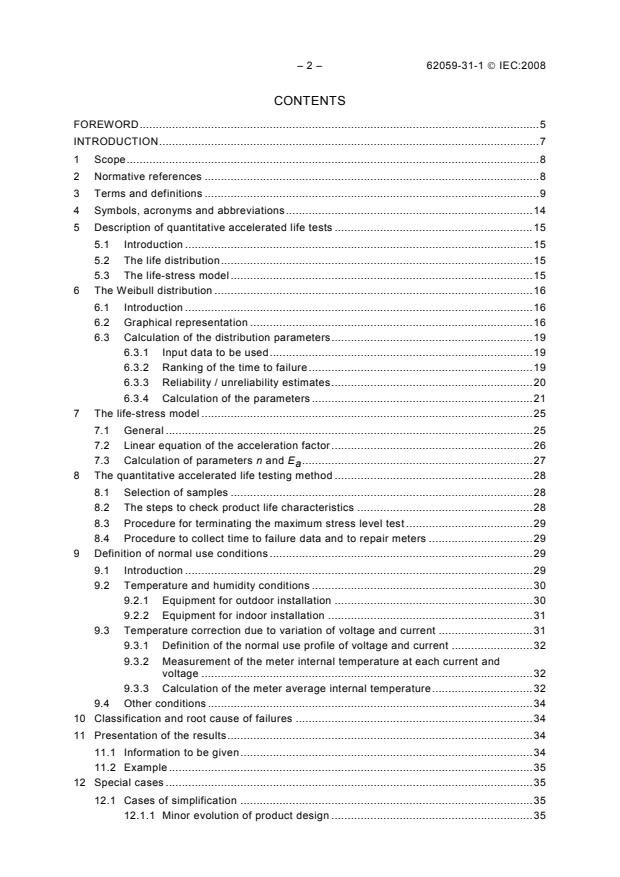
– 2 – 62059-31-1 © IEC:2008
CONTENTS
FOREWORD.5
INTRODUCTION.7
1 Scope.8
2 Normative references .8
3 Terms and definitions .9
4 Symbols, acronyms and abbreviations.14
5 Description of quantitative accelerated life tests .15
5.1 Introduction .15
5.2 The life distribution.15
5.3 The life-stress model .15
6 The Weibull distribution .16
6.1 Introduction .16
6.2 Graphical representation .16
6.3 Calculation of the distribution parameters.19
6.3.1 Input data to be used.19
6.3.2 Ranking of the time to failure.19
6.3.3 Reliability / unreliability estimates.20
6.3.4 Calculation of the parameters .21
7 The life-stress model .25
7.1 General .25
7.2 Linear equation of the acceleration factor.26
7.3 Calculation of parameters n and E .27
a
8 The quantitative accelerated life testing method .28
8.1 Selection of samples .28
8.2 The steps to check product life characteristics .28
8.3 Procedure for terminating the maximum stress level test .29
8.4 Procedure to collect time to failure data and to repair meters .29
9 Definition of normal use conditions .29
9.1 Introduction .29
9.2 Temperature and humidity conditions .30
9.2.1 Equipment for outdoor installation .30
9.2.2 Equipment for indoor installation .31
9.3 Temperature correction due to variation of voltage and current .31
9.3.1 Definition of the normal use profile of voltage and current .32
9.3.2 Measurement of the meter internal temperature at each current and
voltage .32
9.3.3 Calculation of the meter average internal temperature.32
9.4 Other conditions .34
10 Classification and root cause of failures .34
11 Presentation of the results.34
11.1 Information to be given.34
11.2 Example .35
12 Special cases .35
12.1 Cases of simplification .35
12.1.1 Minor evolution of product design .35
62059-31-1 © IEC:2008 – 3 –
12.1.2 Verification of production batches.35
12.2 Cases when additional information is needed .35
12.2.1 The β parameter changes significantly from maximum stress level to
medium or low stress level .35
12.2.2 Fault mode different between stress levels .35
Annex A (informative) Basic statistical background .36
Annex B (informative) The characteristics of the Weibull distribution.38
Annex C (informative, see also draft IEC 62308) Life-stress models .42
Annex D (normative) Rank tables.44
Annex E (normative) Values of the Gamma function Γ(n) .47
Annex F (normative) Calculation of the minimum duration of the maximum stress level
test .48
Annex G (informative) Example.54
Bibliography.84
INDEX .85
Figure 1 – Weibull unreliability representation example with γ = 3 000, β = 1,1, η = 10 000.19
Figure 2 – Example of graphical representation of F(t) in the case of Weibull
distribution.25
Figure 3 – Example of regional climatic conditions.30
Figure 4 – Calculation of average year use conditions .31
Figure A.1 – The probability density function .36
Figure A.2 – The reliability and unreliability functions .37
Figure B.1 – Effect of the β parameter on the Weibull probability density function f (t) .39
Figure B.2 – Effect of the η parameter on the Weibull probability density function f (t) .40
Figure F.1 – Unreliability at normal use conditions .49
Figure F.2 – Unreliability at maximum stress level .50
Figure G.1 – Graphical representation of display failures for each stress level.63
Figure G.2 – Graphical representation of Q2 failures for each stress level .64
Figure G.3 – Graphical representation of U1 failures for each stress level .65
Figure G.4 – Example of climate data .67
Figure G.5 – Graphical representation of all failures at normal use conditions .76
Figure G.6 – Final cumulative distribution with confidence intervals .81
Figure G.7 – Reliability function extrapolated to normal use conditions .82
Figure G.8 – Reliability function extrapolated to normal use conditions (First portion
magnified).83
Table 1 – Construction of ordinate (Y) .17
Table 2 – Construction of abscissa (t-γ) .17
Table 3 – Equations format entered into a spreadsheet .18
Table 4 – Example with γ = 3 000, β = 1,1, η = 10 000 .18
Table 5 – Example of ranking process of times to failure.20
Table 6 – Unreliability estimates by median rank .21
Table 7 – Example of unreliability estimation for Weibull distribution.24
– 4 – 62059-31-1 © IEC:2008
Table 8 – Example of 90 % confidence bounds calculation for Weibull distribution.24
Table 9 – Values of the linear equation .27
Table 10 – Example of procedure for temperature correction .33
Table G.1 – Failures logged at 85 °C with RH = 95 % .57
Table G.2 – Failures logged at 85 °C with RH = 85 % .59
Table G.3 – Failures logged at 85 °C with RH = 75 % .60
Table G.4 – Failures logged at 75 °C with RH = 95 % .61
Table G.5 – Failures logged at 65 °C with RH = 95 % .62
Table G.6 – Best fit Weibull distributions for display failures .63
Table G.7 – Best fit Weibull distributions for Q2 failures.64
Table G.8 – Best fit Weibull distributions for U1 failures.65
Table G.9 – Values of the linear equation for display failures.66
Table G.10 – Values of the linear equation for Q2 failures .66
Table G.11 – Values of the linear equation for other failures.66
Table G.12 – Normal use profile of voltage and current.67
Table G.13 – Measurement of the internal temperature.69
Table G.14 – Arrhenius acceleration factors compared to temperature measured at U
n
and 0,1 I , for display failures .70
max
Table G.15 – Arrhenius acceleration factors compared to temperature measured at U
n
and 0,1 I , for Q2 failures.71
max
Table G.16 – Arrhenius acceleration factors compared to temperature measured at U
n
and 0,1 I , for U1 failures .72
max
Table G.17 – Display failures extrapolated to normal use conditions .74
Table G.18 – Q2 failures extrapolated to normal use conditions.75
Table G.19 – U1 failures extrapolated to normal use conditions .76
Table G.20 – Best fit Weibull distributions at normal use conditions.77
Table G.21 – Display failures 90 % confidence bounds calculation .78
Table G.22 – Q2 failures 90 % confidence bounds calculation .79
Table G.23 – U1 failures 90 % confidence bounds calculation .80
62059-31-1 © IEC:2008 – 5 –
INTERNATIONAL ELECTROTECHNICAL COMMISSION
____________
ELECTRICITY METERING EQUIPMENT –
DEPENDABILITY –
Part 31-1: Accelerated reliability testing –
Elevated temperature and humidity
FOREWORD
1) The International Electrotechnical Commission (IEC) is a worldwide organization for standardization comprising
all national electrotechnical committees (IEC National Committees). The object of IEC is to promote
international co-operation on all questions concerning standardization in the electrical and electronic fields. To
this end and in addition to other activities, IEC publishes International Standards, Technical Specifications,
Technical Reports, Publicly Available Specifications (PAS) and Guides (hereafter referred to as “IEC
Publication(s)”). Their preparation is entrusted to technical committees; any IEC National Committee interested
in the subject dealt with may participate in this preparatory work. International, governmental and non-
governmental organizations liaising with the IEC also participate in this preparation. IEC collaborates closely
with the International Organization for Standardization (ISO) in accordance with conditions determined by
agreement between the two organizations.
2) The formal decisions or agreements of IEC on technical matters express, as nearly as possible, an international
consensus of opinion on the relevant subjects since each technical committee has representation from all
interested IEC National Committees.
3) IEC Publications have the form of recommendations for international use and are accepted by IEC National
Committees in that sense. While all reasonable efforts are made to ensure that the technical content of IEC
Publications is accurate, IEC cannot be held responsible for the way in which they are used or for any
misinterpretation by any end user.
4) In order to promote international uniformity, IEC National Committees undertake to apply IEC Publications
transparently to the maximum extent possible in their national and regional publications. Any divergence
between any IEC Publication and the corresponding national or regional publication shall be clearly indicated in
the latter.
5) IEC provides no marking procedure to indicate its approval and cannot be rendered responsible for any
equipment declared to be in conformity with an IEC Publication.
6) All users should ensure that they have the latest edition of this publication.
7) No liability shall attach to IEC or its directors, employees, servants or agents including individual experts and
members of its technical committees and IEC National Committees for any personal injury, property damage or
other damage of any nature whatsoever, whether direct or indirect, or for costs (including legal fees) and
expenses arising out of the publication, use of, or reliance upon, this IEC Publication or any other IEC
Publications.
8) Attention is drawn to the Normative references cited in this publication. Use of the referenced publications is
indispensable for the correct application of this publication.
9) Attention is drawn to the possibility that some of the elements of this IEC Publication may be the subject of
patent rights. IEC shall not be held responsible for identifying any or all such patent rights.
International Standard IEC 62059-31 has been prepared by IEC technical committee 13:
Electrical energy measurement, tariff- and load control.
The text of this standard is based on the following documents:
FDIS RVD
13/1437A/FDIS 13/1444/RVD
Full information on the voting for the approval of this standard can be found in the report on
voting indicated in the above table.
This publication has been drafted in accordance with the ISO/IEC Directives, Part 2.
– 6 – 62059-31-1 © IEC:2008
A list of all parts of IEC 62059 series, under the general title Electricity metering equipment –
Dependability, can be found on the IEC website.
The committee has decided that the contents of this publication will remain unchanged until
the maintenance result date indicated on the IEC web site under "http://webstore.iec.ch" in
the data related to the specific publication. At this date, the publication will be
• reconfirmed,
• withdrawn,
• replaced by a revised edition, or
• amended.
The contents of the corrigendum of December 2008 have been included in this copy.
62059-31-1 © IEC:2008 – 7 –
INTRODUCTION
Electricity metering equipment are products designed for high reliability and long life under
normal operating conditions, operating continuously without supervision. To manage metering
assets effectively, it is important to have tools for predicting and estimating life characteristics
of various types.
IEC 62059-41 provides methods for predicting the failure rate – assumed to be constant – of
metering equipment based on the parts stress method.
IEC 62059-31-1 provides a method for estimating life characteristics using temperature and
humidity accelerated testing.
It is practically impossible to obtain data about life characteristics by testing under normal
operating conditions. Therefore, accelerated reliability test methods have to be used.
During accelerated reliability testing, samples taken from a defined population are operated
beyond their normal operating conditions, applying stresses to shorten the time to failure, but
without introducing new failure mechanisms.
The estimation is performed by recording and analysing failures during such accelerated
testing, establishing the failure distribution under the test conditions and, using life stress
models, extrapolating failure distribution under accelerated conditions of use to normal
conditions of use.
The method provides quantitative results with their confidence limits and may be used to
compare life characteristics of products coming from different suppliers or different batches
from the same supplier.
– 8 – 62059-31-1 © IEC:2008
ELECTRICITY METERING EQUIPMENT –
DEPENDABILITY –
Part 31-1: Accelerated reliability testing –
Elevated temperature and humidity
1 Scope
This part of IEC 62059 provides one of several possible methods for estimating product life
characteristics by accelerated reliability testing.
Acceleration can be achieved in a number of different ways. In this particular standard,
elevated, constant temperature and humidity is applied to achieve acceleration. The method
also takes into account the effect of voltage and current variation.
Of course, failures not (or not sufficiently) accelerated by temperature and humidity will not be
detected by the application of the test method specified in this standard.
Other factors, like temperature variation, vibration, dust, voltage dips and short interruptions,
static discharges, fast transient burst, surges, etc. – although they may affect the life
characteristics of the meter – are not taken into account in this standard; they may be
addressed in future parts of the IEC 62059 series.
This standard is applicable to all types of metering equipment for energy measurement, tariff-
and load control in the scope of IEC TC 13. The method given in this standard may be used
for estimating (with given confidence limits) product life characteristics of such equipment
prior to and during serial production. This method may also be used to compare different
designs.
2 Normative references
The following referenced documents are indispensable for the application of this document.
For dated references, only the edition cited applies. For undated references, the latest edition
of the referenced document (including any amendments) applies.
IEC 60050-191:1990, International Electrotechnical Vocabulary (IEV) – Chapter 191:
Dependability and quality of service
IEC 60300-3-5 Ed. 1.0:2001, Dependability management – Part 3-5: Application guide –
Reliability test conditions and statistical test principles
IEC 61649:2008, Weibull analysis
IEC 61703 Ed. 1.0: 2001, Mathematical expressions for reliability, availability, maintainability
and maintenance support terms
IEC/TR 62059-11 Ed 1.0:2002, Electricity metering equipment – Dependability – Part 11:
General concepts
IEC/TR 62059-21 Ed. 1.0:2002, Electricity metering equipment – Dependability – Part 21:
Collection of meter dependability data from the field
62059-31-1 © IEC:2008 – 9 –
IEC 62059-41 Ed. 1.0: 2006, Electricity metering equipment – Dependability – Part 41:
Reliability prediction
IEC 62308 Ed. 1.0:2006, Equipment reliability – Reliability assessment methods
3 Terms and definitions
For the purposes of this document, the following terms and definitions apply.
NOTE 1 Here only those terms relevant to the subject are included, which have not been already included in
IEC 62059-11.
3.1
accelerated life test
a test in which the applied stress level is chosen to exceed that stated in the reference
conditions in order to shorten the time duration required to observe the stress response of the
item, or to magnify the response in a given time duration
NOTE To be valid, an accelerated life test shall not alter the basic fault modes and failure mechanisms, or their
relative prevalence.
[IEV 191-14-07, modified]
3.2
ageing failure, wear-out failure
a failure whose probability of occurrence increases with the passage of time, as a result of
processes inherent in the item
[IEV 191-04-09]
3.3
burn-in (for repairable hardware)
a process of increasing the reliability performance of hardware employing functional operation
of every item in a prescribed environment with successive corrective maintenance at every
failure during the early failure period
[IEV 191-17-02]
3.4
burn-in (for a non-repairable item)
a type of screening test employing the functional operation of an item
[IEV 191-17-03]
3.5
censoring
termination of the test after either a certain number of failures or a certain time at which there
are still items functioning
[IEC 60300-3-5, 3.1.2]
3.6
constant failure intensity period
that period, if any, in the life of a repaired item during which the failure intensity is
approximately constant
[IEV 191-10-08]
– 10 – 62059-31-1 © IEC:2008
3.7
constant failure rate period
that period, if any, in the life of a non-repaired item during which the failure rate is
approximately constant
[IEV 191-10-09]
3.8
equipment under prediction
EUP (abbreviation)
the electricity metering equipment for which a reliability prediction is being made
3.9
estimated
qualifies a value obtained as the result of the operation made for the purpose of assigning,
from the observed values in a sample, numerical values to the parameters of the distribution
chosen as the statistical model of the population from which this sample is taken
NOTE The result may be expressed either as a single numerical value (a point estimate) or as a confidence
interval.
[IEV 191-18-04, modified]
3.10
extrapolated
qualifies a predicted value based on observed or estimated values for one or a set of
conditions, intended to apply to other conditions such as time, maintenance and
environmental conditions
[IEV 191-18-03]
3.11
failure
termination of the ability of an item to perform a required function
NOTE 1 After failure the item has a fault.
NOTE 2 “Failure” is an event, as distinguished from “fault”, which is a state.
[IEV 191-04-01, modified]
3.12
failure cause
the circumstances during design, manufacture or use which have led to a failure
NOTE The term “root cause of the failure” is used and described in IEC 62059-21 Clause 8.
[IEV 191-04-17, modified]
3.13
failure mechanism
the physical, chemical or other process which has led to a failure
[IEV 191-04-18]
3.14
failure rate acceleration factor
the ratio of the failure rate under accelerated testing conditions to the failure rate under stated
reference test conditions
NOTE Both failure rates refer to the same time period in the life of the tested items.
62059-31-1 © IEC:2008 – 11 –
[IEV 194-14-11]
3.15
fault
the state of an item characterized by the inability to perform a required function, excluding the
inability during preventive maintenance or other planned actions, or due to lack of external
resources
NOTE A fault is often the result of a failure of the item itself, but may exist without prior failure.
[IEV 191-05-01]
3.16
fault mode
one of the possible states of a faulty item, for a given required function
NOTE 1 The use of the term “failure mode” in this sense is now deprecated.
NOTE 2 A function-based fault mode classification is described in IEC 62059-21 Clause 7.
[IEV 191-05-22, modified]
3.17
(instantaneous) failure rate
the limit, if it exists, of the quotient of the conditional probability that the instant of a failure of
a non-repaired item falls within a given time interval (t, t + ∆t) and the duration of this time
interval, ∆t, when ∆t tends to zero, given that the item has not failed up to the beginning of the
time interval
NOTE 1 The instantaneous failure rate is expressed by the formula:
1 F(t + Δt) −F(t) f (t)
λ(t) = lim =
Δt→0
Δt R(t) R(t)
where F(t) and f(t) are respectively the distribution function and the probability density of the failure instant, and
where R(t) is the reliability function, related to the reliability R(t1,t2) by R(t) =R(0,t).
NOTE 2 An estimated value of the instantaneous failure rate can be obtained by dividing the ratio of the number
of items which have failed during a given time interval to the number of non-failed items at the beginning of the
time interval, by the duration of the time interval.
NOTE 3 In English, the instantaneous failure rate is sometimes called "hazard function".
[IEV 191-12-02, modified]
3.18
item
entity
any part, component, device, subsystem, functional unit, equipment or system that can be
individually considered
NOTE 1 An item may consist of hardware, software or both, and may also in particular cases, include people.
NOTE 2 A number of items, e.g. a population of items or a sample, may itself be considered as an item.
[IEV 191-01-01]
3.19
life test
test with the purpose of estimating, verifying or comparing the lifetime of the class of items
being tested
– 12 – 62059-31-1 © IEC:2008
NOTE The end of the useful life will often be defined as the time when a certain percentage of the items have
failed for non-repaired items and as the time when the failure intensity has increased to a specified level for
repaired items.
3.20
mean time to failure
MTTF (abbreviation)
the expectation of the time to failure
NOTE The term “expectation” has statistical meaning.
[IEV 191-12-07, modified]
3.21
mean time to first failure
MTTFF (abbreviation)
the expectation of the time to first failure
NOTE The term “expectation” has statistical meaning.
[IEV 191-12-06, modified]
3.22
measure (in the probabilistic treatment of dependability)
a function or a quantity used to describe a random variable or a random process
NOTE For a random variable, examples of measures are the distribution function and the mean.
[IEV 191-01-11]
3.23
non-relevant failure
a failure that should be excluded in interpreting test or operational results or in calculating the
value of a reliability performance measure
NOTE The criteria for the exclusion should be stated.
[IEV 191-04-14]
3.24
non-repaired item
item which is not repaired after failure
[IEV 191-01-03]
3.25
operating time
time interval during which an item is in an operating state
[IEV 191-09-01]
3.26
population
the totality of items under consideration
3.27
prediction
the process of computation used to obtain the predicted value(s) of a quantity
NOTE The term “prediction” may also be used to denote the predicted value(s) of a quantity.
[IEV 191-16-01]
62059-31-1 © IEC:2008 – 13 –
3.28
relevant failure
a failure that should be included in interpreting test or operational results or in calculating the
value of a reliability performance measure
NOTE The criteria for the inclusion should be stated.
[IEV 191-04-13]
3.29
reliability test
experiment carried out in order to measure, quantify or classify a reliability measure or
property of an item
NOTE 1 Reliability testing is different from environmental testing where the aim is to prove that the items under
test can survive extreme conditions of storage, transportation and use.
NOTE 2 Reliability test may include environmental testing.
3.30
stress condition
set of conditions to which the metering equipment is exposed during accelerated reliability
testing
3.31
stress model
a mathematical model used to describe the influence of relevant applied stresses on a
reliability performance measure or any other property of an item
[IEV 191-16-10]
3.32
time acceleration factor
the ratio between the time durations necessary to obtain the same stated number of failures
or degradations in two equal size samples, under two different sets of stress conditions
involving the same failure mechanisms and fault modes and their relative prevalence
NOTE One of the two sets of stress conditions should be a reference set.
[IEV 191-14-10]
3.33
time between failures
time duration between two consecutive failures of a repaired item
[IEV 191-10-03]
3.34
time to failure
cumulative operating time of an item, from the instant it is first put in an up state, until failure
or, from the instant of restoration until next failure
[IEV 191-10-02, modified]
3.35 time to suspension
cumulative operating time of a non-failed item, from the instant it is first put in an up state or
from the instant of restoration, until the test is terminated (censored)
3.36
use condition
set of conditions to which the metering equipment is exposed during normal use
– 14 – 62059-31-1 © IEC:2008
4 Symbols, acronyms and abbreviations
Symbol / Meaning
Acronym /
Abbreviation
Constant used in the life stress model (e.g. in Arrhenius model, Eyring model or
A
Peck’s temperature-humidity model)
AccThr Acceptance threshold
AF Acceleration factor
CL Confidence level
E Activation energy in electron volts
a
f(t) Probability density function (pdf) of the (operating) time to failure
Unreliability function, i.e. the probability of failure until time t or fraction of items
F(t)
that have failed up to time t
-5
k Boltzmann constant (8,617 x 10 eV/K)
MRR Median rank regression
n Exponent characteristic of the product (in Peck’s temperature-humidity model)
N Number of items put on a reliability test
p Number of items which failed by the end of the reliability test
pdf Probability density function
q Number of items which have not failed by the end of the reliability test
r Reaction rate (in Arrhenius model)
r Constant (in Arrhenius model)
Reliability function, i.e. the probability of survival until time t or fraction of items
R(t)
that have not failed up to time t
R Correlation coefficient
RH Percent relative humidity
RH Percent relative humidity at stress condition
s
RH Percent relative humidity at normal use condition
u
S Applied stress (in Eyring model)
t Operating time to failure in hours
t Time to failure at stress temperature T
s s
t Time to failure at normal use temperature T
u u
T Reaction temperature in K
T Stress temperature
s
th
TTF Observed time to failure of the i failed item
i
th
TTS Observed time to suspension of the j non failed item
j
T Normal use temperature
u
U5 Unreliability at rank i with a confidence level of 5 % on a sample of N items
i
TTF5 Time to failure corresponding to U5
i
i
th th
Median rank of the i failure, or unreliability estimate of the i failure (at rank i)
U50
i
on a sample of N items with a confidence level of 50 %
U95 Unreliability at rank i with a confidence level of 95 % on a sample of N items
i
TTF95 Time to failure corresponding to U95
i
i
β Weibull shape parameter
η Weibull characteristic life or scale parameter
γ Location parameter in hours
λ(t) Instantaneous failure rate function, also referred to as the hazard rate function
62059-31-1 © IEC:2008 – 15 –
5 Description of quantitative accelerated life tests
5.1 Introduction
Quantitative accelerated life testing may be achieved either by usage rate acceleration or
overstress acceleration.
For equipment that do not operate continuously, the acceleration can be obtained by
continuous operation. This is usage rate acceleration. It is usually not applicable for electricity
metering equipment because they work and measure continuously in normal use conditions.
Therefore usage rate acceleration is not considered in this standard.
The second form of acceleration can be obtained by stressing the equipment; this is
overstress acceleration. This involves applying stresses that exceed the normal use
conditions. The time to failure data obtained under such stresses are then used to extrapolate
to use conditions. Accelerated life tests can be performed at high or low temperature,
humidity, current and voltage, in order to accelerate or stimulate the failure mechanisms.
They can also be performed using a combination of these stresses.
Special attention must be paid when defining stress(es) and stress levels: these should not
reveal fault modes that would never appear under normal conditions. Please refer to 12.2.2.
Accelerated reliability testing is based on two main models: The life distribution of the
product, which describes the product at each stress level, and the life-stress model.
5.2 The life distribution
The life distribution is a statistical distribution describing the time to failure of a product. The
goal of accelerated life testing is to obtain this life distribution under normal use conditions;
this life distribution is the use level probability density function, or pdf, of the time to failure of
the product. Annex A presents this statistical concept of pdf and provides a basic statistical
background as it applies to life data analysis.
Once this use level pdf of the time to failure of the product is obtained, all other desired
reliability characteristics can be easily determined. In typical data analysis, this use level pdf
of the time to failure can be easily determined using regular time to failure data and an
6.
underlying distribution such as Weibull distribution. See clause
In accelerated life testing, the challenge is to determine the pdf at normal use conditions from
accelerated life test data rather than from time to failure data obtained under use conditions.
For this, a method of extrapolation is used to extrapolate from data collected at accelerated
conditions to provide an estimation of characteristics at normal use conditions.
5.3 The life-stress model
The life-stress model quantifies the manner in which the life distribution changes with different
stress levels.
The combination of both an underlying life distribution and a life-stress model with time to
failure data obtained at different stress levels, will provide an estimation of the characteristics
at normal use conditions.
The most commonly used life stress models are:
• the Arrhenius temperature acceleration model (see C.1);
• the Eyring model (see C.2).
– 16 – 62059-31-1 © IEC:2008
6 The Weibull distribution
6.1 Introduction
This clause presents numerical and graphical methods to be used for plotting data, to make a
goodness of fit test, to estimate the parameters of the life distribution and to plot confidence
limits.
The Weibull distribution is one of the most commonly used distribution types in reliability
engineering. It can be used to model material strength, time to failure data of electronic and
mechanical components, equipment or systems.
The main characteristics of the Weibull distribution are presented in Annex B.
6.2 Graphical representation
To allow a linear representation, the Weibull unreliability function has to be transformed first
into a linear form. Starting from the unreliability function:
t−γ
β
−( )
η
F(t) = 1−e
we obtain:
t − γ
β
ln(1−F(t)) = −( )
η
t − γ
ln{}− ln(1−F(t)) = β ln( ) = −β ln(η) + β ln(t − γ )
η
This can be expressed as:
{}
y = A + Bx with y = ln − ln(1−F(t)) , A = −β ln(η) , B = β , and x = ln(t − γ ) .
This equation shows that the unreliability function should be a straight line if it is represented
on a Weibull probability plotting paper, where the unreliability is plotted on a log log reciprocal
scale against (t − γ ) on a log scale. In other words, if unreliability data are plotted on a
Weibull probability paper, and if they conform to a straight line, that supports the contention
that the distribution is Weibull.
β , the shape parameter, gives the slope of the unreliability function, when it is represented
on a Weibull probability paper.
Table 1 to Table 4, a Weibull probability paper can be constructed as follows:
As shown in
62059-31-1 © IEC:2008 – 17 –
Table 1
...