

IEC TR 62282-7-3:2025
(Main)Fuel cell technologies - Part 7-3: Test methods - Status of accelerated tests for fuel cell stacks and components and perspectives for standardization
General Information
- Abstract
IEC TR 62282-7-3:2025 is a generic assessment of the feasibility of standardizing accelerated test procedures (both proton exchange membrane (PEM) and oxide ion-conducting solid oxide cell (SOC) technologies) for fuel cell stacks that have been engineered for a specific system application. This document comprises a review of literature and projects, a discussion of the main physical phenomena of interest in accelerated testing campaigns (focusing on the cell and stack levels, not looking at the system as a black box), a compendium of measurement techniques that are applicable, and it suggests a macroscopic approach to the formulation of a representative accelerated testing campaign.
- Status
- Published
- Publication Date
- 10-Mar-2025
- Technical Committee
- TC 105 - Fuel cell technologies
- Current Stage
- PPUB - Publication issued
- Start Date
- 11-Mar-2025
- Completion Date
- 04-Apr-2025
Buy Documents
IEC TR 62282-7-3:2025 - Fuel cell technologies - Part 7-3: Test methods - Status of accelerated tests for fuel cell stacks and components and perspectives for standardization Released:3/11/2025
Overview - IEC TR 62282-7-3:2025 (Fuel cell technologies - Test methods)
IEC TR 62282-7-3:2025 is an IEC Technical Report from TC 105 that assesses the feasibility of standardizing accelerated test procedures for fuel cell stacks and components. It covers both proton exchange membrane (PEM) and oxide ion‑conducting solid oxide cell (SOC/SOFC) technologies and provides a literature/project review (including ID‑FAST and AD ASTRA inputs), a synthesis of intrinsic degradation mechanisms, a compendium of measurement and diagnostic techniques, and a macroscopic approach for designing representative accelerated testing campaigns.
Key topics and technical requirements
- Scope and rationale: Defines the purpose and limits of accelerated tests - reducing qualification time while maintaining relevance to nominal operating behavior.
- Intrinsic degradation mechanisms: Systematic review of cell‑ and stack‑level phenomena (PEM and SOC) that drive ageing and failure under stress.
- Quantification methods:
- In‑operando diagnostics (electrochemical, thermal, gas analysis) for real‑time monitoring.
- Mathematical transfer‑function approaches to relate accelerated conditions to nominal lifetime.
- Post‑test characterization to validate accelerated results against real‑time ageing.
- Accelerated testing approaches:
- Use of internal reference tests and benchmarking under nominal conditions.
- Single‑component vs integrated stack accelerated tests.
- Strategies to combine multiple degradation mechanisms, define duty cycles and assemble accelerated test programmes.
- Testing environment and limitations: Guidance on stress factors (temperature, humidity, redox cycles, electrolysis mode) and the caveats that accelerated tests are not universally applicable without benchmarking and modelling support.
- Measurement compendium: Tables and examples linking degradation phenomena to appropriate diagnostics and metrics.
Practical applications - who should use this standard
- Fuel cell manufacturers and stack developers qualifying durability and lifetime.
- Test laboratories designing accelerated test programmes and diagnostics.
- System integrators and OEMs assessing stack behaviour in specific application duty cycles.
- Researchers modelling degradation and transfer functions for predictive lifetime estimation.
- Standards bodies and certification authorities seeking harmonized approaches to accelerated testing.
Related standards
- IEC 62282‑7‑1, IEC 62282‑7‑2 (cell/stack performance test methods)
- IEC 62282‑8‑101, IEC 62282‑8‑102 (additional test procedures) IEC TR 62282‑7‑3:2025 complements these by focusing specifically on the status, methods and perspectives for standardization of accelerated tests for PEM and SOC fuel cell stacks.
Keywords: IEC TR 62282-7-3:2025, accelerated tests, fuel cell stacks, PEM, SOC, degradation mechanisms, test methods, durability, lifetime estimation, diagnostic methods, standardization.
Buy Documents
IEC TR 62282-7-3:2025 - Fuel cell technologies - Part 7-3: Test methods - Status of accelerated tests for fuel cell stacks and components and perspectives for standardization Released:3/11/2025
Get Certified
Connect with accredited certification bodies for this standard

DNV
DNV is an independent assurance and risk management provider.

Lloyd's Register
Lloyd's Register is a global professional services organisation specialising in engineering and technology.
DNV Energy Systems
Energy and renewable energy certification.
Sponsored listings
Frequently Asked Questions
IEC TR 62282-7-3:2025 is a technical report published by the International Electrotechnical Commission (IEC). Its full title is "Fuel cell technologies - Part 7-3: Test methods - Status of accelerated tests for fuel cell stacks and components and perspectives for standardization". This standard covers: IEC TR 62282-7-3:2025 is a generic assessment of the feasibility of standardizing accelerated test procedures (both proton exchange membrane (PEM) and oxide ion-conducting solid oxide cell (SOC) technologies) for fuel cell stacks that have been engineered for a specific system application. This document comprises a review of literature and projects, a discussion of the main physical phenomena of interest in accelerated testing campaigns (focusing on the cell and stack levels, not looking at the system as a black box), a compendium of measurement techniques that are applicable, and it suggests a macroscopic approach to the formulation of a representative accelerated testing campaign.
IEC TR 62282-7-3:2025 is a generic assessment of the feasibility of standardizing accelerated test procedures (both proton exchange membrane (PEM) and oxide ion-conducting solid oxide cell (SOC) technologies) for fuel cell stacks that have been engineered for a specific system application. This document comprises a review of literature and projects, a discussion of the main physical phenomena of interest in accelerated testing campaigns (focusing on the cell and stack levels, not looking at the system as a black box), a compendium of measurement techniques that are applicable, and it suggests a macroscopic approach to the formulation of a representative accelerated testing campaign.
IEC TR 62282-7-3:2025 is classified under the following ICS (International Classification for Standards) categories: 27.070 - Fuel cells. The ICS classification helps identify the subject area and facilitates finding related standards.
IEC TR 62282-7-3:2025 is available in PDF format for immediate download after purchase. The document can be added to your cart and obtained through the secure checkout process. Digital delivery ensures instant access to the complete standard document.
Standards Content (Sample)
IEC TR 62282-7-3 ®
Edition 1.0 2025-03
TECHNICAL
REPORT
Fuel cell technologies –
Part 7-3: Test methods – Status of accelerated tests for fuel cell stacks and
components and perspectives for standardization
All rights reserved. Unless otherwise specified, no part of this publication may be reproduced or utilized in any form
or by any means, electronic or mechanical, including photocopying and microfilm, without permission in writing from
either IEC or IEC's member National Committee in the country of the requester. If you have any questions about IEC
copyright or have an enquiry about obtaining additional rights to this publication, please contact the address below or
your local IEC member National Committee for further information.
IEC Secretariat Tel.: +41 22 919 02 11
3, rue de Varembé info@iec.ch
CH-1211 Geneva 20 www.iec.ch
Switzerland
About the IEC
The International Electrotechnical Commission (IEC) is the leading global organization that prepares and publishes
International Standards for all electrical, electronic and related technologies.
About IEC publications
The technical content of IEC publications is kept under constant review by the IEC. Please make sure that you have the
latest edition, a corrigendum or an amendment might have been published.
IEC publications search - webstore.iec.ch/advsearchform IEC Products & Services Portal - products.iec.ch
The advanced search enables to find IEC publications by a Discover our powerful search engine and read freely all the
variety of criteria (reference number, text, technical publications previews, graphical symbols and the glossary.
committee, …). It also gives information on projects, replaced With a subscription you will always have access to up to date
and withdrawn publications. content tailored to your needs.
IEC Just Published - webstore.iec.ch/justpublished
Electropedia - www.electropedia.org
Stay up to date on all new IEC publications. Just Published
The world's leading online dictionary on electrotechnology,
details all new publications released. Available online and once
containing more than 22 500 terminological entries in English
a month by email.
and French, with equivalent terms in 25 additional languages.
Also known as the International Electrotechnical Vocabulary
IEC Customer Service Centre - webstore.iec.ch/csc
(IEV) online.
If you wish to give us your feedback on this publication or need
further assistance, please contact the Customer Service
Centre: sales@iec.ch.
IEC TR 62282-7-3 ®
Edition 1.0 2025-03
TECHNICAL
REPORT
Fuel cell technologies –
Part 7-3: Test methods – Status of accelerated tests for fuel cell stacks and
components and perspectives for standardization
INTERNATIONAL
ELECTROTECHNICAL
COMMISSION
ICS 27.070 ISBN 978-2-8327-0277-2
– 2 – IEC TR 62282-7-3:2025 © IEC 2025
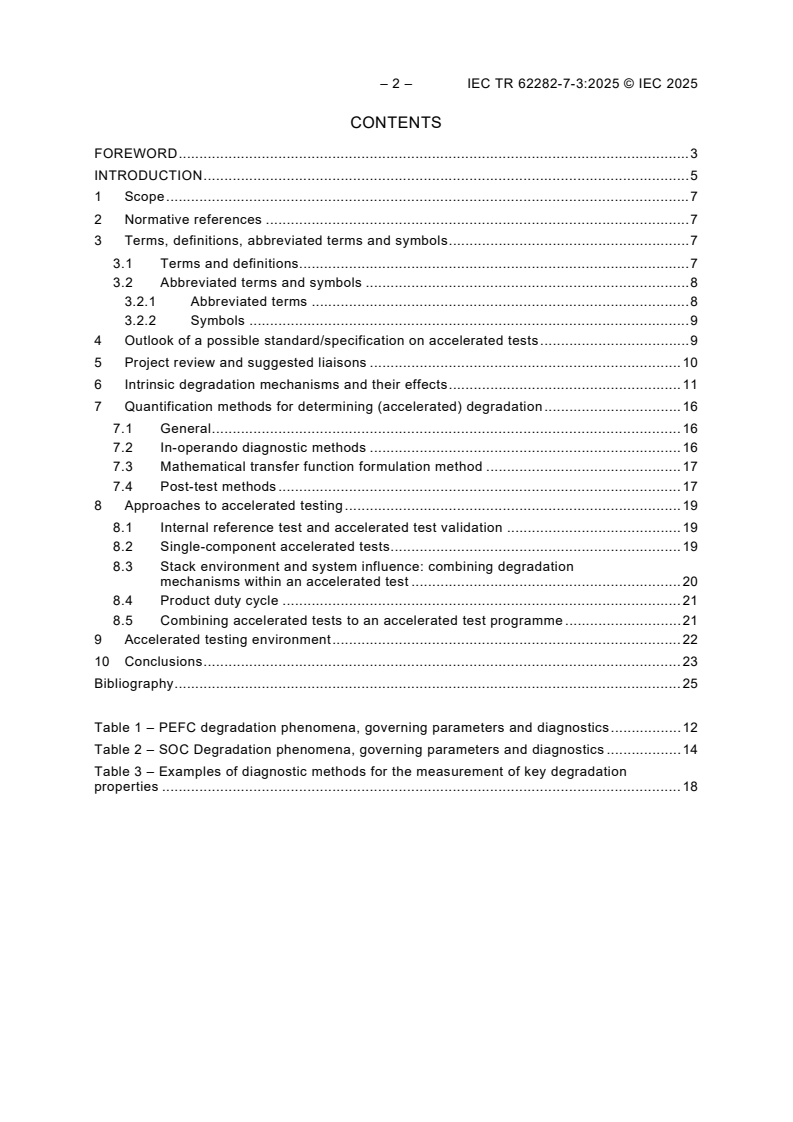
CONTENTS
FOREWORD . 3
INTRODUCTION . 5
1 Scope . 7
2 Normative references . 7
3 Terms, definitions, abbreviated terms and symbols . 7
3.1 Terms and definitions. 7
3.2 Abbreviated terms and symbols . 8
3.2.1 Abbreviated terms . 8
3.2.2 Symbols . 9
4 Outlook of a possible standard/specification on accelerated tests . 9
5 Project review and suggested liaisons . 10
6 Intrinsic degradation mechanisms and their effects . 11
7 Quantification methods for determining (accelerated) degradation . 16
7.1 General . 16
7.2 In-operando diagnostic methods . 16
7.3 Mathematical transfer function formulation method . 17
7.4 Post-test methods . 17
8 Approaches to accelerated testing . 19
8.1 Internal reference test and accelerated test validation . 19
8.2 Single-component accelerated tests . 19
8.3 Stack environment and system influence: combining degradation
mechanisms within an accelerated test . 20
8.4 Product duty cycle . 21
8.5 Combining accelerated tests to an accelerated test programme . 21
9 Accelerated testing environment . 22
10 Conclusions . 23
Bibliography . 25
Table 1 – PEFC degradation phenomena, governing parameters and diagnostics . 12
Table 2 – SOC Degradation phenomena, governing parameters and diagnostics . 14
Table 3 – Examples of diagnostic methods for the measurement of key degradation
properties . 18
INTERNATIONAL ELECTROTECHNICAL COMMISSION
____________
FUEL CELL TECHNOLOGIES –
Part 7-3: Test methods – Status of accelerated tests for fuel cell stacks
and components and perspectives for standardization
FOREWORD
1) The International Electrotechnical Commission (IEC) is a worldwide organization for standardization comprising
all national electrotechnical committees (IEC National Committees). The object of IEC is to promote international
co-operation on all questions concerning standardization in the electrical and electronic fields. To this end and
in addition to other activities, IEC publishes International Standards, Technical Specifications, Technical Reports,
Publicly Available Specifications (PAS) and Guides (hereafter referred to as "IEC Publication(s)"). Their
preparation is entrusted to technical committees; any IEC National Committee interested in the subject dealt with
may participate in this preparatory work. International, governmental and non-governmental organizations liaising
with the IEC also participate in this preparation. IEC collaborates closely with the International Organization for
Standardization (ISO) in accordance with conditions determined by agreement between the two organizations.
2) The formal decisions or agreements of IEC on technical matters express, as nearly as possible, an international
consensus of opinion on the relevant subjects since each technical committee has representation from all
interested IEC National Committees.
3) IEC Publications have the form of recommendations for international use and are accepted by IEC National
Committees in that sense. While all reasonable efforts are made to ensure that the technical content of IEC
Publications is accurate, IEC cannot be held responsible for the way in which they are used or for any
misinterpretation by any end user.
4) In order to promote international uniformity, IEC National Committees undertake to apply IEC Publications
transparently to the maximum extent possible in their national and regional publications. Any divergence between
any IEC Publication and the corresponding national or regional publication shall be clearly indicated in the latter.
5) IEC itself does not provide any attestation of conformity. Independent certification bodies provide conformity
assessment services and, in some areas, access to IEC marks of conformity. IEC is not responsible for any
services carried out by independent certification bodies.
6) All users should ensure that they have the latest edition of this publication.
7) No liability shall attach to IEC or its directors, employees, servants or agents including individual experts and
members of its technical committees and IEC National Committees for any personal injury, property damage or
other damage of any nature whatsoever, whether direct or indirect, or for costs (including legal fees) and
expenses arising out of the publication, use of, or reliance upon, this IEC Publication or any other IEC
Publications.
8) Attention is drawn to the Normative references cited in this publication. Use of the referenced publications is
indispensable for the correct application of this publication.
9) IEC draws attention to the possibility that the implementation of this document may involve the use of (a)
patent(s). IEC takes no position concerning the evidence, validity or applicability of any claimed patent rights in
respect thereof. As of the date of publication of this document, IEC had not received notice of (a) patent(s), which
may be required to implement this document. However, implementers are cautioned that this may not represent
the latest information, which may be obtained from the patent database available at https://patents.iec.ch. IEC
shall not be held responsible for identifying any or all such patent rights.
IEC TR 62282-7-3 has been prepared by IEC technical committee 105: Fuel cell technologies.
It is a Technical Report.
The text of this Technical Report is based on the following documents:
Draft Report on voting
105/1091/DTR 105/1103/RVDTR
Full information on the voting for its approval can be found in the report on voting indicated in
the above table.
The language used for the development of this Technical Report is English.
– 4 – IEC TR 62282-7-3:2025 © IEC 2025
This document was drafted in accordance with ISO/IEC Directives, Part 2, and developed in
accordance with ISO/IEC Directives, Part 1 and ISO/IEC Directives, IEC Supplement, available
at www.iec.ch/members_experts/refdocs. The main document types developed by IEC are
described in greater detail at www.iec.ch/publications.
A list of all parts in the IEC 62282 series, published under the general title Fuel cell
technologies, can be found on the IEC website.
The committee has decided that the contents of this document will remain unchanged until the
stability date indicated on the IEC website under webstore.iec.ch in the data related to the
specific document. At this date, the document will be
• reconfirmed,
• withdrawn, or
• revised.
INTRODUCTION
The scope of accelerated testing is to reduce the time for qualification of the degradation or the
long-term performance of a specific cell, cell component, stack, stack module or stack
component compared to testing at nominal operating conditions. To generate an accelerated
test, operating conditions stress a test item or one of its components, usually through the
exaggeration of one of the testing parameters (the so-called stress factor). The results of this
test are expected to provide a comparative assessment of the robustness (or degradation) of
the test item and possibly – through an established transfer function – an estimation of the
projected lifetime of the test item under nominal (non-stressed) conditions.
An accelerated test thus cannot be a self-standing experiment, since it cannot be applied
universally to all cell technologies, architectures or material combinations. Degradation
phenomena are different and occur heterogeneously for different fuel cell (stack) technologies
and in different operating modes. Also, different fabrication process of cells and components
can lead to different responses under stressed conditions (although the responses at nominal
conditions could be similar). In any case, for each accelerated test, a benchmark test item
(operated at nominal conditions and adequately characterized) is necessary in order to have a
meaningful reference against which the accelerated test can provide the required understanding
of long-term durability of that same item. Nevertheless, actual long-term testing under normal
operating conditions could be the only method to obtain an accurate degradation rate.
Tests on components (ex-situ tests) would only be relevant for comparison of such components,
since the relevance for performance within a system can only be provided in the integrated
assembly. For systems and end products, a generally applicable accelerated test for a given
application (without the need for benchmarking) is certainly useful and is possible in the same
way as there exist standardized drive cycles for vehicles/propulsion systems. However, it is still
considered a major challenge to define an operating cycle that represents the actual application
including events that contribute to degradation like start-stop cycles, air-air-starts, freeze starts,
pressure and humidity cycles, temperature cycles etc. Nevertheless, standardized types of tests
could be defined, generic for all types of fuel cells, with specific test conditions and cycles
adapted to each application case and to each mission profile to be represented.
It is important to understand whether existing standards for testing performance of cells or
stacks (e.g. IEC 62282-7-1 and IEC 62282-7-2, or IEC 62282-8-101 and IEC 62282-8-102) are
sufficient for the definition of the testing approach, and only need a specific (quantified)
definition of the required test parameters for them to be suitable for the accelerated estimation
of durability or lifetime degradation. For example, an increase in operating temperature can be
an accelerating test in solid oxide fuel cells (SOFCs). However, the measurements of
electrochemical performance of cells/stacks at higher temperatures can be carried out
according to the normal standard method (i.e. IEC 62282-7-2 or IEC 62282-8-101). The
accelerated test is expected to enable an inference, from measurement of performance
degradation at high temperature in this example, of the long-term durability of the tested
cell/stack at nominal conditions (i.e. nominal temperature), and – crucially – in a shorter period
of testing time than at nominal conditions. However, the increase of operation temperature (for
example) can change not only cationic diffusion at the electrode/electrolyte interfaces but also
the performance of electrodes/ionic diffusion. In this case, the one stress factor of increasing
temperature can affect multiple performance degradation mechanisms of the SOFC, possibly
with different time scales. Therefore, it will be difficult to univocally correlate an accelerating
factor between degradation/lifetime in the test conditions and degradation/lifetime in nominal
conditions. Defining a window of acceptance where the effects of one accelerating stress factor
can be called representative of a single degradation mechanism can be a viable approach, even
if other intrinsic mechanisms are affected to a lesser degree. To do this would likely require
support from dedicated modelling activities, as well as by gathering the experience from
manufacturers and comparing results with real long term durability tests.
In other cases, new, dedicated test procedures can be formulated to accelerate specific
degradation mechanisms (e.g. controlled oxidation of solid oxide cell (SOC) electrodes to
estimate redox stability).
– 6 – IEC TR 62282-7-3:2025 © IEC 2025
In order to validate the reliability and representativeness of accelerated test procedures, post-
test characterisation on samples having undergone tests are indispensable, also to compare
the morphological/chemical state of test items after accelerated testing with samples from "real-
time" ageing. Though this would fall outside the scope of TC 105, there is a description of such
techniques and their applicability in Clause 4.
In this document, only intrinsic degradation mechanisms are considered, inherent to the
operation of the cell/stack, and excluding degradation caused by externalities (impurities,
shocks, etc.). Nevertheless, it is noted that an approach on contamination is still missing in the
standards portfolio, both on fuel and air sides.
Finally, operating fuel cells in electrolysis mode will be considered, either for systems that can
operate in reverse mode, or because it has been found that electrolysis mode can be a means
to accelerate degradation mechanisms that occur in fuel cell mode.
This document has been compiled based on input from several National Committees and
experts, convened in Ad Hoc Group 11 of IEC TC 105, and from two European projects funded
by the Fuel Cells and Hydrogen Joint Undertaking (ID-FAST and AD ASTRA). The current
Report represents a consensus on the status of accelerated tests for fuel cell stacks and
components and outlines the perspectives for standardization of accelerated test procedures.
FUEL CELL TECHNOLOGIES –
Part 7-3: Test methods – Status of accelerated tests for fuel cell stacks
and components and perspectives for standardization
1 Scope
The objective of this document is to answer several questions that have been circulating in the
area of fuel cell development for many years: "What do we know about influencing fuel cell
degradation, can we control it and accelerate it in a predictable way, is there a need for
accelerated test procedures and can these be formulated adequately enough to be captured in
international standards?"
This document is a generic assessment of the feasibility of standardizing accelerated test
procedures (both proton exchange membrane (PEM) and oxide ion-conducting solid oxide cell
(SOC) technologies) for fuel cell stacks that have been engineered for a specific system
application. This document comprises a review of literature and projects, a discussion of the
main physical phenomena of interest in accelerated testing campaigns (focusing on the cell and
stack levels, not looking at the system as a black box), a compendium of measurement
techniques that are applicable, and it suggests a macroscopic approach to the formulation of a
representative accelerated testing campaign.
2 Normative references
There are no normative references in this document.
3 Terms, definitions, abbreviated terms and symbols
3.1 Terms and definitions
For the purposes of this document, the following terms and definitions apply.
ISO and IEC maintain terminology databases for use in standardization at the following
addresses:
• IEC Electropedia: available at https://www.electropedia.org/
• ISO Online browsing platform: available at https://www.iso.org/obp
3.1.1
accelerated lifetime test
ALT
process of testing a product by subjecting it to aggravated operating conditions (stress, strain,
temperatures, voltage, vibration rate, pressure etc.), thus in excess of nominal service
parameters, in an effort to uncover faults and modes of failure in a short period of time to define
explicitly its full lifetime
Note 1 to entry: This is thus a test for fast-forwarding time, and it is a destructive test in principle. Usually, it is
conducted applying the more relevant failure stresses (this means that they are previously identified), aggravating
normal conditions of use.
For example, if a manufacturer/supplier wishes to guarantee a product for e.g. 10 years, by ALT it can verify what is
the risk to be accounted for, without waiting 10 years or more. This type of test is particularly relevant for components
or systems that are to be introduced to the market.
– 8 – IEC TR 62282-7-3:2025 © IEC 2025
3.1.2
accelerated stress test
AST
process of applying high levels of stress for a short period of time to a device under test (DUT)
assuming it will exhibit the same degradation mechanisms as it would in a longer period of time
at lower stress levels
Note 1 to entry: This is thus a test for assessing degradation generated by stress. Although it is non-destructive in
principle, the device could also be damaged, but certainly less than during ALT. It is not finalised to the determination
of the lifetime, but at the determination/study of potential long-term failure mechanisms and possible mitigation
strategies. It is a test more suitable for research and development (R&D), because it is useful e.g. for verifying what
the effect is of specific operating conditions on the test object or the system, with a view to developing better materials
and components.
3.2 Abbreviated terms and symbols
3.2.1 Abbreviated terms
ACL anode catalyst layer LSCF lanthanum strontium cobalt ferrite
ALT accelerated lifetime test MEA membrane-electrode assembly
ASR area-specific resistance MPL microporous layer
AST accelerated stress test NEDO New Energy Development
Organization
BET Brunner-Emmett-Teller OCV open-circuit voltage
BoP balance-of-plant OEM original equipment manufacturer
BPP bipolar plate PEFC polymer electrolyte fuel cell
CCM catalyst-coated membrane PEM proton exchange membrane
CL catalyst layer R&D research and development
CV cyclic voltammetry RDE rotating disc electrode
DUT device under test RH relative humidity
ECSA electrochemically active surface area SEM scanning electron microscopy
EIS electrochemical impedance spectroscopy SOC solid oxide cell
EDX energy dispersive X-ray analysis SOFC solid oxide fuel cell
EPMA electron probe microanalysis STP standard temperature and pressure
FCTT United States Fuel Cell Technical Team TEM transmission electron microscopy
FCCJ fuel Cell Commercialization Conference of Japan TPB triple-phase boundary
FIB-SEM focused ion beam SEM XPS X-ray photoelectron spectroscopy
GDL gas diffusion layer XRD X-ray diffraction
HRTEM high-resolution transmission electron microscopy XRF X-ray fluorescence
ICP inductively coupled plasma
3.2.2 Symbols
2 2
ASR area specific resistance
Ω∙m , Ω∙cm
2 2
J current density A/m , A/cm
∆J/∆t rate of current density variation
A/m s
3 2
𝑞𝑞
rate of variation of the gas volumetric flow rate m /s
𝑣𝑣̇
T temperature °C, K
x undefined parameter -
-1
∆x/∆t rate of change of x
s
∆α
relative degradation rate -
r
NOTE 1 To express the rate of change of a certain parameter x, a dot above the parameter symbol can be used.
used to express the speed of
For instance, 𝑇𝑇̇ can be used to express the temperature ramp with a unit of K/s, 𝑞𝑞
𝑣𝑣̇
variation of the gas flow rate with a unit of (m /s)/s. Alternatively, (∆x/∆t) can be used. For instance, the temperature
ramp can be expressed by (∆T/∆t) and the speed of current density variation can be expressed by (∆J/∆t).
NOTE 2 The quantity ∆α chosen for calculating the degradation rate can be the cell or stack voltage, current,
power density or ASR, each with their own unit.
4 Outlook of a possible standard/specification on accelerated tests
From a supplier's point of view, a standard to define test methods for estimating the lifetime of
the product (ALT) is of highest importance, also in view of engendering the required confidence
to formulate product guarantees, which in turn are crucial for investors and project developers
to market innovative solutions. After having defined the correct end application, accelerated
tests are expected to predict lifetime and the influence of correlated events (freeze start, air-
air-start, starvation, cell potential reversal, cycling, etc.). A standard for these tests would define
the test and measurement methods, the testing protocols (e.g. kinds and ranges of stress to be
applied, etc.) and provide a clear indication of the degradation mechanisms that the application
of such procedures would accelerate. The definition of certain test parameters can be given
(e.g. air and H2 quality) to be able to compare different solutions by a common test procedure.
In the case of ALTs, it is important to quantify the degree of acceleration that the tests would
lead to. In the case of ASTs, used for R&D, the aim of these tests would be to provide a
benchmark for comparison between different products/components/materials as to the
response to a specific degradation mechanism or event. In order to predict the influence of
single events on lifetime, further systematic tests can reveal, by knowing type and
number/frequency of the defined events and the nominal operational profile of the tested
system, the resulting lifetime in "real-world" conditions (not in accelerated tests).
Possibly, indications can be given as to the number of test repetitions required for reliability, so
that the standard could be used also for "certification" by accredited bodies.
In the rest of this document, reference will be made to accelerated tests generically, without
specifying ALT or AST, since each accelerated testing procedure can be declined as addressing
a specific degradation mechanism (AST) or estimated lifetime (ALT) depending on the
parameter and protocol definitions. This differentiation will be the task of a subsequent work on
a Technical Specification or International Standard.
– 10 – IEC TR 62282-7-3:2025 © IEC 2025
5 Project review and suggested liaisons
Certain fuel cell manufacturers have developed internal correlations between accelerated tests
and full-scale duty cycles, but these results tend to be treated as trade secrets because of their
commercial value. There are a number of available documents or liaisons that can be useful in
the development of a possible standard on accelerated testing.
A liaison is suggested with the US Department of Energy (US DoE) project on accelerated tests
within a framework project called HYDROGEN, which sees the collaboration of players from
France, USA and Japan. Accelerated testing protocols for PEFCs, specifically for heavy duty
vehicle applications, are being developed in a collaboration between M2FCT (USA),
IMMORTAL (EU), and FC-PLATFORM (Japan) with original equipment manufacturers (OEMs):
sharing of drive cycles from the 21st Century Truck Partnership (21CTP) as well as system
modelling efforts. Also, a group "Baselining, MEA testing and protocols" will explore MEA
2 2 2
testing from 1 cm cells (Japan), 5 cm and 50 cm cells (USA) to short stacks (EU) for better
understanding a scaling of performance and durability from small differential cells to operating
stacks.
Besides one accelerating stress factor representative of a single degradation mechanism,
combined effects on the durability are recognized to be significant. For example, a
chemical/mechanical protocol has been proposed to examine the combined effects of humidity
and radicals’ formation on the durability of polymer electrolyte membranes [1] . A new "highly
accelerated stress test" for the combined chemical mechanical degradation has been proposed
by General Motors and is currently utilized by 3M [2]. The M2FCT project has also announced
that they will employ this protocol.
The U.S. DRIVE Fuel Cell Tech Team Cell Component Accelerated Stress Test and Polarization
Curve Protocols for PEM Fuel Cells use the existing profiles for automotive accelerated testing,
though it is unclear how widely these protocols are used in industry. Some aspects of these
profiles are considered unsatisfactory, leading to development of internal protocols.
In the Japanese New Energy Development Organization (NEDO) Project on durability and
reliability of SOFC stacks (2013-2019), there are numerous data which are related to
accelerated stress testing. Among them, the following tests were conducted as accelerated
stress testing on stacks, and these tests are the main candidates for accelerated stress testing:
1) intentionally adding of impurities to the electrodes in single cells (such as Cr-vapor, S-vapor,
and Si-vapours, etc.),
2) thermal cycling of SOFC stacks,
3) high fuel utilization test at constant current density in the stacks (up to 85 % U ),
f
4) load cycling tests with constant fuel flow in the stack.
For polymer electrolyte fuel cell (PEFC) test protocols, a publication is available by NEDO
(December, 2012).
The Chinese standard GB/T 38914-2020: "Evaluation method for lifetime of proton exchange
membrane fuel cell stack in vehicle application". is already defined but it has strong and
generally unproven assumptions. The strongest assumptions are (1) linear independence of
degradation triggered by separate events, i.e. assuming no path dependency, (2) linear
extrapolation allowed up to user defined degradation limit (e. g. 60 mV voltage loss at nominal
load).
A correlation with monitoring and diagnostic tools installed in real stacks/systems could be
useful (see EU-funded projects INSIGHT/RUBY/REFLEX for instance).
___________
Numbers in square brackets refer to the Bibliography.
In the Bibliography, a number of useful website resources [3] to [6], publications on
measurement procedures [7] to [14], relevant scientific papers [15] to [28] and standards [29]
to [44] is given, as well as an indication of European [45] to [52], North-American [53] to [58]
and Japanese [57] and [60] projects that have contributed to the state of the art on accelerated
testing.
6 Intrinsic degradation mechanisms and their effects
In the following, an overview is given of those degradation mechanisms that characterise long-
term lifetime limitation, and which it would be desirable to accelerate in order to assess their
effect over very long operation times in significantly shorter testing times. The focus is on
intrinsic mechanisms, i.e. those mechanisms that are unavoidable and related to the "natural"
deactivation of a component due to the occurring conditions of use. Extrinsic mechanisms
(poisoning, mechanical shocks etc.) are important causes for lifetime limitation but are not
strictly necessary to be accelerated.
Given that:
– an AST correlates to a specific benchmark (materials, application area, etc.),
– a sensitivity analysis is needed to determine the window of acceptance of the effects of a
given accelerating stressor,
the Quantification methods in Table 1 consider the operating regime for which each are
applicable. The tables below (Table 1 for PEFC technology first, Table 2 for SOC technology
afterwards) are intended to help correlate:
1) the identification of the degradation problem,
2) a possible simplification of it in terms of cause (the most important stressor),
3) what to measure to verify the effectiveness of this simplification,
4) how to evaluate the accuracy of the simplification.
As pointed out in the introduction, there are difficulties to specify one single stress factor for
each degradation mechanism. For example, the process fabrication temperature (firing
temperature) of SOCs and materials combination can affect the degradation factors presented
in the table. Also, the operation mode (in particular for reversible operation as described in
IEC 62282-8-101) will lead to different degradation mechanisms even with the same cell
configuration. It is important that these effects are considered and included when considering
the "window" of the accessible stressors.
As indicated in Table 1 and Table 2, the effect of the degradation mechanisms can be qualified
by post analyses methods. However, these are out of scope of the IEC TC 105 standards. Test
procedures rely on electrochemical measurements, such as I-V characteristics, long-term
potentiostatic or galvanostatic measurements, current interruption methods, and/or
electrochemical impedance spectroscopy (EIS) measurements.
– 12 – IEC TR 62282-7-3:2025 © IEC 2025
Table 1 – PEFC degradation phenomena, governing parameters and diagnostics
Degradation Stressors Effects and Quantification methods
mechanism consequences
(primary cause)
GDL carbon Gas switching on cathode Decrease in GDL or MPL transport
corrosion hydrophobicity properties (in-situ?)
Temperature
Increase in gas transport Limitations such as
Cell hydration
resistance transport resistance,
protonic resistance (by
Cell overpotential
Increase in ohmic
EIS)
resistance
Cathode high potential
Cyclic voltammetry
(caused by reverse current)
(effective catalyst surface
Anode high potential (cell
area)
reversal due to fuel starvation,
Current mapping
caused by anode
stoichiometry < 1)
SEM analysis, also
contact angle
measurement as
hydrophobic behaviour
can be affected, also
porosity measurements
Cathode catalyst Cathode high potential Contribution to catalyst Cyclic voltammetry (ECSA
layer carbon particles modification: losses and modification of
(Caused by reverse current,
corrosion electrochemical properties
(anode flooding, H2 starvation catalyst particle
vs. PtOx
if anode stoichiometry < 1), modification
formation/reduction)
such as during start-up, with detachment of catalyst
H2/Air front) particles, agglomeration Limitations such as
of catalyst particles, transport resistance,
Gas switching on cathode
dealloying (Pt-alloy) protonic resistance (by
EIS)
Temperature
Contact loss leading to
increase in protonic and Current mapping
High relative humidity
electronic resistance
SEM and TEM analysis
Thinning of the catalyst
CO2 exhaust
layer
measurement
Change in porosity
Raman spectroscopy
Anode catalyst layer High potential (avoid a Support oxidation ECSA, SEM post-mortem,
carbon corrosion mixture of stressors like Anode catalyst
Loss of carbon support of
(cell reversal) membrane drying during the composition / where can
the ACL reduced
test!) alloy components be
anode ECSA, evolution
found after test?
Anode high potential (caused of anode microstructure
by anode stoichiometry < 1) Raman or XPS for post-
mortem carbon
morphology
characterization
Cyclic voltammetry (ECSA
losses and modification of
electrochemical properties
vs. PtOx
formation/reduction)
Limitations such as
transport resistance,
protonic resistance (by
EIS)
Current mapping
SEM and TEM analysis
Degradation Stressors Effects and Quantification methods
mechanism
consequences
(primary cause)
Anode corrosion High potential (avoid a Pt-oxidation, Cyclic voltammetry
(cell reversal mixture of stressors like oxidation/dissolution of (effective catalyst surface
tolerance) membrane drying during the other metals area)
test)
Current mapping
SEM analysis distribution
throughout the cell / Ir-
Ir/Ru-mapping; Pt-
concentration by ICP
Catalyst de-alloying High potential causing Surface area loss Cyclic voltammetry (ECSA
/ selective oxidation / dissolution Dissolution of smaller losses and modification of
corrosion, structure particles electrochemical properties
Local flooding
changes due to vs. PtOx
Modification of particles
dealloying formation/reduction)
Potential cycling
surface composition
Multi-metallic Pt Advanced electron
Temperature
Contamination of
based catalysts microscopy (SEM, TEM,
ionomer (membrane and
electrochemical Cell hydration EDX), effluent analysis
catalyst layer) by metallic
Ostwald ripening (ICP) for alloy
cations
and oxidation / components, metal
dissolution mapping in MEA. HRTEM
Pt precipitates within the
of particles with element
ionomer
mapping. ECSA can
increase by corrosion of
alloys
Platinum oxidation/
High potential Surface area loss (all ECSA assessed by cyclic
dissolution/ modes) voltammetry
Potential cycling
agglomeration/
Dissolution of smaller Charge transfer resistance
Electrochemical
(for PtOx and dissolution
particles assessed by EIS
Ostwald ripening
based mechanisms)
Pt precipitates within the Particles size distribution,
Temperature (High T > 80°C)
ionomer catalyst and catalyst
layers structure
High humidity (wet or flooding
modifications by advanced
conditions)
electron microscopy
Cell hydration (SEM, TEM, EDX)
Ionomer Cell potential including OCV Mass transport property Mechanical or
degradation for the changes (water uptake, electrochemical leak test
Temperature
membrane and the wetting) to assess permeation (H2
catalyst layers crossover by voltammetry)
Relative humidity (low RH or T
Proton conductivity
(chemical stability
and RH cycles for the
losses High frequency resistance
losses)
membrane)
and CL protonic
Ionomer distribution
conductivity by EIS
Cell hydration
within the membrane or
the CLs Product water conductivity
O2 permeation through
(fluoride emission)
membrane (triggers H2O2
Gas leakage through the
formation on anode –
membrane Membrane or CL structure
chemical stress on ionomer
modifications by advanced
and membrane on anode side)
electron microscopy (XPS
for structural changes in
Impurities (Ions) from stack
the ionomer?)
(BPP) or bench for membrane
chemical attack (scope?)
Membrane cracking Wet-dry cycles Gas leakage through the Mechanical or
(mechanical membrane electrochemical leak test
Temperature
degradation
Product water conductivity
including
Stack mechanical
relationship
compression (uneven) SEM analysis
between cathode
layer cracking and Mechanical properties of
membrane failure; membrane
migration of CeOx))
– 14 – IEC TR 62282-7-3:2025 © IEC 2025
Degradation Stressors Effects and Quantification methods
mechanism
consequences
(primary cause)
Metallic bipolar High potential Increase in contact Resistance measurements
plate degradation resistance, delamination (in- and ex-situ), effluent
(base material and of coating, poisoning of analysis, also post-
coating) MEA mortem MEA-analysis for
metal ions, SEM/X-
EDS/XPS for coating
characterization
Graphite bipolar High potential Loss of carbon SEM, contact angle (?),
plate degradation Raman, increase in
roughness, change in
surface structure
Sealant degradation pH, high potential, fluoride Disintegration of SEM (elastomer surface),
concentration, contact to elastomer, contamination EDX, XPS (composition of
membrane of other components by elastomer, elemental
degradation products mapping over the cell,
dependent on elastomer)
Table 2 – SOC Degradation phenomena, governing parameters and diagnostics
Degradation Stressors Effects and Quantification methods
mechanism (primary consequences
cause)
Nickel agglomeration + Temperature Change in Microstructural characterization
Ni migration microstructures in Ni- techniques like SEM analysis and
Thermal cycling
oxide cermet more accurate techniques if
needed
Cell polarization
Loss of TPB active
area ASR measurements
Steam content
Loss of Ni particles I-V characteristics
connection
Ni re-oxidation Steam content (low Change in SEM analysis
H partial pressure) microstructures in Ni-
ASR measurements
oxide cermet
Fuel starvation
I-V characteristics
Loss of TPB active
Redox cycling area
Ni(OH) or NiO
formation
Ni evaporation Steam content Change in ASR measurements
microstructures in Ni-
I-V characteristics
oxide cermet
Loss of TPB active
area
Ni(OH) or NiO
formation
LSCF demixing Polarization Change in SEM analysis
microstructures
Current density ASR measurements
Active surface reaction
Oxygen partial I-V characteristics
area reduced
pressure
Sr segregation
Humid air
Degradation Stressors Effects and Quantification methods
mechanism (primary
consequences
cause)
Phase transformation (at Polarization Cubic Tetragonal SEM analysis
ZrO based electrolyte) phase transformation
Temperature Current interruption
Ni dissolution will
Raman spectroscopy
facilitate the Tetra
formation
Interface Temperature Change in EIS analysis
reaction/diffusion microstructures
Polarization SEM analysis
Formation of resistive
Formation of insulating
layers
Current density ASR measurements
phase (e.g. SrZrO )
I-V characteristics
Current interruption
Crack/Interface Temperature Loss of contact EIS analysis
delamination, exfoliation surface, which induces
Thermal cycling SEM analysis
an increase in ohmic
resistance
Mechanical pressure
Oxygen partial
pressure
Contact loss Temperature Loss of contact EIS analysis, SEM analysis
surface, which induces
Thermal cycling
an increase in ohmic
resistance
Mechanical pressure
Oxygen partial
pressure
Interconnect oxidation Temperature Formation of an oxide SEM analysis
phase that increases
Atmosphere
ohmic resistance
(enriched air, pure
O , steam content)
Chromium evaporation Temperature, At the interconnect, the SEM, TEM, Raman spectroscopy,
pressure, presence of chromium X-ray diffraction, EDX
in the metal substrate
Atmosphere
can lead to volatile
(especially steam
oxide, oxy-hydroxide
content)
and/or hydroxide
formation that could
release Cr species
through evaporation
that will subsequently
poison the cell
(formation of
secondary phases and
change in composition
of the ceramic)
Tightness loss Flow rates / Mixing of fuel and air OCV, ratio between inlet and
pressure in stack in the stack that can outlet flow rates, T measurement,
combust, or loss of fuel
SEM analysis
Delta P between
out of the stack,
fuel and air
decreasing the stack
chambers
performance
– 16 – IEC TR 62282-7-3:2025 © IEC 2025
7 Quantification methods for determining (accelerated) degradation
7.1 General
In order to correlate the degradation effects under specific accelerated testing conditions with
those under nominal conditions, and thereby make a statement as to the expected lifetime in
nominal conditions based on accelerated test results, it is important to quantify the effects of
degradation in both conditions and find a way to correlate them. There are a number of
techniques available for degradation quantification, some of which are in-operando
(measurements during testing) and some of which are post-test. These are listed below. Note
that these techniques just describe diagnostic methods but do not give indications on testing
conditions that could be valid for accelerating degradation in a way that can be extrapolated to
regular degradation.
7.2 In-operando diagnostic methods
Valid for PEFC and SOFC:
– Determine voltage increase (electrolysis) or decrease (fuel cell) over time, if operating at
constant current (or current decrease over time if operating at constant
...