

IEC TR 63216:2019
(Main)Low-voltage switchgear and controlgear - Electromagnetic compatibility assessment for switchgear and controlgear and their assemblies
General Information
- Abstract
IEC TR 63216:2019 is to define homogeneous categories for the electromagnetic environments in order to harmonize as far as practicable all general rules and product standard requirements of electromagnetic compatibility (EMC), applicable to low-voltage switchgear, controlgear and their assemblies with built-in electronic circuits.
This document also addresses incorporated radiocommunication functions.
The typical application environments for such equipment include the electrical distribution in infrastructure, commercial and industrial buildings and the control systems of machinery, including motor-driven systems.
The primary intention of EMC requirements is to ensure the safe and reliable operation of the equipment, as well as the communication efficiency of the radiocommunication equipment within their intended environments.
- Status
- Published
- Publication Date
- 21-Oct-2019
- Technical Committee
- SC 121A - Low-voltage switchgear and controlgear
- Current Stage
- PPUB - Publication issued
- Start Date
- 22-Oct-2019
- Completion Date
- 18-Nov-2019
Overview
IEC TR 63216:2019 provides guidance for the electromagnetic compatibility (EMC) assessment of low-voltage switchgear, controlgear and their assemblies - especially those with built-in electronic circuits and incorporated radiocommunication functions. The technical report defines homogeneous categories of electromagnetic environments to harmonize product and assembly EMC requirements, with the goal of ensuring safe, reliable operation and effective radiocommunication performance in intended environments such as electrical distribution in infrastructure, commercial and industrial buildings, and machinery control (including motor-driven systems).
Key topics and technical content
- Classification of electromagnetic environments - tailored environment categories derived from the IEC 61000 family and aligned with zones like those in IEC 61131-2.
- EMC assessment principles - system-level approach to determine compatibility between equipment and its expected electromagnetic environment.
- Ports of entry and coupling mechanisms - identification of how disturbances enter equipment (power, signal, enclosure, antennas).
- Emission and immunity considerations - guidance on radiated and conducted emissions, immunity phenomena (including radiated immunity, common-mode RF, voltage dips, transients and overvoltages).
- Radiocommunication functions - treatment of incorporated wireless/radio communication within switchgear and controlgear assemblies.
- Drafting EMC requirements - recommendations for writing product and assembly standards, including what environmental information and test evidence to specify.
- Information for users and installers - instructions for use, good wiring practices, and information related to emission limits and safe installation.
- Informative annexes - rationale based on network topology and a catalogue of EMC phenomena to support test selection and interpretation.
Practical applications and who uses this standard
IEC TR 63216:2019 is useful for:
- Manufacturers and product designers of low-voltage switchgear and controlgear who need to define or verify EMC performance.
- Standards committees and test laboratories drafting or applying product/assembly EMC requirements and test programs.
- EMC engineers and system integrators assessing compatibility in building distribution systems, industrial automation and machinery control panels.
- Specifiers and procurement teams seeking harmonized EMC criteria for equipment selection and acceptance.
Typical applications include defining emission/immunity test scopes, integrating radiocommunication features in controlgear, preparing installation guidance (wiring/layout), and ensuring compliance of assemblies used in industrial, commercial and infrastructure electrical distribution.
Related standards
- IEC 60947 series (switchgear and controlgear design principles referenced)
- IEC 61000 series (generic EMC test methods and environment definitions)
- IEC 61131-2 (environmental zones referenced for controllers)
- CISPR 11 (emission limits - referenced for conducted/radiated limits)
Keywords: IEC TR 63216:2019, EMC, electromagnetic compatibility, low-voltage switchgear, controlgear, radiocommunication, emissions, immunity, IEC 60947, IEC 61000.
Get Certified
Connect with accredited certification bodies for this standard

IMQ S.p.A. (Certification)
Italian electrical product certification.

SLG Prüf- und Zertifizierungs GmbH
German testing and certification body.

UL Solutions
Global safety science company with testing, inspection and certification.
Sponsored listings
Frequently Asked Questions
IEC TR 63216:2019 is a technical report published by the International Electrotechnical Commission (IEC). Its full title is "Low-voltage switchgear and controlgear - Electromagnetic compatibility assessment for switchgear and controlgear and their assemblies". This standard covers: IEC TR 63216:2019 is to define homogeneous categories for the electromagnetic environments in order to harmonize as far as practicable all general rules and product standard requirements of electromagnetic compatibility (EMC), applicable to low-voltage switchgear, controlgear and their assemblies with built-in electronic circuits. This document also addresses incorporated radiocommunication functions. The typical application environments for such equipment include the electrical distribution in infrastructure, commercial and industrial buildings and the control systems of machinery, including motor-driven systems. The primary intention of EMC requirements is to ensure the safe and reliable operation of the equipment, as well as the communication efficiency of the radiocommunication equipment within their intended environments.
IEC TR 63216:2019 is to define homogeneous categories for the electromagnetic environments in order to harmonize as far as practicable all general rules and product standard requirements of electromagnetic compatibility (EMC), applicable to low-voltage switchgear, controlgear and their assemblies with built-in electronic circuits. This document also addresses incorporated radiocommunication functions. The typical application environments for such equipment include the electrical distribution in infrastructure, commercial and industrial buildings and the control systems of machinery, including motor-driven systems. The primary intention of EMC requirements is to ensure the safe and reliable operation of the equipment, as well as the communication efficiency of the radiocommunication equipment within their intended environments.
IEC TR 63216:2019 is classified under the following ICS (International Classification for Standards) categories: 29.130.20 - Low voltage switchgear and controlgear. The ICS classification helps identify the subject area and facilitates finding related standards.
IEC TR 63216:2019 is available in PDF format for immediate download after purchase. The document can be added to your cart and obtained through the secure checkout process. Digital delivery ensures instant access to the complete standard document.
Standards Content (Sample)
IEC TR 63216 ®
Edition 1.0 2019-10
TECHNICAL
REPORT
colour
inside
Low-voltage switchgear and controlgear – Electromagnetic compatibility
assessment for switchgear and controlgear and their assemblies
All rights reserved. Unless otherwise specified, no part of this publication may be reproduced or utilized in any form
or by any means, electronic or mechanical, including photocopying and microfilm, without permission in writing from
either IEC or IEC's member National Committee in the country of the requester. If you have any questions about IEC
copyright or have an enquiry about obtaining additional rights to this publication, please contact the address below or
your local IEC member National Committee for further information.
IEC Central Office Tel.: +41 22 919 02 11
3, rue de Varembé info@iec.ch
CH-1211 Geneva 20 www.iec.ch
Switzerland
About the IEC
The International Electrotechnical Commission (IEC) is the leading global organization that prepares and publishes
International Standards for all electrical, electronic and related technologies.
About IEC publications
The technical content of IEC publications is kept under constant review by the IEC. Please make sure that you have the
latest edition, a corrigendum or an amendment might have been published.
IEC publications search - webstore.iec.ch/advsearchform Electropedia - www.electropedia.org
The advanced search enables to find IEC publications by a The world's leading online dictionary on electrotechnology,
variety of criteria (reference number, text, technical containing more than 22 000 terminological entries in English
committee,…). It also gives information on projects, replaced and French, with equivalent terms in 16 additional languages.
and withdrawn publications. Also known as the International Electrotechnical Vocabulary
(IEV) online.
IEC Just Published - webstore.iec.ch/justpublished
Stay up to date on all new IEC publications. Just Published IEC Glossary - std.iec.ch/glossary
details all new publications released. Available online and 67 000 electrotechnical terminology entries in English and
once a month by email. French extracted from the Terms and Definitions clause of
IEC publications issued since 2002. Some entries have been
IEC Customer Service Centre - webstore.iec.ch/csc collected from earlier publications of IEC TC 37, 77, 86 and
If you wish to give us your feedback on this publication or CISPR.
need further assistance, please contact the Customer Service
Centre: sales@iec.ch.
IEC TR 63216 ®
Edition 1.0 2019-10
TECHNICAL
REPORT
colour
inside
Low-voltage switchgear and controlgear – Electromagnetic compatibility
assessment for switchgear and controlgear and their assemblies
INTERNATIONAL
ELECTROTECHNICAL
COMMISSION
ICS 29.130.20 ISBN 978-2-8322-7542-9
– 2 – IEC TR 63216:2019 © IEC 2019
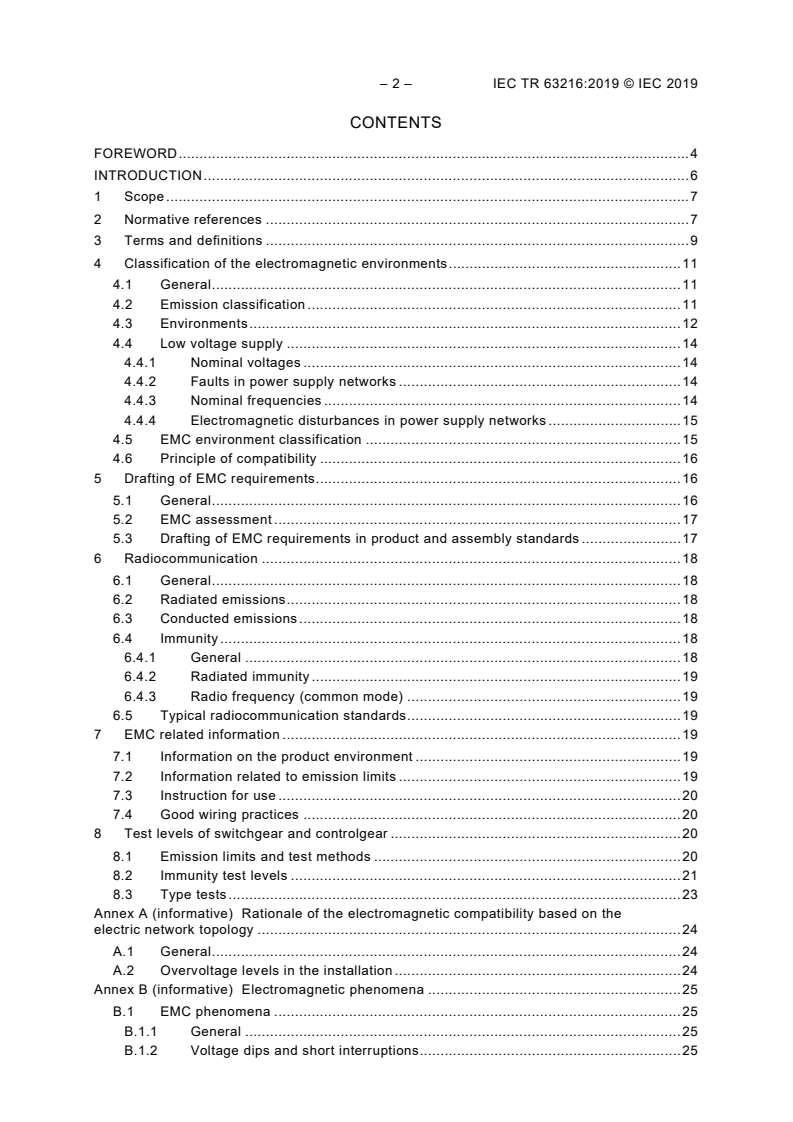
CONTENTS
FOREWORD . 4
INTRODUCTION . 6
1 Scope . 7
2 Normative references . 7
3 Terms and definitions . 9
4 Classification of the electromagnetic environments . 11
4.1 General . 11
4.2 Emission classification . 11
4.3 Environments . 12
4.4 Low voltage supply . 14
4.4.1 Nominal voltages . 14
4.4.2 Faults in power supply networks . 14
4.4.3 Nominal frequencies . 14
4.4.4 Electromagnetic disturbances in power supply networks . 15
4.5 EMC environment classification . 15
4.6 Principle of compatibility . 16
5 Drafting of EMC requirements . 16
5.1 General . 16
5.2 EMC assessment . 17
5.3 Drafting of EMC requirements in product and assembly standards . 17
6 Radiocommunication . 18
6.1 General . 18
6.2 Radiated emissions . 18
6.3 Conducted emissions . 18
6.4 Immunity . 18
6.4.1 General . 18
6.4.2 Radiated immunity . 19
6.4.3 Radio frequency (common mode) . 19
6.5 Typical radiocommunication standards . 19
7 EMC related information . 19
7.1 Information on the product environment . 19
7.2 Information related to emission limits . 19
7.3 Instruction for use . 20
7.4 Good wiring practices . 20
8 Test levels of switchgear and controlgear . 20
8.1 Emission limits and test methods . 20
8.2 Immunity test levels . 21
8.3 Type tests . 23
Annex A (informative) Rationale of the electromagnetic compatibility based on the
electric network topology . 24
A.1 General . 24
A.2 Overvoltage levels in the installation . 24
Annex B (informative) Electromagnetic phenomena . 25
B.1 EMC phenomena . 25
B.1.1 General . 25
B.1.2 Voltage dips and short interruptions . 25
B.1.3 Overvoltages . 25
B.1.4 Sine wave disturbances . 26
B.1.5 Three-phase system disturbances . 26
B.1.6 Electromagnetic disturbances . 26
B.1.7 Electromagnetic fields (EMF) . 27
B.1.8 Transient . 27
B.1.9 Radiated modulated disturbances . 27
B.1.10 Radio frequency identification (RFID) systems . 27
B.1.11 Radiated pulsed disturbances . 28
B.1.12 Electrostatic discharge . 28
B.2 Relation between testing standards and basic phenomena . 28
Bibliography . 31
Figure 1 – Ports of entry of electromagnetic disturbances into equipment . 11
Figure 2 – Example of EMC environments . 13
Figure 3 – Principle of EMC compatibility . 16
Figure 4 – CISPR 11:2015, Class A limits (quasi peak) for conducted and radiated
emission at 10 m . 21
Table 1 – Typical environment levels . 15
Table 2 – Minimum immunity test levels . 21
Table A.1 – Relation between surge coupling and overvoltage category . 24
Table B.1 – Testing standards covering basic phenomena . 29
– 4 – IEC TR 63216:2019 © IEC 2019
INTERNATIONAL ELECTROTECHNICAL COMMISSION
____________
LOW-VOLTAGE SWITCHGEAR AND CONTROLGEAR –
Electromagnetic compatibility assessment
for switchgear and controlgear and their assemblies
FOREWORD
1) The International Electrotechnical Commission (IEC) is a worldwide organization for standardization comprising
all national electrotechnical committees (IEC National Committees). The object of IEC is to promote
international co-operation on all questions concerning standardization in the electrical and electronic fields. To
this end and in addition to other activities, IEC publishes International Standards, Technical Specifications,
Technical Reports, Publicly Available Specifications (PAS) and Guides (hereafter referred to as “IEC
Publication(s)”). Their preparation is entrusted to technical committees; any IEC National Committee interested
in the subject dealt with may participate in this preparatory work. International, governmental and non-
governmental organizations liaising with the IEC also participate in this preparation. IEC collaborates closely
with the International Organization for Standardization (ISO) in accordance with conditions determined by
agreement between the two organizations.
2) The formal decisions or agreements of IEC on technical matters express, as nearly as possible, an international
consensus of opinion on the relevant subjects since each technical committee has representation from all
interested IEC National Committees.
3) IEC Publications have the form of recommendations for international use and are accepted by IEC National
Committees in that sense. While all reasonable efforts are made to ensure that the technical content of IEC
Publications is accurate, IEC cannot be held responsible for the way in which they are used or for any
misinterpretation by any end user.
4) In order to promote international uniformity, IEC National Committees undertake to apply IEC Publications
transparently to the maximum extent possible in their national and regional publications. Any divergence
between any IEC Publication and the corresponding national or regional publication shall be clearly indicated in
the latter.
5) IEC itself does not provide any attestation of conformity. Independent certification bodies provide conformity
assessment services and, in some areas, access to IEC marks of conformity. IEC is not responsible for any
services carried out by independent certification bodies.
6) All users should ensure that they have the latest edition of this publication.
7) No liability shall attach to IEC or its directors, employees, servants or agents including individual experts and
members of its technical committees and IEC National Committees for any personal injury, property damage or
other damage of any nature whatsoever, whether direct or indirect, or for costs (including legal fees) and
expenses arising out of the publication, use of, or reliance upon, this IEC Publication or any other IEC
Publications.
8) Attention is drawn to the Normative references cited in this publication. Use of the referenced publications is
indispensable for the correct application of this publication.
9) Attention is drawn to the possibility that some of the elements of this IEC Publication may be the subject of
patent rights. IEC shall not be held responsible for identifying any or all such patent rights.
The main task of IEC technical committees is to prepare International Standards. However, a
technical committee may propose the publication of a technical report when it has collected
data of a different kind from that which is normally published as an International Standard, for
example "state of the art".
IEC TR 63216, which is a technical report, has been prepared by subcommittee 121A: Low-
voltage switchgear and controlgear, of IEC technical committee 121: Switchgear and
controlgear and their assemblies for low voltage.
The text of this technical report is based on the following documents:
Enquiry draft Report on voting
121A/292/DTR 121A/306A/RVDTR
Full information on the voting for the approval of this technical report can be found in the
report on voting indicated in the above table.
This document has been drafted in accordance with the ISO/IEC Directives, Part 2.
The committee has decided that the contents of this document will remain unchanged until the
stability date indicated on the IEC website under "http://webstore.iec.ch" in the data related to
the specific document. At this date, the document will be
• reconfirmed,
• withdrawn,
• replaced by a revised edition, or
• amended.
A bilingual version of this publication may be issued at a later date.
IMPORTANT – The 'colour inside' logo on the cover page of this publication indicates
that it contains colours which are considered to be useful for the correct
understanding of its contents. Users should therefore print this document using a
colour printer.
– 6 – IEC TR 63216:2019 © IEC 2019
INTRODUCTION
Low-voltage switchgear and controlgear and their assemblies (hereinafter referred to as
"equipment") compliant with their standards, when installed and used in accordance with
manufacturer's instructions, operate safely and reliably with a good level of immunity and do
not produce interferences in normal operation or reasonably foreseeable faulty conditions.
This document is intended to support discussions within IEC TC 121 and its sub-committees,
and with other TCs/SCs, by explaining electromagnetic compatibility assessment of
equipment and compatibility measures contained in the IEC 60947 series of standards.
Those measures are based on a system approach, depending on the EMC environment in
industrial applications. They include design rules and type tests to ensure the compatibility of
equipment to the intended electromagnetic environment.
The collection of IEC 61000 series is very large and very generic. The intent of this document
is to provide the essential applicable EMC concepts for IEC TC 121 and its sub-committees'
working groups, maintenance teams and project teams.
For this intent, this document defines specific descriptions of the relevant EMC environments
which are derived from the generic ones of IEC 61000 series. In addition, these environments
are consistent with the zones defined by IEC 61131-2.
LOW-VOLTAGE SWITCHGEAR AND CONTROLGEAR –
Electromagnetic compatibility assessment
for switchgear and controlgear and their assemblies
1 Scope
The purpose of this document is to define homogeneous categories for the electromagnetic
environments in order to harmonize as far as practicable all general rules and product
standard requirements of electromagnetic compatibility (EMC), applicable to low-voltage
switchgear, controlgear and their assemblies with built-in electronic circuits.
This document also addresses incorporated radiocommunication functions.
The typical application environments for such equipment include the electrical distribution in
infrastructure, commercial and industrial buildings and the control systems of machinery,
including motor-driven systems.
The primary intention of EMC requirements is to ensure the safe and reliable operation of the
equipment, as well as the communication efficiency of the radiocommunication equipment
within their intended environments.
2 Normative references
The following documents are referred to in the text in such a way that some or all of their
content constitutes requirements of this document. For dated references, only the edition
cited applies. For undated references, the latest edition of the referenced document (including
any amendments) applies.
IEC 60050-161:1990, International Electrotechnical Vocabulary (IEV) – Part 161:
Electromagnetic compatibility
IEC 60050-161:1990/AMD1:1997
IEC 60050-161:1990/AMD2:1998
IEC 60050-161:1990/AMD3:2014
IEC 60050-161:1990/AMD4:2014
IEC 60050-161:1990/AMD5:2015
IEC 60050-161:1990/AMD6:2016
IEC 60050-161:1990/AMD7:2017
IEC 60050-161:1990/AMD8:2018
IEC 60050-441, International Electrotechnical Vocabulary (IEV) – Part 441: Switchgear,
controlgear and fuses
IEC 60364-4-44, Low-voltage electrical installations – Part 4-44: Protection for safety –
Protection against voltage disturbances and electromagnetic disturbances
IEC 60364-5-53, Low-voltage electrical installations – Part 5-53: Selection and erection of
electrical equipment – Devices for protection for safety, isolation, switching, control and
monitoring
IEC 60364-5-54, Low-voltage electrical installations – Part 5-54: Selection and erection of
electrical equipment – Earthing arrangements and protective conductors
– 8 – IEC TR 63216:2019 © IEC 2019
IEC 60947-1, Low-voltage switchgear and controlgear – Part 1: General rules
IEC 61000-2-4:2002, Electromagnetic compatibility (EMC) – Part 2-4: Environment –
Compatibility levels in industrial plants for low-frequency conducted disturbances
IEC 61000-4-2:2008, Electromagnetic compatibility (EMC) – Part 4-2: Testing and
measurement techniques – Electrostatic discharge immunity test
IEC 61000-4-3, Electromagnetic compatibility (EMC) – Part 4-3: Testing and measurement
techniques – Radiated, radio-frequency, electromagnetic field immunity test
IEC 61000-4-4, Electromagnetic compatibility (EMC) – Part 4-4: Testing and measurement
techniques – Electrical fast transient/burst immunity test
IEC 61000-4-5, Electromagnetic compatibility (EMC) – Part 4-5: Testing and measurement
techniques – Surge immunity test
IEC 61000-4-6, Electromagnetic compatibility (EMC) – Part 4-6: Testing and measurement
techniques – Immunity to conducted disturbances, induced by radio-frequency fields
IEC 61000-4-8, Electromagnetic compatibility (EMC) – Part 4-8: Testing and measurement
techniques – Power frequency magnetic field immunity test
IEC 61000-4-11, Electromagnetic compatibility (EMC) – Part 4-11: Testing and measurement
techniques – Voltage dips, short interruptions and voltage variations immunity tests
IEC 61000-4-13, Electromagnetic compatibility (EMC) – Part 4-13: Testing and measurement
techniques – Harmonics and interharmonics including mains signalling at a.c. power port, low
frequency immunity tests
IEC 61000-4-16, Electromagnetic compatibility (EMC) – Part 4-16: Testing and measurement
techniques – Test for immunity to conducted, common mode disturbances in the frequency
range 0 Hz to 150 kHz
IEC 61000-4-18, Electromagnetic compatibility (EMC) – Part 4-18: Testing and measurement
techniques – Damped oscillatory wave immunity test
IEC 61000-4-19, Electromagnetic compatibility (EMC) – Part 4-19: Testing and measurement
techniques – Test for immunity to conducted, differential mode disturbances and signalling in
the frequency range 2 kHz to 150 kHz at a.c. power ports
IEC 61000-6-1, Electromagnetic compatibility (EMC) – Part 6-1: Generic standards –
Immunity standard for residential, commercial and light-industrial environments
IEC 61000-6-2, Electromagnetic compatibility (EMC) – Part 6-2: Generic standards –
Immunity standard for industrial environments
IEC 61000-6-3, Electromagnetic compatibility (EMC) – Part 6-3: Generic standards –
Emission standard for residential, commercial and light-industrial environments
IEC 61000-6-5, Electromagnetic compatibility (EMC) – Part 6-5: Generic standards –
Immunity for equipment used in power station and substation environment
IEC 61000-6-7, Electromagnetic compatibility (EMC) – Part 6-7: Generic standards –
Immunity requirements for equipment intended to perform functions in a safety-related system
(functional safety) in industrial locations
IEC 61131-2, Industrial-process measurement and control – Programmable controllers –
Part 2: Equipment requirements and tests
IEC 61439-1:2011, Low-voltage switchgear and controlgear assemblies – Part 1: General
rules
IEC 61800-3, Adjustable speed electrical power drive systems – Part 3: EMC requirements
and specific test methods
IEC Guide 107, Electromagnetic compatibility – Guide to the drafting of electromagnetic
compatibility publications
CISPR 11:2015, Industrial, scientific and medical equipment – Radio-frequency disturbance
characteristics – Limits and methods of measurement
CISPR 11:2015/AMD1:2016
CISPR 11:2015/AMD2:2019
CISPR 32, Electromagnetic compatibility of multimedia equipment – Emission requirements
EN 50160, Voltage characteristics of electricity supplied by public electricity networks
3 Terms and definitions
For the purposes of this document, the terms and definitions of IEC 60050-441 and
IEC 60050-161 as well as the following terms and definitions apply.
ISO and IEC maintain terminological databases for use in standardization at the following
addresses:
• IEC Electropedia: available at http://www.electropedia.org/
• ISO Online browsing platform: available at http://www.iso.org/obp
3.1
compatibility level
electromagnetic compatibility level
specified electromagnetic disturbance level used as a reference level for co-ordination in the
setting of emission and immunity limits
Note 1 to entry: By convention, the compatibility level is chosen so that there is only a small probability that it will
be exceeded by the actual disturbance level. However, electromagnetic compatibility is achieved only if emission
and immunity levels are controlled such that, at each location, the disturbance level resulting from the cumulative
emissions is lower than the immunity level for each device, equipment and system situated at this same location.
Note 2 to entry: The compatibility level may be phenomenon, time or location dependent.
[SOURCE: IEC 60050-161:1990, 161-03-10]
3.2
electromagnetic compatibility
EMC
ability of a device, equipment or system to function satisfactorily in its electromagnetic
environment without introducing intolerable electromagnetic disturbances to anything in that
environment
[SOURCE: IEC 60050-161:2018, 161-01-07, modified – Addition of “device".]
– 10 – IEC TR 63216:2019 © IEC 2019
3.3
electromagnetic environment
totality of electromagnetic phenomena existing at a given location
Note 1 to entry: In general, this totality is time-dependent, and its description can need a statistical approach.
[SOURCE: IEC 60050-161:2018, 161-01-01, modified – In Note 1 to entry, replacement of
"the electromagnetic environment" by "this totality".]
3.4
immunity
ability of a device, equipment or system to perform without degradation in the
presence of an electromagnetic disturbance
[SOURCE: IEC 60050-161:1990, 161-01-20]
3.5
radiocommunication equipment
telecommunications equipment which includes one or more radio transmitters and/or receivers
and/or parts thereof for use in a fixed, mobile or portable application
Note 1 to entry: It can be operated with ancillary equipment but if so, is not dependent on it for basic functionality.
[SOURCE: ITU-T K.48:2006, 3.21]
3.6
radio link
telecommunication facility of specified characteristics between two points provided by means
of radio waves
[SOURCE: ITU-R V.573-5:2015, A21]
3.7
enclosure port
physical boundary of the equipment that electromagnetic fields may radiate through or
impinge on
3.8
power port
port at which a conductor or cable carrying the primary electrical power needed for the
operation (functioning) of equipment or associated equipment is connected to the equipment
3.9
signal port
port at which a conductor or cable intended to carry signals is connected to the equipment
3.10
antenna port
port that is connected to an antenna, which can be external or internal to the building, either
directly or by a cable
Note 1 to entry: Antenna ports connected to antennas internal to the building are covered by signal ports.
[SOURCE: IEC 61000-6-6:2003, 4.1, modified – Definition reworded to comply with the latest
ISO/IEC Directives Part 2.]
4 Classification of the electromagnetic environments
4.1 General
Classification of an electromagnetic environment is based on the electromagnetic phenomena
prevailing at typical locations.
The purpose of a classification system is to identify a limited set of parameters and
associated values, which can be used to determine performance requirements.
Electromagnetic disturbances impact equipment by radiation or by conduction. A useful
concept is to consider a set of ports, as shown in Figure 1, through which the disturbances
enter (or exit) the equipment under evaluation. The nature and degree of disturbing
phenomena depends on the type of port, so that the tables in this report will take this into
consideration.
Electromagnetic radiated disturbances impact on equipment from distant or close sources,
hence the propagation and coupling can be governed by far-field or by near-field
characteristics. Radiated disturbances that couple into the conductors connected to the
equipment, but outside the equipment enclosure, become conducted disturbances.
The enclosure port shown in Figure 1 concerns only the radiated disturbances that enter the
equipment through its housing (either an actual barrier such as a shield, metallic cabinet, etc.,
or a physical barrier with no electromagnetic impact, such as a plastic housing). The
equipment case is normally considered the enclosure port.
The signal port is the point where a cable carrying signals to or from the equipment or
controlling the equipment can be connected. Examples are input/output (I/O) data/control
lines, wired network lines, etc.
The earth port is the point where a cable intended for connection to earth for functional or
safety purposes can be connected.
The power port is the point where a conductor or cable is connected to the equipment carrying
the electrical power (alternating current or direct current) needed for operation. The power
port can be both the input and output power port.
Figure 1 – Ports of entry of electromagnetic disturbances into equipment
4.2 Emission classification
According to CISPR 11 and CISPR 32, equipment is classified into two classes depending on
their intended use.
Class B equipment is intended to be used in residential areas and in establishments directly
connected to a low-voltage power supply network which supplies buildings used for domestic
purposes. This class is not normally included in IEC 60947 (all parts), and therefore not
addressed in this document.
– 12 – IEC TR 63216:2019 © IEC 2019
Class A equipment is intended to be used in all locations other than those allocated in
residential areas and those directly connected to a low-voltage power supply network which
supplies buildings used for domestic purposes.
NOTE Class A and B are only related to emission phenomena. Environment A in IEC 60947-1 and
IEC 61439-1:2011 corresponds to Environment E-III. Environment B of IEC 60947-1 corresponds to equipment
Class B in CISPR 11.
The manufacturer and/or supplier of equipment shall ensure that the user is informed about
the class of the equipment, either by labelling or by the accompanying documentation. In both
cases the manufacturer/supplier shall explain the meaning of the class in the documentation
accompanying the equipment (see 7.2).
4.3 Environments
The electromagnetic environments are not the same at all locations of a building or of an
industrial plant (see Figure 2). The following definitions of the environments, necessary for
managing their appropriate separation are consistent with those defined in IEC 61131-2 and
the associated generic EMC standards:
Environment E-IV: Power distribution
LV power distribution where the interconnections are running as outdoor cables along with
power cable or next to a high-voltage power station or substation.
Protection is of particular relevance to power systems and to the safety, continuity of service
and security of both substations and power stations. The precision and rapidity of electronic
protection equipment shall not experience degradation of performance as a consequence of
electromagnetic phenomena.
Environment E-III: Industrial
Factory or infrastructure mains distribution isolated from the electrical public network by a
power distribution transformer, primary surge protection and other substantial decoupling
means in order to mitigate severe interference.
Environment E-III is the standard environment for low-voltage switchgear, controlgear and
their assemblies.
EXAMPLE 1 Metalworking, pulp and paper, chemical plants, car production, farm building, high-voltage (HV)
areas of airports.
NOTE 1 Industrial locations can generally be described by the existence of an installation with one or more of the
following characteristics:
• items of equipment installed and connected together and working simultaneously;
• significant amount of electrical power is generated, transmitted and/or consumed;
• frequent switching of heavy inductive or capacitive loads;
• high currents and associated magnetic fields;
• presence of industrial, high-power scientific and medical (ISM) equipment (for example, welding machines).
The electromagnetic environment at an industrial location is predominantly produced by the equipment and
installation present at the location. There are types of industrial locations where some of the electromagnetic
phenomena appear in a more severe degree than in other installations.
Environment E-II: Light-industrial
Dedicated power distribution separated from factory mains by a dedicated LV/LV transformer,
secondary surge protection, dedicated DC power network, and other decoupling means, in
order to mitigate moderate interference by means of:
– shielding and filtering, or
– proper integration within the metallic frame of machinery.
EXAMPLE 2 Light-industrial locations are workshops, laboratories, service centres, control systems of machinery,
offices.
NOTE 2 Environment E-II covers zone A and zone B of IEC 61131-2.
NOTE 3 The term “light-industrial” is related to the EMC environment and not the duty of the equipment, such as
high operating demand or the ability to withstand shocks and vibrations.
Environment E-I: Protected zone
Environment E-I levels apply where installation practices reduce industrial environmental
levels below those of environment E-II. These may be installation of protection networks,
AC/DC converters, isolation transformers, surge suppressers, I/O impedance limiting, shorter
wiring, well-protected power supplies, EMC enclosures, feedthrough filters, etc.
The design of Environment E-I needs a high degree of investigation by selecting appropriate
shielding, filters and often needs measurement and calculation (impedances along the
spectrum, propagation, attenuation, etc.). Therefore, this environment is currently not covered
by EMC standards and product standards.
EXAMPLE 3 A protected zone can be a subassembly supplied by an additional AC/DC power supply installed
within an EMC enclosure.
Key
HV high voltage
LV low voltage
SPD surge protective device
CDM complete drive module (variable speed drive)
Prox proximity switch
M motor
Figure 2 – Example of EMC environments
– 14 – IEC TR 63216:2019 © IEC 2019
Residential and commercial EMC areas
Switchgear and controlgear, primarily intended for use in industry, may also be used in
residential and commercial applications directly connected to a low-voltage power supply
network. For these applications, no additional immunity tests are required because their
product standards already require the minimum levels derived from the generic standards
IEC 61000-6-1 or IEC 61000-6-2. But they shall comply with additional emission limits
according to IEC 61000-6-3 and with radio-frequency emission limits according to Class B of
CISPR 11. For installations with frequency converters, equipment with limits according to the
category C2 of IEC 61800-3 may be used if installed by a professional. For further guidance,
see IEC 61800-3.
Interconnection crossing different environments
When interconnections are declared suitable to cross different environments, information
about additional measures (filtering or similar) shall be provided by the manufacturer of the
equipment.
Assembly incorporating complete drive system
Where a complete drive system (CDM) is incorporated within assemblies, IEC 61800-3
provides information about additional measures to be managed in an EMC plan for power
drive systems (PDS) exceeding the limits of CISPR 11, especially for those with device
ratings equal to or above 400 A (category C4). This document also provides additional
guidance about PDS related low frequency phenomena, reactive power compensation and the
EMC analysis for PDS of category C4. The associated compatibility levels for the conducted
disturbances below 9 kHz given in IEC 61000-2-4 with examples of typical industrial networks
should be considered for establishing the EMC plan for PDS.
4.4 Low-voltage supply
4.4.1 Nominal voltages
Nominal voltages are based on the development of electrical supply systems throughout the
world following some degree of harmonisation. IEC 60038 gives the preferential values for
nominal voltages of electrical supply systems to be used as reference values for equipment
and system design.
In addition, voltage drops may occur within the electrical installation in accordance with
IEC 60364-5-52.
Most of the utility companies comply with a fluctuation of ±10 % in accordance with IEC 60038
but accept that, temporarily, voltages may vary outside this limit. IEC 61000-2-4:2002 defines
a Class 3 of voltage fluctuation compatibility in the range −15 % to +10 % for a duration not
longer than 60 s and 3 % of voltage unbalance.
4.4.2 Faults in power supply networks
In case of fault in the high voltage system, IEC 60364-4-44 provides the limits of permissible
power-frequency overvoltage between line to earth or line to neutral of 1 200 V less than 5 s
and 250 V more than 5 s. In case of loss of the neutral conductor in TN and TT systems or an
earth fault in an IT system with distributed neutral, the temporary overvoltage can reach √3
the nominal line to earth or line to neutral voltage.
4.4.3 Nominal frequencies
Slow fluctuations around the nominal value of 50 Hz or 60 Hz are normally small. In Europe,
EN 50160 specifies 50 Hz ± 1 % for 95 % of the week, and [+4 %, −6 %] in the event of major
disturbances. These fluctuations may be far greater for autonomous networks, for example on
an island.
4.4.4 Electromagnetic disturbances in power supply networks
The different earthing systems in accordance with IEC 60364-5-54 are presenting different
EMC conditions and behaviours, mainly owing to the possible fault currents and the
impedance between the phases and the earthing arrangement.
In TN-C systems, neutral (N) and protective conductor (PE) are combined together into only
one conductor, the PEN conductor. In this case, the operational currents are divided between
the neutral conductor and the grounding and equipotential bonding system, depending on the
ratio of their impedances. As a result, common mode currents in the power cables as well as
currents in the grounding arrangement occur with the consequential generation of power
frequency magnetic fields due to the multiple loops of earthing.
From an EMC point of view, TN-S systems are preferred. In these systems, the neutral and
protective earth conductors are strictly separated, except at one point where both are
connected. In this case, the equipotential bonding system is free of operational currents and
does not create significant low-frequency conducted and radiated phenomena.
Detailed installation measures against electromagnetic influences related to each earthing
system, including multiple-source power supplies, are given in IEC 60364-4-44.
4.5 EMC environment classification
Owing to the management of electromagnetic compatibility in electrical systems, the level of
conducted disturbances is in general following proportionally the level of transient coupling
observed in a given environment. The radiated disturbances have generally a similar decay
owing to the shielding effect of the installation environment. Table 1 defines the reference of
the compatibility level for each environment in industry based on the levels of transient
coupling.
Table 1 – Typical environment levels
Environment Maximum Transient Power Immunity levels Emission limits
a
rated coupling frequency
a
operational field
voltage
b
(V RMS) (A/m)
(kV peak)
e
E-I Protected 120 1 - - -
f
IEC 61000-6-1 CISPR 11 Class A
E-II Light-
400 2 3
group 1
industrial c
IEC 61000-6-7
IEC 61000-6-2 CISPR 11 Class A
E-III Industrial 690 4 30
group 1
c
IEC 61000-6-7
100 continuous IEC 61000-6-5 CISPR 11 Class A
E-IV Power
1 000 6
d group 1
distribution c
1 kA/m 1 s IEC 61000-6-7
a
Typical levels of transient and power frequency field which are generally found in the different environments
where switchgear and controlgear are operating at the maximum rated voltage (see also A.2 and Table A.1).
For testing levels see Table 2.
b
Power line to earth coupling limited by surge suppressors. Line to line coupling is generally half the value of
the line to earth value. Higher transient overvoltages may occur, especially those from atmospheric origin.
c
For safety function of safety-related systems according to IEC 61508 (all parts).
d
Performance criterion A of IEC 61000-6-5 is recommended for protection function.
e
Based on Zone A of IEC 61131-2.
f
Based on Zone B of IEC 61131-2.
– 16 – IEC TR 63216:2019 © IEC 2019
The environment E-III is the most typical environment for industrial power distribution and
control. Control devices used for the automation of machinery are normally designed for
environments E-II or E-III.
In the environments E-II, E-III and E-IV, non-periodic overvoltage peaks may appear on
equipment power supply lines as a result of power interruptions to high-energy equipment (for
example, blown fuse on one branch in a 3-phase system). Current interruption in an inductive
power supply line creates a switching overvoltage, at around 2 x U with about 1 ms
peak
duration.
The transient coupling levels of Table 1, mainly from atmospheric origin, are proportional and
consistently classified like the overvoltage categories given in Table A.1.
4.6 Principle of compatibility
Compatibility levels are defined for the coordination of emission limits and immunity levels.
Emissions from equipment should be limited in such a way that together with appropriate
immunity levels, electromagnetic compatibility is achieved. As illustrated in Figure 3, the
approach is to set the emission limits lower than the immunity levels for managing the
tolerances of the potential coupling mechanisms and the equipment properties.
Figure 3 – Principle of EMC compatibility
Typical phenomena at the origin of electromagnetic disturbances are summarised in Annex B.
Annex B also lists the corresponding testing standard covering the phenomena at different
typical levels.
CISPR limits are mainly developed for protection of radiocommunications at a distance of
10 m or 30 m. They are not considering proximity fields. The emission limits for each
environment are given in 8.1.
The minimum immunity levels are given in 8.2.
5 Drafting of EMC requirements
5.1 General
EMC is in constant evolution. The evolution of the EMC phenomena especially associated
with new radiocommunication technologies (e.g. 5G cellular phones, near-field
communication) can trigger the necessity to revise a product standard.
Electromagnetic compatibility assessment shall be developed or updated systematically when
drafting a new product standard, or during the revision cycle of an existing product standard,
using this document, IEC 60947-1 and IEC Guide 107 as references.
5.2 EMC assessment
The EMC assessment consists of:
• reviewing the relevant EMC environments from Table 1 to be considered depending on the
intended applications and taking in account the evolution of the EMC phenomena;
• conducting an EMC impact analysis of the new provisions introduce
...