

IEC 60120:2020
(Main)Ball and socket couplings of string insulator units - Dimensions
General Information
- Abstract
IEC 60120:2020 define the dimensions of a series of standard ball and socket couplings using the standard locking devices (see IEC 60372) in order to permit the assembly of insulators or metal fittings supplied by different manufacturers. This document applies to string insulator units of the cap and pin and long rod types and their associated metal fittings. For the pin ball and the socket, dimensions apply to the finished product after any surface treatment. Extreme positions of the pin ball in the socket are given in annex. Typical examples of gauges for checking the dimensions of pin balls and sockets are given in annex.
- Status
- Published
- Publication Date
- 21-Jul-2020
- Technical Committee
- TC 36 - Insulators
- Drafting Committee
- MT 21 - TC 36/MT 21
- Current Stage
- PPUB - Publication issued
- Start Date
- 22-Jul-2020
- Completion Date
- 10-Jul-2020
Overview
IEC 60120:2020 is an international standard published by the International Electrotechnical Commission (IEC) that specifies the dimensions for ball and socket couplings used in string insulator units. These couplings are integral to the assembly of insulators and metal fittings in electrical and power transmission applications. The standard defines a series of standardized dimensions for ball and socket components, including the use of standard locking devices (referenced from IEC 60372), ensuring interchangeability between products from different manufacturers.
This document applies to string insulator units of the cap and pin and long rod types along with their associated metal fittings. It covers dimensions of finished products following any surface treatment processes, addressing critical parameters to permit reliable assembly and mechanical performance in insulator chains.
Key Topics
Standardized Coupling Dimensions
The core of IEC 60120:2020 is the definition of dimensional specifications for ball and socket couplings. This includes exact measurements for the pin ball and socket components after surface treatment, promoting compatibility and interchangeability.Designated Size Range
The standard introduces multiple coupling sizes, including newly added sizes 36 and 40, expanding applicability for different load and installation requirements.Locking Devices
It references the use of standard locking devices that secure the couplings, as specified in IEC 60372, to ensure mechanical integrity and safety.Gauge Specifications
Annex B provides normative guidance on recommended gauges for verifying critical dimensions of pin balls and sockets, supporting quality control during manufacturing and installation.Extreme Positioning
Annex A includes informative details on the extreme positions permitted for the pin ball within the socket, helping to assess mechanical tolerances and performance under various operational conditions.Scope Limitations
The standard focuses strictly on geometric dimensions related to the assembly process. It does not specify material properties or working load limits, which are covered under other related IEC standards such as IEC 60305 and IEC 60433.
Applications
IEC 60120:2020 is essential for manufacturers, engineers, and quality assurance professionals involved in the design, production, and maintenance of electrical power systems. Specific applications include:
Assembly of String Insulator Units
Ensuring reliable and uniform coupling dimensions for cap and pin, and long rod insulators used in high-voltage line insulator strings.Interchangeability Across Manufacturers
Facilitating cross-manufacturer compatibility of insulator units and metal fittings, which improves supply chain flexibility, reduces inventory complexity, and enhances maintenance efficiency.Quality Control and Inspection
Use of defined gauges and inspection criteria for dimensional verification during manufacturing, helping to maintain product quality, structural safety, and operational reliability.Design Coordination
Coordination with material strength and mechanical load classes defined in IEC 60305 and IEC 60433 allows integrators and designers to combine mechanical performance with dimensional precision.
Related Standards
IEC 60372: Standard for standard locking devices used to secure ball and socket couplings, referenced for locking methods compatibility.
IEC 60305: Specifies coordination of coupling dimensions with different mechanical load strength classes.
IEC 60433: Provides technical guidance on mechanical loads and related properties for insulator components, complementing geometric dimensioning.
ISO/IEC Directives, Part 2: Guides the drafting and publication process of IEC standards for international harmonization.
Practical Value
Implementing IEC 60120:2020 ensures the following practical advantages in electrical power infrastructure:
- Enhanced Safety through secure mechanical couplings conforming to international standards.
- Reduced Downtime thanks to interchangeable parts that facilitate quicker replacement and maintenance.
- Improved Supply Chain Efficiency by standardizing dimensions among multiple manufacturers.
- Consistent Manufacturing Quality with clearly defined gauge standards and inspection procedures.
- Global Harmonization for electrical insulator components, streamlining international procurement and installation projects.
This standard forms a critical foundation toward achieving uniformity in electrical insulator unit assemblies, enhancing system reliability and performance in power transmission and distribution systems globally.
Get Certified
Connect with accredited certification bodies for this standard

IMQ S.p.A. (Certification)
Italian electrical product certification.

SLG Prüf- und Zertifizierungs GmbH
German testing and certification body.

UL Solutions
Global safety science company with testing, inspection and certification.
Sponsored listings
Frequently Asked Questions
IEC 60120:2020 is a standard published by the International Electrotechnical Commission (IEC). Its full title is "Ball and socket couplings of string insulator units - Dimensions". This standard covers: IEC 60120:2020 define the dimensions of a series of standard ball and socket couplings using the standard locking devices (see IEC 60372) in order to permit the assembly of insulators or metal fittings supplied by different manufacturers. This document applies to string insulator units of the cap and pin and long rod types and their associated metal fittings. For the pin ball and the socket, dimensions apply to the finished product after any surface treatment. Extreme positions of the pin ball in the socket are given in annex. Typical examples of gauges for checking the dimensions of pin balls and sockets are given in annex.
IEC 60120:2020 define the dimensions of a series of standard ball and socket couplings using the standard locking devices (see IEC 60372) in order to permit the assembly of insulators or metal fittings supplied by different manufacturers. This document applies to string insulator units of the cap and pin and long rod types and their associated metal fittings. For the pin ball and the socket, dimensions apply to the finished product after any surface treatment. Extreme positions of the pin ball in the socket are given in annex. Typical examples of gauges for checking the dimensions of pin balls and sockets are given in annex.
IEC 60120:2020 is classified under the following ICS (International Classification for Standards) categories: 29.080.10 - Insulators; 29.240.20 - Power transmission and distribution lines. The ICS classification helps identify the subject area and facilitates finding related standards.
IEC 60120:2020 is available in PDF format for immediate download after purchase. The document can be added to your cart and obtained through the secure checkout process. Digital delivery ensures instant access to the complete standard document.
Standards Content (Sample)
IEC 60120 ®
Edition 4.0 2020-07
INTERNATIONAL
STANDARD
NORME
INTERNATIONALE
Ball and socket couplings of string insulator units – Dimensions
Assemblages à rotule des éléments de chaînes d’isolateurs – Dimensions
All rights reserved. Unless otherwise specified, no part of this publication may be reproduced or utilized in any form
or by any means, electronic or mechanical, including photocopying and microfilm, without permission in writing from
either IEC or IEC's member National Committee in the country of the requester. If you have any questions about IEC
copyright or have an enquiry about obtaining additional rights to this publication, please contact the address below or
your local IEC member National Committee for further information.
Droits de reproduction réservés. Sauf indication contraire, aucune partie de cette publication ne peut être reproduite
ni utilisée sous quelque forme que ce soit et par aucun procédé, électronique ou mécanique, y compris la photocopie
et les microfilms, sans l'accord écrit de l'IEC ou du Comité national de l'IEC du pays du demandeur. Si vous avez des
questions sur le copyright de l'IEC ou si vous désirez obtenir des droits supplémentaires sur cette publication, utilisez
les coordonnées ci-après ou contactez le Comité national de l'IEC de votre pays de résidence.
IEC Central Office Tel.: +41 22 919 02 11
3, rue de Varembé info@iec.ch
CH-1211 Geneva 20 www.iec.ch
Switzerland
About the IEC
The International Electrotechnical Commission (IEC) is the leading global organization that prepares and publishes
International Standards for all electrical, electronic and related technologies.
About IEC publications
The technical content of IEC publications is kept under constant review by the IEC. Please make sure that you have the
latest edition, a corrigendum or an amendment might have been published.
IEC publications search - webstore.iec.ch/advsearchform Electropedia - www.electropedia.org
The advanced search enables to find IEC publications by a The world's leading online dictionary on electrotechnology,
variety of criteria (reference number, text, technical containing more than 22 000 terminological entries in English
committee,…). It also gives information on projects, replaced and French, with equivalent terms in 16 additional languages.
and withdrawn publications. Also known as the International Electrotechnical Vocabulary
(IEV) online.
IEC Just Published - webstore.iec.ch/justpublished
Stay up to date on all new IEC publications. Just Published IEC Glossary - std.iec.ch/glossary
details all new publications released. Available online and 67 000 electrotechnical terminology entries in English and
once a month by email. French extracted from the Terms and Definitions clause of
IEC publications issued since 2002. Some entries have been
IEC Customer Service Centre - webstore.iec.ch/csc collected from earlier publications of IEC TC 37, 77, 86 and
If you wish to give us your feedback on this publication or CISPR.
need further assistance, please contact the Customer Service
Centre: sales@iec.ch.
A propos de l'IEC
La Commission Electrotechnique Internationale (IEC) est la première organisation mondiale qui élabore et publie des
Normes internationales pour tout ce qui a trait à l'électricité, à l'électronique et aux technologies apparentées.
A propos des publications IEC
Le contenu technique des publications IEC est constamment revu. Veuillez vous assurer que vous possédez l’édition la
plus récente, un corrigendum ou amendement peut avoir été publié.
Recherche de publications IEC - Electropedia - www.electropedia.org
webstore.iec.ch/advsearchform Le premier dictionnaire d'électrotechnologie en ligne au
La recherche avancée permet de trouver des publications IEC monde, avec plus de 22 000 articles terminologiques en
en utilisant différents critères (numéro de référence, texte, anglais et en français, ainsi que les termes équivalents dans
comité d’études,…). Elle donne aussi des informations sur les 16 langues additionnelles. Egalement appelé Vocabulaire
projets et les publications remplacées ou retirées. Electrotechnique International (IEV) en ligne.
IEC Just Published - webstore.iec.ch/justpublished Glossaire IEC - std.iec.ch/glossary
Restez informé sur les nouvelles publications IEC. Just 67 000 entrées terminologiques électrotechniques, en anglais
Published détaille les nouvelles publications parues. et en français, extraites des articles Termes et Définitions des
Disponible en ligne et une fois par mois par email. publications IEC parues depuis 2002. Plus certaines entrées
antérieures extraites des publications des CE 37, 77, 86 et
Service Clients - webstore.iec.ch/csc CISPR de l'IEC.
Si vous désirez nous donner des commentaires sur cette
publication ou si vous avez des questions contactez-nous:
sales@iec.ch.
IEC 60120 ®
Edition 4.0 2020-07
INTERNATIONAL
STANDARD
NORME
INTERNATIONALE
Ball and socket couplings of string insulator units – Dimensions
Assemblages à rotule des éléments de chaînes d’isolateurs – Dimensions
INTERNATIONAL
ELECTROTECHNICAL
COMMISSION
COMMISSION
ELECTROTECHNIQUE
INTERNATIONALE
ICS 29.080.10; 29.240.20 ISBN 978-2-8322-8475-9
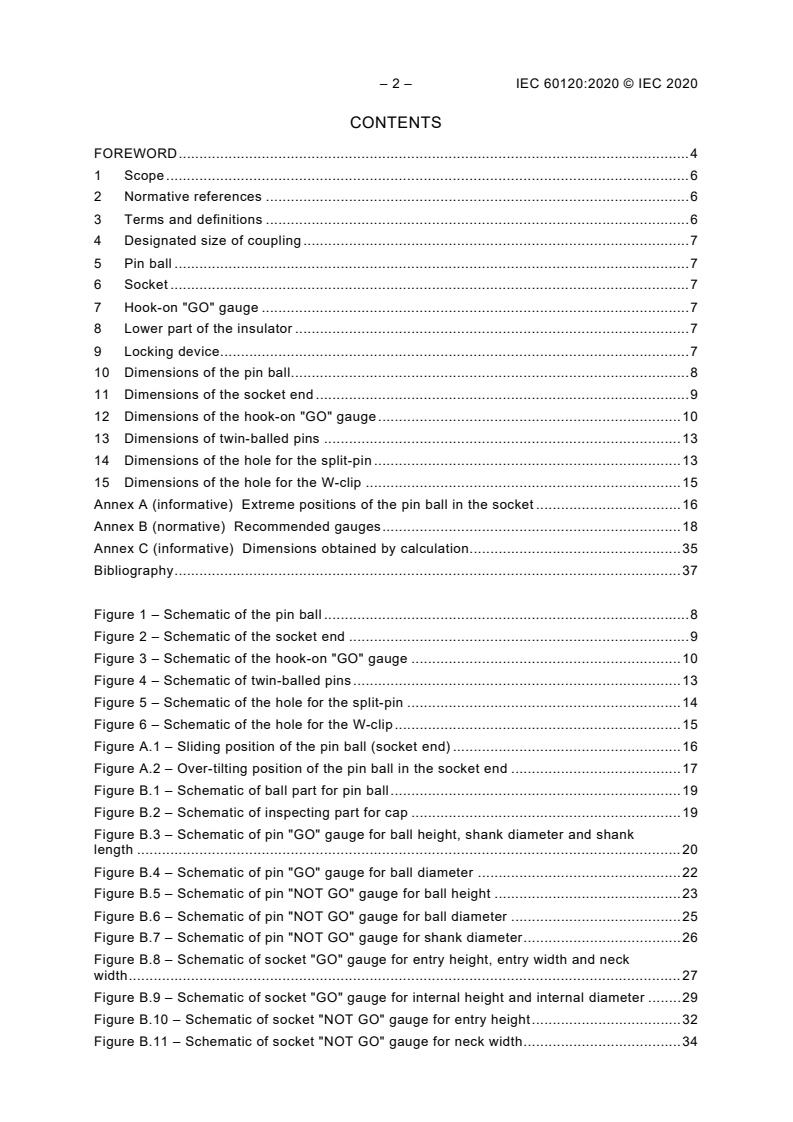
– 2 – IEC 60120:2020 © IEC 2020
CONTENTS
FOREWORD . 4
1 Scope . 6
2 Normative references . 6
3 Terms and definitions . 6
4 Designated size of coupling . 7
5 Pin ball . 7
6 Socket . 7
7 Hook-on "GO" gauge . 7
8 Lower part of the insulator . 7
9 Locking device . 7
10 Dimensions of the pin ball. 8
11 Dimensions of the socket end . 9
12 Dimensions of the hook-on "GO" gauge . 10
13 Dimensions of twin-balled pins . 13
14 Dimensions of the hole for the split-pin . 13
15 Dimensions of the hole for the W-clip . 15
Annex A (informative) Extreme positions of the pin ball in the socket . 16
Annex B (normative) Recommended gauges . 18
Annex C (informative) Dimensions obtained by calculation. 35
Bibliography . 37
Figure 1 – Schematic of the pin ball . 8
Figure 2 – Schematic of the socket end . 9
Figure 3 – Schematic of the hook-on "GO" gauge . 10
Figure 4 – Schematic of twin-balled pins . 13
Figure 5 – Schematic of the hole for the split-pin . 14
Figure 6 – Schematic of the hole for the W-clip . 15
Figure A.1 – Sliding position of the pin ball (socket end) . 16
Figure A.2 – Over-tilting position of the pin ball in the socket end . 17
Figure B.1 – Schematic of ball part for pin ball . 19
Figure B.2 – Schematic of inspecting part for cap . 19
Figure B.3 – Schematic of pin "GO" gauge for ball height, shank diameter and shank
length . 20
Figure B.4 – Schematic of pin "GO" gauge for ball diameter . 22
Figure B.5 – Schematic of pin "NOT GO" gauge for ball height . 23
Figure B.6 – Schematic of pin "NOT GO" gauge for ball diameter . 25
Figure B.7 – Schematic of pin "NOT GO" gauge for shank diameter . 26
Figure B.8 – Schematic of socket "GO" gauge for entry height, entry width and neck
width . 27
Figure B.9 – Schematic of socket "GO" gauge for internal height and internal diameter . 29
Figure B.10 – Schematic of socket "NOT GO" gauge for entry height . 32
Figure B.11 – Schematic of socket "NOT GO" gauge for neck width . 34
Figure C.1 – Schematic of clearance between the pin ball and the socket end . 35
Figure C.2 – Effectiveness of locking the pin ball . 36
Table 1 – Dimensions of the pin ball . 8
Table 2 – Dimensions of the socket end . 9
Table 3 – Dimensions of the hook-on "GO" gauge . 11
Table 4 – Dimensions of twin-balled pins . 13
Table 5 – Dimensions of the hole for the split-pin . 14
Table 6 – Dimensions of the hole for the W-clip . 15
Table A.1 – Allowed deviation angle of pin . 16
Table A.2 – Allowed deviation angle of pin . 17
Table B.1 – Dimensions of pin "GO" gauge for ball height, shank diameter and shank
length . 21
Table B.2 – Dimensions of pin "GO" gauge for ball diameter . 23
Table B.3 – Dimensions of pin "NOT GO" gauge for ball height . 24
Table B.4 – Dimensions of pin "NOT GO" gauge for ball diameter . 25
Table B.5 – Dimensions of pin "NOT GO" gauge for shank diameter . 26
Table B.6 – Dimensions of socket "GO" gauge for entry height, entry width and neck
width . 27
Table B.7 – Dimensions of socket "GO" gauge for internal height and internal diameter. 30
Table B.8 – Dimensions of socket "NOT GO" gauge for entry height . 32
Table B.9 – Dimensions of socket "NOT GO" gauge for neck width . 34
Table C.1 – Clearance between the pin ball and the socket end . 35
Table C.2 – Effectiveness of locking the pin ball . 36
– 4 – IEC 60120:2020 © IEC 2020
INTERNATIONAL ELECTROTECHNICAL COMMISSION
____________
BALL AND SOCKET COUPLINGS OF STRING
INSULATOR UNITS – DIMENSIONS
FOREWORD
1) The International Electrotechnical Commission (IEC) is a worldwide organization for standardization comprising
all national electrotechnical committees (IEC National Committees). The object of IEC is to promote
international co-operation on all questions concerning standardization in the electrical and electronic fields. To
this end and in addition to other activities, IEC publishes International Standards, Technical Specifications,
Technical Reports, Publicly Available Specifications (PAS) and Guides (hereafter referred to as "IEC
Publication(s)"). Their preparation is entrusted to technical committees; any IEC National Committee interested
in the subject dealt with may participate in this preparatory work. International, governmental and non-
governmental organizations liaising with the IEC also participate in this preparation. IEC collaborates closely
with the International Organization for Standardization (ISO) in accordance with conditions determined by
agreement between the two organizations.
2) The formal decisions or agreements of IEC on technical matters express, as nearly as possible, an international
consensus of opinion on the relevant subjects since each technical committee has representation from all
interested IEC National Committees.
3) IEC Publications have the form of recommendations for international use and are accepted by IEC National
Committees in that sense. While all reasonable efforts are made to ensure that the technical content of IEC
Publications is accurate, IEC cannot be held responsible for the way in which they are used or for any
misinterpretation by any end user.
4) In order to promote international uniformity, IEC National Committees undertake to apply IEC Publications
transparently to the maximum extent possible in their national and regional publications. Any divergence
between any IEC Publication and the corresponding national or regional publication shall be clearly indicated in
the latter.
5) IEC itself does not provide any attestation of conformity. Independent certification bodies provide conformity
assessment services and, in some areas, access to IEC marks of conformity. IEC is not responsible for any
services carried out by independent certification bodies.
6) All users should ensure that they have the latest edition of this publication.
7) No liability shall attach to IEC or its directors, employees, servants or agents including individual experts and
members of its technical committees and IEC National Committees for any personal injury, property damage or
other damage of any nature whatsoever, whether direct or indirect, or for costs (including legal fees) and
expenses arising out of the publication, use of, or reliance upon, this IEC Publication or any other IEC
Publications.
8) Attention is drawn to the Normative references cited in this publication. Use of the referenced publications is
indispensable for the correct application of this publication.
9) Attention is drawn to the possibility that some of the elements of this IEC Publication may be the subject of
patent rights. IEC shall not be held responsible for identifying any or all such patent rights.
International Standard IEC 60120 has been prepared by IEC technical committee 36:
Insulators.
This fourth edition cancels and replaces the third edition published in 1984. This edition
constitutes a technical revision.
This edition includes the following significant technical changes with respect to the previous
edition:
a) Two new designated size of couplings, 36 and 40 were introduced;
b) According to the results of the questionnaire(36/424/Q), the relevant content of the 28B
W-clip was deleted;
column in Table C.1 was deleted;
c) The Q
min
d) Annex A is informative, Annex B is normative, Annex C is informative.
The text of this International Standard is based on the following documents:
FDIS Report on voting
36/486/FDIS 36/492/RVD
Full information on the voting for the approval of this International Standard can be found in
the report on voting indicated in the above table.
This document has been drafted in accordance with the ISO/IEC Directives, Part 2.
The committee has decided that the contents of this document will remain unchanged until the
stability date indicated on the IEC website under "http://webstore.iec.ch" in the data related to
the specific document. At this date, the document will be
• reconfirmed,
• withdrawn,
• replaced by a revised edition, or
• amended.
– 6 – IEC 60120:2020 © IEC 2020
BALL AND SOCKET COUPLINGS OF STRING
INSULATOR UNITS – DIMENSIONS
1 Scope
The object of this international standard is to define the dimensions of a series of standard
ball and socket couplings using the standard locking devices (see IEC 60372) in order to
permit the assembly of insulators or metal fittings supplied by different manufacturers.
This document applies to string insulator units of the cap and pin and long rod types and their
associated metal fittings.
For the pin ball and the socket, dimensions apply to the finished product after any surface
treatment.
Extreme positions of the pin ball in the socket are given in Annex A.
Typical examples of gauges for checking the dimensions of pin balls and sockets are given in
Annex B.
NOTE Only the dimensions necessary for assembly are dealt with in this standard. Properties of material and
working loads are not specified. The co-ordination of dimensions with strength classes is specified in IEC 60305
and IEC 60433.
2 Normative references
The following documents are referred to in the text in such a way that some or all of their
content constitutes requirements of this document. For dated references, only the edition
cited applies. For undated references, the latest edition of the referenced document (including
any amendments) applies.
IEC 60050-471:2007, International Electrotechnical Vocabulary (IEV) – Part 471: Insulators
IEC 60372, Locking devices for ball and socket couplings of string insulator units –
Dimensions and tests
3 Terms and definitions
For the purposes of this document, the terms and definitions of IEC 60050-471, some of
which are reproduced below for ease of reference, apply.
ISO and IEC maintain terminological databases for use in standardization at the following
addresses:
• IEC Electropedia: available at http://www.electropedia.org/
• ISO Online browsing platform: available at http://www.iso.org/obp
3.1
ball and socket coupling
coupling consisting of a ball, a socket and a locking device, and providing flexibility
[SOURCE: IEC 60050-471:2007, 471-03-11]
3.2
string insulator unit
cap and pin insulator or long rod insulator of which end fitting are suitable for flexible
attachment to other similar insulator units or to connecting accessories
[SOURCE: IEC 60050-471:2007, 471-03-08]
4 Designated size of coupling
This document includes eight standard ball and socket couplings designated by the nominal
pin diameters in millimetres. Each designated size of coupling is defined by the dimensions of
the pin ball, of the socket, of the hook-on "GO" gauge, of the lower part of the insulator and of
the corresponding locking device.
NOTE Dimensions of twin-balled pins for coupling of two sockets are stated in Clause 13. Dimensions of the hole
for the locking devices are stated in Clause 14 and Clause 15.
5 Pin ball
The pin ball shall conform to the dimensions specified in Clause 10. The main dimensions
governing the shape of the pin ball are h , d , r and r . Dimension r is given for guidance
1 2 1 2 3
because its accurate value may be obtained only by the drawing. In addition, the shank
diameter d , must not exceed the specified values within a length equal to H of the
1 3
corresponding worn hook-on "GO" gauge (see Clause 12).
6 Socket
The socket interior shall conform to the dimensions specified in Clause 11, which also
specifies the thickness of the locking device.
The 16 mm designated size of coupling according to Clause 11 includes two alternative
sockets. There is only one type of pin ball fit for it, but the corresponding locking device
should be used. That is, the 16A socket should be matched with the 16A locking device, the
16B socket should be matched with the 16B locking device.
NOTE Sockets according to the clause mentioned are shown with flat bottoms. Sockets with rounded bottoms with
radii of curvature not less than the dimensions r of the pin balls can also be used. In this case, the dimensions R
2 5
have to be correspondingly decreased.
7 Hook-on "GO" gauge
The external dimensions of the socket have not been laid down. However, the socket shall
permit acceptance of the hook-on "GO" gauge according to Clause 12.
8 Lower part of the insulator
The shape of the lower part of the insulator shall be such that assembly with the socket of
maximum external dimensions according to Clause 7 will always be possible.
9 Locking device
The locking device, i. e. a split-pin or W-clip, shall be designed for locking the minimum-size
pin ball in the maximum size socket. This requirement is fulfilled if the locking devices
standardized in IEC 60372 are used.
– 8 – IEC 60120:2020 © IEC 2020
10 Dimensions of the pin ball
Figure 1 shows a schematic of the pin ball. Table 1 gives dimensions of the pin ball.
Figure 1 – Schematic of the pin ball
Table 1 – Dimensions of the pin ball
Dimensions in millimetres
Designated size
a
d d h r r r r
1 2 1 1 2 3 4
of coupling
0 0 0 +1,0
11 11,9 22,8 9,1 35,0 35,0 3,5 1,5
-1,1 −1,3 −1,2 0
0 0 0 +1,0
16 17,0 33,3 13,4 23,0 50,0 3,0 3,0
−1,2 −1,5 −1,3 −0,5
0 0 0 +1,0
20 21,0 41,0 19,5 27,0 60,0 5,7 3,5
−1,3 −1,6 −1,4 −1,0
0 0 0 +1,5
24 25,0 49,0 21,0 40,0 70,0 6,6 4,0
−1,4 −1,8 −1,7 −1,0
0 0 0 +1,5
28 29,0 57,0 23,5 55,0 80,0 8,0 4,5
−1,5 −1,9 −1,8 −1,0
0 0 0 +1,5
32 33,0 65,0 27,0 70,0 90,0 10,0 5,0
−1,6 −2,1 −1,9 −1,0
0 0 0 +1,5
36 37,0 73,0 34,0 50,0 110,0 10,5 8,0
−1,6 −2,1 −1,9 −1,0
0 0 0 +15,
40 41,0 81,0 39,5 55,0 120,0 12,5 9,0
−1,6 −2,1 −1,9 −10,
a
Given for guidance.
11 Dimensions of the socket end
Figure 2 shows a schematic of the socket end. Table 2 gives dimensions of the socket end.
Figure 2 – Schematic of the socket end
Table 2 – Dimensions of the socket end
Dimensions in millimetres
a b
Designated D D D H H for H for R R R R T
1 2 3 1 2 2 1 3 4 5
size of W-clips standar
coupling and d split-
alter- pins
native
split-
pins
Min. Min Min. Min.
+1,3 +1,3 +0,2
11 12,5 24,5 24,5 10,5 15,5 16,3 35,0 4,0 1,5 4,0 4,8
0 0 0
+1,6 +0,2
c
A 14,5 20,5 21,6 5,5
0 0
+1,6
16 19,2 34,5 34,5 23,0 3,0 3,0 5,0
+1,6 +0,2
c
B 17,0 25,0 25,5 7,9
0 0
+2,1 +2,1 +0,2
20 23,0 42,5 42,5 20,5 28,5 29,3 27,0 6,0 3,5 7,0 7,0
0 0 0
+2,5 +2,5 +0,2
24 27,5 51,0 51,0 23,5 32,5 33,5 40,0 5,0 4,0 10,0 8,7
0 0 0
+2,9 +2,9 +0,2
28 32,0 59,0 59,0 26,0 36,5 37,4 55,0 8,0 4,5 12,0 10,0
0 0 0
+3,3 +3,3 +0,2
32 36,0 67,5 67,5 30,0 42,0 43,0 70,0 10,0 5,0 14,0 11,5
0 0 0
+3,3 +3,3 +0,2
36 40,0 75,5 75,5 38,0 - 51,0 50,0 10,5 8,0 16,0 11,5
0 0 0
+3,3 +3,3 +0,2
40 44,0 83,5 83,5 43,5 - 56,5 55,0 12,5 9,0 17,0 11,5
0 0 0
a
A greater value is given because in this case the split-pin does not always rest on the bottom of the socket.
The position of the standard split-pin is determined by the position H of the centre of the hole and its
diameter D (see clause 14) and dimension F (see IEC 60372) and is also influenced by the tips of legs
4 2
resting in contact with the socket. The values of H ensure the correct clearances for split-pins.
b
Thickness of the locking device.
c
See Clause 6.
– 10 – IEC 60120:2020 © IEC 2020
12 Dimensions of the hook-on "GO" gauge
Figure 3 shows a schematic of the hook-on "GO" gauge. Table 3 gives dimensions of the
hook-on "GO" gauge.
Figure 3 – Schematic of the hook-on "GO" gauge
Table 3 – Dimensions of the hook-on "GO" gauge (1 of 2)
Dimensions in millimetres
Designated
size of Gauge D D D D H H H R R R R R R
1 2 3 4 1 2 3 1 2 3 4 5 6
coupling
a
Max. contour 12,000 22,950 25,322 60,15 9,250 17,775 23,775 35,075 35,075 3,631 1,450 49,70 2,80
New Nominal contour 11,980 22,920 25,348 59,95 9,220 17,860 23,860 35,060 35,060 3,616 1,460 49,80 2,70
a
Min. contour 11,960 22,890 25,374 59,75 9,190 17,945 23,945 35,045 35,045 3,601 1,470 49,90 2,60
b
Worn 11,900 22,800 25,400 59,55 9,100 18,000 24,000 35,000 35,000 3,556 1,500 50,00 2,50
a
Max. contour 17,122 33,490 35,326 90,59 13,572 20,686 31,786 23,086 50,086 3,071 2,939 71,70 2,80
New Nominal contour 17,096 33,450 35,351 90,39 13,536 20,768 31,868 23,068 50,068 3,055 2,952 71,80 2,70
a
Min. contour 17,070 33,410 35,376 90,19 13,500 20,850 31,950 23,050 50,050 3,039 2,965 71,90 2,60
b
Worn 17,000 33,300 35,400 89,99 13,400 20,900 32,000 23,000 50,000 2,993 3,000 72,00 2,50
a
Max. contour 21,150 41,220 45,484 120,95 19,702 25,551 42,151 27,101 60,101 5,845 3,425 89,55 3,45
New Nominal contour 21,120 41,170 45,523 120,65 19,656 25,678 42,278 27,078 60,078 5,824 3,440 89,70 3,30
a
Min. contour 21,090 41,120 45,561 120,35 19,610 25,805 42,405 27,055 60,055 5,803 3,455 89,85 3,15
b
Worn 21,000 41,000 45,600 120,05 19,500 25,900 42,500 27,000 60,000 5,753 3,500 90,00 3,00
a
Max. contour 25,172 49,250 50,490 140,90 21,242 25,971 46,171 40,121 70,121 6,732 3,914 104,55 3,45
New Nominal contour 25,136 49,190 50,527 140,60 21,186 26,093 46,293 40,093 70,093 6,706 3,932 104,70 3,30
a
Min. contour 25,100 49,130 50,564 140,30 21,130 26,215 46,415 40,065 70,065 6,680 3,950 104,85 3,15
b
Worn 25,000 49,000 50,600 140,00 21,000 26,300 46,500 40,000 70,000 6,615 4,000 105,00 3,00
a
The contour of the new gauge shall fall between the maximum and minimum contours.
b
See Clause B.1.
– 12 – IEC 60120:2020 © IEC 2020
Table 3 (2 of 2)
Designated
size of Gauge D D D D H H H R R R R R R
1 2 3 4 1 2 3 1 2 3 4 5 6
coupling
a
Max. contour 29,190 57,290 66,870 165,94 23,770 29,100 51,100 55,135 80,135 7,994 4,414 129,55 3,45
New Nominal contour 29,150 57,215 66,915 165,64 23,708 29,250 51,250 55,104 80,104 7,967 4,432 129,70 3,30
a
Min. contour 29,110 57,140 66,960 165,34 23,646 29,400 51,400 55,073 80,073 7,938 4,450 129,85 3,15
b
29,000 57,000 67,000 165,04 23,500 29,500 51,500 55,000 80,000 7,864 4,500 130,00 3,00
Worn
a
Max. contour 33,220 65,310 85,800 198,45 27,300 34,000 61,400 70,150 90,150 9,719 4,914 149,55 3,45
New Nominal contour 33,170 65,230 85,850 198,22 27,225 34,175 61,600 70,112 90,113 9,683 4,932 149,70 3,30
a
Min. contour 33,120 65,150 85,900 197,98 27,150 34,350 61,800 70,075 90,075 9,647 4,950 149,85 3,15
b
33,000 65,000 86,000 197,83 27,000 34,500 62,000 70,000 90,000 9,572 5,000 150,00 3,00
Worn
a
Max. contour 37,220 73,310 105,800 230,90 34,300 41,000 71,850 50,135 110,165 10,219 7,914 169,55 3,45
New Nominal contour 37,170 73,230 105,850 230,60 34,225 41,175 72,100 50,104 110,123 10,183 7,932 169,70 3,30
a
Min. contour 37,120 73,150 105,900 230,30 34,150 41,350 72,350 50,073 110,081 10,147 7,950 169,85 3,15
b
Worn 37,000 73,000 106,000 230,00 34,000 41,500 72,500 50,000 110,000 10,072 8,000 170,00 3,00
a
Max. contour 41,220 81,310 126,800 262,90 39,800 46,500 82,300 55,135 120,180 12,219 8,914 189,55 3,45
New Nominal contour 41,170 81,230 126,850 262,60 39,725 46,675 82,600 55,104 120,133 12,183 8,932 189,70 3,30
a
Min. contour 41,120 81,150 126,900 262,30 39,650 46,850 82,900 55,073 120,086 12,147 8,950 189,85 3,15
b
Worn 41,000 81,000 127,000 262,00 39,500 47,000 83,000 55,000 120,000 12,072 9,000 190,00 3,00
a
The contour of the new gauge shall fall between the maximum and minimum contours.
b
See Clause B.1.
13 Dimensions of twin-balled pins
Figure 4 shows a schematic of the twin-balled pins. Table 4 gives dimensions of the twin-
balled pins.
Figure 4 – Schematic of twin-balled pins
Table 4 – Dimensions of twin-balled pins
Dimensions in millimetres
Designated size of coupling h
11 47,0
−2,5
16 63,0
−3,0
20 83,0
−3,2
24 90,0
−3,5
28 97,0
−3,5
32 120,0
−4,0
36 135,0
−4,0
40 150,0
−4,0
NOTE For other dimensions, see Clause 10.
14 Dimensions of the hole for the split-pin
Figure 5 shows a schematic of the hole for the split-pin. Table 5 gives dimensions of the hole
for the split-pin.
– 14 – IEC 60120:2020 © IEC 2020
Figure 5 – Schematic of the hole for the split-pin
Table 5 – Dimensions of the hole for the split-pin
Dimensions in millimetres
Designated
D L
size of D H K
4 3
Min. Max.
coupling
+1,0
7,5± 0,4 3,5± 0,6
11 13,5 3,75 24
+1,0
a
9,5± 0,5 4,0± 0,7
A 16,0 4,75
16 32
+1,0
a
10,0± 0,5 5,0± 1,0
B 18,0 5,0
+1,2
10,0± 0,5 5,0± 1,0
20 18,0 5,0 40
+1,5
12,0± 0,5 6,0± 1,0
24 21,5 6,0 51
+1,5
13,0± 0,5 7,0± 1,2
28 24,0 6,5 59
+1,5
15,0± 0,5 8,0± 1,4
32 28,0 7,5 68
+1,5
17,0± 0,5 9,0± 1,4
36 34,0 8,5 78
+1,5
17,0± 0,5 10,0± 1,4
40 34,0 8,5 88
NOTE The dimensions are applicable to both standard and alternative split-pins
(see IEC 60372).
a
See Clause 6.
15 Dimensions of the hole for the W-clip
Figure 6 shows a schematic of the hole for the W-clip. Table 6 gives dimensions of the hole
for the W-clip.
Figure 6 – Schematic of the hole for the W-clip
Table 6 – Dimensions of the hole for the W-clip
Dimensions in millimetres
a
B L
Designated size of 2
B H
1 3
coupling
Min. Max.
12,5± 0,8 6,5± 0,8
11 24,0 18
b
7,0± 0,8
A
16,0± 1,0
16 33,0 24
b
9,5± 0,8
B
17,0± 1,0 8,5± 0,8
20 34,0 29
17,5± 1,0 10,5± 0,8
24 34,5 34
20,0± 1,0 11,5± 0,8
28 39,0 42
22,0± 1,0 13,0± 0,8
32 42,0 48
a
Dimension B is the length of the recess over which the height H shall be
2 3
maintained. Beyond B , the shape of the recess is not important.
b
See Clause 6.
– 16 – IEC 60120:2020 © IEC 2020
Annex A
(informative)
Extreme positions of the pin ball in the socket
A.1 Sliding position of the pin ball in the socket end
Figure A.1 shows the sliding position of the pin ball (socket end). Table A.1 gives the allowed
deviation angle of the pin.
Figure A.1 – Sliding position of the pin ball (socket end)
Table A.1 – Allowed deviation angle of pin
Designated size of coupling α
average
11 1,3°
a
A
16 4,0°
a
B
20 3,3°
24 2,7°
28 2,5°
32 2,0°
36 2,5°
40 2,0°
a
See Clause 6.
A.2 Over-tilting position of the pin ball in the socket end
Figure A.2 shows the over-tilting position of the pin ball in the socket end. Table A.2 gives the
allowed deviation angle of the pin.
Figure A.2 – Over-tilting position of the pin ball in the socket end
Table A.2 – Allowed deviation angle of pin
a
Designated size of coupling β
Average
11 12,0°
b
A 9,5°
b
B 12,0°
20 9,0°
24 10,0°
28 9,0°
32 9,0°
36 8,0°
40 7,0°
a
β values assume reasonable tolerances for H .
b
See Clause 6.
– 18 – IEC 60120:2020 © IEC 2020
Annex B
(normative)
Recommended gauges
B.1 Tolerance system
The tolerance for the gauges follow the ISO system. This means that the "NOT GO" gauges
only have manufacturing tolerances which are symmetrically located in relation to the
corresponding tolerance limit of the coupling part. It also means that the "GO" gauges have
allowances for wear and manufacturing tolerances which fall within the tolerance zone of the
coupling part.
Gauges which have been worn beyond any of the limits given for worn gauges should not be
used.
NOTE For "GO" gauges it is left to the choice of each country to use the allowance for wear to increase the
proposed manufacturing tolerances.
B.2 Constructional features of the gauges
The choice of material, the hardness, the surface finish, the surface treatment and the method
of manufacture are liable to vary from one country to another. Therefore, the following
recommendations are given only for general guidance:
– the thickness of the pin gauges should be not less than 5 mm;
– gauges provided with round holes should be somewhat thicker;
– the material should be a non-shrinking, oil-hardening steel;
– the Rockwell C hardness number should be 62 to 63 in order to reduce deformations and
wear;
– the surface roughness should be less than 4μm;
– hard chromium plating can, in certain cases, increase resistance to wear.
NOTE The socket gauges can be provided with a ground shaft, diameter D , or with centre holes in order to
facilitate checking of the gauges. A centre hole removes part of the curved surface, and this reduces the
manufacturing tolerance.
B.3 Checking the pin ball
Figure B.1 shows the schematic of the ball part for the pin ball.
Figure B.1 – Schematic of ball part for pin ball
a) Ball and shank shall pass in at least one direction through "GO" gauge for ball height,
shank diameter and shank length(see Clause B.5).
b) Ball shall pass through "GO" gauge for ball diameter (see Clause B.6).
c) Ball and shank shall not pass in any direction through "NOT GO" gauge for ball height
(see Clause B.7).
d) Ball shall not pass in any direction through "NOT GO" gauge for ball diameter (see
Clause B.8).
e) Shank shall not enter in any direction through "NOT GO" gauge for ball diameter (see
Clause B.9).
B.4 Checking the socket end
Figure B.2 shows the schematic of the inspecting part for the cap.
Figure B.2 – Schematic of inspecting part for cap
– 20 – IEC 60120:2020 © IEC 2020
a) Socket entry shall accept "GO" gauge for entry height, entry width and neck width(see
Clause B.10).
b) Internal height and internal diameter of socket shall allow rotation through180°inside the
socket of the "GO" gauge for internal height and internal diameter (see Clause B.11).
c) Socket entry height shall refuse the "NOT GO" gauge for entry height (see Clause B.12).
d) Socket entry shall refuse "NOT GO" gauge for neck width (see Clause B.13).
NOTE Marked contour(——.——)to accept hook-on "GO" gauge(see Clause 12).
B.5 Pin "GO" gauge for ball height, shank diameter and shank length
Figure B.3 shows the schematic of the pin "GO" gauge for ball height, shank diameter and
shank length. Table B.1 gives the dimensions of the pin "GO" gauge for ball height, shank
diameter and shank length.
Figure B.3 – Schematic of pin "GO" gauge for ball height,
shank diameter and shank length
Table B.1 – Dimensions of pin "GO" gauge for ball height,
shank diameter and shank length (1 of 2)
Dimensions in millimetres
Designated
size of Gauge d d d h h r r r r
1 2 4 1 3 1 2 3 4
coupling
Min
11,826 22,712 25,5 9,008 24,11 34,954 34,954 3,509 2,537
a
contour
Nominal
11,836 22,728 25,0 9,024 24,08 34,962 34,962 3,517 2,532
New
contour
Max
11,846 22,744 24,5 9,040 24,05 34,970 34,970 3,525 2,527
a
contour
b
11,900 22,800 24,0 9,100 24,00 35,000 35,000 3,556 2,500
Worn
Min
16,922 33,204 35,5 13,304 32,14 22,952 49,952 2,945 4,039
a
contour
Nominal
New 16,932 33,222 35,0 13,320 32,10 22,960 49,960 2,952 4,034
contour
Max
16,942 33,240 34,5 13,336 32,06 22,968 49,968 2,959 4,029
a
contour
b
Worn 17,000 33,300 34,0 13,400 32,00 23,000 50,000 2,993 4,000
Min
20,916 40,900 45,5 19,400 42,64 26,950 59,950 5,703 4,542
a
contour
Nominal
New 20,928 40,920 45,0 19,418 42,60 26,959 59,959 5,711 4,536
contour
Max
20,940 40,940 44,5 19,436 42,56 26,968 59,968 5,719 4,530
a
contour
b
Worn 21,000 41,000 44,0 19,500 42,50 27,000 60,000 5,753 4,500
Min
24,912 48,890 50,5 20,888 46,65 39,944 69,944 6,558 5,544
a
contour
Nominal
24,924 48,912 50,0 20,908 46,61 39,954 69,954 6,567 5,538
New
contour
Max
24,936 48,934 49,5 20,928 46,57 39,964 69,964 6,577 5,532
a
contour
b
Worn 25,000 49,000 49,0 21,000 46,50 40,000 70,000 6,615 5,500
Min
28,906 56,881 68,5 23,380 51,66 54,940 79,940 7,803 6,044
a
contour
Nominal
New 28,919 56,905 68,0 23,402 51,62 54,951 79,951 7,814 6,038
contour
Max
28,932 56,929 67,5 23,424 51,58 54,962 79,962 7,825 6,032
a
contour
b
Worn 29,000 57,000 67,0 23,500 51,50 55,000 80,000 7,864 6,000
a
The contour of the new gauge shall fall between the minimum and maximum contours.
b
See Clause B.1.
– 22 – IEC 60120:2020 © IEC 2020
Table B.1 (2 of 2)
Designated
size of Gauge d d d h h r r r r
1 2 4 1 3 1 2 3 4
coupling
Min
32,899 64,871 87,5 26,868 62,16 69,934 89,934 9,506 6,544
a
contour
Nominal
New 32,913 64,897 87,0 26,892 62,12 69,946 89,946 9,517 6,538
contour
Max
32,927 64,923 86,5 26,916 62,08 69,958 89,958 9,528 6,532
a
contour
b
Worn 33,000 65,000 86,0 27,000 62,00 70,000 90,000 9,572 6,500
Min
36,899 72,871 107,5 33,868 72,66 49,940 109,934 10,006 9,544
a
contour
Nominal
New 36,913 72,897 107,0 33,892 72,62 49,951 109,946 10,017 9,538
contour
Max
36,927 72,923 106,5 33,916 72,58 49,962 109,958 10,068 9,532
a
contour
b
Worn 37,000 73,000 106,0 34,000 72,50 50,000 110,000 10,072 9,500
Min
40,899 80,871 128,5 39,368 83,16 54,940 119,934 12,006 10,544
a
contour
Nominal
40,913 80,897 128,0 39,392 83,12 54,951 119,946 12,017 10,538
New
contour
Max
40,927 80,923 127,5 39,416 83,08 54,962 119,958 12,068 10,532
a
contour
b
Worn 41,000 81,000 127,0 39,500 83,00 55,000 120,000 12,072 10,500
a
The contour of the new gauge shall fall between the minimum and maximum contours.
b
See Clause B.1.
B.6 Pin "GO" gauge for ball diameter
Figure B.4 shows the schematic of the pin "GO" gauge for ball diameter. Table B.2 gives the
dimensions of the pin "GO" gauge for ball diameter.
Figure B.4 – Schematic of pin "GO" gauge for ball diameter
Table B.2 – Dimensions of pin "GO" gauge for ball diameter
Dimensions in millimetres
Designated size of
Gauge d
coupling
22,728± 0,011
New
a
Worn 22,800
33,223± 0,012
New
Worn 33,300
40,920± 0,013
New
a
Worn 41,000
48,913± 0,014
New
a
Worn 49,000
56,908± 0,015
New
a
Worn 57,000
64,903± 0,016
New
a
Worn 65,000
72,903± 0,016
New
a
Worn 73,000
80,903± 0,016
New
a
Worn 81,000
a
See Clause B.1.
B.7 Pin "NOT GO" gauge for ball height
Figure B.5 shows the schematic of the pin "NOT GO" gauge for ball height. Table B.3 gives
the dimensions of the pin "NOT GO" gauge for ball height.
Figure B.5 – Schematic of pin "NOT GO" gauge for ball height
– 24 – IEC 60120:2020 © IEC 2020
Table B.3 – Dimensions of pin "NOT GO" gauge for ball height
Dimensions in millimetres
Designated size of
Gauge d d d h h r r
1 4 5 1 4 1 6
coupling
a
Min contour 16,08 18,60 12,3 7,884 15,5 34,992 3,7
11 Nominal contour 16,10 18,40 12,0 7,900 16,0 35,000 4,0
a
Max contour 16,12 18,20 11,7 7,916 16,5 35,008 4,3
a
Min contour 23,66 30,3 18,3 12,084 21,5 22,992 4,7
16 Nominal contour 23,70 30,0 18,0 12,100 22,0 23,000 5,0
a
Max contour 23,74 29,7 17,7 12,116 22,5 23,008 5,3
a
Min contour 28,36 36,3 23,3 18,082 29,5 26,991 6,7
20 Nominal contour 28,42 36,0 23,0 18,100 30,0 27,000 7,0
a
Max contour 28,48 35,7 22,7 18,118 30,5 27,009 7,3
a
Min contour 34,48 42,3 28,3 19,280 31,5 39,990 7,7
24 Nominal contour 34,54 42,0 28,0 19,300 32,0 40,000 8,0
a
Max contour 34,60 41,7 27,7 19,320 32,5 40,010 8,3
a
Min contour 36,90 47,3 32,3 21,678 44,5 54,989 9,7
28 Nominal contour 37,00 47,0 32,0 21,700 45,0 55,000 10,0
a
Max contour 37,10 46,7 31,7 21,722 45,5 55,011 10,3
a
Min contour 40,88 52,3 36,3 25,076 47,5 69,988 11,7
Nominal contour 41,00 52,0 36,0 25,100 48,0 70,000 12,0
a
Max contour 41,12 51,7 35,7 25,124 48,5 70,012 12.3
a
Min contour 44,88 58,3 40,3 31,876 50,5 49,989 13,7
36 Nominal contour 45,00 58,0 40,0 31,900 51,0 50,000 14,0
a
Max contour 45,12 57,7 39,7 31,924 51,5 50,012 14,3
a
Min contour 48,88 64,3 44,3 37,176 53,5 54,989 15,7
40 Nominal contour 49,00 64,0 44,0 37,200 54,0 55,000 16,0
a
Max contour 49,12 63,7 43,7 37,224 54,5 55,012 16,3
a
The contour of the gauge shall fall between the minimum and maximum contours.
B.8 Pin "NOT GO" gauge for ball diameter
Figure B.6 shows the schematic of the pin "NOT GO" gauge for ball diameter. Table B.4 gives
the dimensions of the pin "NOT GO" gauge for ball diameter.
Figure B.6 – Schematic of pin "NOT GO" gauge for ball diameter
Table B.4 – Dimensions of pin "NOT GO" gauge for ball diameter
Dimensions in millimetres
Designated size of
d h h r
2 4 5 6
coupling
21,500± 0,011 10,0± 0,5 1,0± 0,3 1,5± 0,5
31,800± 0,012 12,0± 0,5 1,0± 0,3 1,5± 0,5
39,400± 0,013 18,0± 0,5 1,0± 0,3 1,5± 0,5
47,200± 0,014 20,0± 0,5 1,0± 0,3 1,5± 0,5
55,100± 0,015 22,0± 0,5 1,0± 0,3 1,5± 0,5
62,900± 0,016 25,0± 0,5 1,0± 0,3 1,5± 0,5
70,700± 0,016 28,0± 0,5 1,0± 0,3 1,5± 0,5
78,500± 0,016 31,0± 0,5 1,0± 0,3 1,5± 0,5
B.9 Pin "NOT GO" gauge for shank diameter
Figure B.7 shows the schematic of the pin "NOT GO" gauge for shank diameter. Table B.5
gives the dimensions of the pin "NOT GO" gauge for shank diameter.
– 26 – IEC 60120:2020 © IEC 2020
Figure B.7 – Schematic of pin "NOT GO" gauge for shank diameter
Table B.5 – Dimensions of pin "NOT GO" gauge for shank diameter
Dimensions in millimetres
Designated size of
d d h h
1 4 4 5
coupling
10,800± 0,009 15,0± 0,5 12,0± 0,5 1,0± 0,3
15,800± 0,010 20,0± 0,5 15,0± 0,5 1,0± 0,3
...