

IEC 60349-2:2010
(Main)Electric traction - Rotating electrical machines for rail and road vehicles - Part 2: Electronic converter-fed alternating current motors
General Information
- Abstract
IEC 60349-2:2010 applies to converter-fed alternating current motors forming part of the equipment of electrically propelled rail and road vehicles. The object of this part is to enable the performance of a motor to be confirmed by tests and to provide a basis for assessment of its suitability for a specified duty and for comparison with other motors. The main technical changes with regard to the previous edition are as follows:
- the limits valid for traction motors are now directly stated in this standard;
- the methods described in the relevant ISO standards are now allowed.
- Status
- Published
- Publication Date
- 12-Oct-2010
- Technical Committee
- TC 9 - Electrical equipment and systems for railways
- Drafting Committee
- MT 30 - TC 9/MT 30
- Current Stage
- PPUB - Publication issued
- Start Date
- 13-Oct-2010
- Completion Date
- 15-Oct-2010
Overview
IEC 60349-2:2010 is an international standard published by the International Electrotechnical Commission (IEC), specifying requirements for electronic converter-fed alternating current (AC) motors used in electric traction for rail and road vehicles. This third edition revises the prior 2002 version, focusing on converter-fed AC rotating electrical machines integral to electrically propelled transport applications. Its primary aim is to standardize performance testing methods to confirm motor capabilities, ensure suitability for specific operational duties, and facilitate reliable comparison among different motor designs.
This standard is crucial for manufacturers, designers, and testing laboratories involved with traction motors, providing unified criteria for performance verification through rigorous testing protocols. It ensures interoperability and quality consistency for traction motors integrated with power electronic converters, a key technology advancing electric transportation systems worldwide.
Key Topics
Scope and Objective
IEC 60349-2 applies specifically to AC motors supplied by electronic converters in electrically propelled rail and road vehicles, including motors on unpowered trailers. It defines methods to confirm motor performance, ensuring that the motor meets operational expectations and compatibility requirements.Performance Testing
The standard outlines comprehensive test categories such as type tests (including temperature rise, overspeed, vibration, and characteristic tests), routine tests conducted on every motor, and investigation tests for detailed motor analysis.Temperature Rise Limits
Temperature-rise tests, critical in traction motors for durability and efficiency, are clearly defined with limits for continuous and short-time overload ratings to guarantee safe operating conditions.Vibration and Noise Limits
Updated vibration velocity limits for traction motors are directly stated, harmonizing with IEC 60034-14. Noise measurement methods incorporate ISO standards for sound power level evaluation, enabling accurate assessment of acoustic emissions with prescribed corrections for pure tones.Information Exchange and Collaboration
IEC 60349-2 emphasizes coordination between motor designers and converter manufacturers to ensure compatibility and optimized performance of the motor-converter system.Marking and Identification
Essential information to be marked on motor nameplates and terminals facilitates traceability and installation accuracy.Conformance with Relevant ISO Standards
The new edition authorizes the use of ISO-compliant measurement methods alongside IEC procedures to support modern testing practices.
Applications
IEC 60349-2:2010 is primarily intended for the design, testing, and certification of electronic converter-fed AC traction motors in:
Rail Vehicles
Including electric locomotives, multiple units, and trams where AC motors provide propulsion power controlled by electronic converters, ensuring efficient and reliable operation on railway networks.Road Electric Vehicles
Such as electric buses and trolleybuses using inverter-fed AC motors for traction, benefiting from standardized testing to guarantee performance and safety.Trailers and Special Purpose Vehicles
Motors installed on trailers hauled by powered vehicles and other specialized electrically propelled equipment (e.g., mining vehicles), ensuring consistent quality across diverse electric traction systems.
The standardized test protocols and motor characteristic definitions support manufacturers in meeting regulatory requirements and provide buyers and operators with confidence in motor performance under real operating conditions.
Related Standards
IEC 60349-2:2010 is part of the broader IEC 60349 series covering rotating electrical machines for rail and road vehicles. Relevant associated standards include:
IEC 60349-1 – General requirements and definitions for rotating electrical machines used in electric traction.
IEC 61377-1 and IEC 61377-3 – Guidance on testing combined motor and converter systems to avoid duplicate testing.
IEC 60034-14 – Specifies vibration limits for rotating electrical machines, with direct reference integration into IEC 60349-2.
ISO 3741, ISO 3743, ISO 3744, ISO 3745, ISO 9614 – ISO standards allowed for noise measurement methods, enhancing sound power level evaluations.
This standard aligns with global efforts in harmonizing electrical traction equipment testing and performance criteria, providing a foundation for innovation and interoperability in the field of electric mobility.
By complying with IEC 60349-2:2010, stakeholders in electric traction industry ensure robust verification of electronic converter-fed AC motors, supporting advancements in sustainable, efficient, and reliable rail and road electric vehicles.
Relations
- Effective Date
- 05-Sep-2023
Get Certified
Connect with accredited certification bodies for this standard

IMQ S.p.A. (Certification)
Italian electrical product certification.

IRIS Certification (UNIFE)
International Railway Industry Standard certification.

SLG Prüf- und Zertifizierungs GmbH
German testing and certification body.
Sponsored listings
Frequently Asked Questions
IEC 60349-2:2010 is a standard published by the International Electrotechnical Commission (IEC). Its full title is "Electric traction - Rotating electrical machines for rail and road vehicles - Part 2: Electronic converter-fed alternating current motors". This standard covers: IEC 60349-2:2010 applies to converter-fed alternating current motors forming part of the equipment of electrically propelled rail and road vehicles. The object of this part is to enable the performance of a motor to be confirmed by tests and to provide a basis for assessment of its suitability for a specified duty and for comparison with other motors. The main technical changes with regard to the previous edition are as follows: - the limits valid for traction motors are now directly stated in this standard; - the methods described in the relevant ISO standards are now allowed.
IEC 60349-2:2010 applies to converter-fed alternating current motors forming part of the equipment of electrically propelled rail and road vehicles. The object of this part is to enable the performance of a motor to be confirmed by tests and to provide a basis for assessment of its suitability for a specified duty and for comparison with other motors. The main technical changes with regard to the previous edition are as follows: - the limits valid for traction motors are now directly stated in this standard; - the methods described in the relevant ISO standards are now allowed.
IEC 60349-2:2010 is classified under the following ICS (International Classification for Standards) categories: 29.280 - Electric traction equipment; 45.060.01 - Railway rolling stock in general. The ICS classification helps identify the subject area and facilitates finding related standards.
IEC 60349-2:2010 has the following relationships with other standards: It is inter standard links to IEC 60349-2:2002. Understanding these relationships helps ensure you are using the most current and applicable version of the standard.
IEC 60349-2:2010 is available in PDF format for immediate download after purchase. The document can be added to your cart and obtained through the secure checkout process. Digital delivery ensures instant access to the complete standard document.
Standards Content (Sample)
IEC 60349-2 ®
Edition 3.0 2010-10
INTERNATIONAL
STANDARD
NORME
INTERNATIONALE
Electric traction – Rotating electrical machines for rail and road vehicles –
Part 2: Electronic converter-fed alternating current motors
Traction électrique – Machines électriques tournantes des véhicules ferroviaires
et routiers –
Partie 2: Moteurs à courant alternatif alimentés par convertisseurs électroniques
All rights reserved. Unless otherwise specified, no part of this publication may be reproduced or utilized in any form or by
any means, electronic or mechanical, including photocopying and microfilm, without permission in writing from either IEC or
IEC's member National Committee in the country of the requester.
If you have any questions about IEC copyright or have an enquiry about obtaining additional rights to this publication,
please contact the address below or your local IEC member National Committee for further information.
Droits de reproduction réservés. Sauf indication contraire, aucune partie de cette publication ne peut être reproduite
ni utilisée sous quelque forme que ce soit et par aucun procédé, électronique ou mécanique, y compris la photocopie
et les microfilms, sans l'accord écrit de la CEI ou du Comité national de la CEI du pays du demandeur.
Si vous avez des questions sur le copyright de la CEI ou si vous désirez obtenir des droits supplémentaires sur cette
publication, utilisez les coordonnées ci-après ou contactez le Comité national de la CEI de votre pays de résidence.
IEC Central Office
3, rue de Varembé
CH-1211 Geneva 20
Switzerland
Email: inmail@iec.ch
Web: www.iec.ch
About the IEC
The International Electrotechnical Commission (IEC) is the leading global organization that prepares and publishes
International Standards for all electrical, electronic and related technologies.
About IEC publications
The technical content of IEC publications is kept under constant review by the IEC. Please make sure that you have the
latest edition, a corrigenda or an amendment might have been published.
ƒ Catalogue of IEC publications: www.iec.ch/searchpub
The IEC on-line Catalogue enables you to search by a variety of criteria (reference number, text, technical committee,…).
It also gives information on projects, withdrawn and replaced publications.
ƒ IEC Just Published: www.iec.ch/online_news/justpub
Stay up to date on all new IEC publications. Just Published details twice a month all new publications released. Available
on-line and also by email.
ƒ Electropedia: www.electropedia.org
The world's leading online dictionary of electronic and electrical terms containing more than 20 000 terms and definitions
in English and French, with equivalent terms in additional languages. Also known as the International Electrotechnical
Vocabulary online.
ƒ Customer Service Centre: www.iec.ch/webstore/custserv
If you wish to give us your feedback on this publication or need further assistance, please visit the Customer Service
Centre FAQ or contact us:
Email: csc@iec.ch
Tel.: +41 22 919 02 11
Fax: +41 22 919 03 00
A propos de la CEI
La Commission Electrotechnique Internationale (CEI) est la première organisation mondiale qui élabore et publie des
normes internationales pour tout ce qui a trait à l'électricité, à l'électronique et aux technologies apparentées.
A propos des publications CEI
Le contenu technique des publications de la CEI est constamment revu. Veuillez vous assurer que vous possédez
l’édition la plus récente, un corrigendum ou amendement peut avoir été publié.
ƒ Catalogue des publications de la CEI: www.iec.ch/searchpub/cur_fut-f.htm
Le Catalogue en-ligne de la CEI vous permet d’effectuer des recherches en utilisant différents critères (numéro de référence,
texte, comité d’études,…). Il donne aussi des informations sur les projets et les publications retirées ou remplacées.
ƒ Just Published CEI: www.iec.ch/online_news/justpub
Restez informé sur les nouvelles publications de la CEI. Just Published détaille deux fois par mois les nouvelles
publications parues. Disponible en-ligne et aussi par email.
ƒ Electropedia: www.electropedia.org
Le premier dictionnaire en ligne au monde de termes électroniques et électriques. Il contient plus de 20 000 termes et
définitions en anglais et en français, ainsi que les termes équivalents dans les langues additionnelles. Egalement appelé
Vocabulaire Electrotechnique International en ligne.
ƒ Service Clients: www.iec.ch/webstore/custserv/custserv_entry-f.htm
Si vous désirez nous donner des commentaires sur cette publication ou si vous avez des questions, visitez le FAQ du
Service clients ou contactez-nous:
Email: csc@iec.ch
Tél.: +41 22 919 02 11
Fax: +41 22 919 03 00
IEC 60349-2 ®
Edition 3.0 2010-10
INTERNATIONAL
STANDARD
NORME
INTERNATIONALE
Electric traction – Rotating electrical machines for rail and road vehicles –
Part 2: Electronic converter-fed alternating current motors
Traction électrique – Machines électriques tournantes des véhicules ferroviaires
et routiers –
Partie 2: Moteurs à courant alternatif alimentés par convertisseurs électroniques
INTERNATIONAL
ELECTROTECHNICAL
COMMISSION
COMMISSION
ELECTROTECHNIQUE
PRICE CODE
INTERNATIONALE
W
CODE PRIX
ICS 45.060 ISBN 978-2-88912-183-0
– 2 – 60349-2 © IEC:2010
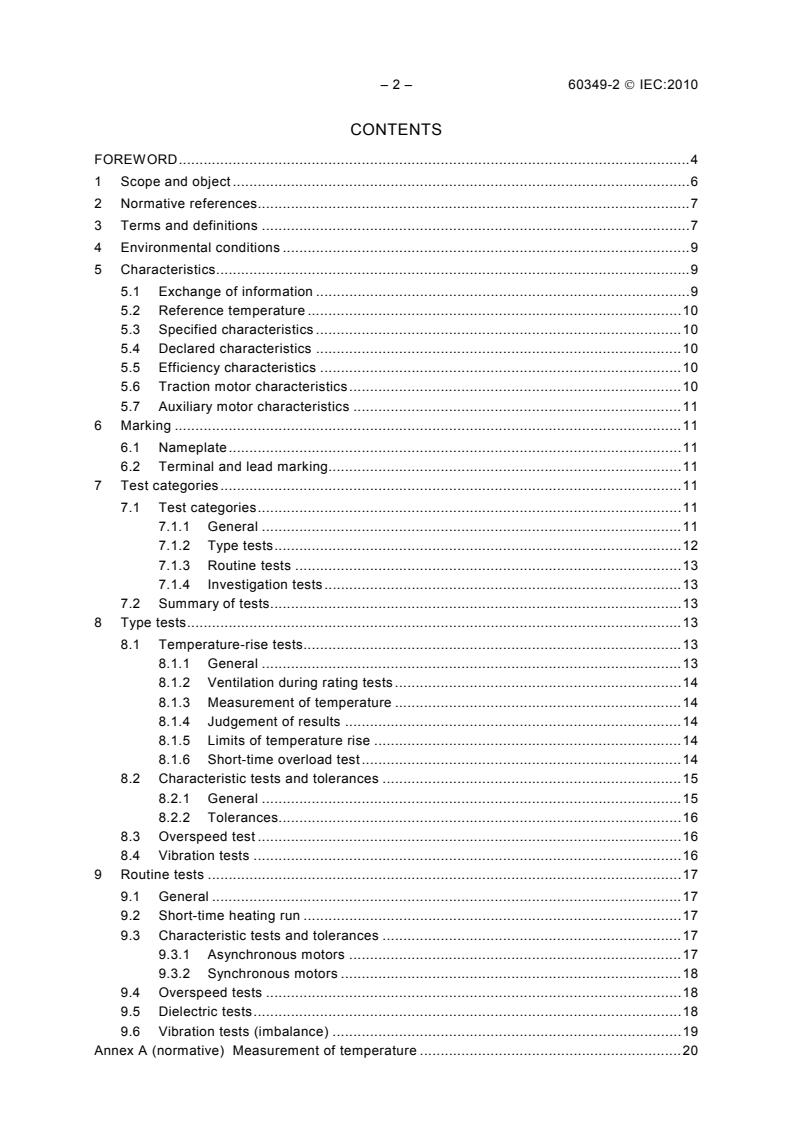
CONTENTS
FOREWORD.4
1 Scope and object .6
2 Normative references.7
3 Terms and definitions .7
4 Environmental conditions .9
5 Characteristics.9
5.1 Exchange of information .9
5.2 Reference temperature .10
5.3 Specified characteristics .10
5.4 Declared characteristics .10
5.5 Efficiency characteristics .10
5.6 Traction motor characteristics.10
5.7 Auxiliary motor characteristics .11
6 Marking .11
6.1 Nameplate.11
6.2 Terminal and lead marking.11
7 Test categories.11
7.1 Test categories.11
7.1.1 General .11
7.1.2 Type tests.12
7.1.3 Routine tests .13
7.1.4 Investigation tests.13
7.2 Summary of tests.13
8 Type tests.13
8.1 Temperature-rise tests.13
8.1.1 General .13
8.1.2 Ventilation during rating tests .14
8.1.3 Measurement of temperature .14
8.1.4 Judgement of results .14
8.1.5 Limits of temperature rise .14
8.1.6 Short-time overload test.14
8.2 Characteristic tests and tolerances .15
8.2.1 General .15
8.2.2 Tolerances.16
8.3 Overspeed test .16
8.4 Vibration tests .16
9 Routine tests .17
9.1 General .17
9.2 Short-time heating run .17
9.3 Characteristic tests and tolerances .17
9.3.1 Asynchronous motors .17
9.3.2 Synchronous motors .18
9.4 Overspeed tests .18
9.5 Dielectric tests.18
9.6 Vibration tests (imbalance) .19
Annex A (normative) Measurement of temperature .20
60349-2 © IEC:2010 – 3 –
Annex B (normative) Conventional values of traction motor transmission losses .23
Annex C (informative) Noise measurement and limits .24
Annex D (normative) Supply voltages of traction systems .33
Annex E (normative) Agreement between user and manufacturer .34
Bibliography .35
Figure B.1 – Conventional values of traction motor transmission losses .23
Figure C.1 – Limiting mean sound power level for airborne noise emitted by traction
motors .30
Figure C.2 – Location of measuring points and prescribed paths for horizontal
machines .31
Figure C.3 – Location of measuring points and prescribed paths for vertical machines .32
Table 1 – Summary of tests.13
Table 2 – Limits of temperature rise for continuous and other ratings.14
Table 3 – Temperature rises for short-time overload ratings .15
Table 4 – Dielectric test voltages.19
Table C.1 – Corrections .26
Table C.2 – Corrections .29
Table C.3 – Correction for pure tones.30
– 4 – 60349-2 © IEC:2010
INTERNATIONAL ELECTROTECHNICAL COMMISSION
____________
ELECTRIC TRACTION –
ROTATING ELECTRICAL MACHINES
FOR RAIL AND ROAD VEHICLES –
Part 2: Electronic converter-fed alternating current motors
FOREWORD
1) The International Electrotechnical Commission (IEC) is a worldwide organization for standardization comprising
all national electrotechnical committees (IEC National Committees). The object of IEC is to promote
international co-operation on all questions concerning standardization in the electrical and electronic fields. To
this end and in addition to other activities, IEC publishes International Standards, Technical Specifications,
Technical Reports, Publicly Available Specifications (PAS) and Guides (hereafter referred to as “IEC
Publication(s)”). Their preparation is entrusted to technical committees; any IEC National Committee interested
in the subject dealt with may participate in this preparatory work. International, governmental and non-
governmental organizations liaising with the IEC also participate in this preparation. IEC collaborates closely
with the International Organization for Standardization (ISO) in accordance with conditions determined by
agreement between the two organizations.
2) The formal decisions or agreements of IEC on technical matters express, as nearly as possible, an international
consensus of opinion on the relevant subjects since each technical committee has representation from all
interested IEC National Committees.
3) IEC Publications have the form of recommendations for international use and are accepted by IEC National
Committees in that sense. While all reasonable efforts are made to ensure that the technical content of IEC
Publications is accurate, IEC cannot be held responsible for the way in which they are used or for any
misinterpretation by any end user.
4) In order to promote international uniformity, IEC National Committees undertake to apply IEC Publications
transparently to the maximum extent possible in their national and regional publications. Any divergence
between any IEC Publication and the corresponding national or regional publication shall be clearly indicated in
the latter.
5) IEC itself does not provide any attestation of conformity. Independent certification bodies provide conformity
assessment services and, in some areas, access to IEC marks of conformity. IEC is not responsible for any
services carried out by independent certification bodies.
6) All users should ensure that they have the latest edition of this publication.
7) No liability shall attach to IEC or its directors, employees, servants or agents including individual experts and
members of its technical committees and IEC National Committees for any personal injury, property damage or
other damage of any nature whatsoever, whether direct or indirect, or for costs (including legal fees) and
expenses arising out of the publication, use of, or reliance upon, this IEC Publication or any other IEC
Publications.
8) Attention is drawn to the Normative references cited in this publication. Use of the referenced publications is
indispensable for the correct application of this publication.
9) Attention is drawn to the possibility that some of the elements of this IEC Publication may be the subject of
patent rights. IEC shall not be held responsible for identifying any or all such patent rights.
International Standard IEC 60349-2 has been prepared by IEC technical committee 9: Electrical
equipment and systems for railways.
This third edition cancels and replaces the second edition published in 2002. It constitutes a
technical revision.
The main technical changes with regard to the previous edition are as follows:
– As the limits of vibration velocities have been changed in IEC 60034-14, the limits valid for
traction motors are now directly stated in this standard.
– In addition to the existing method for measuring and calculating the sound power level, the
methods described in ISO 3741, ISO 3743, ISO 3744, ISO 3745, ISO 9614 are also
allowed. However the maximum sound power levels and the correction for pure tones
remain unchanged in Clauses C.7 and C.8.
60349-2 © IEC:2010 – 5 –
The text of this standard is based on the following documents:
FDIS Report on voting
9/1416/FDIS 9/1466/RVD
Full information on the voting for the approval of this standard can be found in the report on
voting indicated in the above table.
This publication has been drafted in accordance with the ISO/IEC Directives, Part 2.
The list of all parts of IEC 60349 series, published under the general title, Electric traction –
Rotating electrical machines for rail and road vehicles, can be found on the IEC website.
The committee has decided that the contents of this publication will remain unchanged until the
stability date indicated on the IEC web site under "http://webstore.iec.ch" in the data related to
the specific publication. At this date, the publication will be
• reconfirmed,
• withdrawn,
• replaced by a revised edition, or
• amended.
– 6 – 60349-2 © IEC:2010
ELECTRIC TRACTION –
ROTATING ELECTRICAL MACHINES FOR RAIL
AND ROAD VEHICLES –
Part 2: Electronic converter-fed alternating current motors
1 Scope and object
This part of IEC 60349 applies to converter-fed alternating current motors forming part of the
equipment of electrically propelled rail and road vehicles.
The object of this part is to enable the performance of a motor to be confirmed by tests and to
provide a basis for assessment of its suitability for a specified duty and for comparison with
other motors.
Where further testing is to be undertaken in accordance with IEC 61377-1 and IEC 61377-
3, it may be preferable, to avoid duplication, that some type and investigation tests be
carried out on the combined test bed.
Particular attention is drawn to the need for collaboration between the designers of the motor
and its associated converter as detailed in 5.1.
NOTE 1 This part also applies to motors installed on trailers hauled by powered vehicles.
NOTE 2 The basic requirements of this part may be applied to motors for special purpose vehicles such as mine
locomotives but this part does not cover flameproof or other special features that may be required.
NOTE 3 It is not intended that this part should apply to motors on small road vehicles, such as battery-fed delivery
vehicles, factory trucks, etc. This part also does not apply to minor machines such as windscreen wiper motors, etc.
that may be used on all types of vehicles.
NOTE 4 Industrial type motors complying with IEC 60034 may be suitable for some auxiliary drives, providing that
it is demonstrated that operation on a converter supply will meet the requirements of the particular application.
The rating of traction motors fed in parallel by a common converter has to take into account the
effect on load-sharing of differences of wheel diameter and of motor characteristics as well as
weight transfer when operating at high coefficients of adhesion. The user is to be informed of
the maximum permissible difference in wheel diameter for the particular application.
The electrical input to motors covered by this part comes from an electronic converter.
NOTE 5 At the time of drafting, only the following combinations of motors and converters had been used for
traction applications, but it may also apply to other combinations which may be used in the future:
– asynchronous motors fed by voltage source converters;
– asynchronous motors fed by current source converters;
– synchronous motors fed by current source converters.
The motors covered by this part are classified as follows:
a) Traction motors – Motors for propelling rail or road vehicles.
b) Auxiliary motors not covered by IEC 60034 – Motors for driving compressors, fans, auxiliary
generators or other auxiliary machines.
60349-2 © IEC:2010 – 7 –
2 Normative references
The following referenced documents are indispensable for the application of this document. For
dated references, only the edition cited applies. For undated references, the latest edition of
the referenced document (including any amendments) applies.
IEC 60034-1, Rotating electrical machines – Part 1: Rating and performance
IEC 60034-8, Rotating electrical machines – Part 8: Terminal markings and direction of rotation
IEC 60034-9, Rotating electrical machines – Part 9 – Noise limits
IEC 60034-17, Rotating electrical machines – Part 17: Cage induction motors when fed from
convertors – Application guide
IEC 60050-131, International Electrotechnical Vocabulary – Part 131: Circuit theory
IEC 60050-151, International Electrotechnical Vocabulary – Part 151: Electrical and magnetic
devices
IEC 60050-411, International Electrotechnical Vocabulary – Part 411: Rotating machinery
IEC 60050-811, International Electrotechnical Vocabulary – Part 811: Electric traction
IEC 60085, Thermal evaluation and designation
IEC 61672, Electroacoustics – Sound level meters
IEC 62498-1, Railway applications – Environmental conditions for equipment – Part 1:
Equipment on board rolling stock
3 Terms and definitions
For the purposes of this document, the terms and definitions given in IEC 60050-131,
IEC 60050-151, IEC 60050-411 and IEC 60050-811, as well as the following, apply.
3.1
rating of a motor
combination of simultaneous values of electrical and mechanical quantities, with their duration
and sequence, assigned to the motor by the manufacturer
3.2
rated value
numerical value of any quantity included in a rating
3.3
continuous rating
mechanical output that the motor can deliver on the test bed for an unlimited time under the
conditions specified in 8.1 without exceeding the limits of temperature rise given in Table 2, all
other appropriate requirements in this part also being satisfied
NOTE Several continuous ratings may be specified.
– 8 – 60349-2 © IEC:2010
3.4
short-time rating (for example, one hour)
mechanical output that the motor can deliver on the test bed for the stated time without
exceeding the limits of temperature rise given in Table 2, the test being carried out as specified
in 8.1 starting with the motor cold, all other appropriate requirements in this part being also
satisfied
3.5
short-time overload rating
mechanical output that the motor can deliver on the test bed for the stated time without
exceeding the limits of temperature rise given in Table 3, the test being started and carried out
as specified in 8.1.6
NOTE Short-time overload ratings are of value in determining the suitability of motors for duties which involve
relatively long periods of operation below the continuous rating followed by a period above it. These are most likely
to occur in locomotive applications. They are not relevant to the repeated short load cycles of rapid transit and
similar duties, and should not be specified for such applications.
3.6
intermittent duty rating
duty cycle in which the motor may be operated without the temperature rises exceeding the
limits given in Table 2 at any point
3.7
equivalent rating
continuous rating with constant values of voltage, current and speed that, as far as
temperature rise is concerned, is equivalent to the intermittent duty cycle which the motor has
to withstand in service
NOTE This rating should be agreed between user and manufacturer.
3.8
guaranteed rating
rating assigned by the manufacturer for test purposes
3.9
guaranteed rating of a traction motor
normally the continuous rating but in special cases the user and manufacturer may agree that it
be a short-time or intermittent rating
3.10
guaranteed rating of an auxiliary motor
continuous rating unless otherwise specified
3.11
rated voltage
root-mean-square value of the fundamental component of the line-to-line voltage applied to a
motor when it is operating at a guaranteed rating.
NOTE For motors fed directly or indirectly from a contact system, it is normally the highest voltage (excluding
transients) which can be applied to the motor when it is drawing the rated current, with the contact system at its
nominal voltage as defined in Annex D.
3.12
rated speed
speed at a guaranteed rating
60349-2 © IEC:2010 – 9 –
3.13
maximum voltage
highest root-mean-square value of the fundamental component of the line-to-line supply
voltage which can be applied to the motor in service
3.14
repetitive peak voltage
peak value of the waveform of the converter output voltage, any random transient peaks arising
from line voltage transients or other causes being disregarded
3.15
maximum current
maximum current shown on the specified characteristic as defined in 5.3
3.16
maximum working speed
3.16.1
maximum working speed of a traction motor
highest rotational speed assigned to the motor by the manufacturer
NOTE When the characteristics of the vehicle for which a motor is intended are specified, this speed is not less
than that corresponding to the maximum service speed of the vehicle assuming fully worn metallic wheels or the
minimum rolling diameter of rubber tyres.
3.16.2
maximum working speed of an auxiliary motor
highest rotational speed assigned to the motor by the manufacturer
NOTE For specific applications, when assigning this speed, the most unfavourable conditions of voltage,
frequency, loading, etc., that can occur in service should be taken in account.
4 Environmental conditions
Unless otherwise specified by the user, the following environmental conditions are assumed:
a) Altitude
Height above sea level not exceeding Class A3 according IEC 62498-1.
b) Temperature
Air temperature in the shade Class T1 according IEC 62498-1.
Whenever motors are intended to operate where one or both of these limits will be exceeded,
special requirements may be agreed between user and manufacturer. For more information
refer to IEC 60034-1.
Furthermore, the user shall inform the manufacturer of any particularly severe environmental
condition such as dust, humidity, temperature, snow, dynamic effects, etc., to which the motors
will be subjected.
5 Characteristics
5.1 Exchange of information
The motor and converter designers shall collaborate to produce all the technical information
necessary to ensure that the combined unit will meet the requirements of this part of
IEC 60349.
– 10 – 60349-2 © IEC:2010
To fulfil this requirement, the motor designer shall provide the converter designer with all the
information necessary to fully evaluate the interaction between the motor and the converter.
The converter designer shall also provide the motor designer with the characteristics showing,
for example, the converter line-to-line output voltage (including the repetitive voltage peaks),
current, fundamental frequency, harmonics and power over the whole range of the application,
including operation at the maximum and minimum values of the contact-system voltage.
The documents recording this exchange of information shall form an integral part of the
specification of the motor and of the converter.
NOTE 1 For more information refer to IEC 61287-1, 5.3.1.1.
NOTE 2 The length of cable run between motor and converter and the effect on peak voltages seen at the motor
terminals should be considered.
NOTE 3 For information about wave fronts and the impact to the motor see IEC 60034-17.
5.2 Reference temperature
All characteristics, irrespective of the thermal class of the insulation system used on the motor
to which they apply, shall be drawn for a winding reference temperature of 150 °C which shall
be stated in the characteristics.
5.3 Specified characteristics
Motor specifications shall, as a general rule, include characteristic curves in accordance with
the relevant clauses of this part. These curves, defined as the "specified characteristics", shall
be plotted to the designed operating limits of each variable. Unless otherwise agreed between
user and manufacturer, the characteristics shall show the machine performance at the nominal
voltage of the supply system as defined in Annex D, and shall be submitted to the user before
the order for the motors is placed.
5.4 Declared characteristics
Declared characteristics are derived from the results of type tests carried out in accordance
with 8.2.1 and shall meet the requirements of 8.2.2.
Unless previously agreed, the declared characteristics of motors electromagnetically identical
with any previously manufactured for the same user or application shall be those of the existing
motors. In such a case, compliance with the characteristics shall be demonstrated by routine
tests only.
5.5 Efficiency characteristics
Efficiency characteristics shall take into account losses arising from the harmonics in the
supply from the converter. Power used for excitation of synchronous motors shall also be
included in the losses unless otherwise accounted for, (e.g. as an auxiliary load), in which case
the omission shall be stated in the characteristics.
5.6 Traction motor characteristics
The specified and declared characteristics of a traction motor shall be the converter-fed
variable frequency characteristics, which shall show motor line-to-line voltage, current,
frequency, mean torque and efficiency as a function of speed over the whole range of
application of the motor. Characteristics of asynchronous motors shall show slip and those of
synchronous motors shall show the excitation current. Voltage curves shall show the root-
mean-square value of the fundamental component. Current curves shall show the root-mean-
square value of the fundamental component and the total root-mean-square value. For motors
used in the braking mode, similar characteristics shall be produced showing the torque input
and the electrical output as a function of motor speed.
60349-2 © IEC:2010 – 11 –
NOTE 1 Subclause 5.1 refers to the need for the exchange of information between the designers of the motor and
of the converter.
As an alternative to motor torque and speed, the characteristics may show tractive effort at the
rail and vehicle speed, in which case the gear ratio, wheel diameter and transmission losses
shall be stated. If conventional values are used for the latter, they shall be in accordance with
Figure B.1.
NOTE 2 Clause 1 refers to the need to consider the effect on parallel-fed motors of differing wheel diameters and
of weight transfer between axles.
5.7 Auxiliary motor characteristics
The specified and declared characteristics of auxiliary motors shall be the converter-fed
characteristics, which shall show the motor line-to-line voltage, current, speed and mean
torque as a function of motor output for each operating frequency over the whole range of
application of the motor. The characteristics of motors which operate at continuously variable
frequency shall be plotted for the maximum and minimum frequencies only.
Characteristics of asynchronous motors shall show slip and those of synchronous motors shall
show the excitation current. Voltage curves shall show the root-mean-square value of
the fundamental component. Current curves shall show the root-mean-square value of the
fundamental component and the total root-mean-square value. The characteristics shall take
account of the additional losses arising from the supply harmonics and the efficiency at
the guaranteed rating shall be stated.
Alternatively, the characteristics may be plotted as a function of speed.
NOTE Subclause 5.1 refers to the need for the exchange of information between the designers of the motor and
of the converter.
6 Marking
6.1 Nameplate
All motors covered by this part of IEC 60349 shall carry a nameplate including at least the
following information:
a) Manufacturer's name.
b) Motor type designation.
c) Motor serial number.
d) Year of manufacture.
Furthermore, a serial number shall be punched on both the stator and rotor of every motor, and
motors designed for unidirectional rotation shall carry an arrow indicating the direction of
rotation.
NOTE The motor serial number and rotation arrow should be easily readable when the motor is installed
in the vehicle.
6.2 Terminal and lead marking
Terminal and lead markings shall be in accordance with IEC 60034-8 unless otherwise agreed.
7 Test categories
7.1 Test categories
7.1.1 General
There are three categories of tests:
– 12 – 60349-2 © IEC:2010
– type tests;
– routine tests;
– investigation tests.
NOTE See Clause 1 on duplication of tests.
7.1.2 Type tests
7.1.2.1 General
Type tests are intended to prove the ratings, characteristics and performance of new types of
motor. They shall be carried out on one motor of every new design. Unless otherwise agreed,
the motor shall be one of the first ten manufactured. Where there is a change in place and/or
method of manufacture, refer to 7.1.2.4.
Before testing commences, the manufacturer shall provide the user with a test specification
outlining the tests to be undertaken to demonstrate compliance with this standard. Following
completion of the type tests, the manufacturer shall supply the user with a full test report.
7.1.2.2 Type tests on converter supply
If each motor is fed by its own converter, the type test shall preferably be carried out using the
converter to be employed in service, but, as an alternative, a supply which closely resembles
the supply from the vehicle converter in waveform and harmonics may be employed.
If several motors are fed in parallel from a single converter, the type test shall be carried out on
a single motor using a supply closely resembling the supply from the vehicle converter in
waveform and harmonics.
If requested by the user, the manufacturer shall demonstrate the similarity of the test and
service supplies, and shall state the likely effect on the performance of the motor of any
difference between them.
Unless otherwise agreed, the type test shall be repeated if the electrical output characteristics
of the converter are changed.
7.1.2.3 Type tests on sinusoidal supply
This test is to provide a reference for the characteristics of a machine.
The test shall include a temperature rise test at a rating agreed between the manufacturer and
the system responsible.
Voltage, frequency, torque, ventilation and test duration can be at the manufacturers discretion,
but the duration of the test must be at least 1 h and at values that do not over-stress the
machine above those normally seen in service.
The test parameters shall be maintained for any subsequent test on that design of machine.
The temperature rise measurements shall be carried out as detailed in 8.1.
7.1.2.4 Repeat type test
Subject to agreement, and to the results of both the type test on sinusoidal supply
(see 7.1.2.3), and the routine test being within the tolerances established on the previous
motors, a full type test is not required if the manufacturer produces a full type test report, for a
motor of the same electromagnetic design at the same or higher rating. This also applies to
repeat orders, and where there is a change of place and/or method of manufacture.
60349-2 © IEC:2010 – 13 –
7.1.3 Routine tests
Routine tests are intended to demonstrate that a motor has been assembled correctly, is able
to withstand the appropriate dielectric tests, and is in sound working order both mechanically
and electrically.
The routine tests specified in Clause 9 shall normally be carried out on all motors but, before
placing an order, the user and manufacturer may agree to adopt an alternative test procedure
(e.g. in the case of motors produced in large quantities under a strict quality assurance
procedure). This may permit reduced routine testing of all motors or may require the full tests
on a proportion of motors chosen at random from those produced on the order. Any such
agreement shall require the dielectric tests specified in 9.5 to be carried out on all motors.
7.1.4 Investigation tests
Investigation tests are optional special tests performed to obtain additional information. They
shall be carried out only if agreement between user and manufacturer has been reached before
placing the order for manufacture of the motors. The results of these tests shall not influence
acceptance of a motor unless similarly agreed.
7.2 Summary of tests
Table 1 lists the tests required for compliance with this part of IEC 60349.
Table 1 – Summary of tests
Subclause
Short-time
Type of Test
Tempera- thermal Character- Over-
motor category
Dielectric Vibration Noise
ture rise test/heat istics speed
run
a
Type 8.1 7.1.2.2 8.2 8.3 – 8.4 Annex C
Asyn-
a a a
chronous
Routine – 9.1 9.3.1 9.4 9.5 9.6 –
a
Type 8.1 – 8.2 8.3 – 8.4 Annex C
Syn-
a a
chronous
Routine – 9.2/9.1 9.3.2 9.4 9.5 9.6 –
All motors, including those type tested, shall be routine tested.
a
Optional tests, subject to agreement between user and manufacturer.
8 Type tests
8.1 Temperature-rise tests
8.1.1 General
The tests shall be carried out at the guaranteed ratings of the motor.
The rated mechanical output may be measured directly or indirectly at the motor shaft, or be
obtained without measurement by supplying the motor at the voltage, current and frequency
shown on the declared characteristics as producing the rated mechanical output.
In the case of continuous rating tests, the time to reach a steady temperature may be
shortened by commencing the test at an increased load or reduced ventilation provided that the
rated conditions are subsequently maintained for at least 2 h or until it is demonstrated by
appropriate means that steady temperatures have been reached.
NOTE Steady temperature is defined as a change in temperature of less than 2 K during the final hour of the test.
– 14 – 60349-2 © IEC:2010
8.1.2 Ventilation during rating tests
Motors shall be tested with the ventilation arranged as in service with all those parts which
would affect the temperature rise, including any ducting and filters regarded as part of the
vehicle in place, or with an arrangement giving equivalent conditions.
If cooling is by forced ventilation, the static pressure and the airflow shall be measured at the
inlet to the motor so that a table giving the relationship between these two quantities may be
drawn up.
In general, no cooling corresponding to that produced by the movement of the vehicle shall
be provided but, in special cases, such as totally enclosed traction motors where this
cooling is particularly important, it may be provided subject to agreement between user
and manufacturer.
8.1.3 Measurement of temperature
The temperature shall be measured in accordance with Annex A.
8.1.4 Judgement of results
The temperature rises of the windings and slip rings at the “commencement of cooling” as
defined in A.4 shall not exceed the values given in Table 2.
8.1.5 Limits of temperature rise
The different thermal classes of insulation systems are defined in IEC 60085.
Table 2 gives the permissible limits of temperature rise above the temperature of the cooling
air, measured on the test bed, for windings and other parts insulated with materials of the
thermal classes presently used in the construction of motors to which this part applies.
If different parts of the same machine have different thermal classes of insulation, the
temperature-rise limit of each part shall be that of its individual thermal class.
Table 2 – Limits of temperature rise for continuous and other ratings
Part Method of Thermal class of insulation system
measurement
130(B) 155(F) 180(H) 200 220 250
Stator windings
Rotating field windings of Resistance 130 K 155 K 180 K 200 K 220 K 250 K
synchronous motors
Slip rings Electrical thermometer 120 K 120 K 120 K 120 K 120 K 120 K
Cage rotors and damping The temperature rise shall not be sufficient to endanger
Electrical thermometer
windings any windings or other parts.
For totally enclosed motors, the limits above are increased by 10 K.
Where the motors are directly or indirectly exposed to the heat from an engine or from any
other source, the adoption of temperature rises lower than those specified in Table 2 may be
agreed between user and manufacturer.
8.1.6 Short-time overload test
If short-time overload ratings are specified, they shall be verified by one or more tests carried
out as follows.
60349-2 © IEC:2010 – 15 –
At the conclusion of a previous temperature-rise test, the temperature rise at the beginning
given in Table 3 may be obtained by continuing to plot the cooling curve for the critical winding
until the time at which its temperature rise predicted by extrapolating the curve for a period not
exceeding 5 min ahead of the last reading (see Notes 1 and 2) will reach the “start” value given
in Table 3. The specified overload shall be applied at this predicted time with normal ventilation
conditions and shall be maintained for the specified duration, at which point the test shall be
concluded and the temperature rise measured in accordance with 8.1.3.
If the measured temperature rise is within 20 K of the final value given in Table 3, either
the rated current or duration may be amended by calculation to a value estimated to give the
Table 3 temperature rise. If the measured temperature rise differs from the Table 3 value by
more than 20 K, the test shall be repeated with amended values of either current or duration.
Table 3 – Temperature rises for short-time overload ratings
Thermal class of insulation system
Part
130(B) 155(F) 180(H) 200 220 250
Stator windings At start of test 85 K 100 K 120 K 130 K 140 K 155 K
Rotating field windings of
At end of test 130 K 155 K 180 K 200 K 220 K 250 K
synchronous motors
NOTE 1 For totally enclosed motors, the temperature rises given above are increased by 10 K.
NOTE 2 An alternative method of obtaining the starting temperature rise may be employed if agreed between
manufacturer and user.
NOTE 3 If agreed between user and manufacturer, the temperatures of other motor parts (e.g. the rotor cage,
damping windings, bearings, etc.) may be measured.
8.2 Characteristic tests and tolerances
8.2.1 General
Tests to demonstrate compliance with the specified characteristics shall be carried out by
measuring the electrical input to the motor and the mechanical output from it. The output may
either be measured directly or be calculated from the measured output of a driven electrical
machine of known efficiency.
Alternatively, and
...