

IEC 60086-4:2025
(Main)Primary batteries - Part 4: Safety of lithium batteries
General Information
- Abstract
IEC 60086-4:2025 specifies tests and requirements for primary lithium batteries to ensure their safe operation under intended use and reasonably foreseeable misuse.
This sixth edition cancels and replaces the fifth edition published in 2019. This edition includes the following significant technical changes with respect to the previous edition:
- Added definitions for leakage and venting, in addition to the test criteria;
- Revised overdischarge test;
- Revised marking requirements;
- Revised criteria for the child resistant packaging test;
- Changed the purpose of Annex F from "informative" to "normative";
- Added a new Annex G with additional measures against misuse of batteries not intended for consumer replacement;
- Integrated the contents of Interpretation Sheet 1 (IEC 60086-4:2019/ISH1:2020);
- In Clause 3, terms were reordered according their functions: basic terms, electrochemical systems, battery shapes, battery sizes, electrical characteristics, specifications, safety aspects, failure modes;
- In 6.4.4, the exemption for the shock acceleration for lithium primary batteries was reduced from 12 kg to 4,482 kg in order to reflect the fact that this is the threshold in IEC 62281, Test T-4, where the peak acceleration decreases below 150 gn.
- Status
- Published
- Publication Date
- 28-Jan-2025
- Technical Committee
- TC 35 - Primary cells and batteries
- Drafting Committee
- MT 15 - TC 35/MT 15
- Current Stage
- PPUB - Publication issued
- Start Date
- 29-Jan-2025
- Completion Date
- 10-Jan-2025
Buy Documents
REDLINE IEC 60086-4:2025 CMV - Primary batteries - Part 4: Safety of lithium batteries/29/2025
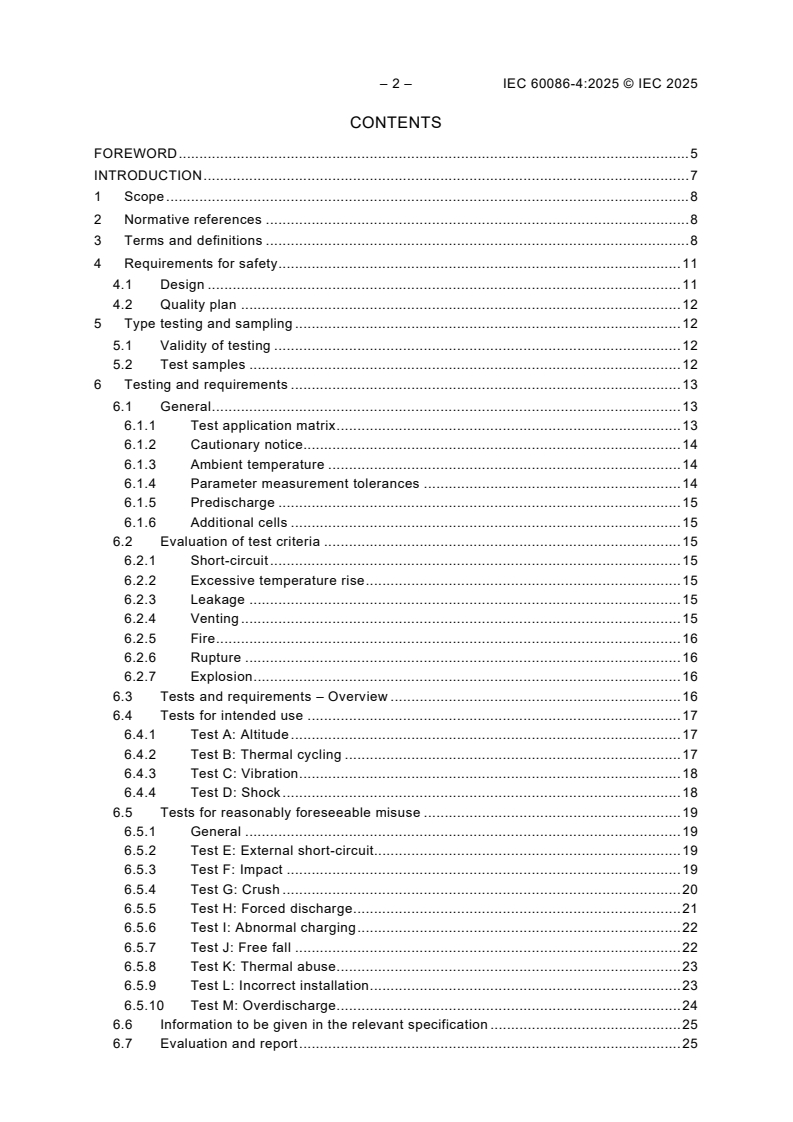
IEC 60086-4:2025 - Primary batteries - Part 4: Safety of lithium batteries Released:1/29/2025
Overview
IEC 60086-4:2025 is the latest sixth edition international standard published by the International Electrotechnical Commission (IEC), focused on the safety of primary lithium batteries. This standard sets forth comprehensive tests and stringent requirements specifically designed to ensure safe operation of primary lithium batteries under both intended use and reasonably foreseeable misuse. It replaces the 2019 fifth edition, introducing critical updates to enhance safety practices, definitions, testing methods, and marking guidelines.
With increasing adoption of lithium primary batteries in a wide range of consumer and industrial products, IEC 60086-4:2025 plays a vital role in mitigating risks associated with battery leakage, venting, thermal incidents, and mechanical abuses. Its requirements promote robust battery design, quality assurance, and safety awareness from manufacturing to end-user handling.
Key Topics
Scope and Definitions
Covers primary lithium batteries with precise definitions for leakage, venting, and failure modes. The reorganization of terms clarifies battery types, electrical characteristics, and safety aspects.Testing Requirements
Introduces revised test protocols including overdischarge, shock, thermal cycling, vibration, crushing, external short-circuit, forced discharge, and abnormal charging tests. These tests simulate real-world and misuse conditions to verify battery safety performance.Marking and Packaging
Updates marking requirements emphasizing clear identification and safety information. Includes enhanced child-resistant packaging tests and mandates safety pictograms to reduce hazards, particularly for swallowable coin cell batteries.Annexes for Enhanced Safety
- Annex F is now normative and mandates the use of "KEEP OUT OF REACH OF CHILDREN" safety signs.
- New Annex G outlines additional measures to prevent misuse of primary batteries not intended for consumer replacement.
Design and Quality Considerations
Emphasizes safe battery design and quality control plans. Offers guidelines for charge protection and cautions in equipment design using lithium batteries.Handling, Storage, and Transport
Provides instructions to ensure safety during battery storage, display, transport by air, sea, and land, as well as disposal protocols.
Applications
IEC 60086-4:2025 is applicable for:
Battery Manufacturers - design, construction, testing, and quality assessment of primary lithium batteries to meet international safety benchmarks.
Electronics and Device Makers - ensuring incorporated lithium batteries comply with safety requirements, improving product reliability and user safety.
Packaging Designers - developing child-resistant packaging and informative labeling to prevent accidental ingestion and misuse.
Regulators and Compliance Teams - reference for certification and regulation enforcement of lithium battery safety in consumer and industrial markets.
Logistics and Retailers - managing safe handling, storage, and transport of lithium batteries in compliance with international safety norms.
This standard supports the entire lithium battery supply chain with practical guidelines that minimize risks of fire, explosion, leakage, and other hazardous incidents.
Related Standards
- IEC 62281 – Safety requirements for primary and secondary lithium batteries during transport, referenced in shock acceleration testing.
- IEC 60086 Series – Other parts include general specifications, dimensions, and marking for primary batteries.
- UN Recommendations on the Transport of Dangerous Goods – Guidelines relevant to lithium battery shipping and packaging.
- ISO Standards on Battery Safety and Packaging – Complementary standards addressing safety measures in packaging and consumer product design.
By aligning with IEC 60086-4:2025 alongside these related standards, stakeholders can ensure comprehensive safety coverage for primary lithium batteries throughout their lifecycle.
Keywords: IEC 60086-4:2025, lithium battery safety, primary lithium batteries, battery testing, child resistant packaging, battery marking, battery misuse prevention, battery design guidelines, safety standards, battery transport safety.
Relations
- Effective Date
- 05-Sep-2023
- Revises
IEC 60086-4:2019/COR2:2020 - Corrigendum 2 - Primary batteries - Part 4: Safety of lithium batteries - Effective Date
- 05-Sep-2023
- Revises
IEC 60086-4:2019/COR1:2019 - Corrigendum 1 - Primary batteries - Part 4: Safety of lithium batteries - Effective Date
- 05-Sep-2023
- Effective Date
- 05-Sep-2023
Buy Documents
REDLINE IEC 60086-4:2025 CMV - Primary batteries - Part 4: Safety of lithium batteries/29/2025
IEC 60086-4:2025 - Primary batteries - Part 4: Safety of lithium batteries Released:1/29/2025
Get Certified
Connect with accredited certification bodies for this standard

IMQ S.p.A. (Certification)
Italian electrical product certification.

SLG Prüf- und Zertifizierungs GmbH
German testing and certification body.

UL Solutions
Global safety science company with testing, inspection and certification.
Sponsored listings
Frequently Asked Questions
IEC 60086-4:2025 is a standard published by the International Electrotechnical Commission (IEC). Its full title is "Primary batteries - Part 4: Safety of lithium batteries". This standard covers: IEC 60086-4:2025 specifies tests and requirements for primary lithium batteries to ensure their safe operation under intended use and reasonably foreseeable misuse. This sixth edition cancels and replaces the fifth edition published in 2019. This edition includes the following significant technical changes with respect to the previous edition: - Added definitions for leakage and venting, in addition to the test criteria; - Revised overdischarge test; - Revised marking requirements; - Revised criteria for the child resistant packaging test; - Changed the purpose of Annex F from "informative" to "normative"; - Added a new Annex G with additional measures against misuse of batteries not intended for consumer replacement; - Integrated the contents of Interpretation Sheet 1 (IEC 60086-4:2019/ISH1:2020); - In Clause 3, terms were reordered according their functions: basic terms, electrochemical systems, battery shapes, battery sizes, electrical characteristics, specifications, safety aspects, failure modes; - In 6.4.4, the exemption for the shock acceleration for lithium primary batteries was reduced from 12 kg to 4,482 kg in order to reflect the fact that this is the threshold in IEC 62281, Test T-4, where the peak acceleration decreases below 150 gn.
IEC 60086-4:2025 specifies tests and requirements for primary lithium batteries to ensure their safe operation under intended use and reasonably foreseeable misuse. This sixth edition cancels and replaces the fifth edition published in 2019. This edition includes the following significant technical changes with respect to the previous edition: - Added definitions for leakage and venting, in addition to the test criteria; - Revised overdischarge test; - Revised marking requirements; - Revised criteria for the child resistant packaging test; - Changed the purpose of Annex F from "informative" to "normative"; - Added a new Annex G with additional measures against misuse of batteries not intended for consumer replacement; - Integrated the contents of Interpretation Sheet 1 (IEC 60086-4:2019/ISH1:2020); - In Clause 3, terms were reordered according their functions: basic terms, electrochemical systems, battery shapes, battery sizes, electrical characteristics, specifications, safety aspects, failure modes; - In 6.4.4, the exemption for the shock acceleration for lithium primary batteries was reduced from 12 kg to 4,482 kg in order to reflect the fact that this is the threshold in IEC 62281, Test T-4, where the peak acceleration decreases below 150 gn.
IEC 60086-4:2025 is classified under the following ICS (International Classification for Standards) categories: 29.220.10 - Primary cells and batteries. The ICS classification helps identify the subject area and facilitates finding related standards.
IEC 60086-4:2025 has the following relationships with other standards: It is inter standard links to IEC 60086-4:2019/ISH1:2020, IEC 60086-4:2019/COR2:2020, IEC 60086-4:2019/COR1:2019, IEC 60086-4:2019. Understanding these relationships helps ensure you are using the most current and applicable version of the standard.
IEC 60086-4:2025 is available in PDF format for immediate download after purchase. The document can be added to your cart and obtained through the secure checkout process. Digital delivery ensures instant access to the complete standard document.
Standards Content (Sample)
IEC 60086-4 ®
Edition 6.0 2025-01
COMMENTED VERSION
INTERNATIONAL
STANDARD
colour
inside
Primary batteries –
Part 4: Safety of lithium batteries
All rights reserved. Unless otherwise specified, no part of this publication may be reproduced or utilized in any form
or by any means, electronic or mechanical, including photocopying and microfilm, without permission in writing from
either IEC or IEC's member National Committee in the country of the requester. If you have any questions about IEC
copyright or have an enquiry about obtaining additional rights to this publication, please contact the address below or
your local IEC member National Committee for further information.
IEC Secretariat Tel.: +41 22 919 02 11
3, rue de Varembé info@iec.ch
CH-1211 Geneva 20 www.iec.ch
Switzerland
About the IEC
The International Electrotechnical Commission (IEC) is the leading global organization that prepares and publishes
International Standards for all electrical, electronic and related technologies.
About IEC publications
The technical content of IEC publications is kept under constant review by the IEC. Please make sure that you have the
latest edition, a corrigendum or an amendment might have been published.
IEC publications search - webstore.iec.ch/advsearchform IEC Products & Services Portal - products.iec.ch
The advanced search enables to find IEC publications by a
Discover our powerful search engine and read freely all the
variety of criteria (reference number, text, technical publications previews, graphical symbols and the glossary.
committee, …). It also gives information on projects, replaced With a subscription you will always have access to up to date
and withdrawn publications. content tailored to your needs.
IEC Just Published - webstore.iec.ch/justpublished
Electropedia - www.electropedia.org
Stay up to date on all new IEC publications. Just Published
The world's leading online dictionary on electrotechnology,
details all new publications released. Available online and
containing more than 22 500 terminological entries in English
once a month by email.
and French, with equivalent terms in 25 additional languages.
Also known as the International Electrotechnical Vocabulary
IEC Customer Service Centre - webstore.iec.ch/csc
(IEV) online.
If you wish to give us your feedback on this publication or
need further assistance, please contact the Customer Service
Centre: sales@iec.ch.
IEC 60086-4 ®
Edition 6.0 2025-01
COMMENTED VERSION
INTERNATIONAL
STANDARD
colour
inside
Primary batteries –
Part 4: Safety of lithium batteries
INTERNATIONAL
ELECTROTECHNICAL
COMMISSION
ICS 29.220.10 ISBN 978-2-8327-0178-2
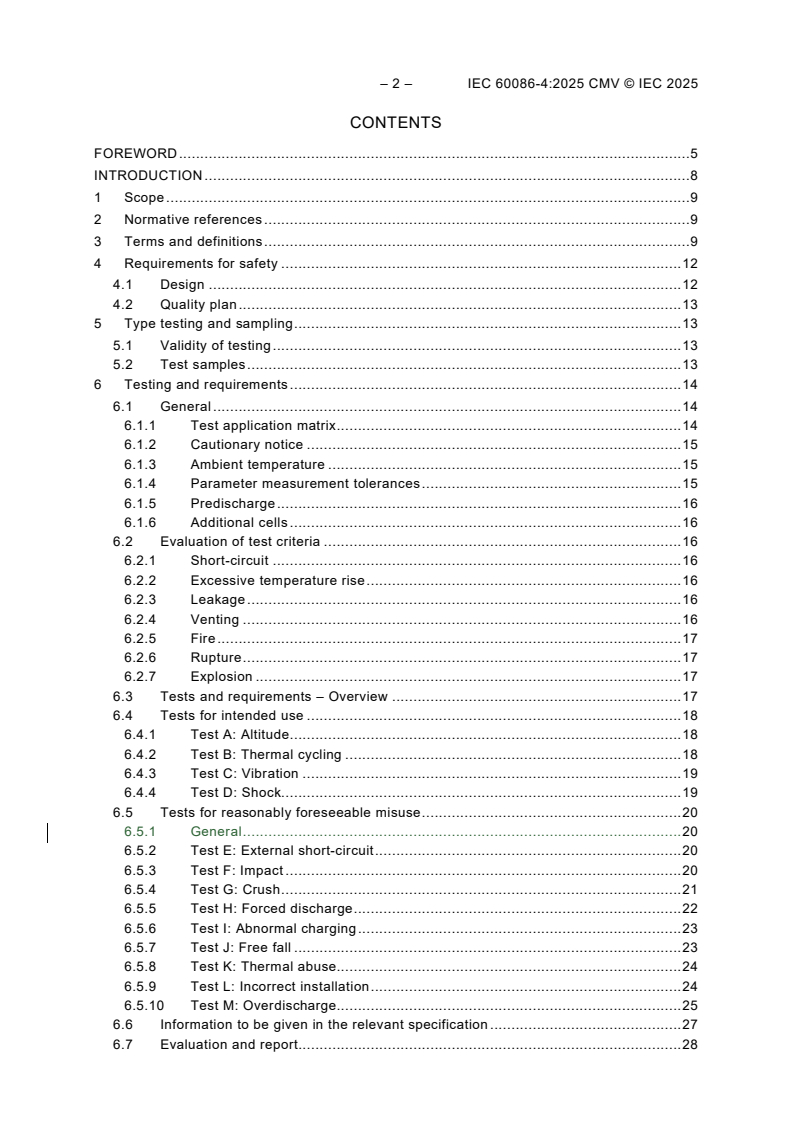
– 2 – IEC 60086-4:2025 CMV © IEC 2025
CONTENTS
FOREWORD .5
INTRODUCTION .8
1 Scope .9
2 Normative references .9
3 Terms and definitions .9
4 Requirements for safety . 12
4.1 Design . 12
4.2 Quality plan . 13
5 Type testing and sampling . 13
5.1 Validity of testing . 13
5.2 Test samples . 13
6 Testing and requirements . 14
6.1 General . 14
6.1.1 Test application matrix . 14
6.1.2 Cautionary notice . 15
6.1.3 Ambient temperature . 15
6.1.4 Parameter measurement tolerances . 15
6.1.5 Predischarge . 16
6.1.6 Additional cells . 16
6.2 Evaluation of test criteria . 16
6.2.1 Short-circuit . 16
6.2.2 Excessive temperature rise . 16
6.2.3 Leakage . 16
6.2.4 Venting . 16
6.2.5 Fire . 17
6.2.6 Rupture . 17
6.2.7 Explosion . 17
6.3 Tests and requirements – Overview . 17
6.4 Tests for intended use . 18
6.4.1 Test A: Altitude . 18
6.4.2 Test B: Thermal cycling . 18
6.4.3 Test C: Vibration . 19
6.4.4 Test D: Shock. 19
6.5 Tests for reasonably foreseeable misuse . 20
6.5.1 General . 20
6.5.2 Test E: External short-circuit . 20
6.5.3 Test F: Impact . 20
6.5.4 Test G: Crush . 21
6.5.5 Test H: Forced discharge . 22
6.5.6 Test I: Abnormal charging . 23
6.5.7 Test J: Free fall . 23
6.5.8 Test K: Thermal abuse. 24
6.5.9 Test L: Incorrect installation . 24
6.5.10 Test M: Overdischarge. 25
6.6 Information to be given in the relevant specification . 27
6.7 Evaluation and report . 28
7 Information for safety . 28
7.1 Safety precautions during design of equipment . 28
7.1.1 General . 28
7.1.2 Charge protection . 28
7.1.3 Parallel connection . 29
7.2 Precautions during handling of batteries . 29
7.3 Additional information for safety of coin cells . 32
7.4 Packaging . 32
7.5 Handling of battery cartons . 32
7.6 Transport . 32
7.6.1 General . 32
7.6.2 Air transport . 32
7.6.3 Sea transport . 32
7.6.4 Land transport . 33
7.7 Display and storage . 33
7.8 Disposal . 33
8 Instructions for use . 34
9 Marking and packaging . 34
9.1 General . 34
9.2 Marking of batteries too small to accommodate all markings . 34
9.3 Additional requirements for swallowable coin cells and batteries . 34
9.4 Safety pictograms . 36
Annex A (informative) Guidelines for the achievement of safety of lithium batteries . 37
Annex B (informative) Guidelines for designers of equipment using lithium batteries . 39
Annex C (informative) Additional information on display and storage . 42
Annex D (informative) Safety pictograms . 43
D.1 General . 43
D.2 Pictograms . 43
D.3 Instruction for use . 44
Annex E (normative) Child resistant packaging of coin cells . 46
E.1 General . 46
E.2 Applicability . 46
E.3 Packaging tests . 46
E.3.1 General . 46
E.3.2 Test items . 47
E.3.3 Test procedure . 49
E.3.4 Criteria . 49
Annex F (informativenormative) Use of the KEEP OUT OF REACH OF CHILDREN
safety sign . 51
F.1 General . 51
F.2 Safety sign . 51
F.3 Best practices for Marking on the packaging . 51
F.4 Best practices for Marking on the cell . 51
Annex G (normative) Measures against misuse of batteries not intended for consumer
replacement . 52
G.1 Background . 52
G.2 Additional measures for the prevention of confusion of primary batteries not
intended for consumer replacement with secondary batteries . 52
– 4 – IEC 60086-4:2025 CMV © IEC 2025
G.2.1 Identification of primary (non-rechargeable) batteries not intended for
consumer replacement . 52
G.2.2 Marking and information requirements for primary batteries not intended
for consumer replacement . 53
G.2.3 Information responsibility of manufacturers and distributors . 53
Bibliography . 54
List of comments . 56
Figure 1 – Thermal cycling procedure . 18
Figure 2 – Example of a test set-up for the impact test . 21
Figure 3 – Examples of a test set-up for the crush test . 22
Figure 4 – Axes for free fall . 24
Figure 5 – Circuit diagram for incorrect installation . 25
Figure 6 – Circuit diagram for overdischarge . 27
Figure 7 – Examples of wiring for charge protection . 29
Figure 8 – Ingestion gauge . 30
Figure 9 – Example for warning against swallowing, particularly coin cell batteries . 30
Figure A.1 – Battery design guidelines . 38
Figure E.1 – Bending test . 47
Figure E.2 – Torsion test . 48
Figure E.3 – Tearing test . 48
Figure E.4 – Pushing test . 48
Figure E.5 – Maximum packaging opening . 50
Figure F.1 – Recommended Safety signs for use on coin cells . 51
Table 1 – Number of test samples. 14
Table 2 – Test application matrix . 15
Table 3 – Mass loss limits . 16
Table 4 – Tests and requirements . 17
Table 5 – Vibration profile (sinusoidal) . 19
Table 6 – Shock parameters . 20
Table 7 – Resistive load for overdischarge . 26
Table 8 – Parameters to be specified . 27
Table 9 – Marking and packaging requirements .
Table 9 – Marking requirements. 35
Table 10 – Additional marking and packaging requirements for swallowable coin cells
and batteries . 36
Table A.1 – Battery design guidelines .
Table B.1 – Equipment design guidelines . 39
Table D.1 – Safety pictograms . 43
Table E.1 – Test procedure . 49
INTERNATIONAL ELECTROTECHNICAL COMMISSION
____________
PRIMARY BATTERIES –
Part 4: Safety of lithium batteries
FOREWORD
1) The International Electrotechnical Commission (IEC) is a worldwide organization for standardization comprising
all national electrotechnical committees (IEC National Committees). The object of IEC is to promote international
co-operation on all questions concerning standardization in the electrical and electronic fields. To this end and
in addition to other activities, IEC publishes International Standards, Technical Specifications, Technical Reports,
Publicly Available Specifications (PAS) and Guides (hereafter referred to as "IEC Publication(s)"). Their
preparation is entrusted to technical committees; any IEC National Committee interested in the subject dealt with
may participate in this preparatory work. International, governmental and non-governmental organizations liaising
with the IEC also participate in this preparation. IEC collaborates closely with the International Organization for
Standardization (ISO) in accordance with conditions determined by agreement between the two organizations.
2) The formal decisions or agreements of IEC on technical matters express, as nearly as possible, an international
consensus of opinion on the relevant subjects since each technical committee has representation from all
interested IEC National Committees.
3) IEC Publications have the form of recommendations for international use and are accepted by IEC National
Committees in that sense. While all reasonable efforts are made to ensure that the technical content of IEC
Publications is accurate, IEC cannot be held responsible for the way in which they are used or for any
misinterpretation by any end user.
4) In order to promote international uniformity, IEC National Committees undertake to apply IEC Publications
transparently to the maximum extent possible in their national and regional publications. Any divergence between
any IEC Publication and the corresponding national or regional publication shall be clearly indicated in the latter.
5) IEC itself does not provide any attestation of conformity. Independent certification bodies provide conformity
assessment services and, in some areas, access to IEC marks of conformity. IEC is not responsible for any
services carried out by independent certification bodies.
6) All users should ensure that they have the latest edition of this publication.
7) No liability shall attach to IEC or its directors, employees, servants or agents including individual experts and
members of its technical committees and IEC National Committees for any personal injury, property damage or
other damage of any nature whatsoever, whether direct or indirect, or for costs (including legal fees) and
expenses arising out of the publication, use of, or reliance upon, this IEC Publication or any other IEC
Publications.
8) Attention is drawn to the Normative references cited in this publication. Use of the referenced publications is
indispensable for the correct application of this publication.
9) IEC draws attention to the possibility that the implementation of this document may involve the use of (a)
patent(s). IEC takes no position concerning the evidence, validity or applicability of any claimed patent rights in
respect thereof. As of the date of publication of this document, IEC had not received notice of (a) patent(s), which
may be required to implement this document. However, implementers are cautioned that this may not represent
the latest information, which may be obtained from the patent database available at https://patents.iec.ch. IEC
shall not be held responsible for identifying any or all such patent rights.
This commented version (CMV) of the official standard IEC 60086-4:2025 edition 6.0
allows the user to identify the changes made to the previous IEC 60086-4:2019
edition 5.0. Furthermore, comments from IEC TC 35 experts are provided to explain the
reasons of the most relevant changes, or to clarify any part of the content.
A vertical bar appears in the margin wherever a change has been made. Additions are in
green text, deletions are in strikethrough red text. Experts' comments are identified by a
blue-background number. Mouse over a number to display a pop-up note with the
comment.
This publication contains the CMV and the official standard. The full list of comments is
available at the end of the CMV.
– 6 – IEC 60086-4:2025 CMV © IEC 2025
IEC 60086-4 has been prepared by technical committee 35: Primary cells and batteries. It is an
International Standard.
This sixth edition cancels and replaces the fifth edition published in 2019. This edition
constitutes a technical revision.
This edition includes the following significant technical changes with respect to the previous
edition:
a) Added definitions for leakage and venting, in addition to the test criteria;
b) Revised overdischarge test;
c) Revised marking requirements;
d) Revised criteria for the child resistant packaging test;
e) Changed the purpose of Annex F from "informative" to "normative";
f) Added a new Annex G with additional measures against misuse of batteries not intended
for consumer replacement;
g) Integrated the contents of Interpretation Sheet 1 (IEC 60086-4:2019/ISH1:2020);
h) In Clause 3, terms were reordered according their functions: basic terms, electrochemical
systems, battery shapes, battery sizes, electrical characteristics, specifications, safety
aspects, failure modes;
i) In 6.4.4, the exemption for the shock acceleration for lithium primary batteries was reduced
from 12 kg to 4,482 kg in order to reflect the fact that this is the threshold in IEC 62281,
Test T-4, where the peak acceleration decreases below 150 g .
n
The text of this International Standard is based on the following documents:
Draft Report on voting
35/1571/FDIS 35/1579/RVD
Full information on the voting for its approval can be found in the report on voting indicated in
the above table.
The language used for the development of this International Standard is English.
This document was drafted in accordance with ISO/IEC Directives, Part 2, and developed in
accordance with ISO/IEC Directives, Part 1 and ISO/IEC Directives, IEC Supplement, available
at www.iec.ch/members_experts/refdocs. The main document types developed by IEC are
described in greater detail at www.iec.ch/publications.
NOTE 1 The following print types are used:
– instructions/warnings for consumers: in italic type.
A list of all parts in the IEC 60086 series, under the general title Primary batteries, can be found
on the IEC website.
The committee has decided that the contents of this document will remain unchanged until the
stability date indicated on the IEC website under webstore.iec.ch in the data related to the
specific document. At this date, the document will be
• reconfirmed,
• withdrawn, or
• revised.
NOTE 2 The attention of National Committees is drawn to the fact that equipment manufacturers and testing
organizations may need a transitional period following publication of a new, amended or revised IEC document in
which to make products in accordance with the new requirements and to equip themselves for conducting new or
revised tests. It is the recommendation of the committee that the content of this document be adopted for
implementation nationally not earlier than 2 years from the date of publication. The transitional period applies
specifically to changes in Table 10. In the meantime, the previous edition can still be ordered by contacting your
local IEC member National Committee or the IEC Secretariat.
IMPORTANT – The "colour inside" logo on the cover page of this document indicates
that it contains colours which are considered to be useful for the correct understanding
of its contents. Users should therefore print this document using a colour printer.
– 8 – IEC 60086-4:2025 CMV © IEC 2025
INTRODUCTION
The concept of safety is closely related to safeguarding the integrity of people and property.
This document specifies tests and requirements for lithium batteries and has been prepared in
accordance with ISO/IEC guidelines, taking into account all relevant national and international
standards which apply.
Lithium batteries are different from conventional primary batteries using aqueous electrolyte in
that they contain flammable materials.
Consequently, it is important to carefully consider safety during design, production, distribution,
use, and disposal of lithium batteries. Based on such special characteristics, lithium batteries
for consumer applications were initially small in size and had low power output. There were also
lithium batteries with high power output which were used for special industrial and military
applications and were characterized as being "technician replaceable". The first edition of this
document was drafted to accommodate this situation.
However, from around the end of the 1980s, lithium batteries with high power output started to
be widely used in the consumer replacement market, mainly as a power source in camera
applications. Since the demand for such lithium batteries with high power output significantly
increased, various manufacturers started to produce these types of lithium batteries. As a
consequence of this situation, the safety aspects for lithium batteries with high power output
were included in the second edition of this document.
Primary lithium batteries both for consumer and industrial applications are well-established safe
and reliable products in the market, which is at least partly due to the existence of safety
standards such as this document and, for transport, IEC 62281. The fourth edition of this
document reflected minor changes which became necessary in order to keep it harmonized with
IEC 62281 and to continuously improve the user information about safety related matters.
Guidelines addressing safety issues during the design of lithium batteries are provided in
Annex A. Annex B provides guidelines addressing safety issues during the design of equipment
where lithium batteries are installed. Both Annex A and Annex B reflect experience with lithium
batteries used in camera applications and are based on [22] .
The ingestion hazard of coin cell batteries has become an issue and was addressed in the fifth
and sixth editions of this document by several independent measures such as the development
of a new safety sign "KEEP OUT OF REACH OF CHILDREN" as well as the introduction of child
resistant packaging.
A new Annex G addresses measures against misuse of cells and batteries not intended for
consumer replacement.
Safety is freedom from unacceptable risk. There can be no absolute safety: some risk will
remain. Therefore a product, process or service can only be relatively safe. Safety is achieved
by reducing risk to a tolerable level determined by the search for an optimal balance between
the ideal of absolute safety and the demands to be met by a product, process or service, and
factors such as benefit to the user, suitability for purpose, cost effectiveness, and conventions
of the society concerned.
As safety will pose different problems, it is impossible to provide a set of precise provisions and
recommendations that will apply in every case. However, this document, when followed on a
judicious "use when applicable" basis, will provide reasonably consistent standards for safety.
___________
Numbers in square brackets refer to the Bibliography.
PRIMARY BATTERIES –
Part 4: Safety of lithium batteries
1 Scope
This part of IEC 60086 specifies tests and requirements for primary lithium batteries to ensure
their safe operation under intended use and reasonably foreseeable misuse.
NOTE Primary lithium batteries that are standardized in IEC 60086-2 are expected to meet all applicable
requirements herein. It is understood that consideration of this part of IEC 60086 might also be given to measuring
and/or ensuring the safety of non-standardized primary lithium batteries. In either case, no claim or warranty is made
that compliance or non-compliance with this part of IEC 60086 will fulfil or not fulfil any of the user's particular
purposes or needs.
2 Normative references
The following documents are referred to in the text in such a way that some or all of their content
constitutes requirements of this document. For dated references, only the edition cited applies.
For undated references, the latest edition of the referenced document (including any
amendments) applies.
IEC 60086-1:2021, Primary batteries – Part 1: General
IEC 60086-2, Primary batteries – Part 2: Physical and electrical specifications
IEC 62281, Safety of primary and secondary lithium cells and batteries during transport
3 Terms and definitions
For the purposes of this document, the following terms and definitions apply.
ISO and IEC maintain terminology databases for use in standardization at the following
addresses:
• IEC Electropedia: available at https://www.electropedia.org/
• ISO Online browsing platform: available at https://www.iso.org/obp
NOTE Certain definitions taken from IEC 60050-482, IEC 60086-1, and ISO/IEC Guide 51 are repeated below for
convenience.
3.1
cell
basic functional unit, consisting of an assembly of electrodes, electrolyte, container, terminals
and usually separators, that is a source of electric energy obtained by direct conversion of
chemical energy
[SOURCE: IEC 60050-482:2004, 482-01-01]
– 10 – IEC 60086-4:2025 CMV © IEC 2025
3.2
battery
one or more cells electrically connected and fitted in a case, with terminals, markings and
protective devices etc., as necessary for use
[SOURCE: IEC 60050-482:2004, 482-01-04, modified – "fitted with devices necessary for use,
for example case" replaced by "electrically connected and fitted in a case", addition of "etc., as
necessary for use".]
3.3
component cell
cell contained in a battery
3.4
lithium cell
cell containing a non-aqueous electrolyte and a negative electrode of lithium or containing
lithium
[SOURCE: IEC 60050-482:2004 482-01-06, modified – removal of Note.]
3.5
coin cell
coin battery
lithium button cell
lithium button battery
small round cell or battery where the overall height is less than the diameter, containing
non-aqueous electrolyte.
Note 1 to entry: The nominal voltage of lithium batteries is typically greater than 2 V. See also the definition of
"button cell" in IEC 60086-5
Note 2 to entry: See 7.3 for proposed use of the alternative terms.
Note 3 to entry: The terms "lithium button cell" and "lithium button battery" were provided as alternative terms for
"coin cell" and "coin battery" in order to prevent the use of the terms "button cell" and "button battery" which would
be confusing as they have a different meaning, see part 1 of this standard.
Consequently, the terms "coin cell" and "coin battery" should be omitted in those languages where they have no
meaningful literal equivalent.
[SOURCE: IEC 60050-482:2004 482-02-40, modified – terms modified, Note “In practice terms,
the term coin is used exclusively for non-aqueous lithium cells.” replaced with a different note)
Note replaced.]
3.6
cylindrical cell
cylindrical battery
round cell or battery in which the overall height is equal to or greater than the diameter
[SOURCE: IEC 60050-482:2004, 482-02-39, modified – "cell with a cylindrical shape" replaced
by "round cell or battery".]
3.7
prismatic cell
prismatic battery
cell or battery having the shape of a parallelepiped whose faces are rectangular
[SOURCE: IEC 60050-482:2004, 482-02-38]
3.8
large cell
cell with a gross mass of more than 500 g
3.9
large battery
battery with a gross mass of more than 12 kg
3.10
nominal voltage
suitable approximate value of the voltage used to designate or identify a cell, a battery or an
electrochemical system
[SOURCE: IEC 60050-482:2004, 482-03-31]
3.11
open circuit voltage
OCV, U , off-load voltage
OC
voltage across the terminals of a cell or battery when no external current is flowing
[SOURCE: IEC 60050-482:2004, 482-03-32, modified – alternative terms "OCV, U , off-load
OC
voltage" added, "across the terminals" added, "when the discharge current is zero" replaced
with "when no external current is flowing".]
3.12
rated capacity
capacity value of a cell or battery determined under specified conditions and declared by the
manufacturer
[SOURCE: IEC 60050-482:2004, 482-03-15, modified – "cell or" added.]
3.13
depth of discharge
DOD
percentage of rated capacity discharged from a cell or battery
3.14
undischarged
state of a primary cell or battery at 0 % depth of discharge
3.15
fully discharged
state of a cell or battery at 100 % depth of discharge
3.16
harm
injury or damage to the health of people, or damage to property or the environment
[SOURCE: ISO/IEC Guide 51:2014, 3.1]
3.17
hazard
potential source of harm
[SOURCE: ISO/IEC Guide 51:2014, 3.2]
– 12 – IEC 60086-4:2025 CMV © IEC 2025
3.18
risk
combination of the probability of occurrence of harm and the severity of that harm
[SOURCE: ISO/IEC Guide 51:2014, 3.9, modified – removal of Note.]
3.19
safety
freedom from risk which is not tolerable
[SOURCE: ISO/IEC Guide 51:2014, 3.14]
3.20
intended use
use in accordance with information provided with a product or system, or, in the absence of
such information, by generally understood patterns of usage
[SOURCE: ISO/IEC Guide 51:2014, 3.6]
3.21
reasonably foreseeable misuse
use of a product, process or system in a way not intended by the supplier, but which may result
from readily predictable human behaviour
[SOURCE: ISO/IEC Guide 51:2014, 3.7, modified – removal of Notes.]
3.22
protective devices
devices such as fuses, diodes or other electric or electronic current limiters designed to interrupt
the current flow, block the current flow in one direction or limit the current flow in an electrical
circuit
3.23
leakage
unplanned escape of electrolyte, gas or other material from a cell or battery 1
Note 1 to entry: Leakage in this sense should not be confused with the test evaluation criteria for leakage specified
in Clause 6.
3.24
venting
release of excessive internal pressure from a cell or battery in a manner intended by design 2
Note 1 to entry: Venting in this sense should not be confused with the test evaluation criteria for venting specified
in Clause 6.
4 Requirements for safety
4.1 Design
Lithium batteries are categorized by their chemical composition (anode, cathode, electrolyte),
internal construction (bobbin, spiral) and are available in cylindrical, coin and prismatic
configurations. It is necessary to consider all relevant safety aspects at the battery design stage,
recognizing the fact that they can differ considerably, depending on the specific lithium system,
power capability and battery configuration.
The following design concepts for safety are common to all lithium batteries:
a) Abnormal temperature rise above the critical value defined by the manufacturer shall be
prevented by design.
a) Temperature increases in the battery shall be controlled by a design which limits current
flow.
b) Lithium cells and batteries shall be designed to relieve excessive internal pressure or to
preclude a violent rupture under conditions of transport, intended use and reasonably
foreseeable misuse.
If, in particular cases, this design concept cannot be implemented, the organisational
requirements described in Annex G shall apply.
See Annex A for guidelines for the achievement of safety of lithium batteries.
4.2 Quality plan
The manufacturer shall prepare and implement a quality plan defining the procedures for the
inspection of materials, components, cells and batteries during the course of manufacture, to
be applied to the total process of producing a specific type of battery. Manufacturers should
understand their process capabilities and should institute the necessary process controls as
they relate to product safety.
5 Type testing and sampling
5.1 Validity of testing
Lithium cells or batteries shall be subjected to the tests, as required in this document. Testing
remains valid until a design change or requirement revision has been made. Retesting is
required when:
a) a battery specification changes by more than 0,1 g or 20 % mass, whichever is greater, for
the cathode, anode or electrolyte;
b) a battery specification change would lead to a failure of any of the tests;
c) there is an addition of new tests or requirements; or
d) there is a requirement change that would lead to a failure of any of the tests.
5.2 Test samples
Samples should be drawn from production lots in accordance with accepted statistical methods.
The number of test samples is given in Table 1. The same test cells and batteries are used for
tests A to E in sequence. New test cells and batteries are required for each of tests F to M.
– 14 – IEC 60086-4:2025 CMV © IEC 2025
Table 1 – Number of test samples
Cells and
Tests Discharge state Multi-cell batteries
a
or single cell batteries
Undischarged 10 4
Tests A to E
Fully discharged 10 4
Undischarged 5 5 component cells
Test F or G
Fully discharged 5 5 component cells
Test H Fully discharged 10 10 component cells
Tests I to K Undischarged 5 5
b
Test L Undischarged n/a
20 (see Note 1)
50 % predischarged 20 (see Note 2) n/a
Test M
75 % predischarged 20 (see Note 3) n/a
c
50 % predischarged CR n/a
d
Fully discharged CR n/a
Test M
e
50 % predischarged FR n/a
f
Fully discharged FR 20 n/a
Key
n/a: not applicable
a
Single cell batteries containing one tested component cell do not require re-testing unless the change could
result in a failure of any of the tests.
NOTE 1 Four batteries connected in series with one of the four batteries reversed (5 sets).
NOTE 2 Four batteries connected in series, one of which is 50 % predischarged (5 sets).
NOTE 3 Four batteries connected in series, one of which is 75 % predischarged (5 sets).
b
Four batteries connected in series with one of the four batteries reversed (5 sets).
c
Two CR-type batteries connected in series, one of which is 50 % predischarged (5 sets). Undischarged cells
shall be sampled from the same production lot.
d
Two CR-type batteries connected in series, one of which is fully discharged (5 sets). Undischarged cells shall
be sampled from the same production lot.
e
Four FR-type batteries connected in series, one of which is 50 % predischarged (5 sets). Undischarged cells
shall be sampled from the same production lot.
f
Four FR-type batteries connected in series, one of which is fully discharged (5 sets). Undischarged cells shall
be sampled from the same production lot.
6 Testing and requirements
6.1 General
6.1.1 Test application matrix
Applicability of test methods to test cells and batteries is shown in Table 2.
Table 2 – Test application matrix
Applicable tests
Form
A B C D E F G H I J K L M
a a b c
s x x x x x x x x x
x x x x
a, d a, d d
m x x x x x x x x n/a n/a
x x x
Test description: Key:
Intended use tests Reasonably foreseeable misuse
tests Form
A: Altitude
E: External short-circuit s: cell or single cell battery
B: Thermal cycling F: Impact
m: multi cell battery
C: Vibration G: Crush
D: Shock H: Forced discharge
I: Abnormal charging
Applicability
J: Free fall
K: Thermal abuse x: applicable
L: Incorrect installation
n/a: not applicable
M: Overdischarge
a
Only one test shall be applied, test F or test G.
b
Only applicable to CR17345, CR15H270, FR14505, FR10G445 and similar type batteries of a spiral construction
that could be installed incorrectly and charged.
c
Only applicable to CR17345, CR15H270, FR14505, FR10G445 and similar type batteries of a spiral construction
that could be overdischarged.
d
Test applies to the component cells.
6.1.2 Cautionary notice
WARNING: These tests call for the use of procedures which can result in injury if adequate
precautions are not taken.
It has been assumed in the drafting of these tests that their execution is
undertaken by appropriately qualified and experienced technicians using
adequate protection.
6.1.3 Ambient temperature
Unless otherwise specified, the tests shall be carried out at an ambient temperature of
20 °C ± 5 °C.
6.1.4 Parameter measurement tolerances
The overall accuracy of controlled or measured values, relative to the specified or actual
parameters, shall be within the following tolerances:
a) ± 1 % for voltage;
b) ± 1 % for current;
c) ± 2 °C for temperature;
d) ± 0,1 % for time;
e) ± 1 % for dimensions;
f) ± 1 % for capacity.
...
IEC 60086-4 ®
Edition 6.0 2025-01
INTERNATIONAL
STANDARD
NORME
INTERNATIONALE
colour
inside
Primary batteries –
Part 4: Safety of lithium batteries
Piles électriques –
Partie 4: Sécurité des piles au lithium
All rights reserved. Unless otherwise specified, no part of this publication may be reproduced or utilized in any form
or by any means, electronic or mechanical, including photocopying and microfilm, without permission in writing from
either IEC or IEC's member National Committee in the country of the requester. If you have any questions about IEC
copyright or have an enquiry about obtaining additional rights to this publication, please contact the address below or
your local IEC member National Committee for further information.
Droits de reproduction réservés. Sauf indication contraire, aucune partie de cette publication ne peut être reproduite ni
utilisée sous quelque forme que ce soit et par aucun procédé, électronique ou mécanique, y compris la photocopie et
les microfilms, sans l'accord écrit de l'IEC ou du Comité national de l'IEC du pays du demandeur. Si vous avez des
questions sur le copyright de l'IEC ou si vous désirez obtenir des droits supplémentaires sur cette publication, utilisez
les coordonnées ci-après ou contactez le Comité national de l'IEC de votre pays de résidence.
IEC Secretariat Tel.: +41 22 919 02 11
3, rue de Varembé info@iec.ch
CH-1211 Geneva 20 www.iec.ch
Switzerland
About the IEC
The International Electrotechnical Commission (IEC) is the leading global organization that prepares and publishes
International Standards for all electrical, electronic and related technologies.
About IEC publications
The technical content of IEC publications is kept under constant review by the IEC. Please make sure that you have the
latest edition, a corrigendum or an amendment might have been published.
IEC publications search - webstore.iec.ch/advsearchform IEC Products & Services Portal - products.iec.ch
The advanced search enables to find IEC publications by a Discover our powerful search engine and read freely all the
variety of criteria (reference number, text, technical publications previews, graphical symbols and the glossary.
committee, …). It also gives information on projects, replaced With a subscription you will always have access to up to date
and withdrawn publications. content tailored to your needs.
IEC Just Published - webstore.iec.ch/justpublished
Electropedia - www.electropedia.org
Stay up to date on all new IEC publications. Just Published
The world's leading online dictionary on electrotechnology,
details all new publications released. Available online and once
containing more than 22 500 terminological entries in English
a month by email.
and French, with equivalent terms in 25 additional languages.
Also known as the International Electrotechnical Vocabulary
IEC Customer Service Centre - webstore.iec.ch/csc
(IEV) online.
If you wish to give us your feedback on this publication or need
further assistance, please contact the Customer Service
Centre: sales@iec.ch.
A propos de l'IEC
La Commission Electrotechnique Internationale (IEC) est la première organisation mondiale qui élabore et publie des
Normes internationales pour tout ce qui a trait à l'électricité, à l'électronique et aux technologies apparentées.
A propos des publications IEC
Le contenu technique des publications IEC est constamment revu. Veuillez vous assurer que vous possédez l’édition la
plus récente, un corrigendum ou amendement peut avoir été publié.
Recherche de publications IEC - IEC Products & Services Portal - products.iec.ch
webstore.iec.ch/advsearchform Découvrez notre puissant moteur de recherche et consultez
La recherche avancée permet de trouver des publications IEC gratuitement tous les aperçus des publications, symboles
en utilisant différents critères (numéro de référence, texte, graphiques et le glossaire. Avec un abonnement, vous aurez
comité d’études, …). Elle donne aussi des informations sur les toujours accès à un contenu à jour adapté à vos besoins.
projets et les publications remplacées ou retirées.
Electropedia - www.electropedia.org
IEC Just Published - webstore.iec.ch/justpublished
Le premier dictionnaire d'électrotechnologie en ligne au monde,
Restez informé sur les nouvelles publications IEC. Just
avec plus de 22 500 articles terminologiques en anglais et en
Published détaille les nouvelles publications parues.
français, ainsi que les termes équivalents dans 25 langues
Disponible en ligne et une fois par mois par email.
additionnelles. Egalement appelé Vocabulaire
Electrotechnique International (IEV) en ligne.
Service Clients - webstore.iec.ch/csc
Si vous désirez nous donner des commentaires sur cette
publication ou si vous avez des questions contactez-nous:
sales@iec.ch.
IEC 60086-4 ®
Edition 6.0 2025-01
INTERNATIONAL
STANDARD
NORME
INTERNATIONALE
colour
inside
Primary batteries –
Part 4: Safety of lithium batteries
Piles électriques –
Partie 4: Sécurité des piles au lithium
INTERNATIONAL
ELECTROTECHNICAL
COMMISSION
COMMISSION
ELECTROTECHNIQUE
INTERNATIONALE
ICS 29.220.10 ISBN 978-2-8327-0079-2
– 2 – IEC 60086-4:2025 © IEC 2025
CONTENTS
FOREWORD . 5
INTRODUCTION . 7
1 Scope . 8
2 Normative references . 8
3 Terms and definitions . 8
4 Requirements for safety . 11
4.1 Design . 11
4.2 Quality plan . 12
5 Type testing and sampling . 12
5.1 Validity of testing . 12
5.2 Test samples . 12
6 Testing and requirements . 13
6.1 General . 13
6.1.1 Test application matrix . 13
6.1.2 Cautionary notice. 14
6.1.3 Ambient temperature . 14
6.1.4 Parameter measurement tolerances . 14
6.1.5 Predischarge . 15
6.1.6 Additional cells . 15
6.2 Evaluation of test criteria . 15
6.2.1 Short-circuit . 15
6.2.2 Excessive temperature rise . 15
6.2.3 Leakage . 15
6.2.4 Venting . 15
6.2.5 Fire . 16
6.2.6 Rupture . 16
6.2.7 Explosion . 16
6.3 Tests and requirements – Overview . 16
6.4 Tests for intended use . 17
6.4.1 Test A: Altitude . 17
6.4.2 Test B: Thermal cycling . 17
6.4.3 Test C: Vibration . 18
6.4.4 Test D: Shock . 18
6.5 Tests for reasonably foreseeable misuse . 19
6.5.1 General . 19
6.5.2 Test E: External short-circuit. 19
6.5.3 Test F: Impact . 19
6.5.4 Test G: Crush . 20
6.5.5 Test H: Forced discharge . 21
6.5.6 Test I: Abnormal charging . 22
6.5.7 Test J: Free fall . 22
6.5.8 Test K: Thermal abuse. 23
6.5.9 Test L: Incorrect installation . 23
6.5.10 Test M: Overdischarge. 24
6.6 Information to be given in the relevant specification . 25
6.7 Evaluation and report . 25
7 Information for safety . 26
7.1 Safety precautions during design of equipment . 26
7.1.1 General . 26
7.1.2 Charge protection . 26
7.1.3 Parallel connection . 26
7.2 Precautions during handling of batteries . 27
7.3 Additional information for safety of coin cells . 29
7.4 Packaging . 29
7.5 Handling of battery cartons . 29
7.6 Transport . 29
7.6.1 General . 29
7.6.2 Air transport. 30
7.6.3 Sea transport . 30
7.6.4 Land transport . 30
7.7 Display and storage . 30
7.8 Disposal . 30
8 Instructions for use . 31
9 Marking and packaging . 31
9.1 General . 31
9.2 Marking of batteries too small to accommodate all markings . 32
9.3 Additional requirements for swallowable coin cells and batteries . 32
9.4 Safety pictograms . 33
Annex A (informative) Guidelines for the achievement of safety of lithium batteries . 34
Annex B (informative) Guidelines for designers of equipment using lithium batteries . 35
Annex C (informative) Additional information on display and storage . 38
Annex D (informative) Safety pictograms . 39
D.1 General . 39
D.2 Pictograms . 39
D.3 Instruction for use . 40
Annex E (normative) Child resistant packaging of coin cells . 41
E.1 General . 41
E.2 Applicability . 41
E.3 Packaging tests . 41
E.3.1 General . 41
E.3.2 Test items . 42
E.3.3 Test procedure . 43
E.3.4 Criteria . 43
Annex F (normative) Use of the KEEP OUT OF REACH OF CHILDREN safety sign . 44
F.1 General . 44
F.2 Safety sign . 44
F.3 Marking on the packaging . 44
F.4 Marking on the cell . 44
Annex G (normative) Measures against misuse of batteries not intended for consumer
replacement . 45
G.1 Background. 45
G.2 Additional measures for the prevention of confusion of primary batteries not
intended for consumer replacement with secondary batteries . 45
– 4 – IEC 60086-4:2025 © IEC 2025
G.2.1 Identification of primary (non-rechargeable) batteries not intended for
consumer replacement . 45
G.2.2 Marking and information requirements for primary batteries not intended
for consumer replacement . 46
G.2.3 Information responsibility of manufacturers and distributors . 46
Bibliography . 47
Figure 1 – Thermal cycling procedure . 17
Figure 2 – Example of a test set-up for the impact test. 20
Figure 3 – Examples of a test set-up for the crush test. 21
Figure 4 – Axes for free fall . 23
Figure 5 – Circuit diagram for incorrect installation . 24
Figure 6 – Circuit diagram for overdischarge . 25
Figure 7 – Examples of wiring for charge protection . 26
Figure 8 – Ingestion gauge . 27
Figure 9 – Example for warning against swallowing, particularly coin cell batteries . 27
Figure A.1 – Battery design guidelines . 34
Figure E.1 – Bending test . 42
Figure E.2 – Torsion test. 42
Figure E.3 – Tearing test . 42
Figure E.4 – Pushing test . 43
Figure E.5 – Maximum packaging opening . 43
Figure F.1 – Safety signs for use on coin cells . 44
Table 1 – Number of test samples . 13
Table 2 – Test application matrix . 14
Table 3 – Mass loss limits . 15
Table 4 – Tests and requirements . 16
Table 5 – Vibration profile (sinusoidal) . 18
Table 6 – Shock parameters . 19
Table 7 – Resistive load for overdischarge . 24
Table 8 – Parameters to be specified . 25
Table 9 – Marking requirements . 32
Table 10 – Additional marking and packaging requirements for swallowable coin cells
and batteries . 33
Table B.1 – Equipment design guidelines . 35
Table D.1 – Safety pictograms . 39
Table E.1 – Test procedure . 43
INTERNATIONAL ELECTROTECHNICAL COMMISSION
____________
PRIMARY BATTERIES –
Part 4: Safety of lithium batteries
FOREWORD
1) The International Electrotechnical Commission (IEC) is a worldwide organization for standardization comprising
all national electrotechnical committees (IEC National Committees). The object of IEC is to promote international
co-operation on all questions concerning standardization in the electrical and electronic fields. To this end and
in addition to other activities, IEC publishes International Standards, Technical Specifications, Technical Reports,
Publicly Available Specifications (PAS) and Guides (hereafter referred to as "IEC Publication(s)"). Their
preparation is entrusted to technical committees; any IEC National Committee interested in the subject dealt with
may participate in this preparatory work. International, governmental and non-governmental organizations liaising
with the IEC also participate in this preparation. IEC collaborates closely with the International Organization for
Standardization (ISO) in accordance with conditions determined by agreement between the two organizations.
2) The formal decisions or agreements of IEC on technical matters express, as nearly as possible, an international
consensus of opinion on the relevant subjects since each technical committee has representation from all
interested IEC National Committees.
3) IEC Publications have the form of recommendations for international use and are accepted by IEC National
Committees in that sense. While all reasonable efforts are made to ensure that the technical content of IEC
Publications is accurate, IEC cannot be held responsible for the way in which they are used or for any
misinterpretation by any end user.
4) In order to promote international uniformity, IEC National Committees undertake to apply IEC Publications
transparently to the maximum extent possible in their national and regional publications. Any divergence between
any IEC Publication and the corresponding national or regional publication shall be clearly indicated in the latter.
5) IEC itself does not provide any attestation of conformity. Independent certification bodies provide conformity
assessment services and, in some areas, access to IEC marks of conformity. IEC is not responsible for any
services carried out by independent certification bodies.
6) All users should ensure that they have the latest edition of this publication.
7) No liability shall attach to IEC or its directors, employees, servants or agents including individual experts and
members of its technical committees and IEC National Committees for any personal injury, property damage or
other damage of any nature whatsoever, whether direct or indirect, or for costs (including legal fees) and
expenses arising out of the publication, use of, or reliance upon, this IEC Publication or any other IEC
Publications.
8) Attention is drawn to the Normative references cited in this publication. Use of the referenced publications is
indispensable for the correct application of this publication.
9) IEC draws attention to the possibility that the implementation of this document may involve the use of (a)
patent(s). IEC takes no position concerning the evidence, validity or applicability of any claimed patent rights in
respect thereof. As of the date of publication of this document, IEC had not received notice of (a) patent(s), which
may be required to implement this document. However, implementers are cautioned that this may not represent
the latest information, which may be obtained from the patent database available at https://patents.iec.ch. IEC
shall not be held responsible for identifying any or all such patent rights.
IEC 60086-4 has been prepared by technical committee 35: Primary cells and batteries. It is an
International Standard.
This sixth edition cancels and replaces the fifth edition published in 2019. This edition
constitutes a technical revision.
This edition includes the following significant technical changes with respect to the previous
edition:
a) Added definitions for leakage and venting, in addition to the test criteria;
b) Revised overdischarge test;
c) Revised marking requirements;
d) Revised criteria for the child resistant packaging test;
e) Changed the purpose of Annex F from "informative" to "normative";
– 6 – IEC 60086-4:2025 © IEC 2025
f) Added a new Annex G with additional measures against misuse of batteries not intended
for consumer replacement;
g) Integrated the contents of Interpretation Sheet 1 (IEC 60086-4:2019/ISH1:2020);
h) In Clause 3, terms were reordered according their functions: basic terms, electrochemical
systems, battery shapes, battery sizes, electrical characteristics, specifications, safety
aspects, failure modes;
i) In 6.4.4, the exemption for the shock acceleration for lithium primary batteries was reduced
from 12 kg to 4,482 kg in order to reflect the fact that this is the threshold in IEC 62281,
Test T-4, where the peak acceleration decreases below 150 g .
n
The text of this International Standard is based on the following documents:
Draft Report on voting
35/1571/FDIS 35/1579/RVD
Full information on the voting for its approval can be found in the report on voting indicated in
the above table.
The language used for the development of this International Standard is English.
This document was drafted in accordance with ISO/IEC Directives, Part 2, and developed in
accordance with ISO/IEC Directives, Part 1 and ISO/IEC Directives, IEC Supplement, available
at www.iec.ch/members_experts/refdocs. The main document types developed by IEC are
described in greater detail at www.iec.ch/publications.
NOTE 1 The following print types are used:
– instructions/warnings for consumers: in italic type.
A list of all parts in the IEC 60086 series, under the general title Primary batteries, can be found
on the IEC website.
The committee has decided that the contents of this document will remain unchanged until the
stability date indicated on the IEC website under webstore.iec.ch in the data related to the
specific document. At this date, the document will be
• reconfirmed,
• withdrawn, or
• revised.
NOTE 2 The attention of National Committees is drawn to the fact that equipment manufacturers and testing
organizations may need a transitional period following publication of a new, amended or revised IEC document in
which to make products in accordance with the new requirements and to equip themselves for conducting new or
revised tests. It is the recommendation of the committee that the content of this document be adopted for
implementation nationally not earlier than 2 years from the date of publication. The transitional period applies
specifically to changes in Table 10. In the meantime, the previous edition can still be ordered by contacting your
local IEC member National Committee or the IEC Secretariat.
IMPORTANT – The "colour inside" logo on the cover page of this document indicates
that it contains colours which are considered to be useful for the correct understanding
of its contents. Users should therefore print this document using a colour printer.
INTRODUCTION
The concept of safety is closely related to safeguarding the integrity of people and property.
This document specifies tests and requirements for lithium batteries and has been prepared in
accordance with ISO/IEC guidelines, taking into account all relevant national and international
standards which apply.
Lithium batteries are different from conventional primary batteries using aqueous electrolyte in
that they contain flammable materials.
Consequently, it is important to carefully consider safety during design, production, distribution,
use, and disposal of lithium batteries. Based on such special characteristics, lithium batteries
for consumer applications were initially small in size and had low power output. There were also
lithium batteries with high power output which were used for special industrial and military
applications and were characterized as being "technician replaceable". The first edition of this
document was drafted to accommodate this situation.
However, from around the end of the 1980s, lithium batteries with high power output started to
be widely used in the consumer replacement market, mainly as a power source in camera
applications. Since the demand for such lithium batteries with high power output significantly
increased, various manufacturers started to produce these types of lithium batteries. As a
consequence of this situation, the safety aspects for lithium batteries with high power output
were included in the second edition of this document.
Primary lithium batteries both for consumer and industrial applications are well-established safe
and reliable products in the market, which is at least partly due to the existence of safety
standards such as this document and, for transport, IEC 62281. The fourth edition of this
document reflected minor changes which became necessary in order to keep it harmonized with
IEC 62281 and to continuously improve the user information about safety related matters.
Guidelines addressing safety issues during the design of lithium batteries are provided in
Annex A. Annex B provides guidelines addressing safety issues during the design of equipment
where lithium batteries are installed. Both Annex A and Annex B reflect experience with lithium
batteries used in camera applications and are based on [22] .
The ingestion hazard of coin cell batteries has become an issue and was addressed in the fifth
and sixth editions of this document by several independent measures such as the development
of a new safety sign "KEEP OUT OF REACH OF CHILDREN" as well as the introduction of child
resistant packaging.
A new Annex G addresses measures against misuse of cells and batteries not intended for
consumer replacement.
Safety is freedom from unacceptable risk. There can be no absolute safety: some risk will
remain. Therefore a product, process or service can only be relatively safe. Safety is achieved
by reducing risk to a tolerable level determined by the search for an optimal balance between
the ideal of absolute safety and the demands to be met by a product, process or service, and
factors such as benefit to the user, suitability for purpose, cost effectiveness, and conventions
of the society concerned.
As safety will pose different problems, it is impossible to provide a set of precise provisions and
recommendations that will apply in every case. However, this document, when followed on a
judicious "use when applicable" basis, will provide reasonably consistent standards for safety.
___________
Numbers in square brackets refer to the Bibliography.
– 8 – IEC 60086-4:2025 © IEC 2025
PRIMARY BATTERIES –
Part 4: Safety of lithium batteries
1 Scope
This part of IEC 60086 specifies tests and requirements for primary lithium batteries to ensure
their safe operation under intended use and reasonably foreseeable misuse.
NOTE Primary lithium batteries that are standardized in IEC 60086-2 are expected to meet all applicable
requirements herein. It is understood that consideration of this part of IEC 60086 might also be given to measuring
and/or ensuring the safety of non-standardized primary lithium batteries. In either case, no claim or warranty is made
that compliance or non-compliance with this part of IEC 60086 will fulfil or not fulfil any of the user's particular
purposes or needs.
2 Normative references
The following documents are referred to in the text in such a way that some or all of their content
constitutes requirements of this document. For dated references, only the edition cited applies.
For undated references, the latest edition of the referenced document (including any
amendments) applies.
IEC 60086-1:2021, Primary batteries – Part 1: General
IEC 60086-2, Primary batteries – Part 2: Physical and electrical specifications
IEC 62281, Safety of primary and secondary lithium cells and batteries during transport
3 Terms and definitions
For the purposes of this document, the following terms and definitions apply.
ISO and IEC maintain terminology databases for use in standardization at the following
addresses:
• IEC Electropedia: available at https://www.electropedia.org/
• ISO Online browsing platform: available at https://www.iso.org/obp
NOTE Certain definitions taken from IEC 60050-482, IEC 60086-1, and ISO/IEC Guide 51 are repeated below for
convenience.
3.1
cell
basic functional unit, consisting of an assembly of electrodes, electrolyte, container, terminals
and usually separators, that is a source of electric energy obtained by direct conversion of
chemical energy
[SOURCE: IEC 60050-482:2004, 482-01-01]
3.2
battery
one or more cells electrically connected and fitted in a case, with terminals, markings and
protective devices etc., as necessary for use
[SOURCE: IEC 60050-482:2004, 482-01-04, modified – "fitted with devices necessary for use,
for example case" replaced by "electrically connected and fitted in a case", addition of "etc., as
necessary for use".]
3.3
component cell
cell contained in a battery
3.4
lithium cell
cell containing a non-aqueous electrolyte and a negative electrode of lithium or containing
lithium
[SOURCE: IEC 60050-482:2004 482-01-06, modified – removal of Note.]
3.5
coin cell
coin battery
lithium button cell
lithium button battery
small round cell or battery where the overall height is less than the diameter, containing
non-aqueous electrolyte.
Note 1 to entry: The nominal voltage of lithium batteries is typically greater than 2 V. See also the definition of
"button cell" in IEC 60086-5
Note 2 to entry: See 7.3 for proposed use of the alternative terms.
Note 3 to entry: The terms "lithium button cell" and "lithium button battery" were provided as alternative terms for
"coin cell" and "coin battery" in order to prevent the use of the terms "button cell" and "button battery" which would
be confusing as they have a different meaning, see part 1 of this standard.
Consequently, the terms "coin cell" and "coin battery" should be omitted in those languages where they have no
meaningful literal equivalent.
[SOURCE: IEC 60050-482:2004 482-02-40, modified – terms modified, Note replaced.]
3.6
cylindrical cell
cylindrical battery
round cell or battery in which the overall height is equal to or greater than the diameter
[SOURCE: IEC 60050-482:2004, 482-02-39, modified – "cell with a cylindrical shape" replaced
by "round cell or battery".]
3.7
prismatic cell
prismatic battery
cell or battery having the shape of a parallelepiped whose faces are rectangular
[SOURCE: IEC 60050-482:2004, 482-02-38]
3.8
large cell
cell with a gross mass of more than 500 g
– 10 – IEC 60086-4:2025 © IEC 2025
3.9
large battery
battery with a gross mass of more than 12 kg
3.10
nominal voltage
suitable approximate value of the voltage used to designate or identify a cell, a battery or an
electrochemical system
[SOURCE: IEC 60050-482:2004, 482-03-31]
3.11
open circuit voltage
OCV, U , off-load voltage
OC
voltage across the terminals of a cell or battery when no external current is flowing
[SOURCE: IEC 60050-482:2004, 482-03-32, modified – alternative terms "OCV, U , off-load
OC
voltage" added, "across the terminals" added, "when the discharge current is zero" replaced
with "when no external current is flowing".]
3.12
rated capacity
capacity value of a cell or battery determined under specified conditions and declared by the
manufacturer
[SOURCE: IEC 60050-482:2004, 482-03-15, modified – "cell or" added.]
3.13
depth of discharge
DOD
percentage of rated capacity discharged from a cell or battery
3.14
undischarged
state of a primary cell or battery at 0 % depth of discharge
3.15
fully discharged
state of a cell or battery at 100 % depth of discharge
3.16
harm
injury or damage to the health of people, or damage to property or the environment
[SOURCE: ISO/IEC Guide 51:2014, 3.1]
3.17
hazard
potential source of harm
[SOURCE: ISO/IEC Guide 51:2014, 3.2]
3.18
risk
combination of the probability of occurrence of harm and the severity of that harm
[SOURCE: ISO/IEC Guide 51:2014, 3.9, modified – removal of Note.]
3.19
safety
freedom from risk which is not tolerable
[SOURCE: ISO/IEC Guide 51:2014, 3.14]
3.20
intended use
use in accordance with information provided with a product or system, or, in the absence of
such information, by generally understood patterns of usage
[SOURCE: ISO/IEC Guide 51:2014, 3.6]
3.21
reasonably foreseeable misuse
use of a product, process or system in a way not intended by the supplier, but which may result
from readily predictable human behaviour
[SOURCE: ISO/IEC Guide 51:2014, 3.7, modified – removal of Notes.]
3.22
protective devices
devices such as fuses, diodes or other electric or electronic current limiters designed to interrupt
the current flow, block the current flow in one direction or limit the current flow in an electrical
circuit
3.23
leakage
unplanned escape of electrolyte, gas or other material from a cell or battery
Note 1 to entry: Leakage in this sense should not be confused with the test evaluation criteria for leakage specified
in Clause 6.
3.24
venting
release of excessive internal pressure from a cell or battery in a manner intended by design
Note 1 to entry: Venting in this sense should not be confused with the test evaluation criteria for venting specified
in Clause 6.
4 Requirements for safety
4.1 Design
Lithium batteries are categorized by their chemical composition (anode, cathode, electrolyte),
internal construction (bobbin, spiral) and are available in cylindrical, coin and prismatic
configurations. It is necessary to consider all relevant safety aspects at the battery design stage,
recognizing the fact that they can differ considerably, depending on the specific lithium system,
power capability and battery configuration.
– 12 – IEC 60086-4:2025 © IEC 2025
The following design concepts for safety are common to all lithium batteries:
a) Abnormal temperature rise above the critical value defined by the manufacturer shall be
prevented by design.
b) Temperature increases in the battery shall be controlled by a design which limits current
flow.
c) Lithium cells and batteries shall be designed to relieve excessive internal pressure or to
preclude a violent rupture under conditions of transport, intended use and reasonably
foreseeable misuse.
If, in particular cases, this design concept cannot be implemented, the organisational
requirements described in Annex G shall apply.
See Annex A for guidelines for the achievement of safety of lithium batteries.
4.2 Quality plan
The manufacturer shall prepare and implement a quality plan defining the procedures for the
inspection of materials, components, cells and batteries during the course of manufacture, to
be applied to the total process of producing a specific type of battery. Manufacturers should
understand their process capabilities and should institute the necessary process controls as
they relate to product safety.
5 Type testing and sampling
5.1 Validity of testing
Lithium cells or batteries shall be subjected to the tests, as required in this document. Testing
remains valid until a design change or requirement revision has been made. Retesting is
required when:
a) a battery specification changes by more than 0,1 g or 20 % mass, whichever is greater, for
the cathode, anode or electrolyte;
b) a battery specification change would lead to a failure of any of the tests;
c) there is an addition of new tests or requirements; or
d) there is a requirement change that would lead to a failure of any of the tests.
5.2 Test samples
Samples should be drawn from production lots in accordance with accepted statistical methods.
The number of test samples is given in Table 1. The same test cells and batteries are used for
tests A to E in sequence. New test cells and batteries are required for each of tests F to M.
Table 1 – Number of test samples
a
Tests Discharge state Cells or single cell batteries Multi-cell batteries
Undischarged 10 4
Tests A to E
Fully discharged 10 4
Undischarged 5 5 component cells
Test F or G
Fully discharged 5 5 component cells
Test H Fully discharged 10 10 component cells
Tests I to K Undischarged 5 5
b
Test L Undischarged 20 n/a
c
50 % predischarged CR 10 n/a
d
Fully discharged CR n/a
Test M
e
50 % predischarged FR n/a
f
Fully discharged FR n/a
Key
n/a: not applicable
a
Single cell batteries containing one tested component cell do not require re-testing unless the change could
result in a failure of any of the tests.
b
Four batteries connected in series with one of the four batteries reversed (5 sets).
c
Two CR-type batteries connected in series, one of which is 50 % predischarged (5 sets). Undischarged cells
shall be sampled from the same production lot.
d
Two CR-type batteries connected in series, one of which is fully discharged (5 sets). Undischarged cells shall
be sampled from the same production lot.
e
Four FR-type batteries connected in series, one of which is 50 % predischarged (5 sets). Undischarged cells
shall be sampled from the same production lot.
f
Four FR-type batteries connected in series, one of which is fully discharged (5 sets). Undischarged cells shall
be sampled from the same production lot.
6 Testing and requirements
6.1 General
6.1.1 Test application matrix
Applicability of test methods to test cells and batteries is shown in Table 2.
– 14 – IEC 60086-4:2025 © IEC 2025
Table 2 – Test application matrix
Applicable tests
Form
A B C D E F G H I J K L M
a a b c
s x x x x x x x x x
x x x x
a, d a, d d
m x x x x x x x x x x x n/a n/a
Test description: Key:
Intended use tests Reasonably foreseeable misuse
tests Form
A: Altitude E: External short-circuit s: cell or single cell battery
B: Thermal cycling F: Impact
m: multi cell battery
C: Vibration G: Crush
D: Shock H: Forced discharge
I: Abnormal charging
Applicability
J: Free fall
K: Thermal abuse
x: applicable
L: Inc
...