

IEC 61753-059-2:2013
(Main)Fibre optic interconnecting devices and passive components - Performance standard - Part 059-2: Single-mode fibre plug-receptacle style optical limiter for category C - Controlled environment
General Information
- Abstract
IEC 61753-059-2:2013 contains the minimum initial test and measurement requirements and severities which an optical power limiter needs to satisfy in order to be categorized as meeting the requirements of single mode fibre plug-receptable style optical limiter used in controlled environments. IEC 60869-1, contains the generic specification of the optical limiter. Optical performances specified in this standard relate to plug-receptacle style configurations optical power limiters only. Keywords: initial test and measurement requirements, single mode fibre plug-receptable style optical limiter used in controlled environments
- Status
- Published
- Publication Date
- 19-Mar-2013
- Technical Committee
- SC 86B - Fibre optic interconnecting devices and passive components
- Drafting Committee
- WG 7 - TC 86/SC 86B/WG 7
- Current Stage
- PPUB - Publication issued
- Start Date
- 20-Mar-2013
- Completion Date
- 31-Mar-2013
Buy Documents
IEC 61753-059-2:2013 - Fibre optic interconnecting devices and passive components - Performance standard - Part 059-2: Single-mode fibre plug-receptacle style optical limiter for category C - Controlled environment Released:3/20/2013
Overview
IEC 61753-059-2:2013 is an international performance standard developed by the International Electrotechnical Commission (IEC) for single-mode fibre plug-receptacle style optical power limiters designed for category C controlled environments. This standard specifies the minimum initial test and measurement requirements and severity levels that these optical limiters must meet to ensure reliability and consistent performance in controlling optical power within fibre optic networks. The optical power limiter is a passive device crucial for safeguarding sensitive optical components by regulating output power and preventing damage from excessive light intensities.
This part of IEC 61753 applies to plug-receptacle style configurations only, aligning with the generic optical limiter specifications detailed in IEC 60869-1. It serves as an essential guideline for manufacturers, testers, and system designers involved in developing and deploying optical power limiting devices in controlled environments where stable and reliable fibre optic communication is critical.
Key Topics
- Performance Requirements: The standard outlines stringent performance criteria for optical power limiters, including maximum allowable power input, output power consistency, response time, and durability under controlled environmental conditions.
- Test Procedures: IEC 61753-059-2 prescribes detailed initial test and measurement procedures such as vibration tests, mating durability, tensile strength, shock, high optical power exposure, cold and dry heat endurance tests consistent with IEC 61300 series standards.
- Sample Size and Product Sourcing: Requirements for sample size and product sourcing to validate test results and ensure reproducibility of performance data are clearly defined.
- Controlled Environment Focus: Designed specifically for category C environments-such as cleanrooms or scientifically controlled laboratories-where environmental variables like temperature and humidity are regulated.
- Reference Components: The standard references specific test connectors and adaptors for use during performance validation, ensuring uniformity and comparability of results.
- Safety and Compliance: Highlights the passive optical limiter’s role in eye safety by restricting optical power transmission to safe levels, as well as compliance with wavelength-independent operation across specified spectral ranges.
Applications
- Optical Communication Networks: Ensures the protection of sensitive network components such as receivers and amplifiers from potential damage caused by excessive optical power levels.
- High-Power Optical Systems: Used at outputs of high-power sources (e.g., lasers and amplifiers) to prevent signal distortion or device failure due to overloading.
- Controlled Laboratory and Manufacturing Environments: Supports fiber optic applications in clean rooms and other controlled settings where precision and reliability are paramount.
- Safety Devices: Optical limiters play a critical role in eye safety by capping output power to prevent hazards in fibre optic telecommunications and sensing equipment.
- Passive Optical Components: Integrated into passive interconnecting devices to maintain stable optical power levels without requiring active electronic control.
Related Standards
- IEC 60869-1: Provides the generic specifications and principles for fibre optic passive power control devices, including optical power limiters.
- IEC 61300 Series: Defines the basic test and measurement procedures used to assess fibre optic interconnecting devices and passive components, which IEC 61753-059-2 references for testing protocols.
- IEC 60793-2-50: Details product specifications for single-mode optical fibres, underpinning the fibre compatibility requirements for optical limiters under this standard.
- Additional parts of IEC 61753 series address performance standards for other fibre optic interconnecting devices and components, providing a comprehensive framework for optical network hardware testing.
Keywords
Optical power limiter, single-mode fibre, plug-receptacle style, controlled environment, IEC 61753-059-2, fibre optic interconnecting devices, performance standard, initial test and measurement requirements, optical limiter testing, optical safety device, high-power optical systems, fibre optic passive components.
Buy Documents
IEC 61753-059-2:2013 - Fibre optic interconnecting devices and passive components - Performance standard - Part 059-2: Single-mode fibre plug-receptacle style optical limiter for category C - Controlled environment Released:3/20/2013
Get Certified
Connect with accredited certification bodies for this standard

ANCE
Mexican certification and testing association.

Intertek Slovenia
Intertek testing, inspection, and certification services in Slovenia.

LNE (Laboratoire National de Métrologie et d'Essais)
French national laboratory for metrology and testing.
Sponsored listings
Frequently Asked Questions
IEC 61753-059-2:2013 is a standard published by the International Electrotechnical Commission (IEC). Its full title is "Fibre optic interconnecting devices and passive components - Performance standard - Part 059-2: Single-mode fibre plug-receptacle style optical limiter for category C - Controlled environment". This standard covers: IEC 61753-059-2:2013 contains the minimum initial test and measurement requirements and severities which an optical power limiter needs to satisfy in order to be categorized as meeting the requirements of single mode fibre plug-receptable style optical limiter used in controlled environments. IEC 60869-1, contains the generic specification of the optical limiter. Optical performances specified in this standard relate to plug-receptacle style configurations optical power limiters only. Keywords: initial test and measurement requirements, single mode fibre plug-receptable style optical limiter used in controlled environments
IEC 61753-059-2:2013 contains the minimum initial test and measurement requirements and severities which an optical power limiter needs to satisfy in order to be categorized as meeting the requirements of single mode fibre plug-receptable style optical limiter used in controlled environments. IEC 60869-1, contains the generic specification of the optical limiter. Optical performances specified in this standard relate to plug-receptacle style configurations optical power limiters only. Keywords: initial test and measurement requirements, single mode fibre plug-receptable style optical limiter used in controlled environments
IEC 61753-059-2:2013 is classified under the following ICS (International Classification for Standards) categories: 33.180.20 - Fibre optic interconnecting devices. The ICS classification helps identify the subject area and facilitates finding related standards.
IEC 61753-059-2:2013 is available in PDF format for immediate download after purchase. The document can be added to your cart and obtained through the secure checkout process. Digital delivery ensures instant access to the complete standard document.
Standards Content (Sample)
IEC 61753-059-2 ®
Edition 1.0 2013-03
INTERNATIONAL
STANDARD
NORME
INTERNATIONALE
Fibre optic interconnecting devices and passive components – Performance
standard –
Part 059-2: Single-mode fibre plug-receptacle style optical limiter for category C
– Controlled environment
Dispositifs d’interconnexion et composants passifs à fibres optiques – Norme
de performance –
Partie 059-2: Limiteur optique de type fiche-embase pour fibre unimodale pour
catégorie C – Environnement contrôlé
All rights reserved. Unless otherwise specified, no part of this publication may be reproduced or utilized in any form
or by any means, electronic or mechanical, including photocopying and microfilm, without permission in writing from
either IEC or IEC's member National Committee in the country of the requester.
If you have any questions about IEC copyright or have an enquiry about obtaining additional rights to this publication,
please contact the address below or your local IEC member National Committee for further information.
Droits de reproduction réservés. Sauf indication contraire, aucune partie de cette publication ne peut être reproduite ni
utilisée sous quelque forme que ce soit et par aucun procédé, électronique ou mécanique, y compris la photocopie et les
microfilms, sans l'accord écrit de la CEI ou du Comité national de la CEI du pays du demandeur.
Si vous avez des questions sur le copyright de la CEI ou si vous désirez obtenir des droits supplémentaires sur cette
publication, utilisez les coordonnées ci-après ou contactez le Comité national de la CEI de votre pays de résidence.
IEC Central Office Tel.: +41 22 919 02 11
3, rue de Varembé Fax: +41 22 919 03 00
CH-1211 Geneva 20 info@iec.ch
Switzerland www.iec.ch
About the IEC
The International Electrotechnical Commission (IEC) is the leading global organization that prepares and publishes
International Standards for all electrical, electronic and related technologies.
About IEC publications
The technical content of IEC publications is kept under constant review by the IEC. Please make sure that you have the
latest edition, a corrigenda or an amendment might have been published.
Useful links:
IEC publications search - www.iec.ch/searchpub Electropedia - www.electropedia.org
The advanced search enables you to find IEC publications The world's leading online dictionary of electronic and
by a variety of criteria (reference number, text, technical electrical terms containing more than 30 000 terms and
committee,…). definitions in English and French, with equivalent terms in
It also gives information on projects, replaced and additional languages. Also known as the International
withdrawn publications. Electrotechnical Vocabulary (IEV) on-line.
IEC Just Published - webstore.iec.ch/justpublished Customer Service Centre - webstore.iec.ch/csc
Stay up to date on all new IEC publications. Just Published If you wish to give us your feedback on this publication
details all new publications released. Available on-line and or need further assistance, please contact the
also once a month by email. Customer Service Centre: csc@iec.ch.
A propos de la CEI
La Commission Electrotechnique Internationale (CEI) est la première organisation mondiale qui élabore et publie des
Normes internationales pour tout ce qui a trait à l'électricité, à l'électronique et aux technologies apparentées.
A propos des publications CEI
Le contenu technique des publications de la CEI est constamment revu. Veuillez vous assurer que vous possédez
l’édition la plus récente, un corrigendum ou amendement peut avoir été publié.
Liens utiles:
Recherche de publications CEI - www.iec.ch/searchpub Electropedia - www.electropedia.org
La recherche avancée vous permet de trouver des Le premier dictionnaire en ligne au monde de termes
publications CEI en utilisant différents critères (numéro de électroniques et électriques. Il contient plus de 30 000
référence, texte, comité d’études,…). termes et définitions en anglais et en français, ainsi que
Elle donne aussi des informations sur les projets et les les termes équivalents dans les langues additionnelles.
publications remplacées ou retirées. Egalement appelé Vocabulaire Electrotechnique
International (VEI) en ligne.
Just Published CEI - webstore.iec.ch/justpublished
Service Clients - webstore.iec.ch/csc
Restez informé sur les nouvelles publications de la CEI.
Just Published détaille les nouvelles publications parues. Si vous désirez nous donner des commentaires sur
Disponible en ligne et aussi une fois par mois par email. cette publication ou si vous avez des questions
contactez-nous: csc@iec.ch.
IEC 61753-059-2 ®
Edition 1.0 2013-03
INTERNATIONAL
STANDARD
NORME
INTERNATIONALE
Fibre optic interconnecting devices and passive components – Performance
standard –
Part 059-2: Single-mode fibre plug-receptacle style optical limiter for category C
– Controlled environment
Dispositifs d’interconnexion et composants passifs à fibres optiques – Norme
de performance –
Partie 059-2: Limiteur optique de type fiche-embase pour fibre unimodale pour
catégorie C – Environnement contrôlé
INTERNATIONAL
ELECTROTECHNICAL
COMMISSION
COMMISSION
ELECTROTECHNIQUE
PRICE CODE
INTERNATIONALE
CODE PRIX T
ICS 33.180.20 ISBN 978-2-83220-677-5
– 2 – 61753-059-2 © IEC:2013
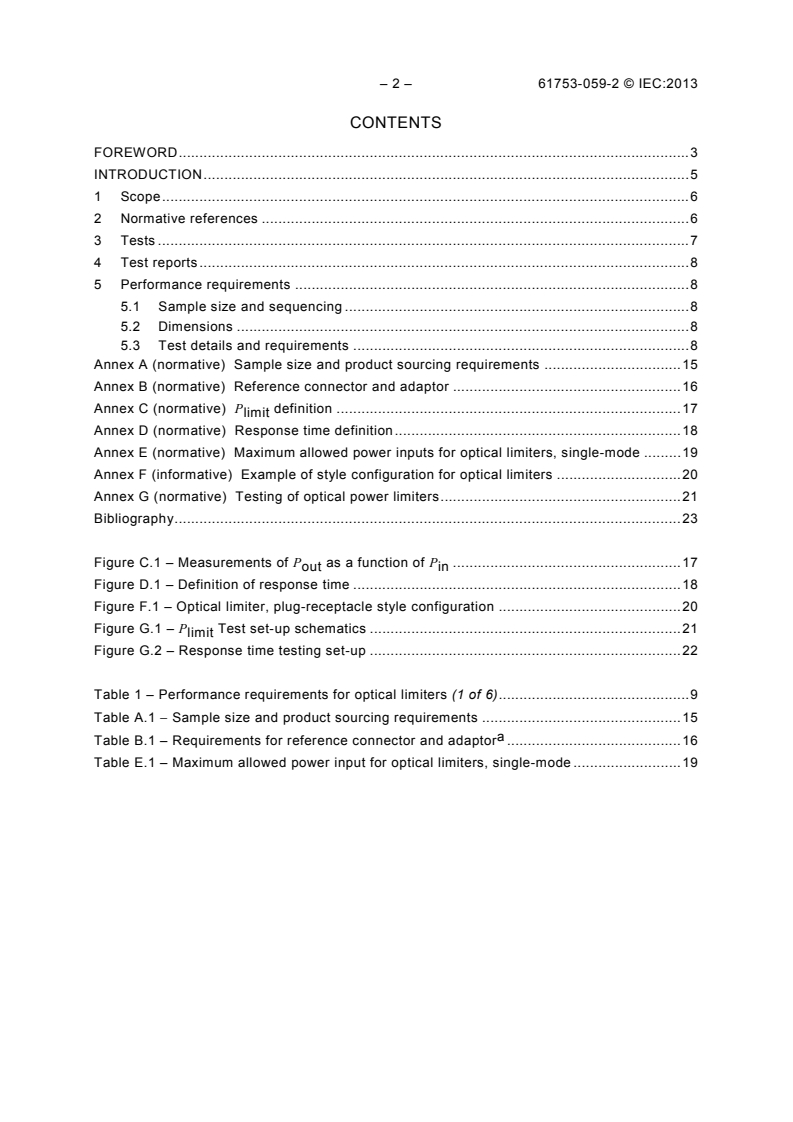
CONTENTS
FOREWORD . 3
INTRODUCTION . 5
1 Scope . 6
2 Normative references . 6
3 Tests . 7
4 Test reports . 8
5 Performance requirements . 8
5.1 Sample size and sequencing . 8
5.2 Dimensions . 8
5.3 Test details and requirements . 8
Annex A (normative) Sample size and product sourcing requirements . 15
Annex B (normative) Reference connector and adaptor . 16
Annex C (normative) P definition . 17
limit
Annex D (normative) Response time definition . 18
Annex E (normative) Maximum allowed power inputs for optical limiters, single-mode . 19
Annex F (informative) Example of style configuration for optical limiters . 20
Annex G (normative) Testing of optical power limiters . 21
Bibliography . 23
Figure C.1 – Measurements of P as a function of P . 17
out in
Figure D.1 – Definition of response time . 18
Figure F.1 – Optical limiter, plug-receptacle style configuration . 20
Figure G.1 – P Test set-up schematics . 21
limit
Figure G.2 – Response time testing set-up . 22
Table 1 – Performance requirements for optical limiters (1 of 6) . 9
Table A.1 − Sample size and product sourcing requirements . 15
a
Table B.1 – Requirements for reference connector and adaptor . 16
Table E.1 – Maximum allowed power input for optical limiters, single-mode . 19
61753-059-2 © IEC:2013 – 3 –
INTERNATIONAL ELECTROTECHNICAL COMMISSION
____________
FIBRE OPTIC INTERCONNECTING DEVICES AND
PASSIVE COMPONENTS – PERFORMANCE STANDARD –
Part 059-2: Single-mode fibre plug-receptacle style optical
limiter for category C – Controlled environment
FOREWORD
1) The International Electrotechnical Commission (IEC) is a worldwide organization for standardization comprising
all national electrotechnical committees (IEC National Committees). The object of IEC is to promote
international co-operation on all questions concerning standardization in the electrical and electronic fields. To
this end and in addition to other activities, IEC publishes International Standards, Technical Specifications,
Technical Reports, Publicly Available Specifications (PAS) and Guides (hereafter referred to as “IEC
Publication(s)”). Their preparation is entrusted to technical committees; any IEC National Committee interested
in the subject dealt with may participate in this preparatory work. International, governmental and non-
governmental organizations liaising with the IEC also participate in this preparation. IEC collaborates closely
with the International Organization for Standardization (ISO) in accordance with conditions determined by
agreement between the two organizations.
2) The formal decisions or agreements of IEC on technical matters express, as nearly as possible, an international
consensus of opinion on the relevant subjects since each technical committee has representation from all
interested IEC National Committees.
3) IEC Publications have the form of recommendations for international use and are accepted by IEC National
Committees in that sense. While all reasonable efforts are made to ensure that the technical content of IEC
Publications is accurate, IEC cannot be held responsible for the way in which they are used or for any
misinterpretation by any end user.
4) In order to promote international uniformity, IEC National Committees undertake to apply IEC Publications
transparently to the maximum extent possible in their national and regional publications. Any divergence
between any IEC Publication and the corresponding national or regional publication shall be clearly indicated in
the latter.
5) IEC itself does not provide any attestation of conformity. Independent certification bodies provide conformity
assessment services and, in some areas, access to IEC marks of conformity. IEC is not responsible for any
services carried out by independent certification bodies.
6) All users should ensure that they have the latest edition of this publication.
7) No liability shall attach to IEC or its directors, employees, servants or agents including individual experts and
members of its technical committees and IEC National Committees for any personal injury, property damage or
other damage of any nature whatsoever, whether direct or indirect, or for costs (including legal fees) and
expenses arising out of the publication, use of, or reliance upon, this IEC Publication or any other IEC
Publications.
8) Attention is drawn to the Normative references cited in this publication. Use of the referenced publications is
indispensable for the correct application of this publication.
International Standard IEC 61753-059-2 has been prepared by subcommittee 86B: Fibre optic
interconnecting devices and passive components, of IEC technical committee 86: Fibre optics.
The text of this standard is based on the following documents:
FDIS Report on voting
86B/3553/FDIS 86B/3596/RVD
Full information on the voting for the approval of this standard can be found in the report on
voting indicated in the above table.
This publication has been drafted in accordance with the ISO/IEC Directives, Part 2.
– 4 – 61753-059-2 © IEC:2013
A list of all the parts in the IEC 61753 series, published under the general title Fibre optic
interconnecting devices and passive components – Performance standard, can be found on
the IEC website.
The committee has decided that the contents of this publication will remain unchanged until
the stability date indicated on the IEC web site under "http://webstore.iec.ch" in the data
related to the specific publication. At this date, the publication will be
• reconfirmed,
• withdrawn,
• replaced by a revised edition, or
• amended.
IMPORTANT – The 'colour inside' logo on the cover page of this publication indicates
that it contains colours which are considered to be useful for the correct
understanding of its contents. Users should therefore print this document using a
colour printer.
61753-059-2 © IEC:2013 – 5 –
INTRODUCTION
1) The International Electrotechnical Commission (IEC) draws attention to the fact that it is
claimed that compliance with this document may involve the use of a patent concerning
power limiters, registered as follows:
Country Patent number
Israel 147554
European Union EP 1467239 A2
USA USP110/398'859
Japan 4587695
Canada 24649043
IEC takes no position concerning the evidence, validity and scope of this patent right.
The holder of this patent right has assured the IEC that he/she is willing to negotiate
licences under reasonable and non-discriminatory terms and conditions with applicants
throughout the world. In this respect, the statement of the holder of this patent right is
registered with IEC. Information may be obtained from:
IEC takes no position concerning the evidence, validity and scope of this patent right.
The holder of this patent right has assured the IEC that he/she is willing to negotiate
licences under reasonable and non-discriminatory terms and conditions with applicants
throughout the world. In this respect, the statement of the holder of this patent right is
registered with IEC. Information may be obtained from:
KiloLambda technologies, Ltd.
22a Wallenberg street,
Tel-Aviv 69719, Israel
Attention is drawn to the possibility that some of the elements of this document may be the
subject of patent rights other than those identified above. IEC shall not be held
responsible for identifying any or all such patent rights.
ISO (www.iso.org/patents) and IEC (http://patents.iec.ch) maintain on-line data bases of
patents relevant to their standards. Users are encouraged to consult these data bases for
the most up to date information concerning patents.
2) The optical power limiter is a passive device that regulates the optical power in fibres,
producing a controlled, constant output power P , as a result of varying input power
limit
higher than P , and has no influence at powers below P . Under normal operation,
limit limit
when the input power is low, the optical power limiter has no effect on the system.
However, when the input power is high, the optical output power is limited to a
predetermined level (P ).The optical limiter is wavelength independent over its entire
limit
specified spectral range. IEC 60869-1contains the generic information of the optical power
limiter. The optical power limiter is used at the input of power-sensitive equipment and at
the output of high power devices, such as amplifiers, or wherever power regulation is
required. The optical power limiter can serve as an eye safety device. The optical power
limiter has a maximum allowed power input P . Above this power it is dysfunctional
in max
and can let light through. Numerical values for P are given in Annex E.
in max
– 6 – 61753-059-2 © IEC:2013
FIBRE OPTIC INTERCONNECTING DEVICES AND
PASSIVE COMPONENTS – PERFORMANCE STANDARD –
Part 059-2: Single-mode fibre plug-receptacle style optical
limiter for category C – Controlled environment
1 Scope
This part of IEC 61753 contains the minimum initial test and measurement requirements and
severities which an optical power limiter needs to satisfy in order to be categorized as
meeting the requirements of single mode fibre plug-receptable style optical limiter used in
controlled environments. IEC 60869-1, contains the generic specification of the optical limiter.
Optical performances specified in this standard relate to plug-receptacle style configurations
optical power limiters only.
2 Normative references
The following documents, in whole or in part, are normatively referenced in this document and
are indispensable for its application. For dated references, only the edition cited applies. For
undated references, the latest edition of the referenced document (including any
amendments) applies.
IEC 60793-2-50, Optical fibres – Part 2-50: Product specifications – Sectional specification for
class B single-mode fibres
IEC 60869-1, Fibre optic interconnecting devices and passive components – Fibre optic
passive power control devices – Part 1: Generic specification
IEC 61300 (all parts), Fibre optic interconnecting devices and passive components – Basic
test and measurement procedures
IEC 61300-1, Fibre optic interconnecting devices and passive components – Basic test and
measurement procedures – Part 1: General and guidance
IEC 61300-2-1, Fibre optic interconnecting devices and passive components – Basic test and
measurement procedures – Part 2:1: Tests – Vibration (sinusoidal)
IEC 61300-2-2, Fibre optic interconnecting devices and passive components – Basic test and
measurement procedures – Part 2-2: Tests – Mating durability
IEC 61300-2-6, Fibre optic interconnecting devices and passive components – Basic test and
measurement procedures – Part 2-6: Tests – Tensile strength of coupling mechanism
IEC 61300-2-9, Fibre optic interconnecting devices and passive components – Basic test and
measurement procedures – Part 2-9: Tests – Shock
IEC 61300-2-14, Fibre optic interconnecting devices and passive components – Basic test
and measurement procedures– Part 2-14: Tests – High optical power
IEC 61300-2-17, Fibre optic interconnecting devices and passive components – Basic test
and measurement procedures – Part 2-17: Tests – Cold
61753-059-2 © IEC:2013 – 7 –
IEC 61300-2-18, Fibre optic interconnecting devices and passive components – Basic test
and measurement procedures – Part 2-18: Tests – Dry heat – High temperature endurance
IEC 61300-2-19, Fibre optic interconnecting devices and passive components – Basic test
and measurement procedures – Part 2-19: Tests – Damp heat (steady state)
IEC 61300-2-22, Fibre optic interconnecting devices and passive components – Basic test
and measurement procedures – Part 2-22: Tests – Change of temperature
IEC 61300-3-2, Fibre optic interconnecting devices and passive components – Basic test and
measurement procedures – Part 3-2: Examinations and measurements – Polarization
dependent loss in a single-mode fibre optic device
IEC 61300-3-3, Fibre optic interconnecting devices and passive components - Basic test and
measurement procedures - Part 3-3: Examinations and measurements - Active monitoring of
changes in attenuation and return loss
IEC 61300-3-4, Fibre optic interconnecting devices and passive components – Basic test and
measurement procedures – Part 3-4: Examinations and measurements – Attenuation
IEC 61300-3-6, Fibre optic interconnecting devices and passive components – Basic test and
measurement procedures – Part 3-6: Examinations and measurements – Return loss
IEC 61300-3-7, Fibre optic interconnecting devices and passive components – Basic test and
measurement procedures – Part 3-7: Examinations and measurements – Wavelength
dependence of attenuation and return loss of single mode components
IEC 61300-3-28, Fibre optic interconnecting devices and passive components – Basic test
and measurement procedures – Part 3-28: Examinations and measurements – Transient loss
IEC 61300-3-32, Fibre optic interconnecting devices and passive components – Basic test
and measurement procedures – Part 3-32: Examinations and measurements – Polarization
mode dispersion measurement for passive optical components
IEC 61754 (all parts), Fibre optic connector interfaces
IEC 61755 ( all parts, Fibre optic connector optical interfaces
IEC/TR 62627-02:2010, Fibre optic interconnecting devices and passive components –
Part 02: Report of round robin test results on SC plug style fixed attenuators
3 Tests
All test methods are in accordance with the IEC 61300 series.
Some tests require the use of reference connector plugs and reference connector adaptors.
These are specified in Annex B. It is essential and recommended that all connector, plugs and
reference connector adaptors be inspected and cleaned if dirty and checked again, according
to manufacturers’ instructions, prior to every mating in all tests.
All tests shall be carried out to validate performance over the required operating wavelength
and power range.
– 8 – 61753-059-2 © IEC:2013
4 Test reports
Fully documented test reports and supporting evidence shall be prepared and shall be
available for inspection as evidence that the tests have been carried out and complied with
relevant requirements.
5 Performance requirements
5.1 Sample size and sequencing
Sample sizes for the tests are defined in Annex A.
Test groups shall be performed as shown in Annex A.
5.2 Dimensions
Dimension of mechanical interface for mating, plug and receptacle size, shall comply with IEC
optical connector interface standard IEC 61754 series and IEC optical interface standard
IEC 61755 series. Other dimensions shall comply with those given in appropriate
manufacturer's drawings
When implementing this standard, be aware that there have been problems when using a rigid
interface component with SC plug style adapters and plugs. See Clause 6 of
IEC/TR 62627-02:2010.
5.3 Test details and requirements
Table 1 specifies the optical, environmental and mechanical performance requirements and
related test methods for optical power limiters.
Compliance to this standard requires demonstration of the ability to meet the relevant
performance requirement in Table 1.
61753-059-2 © IEC:2013 – 9 –
Table 1 – Performance requirements for optical limiters (1 of 6)
No. Tests Requirements Details
1 Insertion loss Operating wavelength range: Method: IEC 61300-3-7, method B.2.1. Test
1 520 nm to 1 625 nm sample configuration in accordance
with IEC 61300-3-4, substitution
Insertion loss:
method.
≤ 2 dB for P > 9 dBm
limit
Launch patchcord ≥ 2 m. Only the fundamental mode
length:
shall propagate at the limiter interface
≤ 5 dB for 0 dBm P ≤ 9 dBm
limit
and at the detector.
≤ 7 dB for P ≤ 0 dBm
limit
Other This test shall be performed against
a,b
requirements: two reference plug and reference
Insertion loss is measured
adapter.
with input power ≤ –5 dBm
this power level is always
Launch conditions: The wavelength of the source shall be
below P , at the linear
limit
longer than cut-off wavelength of the
behaviour of the limiter
fibre.
Source power
≤ ± 0,05 dB over the measuring period
stability:
or at least 1 h.
Wavelength range: 1 520 nm to 1 625 nm
Total uncertainty:
≤ ± 0,05 dB
2 Return loss Method: IEC 61300-3-6 (against 2 reference
Up to P : ≥40 dB return
limit
a
plugs ) measurement method 1,
loss is measured with input
OCWR.
power ≤ –5 dBm. This power
level is always below P ,
limit
Optical source 1 520 nm and 1 625 nm
at the linear behaviour of the
wavelength:
limiter.
Test every sample with the two
wavelengths.
Above P : ≥ 30 dB return
limit
loss is measured with input Total uncertainty
≤ ±2 dB over the dynamic range to be
power of +3 dB above P
measured
limit
3 Polarization ≤0,2 dB Method: IEC 61300-3-2, method 1 OCWR.
dependent
Optical source
Over the specified operating 1 550 nm ± 10 nm
loss
wavelength. wavelength:
The samples shall be
Total uncertainty: ≤ ±0,05 dB over the dynamic range
terminated onto single-mode
to be measured
fibres as per future
IEC 60793-2-50, Type B 1.1,
in either coated fibres
(primary and secondary) or
reinforced cable format
4 Polarization ≤0,2 ps (max. value) Method: IEC 61300-3-32, MPS method
mode
Optical source
Over the specified operating 1 550 nm ± 10 nm
dispersion
wavelength range. wavelength:
Measurements carried out
Total uncertainty: ≤ ±0,05 dB over the dynamic range
only in low power
to be measured
≤ –5 dBm
– 10 – 61753-059-2 © IEC:2013
Table 1 (2 of 6)
No. Tests Requirements Details
5 High optical Before and after the test Method: Future IEC 61300-2-14: Full
power the insertion loss shall meet characterization at a specific
the requirements of test 1. wavelength.
Before and after the test Test temperature:
25 °C ± 2 °C
the return loss shall meet
the requirements of test 2 Power loads for For P ≤ 10 dBm:
limit
testing:
P +5 dB for CW operation, tested
limit
for 96 h.
P + 8 dB for short bursts, up to
limit
1 s/min for 1 h.
For P > 10 dBm:
limit
P +3 dB for CW operation, tested
limit
for 96 h.
P +5 dB for short bursts, up to
limit
1 s/min for 1 h.
Optical source 1 550 nm
wavelength:
Test duration: Duration of long-term test: 96 h at max.
power. For short bursts, up to
1 s/min.
Launch patchcord Same as in test No.1
length and launch
conditions:
See Annex G.
6 Limit power P as specified ± 0,5 dB Method:
limit
Source: Slowly varying optical power source
P example is shown in
limit
Annex C.
from –5 dBm and up to +8 dB above
P
The limiter will meet the
limit
limit power requirements as
Optical source 1 550 nm
specified in Annex E, when
wavelength:
operated at the 3 specified
temperatures. Optical source 100 mW power increments, at a rate
power increment: of 1 increment of 100 mW/s.
This test uses a slowly
varying optical power 10 °C ± 2 °C
Test temperature:
source starting at –5 dBm
25 °C ± 2 °C
and up to +8 dB above
60 °C ± 2 °C
P ., giving results of
limit
Detector system: Linearity within ± 0,05 dB.
insertion loss and P for
limit
the whole range of input
Spectral response matched to source.
powers
Dynamic range between –5 dBm to
+8 dB above P
limit
7 Response time Method: See Annex G.
500 μs ± 10 μs
Optical source: Laser source having adjustable power
Response time example
up to 8 dB above P
see Annex D.
limit.
The limiter will meet the Square wave input power, having rise
requirements as specified time of 10 μs.
when operated at the 3
Optical source 1 550 nm
specified temperatures
wavelength:
Test temperature:
10 °C ± 2 °C
25 °C ± 2 °C
60 °C ± 2 °C
Launch patchcord Same as in test No.1
length and launch
conditions
61753-059-2 © IEC:2013 – 11 –
Table 1 (3 of 6)
No. Tests Requirements Details
8 Damp heat Before and after the test the Method: Future IEC 61300-2-19.
insertion loss shall meet the
(steady state)
During the test the change in insertion
requirements of test 1.
loss shall be measured by test method
Before and after the test the IEC 61300-3-3.
return loss shall meet the
Pre conditioning Standard atmospheric conditions as
requirements of test 2.
procedure: defined in IEC 61300-1 for 2 h.
The insertion loss change
Temperature: +40 °C ± 2 °C
during the test shall be
within ± 0,5 dB of the initial
Relative humidity: +2
93 %
value Above measurements
−3
carried out in power ≤
-5 dBm.
Duration of 96 h
exposure:
Before and after the test the
P shall meet the
limit Specimen optically Yes
requirements of test 6
functioning:
Optical source 1 550 nm
wavelength:
Recovery Allow specimens to return to standard
procedure: atmospheric conditions in 2 h
9 Change of Before and after the test the Method: IEC 61300-2-22.
Insertion loss shall meet the
temperature
During the test the change in Insertion
requirements of test 1.
loss shall be measured by test method
Before and after the test the IEC 61300-3-3.
return loss shall meet the
Pre conditioning Standard atmospheric conditions as
requirements of test 2.
procedure: defined in IEC 61300-1 for 2 h.
The insertion loss change
High temperature:
+60 °C ± 2 °C
during the test shall be
within ±0,5 dB of the initial
Low temperature:
–10 °C ± 2 °C
value. The above
measurements are carried
Duration at 1 h
out at a power of
extreme
≤–5 dBm.
temperature:
Before and after the test the
Temperature rate 1 °C/min
P shall meet the
of change:
limit
requirements of test 6
Number of cycles: 5
Specimen optically Yes
functioning:
Maximum sampling 15 min
interval during the
test:
Optical source 1 550 nm
wavelength:
Recovery Allow specimens to return to standard
procedure: atmospheric conditions in 2 h.
Pre-conditioning Clean plug and adaptor according to
procedure: the manufacturers’ instructions
– 12 – 61753-059-2 © IEC:2013
Table 1 (4 of 6)
No. Tests Requirements Details
10 Dry heat – Before and after the test the Method: IEC 61300-2-18.
insertion loss shall meet the
High
During the test the change in insertion
requirements of test 1.
temperature
loss shall be measured by test method
Before and after the test the IEC 61300-3-3.
endurance
return loss shall meet the
Pre-conditioning Standard atmospheric conditions as
requirements of test 2.
procedure: defined in IEC 61300-1 for 2 h.
The insertion loss change
Specimen optically Yes
during the test shall be
functioning:
within ± 0,5 dB of the initial
value. The above
Temperature:
+60 °C ± 2 °C
measurements are carried
out at a power of
Duration of the 96 h
≤ –5 dBm.
exposure:
Before and after the test the
Optical source 1 550 nm
P shall meet the
wavelength:
limit
requirements of test 6
Maximum sampling 1 h
interval during the
test:
Recovery Allow specimen to return to standard
procedure: atmospheric conditions as defined in
IEC 61300-1 within 2 h
11 Cold Before and after the test the Method: IEC 61300-2-17.
insertion loss shall meet the
During the test the change in Insertion
requirements of test 1.
loss shall be measured by test method
IEC 61300-3-3.
Before and after the test the
Pre-conditioning Standard atmospheric conditions as
return loss shall meet the
procedure: defined in IEC 61300-1 for 2 h.
requirements of test 2.
Specimen optically Yes
The insertion loss change
functioning:
during the test shall be
within ±0,5 dB of the initial
Temperature:
–10 °C ± 2 °C
value. The above
measurements are carried
Duration of the 96 h
out at a power of
exposure:
≤ –5 dBm.
Optical source 1 550 nm
Before and after the test the wavelength:
P shall meet the Maximum sampling 1 h
limit
requirements of test 6 interval during the
test:
Recovery
Allow specimen to return to standard
procedure:
atmospheric conditions as defined in
IEC 61300-1 within 2 h
12 Vibration Before and after the test the Method: IEC 61300-2-1.
insertion loss shall meet the
(sinusoidal)
During the test the change in insertion
requirements of test 1.
loss shall be measured by test method
The insertion loss change IEC 61300-3-3.
between value before test
Frequency range: 10 Hz – 55 Hz
and value after test shall be
within ±0,5 dB of the initial
Vibration 0,75 mm
value.
amplitude:
Before and after the test the
Number of cycles: 15
return loss shall meet the
requirements of test 2.
Rate of change: 1 octave/min
Above measurements
Number of axes: 3 orthogonal axes
carried out in power
Specimen optically No
≤ –5 dBm.
functioning:
Before and after the test the
Optical source 1 550 nm
P shall meet the
limit
wavelength:
requirements of test 6
61753-059-2 © IEC:2013 – 13 –
Table 1 (5 of 6)
No. Tests Requirements Details
13 Shock Before and after the test the Method: IEC 61300-2-9.
Insertion loss shall meet the
Acceleration force: 500 g
requirements of test 1.
Before and after the test the
return loss shall meet the
Number of axes: 3 axes, 2 directions
requirements of test 2.
Number of cycles: 2 shocks per direction, 12 shocks total
Above measurements
carried out in power
Duration per axis: Nominal 1 ms duration, half sine pulse
≤ –5 dBm.
Measurements Before, after each axis, and after the
Before and after the test the
required: test
P shall meet the
limit
Specimen optically No
requirements of test 6.
functioning:
Before and after the test
specimen tested in mated Optical source 1 550 nm
position
wavelength:
14 Strength of Before and after the test the Method: IEC 61300-2-6.
coupling Insertion loss shall meet the
During the test the change insertion
mechanism requirements of test 1.
loss shall be measured by transient
Before and after the test the loss test method IEC 61300-3-28
return loss shall meet the (Transient loss).
requirements of test 2.
Magnitude of the 40 N, at a rate of 2 N/s
The insertion loss change load:
during the test shall be
Load application 0,2 m from the optical interface
within ±0,5 dB of the initial
point:
value Above measurements
carried out in power
Duration of the 120 s
≤– dBm.
load:
Before and after the test the
Specimen optically Yes
P shall meet the
limit
functioning:
requirements of test 6
Optical source 1 550 nm
wavelength:
– 14 – 61753-059-2 © IEC:2013
Table 1 (6 of 6)
No. Tests Requirements Details
15 Mating Before and after the test the Method: IEC 61300-2-2
durability insertion loss shall meet the
Number of mating 200, all parts (connector limiter-
requirements of test 1.
cycles: adapter-connector) shall be demated
Before and after the test the and mated
return loss shall meet the
requirements of test 2.
Specimen optically Yes
functioning:
The insertion loss change
during the test shall be
Measurements Change in insertion loss shall be
within ± 0,5 dB of the initial
required: measured after every cycle; Before and
value. The above
after the test the insertion loss shall
measurements are carried
meet the requirements of test 1.
out at a power of
≤ –5 dBm. Return loss shall be measured before
and after the test.
Before and after the test the
P shall meet the
Optical source 1 550 nm
limit
requirements of test 6 wavelength:
Other Preconditioning procedure: clean plug
specifications: and adapter according to
manufacturer’s instructions.
In situ conditioning procedure: clean
the mechanical and optical alignment
parts of the moving connector
according to the manufacturer
instructions after cycle 24, 74, 124, and
174. Clean both the moving and
stationary connectors and adapter
according to the manufacturer
instructions after cycle 49, 99, 149, and
199. No additional cleaning or re-
cleaning is allowed.
Recovery procedure: the mechanical
and optical alignment parts of the
specimen may be cleaned according to
manufacturer instructions up to 2 times
after the final mating cycle
a
Reference connector definition is given in Annex B.
b
Clean connectors, plugs and adaptors according to manufacturer's instructions, prior to every mating.
61753-059-2 © IEC:2013 – 15 –
Annex A
(normative)
Sample size and product sourcing requirements
Table A.1 gives sample size and product sourcing requirements.
Table A.1 − Sample size and product sourcing requirements
No. Test Sample size Source
N/A Dimensional 10 New
1 Insertion loss 52 New
2 Return loss 52 Test 1
3 Polarization dependent loss 52 Test 2
4 Polarization mode dispersion 4 Test 3
5 Optical power handling and damage 8 Test 3
threshold characterization
6 Limit power 4 Test 3
7 Response time 4 Test 3
8 Damp heat (steady state) 4 Test 3
9 Change of temperature 4 Test 3
10 Dry heat – High temperature endurance 4 Test 3
11 Cold 4 Test 3
12 Vibration (sinusoidal) 4 Test 3
13 Shock 4 Test 3
14 Strength of coupling mechanism 4 Test 3
15 Mating durability 4 Test 3
NOTE Tests 5 to 15 may be performed at any order. Samples for tests 5 to 15
should be randomly selected from the samples of test 3.
– 16 – 61753-059-2 © IEC:2013
Annex B
(normative)
Reference connector and adaptor
Table B.1 gives the requirements for reference connector and adapter
a
Table B.1 – Requirements for reference connector and adaptor
Ferrule outer diameter
2,499 mm ± 0,000 5 mm 1,249 mm ± 0,000 5 mm
Eccentricity of fibre core centre to ferrule centre
≤0,000 3 mm ≤0,000 3 mm
Deviation of axis of fibre to axis of ferrule
≤0,2° ≤0,2°
Eccentricity of spherically polished ferrule endface
≤50 μm ≤50 μm
No defects in core zone No defects in core zone
Visual examination of fibre end surface with ×200
magnification
Insertion loss between two reference plugs
≤0,2 dB ≤0,2 dB
Visual examination Every 50 mating Every 50 mating
a
Reference adaptors shall give 0,2 dB maximum insertion loss when used with two reference plugs.
61753-059-2 © IEC:2013 – 17 –
Annex C
(normative)
P definition
limit
P is defined as the average between P and P of two consecutive
limit out max out min
measurements, one after the other, of P as a function of P , as depicted in Figure C.1,
out in
where P is the maximal allowed power into the optical power limiter according to
in max
Table E.1.
P
out
P
out max
P
out min
P P (dBm)
P –3 dB
in max in max in
IEC 522/13
Figure C.1 – Measurements of P as a function of P
out in
– 18 – 61753-059-2 © IEC:2013
Annex D
(normative)
Response time definition
Response time is the total time where the optical power limiter output power level is above the
(P + 1 dB) power line, when exposed to a square wave input power, 1 ms long, having rise
limit
time of 10 μs and a steady-state power of P + 3 dB. Figure D.1 illustrates the parameters.
limit
In this case, rise time is the elapsed time for input power to reach 90 % of its steady-state
value from the time it starts.
P
in
Power
Response time
P
out
P +3 dB
limit
P +1 dB
limit
P
limit
Time
1 ms input pulse time
IEC 523/13
Figure D.1 – Definition of response time
61753-059-2 © IEC:2013 – 19 –
Annex E
(normative)
Maximum allowed power inputs for optical limiters, single-mode
Table E.1 gives the maximum allowed power inputs for optical limiters, single-mode.
Table E.1 – Maximum allowed power input for optical limiters, single-mode
P P continuous wave P for 1 s exposure every min
limit in max in max
dBm dBm dBm
0 Up to 5 Up to 8
1 Up to 6 Up to 9
2 Up to 7 Up to 10
3 Up to 8 Up to 11
4 Up to 9 Up to 12
5 Up to 10 Up to 13
6 Up to 11 Up to 14
7 Up to 12 Up to 15
8 Up to 13 Up to 16
9 Up to 14 Up to 17
10 Up to 15 Up to 18
11 Up to 16 Up to 19
12 Up to 17 Up to 20
13 Up to 18 Up to 21
14 Up to 19 Up to 22
15 Up to 20 Up to 23
16 Up to 21 Up to 24
17 Up to 22 Up to 25
NOTE 25 dBm is the maximum allowed power input into optical limiters having P up to 17 dBm. Beyond
limit
25 dBm maximum power, the optical limiter is dysfunctional and can let light through.
– 20 – 61753-059-2 © IEC:2013
Annex F
(informative)
Example of style configuration for optical limiters
The optical limiter, plug-receptacle style, configuration is shown in Figure F.1.
IEC 524/13
Figure F.1 – Optical limiter, plug-receptacle style configuration
61753-059-2 © IEC:2013 – 21 –
Annex G
(normative)
Testing of optical power limiters
G.1 Introductory remark
Annex G describes the testing of the optical limiter functionality and the measurement of its
parameters. Testing of the following parameters, which do not appear in regular IEC
standards, is described:
P
limit ;
response time.
The test requires high power, and needs a dedicated test set-up.
An example of a test carried on an optical limiter will be followed according to this annex,
having the parameters:
P : 9 dBm to 11 dBm
limit
Response time: 500 µs ± 10 µs
G.2 P measurement
limit
G.2.1 General
Measuring P is the first and most important functional test of the limiter, calling for
limit
exposure of the rated limiter, e.g. 10 dBm limiter, to slowly varying powers starting at 0 dBm
and ranging up to 18 dBm.
The powers needed call for an oscillator followed by fibre amplifiers reaching the power level
of 18 dBm and more.
G.2.2 Test set-up schematics
Schematics of the test set-up and description are shown in Figure G.1.
Thermal chamber
Laser Variable
Amplifier DUT
oscillator attenuator
Detector
PC
Control line
Optical fibre
IEC 525/13
Figure G.1 – P Test set-up schematics
limit
___________
This annex will be deleted when an IEC standard for a test method for an optical limiter is published.
– 22 – 61753-059-2 © IEC:2013
The output power measured by the detector, as a function of input power, provides the P
limit
of the DUT. The insertion loss for low and high power is provided as well and return loss
measurement can be added to the set-up.
G.3 Response time measurement
G.3.1 General
The response time of the optical limiter is defined in Annex D.
G.3.2 Test set-up schematics
Schematics of the test set-up and description are shown in Figure G.2:
Thermal chamber
Optical pulse
Detector
Laser DUT
generator
Scope
PC
Control line
Optical fibre
IEC 526/13
Figure G.2 – Response time testing set-up
A 1 550 nm wavelength laser provides the input signal, which is amplified and re-generated by
the optical pulse generator unit, controlled by a designated software program at the PC.
Output power is measured and presented graphically using an oscilloscope. Analysis of the
data is carried out using standard mathematical software.
Since the response time is input energy dependent, the response time needs to be measured
.
at a predetermined value above threshold, e.g. 3 dB above P
limit
Since the test is carried out at three different temperatures, the minimal specified temperature,
the maximal specified temperature and the average specified temperature of the optical limiter,
the DUT is placed in a thermal chamber having stable temperature as required.
61753-059-2 © IEC:2013 – 23 –
Bibliography
IEC/TR 62627-01:2010, Fibre optic interconnecting devices and passive components –
Part 01: Fibre optic connector cleaning methods
______________
– 24 – 61753-059-2 © CEI:2013
SOMMAIRE
AVANT-PROPOS . 25
INTRODUCTION
...