

IEC 62439-3:2016
(Main)Industrial communication networks - High availability automation networks - Part 3: Parallel Redundancy Protocol (PRP) and High-availability Seamless Redundancy (HSR)
General Information
- Abstract
IEC 62439-3:2016 is applicable to high-availability automation networks based on the Ethernet technology. This part of IEC 62439 specifies two redundancy protocols designed to provide seamless recovery in case of single failure of an inter-bridge link or bridge in the network, which are based on the same scheme: parallel transmission of duplicated information. This third edition cancels and replaces the second edition published in 2012. This edition constitutes a technical revision. This edition includes the following significant technical changes with respect to the previous edition:
- technical corrections and extension of specifications;
- consideration of IEC 61588 clock synchronization with end-to-end delay measurement alongside the existing peer-to-peer delay measurement in PRP.
- Status
- Published
- Publication Date
- 30-Mar-2016
- Technical Committee
- SC 65C - Industrial networks
- Drafting Committee
- WG 15 - TC 65/SC 65C/WG 15
- Current Stage
- DELPUB - Deleted Publication
- Start Date
- 15-Dec-2021
- Completion Date
- 28-Aug-2026
Buy Documents


IEC 62439-3:2016 RLV - Industrial communication networks - High availability automation networks - Part 3: Parallel Redundancy Protocol (PRP) and High-availability Seamless Redundancy (HSR) Released:3/31/2016
IEC 62439-3:2016 - Industrial communication networks - High availability automation networks - Part 3: Parallel Redundancy Protocol (PRP) and High-availability Seamless Redundancy (HSR) Released:3/31/2016
Overview
IEC 62439-3:2016 - Industrial communication networks - High availability automation networks - Part 3: Parallel Redundancy Protocol (PRP) and High-availability Seamless Redundancy (HSR) - defines two Ethernet-based redundancy protocols that deliver seamless recovery from single network or bridge/link failures by using parallel transmission of duplicated information. Edition 3.0 (2016) is a technical revision of the 2012 edition and adds technical corrections, extended specifications, and explicit consideration of IEC 61588 (PTP) clock synchronization using end-to-end delay measurement alongside peer-to-peer delay measurement in PRP.
Key Topics and Requirements
- PRP (Parallel Redundancy Protocol): topology options, doubly attached node structures (DANP), duplicate handling, PRP_Supervision frames, unicast/multicast addressing and service specification, and guidance for installation, configuration and repair.
- HSR (High-availability Seamless Redundancy): ring-based operation, DANH node and RedBox/QuadBox definitions, forwarding rules, HSR frame format, supervision, and deterministic medium access considerations.
- Clock synchronization: normative mapping and guidance for using PTP (IEC 61588 / IEEE C37.238) over redundant paths, including annexes on redundant clock attachment and PTP profiles for high-availability automation.
- Management and conformance: Protocol Implementation Conformance Statement (PICS), PRP/HSR MIB, supervision and redundancy management interfaces.
- Annexes: detailed normative annexes on PTP mapping, redundant clock models, and profiles for power-utility and automation applications; informative PTP tutorial.
Applications and Who Uses It
IEC 62439-3 is targeted at systems that require uninterrupted Ethernet communications and deterministic behavior in the face of single failures. Typical applications include:
- Power utility and substation automation
- Process control and manufacturing automation
- Railway signaling and transportation control
- Critical infrastructures requiring zero packet-loss on failure
Primary users:
- Network architects and automation engineers designing high-availability Ethernet networks
- System integrators and OEMs implementing PRP/HSR-capable devices
- Vendors creating switches, RedBoxes, and HSR/PRP endpoints
- Test labs and certification bodies verifying conformance (PICS, MIBs)
Related Standards
- IEC 61588 (Precision Time Protocol - PTP): referenced for clock synchronization over redundant paths.
- IEEE C37.238: relevant for PTP in power systems and referenced in mapping annexes.
- Other parts of the IEC 62439 series (for context on high-availability automation networks and implementation guidance).
Keywords: IEC 62439-3, PRP, HSR, high-availability automation networks, seamless redundancy, Parallel Redundancy Protocol, High-availability Seamless Redundancy, Ethernet redundancy, IEC 61588, PTP.
Relations
- Effective Date
- 05-Sep-2023
Buy Documents
IEC 62439-3:2016 RLV - Industrial communication networks - High availability automation networks - Part 3: Parallel Redundancy Protocol (PRP) and High-availability Seamless Redundancy (HSR) Released:3/31/2016
IEC 62439-3:2016 - Industrial communication networks - High availability automation networks - Part 3: Parallel Redundancy Protocol (PRP) and High-availability Seamless Redundancy (HSR) Released:3/31/2016
Get Certified
Connect with accredited certification bodies for this standard

BSI Group
BSI (British Standards Institution) is the business standards company that helps organizations make excellence a habit.

DVS-ZERT GmbH
German welding certification society.
CARES (UK Certification Authority for Reinforcing Steels)
UK certification for reinforcing steels and construction.
Sponsored listings
Frequently Asked Questions
IEC 62439-3:2016 is a standard published by the International Electrotechnical Commission (IEC). Its full title is "Industrial communication networks - High availability automation networks - Part 3: Parallel Redundancy Protocol (PRP) and High-availability Seamless Redundancy (HSR)". This standard covers: IEC 62439-3:2016 is applicable to high-availability automation networks based on the Ethernet technology. This part of IEC 62439 specifies two redundancy protocols designed to provide seamless recovery in case of single failure of an inter-bridge link or bridge in the network, which are based on the same scheme: parallel transmission of duplicated information. This third edition cancels and replaces the second edition published in 2012. This edition constitutes a technical revision. This edition includes the following significant technical changes with respect to the previous edition: - technical corrections and extension of specifications; - consideration of IEC 61588 clock synchronization with end-to-end delay measurement alongside the existing peer-to-peer delay measurement in PRP.
IEC 62439-3:2016 is applicable to high-availability automation networks based on the Ethernet technology. This part of IEC 62439 specifies two redundancy protocols designed to provide seamless recovery in case of single failure of an inter-bridge link or bridge in the network, which are based on the same scheme: parallel transmission of duplicated information. This third edition cancels and replaces the second edition published in 2012. This edition constitutes a technical revision. This edition includes the following significant technical changes with respect to the previous edition: - technical corrections and extension of specifications; - consideration of IEC 61588 clock synchronization with end-to-end delay measurement alongside the existing peer-to-peer delay measurement in PRP.
IEC 62439-3:2016 is classified under the following ICS (International Classification for Standards) categories: 25.040.40 - Industrial process measurement and control; 35.100.05 - Multilayer applications. The ICS classification helps identify the subject area and facilitates finding related standards.
IEC 62439-3:2016 has the following relationships with other standards: It is inter standard links to IEC 62439-3:2012. Understanding these relationships helps ensure you are using the most current and applicable version of the standard.
IEC 62439-3:2016 is available in PDF format for immediate download after purchase. The document can be added to your cart and obtained through the secure checkout process. Digital delivery ensures instant access to the complete standard document.
Standards Content (Sample)
IEC 62439-3 ®
Edition 3.0 2016-03
REDLINE VERSION
INTERNATIONAL
STANDARD
colour
inside
Industrial communication networks – High availability automation networks –
Part 3: Parallel Redundancy Protocol (PRP) and High-availability Seamless
Redundancy (HSR)
All rights reserved. Unless otherwise specified, no part of this publication may be reproduced or utilized in any form
or by any means, electronic or mechanical, including photocopying and microfilm, without permission in writing from
either IEC or IEC's member National Committee in the country of the requester. If you have any questions about IEC
copyright or have an enquiry about obtaining additional rights to this publication, please contact the address below or
your local IEC member National Committee for further information.
IEC Central Office Tel.: +41 22 919 02 11
3, rue de Varembé Fax: +41 22 919 03 00
CH-1211 Geneva 20 info@iec.ch
Switzerland www.iec.ch
About the IEC
The International Electrotechnical Commission (IEC) is the leading global organization that prepares and publishes
International Standards for all electrical, electronic and related technologies.
About IEC publications
The technical content of IEC publications is kept under constant review by the IEC. Please make sure that you have the
latest edition, a corrigenda or an amendment might have been published.
IEC Catalogue - webstore.iec.ch/catalogue Electropedia - www.electropedia.org
The stand-alone application for consulting the entire The world's leading online dictionary of electronic and
bibliographical information on IEC International Standards, electrical terms containing 20 000 terms and definitions in
Technical Specifications, Technical Reports and other English and French, with equivalent terms in 15 additional
documents. Available for PC, Mac OS, Android Tablets and languages. Also known as the International Electrotechnical
iPad. Vocabulary (IEV) online.
IEC publications search - www.iec.ch/searchpub IEC Glossary - std.iec.ch/glossary
The advanced search enables to find IEC publications by a 65 000 electrotechnical terminology entries in English and
variety of criteria (reference number, text, technical French extracted from the Terms and Definitions clause of
committee,…). It also gives information on projects, replaced IEC publications issued since 2002. Some entries have been
and withdrawn publications. collected from earlier publications of IEC TC 37, 77, 86 and
CISPR.
IEC Just Published - webstore.iec.ch/justpublished
Stay up to date on all new IEC publications. Just Published IEC Customer Service Centre - webstore.iec.ch/csc
details all new publications released. Available online and If you wish to give us your feedback on this publication or
also once a month by email. need further assistance, please contact the Customer Service
Centre: csc@iec.ch.
IEC 62439-3 ®
Edition 3.0 2016-03
REDLINE VERSION
INTERNATIONAL
STANDARD
colour
inside
Industrial communication networks – High availability automation networks –
Part 3: Parallel Redundancy Protocol (PRP) and High-availability Seamless
Redundancy (HSR)
INTERNATIONAL
ELECTROTECHNICAL
COMMISSION
ICS 25.040, 35.040 ISBN 978-2-8322-3291-0
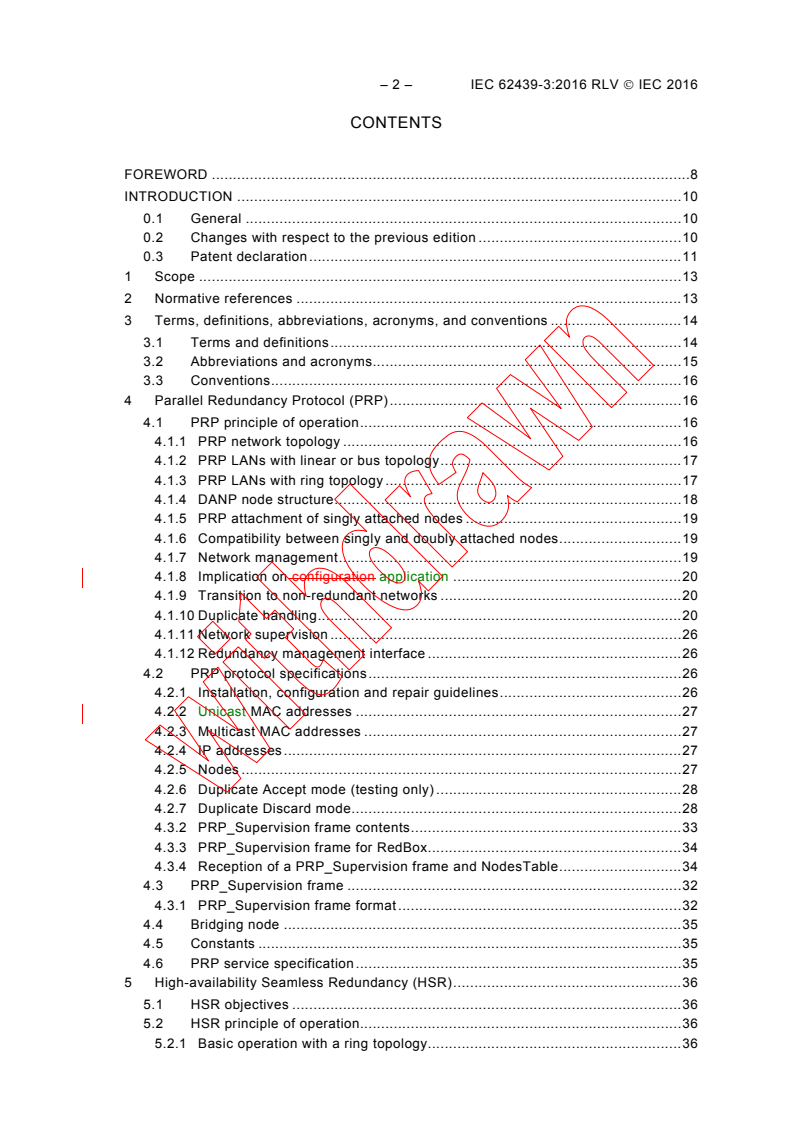
– 2 – IEC 62439-3:2016 RLV IEC 2016
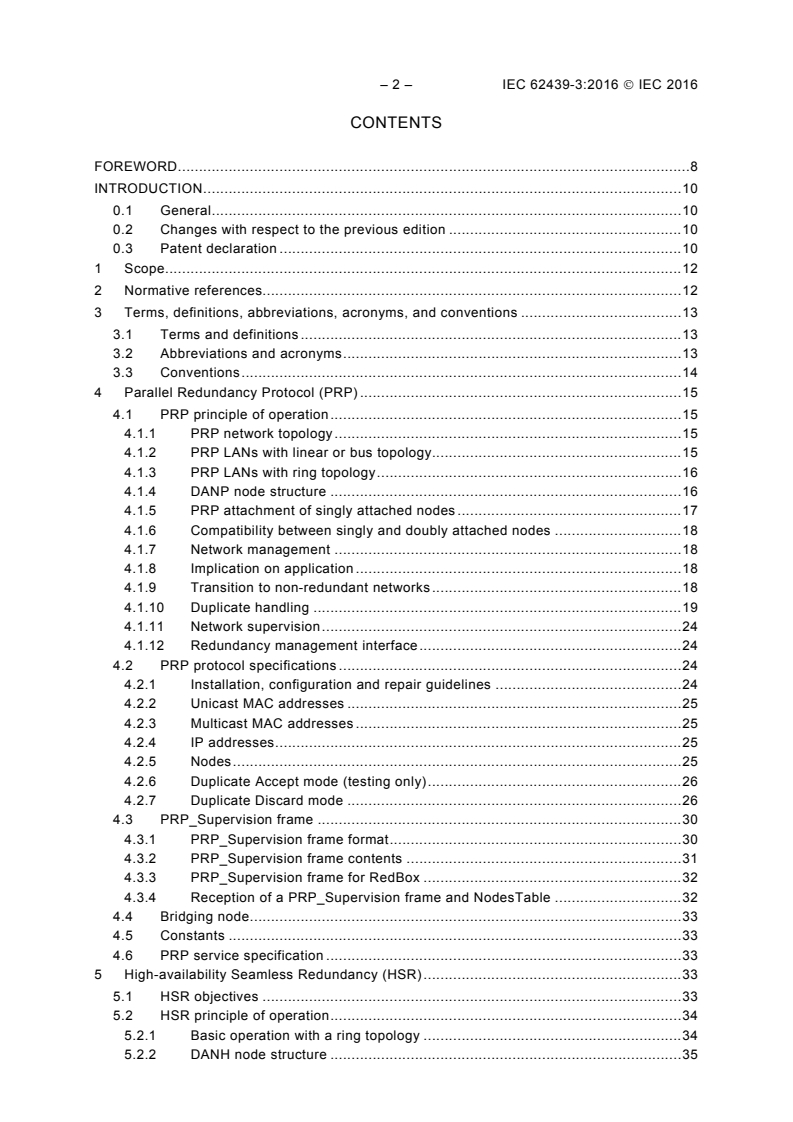
CONTENTS
FOREWORD . 8
INTRODUCTION . 10
0.1 General . 10
0.2 Changes with respect to the previous edition . 10
0.3 Patent declaration . 11
1 Scope . 13
2 Normative references . 13
3 Terms, definitions, abbreviations, acronyms, and conventions . 14
3.1 Terms and definitions . 14
3.2 Abbreviations and acronyms . 15
3.3 Conventions . 16
4 Parallel Redundancy Protocol (PRP) . 16
4.1 PRP principle of operation . 16
4.1.1 PRP network topology . 16
4.1.2 PRP LANs with linear or bus topology . 17
4.1.3 PRP LANs with ring topology . 17
4.1.4 DANP node structure . 18
4.1.5 PRP attachment of singly attached nodes . 19
4.1.6 Compatibility between singly and doubly attached nodes . 19
4.1.7 Network management . 19
4.1.8 Implication on configuration application . 20
4.1.9 Transition to non-redundant networks . 20
4.1.10 Duplicate handling . 20
4.1.11 Network supervision . 26
4.1.12 Redundancy management interface . 26
4.2 PRP protocol specifications . 26
4.2.1 Installation, configuration and repair guidelines . 26
4.2.2 Unicast MAC addresses . 27
4.2.3 Multicast MAC addresses . 27
4.2.4 IP addresses . 27
4.2.5 Nodes . 27
4.2.6 Duplicate Accept mode (testing only) . 28
4.2.7 Duplicate Discard mode . 28
4.3.2 PRP_Supervision frame contents . 33
4.3.3 PRP_Supervision frame for RedBox . 34
4.3.4 Reception of a PRP_Supervision frame and NodesTable . 34
4.3 PRP_Supervision frame . 32
4.3.1 PRP_Supervision frame format . 32
4.4 Bridging node . 35
4.5 Constants . 35
4.6 PRP service specification . 35
5 High-availability Seamless Redundancy (HSR) . 36
5.1 HSR objectives . 36
5.2 HSR principle of operation. 36
5.2.1 Basic operation with a ring topology . 36
5.2.2 DANH node structure . 38
5.2.3 Topology . 38
5.2.4 RedBox structure . 46
5.3 HSR node specifications . 48
5.3.1 HSR operation . 48
5.3.2 DANH receiving from its link layer interface . 48
5.3.3 DANH receiving from an HSR port . 49
5.3.4 DANH forwarding rules . 50
5.3.5 CoS . 52
5.3.6 Clock synchronization . 52
5.3.7 Deterministic medium access . 52
5.4 HSR RedBox specifications . 52
5.4.1 RedBox properties. 52
5.4.2 RedBox receiving from interlink . 53
5.4.3 RedBox forwarding on the ring . 55
5.4.4 RedBox receiving from an HSR port . 55
5.4.5 RedBox receiving from its link layer interface . 57
5.4.6 Redbox ProxyNodeTable handling . 57
5.4.7 RedBox CoS . 57
5.4.8 RedBox clock synchronization . 58
5.4.9 RedBox medium access . 58
5.5 QuadBox specification . 58
5.6 Duplicate Discard method . 58
5.7 Frame format for HSR . 58
5.7.1 Frame format for all frames . 58
5.7.2 HSR_Supervision frame . 59
5.8 Constants . 62
5.9 HSR service specification . 63
6 Protocol Implementation Conformance Statement (PICS) . 64
7 PRP/HSR Management Information Base (MIB) . 65
Annex A (normative) Use of IEC 61588 and IEEE C37.238 for IEC 62439-3 .
Annex A (normative) Clocks synchronization over redundant paths in
IEC 62439-3 . 96
A.1 Overview . 96
A.2 Attachment to redundant LANs by a boundary clock . 96
A.3 Attachment to redundant LANs by doubly attached ordinary clocks . 97
A.4 PRP mapping to PTP . 99
A.4.1 Scenarios and device roles . 99
A.4.2 Operation in PRP . 101
A.4.3 Configuration specification . 102
A.4.4 Specifications of DANP as DAC . 103
A.4.5 Clock model of a RedBox for PTP . 103
A.5 HSR Mapping to PTP . 120
A.5.1 PTP traffic in HSR . 120
A.5.2 HSR nodes specifications . 123
A.5.3 Redundant clocks in HSR . 124
A.5.4 Attachment of an MC to an external LAN . 124
A.6 PRP to HSR Mapping . 125
A.6.1 Connection methods . 125
– 4 – IEC 62439-3:2016 RLV IEC 2016
A.6.2 PRP-HSR connection by BC . 125
A.6.3 PRP-HSR connection by TCs . 126
A.7 Doubly attached clock model . 127
A.7.1 State machine . 127
A.7.2 Supervision of the port . 130
A.7.3 BMCA for paired ports . 131
A.7.4 Selection of the port state . 132
A.8 PTP datasets for high availability . 132
A.8.1 General . 132
A.8.2 Data types . 132
A.8.3 Datasets for ordinary or boundary clocks . 133
A.8.4 Object for transparent clocks . 137
Annex B (informative) Deterministic medium access in HSR .
Annex B (normative) PTP profile for Power Utility Automation – Redundant clock
attachment . 141
B.1 Application domain . 141
B.2 PTP profile specification . 141
B.3 Redundant clock attachment . 141
Annex C (normative) PTP profiles for high-availability automation networks . 142
C.1 Application domain . 142
C.2 PTP profile specification . 142
C.3 Clock types . 142
C.4 Protocol specification common . 143
C.5 Protocol specification for L3E2E automation profile . 143
C.6 Protocol specification for L2P2P automation profile . 143
C.7 Timing requirements . 144
C.7.1 Measurement conditions . 144
C.7.2 Network time inaccuracy . 144
C.7.3 Network elements . 144
C.7.4 Requirements for grandmasters . 144
C.7.5 Requirements for TCs . 145
C.7.6 Requirements for BCs . 145
C.7.7 Requirements for media converters . 145
C.7.8 Requirements for links . 145
C.8 Network engineering . 146
C.9 Default settings . 146
C.10 Redundant clock handling . 147
C.11 Protocol Implementation Conformance Statement (PICS) . 148
C.11.1 Conventions . 148
C.11.2 PICS . 148
Annex D (informative) Precision Time Protocol tutorial for IEC 62439-3 . 150
D.1 Objective . 150
D.2 Precision and accuracy . 150
D.3 PTP clock types . 151
D.4 PTP main options . 152
D.5 Layer 2 and layer 3 communication . 153
D.6 1-step and 2-step correction . 153
D.6.1 Time correction in TCs . 153
D.6.2 2-step to 1-step translation . 154
D.7 End-To-End link delay measurement . 156
D.7.1 General method . 156
D.7.2 End-to-End link delay measurement with 1-step clock correction . 156
D.7.3 End-to-End link delay measurement with 2-step clock correction . 157
D.7.4 End-to-End link delay calculation by Delay_Req/Delay_Resp . 158
D.8 Peer-to-Peer link delay calculation . 158
D.8.1 Peer-to-Peer link delay calculation with 1-step correction . 158
D.8.2 Peer-to-Peer link delay calculation with 2-step correction . 159
Annex E (normative) Management Information base for singly and doubly
attached clocks . 161
Bibliography . 186
Figure 1 – PRP example of general redundant network . 16
Figure 2 – PRP example of redundant network as two LANs (bus topology) . 17
Figure 3 – PRP example of redundant ring with SANs and DANPs . 18
Figure 4 – PRP with two DANPs communicating . 18
Figure 5 – PRP RedBox, transition from single to double LAN . 20
Figure 6 – PRP frame extended by an RCT . 21
Figure 7 – PRP VLAN-tagged frame extended by an RCT . 22
Figure 8 – PRP padded frame closed by an RCT . 22
Figure 9 – Duplicate Discard algorithm boundaries . 24
Figure 10 – HSR example of ring configuration for multicast traffic . 36
Figure 11 – HSR example of ring configuration for unicast traffic . 37
Figure 12 – HSR structure of a DANH . 38
Figure 13 – HSR example of topology using two independent networks . 39
Figure 14 – HSR example of peer coupling of two rings . 40
Figure 15 – HSR example of connected rings . 41
Figure 16 – HSR example of coupling two redundant PRP LANs to a ring . 42
Figure 17 – HSR example of coupling from a ring node to redundant PRP LANs . 43
Figure 18 – HSR example of coupling from a ring to two PRP LANs . 44
Figure 19 – HSR example of coupling three rings to one PRP LAN. 45
Figure 20 – HSR example of meshed topology . 46
Figure 21 – HSR structure of a RedBox . 47
Figure 22 – HSR frame without a VLAN tag . 58
Figure 23 – HSR frame with VLAN tag . 59
Figure 24 – HSR node with management counters . 63
Figure 25 – HSR RedBox with management counters . 64
Figure A.1 – Doubly Attached Clock as BC (MCA is best master) . 96
Figure A.2 – Doubly Attached Clock when MCA is best master . 98
Figure A.3 – Doubly attached clocks when OC1 is best master . 99
Figure A.4 – Elements of PRP networks . 101
Figure A.5 – Connection of a master clock to an ordinary clock over PRP . 102
Figure A.6 – PRP RedBox as BCs (OC3 and BC7 are best masters) . 104
Figure A.7 – RedBox DABC clock model . 105
– 6 – IEC 62439-3:2016 RLV IEC 2016
Figure A.8 – PRP RedBoxes as DABC with E2E – BC7 is master . 106
Figure A.9 – PRP RedBoxes as DABC with E2E – timing . 107
Figure A.10 – PRP RedBoxes as DABC with P2P – OC5 is best master . 108
Figure A.11 – PRP RedBoxes as DABC with P2P – timing . 109
Figure A.12 – PRP RedBox as DATC with E2E –signal flow . 110
Figure A.13 – PRP RedBox as DATC with E2E – timing . 112
Figure A.14 – PRP RedBox as DATC with P2P . 113
Figure A.15 – PRP RedBox as DATC with P2P – timing . 114
Figure A.16 – PRP RedBox as SLTC with E2E . 117
Figure A.17 – PRP RedBox as SLTC with E2E – timing . 118
Figure A.18 – PRP RedBox as SLTC with P2P . 119
Figure A.19 – HSR with one GMC . 121
Figure A.20 – PTP messages sent and received by an HSR node (1-step). . 122
Figure A.21 – PTP messages sent and received by an HSR node (2-step) . 123
Figure A.22 – Attachment of a GMC to an HSR ring through a RedBox as TC . 125
Figure A.23 – PRP to HSR coupling by BCs . 126
Figure A.24 – PRP to HSR coupling by TCs . 127
Figure A.25 – Port states including transitions for redundant operation . 128
Figure A.26 – BMCA for redundant masters . 131
Figure D.1 – Precision and accuracy example . 150
Figure D.2 – Precision Time Protocol principle . 151
Figure D.3 – Precision Time Protocol elements . 152
Figure D.4 – Delays and time-stamping logic in TCs . 153
Figure D.5 – Correction of the Sync message by 1-step and 2-step (peer-to-peer) . 154
Figure D.6 – Translation from 2-step to 1-step in TCs . 155
Figure D.7 – Translation from 2-step to 1-step – message view . 156
Figure D.8 – End-to-end link delay measurement with 1-step clock correction . 157
Figure D.9 – End-to-end delay measurement with 2-step clock correction . 158
Figure D.10 – Peer-to-peer link delay measurement with 1-step clock correction . 159
Figure D.11 – Peer-to-peer link delay measurement with 2-step clock correction . 160
Table 1 – Duplicate discard cases . 25
Table 2 – Monitoring data set . 28
Table 3 – NodesTable attributes . 29
Table 4 – PRP_Supervision frame with no VLAN tag . 32
Table 5 – PRP_Supervision frame with (optional) VLAN tag . 33
Table 6 – PRP_Supervision frame contents . 34
Table 7 – PRP_Supervision TLV for Redbox . 34
Table 8 – PRP constants . 35
Table 9 – HSR_Supervision frame with no VLAN tag . 60
Table 10 – HSR_Supervision frame with optional VLAN tag . 61
Table 11 – HSR Constants . 63
Table A.1 – States . 129
Table A.2 – Transitions . 130
Table A.3 – Variables. 130
Table C.1 – PTP attributes for the Industrial Automation profile . 147
Table C.2 – PICS for clocks . 149
– 8 – IEC 62439-3:2016 RLV IEC 2016
INTERNATIONAL ELECTROTECHNICAL COMMISSION
____________
INDUSTRIAL COMMUNICATION NETWORKS –
HIGH AVAILABILITY AUTOMATION NETWORKS –
Part 3: Parallel Redundancy Protocol (PRP) and
High-availability Seamless Redundancy (HSR)
FOREWORD
1) The International Electrotechnical Commission (IEC) is a worldwide organization for standardization comprising
all national electrotechnical committees (IEC National Committees). The object of IEC is to promote
international co-operation on all questions concerning standardization in the electrical and electronic fields. To
this end and in addition to other activities, IEC publishes International Standards, Technical Specifications,
Technical Reports, Publicly Available Specifications (PAS) and Guides (hereafter referred to as “IEC
Publication(s)”). Their preparation is entrusted to technical committees; any IEC National Committee interested
in the subject dealt with may participate in this preparatory work. International, governmental and non-
governmental organizations liaising with the IEC also participate in this preparation. IEC collaborates closely
with the International Organization for Standardization (ISO) in accordance with conditions determined by
agreement between the two organizations.
2) The formal decisions or agreements of IEC on technical matters express, as nearly as possible, an international
consensus of opinion on the relevant subjects since each technical committee has representation from all
interested IEC National Committees.
3) IEC Publications have the form of recommendations for international use and are accepted by IEC National
Committees in that sense. While all reasonable efforts are made to ensure that the technical content of IEC
Publications is accurate, IEC cannot be held responsible for the way in which they are used or for any
misinterpretation by any end user.
4) In order to promote international uniformity, IEC National Committees undertake to apply IEC Publications
transparently to the maximum extent possible in their national and regional publications. Any divergence
between any IEC Publication and the corresponding national or regional publication shall be clearly indicated in
the latter.
5) IEC itself does not provide any attestation of conformity. Independent certification bodies provide conformity
assessment services and, in some areas, access to IEC marks of conformity. IEC is not responsible for any
services carried out by independent certification bodies.
6) All users should ensure that they have the latest edition of this publication.
7) No liability shall attach to IEC or its directors, employees, servants or agents including individual experts and
members of its technical committees and IEC National Committees for any personal injury, property damage or
other damage of any nature whatsoever, whether direct or indirect, or for costs (including legal fees) and
expenses arising out of the publication, use of, or reliance upon, this IEC Publication or any other IEC
Publications.
8) Attention is drawn to the Normative references cited in this publication. Use of the referenced publications is
indispensable for the correct application of this publication.
This redline version of the official IEC Standard allows the user to identify the changes
made to the previous edition. A vertical bar appears in the margin wherever a change
has been made. Additions are in green text, deletions are in strikethrough red text.
International Standard IEC 62439-3 has been prepared by subcommittee 65C: Industrial
networks, of IEC technical committee 65: Industrial-process measurement, control and
automation.
This third edition cancels and replaces the second edition published in 2012. This edition
constitutes a technical revision.
This edition includes the following significant technical changes with respect to the previous
edition:
a) technical corrections and extension of specifications;
b) consideration of IEC 61588 clock synchronization with end-to-end delay measurement
alongside the existing peer-to-peer delay measurement in PRP.
The text of this standard is based on the following documents:
FDIS Report on voting
65C/834/FDIS 65C/841/RVD
Full information on the voting for the approval of this standard can be found in the report on
voting indicated in the above table.
This publication has been drafted in accordance with the ISO/IEC Directives, Part 2.
This International Standard is to be read in conjunction with IEC 62439-1.
A list of all parts in the IEC 62439 series, published under the general title Industrial
communication networks – High availability automation networks, can be found on the IEC
website.
The committee has decided that the contents of this publication will remain unchanged until
the stability date indicated on the IEC web site under "http://webstore.iec.ch" in the data
related to the specific publication. At this date, the publication will be
• reconfirmed,
• withdrawn,
• replaced by a revised edition, or
• amended.
IMPORTANT – The “colour inside” logo on the cover page of this publication
indicates that it contains colours which are considered to be useful for the correct
understanding of its contents. Users should therefore print this publication using a
colour printer.
– 10 – IEC 62439-3:2016 RLV IEC 2016
INTRODUCTION
0.1 General
IEC 62439-3 belongs to the IEC 62439 series “Industrial communication networks – High
availability automation networks”. It specifies the PRP and HSR seamless redundancy
protocols. It was adopted by IEC TC57 WG10 as the redundancy method for demanding
substation automation networks based on IEC 61850 series, introducing new requirements
operating on layer 2 networks, according to IEC 61850-8-1 and IEC 61850-9-2.
The seamless redundancy principle has been extended to clocks operating according to the
Precision Time Protocol (IEC 61588) and attached to redundant networks. Two variants are
specified: L3E2E for clocks which operate on layer 3 networks with end-to-end link delay
measurement (E2E) and L2P2P for clocks that operate on layer 2 with peer-to-peer link delay
measurement (P2P).
0.2 Changes with respect to the previous edition
The major changes with respect to IEC 62439-3:2010 are listed below.
Aligning the sequence number between PRP and HSR, to enable coupling of HSR and PRP
networks and simplify the implementation of dual-mode nodes in hardware. At the same time,
introduce a suffix in the PRP Redundancy Control Trailer to allow better identification, future
extensions and coexistence with other protocols that also happen to use a trailer. This change
is not backwards-compatible, so means are provided to identify the version and ensure that
the networks are homogeneous.
Removing all implementation restrictions on the Duplicate Discard algorithm (especially
references to the drop window algorithm and references to connection orientation) since other
methods such as hash tables can be used.
Removing the purging of the duplicate table. Replace this specific method by requiring that
any Duplicate Discard algorithm provides a mechanism to remove old entries, thus ensuring
that a node can properly reboot.
Making node tables optional for simple nodes to simplify hardware implementation.
Suppression of explicit mention of the HSR-PRP mode (PRP with HSR Tags), but allow it
through the Mode N (no forwarding).
Introducing Mode T (forward through) to allow maintenance laptops to configure an open ring
when attached to one end and Mode M (mixed) to allow forwarding of non-HSR-tagged frames
in a closed ring.
Recommending the position of connectors, rather than impose it.
Defining the behaviour of an HSR node when non-HSR frames are encountered without
requiring the recording of the source addresses and specify how IEEE 802.1D:2004, Table 7-
10 frames are treated.
Prefixing the supervision frames on HSR by an HSR tag to simplify the hardware
implementation and introduce a unique EtherType for HSR to simplify processing.
Changing the rule for the RedBox to allow more than one PRP network to be connected to an
HSR ring, and introduce an identifier per RedBox pair.
Specifying tagging of IEC 61588 frames to follow IEEE C37.238 recommendations (informal).
Suppressing MAC address substitution.
Adapting the MIB to above changes.
The major changes with respect to IEC 62439-3:2012 are:
– Subclause 4.1.10.3 has been rewritten to explain the calculation of the duplicate rejection
for different speeds.
– Annex A has been redrafted as a general concept for doubly attached clocks applicable to
end-to-end (E2E) and to peer-to-peer (P2P) link delay measurement; the principle of
paired port operation has now been specified in terms of a state machine based on
IEC 61588:2009.
– Annex B of IEC 62439-3:2012 has been deleted; its properties are mentioned in 5.3.7.
– Annex B (new) makes the support of redundancy mandatory for IEC/IEEE 61850-9-3 that
specifies doubly attached clocks on layer 2, with peer-to-peer delay measurement.
– Annex C specifies two profiles of a precision clock for industrial automation:
L3E2E for layer 3, end-to-end delay measurement and
L2P2P for layer 2, peer-to-peer delay measurement.
– Annex D contains the tutorial information on IEC 61588:2009 for understanding the above
annexes. It was contained in IEC 62439-3:2012 Annex A.
– Annex E (MIB) contains the SNMP Management Information Base to be used for singly
and doubly attached clocks in all profiles.
0.3 Patent declaration
The International Electrotechnical Commission (IEC) draws attention to the fact that it is
claimed that compliance with this document may involve the use of patents concerning
filtering of redundant frames in a network node (Siemens Aktiengesellschaft – EP 2127329,
US 8184650, CN 101611615B) given in 5.2.3.3.
IEC takes no position concerning the evidence, validity and scope of this patent right.
The holder of this patent right has assured the IEC that he/she is willing to negotiate licences
under reasonable and non-discriminatory terms and conditions with applicants throughout the
world. In this respect, the statement of the holder of this patent right is registered with IEC.
Information may be obtained from:
Siemens Aktiengesellschaft
Oto-Hahn-Ring 6
81379 Munich, Germany
The International Electrotechnical Commission (IEC) draws attention to the fact that it is
claimed that compliance with this document may involve the use of a patent concerning
Reception of redundant and non-redundant frames (ABB Schweiz AG – WO 2006/053459 A1
Research Ltd – EP 1825657, US 20070223533 8582426, CN 101057483, IN 254425) given in
4.2.7, concerning Identifying improper cabling of devices (ABB Schweiz Technology AG – EP
2 015 501 A1 2163024, US 8344736, CN 101689985) given in 4.3, concerning Critical device
with increased availability (ABB Schweiz AG Research Ltd – EP 2090950 A1) given in 4.4,
concerning Ring coupling nodes for high availability networks (ABB Schweiz AG Research Ltd
– WO 2010/010120 A1 US 8582424, EP 2327185, CN 102106121) given in 5.2.3.
IEC takes no position concerning the evidence, validity and scope of these patent rights.
The holder of these patent rights has assured the IEC that he/she is willing to negotiate
licences under reasonable and non-discriminatory terms and conditions with applicants
throughout the world. In this respect, the statement of the holder of these patent rights is
registered with IEC. Information may be obtained from:
– 12 – IEC 62439-3:2016 RLV IEC 2016
ABB Schweiz AG
Intellectual Property CH-IP (CH-150016-L)
Brown Boveri Strasse 6
CH-5400 Baden, Switzerland
ch-ip.patent@abb.com
Attention is drawn to the possibility that some of the elements of this document may be the
subject of patent rights other than those identified above. IEC shall not be held responsible for
identifying any or all such patent rights.
ISO (www.iso.org/patents) and IEC (http://patents.iec.ch) maintain on-line data bases of
patents relevant to their standards. Users are encouraged to consult the data bases for the
most up to date information concerning patents.
INDUSTRIAL COMMUNICATION NETWORKS –
HIGH AVAILABILITY AUTOMATION NETWORKS –
Part 3: Parallel Redundancy Protocol (PRP) and
High-availability Seamless Redundancy (HSR)
1 Scope
The IEC 62439 series is applicable to high-availability automation networks based on the
ISO/IEC 8802-3 Ethernet technology.
This part of IEC 62439 specifies two redundancy protocols designed to provide seamless
recovery in case of single failure of an inter-bridge link or bridge in the network, which are
based on the same scheme: duplication of the LAN, resp. duplication of the transmitted
parallel transmission of duplicated information.
2 Normative references
The following documents, in whole or in part, are normatively referenced in this document and
are indispensable for its application. For dated references, only the edition cited applies. For
undated references, the latest edition of the referenced document (including any
amendments) applies.
IEC 60050-191, International Electrotechnical Vocabulary – Chapter 191: Dependability and
quality of service
IEC 61588:2009, Precision clock synchronization protocol for networked measurement and
control systems
IEC TR 61850-90-4:2013, Communication networks and systems for power utility automation
– Part 90-4: Network engineering guidelines
IEC 62439-1, Industrial communication networks – High availability automation networks –
Part 1: General concepts and calculation methods
IEC 62439-2, Industrial Communication networks – High availability automation networks –
Part 2: Media Redundancy Protocol (MRP)
IEC 62439-6, Industrial communication networks – High availability automation networks –
Part 6: Distributed Redundancy Protocol (DRP)
IEC 62439-7, Industrial communication networks – High availability automation
...
IEC 62439-3 ®
Edition 3.0 2016-03
INTERNATIONAL
STANDARD
NORME
INTERNATIONALE
colour
inside
Industrial communication networks – High availability automation networks –
Part 3: Parallel Redundancy Protocol (PRP) and High-availability Seamless
Redundancy (HSR)
Réseaux de communication industriels – Réseaux d'automatisme à haute
disponibilité –
Partie 3: Protocole de redondance en parallèle (PRP) et redondance transparente
de haute disponibilité (HSR)
All rights reserved. Unless otherwise specified, no part of this publication may be reproduced or utilized in any form
or by any means, electronic or mechanical, including photocopying and microfilm, without permission in writing from
either IEC or IEC's member National Committee in the country of the requester. If you have any questions about IEC
copyright or have an enquiry about obtaining additional rights to this publication, please contact the address below or
your local IEC member National Committee for further information.
Droits de reproduction réservés. Sauf indication contraire, aucune partie de cette publication ne peut être reproduite
ni utilisée sous quelque forme que ce soit et par aucun procédé, électronique ou mécanique, y compris la photocopie
et les microfilms, sans l'accord écrit de l'IEC ou du Comité national de l'IEC du pays du demandeur. Si vous avez des
questions sur le copyright de l'IEC ou si vous désirez obtenir des droits supplémentaires sur cette publication, utilisez
les coordonnées ci-après ou contactez le Comité national de l'IEC de votre pays de résidence.
IEC Central Office Tel.: +41 22 919 02 11
3, rue de Varembé Fax: +41 22 919 03 00
CH-1211 Geneva 20 info@iec.ch
Switzerland www.iec.ch
About the IEC
The International Electrotechnical Commission (IEC) is the leading global organization that prepares and publishes
International Standards for all electrical, electronic and related technologies.
About IEC publications
The technical content of IEC publications is kept under constant review by the IEC. Please make sure that you have the
latest edition, a corrigenda or an amendment might have been published.
IEC Catalogue - webstore.iec.ch/catalogue Electropedia - www.electropedia.org
The stand-alone application for consulting the entire The world's leading online dictionary of electronic and
bibliographical information on IEC International Standards, electrical terms containing 20 000 terms and definitions in
Technical Specifications, Technical Reports and other English and French, with equivalent terms in 15 additional
documents. Available for PC, Mac OS, Android Tablets and languages. Also known as the International Electrotechnical
iPad. Vocabulary (IEV) online.
IEC publications search - www.iec.ch/searchpub IEC Glossary - std.iec.ch/glossary
The advanced search enables to find IEC publications by a 65 000 electrotechnical terminology entries in English and
variety of criteria (reference number, text, technical French extracted from the Terms and Definitions clause of
committee,…). It also gives information on projects, replaced IEC publications issued since 2002. Some entries have been
and withdrawn publications. collected from earlier publications of IEC TC 37, 77, 86 and
CISPR.
IEC Just Published - webstore.iec.ch/justpublished
Stay up to date on all new IEC publications. Just Published IEC Customer Service Centre - webstore.iec.ch/csc
details all new publications released. Available online and If you wish to give us your feedback on this publication or
also once a month by email. need further assistance, please contact the Customer Service
Centre: csc@iec.ch.
A propos de l'IEC
La Commission Electrotechnique Internationale (IEC) est la première organisation mondiale qui élabore et publie des
Normes internationales pour tout ce qui a trait à l'électricité, à l'électronique et aux technologies apparentées.
A propos des publications IEC
Le contenu technique des publications IEC est constamment revu. Veuillez vous assurer que vous possédez l’édition la
plus récente, un corrigendum ou amendement peut avoir été publié.
Catalogue IEC - webstore.iec.ch/catalogue Electropedia - www.electropedia.org
Application autonome pour consulter tous les renseignements
Le premier dictionnaire en ligne de termes électroniques et
bibliographiques sur les Normes internationales,
électriques. Il contient 20 000 termes et définitions en anglais
Spécifications techniques, Rapports techniques et autres
et en français, ainsi que les termes équivalents dans 15
documents de l'IEC. Disponible pour PC, Mac OS, tablettes
langues additionnelles. Egalement appelé Vocabulaire
Android et iPad.
Electrotechnique International (IEV) en ligne.
Recherche de publications IEC - www.iec.ch/searchpub
Glossaire IEC - std.iec.ch/glossary
La recherche avancée permet de trouver des publications IEC 65 000 entrées terminologiques électrotechniques, en anglais
en utilisant différents critères (numéro de référence, texte, et en français, extraites des articles Termes et Définitions des
comité d’études,…). Elle donne aussi des informations sur les publications IEC parues depuis 2002. Plus certaines entrées
projets et les publications remplacées ou retirées. antérieures extraites des publications des CE 37, 77, 86 et
CISPR de l'IEC.
IEC Just Published - webstore.iec.ch/justpublished
Service Clients - webstore.iec.ch/csc
Restez informé sur les nouvelles publications IEC. Just
Published détaille les nouvelles publications parues. Si vous désirez nous donner des commentaires sur cette
Disponible en ligne et aussi une fois par mois par email. publication ou si vous avez des questions contactez-nous:
csc@iec.ch.
IEC 62439-3 ®
Edition 3.0 2016-03
INTERNATIONAL
STANDARD
NORME
INTERNATIONALE
colour
inside
Industrial communication networks – High availability automation networks –
Part 3: Parallel Redundancy Protocol (PRP) and High-availability Seamless
Redundancy (HSR)
Réseaux de communication industriels – Réseaux d'automatisme à haute
disponibilité –
Partie 3: Protocole de redondance en parallèle (PRP) et redondance transparente
de haute disponibilité (HSR)
INTERNATIONAL
ELECTROTECHNICAL
COMMISSION
COMMISSION
ELECTROTECHNIQUE
INTERNATIONALE
ICS 25.040, 35.040 ISBN 978-2-8322-3150-0
– 2 – IEC 62439-3:2016 IEC 2016
CONTENTS
FOREWORD . 8
INTRODUCTION . 10
0.1 General . 10
0.2 Changes with respect to the previous edition . 10
0.3 Patent declaration . 10
1 Scope . 12
2 Normative references. 12
3 Terms, definitions, abbreviations, acronyms, and conventions . 13
3.1 Terms and definitions . 13
3.2 Abbreviations and acronyms . 13
3.3 Conventions . 14
4 Parallel Redundancy Protocol (PRP) . 15
4.1 PRP principle of operation . 15
4.1.1 PRP network topology . 15
4.1.2 PRP LANs with linear or bus topology . 15
4.1.3 PRP LANs with ring topology . 16
4.1.4 DANP node structure . 16
4.1.5 PRP attachment of singly attached nodes . 17
4.1.6 Compatibility between singly and doubly attached nodes . 18
4.1.7 Network management . 18
4.1.8 Implication on application . 18
4.1.9 Transition to non-redundant networks . 18
4.1.10 Duplicate handling . 19
4.1.11 Network supervision . 24
4.1.12 Redundancy management interface . 24
4.2 PRP protocol specifications . 24
4.2.1 Installation, configuration and repair guidelines . 24
4.2.2 Unicast MAC addresses . 25
4.2.3 Multicast MAC addresses . 25
4.2.4 IP addresses . 25
4.2.5 Nodes . 25
4.2.6 Duplicate Accept mode (testing only) . 26
4.2.7 Duplicate Discard mode . 26
4.3 PRP_Supervision frame . 30
4.3.1 PRP_Supervision frame format . 30
4.3.2 PRP_Supervision frame contents . 31
4.3.3 PRP_Supervision frame for RedBox . 32
4.3.4 Reception of a PRP_Supervision frame and NodesTable . 32
4.4 Bridging node . 33
4.5 Constants . 33
4.6 PRP service specification . 33
5 High-availability Seamless Redundancy (HSR) . 33
5.1 HSR objectives . 33
5.2 HSR principle of operation . 34
5.2.1 Basic operation with a ring topology . 34
5.2.2 DANH node structure . 35
5.2.3 Topology . 36
5.2.4 RedBox structure . 44
5.3 HSR node specifications . 46
5.3.1 HSR operation . 46
5.3.2 DANH receiving from its link layer interface . 46
5.3.3 DANH receiving from an HSR port . 47
5.3.4 DANH forwarding rules . 48
5.3.5 CoS . 49
5.3.6 Clock synchronization . 50
5.3.7 Deterministic medium access . 50
5.4 HSR RedBox specifications . 50
5.4.1 RedBox properties . 50
5.4.2 RedBox receiving from interlink . 50
5.4.3 RedBox forwarding on the ring . 52
5.4.4 RedBox receiving from an HSR port . 52
5.4.5 RedBox receiving from its link layer interface . 54
5.4.6 Redbox ProxyNodeTable handling . 54
5.4.7 RedBox CoS . 54
5.4.8 RedBox clock synchronization . 55
5.4.9 RedBox medium access . 55
5.5 QuadBox specification . 55
5.6 Duplicate Discard method . 55
5.7 Frame format for HSR . 55
5.7.1 Frame format for all frames . 55
5.7.2 HSR_Supervision frame . 56
5.8 Constants . 59
5.9 HSR service specification . 60
6 Protocol Implementation Conformance Statement (PICS) . 61
7 PRP/HSR Management Information Base (MIB) . 62
Annex A (normative) Clocks synchronization over redundant paths in IEC 62439-3 . 79
A.1 Overview. 79
A.2 Attachment to redundant LANs by a boundary clock . 79
A.3 Attachment to redundant LANs by doubly attached ordinary clocks . 80
A.4 PRP mapping to PTP . 82
A.4.1 Scenarios and device roles . 82
A.4.2 Operation in PRP . 84
A.4.3 Configuration specification . 85
A.4.4 Specifications of DANP as DAC . 86
A.4.5 Clock model of a RedBox for PTP . 86
A.5 HSR Mapping to PTP . 103
A.5.1 PTP traffic in HSR . 103
A.5.2 HSR nodes specifications . 106
A.5.3 Redundant clocks in HSR . 107
A.5.4 Attachment of an MC to an external LAN . 107
A.6 PRP to HSR Mapping . 108
A.6.1 Connection methods . 108
A.6.2 PRP-HSR connection by BC . 108
A.6.3 PRP-HSR connection by TCs . 109
– 4 – IEC 62439-3:2016 IEC 2016
A.7 Doubly attached clock model . 110
A.7.1 State machine . 110
A.7.2 Supervision of the port . 113
A.7.3 BMCA for paired ports . 114
A.7.4 Selection of the port state . 115
A.8 PTP datasets for high availability . 115
A.8.1 General . 115
A.8.2 Data types . 115
A.8.3 Datasets for ordinary or boundary clocks . 116
A.8.4 Object for transparent clocks . 120
Annex B (normative) PTP profile for Power Utility Automation – Redundant clock
attachment . 123
B.1 Application domain . 123
B.2 PTP profile specification . 123
B.3 Redundant clock attachment. 123
Annex C (normative) PTP profiles for high-availability automation networks . 124
C.1 Application domain . 124
C.2 PTP profile specification . 124
C.3 Clock types . 124
C.4 Protocol specification common . 125
C.5 Protocol specification for L3E2E automation profile . 125
C.6 Protocol specification for L2P2P automation profile . 125
C.7 Timing requirements . 126
C.7.1 Measurement conditions . 126
C.7.2 Network time inaccuracy . 126
C.7.3 Network elements . 126
C.7.4 Requirements for grandmasters . 126
C.7.5 Requirements for TCs . 127
C.7.6 Requirements for BCs . 127
C.7.7 Requirements for media converters . 127
C.7.8 Requirements for links . 127
C.8 Network engineering . 128
C.9 Default settings . 128
C.10 Redundant clock handling . 129
C.11 Protocol Implementation Conformance Statement (PICS) . 130
C.11.1 Conventions . 130
C.11.2 PICS . 130
Annex D (informative) Precision Time Protocol tutorial for IEC 62439-3 . 132
D.1 Objective . 132
D.2 Precision and accuracy . 132
D.3 PTP clock types . 133
D.4 PTP main options . 134
D.5 Layer 2 and layer 3 communication. 135
D.6 1-step and 2-step correction . 135
D.6.1 Time correction in TCs . 135
D.6.2 2-step to 1-step translation . 136
D.7 End-To-End link delay measurement . 138
D.7.1 General method . 138
D.7.2 End-to-End link delay measurement with 1-step clock correction . 138
D.7.3 End-to-End link delay measurement with 2-step clock correction . 139
D.7.4 End-to-End link delay calculation by Delay_Req/Delay_Resp . 140
D.8 Peer-to-Peer link delay calculation . 140
D.8.1 Peer-to-Peer link delay calculation with 1-step correction . 140
D.8.2 Peer-to-Peer link delay calculation with 2-step correction . 141
Annex E (normative) Management Information base for singly and doubly attached
clocks . 143
Bibliography . 168
Figure 1 – PRP example of general redundant network . 15
Figure 2 – PRP example of redundant network as two LANs (bus topology) . 16
Figure 3 – PRP example of redundant ring with SANs and DANPs . 16
Figure 4 – PRP with two DANPs communicating . 17
Figure 5 – PRP RedBox, transition from single to double LAN . 19
Figure 6 – PRP frame extended by an RCT . 20
Figure 7 – PRP VLAN-tagged frame extended by an RCT . 21
Figure 8 – PRP padded frame closed by an RCT . 21
Figure 9 – Duplicate Discard algorithm boundaries . 22
Figure 10 – HSR example of ring configuration for multicast traffic . 34
Figure 11 – HSR example of ring configuration for unicast traffic . 35
Figure 12 – HSR structure of a DANH . 36
Figure 13 – HSR example of topology using two independent networks . 37
Figure 14 – HSR example of peer coupling of two rings . 38
Figure 15 – HSR example of connected rings . 39
Figure 16 – HSR example of coupling two redundant PRP LANs to a ring . 40
Figure 17 – HSR example of coupling from a ring node to redundant PRP LANs . 41
Figure 18 – HSR example of coupling from a ring to two PRP LANs . 42
Figure 19 – HSR example of coupling three rings to one PRP LAN. 43
Figure 20 – HSR example of meshed topology . 44
Figure 21 – HSR structure of a RedBox . 45
Figure 22 – HSR frame without a VLAN tag . 55
Figure 23 – HSR frame with VLAN tag . 56
Figure 24 – HSR node with management counters . 60
Figure 25 – HSR RedBox with management counters . 61
Figure A.1 – Doubly Attached Clock as BC (MCA is best master) . 79
Figure A.2 – Doubly Attached Clock when MCA is best master . 81
Figure A.3 – Doubly attached clocks when OC1 is best master . 82
Figure A.4 – Elements of PRP networks . 84
Figure A.5 – Connection of a master clock to an ordinary clock over PRP . 85
Figure A.6 – PRP RedBox as BCs (OC3 and BC7 are best masters) . 87
Figure A.7 – RedBox DABC clock model . 88
Figure A.8 – PRP RedBoxes as DABC with E2E – BC7 is master . 89
Figure A.9 – PRP RedBoxes as DABC with E2E – timing . 90
– 6 – IEC 62439-3:2016 IEC 2016
Figure A.10 – PRP RedBoxes as DABC with P2P – OC5 is best master . 91
Figure A.11 – PRP RedBoxes as DABC with P2P – timing . 92
Figure A.12 – PRP RedBox as DATC with E2E –signal flow . 93
Figure A.13 – PRP RedBox as DATC with E2E – timing . 95
Figure A.14 – PRP RedBox as DATC with P2P . 96
Figure A.15 – PRP RedBox as DATC with P2P – timing . 97
Figure A.16 – PRP RedBox as SLTC with E2E . 100
Figure A.17 – PRP RedBox as SLTC with E2E – timing . 101
Figure A.18 – PRP RedBox as SLTC with P2P . 102
Figure A.19 – HSR with one GMC . 104
Figure A.20 – PTP messages sent and received by an HSR node (1-step). . 105
Figure A.21 – PTP messages sent and received by an HSR node (2-step) . 106
Figure A.22 – Attachment of a GMC to an HSR ring through a RedBox as TC . 108
Figure A.23 – PRP to HSR coupling by BCs . 109
Figure A.24 – PRP to HSR coupling by TCs . 110
Figure A.25 – Port states including transitions for redundant operation . 111
Figure A.26 – BMCA for redundant masters . 114
Figure D.1 –Precision and accuracy example . 132
Figure D.2 – Precision Time Protocol principle . 133
Figure D.3 – Precision Time Protocol elements . 134
Figure D.4 – Delays and time-stamping logic in TCs . 135
Figure D.5 – Correction of the Sync message by 1-step and 2-step (peer-to-peer) . 136
Figure D.6 – Translation from 2-step to 1-step in TCs . 137
Figure D.7 – Translation from 2-step to 1-step – message view . 138
Figure D.8 – End-to-end link delay measurement with 1-step clock correction . 139
Figure D.9 – End-to-end delay measurement with 2-step clock correction . 140
Figure D.10 – Peer-to-peer link delay measurement with 1-step clock correction . 141
Figure D.11 – Peer-to-peer link delay measurement with 2-step clock correction . 142
Table 1 – Duplicate discard cases . 23
Table 2 – Monitoring data set . 26
Table 3 – NodesTable attributes . 27
Table 4 – PRP_Supervision frame with no VLAN tag . 30
Table 5 – PRP_Supervision frame with (optional) VLAN tag . 31
Table 6 – PRP_Supervision frame contents . 32
Table 7 – PRP_Supervision TLV for Redbox . 32
Table 8 – PRP constants . 33
Table 9 – HSR_Supervision frame with no VLAN tag . 57
Table 10 – HSR_Supervision frame with optional VLAN tag . 58
Table 11 – HSR Constants . 60
Table A.1 – States . 112
Table A.2 – Transitions . 113
Table A.3 – Variables. 113
Table C.1 – PTP attributes for the Industrial Automation profile . 129
Table C.2 – PICS for clocks . 131
– 8 – IEC 62439-3:2016 IEC 2016
INTERNATIONAL ELECTROTECHNICAL COMMISSION
____________
INDUSTRIAL COMMUNICATION NETWORKS –
HIGH AVAILABILITY AUTOMATION NETWORKS –
Part 3: Parallel Redundancy Protocol (PRP) and
High-availability Seamless Redundancy (HSR)
FOREWORD
1) The International Electrotechnical Commission (IEC) is a worldwide organization for standardization comprising
all national electrotechnical committees (IEC National Committees). The object of IEC is to promote
international co-operation on all questions concerning standardization in the electrical and electronic fields. To
this end and in addition to other activities, IEC publishes International Standards, Technical Specifications,
Technical Reports, Publicly Available Specifications (PAS) and Guides (hereafter referred to as “IEC
Publication(s)”). Their preparation is entrusted to technical committees; any IEC National Committee interested
in the subject dealt with may participate in this preparatory work. International, governmental and non-
governmental organizations liaising with the IEC also participate in this preparation. IEC collaborates closely
with the International Organization for Standardization (ISO) in accordance with conditions determined by
agreement between the two organizations.
2) The formal decisions or agreements of IEC on technical matters express, as nearly as possible, an international
consensus of opinion on the relevant subjects since each technical committee has representation from all
interested IEC National Committees.
3) IEC Publications have the form of recommendations for international use and are accepted by IEC National
Committees in that sense. While all reasonable efforts are made to ensure that the technical content of IEC
Publications is accurate, IEC cannot be held responsible for the way in which they are used or for any
misinterpretation by any end user.
4) In order to promote international uniformity, IEC National Committees undertake to apply IEC Publications
transparently to the maximum extent possible in their national and regional publications. Any divergence
between any IEC Publication and the corresponding national or regional publication shall be clearly indicated in
the latter.
5) IEC itself does not provide any attestation of conformity. Independent certification bodies provide conformity
assessment services and, in some areas, access to IEC marks of conformity. IEC is not responsible for any
services carried out by independent certification bodies.
6) All users should ensure that they have the latest edition of this publication.
7) No liability shall attach to IEC or its directors, employees, servants or agents including individual experts and
members of its technical committees and IEC National Committees for any personal injury, property damage or
other damage of any nature whatsoever, whether direct or indirect, or for costs (including legal fees) and
expenses arising out of the publication, use of, or reliance upon, this IEC Publication or any other IEC
Publications.
8) Attention is drawn to the Normative references cited in this publication. Use of the referenced publications is
indispensable for the correct application of this publication.
International Standard IEC 62439-3 has been prepared by subcommittee 65C: Industrial
networks, of IEC technical committee 65: Industrial-process measurement, control and
automation.
This third edition cancels and replaces the second edition published in 2012. This edition
constitutes a technical revision.
This edition includes the following significant technical changes with respect to the previous
edition:
a) technical corrections and extension of specifications;
b) consideration of IEC 61588 clock synchronization with end-to-end delay measurement
alongside the existing peer-to-peer delay measurement in PRP.
The text of this standard is based on the following documents:
FDIS Report on voting
65C/834/FDIS 65C/841/RVD
Full information on the voting for the approval of this standard can be found in the report on
voting indicated in the above table.
This publication has been drafted in accordance with the ISO/IEC Directives, Part 2.
This International Standard is to be read in conjunction with IEC 62439-1.
A list of all parts in the IEC 62439 series, published under the general title Industrial
communication networks – High availability automation networks, can be found on the IEC
website.
The committee has decided that the contents of this publication will remain unchanged until
the stability date indicated on the IEC web site under "http://webstore.iec.ch" in the data
related to the specific publication. At this date, the publication will be
• reconfirmed,
• withdrawn,
• replaced by a revised edition, or
• amended.
IMPORTANT – The “colour inside” logo on the cover page of this publication
indicates that it contains colours which are considered to be useful for the correct
understanding of its contents. Users should therefore print this publication using a
colour printer.
– 10 – IEC 62439-3:2016 IEC 2016
INTRODUCTION
0.1 General
IEC 62439-3 belongs to the IEC 62439 series “Industrial communication networks – High
availability automation networks”. It specifies the PRP and HSR seamless redundancy
protocols. It was adopted by IEC TC57 WG10 as the redundancy method for demanding
substation automation networks operating on layer 2 networks, according to IEC 61850-8-1
and IEC 61850-9-2.
The seamless redundancy principle has been extended to clocks operating according to the
Precision Time Protocol (IEC 61588) and attached to redundant networks. Two variants are
specified: L3E2E for clocks which operate on layer 3 networks with end-to-end link delay
measurement (E2E) and L2P2P for clocks that operate on layer 2 with peer-to-peer link delay
measurement (P2P).
0.2 Changes with respect to the previous edition
The major changes with respect to IEC 62439-3:2012 are:
– Subclause 4.1.10.3 has been rewritten to explain the calculation of the duplicate rejection
for different speeds.
– Annex A has been redrafted as a general concept for doubly attached clocks applicable to
end-to-end (E2E) and to peer-to-peer (P2P) link delay measurement; the principle of
paired port operation has now been specified in terms of a state machine based on
IEC 61588:2009.
– Annex B of IEC 62439-3:2012 has been deleted; its properties are mentioned in 5.3.7.
– Annex B (new) makes the support of redundancy mandatory for IEC/IEEE 61850-9-3 that
specifies doubly attached clocks on layer 2, with peer-to-peer delay measurement.
– Annex C specifies two profiles of a precision clock for industrial automation:
L3E2E for layer 3, end-to-end delay measurement and
L2P2P for layer 2, peer-to-peer delay measurement.
– Annex D contains the tutorial information on IEC 61588:2009 for understanding the above
annexes. It was contained in IEC 62439-3:2012 Annex A.
– Annex E (MIB) contains the SNMP Management Information Base to be used for singly
and doubly attached clocks in all profiles.
0.3 Patent declaration
The International Electrotechnical Commission (IEC) draws attention to the fact that it is
claimed that compliance with this document may involve the use of a patent concerning
filtering of redundant frames in a network node (Siemens Aktiengesellschaft – EP 2127329,
US 8184650, CN 101611615B) given in 5.2.3.3.
IEC takes no position concerning the evidence, validity and scope of this patent right.
The holder of this patent right has assured the IEC that he/she is willing to negotiate licences
under reasonable and non-discriminatory terms and conditions with applicants throughout the
world. In this respect, the statement of the holder of this patent right is registered with IEC.
Information may be obtained from:
Siemens Aktiengesellschaft
Oto-Hahn-Ring 6
81379 Munich, Germany
The International Electrotechnical Commission (IEC) draws attention to the fact that it is
claimed that compliance with this document may involve the use of patents concerning
Reception of redundant and non-redundant frames (ABB Research Ltd – EP 1825657,
US 8582426, CN 101057483, IN 254425) given in 4.2.7, concerning Identifying improper
cabling of devices (ABB Technology AG – EP 2163024, US 8344736, CN 101689985) given in
4.3, concerning Critical device with increased availability (ABB Research Ltd – EP 2090950)
given in 4.4, concerning Ring coupling nodes for high availability networks (ABB Research Ltd
– US 8582424, EP 2327185, CN 102106121) given in 5.2.3.
IEC takes no position concerning the evidence, validity and scope of these patent rights.
The holder of these patent rights has assured the IEC that he/she is willing to negotiate
licences under reasonable and non-discriminatory terms and conditions with applicants
throughout the world. In this respect, the statement of the holder of these patent rights is
registered with IEC. Information may be obtained from:
ABB Schweiz AG
Intellectual Property CH-IP (CH-150016-L)
Brown Boveri Strasse 6
CH-5400 Baden, Switzerland
ch-ip.patent@abb.com
Attention is drawn to the possibility that some of the elements of this document may be the
subject of patent rights other than those identified above. IEC shall not be held responsible for
identifying any or all such patent rights.
ISO (www.iso.org/patents) and IEC (http://patents.iec.ch) maintain on-line data bases of
patents relevant to their standards. Users are encouraged to consult the data bases for the
most up to date information concerning patents.
– 12 – IEC 62439-3:2016 IEC 2016
INDUSTRIAL COMMUNICATION NETWORKS –
HIGH AVAILABILITY AUTOMATION NETWORKS –
Part 3: Parallel Redundancy Protocol (PRP) and
High-availability Seamless Redundancy (HSR)
1 Scope
The IEC 62439 series is applicable to high-availability automation networks based on the
Ethernet technology.
This part of IEC 62439 specifies two redundancy protocols designed to provide seamless
recovery in case of single failure of an inter-bridge link or bridge in the network, which are
based on the same scheme: parallel transmission of duplicated information.
2 Normative references
The following documents, in whole or in part, are normatively referenced in this document and
are indispensable for its application. For dated references, only the edition cited applies. For
undated references, the latest edition of the referenced document (including any
amendments) applies.
IEC 60050-191, International Electrotechnical Vocabulary – Chapter 191: Dependability and
quality of service
IEC 61588:2009, Precision clock synchronization protocol for networked measurement and
control systems
IEC TR 61850-90-4:2013, Communication networks and systems for power utility automation
– Part 90-4: Network engineering guidelines
IEC 62439-1, Industrial communication networks – High availability aut
...