

IEC 62109-2:2011
(Main)Safety of power converters for use in photovoltaic power systems - Part 2: Particular requirements for inverters
General Information
- Abstract
IEC 62109-2:2011 covers the particular safety requirements relevant to d.c. to a.c. inverter products as well as products that have or perform inverter functions in addition to other functions, where the inverter is intended for use in photovoltaic power systems. Inverters covered by this standard may be grid-interactive, stand-alone, or multiple mode inverters, may be supplied by single or multiple photovoltaic modules grouped in various array configurations, and may be intended for use in conjunction with batteries or other forms of energy storage. This standard must be used jointly with IEC 62109-1.
- Status
- Published
- Publication Date
- 22-Jun-2011
- Technical Committee
- TC 82 - Solar photovoltaic energy systems
- Drafting Committee
- WG 6 - TC 82/WG 6
- Current Stage
- PPUB - Publication issued
- Start Date
- 23-Jun-2011
- Completion Date
- 15-Jun-2011
Overview
IEC 62109-2:2011 is an international standard developed by the International Electrotechnical Commission (IEC) focusing on the safety of power converters used in photovoltaic (PV) power systems, specifically addressing the particular safety requirements for inverters. This standard supplements IEC 62109-1 and applies to various types of inverters including grid-interactive, stand-alone, and multiple mode inverters. It covers inverters powered by single or multiple PV modules and those used in conjunction with batteries or other energy storage systems.
The purpose of IEC 62109-2 is to ensure the safe design, construction, and operation of inverters to prevent electrical, mechanical, fire, and energy hazards. It sets requirements for testing, marking, documentation, and protective measures, contributing to enhancing performance reliability and user safety in photovoltaic applications worldwide.
Key Topics
Scope and Applicability
The standard applies to DC-to-AC inverter products and multifunctional products with inverter functions in PV power systems. It addresses different configurations and environments including grid-connected and off-grid installations.Testing Requirements
Includes general testing and specific tests under single fault conditions, cooling system failures, electrical rating assessments, and performance under various load and fault scenarios. Special emphasis is placed on:- Fault tolerance and protection in grid-interactive inverters
- Load transfer tests for stand-alone inverters
- Residual current detection and array insulation resistance tests for safety assurance
Electrical Ratings and Output Quality
Requirements for output voltage, frequency stability, and waveform quality are detailed, including limits on sinusoidal and non-sinusoidal waveform characteristics based on the inverter’s intended use.Protection Against Hazards
Guidelines for protecting users and equipment from electrical shock, fire, mechanical, chemical, liquid, and sonic pressure hazards. Specific rules apply for inverter backfeed currents, short-circuit protection, and residual current monitoring.Marking and Documentation
Comprehensive instructions for labeling inverter equipment with safety ratings, warnings, and installation information. Documentation must include performance data, fault indicators, firmware version identification, and instructions related to grid interactivity and grounding.Environmental and Physical Requirements
Inverters must meet environmental testing to ensure durability and safety under expected operating conditions. Mechanical and physical protections against hazards are also specified.
Applications
IEC 62109-2:2011 is crucial for manufacturers, installers, and safety inspectors involved in photovoltaic power systems. Its practical applications include:
- Designing and certifying solar inverters that comply with international safety standards.
- Ensuring reliable grid-tied and stand-alone solar power installations with safe operation under normal and fault conditions.
- Supporting energy storage integration with inverters for residential, commercial, and utility-scale solar systems.
- Providing guidelines for system fault detection and safety alarms to protect users and infrastructure.
- Assisting national certification bodies and testing laboratories in carrying out standardized safety evaluations and compliance testing.
Related Standards
IEC 62109-1:2010 – Safety of power converters for use in photovoltaic power systems – Part 1: General requirements
Serves as the foundational document combined with Part 2 to cover comprehensive safety aspects of PV power converters.IEC 61727 – Photovoltaic (PV) Systems – Characteristics of the utility interface
Addresses grid-connected inverter requirements related to grid interface and system performance.IEC 60364 Series – Low-voltage electrical installations
Provides general electrical safety requirements that complement inverter safety standards.IEC 61000 Series – Electromagnetic compatibility (EMC) standards
Relevant for ensuring inverters meet immunity and emission requirements in PV systems.
By adhering to IEC 62109-2:2011, stakeholders can ensure their photovoltaic inverter systems provide safe, reliable, and efficient power conversion that meets internationally recognized safety protocols, thus supporting the global adoption of solar energy technologies.
Get Certified
Connect with accredited certification bodies for this standard

DNV
DNV is an independent assurance and risk management provider.

Lloyd's Register
Lloyd's Register is a global professional services organisation specialising in engineering and technology.
DNV Energy Systems
Energy and renewable energy certification.
Sponsored listings
Frequently Asked Questions
IEC 62109-2:2011 is a standard published by the International Electrotechnical Commission (IEC). Its full title is "Safety of power converters for use in photovoltaic power systems - Part 2: Particular requirements for inverters". This standard covers: IEC 62109-2:2011 covers the particular safety requirements relevant to d.c. to a.c. inverter products as well as products that have or perform inverter functions in addition to other functions, where the inverter is intended for use in photovoltaic power systems. Inverters covered by this standard may be grid-interactive, stand-alone, or multiple mode inverters, may be supplied by single or multiple photovoltaic modules grouped in various array configurations, and may be intended for use in conjunction with batteries or other forms of energy storage. This standard must be used jointly with IEC 62109-1.
IEC 62109-2:2011 covers the particular safety requirements relevant to d.c. to a.c. inverter products as well as products that have or perform inverter functions in addition to other functions, where the inverter is intended for use in photovoltaic power systems. Inverters covered by this standard may be grid-interactive, stand-alone, or multiple mode inverters, may be supplied by single or multiple photovoltaic modules grouped in various array configurations, and may be intended for use in conjunction with batteries or other forms of energy storage. This standard must be used jointly with IEC 62109-1.
IEC 62109-2:2011 is classified under the following ICS (International Classification for Standards) categories: 27.160 - Solar energy engineering. The ICS classification helps identify the subject area and facilitates finding related standards.
IEC 62109-2:2011 is available in PDF format for immediate download after purchase. The document can be added to your cart and obtained through the secure checkout process. Digital delivery ensures instant access to the complete standard document.
Standards Content (Sample)
IEC 62109-2 ®
Edition 1.0 2011-06
INTERNATIONAL
STANDARD
NORME
INTERNATIONALE
Safety of power converters for use in photovoltaic power systems –
Part 2: Particular requirements for inverters
Sécurité des convertisseurs de puissance utilisés dans les systèmes
photovoltaïques –
Partie 2: Exigences particulières pour les onduleurs
All rights reserved. Unless otherwise specified, no part of this publication may be reproduced or utilized in any form or by
any means, electronic or mechanical, including photocopying and microfilm, without permission in writing from either IEC or
IEC's member National Committee in the country of the requester.
If you have any questions about IEC copyright or have an enquiry about obtaining additional rights to this publication,
please contact the address below or your local IEC member National Committee for further information.
Droits de reproduction réservés. Sauf indication contraire, aucune partie de cette publication ne peut être reproduite
ni utilisée sous quelque forme que ce soit et par aucun procédé, électronique ou mécanique, y compris la photocopie
et les microfilms, sans l'accord écrit de la CEI ou du Comité national de la CEI du pays du demandeur.
Si vous avez des questions sur le copyright de la CEI ou si vous désirez obtenir des droits supplémentaires sur cette
publication, utilisez les coordonnées ci-après ou contactez le Comité national de la CEI de votre pays de résidence.
IEC Central Office
3, rue de Varembé
CH-1211 Geneva 20
Switzerland
Email: inmail@iec.ch
Web: www.iec.ch
About the IEC
The International Electrotechnical Commission (IEC) is the leading global organization that prepares and publishes
International Standards for all electrical, electronic and related technologies.
About IEC publications
The technical content of IEC publications is kept under constant review by the IEC. Please make sure that you have the
latest edition, a corrigenda or an amendment might have been published.
Catalogue of IEC publications: www.iec.ch/searchpub
The IEC on-line Catalogue enables you to search by a variety of criteria (reference number, text, technical committee,…).
It also gives information on projects, withdrawn and replaced publications.
IEC Just Published: www.iec.ch/online_news/justpub
Stay up to date on all new IEC publications. Just Published details twice a month all new publications released. Available
on-line and also by email.
Electropedia: www.electropedia.org
The world's leading online dictionary of electronic and electrical terms containing more than 20 000 terms and definitions
in English and French, with equivalent terms in additional languages. Also known as the International Electrotechnical
Vocabulary online.
Customer Service Centre: www.iec.ch/webstore/custserv
If you wish to give us your feedback on this publication or need further assistance, please visit the Customer Service
Centre FAQ or contact us:
Email: csc@iec.ch
Tel.: +41 22 919 02 11
Fax: +41 22 919 03 00
A propos de la CEI
La Commission Electrotechnique Internationale (CEI) est la première organisation mondiale qui élabore et publie des
normes internationales pour tout ce qui a trait à l'électricité, à l'électronique et aux technologies apparentées.
A propos des publications CEI
Le contenu technique des publications de la CEI est constamment revu. Veuillez vous assurer que vous possédez
l’édition la plus récente, un corrigendum ou amendement peut avoir été publié.
Catalogue des publications de la CEI: www.iec.ch/searchpub/cur_fut-f.htm
Le Catalogue en-ligne de la CEI vous permet d’effectuer des recherches en utilisant différents critères (numéro de référence,
texte, comité d’études,…). Il donne aussi des informations sur les projets et les publications retirées ou remplacées.
Just Published CEI: www.iec.ch/online_news/justpub
Restez informé sur les nouvelles publications de la CEI. Just Published détaille deux fois par mois les nouvelles
publications parues. Disponible en-ligne et aussi par email.
Electropedia: www.electropedia.org
Le premier dictionnaire en ligne au monde de termes électroniques et électriques. Il contient plus de 20 000 termes et
définitions en anglais et en français, ainsi que les termes équivalents dans les langues additionnelles. Egalement appelé
Vocabulaire Electrotechnique International en ligne.
Service Clients: www.iec.ch/webstore/custserv/custserv_entry-f.htm
Si vous désirez nous donner des commentaires sur cette publication ou si vous avez des questions, visitez le FAQ du
Service clients ou contactez-nous:
Email: csc@iec.ch
Tél.: +41 22 919 02 11
Fax: +41 22 919 03 00
IEC 62109-2 ®
Edition 1.0 2011-06
INTERNATIONAL
STANDARD
NORME
INTERNATIONALE
Safety of power converters for use in photovoltaic power systems –
Part 2: Particular requirements for inverters
Sécurité des convertisseurs de puissance utilisés dans les systèmes
photovoltaïques –
Partie 2: Exigences particulières pour les onduleurs
INTERNATIONAL
ELECTROTECHNICAL
COMMISSION
COMMISSION
ELECTROTECHNIQUE
PRICE CODE
INTERNATIONALE
CODE PRIX V
ICS 27.160 ISBN 978-2-88912-491-6
– 2 – 62109-2 IEC:2011
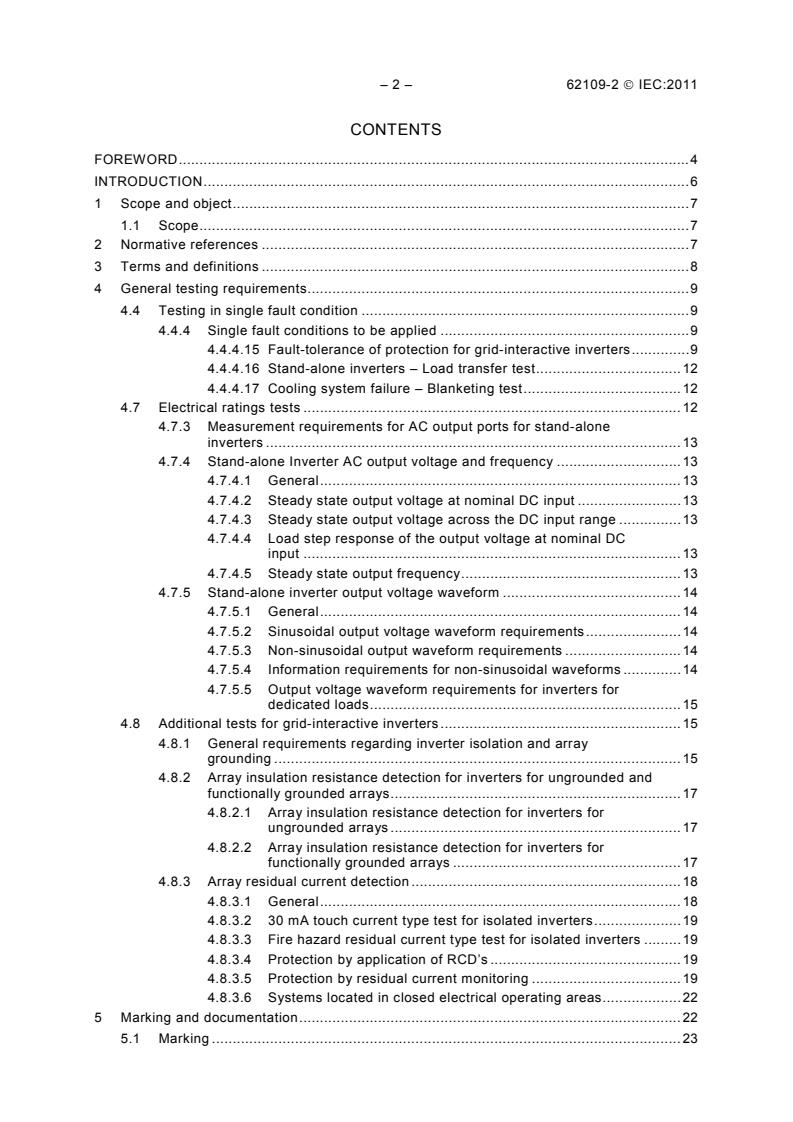
CONTENTS
FOREWORD . 4
INTRODUCTION . 6
1 Scope and object . 7
1.1 Scope . 7
2 Normative references . 7
3 Terms and definitions . 8
4 General testing requirements. 9
4.4 Testing in single fault condition . 9
4.4.4 Single fault conditions to be applied . 9
4.4.4.15 Fault-tolerance of protection for grid-interactive inverters . 9
4.4.4.16 Stand-alone inverters – Load transfer test . 12
4.4.4.17 Cooling system failure – Blanketing test . 12
4.7 Electrical ratings tests . 12
4.7.3 Measurement requirements for AC output ports for stand-alone
inverters . 13
4.7.4 Stand-alone Inverter AC output voltage and frequency . 13
4.7.4.1 General . 13
4.7.4.2 Steady state output voltage at nominal DC input . 13
4.7.4.3 Steady state output voltage across the DC input range . 13
4.7.4.4 Load step response of the output voltage at nominal DC
input . 13
4.7.4.5 Steady state output frequency . 13
4.7.5 Stand-alone inverter output voltage waveform . 14
4.7.5.1 General . 14
4.7.5.2 Sinusoidal output voltage waveform requirements . 14
4.7.5.3 Non-sinusoidal output waveform requirements . 14
4.7.5.4 Information requirements for non-sinusoidal waveforms . 14
4.7.5.5 Output voltage waveform requirements for inverters for
dedicated loads . 15
4.8 Additional tests for grid-interactive inverters . 15
4.8.1 General requirements regarding inverter isolation and array
grounding . 15
4.8.2 Array insulation resistance detection for inverters for ungrounded and
functionally grounded arrays . 17
4.8.2.1 Array insulation resistance detection for inverters for
ungrounded arrays . 17
4.8.2.2 Array insulation resistance detection for inverters for
functionally grounded arrays . 17
4.8.3 Array residual current detection . 18
4.8.3.1 General . 18
4.8.3.2 30 mA touch current type test for isolated inverters . 19
4.8.3.3 Fire hazard residual current type test for isolated inverters . 19
4.8.3.4 Protection by application of RCD’s . 19
4.8.3.5 Protection by residual current monitoring . 19
4.8.3.6 Systems located in closed electrical operating areas . 22
5 Marking and documentation . 22
5.1 Marking . 23
62109-2 IEC:2011 – 3 –
5.1.4 Equipment ratings. 23
5.2 Warning markings . 23
5.2.2 Content for warning markings . 23
5.2.2.6 Inverters for closed electrical operating areas . 24
5.3 Documentation . 24
5.3.2 Information related to installation . 24
5.3.2.1 Ratings . 24
5.3.2.2 Grid-interactive inverter setpoints . 25
5.3.2.3 Transformers and isolation . 25
5.3.2.4 Transformers required but not provided. 25
5.3.2.5 PV modules for non-isolated inverters . 25
5.3.2.6 Non-sinusoidal output waveform information . 25
5.3.2.7 Systems located in closed electrical operating areas . 26
5.3.2.8 Stand-alone inverter output circuit bonding . 26
5.3.2.9 Protection by application of RCD’s . 26
5.3.2.10 Remote indication of faults . 26
5.3.2.11 External array insulation resistance measurement and
response . 26
5.3.2.12 Array functional grounding information . 26
5.3.2.13 Stand-alone inverters for dedicated loads . 27
5.3.2.14 Identification of firmware version(s) . 27
6 Environmental requirements and conditions. 27
7 Protection against electric shock and energy hazards . 27
7.3 Protection against electric shock . 27
7.3.10 Additional requirements for stand-alone inverters . 27
7.3.11 Functionally grounded arrays . 28
8 Protection against mechanical hazards . 28
9 Protection against fire hazards . 28
9.3 Short-circuit and overcurrent protection . 28
9.3.4 Inverter backfeed current onto the array . 28
10 Protection against sonic pressure hazards. 28
11 Protection against liquid hazards . 28
12 Protection against chemical hazards . 28
13 Physical requirements . 29
13.9 Fault indication . 29
14 Components . 29
Bibliography . 30
Figure 20 – Example system discussed in Note 2 above . 11
Figure 21 – Example test circuit for residual current detection testing . 21
Table 30 – Requirements based on inverter isolation and array grounding . 16
Table 31 – Response time limits for sudden changes in residual current . 20
Table 32 – Inverter ratings – Marking requirements . 23
Table 33 – Inverter ratings – Documentation requirements . 24
– 4 – 62109-2 IEC:2011
INTERNATIONAL ELECTROTECHNICAL COMMISSION
____________
SAFETY OF POWER CONVERTERS FOR USE
IN PHOTOVOLTAIC POWER SYSTEMS –
Part 2: Particular requirements for inverters
FOREWORD
1) The International Electrotechnical Commission (IEC) is a worldwide organization for standardization comprising
all national electrotechnical committees (IEC National Committees). The object of IEC is to promote
international co-operation on all questions concerning standardization in the electrical and electronic fields. To
this end and in addition to other activities, IEC publishes International Standards, Technical Specifications,
Technical Reports, Publicly Available Specifications (PAS) and Guides (hereafter referred to as “IEC
Publication(s)”). Their preparation is entrusted to technical committees; any IEC National Committee interested
in the subject dealt with may participate in this preparatory work. International, governmental and non-
governmental organizations liaising with the IEC also participate in this preparation. IEC collaborates closely
with the International Organization for Standardization (ISO) in accordance with conditions determined by
agreement between the two organizations.
2) The formal decisions or agreements of IEC on technical matters express, as nearly as possible, an international
consensus of opinion on the relevant subjects since each technical committee has representation from all
interested IEC National Committees.
3) IEC Publications have the form of recommendations for international use and are accepted by IEC National
Committees in that sense. While all reasonable efforts are made to ensure that the technical content of IEC
Publications is accurate, IEC cannot be held responsible for the way in which they are used or for any
misinterpretation by any end user.
4) In order to promote international uniformity, IEC National Committees undertake to apply IEC Publications
transparently to the maximum extent possible in their national and regional publications. Any divergence
between any IEC Publication and the corresponding national or regional publication shall be clearly indicated in
the latter.
5) IEC itself does not provide any attestation of conformity. Independent certification bodies provide conformity
assessment services and, in some areas, access to IEC marks of conformity. IEC is not responsible for any
services carried out by independent certification bodies.
6) All users should ensure that they have the latest edition of this publication.
7) No liability shall attach to IEC or its directors, employees, servants or agents including individual experts and
members of its technical committees and IEC National Committees for any personal injury, property damage or
other damage of any nature whatsoever, whether direct or indirect, or for costs (including legal fees) and
expenses arising out of the publication, use of, or reliance upon, this IEC Publication or any other IEC
Publications.
8) Attention is drawn to the Normative references cited in this publication. Use of the referenced publications is
indispensable for the correct application of this publication.
9) Attention is drawn to the possibility that some of the elements of this IEC Publication may be the subject of
patent rights. IEC shall not be held responsible for identifying any or all such patent rights.
International Standard IEC 62109-2 has been prepared by IEC technical committee 82: Solar
photovoltaic energy systems.
The text of this standard is based on the following documents:
FDIS Report on voting
82/636/FDIS 82/648A/RVD
Full information on the voting for the approval of this standard can be found in the report on
voting indicated in the above table.
This publication has been drafted in accordance with the ISO/IEC Directives, Part 2.
62109-2 IEC:2011 – 5 –
The requirements in this Part 2 are to be used with the requirements in Part 1, and
supplement or modify clauses in Part 1. When a particular clause or subclause of Part 1 is not
mentioned in this Part 2, that clause of Part 1 applies. When this Part 2 contains clauses that
add to, modify, or replace clauses in Part 1, the relevant text of Part 1 is to be applied with
the required changes.
Subclauses, figures and tables additional to those in Part 1 are numbered in continuation of
the sequence existing in Part 1.
All references to “Part 1” in this Part 2 shall be taken as dated references to
IEC 62109-1:2010.
The committee has decided that the contents of this publication will remain unchanged until
the stability date indicated on the IEC web site under "http://webstore.iec.ch" in the data
related to the specific publication. At this date, the publication will be
• reconfirmed,
• withdrawn,
• replaced by a revised edition, or
• amended.
– 6 – 62109-2 IEC:2011
INTRODUCTION
This Part 2 of IEC 62109 gives requirements for grid-interactive and stand-alone inverters.
This equipment has potentially hazardous input sources and output circuits, internal
components, and features and functions, which demand different requirements for safety than
those given in Part 1 (IEC 62109-1:2010).
62109-2 IEC:2011 – 7 –
SAFETY OF POWER CONVERTERS FOR USE
IN PHOTOVOLTAIC POWER SYSTEMS –
Part 2: Particular requirements for inverters
1 Scope and object
This clause of Part 1 is applicable with the following exception:
1.1 Scope
Addition:
This Part 2 of IEC 62109 covers the particular safety requirements relevant to d.c. to a.c.
inverter products as well as products that have or perform inverter functions in addition to
other functions, where the inverter is intended for use in photovoltaic power systems.
Inverters covered by this standard may be grid-interactive, stand-alone, or multiple mode
inverters, may be supplied by single or multiple photovoltaic modules grouped in various
array configurations, and may be intended for use in conjunction with batteries or other forms
of energy storage.
Inverters with multiple functions or modes shall be judged against all applicable requirements
for each of those functions and modes.
NOTE Throughout this standard where terms such as “grid-interactive inverter” are used, the meaning is either a
grid-interactive inverter or a grid-interactive operating mode of a multi-mode inverter
This standard does not address grid interconnection requirements for grid-interactive
inverters.
NOTE The authors of this Part 2 did not think it would be appropriate or successful to attempt to put grid
interconnection requirements into this standard, for the following reasons:
a) Grid interconnection standards typically contain both protection and power quality requirements, dealing with
aspects such as disconnection under abnormal voltage or frequency conditions on the grid, protection against
islanding, limitation of harmonic currents and d.c. injection, power factor, etc. Many of these aspects are
power quality requirements that are beyond the scope of a product safety standard such as this.
b) At the time of writing there is inadequate consensus amongst regulators of grid-interactive inverters to lead to
acceptance of harmonized interconnect requirements. For example, IEC 61727 gives grid interconnection
requirements, but has not gained significant acceptance, and publication of EN 50438 required inclusion of
country-specific deviations for a large number of countries.
c) The recently published IEC 62116 contains test methods for islanding protection.
This standard does contain safety requirements specific to grid-interactive inverters that are similar to the safety
aspects of some existing national grid interconnection standards.
Users of this standard should be aware that in most jurisdictions allowing grid interconnection of inverters there are
national or local requirements that must be met. Examples include EN 50438, IEEE 1547, DIN VDE 0126-1-1, and
AS 4777.3
2 Normative references
This clause of Part 1 is applicable, with the following exception:
Addition
– 8 – 62109-2 IEC:2011
IEC 62109-1:2010, Safety of power converters for use in photovoltaic power systems – Part 1:
General requirements
3 Terms and definitions
This clause of Part 1 is applicable, with the following exceptions:
Additional definitions
3.100
functionally grounded array
a PV array that has one conductor intentionally connected to earth for purposes other than
safety, by means not complying with the requirements for protective bonding
NOTE 1 Such a system is not considered to be a grounded array – see 3.102.
NOTE 2 Examples of functional array grounding include grounding one conductor through an impedance, or only
temporarily grounding the array for functional or performance reasons
NOTE 3 In an inverter intended for an un-grounded array, that uses a resistive measurement network to measure
the array impedance to ground, that measurement network is not considered a form of functional grounding.
3.101
grid-interactive inverter
an inverter or inverter function intended to export power to the grid
NOTE Also commonly referred to as “grid-connected”, “grid-tied”, “utility-interactive”. Power exported may or may
not be in excess of the local load.
3.102
grounded array
a PV array that has one conductor intentionally connected to earth by means complying with
the requirements for protective bonding
NOTE 1 The connection to earth of the mains circuit in a non-isolated inverter with an otherwise ungrounded
array, does not create a grounded array. In this standard such a system is an ungrounded array because the
inverter electronics are in the fault current path from the array to the mains grounding point, and are not
considered to provide reliable grounding of the array
NOTE 2 This is not to be confused with protective earthing (equipment grounding) of the array frame
NOTE 3 In some local installation codes, grounded arrays are allowed or required to open the array connection to
earth under ground-fault conditions on the array, to interrupt the fault current, temporarily ungrounding the array
under fault conditions. This arrangement is still considered a grounded array in this standard.
3.103
indicate a fault
annunciate that a fault has occurred, in accordance with 13.9
3.104
inverter
electric energy converter that changes direct electric current to single-phase or polyphase
alternating current
3.105
inverter backfeed current
the maximum current that can be impressed onto the PV array and its wiring from the inverter,
under normal or single fault conditions
3.106
isolated inverter
an inverter with at least simple separation between the mains and PV circuits
62109-2 IEC:2011 – 9 –
NOTE 1 In an inverter with more than one external circuit, there may be isolation between some pairs of circuits
and no isolation between others. For example, an inverter with PV, battery, and mains circuits may provide
isolation between the mains circuit and the PV circuit, but no isolation between the PV and battery circuits. In this
standard, the term isolated inverter is used as defined above in general – referring to isolation between the mains
and PV circuits. If two circuits other than the mains and PV circuits are being discussed, additional wording is used
to clarify the meaning.
NOTE 2 For an inverter that does not have internal isolation between the mains and PV circuits, but is required to
be used with a dedicated isolation transformer, with no other equipment connected to the inverter side of that
isolation transformer, the combination may be treated as an isolated inverter. Other configurations require analysis
at the system level, and are beyond the scope of this standard, however the principles in this standard may be
used in the analysis.
3.107
multiple mode inverter
an inverter that operates in more than one mode, for example having grid-interactive
functionality when mains voltage is present, and stand-alone functionality when the mains is
de-energized or disconnected
3.108
non-isolated inverter
an inverter without at least simple separation between the mains and PV circuits
NOTE See the notes under 3.106 above.
3.109
stand-alone inverter
an inverter or inverter function intended to supply AC power to a load that is not connected to
the mains.
NOTE Stand-alone inverters may be designed to be paralleled with other non-mains sources (other inverters,
rotating generators, etc.). Such a system does not constitute a grid-interactive system.
4 General testing requirements
This clause of Part 1 is applicable except as follows:
NOTE In IEC 62109-1 and therefore in this Part 2, test requirements that relate only to a single type of hazard
(shock, fire, etc.) are located in the clause specific to that hazard type. Test requirements that relate to more than
one type of hazard (for example testing under fault conditions) or that provide general test conditions, are located
in this Clause 4.
4.4 Testing in single fault condition
4.4.4 Single fault conditions to be applied
Additional subclauses:
4.4.4.15 Fault-tolerance of protection for grid-interactive inverters
4.4.4.15.1 Fault-tolerance of residual current monitoring
Where protection against hazardous residual currents according to 4.8.3.5 is required, the
residual current monitoring system must be able to operate properly with a single fault
applied, or must detect the fault or loss of operability and cause the inverter to indicate a fault
in accordance with 13.9, and disconnect from, or not connect to, the mains, no later than the
next attempted re-start.
NOTE For a PV inverter, the “next attempted re-start” will occur no later than the morning following the fault
occurring. Operation during that period of less than one day is allowed because it is considered highly unlikely that
a fault in the monitoring system would happen on the same day as a person coming into contact with normally
enclosed hazardous live parts of the PV system, or on the same day as a fire-hazardous ground fault.
Compliance is checked by testing with the grid-interactive inverter connected as in reference
test conditions in Part 1. Single faults are to be applied in the inverter one at a time, for
– 10 – 62109-2 IEC:2011
example in the residual current monitoring circuit, other control circuits, or in the power
supply to such circuits.
For each fault condition, the inverter complies if one of the following occurs:
a) the inverter ceases to operate, indicates a fault in accordance with 13.9, disconnects from
the mains, and does not re-connect after any sequence of removing and reconnecting PV
power, AC power, or both,
or
b) the inverter continues to operate, passes testing in accordance with 4.8.3.5 showing that
the residual current monitoring system functions properly under the single fault condition,
and indicates a fault in accordance with 13.9,
or
c) the inverter continues to operate, regardless of loss of residual current monitoring
functionality, but does not re-connect after any sequence of removing and reconnecting
PV power, AC power, or both, and indicates a fault in accordance with 13.9.
4.4.4.15.2 Fault-tolerance of automatic disconnecting means
4.4.4.15.2.1 General
The means provided for automatic disconnection of a grid-interactive inverter from the mains
shall:
– disconnect all grounded and ungrounded current-carrying conductors from the mains, and
– be such that with a single fault applied to the disconnection means or to any other location
in the inverter, at least basic insulation or simple separation is maintained between the PV
array and the mains when the disconnecting means is intended to be in the open state.
4.4.4.15.2.2 Design of insulation or separation
The design of the basic insulation or simple separation referred to in 4.4.4.15.2.1 shall
comply with the following:
– the basic insulation or simple separation shall be based on the PV circuit working voltage,
impulse withstand voltage, and temporary over-voltage, in accordance with 7.3.7 of Part 1;
– the mains shall be assumed to be disconnected;
– the provisions of 7.3.7.1.2 g) of Part 1 may be applied if the design incorporates means to
reduce impulse voltages, and where required by 7.3.7.1.2 of Part 1, monitoring of such
means;
– in determining the clearance based on working voltage in 7.3.7 of Part 1, the values of
column 3 of Table 13 of Part 1 shall be used.
NOTE 1 These requirements are intended to protect workers who are servicing the AC mains system. In that
scenario the mains will be disconnected, and the hazard being protected against is the array voltage appearing
on the disconnected mains wiring, either phase-to-phase, or phase-to-earth. Therefore it is the PV array
parameters (working voltage, impulse withstand voltage, and temporary over-voltage) that determine the
required insulation or separation. The worker may be in a different location than any PV disconnection means
located between the array and the inverter, or may not have access, so the insulation or separation provided in
the inverter must be relied on. In a non-isolated inverter, only the required automatic disconnection means
separates the mains service worker from the PV voltage. In an isolated inverter, the isolation transformer and
other isolation components are in series with the automatic disconnection means, and separate the worker
from the PV voltage in the event of failure of the automatic disconnection means.
NOTE 2 Example for a single-phase non-isolated inverter: Assume a non-isolated inverter rated for a floating
array with a PV maximum input rating of 1 000 V d.c., and intended for use on a single-phase AC mains with
an earthed neutral. See Figure 20 below.
– Subclause 4.4.4.15.2.1 requires the design to provide basic insulation after application of a single fault, in
order to protect against shock hazard from the PV voltage for someone working on the mains circuits.
– One common method for achieving the required fault tolerant automatic disconnection means is to use 2
relays (a1 and b1 in Figure 20 below) in the ungrounded AC conductor (line), and another 2 relays (a2 and
62109-2 IEC:2011 – 11 –
b2) in the grounded conductor (neutral). The required single-fault tolerance can then be arranged by
having 2 separate relay control circuits (Control A and B) each controlling one line relay and one neutral
relay. In any single fault scenario involving one control circuit or one relay, there will still be at least one
relay in the line and one relay in the neutral that can properly open to isolate both mains circuit conductors
from the inverter and therefore from the array.
– Since the mains neutral is earthed in this example, there is single fault protection from a possible shock
hazard between the neutral and earth regardless of isolation of the mains from the inverter and the PV
array. Therefore the shock hazard the relays need to protect against is from the mains line conductor to
earth or neutral.
– The single fault scenario prevents one pair of relays from opening, but leaves the remaining un-faulted
pair of relays properly able to open and to provide the required basic insulation.
– In order for a shock to occur, current would have to flow from the mains line conductor, through the
person, to earth or neutral, and back to the line conductor through both of the remaining relay gaps in
series. Therefore the required basic insulation is provided by the total of the air gaps in the two remaining
relays.
– From Table 12 of Part 1, the impulse voltage withstand rating for a PV circuit system voltage of 1000 V dc
is 4 464 V. From Table 13 of Part 1, the required total clearance is 3,58 mm divided between the air gaps
in the two remaining relays. If identical relays are used, each relay must provide approximately 1,8 mm
clearance. The required creepage across the open relays depends on the pollution degree and material
group, is based on 1000 V d.c., and is divided between the air gaps in the two remaining relays.
– Similar analysis can be done for other system and inverter topologies.
Touch point with
Inverter
potential hazard to
earth or neutral
a1
b1
Line
Open mains
disconnect switch
1 000 V
Array
b2
Neutral
Earthed neutral is
safe to touch
a2
Control A Control B
IEC 1012/11
Figure 20 – Example system discussed in Note 2 above
4.4.4.15.2.3 Automatic checking of the disconnect means
For a non-isolated inverter, the isolation provided by the automatic disconnection means shall
be automatically checked before the inverter starts operation. After the isolation check, if the
check fails, any still-functional disconnection means shall be left in the open position, at least
basic insulation or simple separation shall be maintained between the PV input and the
mains, the inverter shall not start operation, and the inverter shall indicate a fault in
accordance with 13.9.
Compliance with 4.4.4.15.2.1 through 4.4.4.15.2.3 is checked by inspection of the PCE and
schematics, evaluation of the insulation or separation provided by components, and for non-
isolated inverters by the following test:
With the non-isolated grid-interactive inverter connected and operating as in reference test
conditions in Part 1, single faults are to be applied to the automatic disconnection means or to
other relevant parts of the inverter. The faults shall be chosen to render all or part of the
disconnection means inoperable, for example by defeating control means or by short-
circuiting one switch pole at a time. With the inverter operating, the fault is applied, and then
PV input voltage is removed or lowered below the minimum required for inverter operation, to
trigger a disconnection from the mains. The PV input voltage is then raised back up into the
operational range. After the inverter completes its isolation check, any still-functional
– 12 – 62109-2 IEC:2011
disconnection means shall be in the open position, at least basic insulation or simple
separation shall be maintained between the PV input and the mains, the inverter shall not
start operation, and the inverter shall indicate a fault in accordance with 13.9.
In all cases, the non-isolated grid-interactive inverter shall comply with the requirements for
basic insulation or simple separation between the mains and the PV input following
application of the fault.
4.4.4.16 Stand-alone inverters – Load transfer test
A stand-alone inverter with a transfer switch to transfer AC loads from the mains or other AC
bypass source to the inverter output shall continue to operate normally and shall not present a
risk of fire or shock as the result of an out-of-phase transfer.
Compliance is checked by the following test. The bypass a.c. source is to be displaced 180°
from the a.c. output of a single-phase inverter and 120° for a 3-phase supply. The transfer
switch is to be subjected to one operation of switching the load from the a.c. output of the
inverter to the bypass a.c. source. The load is to be adjusted to draw maximum rated a.c.
power.
For an inverter employing a bypass switch having a control preventing switching between two
a.c. sources out of synchronization, the test is to be conducted under the condition of a
component malfunction when such a condition could result in an out-of-phase transfer
between the two a.c. sources of supply.
4.4.4.17 Cooling system failure – Blanketing test
In addition to the applicable tests of subclause 4.4.4.8 of Part 1, inadvertent obstruction of the
airflow over an exposed external heatsink shall be one of the fault conditions considered. No
hazards according to the criteria of subclause 4.4.3 of Part 1 shall result from blanketing the
inverter in accordance with the test below.
This test is not required for inverters restricted to use only in closed electrical operating
areas.
NOTE The intent of this testing is to simulate unintentional blanketing that may occur after installation, due to lack
of user awareness of the need for proper ventilation. For example, inverters for residential systems may be
installed in spaces such as closets that originally allow proper ventilation, but later get used for storage of
household goods. In such a situation, the heatsink may have materials resting against it that block convection and
prevent heat exchange with the ambient air. Tests for blocked ventilation openings and failed fans are contained in
Part 1, but not for blanketing of a heatsink.
Compliance is checked by the following test, performed in accordance with the requirements
of subclause 4.4.2 of Part 1 along with the following.
The inverter shall be mounted in accordance with the manufacturer’s installation instructions.
If more than one position or orientation is allowed, the test shall be performed in the
orientation or position that is most likely to result in obstruction of the heatsink after
installation. The entire inverter including any external heatsink provided shall be covered in
surgical cotton with an uncompressed thickness of minimum 2 cm, covering all heatsink fins
and air channels. This surgical cotton replaces the cheesecloth required by subclause 4.4.3.2
of Part 1. The inverter shall be operated at full power. The duration of the test shall be a
minimum of 7 h except that the test may be stopped when temperatures stabilize if no
external surface of the inverter is at a temperature exceeding 90 °C.
4.7 Electrical ratings tests
Additional subclauses:
62109-2 IEC:2011 – 13 –
4.7.3 Measurement requirements for AC output ports for stand-alone inverters
Measurements of the AC output voltage and current on a stand-alone inverter shall be made
with a meter that indicates the true RMS value.
NOTE Some non-sinusoidal inverter output waveforms will not be properly measured if an average responding
meter is used.
4.7.4 Stand-alone Inverter AC output voltage and frequency
4.7.4.1 General
The AC output voltage and frequency of a stand-alone inverter, or multi-mode inverter
operating in stand-alone mode, shall comply with the requirements of 4.7.4.2 to 4.7.4.5.
4.7.4.2 Steady state output voltage at nominal DC input
The steady-state AC output voltage shall not be less than 90 % or more than 110 % of the
rated nominal voltage with the inverter supplied with its nominal value of DC input voltage.
Compliance is checked by measuring the AC output voltage with the inverter supplying no
load, and again with the inverter supplying a resistive load equal to the inverters rated
maximum continuous output power in stand-alone mode. The AC output voltage is measured
after any transient effects from the application or removal of the load have ceased.
4.7.4.3 Steady state output voltage across the DC input range
The steady-state AC output voltage shall not be less than 85 % or more than 110 % of the
rated nominal voltage with the inverter supplied with any value within the rated range of DC
input voltage.
Compliance is checked by measuring the AC output voltage under four sets of conditions: with
the inverter supplying no load and supplying a resistive load equal to the inverters rated
maximum continuous output power in stand-alone mode, both at the minimum rated DC input
voltage and at the maximum rated DC input voltage. The AC output voltage is measured after
any transient effects from the application or removal of the load have ceased.
4.7.4.4 Load step response of the output voltage at nominal DC input
The AC output voltage shall not be less than 85 % or more than 110 % of the rated nominal
voltage for more than 1,5 s after application or removal of a resistive load equal to the
inverter’s rated maximum continuous output power in stand-alone mode, with the inverter
supplied with its nominal value of DC input voltage.
Compliance is checked by measuring the AC output voltage after a resistive load step from no
load to full rated maximum continuous output power, and from full power to no load. The RMS
output voltage of the first complete cycle coming after t = 1,5 s is to be measured, where t is
the time measured from the application of the load step change.
4.7.4.5 Steady state output frequency
The steady-state AC output frequency shall not vary from the nominal value by more than
+4 % or –6 %.
Compliance is checked by measuring the AC output frequency under four sets of conditions:
with the inverter supplying no load and supplying a resistive load equal to the inverters rated
maximum continuous output power in stand-alone mode, at both the minimum rated DC input
voltage and at the maximum rated DC input voltage. The AC output frequency is measured
after any transient effects from the application or removal of the load have ceased.
– 14 – 62109-2 IEC:2011
4.7.5 Stand-alone inverter output voltage waveform
4.7.5.1 General
The AC output voltage waveform of a stand-alone inverter, or multi-mode inverter operating in
stand-alone mode, shall comply with the requirements in 4.7.5.2
...