

IEC 61290-4-4:2018
(Main)Optical amplifiers - Test methods - Part 4-4: Gain transient parameters - Single channel optical amplifiers with gain control
General Information
- Abstract
IEC 61290-4-4:2018 applies to optical amplifiers (OAs) and optically amplified elementary sub-systems. More specifically, it applies to OAs using active fibres (optical fibre amplifiers, OFAs) containing rare-earth dopants, such as erbium doped fibre amplifiers (EDFAs), presently commercially available, as indicated in IEC 61291-1. This document provides the general background for optical amplifier gain transients and their measurements and indicates those IEC standard test methods for accurate and reliable measurements of the following transient parameters:
a) optical input power increase/decrease transient gain overshoot and transient net gain overshoot;
b) optical input power increase/decrease transient gain undershoot and transient net gain undershoot;
c) optical input power increase/decrease gain offset;
d) optical input power increase/decrease transient gain response constant (settling time).
These parameters have been included to provide a complete description of the transient behaviour of gain controlled OA. The parameters defined here are applicable if the amplifier is an OFA or an alternative type of OA.
Keywords: optical amplifiers (OAs) gain transients
- Status
- Published
- Publication Date
- 28-May-2018
- Technical Committee
- SC 86C - Fibre optic systems, sensing and active devices
- Drafting Committee
- WG 3 - TC 86/SC 86C/WG 3
- Current Stage
- PPUB - Publication issued
- Start Date
- 29-May-2018
- Completion Date
- 15-Jun-2018
Overview
IEC 61290-4-4:2018 is an international standard published by the International Electrotechnical Commission (IEC) that specifies test methods for measuring gain transient parameters in single-channel optical amplifiers with gain control mechanisms. This standard is applicable primarily to optical amplifiers (OAs) using active fibres containing rare-earth dopants such as erbium doped fibre amplifiers (EDFAs). It provides a detailed framework to accurately evaluate transient gain behaviors when the optical input power to these amplifiers changes suddenly, ensuring consistent performance in optically amplified elementary subsystems.
The document outlines definitions, testing apparatus, procedures, and calculations essential for assessing key transient gain parameters. These parameters include transient gain overshoot and undershoot during input power variations, gain offset, and gain response settling times, all critical for characterizing the dynamic response of gain-controlled OAs.
Key Topics
Gain Transient Parameters
- Transient Gain Overshoot: The temporary increase in gain above the steady-state level following an optical input power change.
- Transient Gain Undershoot: A temporary decrease in gain below the steady-state level after a change in input power.
- Gain Offset: The difference in gain level from nominal steady-state caused by power fluctuations.
- Transient Gain Response Time Constant (Settling Time): The time it takes for the gain to stabilize after a transient event.
Test Methods and Setup
- Defines standardized test procedures to measure input power increase/decrease events.
- Specifies the appropriate use of test equipment such as variable optical attenuators, optical power meters, and signal sources.
- Illustrates test set-ups ensuring repeatability and accuracy.
Definitions and Terms
- Provides clear definitions aligned with IEC Electropedia terms for "optical amplifier," "gain control," "transient," and related concepts.
- Specifies the rise and fall times in optical input power changes as critical timing metrics.
Applications
IEC 61290-4-4:2018 is essential for:
- Network Equipment Manufacturers (NEMs): Ensuring optical amplifiers meet stringent gain transient performance, mitigating signal degradation in cascaded optical networks.
- Telecommunication Operators: Improving reliability and quality of optical transmission systems by selecting amplifiers that adhere to standardized transient response parameters.
- Optical Amplifier Developers: Facilitating product validation, performance benchmarking, and compliance with global standards.
- Testing Laboratories: Providing standardized procedures to certify optical amplifiers' transient gain behavior for commercial or regulatory purposes.
The standard helps prevent amplified spontaneous emission fluctuations and signal distortions resulting from rapid input power changes, which are common in dynamic communication networks.
Related Standards
- IEC 61291-1: Optical amplifiers – Part 1: Generic specification, providing broader amplifier specifications complementing transient tests.
- IEC 60050-731: International Electrotechnical Vocabulary – Chapter 731: Optical fibre communication, for consistent terminology.
- IEC TR 61931: Fibre optic – Terminology, aiding uniform communication across standards.
- Other parts in the IEC 61290 series addressing varied optical amplifier test methods.
Practical Value
Implementing IEC 61290-4-4:2018 provides:
- Reliable and reproducible measurements of gain transient phenomena critical for optimizing optical transmission systems.
- A standardized method to compare single-channel optical amplifiers from different manufacturers.
- Insights into gain control mechanisms’ effectiveness under realistic operating conditions.
- Data that supports minimizing performance issues such as signal distortion and network outages linked to transient gain fluctuations.
This standard is a vital resource for ensuring optical amplifiers maintain gain stability and optimal performance in evolving optical fiber communication networks.
Keywords: IEC 61290-4-4:2018, optical amplifiers, gain transient parameters, single channel optical amplifiers, gain control, erbium doped fibre amplifiers (EDFAs), optical fibre amplifiers (OFAs), test methods, transient gain response, gain overshoot, gain undershoot, settling time, optical communications, network equipment manufacturers, telecommunication standards.
Get Certified
Connect with accredited certification bodies for this standard

ANCE
Mexican certification and testing association.

Intertek Slovenia
Intertek testing, inspection, and certification services in Slovenia.

LNE (Laboratoire National de Métrologie et d'Essais)
French national laboratory for metrology and testing.
Sponsored listings
Frequently Asked Questions
IEC 61290-4-4:2018 is a standard published by the International Electrotechnical Commission (IEC). Its full title is "Optical amplifiers - Test methods - Part 4-4: Gain transient parameters - Single channel optical amplifiers with gain control". This standard covers: IEC 61290-4-4:2018 applies to optical amplifiers (OAs) and optically amplified elementary sub-systems. More specifically, it applies to OAs using active fibres (optical fibre amplifiers, OFAs) containing rare-earth dopants, such as erbium doped fibre amplifiers (EDFAs), presently commercially available, as indicated in IEC 61291-1. This document provides the general background for optical amplifier gain transients and their measurements and indicates those IEC standard test methods for accurate and reliable measurements of the following transient parameters: a) optical input power increase/decrease transient gain overshoot and transient net gain overshoot; b) optical input power increase/decrease transient gain undershoot and transient net gain undershoot; c) optical input power increase/decrease gain offset; d) optical input power increase/decrease transient gain response constant (settling time). These parameters have been included to provide a complete description of the transient behaviour of gain controlled OA. The parameters defined here are applicable if the amplifier is an OFA or an alternative type of OA. Keywords: optical amplifiers (OAs) gain transients
IEC 61290-4-4:2018 applies to optical amplifiers (OAs) and optically amplified elementary sub-systems. More specifically, it applies to OAs using active fibres (optical fibre amplifiers, OFAs) containing rare-earth dopants, such as erbium doped fibre amplifiers (EDFAs), presently commercially available, as indicated in IEC 61291-1. This document provides the general background for optical amplifier gain transients and their measurements and indicates those IEC standard test methods for accurate and reliable measurements of the following transient parameters: a) optical input power increase/decrease transient gain overshoot and transient net gain overshoot; b) optical input power increase/decrease transient gain undershoot and transient net gain undershoot; c) optical input power increase/decrease gain offset; d) optical input power increase/decrease transient gain response constant (settling time). These parameters have been included to provide a complete description of the transient behaviour of gain controlled OA. The parameters defined here are applicable if the amplifier is an OFA or an alternative type of OA. Keywords: optical amplifiers (OAs) gain transients
IEC 61290-4-4:2018 is classified under the following ICS (International Classification for Standards) categories: 33.180.30 - Optic amplifiers. The ICS classification helps identify the subject area and facilitates finding related standards.
IEC 61290-4-4:2018 is available in PDF format for immediate download after purchase. The document can be added to your cart and obtained through the secure checkout process. Digital delivery ensures instant access to the complete standard document.
Standards Content (Sample)
IEC 61290-4-4 ®
Edition 1.0 2018-05
INTERNATIONAL
STANDARD
NORME
INTERNATIONALE
Optical amplifiers – Test methods –
Part 4-4: Gain transient parameters – Single channel optical amplifiers with gain
control
Amplificateurs optiques – Méthodes d'essai –
Partie 4-4: Paramètres de gain transitoire – Amplificateurs optiques monocanaux
avec commande de gain
All rights reserved. Unless otherwise specified, no part of this publication may be reproduced or utilized in any form
or by any means, electronic or mechanical, including photocopying and microfilm, without permission in writing from
either IEC or IEC's member National Committee in the country of the requester. If you have any questions about IEC
copyright or have an enquiry about obtaining additional rights to this publication, please contact the address below or
your local IEC member National Committee for further information.
Droits de reproduction réservés. Sauf indication contraire, aucune partie de cette publication ne peut être reproduite
ni utilisée sous quelque forme que ce soit et par aucun procédé, électronique ou mécanique, y compris la photocopie
et les microfilms, sans l'accord écrit de l'IEC ou du Comité national de l'IEC du pays du demandeur. Si vous avez des
questions sur le copyright de l'IEC ou si vous désirez obtenir des droits supplémentaires sur cette publication, utilisez
les coordonnées ci-après ou contactez le Comité national de l'IEC de votre pays de résidence.
IEC Central Office Tel.: +41 22 919 02 11
3, rue de Varembé info@iec.ch
CH-1211 Geneva 20 www.iec.ch
Switzerland
About the IEC
The International Electrotechnical Commission (IEC) is the leading global organization that prepares and publishes
International Standards for all electrical, electronic and related technologies.
About IEC publications
The technical content of IEC publications is kept under constant review by the IEC. Please make sure that you have the
latest edition, a corrigenda or an amendment might have been published.
IEC Catalogue - webstore.iec.ch/catalogue Electropedia - www.electropedia.org
The stand-alone application for consulting the entire The world's leading online dictionary of electronic and
bibliographical information on IEC International Standards, electrical terms containing 21 000 terms and definitions in
Technical Specifications, Technical Reports and other English and French, with equivalent terms in 16 additional
documents. Available for PC, Mac OS, Android Tablets and languages. Also known as the International Electrotechnical
iPad. Vocabulary (IEV) online.
IEC publications search - webstore.iec.ch/advsearchform IEC Glossary - std.iec.ch/glossary
The advanced search enables to find IEC publications by a 67 000 electrotechnical terminology entries in English and
variety of criteria (reference number, text, technical French extracted from the Terms and Definitions clause of
committee,…). It also gives information on projects, replaced IEC publications issued since 2002. Some entries have been
and withdrawn publications. collected from earlier publications of IEC TC 37, 77, 86 and
CISPR.
IEC Just Published - webstore.iec.ch/justpublished
Stay up to date on all new IEC publications. Just Published IEC Customer Service Centre - webstore.iec.ch/csc
details all new publications released. Available online and If you wish to give us your feedback on this publication or
also once a month by email. need further assistance, please contact the Customer Service
Centre: sales@iec.ch.
A propos de l'IEC
La Commission Electrotechnique Internationale (IEC) est la première organisation mondiale qui élabore et publie des
Normes internationales pour tout ce qui a trait à l'électricité, à l'électronique et aux technologies apparentées.
A propos des publications IEC
Le contenu technique des publications IEC est constamment revu. Veuillez vous assurer que vous possédez l’édition la
plus récente, un corrigendum ou amendement peut avoir été publié.
Catalogue IEC - webstore.iec.ch/catalogue Electropedia - www.electropedia.org
Application autonome pour consulter tous les renseignements
Le premier dictionnaire en ligne de termes électroniques et
bibliographiques sur les Normes internationales,
électriques. Il contient 21 000 termes et définitions en anglais
Spécifications techniques, Rapports techniques et autres
et en français, ainsi que les termes équivalents dans 16
documents de l'IEC. Disponible pour PC, Mac OS, tablettes
langues additionnelles. Egalement appelé Vocabulaire
Android et iPad.
Electrotechnique International (IEV) en ligne.
Recherche de publications IEC -
Glossaire IEC - std.iec.ch/glossary
webstore.iec.ch/advsearchform
67 000 entrées terminologiques électrotechniques, en anglais
La recherche avancée permet de trouver des publications IEC et en français, extraites des articles Termes et Définitions des
en utilisant différents critères (numéro de référence, texte, publications IEC parues depuis 2002. Plus certaines entrées
comité d’études,…). Elle donne aussi des informations sur les antérieures extraites des publications des CE 37, 77, 86 et
projets et les publications remplacées ou retirées. CISPR de l'IEC.
IEC Just Published - webstore.iec.ch/justpublished Service Clients - webstore.iec.ch/csc
Restez informé sur les nouvelles publications IEC. Just Si vous désirez nous donner des commentaires sur cette
Published détaille les nouvelles publications parues. publication ou si vous avez des questions contactez-nous:
Disponible en ligne et aussi une fois par mois par email. sales@iec.ch.
IEC 61290-4-4 ®
Edition 1.0 2018-05
INTERNATIONAL
STANDARD
NORME
INTERNATIONALE
Optical amplifiers – Test methods –
Part 4-4: Gain transient parameters – Single channel optical amplifiers with gain
control
Amplificateurs optiques – Méthodes d'essai –
Partie 4-4: Paramètres de gain transitoire – Amplificateurs optiques monocanaux
avec commande de gain
INTERNATIONAL
ELECTROTECHNICAL
COMMISSION
COMMISSION
ELECTROTECHNIQUE
INTERNATIONALE
ICS 33.180.30 ISBN 978-2-8322-5746-3
– 2 – IEC 61290-4-4:2018 © IEC 2018
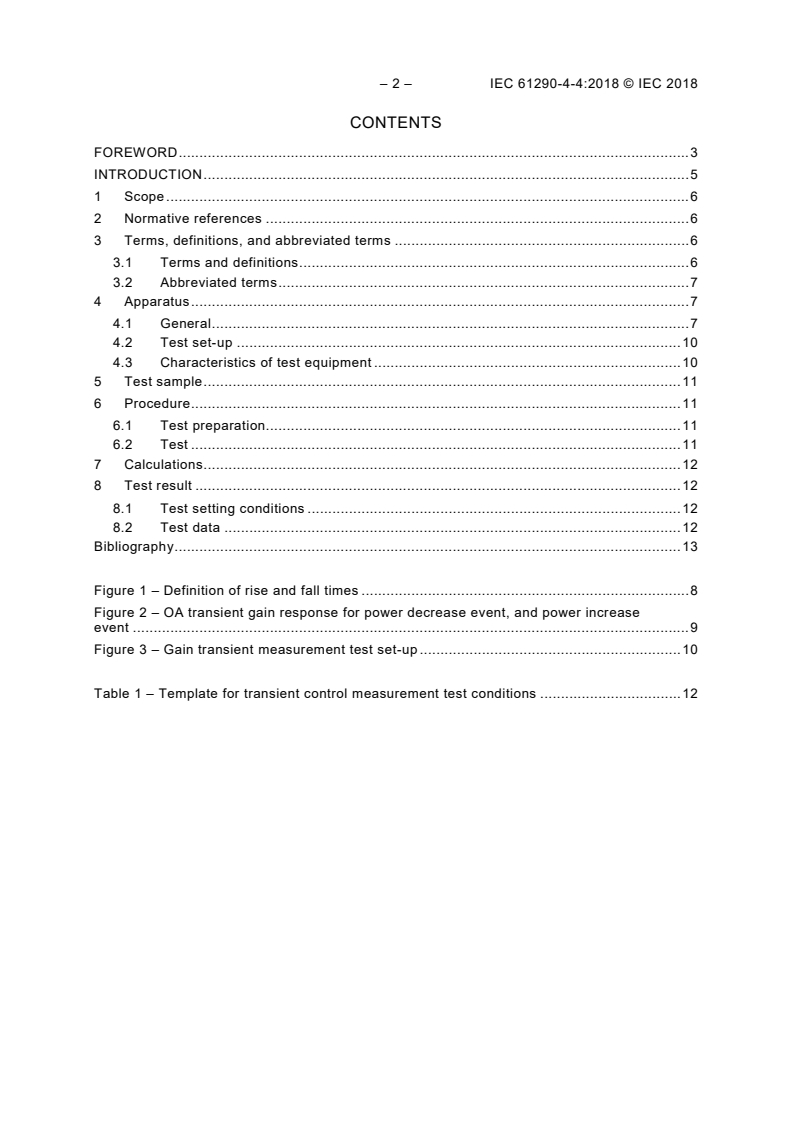
CONTENTS
FOREWORD . 3
INTRODUCTION . 5
1 Scope . 6
2 Normative references . 6
3 Terms, definitions, and abbreviated terms . 6
3.1 Terms and definitions . 6
3.2 Abbreviated terms . 7
4 Apparatus . 7
4.1 General . 7
4.2 Test set-up . 10
4.3 Characteristics of test equipment . 10
5 Test sample . 11
6 Procedure . 11
6.1 Test preparation. 11
6.2 Test . 11
7 Calculations . 12
8 Test result . 12
8.1 Test setting conditions . 12
8.2 Test data . 12
Bibliography . 13
Figure 1 – Definition of rise and fall times . 8
Figure 2 – OA transient gain response for power decrease event, and power increase
event . 9
Figure 3 – Gain transient measurement test set-up . 10
Table 1 – Template for transient control measurement test conditions . 12
INTERNATIONAL ELECTROTECHNICAL COMMISSION
____________
OPTICAL AMPLIFIERS – TEST METHODS –
Part 4-4: Gain transient parameters –
Single channel optical amplifiers with gain control
FOREWORD
1) The International Electrotechnical Commission (IEC) is a worldwide organization for standardization comprising
all national electrotechnical committees (IEC National Committees). The object of IEC is to promote
international co-operation on all questions concerning standardization in the electrical and electronic fields. To
this end and in addition to other activities, IEC publishes International Standards, Technical Specifications,
Technical Reports, Publicly Available Specifications (PAS) and Guides (hereafter referred to as “IEC
Publication(s)”). Their preparation is entrusted to technical committees; any IEC National Committee interested
in the subject dealt with may participate in this preparatory work. International, governmental and non-
governmental organizations liaising with the IEC also participate in this preparation. IEC collaborates closely
with the International Organization for Standardization (ISO) in accordance with conditions determined by
agreement between the two organizations.
2) The formal decisions or agreements of IEC on technical matters express, as nearly as possible, an international
consensus of opinion on the relevant subjects since each technical committee has representation from all
interested IEC National Committees.
3) IEC Publications have the form of recommendations for international use and are accepted by IEC National
Committees in that sense. While all reasonable efforts are made to ensure that the technical content of IEC
Publications is accurate, IEC cannot be held responsible for the way in which they are used or for any
misinterpretation by any end user.
4) In order to promote international uniformity, IEC National Committees undertake to apply IEC Publications
transparently to the maximum extent possible in their national and regional publications. Any divergence
between any IEC Publication and the corresponding national or regional publication shall be clearly indicated in
the latter.
5) IEC itself does not provide any attestation of conformity. Independent certification bodies provide conformity
assessment services and, in some areas, access to IEC marks of conformity. IEC is not responsible for any
services carried out by independent certification bodies.
6) All users should ensure that they have the latest edition of this publication.
7) No liability shall attach to IEC or its directors, employees, servants or agents including individual experts and
members of its technical committees and IEC National Committees for any personal injury, property damage or
other damage of any nature whatsoever, whether direct or indirect, or for costs (including legal fees) and
expenses arising out of the publication, use of, or reliance upon, this IEC Publication or any other IEC
Publications.
8) Attention is drawn to the Normative references cited in this publication. Use of the referenced publications is
indispensable for the correct application of this publication.
9) Attention is drawn to the possibility that some of the elements of this IEC Publication may be the subject of
patent rights. IEC shall not be held responsible for identifying any or all such patent rights.
International Standard IEC 61290-4-4 has been prepared by subcommittee 86C: Fibre optic
systems and active devices, of IEC technical committee 86: Fibre optics.
The text of this International Standard is based on the following documents:
FDIS Report on voting
86C/1507/FDIS 86C/1525/RVD
Full information on the voting for the approval of this International Standard can be found in
the report on voting indicated in the above table.
This document has been drafted in accordance with the ISO/IEC Directives, Part 2.
– 4 – IEC 61290-4-4:2018 © IEC 2018
A list of all parts in the 61290 series, published under the general title Optical amplifiers –
Test methods, can be found on the IEC website.
The committee has decided that the contents of this document will remain unchanged until the
stability date indicated on the IEC website under "http://webstore.iec.ch" in the data related to
the specific document. At this date, the document will be
• reconfirmed,
• withdrawn,
• replaced by a revised edition, or
• amended.
INTRODUCTION
This document is based on standard OITDA AM 01 published by the optoelectronic industry
and technology development association (OITDA).
– 6 – IEC 61290-4-4:2018 © IEC 2018
OPTICAL AMPLIFIERS – TEST METHODS –
Part 4-4: Gain transient parameters –
Single channel optical amplifiers with gain control
1 Scope
This part of IEC 61290-4 applies to optical amplifiers (OAs) and optically amplified elementary
sub-systems. More specifically, it applies to OAs using active fibres (optical fibre amplifiers,
OFAs) containing rare-earth dopants, such as erbium doped fibre amplifiers (EDFAs),
presently commercially available, as indicated in IEC 61291-1.
This document provides the general background for optical amplifier gain transients and their
measurements and indicates those IEC standard test methods for accurate and reliable
measurements of the following transient parameters:
a) optical input power increase/decrease transient gain overshoot and transient net gain
overshoot;
b) optical input power increase/decrease transient gain undershoot and transient net gain
undershoot;
c) optical input power increase/decrease gain offset;
d) optical input power increase/decrease transient gain response constant (settling time).
These parameters have been included to provide a complete description of the transient
behaviour of gain controlled OA. The parameters defined here are applicable if the amplifier is
an OFA or an alternative type of OA.
2 Normative references
The following documents are referred to in the text in such a way that some or all of their
content constitutes requirements of this document. For dated references, only the edition
cited applies. For undated references, the latest edition of the referenced document (including
any amendments) applies.
IEC 60050-731, International Electrotechnical Vocabulary – Chapter 731: Optical fibre
communication (available at www.electropedia.org)
IEC 61291-1, Optical amplifiers – Part 1: Generic specification
IEC TR 61931, Fibre optic – Terminology
3 Terms, definitions, and abbreviated terms
3.1 Terms and definitions
For the purposes of this document, the terms and definitions given in IEC 60050-731,
IEC 61291-1 and IEC TR 61931 apply.
ISO and IEC maintain terminological databases for use in standardization at the following
addresses:
• IEC Electropedia: available at http://www.electropedia.org/
• ISO Online browsing platform: available at http://www.iso.org/obp
3.2 Abbreviated terms
For the purposes of this document, the abbreviated terms given in IEC 61291-1 and the
following apply.
DFB distributed feedback
DUT device under test
NEM network equipment manufacturer
OA optical amplifier
O/E optical-to-electronic
OFA optical fibre amplifier
SOP state of polarization
VOA variable optical attenuator
NOTE DFB applies to lasers.
4 Apparatus
4.1 General
When the input power to an OA operating in saturation changes sharply, the gain of the
amplifier will typically exhibit a transient response before settling to the required gain. This
response is dictated both by the optical characteristics of the active fibre within the OA as well
as the performance of the gain control mechanism. Definitions are provided that describe a
dynamic event leading to transient response. Rise and fall time definitions are shown in
Figure 1.
– 8 – IEC 61290-4-4:2018 © IEC 2018
Final input power level
10% of change
Rise time
Start input power level
Time
Power increase end
Power increase start
IEC
a) Power increase event
Start input power level
10% of
Fall time
Final input power
Time
Power decrease start Power decrease
IEC
b) Power decrease event
Figure 1 – Definition of rise and fall times
The terms generally used to characterize the transient gain behaviour of a gain controlled OA
for the case of optical input power decrease are defined in Figure 2 a). The figure specifically
represents the dependence of the gain of optical signal when optical input power is decreased.
Likewise, the transient gain behaviour for the case when optical input power is increased is
shown Figure 2 b).
The main transient parameters are the following:
Input power to OA (linear a.u.) Input power to OA (linear a.u.)
100% of change
90% of change
100% of change
90% of change
– transient gain response time constant (settling time);
– gain offset;
– transient net gain overshoot;
– transient gain net undershoot.
The transient gain overshoot and undershoot are particularly critical to carriers and network
equipment manufacturers (NEMs), given that the speed and amplitude of gain fluctuations
compound through the network as the optical signal passes through an increasing number of
cascaded amplifiers. Optical amplifiers typically have very small values for these transient
parameters.
Gain stability
Final gain
Gain offset
Initial gain
Net gain
Gain undershoot
undershoot
Transient gain response time
constant (settling time)
Time
IEC
a) Power decrease event
Net gain overshoot Gain overshoot
Initial gain
Gain offset
Final gain
Gain stability
Transient gain response time
constant (settling time)
Time
IEC
b) Power increase event
Figure 2 – OA transient gain response for power decrease event,
and power increase event
Gain (dB)
Gain (dB)
Gain overshoot
Gain undershoot
Net gain
overshoot
Net gain undershoot
– 10 – IEC 61290-4-4:2018 © IEC 2018
4.2 Test set-up
Figure 3 shows a generic setup to characterize the transient response properties of gain
controlled single-channel OAs.
Optical
Polarization Optical
bandpass
Optical
VOA
Laser
DUT
scrambler coupler
filter
modulator
source
(optional) (optional)
(optional)
O/E
Function
converter
O/E converter
generator
(optional)
Oscilloscope
IEC
Figure 3 – Gain transient measurement test set-up
4.3 Characteristics of test equipment
The test equipment listed below is needed, with the required characteristics.
a) A laser source for supplying the input signal, with the following characteristics.
– Ability to support the range of input signal wavelengths for which the DUT is to be
tested. This could be provided, for example, by a tuneable laser, or a bank of
distributed feedback (DFB) lasers.
– An achievable average output power such that, at the input to the DUT, the power will
be above the maximum specified input power of the OA.
b) Polarization scrambler to randomize the incoming polarization state of the laser source, or
to control it to a defined state of polarization (SOP). The polarization scrambler is optional.
c) Variable optical attenuator (VOA) with a dynamic range sufficient to support the required
range of input signal levels at which the DUT is to be tested.
d) Optical modulator to switch the saturating signal on and off with the following
characteristics:
– extinction ratio 5 dB higher than the maximum drop level for which the DUT is to be
tested;
– switching time fast enough to support the fastest drop time for which the DUT is to be
tested.
e) Optical coupler – Low loss and wavelength dependence of separate ratio to support the
range of signal wavelengths for which the DUT is to be tested. The optical coupler is
optional.
f) Optical bandpass filter – A filter designed to pass only the input signal wavelength with
the following characteristics. The optical bandpass filter is optional.
– Ability to support the range of input signal wavelengths for which the DUT is to be
tested. This could be provided, for example, by a tuneable filter, or a series of discrete
filters.
– 1-dB passband of within ± 20 GHz centred around the input signal wavelength.
– At least 20 dB attenuation level below the minimum insertion loss across the entire
specified transmission band of the DUT, except within a range of ± 100 GHz centred
around the input signal wavelength.
g) O/E converter – to detect the filtered output of the DUT, with the following characteristics.
O/E converter after optical coupler for measurement of optical input power is optional.
– A sufficiently wide bandwidth to support the fastest drop time for which the OA is to be
tested.
– A linear response within a ± 5 dB range of all input signal levels for which the DUT is
to be tested.
– When O/E convertor does not have sufficient linear response range, an optical
attenuator before O/E convertor is needed to ensure the maximum linear response
range.
h) Oscilloscope – to measure the transient response of the filtered output of the DUT, with a
sufficiently wide bandwidth to support the fastest drop time for which the OA is to be
tested.
i) Function generator – to generate the on-off signal to the optical modulator, with a pulse
width short enough to support the fastest drop time for which the DUT is to be tested.
5 Test sample
The OA shall operate at nominal operating conditions. If the OA is likely to cause laser
oscillations due to unwanted reflections, optical isolators should be used to bracket the DUT.
This will minimize signal instability and measurement inaccuracy.
6 Procedure
6.1 Test preparation
In the setup shown in Figure 3, the input optical signal power injected into the amplifier being
tested is generated from a suitable laser source. The optical power is passed through an
optional polarization scrambler to allow randomization or control of the signal polarization
state and is subsequently adjusted with a VOA to the desired optical input power levels. The
signal then passes through an optical modulator driven by a function generator that provides
the desired test waveform to stimulate the transient input power excursions. The signal is
divided into two parts by an optical coupler. One part is injected into the amplifier being tested.
An optical bandpass filter (such as a tuneable optical filter, fixed optical filter or similar
component) may be used to select only the relevant channel wavelength under test, followed
by an O/E converter and an oscilloscope at the output of the amplifier. The second part from
the coupler is followed by an O/E converter and an oscilloscope at the input of the amplifier.
The output channel selected by the optional optical bandpass filter and its transient response
is monitored with the O/E converter and oscilloscope. Waveforms similar to those shown in
Figure 1 are captured via the oscilloscope for subsequent computer processing.
6.2 Test
For this test, to stimulate a gain excursion at the input of the DUT, the source laser power at
the OA input is set at some typical power level. The function generator waveform is chosen to
increase or decrease the input power to the DUT with power excursions and slew rate
relevant to the defined test condition.
Several sequential transient control measurements can be performed according to the optical
amplifier’s specified operating conditions. Table 1 is a template for entering power excursion
scenarios. These measurements are typically performed over a broad range of input power
levels.
– 12 – IEC 61290-4-4:2018 © IEC 2018
Table 1 – Template for transient control measurement test conditions
Scenario Power excursion Rise/fall time
dB s
Input optical power increase
Input optical power decrease
7 Calculations
Calculate the following parameters:
– optical input power increase/decrease transient gain overshoot and transient net gain
overshoot;
– optical input power increase/decrease transient gain undershoot and transient net gain
undershoot;
– optical input power increase/decrease gain offset;
– optical input power increase/decrease transient gain response time constant (setting time).
These parameters can be extracted from the oscilloscope display, as described in Figure 2.
8 Test result
8.1 Test setting conditions
The following test setting conditions shall be recorded:
a) arrangement of the test set-up;
b) details (make and model) of each piece of test equipment;
c) set-up condition of each piece of test equipment (e.g. operating speed of polarization
scrambler);
d) mounting method of test sample;
e) ambient conditions such as temperature and air flow for the test sample;
f) input optical wavelength λ .
in
8.2 Test data
The following test data shall be recorded:
a) input optical power, trace;
b) output optical power, trace;
c) OA reported input power before and after input excursion (where available);
d) OA reported output power before and after input excursion (where available);
e) OA reported internal temperature (where available);
f)
...