

IEC 60519-12:2013
(Main)Safety in electroheating installations - Part 12: Particular requirements for infrared electroheating installations
General Information
- Abstract
IEC 60519-12:2013 specifies safety requirements for industrial electroheating equipment and installations in which infrared radiation, usually generated by infrared emitters, is significantly dominating over heat convection or heat conduction as means of energy transfer to the material to be treated. A further limitation of the scope is that the infrared emitters have a maximum spectral emission at longer wavelengths than 780 nm in air or vacuum, and are emitting wideband continuous spectra such as by thermal radiation or high pressure arcs.
This publication is to be read in conjunction with IEC 60519-1:2010.
- Status
- Published
- Publication Date
- 14-Apr-2013
- Technical Committee
- TC 27 - Industrial electroheating and electromagnetic processing
- Drafting Committee
- MT 31 - TC 27/MT 31
- Current Stage
- DELPUB - Deleted Publication
- Start Date
- 15-Dec-2016
- Completion Date
- 28-Aug-2026
Overview
IEC 60519-12:2013 is an international standard published by the International Electrotechnical Commission (IEC) that defines the safety requirements for infrared electroheating installations. This part of the IEC 60519 series specifically addresses industrial electroheating equipment where infrared (IR) radiation dominates as the primary energy transfer method, typically through infrared emitters producing long-wavelength emissions above 780 nm. The standard complements general requirements found in IEC 60519-1:2010 by focusing on the particular hazards and safety measures related to IR radiation in industrial electroheating environments.
Key objectives of IEC 60519-12 include providing practical guidance on protecting personnel and equipment from harmful infrared exposure, clarifying classification and measurement methods for IR emissions, and ensuring comprehensive safety controls in installation and operation.
Key Topics
Scope and Classification: Covers all industrial infrared electroheating equipment emitting wideband continuous spectra (thermal radiation, high-pressure arcs) with peak emission wavelengths longer than 780 nm.
Safety Requirements: Detailed specifications for protection against:
- Electric shock and thermal hazards specific to IR electroheating
- Overexposure to infrared radiation from emitters and hot materials
- Proper isolation, switching, and grounding to ensure safe electrical operation
Measurement and Exposure Assessment: Introduces practical procedures for straightforward IR radiation measurements usable by operators without specialized optical labs. It references established standards like IEC 62471:2006 for risk group classifications and exposure limits but adapts them for electroheating contexts.
Control and Protection: Requirements for control circuits, safety controls, equipotential bonding, marking, documentation, and maintenance practices to maintain safe working conditions.
Annexes for In-Depth Guidance:
- Normative annexes on shock protection, classification, measurement, exposure calculation, and protective measures.
- Informative annexes including simplified measurement methods, total irradiance detection, and standardized warning signs for infrared radiation hazards.
Applications
IEC 60519-12:2013 is essential in industrial sectors where infrared electroheating is utilized, such as:
Manufacturing and Processing Industries: Metal hardening, plastics curing, glass tempering, drying processes, and other thermal treatments relying on IR heating technology.
Safety Engineering: Designing electroheating installations to minimize risks due to IR radiation exposure to workers and nearby equipment.
Equipment Design and Testing: Manufacturers developing infrared emitters and electroheating systems use this standard to certify compliance with recognized safety norms.
Regulatory Compliance: Ensures adherence to internationally accepted guidelines for occupational safety concerning IR radiation, helping industries meet legal and insurance requirements.
Related Standards
- IEC 60519-1:2010 – General safety requirements for electroheating installations; IEC 60519-12 must be read alongside this foundational part.
- IEC 62471:2006 – Photobiological safety of lamps and lamp systems, providing classification and exposure limits referenced and adapted for electroheating.
- EN 14255-2:2005 – Applicable mainly to lamps, useful for understanding measurement approaches.
- EN 12198 series – Offers procedural guidance pertinent to industrial radiation safety.
- ANSI/IESNA RP 27 Series – North American standards harmonized with ICNIRP guidelines for radiation exposure.
Conclusion
IEC 60519-12:2013 delivers critical safety principles and practical methods tailored for infrared electroheating installations, focusing on minimizing infrared radiation hazards. It supports manufacturers, installers, and operators in implementing effective safety controls, ensuring the protection of personnel, compliance with international standards, and optimal operational safety in industrial IR electroheating applications.
Keywords: IEC 60519-12, infrared electroheating, safety standards, industrial heating, IR radiation exposure, electrothermal installations, infrared emitters safety, IEC electroheating standards, radiation measurement, thermal hazard protection.
Relations
- Effective Date
- 05-Sep-2023
Get Certified
Connect with accredited certification bodies for this standard

DVS-ZERT GmbH
German welding certification society.
CARES (UK Certification Authority for Reinforcing Steels)
UK certification for reinforcing steels and construction.
EWF/IIW (European/International Welding Federation)
International welding personnel certification.
Sponsored listings
Frequently Asked Questions
IEC 60519-12:2013 is a standard published by the International Electrotechnical Commission (IEC). Its full title is "Safety in electroheating installations - Part 12: Particular requirements for infrared electroheating installations". This standard covers: IEC 60519-12:2013 specifies safety requirements for industrial electroheating equipment and installations in which infrared radiation, usually generated by infrared emitters, is significantly dominating over heat convection or heat conduction as means of energy transfer to the material to be treated. A further limitation of the scope is that the infrared emitters have a maximum spectral emission at longer wavelengths than 780 nm in air or vacuum, and are emitting wideband continuous spectra such as by thermal radiation or high pressure arcs. This publication is to be read in conjunction with IEC 60519-1:2010.
IEC 60519-12:2013 specifies safety requirements for industrial electroheating equipment and installations in which infrared radiation, usually generated by infrared emitters, is significantly dominating over heat convection or heat conduction as means of energy transfer to the material to be treated. A further limitation of the scope is that the infrared emitters have a maximum spectral emission at longer wavelengths than 780 nm in air or vacuum, and are emitting wideband continuous spectra such as by thermal radiation or high pressure arcs. This publication is to be read in conjunction with IEC 60519-1:2010.
IEC 60519-12:2013 is classified under the following ICS (International Classification for Standards) categories: 25.180.10 - Electric furnaces. The ICS classification helps identify the subject area and facilitates finding related standards.
IEC 60519-12:2013 has the following relationships with other standards: It is inter standard links to IEC 60519-12:2016. Understanding these relationships helps ensure you are using the most current and applicable version of the standard.
IEC 60519-12:2013 is available in PDF format for immediate download after purchase. The document can be added to your cart and obtained through the secure checkout process. Digital delivery ensures instant access to the complete standard document.
Standards Content (Sample)
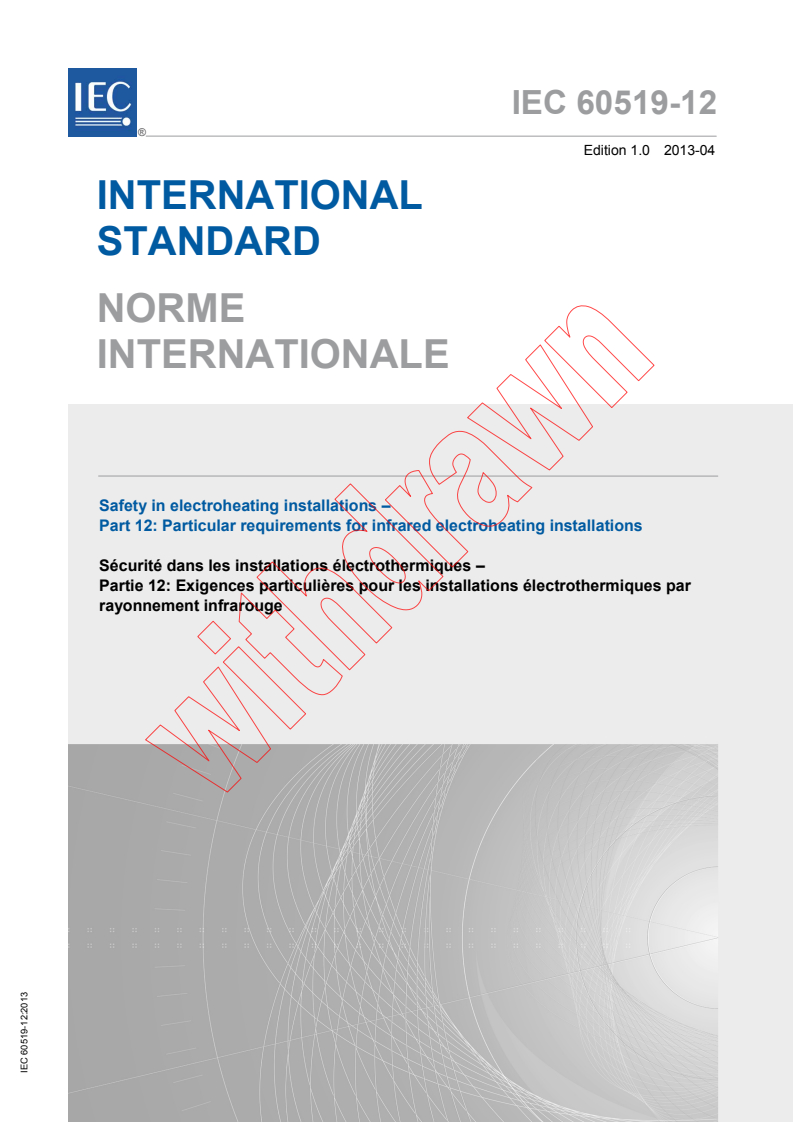
IEC 60519-12 ®
Edition 1.0 2013-04
INTERNATIONAL
STANDARD
NORME
INTERNATIONALE
Safety in electroheating installations –
Part 12: Particular requirements for infrared electroheating installations
Sécurité dans les installations électrothermiques –
Partie 12: Exigences particulières pour les installations électrothermiques par
rayonnement infrarouge
All rights reserved. Unless otherwise specified, no part of this publication may be reproduced or utilized in any form
or by any means, electronic or mechanical, including photocopying and microfilm, without permission in writing from
either IEC or IEC's member National Committee in the country of the requester.
If you have any questions about IEC copyright or have an enquiry about obtaining additional rights to this publication,
please contact the address below or your local IEC member National Committee for further information.
Droits de reproduction réservés. Sauf indication contraire, aucune partie de cette publication ne peut être reproduite ni
utilisée sous quelque forme que ce soit et par aucun procédé, électronique ou mécanique, y compris la photocopie et les
microfilms, sans l'accord écrit de la CEI ou du Comité national de la CEI du pays du demandeur.
Si vous avez des questions sur le copyright de la CEI ou si vous désirez obtenir des droits supplémentaires sur cette
publication, utilisez les coordonnées ci-après ou contactez le Comité national de la CEI de votre pays de résidence.
IEC Central Office Tel.: +41 22 919 02 11
3, rue de Varembé Fax: +41 22 919 03 00
CH-1211 Geneva 20 info@iec.ch
Switzerland www.iec.ch
About the IEC
The International Electrotechnical Commission (IEC) is the leading global organization that prepares and publishes
International Standards for all electrical, electronic and related technologies.
About IEC publications
The technical content of IEC publications is kept under constant review by the IEC. Please make sure that you have the
latest edition, a corrigenda or an amendment might have been published.
Useful links:
IEC publications search - www.iec.ch/searchpub Electropedia - www.electropedia.org
The advanced search enables you to find IEC publications The world's leading online dictionary of electronic and
by a variety of criteria (reference number, text, technical electrical terms containing more than 30 000 terms and
committee,…). definitions in English and French, with equivalent terms in
It also gives information on projects, replaced and additional languages. Also known as the International
withdrawn publications. Electrotechnical Vocabulary (IEV) on-line.
IEC Just Published - webstore.iec.ch/justpublished Customer Service Centre - webstore.iec.ch/csc
Stay up to date on all new IEC publications. Just Published If you wish to give us your feedback on this publication
details all new publications released. Available on-line and or need further assistance, please contact the
also once a month by email. Customer Service Centre: csc@iec.ch.
A propos de la CEI
La Commission Electrotechnique Internationale (CEI) est la première organisation mondiale qui élabore et publie des
Normes internationales pour tout ce qui a trait à l'électricité, à l'électronique et aux technologies apparentées.
A propos des publications CEI
Le contenu technique des publications de la CEI est constamment revu. Veuillez vous assurer que vous possédez
l’édition la plus récente, un corrigendum ou amendement peut avoir été publié.
Liens utiles:
Recherche de publications CEI - www.iec.ch/searchpub Electropedia - www.electropedia.org
La recherche avancée vous permet de trouver des Le premier dictionnaire en ligne au monde de termes
publications CEI en utilisant différents critères (numéro de électroniques et électriques. Il contient plus de 30 000
référence, texte, comité d’études,…). termes et définitions en anglais et en français, ainsi que
Elle donne aussi des informations sur les projets et les les termes équivalents dans les langues additionnelles.
publications remplacées ou retirées. Egalement appelé Vocabulaire Electrotechnique
International (VEI) en ligne.
Just Published CEI - webstore.iec.ch/justpublished
Service Clients - webstore.iec.ch/csc
Restez informé sur les nouvelles publications de la CEI.
Just Published détaille les nouvelles publications parues. Si vous désirez nous donner des commentaires sur
Disponible en ligne et aussi une fois par mois par email. cette publication ou si vous avez des questions
contactez-nous: csc@iec.ch.
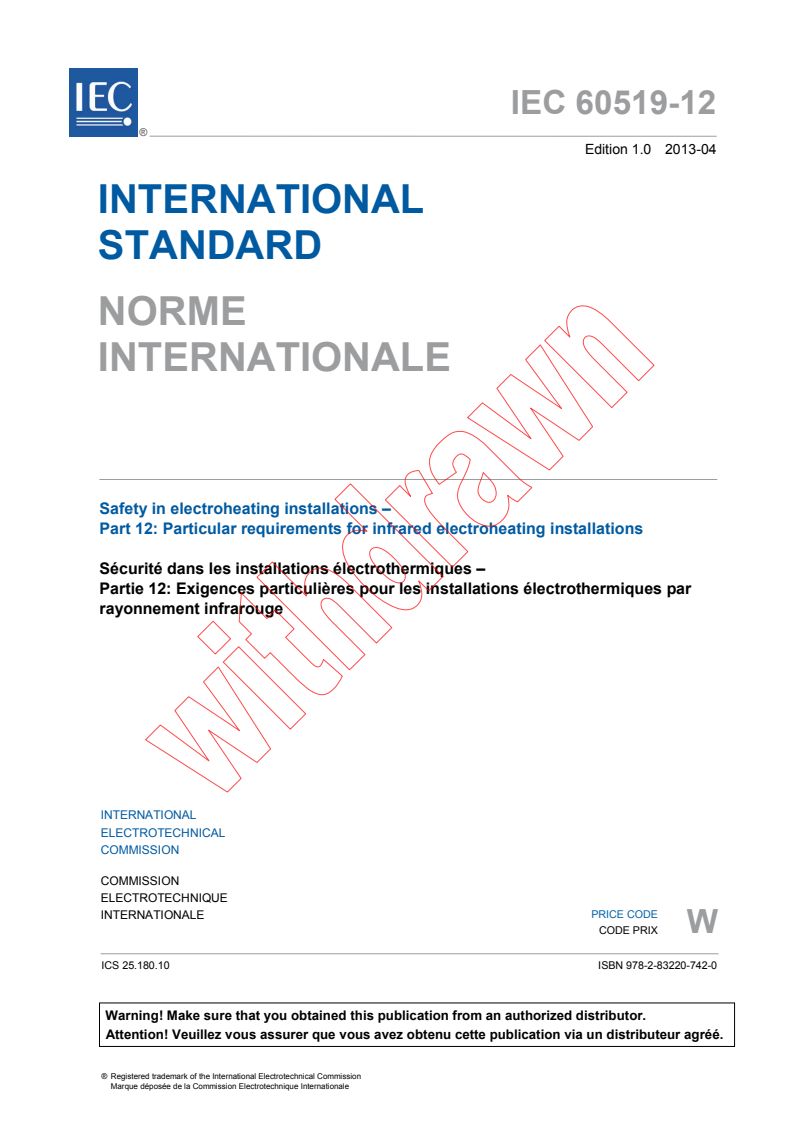
IEC 60519-12 ®
Edition 1.0 2013-04
INTERNATIONAL
STANDARD
NORME
INTERNATIONALE
Safety in electroheating installations –
Part 12: Particular requirements for infrared electroheating installations
Sécurité dans les installations électrothermiques –
Partie 12: Exigences particulières pour les installations électrothermiques par
rayonnement infrarouge
INTERNATIONAL
ELECTROTECHNICAL
COMMISSION
COMMISSION
ELECTROTECHNIQUE
PRICE CODE
INTERNATIONALE
CODE PRIX W
ICS 25.180.10 ISBN 978-2-83220-742-0
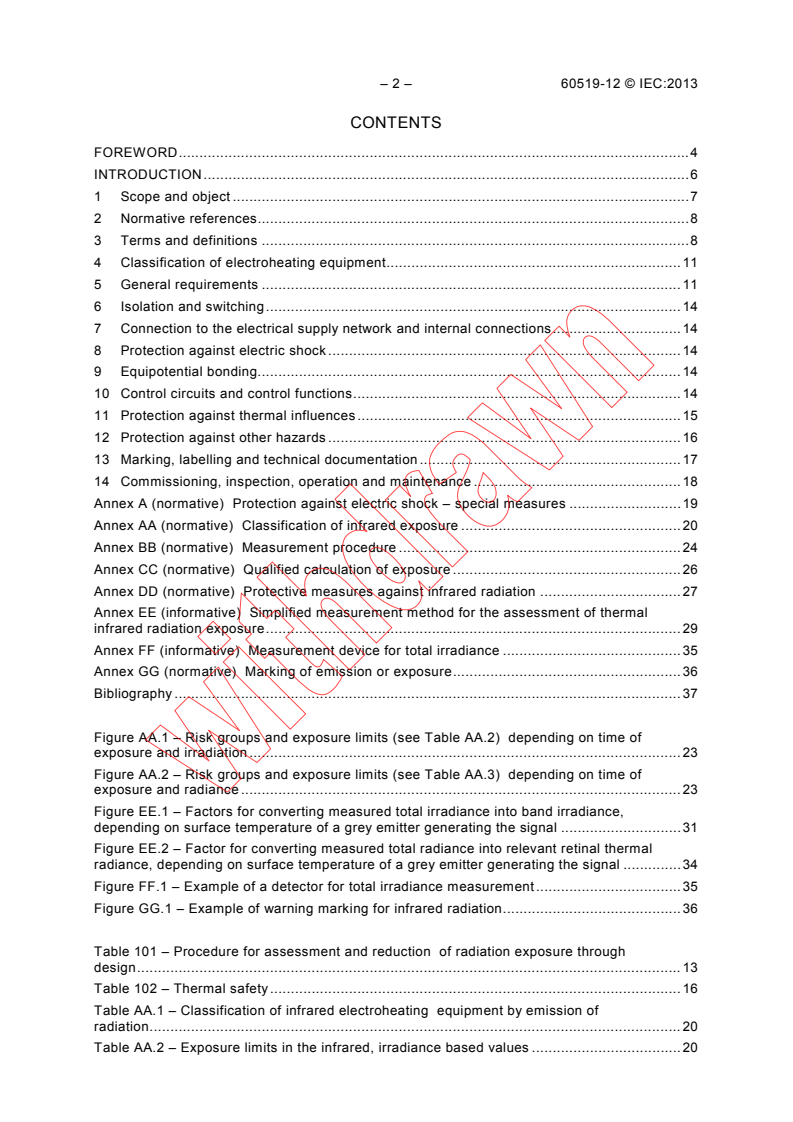
– 2 – 60519-12 © IEC:2013
CONTENTS
FOREWORD . 4
INTRODUCTION . 6
1 Scope and object . 7
2 Normative references . 8
3 Terms and definitions . 8
4 Classification of electroheating equipment . 11
5 General requirements . 11
6 Isolation and switching . 14
7 Connection to the electrical supply network and internal connections . 14
8 Protection against electric shock . 14
9 Equipotential bonding. 14
10 Control circuits and control functions . 14
11 Protection against thermal influences . 15
12 Protection against other hazards . 16
13 Marking, labelling and technical documentation . 17
14 Commissioning, inspection, operation and maintenance . 18
Annex A (normative) Protection against electric shock – special measures . 19
Annex AA (normative) Classification of infrared exposure . 20
Annex BB (normative) Measurement procedure . 24
Annex CC (normative) Qualified calculation of exposure . 26
Annex DD (normative) Protective measures against infrared radiation . 27
Annex EE (informative) Simplified measurement method for the assessment of thermal
infrared radiation exposure . 29
Annex FF (informative) Measurement device for total irradiance . 35
Annex GG (normative) Marking of emission or exposure . 36
Bibliography . 37
Figure AA.1 – Risk groups and exposure limits (see Table AA.2) depending on time of
exposure and irradiation . 23
Figure AA.2 – Risk groups and exposure limits (see Table AA.3) depending on time of
exposure and radiance . 23
Figure EE.1 – Factors for converting measured total irradiance into band irradiance,
depending on surface temperature of a grey emitter generating the signal . 31
Figure EE.2 – Factor for converting measured total radiance into relevant retinal thermal
radiance, depending on surface temperature of a grey emitter generating the signal . 34
Figure FF.1 – Example of a detector for total irradiance measurement . 35
Figure GG.1 – Example of warning marking for infrared radiation . 36
Table 101 – Procedure for assessment and reduction of radiation exposure through
design . 13
Table 102 – Thermal safety . 16
Table AA.1 – Classification of infrared electroheating equipment by emission of
radiation . 20
Table AA.2 – Exposure limits in the infrared, irradiance based values . 20
60519-12 © IEC:2013 – 3 –
Table AA.3 – Exposure limits in the infrared, radiance based values . 21
Table EE.1 – Measurement procedure . 29
– 4 – 60519-12 © IEC:2013
INTERNATIONAL ELECTROTECHNICAL COMMISSION
____________
SAFETY IN ELECTROHEATING INSTALLATIONS –
Part 12: Particular requirements for infrared electroheating installations
FOREWORD
1) The International Electrotechnical Commission (IEC) is a worldwide organization for standardization comprising
all national electrotechnical committees (IEC National Committees). The object of IEC is to promote
international co-operation on all questions concerning standardization in the electrical and electronic fields. To
this end and in addition to other activities, IEC publishes International Standards, Technical Specifications,
Technical Reports, Publicly Available Specifications (PAS) and Guides (hereafter referred to as “IEC
Publication(s)”). Their preparation is entrusted to technical committees; any IEC National Committee interested
in the subject dealt with may participate in this preparatory work. International, governmental and non-
governmental organizations liaising with the IEC also participate in this preparation. IEC collaborates closely
with the International Organization for Standardization (ISO) in accordance with conditions determined by
agreement between the two organizations.
2) The formal decisions or agreements of IEC on technical matters express, as nearly as possible, an international
consensus of opinion on the relevant subjects since each technical committee has representation from all
interested IEC National Committees.
3) IEC Publications have the form of recommendations for international use and are accepted by IEC National
Committees in that sense. While all reasonable efforts are made to ensure that the technical content of IEC
Publications is accurate, IEC cannot be held responsible for the way in which they are used or for any
misinterpretation by any end user.
4) In order to promote international uniformity, IEC National Committees undertake to apply IEC Publications
transparently to the maximum extent possible in their national and regional publications. Any divergence
between any IEC Publication and the corresponding national or regional publication shall be clearly indicated in
the latter.
5) IEC itself does not provide any attestation of conformity. Independent certification bodies provide conformity
assessment services and, in some areas, access to IEC marks of conformity. IEC is not responsible for any
services carried out by independent certification bodies.
6) All users should ensure that they have the latest edition of this publication.
7) No liability shall attach to IEC or its directors, employees, servants or agents including individual experts and
members of its technical committees and IEC National Committees for any personal injury, property damage or
other damage of any nature whatsoever, whether direct or indirect, or for costs (including legal fees) and
expenses arising out of the publication, use of, or reliance upon, this IEC Publication or any other IEC
Publications.
8) Attention is drawn to the Normative references cited in this publication. Use of the referenced publications is
indispensable for the correct application of this publication.
9) Attention is drawn to the possibility that some of the elements of this IEC Publication may be the subject of
patent rights. IEC shall not be held responsible for identifying any or all such patent rights.
International Standard IEC 60519-12 has been prepared by IEC technical committee 27:
Industrial electroheating and electromagnetic processing.
The text of this standard is based on the following documents:
FDIS Report on voting
27/894/FDIS 27/905/RVD
Full information on the voting for the approval of this standard can be found in the report on
voting indicated in the above table.
This publication has been drafted in accordance with the ISO/IEC Directives, Part 2.
A list of all parts in the IEC 60519 series, published under the general title Safety in
electroheating installations, can be found on the IEC website.
60519-12 © IEC:2013 – 5 –
The clauses of parts of the IEC 60519 series (hereinafter called Particular requirements)
supplement or modify the corresponding clauses of IEC 60519-1:2010 (General requirements
hereinafter called Part 1).
This part of IEC 60519 is to be read in conjunction with Part 1. It supplements or modifies the
corresponding clauses of Part 1. Where the text indicates an "addition" to or a "replacement" of
the relevant provision of Part 1, these changes are made to the relevant text of Part 1. Where
no change is necessary, the words "This clause of Part 1 is applicable" are used. When a
particular subclause of Part 1 is not mentioned in this part, that subclause applies as far as is
reasonable.
Additional specific provisions to those in Part 1, given as individual clauses or subclauses, are
numbered starting from 101.
NOTE The following numbering system is used:
– subclauses, tables and figures that are numbered starting from 101 are additional to those in Part 1;
– unless notes are in a new subclause or involve notes in Part 1, they are numbered starting from 101, including
those in a replaced clause or subclause;
– additional annexes are lettered AA, BB, etc.
The committee has decided that the contents of this publication will remain unchanged until the
stability date indicated on the IEC web site under "http://webstore.iec.ch" in the data related to
the specific publication. At this date, the publication will be
• reconfirmed,
• withdrawn,
• replaced by a revised edition, or
• amended.
– 6 – 60519-12 © IEC:2013
INTRODUCTION
The scope of this standard covers very different types and designs of infrared equipment used
for many different purposes by the industry. This standard is intended to cover all industrial
infrared equipment types, with some few exceptions described in Clause 1.
As many different types of electroheating equipment emit infrared radiation of hazardous
levels, the scope of this Part 12 of the IEC 60519 series addresses these infrared radiation
aspects for other parts of the series as well. Especially and with reference to IEC 60519-2:2006
[3] it has been agreed in TC 27 that this standard covers all kinds of infrared emission
hazards of industrial electroheating installations.
The discussion of infrared radiation has become quite detailed in this standard, as for the
industry there is not any single useful source available for simple, versatile, easy to use and
cost effective measurement methods.
Provisions of this standard relating to hazards by infrared emission from the equipment as such
and from hot workloads can be used as a complement to IEC 60519-2:2006, since such
aspects are not dealt with in that standard.
This standard provides guidance on the assessment and avoidance of hazards caused by
infrared radiation emitted to accessible locations by hot workloads, electrodes, or other thermal
sources belonging to electroheating equipment.
The other principles for covering the risks caused by infrared radiation were:
– Neither the manufacturer nor the user of electroheating equipment usually employs an
expert in optical radiation measurement or has access to an optical laboratory with all the
necessary equipment needed for elaborate measurements.
– Operating staff with limited experience in radiation measurement is usually responsible for
the task of performing the necessary measurements and will appreciate a simple and easy
to follow guide.
– EN 14255-2:2005 is defined for and useful for lamps only [8].
– EN 12198 series is not very detailed on measurement methods. It gives good guidance on
procedures to improve the safety of equipment. Some material from this source has been
adapted [9 – 11].
– The scope of IEC 62471:2006 is limited to lamps but that standard can be used for other
light sources. Therefore, core aspects were adapted and if possible simplified for this
standard. Content that is essential for safety of electroheating equipment is included in this
standard.
– Figures illustrating the classes defined in IEC 62471:2006 are included to provide a more
understandable and useful standard (IEC 62471:2006 provides data only in the tables).
– Relevant documents of American National Standard Institute / Illuminating Engineering
Society of North America, the ANSI/IESNA RP 27 series [12 – 14], are based on the
ICNIRP recommendations [1, 2] as well. They provide no extra material with regard to this
standard and its references.
A new infrared warning sign shown in Annex GG has been defined in liaison with IEC/SC 3C.
———————
Numbers in square brackets refer to the Bibliography.
60519-12 © IEC:2013 – 7 –
SAFETY IN ELECTROHEATING INSTALLATIONS –
Part 12: Particular requirements for infrared electroheating installations
1 Scope and object
This clause of Part 1 is replaced by the following.
Replacement:
This part of IEC 60519 specifies safety requirements for industrial electroheating equipment
and installations in which infrared radiation, usually generated by infrared emitters, is
significantly dominating over heat convection or heat conduction as means of energy transfer
to the material to be treated. A further limitation of the scope is that the infrared emitters have
a maximum spectral emission at longer wavelengths than 780 nm in air or vacuum, and are
emitting wideband continuous spectra such as by thermal radiation or high pressure arcs.
IEC 60519-1:2010 defines infrared as radiation within the frequency range between about
400 THz and 300 GHz. This corresponds to the wavelength range between 780 nm and 1 mm
in vacuum. Industrial infrared heating usually uses infrared sources with rated temperatures
between 500 °C and 3 000 °C; the emitted radiation from these sources dominates in the
wavelength range between 780 nm and 10 µm.
Since substantial emission of e.g. blackbody thermal emitters may extend beyond 780 nm or
3 000 nm, the safety aspects of emitted visible light and emission at wavelengths longer than
3 000 nm are also considered in this standard.
This standard is not applicable to:
– infrared installations with lasers or light-emitting diodes (LEDs) as main sources – they are
covered by IEC 62471:2006, IEC 60825-1:2007 [4] and IEC/TR 60825-9:1999 [5];
– appliances for use by the general public;
– appliances for laboratory use – they are covered by IEC 61010-1:2010 [6];
– electroheating installations where resistance heated bare wires, tubes or bars are used as
heating elements, and infrared radiation is not a dominant side effect of the intended use,
covered by IEC 60519-2:2006 [3];
– infrared heating equipment with a nominal combined electrical power of the infrared
emitters of less than 250 W;
– handheld infrared equipment.
Industrial infrared electroheating equipment under the scope of this standard typically uses the
Joule effect for the conversion of electric energy into infrared radiation by one or several
sources. Radiation is then emitted from one or several elements onto the material to be
treated. Such infrared heating elements are in particular:
– thermal infrared emitters in the form of tubular, plate-like or otherwise shaped ceramics
with a resistive element inside;
– infrared quartz glass tube or halogen lamp emitters with a hot filament as a source;
– non insulated elements made from molybdenum disilicide, silicon carbide, graphite, iron-
TM
chromium-aluminium alloys like Kanthal or comparable materials;
– wide-spectrum arc lamps.
– 8 – 60519-12 © IEC:2013
2 Normative references
This clause of Part 1 is applicable except as follows.
Additions:
IEC 60519-1:2010, Safety in electroheating installations – Part 1: General requirements
IEC 62471:2006, Photobiological safety of lamps and lamp systems
ISO 12100:2010, Safety of machinery – General principles for design – Risk assessment and
risk reduction
ISO 13577-1, Industrial furnaces and associated processing equipment – Safety – Part 1:
General requirements
ISO 14159, Safety of machinery – Hygiene requirements for the design of machinery
3 Terms and definitions
This clause of Part 1 is applicable except as follows.
Additions:
3.101
infrared radiation
optical radiation for which the wavelengths are longer than those for visible radiation
Note 1 to entry: The infrared radiation range between 780 nm and 1 mm is commonly subdivided into:
IR-A 780 nm to 1 400 nm, or for a grey emitter 3 450 °C to 1 800 °C surface temperature;
IR-B 1 400 nm to 3 000 nm, or for a grey emitter 1 800 °C to 690 °C surface temperature;
IR-C 3 000 nm to 1 mm, or for a grey emitter less than 690 °C surface temperature.
The temperature corresponds to a spectrum where maximum intensity is at the wavelength of the limit.
These ranges comply with IEC 62471:2006.
Note 2 to entry: In IEC 60050-841:2004, the following terms are defined:
841-24-04 – shortwave infrared radiation or near infrared radiation (780 nm to 2 µm);
841-24-03 – mediumwave infrared radiation or medium infrared radiation (2 µm to 4 µm);
841-24-02 – longwave infrared radiation or far infrared radiation (4 µm to 1 mm).
These terms are not used in this standard.
[SOURCE: IEC 62471:2006, 3.14, modified – Note 1 has been modified and Note 2 added]
3.102
infrared heating
heating consisting in absorption of thermal and optical radiation, mostly infrared radiation,
emitted by especially constructed equipment
[SOURCE: IEC 60050-841:2004, 841-24-05, modified – the definition has been editorially
improved]
60519-12 © IEC:2013 – 9 –
3.103
infrared installation
infrared electroheating installation
electroheating installation, where processing of the workload is achieved by infrared heating
[SOURCE: IEC 60050-841:2004, 841-24-09, modified – the synonym has been added; the
definition has been shortened]
3.104
infrared emitter
component from which infrared radiation is emitted
Note 1 to entry: This component is usually replaceable.
3.105
infrared source
part of the infrared emitter, where electric energy is converted by the Joule effect into heat or
radiation
3.106
filament
conductive wire or thread of an infrared emitter, in which electric energy is converted into heat
by the Joule effect
[SOURCE: IEC 60050-841:2004, 841-24-27, modified – the definition has been clarified]
3.107
infrared ceramic heater
infrared emitter made of or covered with ceramic material
[SOURCE: IEC 60050-841:2004, 841-24-13, modified – the definition has been shortened]
3.108
tubular infrared emitter
infrared emitter in which one of the basic dimensions is dominant
Note 1 to entry: The emitter can include reflecting means and be straight or bent.
[SOURCE: IEC 60050-841:2004, 841-24-24, modified – the definition has been shortened;
Note 1 has been added]
3.109
infrared plate emitter
infrared emitter in which two of the basic dimensions are dominant
Note 1 to entry: The emitter can include reflecting means and may be flat or curved.
[SOURCE: IEC 60050-841:2004, 841-24-25, modified – the definition has been shortened;
Note 1 has been added]
3.110
infrared quartz emitter
infrared emitter in which the source is inside a quartz glass envelope
TM
Note 1 to entry: Glass envelopes made from hard glasses like Vycor are included.
[SOURCE: IEC 60050-841:2004, 841-24-26, modified – the definition has been shortened;
Note 1 has been added]
– 10 – 60519-12 © IEC:2013
3.111
halogen lamp emitter
infrared emitter with a tungsten filament placed inside a gas tight glass envelope with halogen,
containing atmosphere where the halogen actively transports tungsten from the glass wall to
the tungsten filament
Note 1 to entry: Halogen lamp emitters are typically infrared quartz emitters.
[SOURCE: IEC 60050-841:2004, 841-24-22, modified – the definition has been clarified; Note 1
has been added]
3.112
infrared reflector
passive, non transmitting component which reflects and directs infrared radiation
Note 1 to entry: The reflector can be part of an infrared emitter and can reflect specularly or diffusely.
3.113
infrared refractor
passive, transmitting component that focuses and directs infrared radiation
Note 1 to entry: The refractor can be part of an infrared emitter.
3.114
infrared wavelength converter
element inside the infrared installation that is heated up by infrared radiation during normal
operation to a temperature, where its own emitted radiation participates in heating up the
workload
Note 1 to entry: The spectrum of a wavelength converter has a substantially longer wavelength than the
wavelength of major emission of the infrared emitters.
3.115
infrared module
component housing one or more infrared emitters
Note 1 to entry: The module can include reflectors, refractors, filters, or other means for protecting the emitter as
well as cooling devices.
3.116
infrared shield
opaque component designed to stop infrared radiation from being transmitted through it
3.117
protection shield
shield used for the radiation protection of people or equipment
3.118
filter
partially transparent, partially absorbing or reflecting component, designed to reduce
transmission at selected wavelength
3.119
infrared barrier
physical barrier, which limits access to areas of potentially hazardous irradiation, and can only
be removed with the aid of a tool
3.120
infrared enclosure
structure intended to confine the infrared radiation to a defined region
60519-12 © IEC:2013 – 11 –
EXAMPLE Closed treatment chamber, infrared shield, infrared reflector.
Note 1 to entry: Infrared barriers mounted outside the infrared enclosure are not considered as part of it.
3.121
rated temperature
maximum surface temperature of the infrared filament or infrared emitter at rated voltage
Note 1 to entry: This temperature is used for the determination of the spectral emission of thermal infrared
emitters.
Note 2 to entry: The temperature applies under conditions of normal operation.
4 Classification of electroheating equipment
This clause of Part 1 is applicable.
5 General requirements
This clause of Part 1 is applicable except as follows.
5.1.5
Addition:
Bare conductors shall be placed in such a way that they cannot come into contact with persons,
the workload, or the workload handling equipment under normal operating conditions or single
fault conditions. Exception may be made for bare conductors supplied from sources which
comply with the requirements for safety of extra-low voltage (SELV) supplied in accordance
with IEC 60364-4-41.
Bare conductors may be used to contact infrared emitters in hot environments, or they may be
the infrared source as such.
5.2.1
Addition:
In case of parts of infrared equipment inside a vacuum, the voltage applied to all such parts
subjected to subatmospheric pressure shall be chosen in such a way that no flashover or
breakdown occurs.
In most cases this limits the voltage difference inside the vacuum to about 80 V.
5.2.5
Addition:
Precautions shall be taken to ensure that the workload or auxiliary equipment for example
handling, transport and charging devices do not constitute a source of damage to the infrared
emitters or modules. Special care is needed to avoid damage to infrared quartz emitters and
halogen lamp emitters.
Additional subclauses:
5.3.101 If the filament material or the infrared source has a substantially higher specific
electric resistivity at rated temperature than at ambient – exceeding 130 % of ambient
resistivity at rated temperature – this inrush current effect shall be taken into account in the
– 12 – 60519-12 © IEC:2013
design and specification of conductors and other associated components as fuses as well as
with regard to voltage fluctuations and flicker.
The exact value of the inrush current and its duration depend inter alia on the material, the
electric impedance of the complete feeding circuit, the temperature of the source or filament in
the cold state, and the equilibrium temperature of the filaments at applied voltage.
This effect is very pronounced with filaments made from refractory metals such as tungsten.
5.5.101 Hazards from infrared radiation
Infrared equipment and installations shall be so designed and constructed that emission of
infrared radiation is limited to the extent necessary for their operation and that their effects on
exposed persons are non-existent or reduced to non-hazardous proportions.
The safety limits of hazardous exposure are defined in Annex AA (which is in accordance with
IEC 62471:2006). It shall be taken into account, if not otherwise required by national
regulations.
The following conditions can lead to hazardous exposure:
– Emission of radiation through the entrance and exit ports of continuously operating
equipment;
– Emission of radiation when door(s) of batch equipment are opened during process or stay
open and the equipment, the workload or infrared emitters have not cooled down in
advance;
– Emission of radiation by a very hot workload after leaving the infrared installation;
– Emission of radiation caused by insufficient precautions during maintenance or
commissioning;
– If infrared emitters or modules are operated outside the infrared equipment;
– If infrared reflectors or refractors or reflective walls inside the infrared installation cause
zones of intense irradiation outside the installation;
– If hot walls and wavelength converters inside the infrared equipment cause zones of
intense irradiation outside the installation.
Different phases of the life cycle of the equipment can cause different levels of radiation
emission.
5.5.102 Procedure for reducing risk from infrared radiation
If the equipment can cause hazardous emission of infrared radiation during some stages of its
life cycle, the procedure given in Table 101 shall be used for risk assessment and risk
reduction.
Some steps of the procedure for assessing and reducing radiation exposure of persons from
the equipment through technical means depend on the product being a unique installation
made to order or being manufactured repetitively. Repetitively manufactured equipment and
made to order equipment usually vary in the design process. Manufacturers and users usually
agree jointly on the design only in the design process for made to order equipment. Therefore,
in this case responsibility for design decisions can be shared between the manufacturer and
user.
60519-12 © IEC:2013 – 13 –
Table 101 – Procedure for assessment and reduction
of radiation exposure through design
Made to purpose industrial equipment Repetitively manufactured industrial equipment
This is an individual process, to be undertaken for This process is type testing and done once and
each installation individually. before placing the product on the market.
The process takes place during the design, The procedure shall be repeated, if design changes
construction and commissioning phases of the can affect the emission of infrared radiation from
product. the product.
a) Specify the design target of risk groups according Specify the design target of risk groups according
to intended purpose, environment, and national to intended purpose, environment, and national
regulations for all phases of the life cycle. The regulations for all phases of the life cycle.
manufacturer can involve the user during this
Annex AA shall be used if no national regulations
process.
apply for the definition of design targets.
Annex AA shall be used if no national regulations
apply for the definition of design targets.
b) Characterize all infrared emission caused by the equipment, direct and indirect for all stages of operation,
considering
– the number of sources;
– the geometry of the emitters for example point source, tubular infrared emitter, infrared plate emitter;
– the emitted spectrum of the emitters – which depends on rated temperature, emissivity of the
surfaces as well as on the conditions during normal operation;
– the surface area of emitting sources or surfaces and emitted power from there depending on
operation conditions;
– the direction of emission of all emitting surfaces;
– the temporal reaction of the sources.
c) Define intended directions of irradiation, intensity of Define intended directions of irradiation, intensity of
intended irradiation and access to the irradiated intended irradiation and access to the irradiated
area. area for the equipment.
The point of use and possible interference with
other equipment or processes shall be retrieved
from the user, if possible.
d) Review available materials for infrared shields, protection shields, infrared barriers, enclosures or filters.
The materials shall be able to withstand all environmental conditions and the effects of all conditions of
irradiation caused during the intended purpose of the equipment and for expected failure modes.
e) The manufacturer shall involve the user when The manufacturer makes design decisions. They
making the necessary design decisions. Design shall be based on Annex DD.
decisions shall be based on Annex DD.
f) Either proceed to step h) or calculate emission and exposure of the equipment according to Annex CC and
compare the results with the specified levels set in step a).
g) If calculated results show discrepancy with the specified levels as set in step a), make changes in the
design by repeating steps e) and f).
h) Manufacture and install the equipment at the user’s Manufacture the equipment.
site.
Measure in accordance with Annex BB in the
Measure in accordance with Annex BB in the following cases:
following cases:
– no calculation regarding step f) has been
– no calculation regarding step f) has been undertaken;
undertaken;
– calculations regarding step f) or the design
– calculations regarding step f) or the design need verification.
need verification.
i) If the measured results show discrepancy with the If measured results show discrepancy with the
specified levels set in step a), decide on necessary specified levels set in a), make changes in the
measures: design improvements, shields, barriers, design and repeat steps e), h) and i).
or organisational means.
If agreed on, make changes in the design and
repeat steps e), h) and i).
j) Prepare the documentation and instructions for commissioning and maintenance, list the necessary
organisational means.
– 14 – 60519-12 © IEC:2013
If emission occurs by intent only during commissioning or maintenance phase and
organisational means are sufficient to prevent harm, the procedure given in Table 101 is not
necessary, but classification and documentation shall follow this standard.
5.5.103 Filtering of radiation
No exclusive reduction or exclusive filtering of visible radiation shall be done.
NOTE Reducing the visual stimulus of radiation increases risk to persons, as is argued in ICNIRP Guidelines 1997
[1].
5.5.104 Visible and ultraviolet radiation
Infrared equipment and installations shall be so designed and constructed that any emission of
visible or ultraviolet radiation is limited to the extent necessary for their operation and that the
effects on exposed persons are non-existent or reduced to non-hazardous proportions. For
classification and measurement procedure, refer to IEC 62471:2006 or to national regulations.
NOTE 1 Some kinds of infrared emitters can emit hazardous levels of visible or ultraviolet radiation. This includes
arc lamps or halogen lamp emitters operating at high rated temperature.
NOTE 2 National regulations can have requirements exceeding those in IEC 62471:2006 in the visible and
ultraviolet ranges.
6 Isolation and switching
This clause of Part 1 is applicable except as follows.
Addition:
6.101 Leakage current
Protective measures shall be applied to ensure that persons are not exposed to electrical
hazards due to leakage currents arising under normal operating conditions. Effective measures
shall be taken to ensure that the leakage current does not cause electrical hazards of any kind.
NOTE A source of leakage currents are infrared quartz emitter and halogen emitter with hot quartz glass envelope,
as glass becomes conductive with high temperature.
7 Connection to the electrical supply network and internal connections
This clause of Part 1 is applicable.
8 Protection against electric shock
This clause of Part 1 is applicable.
9 Equipotential bonding
This clause of Part 1 is applicable.
10 Control circuits and control functions
This clause of Part 1 is applicable except as follows.
60519-12 © IEC:2013 – 15 –
10.3.5 Emergency operations
Addition:
Temperature-limiting safety devices shall be provided if fault conditions are likely to cause
hazards due to failure of the temperature controller. These devices shall be both functionally
and electrically independent.
In the case of both electronic power controllers and circuit-breakers, as well as in the case of
electromagnetically operated contactors with a high operation frequency, the infrared emitters
or equipment shall be cut off via a separate safety switch.
11 Protection against thermal influences
This clause of Part 1 is applicable except as follows.
Additional subclauses:
11.101 Infrared electroheating equipment shall be so designed, installed and operated that
even when the equipment is unattended or switched on inadvertently, no hazard due to the
temperature is likely to be caused to the operating staff or the environment.
11.102 Infrared electroheating equipment shall be so designed and installed that all necessary
measures to limit any hazard from excessive heating of the workload shall be undertaken.
11.103 If the equipment is to be used to process a workload that can ignite or cause damage
after an emergency stop, the design and installation of the equipment shall include:
– means for an instant removal of the workload from the equipment;
– all necessary cooling equipment shall operate on a separate circuit and shall operate until
safe temperature conditions are reached inside the equipment;
– if no sufficient cooling of the equipment is installed, thermal insulating shields shall
separate instantly the workload or other heat sources from those parts of the equipment,
that can ignite or can otherwise be damaged by the residual heat stored in the workload or
other heat sources;
– if no sufficient cooling of the equipment is possible due to high residual thermal load inside
the equipment exceeding the cooling abilities of the equipment, thermal insulating shields
shall separate instantly the workload or other heat sources from those parts of the
equipment that can ignite or can otherwise be damaged by the residual heat.
NOTE 1 Residual heat stored in the equipment can be released over a long period after switching off.
NOTE 2 Surfaces can increase in temperature after switch off due to the release of stored heat.
11.104 In order to ensure the necessary degree of safety in the case of a fault condition in the
temperature control circuit, appropriate safety devices and safety measures specified in
Table 102 shall be applied.
– 16 – 60519-12 © IEC:2013
Table 102 – Thermal safety
Class Protection objective Extent of protection Safety device Safety measures
Attended operation with
non-hazardous
Infrared electroheating
workload only
0 equipment and – –
Overheating precluded
environment thereof
by constructional
measures
In the case of a fault no
Infrared electroheating thermal cut-out,
danger caused by
1 equipment and temperature protectors,
electroheating
environment thereof or comparable
Depending on
equipment
utilization and site of
Infrared electroheating In the case of a fault no
installation
pre-selected
equipment, danger caused by
2 temperature controllers,
environment thereof electroheating
or comparable
and workload equipment or workload
In the case of unattended operation, the state of the electroheating equipment shall be checked
at reasonably limited intervals.
Safety classes applicable for the electroheating equipment in question shall be given in the
operating instruction; for example, thermal class 2 according to 11.102.
12 Protection against other hazards
This clause of Part 1 is replaced as follows.
12.101 General
In addition to potential hazards due to the electrical, mechanical, magnetic and electromagnetic
field and radiation described in Clauses 5, 8 or 11, the following hazards shall be considered
and be addressed in the operating and maintenance manuals:
– ergonomics of the working environment,
– fire caused by the electroheating equipment itself or by the workload,
– explosion caused by the electroheating equipment itself or by the workload,
– implosion of the equipment,
– eruption or sudden expansion of the workload
– leakage of water or other conducting liquids,
– vibration, infra- and ultrasound,
– acoustic noise and interference of noise wit
...