

IEC 62014-4:2025
(Main)IP-XACT, Standard Structure for Packaging, Integrating, and Reusing IP within Tool Flows
General Information
- Abstract
IEC 62014-4:2025 describes an eXtensible Markup Language (XML) schema for meta-data documenting intellectual property (IP) used in the development, implementation, and verification of electronic systems. This schema provides both a standard method to document IP that is compatible with automated integration techniques and a standard method (generators) for linking tools into a system development framework, enabling a more flexible, optimized development environment. Tools compliant with this standard will be able to interpret, configure, integrate, and manipulate IP blocks that comply with the IP meta-data description. The standard is independent of any specific design processes. It does not cover behavioral characteristics of the IP that are not relevant to integration. This standard enables the creation and exchange of IP in a highly automated design environment.
This standard is published as a double logo IEC-IEEE standard.
- Status
- Published
- Publication Date
- 24-Jun-2025
- Technical Committee
- TC 91 - Electronics assembly technology
- Drafting Committee
- WG 13 - TC 91/WG 13
Overview
IEC 62014-4:2025 - IP‑XACT, Standard Structure for Packaging, Integrating, and Reusing IP within Tool Flows defines an XML schema for IP meta-data used in the development, implementation, and verification of electronic systems. Published as a double‑logo IEC‑IEEE standard (aligned with IEEE Std 1685), this edition standardizes how intellectual property (IP) is described so tools can automatically interpret, configure, integrate, and manipulate IP blocks across tool flows. The standard is process‑agnostic and focuses on integration‑relevant metadata rather than IP behavioral details.
Key topics and requirements
- XML schema for IP meta‑data: standardized format to describe components, ports, buses, memory maps, registers, and models for automated exchange.
- Component and design descriptions: rules for packaging component definitions, interfaces, interconnections, file sets, and clear‑box elements.
- Interface definitions: busDefinitions, abstractionDefinitions, ports (wire, transactional, grouped), qualifiers, and complex interconnections.
- Addressing and memory maps: address spaces, memory mapping, remapping, and rules for calculating bit and bus addresses.
- Registers and type definitions: register files, fields, enumerations, access policies and semantic consistency checks.
- Generators and generator chains: standardized mechanism to link tools into a development framework (component generators, generatorChain, selectors).
- Design configurations & catalogs: design views, configuration of interconnections and abstractors, and catalog management for IP exchange.
- Abstractors and models: abstractor descriptions, views, and models to enable simulation and verification abstraction.
- Data visibility & semantic rules: rules for bit visibility, address translation, and consistency to ensure interoperable exchanges between tools.
Applications and who should use it
- IP vendors packaging reusable IP blocks for third‑party integration.
- SoC architects and system integrators assembling multi‑vendor designs.
- EDA tool developers implementing import/export, configuration, and generator support.
- Verification engineers automating model and testbench generation from IP meta‑data.
- Embedded systems teams using automated flows for register access, memory mapping, and address translation.
Practical benefits include reduced manual integration effort, improved automation in tool chains, consistent IP documentation, and easier exchange of IP between organizations.
Related standards
- IEEE Std 1685 (aligned standard; IEC 62014‑4:2025 published under IEC‑IEEE double logo)
- Other IP‑XACT family documents (referenced within IEC 62014‑4) for broader interoperability and tooling guidance.
Keywords: IEC 62014‑4:2025, IP‑XACT, IP meta‑data, XML schema, IP packaging, generator chains, memory map, register description, tool flows, IEC‑IEEE.
Relations
- Effective Date
- 14-Mar-2025
Get Certified
Connect with accredited certification bodies for this standard

BSI Group
BSI (British Standards Institution) is the business standards company that helps organizations make excellence a habit.

DVS-ZERT GmbH
German welding certification society.
CARES (UK Certification Authority for Reinforcing Steels)
UK certification for reinforcing steels and construction.
Sponsored listings
Frequently Asked Questions
IEC 62014-4:2025 is a standard published by the International Electrotechnical Commission (IEC). Its full title is "IP-XACT, Standard Structure for Packaging, Integrating, and Reusing IP within Tool Flows". This standard covers: IEC 62014-4:2025 describes an eXtensible Markup Language (XML) schema for meta-data documenting intellectual property (IP) used in the development, implementation, and verification of electronic systems. This schema provides both a standard method to document IP that is compatible with automated integration techniques and a standard method (generators) for linking tools into a system development framework, enabling a more flexible, optimized development environment. Tools compliant with this standard will be able to interpret, configure, integrate, and manipulate IP blocks that comply with the IP meta-data description. The standard is independent of any specific design processes. It does not cover behavioral characteristics of the IP that are not relevant to integration. This standard enables the creation and exchange of IP in a highly automated design environment. This standard is published as a double logo IEC-IEEE standard.
IEC 62014-4:2025 describes an eXtensible Markup Language (XML) schema for meta-data documenting intellectual property (IP) used in the development, implementation, and verification of electronic systems. This schema provides both a standard method to document IP that is compatible with automated integration techniques and a standard method (generators) for linking tools into a system development framework, enabling a more flexible, optimized development environment. Tools compliant with this standard will be able to interpret, configure, integrate, and manipulate IP blocks that comply with the IP meta-data description. The standard is independent of any specific design processes. It does not cover behavioral characteristics of the IP that are not relevant to integration. This standard enables the creation and exchange of IP in a highly automated design environment. This standard is published as a double logo IEC-IEEE standard.
IEC 62014-4:2025 is classified under the following ICS (International Classification for Standards) categories: 25.040.01 - Industrial automation systems in general; 35.240.50 - IT applications in industry. The ICS classification helps identify the subject area and facilitates finding related standards.
IEC 62014-4:2025 has the following relationships with other standards: It is inter standard links to IEC 62014-4:2015. Understanding these relationships helps ensure you are using the most current and applicable version of the standard.
IEC 62014-4:2025 is available in PDF format for immediate download after purchase. The document can be added to your cart and obtained through the secure checkout process. Digital delivery ensures instant access to the complete standard document.
Standards Content (Sample)
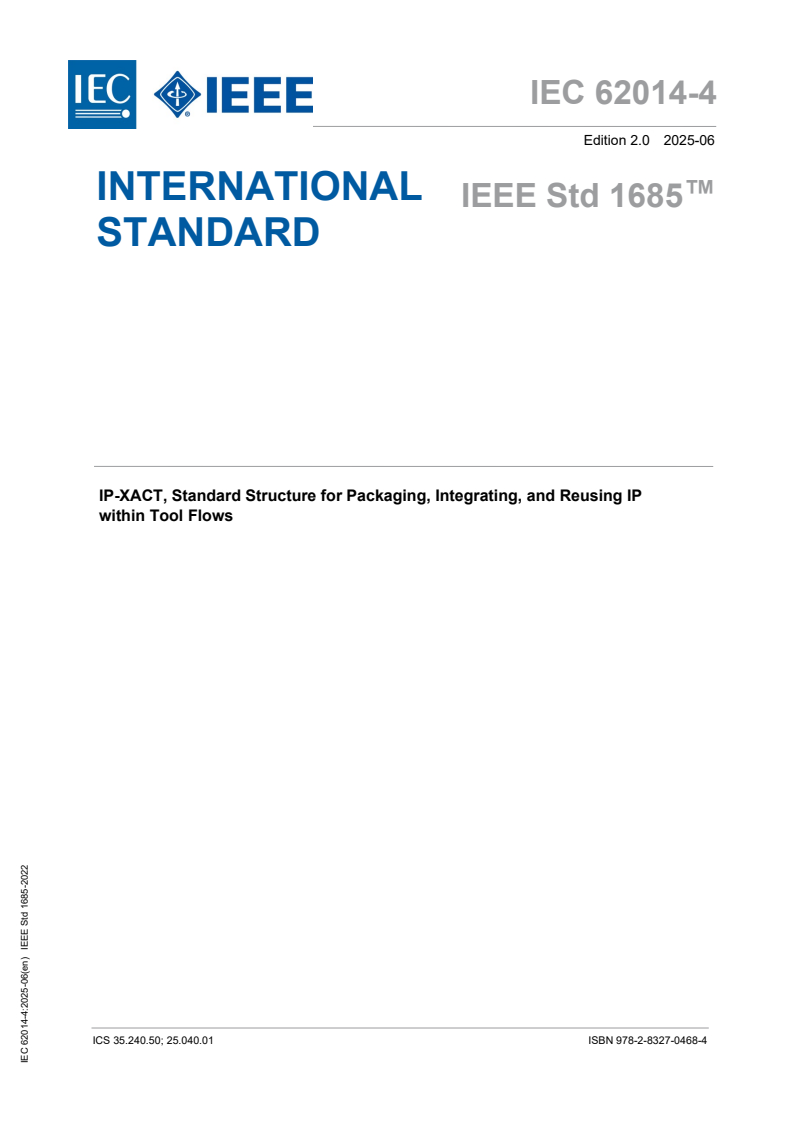
IEC 62014-4 ®
Edition 2.0 2025-06
INTERNATIONAL
™
IEEE Std 1685
STANDARD
IP-XACT, Standard Structure for Packaging, Integrating, and Reusing IP
within Tool Flows
ICS 35.240.50; 25.040.01 ISBN 978-2-8327-0468-4
All rights reserved. IEEE is a registered trademark in the U.S. Patent & Trademark Office, owned by the Institute of
Electrical and Electronics Engineers, Inc. Unless otherwise specified, no part of this publication may be reproduced or
utilized in any form or by any means, electronic or mechanical, including photocopying and microfilm, without permission
in writing from the IEC Central Office. Any questions about IEEE copyright should be addressed to the IEEE. Enquiries
about obtaining additional rights to this publication and other information requests should be addressed to the IEC or
your local IEC member National Committee.
IEC Secretariat Institute of Electrical and Electronics Engineers, Inc.
3, rue de Varembé 3 Park Avenue
CH-1211 Geneva 20 New York, NY 10016-5997
Switzerland United States of America
Tel.: +41 22 919 02 11 stds.ipr@ieee.org
info@iec.ch www.ieee.org
www.iec.ch
About the IEC
The International Electrotechnical Commission (IEC) is the leading global organization that prepares and publishes
International Standards for all electrical, electronic and related technologies.
About IEC/IEEE publications
The technical content of IEC publications is kept under constant review by the IEC. Please make sure that you have the
latest edition, a corrigendum or an amendment might have been published.
IEC publications search - webstore.iec.ch/advsearchform IEC Products & Services Portal - products.iec.ch
The advanced search enables to find IEC publications by a Discover our powerful search engine and read freely all the
variety of criteria (reference number, text, technical publications previews, graphical symbols and the glossary. With a
committee, …). It also gives information on projects, replaced subscription you will always have access to up to date content
and withdrawn publications. tailored to your needs.
IEC Just Published - webstore.iec.ch/justpublished
Electropedia - www.electropedia.org
Stay up to date on all new IEC publications. Just Published
The world's leading online dictionary on electrotechnology,
details all new publications released. Available online and
containing more than 22 500 terminological entries in English and
once a month by email.
French, with equivalent terms in 25 additional languages. Also
known as the International Electrotechnical Vocabulary (IEV)
IEC Customer Service Centre - webstore.iec.ch/csc
online.
If you wish to give us your feedback on this publication or need
further assistance, please contact the Customer Service
Centre: sales@iec.ch.
IEEE Std 1685™‐2022
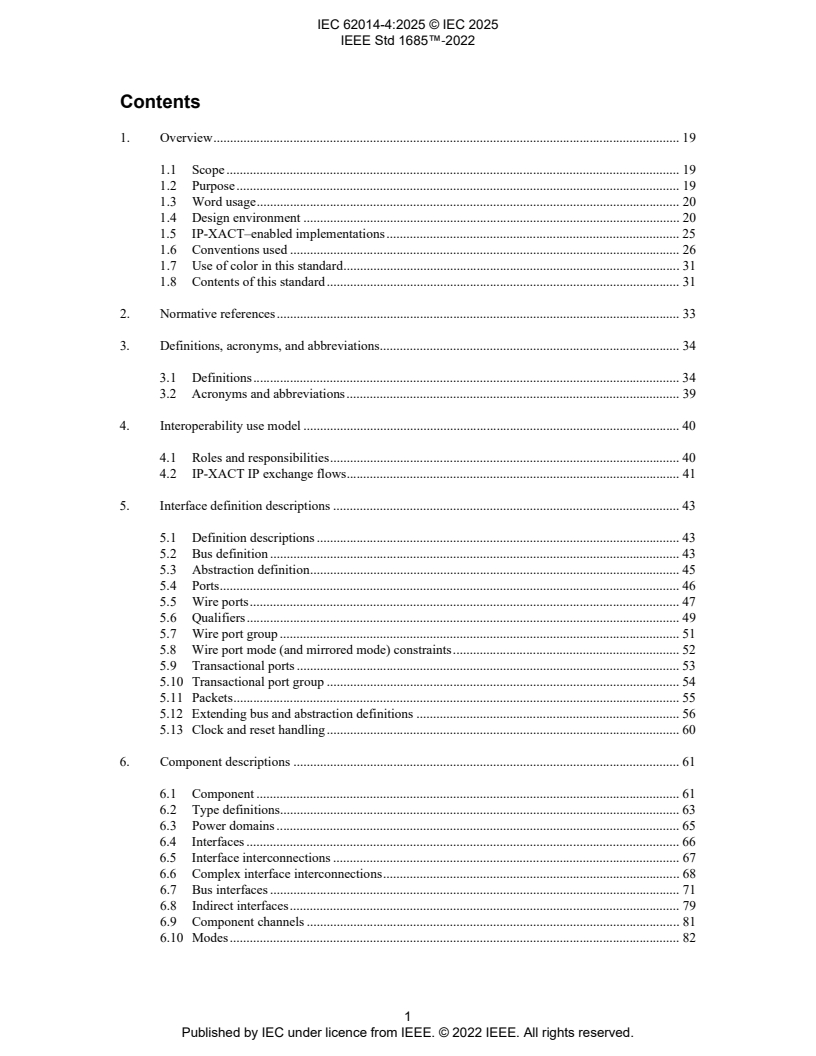
Contents
1. Overview. 19
1.1 Scope . 19
1.2 Purpose. 19
1.3 Word usage. 20
1.4 Design environment . 20
1.5 IP-XACT–enabled implementations. 25
1.6 Conventions used . 26
1.7 Use of color in this standard. 31
1.8 Contents of this standard. 31
2. Normative references. 33
3. Definitions, acronyms, and abbreviations. 34
3.1 Definitions. 34
3.2 Acronyms and abbreviations. 39
4. Interoperability use model . 40
4.1 Roles and responsibilities. 40
4.2 IP-XACT IP exchange flows.41
5. Interface definition descriptions . 43
5.1 Definition descriptions . 43
5.2 Bus definition . 43
5.3 Abstraction definition. 45
5.4 Ports. 46
5.5 Wire ports. 47
5.6 Qualifiers. 49
5.7 Wire port group . 51
5.8 Wire port mode (and mirrored mode) constraints. 52
5.9 Transactional ports . 53
5.10 Transactional port group . 54
5.11 Packets. 55
5.12 Extending bus and abstraction definitions . 56
5.13 Clock and reset handling. 60
6. Component descriptions . 61
6.1 Component . 61
6.2 Type definitions. 63
6.3 Power domains . 65
6.4 Interfaces . 66
6.5 Interface interconnections . 67
6.6 Complex interface interconnections. 68
6.7 Bus interfaces . 71
6.8 Indirect interfaces. 79
6.9 Component channels . 81
6.10 Modes. 82
Published by IEC under licence from IEEE. © 2022 IEEE. All rights reserved.
IEEE Std 1685™‐2022
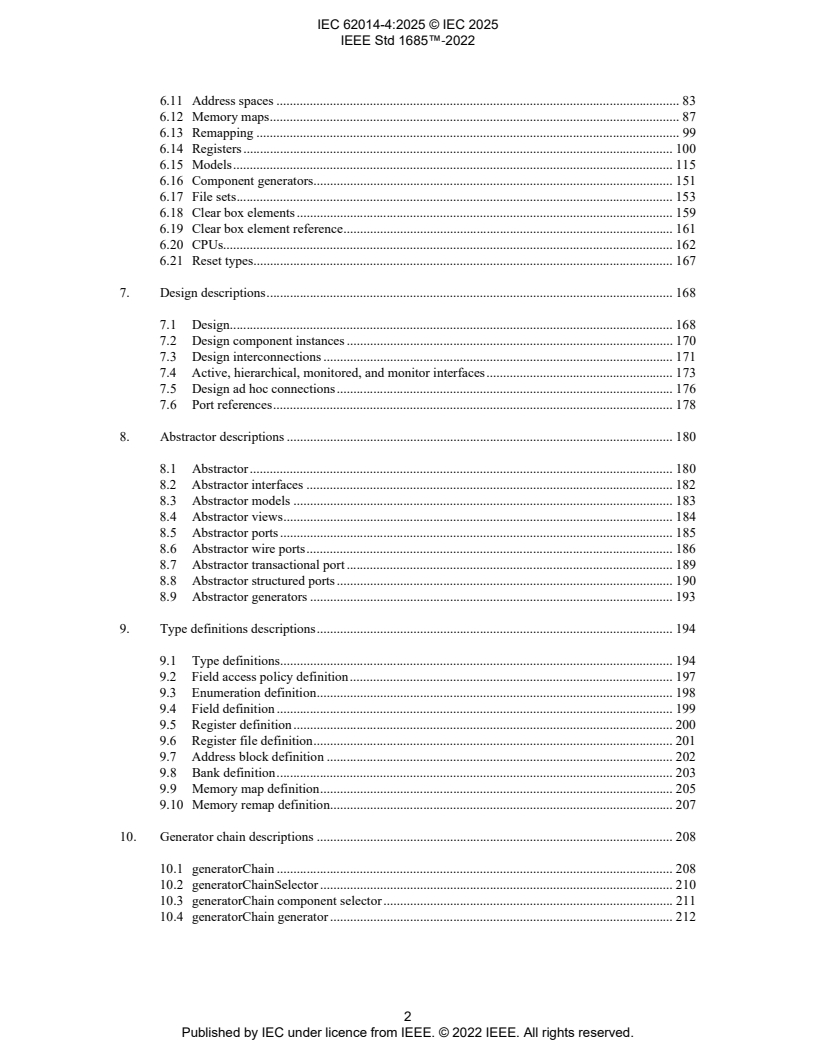
6.11 Address spaces . 83
6.12 Memory maps. 87
6.13 Remapping . 99
6.14 Registers. 100
6.15 Models. 115
6.16 Component generators. 151
6.17 File sets. 153
6.18 Clear box elements. 159
6.19 Clear box element reference. 161
6.20 CPUs. 162
6.21 Reset types. 167
7. Design descriptions. 168
7.1 Design. 168
7.2 Design component instances . 170
7.3 Design interconnections . 171
7.4 Active, hierarchical, monitored, and monitor interfaces. 173
7.5 Design ad hoc connections. 176
7.6 Port references. 178
8. Abstractor descriptions . 180
8.1 Abstractor. 180
8.2 Abstractor interfaces . 182
8.3 Abstractor models . 183
8.4 Abstractor views. 184
8.5 Abstractor ports. 185
8.6 Abstractor wire ports. 186
8.7 Abstractor transactional port . 189
8.8 Abstractor structured ports. 190
8.9 Abstractor generators . 193
9. Type definitions descriptions. 194
9.1 Type definitions. 194
9.2 Field access policy definition. 197
9.3 Enumeration definition. 198
9.4 Field definition . 199
9.5 Register definition . 200
9.6 Register file definition. 201
9.7 Address block definition . 202
9.8 Bank definition. 203
9.9 Memory map definition. 205
9.10 Memory remap definition. 207
10. Generator chain descriptions . 208
10.1 generatorChain . 208
10.2 generatorChainSelector . 210
10.3 generatorChain component selector . 211
10.4 generatorChain generator . 212
Published by IEC under licence from IEEE. © 2022 IEEE. All rights reserved.
IEEE Std 1685™‐2022
11. Design configuration descriptions . 214
11.1 Design configuration. 214
11.2 designConfiguration . 215
11.3 interconnectionConfiguration. 216
11.4 abstractorInstance. 217
11.5 viewConfiguration. 218
12. Catalog descriptions. 219
12.1 catalog . 219
12.2 ipxactFile. 221
13. Addressing . 222
13.1 Calculating the bit address of a bit in a memory map or address space. 222
13.2 Calculating the bus address at the bus interface. 224
13.3 Calculating the address at the indirect interface. 224
13.4 Address modifications of a channel . 225
13.5 Address translation in a bridge. 225
14. Data visibility. 226
14.1 Mapped address bits mask. 226
14.2 Address modifications of an interconnection. 226
14.3 Bit steering in a channel. 226
14.4 Visibility of bits. 227
Annex A Bibliography . 230
Annex B Semantic consistency rules . 231
B.1 Semantic consistency rule definitions. 231
B.1.1 Compatibility of busDefinitions. 231
B.1.2 Interface mode of a bus interface . 231
B.1.3 Compatibility of abstractionDefinitions. 231
B.1.4 Element referenced by configurableElementValue element. 231
B.1.5 Memory mapping . 231
B.1.6 Port connection equivalence class. 232
B.1.7 Logical and physical ports. 232
B.1.8 Addressable bus interface. 232
B.1.9 Field connection graph . 232
B.2 Rule listings . 234
B.2.1 Cross-references and VLNVs . 234
B.2.2 Interconnections . 238
B.2.3 Channels, bridges, and abstractors . 240
B.2.4 Monitor interfaces and monitor interconnections . 243
B.2.5 Configurable elements . 244
B.2.6 Ports . 247
B.2.7 Registers . 255
B.2.8 Memory maps . 259
B.2.9 Addressing . 260
B.2.10 Hierarchy . 261
B.2.11 Hierarchy and memory maps . 262
Published by IEC under licence from IEEE. © 2022 IEEE. All rights reserved.
IEEE Std 1685™‐2022
B.2.12 Constraints . 262
B.2.13 Design configurations . 264
B.2.14 Expressions . 265
B.2.15 Access handles . 268
Annex C Common elements and concepts. 269
C.1 accessHandles . 269
C.1.1 simpleAccessHandle . 269
C.1.2 slicedAccessHandle. 270
C.1.3 portAccessHandle. 271
C.1.4 sliceType . 272
C.1.5 portSliceType . 272
C.2 accessPolicies. 273
C.2.1 Schema . 273
C.2.2 Description . 273
C.3 Access resolution . 274
C.4 arrays. 275
C.4.1 Configurable arrays with arrayId . 275
C.4.2 Configurable arrays without arrayId . 276
C.4.3 Memory arrays with stride . 276
C.4.4 Field arrays with bit stride. 277
C.5 assertions. 278
C.5.1 Schema . 278
C.5.2 Description . 278
C.6 attributes. 279
C.6.1 Schema . 279
C.6.2 Description . 280
C.7 complexBaseExpression . 281
C.7.1 complexTiedValueExpression . 282
C.7.2 qualifiedExpression. 282
C.7.3 realExpression . 283
C.7.4 signedLongintExpression . 284
C.7.5 stringExpression . 285
C.7.6 unresolvedStringExpression. 285
C.7.7 unresolvedUnsignedBitExpression . 286
C.7.8 unresolvedUnsignedPositiveIntExpression. 286
C.7.9 unsignedBitExpression. 287
C.7.10 unsignedBitVectorExpression. 287
C.7.11 unsignedIntExpression . 288
C.7.12 unsignedLongintExpression . 289
C.7.13 unsignedPositiveIntExpression . 290
C.7.14 unsignedPositiveLongintExpression . 291
C.8 choices . 292
C.8.1 Schema . 292
C.9 configurableElementValues. 293
C.9.1 Schema . 293
C.9.2 Description . 293
C.10 configurableLibraryRefType . 294
C.10.1 Schema . 294
C.10.2 Description . 294
C.11 documentName group. 295
C.11.1 Schema . 295
C.11.2 Description . 295
Published by IEC under licence from IEEE. © 2022 IEEE. All rights reserved.
IEEE Std 1685™‐2022
C.12 Endianness . 296
C.13 fieldReferenceGroup. 297
C.13.1 Schema . 297
C.13.2 Description . 297
C.14 fieldSliceReferenceGroup. 299
C.14.1 Schema . 299
C.14.2 Description . 300
C.15 fileSetRef . 300
C.15.1 Schema . 300
C.15.2 Description . 301
C.16 fileType. 301
C.16.1 Schema . 301
C.16.2 Description . 301
C.17 indices . 302
C.17.1 Schema . 302
C.17.2 Description . 302
C.18 libraryRefType. 303
C.18.1 Schema . 303
C.18.2 Description . 303
C.19 Name groups . 304
C.19.1 nameGroup group. 304
C.19.2 nameGroupNMTOKEN group. 305
C.19.3 nameGroupOptional group. 306
C.19.4 nameGroupPort group . 307
C.19.5 nameGroupString group. 308
C.20 nameValuePairType. 308
C.20.1 Schema . 308
C.20.2 Description . 309
C.21 parameters. 309
C.21.1 Schema . 309
C.21.2 Description . 309
C.22 partSelect . 310
C.22.1 Schema . 310
C.22.2 Description . 310
C.23 pathSegments . 311
C.23.1 pathSegment . 311
C.23.2 portPathSegment . 311
C.24 Power constraints. 312
C.24.1 transactionalPowerConstraints . 312
C.24.2 wirePowerConstraints . 312
C.25 range. 313
C.25.1 Schema . 313
C.25.2 Description . 313
C.26 Vectors . 314
C.26.1 vectors . 314
C.26.2 extendedVectorsType. 314
C.27 vendorExtensions. 315
C.27.1 Schema . 315
C.27.2 Description . 315
C.28 versionedIdentifier group. 315
C.28.1 Schema . 315
C.28.2 Description . 316
C.28.3 Sorting and comparing version elements . 316
C.28.4 Version control. 317
Published by IEC under licence from IEEE. © 2022 IEEE. All rights reserved.
IEEE Std 1685™‐2022
C.29 viewRef. 318
C.29.1 Schema . 318
C.29.2 Description . 318
C.30 xml:id . 318
C.31 Component vs. Abstraction Definition Ports. 318
Annex D Types. 320
D.1 boolean. 320
D.2 float . 320
D.3 ID or IDREF . 320
D.4 instancePath . 320
D.5 integer . 320
D.6 libraryRefType. 320
D.7 Name. 320
D.8 NMTOKEN . 321
D.9 NMTOKENS . 321
D.10 portName . 321
D.11 ipxactURI. 321
D.12 string . 321
D.13 token. 321
Annex E SystemVerilog expressions. 322
E.1 Overview. 322
E.2 Data-types . 322
E.2.1 bit data type . 322
E.2.2 byte data type . 322
E.2.3 shortint data type . 323
E.2.4 int data type . 323
E.2.5 longint data type . 323
E.2.6 shortreal data type . 323
E.2.7 real data type . 323
E.2.8 string data type . 323
E.2.9 Signed and unsigned data types . 324
E.2.10 Unresolved data types . 324
E.3 Assignments. 324
E.3.1 Single value assignment . 324
E.3.2 Parameter type. 324
E.3.3 Parameter signing. 325
E.3.4 Vector assignment . 325
E.3.5 Array assignment. 325
E.3.6 Identifiers . 326
E.3.7 Identifier references. 326
E.4 Operators. 328
E.5 Functions. 329
E.5.1 Integer function . 329
E.5.2 Real functions. 329
E.5.3 String function. 330
E.5.4 IP-XACT specific functions. 332
E.5.5 IP-XACT specific escape sequences. 334
E.6 Expression language formal syntax (BNF). 335
E.6.1 Declarations: declaration data types. 335
E.6.2 Behavioral statements: Case statements. 335
Published by IEC under licence from IEEE. © 2022 IEEE. All rights reserved.
IEEE Std 1685™‐2022
E.6.3 Expressions. 336
E.6.4 General: Identifiers. 337
E.7 SystemVerilog conversion steps. 338
E.7.1 Convert parameter . 338
E.7.2 Convert expression. 338
E.8 SystemVerilog reference. 338
Annex F Tight generator interface. 341
F.1 Method of communication. 341
F.2 Generator invocation. 341
F.2.1 Resolving the URL. 342
F.2.2 Example. 342
F.3 TGI API . 343
F.3.1 TGI fault codes. 344
F.3.2 Administrative commands. 344
F.3.3 Return values. 345
F.4 IDs and configurable values . 345
F.5 TGI messages. 346
F.6 Vendor attributes. 346
F.7 TGI calls . 346
F.7.1 Category index .
...