

IEC 62567:2013
(Main)Overhead lines - Methods for testing self-damping characteristics of conductors
General Information
- Abstract
IEC 62567:2013 provides test procedures based on the documents mentioned in the introduction and devoted to minimize the causes of discrepancy between test results, taking into consideration the large experience accumulated in the last 30 years by numerous test engineers and available in literature, including a CIGRE Technical Brochure specifically referring to this standard (see Bibliography). This Standard describes the current methodologies, including apparatus, procedures and accuracies, for the measurement of conductor self-damping and for the data reduction formats. In addition, some basic guidance is also provided to inform the potential user of a given method's strengths and weaknesses. The methodologies and procedures incorporated in this Standard are applicable only to testing on indoor laboratory spans. Key words: Overhead lines, Self-damping, Conductors
- Status
- Published
- Publication Date
- 11-Sep-2013
- Technical Committee
- TC 7 - Overhead electrical conductors
- Drafting Committee
- PT 62567 - TC 7/PT 62567
- Current Stage
- PPUB - Publication issued
- Start Date
- 12-Sep-2013
- Completion Date
- 30-Sep-2013
Overview
IEC 62567:2013 is an international standard developed by the International Electrotechnical Commission (IEC) that specifies standardized methods for testing the self-damping characteristics of conductors used in overhead power lines. Self-damping is a critical property influencing conductor behavior under wind-induced vibrations and affects the operational reliability and longevity of overhead transmission lines.
The standard provides detailed procedures, apparatus specifications, and data evaluation methods for conducting self-damping tests on conductor samples within controlled indoor laboratory spans. These methodologies are grounded in over 30 years of cumulative experience and aim to harmonize testing results by minimizing discrepancies across different laboratories and practices.
Key Topics
Self-Damping in Conductors: Self-damping refers to a conductor's inherent ability to dissipate energy internally during vibrations, primarily attributed to frictional effects between individual wire strands within the conductor and, to a lesser extent, hysteresis at the molecular level.
Testing Methods: IEC 62567 outlines three accepted methods for measuring self-damping:
Power Method (Forced Vibration): Measures power dissipated by the conductor through forced resonant vibrations at multiple harmonics, analyzing the energy required to maintain vibration.
Inverse Standing Wave Ratio (ISWR) Method (Forced Vibration): Assesses nodal and antinodal vibration amplitudes to estimate power dissipation characteristics without direct force measurement.
Decay Method (Free Vibration): Observes how vibration amplitude decays over time after initial forced excitation, providing insight into energy dissipation rates.
Test Setup and Apparatus: The standard defines key components and arrangements, such as span terminations, types of shakers, and connection methods (rigid or flexible) between the shaker and conductor. It also details transducers and measurement device specifications necessary for accurate data collection.
Data Reduction and Reporting: IEC 62567 specifies standardized data formats and provides recommendations for correcting extraneous effects like aerodynamic damping and phase shifts between measurement devices to ensure reliable interpretation of self-damping parameters.
Strengths and Weaknesses: The document offers guidance on choosing the appropriate method depending on laboratory capabilities and application needs, acknowledging each method’s advantages and limitations.
Applications
Overhead Transmission Line Design: Accurate self-damping data supports the design of conductors and dampers that mitigate wind-induced vibrations, improving the mechanical integrity and reliability of overhead lines.
Quality Control and R&D: Manufacturers and researchers use these standardized tests to characterize new conductor types and verify compliance with design specifications, especially important for novel conductor constructions differing from conventional stranded types.
Performance Assessment: Power utilities and testing laboratories leverage these methods to evaluate conductor aging effects and performance under varying environmental conditions.
Standardization and Industry Harmonization: By unifying testing methodologies, IEC 62567 enables more consistent comparisons of self-damping characteristics across different products, laboratories, and geographic regions.
Related Standards
CIGRE Technical Brochures: The IEC standard references comprehensive technical documents produced by CIGRE (International Council on Large Electric Systems) that align with and complement its methodologies.
IEEE Std. 563-1978: An earlier guide on conductor self-damping measurements jointly developed by IEEE and CIGRE, providing foundational test methods later incorporated and refined in IEC 62567.
IEC Standards on Overhead Lines: Other IEC standards dealing with overhead conductor specifications, vibration mitigation devices, and mechanical testing complement IEC 62567 to ensure comprehensive assessment of conductor performance.
IEC 62567:2013 plays a pivotal role in advancing the precision and uniformity of self-damping measurements for overhead line conductors, fostering enhanced understanding and better-performing transmission infrastructure worldwide. It is an essential reference for test engineers, manufacturers, utilities, and research institutions focused on overhead power line reliability and innovation.
Get Certified
Connect with accredited certification bodies for this standard

IMQ S.p.A. (Certification)
Italian electrical product certification.

SLG Prüf- und Zertifizierungs GmbH
German testing and certification body.

UL Solutions
Global safety science company with testing, inspection and certification.
Sponsored listings
Frequently Asked Questions
IEC 62567:2013 is a standard published by the International Electrotechnical Commission (IEC). Its full title is "Overhead lines - Methods for testing self-damping characteristics of conductors". This standard covers: IEC 62567:2013 provides test procedures based on the documents mentioned in the introduction and devoted to minimize the causes of discrepancy between test results, taking into consideration the large experience accumulated in the last 30 years by numerous test engineers and available in literature, including a CIGRE Technical Brochure specifically referring to this standard (see Bibliography). This Standard describes the current methodologies, including apparatus, procedures and accuracies, for the measurement of conductor self-damping and for the data reduction formats. In addition, some basic guidance is also provided to inform the potential user of a given method's strengths and weaknesses. The methodologies and procedures incorporated in this Standard are applicable only to testing on indoor laboratory spans. Key words: Overhead lines, Self-damping, Conductors
IEC 62567:2013 provides test procedures based on the documents mentioned in the introduction and devoted to minimize the causes of discrepancy between test results, taking into consideration the large experience accumulated in the last 30 years by numerous test engineers and available in literature, including a CIGRE Technical Brochure specifically referring to this standard (see Bibliography). This Standard describes the current methodologies, including apparatus, procedures and accuracies, for the measurement of conductor self-damping and for the data reduction formats. In addition, some basic guidance is also provided to inform the potential user of a given method's strengths and weaknesses. The methodologies and procedures incorporated in this Standard are applicable only to testing on indoor laboratory spans. Key words: Overhead lines, Self-damping, Conductors
IEC 62567:2013 is classified under the following ICS (International Classification for Standards) categories: 29.060.01 - Electrical wires and cables in general; 29.240.20 - Power transmission and distribution lines. The ICS classification helps identify the subject area and facilitates finding related standards.
IEC 62567:2013 is available in PDF format for immediate download after purchase. The document can be added to your cart and obtained through the secure checkout process. Digital delivery ensures instant access to the complete standard document.
Standards Content (Sample)
IEC 62567 ®
Edition 1.0 2013-09
INTERNATIONAL
STANDARD
NORME
INTERNATIONALE
colour
inside
Overhead lines – Methods for testing self-damping characteristics of conductors
Lignes électriques aériennes – Méthodes d'essai des caractéristiques d'auto-
amortissement des conducteurs
All rights reserved. Unless otherwise specified, no part of this publication may be reproduced or utilized in any form
or by any means, electronic or mechanical, including photocopying and microfilm, without permission in writing from
either IEC or IEC's member National Committee in the country of the requester.
If you have any questions about IEC copyright or have an enquiry about obtaining additional rights to this publication,
please contact the address below or your local IEC member National Committee for further information.
Droits de reproduction réservés. Sauf indication contraire, aucune partie de cette publication ne peut être reproduite ni
utilisée sous quelque forme que ce soit et par aucun procédé, électronique ou mécanique, y compris la photocopie et les
microfilms, sans l'accord écrit de la CEI ou du Comité national de la CEI du pays du demandeur.
Si vous avez des questions sur le copyright de la CEI ou si vous désirez obtenir des droits supplémentaires sur cette
publication, utilisez les coordonnées ci-après ou contactez le Comité national de la CEI de votre pays de résidence.
IEC Central Office Tel.: +41 22 919 02 11
3, rue de Varembé Fax: +41 22 919 03 00
CH-1211 Geneva 20 info@iec.ch
Switzerland www.iec.ch
About the IEC
The International Electrotechnical Commission (IEC) is the leading global organization that prepares and publishes
International Standards for all electrical, electronic and related technologies.
About IEC publications
The technical content of IEC publications is kept under constant review by the IEC. Please make sure that you have the
latest edition, a corrigenda or an amendment might have been published.
Useful links:
IEC publications search - www.iec.ch/searchpub Electropedia - www.electropedia.org
The advanced search enables you to find IEC publications The world's leading online dictionary of electronic and
by a variety of criteria (reference number, text, technical electrical terms containing more than 30 000 terms and
committee,…). definitions in English and French, with equivalent terms in
It also gives information on projects, replaced and additional languages. Also known as the International
withdrawn publications. Electrotechnical Vocabulary (IEV) on-line.
IEC Just Published - webstore.iec.ch/justpublished Customer Service Centre - webstore.iec.ch/csc
Stay up to date on all new IEC publications. Just Published If you wish to give us your feedback on this publication
details all new publications released. Available on-line and or need further assistance, please contact the
also once a month by email. Customer Service Centre: csc@iec.ch.
A propos de la CEI
La Commission Electrotechnique Internationale (CEI) est la première organisation mondiale qui élabore et publie des
Normes internationales pour tout ce qui a trait à l'électricité, à l'électronique et aux technologies apparentées.
A propos des publications CEI
Le contenu technique des publications de la CEI est constamment revu. Veuillez vous assurer que vous possédez
l’édition la plus récente, un corrigendum ou amendement peut avoir été publié.
Liens utiles:
Recherche de publications CEI - www.iec.ch/searchpub Electropedia - www.electropedia.org
La recherche avancée vous permet de trouver des Le premier dictionnaire en ligne au monde de termes
publications CEI en utilisant différents critères (numéro de électroniques et électriques. Il contient plus de 30 000
référence, texte, comité d’études,…). termes et définitions en anglais et en français, ainsi que
Elle donne aussi des informations sur les projets et les les termes équivalents dans les langues additionnelles.
publications remplacées ou retirées. Egalement appelé Vocabulaire Electrotechnique
International (VEI) en ligne.
Just Published CEI - webstore.iec.ch/justpublished
Service Clients - webstore.iec.ch/csc
Restez informé sur les nouvelles publications de la CEI.
Just Published détaille les nouvelles publications parues. Si vous désirez nous donner des commentaires sur
Disponible en ligne et aussi une fois par mois par email. cette publication ou si vous avez des questions
contactez-nous: csc@iec.ch.
IEC 62567 ®
Edition 1.0 2013-09
INTERNATIONAL
STANDARD
NORME
INTERNATIONALE
colour
inside
Overhead lines – Methods for testing self-damping characteristics of
conductors
Lignes électriques aériennes – Méthodes d'essai des caractéristiques d'auto-
amortissement des conducteurs
INTERNATIONAL
ELECTROTECHNICAL
COMMISSION
COMMISSION
ELECTROTECHNIQUE
PRICE CODE
INTERNATIONALE
CODE PRIX W
ICS 29.060; 29.240.20 ISBN 978-2-8322-1056-7
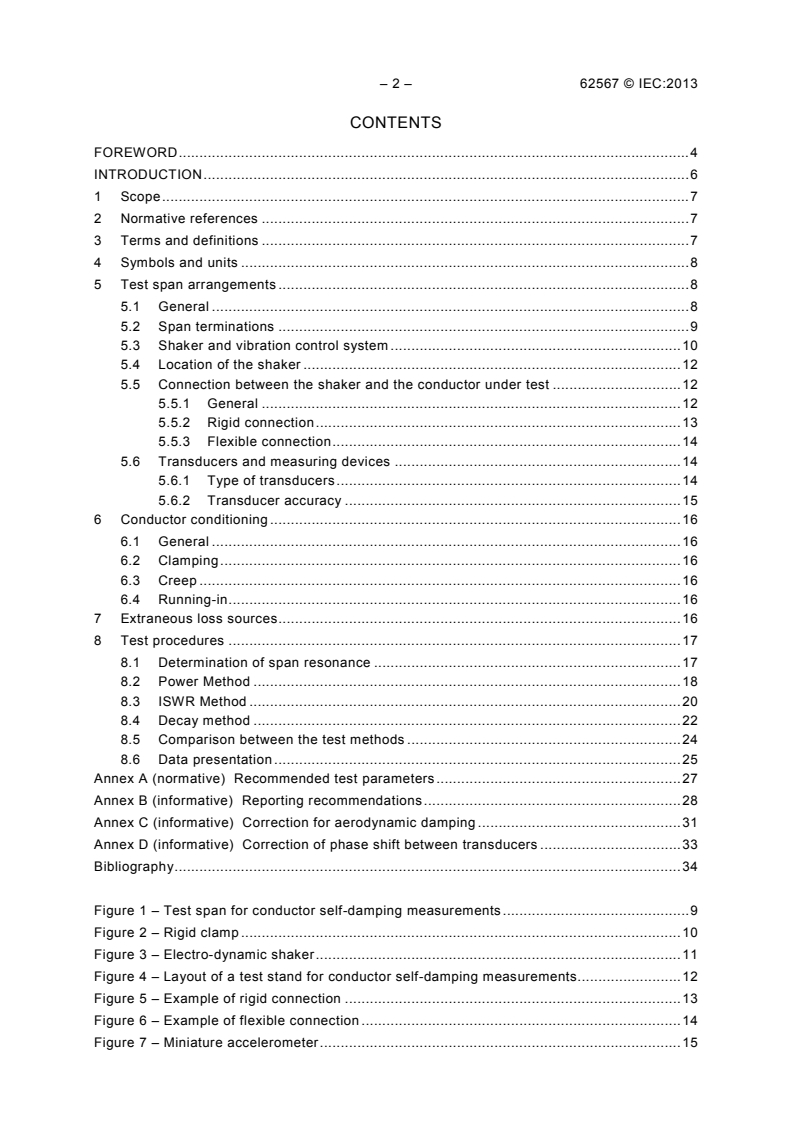
– 2 – 62567 © IEC:2013
CONTENTS
FOREWORD . 4
INTRODUCTION . 6
1 Scope . 7
2 Normative references . 7
3 Terms and definitions . 7
4 Symbols and units . 8
5 Test span arrangements . 8
5.1 General . 8
5.2 Span terminations . 9
5.3 Shaker and vibration control system . 10
5.4 Location of the shaker . 12
5.5 Connection between the shaker and the conductor under test . 12
5.5.1 General . 12
5.5.2 Rigid connection . 13
5.5.3 Flexible connection . 14
5.6 Transducers and measuring devices . 14
5.6.1 Type of transducers . 14
5.6.2 Transducer accuracy . 15
6 Conductor conditioning . 16
6.1 General . 16
6.2 Clamping . 16
6.3 Creep . 16
6.4 Running-in . 16
7 Extraneous loss sources . 16
8 Test procedures . 17
8.1 Determination of span resonance . 17
8.2 Power Method . 18
8.3 ISWR Method . 20
8.4 Decay method . 22
8.5 Comparison between the test methods . 24
8.6 Data presentation . 25
Annex A (normative) Recommended test parameters . 27
Annex B (informative) Reporting recommendations . 28
Annex C (informative) Correction for aerodynamic damping . 31
Annex D (informative) Correction of phase shift between transducers . 33
Bibliography . 34
Figure 1 – Test span for conductor self-damping measurements . 9
Figure 2 – Rigid clamp . 10
Figure 3 – Electro-dynamic shaker . 11
Figure 4 – Layout of a test stand for conductor self-damping measurements . 12
Figure 5 – Example of rigid connection . 13
Figure 6 – Example of flexible connection . 14
Figure 7 – Miniature accelerometer . 15
62567 © IEC:2013 – 3 –
Figure 8 – Resonant condition detected by the acceleration and force signals . 18
Figure 9 – Fuse wire system disconnecting a shaker from a test span; this double
exposure shows the mechanism both closed and open. . 23
Figure 10 – A decay trace . 24
Figure B.1 – Example of conductor power dissipation characteristics . 29
Figure B.2 – Example of conductor power dissipation characteristics . 30
Table 1 – Comparison of laboratory methods . 25
Table 2 – Comparison of Conductor Self-damping Empirical Parameters . 26
Table C.1 – Coefficients to be used with equation C-3 . 32
– 4 – 62567 © IEC:2013
INTERNATIONAL ELECTROTECHNICAL COMMISSION
____________
OVERHEAD LINES – METHODS FOR TESTING SELF-DAMPING
CHARACTERISTICS OF CONDUCTORS
FOREWORD
1) The International Electrotechnical Commission (IEC) is a worldwide organization for standardization comprising
all national electrotechnical committees (IEC National Committees). The object of IEC is to promote
international co-operation on all questions concerning standardization in the electrical and electronic fields. To
this end and in addition to other activities, IEC publishes International Standards, Technical Specifications,
Technical Reports, Publicly Available Specifications (PAS) and Guides (hereafter referred to as “IEC
Publication(s)”). Their preparation is entrusted to technical committees; any IEC National Committee interested
in the subject dealt with may participate in this preparatory work. International, governmental and non-
governmental organizations liaising with the IEC also participate in this preparation. IEC collaborates closely
with the International Organization for Standardization (ISO) in accordance with conditions determined by
agreement between the two organizations.
2) The formal decisions or agreements of IEC on technical matters express, as nearly as possible, an international
consensus of opinion on the relevant subjects since each technical committee has representation from all
interested IEC National Committees.
3) IEC Publications have the form of recommendations for international use and are accepted by IEC National
Committees in that sense. While all reasonable efforts are made to ensure that the technical content of IEC
Publications is accurate, IEC cannot be held responsible for the way in which they are used or for any
misinterpretation by any end user.
4) In order to promote international uniformity, IEC National Committees undertake to apply IEC Publications
transparently to the maximum extent possible in their national and regional publications. Any divergence
between any IEC Publication and the corresponding national or regional publication shall be clearly indicated in
the latter.
5) IEC itself does not provide any attestation of conformity. Independent certification bodies provide conformity
assessment services and, in some areas, access to IEC marks of conformity. IEC is not responsible for any
services carried out by independent certification bodies.
6) All users should ensure that they have the latest edition of this publication.
7) No liability shall attach to IEC or its directors, employees, servants or agents including individual experts and
members of its technical committees and IEC National Committees for any personal injury, property damage or
other damage of any nature whatsoever, whether direct or indirect, or for costs (including legal fees) and
expenses arising out of the publication, use of, or reliance upon, this IEC Publication or any other IEC
Publications.
8) Attention is drawn to the Normative references cited in this publication. Use of the referenced publications is
indispensable for the correct application of this publication.
9) Attention is drawn to the possibility that some of the elements of this IEC Publication may be the subject of
patent rights. IEC shall not be held responsible for identifying any or all such patent rights.
International Standard IEC 62567 has been prepared by IEC technical committee 7: Overhead
electrical conductors.
The text of this standard is based on the following documents:
FDIS Report on voting
7/629/FDIS 7/630/RVD
Full information on the voting for the approval of this standard can be found in the report on
voting indicated in the above table.
This publication has been drafted in accordance with the ISO/IEC Directives, Part 2.
62567 © IEC:2013 – 5 –
The committee has decided that the contents of this publication will remain unchanged until
the stability date indicated on the IEC web site under "http://webstore.iec.ch" in the data
related to the specific publication. At this date, the publication will be
• reconfirmed,
• withdrawn,
• replaced by a revised edition, or
• amended.
IMPORTANT – The 'colour inside' logo on the cover page of this publication indicates
that it contains colours which are considered to be useful for the correct
understanding of its contents. Users should therefore print this document using a
colour printer.
– 6 – 62567 © IEC:2013
INTRODUCTION
Conductor self-damping is a physical characteristic of the conductor that defines its capacity
to dissipate energy internally while vibrating. For conventional stranded conductors, energy
dissipation can be attributed partly to inelastic effects within the body of the wires (hysteresis
damping at the molecular level) but mostly to frictional damping, due to small relative
movements between overlapping individual wires, as the conductor flexes with the vibration
wave shape.
Self-damping capacity is an important characteristic of the conductors for overhead
transmission lines. This parameter is a principal factor in determining the response of a
conductor to alternating forces induced by the wind.
As the conductor self-damping is generally not specified by the manufacturer, it can be
determined through measurements performed on a laboratory test span. Semi-empirical
methods to estimate the self-damping parameters of untested conventional stranded
conductors are also available but often lead to different results. Further, a great variety of new
conductor types is increasingly used on transmission lines and some of them may have self-
damping characteristics and mechanisms different from the conventional stranded conductors.
A “Guide on conductor self-damping measurements” was prepared jointly in the past by the
IEEE Task Force on Conductor Vibration and CIGRE SC22 WG01, to promote uniformity in
measuring procedures. The Guide was published by IEEE as Std. 563-1978 and also by
CIGRE in Electra n°62-1979.
Three main methods are recognized in the above documents and divided into two main
categories which are usually referred to as the "forced vibration" and ''free vibration" methods.
The first forced vibration method is the “Power [Test] Method” in which the conductor is forced
into resonant vibrations, at a number of tunable harmonics, and the total power dissipated by
the vibrating conductor is measured at the point of attachment to the shaker.
The second forced vibration method, known as the “Standing Wave Method” or more precisely
“Inverse Standing Wave Ratio [Test] Method” (ISWR), determines the power dissipation
characteristics of a conductor by the measurement of antinodal and nodal amplitudes on the
span, for a number of tunable harmonics.
The free vibration method named “Decay [Test] Method” determines the power dissipation
characteristics of a conductor by measuring, at a number of tunable harmonics, the decay rate
of the free motion amplitude following a period of forced vibration.
Several laboratories around the world have performed conductor self-damping measurements
in accordance with the above mentioned Guide. However, large disparities in self-damping
predictions have been found among the results supplied by the various laboratories. The
causes of these disparities have been identified into five main points:
1) The different test methods adopted for the self-damping measurements.
2) The different span end conditions set up in the various test laboratories (rigid clamps,
flexure members, etc.)
3) The different types of connection between the shaker and the conductor (rigid or flexible)
and the different location of the power input point along the span.
4) The different conductor conditioning before the test (creep, running in, etc.)
5) The different manufacturing processes of the conductor.
62567 © IEC:2013 – 7 –
OVERHEAD LINES – METHODS FOR TESTING SELF-DAMPING
CHARACTERISTICS OF CONDUCTORS
1 Scope
The scope of this Standard is to provide test procedures based on the above-mentioned
documents and devoted to minimize the causes of discrepancy between test results, taking
into consideration the large experience accumulated in the last 30 years by numerous test
engineers and available in literature, including a CIGRE Technical Brochure specifically
referring to this standard (see Bibliography).
This Standard describes the current methodologies, including apparatus, procedures and
accuracies, for the measurement of conductor self-damping and for the data reduction formats.
In addition, some basic guidance is also provided to inform the potential user of a given
method's strengths and weaknesses.
The methodologies and procedures incorporated in this Standard are applicable only to
testing on indoor laboratory spans.
2 Normative references
The following documents, in whole or in part, are normatively referenced in this document and
are indispensable for its application. For dated references, only the edition cited applies. For
undated references, the latest edition of the referenced document (including any
amendments) applies.
IEC 60050-466:1990, International Electrotechnical Vocabulary. Chapter 466: Overhead lines
IEEE Std. 563-1978, IEEE Guide on conductor self-damping measurements
IEEE Std. 664-1993, IEEE Guide for laboratory measurement of the power dissipation
characteristics of aeolian vibration dampers for single conductors
3 Terms and definitions
For the purpose of this International Standard, the definitions of the International
Electrotechnical Vocabulary (IEV) apply, in particular IEC 60050-466. Those which differ or do
not appear in the IEV are given below.
3.1
conductor self-damping:
the self-damping of a conductor subjected to a tensile load T is defined by the power P
c
dissipated per unit length by the conductor vibrating in a natural mode, with a loop length λ/2,
an antinode displacement amplitude Y and a frequency f
3.2
node
in a vibrating conductor, nodes are the points in which the vibration amplitude is the smallest
3.3
anti-node
in a vibrating conductor, anti-nodes are the points in which the vibration amplitude is the
greatest
– 8 – 62567 © IEC:2013
4 Symbols and units
A
forcing point transverse acceleration, single amplitude m/s
th
a vibration amplitude at the n node mm
n
D,d diameter of the conductor m
δ logarithmic decrement
E total energy dissipated by the vibrating conductor Joule
diss
E total kinetic energy of the vibrating conductor Joule
kin
F single amplitude exciting force N
f vibration frequency Hz
h non dimensional viscous damping coefficient
L free length of the test span m
λ wavelength m
λ/2 loop length m
m conductor mass per unit length kg/m
n number of vibrating loops in the span
n number of vibration cycles
c
n
number of loops between loop k and loop j
kj
P power dissipated by the conductor mW
P power dissipated by the conductor per unit length mW/m
c
P power dissipated by the conductor, measured at loop j mW
j
P power dissipated by the conductor, measured at loop k mW
k
θ phase angle between force and acceleration deg
a
θ phase angle between force and displacement deg
d
θ phase angle between force and velocity deg
v
S Inverse standing wave ratio (ISWR) at loop j
j
S Inverse standing wave ratio (ISWR) at loop k
k
th
S
Inverse standing wave ratio (ISWR) at the n loop
n
T conductor tension N
V forcing point transverse velocity, single amplitude m/s
th
V vibration velocity at the n antinode – peak value m/s
n
circular frequency rad
ω
Y
single antinode amplitude at the first decay cycle mm
a
Y vibration single amplitude at the driving point mm
f
th
Y vibration single amplitude at the n antinode mm
n
Y vibration single amplitude at antinode mm
o
Y
z single antinode amplitude at the last decay cycle mm
Tm
characteristic impedance of the conductor N s/m
5 Test span arrangements
5.1 General
The laboratory test spans for conductor self-damping measurements are generally built indoor
in still air areas where the variation of ambient temperature is minimal or can be suitably
controlled. Ambient temperature variations up to 0,2 °C/h are considered acceptable.
62567 © IEC:2013 – 9 –
The free span length L should preferably be at least ten times longer than the longest loop
length used in the tests. For consistent results, a span length greater than 40m is
recommended but satisfactory results can be obtained with spans in the range of 30m. For
shorter spans, the influence of the termination losses and the distribution of the tensile load
between the conductor strands may be critical.
The test span shall be strung between two massive blocks with a weight not lower than 10 per
cent of the ultimate tensile strength of the largest conductor to be tested. Each block should
be a single piece, generally made of steel reinforced concrete, and preferably be common or
solidly connected with the concrete floor. The stiffness of these blocks should be as high as
possible in order to minimize the losses and provide the maximum reflexion of the waves.
An example of laboratory test span layout is shown in Figure 1.
IEC 2187/13
Figure 1 – Test span for conductor self-damping measurements
5.2 Span terminations
The test span should have the capability of maintaining a constant conductor tension.
Hydraulic and pneumatic cylinders, springs, threaded bars and pivotal balance beams have
been used successfully.
A rigid non-articulating square faced clamp similar to that shown in Figure 2 shall be used to
minimize energy dissipation by the termination fixture. An example of a typical termination
design is also provided in Figure 3 of IEEE Std. 563-1978. Terminating fixtures and rigid
clamps shall be of sufficient stiffness to ensure that energy losses do not occur beyond the
extremities of the free span.
Rigid end clamps (also called heavy clamps), equal to or up to ten times longer than the
conductor diameters and with groove diameters not exceeding by more than 0,25 mm the
diameter of the conductor, have given good results. Generally, the clamp groove is
dimensioned for the biggest conductor to be tested and a set of sleeves is made available to
accommodate smaller conductor diameters.
The rigid clamps shall not be used to maintain tension on the span. However, the rigid
clamps, once closed, will retain some load. Consequently, the tension devices cannot fully
control the conductor tension. Subsequent adjustments, if necessary, shall be performed only
after releasing the rigid clamps.
It is very important to have a good alignment between tension clamps and rigid clamps in the
horizontal direction. In the vertical direction, in order to eliminate the static bending of
conductor at the rigid clamp departure, it may be necessary to incline the rigid clamps
following the catenary angle. This practice, when necessary, would avoid any change in
tensile load when closing or opening the clamps.
– 10 – 62567 © IEC:2013
IEC 2188/13
Figure 2 – Rigid clamp
On a laboratory test span, normally, the wave shape of the end loops differs from the shape of
the free loops and the end loop dissipation is greater than free loop dissipation. As the energy
dissipation of the conductor is, to a first approximation, proportional to the square of its
curvature, it is easy to explain the large dissipation of energy near the end of the span. The
effect is more noticeable at low frequencies where the end loops constitute a higher
proportion of the total number of loops. It further restricts the usefulness of very short indoor
test spans.
Preference should be given to a test arrangement which would minimize energy dissipation at
the span end terminations. If there is uncertainty about this, the energy should be assessed
and eventually accounted for, unless using the ISWR method.
The termination losses may be minimized by terminating the conductor by a flexure member,
such as a wide, flat bar of sufficient strength to accommodate the span tension but also
flexible enough in the vertical direction to allow it to bend readily and to avoid bending the
conductor through a sharp radius of curvature where it would normally enter the clamp. This
procedure has the undesirable effect, though, of including the end termination in the test span.
An example of flexible cantilever is provided in Figure 4 of IEEE Std. 563-1978.
5.3 Shaker and vibration control system
The vibration exciter used for these tests is generally an electro-dynamic shaker (Figure 3).
Hydraulic actuators are also used.
Modal shakers having light armature and linear bearings can be used to excite resonance
modes of the conductor with minimal distortion of the natural mode shape and to produce
virtually zero stiffness and zero damping in the direction of the movement.
The shaker shall be able to provide a suitable sinusoidal force to the test span. The
alternating movement provided by the shaker shall be simple harmonic with a distortion level
of less than 5 %.
Vibration amplitude and frequency shall be controllable to an accuracy of ± 2 % and frequency
shall be stable within 0,001 Hz.
62567 © IEC:2013 – 11 –
IEC 2189/13
Figure 3 – Electro-dynamic shaker
The use of computers and dedicated software for the shaker control and for the data
acquisition, reduction and elaboration is considered as a normal practice.
An example of the layout for the conductor self-damping measurements, fully equipped to
perform the conductor self-damping measurements with the methods outlined in this standard,
is shown in Figure 4.
– 12 – 62567 © IEC:2013
IEC 2190/13
Figure 4 – Layout of a test stand for conductor self-damping measurements
5.4 Location of the shaker
The most used position of the shaker is within one of the end loops of the span, but not
necessarily at an anti-node. This location also makes it possible to excite greater amplitudes
than the maximum travel of the shaker even if a rigid connection between the shaker and the
conductor is used.
The near end location makes it possible to excite odd numbers of loops, as well as even.
Although some span symmetry may be lost due to the presence of the shaker, a centre free
loop will be present for the odd loop excitations. This often makes it possible to conduct
amplitude measurements within the centre loop without being forced to relocate the
transducer for each frequency investigated.
The shaker should be located at a distance from the rigid clamp which is less than the
calculated loop length of the span at the highest test frequency. This will ensure that whole
loops will not be forced to occur between the shaker and the nearest span extremity, because
this may cause erroneous test results. It is preferably to identify a location of the shaker that
can be maintained unchanged for the whole test on one conductor. A wide range of conductor
sizes has been tested with the shaker at a fixed distance from the end clamp of 0,8 to 1,2 m.
5.5 Connection between the shaker and the conductor under test
5.5.1 General
In the artificial excitation of the indoor test span, the armature of the shaker can be connected
to the test span either rigidly or by the use of a flexible connection. In any case, the fixture
shall be as light as possible in order to avoid the introduction of unwanted inertial forces and
to prevent that, at the higher frequencies, the force needed to vibrate that mass plus the
shaker armature will be beyond the capability of the shaker system.
62567 © IEC:2013 – 13 –
To avoid distortion of the mode shape in the conductor vibration, the clamp mass must be as
low as possible and, in resonance conditions, the phase between force and acceleration, at
the driving point, must be as close as possible to 90 °. In this case, the force applied by the
shaker has its minimum and equals the damping force. For angles different from 90 °, inertia
and elastic components are also present and can give rise to distortions.
The shaker connection shall be instrumented for force and vibration level measurements. The
latter is generally made using accelerometers but also velocity transducers and displacement
transducer can be used.
5.5.2 Rigid connection
Rigidly fixing the shaker to the conductor (Figure 5) has a tendency to create distortion in the
standing wave vibration. Care should be taken when establishing span resonance to minimize
this effect.
IEC 2191/13
Figure 5 – Example of rigid connection
Using a rigid connection, the vibration exciter becomes a part of the system being measured;
if the mass of the moving system within the shaker is high, conductor distortion is induced in
that portion of the span where the shaker is attached.
This changes the length of the loop to which the shaker is attached and is indicative of
localized inertial and damping effects. The effect of attaching the shaker to the conductor
should not change the loop length in which the attachment is made by more than 10 %. An
attached mass of less than 20 % of the mass per unit length of the conductor is normally
satisfactory. However, this can only be achieved using modal shakers or adopting a flexible
connection as described in the following paragraph. Otherwise, the ISWR method, that is not
sensitive to localized effects at the shaker as well as in end loops, should be used.
– 14 – 62567 © IEC:2013
5.5.3 Flexible connection
Spring steel bands are often used to reduce distortion of the loop where the shaker is
attached and to allow different conductor amplitudes at the drive point than the amplitude of
the shaker. Suitable flexibility should be present in all directions in order to:
1) uncouple the shaker from the conductor so that possible misalignment between the centre
of the shaker table and the point of attachment of the conductor can be accommodated
and will not risk to damage the shaker armature;
2) prevent the shaker table from being driven by the conductor in resonant conditions where
conductor vibration amplitude can be higher than the shaker amplitude;
3) avoid the introduction of additional inertial and damping effects due to the shaker
armature and conductor attachment.
The stiffness of the springs in the excitation direction should be empirically determined in
accordance with the conductor stiffness and mass. The spring should be soft enough to
uncouple the conductor from the shaker but still able to transmit to the conductor enough
force to excite vibration at the required amplitude.
An example of a flexible connection equipped with force and acceleration transducers is
shown in Figure 6.
Accelerometer
Conductor clamp
Load cell
Spring steel bands
IEC 2192/13
Figure 6 – Example of flexible connection
5.6 Transducers and measuring devices
5.6.1 Type of transducers
The following transducers are used for the self-damping measurements:
A. Load cells: to measure the force transmitted by the shaker to the conductor.
B. Accelerometers, velocity transducers and displacement transducers: to measure the level
of vibration.
In addition, strain gauges are sometimes used to control the tension of the individual wires of
the outer layer and temperature probes may be used for monitoring the ambient and/or
conductor temperature.
There is no limitation or preference regarding the working principle of the transducers,
providing their mass is small enough in order not to interfere with the system. Miniature load
62567 © IEC:2013 – 15 –
cells and miniature accelerometers (Figures 6, 7 and 8) are most commonly used for in-span
measurements.
Contactless displacement transducers (laser or eddy current based) have also been used for
measurements of node and antinode amplitudes, especially with small and light conductors.
Using transducers having a different working principle, for example a piezoelectric
accelerometer and a strain gauge load cell, it is possible to have a phase shift between the
two signals due to the different response time of the two transducers. This phase shift is
frequency dependant and shall be taken into account in the determination of the phase angle
between the measured quantities at each tunable vibration mode. A procedure to calculate
the phase shift at each test frequency is presented in Annex D.
In a computer controlled test system, the data acquisition software can be set up to perform
automatically the phase shift correction. In any case, for the sake of simplicity, it is
recommended to use transducers having the same working principle so that no phase shift
correction will be required.
IEC 2193/13
Figure 7 – Miniature accelerometer
5.6.2 Transducer accuracy
All the transducers used for the tests shall be checked for phase accuracy and linearity over
the anticipated testing frequency range. The transducers shall be mounted on a shaker table
and a small mass shall be rigidly attached on the force transducer. The transducers shall be
shaken at all proposed test frequencies, and at approximately the amplitudes chosen for the
conductor test. Correct operation of the transducers is demonstrated by two criteria: (1) the
phase angle between force and acceleration (or displacement) should be at or near zero
degrees and (2) the ratio of force to acceleration (F/A) should be constant at all frequencies
and amplitudes. F/A, is the effective mass installed on the force transducer. If velocity
transducers are used, the phase angle between force and velocity should be at or near 90
degrees and acceleration can be obtained by the derivative of the velocity signal acquired.
Deviations of the phase values up to ± 5 degrees are acceptable.
– 16 – 62567 © IEC:2013
The test verifies (1) that there is no spurious phase shifting due to effects of fixtures,
transducers and signal conditioning devices and (2) that the transducers are linear with
respect to frequency and vibration amplitude. This is important especially for the transducers
used for the measurement of the power imparted to the conductor by the shaker.
6 Conductor conditioning
6.1 General
Unless otherwise specified, the conductor under test shall be unused.
Before the installation on the test span, any looseness in the conductor layers should be
worked out.
After that, the conductor is clamped and should be conditioned as described in the following.
6.2 Clamping
The terminations of the conductor under test can be made using compression dead end joints,
or bolted dead end clamps. Wedge type tension clamps and potted (resin) terminations can
also be used.
If compression end fittings are used, then they shall be reverse compressed (starting from the
clamp mouth rather than from the end of the conductor) to prevent looseness from being
worked back into the span.
6.3 Creep
After the installation of an unused conductor on the test span, a pre-stretching shall be
performed in order to accomplish most of the metallurgic creep and the geometrical
settlement of the conductor and distribute the tensile load more uniformly in the conductor
strands. The pre-stretching consists in keeping the conductor at a tension equal or higher
than the test tension for period of time, generally 12 to 48 hours. The tension to be applied
during the preconditioning shall be established in accordance with the service parameters of
the conductor.
The preconditioning will be considered sufficiently settled when the tension of the still
conductor does not change more than 3 to 4 % in 30 minutes at constant room temperature.
The conductor shall be submitted to this preconditioning without clamping it into the end rigid
clamps.
6.4 Running-in
When a conductor is unused its self-damping is not constant but varies with the accumulating
vibration cycles. This variation may be in the order of 20-40 % during the first 30-60 minutes
of vibration. A “running-in” is considered necessary to stabilize the conductor self-damping.
This consists of vibrating the conductor at a fixed frequency, or with a swept frequency in a
limited frequency range, at the maximum amplitude considered for the self-damping
measurements. Power measurements should be performed every 15 minutes and the running
in will be considered completed when the difference between two consecutive measurements
will not exceed 3 to 4 %.
7 Extraneous loss sources
Apart of the main energy dissipation due to the vibration of the conductor at a natural
frequency, some other energy losses take place in the test span. The source of these
62567 © IEC:2013 – 17 –
extraneous losses has to be recognized and, if possible, eliminated or reduced to the
minimum. They are:
• Conductor deformation induced by the device used to force conductor vibration.
• Conductor deformation at span extremities due to the clamping system.
• Aerodynamic losses due to the conductor vibration in still air. The contribution of the
aerodynamic damping to total damping may not be negligible at low frequency but
generally it is reduced practically to zero at high frequency. Aerodynamic losses can be
calculated according to the method reported in Annex C and subtracted, if required, from
the measured losses.
• Torsional, longitudinal and transversal motions other than the driven motion. Torsional and
longitudinal motions may be induced through coupling with the forced transversal motion.
Test frequencies where this occurs shall be skipped. Torsional modes can also be excited
Transversal
by the asymmetry of the conductor and by misalignment of the shaker.
motions at low frequency can be excited by air movements or by accidental contact with
the conductor. The vibrating conductor shall be visually controlled to verify the absence of
these kinds of motion.
• Longitudinal support damping due to the insufficient rigidity of the terminating fixtures
which results in the transmission of conductor vibration power into the tensioning
apparatus where some of that power may be dissipated.
8 Test procedures
8.1 Determination of span resonance
All the test methods described in this Standard require that the conductor should reach a
resonant condition.
To find the system resonance, the shaker is operated at a trial power setting and the
frequency control is adjusted to provide for maximum displacement of the conductor at an
antinode. Then the shaker power controls are adjusted to provide the correct loop amplitude/
velocity at an antinode. Frequency is fine-tuned to maximize loop amplitude. If necessary, the
shaker power is again adjusted to provide the desired loop amplitude. System resonance is
found when adjustments of the frequency control no longer results in an increase in loop
amplitude. Testing is performed when the standing wave is stable at the correct
amplitude/velocity.
An alternative method make use of the measurements/monitoring of force and acceleration (or
velocity) and their relative phase angle at the shaker attachment. The frequency is tuned until
the phase angle between the force and the acceleration signals is stable at or near 90° (see
Figure 8) or the phase angle between the force and the velocity signals is stable at or near
zero degrees. In practice, the force signal may be distorted and filtering will be needed to
obtain a valid phase measurement.
– 18 – 62567 © IEC:2013
Force
Acceleration
Accelerometer
Accelerometer
LLooaadd cceellll
Acceleration
Force
IEC 2194/13
Figure 8 – Resonant condition detected by
the acceleration and force signals
The vibration frequencies to be considered during the tests should cover the spectrum
corresponding to a wind velocity range of 1 to 7 m/s (3,6 to 25,2 km/h) unless otherwise
specified. Equation (A.1), in Annex A, can be used to conve
...