

IEC 60404-17:2021
(Main)Magnetic materials - Part 17: Methods of measurement of the magnetostriction characteristics of grain-oriented electrical steel strip and sheet by means of a single sheet tester and an optical sensor
General Information
- Abstract
IEC 60404-17:2021 is applicable to grain-oriented electrical steel strip and sheet specified in IEC 60404-8-7 for the measurement of magnetostriction characteristics under an applied AC magnetic field at 50 Hz or 60 Hz.
This document defines the general principles and technical details of the measurement of magnetostriction characteristics of grain-oriented electrical steel strip and sheet by means of a single sheet tester and an optical sensor.
This document is applicable to the measurement of:
the butterfly loop;
the peak-to-peak value λp-p;
the zero-to-peak value λ0-p.
The magnetostriction characteristics are determined for a sinusoidal induced secondary voltage, for a specified peak value of the magnetic polarization and at a specified magnetizing frequency.
- Status
- Published
- Publication Date
- 03-Nov-2021
- Technical Committee
- TC 68 - Magnetic alloys and steels
- Drafting Committee
- WG 2 - TC 68/WG 2
- Current Stage
- PPUB - Publication issued
- Start Date
- 04-Nov-2021
- Completion Date
- 29-Nov-2021
Buy Documents
IEC 60404-17:2021 - Magnetic materials - Part 17: Methods of measurement of the magnetostriction characteristics of grain-oriented electrical steel strip and sheet by means of a single sheet tester and an optical sensor Released:11/4/2021
Overview
IEC 60404-17:2021 is an international standard developed by the International Electrotechnical Commission (IEC) that specifies methods for measuring the magnetostriction characteristics of grain-oriented electrical steel strip and sheet. Using a single sheet tester combined with an optical sensor, this standard ensures precise and reliable determination of magnetostriction under AC magnetic fields at typical industrial frequencies of 50 Hz or 60 Hz. It focuses primarily on materials defined in IEC 60404-8-7, providing standardized procedures essential for consistent evaluation and comparison of magnetic materials used in electrical engineering applications.
Key Topics
- Measurement Principles: The standard outlines the general principles of magnetostriction measurement, emphasizing the use of sinusoidal induced secondary voltage and controlled magnetic polarization.
- Test Apparatus Setup: Detailed descriptions of essential components such as yokes, windings, clamps, optical sensors, and air flux compensation are provided to ensure test consistency and accuracy.
- Magnetostriction Characteristics: It covers critical parameters including the butterfly loop, peak-to-peak magnetostriction value (λp-p), and zero-to-peak magnetostriction value (λ0-p).
- Measurement Procedures: Step-by-step guidelines for preparing specimens, adjusting power supplies, and conducting measurements are included to maintain reproducibility and reliability.
- Reproducibility and Calibration: Requirements for managing frictional forces, vibration suppression, and external noise isolation are discussed, alongside methods for apparatus calibration to ensure test validity.
Applications
IEC 60404-17:2021 is pivotal for manufacturers, researchers, and quality control laboratories working with grain-oriented electrical steel used in electrical machines, transformers, and other electromagnetic devices. Key applications include:
- Transformer Acoustic Design: Measurement data on magnetostriction directly supports efforts to reduce transformer noise by correlating magnetostriction strain with vibration and sound levels.
- Material Selection and Development: Standardized magnetostriction measurement helps in comparing steel grades and optimizing materials for improved magnetic performance and reduced operational noise.
- Quality Control: Consistent characterization of magnetostrictive behavior assists in verifying compliance with material specifications and detecting production variations.
- Research and Innovation: The standard facilitates advanced studies on magnetostrictive effects under varying magnetic and mechanical conditions, including compressive stresses, as detailed in annexes.
Related Standards
- IEC 60404-8-7: Defines specifications for grain-oriented electrical steel strip and sheet, providing complementary material classification essential for applying IEC 60404-17:2021.
- IEC 60404 Series: Covers broader magnetic materials measurement techniques, offering a holistic framework for evaluating magnetic properties in electrical steels and related alloys.
- ISO/IEC Directives: Provide the procedural and editorial guidelines followed for developing IEC 60404-17:2021, ensuring international consensus and publication quality.
By adhering to IEC 60404-17:2021, stakeholders gain access to a robust, internationally accepted methodology for the accurate and repeatable measurement of magnetostriction characteristics, thereby enhancing the performance and reliability of electrical steel applications in modern electrotechnology.
Buy Documents
IEC 60404-17:2021 - Magnetic materials - Part 17: Methods of measurement of the magnetostriction characteristics of grain-oriented electrical steel strip and sheet by means of a single sheet tester and an optical sensor Released:11/4/2021
Get Certified
Connect with accredited certification bodies for this standard

IMQ S.p.A. (Certification)
Italian electrical product certification.

SLG Prüf- und Zertifizierungs GmbH
German testing and certification body.

UL Solutions
Global safety science company with testing, inspection and certification.
Sponsored listings
Frequently Asked Questions
IEC 60404-17:2021 is a standard published by the International Electrotechnical Commission (IEC). Its full title is "Magnetic materials - Part 17: Methods of measurement of the magnetostriction characteristics of grain-oriented electrical steel strip and sheet by means of a single sheet tester and an optical sensor". This standard covers: IEC 60404-17:2021 is applicable to grain-oriented electrical steel strip and sheet specified in IEC 60404-8-7 for the measurement of magnetostriction characteristics under an applied AC magnetic field at 50 Hz or 60 Hz. This document defines the general principles and technical details of the measurement of magnetostriction characteristics of grain-oriented electrical steel strip and sheet by means of a single sheet tester and an optical sensor. This document is applicable to the measurement of: the butterfly loop; the peak-to-peak value λp-p; the zero-to-peak value λ0-p. The magnetostriction characteristics are determined for a sinusoidal induced secondary voltage, for a specified peak value of the magnetic polarization and at a specified magnetizing frequency.
IEC 60404-17:2021 is applicable to grain-oriented electrical steel strip and sheet specified in IEC 60404-8-7 for the measurement of magnetostriction characteristics under an applied AC magnetic field at 50 Hz or 60 Hz. This document defines the general principles and technical details of the measurement of magnetostriction characteristics of grain-oriented electrical steel strip and sheet by means of a single sheet tester and an optical sensor. This document is applicable to the measurement of: the butterfly loop; the peak-to-peak value λp-p; the zero-to-peak value λ0-p. The magnetostriction characteristics are determined for a sinusoidal induced secondary voltage, for a specified peak value of the magnetic polarization and at a specified magnetizing frequency.
IEC 60404-17:2021 is classified under the following ICS (International Classification for Standards) categories: 17.220.20 - Measurement of electrical and magnetic quantities; 29.030 - Magnetic materials. The ICS classification helps identify the subject area and facilitates finding related standards.
IEC 60404-17:2021 is available in PDF format for immediate download after purchase. The document can be added to your cart and obtained through the secure checkout process. Digital delivery ensures instant access to the complete standard document.
Standards Content (Sample)
IEC 60404-17 ®
Edition 1.0 2021-11
INTERNATIONAL
STANDARD
NORME
INTERNATIONALE
Magnetic materials –
Part 17: Methods of measurement of the magnetostriction characteristics of
grain-oriented electrical steel strip and sheet by means of a single sheet tester
and an optical sensor
Matériaux magnétiques –
Partie 17: Méthodes de mesure des caractéristiques de magnétostriction des
bandes et tôles magnétiques en acier à grains orientés au moyen d’un essai sur
tôle unique et d’un capteur optique
All rights reserved. Unless otherwise specified, no part of this publication may be reproduced or utilized in any form
or by any means, electronic or mechanical, including photocopying and microfilm, without permission in writing from
either IEC or IEC's member National Committee in the country of the requester. If you have any questions about IEC
copyright or have an enquiry about obtaining additional rights to this publication, please contact the address below or
your local IEC member National Committee for further information.
Droits de reproduction réservés. Sauf indication contraire, aucune partie de cette publication ne peut être reproduite
ni utilisée sous quelque forme que ce soit et par aucun procédé, électronique ou mécanique, y compris la photocopie
et les microfilms, sans l'accord écrit de l'IEC ou du Comité national de l'IEC du pays du demandeur. Si vous avez des
questions sur le copyright de l'IEC ou si vous désirez obtenir des droits supplémentaires sur cette publication, utilisez
les coordonnées ci-après ou contactez le Comité national de l'IEC de votre pays de résidence.
IEC Central Office Tel.: +41 22 919 02 11
3, rue de Varembé info@iec.ch
CH-1211 Geneva 20 www.iec.ch
Switzerland
About the IEC
The International Electrotechnical Commission (IEC) is the leading global organization that prepares and publishes
International Standards for all electrical, electronic and related technologies.
About IEC publications
The technical content of IEC publications is kept under constant review by the IEC. Please make sure that you have the
latest edition, a corrigendum or an amendment might have been published.
IEC publications search - webstore.iec.ch/advsearchform IEC online collection - oc.iec.ch
The advanced search enables to find IEC publications by a Discover our powerful search engine and read freely all the
variety of criteria (reference number, text, technical publications previews. With a subscription you will always
committee, …). It also gives information on projects, replaced have access to up to date content tailored to your needs.
and withdrawn publications.
Electropedia - www.electropedia.org
IEC Just Published - webstore.iec.ch/justpublished
The world's leading online dictionary on electrotechnology,
Stay up to date on all new IEC publications. Just Published
containing more than 22 000 terminological entries in English
details all new publications released. Available online and
and French, with equivalent terms in 18 additional languages.
once a month by email.
Also known as the International Electrotechnical Vocabulary
(IEV) online.
IEC Customer Service Centre - webstore.iec.ch/csc
If you wish to give us your feedback on this publication or
need further assistance, please contact the Customer Service
Centre: sales@iec.ch.
A propos de l'IEC
La Commission Electrotechnique Internationale (IEC) est la première organisation mondiale qui élabore et publie des
Normes internationales pour tout ce qui a trait à l'électricité, à l'électronique et aux technologies apparentées.
A propos des publications IEC
Le contenu technique des publications IEC est constamment revu. Veuillez vous assurer que vous possédez l’édition la
plus récente, un corrigendum ou amendement peut avoir été publié.
Recherche de publications IEC - IEC online collection - oc.iec.ch
webstore.iec.ch/advsearchform Découvrez notre puissant moteur de recherche et consultez
La recherche avancée permet de trouver des publications IEC gratuitement tous les aperçus des publications. Avec un
en utilisant différents critères (numéro de référence, texte, abonnement, vous aurez toujours accès à un contenu à jour
comité d’études, …). Elle donne aussi des informations sur adapté à vos besoins.
les projets et les publications remplacées ou retirées.
Electropedia - www.electropedia.org
IEC Just Published - webstore.iec.ch/justpublished
Le premier dictionnaire d'électrotechnologie en ligne au
Restez informé sur les nouvelles publications IEC. Just
monde, avec plus de 22 000 articles terminologiques en
Published détaille les nouvelles publications parues.
anglais et en français, ainsi que les termes équivalents dans
Disponible en ligne et une fois par mois par email.
16 langues additionnelles. Egalement appelé Vocabulaire
Electrotechnique International (IEV) en ligne.
Service Clients - webstore.iec.ch/csc
Si vous désirez nous donner des commentaires sur cette
publication ou si vous avez des questions contactez-nous:
sales@iec.ch.
IEC 60404-17 ®
Edition 1.0 2021-11
INTERNATIONAL
STANDARD
NORME
INTERNATIONALE
Magnetic materials –
Part 17: Methods of measurement of the magnetostriction characteristics of
grain-oriented electrical steel strip and sheet by means of a single sheet tester
and an optical sensor
Matériaux magnétiques –
Partie 17: Méthodes de mesure des caractéristiques de magnétostriction des
bandes et tôles magnétiques en acier à grains orientés au moyen d’un essai sur
tôle unique et d’un capteur optique
INTERNATIONAL
ELECTROTECHNICAL
COMMISSION
COMMISSION
ELECTROTECHNIQUE
INTERNATIONALE
ICS 17.220.20; 29.030 ISBN 978-2-8322-1042-5
– 2 – IEC 60404-17:2021 © IEC 2021
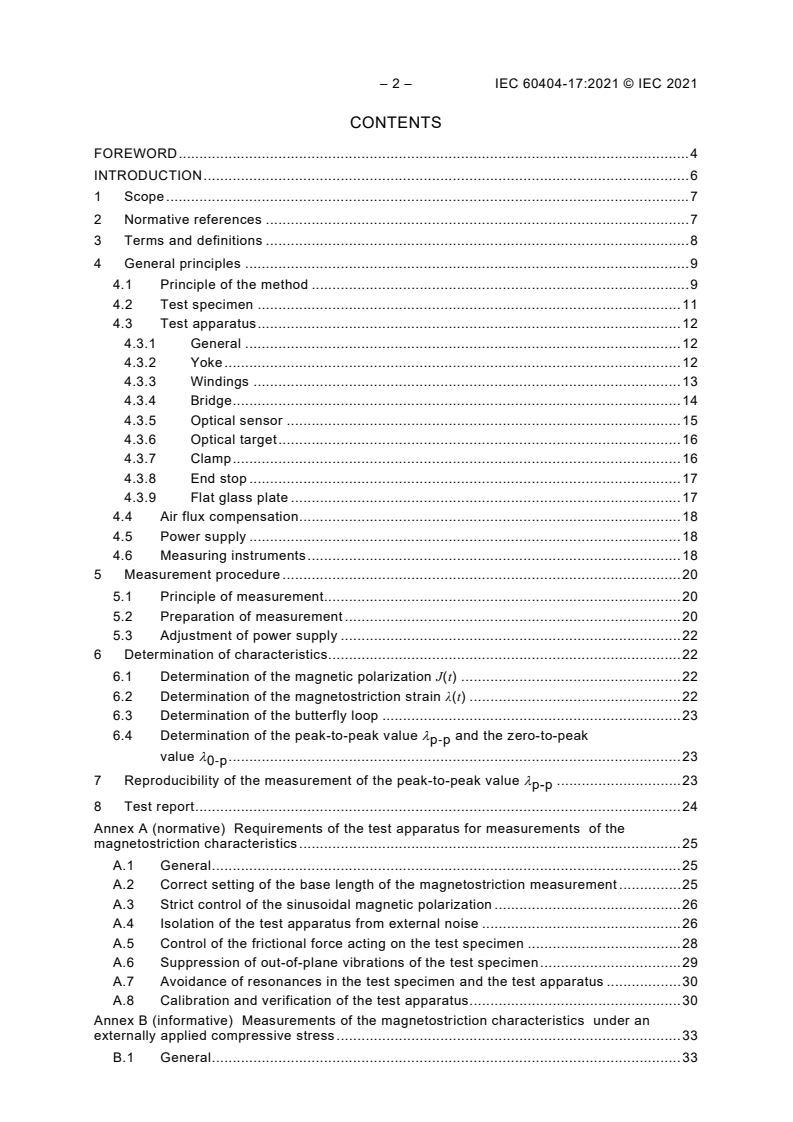
CONTENTS
FOREWORD . 4
INTRODUCTION . 6
1 Scope . 7
2 Normative references . 7
3 Terms and definitions . 8
4 General principles . 9
4.1 Principle of the method . 9
4.2 Test specimen . 11
4.3 Test apparatus . 12
4.3.1 General . 12
4.3.2 Yoke . 12
4.3.3 Windings . 13
4.3.4 Bridge . 14
4.3.5 Optical sensor . 15
4.3.6 Optical target . 16
4.3.7 Clamp . 16
4.3.8 End stop . 17
4.3.9 Flat glass plate . 17
4.4 Air flux compensation . 18
4.5 Power supply . 18
4.6 Measuring instruments . 18
5 Measurement procedure . 20
5.1 Principle of measurement. 20
5.2 Preparation of measurement . 20
5.3 Adjustment of power supply . 22
6 Determination of characteristics . 22
6.1 Determination of the magnetic polarization J(t) . 22
6.2 Determination of the magnetostriction strain λ(t) . 22
6.3 Determination of the butterfly loop . 23
6.4 Determination of the peak-to-peak value λ and the zero-to-peak
p‑p
value λ . 23
0‑p
7 Reproducibility of the measurement of the peak-to-peak value λ . 23
p-p
8 Test report . 24
Annex A (normative) Requirements of the test apparatus for measurements of the
magnetostriction characteristics . 25
A.1 General . 25
A.2 Correct setting of the base length of the magnetostriction measurement . 25
A.3 Strict control of the sinusoidal magnetic polarization . 26
A.4 Isolation of the test apparatus from external noise . 26
A.5 Control of the frictional force acting on the test specimen . 28
A.6 Suppression of out-of-plane vibrations of the test specimen . 29
A.7 Avoidance of resonances in the test specimen and the test apparatus . 30
A.8 Calibration and verification of the test apparatus . 30
Annex B (informative) Measurements of the magnetostriction characteristics under an
externally applied compressive stress . 33
B.1 General . 33
B.2 Test specimen . 33
B.3 Test apparatus . 33
B.4 Measurement procedure . 34
B.5 Determination of characteristics . 34
Annex C (informative) Air flux compensation by digital means. 36
Annex D (informative) Sinusoidal waveform control of the induced secondary voltage
by digital means . 37
Annex E (informative) Magnetostriction characteristics for the acoustic design of
power transformers . 39
E.1 Transformer no-load noise/sound development process . 39
E.2 Transformer no-load sound levels and magnetostriction strain . 39
E.3 Vibration levels characterizing magnetostriction strain . 40
E.4 Determination of vibration levels . 41
E.4.1 General . 41
E.4.2 Velocity levels . 41
E.4.3 Acceleration levels . 42
E.4.4 Reproducibility of the measurements of the velocity level and the
acceleration level values. 43
Bibliography . 44
Figure 1 – Illustrations of butterfly loop, peak-to-peak value and zero-to-peak value . 8
Figure 2 – Schematic diagram of a test apparatus (cross-sectional) . 9
Figure 3 – Schematic diagram of test frames with different types of yoke . 13
Dimensions in millimetres . 14
Figure 4 – Cross-section of the winding former and the bridge (schematic) . 14
Figure 5 – Fundamental circuit of the measurement system . 19
Figure A.1 – Butterfly loop of a high permeability grain-oriented electrical steel sheet
cut perpendicular to the rolling direction [3]. 32
Figure B.1 – Schematic diagram of a test apparatus for the measurement under an
externally applied compressive stress (cross-sectional) . 33
Table E.1 – A-weighting coefficients at a magnetizing frequency of 50 Hz . 42
Table E.2 – A-weighting coefficients at a magnetizing frequency of 60 Hz . 42
– 4 – IEC 60404-17:2021 © IEC 2021
INTERNATIONAL ELECTROTECHNICAL COMMISSION
____________
MAGNETIC MATERIALS –
Part 17: Methods of measurement of the magnetostriction
characteristics of grain-oriented electrical steel strip and sheet
by means of a single sheet tester and an optical sensor
FOREWORD
1) The International Electrotechnical Commission (IEC) is a worldwide organization for standardization comprising
all national electrotechnical committees (IEC National Committees). The object of IEC is to promote international
co-operation on all questions concerning standardization in the electrical and electronic fields. To this end and
in addition to other activities, IEC publishes International Standards, Technical Specifications, Technical Reports,
Publicly Available Specifications (PAS) and Guides (hereafter referred to as “IEC Publication(s)”). Their
preparation is entrusted to technical committees; any IEC National Committee interested in the subject dealt with
may participate in this preparatory work. International, governmental and non-governmental organizations liaising
with the IEC also participate in this preparation. IEC collaborates closely with the International Organization for
Standardization (ISO) in accordance with conditions determined by agreement between the two organizations.
2) The formal decisions or agreements of IEC on technical matters express, as nearly as possible, an international
consensus of opinion on the relevant subjects since each technical committee has representation from all
interested IEC National Committees.
3) IEC Publications have the form of recommendations for international use and are accepted by IEC National
Committees in that sense. While all reasonable efforts are made to ensure that the technical content of IEC
Publications is accurate, IEC cannot be held responsible for the way in which they are used or for any
misinterpretation by any end user.
4) In order to promote international uniformity, IEC National Committees undertake to apply IEC Publications
transparently to the maximum extent possible in their national and regional publications. Any divergence between
any IEC Publication and the corresponding national or regional publication shall be clearly indicated in the latter.
5) IEC itself does not provide any attestation of conformity. Independent certification bodies provide conformity
assessment services and, in some areas, access to IEC marks of conformity. IEC is not responsible for any
services carried out by independent certification bodies.
6) All users should ensure that they have the latest edition of this publication.
7) No liability shall attach to IEC or its directors, employees, servants or agents including individual experts and
members of its technical committees and IEC National Committees for any personal injury, property damage or
other damage of any nature whatsoever, whether direct or indirect, or for costs (including legal fees) and
expenses arising out of the publication, use of, or reliance upon, this IEC Publication or any other IEC
Publications.
8) Attention is drawn to the Normative references cited in this publication. Use of the referenced publications is
indispensable for the correct application of this publication.
9) Attention is drawn to the possibility that some of the elements of this IEC Publication may be the subject of patent
rights. IEC shall not be held responsible for identifying any or all such patent rights.
IEC 60404-17 has been prepared by IEC technical committee 68: Magnetic alloys and steels.
It is an International Standard.
The text of this International Standard is based on the following documents:
Draft Report on voting
68/685/CDV 68/692/RVC
Full information on the voting for its approval can be found in the report on voting indicated in
the above table.
The language used for the development of this International Standard is English.
This document was drafted in accordance with ISO/IEC Directives, Part 2, and developed in
accordance with ISO/IEC Directives, Part 1 and ISO/IEC Directives, IEC Supplement, available
at www.iec.ch/members_experts/refdocs. The main document types developed by IEC are
described in greater detail at www.iec.ch/standardsdev/publications.
A list of all parts in the IEC 60404 series, published under the general title Magnetic materials,
can be found on the IEC website.
The committee has decided that the contents of this document will remain unchanged until the
stability date indicated on the IEC website under webstore.iec.ch in the data related to the
specific document. At this date, the document will be
• reconfirmed,
• withdrawn,
• replaced by a revised edition, or
• amended.
– 6 – IEC 60404-17:2021 © IEC 2021
INTRODUCTION
This document provides standard methods to measure the magnetostriction characteristics of
grain-oriented electrical steel strip and sheet under an applied AC magnetic field at 50 Hz or
60 Hz. The technical details are specified after intense considerations among magnetostriction
experts, so that a satisfactory reproducibility of the measurement can be expected. The
measurement requires detections of tiny vibrations of the test specimen at a resolution of
0,01 μm or better. In order to meet this challenging condition, not only the magnetic aspects,
but also mechanical aspects of the test apparatus, e.g. the influence of friction, Maxwell forces,
resonance and external vibrations, had to be specified.
The methods to determine magnetostriction characteristics of the butterfly loop, the peak-to-
peak and zero-to-peak values of magnetostriction strain are specified in this document.
Subsidiary characteristics of the velocity levels and the acceleration levels are described in
Annex E.
The technical report IEC TR 62581:2010 [1] reviewed the methods of measurement of the
magnetostriction characteristics of grain-oriented electrical steel by means of a single sheet
tester. Various methods have been used for the measurement of the change in length of the
various test specimens. However, for methods using sensors in contact with the test specimen,
it is difficult to avoid measurement offsets associated with the contact methods. Moreover, the
methods require special skills to be used in order to carry out the measurements. Therefore,
this document provides methods using an optical sensor, namely a laser Doppler vibrometer,
which fulfils the requirements of non-contact, high resolution and high reproducibility of
measurements.
It is well known that mechanical stress in grain-oriented electrical steel has a strong influence
on magnetostriction [1]. Grain-oriented electrical steel has a particular behaviour with regards
to its sensitivity to compressive stress along the rolling direction compared to other kinds of
electrical steels. It depends on the degree of grain-orientation of the material and the level of
tensile stress in the material applied by surface coatings. Methods of measurement under an
externally applied compressive stress are described in Annex B.
International round robin comparisons of the magnetostriction measurements have been carried
out repeatedly by reducing the range of methods [2], [3], [4]. The reproducibility of the
measurement was characterized by a relative standard deviation of more than 20 % when
various methods were allowed. It became less than 2 % when test apparatuses following the
principles described in this document were used for the assessment of grain-oriented electrical
steel sheets cut along the rolling direction under the condition of a peak magnetic polarization
of 1,7 T and a magnetizing frequency of 50 Hz.
___________
Numbers in square bracket refer to the Bibliography.
MAGNETIC MATERIALS –
Part 17: Methods of measurement of the magnetostriction
characteristics of grain-oriented electrical steel strip and sheet
by means of a single sheet tester and an optical sensor
1 Scope
This part of IEC 60404 is applicable to grain-oriented electrical steel strip and sheet specified
in IEC 60404-8-7 for the measurement of magnetostriction characteristics under an applied AC
magnetic field at 50 Hz or 60 Hz.
This document defines the general principles and technical details of the measurement of
magnetostriction characteristics of grain-oriented electrical steel strip and sheet by means of a
single sheet tester and an optical sensor.
NOTE 1 The accelerometer method [5] is also an established method for the measurement of magnetostriction.
However, it is more suited to the measurement of magnetostriction under an externally applied tensile or compressive
stress, not zero stress, because it places a weight on the test specimen to prevent a deformation of the test specimen.
Since this document includes the measurement at zero stress, the optical sensor method is provided as the optimum
method.
This document is applicable to the measurement of:
– the butterfly loop;
– the peak-to-peak value λ ;
p-p
– the zero-to-peak value λ .
0-p
The magnetostriction characteristics are determined for a sinusoidal induced secondary voltage,
for a specified peak value of the magnetic polarization and at a specified magnetizing frequency.
NOTE 2 Throughout this document the term “magnetic polarization” is used as described in IEC 60050-121:1998,
121-11-54. In some standards of the IEC 60404 series, the term “magnetic flux density” is used.
2 Normative references
The following documents are referred to in the text in such a way that some or all of their content
constitutes requirements of this document. For dated references, only the edition cited applies.
For undated references, the latest edition of the referenced document (including any
amendments) applies.
IEC 60050-103, International Electrotechnical Vocabulary – Part 103: Mathematics – Functions
(available at www.electropedia.org)
IEC 60050-121, International Electrotechnical Vocabulary – Part 121: Electromagnetism
(available at www.electropedia.org)
IEC 60050-221, International Electrotechnical Vocabulary – Chapter 221: Magnetic materials
and components (available at www.electropedia.org)
IEC 60050-801, International Electrotechnical Vocabulary – Chapter 801: Acoustics and
electroacoustics (available at www.electropedia.org)
– 8 – IEC 60404-17:2021 © IEC 2021
IEC 60404-8-7, Magnetic materials – Part 8-7: Specifications for individual materials – Cold-
rolled grain-oriented electrical steel strip and sheet delivered in the fully-processed state
IEC 61672-1:2013, Electroacoustics – Sound level meters – Part 1: Specifications
3 Terms and definitions
For the purposes of this document, the terms and definitions given in IEC 60050-103,
IEC 60050-121, IEC 60050-221, IEC 60050-801, IEC 61672-1 and the following apply.
ISO and IEC maintain terminological databases for use in standardization at the following
addresses:
• ISO Online browsing platform: available at http://www.iso.org/obp
• IEC Electropedia: available at http://www.electropedia.org/
3.1
butterfly loop
butterfly curve
hysteresis loop of magnetostriction strain versus magnetic polarization along the direction of
applied AC magnetic field for a period of magnetization, as illustrated in Figure 1
EXAMPLE
Key
λ peak-to-peak value
p-p
λ zero-to-peak value
0-p
Figure 1 – Illustrations of butterfly loop, peak-to-peak
value and zero-to-peak value
3.2
λ
p-p
peak-to-peak value
peak-to-peak amplitude of magnetostriction strain along the direction of applied AC magnetic
field, taking an absolute value, expressed in μm/m
Note 1 to entry: The peak-to-peak value can be read from the butterfly loop as shown in Figure 1.
3.3
λ
0-p
zero-to-peak value
difference in magnetostriction strain along the direction of applied AC magnetic field between
the values at the prescribed peak magnetic polarization and at the zero value of the magnetic
polarization, taking a positive or negative value, expressed in μm/m
Note 1 to entry: The zero-to-peak value can be read from the butterfly loop as shown in Figure 1.
3.4
L
v
velocity level
indicator of magnetostriction velocity comprising all harmonic components of magnetostriction
strain of interest, expressed in dB
Note 1 to entry: The frequency weighting filter “A” defined in IEC 61672-1:2013 can be applied to the velocity level
resulting as A-weighted velocity level, L , expressed in dB(A).
vA
3.5
L
a
acceleration level
indicator of magnetostriction acceleration comprising all harmonic components of
magnetostriction strain of interest, expressed in dB
Note 1 to entry: The frequency weighting filter “A” defined in IEC 61672-1:2013 can be applied to the acceleration
level resulting as A-weighted acceleration level, L , expressed in dB(A).
aA
4 General principles
4.1 Principle of the method
A length change of a test specimen for a base length under an AC magnetic field is measured
by means of a single sheet tester and an optical sensor. Magnetostriction characteristics of the
material are determined from the length change of the base length of the test specimen for
prescribed peak values of the magnetic polarization and at a specified magnetizing frequency.
A schematic diagram of a test apparatus is illustrated in Figure 2. The test apparatus consisting
of windings, a winding former, a bridge, a yoke, a clamp block, a weight, an end stop, an optical
sensor and auxiliary support structures shall be fixed to a vibration-free table. The test
apparatus may be assembled on a rigid base plate which is non-magnetic and fixed to the
vibration-free table.
NOTE 1 Methods of measurement under an externally applied compressive stress are described in Annex B.
Figure 2 – Schematic diagram of a test apparatus (cross-sectional)
The test specimen shall be placed on the bridge inside the following two windings wound on
the winding former (see 4.3.3):
– an exterior primary winding (magnetizing winding);
– an interior secondary winding (induced voltage winding).
– 10 – IEC 60404-17:2021 © IEC 2021
A flux closure shall be made by the yoke placed under the test specimen. The two pole faces
shall be in a horizontal plane. The cross-section of the yoke shall be sufficiently large compared
to that of the test specimen. Several types of yoke may be used (see 4.3.2).
The winding former shall be placed symmetrically between the two pole faces so that the
magnetic field is symmetrically distributed within the winding former. The length of the winding
former shall be as long as possible.
The bridge between the two pole faces shall be placed inside the winding former without
touching the winding former. The bridge shall be sufficiently rigid to keep the test specimen on
it flat, and the surface on which the test specimen is placed shall be flat and smooth with a low
friction film adhered to the surface (see 4.3.4).
Both end parts of the bridge shall be held in close contact with the pole faces. The remaining
space between the end parts of the bridge and the pole faces shall be filled with a small amount
of high vacuum silicone grease whilst keeping the top surface of the bridge strip flat. In order
to prevent a formation of large cavities, the grease should be spotted on the pole face in a grid
pattern, the bridge is placed, and pressed firmly from the top of a flat glass plate placed on the
bridge. Care shall be taken not to stain the surface of the low friction film with grease. The
bridge shall be replaceable in order to maintain the smooth surface condition (see 4.3.4 and
Clause A.8).
NOTE 2 High vacuum silicone grease has the appropriate properties being chemically inert, having low vapour
pressure, and being difficult to solidify for a long time. However, if the grease stains the surface of the low friction
film and/or the back surface of the test specimen, the frictional force acting on the test specimen increases and the
magnetostriction value decreases. Grease stains can be removed with acetone.
NOTE 3 An H coil with the same length as the secondary coil can be embedded in the bridge inside the secondary
winding in order to detect the magnetic field strength H(t) applied to the test specimen. This is useful to investigate
magnetostriction characteristics of grain-oriented electrical steel.
The test specimen shall be placed on the bridge so that the axis of the test specimen is
coincident with the horizontal axis of symmetry of the winding former (hereafter, simply called
“the axis of the winding former”).
NOTE 4 Misalignments of the test specimen can cause lateral vibrations of the test specimen by the Maxwell force,
which works to align the axes of the test specimen and the winding former, causing measurement offsets.
Both ends of the test specimen shall overhang the bridge (see Clause A.6). The parts of the
test specimen situated outside the pole faces shall be no longer than a few mm (see Clause A.7).
The end of the test specimen opposite to the clamp shall be free to move. Nothing shall be
connected to this end (see Clause A.7). The other end of the test specimen shall make contact
with the end stop over the full width.
During the measurement, the test specimen shall be fixed to the test apparatus by means of
the clamp block and the weight (see 4.3.7). The side of the clamp block facing the optical sensor
shall be in plane with the inner edge of the pole face (see Figure 2 and Clause A.2).
No weight, except the optical target, shall be placed on the test specimen between the end of
the test specimen opposite the clamp and the clamp block (see Clause A.5) [12].
The optical target shall be placed on the test specimen inside the winding former so that the
distance between the optical target centre and the inner edge of the pole face is 10 mm ± 1 mm
when the test specimen is placed on the bridge (see Figure 2 and 4.3.5).
NOTE 5 If the optical target is located close to the pole face, out-of-plane vibrations of the test specimen on the
pole face can cause measurement offsets (see Clause A.2).
The optical sensor shall be placed in the optimum position so as to maximize the signal to noise
ratio of the output signal. The laser beam shall be parallel to the axis of the winding former
within ±0,1° in order to prevent measurement offsets due to vertical and lateral vibrations of the
test specimen.
NOTE 6 The optical sensor has optimum distances from the optical target to maximize the signal to noise ratio of
the output signal. The optimum distances are usually specified in the instruction manual of the optical sensor.
NOTE 7 The inclination of the laser beam can be adjusted so that the displacements of the laser beam from the
axis of the winding former at both ends of the winding former are the same within ±0,7 mm.
The laser beam position on the optical target should be adjusted to maximize the intensity level
of the reflected laser beam detected by the optical sensor in order to increase the signal to
noise ratio of the output signal. The optical sensor should be mounted on an external positioner
in order to make it easier to adjust the laser beam position (see Figure 2).
The base length of the magnetostriction measurement is the distance along the axis of the
winding former between the optical target centre and the side of the clamp block facing the
optical sensor (see Figure 2).
The auxiliary support structures close to the magnetic circuit shall be non-magnetic. Care shall
be taken to avoid an electrical short circuit around the magnetic flux through the magnetic circuit.
All items placed on the vibration-free table should be stabilized to the table in order to prevent
unexpected resonance generation and vibration transmission to the test apparatus.
The test apparatus should be located away from external noise. The test apparatus shall not
be touched by hand or tools during the measurement, otherwise it induces vibration of the test
apparatus causing, in turn, measurement offsets. The test apparatus should be placed so that
the axis of the winding former is approximately at right angles to the direction of the earth’s
magnetic field (see Clause A.4).
NOTE 8 A simple magnetic shield and a windshield covering the test apparatus can weaken the influence of the
external magnetic and acoustic noises respectively.
It is fundamentally important that the surface on which the test specimen is placed is flat and
clean in order to stabilize the frictional force acting on the test specimen to low values (see
Clause A.5). A flat glass plate shall be used to check and maintain the flatness (see 4.3.2, 4.3.4
and 4.3.9).
The test apparatus shall be verified so that there is no out-of-plane vibration of the test
specimen and no effect of resonance causing measurement offsets (see Clause A.8).
4.2 Test specimen
The test specimen shall be rectangular and flat. The test specimen shall be free of fold marks,
dents and scratches with residual stress. The back surface of the test specimen shall be free
of substances that affect friction such as grease, adhesives, liquids, powders, etc. (see
Clause A.5).
The length and width of the test specimen shall be 500 mm ± 0,5 mm and 100 mm ± 0,2 mm
respectively.
The test specimen shall be cut parallel to the direction of rolling unless otherwise specified.
The test specimen shall be cut without forming excessive burrs and mechanical distortion.
Stresses introduced into the test specimen by the cutting process shall be as low as possible.
The test specimen shall be handled very carefully in order to avoid any further introduction of
stresses.
NOTE 1 The stress introduced into the test specimen can create 90 degree magnetic domains in the material
causing magnetostriction offsets.
NOTE 2 A laser cutting technique can be used provided that the comparability of the results is demonstrated. It can
leave a considerable amount of stress along the cut edges [6].
– 12 – IEC 60404-17:2021 © IEC 2021
When a test specimen is being cut, the edge of the parent strip is taken as the reference
direction. The angle between the reference direction and the cutting direction shall be within ±1°.
4.3 Test apparatus
4.3.1 General
The components of the test apparatus shall be assembled with minimal misalignment in order
to prevent measurement offsets. In particular, the flatness of the surface on which the test
specimen is placed shall be ensured.
In order to prevent resonance with the harmonic components of magnetostriction strain, the test
apparatus shall be free from natural frequencies between 50 Hz and 1 000 Hz (see Clause A.7).
4.3.2 Yoke
The yoke should have a low residual magnetization and a low reluctance. The yoke shall be
fixed to the test apparatus so that the two pole faces are in the same horizontal plane.
NOTE 1 That the two pole faces are in the same horizontal plane can be confirmed by the fact that when a liquid
such as alcohol is dropped on the pole faces and the glass plate is placed on top, a thin film of the liquid spreads
uniformly over the entire pole faces. A difference in height and/or an inclination between the two pole faces can
cause deformation of the bridge strip and measurement offsets (see Clause A.6).
NOTE 2 Due to the elastic deformability of the yoke, the two pole faces can be no longer in the same plane
depending on how the yoke is fixed, even if the yoke alone was processed so that the two pole faces are in the same
plane.
Care shall be taken to avoid a deterioration of the magnetic properties of the yoke due to
excessive stress and to prevent vibration of the yoke during magnetization. The yoke should be
fixed rigidly to the vibration-free table, or the rigid base plate, at points close to the pole faces
so that it will not be displaced by the clamping force. The outside dimension of the yoke along
the axis of the winding former shall be slightly shorter than 500 mm; between 494 mm and
496 mm is recommended.
The yoke may be a vertical single yoke or a horizontal double yoke (see Figure 3). Other types
of yoke may be used provided that no stress is applied to the test specimen due to the yoke,
and that the comparability of the results is demonstrated.
The vertical yoke shall have two pole faces having a length of 25 mm ± 1 mm along the axis of
the winding former and a width between 105 mm and 110 mm. The height of the yoke shall be
between 80 mm and 90 mm.
The horizontal yoke shall have two pole faces having a length between 50 mm and 60 mm along
the axis of the winding former and a width between 400 mm and 500 mm. The height of the
yoke shall be around 10 mm.
Other dimensions of the yoke may be applicable provided that the comparability of the results
is demonstrated.
(a) Vertical single yoke (b) Horizontal double yoke
Figure 3 – Schematic diagram of test frames with different types of yoke
NOTE 3 It was confirmed by experiments that the difference in measurement results when a vertical yoke is replaced
with a horizontal yoke is sufficiently small in comparison to the reproducibility of the measurement required in this
document [3].
The yoke may be made of a glued stack or a C-core of high permeability grain-oriented electrical
steel sheets. In the case of the glued stack, the corners shall have staggered butt joints. In the
case of horizontal yoke, the sheets should be laminated on a flat plate with sparsely distributed
particles of glue on one side of each sheet to minimise stress introduction caused by the gluing.
The yoke shall be carefully demagnetized before use. For the demagnetization of the yoke, an
exciting winding shall be wound around the yoke. The demagnetization shall be made without
the test specimen in the test apparatus and by slowly decreasing an AC current flowing through
the exciting winding to zero, starting from the current that produces a magnetic field in the yoke
well above the knee of the magnetization curve of the yoke material. The demagnetized state
can be verified by whether the positive and negative peak values of the magnetization current
of the test specimen match at the measurement of magnetostriction (see Clause A.3). In the
case of the vertical single yoke, a flux closure of the same dimensions as the yoke, e.g. the
upper yoke, should be put on the two pole faces during the demagnetization.
NOTE 4 The residual magnetization of the yoke can cause asymmetrical butterfly loops and thus cause measuring
offsets.
A vertical double yoke may be applicable provided that the upper yoke does not affect the length
change of the test specimen and does not disturb the laser beam path between the optical
sensor and the optical target.
NOTE 5 The vertical double yoke is suitable for general loss measurements by the magnetizing current method
provided that the bridge is removed and the upper and lower yokes are in contact with the test specimen. The H coil
method using an H coil embedded in the bridge inside the secondary winding enables simultaneous measurements
of magnetostriction and loss regardless of the yoke type. For the H coil method, see IEC 60404-16:2018 [7].
4.3.3 Windings
The primary and secondary windings shall be wound around the winding former. The winding
former shall be non-conducting and non-magnetic. The dimensions of the winding former shall
be as follows (see Figure 4):
– length: as long as possible between the two pole faces;
– internal width: wider than the width of the bridge, 120 mm is recommended;
– internal height: higher than the height of the bridge, 15 mm is recommended;
– external height: ≤ 20 mm.
– 14 – IEC 60404-17:2021 © IEC 2021
Dimensions in millimetres
Figure 4 – Cross-section of the winding former and the bridge (schematic)
The primary winding shall be wound homogeneously as long as possible on the winding former.
Parts of the winding former flanges in contact with the primary winding should be as thin as
possible provided that it can hold the winding former. Care shall be taken to avoid a deformation
of the winding former due to tension when winding a copper wire around it.
NOTE 1 The primary winding can be constructed from a single continuous and uniform coil made up of a copper
wire 1 mm in diameter wound turn by turn. The winding former thickness can be thinner by using a self-supporting
type of coil for the primary winding.
The secondary winding shall be wound on the centre part of the winding former under the
...