

IEC 60092-376:2017
(Main)Electrical installations in ships - Part 376: Cables for control and instrumentation circuits 150/250 V (300 V)
General Information
- Abstract
IEC 60092-376:2017 is applicable to screened and unscreened cables for control and instrumentation circuits on ships and offshore units. The cables have extruded solid insulation with a voltage rating of 150/250V (300V) and are intended for fixed installations.
The various types of cables are given in Clause 5. The constructional requirements and test methods are aligned with those indicated in IEC 60092-350, unless otherwise specified in this document.
The object of this document is:
- to standardise cables whose safety and reliability are ensured when they are installed in accordance with the requirements of IEC 60092-352,
- to lay down standard manufacturing requirements and characteristics of such cables directly or indirectly bearing on safety, and
- to specify test methods for checking conformity with those requirements.
This edition includes the following significant technical changes with respect to the previous edition:
- new structure in line with IEC 60092-353 and IEC 60092-354;
- requirements and test methods have been divided in several tables for clarification (enhanced cold properties, oil resistance or resistance to drilling fluids) and have been aligned to IEC 60092-350;
- the new testing methods for fire resistant cables are referenced in this document.
- Status
- Published
- Publication Date
- 21-May-2017
- Technical Committee
- SC 18A - Electric cables for ships and mobile and fixed offshore units
- Drafting Committee
- MT 2 - TC 18/SC 18A/MT 2
Buy Documents
IEC 60092-376:2017 - Electrical installations in ships - Part 376: Cables for control and instrumentation circuits 150/250 V (300 V) Released:5/22/2017
IEC 60092-376:2017 RLV - Electrical installations in ships - Part 376: Cables for control and instrumentation circuits 150/250 V (300 V) Released:5/22/2017
Overview
IEC 60092-376:2017 - "Electrical installations in ships - Part 376: Cables for control and instrumentation circuits 150/250 V (300 V)" is an international standard that specifies constructional requirements and test methods for screened and unscreened control and instrumentation cables used in ships and offshore units. These cables have extruded solid insulation with a voltage rating of 150/250 V (300 V) and are intended for fixed installations. The standard aligns its core construction and testing principles with IEC 60092-350 unless otherwise stated.
Key topics and technical requirements
- Scope and object
- Standardizes cables whose safety and reliability are ensured when installed in accordance with IEC 60092-352.
- Defines manufacturing requirements and characteristics affecting safety.
- Specifies test methods for conformity assessment.
- Cable types and construction (Clause 5)
- Covers a variety of screened and unscreened multicore and single-unit constructions; specific types are listed in the standard.
- Details requirements for conductors, insulation, cabling, inner/outer sheaths, screens and braid armour.
- Tests, methods and requirements (Clause 6)
- Refers to general test methods from IEC 60092-350 and adds tables for clarity on enhanced cold properties, oil resistance, resistance to drilling fluids, etc.
- References updated test methods for fire resistant, low smoke, and halogen-free cable performance where applicable.
- Marking and identification
- Requirements for voltage marking, origin, core identification and continuity of marking.
- Alignment and updates
- New structure aligned with IEC 60092-353 and IEC 60092-354.
- Divided test-method tables for improved clarity and consistency with IEC 60092-350.
Practical applications and who uses this standard
IEC 60092-376 is used by professionals involved in shipboard and offshore electrical systems, including:
- Shipbuilders and shipyard electrical engineers specifying and installing control and instrumentation cables.
- Offshore platform designers and maintenance teams selecting fixed wiring solutions.
- Cable manufacturers and suppliers designing products to meet marine safety and performance requirements.
- Classification societies, procurement specialists and regulatory bodies verifying compliance.
- Test laboratories conducting conformity and fire-resistance testing.
Typical applications include control circuits, instrumentation wiring, sensor and signal cabling, and other fixed onboard wiring where reliable low-voltage performance and defined mechanical, thermal and fire characteristics are required.
Related standards
- IEC 60092-350 - General construction and test methods for shipboard cables
- IEC 60092-352 - Choice and installation of electrical cables
- IEC 60092-353 / IEC 60092-354 - Related parts in the 60092 series
- IEC 60092-360 - Materials for power, control, instrumentation cables
- IEC 60331-1 - Circuit integrity tests for cable fire performance
For safe, compliant marine installations, always reference the latest editions and the normative references cited in IEC 60092-376.
Relations
- Effective Date
- 05-Sep-2023
- Effective Date
- 05-Sep-2023
Buy Documents
IEC 60092-376:2017 - Electrical installations in ships - Part 376: Cables for control and instrumentation circuits 150/250 V (300 V) Released:5/22/2017
IEC 60092-376:2017 RLV - Electrical installations in ships - Part 376: Cables for control and instrumentation circuits 150/250 V (300 V) Released:5/22/2017
Get Certified
Connect with accredited certification bodies for this standard

DNV
DNV is an independent assurance and risk management provider.

Lloyd's Register
Lloyd's Register is a global professional services organisation specialising in engineering and technology.

FSC International
Forest Stewardship Council certification.
Sponsored listings
Frequently Asked Questions
IEC 60092-376:2017 is a standard published by the International Electrotechnical Commission (IEC). Its full title is "Electrical installations in ships - Part 376: Cables for control and instrumentation circuits 150/250 V (300 V)". This standard covers: IEC 60092-376:2017 is applicable to screened and unscreened cables for control and instrumentation circuits on ships and offshore units. The cables have extruded solid insulation with a voltage rating of 150/250V (300V) and are intended for fixed installations. The various types of cables are given in Clause 5. The constructional requirements and test methods are aligned with those indicated in IEC 60092-350, unless otherwise specified in this document. The object of this document is: - to standardise cables whose safety and reliability are ensured when they are installed in accordance with the requirements of IEC 60092-352, - to lay down standard manufacturing requirements and characteristics of such cables directly or indirectly bearing on safety, and - to specify test methods for checking conformity with those requirements. This edition includes the following significant technical changes with respect to the previous edition: - new structure in line with IEC 60092-353 and IEC 60092-354; - requirements and test methods have been divided in several tables for clarification (enhanced cold properties, oil resistance or resistance to drilling fluids) and have been aligned to IEC 60092-350; - the new testing methods for fire resistant cables are referenced in this document.
IEC 60092-376:2017 is applicable to screened and unscreened cables for control and instrumentation circuits on ships and offshore units. The cables have extruded solid insulation with a voltage rating of 150/250V (300V) and are intended for fixed installations. The various types of cables are given in Clause 5. The constructional requirements and test methods are aligned with those indicated in IEC 60092-350, unless otherwise specified in this document. The object of this document is: - to standardise cables whose safety and reliability are ensured when they are installed in accordance with the requirements of IEC 60092-352, - to lay down standard manufacturing requirements and characteristics of such cables directly or indirectly bearing on safety, and - to specify test methods for checking conformity with those requirements. This edition includes the following significant technical changes with respect to the previous edition: - new structure in line with IEC 60092-353 and IEC 60092-354; - requirements and test methods have been divided in several tables for clarification (enhanced cold properties, oil resistance or resistance to drilling fluids) and have been aligned to IEC 60092-350; - the new testing methods for fire resistant cables are referenced in this document.
IEC 60092-376:2017 is classified under the following ICS (International Classification for Standards) categories: 29.080.30 - Insulation systems; 47.020.60 - Electrical equipment of ships and of marine structures. The ICS classification helps identify the subject area and facilitates finding related standards.
IEC 60092-376:2017 has the following relationships with other standards: It is inter standard links to IEC 60092-376:2025, IEC 60092-376:2003. Understanding these relationships helps ensure you are using the most current and applicable version of the standard.
IEC 60092-376:2017 is available in PDF format for immediate download after purchase. The document can be added to your cart and obtained through the secure checkout process. Digital delivery ensures instant access to the complete standard document.
Standards Content (Sample)
IEC 60092-376 ®
Edition 3.0 2017-05
INTERNATIONAL
STANDARD
Electrical installations in ships –
Part 376: Cables for control and instrumentation circuits 150/250 V (300 V)
All rights reserved. Unless otherwise specified, no part of this publication may be reproduced or utilized in any form
or by any means, electronic or mechanical, including photocopying and microfilm, without permission in writing from
either IEC or IEC's member National Committee in the country of the requester. If you have any questions about IEC
copyright or have an enquiry about obtaining additional rights to this publication, please contact the address below or
your local IEC member National Committee for further information.
IEC Central Office Tel.: +41 22 919 02 11
3, rue de Varembé Fax: +41 22 919 03 00
CH-1211 Geneva 20 info@iec.ch
Switzerland www.iec.ch
About the IEC
The International Electrotechnical Commission (IEC) is the leading global organization that prepares and publishes
International Standards for all electrical, electronic and related technologies.
About IEC publications
The technical content of IEC publications is kept under constant review by the IEC. Please make sure that you have the
latest edition, a corrigenda or an amendment might have been published.
IEC Catalogue - webstore.iec.ch/catalogue Electropedia - www.electropedia.org
The stand-alone application for consulting the entire The world's leading online dictionary of electronic and
bibliographical information on IEC International Standards, electrical terms containing 20 000 terms and definitions in
Technical Specifications, Technical Reports and other English and French, with equivalent terms in 16 additional
documents. Available for PC, Mac OS, Android Tablets and languages. Also known as the International Electrotechnical
iPad. Vocabulary (IEV) online.
IEC publications search - www.iec.ch/searchpub IEC Glossary - std.iec.ch/glossary
The advanced search enables to find IEC publications by a 65 000 electrotechnical terminology entries in English and
variety of criteria (reference number, text, technical French extracted from the Terms and Definitions clause of
committee,…). It also gives information on projects, replaced IEC publications issued since 2002. Some entries have been
and withdrawn publications. collected from earlier publications of IEC TC 37, 77, 86 and
CISPR.
IEC Just Published - webstore.iec.ch/justpublished
Stay up to date on all new IEC publications. Just Published IEC Customer Service Centre - webstore.iec.ch/csc
details all new publications released. Available online and If you wish to give us your feedback on this publication or
also once a month by email. need further assistance, please contact the Customer Service
Centre: csc@iec.ch.
IEC 60092-376 ®
Edition 3.0 2017-05
INTERNATIONAL
STANDARD
Electrical installations in ships –
Part 376: Cables for control and instrumentation circuits 150/250 V (300 V)
INTERNATIONAL
ELECTROTECHNICAL
COMMISSION
ICS 47.020.60 ISBN 978-2-8322-4321-3
– 2 – IEC 60092-376:2017 © IEC 2017
CONTENTS
FOREWORD . 4
1 Scope and object . 6
2 Normative references . 6
3 Terms and definitions . 7
4 General requirements . 7
4.1 Rated voltage . 7
4.2 Markings . 8
4.2.1 Indication of origin and voltage identification . 8
4.2.2 Continuity of marking . 8
4.2.3 Core identification . 8
5 Constructional requirements . 8
5.1 General description . 8
5.1.1 Overview . 8
5.1.2 Unarmoured single- or double-sheathed cable . 9
5.1.3 Armoured single-sheathed cable with outer sheath only . 9
5.1.4 Armoured double-sheathed cable with inner and outer sheath only . 9
5.1.5 Armoured single-sheathed cable with inner sheath only . 9
5.2 Conductors . 10
5.3 Insulation . 10
5.3.1 Material . 10
5.3.2 Application . 10
5.3.3 Thickness of insulation . 10
5.4 Cabling . 11
5.4.1 General . 11
5.4.2 Core assembly . 11
5.4.3 Forming pair, triple or quad units . 11
5.4.4 Fillers . 11
5.4.5 Number of cores, pair, triple or quad units . 12
5.5 Inner covering . 12
5.5.1 General . 12
5.5.2 Thickness of inner covering . 12
5.6 Screen . 12
5.6.1 Individual screen . 12
5.6.2 Collective electrostatic screen . 13
5.7 Inner sheath . 14
5.7.1 Material . 14
5.7.2 Application . 14
5.7.3 Thickness of inner sheath . 14
5.8 Braid armour . 15
5.8.1 General . 15
5.8.2 Braid wire diameter . 15
5.8.3 Coverage density . 15
5.8.4 Application of the armour . 15
5.9 Outer sheath . 15
5.9.1 Material . 15
5.9.2 Application . 16
5.9.3 Thickness of outer sheath . 16
5.9.4 Colour of outer sheath . 16
6 Tests – methods and requirements . 16
Annex A (informative) Core identification . 20
Annex B (informative) Identification of cores of multicore cables . 21
B.1 Inscription . 21
B.2 Arrangement of the marks . 21
B.3 Spacing and dimensions of the marks . 21
B.4 Appearance of inscription. 22
Annex C (informative) Number of cores, pair, triple or quad units . 23
C.1 Number of cores . 23
C.2 Number of pair, triple or quad units . 23
Bibliography . 24
Figure B.1 – Arrangement of the marks . 21
Table 1 – Electrical resistance of conductors . 10
Table 2 – Insulation thickness . 11
Table 3 – Thickness of inner covering . 12
Table 4 – Requirements of drain wire . 13
Table 5 – Tests applicable to all cables . 17
Table 6 – Additional tests required for halogen-free cables . 18
Table 7 – Additional test required for low smoke cables . 19
Table 8 – Additional tests required for fire resistant cables . 19
Table 9 – Additional tests required for specific performances . 19
Table A.1 – Preferred colour code for single unit cables . 20
Table B.1 – Dimensions of the marks . 22
– 4 – IEC 60092-376:2017 © IEC 2017
INTERNATIONAL ELECTROTECHNICAL COMMISSION
____________
ELECTRICAL INSTALLATIONS IN SHIPS –
Part 376: Cables for control and instrumentation
circuits 150/250 V (300 V)
FOREWORD
1) The International Electrotechnical Commission (IEC) is a worldwide organization for standardization comprising
all national electrotechnical committees (IEC National Committees). The object of IEC is to promote
international co-operation on all questions concerning standardization in the electrical and electronic fields. To
this end and in addition to other activities, IEC publishes International Standards, Technical Specifications,
Technical Reports, Publicly Available Specifications (PAS) and Guides (hereafter referred to as “IEC
Publication(s)”). Their preparation is entrusted to technical committees; any IEC National Committee interested
in the subject dealt with may participate in this preparatory work. International, governmental and non-
governmental organizations liaising with the IEC also participate in this preparation. IEC collaborates closely
with the International Organization for Standardization (ISO) in accordance with conditions determined by
agreement between the two organizations.
2) The formal decisions or agreements of IEC on technical matters express, as nearly as possible, an international
consensus of opinion on the relevant subjects since each technical committee has representation from all
interested IEC National Committees.
3) IEC Publications have the form of recommendations for international use and are accepted by IEC National
Committees in that sense. While all reasonable efforts are made to ensure that the technical content of IEC
Publications is accurate, IEC cannot be held responsible for the way in which they are used or for any
misinterpretation by any end user.
4) In order to promote international uniformity, IEC National Committees undertake to apply IEC Publications
transparently to the maximum extent possible in their national and regional publications. Any divergence
between any IEC Publication and the corresponding national or regional publication shall be clearly indicated in
the latter.
5) IEC itself does not provide any attestation of conformity. Independent certification bodies provide conformity
assessment services and, in some areas, access to IEC marks of conformity. IEC is not responsible for any
services carried out by independent certification bodies.
6) All users should ensure that they have the latest edition of this publication.
7) No liability shall attach to IEC or its directors, employees, servants or agents including individual experts and
members of its technical committees and IEC National Committees for any personal injury, property damage or
other damage of any nature whatsoever, whether direct or indirect, or for costs (including legal fees) and
expenses arising out of the publication, use of, or reliance upon, this IEC Publication or any other IEC
Publications.
8) Attention is drawn to the Normative references cited in this publication. Use of the referenced publications is
indispensable for the correct application of this publication.
9) Attention is drawn to the possibility that some of the elements of this IEC Publication may be the subject of
patent rights. IEC shall not be held responsible for identifying any or all such patent rights.
International Standard IEC 60092-376 has been prepared by subcommittee 18A: Electric
cables for ships and mobile and fixed offshore units, of IEC technical committee 18: Electrical
installations of ships and of mobile and fixed offshore units.
This third edition of IEC 60092-376 cancels and replaces the second edition published in
2003, of which it constitutes a technical revision.
This edition includes the following significant technical changes with respect to the previous
edition:
a) new structure in line with IEC 60092-353 and IEC 60092-354;
b) requirements and test methods have been divided in several tables for clarification
(enhanced cold properties, oil resistance or resistance to drilling fluids) and have been
aligned to IEC 60092-350;
c) the new testing methods for fire resistant cables are referenced in this document.
The text of this International Standard is based on the following documents:
FDIS Report on voting
18A/404/FDIS 18A/409/RVD
Full information on the voting for the approval of this International Standard can be found in
the report on voting indicated in the above table.
This document has been drafted in accordance with the ISO/IEC Directives, Part 2.
A list of all parts in the IEC 60092 series, published under the general title Electrical
installations in ships, can be found on the IEC website.
The committee has decided that the contents of this document will remain unchanged until the
stability date indicated on the IEC website under "http://webstore.iec.ch" in the data related to
the specific document. At this date, the document will be
• reconfirmed,
• withdrawn,
• replaced by a revised edition, or
• amended.
A bilingual version of this publication may be issued at a later date.
– 6 – IEC 60092-376:2017 © IEC 2017
ELECTRICAL INSTALLATIONS IN SHIPS –
Part 376: Cables for control and instrumentation
circuits 150/250 V (300 V)
1 Scope and object
This part of IEC 60092 is applicable to screened and unscreened cables for control and
instrumentation circuits on ships and offshore units. The cables have extruded solid insulation
with a voltage rating of 150/250V (300V) (see Clause 4) and are intended for fixed
installations.
The various types of cables are given in Clause 5. The constructional requirements and test
methods are aligned with those indicated in IEC 60092-350, unless otherwise specified in this
document.
The object of this document is
– to standardise cables whose safety and reliability are ensured when they are installed in
accordance with the requirements of IEC 60092-352,
– to lay down standard manufacturing requirements and characteristics of such cables
directly or indirectly bearing on safety, and
– to specify test methods for checking conformity with those requirements.
2 Normative references
The following documents are referred to in the text in such a way that some or all of their
content constitutes requirements of this document. For dated references, only the edition
cited applies. For undated references, the latest edition of the referenced document (including
any amendments) applies.
IEC 60050-461, International Electrotechnical Vocabulary – Part 461: Electric cables
IEC 60092-350:2014, Electrical installations in ships – Part 350: General construction and test
methods of power, control and instrumentation cables for shipboard and offshore applications
IEC 60092-352, Electrical installations in ships – Part 352: Choice and installation of electrical
cables
IEC 60092-360:2014, Electrical installations in ships – Part 360: Insulating and sheathing
materials for shipboard and offshore units, power, control, instrumentation and
telecommunication cables
IEC 60331-1, Tests for electric cables under fire conditions – Circuit integrity – Part 1: Test
method for fire with shock at a temperature of at least 830 °C for cables of rated voltage up to
and including 0,6/1,0 kV and with an overall diameter exceeding 20 mm
IEC 60331-2, Tests for electric cables under fire conditions – Circuit integrity – Part 2: Test
method for fire with shock at a temperature of at least 830 °C for cables of rated voltage up to
and including 0,6/1,0 kV and with an overall diameter not exceeding 20 mm
IEC 60331-21, Tests for electric cables under fire conditions – Circuit integrity – Part 21:
Procedures and requirements – Cables of rated voltage up to and including 0,6/1,0 kV
IEC 60332-1-2, Tests on electric and optical fibre cables under fire conditions – Part 1-2: Test
for vertical flame propagation for a single insulated wire or cable – Procedure for 1 kW pre-
mixed flame
IEC 60332-3-22, Tests on electric cables under fire conditions – Part 3-22: Test for vertical
flame spread of vertically-mounted bunched wires or cables – Category A
IEC 60445, Basic and safety principles for man-machine interface, marking and identification
– Identification of equipment terminals, conductor terminations and conductors
IEC 60684-2, Flexible insulating sleeving – Part 2: Methods of test
IEC 60754-1, Test on gases evolved during combustion of materials from cables – Part 1:
Determination of the halogen acid gas content
IEC 60754-2, Test on gases evolved during combustion of materials from cables – Part 2:
Determination of acidity (by pH measurement) and conductivity
IEC 61034-2, Measurement of smoke density of cables burning under defined conditions –
Part 2: Test procedure and requirements
3 Terms and definitions
For the purposes of this document, the terms and definitions given in IEC 60092-350 and
IEC 60050-461 apply.
ISO and IEC maintain terminological databases for use in standardization at the following
addresses:
• IEC Electropedia: available at http://www.electropedia.org/
• ISO Online browsing platform: available at http://www.iso.org/obp
4 General requirements
4.1 Rated voltage
The standard method of designating the rated voltages of cables covered by this document
shall take the form U /U (U ),
o m
where
U is the rated power-frequency voltage between phase conductor and earth or metallic
o
screen, for which the cable is designed;
U is the rated power-frequency voltage between phase conductors for which the cable is
designed;
U is the maximum value of the "highest system voltage" for which the equipment
m
(including cable) may be used (see IEC 60038).
All voltages are given as RMS values.
The standard rated voltages U /U (U ) of the cables considered in this document are:
o m
U /U (U ) = 150 V/250 V (300 V) AC
o m
– 8 – IEC 60092-376:2017 © IEC 2017
For 150/250 (300) V cables, DC voltage up to a maximum of 1,5 times the AC voltage may be
used provided that the voltage to earth does not exceed 250 V.
NOTE When circuits are to be supplied from a low impedance source, attention is drawn to IEC 60092-353 for
600/1000 V cables having a minimum conductor size of 1,5 mm .
4.2 Markings
4.2.1 Indication of origin and voltage identification
Cables shall comply with 4.1.3 of IEC 60092-350:2014 with respect to:
• indication of origin;
• rated voltage and cable construction (number of cores and cross sectional area of the
construction);
• continuity of marking;
• durability/legibility.
4.2.2 Continuity of marking
The marking is deemed to be continuous if the distance between the end of any marking and
the beginning of the next does not exceed
• 550 mm if the marking is on the outer surface of the cable, and
• 275 mm in all other cases.
4.2.3 Core identification
4.2.3.1 General
Cable cores shall be clearly identified by either colours or numbers.
4.2.3.2 Coloured cores
The core colours shall be in accordance with IEC 60445.
NOTE Annex A gives details of preferred colour code.
4.2.3.3 Numbered cores – multicore cables
Identification should be made by inscription of numbers on each core starting from the centre
beginning with 1 in accordance with Annex B.
4.2.3.4 Unit identification
When requested by the purchaser, identification of the individual units of multiunit cables is
permitted by the use of tape(s) marked with numbers.
5 Constructional requirements
5.1 General description
5.1.1 Overview
Shipboard and offshore cables for fixed installations shall be single or multicore cables
generally constructed as follows.
5.1.2 Unarmoured single- or double-sheathed cable
• copper conductor, see 5.2;
• insulation, see 5.3;
• cabling (for multicore cables), see 5.4;
• inner covering (optional, but mandatory when a braided electrostatic screening is applied
over the core lay-up), see 5.5;
• electrostatic screening (optional), see 5.6;
• inner sheath (optional), see 5.7;
• outer sheath applied as either one or two layer systems, see 5.9.
5.1.3 Armoured single-sheathed cable with outer sheath only
• copper conductor, see 5.2;
• insulation, see 5.3;
• cabling (for multicore cables), see 5.4;
• inner covering below electrostatic screening (optional, but mandatory when a braided
electrostatic screening is applied over the core lay-up), see 5.5;
• electrostatic screening (optional), see 5.6;
• inner covering (optional, but mandatory in case of a braid armour of galvanised steel wires
in which case the inner covering shall be extruded), see 5.5;
• braid armour, see 5.8;
• outer sheath applied as either one or two layer systems, see 5.9.
5.1.4 Armoured double-sheathed cable with inner and outer sheath only
• copper conductor, see 5.2;
• insulation, see 5.3;
• cabling (for multicore cables), see 5.4;
• inner covering (optional, but m
...
IEC 60092-376 ®
Edition 3.0 2017-05
REDLINE VERSION
INTERNATIONAL
STANDARD
colour
inside
Electrical installations in ships –
Part 376: Cables for control and instrumentation circuits 150/250 V (300 V)
All rights reserved. Unless otherwise specified, no part of this publication may be reproduced or utilized in any form
or by any means, electronic or mechanical, including photocopying and microfilm, without permission in writing from
either IEC or IEC's member National Committee in the country of the requester. If you have any questions about IEC
copyright or have an enquiry about obtaining additional rights to this publication, please contact the address below or
your local IEC member National Committee for further information.
IEC Central Office Tel.: +41 22 919 02 11
3, rue de Varembé Fax: +41 22 919 03 00
CH-1211 Geneva 20 info@iec.ch
Switzerland www.iec.ch
About the IEC
The International Electrotechnical Commission (IEC) is the leading global organization that prepares and publishes
International Standards for all electrical, electronic and related technologies.
About IEC publications
The technical content of IEC publications is kept under constant review by the IEC. Please make sure that you have the
latest edition, a corrigenda or an amendment might have been published.
IEC Catalogue - webstore.iec.ch/catalogue Electropedia - www.electropedia.org
The stand-alone application for consulting the entire The world's leading online dictionary of electronic and
bibliographical information on IEC International Standards, electrical terms containing 20 000 terms and definitions in
Technical Specifications, Technical Reports and other English and French, with equivalent terms in 16 additional
documents. Available for PC, Mac OS, Android Tablets and languages. Also known as the International Electrotechnical
iPad. Vocabulary (IEV) online.
IEC publications search - www.iec.ch/searchpub IEC Glossary - std.iec.ch/glossary
The advanced search enables to find IEC publications by a 65 000 electrotechnical terminology entries in English and
variety of criteria (reference number, text, technical French extracted from the Terms and Definitions clause of
committee,…). It also gives information on projects, replaced IEC publications issued since 2002. Some entries have been
and withdrawn publications. collected from earlier publications of IEC TC 37, 77, 86 and
CISPR.
IEC Just Published - webstore.iec.ch/justpublished
Stay up to date on all new IEC publications. Just Published IEC Customer Service Centre - webstore.iec.ch/csc
details all new publications released. Available online and If you wish to give us your feedback on this publication or
also once a month by email. need further assistance, please contact the Customer Service
Centre: csc@iec.ch.
IEC 60092-376 ®
Edition 3.0 2017-05
REDLINE VERSION
INTERNATIONAL
STANDARD
colour
inside
Electrical installations in ships –
Part 376: Cables for control and instrumentation circuits 150/250 V (300 V)
INTERNATIONAL
ELECTROTECHNICAL
COMMISSION
ICS 47.020.60 ISBN 978-2-8322-4411-1
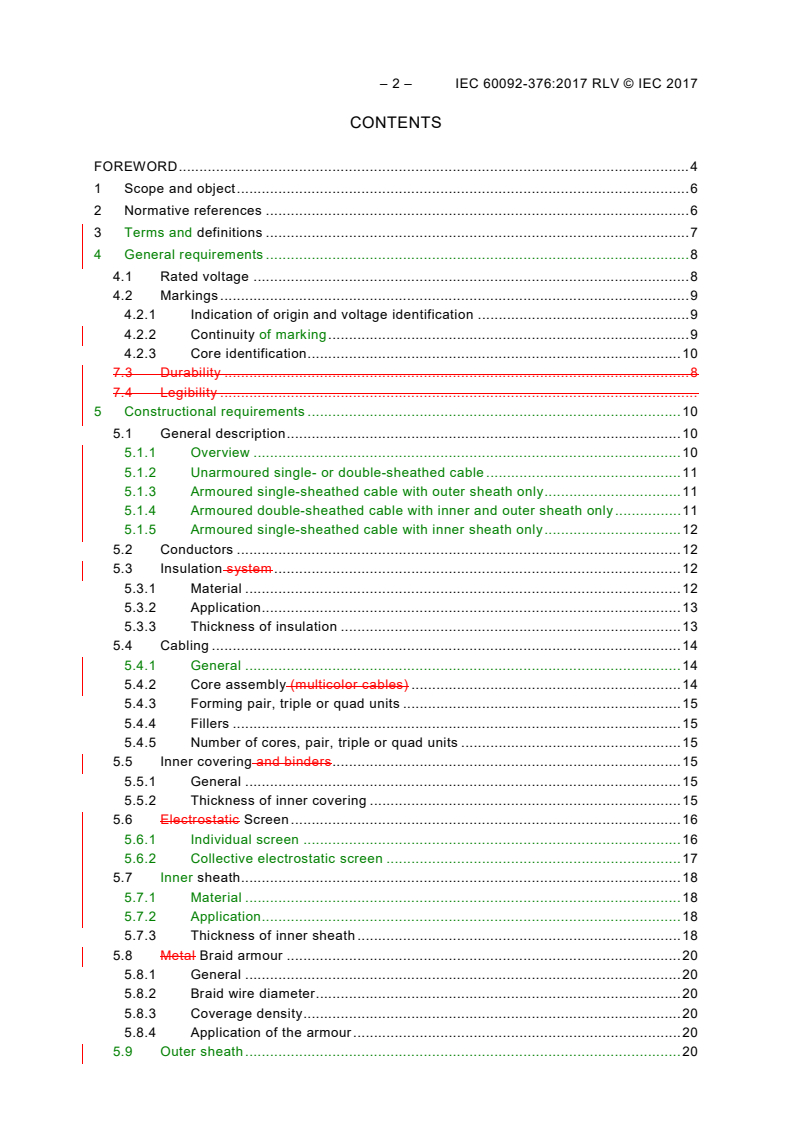
– 2 – IEC 60092-376:2017 RLV © IEC 2017
CONTENTS
FOREWORD . 4
1 Scope and object . 6
2 Normative references . 6
3 Terms and definitions . 7
4 General requirements . 8
4.1 Rated voltage . 8
4.2 Markings . 9
4.2.1 Indication of origin and voltage identification . 9
4.2.2 Continuity of marking . 9
4.2.3 Core identification . 10
7.3 Durability . 8
7.4 Legibility .
5 Constructional requirements . 10
5.1 General description . 10
5.1.1 Overview . 10
5.1.2 Unarmoured single- or double-sheathed cable . 11
5.1.3 Armoured single-sheathed cable with outer sheath only . 11
5.1.4 Armoured double-sheathed cable with inner and outer sheath only . 11
5.1.5 Armoured single-sheathed cable with inner sheath only . 12
5.2 Conductors . 12
5.3 Insulation system . 12
5.3.1 Material . 12
5.3.2 Application . 13
5.3.3 Thickness of insulation . 13
5.4 Cabling . 14
5.4.1 General . 14
5.4.2 Core assembly (multicolor cables) . 14
5.4.3 Forming pair, triple or quad units . 15
5.4.4 Fillers . 15
5.4.5 Number of cores, pair, triple or quad units . 15
5.5 Inner covering and binders . 15
5.5.1 General . 15
5.5.2 Thickness of inner covering . 15
5.6 Electrostatic Screen . 16
5.6.1 Individual screen . 16
5.6.2 Collective electrostatic screen . 17
5.7 Inner sheath . 18
5.7.1 Material . 18
5.7.2 Application . 18
5.7.3 Thickness of inner sheath . 18
5.8 Metal Braid armour . 20
5.8.1 General . 20
5.8.2 Braid wire diameter . 20
5.8.3 Coverage density . 20
5.8.4 Application of the armour . 20
5.9 Outer sheath . 20
5.9.1 Material . 20
5.9.2 Application . 21
5.9.3 Thickness of outer sheath . 21
5.9.4 Colour of outer sheath . 21
16 Particular tests .
16.1 Additional compatibility test.
16.2 Durability .
17 Tests on completed cables .
17.1 Routine tests.
17.2 Special tests .
17.3 Type tests, non-electrical .
17.4 Type tests, electrical .
6 Tests – methods and requirements . 23
Annex A (informative) Core identification . 26
Annex B (informative) Identification of cores of multicore cables . 27
B.1 Identification Inscription . 27
B.2 Arrangement of the marks . 27
B.3 Spacing and dimensions of the marks . 27
B.4 Appearance of inscription. 28
Annex C (informative) Number of cores, pair, triple or quad units . 29
C.1 Number of cores . 29
C.2 Number of pair, triple or quad units . 29
Bibliography . 30
Figure B.1 – Arrangement of the marks . 27
Table 1 – Electrical resistance of conductors . 12
Table 2 – Specified thickness of insulation Insulation thickness . 14
Table 3 – Thickness of inner covering . 16
Table 4 – Requirements of drain wire . 17
Table 5 –Coefficient cf .
Table 6 – Electrical resistance of conductors .
Table 5 – Tests applicable to all cables . 23
Table 6 – Additional tests required for halogen-free cables . 25
Table 7 – Additional test required for low smoke cables . 25
Table 8 – Additional tests required for fire resistant cables . 25
Table 9 – Additional tests required for specific performances . 25
Table A.1 – Typical Preferred colour code for single unit cables . 26
Table B.1 – Dimensions of the marks . 28
– 4 – IEC 60092-376:2017 RLV © IEC 2017
INTERNATIONAL ELECTROTECHNICAL COMMISSION
____________
ELECTRICAL INSTALLATIONS IN SHIPS –
Part 376: Cables for control and instrumentation
circuits 150/250 V (300 V)
FOREWORD
1) The International Electrotechnical Commission (IEC) is a worldwide organization for standardization comprising
all national electrotechnical committees (IEC National Committees). The object of IEC is to promote
international co-operation on all questions concerning standardization in the electrical and electronic fields. To
this end and in addition to other activities, IEC publishes International Standards, Technical Specifications,
Technical Reports, Publicly Available Specifications (PAS) and Guides (hereafter referred to as “IEC
Publication(s)”). Their preparation is entrusted to technical committees; any IEC National Committee interested
in the subject dealt with may participate in this preparatory work. International, governmental and non-
governmental organizations liaising with the IEC also participate in this preparation. IEC collaborates closely
with the International Organization for Standardization (ISO) in accordance with conditions determined by
agreement between the two organizations.
2) The formal decisions or agreements of IEC on technical matters express, as nearly as possible, an international
consensus of opinion on the relevant subjects since each technical committee has representation from all
interested IEC National Committees.
3) IEC Publications have the form of recommendations for international use and are accepted by IEC National
Committees in that sense. While all reasonable efforts are made to ensure that the technical content of IEC
Publications is accurate, IEC cannot be held responsible for the way in which they are used or for any
misinterpretation by any end user.
4) In order to promote international uniformity, IEC National Committees undertake to apply IEC Publications
transparently to the maximum extent possible in their national and regional publications. Any divergence
between any IEC Publication and the corresponding national or regional publication shall be clearly indicated in
the latter.
5) IEC itself does not provide any attestation of conformity. Independent certification bodies provide conformity
assessment services and, in some areas, access to IEC marks of conformity. IEC is not responsible for any
services carried out by independent certification bodies.
6) All users should ensure that they have the latest edition of this publication.
7) No liability shall attach to IEC or its directors, employees, servants or agents including individual experts and
members of its technical committees and IEC National Committees for any personal injury, property damage or
other damage of any nature whatsoever, whether direct or indirect, or for costs (including legal fees) and
expenses arising out of the publication, use of, or reliance upon, this IEC Publication or any other IEC
Publications.
8) Attention is drawn to the Normative references cited in this publication. Use of the referenced publications is
indispensable for the correct application of this publication.
9) Attention is drawn to the possibility that some of the elements of this IEC Publication may be the subject of
patent rights. IEC shall not be held responsible for identifying any or all such patent rights.
This redline version of the official IEC Standard allows the user to identify the changes
made to the previous edition. A vertical bar appears in the margin wherever a change
has been made. Additions are in green text, deletions are in strikethrough red text.
International Standard IEC 60092-376 has been prepared by subcommittee 18A: Electric
cables for ships and mobile and fixed offshore units, of IEC technical committee 18: Electrical
installations of ships and of mobile and fixed offshore units.
This third edition of IEC 60092-376 cancels and replaces the second edition published in
2003, of which it constitutes a technical revision.
This edition includes the following significant technical changes with respect to the previous
edition:
a) new structure in line with IEC 60092-353 and IEC 60092-354;
b) requirements and test methods have been divided in several tables for clarification
(enhanced cold properties, oil resistance or resistance to drilling fluids) and have been
aligned to IEC 60092-350;
c) the new testing methods for fire resistant cables are referenced in this document.
The text of this International Standard is based on the following documents:
FDIS Report on voting
18A/404/FDIS 18A/409/RVD
Full information on the voting for the approval of this International Standard can be found in
the report on voting indicated in the above table.
This document has been drafted in accordance with the ISO/IEC Directives, Part 2.
A list of all parts in the IEC 60092 series, published under the general title Electrical
installations in ships, can be found on the IEC website.
The committee has decided that the contents of this document will remain unchanged until the
stability date indicated on the IEC website under "http://webstore.iec.ch" in the data related to
the specific document. At this date, the document will be
• reconfirmed,
• withdrawn,
• replaced by a revised edition, or
• amended.
A bilingual version of this publication may be issued at a later date.
IMPORTANT – The “colour inside” logo on the cover page of this publication indicates
that it contains colours which are considered to be useful for the correct understanding
of its contents. Users should therefore print this publication using a colour printer.
– 6 – IEC 60092-376:2017 RLV © IEC 2017
ELECTRICAL INSTALLATIONS IN SHIPS –
Part 376: Cables for control and instrumentation
circuits 150/250 V (300 V)
1 Scope and object
This part of IEC 60092 is applicable to screened and unscreened cables for control and
instrumentation circuits on ships and offshore units. The cables have extruded solid insulation
with a voltage rating of 150/250V (300V) (see Clause 4) and are intended for fixed
installations.
The various types of cables are given in Clause 5. The constructional requirements and test
methods are expected to comply aligned with those indicated in IEC 60092-350, unless
otherwise specified in this document.
NOTE Provision is made for fire resistant (limited circuit integrity) cables to be specified if required.
The object of this document is
– to standardise cables whose safety and reliability are ensured when they are installed in
accordance with the requirements of IEC 60092-352,
– to lay down standard manufacturing requirements and characteristics of such cables
directly or indirectly bearing on safety, and
– to specify test methods for checking conformity with those requirements.
2 Normative references
The following documents are referred to in the text in such a way that some or all of their
content constitutes requirements of this document. For dated references, only the edition
cited applies. For undated references, the latest edition of the referenced document (including
any amendments) applies.
IEC 60050-461, International Electrotechnical Vocabulary – Part 461: Electric cables
IEC 60228, Conductors of insulated cables
IEC 60092-350:2001 2014, Electrical installations in ships – Part 350: Shipboard power
cables – General construction and test requirements methods of power, control and
instrumentation cables for shipboard and offshore applications
IEC 60092-351, Electrical installations in ships – Part 351: Insulating materials for shipboard
and mobile and fixed offshore units power, telecommunication, and control data cables
IEC 60092-352, Electrical installations in ships – Part 352: Choice and installation of electrical
cables for low-voltage power systems
IEC 60092-359, Electrical installations in ships – Part 359: Sheathing materials for shipboard
power and telecommunication cables
IEC 60092-360:2014, Electrical installations in ships – Part 360: Insulating and sheathing
materials for shipboard and offshore units, power, control, instrumentation and
telecommunication cables
IEC 60331-1, Tests for electric cables under fire conditions – Circuit integrity – Part 1: Test
method for fire with shock at a temperature of at least 830 °C for cables of rated voltage up to
and including 0,6/1,0 kV and with an overall diameter exceeding 20 mm
IEC 60331-2, Tests for electric cables under fire conditions – Circuit integrity – Part 2: Test
method for fire with shock at a temperature of at least 830 °C for cables of rated voltage up to
and including 0,6/1,0 kV and with an overall diameter not exceeding 20 mm
IEC 60331-21, Tests for electric cables under fire conditions – Circuit integrity – Part 21:
Procedures and requirements – Cables of rated voltage up to and including 0,6/1,0 kV
IEC 60332-1, Tests on electric cables under fire conditions – Part 1: Test on a single vertical
insulated wire or cable
IEC 60332-1-2, Tests on electric and optical fibre cables under fire conditions – Part 1-2: Test
for vertical flame propagation for a single insulated wire or cable – Procedure for 1 kW pre-
mixed flame
IEC 60332-3-22, Tests on electric cables under fire conditions – Part 3-22: Test for vertical
flame spread of vertically-mounted bunched wires or cables – Category A
IEC 60445, Basic and safety principles for man-machine interface, marking and identification
– Identification of equipment terminals, conductor terminations and conductors
IEC 60684-2, Flexible insulating sleeving – Part 2: Methods of test
IEC 60754-1, Test on gases evolved during combustion of materials from cables – Part 1:
Determination of the halogen acid gas content
IEC 60754-2, Test on gases evolved during combustion of materials from cables – Part 2:
Determination of acidity (by pH measurement) and conductivity
IEC 60811 (all parts), Common test methods for insulating and sheathing materials of electric
cables
IEC 61034-1, Measurement of smoke density of cables burning under defined conditions –
Part 1: Test apparatus
IEC 61034-2, Measurement of smoke density of cables burning under defined conditions –
Part 2: Test procedure and requirements
IEC 60092-353, Electrical installations in ships – Part 353: Single and multicore non-radial
field power cables with extruded solid insulation for rated voltages 1 kV and 3 kV
3 Terms and definitions
For the purposes of this document, the terms and definitions given in IEC 60092-350 and
IEC 60050-461 apply.
ISO and IEC maintain terminological databases for use in standardization at the following
addresses:
• IEC Electropedia: available at http://www.electropedia.org/
• ISO Online browsing platform: available at http://www.iso.org/obp
– 8 – IEC 60092-376:2017 RLV © IEC 2017
3.1
pair unit
a unit which consists of two cores laid up with or without interstitial fillers or binder tape(s)
3.2
triple unit
a unit which consists of three cores laid up with or without interstitial fillers or binder tape(s)
3.3
quad unit
a unit which consists of four cores laid up with or without interstitial fillers or binder tape(s)
3.4
electrostatic screen
surrounding earthed metallic layer to confine the electrical field within the cable cores, pair(s),
triple(s) or quad(s) and/or to protect the cable core(s), pair(s), triple(s) or quad(s) from
external electrical influence
3.5
drain wire
an uninsulated conductor which has the specific function of earthing an electrostatic tape
screen by ensuring a low resistive path throughout the length of the cable
3.6
single unit cable
a cable consisting of either one pair, triple or quad unit, either unscreened or with an
individual electrostatic screen
3.7
multi-unit cable
a cable consisting of more than one pair, triple or quad units either unscreened or with an
individual electrostatic screen around each unit or having an electrostatic screen applied
around the assembly of units (a collective screen)
3.8
braid armour
a covering formed from braided metal wires used to protect the cable from external
mechanical effects
NOTE Copper wire braid armour may also provide the function of an electrostatic collective screen, providing it is
earthed.
3.9
inner covering
a non-metallic covering which surrounds the assembly of the cores (and filler if any) of a
multi-conductor cable and over which the protective covering is applied
4 General requirements
4.1 Rated voltage
The standard method of designating the rated voltages of cables covered by this document
shall take the form U /U (U ) is as follows.
o m
where
U is the rated power-frequency voltage between phase conductor and earth or metallic
o
covering screen, for which the cable is designed;
U is the rated power-frequency voltage between phase conductors for which the cable is
designed;
U is the maximum value of the "highest system voltage" for which the equipment
m
(including cable) may be used (see IEC 60038).
All voltages are given as RMS values.
The standard rated voltages U /U (U ) of the cables considered in this document are:
o m
U /U (U ) = 150 V/250 V (300 V) AC
o m
For 150/250 (300) V cables, DC voltage up to a maximum of 1,5 times the AC voltage may be
used provided that the voltage to earth does not exceed 250 V.
NOTE When circuits are to be supplied from a low impedance source, attention is drawn to IEC 60092-353 for
600/1000 V cables having a minimum conductor size of 1,5 mm .
5 Types of insulating compounds
The insulation compounds and their designations shall be selected fromIEC 60092-351.
6 Types of sheathing compounds
The sheathing compounds and their designations shall be selected from IEC 60092-359.
4.2 Markings
4.2.1 Indication of origin and voltage identification
Identification of origin (manufacturer’s name or trade mark), rated voltage (U /U) and cons-
o
truction (number of cores, pairs, triples or quads and cross sectional area of the conductor) to
be printed, embossed or indented on the oversheath. It is allowed, in addition, to include an
identification printed tape.
Multicore example : “Name or Trade mark 150/250 V 19 x 1,5 mm “
Multi-unit example: “Name or Trade mark 150/250 V 3 x 2 x 0,75 mm “
In the case of an outer metal braid armour applied above the oversheath, identification by
threads or printed tapes inserted under the metal braid is permitted.
Cables shall comply with 4.1.3 of IEC 60092-350:2014 with respect to:
• indication of origin;
• rated voltage and cable construction (number of cores and cross sectional area of the
construction);
• continuity of marking;
• durability/legibility.
4.2.2 Continuity of marking
The marking of the manufacturer's name or trademark is deemed to be continuous if the
distance between the end of any marking and the beginning of the next does not exceed
• 550 mm if the indication is on the sheath marking is on the outer surface of the cable, and
• 275 mm in all other cases.
– 10 – IEC 60092-376:2017 RLV © IEC 2017
7.3 Durability
The printed marking shall be indelible.
Compliance with this requirement is checked by the test described in 16.2.
7.4 Legibility
The marking of the manufacturer's name or trademark shall be legible.
The colours of identification threads, if any, shall be easy to recognise or easily made
recognisable, if necessary, by cleaning.
4.2.3 Core identification
Identification of cores shall be made within multicore cables or cores within pair, triple or quad
unit(s), according to one of the methods below.
4.2.3.1 General
Cable cores shall be clearly identified by either colours or numbers.
4.2.3.2 Coloured cores
The core colours shall be in accordance with IEC 60445.
NOTE Annex A gives details of preferred colour code.
4.2.3.3 Numbered cores – multicore cables
Identification shall should be made by inscription of numbers on each core starting from the
centre beginning with 1 in accordance with Annex B.
7.5.2 Single and multiunit cables
The cores of single and multiunit cables shall be provided with a suitable method of
identification.
4.2.3.4 Unit identification
When requested by the purchaser, identification of the individual units of multiunit cables is
permitted by the use of tape(s) marked with numbers.
NOTE Annex A gives details of a typical colour code.
5 Constructional requirements
5.1 General description
5.1.1 Overview
Screened and unscreened cables for control and instrumentation circuits in fixed installations
on ships and offshore units, 150/250 V (300 V) shall consist of copper conductors insulated
with one of the materials listed in IEC 60092-351 and assembled as follows:
Unarmoured types:
1) a single sheath;
2) i) an inner sheath and an outer sheath – double sheathed;
ii) an inner covering and an outer sheath.
Armoured types:
3) an inner covering, metal armour and an outer sheath;
4) a single sheath with an outer metal armour;
5) an inner sheath, a metal armour and an outer sheath.
Non-cross-linked insulation shall not be used when the cross-linking process of the sheath
leads to a detrimental change in the properties and/or shape of the insulation.
)
Where a cable is claimed to be “halogen-free” all non-metallic components shall be
“halogen-free”.
Shipboard and offshore cables for fixed installations shall be single or multicore cables
generally constructed as follows.
5.1.2 Unarmoured single- or double-sheathed cable
• copper conductor, see 5.2;
• insulation, see 5.3;
• cabling (for multicore cables), see 5.4;
• inner covering (optional, but mandatory when a braided electrostatic screening is applied
over the core lay-up), see 5.5;
• electrostatic screening (optional), see 5.6;
• inner sheath (optional), see 5.7;
• outer sheath applied as either one or two layer systems, see 5.9.
5.1.3 Armoured single-sheathed cable with outer sheath only
• copper conductor, see 5.2;
• insulation, see 5.3;
• cabling (for multicore cables), see 5.4;
• inner covering below electrostatic screening (optional, but mandatory when a braided
electrostatic screening is applied over the core lay-up), see 5.5;
• electrostatic screening (optional), see 5.6;
• inner covering (optional, but mandatory in case of a braid armour of galvanised steel wires
in which case the inner covering shall be extruded), see 5.5;
• braid armour, see 5.8;
• outer sheath applied as either one or two layer systems, see 5.9.
5.1.4 Armoured double-sheathed cable with inner and outer sheath only
• copper conductor, see 5.2;
• insulation, see 5.3;
• cabling (for multicore cables), see 5.4;
• inner covering (optional, but mandatory when a braided electrostatic screening is applied
over the core lay-up), see 5.5;
• electrostatic screening (optional), see 5.6;
• inner sheath, see 5.7;
• braid armour, see 5.8;
)
A definition of “halogen-free” is under discussion.
– 12 – IEC 60092-376:2017 RLV © IEC 2017
• outer sheath applied as either one or two layer systems, see 5.9.
5.1.5 Armoured single-sheathed cable with inner sheath only
• copper conductor, see 5.2;
• insulation, see 5.3;
• cabling (for multicore cables), see 5.4;
• inner covering (optional, but mandatory when a braided electrostatic screening is applied
over the core lay-up), see 5.5;
• electrostatic screening (optional), see 5.6;
• inner sheath, see 5.7;
• braid armour, see 5.8.
Cables for installation in spaces where corrosion may can occur, for example weather decks,
wet locations, battery compartments, refrigeration rooms, etc., shall should have an outer
sheath over the metal armour braid, unless the braid itself is corrosion-resistant.
5.2 Conductors
The material, metal coating, separator, class and form of the conductors shall be in
accordance with IEC 60092-350 and shall be circular Class 2 or Class 5 constructions of
2 2 2 2 2
cross-sectional area 0,50 mm , 0,75 mm , 1,0 mm , 1,5 mm or 2,5 mm .
2 2
NOTE The preferred conductor sizes are 0,75 mm and 1,5 mm .
Conductor resistance shall be in accordance with Table 1.
Table 1 – Electrical resistance of conductors
Maximum DC resistance for Maximum DC resistance for
class 2 stranding class 5 stranding
Nominal cross- of plain copper of tinned copper of plain copper of tinned copper
section conductors conductors conductors conductors
mm
Ω/km at 20°C Ω/km at 20°C Ω/km at 20°C Ω/km at 20°C
0,50 40,4 41,6 41,4 42,5
0,75 26,0 26,3 27,6 28,3
1,00 19,2 19,3 20,7 21,2
1,50 12,8 12,9 14,1 14,5
2,50 7,86 8,02 8,47 8,71
5.3 Insulation system
5.3.1 Material
The insulating compounds and their designations shall be as given in IEC 60092-360, thus
types EPR, HEPR, XLPE, HF 90 or S 95 shall be used.
The insulation system shall consist of either one of the options (a) to (c) as listed in
IEC 60092-350:2014, 4.3.1.
– one of the insulating compounds indicated in Table 2,
– a combination of one or more layers of inorganic tape(s) and a layer of one of the
insulating compounds indicated in Table 2 or
– a combination of S95 compound together with a varnished glass braid.
10.2 Electrical and non-electrical characteristics of the insulation system
These shall be as specified in IEC 60092-351 for the relevant type of insulating compound
used.
5.3.2 Application to the conductor
The insulation shall be applied closely to the conductor, to the separator or to inorganic
tape(s), if any. It shall be possible to remove the insulation without damaging the conductor or
its metal coating, if any. Compliance shall be checked by visual inspection.
The application shall be as detailed in IEC 60092-350:2014, 4.3.2.
5.3.3 Thickness of insulation
a) The average thickness shall be not less than the value specified in Table 2 for each type
of insulation and cross-section of conductor.
b) For multicore cables the thickness at any point may be less than the specified value,
provided the difference does not exceed 0,1 mm + 10 % of the specified value.
c) For multiunit cables the thickness at any point may be less than the specified value,
provided the difference does not exceed 0,1 mm + 20 % of the specified value.
d) The thickness of any separator or inorganic tape(s) applied over the conductor or over the
insulation shall not be included in the thickness of insulation.
e) The thickness of the inorganic tape(s) shall be adequate to meet the performance
requirements of this standard (see in particular 17.3 (i)).
The thickness of the insulation shall be as specified in Table 2 hereinafter and meet the
requirements of IEC 60092-350:2014, 4.3.3.
– 14 – IEC 60092-376:2017 RLV © IEC 2017
Table 2 – Specified thickness of Insulation Insulation thickness
Nominal cross- PVC/A EPR XLPE HEPR HF 85 S 95
sectional area of HF EPR HF XLPE HF HEPR HF S 95
conductor
mm mm mm mm mm mm
mm
0,50 0,6 0,6 0,4 0,4 0,6 0,6
0,75 0,6 0,6 0,5 0,5 0,6 0,6
1,0 0,6 0,6 0,5 0,5 0,6 0,6
1,5 0,7 0,7 0,6 0,6 0,7 0,7
2,5 0,7 0,7 0,6 0,6 0,7 0,7
Nominal cross-sectional EPR XLPE
area of conductor
HF 90 HEPR
S 95
mm mm mm
0,50 0,6 0,4
0,75 0,6 0,5
1,0 0,6 0,5
1,5 0,7 0,6
2,5 0,7 0,6
NOTE For cables which include inorganic tape(s) or varnished glass braid to confer fire resistance (limited circuit
integrity), all the values of insulation given in this table shall be increased by 0,20 mm for subsequent
consideration in the calculation of fictitious diameters.
NOTE For the calculation of fictitious diameters, see method outlined in Annex A and Annex B of IEC 60092-
350.
NOTE 1 IEC 60092-351 is currently under revision: under consideration is the renaming of HF85 as HF90.
5.4 Cabling
5.4.1 General
Cores of a multicore cable shall be laid up, and the interstices filled if necessary with fillers,
inner covering or inner sheath (outer sheath in the case of unarmoured cables) according to
IEC 60092-350:2014, 4.5.
5.4.2 Core assembly (multicore cables)
The individual cores identified in accordance with 7.5.1 shall be twisted together in concentric
layers. When necessary, filler(s) as detailed in 11.4 may be used to obtain a circular cable.
– Cores laid up in concentric layers, unscreened, provided with an optional tape wrapping,
finished to one of the constructions detailed in 5.1.2.
– Cores laid up in concentric layers, with an overall collective screen with drain wire, with an
optional tape wrapping, finished to one of the constructions detailed in 5.1.3, 5.1.4 and
5.1.5.
– Cores twisted together to form a pair, triple or quad unit each unit being individually
screened with drain wire ,then cabled together, provided with an optional tape wrapping or
optional tape screen, finished to one of the constructions detailed in 5.1.3, 5.1.4 and 5.1.5.
– Cores twisted to form a pair, triple or quad unit, these unscreened units cabled together
with an overall collective screen with drain wire, provided with an optional tape wrapping,
finished to one of the constructions detailed in 5.1.3, 5.1.4 and 5.1.5.
NOTE A non-hygroscopic binder tape or tapes may can be applied over each layer.
5.4.3 Forming pair, triple or quad units
Cores identified in accordance with 7.5 shall be twisted together with either a left hand or right
hand lay to form a pair, triple or quad unit.
If the pair, triple or quad units are not individually screened then the lay length of the cores, in
adjacent units, shall be selected so as to reduce inductive effects and cross-talk to a minimum
and ensure that the cores of the pair, triple or quad units do not become disassociated by
normal handling. The lay length of the cores individually or collectively screened shall not
2 2
exceed 120 mm for sizes below 1,5 mm and 150 mm for sizes 1,5 mm and above.
NOTE A non-hygroscopic binder tape or tapes may can be applied over each unit layer.
11.3 Unit assembly (multiunit cables)
The individual units, screened or unscreened, and identified in accordance with 7.5.2 shall be
assembled in concentric layers using either a unidirectional or reverse lay. When necessary, a
filler(s) as detailed in 11.4 may be used to obtain a circular cable. Different lay lengths shall
be selected for neighbouring unscreened units.
NOTE A non-hygroscopic binder tape or tapes may be applied over each layer.
5.4.4 Fillers
Use of fillers is permitted, as necessary, to give the completed cable a substantially circular
cross section. When used, they shall be composed of a vulcanised or unvulcanised
crosslinked or non crosslinked elastomeric compound, a thermoplastic compound or natural or
synthetic textiles. The fillers shall be non-hygroscopic and there shall be no harmful
interactions between the constituents of the filler and the insulation and/or the sheath and
they shall be capable of being removed without damaging any other component in the cable.
Alternatively, interstitial fillers may be applied integrally with the sheath of unarmoured cables
or the inner sheath or inner covering of metal armoured cables.
5.4.5 Number of cores, pair, triple or quad units
Within practical physical limits any number of cores, pairs, triples or quads can be laid up to
form a cable assembly, however Annex C gives recommended cable assemblies the adoption
of which will enable cable makers and stockists to provide an ex-stock service to the
customer.
5.5 Inner covering and binders
5.5.1 General
The covering over the core assembly (inner covering), if any, shall be extruded with a
protective layer in accordance with IEC 60092-350 or lapped with one or more suitable non-
hygroscopic tapes.
The inner covering, if any, may be extruded (mandatory below galvanized steel wire braid) or
lapped. The relevant material and characteristics shall be in accordance with 4.6 of
IEC 60092-350:2014.
5.5.2 Thickness of inner covering
The values of the (approximate) thickness of extruded inner covering for the calculation of
fictitious diameters are given in Table 3.
– 16 – IEC 60092-376:2017 RLV © IEC 2017
Table 3 – Thickness of inner covering
Fictitious diameter Thickness of inner covering
over laid-up cores (approximate value)
Above Up to and including Extruded Lapped
mm mm mm mm
- 25 1,0 0,1
25 35 1,2 0,1
35 45 1,4 0,1
45 60 1,6 0,1
60 - 1,8 0,1
NOTE For the calculation of fictitious diameter, see Annex A and Annex C of IEC 60092-350.
5.6 Electrostatic Screen
5.6.1 Individual screen
5.6.1.1 General
The screen, if any, shall be individually metallic screen of pair, triple or quad. It shall be in
accordance with IEC 60092-350:2014, 4.4.2, and shall consist of one or more tapes, a braid
or a combination of a braid with tape.
5.6.1.2 Metal/polymer tape
12.1 Individually taped screened pair, triple or quad constructions
When an individual taped screened pair, triple or quad construction is required, each pair,
triple or quad shall have The laminated electrostatic screening tape shall be applied with the
metallic side in electrical contact with a drain wire. The nominal minimum overlap of the
laminated tape shall not be less than 25 % of its total width, to ensure coverage in case of
bending the cable. The laminated tape shall be either aluminium bonded to polyester
polymeric material having a minimum thickness of aluminium of 0,008 mm and a minimum
thickness of polyester polymer of 0,010 mm, or copper bonded to polyester polymer having a
minimum thickness of copper of 0,018 mm and a minimum thickness of polyester polymer of
0,023 mm.
The drain wire shall be composed of a number of strands of tinned annealed copper wires in
the case of aluminium laminate tape and either plain or tinned annealed copper wires in the
case of copper laminate tape. The drain wire shall have a maximum resistance in accordance
wit
...