


IEC 62253:2011
(Main)Photovoltaic pumping systems - Design qualification and performance measurements
General Information
- Abstract
IEC 62253:2011 defines the requirements for design, qualification and performance measurements of photovoltaic (PV) pumping systems in stand-alone operation. The outlined measurements are applicable for either indoor tests with PV generator simulator or outdoor tests using a real PV generator. This standard applies to systems with motor pump sets connected to the PV generator directly or via a converter (DC to DC or DC to AC).
- Status
- Published
- Publication Date
- 14-Jul-2011
- Technical Committee
- TC 82 - Solar photovoltaic energy systems
- Drafting Committee
- WG 3 - TC 82/WG 3
- Current Stage
- PPUB - Publication issued
- Start Date
- 15-Jul-2011
- Completion Date
- 15-Aug-2011
Overview
IEC 62253:2011 is an international standard published by the International Electrotechnical Commission (IEC) that specifies requirements for the design qualification and performance measurement of photovoltaic (PV) pumping systems operating in stand-alone mode. The standard applies to motor pump sets powered directly by a PV generator or via converters (DC to DC or DC to AC), and covers both indoor testing with PV simulators and outdoor testing with real PV generators. IEC 62253:2011 aims to standardize the verification of PV pumping system performance under varying environmental conditions, excluding systems with electrical storage except when storage is used only for pump startup (<100 Wh).
Key Topics
Design Qualification
The standard defines procedures to verify the design of PV pumping systems to meet specific operational and environmental criteria. This includes assessment of hydraulic equipment, system specifications, and documentation requirements to ensure reliable performance.Performance Measurement
Detailed methodologies are provided for measuring key system parameters such as:- Power vs. flow rate characteristics at constant pumping head
- Pumping head vs. flow rate characteristics at constant speed
- Start-up power requirements
Testing Methods
IEC 62253 allows for both indoor tests using PV generator simulators and outdoor tests using actual PV arrays, facilitating thorough evaluation and comparative analysis in controlled and real-world conditions.System Components and Requirements
The standard specifies requirements for the photovoltaic generator, motor pump sets, converters, and related components, ensuring compatibility and optimal system performance.Documentation and Reporting
Clear guidance on documentation is provided, including operating and maintenance manuals, test reports, and design verification records to support system lifecycle management.
Applications
IEC 62253:2011 is vital for manufacturers, designers, and testing laboratories involved in the development and certification of solar-powered water pumping systems. Typical applications include:
- Agricultural irrigation – Providing reliable water supply without reliance on grid or fuel-based power sources.
- Rural water supply – Serving remote locations with stand-alone PV pumping systems to improve access to clean water.
- Livestock watering – Ensuring consistent water availability in off-grid farming operations.
- Environmental monitoring and conservation projects – Using sustainable energy for water management and ecosystem support.
By adhering to this standard, stakeholders can deliver resilient and efficient PV pumping solutions tailored to specific environmental conditions and water requirements.
Related Standards
- IEC 60068 Series – Environmental testing for vibrations and damp heat essential for component durability evaluation.
- IEC 60269, IEC 60364 Series – Electrical safety and installation standards supporting PV system safety and reliability.
- IEC 61215, IEC 61646 – PV module design qualification standards ensuring module performance and safety.
- IEC 62109-1 – Safety of power converters within photovoltaic systems, relevant for converters in pumping systems.
- IEC 62124:2004 – Design verification for stand-alone PV systems, providing complementary guidance for system design.
- ISO/DIS 9905 – Technical specifications for centrifugal pumps, important for hydraulic component standardization.
Practical Benefits
- Establishes uniform performance benchmarks for PV pumping systems to guide testing and certification processes.
- Helps optimize system design by linking hydraulic and electrical characteristics for improved efficiency.
- Supports comprehensive quality assurance through defined documentation and verification protocols.
- Enables system designers to account for specific local environmental factors, promoting sustainable and reliable water pumping solutions.
By implementing IEC 62253:2011, organizations ensure their photovoltaic pumping systems meet international quality and reliability standards, promoting wider adoption of clean solar-powered water pumping technologies worldwide.
Get Certified
Connect with accredited certification bodies for this standard

DNV
DNV is an independent assurance and risk management provider.

Lloyd's Register
Lloyd's Register is a global professional services organisation specialising in engineering and technology.
DNV Energy Systems
Energy and renewable energy certification.
Sponsored listings
Frequently Asked Questions
IEC 62253:2011 is a standard published by the International Electrotechnical Commission (IEC). Its full title is "Photovoltaic pumping systems - Design qualification and performance measurements". This standard covers: IEC 62253:2011 defines the requirements for design, qualification and performance measurements of photovoltaic (PV) pumping systems in stand-alone operation. The outlined measurements are applicable for either indoor tests with PV generator simulator or outdoor tests using a real PV generator. This standard applies to systems with motor pump sets connected to the PV generator directly or via a converter (DC to DC or DC to AC).
IEC 62253:2011 defines the requirements for design, qualification and performance measurements of photovoltaic (PV) pumping systems in stand-alone operation. The outlined measurements are applicable for either indoor tests with PV generator simulator or outdoor tests using a real PV generator. This standard applies to systems with motor pump sets connected to the PV generator directly or via a converter (DC to DC or DC to AC).
IEC 62253:2011 is classified under the following ICS (International Classification for Standards) categories: 27.160 - Solar energy engineering. The ICS classification helps identify the subject area and facilitates finding related standards.
IEC 62253:2011 is available in PDF format for immediate download after purchase. The document can be added to your cart and obtained through the secure checkout process. Digital delivery ensures instant access to the complete standard document.
Standards Content (Sample)
IEC 62253 ®
Edition 1.0 2011-07
INTERNATIONAL
STANDARD
NORME
INTERNATIONALE
colour
inside
Photovoltaic pumping systems – Design qualification and performance
measurements
Systèmes de pompage photovoltaïques – Qualification de la conception et
mesures de performance
All rights reserved. Unless otherwise specified, no part of this publication may be reproduced or utilized in any form or by
any means, electronic or mechanical, including photocopying and microfilm, without permission in writing from either IEC or
IEC's member National Committee in the country of the requester.
If you have any questions about IEC copyright or have an enquiry about obtaining additional rights to this publication,
please contact the address below or your local IEC member National Committee for further information.
Droits de reproduction réservés. Sauf indication contraire, aucune partie de cette publication ne peut être reproduite
ni utilisée sous quelque forme que ce soit et par aucun procédé, électronique ou mécanique, y compris la photocopie
et les microfilms, sans l'accord écrit de la CEI ou du Comité national de la CEI du pays du demandeur.
Si vous avez des questions sur le copyright de la CEI ou si vous désirez obtenir des droits supplémentaires sur cette
publication, utilisez les coordonnées ci-après ou contactez le Comité national de la CEI de votre pays de résidence.
IEC Central Office
3, rue de Varembé
CH-1211 Geneva 20
Switzerland
Email: inmail@iec.ch
Web: www.iec.ch
About the IEC
The International Electrotechnical Commission (IEC) is the leading global organization that prepares and publishes
International Standards for all electrical, electronic and related technologies.
About IEC publications
The technical content of IEC publications is kept under constant review by the IEC. Please make sure that you have the
latest edition, a corrigenda or an amendment might have been published.
Catalogue of IEC publications: www.iec.ch/searchpub
The IEC on-line Catalogue enables you to search by a variety of criteria (reference number, text, technical committee,…).
It also gives information on projects, withdrawn and replaced publications.
IEC Just Published: www.iec.ch/online_news/justpub
Stay up to date on all new IEC publications. Just Published details twice a month all new publications released. Available
on-line and also by email.
Electropedia: www.electropedia.org
The world's leading online dictionary of electronic and electrical terms containing more than 20 000 terms and definitions
in English and French, with equivalent terms in additional languages. Also known as the International Electrotechnical
Vocabulary online.
Customer Service Centre: www.iec.ch/webstore/custserv
If you wish to give us your feedback on this publication or need further assistance, please visit the Customer Service
Centre FAQ or contact us:
Email: csc@iec.ch
Tel.: +41 22 919 02 11
Fax: +41 22 919 03 00
A propos de la CEI
La Commission Electrotechnique Internationale (CEI) est la première organisation mondiale qui élabore et publie des
normes internationales pour tout ce qui a trait à l'électricité, à l'électronique et aux technologies apparentées.
A propos des publications CEI
Le contenu technique des publications de la CEI est constamment revu. Veuillez vous assurer que vous possédez
l’édition la plus récente, un corrigendum ou amendement peut avoir été publié.
Catalogue des publications de la CEI: www.iec.ch/searchpub/cur_fut-f.htm
Le Catalogue en-ligne de la CEI vous permet d’effectuer des recherches en utilisant différents critères (numéro de référence,
texte, comité d’études,…). Il donne aussi des informations sur les projets et les publications retirées ou remplacées.
Just Published CEI: www.iec.ch/online_news/justpub
Restez informé sur les nouvelles publications de la CEI. Just Published détaille deux fois par mois les nouvelles
publications parues. Disponible en-ligne et aussi par email.
Electropedia: www.electropedia.org
Le premier dictionnaire en ligne au monde de termes électroniques et électriques. Il contient plus de 20 000 termes et
définitions en anglais et en français, ainsi que les termes équivalents dans les langues additionnelles. Egalement appelé
Vocabulaire Electrotechnique International en ligne.
Service Clients: www.iec.ch/webstore/custserv/custserv_entry-f.htm
Si vous désirez nous donner des commentaires sur cette publication ou si vous avez des questions, visitez le FAQ du
Service clients ou contactez-nous:
Email: csc@iec.ch
Tél.: +41 22 919 02 11
Fax: +41 22 919 03 00
IEC 62253 ®
Edition 1.0 2011-07
INTERNATIONAL
STANDARD
NORME
INTERNATIONALE
colour
inside
Photovoltaic pumping systems – Design qualification and performance
measurements
Systèmes de pompage photovoltaïques – Qualification de la conception et
mesures de performance
INTERNATIONAL
ELECTROTECHNICAL
COMMISSION
COMMISSION
ELECTROTECHNIQUE
PRICE CODE
INTERNATIONALE
CODE PRIX T
ICS 27.160 ISBN 978-2-88912-592-0
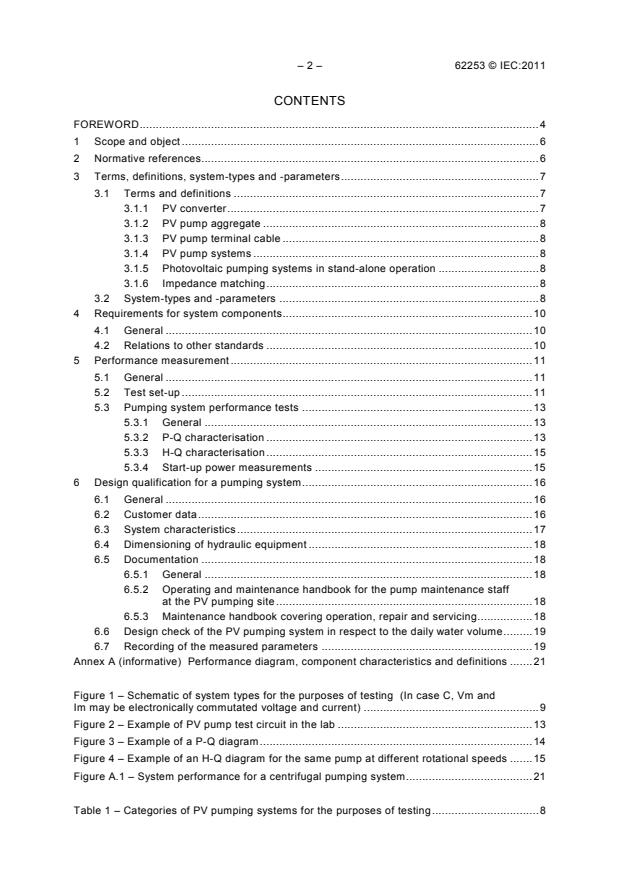
– 2 – 62253 © IEC:2011
CONTENTS
FOREWORD . 4
1 Scope and object . 6
2 Normative references. 6
3 Terms, definitions, system-types and -parameters . 7
3.1 Terms and definitions . 7
3.1.1 PV converter . 7
3.1.2 PV pump aggregate . 8
3.1.3 PV pump terminal cable . 8
3.1.4 PV pump systems . 8
3.1.5 Photovoltaic pumping systems in stand-alone operation . 8
3.1.6 Impedance matching . 8
3.2 System-types and -parameters . 8
4 Requirements for system components . 10
4.1 General . 10
4.2 Relations to other standards . 10
5 Performance measurement . 11
5.1 General . 11
5.2 Test set-up . 11
5.3 Pumping system performance tests . 13
5.3.1 General . 13
5.3.2 P-Q characterisation . 13
5.3.3 H-Q characterisation . 15
5.3.4 Start-up power measurements . 15
6 Design qualification for a pumping system . 16
6.1 General . 16
6.2 Customer data . 16
6.3 System characteristics . 17
6.4 Dimensioning of hydraulic equipment . 18
6.5 Documentation . 18
6.5.1 General . 18
6.5.2 Operating and maintenance handbook for the pump maintenance staff
at the PV pumping site . 18
6.5.3 Maintenance handbook covering operation, repair and servicing . 18
6.6 Design check of the PV pumping system in respect to the daily water volume . 19
6.7 Recording of the measured parameters . 19
Annex A (informative) Performance diagram, component characteristics and definitions . 21
Figure 1 – Schematic of system types for the purposes of testing (In case C, Vm and
Im may be electronically commutated voltage and current) . 9
Figure 2 – Example of PV pump test circuit in the lab . 13
Figure 3 – Example of a P-Q diagram . 14
Figure 4 – Example of an H-Q diagram for the same pump at different rotational speeds . 15
Figure A.1 – System performance for a centrifugal pumping system . 21
Table 1 – Categories of PV pumping systems for the purposes of testing . 8
62253 © IEC:2011 – 3 –
Table 2 – Definition of the parameters . 10
Table 3 – Pressure in bars for equivalent heads of water . 17
Table 4 – Core and optional parameters to be measured and recorded . 20
– 4 – 62253 © IEC:2011
INTERNATIONAL ELECTROTECHNICAL COMMISSION
____________
PHOTOVOLTAIC PUMPING SYSTEMS –
DESIGN QUALIFICATION AND PERFORMANCE MEASUREMENTS
FOREWORD
1) The International Electrotechnical Commission (IEC) is a worldwide organization for standardization comprising
all national electrotechnical committees (IEC National Committees). The object of IEC is to promote
international co-operation on all questions concerning standardization in the electrical and electronic fields. To
this end and in addition to other activities, IEC publishes International Standards, Technical Specifications,
Technical Reports, Publicly Available Specifications (PAS) and Guides (hereafter referred to as “IEC
Publication(s)”). Their preparation is entrusted to technical committees; any IEC National Committee interested
in the subject dealt with may participate in this preparatory work. International, governmental and non-
governmental organizations liaising with the IEC also participate in this preparation. IEC collaborates closely
with the International Organization for Standardization (ISO) in accordance with conditions determined by
agreement between the two organizations.
2) The formal decisions or agreements of IEC on technical matters express, as nearly as possible, an international
consensus of opinion on the relevant subjects since each technical committee has representation from all
interested IEC National Committees.
3) IEC Publications have the form of recommendations for international use and are accepted by IEC National
Committees in that sense. While all reasonable efforts are made to ensure that the technical content of IEC
Publications is accurate, IEC cannot be held responsible for the way in which they are used or for any
misinterpretation by any end user.
4) In order to promote international uniformity, IEC National Committees undertake to apply IEC Publications
transparently to the maximum extent possible in their national and regional publications. Any divergence
between any IEC Publication and the corresponding national or regional publication shall be clearly indicated in
the latter.
5) IEC itself does not provide any attestation of conformity. Independent certification bodies provide conformity
assessment services and, in some areas, access to IEC marks of conformity. IEC is not responsible for any
services carried out by independent certification bodies.
6) All users should ensure that they have the latest edition of this publication.
7) No liability shall attach to IEC or its directors, employees, servants or agents including individual experts and
members of its technical committees and IEC National Committees for any personal injury, property damage or
other damage of any nature whatsoever, whether direct or indirect, or for costs (including legal fees) and
expenses arising out of the publication, use of, or reliance upon, this IEC Publication or any other IEC
Publications.
8) Attention is drawn to the Normative references cited in this publication. Use of the referenced publications is
indispensable for the correct application of this publication.
9) Attention is drawn to the possibility that some of the elements of this IEC Publication may be the subject of
patent rights. IEC shall not be held responsible for identifying any or all such patent rights.
International Standard IEC 62253 has been prepared by IEC technical committee 82: Solar
photovoltaic energy systems.
The text of this standard is based on the following documents:
FDIS Report on voting
82/647/FDIS 82/656/RVD
Full information on the voting for the approval of this standard can be found in the report on
voting indicated in the above table.
This publication has been drafted in accordance with the ISO/IEC Directives, Part 2.
62253 © IEC:2011 – 5 –
The committee has decided that the contents of this publication will remain unchanged until the
stability date indicated on the IEC web site under "http://webstore.iec.ch" in the data related to
the specific publication. At this date, the publication will be
• reconfirmed,
• withdrawn,
• replaced by a revised edition, or
• amended.
IMPORTANT – The 'colour inside' logo on the cover page of this publication indicates
that it contains colours which are considered to be useful for the correct understanding
of its contents. Users should therefore print this document using a colour printer.
– 6 – 62253 © IEC:2011
PHOTOVOLTAIC PUMPING SYSTEMS –
DESIGN QUALIFICATION AND PERFORMANCE MEASUREMENTS
1 Scope and object
This International Standard defines the requirements for design, qualification and performance
measurements of photovoltaic pumping systems in stand-alone operation. The outlined
measurements are applicable for either indoor tests with PV generator simulator or outdoor
tests using a real PV generator. This standard applies to systems with motor pump sets
connected to the PV generator directly or via a converter (DC to DC or DC to AC). It does not
apply to systems with electrical storage unless this storage is only used for the pump start up
(< 100 Wh).
The goal is to establish a PV pumping system design verification procedure according to the
specific environmental conditions. This Standard addresses the following pumping system
design features:
• Power vs. flow rate characteristics at constant pumping head
• Pumping head vs. flow rate characteristics at constant speed
• System design parameters and requirements
• System specification
• Documentation requirements
• System design verification procedure
The object of this standard is to establish requirements in order to be able to verify the system
performance characteristics of the PV pumping system. For this purpose the test set-up is
outlined, the measurements and deviations to be taken are defined and a checklist for the data
mining is established.
2 Normative references
The following referenced documents are indispensable for the application of this document. For
dated references, only the edition cited applies. For undated references, the latest edition of
the referenced document (including any amendments) applies.
IEC 60068-2-6, Environmental testing – Part 2-6: Tests – Test Fc: Vibration (sinusoidal)
IEC 60068-2-30, Environmental testing – Part 2:30: Tests – Test Db: Damp heat, cyclic (12 +
12 h cycle)
IEC 60146 (all parts), Semiconductor converters – General requirements and line commutated
converters
IEC 60364-4-41, Low-voltage electrical installations – Part 4-41: Protection for safety –
Protection against electric shock
IEC 60364-7-712, Electrical installations of buildings – Part 7-712: Requirements for special
installations or locations – Solar photovoltaic (PV) power supply systems
IEC 60529, Degree of protection provided by enclosures (IP Code)
62253 © IEC:2011 – 7 –
IEC 60947-1, Low voltage switchgear and controlgear – Part 1: General rules
IEC 61000-6-2, Electromagnetic compatibility (EMC) – Part 6-2: Generic standards – Immunity
for industrial environments
IEC 61000-6-3, Electromagnetic compatibility (EMC) – Part 6-3: Generic standards – Emission
standard for residential, commercial and light-industrial environments
IEC 61215, Crystalline silicon terrestrial photovoltaic (PV) modules – Design qualification and
type approval
IEC 61646, Thin-film terrestrial photovoltaic (PV) modules – Design qualification and type
approval
IEC 61683:1999, Photovoltaic systems – Power conditioners – Procedure for measuring
efficiency
IEC 61725, Analytical expression for daily solar profiles
IEC 61730-1, Photovoltaic (PV) module safety qualification – Part 1: Requirements for
construction
IEC 61730-2, Photovoltaic (PV) module safety qualification – Part 2: Requirements for testing
IEC 61800-3, Adjustable speed electrical power drive systems – Part 3: EMC requirements and
specific test methods
IEC 62103, Electronic equipment for use in power installations
IEC 62109-1, Safety of power converters for use in photovoltaic power systems – Part 1:
General requirements
IEC 62124:2004, Photovoltaic (PV) stand-alone systems design verification
IEC 62305-3, Protection against lightning – Part 3: Physical damage to structures and life
hazard
IEC 62458, Sound system equipment – Electroacoustical transducers – Measurement of large
signal parameters
IEC 62548 , Design requirements for photovoltaic (PV) arrays
ISO/DIS 9905, Technical specifications for centrifugal pumps – Class I (ISO 9905:1994)
3 Terms, definitions, system-types and -parameters
3.1 Terms and definitions
3.1.1 PV converter
The PV converter converts the DC voltage of the PV generator into a high or low DC voltage or
converts this DC voltage and/or DC current into one-phase or multi-phase alternating-current
voltage or alternating current
___________
To be published.
– 8 – 62253 © IEC:2011
NOTE the PV converter may also include equipment for MPPT, monitoring, metering and for protection purposes.
3.1.2 PV pump aggregate
The PV pump aggregate consists of the pump (centrifugal pump, displacement volume pump)
the driving motor and control
3.1.3 PV pump terminal cable
A PV pump terminal cable connects the PV converter and the pump aggregate
3.1.4 PV pump systems
A PV installation is comprised mainly of the following components and equipment:
PV generator, cabling, control unit (e.g. inverter, DC/DC converter, etc.), motor, pump and
hydraulic piping
3.1.5 Photovoltaic pumping systems in stand-alone operation
Photovoltaic pumping systems in stand-alone operation are photovoltaic pumping systems with
no connection to the grid
3.1.6 Impedance matching
DC/DC Converter, which may include MPPT or V/I tracking maybe with temperature correction
3.2 System-types and -parameters
For the purposes of testing, PV pumping systems can be divided into four categories as shown
in Table 1. The measurement access points within the system define these categories.
Figure 1 illustrates the four basic arrangements, and defines the parameters that can be
measured at each accessible point in the system. The parameters are defined in Table 2.
Table 1 – Categories of PV pumping systems for the purposes of testing
Pumping system types
A. DC systems either directly connected or with a control (impedance matching) electronics integral with
motor-pump
B. DC system with separate impedance matching unit, connected to either brushed or electronics
commutated motor-pump unit where the corresponding controls are integral with motor-pump
C. DC system (brushless) with separate commutation control (and impedance matching)
D. System with DC/AC inverter for operation of a standard AC pump-motor
62253 © IEC:2011 – 9 –
A.
Motor Pump
Array Control
p, Q
Va, Ia
n, T
B.
Impedance
Motor Pump
Control p, Q
Array
matching
Vm, Im
Va, Ia
n, T
Commutation
C.
p, Q
Motor Pump
(and impedance
Array
matching)
Va, Ia Vm, Im
n, T
D.
p, Q
Motor Pump
Array Inverter
Va, Ia Vm, Im, f
n, T
IEC 1669/11
Figure 1 – Schematic of system types for the purposes of testing
(In case C, Vm and Im may be electronically commutated voltage and current)
– 10 – 62253 © IEC:2011
Table 2 – Definition of the parameters
No. Parameter Sym Unit
1 Generator voltage DC Va V
2 Generator current DC Ia A
3 Generator open circuit voltage DC Voc V
4 Generator short cut current DC Isc A
5 Generator maximum power point voltage DC Vmpp V
6 Generator maximum power point current DC Impp A
7 Pressure as measured Pa
p
8 Flow rate m /h
Q
9 Motor voltage DC or AC Vm V
10 Motor current DC or AC Im A
11 Motor voltage (multi-phase AC) V V
rms
12 Motor current (multi-phase AC) I A
rms
13 Power factor λ -
14 AC frequency (or DC switching frequency) Hz
f
–1
15 Motor speed min
n
16 Torque at motor-pump coupling T Nm
o
17 Water temperature (at inlet) t C
4 Requirements for system components
4.1 General
Typically a PV pumping system consists of the following main components:
• PV generator
• Electronic converters which are separate (impedance matching device or inverter)
• Combined motor pump unit
4.2 Relations to other standards
PV pumping systems are one of the applications for photovoltaics. Therefore existing
standards for the components shall be applied.
PV modules should comply with the requirements of relevant standards. For crystalline PV
modules IEC 61215, for thin-film PV modules IEC 61646 and for safety requirements for PV
modules IEC 61730-1 and IEC 61730-2 are applicable. PV generators should be installed
according to IEC 62548. The PV generator combiner box should bear a warning label indicating
that active parts of the PV generator combiner box may still be live even after disconnection
from the converter.
As PV pumping systems are stand-alone systems IEC 60364-7-712 applies as well.
The PV generator combiner boxes and the switchgear assembly for the installation of the PV
converter should be in compliance with the requirements of IEC 60947-1. A warning label is
required to the extent that fuses or disconnect devices should not be withdrawn or switched
under load if such devices are installed on the DC side.
62253 © IEC:2011 – 11 –
Power Conditioning Units (DC-DC converter, DC-AC converter) have to fulfil the requirements
given in IEC 62109-1.
Upon selection of the electrical equipment of the DC side one should ensure that the
equipment is suited for direct voltage and direct current. PV generators are to be connected in
series up to the maximum open-circuit voltage of the PV generator. The respective
specifications are to be given by the module manufacturer. If blocking diodes are necessary,
their reverse voltage is to be rated at twice the value of the open-circuit voltage of the PV
generator under STC. IEC 62458 for PV installation shall be referred.
The protection concept should meet the requirements against electric shocks (IEC 60364-4-41)
and the operation safety of the system. Testing of electrical components and electronic
apparatus shall comply with IEC 60146, IEC 62103 and all relevant standards.
Lightning protection shall be compliant to the relevant standards and the requirements of
IEC 62305-3.
The damp-heat suitability of electronic apparatus shall be compliant at local ambient conditions
to IEC 60068-2-30 (ref. to damp-heat cyclic). 5 cycles shall be made for the electronic
apparatus.
Severity: With plants for tropical application the temperature amounts to 55 °C max.
With plants in temperate climates the temperature amounts to 45 °C max.
Protection against contact, foreign bodies and water shall be compliant to IEC 60529.
Type testing of the transportability of electronic apparatus with packaging shall be compliant to
IEC 60068-2-6.
Assessment of immunity against conducted and radiated disturbing quantities shall be
compliant to IEC 61000-6-2, IEC 61000-6-3 and IEC 61800-3.
Pumps can be classified into 4 main categories, although supplementary types might exist.
Centrifugal pumps shall fulfil the requirements given in ISO/DIS 9905 Class I.
5 Performance measurement
5.1 General
The performance of the system can be determined by evaluation the complete system under
varying conditions. The performance shall be evaluated either under laboratory (replicable and
reproducible) conditions or under field conditions for acceptance test. One of them is enough.
5.2 Test set-up
The minimum requirement for a test set-up for performance measurement is defined as follows
(Maximum measurement uncertainties are given in Table 4):
Electric:
• Real PV generator with irradiance and wind measurement (for field acceptance)
or
Programmable PV solar generator simulator capable to simulate a given PV solar
generator configuration (i.e. the number of modules, the type and the series/parallel
combination) for laboratory test.
• Real cable type, length and diameter (for field acceptance or laboratory test)
or
Cable impedance simulator (for laboratory test).
– 12 – 62253 © IEC:2011
• Measurement equipment with acceptable accuracy and precision for detection and
registration of the parameters listed in Table 2.
Hydraulic:
• Water tank
• Motor-pump set
• Pressure transducer
• Pre-pressurised air chamber (where the pressure level can be adjusted)
• Flow transducer
• Pressure sustaining device
• Discharge pipe
An example test circuit schematic is shown in Figure 2.
NOTE Any equivalent test circuit (e.g. for different pumping types) verifying correct hydraulic characteristics and
system performance can be used, provided that it ensures the required initial counter pressure.
The pipe set up between the pump outlet and the pressure sensor should be the same
diameter as the manufacturer’s outlet fitting. It is assumed that over the normal operating
range of the pump the pressure drop due to frictional losses between the pump outlet and the
pressure sensor will be negligible and the kinetic energy component of the water at the pump
outlet will be small compared to the increase in potential energy due to the increased pressure
across the pump. These assumptions should be verified and if necessary the effect on the
calculation of hydraulic power should be corrected. This should be noted in the test report.
The general layout of the system pipe work should be designed to avoid airlocks.
For instantaneous performance testing, pressure can be sustained by means of a simple gate
valve in which a backpressure is sustained by restricting the flow. There are also special valves
available which sustain a constant upstream pressure (pressure sustaining valves) although
care should be taken, as their performance can be unpredictable. Some better equipped test
laboratories may sustain pressure by means of a pre-pressurised air chamber operating with a
pressure maintaining valve at the outlet or a real water column (see Table 3).
If a flow meter is used for laboratory measurements, then the end of the discharge pipe should
be beneath the water surface to prevent splashing. This could cause a mixed water / air
bubbles fluid entering the pump inlet and affecting its proper operation. If the bucket and stop-
watch method (field method) is used, it is not possible to discharge the water beneath the
surface, and so a vertical baffle shall be inserted in the tank between the pump intake and the
return pipe such that water has to pass under the baffle near the bottom of the tank to reach
the pump. In this way any small bubbles will be excluded, as they will remain near the surface.
Alternatively a large pipe can be placed around the pump with its top breaking the surface and
an arch cut in its base to allow water entry.
62253 © IEC:2011 – 13 –
Pre - pressurised
air chamber
10 m hose
(f or induced
flow pumps)
V I P Q
Pressure
sustaining
device
Controller etc.
Discharge
Instrumentation
Pump
I
I = C urrent
V = V oltage
Q = fl ow rate
P = pr essure
V
Motor
PV generator PV generator
Water tank
outdoor test simulator
IEC 1670/11
Figure 2 – Example of PV pump test circuit in the lab
5.3 Pumping system performance tests
5.3.1 General
The characteristics agreed to in the component and implementation specification shall be
verified in the performance tests. During the performance test, components or subsystems are
submitted to various test procedures and are tested for adherence to the stipulated
characteristics. A first design check will be carried out after the performance curves have been
determined to compare them with the required design data of the plant. Data for the system as
a whole is verified on site by performing the field performance test. The test provides all
necessary information and performance curves to be taken as a basic for the field performance
test.
Laboratory performance test: A schematic of the required laboratory system test circuit is
shown in Figure 2.
The converter efficiency test is performed according to IEC 61683:1999 and therefore not
detailed in this standard.
5.3.2 P-Q characterisation
It is important to test the performance of the pumping systems at constant head (H) and
varying input power (P) to determine the resultant flow rate (Q). In the laboratory these
characteristic constant head (H) curves for P over Q shall be determined.
The following constant head (H) curves should be determined (unless the manufacturer defines
the lowest allowed head different. Then H should be taken as H ):
1 min
H = 0,3 H
1 max
H = 0,4 H
2 max
Baffle
– 14 – 62253 © IEC:2011
H = 0,5 H
3 max
H = 0,6 H
4 max
H = 0,7 H
5 max
H = 0,8 H
6 max
H = 0,9 H
7 max
See also Figure 3 (example for a centrifugal pumping system) as an example of a graphical
representation. H (Q = 0 for centrifugal pumps. For other pump types, e.g. helical rotor
max
pumps H is defined by the manufacturer as the maximum allowed operational head) is the
max
maximum pumping head of the pump at the maximum safe motor speed or the maximum
frequency supplied by the converter (in case this is lower than the safe motor speed). Safety
requirements from the pump manufacturer should be considered.
The pumping system shall be run at nominal speed for 5 min at low pressure respectively open
valves in order to get air bubbles out of the test loop.
The pressure is set to a fixed value. Measurements are started at the highest pressure. The
system input power is varied from high to low in steps and the flow rate is measured, for this
purpose, the PV generator simulator or real PV generator I-V characteristics shall be as
specified in the system design. Between high input power and low input power at least 5
measurement points with equal delta flows (the difference in the flow rates should be equal
from measurement point to measurement point) shall be taken. This results in one P-Q curve
for constant pressure (water head in m).
Power vs. flow rate for constant water head
for a centrifugal pump with H (Q = 0 m /h) = 100 m
max
at rpm = 3 900
max
Water
head
6,0
30 m
5,0
40 m
4,0
50 m
3,0 60 m
70 m
2,0
80 m
1,0
90 m
0,0
0 250 500 750 1 000 1 250 1 500 1 750 2 000
IEC 1671/11
Power (W)
Figure 3 – Example of a P-Q diagram
For field application a simplified procedure is applied:
The PV pumping system is installed at the desired location. A pressure sensor is brought into
the well to determine the real water pumping head H [m] (static + dynamic water head). The
flow rate of pumped water Q [l/s] is measured either with a calibrated flow meter or with the
bucket method mentioned in 5.2. At the input of the converter DC voltage V [V] and current I
[A] are measured. With these measurement the efficiency of the converter-motor-pump
subsystem can be calculated (g = earth gravity = 9,81 m/s ):
H×Q× g
η=
I×V
Flow Rate Q (m³/h)
62253 © IEC:2011 – 15 –
5.3.3 H-Q characterisation
In this characterisation the systems power is varied so that the pump runs at a set speed
(parameter n). One of the speeds included in the characterisation should include the speed
equivalent to the measured manufacturer data which for a.c. pumps would be related to the
inverter output frequency (US data (60 Hz) – EU data (50 Hz)).
The procedure is:
• Initially the pumping system shall be run at nominal speed for 5 min at low pressure with
open valves in order to get air bubbles out of the test loop.
• The valve is then set in a way that the pump is running against its full head. (For centrifugal
pumps the valve can be fully closed, for displacement pump the valve is closed so that the
rated maximum head of the pump is reached.)
• From this point the valve is opened in steps so that the maximum flow is reached.
• Every time a new point is reached, the input power has to be adjusted so that the set speed
is reached again (parameter n). For this purpose, the PV generator simulator or real PV
generator I-V characteristics shall be as specified in the system design.
• Between closed valve and opened valve at least 5 measurement points for equal delta flows
shall be taken. This results in one H-Q curve for constant speed, whereas voltage and
current might differ.
• This procedure is repeated for other speeds. A set of 5 curves should be taken where the
speed difference corresponds to 5 Hz.
Figure 4 shows an example graphic presentation.
Speed 8
Speed 7
Speed 6
Speed 5
Speed 4
Speed 3
Speed 2
Speed 1
0 20 40 60 80 100 120 140 160
H (m)
IEC 1672/11
Figure 4 – Example of an H-Q diagram for the same pump at different rotational speeds
5.3.4 Start-up power measurements
This test is for the determination of the minimum power needed to start a photovoltaic pumping
system. This test is obsolete for centrifugal pumps if no non-return valve is installed in the
pump.
The pump is switched off. The pre-pressurised air chamber is filled 50 % with water and air
pressure is applied until the nominal head of the pump is reached in the system. The pressure-
sustaining device (e.g. a pressure controlled valve) is as well set to this head value (see
Figure 2). The PV generator simulator is set to a maximum current value (irradiance) and the
system is started. This procedure is repeated from low value to high value until the system
starts, runs stable for 2 min and does not trip. This is the needed start up power for the
specified head.
Q (m /s)
– 16 – 62253 © IEC:2011
For displacement pumps the procedure applies in the same way. The difference to centrifugal
pumps is that with each start up test a water film is sucked between rotor and stator and
serves as lubricant. This reduces the friction and therefore the start-up power. As in practice
between shut down in the evening and start up in the morning there are several hours during
which the water film is pressed out, a waiting time between 2 start-up tests of 2 h is appropriate
for helical rotor pumps.
6 Design qualification for a pumping system
6.1 General
A fundamental requirement for planning solar energy pumping systems is that adequate data is
available for use as a basis. On the one hand sufficient data from the customer shall be made
available to the planner and on the other hand the planner shall take reliable data from the
component manufacturer as a basis.
This clause gives a guideline on how to properly design a solar pumping system for optimized
operation.
6.2 Customer data
a) Geographical
– Longitude, latitude, topography
Longitude and latitude define the site where the system is located. The topography
defines the local situation, e.g. orientation of the generator in azimuth and elevation,
shading conditions and air quality (humidity and dust level).
b) Climatic data
– Irradiation: Design basis: IEC 61725. NASA data.
If there is no data given by the customer, use the default irradiation data of
IEC 62124:2004, Table A.1.
– Temperature data: average, min, max.
If there is no data given by the customer, use the default average ambient temperature
of 30 °C.
– Precipitation.
– Maximum and average wind speed.
c) Specific local conditions
– Well data or data of the water source:
• well depth (static head), well diameter;
• well productivity (Q in m /h and total pumping head at this level) and evidence of
max
well suitability;
• dynamic water level (the well output is determined according to international or
national regulations);
• TDH (total dynamic head, including the friction losses of the piping system);
• required daily water supply under defined worst condition (irradiance, date, water
head).
For adjusting the pressure in the pre-pressurised air chamber, also see Table 3.
Water quality shall be according to international or national regulations, indication of dirt or
sand particles.
d) Water demand
– Required daily water supply under defined worst condition (irradiance, date, water head)
as Q in m /day
d
62253 © IEC:2011 – 17 –
– Consumption profile
e) Project description
– Site description (including photographs where available)
– Type of site with height data for the determination of the total pump head, TDH, piping
systems, (length, diameter)
– Existing or planned buildings
– Vegetation with regard to shading
– Storage and distribution facilities
– Water tank, other distribution or storage facilities including technical specifications
The required data supplied by the customer leads to diagrams 1 and 2 and to the value v
(average daily pumped water) of Figure A.1 (example for a direct coupled PV centrifugal
pumping system). This is the basis of the design performed by the systems supplier.
Table 3 – Pressure in bars for equivalent heads of water
Head Pressure Head Pressure Head Pressure
m hPa m hPa m hPa
5 0,49 40 3,92 75 7,36
10 0,98 45 4,41 80 7,85
15 1,47 50 4,91 85 8,34
20 1,96 55 5,40 90 8,83
25 2,45 60 5,89 95 9,32
30 2,94 65 6,37 100 9,81
35 3,43 70 6,87
For templates for the capture of data, see Clause A.2.
6.3 System characteristics
(See the example of a centrifugal pumping system in Figure A.1 for further details.)
From the available data the system supplier defines the following plant characteristics:
• Dynamic pump head H including pressure losses due to pipe friction, measuring appliances
and well draw-down over volume flow Q (see curve 1 in Figure A.1).
• Solar irradiance profiles (see curve 2 in Figure A.1).
• Power characteristic of the photovoltaic generator (see curve 3 in Figure A.1) dependent on
the irradiation under the operational (ambient temperature) important is the temperature of
the PV module cells conditions and with regard to the generator setting angle. This figure
shall be given by at least four points (G , 0,8 × G , 0,6 × G , 0,4 × G ).
max max max max
• The PV-generator should be defined by the following characteristic: electrical output P over
irradiation G. This characteristic is formed from the maximum power points (MPPs) for
various irradiations at the module temperatures occurring for set limiting conditions. The
limiting conditions (air temperature, wind speed) taken as a basis by the manufacturer
when establishing the characteristic should be quoted. Possible deviations of the converter
from the MPPs should be taken into account when quoting the PV-generator characteristic.
With direct-coupled DC motors the adaptation of the generator characteristic to the motor
operation is to be observed. Voc of the PV generator has to the considered as well, Uoc
must be < Umax of the converter electronics at any ambient conditions.
– 18 – 62253 © IEC:2011
• The volume flow rate should be stated for the course of irradiation and for these plant
characteristics. It shall be defined by at least four points (G , 0,8 × G , 0,6 ×
max max
G , 0,4 × G ).
max max
• The integral of the flow rate graph represents the quantity of water pumped daily. This
value should meet the value of the required volume within a tolerance of –5 % to +20 %.
It may become apparent during the dimensioning of the system that an optimal design that
achieves within –5 % / 20 % of the daily requirement is not possible due to the discrete design
parameters (e.g. number of strings). If this is the case, an agreement shall be reached with the
operator, and if necessary, the operator's criteria should be modified.
6.4 Dimensioning of hydraulic equipment
Pressure loss calculations need not be made if the following dimensioning criteria are fulfilled:
Piping should be dimensioned to achieve feasible friction losses. Recommended maximum
friction loss is 5 % (at STC) of total dynamic head. The nominal flow rate of water meters
should be at least 1,5 times the maximum volume flow rate.
6.5 Documentation
6.5.1 General
The documentation shall serve as reference for the way the design was performed. It shall
outline the data and assumptions on which the design was based as well as the process used
in the design. Measures for a safe, sustainable and environmental friendly operation shall be
stated. By this, in case the installed system does not comply with the requirements, the
documentation will help in the discussion.
6.5.2 Operating and maintenance handbook for the pump maintenance staff at the PV
pumping site
This document shall contain easily comprehensible descriptions with simple figures covering
the following topics:
• Standard operational procedures such as start-up and shut-down
• Functional description, description of functional supervision and interpretation of status and
error indicators
• Rules for action on faulty operation
• Instructions on safety techniques
• Personal safety behaviour, protection against electric shocks
• Maintenance work such as cleaning
A logbook should be established in order to gain continuous operation information. The
document shall be written in the language common to the country and in English.
6.
...