

IEC 60068-3-8:2003
(Main)Environmental testing - Part 3-8: Supporting documentation and guidance - Selecting amongst vibration tests
General Information
- Abstract
Provides guidance for selecting amongst the IEC 60068-2 stationary vibration test methods Fc sinusoidal, Fh random and F(x) Mixed mode vibration. The different steady-state test methods and their aims are briefly described in Clause 4. Transient test methods are not included. For vibration testing, the environmental conditions, especially the dynamic conditions for the specimen, should be known. This standard helps to collect information about the environmental conditions (Clause 5), to estimate or measure the dynamic conditions (Clause 6) and gives examples to enable decisions to be made on the most applicable environmental vibration test method. Starting from the condition, the method of selecting the appropriate test is given. Since real life vibration conditions are dominated by vibration of a random nature, random testing should be the commonly used method, see Table 1, Clause 7. The methods included hereafter may be used to examine the vibration response of a specimen under test before, during and after vibration testing. The selection for the appropriate excitation method is described in Clause 8 and tabulated in Table 2. In this standard specification, writers will find information concerning vibration test methods and guidance for their selection. For guidance on test parameters, or severities of one of the test methods, reference should be made to the normative references.
- Status
- Published
- Publication Date
- 27-Aug-2003
- Technical Committee
- TC 104 - Environmental conditions, classification and methods of test
- Drafting Committee
- MT 17 - TC 104/MT 17
- Current Stage
- PPUB - Publication issued
- Start Date
- 28-Aug-2003
- Completion Date
- 15-Nov-2003
Overview
IEC 60068-3-8:2003 is a fundamental international standard providing comprehensive guidance on selecting appropriate vibration test methods in environmental testing. This standard supports engineers and test specialists in choosing between stationary vibration test methods defined in IEC 60068-2, specifically sinusoidal (Fc), random (Fh), and mixed-mode vibration tests (F(x)). It excludes transient vibration tests and focuses on steady-state conditions, aiming to align test methods precisely with the environmental vibration conditions expected in the real world.
By detailing how to collect environmental data, estimate dynamic specimen conditions, and analyze vibration responses, IEC 60068-3-8 helps ensure that vibration testing is both relevant and effective. This results in better durability, reliability, and qualification of electrical and electronic components subject to vibrational stress.
Key Topics
Vibration Test Methods
Explanation of sinusoidal, random, and mixed-mode vibration test principles along with their objectives. The standard describes the test setups, typical use cases, and comparative advantages.Environmental Condition Assessment
Emphasis on gathering detailed environmental vibration information including dynamic conditions faced by the specimen during its lifecycle. Guidance is provided on estimating or measuring these conditions accurately.Test Method Selection Strategy
Decision-making framework starting from the identified environmental conditions to selecting the most representative vibration method. Random vibration testing is recommended as the default method due to its alignment with real-life environmental vibrations.Dynamic Condition Estimation and Data Analysis
Procedures for measuring actual dynamic conditions using instrumentation, followed by techniques to analyze vibration data for insight into specimen response.Vibration Response Investigation
Guidance on evaluating the response of specimens during and after vibration tests to identify resonance frequencies, potential failure points, and to troubleshoot vibration-related issues.Accelerated Testing Considerations
Discussion on accelerated vibration tests to simulate extended or harsher vibration exposure within shortened test durations.Specification and Documentation Guidelines
Requirements for inclusion of relevant vibration testing details and acceptance criteria in test specifications to ensure clear communication and reproducibility.
Applications
IEC 60068-3-8:2003 is applicable across industries where electrical and electronic equipment undergo mechanical vibration stresses, including:
Aerospace and Defense
Assessing avionics and mission-critical electronics for vibration resilience during flight and transport.Automotive Engineering
Testing vehicle electronics under road-induced vibrations and operational stresses.Consumer Electronics
Verifying durability of handheld devices, computing equipment, and appliances in daily use.Industrial Machinery
Qualification of control and monitoring systems in vibrationally intense environments.Telecommunications Infrastructure
Ensuring robustness of network equipment exposed to vibration during installation and operation.
By adopting IEC 60068-3-8, test engineers can achieve more reliable vibration testing, reducing product failures due to inappropriate test methods and better simulating real-life conditions.
Related Standards
IEC 60068-2 Series
Defines the detailed stationary vibration test methods such as sine (Fc), random (Fh), and mixed-mode (F(x)) which IEC 60068-3-8 supports in selection.ISO 10816 Series
Focuses on vibration severity evaluation for rotating machinery and may complement IEC 60068 standards in broader vibration assessment.ISO/IEC 17025
Specifies the general requirements for testing and calibration laboratories ensuring reliable environmental test results.IEC 60068-1
General and guidance provisions for environmental testing, providing broader context for applying IEC 60068-3-8.
Keywords: IEC 60068-3-8, vibration testing, environmental testing, sinusoidal vibration, random vibration, mixed-mode vibration, vibration test selection, dynamic conditions, electrical equipment testing, vibration response, accelerated vibration tests, IEC standards, vibration environment, electrotechnical standardization.
Get Certified
Connect with accredited certification bodies for this standard

IMQ S.p.A. (Certification)
Italian electrical product certification.

SLG Prüf- und Zertifizierungs GmbH
German testing and certification body.

UL Solutions
Global safety science company with testing, inspection and certification.
Sponsored listings
Frequently Asked Questions
IEC 60068-3-8:2003 is a standard published by the International Electrotechnical Commission (IEC). Its full title is "Environmental testing - Part 3-8: Supporting documentation and guidance - Selecting amongst vibration tests". This standard covers: Provides guidance for selecting amongst the IEC 60068-2 stationary vibration test methods Fc sinusoidal, Fh random and F(x) Mixed mode vibration. The different steady-state test methods and their aims are briefly described in Clause 4. Transient test methods are not included. For vibration testing, the environmental conditions, especially the dynamic conditions for the specimen, should be known. This standard helps to collect information about the environmental conditions (Clause 5), to estimate or measure the dynamic conditions (Clause 6) and gives examples to enable decisions to be made on the most applicable environmental vibration test method. Starting from the condition, the method of selecting the appropriate test is given. Since real life vibration conditions are dominated by vibration of a random nature, random testing should be the commonly used method, see Table 1, Clause 7. The methods included hereafter may be used to examine the vibration response of a specimen under test before, during and after vibration testing. The selection for the appropriate excitation method is described in Clause 8 and tabulated in Table 2. In this standard specification, writers will find information concerning vibration test methods and guidance for their selection. For guidance on test parameters, or severities of one of the test methods, reference should be made to the normative references.
Provides guidance for selecting amongst the IEC 60068-2 stationary vibration test methods Fc sinusoidal, Fh random and F(x) Mixed mode vibration. The different steady-state test methods and their aims are briefly described in Clause 4. Transient test methods are not included. For vibration testing, the environmental conditions, especially the dynamic conditions for the specimen, should be known. This standard helps to collect information about the environmental conditions (Clause 5), to estimate or measure the dynamic conditions (Clause 6) and gives examples to enable decisions to be made on the most applicable environmental vibration test method. Starting from the condition, the method of selecting the appropriate test is given. Since real life vibration conditions are dominated by vibration of a random nature, random testing should be the commonly used method, see Table 1, Clause 7. The methods included hereafter may be used to examine the vibration response of a specimen under test before, during and after vibration testing. The selection for the appropriate excitation method is described in Clause 8 and tabulated in Table 2. In this standard specification, writers will find information concerning vibration test methods and guidance for their selection. For guidance on test parameters, or severities of one of the test methods, reference should be made to the normative references.
IEC 60068-3-8:2003 is classified under the following ICS (International Classification for Standards) categories: 19.040 - Environmental testing; 29.020 - Electrical engineering in general. The ICS classification helps identify the subject area and facilitates finding related standards.
IEC 60068-3-8:2003 is available in PDF format for immediate download after purchase. The document can be added to your cart and obtained through the secure checkout process. Digital delivery ensures instant access to the complete standard document.
Standards Content (Sample)
NORME CEI
INTERNATIONALE IEC
60068-3-8
INTERNATIONAL
Première édition
STANDARD
First edition
2003-08
PUBLICATION FONDAMENTALE DE SÉCURITÉ
BASIC SAFETY PUBLICATION
Essais d'environnement –
Partie 3-8:
Documentation d'accompagnement
et lignes directrices –
Sélection d'essais de vibrations
Environmental testing –
Part 3-8:
Supporting documentation and guidance –
Selecting amongst vibration tests
Numéro de référence
Reference number
CEI/IEC 60068-3-8:2003
Numérotation des publications Publication numbering
Depuis le 1er janvier 1997, les publications de la CEI As from 1 January 1997 all IEC publications are
sont numérotées à partir de 60000. Ainsi, la CEI 34-1 issued with a designation in the 60000 series. For
devient la CEI 60034-1. example, IEC 34-1 is now referred to as IEC 60034-1.
Editions consolidées Consolidated editions
Les versions consolidées de certaines publications de la The IEC is now publishing consolidated versions of its
CEI incorporant les amendements sont disponibles. Par publications. For example, edition numbers 1.0, 1.1
exemple, les numéros d’édition 1.0, 1.1 et 1.2 indiquent and 1.2 refer, respectively, to the base publication,
respectivement la publication de base, la publication de the base publication incorporating amendment 1 and
base incorporant l’amendement 1, et la publication de the base publication incorporating amendments 1
base incorporant les amendements 1 et 2. and 2.
Informations supplémentaires Further information on IEC publications
sur les publications de la CEI
Le contenu technique des publications de la CEI est The technical content of IEC publications is kept
constamment revu par la CEI afin qu'il reflète l'état under constant review by the IEC, thus ensuring that
actuel de la technique. Des renseignements relatifs à the content reflects current technology. Information
cette publication, y compris sa validité, sont dispo- relating to this publication, including its validity, is
nibles dans le Catalogue des publications de la CEI available in the IEC Catalogue of publications
(voir ci-dessous) en plus des nouvelles éditions, (see below) in addition to new editions, amendments
amendements et corrigenda. Des informations sur les and corrigenda. Information on the subjects under
sujets à l’étude et l’avancement des travaux entrepris consideration and work in progress undertaken by the
par le comité d’études qui a élaboré cette publication, technical committee which has prepared this
ainsi que la liste des publications parues, sont publication, as well as the list of publications issued,
également disponibles par l’intermédiaire de: is also available from the following:
• Site web de la CEI (www.iec.ch) • IEC Web Site (www.iec.ch)
• Catalogue des publications de la CEI • Catalogue of IEC publications
Le catalogue en ligne sur le site web de la CEI The on-line catalogue on the IEC web site
(www.iec.ch/searchpub) vous permet de faire des (www.iec.ch/searchpub) enables you to search by a
recherches en utilisant de nombreux critères, variety of criteria including text searches,
comprenant des recherches textuelles, par comité technical committees and date of publication. On-
d’études ou date de publication. Des informations en line information is also available on recently
ligne sont également disponibles sur les nouvelles issued publications, withdrawn and replaced
publications, les publications remplacées ou retirées, publications, as well as corrigenda.
ainsi que sur les corrigenda.
• IEC Just Published • IEC Just Published
Ce résumé des dernières publications parues This summary of recently issued publications
(www.iec.ch/online_news/justpub) est aussi dispo- (www.iec.ch/online_news/justpub) is also available
nible par courrier électronique. Veuillez prendre by email. Please contact the Customer Service
contact avec le Service client (voir ci-dessous) Centre (see below) for further information.
pour plus d’informations.
• Service clients • Customer Service Centre
Si vous avez des questions au sujet de cette If you have any questions regarding this
publication ou avez besoin de renseignements publication or need further assistance, please
supplémentaires, prenez contact avec le Service contact the Customer Service Centre:
clients:
Email: custserv@iec.ch Email: custserv@iec.ch
Tél: +41 22 919 02 11 Tel: +41 22 919 02 11
Fax: +41 22 919 03 00 Fax: +41 22 919 03 00
.
NORME CEI
INTERNATIONALE IEC
60068-3-8
INTERNATIONAL
Première édition
STANDARD
First edition
2003-08
PUBLICATION FONDAMENTALE DE SÉCURITÉ
BASIC SAFETY PUBLICATION
Essais d'environnement –
Partie 3-8:
Documentation d'accompagnement
et lignes directrices –
Sélection d'essais de vibrations
Environmental testing –
Part 3-8:
Supporting documentation and guidance –
Selecting amongst vibration tests
IEC 2003 Droits de reproduction réservés Copyright - all rights reserved
Aucune partie de cette publication ne peut être reproduite ni No part of this publication may be reproduced or utilized in any
utilisée sous quelque forme que ce soit et par aucun procédé, form or by any means, electronic or mechanical, including
y compris la photo-copie et les photocopying and microfilm, without permission in writing from
électronique ou mécanique,
microfilms, sans l'accord écrit de l'éditeur. the publisher.
International Electrotechnical Commission, 3, rue de Varembé, PO Box 131, CH-1211 Geneva 20, Switzerland
Telephone: +41 22 919 02 11 Telefax: +41 22 919 03 00 E-mail: inmail@iec.ch Web: www.iec.ch
CODE PRIX
S
Commission Electrotechnique Internationale
PRICE CODE
International Electrotechnical Commission
МеждународнаяЭлектротехническаяКомиссия
Pour prix, voir catalogue en vigueur
For price, see current catalogue
– 2 – 60068-3-8 CEI:2003
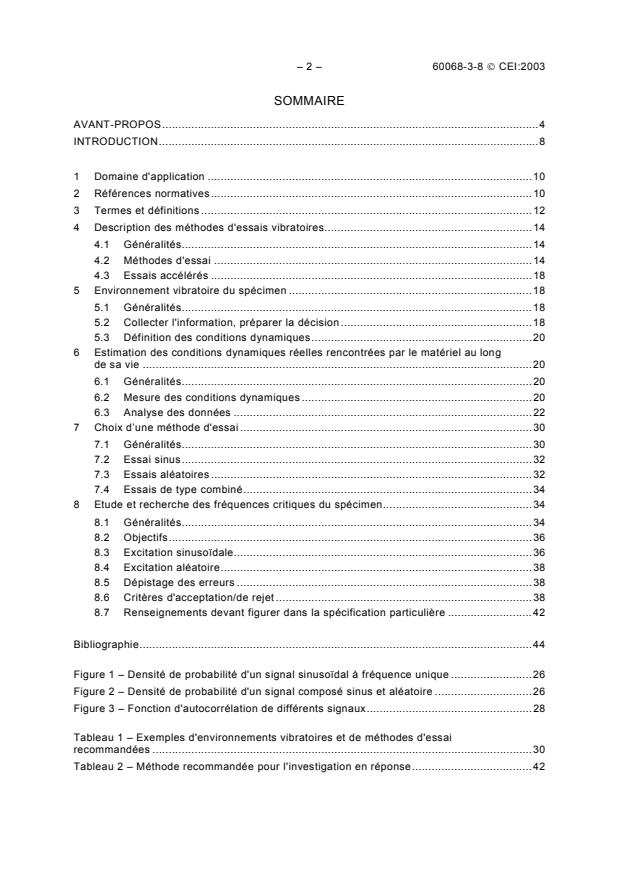
SOMMAIRE
AVANT-PROPOS.4
INTRODUCTION.8
1 Domaine d'application .10
2 Références normatives.10
3 Termes et définitions .12
4 Description des méthodes d'essais vibratoires.14
4.1 Généralités.14
4.2 Méthodes d'essai .14
4.3 Essais accélérés .18
5 Environnement vibratoire du spécimen .18
5.1 Généralités.18
5.2 Collecter l'information, préparer la décision .18
5.3 Définition des conditions dynamiques.20
6 Estimation des conditions dynamiques réelles rencontrées par le matériel au long
de sa vie .20
6.1 Généralités.20
6.2 Mesure des conditions dynamiques .20
6.3 Analyse des données .22
7 Choix d’une méthode d'essai .30
7.1 Généralités.30
7.2 Essai sinus.32
7.3 Essais aléatoires .32
7.4 Essais de type combiné.34
8 Etude et recherche des fréquences critiques du spécimen.34
8.1 Généralités.34
8.2 Objectifs.36
8.3 Excitation sinusoïdale.36
8.4 Excitation aléatoire.38
8.5 Dépistage des erreurs .38
8.6 Critères d'acceptation/de rejet .38
8.7 Renseignements devant figurer dans la spécification particulière .42
Bibliographie.44
Figure 1 – Densité de probabilité d'un signal sinusoïdal à fréquence unique .26
Figure 2 – Densité de probabilité d'un signal composé sinus et aléatoire .26
Figure 3 – Fonction d'autocorrélation de différents signaux.28
Tableau 1 – Exemples d'environnements vibratoires et de méthodes d'essai
recommandées .30
Tableau 2 – Méthode recommandée pour l'investigation en réponse.42
60068-3-8 IEC:2003 – 3 –
CONTENTS
FOREWORD.5
INTRODUCTION.9
1 Scope.11
2 Normative references .11
3 Terms and definitions .13
4 Description of vibration test methods .15
4.1 General .15
4.2 Test methods .15
4.3 Accelerated testing.19
5 Vibration environment of a specimen .19
5.1 General .19
5.2 Collecting information, preparing a decision .19
5.3 Definition of dynamic conditions .21
6 Estimation of ‘real life’ dynamic conditions for the specimen.21
6.1 General .21
6.2 Measurement of dynamic conditions.21
6.3 Data analysis .23
7 Selection of test method .31
7.1 General .31
7.2 Sine testing .33
7.3 Random testing .33
7.4 Mixed mode testing .35
8 Vibration response investigation of the specimen .35
8.1 General .35
8.2 Aims, purposes .37
8.3 Sinusoidal excitation .37
8.4 Random excitation.39
8.5 Problem investigation (troubleshooting).39
8.6 Survival pass/fail criterion .39
8.7 Information to be given in the relevant specification .43
Bibliography.45
Figure 1 – Probability density of a single frequency sinusoidal signal.27
Figure 2 – Probability density of a mixture of sine and random signals.27
Figure 3 – Autocorrelation functions for various signals .29
Table 1 – Examples of vibration environment and recommended test method .31
Table 2 – Recommended method for response investigation.43
– 4 – 60068-3-8 CEI:2003
COMMISSION ÉLECTROTECHNIQUE INTERNATIONALE
____________
ESSAIS D’ENVIRONNEMENT –
Partie 3-8: Documentation d’accompagnement et lignes directrices –
Sélection d’essais de vibrations
AVANT-PROPOS
1) La CEI (Commission Electrotechnique Internationale) est une organisation mondiale de normalisation
composée de l'ensemble des comités électrotechniques nationaux (Comités nationaux de la CEI). La CEI a
pour objet de favoriser la coopération internationale pour toutes les questions de normalisation dans les
domaines de l'électricité et de l'électronique. A cet effet, la CEI – entre autres activités – publie des Normes
internationales, des Spécifications techniques, des Rapports techniques et des Guides (ci-après dénommés
"Publication(s) de la CEI"). Leur élaboration est confiée à des comités d'études, aux travaux desquels tout
Comité national intéressé par le sujet traité peut participer. Les organisations internationales,
gouvernementales et non gouvernementales, en liaison avec la CEI, participent également aux travaux. La CEI
collabore étroitement avec l'Organisation Internationale de Normalisation (ISO), selon des conditions fixées par
accord entre les deux organisations.
2) Les décisions ou accords officiels de la CEI concernant les questions techniques représentent, dans la mesure
du possible, un accord international sur les sujets étudiés, étant donné que les Comités nationaux de la CEI
intéressés sont représentés dans chaque comité d’études.
3) Les Publications de la CEI se présentent sous la forme de recommandations internationales et sont agréées
comme telles par les Comités nationaux de la CEI. Tous les efforts raisonnables sont entrepris afin que la CEI
s'assure de l'exactitude du contenu technique de ses publications; la CEI ne peut pas être tenue responsable
de l'éventuelle mauvaise utilisation ou interprétation qui en est faite par un quelconque utilisateur final.
4) Dans le but d'encourager l'uniformité internationale, les Comités nationaux de la CEI s'engagent, dans toute la
mesure possible, à appliquer de façon transparente, les Publications de la CEI dans leurs publications
nationales et régionales. Toutes divergences entre toutes Publications de la CEI et toutes publications
nationales ou régionales correspondantes doivent être indiquées en termes clairs dans ces dernières.
5) La CEI n’a prévu aucune procédure de marquage valant indication d’approbation et n'engage pas sa
responsabilité pour les équipements déclarés conformes à une de ses Publications.
6) Tous les utilisateurs doivent s'assurer qu'ils sont en possession de la dernière édition de cette publication.
7) Aucune responsabilité ne doit être imputée à la CEI, à ses administrateurs, employés, auxiliaires ou
mandataires, y compris ses experts particuliers et les membres de ses comités d'études et des Comités
nationaux de la CEI, pour tout préjudice causé en cas de dommages corporels et matériels, ou de tout autre
dommage de quelque nature que ce soit, directe ou indirecte, ou pour supporter les coûts (y compris les frais
de justice) et les dépenses découlant de la publication ou de l'utilisation de cette Publication de la CEI ou de
toute autre Publication de la CEI, ou au crédit qui lui est accordé.
8) L'attention est attirée sur les références normatives citées dans cette publication. L'utilisation de publications
référencées est obligatoire pour une application correcte de la présente publication.
9) L’attention est attirée sur le fait que certains des éléments de la présente Publication de la CEI peuvent faire
l’objet de droits de propriété intellectuelle ou de droits analogues. La CEI ne saurait être tenue pour
responsable de ne pas avoir identifié de tels droits de propriété et de ne pas avoir signalé leur existence.
La Norme internationale CEI 60068-3-8 a été établie par le comité d’études 104 de la CEI:
Conditions, classification et essais d’environnement.
Le texte de cette norme est basé sur les documents suivants:
FDIS Rapport de vote
104/308/FDIS 104/324/RVD
Le rapport de vote indiqué dans le tableau ci-dessus donne toute information sur le vote ayant
abouti à l'approbation de cette norme.
Cette publication a été rédigée selon les Directives ISO/CEI, Partie 2.
Elle a le statut d’une publication fondamentale de sécurité conformément au Guide CEI 104.
60068-3-8 IEC:2003 – 5 –
INTERNATIONAL ELECTROTECHNICAL COMMISSION
____________
ENVIRONMENTAL TESTING –
Part 3-8: Supporting documentation and guidance –
Selecting amongst vibration tests
FOREWORD
1) The International Electrotechnical Commission (IEC) is a worldwide organization for standardization comprising
all national electrotechnical committees (IEC National Committees). The object of IEC is to promote
international co-operation on all questions concerning standardization in the electrical and electronic fields. To
this end and in addition to other activities, IEC publishes International Standards, Technical Specifications,
Technical Reports, and Guides (hereafter referred to as “IEC Publication(s)”). Their preparation is entrusted to
technical committees; any IEC National Committee interested in the subject dealt with may participate in this
preparatory work. International, governmental and non-governmental organizations liaising with the IEC also
participate in this preparation. IEC collaborates closely with the International Organization for Standardization
(ISO) in accordance with conditions determined by agreement between the two organizations.
2) The formal decisions or agreements of IEC on technical matters express, as nearly as possible, an international
consensus of opinion on the relevant subjects since each technical committee has representation from all
interested IEC National Committees.
3) IEC Publications have the form of recommendations for international use and are accepted by IEC National
Committees in that sense. While all reasonable efforts are made to ensure that the technical content of IEC
Publications is accurate, IEC cannot be held responsible for the way in which they are used or for any
misinterpretation by any end user.
4) In order to promote international uniformity, IEC National Committees undertake to apply IEC Publications
transparently to the maximum extent possible in their national and regional publications. Any divergence
between any IEC Publication and the corresponding national or regional publication shall be clearly indicated in
the latter.
5) IEC provides no marking procedure to indicate its approval and cannot be rendered responsible for any
equipment declared to be in conformity with an IEC Publication.
6) All users should ensure that they have the latest edition of this publication.
7) No liability shall attach to IEC or its directors, employees, servants or agents including individual experts and
members of its technical committees and IEC National Committees for any personal injury, property damage or
other damage of any nature whatsoever, whether direct or indirect, or for costs (including legal fees) and
expenses arising out of the publication, use of, or reliance upon, this IEC Publication or any other IEC
Publications.
8) Attention is drawn to the Normative references cited in this publication. Use of the referenced publications is
indispensable for the correct application of this publication.
9) Attention is drawn to the possibility that some of the elements of this IEC Publication may be the subject of
patent rights. IEC shall not be held responsible for identifying any or all such patent rights.
International Standard IEC 60068-3-8 has been prepared by IEC technical committee 104:
Environmental conditions, classification and methods of test.
The text of this standard is based on the following documents:
FDIS Report on voting
104/308/FDIS 104/324/RVD
Full information on the voting for the approval of this standard can be found in the report on
voting indicated in the above table.
This publication has been drafted in accordance with the ISO/IEC Directives, Part 2.
It has the status of a basic safety publication in accordance with IEC Guide 104.
– 6 – 60068-3-8 CEI:2003
Le comité a décidé que le contenu de cette publication ne sera pas modifié avant 2007.
A cette date, la publication sera
• reconduite;
• supprimée;
• remplacée par une édition révisée, ou
• amendée.
La CEI 60068 comprend les parties suivantes, présentées sous le titre général Essais
d’environnement:
Partie 1: Généralités et guide
Partie 2: Essais
Partie 3: Documentation d’accompagnement et guide/lignes directrices
Partie 4: Renseignements destinés aux rédacteurs de spécifications – Résumé d'essais
Partie 5: Guide pour la rédaction des méthodes d'essais
60068-3-8 IEC:2003 – 7 –
The committee has decided that the contents of this publication will remain unchanged until
2007. At this date, the publication will be
• reconfirmed;
• withdrawn;
• replaced by a revised edition, or
• amended.
IEC 60068 consists of the following parts, under the general title Environmental testing:
Part 1: General and guidance
Part 2: Tests
Part 3: Supporting documentation and guidance
Part 4: Information for specification writers – Test summaries
Part 5: Guide to drafting of test methods
– 8 – 60068-3-8 CEI:2003
INTRODUCTION
Les composants, équipements et produits électrotechniques en général, et indiqués comme
«spécimens» dans la suite du présent document, sont soumis à différents types de vibration
à l'occasion de leur fabrication, de leur transport ou de leur utilisation. Ces différents
environnements vibratoires sont répartis en plusieurs classes suivant leur caractère sta-
tionnaire ou transitoire dans la série de la CEI 60721-3. Les normes de la série CEI 60068-2
décrivent les méthodes d'essais associées respectivement aux vibrations à caractère
stationnaire ou transitoire. Ces normes d'essai en environnement décrivant les méthodes
d'essais à respecter pour des vibrations stationnaires seront au nombre de trois dans la
série 60068-2.
Partie 2-6 Essai Fc: Vibrations sinusoïdales
Partie 2-64 Essai Fh: Vibrations aléatoires à large bande (asservissement numérique) et
guide
Partie 2-80 Essai F-: Essai combiné
___________
A l’étude.
60068-3-8 IEC:2003 – 9 –
INTRODUCTION
Components, equipment and other electrotechnical products, hereinafter called specimens,
can be subjected to different kinds of vibration during manufacture, transportation or in
service. In the IEC 60721-3 standards, those different vibration environments are tabulated
into classes characterizing stationary and transient vibration conditions. The standards in the
IEC 60068-2 series describe methods for testing with stationary or transient vibration. There
will be three standards in the IEC 60068-2 series for environmental testing that specify test
methods employing stationary vibration:
Part 2-6 Test Fc: Vibration (sinusoidal),
Part 2-64 Test Fh: Vibration, broad-band random (digital control) and guidance, and
Part 2-80 Test F-: Mixed mode testing
___________
Under consideration.
– 10 – 60068-3-8 CEI:2003
ESSAIS D’ENVIRONNEMENT –
Partie 3-8: Documentation d’accompagnement et lignes directrices –
Sélection d’essais de vibrations
1 Domaine d'application
La présente partie de la CEI 60068 fournit les lignes directrices pour la sélection parmi les
méthodes d'essais Fc de vibrations stationnaires sinusoïdales, Fh aléatoires et Fx composites
de la série 60068-2. Ces différentes méthodes d'essais quasi stationnaires ainsi que leur objet
sont brièvement décrites à l'Article 4. Les méthodes d'essais en transitoire ne sont pas incluses.
Lors de la réalisation d'essais en vibration, il convient de connaître les conditions
d'environnement, et spécialement les conditions dynamiques du spécimen en essai. La
présente norme aide à réunir l'information relative aux conditions d'environnement (Article 5),
à estimer ou à mesurer les conditions dynamiques (Article 6) et donne des exemples afin
d'illustrer les choix à réaliser pour la plupart des méthodes d'essais applicables en
environnement vibratoire. A partir des conditions d'environnement, la méthodologie de choix
de l'essai approprié est fournie. Puisque les conditions d'environnement vibratoire naturelles
sont de nature aléatoire, il est recommandé que les essais en vibrations aléatoires soient
généralement, les méthodes retenues (voir Tableau 1, Article 7).
Les méthodes décrites ci-après peuvent être utilisées pour examiner la réponse vibratoire du
spécimen en essai avant, pendant et après un essai de vibrations. Le choix de la méthode
appropriée est décrit à l'Article 8 et présenté au Tableau 2.
Les spécificateurs trouveront dans la présente norme les informations relatives aux méthodes
d'essais vibratoires et les lignes directrices pour choisir parmi elles la méthode appropriée.
Pour choisir les paramètres ou les sévérités relatives à l'une de ces méthodes, il y a lieu de
se reporter aux références normatives.
2 Références normatives
Les documents normatifs suivants sont indispensables à l'application du présent document.
Pour les références datées, seules les éditions citées sont applicables. Pour les références
non datées, la dernière édition du document normatif en référence (et ses éventuels
amendements) s'applique.
CEI 60068-1, Essais d’environnement – Première partie: Généralités et guide
CEI 60068-2-6, Essais d’environnement – Partie 2-6: Essais – Essai Fc: Vibrations
(sinusoïdales)
CEI 60068-2-64, Essais d’environnement – Partie 2-64: Méthodes d'essai – Essai Fh:
Vibrations aléatoires à large bande (asservissement numérique) et guide
CEI 60068-2-80, Essais d’environnement – Partie 2-80: Essais – Essai F-: Essai combiné
CEI 60721-3 (toutes les parties), Classification des conditions d'environnement – Partie 3:
Classification des groupements des agents d'environnement et de leurs sévérités
CEI 60721-4 (toutes les parties) Classification des conditions d'environnement – Partie 4:
Guide pour la corrélation et la transformation des classes de conditions d'environnement de
la CEI 60721-3 en essais d'environnement de la CEI 60068-2
___________
A l’étude.
60068-3-8 IEC:2003 – 11 –
ENVIRONMENTAL TESTING –
Part 3-8: Supporting documentation and guidance –
Selecting amongst vibration tests
1 Scope
This part of IEC 60068 provides guidance for selecting amongst the IEC 60068-2 stationary
vibration test methods Fc sinusoidal, Fh random and F(x) Mixed mode vibration. The different
steady-state test methods and their aims are briefly described in Clause 4. Transient test
methods are not included.
For vibration testing, the environmental conditions, especially the dynamic conditions for
the specimen, should be known. This standard helps to collect information about the
environmental conditions (Clause 5), to estimate or measure the dynamic conditions
(Clause 6) and gives examples to enable decisions to be made on the most applicable
environmental vibration test method. Starting from the condition, the method of selecting the
appropriate test is given. Since real life vibration conditions are dominated by vibration of a
random nature, random testing should be the commonly used method, see Table 1, Clause 7.
The methods included hereafter may be used to examine the vibration response of a
specimen under test before, during and after vibration testing. The selection for the
appropriate excitation method is described in Clause 8 and tabulated in Table 2.
In this standard specification, writers will find information concerning vibration test methods
and guidance for their selection. For guidance on test parameters, or severities of one of the
test methods, reference should be made to the normative references.
2 Normative references
The following referenced documents are indispensable for the application of this document.
For dated references, only the edition cited applies. For undated references, the latest edition
of the referenced document (including any amendments) applies.
IEC 60068-1, Environmental testing – Part 1: General and guidance
IEC 60068-2-6, Environmental testing – Part 2-6: Tests – Test Fc: Vibration (sinusoidal)
IEC 60068-2-64, Environmental testing – Part 2-64: Test methods – Test Fh: Vibration, broad-
band random (digital control) and guidance
IEC 60068-2-80, Environmental testing – Part 2-80: Tests – Test F-: Mixed mode testing
IEC 60721-3 (all parts), Classification of environmental conditions – Part 3: Classification of
groups of environmental parameters and their severities
IEC 60721-4 (all parts), Classification of environmental conditions – Part 4: Guidance for
the correlation and transformation of environmental condition classes of IEC 60721-3 to the
environmental tests of IEC 60068-2
___________
Under consideration.
– 12 – 60068-3-8 CEI:2003
Guide CEI 104:1997, Elaboration des publications de sécurité et utilisation des publications
fondamentales de sécurité et publications groupée de sécurité
ISO 2041, Vibrations et chocs – Vocabulaire
ISO 5348, Vibrations et chocs mécaniques – Fixation mécanique des accéléromètres
3 Termes et définitions
Pour les besoins du présent document, les termes et définitions utilisés sont généralement
définis dans l'ISO 2041, dans la CEI 60068-1, la CEI 60068-2-6 ou la CEI 60068-2-64.
Lorsque, pour des raisons pratiques, la définition de l'un des termes de ces documents est
donnée dans la présente norme, l'origine en est indiquée et les écarts aux définitions de ces
normes sont également précisés.
3.1
conditions dynamiques
tous les paramètres décrivant l'environnement vibratoire du spécimen
3.2
vibration stationnaire
catégorie de vibrations dont tous les paramètres vibratoires associés (statistiques et
spectraux) sont constants dans le temps
3.3
balayage en fréquence
évolution de la fréquence d'excitation pendant l'essai sinus
NOTE Pour les définitions complémentaires des essais sinus, voir la CEI 60068-2-6.
3.4
spectre linéaire
type de spectres utilisé pour les signaux périodiques, généralement calculés à l'aide
d'algorithme de transformation de Fourier rapide (FFT), et dont les unités sont par exemple
m/s × s ou g/Hz ou g × s
[IES-RP-DET 012.1]
3.5
densité spectrale d'accélération
DSA
type de spectres utilisé pour les signaux aléatoires stationnaires, généralement calculés à
partir du carré de l'amplitude des transformations de Fourier discrètes (TFD): moyenne des
carrés des valeurs de la partie d'un signal d'accélération en sortie d'un filtre à bande étroite
de fréquence centrale déterminée, par unité de largeur de bande, lorsque cette largeur de
bande tend vers zéro et que la durée prise en compte pour le calcul de la moyenne tend vers
2 2 2
l'infini, appelé parfois autospectre, et dont l'unité est (m/s ) /Hz ou g /Hz
n
[ISO 2041, modifiée]
3.6
autocorrélation
mesure statistique du degré avec lequel une partie du signal est reliée avec une autre partie
du même signal (décalée d'un temps donné)
NOTE La transformée de Fourier de la fonction d'autocorrélation fournit l'autospectre ou DSA, dont l'unité est
un rapport compris entre –1 et +1.
60068-3-8 IEC:2003 – 13 –
IEC Guide 104:1997, The preparation of safety publications and the use of basic safety
publications and group safety publications
ISO 2041, Vibration and shock – Vocabulary
ISO 5348, Mechanical vibration and shock – Mechanical mounting of accelerometers
3 Terms and definitions
For the purposes of this document, terms and definitions used are generally defined in
ISO 2041, in IEC 60068-1, IEC 60068-2-6 or IEC 60068-2-64. Where, for the convenience of
the reader, a definition from one of those sources is included here, the derivation is indicated
and departures from the definitions in those sources are also indicated.
3.1
dynamic conditions
all parameters that describe the vibration environment for a specimen
3.2
stationary vibration
type of vibration with all the vibration-related parameters (statistical and spectral) constant
over time
3.3
frequency sweep
change of exciting frequency during sine testing
NOTE For further definitions for sine testing, see IEC 60068-2-6.
3.4
linear spectrum
type of spectrum used for periodic signals, usually calculated with fast Fourier transformation
(FFT) algorithms, units being, for example, m/s² × s or g/Hz or g × s.
[IES-RP-DET 012.1]
3.5
acceleration spectral density
ASD
type of spectrum used for stationary random signals, usually calculated using squared
discrete Fourier transformations (DFT): mean-square value of that part of an acceleration
signal passed by a narrow-band filter of a centre frequency, per unit bandwidth, in the limit as
the bandwidth approaches zero and the averaging time approaches infinity, sometimes called
2 2 2
autospectrum, the unit being (m/s ) /Hz or g /Hz
n
[ISO 2041, modified]
3.6
autocorrelation
statistical measure of the degree of which one part of a signal is related to another part (offset
by a given time) of the same signal
NOTE The Fourier transform of the autocorrelation function gives the autospectrum or ASD, the unit being a ratio
from –1 to +1.
– 14 – 60068-3-8 CEI:2003
3.7
degrés de liberté statistique
DDL
pour l'estimation de la densité spectrale d'accélération de données aléatoires à l'aide d'une
technique de moyennes temporelles, nombre réel de degrés de liberté statistiques dérivé de
la résolution en fréquence et de la durée réelle sur laquelle est calculée la moyenne
[CEI 60068-2-64, 4.3.5, ISO 2041, modifiée]
3.8
fréquence critique
fréquences pour laquelle:
– apparaît un mauvais fonctionnement et/ou une altération des propriétés du spécimen, dus
aux vibrations et/ou
– se produisent des résonances mécaniques et/ou d'autres manifestations d'une réponse,
par exemple des martèlements
4 Description des méthodes d'essais vibratoires
4.1 Généralités
Les essais en environnement sont utilisés pour simuler en laboratoire les effets de
l'environnement vibratoire sur le matériel en situation réelle. Les essais vibratoires exploitent
différents signaux d'excitation en entrée du spécimen, par exemple, sur un générateur de
vibrations. Les méthodes d'essais se caractérisent par ces signaux d'entrée.
4.2 Méthodes d'essai
Les vibrations sinusoïdales et aléatoires correspondent à des phénomènes physiques
différents et produisent des effets différents sur les matériels. Il convient que le spécificateur
sache toujours qu'en raison de ces différences physiques, il n'existe aucune équivalence
stricte entre les essais de vibrations sinusoïdale et aléatoire. Il est donc fortement
recommandé de ne pas tenter de transcrire des sévérités de vibration sinusoïdale en vibration
aléatoire ou vice versa.
Une brève description des différentes méthodes d'essais vibratoires est fournie.
4.2.1 Essai sinus
Les essais sinus (CEI 60068-2-6) utilisent un signal sinus à fréquence et amplitude
constantes ou variables. Une unique fréquence est appliquée à chaque instant. Les
conditions d'essai incluent la plage (bande) des fréquences ou la fréquence constante, les
amplitudes des vibrations et la durée de l'essai.
Les vibrations sinusoïdales ne se rencontrent dans l'environnement réel que rarement, sinon
jamais, avec une fréquence unique. Ce peut être le cas même à l'occasion de mesures
d'accélération directement sur une machine tournante. En pratique, les tolérances et les jeux,
par exemple sur les engrenages et les paliers, résultent généralement en une légère
évolution en fréquence. Certaines formes de vibrations aléatoires sont également le résultat
des propriétés aléatoires des machines tournantes.
Une vibration sinusoïdale peut être décrite de manière déterministe. Elle suit une allure
déterminée, de telle sorte que l'on peut prédire la valeur de l'accélération à n'importe quelle
date dans le futur à partir de sa connaissance dans le passé.
60068-3-8 IEC:2003 – 15 –
3.7
statistical degrees of freedom
DOF
for the estimation of the acceleration spectral density of random data with a time-averaging
technique, effective number of statistical degrees of freedom derived from the frequency
resolution and the effective averaging time
[IEC 60068-2-64, 4.3.5, ISO 2041, modified]
3.8
critical frequency
frequencies at which
– malfunctioning and/or deterioration of performance of the specimen, which are dependent
on vibration are exhibited, and/or
– mechanical resonances and/or other response effects occur, for example chatter
4 Description of vibration test methods
4.1 General
Environmental testing is used to simulate in a laboratory the effects of a real life vibration
environment. Vibration testing uses different input signals to excite the specimen, for example
on a vibration table. The test methods are characterized by those input signals.
4.2 Test methods
Sine and random vibration are different physical processes and produce different effects on
the specimen. The specification writer should be aware that, due to the physically different
processes there is no precise equivalence between sine and random vibration testing. It is
strongly recommended not to attempt to transfer severities from sine to random or vice versa.
A brief description of the various vibration test methods is given.
4.2.1 Sine testing
Sine testing (IEC 60068-2-6) uses a sinusoidal signal with constant or changing frequency
and amplitude. Only one frequency is applied at any instant in time. The test conditions
include frequency range (bands) or fixed frequencies, vibration amplitudes and test duration.
Sinusoidal vibration rarely, if ever, occurs as a single frequency vibration in isolation in a real
life environment. This can be the case even when measuring the acceleration directly on
rotating machinery. Practical tolerances and clearances, e.g. in gears and bearings, generally
result in a small change in frequency. Some form of random vibration is also produced by
random properties of the rotating machinery.
Sinusoidal vibration may be described as deterministic. It follows an established pattern so
that the value of the vibration at any designated future time is completely predictable from
the past history.
– 16 – 60068-3-8 CEI:2003
Ce type d'essai peut être utile dans le domaine de la détermination de la date au moment de
la défaillance lors d'un balayage en fréquence, balayage pendant lequel il est alors possible
d'identifier la fréquence particulière recherchée, ce qui ne serait que difficilement le cas si
l'essai réalisé était de type aléatoire. Néanmoins, en comparaison avec les essais aléatoires,
ce type d'essai nécessite plus de temps avant rupture; en effet chaque fréquence de
résonance n'est excitée que brièvement lors du balayage. Bien qu'une fréquence unique soit
appliquée à chaque instant, un balayage lent permet aux fréquences particulières de
résonance du matériel d'atteindre leur plein niveau d'excitation. Ce type d'essai autorise
également l'identification au stade de la conception/du développement des fréquences de
résonances potentiellement dommageables pour le matériel.
Une autre utilisation des essais sinusoïdaux peut consister à réaliser «l'essai par palier»:
a) à une fréquence connue, ou
b) aux fréquences de résonance du spécimen.
4.2.2 Essais aléatoires
Une excitation aléatoire utilise un signal d'entrée stochastique et aléatoire qui comprend à
chaque instant toutes les fréquences contenues dans une plage spécifiée (largeur de bande)
(CEI 60068-2-64). Les valeurs instantanées sont distribuées suivant une loi normale (de
Gauss). La distribution sur la plage de fréquences est spécifiée par une densité spectrale
d'accélération (DSA).
La vibration aléatoire est le type d'excitation le plus couramment rencontré en environnement
réel. Sa valeur instantanée à un instant futur ne peut pas être déduite de ses valeurs passées
et ne peut donc être estimée que sur une base probabiliste. Cette propriété statistique
s'applique à tous les résultats de calculs utilisant les vibrations aléatoires, par exemple les
calculs de fatigue, de contrainte, etc.
Par opposition aux essais sinus, une vibration aléatoire sollicite les résonances de manière
continue sur toute la durée de l'essai, mais pas à leur puissance maximale. La plupart des
vibrations aléatoires appliquées en laboratoires contiennent des niveaux à trois écarts types, ce
qui signifie que les valeurs instantanées du signal d'excitation dans la plage de fréquences
concernée peuvent être comprises entre zéro et trois fois la valeur efficace totale du signal.
Une autre différence notable est que les excitations aléatoires peuvent générer un certain
nombre d’inversions de contrainte, positivement et négativement en suivant les directions, avec
des changements de signes des contraintes. Cette propriété peut influencer l'accumulation des
dommages en fatigue et donc la durée prévisible avant rupture.
4.2.3 Essai combiné
L'essai combiné (CEI 60068-2-80) combine des signaux sinusoïdaux et aléatoires. Les
environnements dont l'origine provient de sources différentes peuvent ainsi être simulés. En
fonction du type des sources à combiner, ces essais sont dits:
– sinus sur bruit, (SsB);
– bruit sur bruit (BsB);
– sinus sur bruit sur bruit (SsBsB).
NOTE Le choc sur bruit (phénomène transitoire appliqué simultanément à une vibration aléatoire comme c'est
le cas pour le tir canon) n'est pas inclus dans la présente norme.
Les essais en mode composite combinent les avantages des essais sinus et aléatoires
...