

IEC TS 61836:2007
(Main)Solar photovoltaic energy systems - Terms, definitions and symbols
General Information
- Abstract
Provides terms, definitions and symbols from national and international solar photovoltaic standards and relevant documents used within the field of solar photovoltaic (PV) energy systems. The main changes with respect to the previous edition are as follows: increased number of terms, inclusion of a list of abbreviations, organization of terms in categories and families.
- Status
- Published
- Publication Date
- 12-Dec-2007
- Technical Committee
- TC 82 - Solar photovoltaic energy systems
- Drafting Committee
- WG 1 - TC 82/WG 1
- Current Stage
- DELPUB - Deleted Publication
- Start Date
- 13-Dec-2016
- Completion Date
- 28-Aug-2026
Overview
IEC/TS 61836:2007 - "Solar photovoltaic energy systems - Terms, definitions and symbols" is a Technical Specification published by the International Electrotechnical Commission (IEC). It provides a consolidated glossary of terms, definitions and symbols used across national and international standards for solar photovoltaic (PV) energy systems. The document is organized to promote consistent use of PV vocabulary across design, testing, manufacturing and regulation.
Key editorial features:
- Increased number of terms compared with the previous edition
- Inclusion of a list of acronyms and abbreviations
- Organisation of terms into categories and families with cross-references
- Harmonisation with IEC 60050 and other IEC documents
Key topics
IEC TS 61836 organizes PV terminology into clear topical subclauses, including:
- Solar photovoltaic cells and modules (materials, cell types, anti-reflective coatings, efficiency)
- PV system components (bypass diodes, bus bars, junctions)
- Solar photovoltaic systems (arrays, fields, system-level vocabulary)
- Performance parameters (conversion efficiency, rated power, Standard Test Conditions - STC)
- Measurement devices and normative references (e.g., reference to IEC 60904-3 for spectral irradiance measurement)
- Environmental parameters, quality and testing terminology
- Concentrator photovoltaics, project management and miscellaneous PV terms
- Index and bibliography for sources and further reading
Note: The specification focuses on "what the words mean" rather than prescribing test procedures or design requirements.
Practical applications
IEC TS 61836 is a foundational reference for anyone working with PV standards, enabling:
- Consistent specifications in technical documents, datasheets and contracts
- Clarity in test reports and certification by aligning vocabulary used by laboratories and certification bodies
- Aligned procurement and tendering language to avoid ambiguity in component and system requirements
- Improved interoperability across manufacturers, installers and system integrators
- Educational and research use as a standardised glossary for training and publications
Who uses this standard
- PV system designers and engineers
- Module and inverter manufacturers
- Test laboratories and certification bodies
- Standards developers and regulatory agencies
- Procurement specialists, project managers and consultants
- Academics and technical authors
Related standards
- IEC 60904-3 (Photovoltaic devices - Measurement principles for terrestrial PV devices) - normative reference cited in the TS
- IEC 60050 (International Electrotechnical Vocabulary) - terminology coordination
- IEC Technical Committee 82 publications (PV system standards)
Keywords: IEC TS 61836, solar photovoltaic glossary, PV terminology, PV terms definitions symbols, photovoltaic standards, conversion efficiency, standard test conditions (STC).
Relations
- Effective Date
- 05-Sep-2023
- Effective Date
- 05-Sep-2023
Get Certified
Connect with accredited certification bodies for this standard

DNV
DNV is an independent assurance and risk management provider.

Lloyd's Register
Lloyd's Register is a global professional services organisation specialising in engineering and technology.
DNV Energy Systems
Energy and renewable energy certification.
Sponsored listings
Frequently Asked Questions
IEC TS 61836:2007 is a technical specification published by the International Electrotechnical Commission (IEC). Its full title is "Solar photovoltaic energy systems - Terms, definitions and symbols". This standard covers: Provides terms, definitions and symbols from national and international solar photovoltaic standards and relevant documents used within the field of solar photovoltaic (PV) energy systems. The main changes with respect to the previous edition are as follows: increased number of terms, inclusion of a list of abbreviations, organization of terms in categories and families.
Provides terms, definitions and symbols from national and international solar photovoltaic standards and relevant documents used within the field of solar photovoltaic (PV) energy systems. The main changes with respect to the previous edition are as follows: increased number of terms, inclusion of a list of abbreviations, organization of terms in categories and families.
IEC TS 61836:2007 is classified under the following ICS (International Classification for Standards) categories: 27.160 - Solar energy engineering. The ICS classification helps identify the subject area and facilitates finding related standards.
IEC TS 61836:2007 has the following relationships with other standards: It is inter standard links to IEC TS 61836:1997, IEC TS 61836:2016. Understanding these relationships helps ensure you are using the most current and applicable version of the standard.
IEC TS 61836:2007 is available in PDF format for immediate download after purchase. The document can be added to your cart and obtained through the secure checkout process. Digital delivery ensures instant access to the complete standard document.
Standards Content (Sample)
IEC/TS 61836
Edition 2.0 2007-12
TECHNICAL
SPECIFICATION
Solar photovoltaic energy systems – Terms, definitions and symbols
IEC/TS 61836:2007(E)
All rights reserved. Unless otherwise specified, no part of this publication may be reproduced or utilized in any form
or by any means, electronic or mechanical, including photocopying and microfilm, without permission in writing from
either IEC or IEC's member National Committee in the country of the requester.
If you have any questions about IEC copyright or have an enquiry about obtaining additional rights to this publication,
please contact the address below or your local IEC member National Committee for further information.
IEC Central Office
3, rue de Varembé
CH-1211 Geneva 20
Switzerland
Email: inmail@iec.ch
Web: www.iec.ch
About the IEC
The International Electrotechnical Commission (IEC) is the leading global organization that prepares and publishes
International Standards for all electrical, electronic and related technologies.
About IEC publications
The technical content of IEC publications is kept under constant review by the IEC. Please make sure that you have the
latest edition, a corrigenda or an amendment might have been published.
ƒ Catalogue of IEC publications: www.iec.ch/searchpub
The IEC on-line Catalogue enables you to search by a variety of criteria (reference number, text, technical committee,…).
It also gives information on projects, withdrawn and replaced publications.
ƒ IEC Just Published: www.iec.ch/online_news/justpub
Stay up to date on all new IEC publications. Just Published details twice a month all new publications released. Available
on-line and also by email.
ƒ Electropedia: www.electropedia.org
The world's leading online dictionary of electronic and electrical terms containing more than 20 000 terms and definitions
in English and French, with equivalent terms in additional languages. Also known as the International Electrotechnical
Vocabulary online.
ƒ Customer Service Centre: www.iec.ch/webstore/custserv
If you wish to give us your feedback on this publication or need further assistance, please visit the Customer Service
Centre FAQ or contact us:
Email: csc@iec.ch
Tel.: +41 22 919 02 11
Fax: +41 22 919 03 00
IEC/TS 61836
Edition 2.0 2007-12
TECHNICAL
SPECIFICATION
Solar photovoltaic energy systems – Terms, definitions and symbols
INTERNATIONAL
ELECTROTECHNICAL
COMMISSION
PRICE CODE
XC
ICS 27.160 ISBN 2-8318-9506-5
– 2 – TS 61836 © IEC:2007(E)
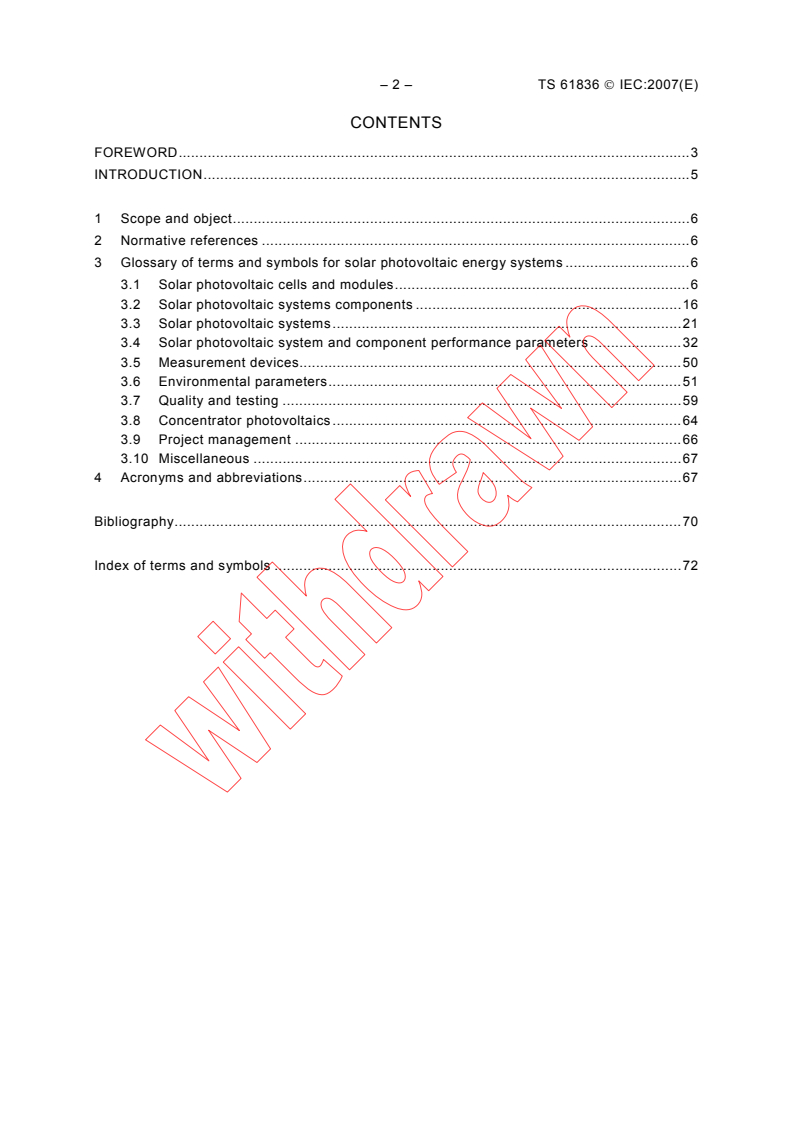
CONTENTS
FOREWORD.3
INTRODUCTION.5
1 Scope and object.6
2 Normative references .6
3 Glossary of terms and symbols for solar photovoltaic energy systems .6
3.1 Solar photovoltaic cells and modules.6
3.2 Solar photovoltaic systems components .16
3.3 Solar photovoltaic systems.21
3.4 Solar photovoltaic system and component performance parameters .32
3.5 Measurement devices.50
3.6 Environmental parameters.51
3.7 Quality and testing .59
3.8 Concentrator photovoltaics.64
3.9 Project management .66
3.10 Miscellaneous .67
4 Acronyms and abbreviations.67
Bibliography.70
Index of terms and symbols .72
TS 61836 © IEC:2007(E) – 3 –
INTERNATIONAL ELECTROTECHNICAL COMMISSION
____________
SOLAR PHOTOVOLTAIC ENERGY SYSTEMS –
TERMS, DEFINITIONS AND SYMBOLS
FOREWORD
1) The International Electrotechnical Commission (IEC) is a worldwide organization for standardization comprising
all national electrotechnical committees (IEC National Committees). The object of IEC is to promote
international co-operation on all questions concerning standardization in the electrical and electronic fields. To
this end and in addition to other activities, IEC publishes International Standards, Technical Specifications,
Technical Reports, Publicly Available Specifications (PAS) and Guides (hereafter referred to as “IEC
Publication(s)”). Their preparation is entrusted to technical committees; any IEC National Committee interested
in the subject dealt with may participate in this preparatory work. International, governmental and non-
governmental organizations liaising with the IEC also participate in this preparation. IEC collaborates closely
with the International Organization for Standardization (ISO) in accordance with conditions determined by
agreement between the two organizations.
2) The formal decisions or agreements of IEC on technical matters express, as nearly as possible, an international
consensus of opinion on the relevant subjects since each technical committee has representation from all
interested IEC National Committees.
3) IEC Publications have the form of recommendations for international use and are accepted by IEC National
Committees in that sense. While all reasonable efforts are made to ensure that the technical content of IEC
Publications is accurate, IEC cannot be held responsible for the way in which they are used or for any
misinterpretation by any end user.
4) In order to promote international uniformity, IEC National Committees undertake to apply IEC Publications
transparently to the maximum extent possible in their national and regional publications. Any divergence
between any IEC Publication and the corresponding national or regional publication shall be clearly indicated in
the latter.
5) IEC provides no marking procedure to indicate its approval and cannot be rendered responsible for any
equipment declared to be in conformity with an IEC Publication.
6) All users should ensure that they have the latest edition of this publication.
7) No liability shall attach to IEC or its directors, employees, servants or agents including individual experts and
members of its technical committees and IEC National Committees for any personal injury, property damage or
other damage of any nature whatsoever, whether direct or indirect, or for costs (including legal fees) and
expenses arising out of the publication, use of, or reliance upon, this IEC Publication or any other IEC
Publications.
8) Attention is drawn to the Normative references cited in this publication. Use of the referenced publications is
indispensable for the correct application of this publication.
9) Attention is drawn to the possibility that some of the elements of this IEC Publication may be the subject of
patent rights. IEC shall not be held responsible for identifying any or all such patent rights.
The main task of IEC technical committees is to prepare International Standards. In
exceptional circumstances, a technical committee may propose the publication of a technical
specification when
• the required support cannot be obtained for the publication of an International Standard,
despite repeated efforts, or
• The subject is still under technical development or where, for any other reason, there is
the future but no immediate possibility of an agreement on an International Standard.
Technical specifications are subject to review within three years of publication to decide
whether they can be transformed into International Standards.
IEC 61836, which is a technical specification, has been prepared IEC technical committee 82:
Solar photovoltaic energy systems.
This second edition cancels and replaces the first edition published in 1997. This edition
constitutes a technical revision.
– 4 – TS 61836 © IEC:2007(E)
This edition included the following significant technical changes with respect to the previous
edition:
1) The number of terms has increased. Abbreviations have been included.
2) The terms in Edition 2 are organised into categories and families. Terms contained in
families are cross referenced with an alphabetical listing. A bibliography and an index were
added. The purpose of aggregating terms into families is to allow readers to easily see the
relationships between terms that speak of similar quantities and subjects but that have slight
variations.
The text of this technical specification is based on the following documents:
Enquiry draft Report on voting
82/442/DTS 82/487/RVC
Full information on the voting for the approval of this technical specification can be found in
the report on voting indicated in the above table.
This publication has been drafted in accordance with the ISO/IEC Directives, Part 2.
The committee has decided that the contents of this publication will remain unchanged until
the maintenance result date indicated on the IEC web site under "http://webstore.iec.ch" in
the data related to the specific publication. At this date, the publication will be
• transformed into an International standard,
• reconfirmed,
• withdrawn,
• replaced by a revised edition, or
• amended.
A bilingual edition of this document may be issued at a later date.
TS 61836 © IEC:2007(E) – 5 –
INTRODUCTION
Following the development of solar photovoltaic (PV) technology, specific Standards have
been prepared by IEC Technical Committee 82 since 1987. The terms and symbols used in
the PV industry necessitate a systematisation in order to have a consolidated glossary for
experts’ common understanding.
This Glossary lists the terms and symbols that the PV industry commonly uses. It is a living
document that will change as new terms and symbols are added. These have been
harmonized with IEC 60050 and other IEC documents as far as possible. All definitions not
included in this Technical Specification may be found elsewhere in other IEC documents.
NOTE 1 The terms "PV", "photovoltaic" and "solar photovoltaic" can be read and used interchangeably and without
the need for stating each term to show that each are applicable and commonly used by the solar photovoltaic
industry.
NOTE 2 All terms beginning with "solar photovoltaic" and "PV" are listed under their respective "photovoltaic"
names.
NOTE 3 The terms are listed alphabetically in ten categories. Under these categories, some of the terms have
been grouped into families of related meaning in order for the reader to readily see the differences between the
terms.
NOTE 4 This Glossary lists the precise usage of terms. Cross-references are provided to efficiently point the
reader to the location of definitions. For example, a "solar photovoltaic array" may also be referred to as
"photovoltaic array" or "array" when the reference to it is particularly clear. The definition for this term, for
example, occurs under the family heading of "photovoltaic" in the "Solar photovoltaic systems" section.
NOTE 5 The colloquial use of "solar" as the sole adjective of a noun is discouraged. For example, though "solar
array" may be commonly used in non-technical conversations, the precise terms are "solar photovoltaic array",
"photovoltaic array", and "array".
NOTE 6 Unless specifically noted otherwise, the terms "device", "cell", "module", "array", "sub-array", "field",
"component", "system", and "product" refer to items incorporating a photovoltaic device. As a result, each of these
terms can be understood to read as "PV device", "PV cell", "PV module", etc., without having to re-state the term
"PV" each time, though now and then it is useful to re-state "PV".
NOTE 7 The numeric quantities described by many of the terms can be expressed over any convenient unit of time
that the user may wish, such as day, month or year.
NOTE 8 "W " is not a recommended unit for rated power. For example for a 50 W module, the correct terminology
p
is "the rated power is 50 W", and not "the power is 50 W ".
p
NOTE 9 The documents from which these terms originated are shown in square brackets [ ]. Some adaptations
may have occurred.
NOTE 10 This Glossary document recognises the related IEC co-ordinating Technical Committees:
1 Terminology 77 Electromagnetic compatibility
21 Secondary cells and batteries 82 Solar photovoltaic energy systems
22 Power electronic systems and 88 Wind turbines
equipment
47 Semiconductor devices 105 Fuel cell technologies
64 Electrical installations and 106 Methods for the assessment of electric,
protection against electric shock magnetic and electromagnetic fields
associated with human exposure
– 6 – TS 61836 © IEC:2007(E)
SOLAR PHOTOVOLTAIC ENERGY SYSTEMS –
TERMS, DEFINITIONS AND SYMBOLS
1 Scope and object
This Technical Specification deals with the terms and symbols from national and international
solar photovoltaic standards and relevant documents used within the field of solar
photovoltaic (PV) energy systems. It includes the terms and symbols compiled from the
published IEC technical committee 82 standards, previously published as technical report
IEC 61836:1997.
The focus of this Technical Specification is "what do the words mean" and not "under what
conditions do the terms apply".
2 Normative references
The following referenced documents are indispensable for the application of this document.
For dated references, only the edition cited applies. For undated references, the latest edition
of the referenced document (including any amendments) applies.
IEC 60904-3:1989, Photovoltaic devices – Part 3: Measurement principles for terrestrial
photovoltaic (PV) solar devices with reference spectral irradiance data
3 Glossary of terms, definitions and symbols for solar photovoltaic energy
systems
3.1 Solar photovoltaic cells and modules
This subclause addresses vocabulary pertaining to photovoltaic materials, photovoltaic cells
and photovoltaic modules. Other photovoltaic components are described in subclause 3.2.
Photovoltaic systems are described in subclause 3.3.
3.1.1 amorphous photovoltaic material
solid-state material in a semi-stable condition with no long-range order in the structural
arrangement of the atoms
3.1.2 amorphous silicon
see "silicon/amorphous", 3.1.58a).
3.1.3 anti-reflective coating
layer formed on the surface of a PV cell to reduce reflective loss
3.1.4 back surface field effect
see "effect/back surface field effect", 3.1.25a)
3.1.5 band gap energy
(Unit: eV)
TS 61836 © IEC:2007(E) – 7 –
amount of energy required to bring an electron from the state of valence electron to the state
of free electron
3.1.6 barrier energy
(Unit: eV)
energy given up by an electron in penetrating the PV cell barrier
NOTE The barrier energy is a measure of the electrostatic potential of the barrier.
3.1.7 bus lines
see "metallisation line/bus bar", 3.1.37a)
3.1.8 bypass diode (on a module level)
diode connected across one or more PV cells in the forward electric current direction to allow
the PV module electric current to bypass cells to prevent hot spot or hot cell damage resulting
from the reverse voltage biasing from the other cells in that module
3.1.9 cell
see "photovoltaic/photovoltaic cell", 3.1.43a).
The following terms are used to describe the structure of PV cells and materials.
a) CIS photovoltaic cell
PV cell fabricated of copper indium diselenide (CuInSe , abbreviation CIS) material as
a main constituent (thin film type)
b) compound semiconductor photovoltaic cell
PV cell made of compound semiconductor, which consists of different chemical
elements, such as GaAs (III-V compounds), CdS/CdTe (II-VI compounds),
CdS/CuInSe , etc.
c) concentrator photovoltaic cell
see "concentrator photovoltaic cell", 3.8.5a)
d) dye-sensitized photovoltaic cell
photoelectrochemical device using dye molecules with two electrodes and an
electrolyte
e) integrated type photovoltaic cell
multiple PV cells connected in series produced on a single substrate that appears like
a single cell
NOTE 1 Integrated type PV cells may include stacked or side-by-side configurations.
f) multijunction photovoltaic cell
see "cell/stacked photovoltaic cell", 3.1.9k)
g) organic photovoltaic cell
PV cell fabricated of organic materials being polymers and/or small molecules (thin film
type)
h) PN junction photovoltaic cell
PV cell using a PN junction
NOTE 2 See also "PN junction", 3.1.34f).
i) Schottky barrier photovoltaic cell
– 8 – TS 61836 © IEC:2007(E)
PV cell using a Schottky junction formed at the metal-semiconductor interface
j) silicon photovoltaic cell
PV cell fabricated of silicon material as a main constituent
k) stacked photovoltaic cell
PV cell consisting of layers of different PV cells having different optical properties in
which incident light is absorbed by each cell layer
l) tandem photovoltaic cell
common name for a stack of two or more PV cells behind each other
m) thin film photovoltaic cell
PV cell made of thin layers of semiconductor material
NOTE 3 See also "silicon/polycrystalline silicon", 3.1.58e).
3.1.10 cell barrier
very thin electric-potential barrier along the interface between the P-type layer and the N-type
layer of a PV cell
NOTE 1 A cell barrier is also known as the "depletion zone".
NOTE 2 An enlectric-potential barrier is a region of high electric field strength opposing the passage of an
electrically charged particle in a direction depending on the sign of the electric charge.
3.1.11 cell junction
see "junction/cell junction", 3.1.34a)
3.1.12 CIS photovoltaic cell
see "cell/CIS photovoltaic cell", 3.1.9a)
3.1.13 compound semiconductor photovoltaic cell
see "cell/compound semiconductor photovoltaic cell", 3.1.9b)
3.1.14 conversion efficiency
(Unit: dimensionless, usually expressed as a percentage, %)
ratio of electric power generated by a PV device per unit area to its incident irradiance as
measured under standard test conditions, STC
NOTE See also "conditions/standard test conditions", 3.4.16e).
3.1.15 crystalline silicon
see "silicon/crystalline silicon", 3.1.58b).
3.1.16 current
For PV devices and related entries, see "photovoltaic/photovoltaic current", 3.1.43b)
NOTE There are many uses for the electrical term "current".
3.1.17 Czochralski process
see "ingot manufacturing process/Czochralski process", 3.1.32a)
TS 61836 © IEC:2007(E) – 9 –
3.1.18 dark current
(Unit: A)
electric current remaining in a PV device when its incident irradiance is zero
3.1.19 device
see "photovoltaic/photovoltaic device", 3.1.43c)
3.1.20 diffusion layer
portion of P-layer or N-layer prepared by a diffusion of dopants to form a PN junction
3.1.21 directional solidification
see "ingot manufacturing process/directional solidification", 3.1.32b)
3.1.22 donor (in photovoltaic cells)
dopant (such as phosphorus in the case of silicon material) that supplies an additional
electron to an otherwise balanced material structure
3.1.23 dopant (in photovoltaic cells)
chemical added in small amounts to a semiconductor material to modify its electrical
properties
NOTE 1 An N-dopant introduces more electrons than are required for the structure of the material
(e.g., phosphorus for silicon material).
NOTE 2 A P-dopant creates electron vacancies in the material structure (e.g., boron for silicon material).
3.1.24 dye-sensitized photovoltaic cell
see "cell/dye-sensitized photovoltaic cell", 3.1.9d)
3.1.25 effect
see "photovoltaic/photovoltaic effect", 3.1.43d).
a) back-surface field effect
effect where the charge carriers generated near the back side of a PV cell are
collected effectively by the inner electric field that is formed by a heavily doped zone
near the rear electrode
b) light-confinement effect
effect where the short-circuit electric current is increased by trapping incident light
inside a PV cell using textured surfaces and structures, etc.
3.1.26 electromagnetic casting
see "ingot manufacturing process/electromagnetic casting", 3.1.32c).
3.1.27 energy gap
(Unit: eV)
– 10 – TS 61836 © IEC:2007(E)
smallest energy difference between two neighbouring allowed bands separated by a forbidden
band
[IEV 111-14-37]
NOTE See also "band gap energy", 3.1.5).
3.1.28 float zone melting
see "ingot manufacturing process/float zone melting", 3.1.32d)
3.1.29 grid lines
see "metallisation line/grid line", 3.1.37b)
3.1.30 heterojunction
see "junction/heterojunction", 3.1.34b)
3.1.31 hot spot
intense localised heating occurring in a PV module when its operating electric current
exceeds the reduced short-circuit current of a shadowed or faulty PV cell or group of cells
within it
NOTE When a hot spot occurs, the affected cell or group of cells is forced into reverse bias and must dissipate
power, which can cause overheating. The voltage bias or damage creates a small, localized shunt path where a
large portion of the PV module current appears.
3.1.32 ingot manufacturing process
process by which an ingot is manufactured
a) Czochralski process
method of growing a perfect large-size single crystal by slowly lifting, under careful
cooling conditions, a rotating seed crystal from a counter-rotating molten silicon bath
NOTE 1 The Czochralski process produces a cylindrical-section silicon ingot, which can be cut into
wafers that are usually round or pseudo-square.
b) directional solidification
method of making large-grain multicrystalline silicon ingots by controlling the cooling
rate of molten silicon that has been placed in a square-section crucible
NOTE 2 Directional solidification produces a square-section silicon ingot that can be cut into wafers that
are square or rectangular.
c) electromagnetic casting
method of making multicrystalline silicon ingots by which a continuously fed square-
sectional open-bottom cold crucible of molten silicon is continuously pulled downward
through an electromagnetic field
NOTE 3 Electromagnetic casting produces a square-section silicon ingot that can be cut into wafers that
are square or rectangular.
d) float zone melting
method of growing and purifying high quality single crystal ingots
3.1.33 integrated type photovoltaic cell
see "cell/integrated type cell", 3.1.9e)
TS 61836 © IEC:2007(E) – 11 –
3.1.34 junction (of semiconductors)
transition layer between semiconducting regions of different electrical properties, or between
a semiconductor and a layer of a different type, being characterized by a potential barrier
impeding the movement of charge carriers from one region to the other
[IEV 521-02-72]
a) cell junction
junction between the P-type semiconductor and N-type semiconductor of a PV cell
NOTE 1 The PV cell junction lies within the cell barrier or depletion zone.
b) heterojunction
PN junction in which the two regions differ in their doping conductivities, and also in
their atomic compositions
c) homojunction
PN junction in which the two regions differ in their doping conductivities, but not in
their atomic compositions
d) Schottky barrier
junction between a metal and a semiconductor in which a transition region, formed at
the surface of the semiconductor, acts as a rectifying barrier
[IEV 521-02-71]
e) PIN junction
junction consisting of an intrinsic semiconductor between a P-type semiconductor and
an N-type semiconductor, intended to reduce the recombination of minority carriers
NOTE 2 A PIN junction is widely used in thin film amorphous silicon PV cells.
f) PN junction
junction between a P-type semiconductor and an N-type semiconductor
3.1.35 light confinement effect
see "effect/light-confinement effect", 3.1.25b)
3.1.36 material
see "photovoltaic/photovoltaic material", 3.1.43e)
3.1.37 metallisation line
metallic conductor on the front or back of a PV cell intended to conduct the electric current
generated by the PV cell
NOTE 1 A metallisation line can be screen-printed, vapour-deposited or extruded (line-written).
The lines are of two types
a) bus bar (of photovoltaic cells)
metallisation line with a cross-section area greater than that of the grid lines,
connected to grid lines and intended to carry their electric current to the wires or
ribbons interconnecting the PV cell with other PV cells
NOTE 2 Interconnect wires are connected to the bus bars by soldering or welding.
b) grid line
metallisation line intended to collect electric current from the surface of the
semiconductor of the PV cell
– 12 – TS 61836 © IEC:2007(E)
3.1.38 microcrystalline silicon
see "silicon/microcrystalline silicon", 3.1.58c).
3.1.39 module
see "photovoltaic/photovoltaic module", 3.1.43f).
3.1.40 multicrystalline silicon
see "silicon/multicrystalline silicon", 3.1.58d).
3.1.41 multijunction photovoltaic cell
see "cell/multijunction photovoltaic cell", 3.1.9f).
3.1.42 organic photovoltaic cell
see "cell, organic photovoltaic cell", 3.1.9g).
3.1.43 photovoltaic, photovoltaics
(Abbreviation: PV)
photovoltaic, adjective
photovoltaics, noun
relating to electrical phenomena caused by the photovoltaic effect
The following terms are commonly used in describing photovoltaic devices. The term
"photovoltaic" is commonly referred to "PV". See also "photovoltaic", 3.2.21 and 3.3.56.
a) photovoltaic cell
most elementary photovoltaic device
NOTE 1 In solar PV energy system applications, another term for "photovoltaic cell" is "solar photovoltaic
cell", colloquially referred to as a "solar cell".
b) photovoltaic current
(Unit: A)
DC electric current generated in a photovoltaic device
NOTE 2 See also "dark current", 3.1.18.
c) photovoltaic device
component that exhibits the photovoltaic effect
NOTE 3 Examples of a photovoltaic device includes a photovoltaic cell, module or array.
d) photovoltaic effect
production of DC voltage by the absorption of photons
NOTE 4 Currently the photovoltaic effect is known to be produced by specifically designed
semiconductors. This results in the direct non-thermal conversion of radiant energy into electrical energy.
e) photovoltaic material
material that exhibits the photovoltaic effect
f) photovoltaic module
complete and environmentally protected assembly of interconnected photovoltaic cells
TS 61836 © IEC:2007(E) – 13 –
NOTE 5 Photovoltaic modules can be assembled into photovoltaic panels and photovoltaic arrays. See "
photovoltaic/photovoltaic panel" (3.3.56e) and "photovoltaic/photovoltaic array" (3.3.56a).
3.1.44 PIN junction
see "junction/PIN junction", 3.1.34e).
3.1.45 PN junction
see "junction/PN junction", 3.1.34f)
3.1.46 PN junction photovoltaic cell
see "cell/PN junction cell", 3.1.9h)
3.1.47 polycrystalline silicon
see "silicon/polycrystalline silicon", 3.1.58e)
3.1.48 power
(Unit: W)
time-based rate of transferring or transforming energy, or of doing work
NOTE Power is commonly but incorrectly used to mean "electricity" or "electrical".
3.1.49 primary reference photovoltaic cell
see "reference photovoltaic cell/primary reference photovoltaic cell", 3.1.50a)
3.1.50 reference photovoltaic cell
specially calibrated PV cell that is used to measure irradiance or to set simulator irradiance
levels to compensate for non-reference spectral irradiance distribution
a) primary reference photovoltaic cell
reference PV cell whose calibration is based on a radiometer or standard detector
conforming to the standard World Radiometric Reference (WRR)
b) secondary reference photovoltaic cell
reference PV cell calibrated in natural or simulated sunlight against a primary
reference cell
3.1.51 reference photovoltaic device
reference PV cell, package of multiple reference cells or a reference module
3.1.52 reference photovoltaic module
specially calibrated PV module that is used to measure irradiance or to set simulator
irradiance levels for measuring the performance of other modules having similar spectral
response, optical characteristics, dimensions, and electrical circuitry
3.1.53 ribbon
thin sheet of crystalline or multicrystalline material produced in a continuous process by
withdrawal from a molten bath of the parent material (usually silicon)
– 14 – TS 61836 © IEC:2007(E)
3.1.54 Schottky barrier photovoltaic cell
see "cell/Schottky barrier photovoltaic cell", 3.1.9i).
3.1.55 Schottky junction
see "junction, Schottky barrier", 3.1.34d)
3.1.56 secondary reference photovoltaic cell
see "reference photovoltaic cell/secondary reference photovoltaic cell", 3.1.50b).
3.1.57 semiconductor material
substance, the conductivity of which, due to charge carriers of both signs, is normally in the
range between that of conductors and insulating media, and in which the density of its charge
carriers can be changed by external means
[IEV 121-12-06] [IEV 521-02-01, modified]
NOTE 1 The term “semiconductor” generally applies where the charge carriers are electrons or holes.
NOTE 2 In order to increase the conductivity, the energy supplied must be greater than the band gap energy.
See also "band gap energy", 3.1.5.
NOTE 3 Certain semiconductors, such as silicon, gallium arsenide, cadmium telluride and copper indium
diselenide compounds, to name a number of materials currently available, are well suited to the PV conversion
process.
3.1.58 silicon
(Symbol: Si)
semi-metallic chemical element, atomic weight of 14, an extensively used semiconductor
material, a common constituent of sand and quartz in the form of an oxide, and commonly
used in PV cells
NOTE 1 Silicon crystallises in a face-centred cubic lattice like a diamond.
NOTE 2 The terms here are applied to materials, wafers, cells, and modules.
a) amorphous silicon
(Symbol: a-Si, a-Si:H)
hydrogenated non-crystalline silicon alloy in a semi-stable condition deposited on a
foreign substrate with a thickness of the order of 1 μm
b) crystalline silicon
(Symbol: c-Si)
general category of silicon materials exhibiting a crystalline structure, i.e., showing
long range ordering of the silicon atoms
c) microcrystalline silicon
(Symbol: μc-Si)
hydrogenated silicon alloy deposited on a foreign substrate with a thickness of the
order of 1 μm presenting grains < 1 μm of crystalline structure
d) multicrystalline silicon
(Symbol: mc-Si)
silicon material that has solidified at such a rate that many large grain single crystals
(called crystallites, and ranging from 1 mm to 10 mm) are formed
TS 61836 © IEC:2007(E) – 15 –
NOTE 3 The atoms of each crystallite are symmetrically arrayed, but the multitude of crystallites is
randomly jumbled.
NOTE 4 Often moulded as a cast ingot or pulled ribbon.
e) polycrystalline silicon
(Symbol: pc-Si)
silicon material deposited on a foreign substrate as a layer with a thickness of 10 μm
to 30 μm and a grain size of 1 μm to 1 mm
NOTE 5 Polycrystalline silicon is known as thin film pc-Si.
NOTE 6 Polycrystalline silicon is also a term used in the feedstock silicon fabrication process.
f) single crystalline silicon
(Symbol: sc-Si)
silicon material characterized by an orderly and periodic arrangement of atoms such
that it has only one crystal orientation: i.e., all of the atoms are symmetrically arrayed
NOTE 7 Single crystalline silicon is known as mono-crystalline and single crystal.
g) solar photovoltaic grade silicon
(Abbreviation: SOG)
feedstock material with a high chemical purity adapted to the growth of crystalline
silicon ingots
3.1.59 silicon photovoltaic cell
see "cell/silicon photovoltaic cell", 3.1.9j).
3.1.60 single crystalline silicon
see "silicon/single crystalline silicon", 3.1.58f).
3.1.61 solar photovoltaic, solar photovoltaics
pertaining to PV devices under the influence of sunlight
NOTE All terms beginning with "solar photovoltaic" are listed under their respective "photovoltaic" names (3.1.43,
3.2.21, and 3.3.56).
3.1.62 stacked photovoltaic cell
see "cell/stacked photovoltaic cell", 3.1.9k).
3.1.63 tandem photovoltaic cell
see "cell/tandem photovoltaic cell", 3.1.9l).
3.1.64 transparent conducting oxide layer
(Abbreviation: TCO for Transparent Conducting Oxide)
transparent conducting oxide used as an electrode in thin-film PV cells deposited on
transparent glass (superstrate configuration)
NOTE See also "transparent electrode", 3.1.67.
3.1.65 textured surface
uneven structure formed on the front surface or back surface of a PV cell to increase the light
absorption by decreasing the surface reflection loss and utilizing light confinement effect
– 16 – TS 61836 © IEC:2007(E)
3.1.66 thin film photovoltaic cell
see "cell/thin film photovoltaic cell", 3.1.9m).
3.1.67 transparent electrode
thin film electrode with high electrical conductivity and high optical transmissivity formed on a
PV cell
3.1.68 wafer
slice of semiconductor material, that forms the mechanical and electrical basis of a crystalline
PV cell
3.2 Solar photovoltaic systems components
This subclause addresses vocabulary pertaining to the components of a photovoltaic system
except photovoltaic modules (see 3.1). Photovoltaic systems are described in subclause 3.3).
3.2.1 array
see "photovoltaic/photovoltaic array", 3.3.56a).
3.2.2 array cable
see "photovoltaic/photovoltaic array cable", 3.2.21a).
3.2.3 array junction box
see "junction box/array junction box", 3.2.16a).
3.2.4 automatic start/stop
function to start and/or stop a power conditioner automatically according to the output of a PV
array
3.2.5 blocking diode
diode connected in series to PV module(s), panel(s), sub-arrays and array(s) to block reverse
electric current into such module(s), panel(s), sub-arrays and array(s)
3.2.6 bypass diode (on a PV system level)
diode connected in parallel across one or more PV modules in the forward electric current
direction to allow the module current to bypass a module to prevent module overheating and
burning resulting from the reverse voltage biasing from the other modules in the PV array
NOTE A bypass diode at a PV system level is also known as a system bypass diode or a bypass device.
3.2.7 commutation (static inverters)
control of a power conditioner’s AC output waveform
The terms of commutation for power conditioners are listed below.
a) line commutation
type of external commutation where the commutating voltage is supplied from the
"line", which normally refers to a utility line
TS 61836 © IEC:2007(E) – 17 –
b) line commutation type
power conditioner operated with line commutation
c) self-commutation
type of commutation where the commutating voltage is supplied by components within
the converter or the electronic switch
d) self-commutation type
power conditioner operated with self-commutation
3.2.8 current control type inverter
see "inverter/current control inverter", 3.2.15a).
3.2.9 current stiff type inverter
see "inverter/current stiff inverter", 3.2.15b).
3.2.10 DC conditioner
PV system component that changes the PV array output voltage into a useable DC voltage
3.2.11 DC main cable
see "photovoltaic/photovoltaic DC main cable", 3.2.21b).
3.2.12 generator junction box
see "junction box/generator junction box", 3.2.16b).
3.2.13 high frequency link type inverter
see "inverter/high frequency link inverter", 3.2.15f).
3.2.14 input voltage operating range
(Unit: V)
input DC voltage range in which the power conditioner operates stably
3.2.15 inverter
electric energy converter that changes direct electric current to single-phase or polyphase
alternating currents
[IEV 151-13-46]
NOTE 1 An inverter is one of a number of components that is included in the term "power conditioner".
a) current control inverter
inverter with an output electric current having a specified sine waveform produced by
pulse-width modulated (PWM) control or other similar control system
b) current stiff inverter
inverter having an essentially smooth DC input electric current
c) grid-connected inverter
inverter that is able to operate in parallel with the distribution or transmission system of
an electrical utility
– 18 – TS 61836 © IEC:2007(E)
NOTE 2 A grid-connected inverter is also known variously as a grid-intertie or a grid-tied inverter.
d) grid-dependent inverter
grid-connected inverter that operates only in grid-dependent mode
e) grid-interactive inverter
grid-connected inverter that is able to operate in both stand-alone and parallel modes
NOTE 3 A grid-interactive inverter initiates a grid-parallel mode of operation.
f) high frequency link inverter
inverter with a high frequency transformer for electrical isolation between the inverter's
input and output circuits
g) module inverter
inverter that is integrated to the output of a single PV module
NOTE 4 A module inverter is usually attached to the rear of a module.
NOTE 5 See also "AC module", 3.3.2.
h) non-islanding inverter
inverter that ceases to energize an electricity distribution system that is out of the
normal operating specifications for voltage and/or frequency
i) stand-alone inverter
inverter that supplies a load not connected to the distribution or transmission system of
an electrical utility
NOTE 6 A stand-alone inverter is also known as a "battery-powered inverter".
j) string inverter
inverter that is designed to operate with a single PV string
NOTE 7 The AC output of a string inverter can be connected in parallel to the output of other string
inverters.
k) transformerless inverter
inverter without any isolation transformer
l) utility frequency link inverter
inverter with a utility frequency transformer for electrical isolation at the inverter output
m) utility interactive inverter
inverter used in parallel with the distribution or transmission system of an electrical
utility to supply common loads and that may deliver electricity to that distribution or
transmission system
n) voltage control inverter
inverter with an output voltage having a specified sine waveform produced by
pulse-width modulated (PWM) control, etc.
o) voltage stiff inverter
inverter having an essentially smooth DC input voltage
3.2.16 junction box
closed or protected enclosure in which circuits are electrically connected
a) array junction box
junction box where PV strings are connected
b) generator junction box
junction box where PV arrays are connected
TS 61836 © IEC:2007(E) – 19 –
3.2.17 lead-acid battery
secondary battery with an aqueous electrolyte based on dilute sulphuric acid, a positive
electrode of lead dioxide and a negative electrode of lead
NOTE 1 "Secondary" refers to a rechargeable battery.
NOTE 2 Lead-acid batteries are commonly used in stand-alone PV systems.
a) lead-acid battery for PV systems
generic term for lead-acid batteries used in stand-alone PV systems
NOTE 3 In a narrow sense, a lead-acid battery in PV systems refers to a battery of lead-acid
electrochemical cells designed to meet the quality requirements of a PV system.
NOTE 4 A lead-acid battery in PV systems is commonly referred to as a “PV battery”.
b) valve regulated lead-acid battery
sealed lead-acid battery in which oxygen gas generated from positive plates is
reactively absorbed into negative plates thereby suppressing generation of hydrogen
gas
NOTE 5 A valve regulated lead-acid battery is equipped with a valve to release gas outside the battery
when pressure builds up in the electrochemical cells.
c) vented lead-acid battery
lead-acid battery designed with a vent mechanism to expel gases generated during
charging
3.2.18 line commutation
see "commutation/line commutation", 3.2.7a).
3.2.19 line commutation type
see "commutation/line commutation type", 3.2.7b).
3.2.20 non-islanding inverter
see "inverter/non-islanding inverter", 3.2.15h).
3.2.21 photovoltaic
The following terms describe common cabling components of a PV system. See also
"photovoltaic" (3.1.43 and 3.3.56).
a) photovoltaic array cable
electrical cable connecting PV arrays to each other
b) photovoltaic DC main cable
cable connecting the generator junction box to the inverter
c) photovoltaic string cable
cable connecting PV modules to form a PV string
d) photovoltaic supply cable
cable connecting the inverter to a distribution circuit of the electrical installation
3.2.22 power conditioner
equipment used to convert electricity into a form suitable for subsequent use
NOTE 1 "Power conditioner" is commonly used to mean a piece of equipment comprising an inverter combined
with other electrical regulation sub-systems.
– 20 – TS 61836 © IEC:2007(E)
NOTE 2 See also "sub-system/power conditioning sub-system" (3.3.75c), and "inverter" (3.2.15).
3.2.23 pulse width modulation control
(Abbreviation for Pulse Width Modulation: PWM)
pulse control in which the pulse width or frequency or both are modulated within each
fundamental period to produce a certain output waveform [IEC 551-16-30]
3.2.24 self-commutation
see "commutation/self-commutation", 3.2.7c).
3.2.25 self-commutation type
see "commutation/self-commutation type", 3.2.7d).
3.2.26 soft-start
function intended to prevent a voltage dip on the load or the electric power system, which may
be caused by the AC output electric current of a starting or re-starting power conditioner
3.2.27 solar photovoltaic
see "photovoltaic", 3.1.43.
NOTE All terms beginning with "solar photovoltaic" are listed under their respective "photovoltaic" names (3.1.43,
3.2.21, and 3.3.56).
3.2.28 stand-alone inverter
see "inverter/stand-alone inverter", 3.2.15i).
3.2.29 string cable
see "photovoltaic/photovoltaic string cable", 3.2.21c).
3.2.30 string inverter
see "inverter/string inverter", 3.2.15j).
3.2.31 supply cable
see "photovoltaic/photovoltaic supply cable", 3.2.21d).
3.2.32 support structure
structure on which PV modules, panels, or arrays are installed
3.2.33 transformerless type inverter
see "inverter/transformerless inverter", 3.2.15k).
3.2.34 utility frequency link type inverter
see "inverter/utility frequency link inverter", 3.2.15l).
TS 61836 © IEC:2007(E) – 21 –
3.2.35 utility interactive inverter
see "inverter/utility interactive inverter", 3.2.15m).
3.2.36 utility interface disconnect switch
switch at the interface between the PV system and the utility grid
3.2.37 valve regulated lead-acid batter
...