

IEC 61252:2025
(Main)Electroacoustics - Personal sound exposure meters
General Information
- Abstract
IEC 61252:2025 specifies
– performance specifications for personal sound exposure meters,
– details of the tests necessary to verify conformance to all mandatory specifications for the purpose of pattern evaluation, and
– procedures for periodic testing of a personal sound exposure meter.
Personal sound exposure meters conforming to the requirements of this document have a specified frequency response for sound incident on the microphone from all directions.
This document is applicable to instruments that are designed to be worn on a person in a configuration specified by the manufacturer for the measurement of sound immission resulting from steady, intermittent, fluctuating, irregular, or impulsive sounds. For reproducibility of results, specifications and tests for the response to sound waves apply without an operator present in the sound field.
Pattern evaluation tests and periodic tests described in this this document apply to personal sound exposure meters for which the manufacturer claims conformance to the specifications given in this document.
IEC 61252:2025 cancels and replaces the first edition published in 1993, Amendment 1:2000, and Amendment 2:2017. This edition constitutes a technical revision.
This edition includes the following significant technical changes with respect to the previous edition:
a) personal sound exposure meters are required to provide indications of time-averaged sound level and peak sound level;
b) sound exposure is an optional quantity for indication;
c) specifications for physical quantities that do not follow the principle of equal-energy exchange rate have been added;
d) specifications for directional response have been added;
e) specifications for frequency weightings apply to the relative diffuse-field frequency response;
f) determination of conformance to specifications takes account of uncertainties of measurement;
g) detailed requirements for pattern-evaluation tests and periodic testing have been added.
- Status
- Published
- Publication Date
- 16-Oct-2025
- Technical Committee
- TC 29 - Electroacoustics
- Drafting Committee
- MT 4 - TC 29/MT 4
- Current Stage
- PPUB - Publication issued
- Start Date
- 17-Oct-2025
- Completion Date
- 26-Sep-2025
Buy Documents
IEC 61252:2025 - Electroacoustics - Personal sound exposure meters Released:10/17/2025
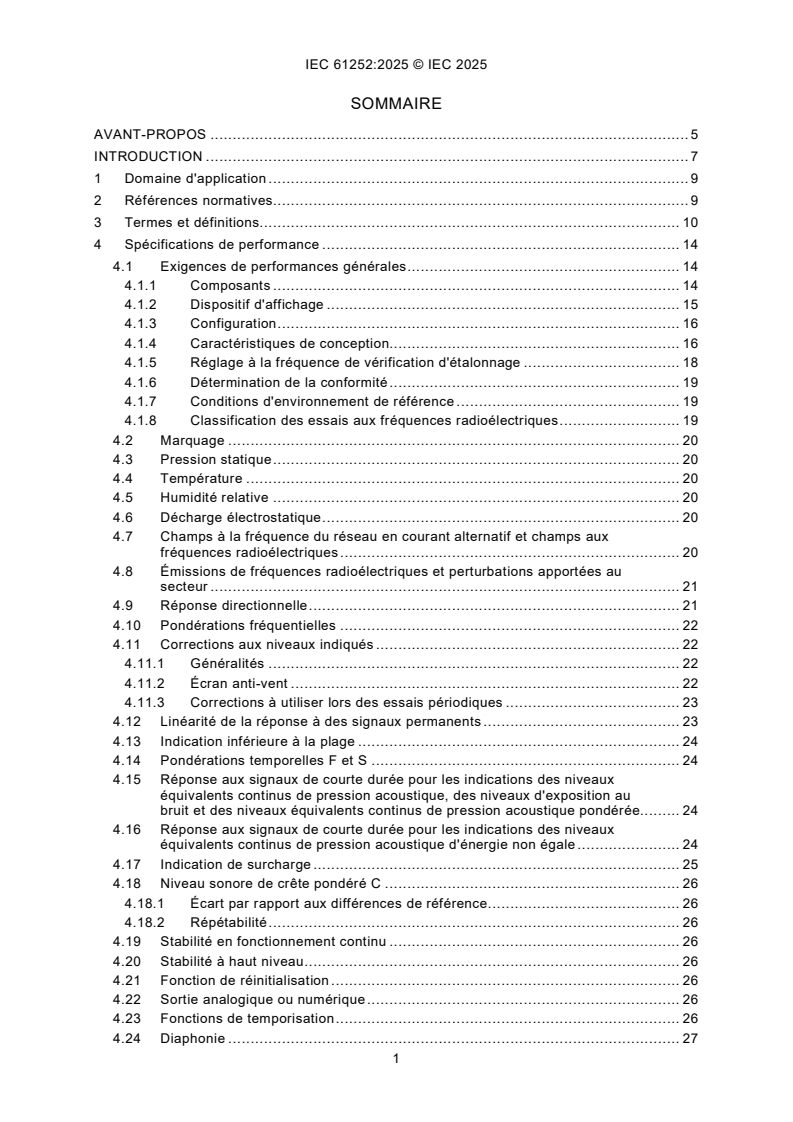
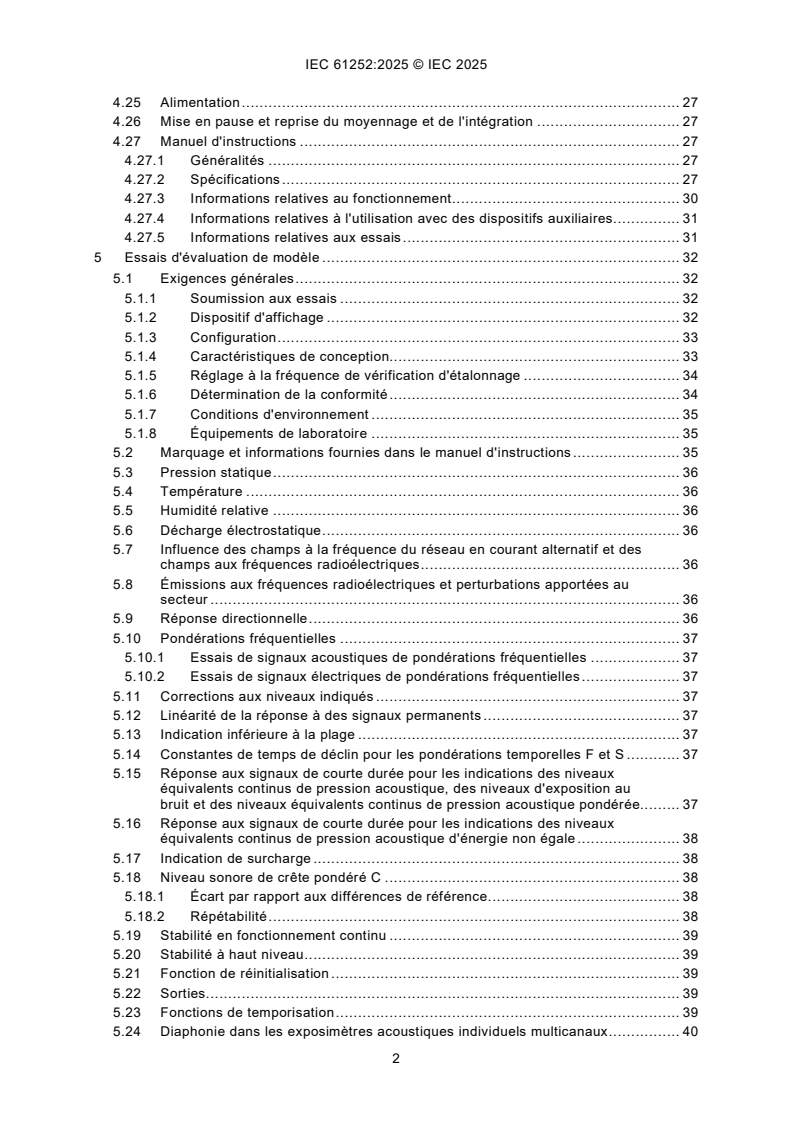
IEC 61252:2025 - Électroacoustique - Exposimetres acoustiques individuels Released:10/17/2025
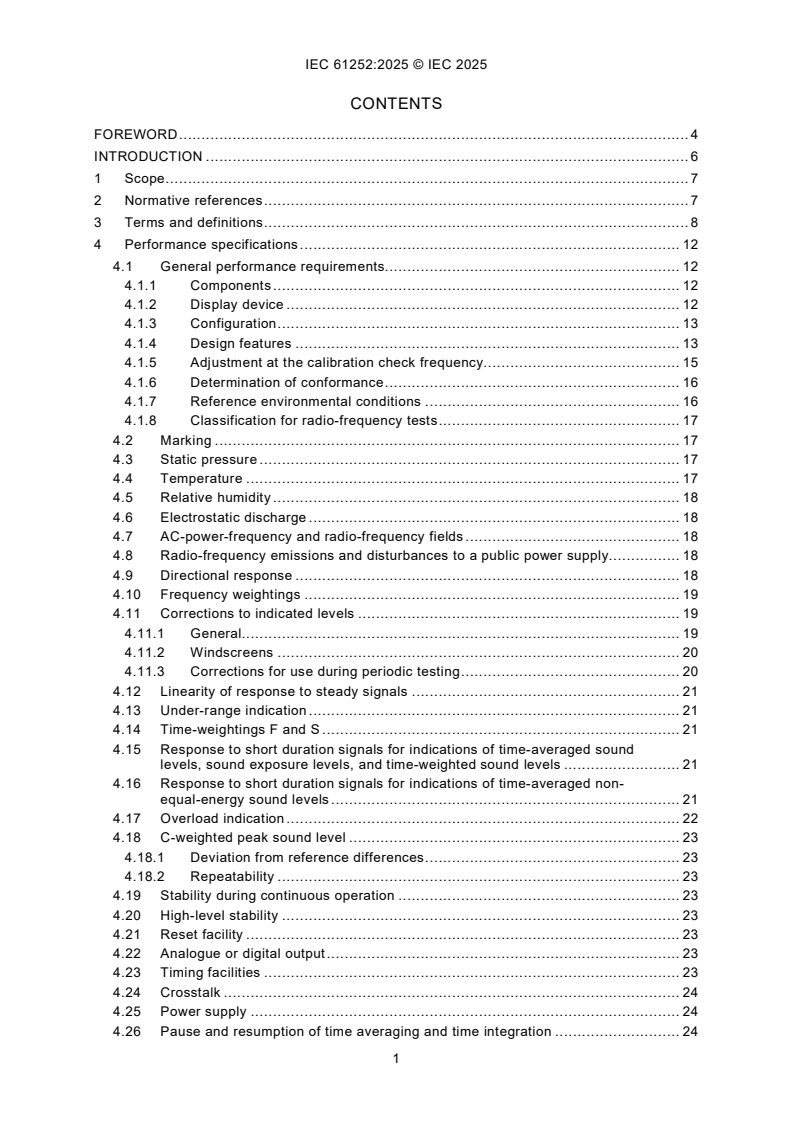
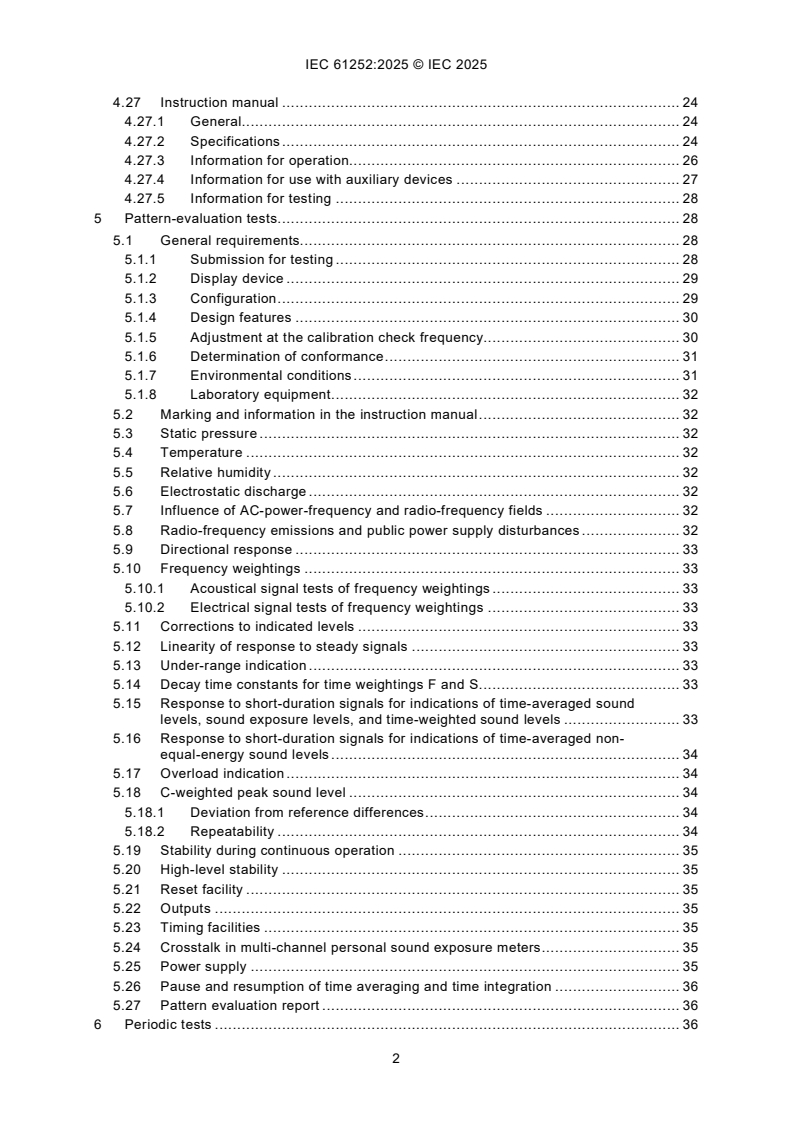
IEC 61252:2025 - Electroacoustics - Personal sound exposure meters Released:10/17/2025
Overview
IEC 61252:2025 - "Electroacoustics - Personal sound exposure meters" is the updated international standard specifying performance requirements, pattern-evaluation tests, and periodic testing procedures for personal sound exposure meters (PSEMs). Applicable to devices designed to be worn on a person, this edition (2.0, 2025) replaces earlier editions and introduces key technical revisions for modern occupational and environmental noise monitoring.
Key topics and requirements
- Performance specifications for PSEMs, including components, displays, configuration, and design features required for reproducible measurements.
- Required indications: time‑averaged sound level and C‑weighted peak sound level; sound exposure indication is optional.
- Directional response and frequency weighting requirements (relative diffuse‑field frequency response) to ensure consistent microphone response from all directions.
- Response characteristics: linearity, time‑weightings (F and S), response to short‑duration and impulsive sounds, overload and under‑range indications.
- Calibration and adjustment at a calibration check frequency and procedures for determining conformance that account for measurement uncertainty.
- Environmental and EMC tests: temperature, humidity, static pressure, electrostatic discharge, AC and radio‑frequency influences.
- Pattern‑evaluation tests and periodic tests: detailed methods for type/evaluation testing and routine re‑verification of instruments claimed to conform to IEC 61252.
- Documentation requirements: instruction manual contents, marking, and test reporting (pattern evaluation report and periodic test documentation).
Applications and practical value
- Ensures reliable, repeatable measurement of occupational and environmental noise exposure for:
- Workplace noise assessments and hearing conservation programs
- Regulatory compliance and enforcement
- Product design, manufacturing and certification of wearable noise dosimeters
- Acoustic research involving fluctuating, intermittent, or impulsive sound fields
- Enables manufacturers and test laboratories to validate device performance (pattern evaluation) and maintain ongoing accuracy (periodic testing), with explicit guidance on accounting for measurement uncertainties.
Who should use IEC 61252:2025
- Manufacturers of personal sound exposure meters (design, production, and certification)
- Accredited test laboratories and conformity assessment bodies
- Occupational hygienists, acoustic consultants, and safety managers
- Regulatory agencies and procurement specialists specifying dosimeters for workplace monitoring
Related standards
- Complementary IEC and ISO standards on electroacoustics and occupational noise measurement provide broader context for sound measurement best practices and regulatory compliance.
Keywords: IEC 61252, personal sound exposure meters, electroacoustics, sound exposure, peak sound level, frequency weighting, directional response, pattern‑evaluation tests, periodic testing, measurement uncertainty.
Relations
- Effective Date
- 05-Sep-2023
- Effective Date
- 05-Sep-2023
- Effective Date
- 05-Sep-2023
Buy Documents
IEC 61252:2025 - Electroacoustics - Personal sound exposure meters Released:10/17/2025
IEC 61252:2025 - Électroacoustique - Exposimetres acoustiques individuels Released:10/17/2025
IEC 61252:2025 - Electroacoustics - Personal sound exposure meters Released:10/17/2025
Get Certified
Connect with accredited certification bodies for this standard

BSMI (Bureau of Standards, Metrology and Inspection)
Taiwan's standards and inspection authority.
CIS Institut d.o.o.
Personal Protective Equipment (PPE) certification body. Notified Body NB-2890 for EU Regulation 2016/425 PPE.

Kiwa BDA Testing
Building and construction product certification.
Sponsored listings
Frequently Asked Questions
IEC 61252:2025 is a standard published by the International Electrotechnical Commission (IEC). Its full title is "Electroacoustics - Personal sound exposure meters". This standard covers: IEC 61252:2025 specifies – performance specifications for personal sound exposure meters, – details of the tests necessary to verify conformance to all mandatory specifications for the purpose of pattern evaluation, and – procedures for periodic testing of a personal sound exposure meter. Personal sound exposure meters conforming to the requirements of this document have a specified frequency response for sound incident on the microphone from all directions. This document is applicable to instruments that are designed to be worn on a person in a configuration specified by the manufacturer for the measurement of sound immission resulting from steady, intermittent, fluctuating, irregular, or impulsive sounds. For reproducibility of results, specifications and tests for the response to sound waves apply without an operator present in the sound field. Pattern evaluation tests and periodic tests described in this this document apply to personal sound exposure meters for which the manufacturer claims conformance to the specifications given in this document. IEC 61252:2025 cancels and replaces the first edition published in 1993, Amendment 1:2000, and Amendment 2:2017. This edition constitutes a technical revision. This edition includes the following significant technical changes with respect to the previous edition: a) personal sound exposure meters are required to provide indications of time-averaged sound level and peak sound level; b) sound exposure is an optional quantity for indication; c) specifications for physical quantities that do not follow the principle of equal-energy exchange rate have been added; d) specifications for directional response have been added; e) specifications for frequency weightings apply to the relative diffuse-field frequency response; f) determination of conformance to specifications takes account of uncertainties of measurement; g) detailed requirements for pattern-evaluation tests and periodic testing have been added.
IEC 61252:2025 specifies – performance specifications for personal sound exposure meters, – details of the tests necessary to verify conformance to all mandatory specifications for the purpose of pattern evaluation, and – procedures for periodic testing of a personal sound exposure meter. Personal sound exposure meters conforming to the requirements of this document have a specified frequency response for sound incident on the microphone from all directions. This document is applicable to instruments that are designed to be worn on a person in a configuration specified by the manufacturer for the measurement of sound immission resulting from steady, intermittent, fluctuating, irregular, or impulsive sounds. For reproducibility of results, specifications and tests for the response to sound waves apply without an operator present in the sound field. Pattern evaluation tests and periodic tests described in this this document apply to personal sound exposure meters for which the manufacturer claims conformance to the specifications given in this document. IEC 61252:2025 cancels and replaces the first edition published in 1993, Amendment 1:2000, and Amendment 2:2017. This edition constitutes a technical revision. This edition includes the following significant technical changes with respect to the previous edition: a) personal sound exposure meters are required to provide indications of time-averaged sound level and peak sound level; b) sound exposure is an optional quantity for indication; c) specifications for physical quantities that do not follow the principle of equal-energy exchange rate have been added; d) specifications for directional response have been added; e) specifications for frequency weightings apply to the relative diffuse-field frequency response; f) determination of conformance to specifications takes account of uncertainties of measurement; g) detailed requirements for pattern-evaluation tests and periodic testing have been added.
IEC 61252:2025 is classified under the following ICS (International Classification for Standards) categories: 13.140 - Noise with respect to human beings; 17.140.50 - Electroacoustics. The ICS classification helps identify the subject area and facilitates finding related standards.
IEC 61252:2025 has the following relationships with other standards: It is inter standard links to IEC 61252:1993/AMD1:2000, IEC 61252:1993/AMD2:2017, IEC 61252:1993. Understanding these relationships helps ensure you are using the most current and applicable version of the standard.
IEC 61252:2025 is available in PDF format for immediate download after purchase. The document can be added to your cart and obtained through the secure checkout process. Digital delivery ensures instant access to the complete standard document.
Standards Content (Sample)
IEC 61252 ®
Edition 2.0 2025-10
INTERNATIONAL
STANDARD
Electroacoustics - Personal sound exposure meters
ICS 13.140; 17.140.50 ISBN 978-2-8327-0674-9
All rights reserved. Unless otherwise specified, no part of this publication may be reproduced or utilized in any form or
by any means, electronic or mechanical, including photocopying and microfilm, without permission in writing from either
IEC or IEC's member National Committee in the country of the requester. If you have any questions about IEC copyright
or have an enquiry about obtaining additional rights to this publication, please contact the address below or your local
IEC member National Committee for further information.
IEC Secretariat Tel.: +41 22 919 02 11
3, rue de Varembé info@iec.ch
CH-1211 Geneva 20 www.iec.ch
Switzerland
About the IEC
The International Electrotechnical Commission (IEC) is the leading global organization that prepares and publishes
International Standards for all electrical, electronic and related technologies.
About IEC publications
The technical content of IEC publications is kept under constant review by the IEC. Please make sure that you have the
latest edition, a corrigendum or an amendment might have been published.
IEC publications search - IEC Products & Services Portal - products.iec.ch
webstore.iec.ch/advsearchform Discover our powerful search engine and read freely all the
The advanced search enables to find IEC publications by a
publications previews, graphical symbols and the glossary.
variety of criteria (reference number, text, technical With a subscription you will always have access to up to date
committee, …). It also gives information on projects, content tailored to your needs.
replaced and withdrawn publications.
Electropedia - www.electropedia.org
IEC Just Published - webstore.iec.ch/justpublished The world's leading online dictionary on electrotechnology,
Stay up to date on all new IEC publications. Just Published containing more than 22 500 terminological entries in English
details all new publications released. Available online and and French, with equivalent terms in 25 additional languages.
once a month by email. Also known as the International Electrotechnical Vocabulary
(IEV) online.
IEC Customer Service Centre - webstore.iec.ch/csc
If you wish to give us your feedback on this publication or
need further assistance, please contact the Customer
Service Centre: sales@iec.ch.
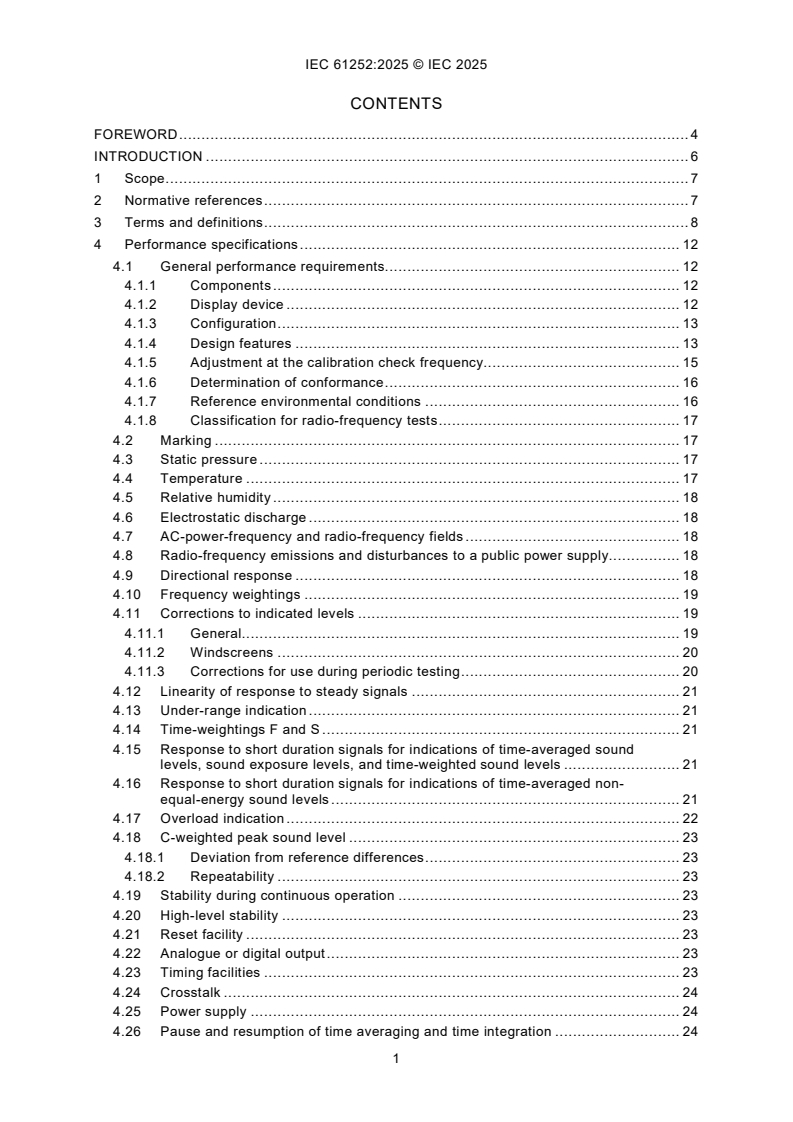
CONTENTS
FOREWORD . 4
INTRODUCTION . 6
1 Scope . 7
2 Normative references . 7
3 Terms and definitions . 8
4 Performance specifications . 12
4.1 General performance requirements. 12
4.1.1 Components . 12
4.1.2 Display device . 12
4.1.3 Configuration . 13
4.1.4 Design features . 13
4.1.5 Adjustment at the calibration check frequency. 15
4.1.6 Determination of conformance . 16
4.1.7 Reference environmental conditions . 16
4.1.8 Classification for radio-frequency tests . 17
4.2 Marking . 17
4.3 Static pressure . 17
4.4 Temperature . 17
4.5 Relative humidity . 18
4.6 Electrostatic discharge . 18
4.7 AC-power-frequency and radio-frequency fields . 18
4.8 Radio-frequency emissions and disturbances to a public power supply. 18
4.9 Directional response . 18
4.10 Frequency weightings . 19
4.11 Corrections to indicated levels . 19
4.11.1 General. 19
4.11.2 Windscreens . 20
4.11.3 Corrections for use during periodic testing . 20
4.12 Linearity of response to steady signals . 21
4.13 Under-range indication . 21
4.14 Time-weightings F and S . 21
4.15 Response to short duration signals for indications of time-averaged sound
levels, sound exposure levels, and time-weighted sound levels . 21
4.16 Response to short duration signals for indications of time-averaged non-
equal-energy sound levels . 21
4.17 Overload indication . 22
4.18 C-weighted peak sound level . 23
4.18.1 Deviation from reference differences . 23
4.18.2 Repeatability . 23
4.19 Stability during continuous operation . 23
4.20 High-level stability . 23
4.21 Reset facility . 23
4.22 Analogue or digital output . 23
4.23 Timing facilities . 23
4.24 Crosstalk . 24
4.25 Power supply . 24
4.26 Pause and resumption of time averaging and time integration . 24
4.27 Instruction manual . 24
4.27.1 General. 24
4.27.2 Specifications . 24
4.27.3 Information for operation. 26
4.27.4 Information for use with auxiliary devices . 27
4.27.5 Information for testing . 28
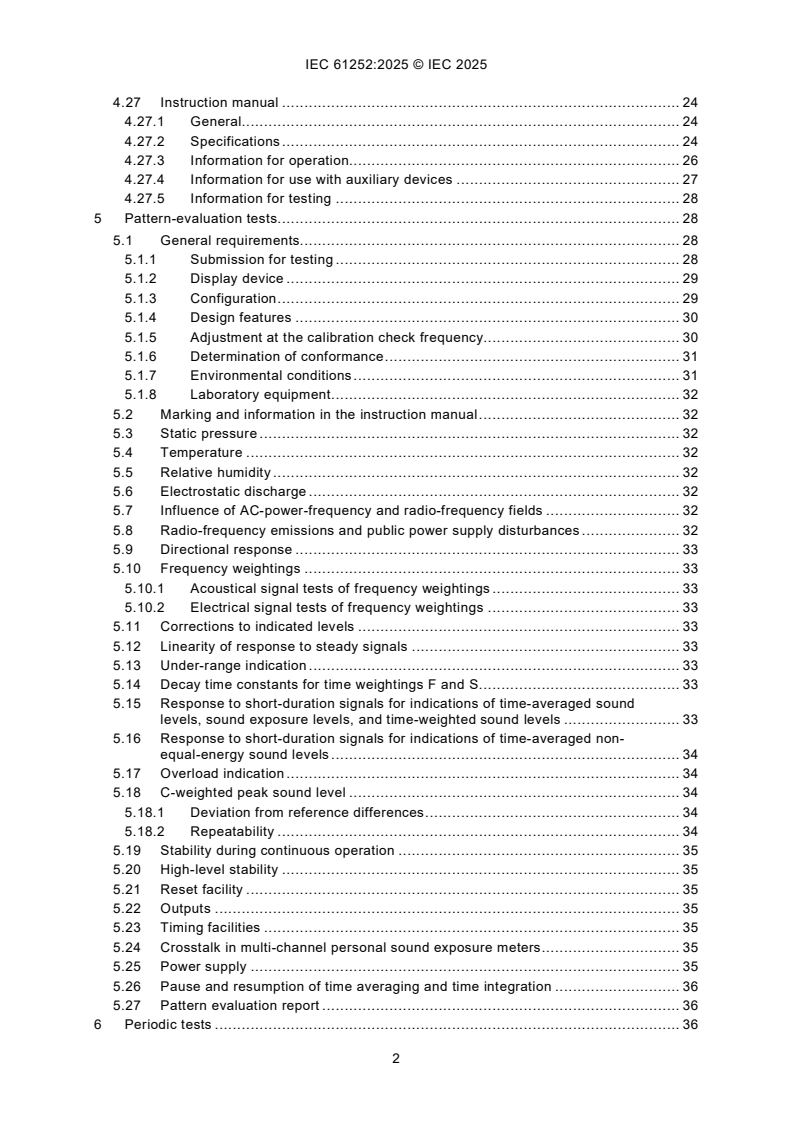
5 Pattern-evaluation tests. 28
5.1 General requirements. 28
5.1.1 Submission for testing . 28
5.1.2 Display device . 29
5.1.3 Configuration . 29
5.1.4 Design features . 30
5.1.5 Adjustment at the calibration check frequency. 30
5.1.6 Determination of conformance . 31
5.1.7 Environmental conditions . 31
5.1.8 Laboratory equipment . 32
5.2 Marking and information in the instruction manual . 32
5.3 Static pressure . 32
5.4 Temperature . 32
5.5 Relative humidity . 32
5.6 Electrostatic discharge . 32
5.7 Influence of AC-power-frequency and radio-frequency fields . 32
5.8 Radio-frequency emissions and public power supply disturbances . 32
5.9 Directional response . 33
5.10 Frequency weightings . 33
5.10.1 Acoustical signal tests of frequency weightings . 33
5.10.2 Electrical signal tests of frequency weightings . 33
5.11 Corrections to indicated levels . 33
5.12 Linearity of response to steady signals . 33
5.13 Under-range indication . 33
5.14 Decay time constants for time weightings F and S . 33
5.15 Response to short-duration signals for indications of time-averaged sound
levels, sound exposure levels, and time-weighted sound levels . 33
5.16 Response to short-duration signals for indications of time-averaged non-
equal-energy sound levels . 34
5.17 Overload indication . 34
5.18 C-weighted peak sound level . 34
5.18.1 Deviation from reference differences . 34
5.18.2 Repeatability . 34
5.19 Stability during continuous operation . 35
5.20 High-level stability . 35
5.21 Reset facility . 35
5.22 Outputs . 35
5.23 Timing facilities . 35
5.24 Crosstalk in multi-channel personal sound exposure meters . 35
5.25 Power supply . 35
5.26 Pause and resumption of time averaging and time integration . 36
5.27 Pattern evaluation report . 36
6 Periodic tests . 36
6.1 General requirements. 36
6.1.1 Submission for testing . 36
6.1.2 Preliminary inspection . 37
6.1.3 Configuration . 38
6.1.4 Design features . 38
6.1.5 Adjustment at the calibration check frequency. 38
6.1.6 Determination of conformance . 38
6.1.7 Environmental conditions . 39
6.1.8 Laboratory equipment . 40
6.1.9 Power supply . 40
6.2 Marking . 40
6.3 Frequency weightings . 40
6.3.1 Acoustical signal tests of a frequency weighting . 40
6.3.2 Electrical signal tests of frequency weightings . 40
6.4 Frequency and time weightings at 1 kHz . 41
6.5 Linearity of response to steady signals . 41
6.6 Response to short-duration signals for indications of time-averaged sound
levels . 41
6.7 Response to short-duration signals for indications of time-averaged non-
equal-energy sound levels . 41
6.8 Overload indication . 41
6.9 C-weighted peak sound level . 41
6.9.1 Deviation from reference differences . 41
6.9.2 Repeatability . 41
6.10 Documentation . 42
Annex A (informative) Sound exposures and corresponding normalized 8 h-average
sound levels . 44
Annex B (informative) Relationship between tolerance interval, corresponding
acceptance interval and the maximum-permitted uncertainty of measurement . 45
Annex C (normative) Maximum-permitted uncertainties of measurement . 46
Annex D (informative) Example assessments of conformance to specifications of this
document . 47
D.1 General . 47
D.2 Conformance criteria . 47
D.3 Example test results. 47
Bibliography . 50
Figure B.1 – Relationship between tolerance interval, corresponding acceptance
interval and the maximum-permitted uncertainty of measurement . 45
Figure D.1 – Examples of assessment of conformance . 49
Table 1 – Acceptance limits for deviations of directional response from the design goal . 19
Table 2 – Reference response to a sequence of repeated 4 kHz tonebursts for time-
averaged non-equal-energy sound levels and acceptance limits . 22
Table A.1 – Sound exposures and corresponding normalized 8 h-average sound levels . 44
Table C.1 – Maximum-permitted uncertainties of measurement for a coverage
probability of 95 % for the response to short-duration signals for indications of time-
averaged non-equal-energy sound levels and for timing facilities . 46
Table D.1 – Examples of assessment of conformance . 48
INTERNATIONAL ELECTROTECHNICAL COMMISSION
____________
Electroacoustics - Personal sound exposure meters
FOREWORD
1) The International Electrotechnical Commission (IEC) is a worldwide organization for standardization comprising
all national electrotechnical committees (IEC National Committees). The object of IEC is to promote international
co-operation on all questions concerning standardization in the electrical and electronic fields. To this end and
in addition to other activities, IEC publishes International Standards, Technical Specifications, Technical Reports,
Publicly Available Specifications (PAS) and Guides (hereafter referred to as "IEC Publication(s)"). Their
preparation is entrusted to technical committees; any IEC National Committee interested in the subject dealt with
may participate in this preparatory work. International, governmental and non-governmental organizations liaising
with the IEC also participate in this preparation. IEC collaborates closely with the International Organization for
Standardization (ISO) in accordance with conditions determined by agreement between the two organizations.
2) The formal decisions or agreements of IEC on technical matters express, as nearly as possible, an international
consensus of opinion on the relevant subjects since each technical committee has representation from all
interested IEC National Committees.
3) IEC Publications have the form of recommendations for international use and are accepted by IEC National
Committees in that sense. While all reasonable efforts are made to ensure that the technical content of IEC
Publications is accurate, IEC cannot be held responsible for the way in which they are used or for any
misinterpretation by any end user.
4) In order to promote international uniformity, IEC National Committees undertake to apply IEC Publications
transparently to the maximum extent possible in their national and regional publications. Any divergence between
any IEC Publication and the corresponding national or regional publication shall be clearly indicated in the latter.
5) IEC itself does not provide any attestation of conformity. Independent certification bodies provide conformity
assessment services and, in some areas, access to IEC marks of conformity. IEC is not responsible for any
services carried out by independent certification bodies.
6) All users should ensure that they have the latest edition of this publication.
7) No liability shall attach to IEC or its directors, employees, servants or agents including individual experts and
members of its technical committees and IEC National Committees for any personal injury, property damage or
other damage of any nature whatsoever, whether direct or indirect, or for costs (including legal fees) and
expenses arising out of the publication, use of, or reliance upon, this IEC Publication or any other IEC
Publications.
8) Attention is drawn to the Normative references cited in this publication. Use of the referenced publications is
indispensable for the correct application of this publication.
9) IEC draws attention to the possibility that the implementation of this document may involve the use of (a)
patent(s). IEC takes no position concerning the evidence, validity or applicability of any claimed patent rights in
respect thereof. As of the date of publication of this document, IEC had not received notice of (a) patent(s), which
may be required to implement this document. However, implementers are cautioned that this may not represent
the latest information, which may be obtained from the patent database available at https://patents.iec.ch. IEC
shall not be held responsible for identifying any or all such patent rights.
IEC 61252 has been prepared by IEC technical committee 29: Electroacoustics. It is an
International Standard.
This second edition cancels and replaces the first edition published in 1993,
Amendment 1:2000, and Amendment 2:2017. This edition constitutes a technical revision.
This edition includes the following significant technical changes with respect to the previous
edition:
a) personal sound exposure meters are required to provide indications of time-averaged sound
level and peak sound level;
b) sound exposure is an optional quantity for indication;
c) specifications for physical quantities that do not follow the principle of equal-energy
exchange rate have been added;
d) specifications for directional response have been added;
e) specifications for frequency weightings apply to the relative diffuse-field frequency
response;
f) determination of conformance to specifications takes account of uncertainties of
measurement;
g) detailed requirements for pattern-evaluation tests and periodic testing have been added.
The text of this International Standard is based on the following documents:
Draft Report on voting
29/1206/FDIS 29/1218/RVD
Full information on the voting for its approval can be found in the report on voting indicated in
the above table.
The language used for the development of this International Standard is English.
This document was drafted in accordance with ISO/IEC Directives, Part 2, and developed in
accordance with ISO/IEC Directives, Part 1 and ISO/IEC Directives, IEC Supplement, available
at www.iec.ch/members_experts/refdocs. The main document types developed by IEC are
described in greater detail at www.iec.ch/publications.
The committee has decided that the contents of this document will remain unchanged until the
stability date indicated on the IEC website under webstore.iec.ch in the data related to the
specific document. At this date, the document will be
• reconfirmed,
• withdrawn, or
• revised.
INTRODUCTION
The principal application for a personal sound exposure meter is the measurement of sound
immission in the vicinity of a person's head, for example for assessment of occupational noise
exposure in accordance with International Standards such as ISO 1999 and ISO 9612.
The microphone of a personal sound exposure meter is typically worn on the shoulder, collar,
or other location close to the ear. In many practical situations, the sound immission indicated
by an instrument worn on a person is likely to be different from that which would be measured
in the absence of a person. The influence of the person wearing a personal sound exposure
meter should be considered when estimating the sound immission that would have been
measured with the person absent.
The most common physical quantities for characterisation of sound immission are time-
averaged sound levels and peak sound levels. For this reason, this document requires a
personal sound exposure meter to provide indications of these sound levels.
Other quantities which are sometimes measured include sound exposure and sound exposure
levels. Therefore, this document optionally allows a personal sound exposure meter to indicate
these quantities.
Sound exposure is a physical measure that accounts for both the sound pressure and its
duration, at a given location, through the time integral of the square of the instantaneous
frequency-weighted sound pressure. A doubling (or halving) of the integration time of a constant
sound level yields a doubling (or halving) of sound exposure. Similarly, an increase (or
decrease) of 3 dB in a constant input sound level for a constant integration time yields a
doubling (or halving) of the sound exposure. The same operating principle ("equal-energy
exchange rate") underlies the measurement of sound exposure level.
The term "dose" is sometimes used to refer to a percentage of a predetermined criterion for
exposure to noise in terms of a specified upper limit (often a legal limit) of a specified physical
quantity. The physical quantity and the value of the limit vary between jurisdictions, and some
jurisdictions specify quantities that are not based on the principle of equal-energy exchange.
Therefore, this document allows a personal sound exposure meter to indicate these quantities
and distinguishes between equal-energy-based and non-equal-energy-based quantities.
This document specifies performance requirements for personal sound exposure meters of one
performance class. The specifications generally correspond to those for a class 2 integrating-
averaging sound level meter as given in IEC 61672-1:2013 for an A-weighted sound pressure
level range at least from 67 dB to 137 dB and a nominal frequency range from 20 Hz to 8 kHz.
The design goals and the acceptance limits for deviations from the design goals are
representative of the performance of practical instruments. Personal sound exposure meters
are unlikely to be suitable for measurement of sound levels outside these ranges.
The title of this document has been changed with respect to IEC 61252:1993 because this
document includes requirements for pattern-evaluation tests and periodic testing in addition to
performance specifications.
The purpose of pattern evaluation is to determine whether a model of personal sound exposure
meter conforms to all the performance specifications given in this document.
The purpose of periodic testing is to assure the user that the individual personal sound exposure
meter conforms to the applicable performance specifications for a limited set of key tests and
for the environmental conditions under which the tests are performed. The extent of the periodic
tests is deliberately restricted to the minimum considered necessary. Because of the limited
extent of the periodic tests, evidence of pattern approval is necessary to state that the individual
personal sound exposure meter conforms to the complete set of specifications of this document.
The aim is to ensure that pattern evaluation and periodic testing are performed in a consistent
manner by all laboratories.
1 Scope
This document specifies
– performance specifications for personal sound exposure meters,
– details of the tests necessary to verify conformance to all mandatory specifications for the
purpose of pattern evaluation, and
– procedures for periodic testing of a personal sound exposure meter.
Personal sound exposure meters conforming to the requirements of this document have a
specified frequency response for sound incident on the microphone from all directions.
This document is applicable to instruments that are designed to be worn on a person in a
configuration specified by the manufacturer for the measurement of sound immission resulting
from steady, intermittent, fluctuating, irregular, or impulsive sounds. For reproducibility of
results, specifications and tests for the response to sound waves apply without an operator
present in the sound field.
Pattern evaluation tests and periodic tests described in this document apply to personal sound
exposure meters for which the manufacturer claims conformance to the specifications given in
this document.
2 Normative references
The following documents are referred to in the text in such a way that some or all of their content
constitutes requirements of this document. For dated references, only the edition cited applies.
For undated references, the latest edition of the referenced document (including any
amendments) applies.
IEC 60942, Electroacoustics - Sound calibrators
IEC 61000-4-3:2020, Electromagnetic compatibility (EMC) - Part 4-3: Testing and measurement
techniques - Radiated, radio-frequency, electromagnetic field immunity test
IEC 61094-6, Measurement microphones - Part 6: Electrostatic actuators for determination of
frequency response
IEC 61183, Electroacoustics - Random-incidence and diffuse-field calibration of sound level
meters
IEC 61672 (all parts), Electroacoustics - Sound level meters
IEC 61672-1:2013, Electroacoustics - Sound level meters - Part 1: Specifications
IEC 61672-2:2013, Electroacoustics - Sound level meters - Part 2: Pattern evaluation tests
IEC 61672-3:2013, Electroacoustics - Sound level meters - Part 3: Periodic tests
IEC 62585:2012, Electroacoustics - Methods to determine corrections to obtain the free-field
response of a sound level meter
ISO/IEC Guide 98-3, Uncertainty of measurement - Part 3: Guide to the expression of
uncertainty in measurement (GUM:1995)
ISO/IEC Guide 98-4, Uncertainty of measurement - Part 4: Role of measurement uncertainty in
conformity assessment
ISO/IEC Guide 99, International vocabulary of metrology - Basic and general concepts and
associated terms (VIM)
3 Terms and definitions
For the purposes of this document, the terms and definitions given in IEC 61000-4-3,
IEC 61183, IEC 61672 (all parts), IEC 62585, ISO/IEC Guide 98-3, ISO/IEC Guide 98-4,
ISO/IEC Guide 99, and the following apply.
ISO and IEC maintain terminology databases for use in standardization at the following
addresses:
• IEC Electropedia: available at https://www.electropedia.org/
• ISO Online browsing platform: available at https://www.iso.org/obp
3.1
sound exposure
time integral of the square of a frequency-weighted sound pressure signal over a stated time
interval or event of stated duration
Note 1 to entry: Duration of integration is included implicitly in the time integral and is not always reported explicitly,
although it is useful to state the nature of the event. For measurements of sound exposure over a specified time
interval, duration of integration is usually reported and indicated by a suitable subscript to the letter symbol, for
example as E .
A,1 h
Note 2 to entry: In symbols and as an example, A-weighted sound exposure E is represented by Formula (1):
A,T
t
E = p (t)dt
(1)
A,T A
∫
t
where pt is the square of the A-weighted sound-pressure signal during integration time T starting at t and
()
A 1
ending at t .
Note 3 to entry: The unit of sound exposure is pascal-squared seconds (Pa s) if sound pressure is in pascals and
running time is in seconds.
Note 4 to entry: For applications such as measurement of exposure to noise in the workplace, sound exposure in
pascal-squared hours is more convenient than pascal-squared seconds.
[SOURCE: IEC 61672-1:2013, 3.11]
3.2
normalized 8 h-average sound level
level of the time-mean-square, A-weighted sound pressure during a normalization time period
T of 8 h such that the sound exposure therefrom is equal to that of a time-varying sound at a
n
place where total sound exposure occurs within a time period not necessarily 8 h
Note 1 to entry: The unit of normalized 8 h-average sound level is decibels.
Note 2 to entry: In symbols, a normalized 8 h-average sound level (letter symbol L ), relative to the reference
Aeq,8 hn
sound pressure p and the 8 h normalization time period T , is related to sound exposure E in pascal-squared hours
0 n
by Formula (2):
L = 10lg E pT (2)
Aeq,8 hn ( 0 n)
or, alternatively, by Formula (3):
0,1×L
( )
2 Aeq,8 hn
E= pT 10 (3)
( )
0n
Note 3 to entry: For computations, a simpler form of Formula (2) for normalized 8 h-average sound level is obtained,
for sound exposure E in pascal-squared hours, after substituting the values of 20 µPa for p and 8 h for T , as in
0 n
Formula (4):
LE10lg×10 3,2 (4)
( )
Aeq,8 hn
Note 4 to entry: When a total sound exposure is described indirectly by an A-weighted time-averaged sound
pressure level L , for an averaging time T greater or less than the normalization time period of 8 h, normalized
Aeq,T
8 h-average sound level can be determined from Formula (5):
L L +10lg(TT ) (5)
Aeq,8 hn Aeq,T n
Note 5 to entry: Annex A provides a table of normalized 8 h-average sound levels and corresponding sound
exposures. For example, a sound exposure of 1 Pa h (irrespective of the period of time over which it is measured)
corresponds to a normalized 8 h-average sound level of approximately 85 dB; a sound exposure of 3,20 Pa h
corresponds to a normalized 8 h-average sound level of 90 dB.
Note 6 to entry: Normalized 8 h-average sound level in Formula (2) is identical to "daily noise exposure level"
) defined in Directive 2003/10/EC, Article 2.
(L
EX,8h
Note 7 to entry: Normalized 8 h-average sound level in Formula (2) is also the same as "noise exposure level
normalized to a nominal 8 h working day, L " defined in ISO 1999.
EX,8 h
3.3
exchange rate
change in sound level corresponding to a doubling or halving of the duration of a steady input
sound pressure signal while a constant percentage non-equal-energy sound exposure is
maintained
3.4
non-equal-energy sound exposure
time integral of a power function of the time-weighted square of a frequency-weighted sound
pressure signal over a stated time interval or event of stated duration
Note 1 to entry: Duration of integration is included implicitly in the time integral and is not always reported explicitly,
although it is useful to state the nature of the event. For measurements of non-equal-energy sound exposure over a
specified time interval, duration of integration is usually reported and indicated by a suitable subscript to the letter
symbol, for example as E .
neeA,1 h
Note 2 to entry: In symbols and as an example, A-frequency weighted F-time weighted non-equal-energy sound
exposure E is represented by Formula (6):
neeAF,T
10lg(2) Q
t t
2
−(t−ξτ)
F
Ep= ξξed dt (6)
( )
neeAF,T A
∫∫τ
t −∞
F
=
=
where
τ is the exponential time constant in seconds for time weighting F;
F
ξ is a dummy variable of time integration from some time in the past, as indicated by –∞ for the lower limit of
the integral, to the time of observation t;
pA(ξ) is the A-weighted instantaneous sound-pressure signal;
Q is the exchange rate in decibels;
T is the integration time beginning at t and ending at t .
1 2
Note 3 to entry: The unit of sound exposure is pascal-squared seconds (Pa s) if sound pressure is in pascals and
running time is in seconds.
Note 4 to entry: For applications such as measurement of exposure to noise in the workplace, sound exposure in
pascal-squared hours is more convenient than pascal-squared seconds.
Note 5 to entry: If the exchange rate were 3 dB and there were no time weighting, non-equal-energy sound exposure
would be equivalent to sound exposure.
3.5
criterion duration
specified duration of time integration
Note 1 to entry: The criterion duration is typically chosen to be the maximum duration of exposure for the
application, for example the duration of a working day.
3.6
criterion sound level
specified level of a sound
Note 1 to entry: The criterion sound level is typically chosen to be a level of sound which, if maintained for longer
than the criterion duration or if exceeded, could have adverse effects on human health.
3.7
criterion sound exposure
product of the criterion duration and the mean-square sound pressure corresponding to the
criterion sound level
Note 1 to entry: The criterion sound exposure is typically chosen to be a legal limit. Such limits vary between
jurisdictions and are subject to change.
3.8
criterion non-equal-energy sound exposure
product of the criterion duration and a power function of the mean-square sound pressure
corresponding to the criterion sound level
Note 1 to entry: The criterion non-equal-energy sound exposure is typically chosen to be a legal limit. Such limits
vary between jurisdictions and are subject to change.
3.9
percentage criterion sound exposure
quotient of sound exposure to criterion sound exposure, multiplied by 100
Note 1 to entry: The unit of percentage criterion sound exposure is per cent.
Note 2 to entry: In symbols and as an example, the percentage criterion sound exposure using frequency weighting
A can also be calculated from Formula (7):
t
0,1 LL−
2 ( )
A cr
DT= 100 10 dt
( ) (7)
A cr
∫
t
where
T is the criterion duration;
cr
T is the integration time beginning at t and ending at t ;
1 2
L is the A-frequency weighted sound level equivalent to the A-frequency-weighted input sound pressure;
A
L is the criterion sound level.
cr
3.10
percentage criterion non-equal-energy sound exposure
quotient of non-equal-energy sound exposure to criterion non-equal-energy sound exposure,
multiplied by 100
Note 1 to entry: The unit of percentage criterion non-equal-energy sound exposure is per cent.
Note 2 to entry: In symbols and as an example, the percentage criterion non-equal-energy sound exposure using
frequency weighting A and time weighting S can also be calculated from Formula (8):
t
LL− lg(2) Q
2 ( )( )
AS cr
DT= 100 10 dt (8)
( )
ASQ cr
∫
t
where
Q is the exchange rate in decibels;
T is the criterion duration;
cr
T is the integration time beginning at t and ending at t ;
1 2
L is the S-time-weighted A-frequency-weighted sound level equivalent to the A-frequency-weighted input sound
AS
pressure;
L is the criterion sound level.
cr
Note 3 to entry: If the exchange rate were 3 dB and there were no time weighting, percentage criterion non-equal-
energy sound exposure would be equivalent to percentage criterion sound exposure.
3.11
time-averaged non-equal-energy sound level
average sound level during the integration time over which a percentage criterion non-equal-
energy sound exposure is measured
Note 1 to entry: In symbols and as an example, the time-averaged non-equal-energy sound level using frequency
weighting A and time-weighting S can be calculated from Formula (9):
L L+ Q lg 2 lg DT 100T (9)
( ( )) ( )
neeAS,TQcr AS cr
where
Q is the exchange rate in decibels;
D is the percentage criterion non-equal-energy sound exposure;
ASQ
T is the criterion duration;
cr
T is the integration time;
L is the criterion sound level.
cr
Note 2 to entry: If the sound level is held constant during a test, time-averaged non-equal-energy sound level is
that constant level.
Note 3 to entry: If the exchange rate were 3 dB and there were no time weighting, time-averaged non-equal-energy
sound level is a close approximation of time-averaged sound level.
Note 4 to entry: Time-averaged non-equal-energy sound level is equivalent to average sound level as described in
ANSI S1.25-1991, 4.7.
=
4 Performance specifications
4.1 General performance requirements
4.1.1 Components
Generally, a personal sound exposure meter is a combination of a microphone, a signal
processor, and a display device. Performance specifications of this document apply to any
design of microphone that is appropriate for a personal sound exposure meter.
NOTE 1 The signal processor typically includes the combined functions of an amplifier with a specified and
controlled frequency response, a device to form the square of the frequency-weighted, time-varying sound-pressure
signal, and a time integrator.
NOTE 2 Computer software is an integral part of some personal sound exposure meters.
All components that are necessary for conformance to the specifications are integral parts of a
personal sound exposure meter.
The manufacturer shall provide a means to apply an electrical input signal in place of the signal
from the microphone, for the purpose of performing tests on the complete instrument without
the microphone.
NOTE 3 A combination of limited acoustical signal tests with electrical input signal tests can be more practicable
than acoustical signal tests of the entire personal sound exposure meter.
The manufacturer may provide an accessible input test point or recommend and provide a
dummy microphone or equivalent input adaptor (electrical or non-electrical) for performing
electrical tests on the instrument. The point of access for electrical input signals should be
before any signal processing such that electrical input signals for testing can be applied to as
much of the personal sound exposure meter as possible.
EXAMPLE 1 Some personal sound exposure meters allow the microphone to be removed to allow electrical signals
to be applied to the remainder of the personal sound exposure meter.
An optional extension device or cable may be provided by the manufacturer of the personal
sound exposure meter for installation between the components. If such device or cable is
provided, details shall be given in the instruction manual for any corrections to be applied to
the results of measurements made in this manner (see 4.27.4).
EXAMPLE 2 Some personal sound exposure meters allow for an extension cable for installation between the
microphone or a microphone preamplifier and the other components.
Accessories including windscreens or rain protection devices may be specified for installation
around the microphone (see 4.11.2).
It is recommended that the manufacturer provide an accessible output test point (see 4.22).
NOTE 4 An output test point such as an AC analogue signal port or digital output port enables easier determination
of conformance to specifications.
4.1.2 Display device
The display device shall provide a physical and visible display, or storage, of measurement
results. Any stored measurement result shall be available for display by means of a
manufacturer-specified device. An analogue or digital output connection alone is not a display
device.
EXAMPLE Some personal sound exposure meters use a computer with associated software to provide the display.
The display device may be built into, or be separate from, the wearable part of the personal
sound exposure meter.
---------------------- Pag
...
IEC 61252 ®
Edition 2.0 2025-10
NORME
INTERNATIONALE
Électroacoustique - Exposimètres acoustiques individuels
ICS 13.140; 17.140.50 ISBN 978-2-8327-0674-9
Droits de reproduction réservés. Sauf indication contraire, aucune partie de cette publication ne peut être reproduite ni
utilisée sous quelque forme que ce soit et par aucun procédé, électronique ou mécanique, y compris la photocopie et
les microfilms, sans l'accord écrit de l'IEC ou du Comité national de l'IEC du pays du demandeur. Si vous avez des
questions sur le copyright de l'IEC ou si vous désirez obtenir des droits supplémentaires sur cette publication, utilisez
les coordonnées ci-après ou contactez le Comité national de l'IEC de votre pays de résidence.
IEC Secretariat Tel.: +41 22 919 02 11
3, rue de Varembé info@iec.ch
CH-1211 Geneva 20 www.iec.ch
Switzerland
A propos de l'IEC
La Commission Electrotechnique Internationale (IEC) est la première organisation mondiale qui élabore et publie des
Normes internationales pour tout ce qui a trait à l'électricité, à l'électronique et aux technologies apparentées.
A propos des publications IEC
Le contenu technique des publications IEC est constamment revu. Veuillez vous assurer que vous possédez l’édition la
plus récente, un corrigendum ou amendement peut avoir été publié.
Recherche de publications IEC - IEC Products & Services Portal - products.iec.ch
webstore.iec.ch/advsearchform Découvrez notre puissant moteur de recherche et consultez
La recherche avancée permet de trouver des publications gratuitement tous les aperçus des publications, symboles
IEC en utilisant différents critères (numéro de référence, graphiques et le glossaire. Avec un abonnement, vous aurez
texte, comité d’études, …). Elle donne aussi des toujours accès à un contenu à jour adapté à vos besoins.
informations sur les projets et les publications remplacées
ou retirées. Electropedia - www.electropedia.org
Le premier dictionnaire d'électrotechnologie en ligne au
IEC Just Published - webstore.iec.ch/justpublished monde, avec plus de 22 500 articles terminologiques en
Restez informé sur les nouvelles publications IEC. Just anglais et en français, ainsi que les termes équivalents
Published détaille les nouvelles publications parues. dans 25 langues additionnelles. Egalement appelé
Disponible en ligne et une fois par mois par email. Vocabulaire Electrotechnique International (IEV) en ligne.
Service Clients - webstore.iec.ch/csc
Si vous désirez nous donner des commentaires sur cette
publication ou si vous avez des questions contactez-
nous: sales@iec.ch.
SOMMAIRE
AVANT-PROPOS . 5
INTRODUCTION . 7
1 Domaine d'application . 9
2 Références normatives . 9
3 Termes et définitions. 10
4 Spécifications de performance . 14
4.1 Exigences de performances générales . 14
4.1.1 Composants . 14
4.1.2 Dispositif d'affichage . 15
4.1.3 Configuration . 16
4.1.4 Caractéristiques de conception. 16
4.1.5 Réglage à la fréquence de vérification d'étalonnage . 18
4.1.6 Détermination de la conformité . 19
4.1.7 Conditions d'environnement de référence . 19
4.1.8 Classification des essais aux fréquences radioélectriques . 19
4.2 Marquage . 20
4.3 Pression statique . 20
4.4 Température . 20
4.5 Humidité relative . 20
4.6 Décharge électrostatique . 20
4.7 Champs à la fréquence du réseau en courant alternatif et champs aux
fréquences radioélectriques . 20
4.8 Émissions de fréquences radioélectriques et perturbations apportées au
secteur . 21
4.9 Réponse directionnelle . 21
4.10 Pondérations fréquentielles . 22
4.11 Corrections aux niveaux indiqués . 22
4.11.1 Généralités . 22
4.11.2 Écran anti-vent . 22
4.11.3 Corrections à utiliser lors des essais périodiques . 23
4.12 Linéarité de la réponse à des signaux permanents . 23
4.13 Indication inférieure à la plage . 24
4.14 Pondérations temporelles F et S . 24
4.15 Réponse aux signaux de courte durée pour les indications des niveaux
équivalents continus de pression acoustique, des niveaux d'exposition au
bruit et des niveaux équivalents continus de pression acoustique pondérée. 24
4.16 Réponse aux signaux de courte durée pour les indications des niveaux
équivalents continus de pression acoustique d'énergie non égale . 24
4.17 Indication de surcharge . 25
4.18 Niveau sonore de crête pondéré C . 26
4.18.1 Écart par rapport aux différences de référence . 26
4.18.2 Répétabilité . 26
4.19 Stabilité en fonctionnement continu . 26
4.20 Stabilité à haut niveau . 26
4.21 Fonction de réinitialisation . 26
4.22 Sortie analogique ou numérique . 26
4.23 Fonctions de temporisation . 26
4.24 Diaphonie . 27
4.25 Alimentation . 27
4.26 Mise en pause et reprise du moyennage et de l'intégration . 27
4.27 Manuel d'instructions . 27
4.27.1 Généralités . 27
4.27.2 Spécifications . 27
4.27.3 Informations relatives au fonctionnement . 30
4.27.4 Informations relatives à l'utilisation avec des dispositifs auxiliaires . 31
4.27.5 Informations relatives aux essais . 31
5 Essais d'évaluation de modèle . 32
5.1 Exigences générales . 32
5.1.1 Soumission aux essais . 32
5.1.2 Dispositif d'affichage . 32
5.1.3 Configuration . 33
5.1.4 Caractéristiques de conception. 33
5.1.5 Réglage à la fréquence de vérification d'étalonnage . 34
5.1.6 Détermination de la conformité . 34
5.1.7 Conditions d'environnement . 35
5.1.8 Équipements de laboratoire . 35
5.2 Marquage et informations fournies dans le manuel d'instructions . 35
5.3 Pression statique . 36
5.4 Température . 36
5.5 Humidité relative . 36
5.6 Décharge électrostatique . 36
5.7 Influence des champs à la fréquence du réseau en courant alternatif et des
champs aux fréquences radioélectriques . 36
5.8 Émissions aux fréquences radioélectriques et perturbations apportées au
secteur . 36
5.9 Réponse directionnelle . 36
5.10 Pondérations fréquentielles . 37
5.10.1 Essais de signaux acoustiques de pondérations fréquentielles . 37
5.10.2 Essais de signaux électriques de pondérations fréquentielles . 37
5.11 Corrections aux niveaux indiqués . 37
5.12 Linéarité de la réponse à des signaux permanents . 37
5.13 Indication inférieure à la plage . 37
5.14 Constantes de temps de déclin pour les pondérations temporelles F et S . 37
5.15 Réponse aux signaux de courte durée pour les indications des niveaux
équivalents continus de pression acoustique, des niveaux d'exposition au
bruit et des niveaux équivalents continus de pression acoustique pondérée. 37
5.16 Réponse aux signaux de courte durée pour les indications des niveaux
équivalents continus de pression acoustique d'énergie non égale . 38
5.17 Indication de surcharge . 38
5.18 Niveau sonore de crête pondéré C . 38
5.18.1 Écart par rapport aux différences de référence . 38
5.18.2 Répétabilité . 38
5.19 Stabilité en fonctionnement continu . 39
5.20 Stabilité à haut niveau . 39
5.21 Fonction de réinitialisation . 39
5.22 Sorties . 39
5.23 Fonctions de temporisation . 39
5.24 Diaphonie dans les exposimètres acoustiques individuels multicanaux . 40
5.25 Alimentation . 40
5.26 Mise en pause et reprise du moyennage et de l'intégration . 40
5.27 Rapport d'évaluation de modèle . 40
6 Essais périodiques. 41
6.1 Exigences générales . 41
6.1.1 Soumission aux essais . 41
6.1.2 Inspection préliminaire . 42
6.1.3 Configuration . 42
6.1.4 Caractéristiques de conception. 43
6.1.5 Réglage à la fréquence de vérification d'étalonnage . 43
6.1.6 Détermination de la conformité . 43
6.1.7 Conditions d'environnement . 44
6.1.8 Équipements de laboratoire . 45
6.1.9 Alimentation . 45
6.2 Marquage . 45
6.3 Pondérations fréquentielles . 45
6.3.1 Essais de signaux acoustiques d'une pondération fréquentielle . 45
6.3.2 Essais de signaux électriques de pondérations fréquentielles . 45
6.4 Pondérations fréquentielles et temporelles à 1 kHz . 45
6.5 Linéarité de la réponse à des signaux permanents . 46
6.6 Réponse aux signaux de courte durée pour les indications des niveaux
équivalents continus de pression acoustique . 46
6.7 Réponse aux signaux de courte durée pour les indications des niveaux
équivalents continus de pression acoustique d'énergie non égale . 46
6.8 Indication de surcharge . 46
6.9 Niveau sonore de crête pondéré C . 46
6.9.1 Écart par rapport aux différences de référence . 46
6.9.2 Répétabilité . 46
6.10 Documentation . 47
Annexe A (informative) Expositions au bruit et niveaux sonores moyens
correspondants ramenés à 8 h . 50
Annexe B (informative) Relation entre l'intervalle de tolérance, l'intervalle
d'acceptation correspondant et l'incertitude de mesure maximale admise . 51
Annexe C (normative) Incertitudes de mesure maximales admises . 52
Annexe D (informative) Exemple d'évaluations de conformité aux spécifications du
présent document . 53
D.1 Généralités . 53
D.2 Critères de conformité . 53
D.3 Exemple de résultats d'essai. 53
Bibliographie . 56
Figure B.1 – Relation entre l'intervalle de tolérance, l'intervalle d'acceptation
correspondant et l'incertitude de mesure maximale admise . 51
Figure D.1 – Exemples d'évaluations de conformité . 55
Tableau 1 – Limites d'acceptation des écarts de réponse directionnelle par rapport à la
valeur nominale . 21
Tableau 2 – Réponse de référence à une séquence de bruits impulsionnels répétés de
4 kHz pour des niveaux équivalents continus de pression acoustique d'énergie non
égale et limites d'acceptation . 25
Tableau A.1 – Expositions au bruit et niveaux sonores moyens correspondants
ramenés à 8 h . 50
Tableau C.1 – Incertitudes de mesure maximales admises pour une probabilité de
couverture de 95 % pour la réponse aux signaux de courte durée pour les indications
des niveaux équivalents continus de pression acoustique d'énergie non égale et pour
les fonctions de temporisation. 52
Tableau D.1 – Exemples d'évaluations de conformité . 54
COMMISSION ÉLECTROTECHNIQUE INTERNATIONALE
____________
Électroacoustique - Exposimètres acoustiques individuels
AVANT-PROPOS
1) La Commission Électrotechnique Internationale (IEC) est une organisation mondiale de normalisation composée
de l'ensemble des comités électrotechniques nationaux (Comités nationaux de l'IEC). L'IEC a pour objet de
favoriser la coopération internationale pour toutes les questions de normalisation dans les domaines de
l'électricité et de l'électronique. À cet effet, l'IEC – entre autres activités – publie des Normes internationales,
des Spécifications techniques, des Rapports techniques, des Spécifications accessibles au public (PAS) et des
Guides (ci-après dénommés "Publication(s) de l'IEC"). Leur élaboration est confiée à des comités d'études, aux
travaux desquels tout Comité national intéressé par le sujet traité peut participer. Les organisations
internationales, gouvernementales et non gouvernementales, en liaison avec l'IEC, participent également aux
travaux. L'IEC collabore étroitement avec l'Organisation Internationale de Normalisation (ISO), selon des
conditions fixées par accord entre les deux organisations.
2) Les décisions ou accords officiels de l'IEC concernant les questions techniques représentent, dans la mesure du
possible, un accord international sur les sujets étudiés, étant donné que les Comités nationaux de l'IEC intéressés
sont représentés dans chaque comité d'études.
3) Les Publications de l'IEC se présentent sous la forme de recommandations internationales et sont agréées
comme telles par les Comités nationaux de l'IEC. Tous les efforts raisonnables sont entrepris afin que
l'IEC s'assure de l'exactitude du contenu technique de ses publications; l'IEC ne peut pas être tenue responsable
de l'éventuelle mauvaise utilisation ou interprétation qui en est faite par un quelconque utilisateur final.
4) Dans le but d'encourager l'uniformité internationale, les Comités nationaux de l'IEC s'engagent, dans toute la
mesure possible, à appliquer de façon transparente les Publications de l'IEC dans leurs publications nationales
et régionales. Toutes divergences entre toutes Publications de l'IEC et toutes publications nationales ou
régionales correspondantes doivent être indiquées en termes clairs dans ces dernières.
5) L'IEC elle-même ne fournit aucune attestation de conformité. Des organismes de certification indépendants
fournissent des services d'évaluation de conformité et, dans certains secteurs, accèdent aux marques de
conformité de l'IEC. L'IEC n'est responsable d'aucun des services effectués par les organismes de certification
indépendants.
6) Tous les utilisateurs doivent s'assurer qu'ils sont en possession de la dernière édition de cette publication.
7) Aucune responsabilité ne doit être imputée à l'IEC, à ses administrateurs, employés, auxiliaires ou mandataires,
y compris ses experts particuliers et les membres de ses comités d'études et des Comités nationaux de l'IEC,
pour tout préjudice causé en cas de dommages corporels et matériels, ou de tout autre dommage de quelque
nature que ce soit, directe ou indirecte, ou pour supporter les coûts (y compris les frais de justice) et les dépenses
découlant de la publication ou de l'utilisation de cette Publication de l'IEC ou de toute autre Publication de l'IEC,
ou au crédit qui lui est accordé.
8) L'attention est attirée sur les références normatives citées dans cette publication. L'utilisation de publications
référencées est obligatoire pour une application correcte de la présente publication.
9) L'IEC attire l'attention sur le fait que la mise en application du présent document peut entraîner l'utilisation d'un
ou de plusieurs brevets. L'IEC ne prend pas position quant à la preuve, à la validité et à l'applicabilité de tout
droit de brevet revendiqué à cet égard. À la date de publication du présent document, l'IEC n'avait pas reçu
notification qu'un ou plusieurs brevets pouvaient être nécessaires à sa mise en application. Toutefois, il y a lieu
d'avertir les responsables de la mise en application du présent document que des informations plus récentes
sont susceptibles de figurer dans la base de données de brevets, disponible à l'adresse https://patents.iec.ch.
L'IEC ne saurait être tenue pour responsable de ne pas avoir identifié de tels droits de brevets.
L'IEC 61252 a été établie par le comité d'études 29 de l'IEC: Électroacoustique. Il s'agit d'une
Norme internationale.
Cette seconde édition annule et remplace la première édition parue en 1993,
l'Amendement 1:2000 et l'Amendement 2:2017. Cette édition constitue une révision technique.
Cette édition inclut les modifications techniques majeures suivantes par rapport à l'édition
précédente:
a) les exposimètres acoustiques individuels doivent fournir des indications du niveau
équivalent continu de pression acoustique et du niveau sonore de crête;
b) l'exposition au bruit est une grandeur dont l'indication est facultative;
c) les spécifications des grandeurs physiques qui ne respectent pas le principe d'un taux de
conversion d'énergie égale ont été ajoutées;
d) les spécifications de la réponse directionnelle ont été ajoutées;
e) les spécifications des pondérations fréquentielles s'appliquent à la réponse en fréquence
en champ diffus relative;
f) la détermination de la conformité aux spécifications tient compte des incertitudes de
mesure;
g) les exigences détaillées des essais d'évaluation de modèle et des essais périodiques ont
été ajoutées.
Le texte de cette Norme internationale est issu des documents suivants:
Projet Rapport de vote
29/1206/FDIS 29/1218/RVD
Le rapport de vote indiqué dans le tableau ci-dessus donne toute information sur le vote ayant
abouti à son approbation.
La langue employée pour l'élaboration de cette Norme internationale est l'anglais.
Ce document a été rédigé selon les Directives ISO/IEC, Partie 2, il a été développé selon les
Directives ISO/IEC, Partie 1 et les Directives ISO/IEC, Supplément IEC, disponibles sous
www.iec.ch/members_experts/refdocs. Les principaux types de documents développés par
l'IEC sont décrits plus en détail sous www.iec.ch/publications.
Le comité a décidé que le contenu de ce document ne sera pas modifié avant la date de stabilité
indiquée sur le site web de l'IEC sous webstore.iec.ch dans les données relatives au document
recherché. À cette date, le document sera
• reconduit,
• supprimé, ou
• révisé.
INTRODUCTION
L'application principale d'un exposimètre acoustique individuel est le mesurage de l'exposition
sonore à proximité de la tête d'une personne, par exemple pour l'évaluation de l'exposition au
bruit en milieu professionnel selon des Normes internationales telles que l'ISO 1999 et
l'ISO 9612.
Le microphone d'un exposimètre acoustique individuel est généralement porté sur l'épaule, le
col, ou à un autre emplacement près de l'oreille. Dans de nombreuses situations pratiques,
l'exposition sonore indiquée par un instrument porté par une personne est probablement
différente de celle qui serait mesurée en l'absence de la personne. Il convient d'examiner
l'influence de la personne qui porte l'exposimètre acoustique individuel lors de l'estimation de
l'exposition sonore qui aurait été mesurée en l'absence de la personne.
Les grandeurs physiques les plus courantes pour la caractérisation de l'exposition sonore sont
les niveaux équivalents continus de pression acoustique et les niveaux sonores de crête. Pour
cette raison, le présent document exige qu'un exposimètre acoustique individuel fournisse des
indications de ces niveaux sonores.
D'autres grandeurs qui sont parfois mesurées incluent l'exposition au bruit et les niveaux
d'exposition au bruit. Par conséquent, le présent document admet, en option, qu'un exposimètre
acoustique individuel indique ces grandeurs.
L'exposition au bruit est une mesure physique qui tient compte à la fois de la pression
acoustique et de la durée des sons, à un emplacement donné, à l'aide de l'intégration en
fonction du temps du carré de la pression acoustique instantanée pondérée en fréquence. Un
doublement (ou une division par deux) de la durée d'intégration d'un niveau sonore constant
produit un doublement (ou une division par deux) de l'exposition au bruit. De même, une
augmentation (ou une diminution) de 3 dB du niveau sonore permanent d'entrée pour une durée
d'intégration constante produit un doublement (ou une division par deux) de l'exposition au
bruit. Le même principe de fonctionnement ("taux de conversion d'énergie égale") sous-tend le
mesurage du niveau d'exposition au bruit.
Le terme "dose" est parfois utilisé pour désigner un pourcentage d'une référence prédéterminée
d'exposition au bruit comme une limite supérieure spécifiée (souvent une limite légale) d'une
grandeur physique spécifiée. La grandeur physique et la valeur de la limite varient d'une
juridiction à l'autre, et certaines juridictions spécifient des grandeurs qui ne reposent pas sur le
principe du taux de conversion d'énergie égale. Par conséquent, le présent document admet
qu'un exposimètre acoustique individuel indique ces grandeurs et établisse une distinction entre
les grandeurs d'énergie égale et les grandeurs d'énergie non égale.
Le présent document spécifie les exigences de performance pour les exposimètres acoustiques
individuels d'une classe de performances. Les spécifications correspondent généralement à
celles d'un sonomètre intégrateur-moyenneur de classe 2 selon l'IEC 61672-1:2013 pour une
plage de niveaux de pression acoustique pondérée A comprise entre 67 dB et 137 dB et une
plage de fréquences nominales comprise entre 20 Hz et 8 kHz. Les valeurs nominales et les
limites d'acceptation des écarts par rapport aux valeurs nominales sont représentatives des
performances d'instruments pratiques. Il est peu probable que les exposimètres acoustiques
individuels soient adaptés au mesurage des niveaux sonores en dehors de ces plages.
Le titre du présent document a été modifié par rapport à l'IEC 61252:1993, car le présent
document comprend les exigences pour les essais d'évaluation de modèle et les essais
périodiques, en plus des spécifications de performance.
L'objectif de l'évaluation de modèle est de déterminer si un modèle d'exposimètre acoustique
individuel est conforme à toutes les spécifications de performance données dans le présent
document.
L'objectif des essais périodiques est d'assurer à l'utilisateur que l'exposimètre acoustique
individuel satisfait aux spécifications de performance applicables pour un ensemble limité
d'essais essentiels et pour les conditions d'environnement dans lesquelles les essais sont
réalisés. L'étendue des essais périodiques est délibérément limitée au minimum jugé
nécessaire. Étant donné l'étendue limitée des essais périodiques, une preuve de l'approbation
de modèle est nécessaire pour indiquer que l'exposimètre acoustique individuel satisfait à
l'ensemble des spécifications du présent document.
L'objectif est de s'assurer que l'évaluation de modèle et les essais périodiques sont réalisés de
manière cohérente par l'ensemble des laboratoires.
1 Domaine d'application
Le présent document spécifie
– les performances des exposimètres acoustiques individuels;
– les détails des essais nécessaires pour vérifier la conformité à toutes les spécifications
obligatoires aux fins de l'évaluation de modèle; et
– les procédures d'essais périodiques d'un exposimètre acoustique individuel.
Les exposimètres acoustiques individuels conformes aux exigences du présent document ont
une réponse en fréquence spécifiée pour le niveau sonore incident sur le microphone dans
toutes les directions.
Le présent document s'applique aux instruments conçus pour être portés par une personne
dans une configuration spécifiée par le fabricant pour mesurer l'exposition sonore qui résulte
de sons permanents, intermittents, fluctuants, irréguliers ou impulsifs. Pour la reproductibilité
des résultats, les spécifications et les essais de la réponse aux ondes sonores s'appliquent
sans opérateur présent dans le champ acoustique.
Les essais d'évaluation de modèle et les essais périodiques décrits dans le présent document
s'appliquent aux exposimètres acoustiques individuels pour lesquels le fabricant revendique la
conformité aux spécifications données dans le présent document.
2 Références normatives
Les documents suivants sont cités dans le texte de sorte qu'ils constituent, pour tout ou partie
de leur contenu, des exigences du présent document. Pour les références datées, seule
l'édition citée s'applique. Pour les références non datées, la dernière édition du document de
référence s'applique (y compris les éventuels amendements).
IEC 60942, Électroacoustique - Calibreurs acoustiques
IEC 61000-4-3:2020, Compatibilité électromagnétique (CEM) - Partie 4-3: Techniques d'essai
et de mesure - Essai d'immunité aux champs électromagnétiques rayonnés aux fréquences
radioélectriques
IEC 61094-6, Microphones de mesure - Partie 6: Grilles d'entraînement pour la détermination
de la réponse en fréquence
IEC 61183, Électroacoustique - Étalonnage des sonomètres sous incidence aléatoire et en
champ diffus
IEC 61672 (toutes les parties), Électroacoustique - Sonomètres
IEC 61672-1:2013, Électroacoustique - Sonomètres - Partie 1: Spécifications
IEC 61672-2:2013, Électroacoustique - Sonomètres - Partie 2: Essais d'évaluation d'un modèle
IEC 61672-3:2013, Électroacoustique - Sonomètres - Partie 3: Essais périodiques
IEC 62585:2012, Électroacoustique - Méthodes de détermination de corrections pour obtenir la
réponse en champ libre d'un sonomètre
Guide 98-3 de l'ISO/IEC, Incertitude de mesure - Partie 3: Guide pour l'expression de
l'incertitude de mesure (GUM:1995)
Guide 98-4 de l'ISO/IEC, Incertitude de mesure - Partie 4: Rôle de l'incertitude de mesure dans
l'évaluation de la conformité
Guide 99 de l'ISO/IEC, Vocabulaire international de métrologie - Concepts fondamentaux et
généraux et termes associés (VIM)
3 Termes et définitions
Pour les besoins du présent document, les termes et les définitions de l'IEC 61000-4-3, de
l'IEC 61183, de l'IEC 61672 (toutes les parties), de l'IEC 62585, du Guide 98-3 de l'ISO/IEC,
du Guide 98-4 de l'ISO/IEC, du Guide 99 de l'ISO/IEC ainsi que les suivants s'appliquent.
L'ISO et l'IEC tiennent à jour des bases de données terminologiques destinées à être utilisées
en normalisation, consultables aux adresses suivantes:
• IEC Electropedia: disponible à l'adresse https://www.electropedia.org/
• ISO Online browsing platform: disponible à l'adresse https://www.iso.org/obp
3.1
exposition au bruit
intégration, en fonction du temps, du carré d'un signal de pression acoustique avec pondération
fréquentielle, pendant un intervalle de temps donné ou un événement de durée donnée
Note 1 à l'article: La durée d'intégration est implicitement comprise dans l'intégrale et n'est pas toujours rapportée
explicitement, bien qu'il soit utile d'indiquer la nature de l'événement. Pour des mesures d'exposition au bruit
couvrant un intervalle de temps spécifié, la durée d'intégration est généralement rapportée et indiquée en ajoutant
un indice approprié au symbole littéral, par exemple E .
A,1 h
Note 2 à l'article: L'exposition au bruit pondérée A, donnée à titre d'exemple et symbolisée par E , est donnée
A,T
par la Formule (1):
t
E = p (t)dt (1)
A,T A
∫
t
où pt() est le carré de la pression acoustique pondérée A pendant l'intervalle d'intégration T débutant à t et se
A 1
terminant à t .
Note 3 à l'article: L'unité d'exposition au bruit est le pascal carré-seconde (Pa s) si la pression acoustique est
exprimée en pascals et si le temps est exprimé en secondes.
Note 4 à l'article: Pour les applications telles que la mesure de l'exposition au bruit sur le lieu de travail, l'exposition
au bruit exprimée en pascal carré-heure convient mieux que le pascal carré-seconde.
[SOURCE: IEC 61672-1:2013, 3.11]
3.2
niveau sonore moyen ramené à 8 h
niveau de la moyenne quadratique pour une durée normalisée T de 8 h de la pression
n
acoustique pondérée A, de sorte que l'exposition au bruit qui en résulte soit égale à celle d'un
son variable dans le temps à un emplacement où l'exposition au bruit totale correspond à une
durée qui n'est pas nécessairement égale à 8 h
Note 1 à l'article: L'unité du niveau sonore moyen ramené à 8 h est le décibel.
Note 2 à l'article: En symboles, le niveau sonore moyen ramené à 8 h (symbole en lettres L ), par rapport à
Aeq,8 hn
la pression acoustique de référence p et à la durée normalisée T de 8 h, est lié à l'exposition au bruit E en pascal
0 n
carré-heure par la Formule (2):
L = 10lg E pT (2)
Aeq,8 hn ( 0 n)
ou, réciproquement, par la Formule (3):
0,1×L
( Aeq,8 hn)
E= pT 10 (3)
( )
0n
Note 3 à l'article: Pour les calculs, une forme plus simple de la Formule (2) du niveau sonore moyen ramené à 8 h
est obtenue, pour l'exposition au bruit E en pascal carré-heure, après le remplacement de p par 20 µPa et de T par
0 n
8 h, sous la forme de la Formule (4):
LE10lg×10 3,2 (4)
( )
Aeq,8 hn
Note 4 à l'article: Quand une exposition au bruit totale est exprimée indirectement par un niveau équivalent continu
L de pression acoustique pondérée A, où la durée de moyennage T est supérieure ou inférieure à la durée
Aeq,T
normalisée de 8 h, le niveau sonore moyen ramené à 8 h peut être déterminé à partir de la Formule (5):
L L +10lg TT
( ) (5)
Aeq,8 hn Aeq,T n
Note 5 à l'article: L'Annexe A fournit un tableau de niveaux sonores moyens ramenés à 8 h et les expositions au
bruit correspondantes. Par exemple, une exposition au bruit de 1 Pa h (quel que soit l'intervalle de temps sur lequel
elle est mesurée) correspond à un niveau sonore moyen ramené à 8 h d'environ 85 dB; une exposition au bruit de
3,20 Pa h correspond à un niveau sonore moyen ramené à 8 h de 90 dB.
Note 6 à l'article: Le niveau sonore moyen ramené à 8 h de la Formule (2) est identique au "niveau d'exposition
quotidienne au bruit" (L ) défini à l'Article 2 de la Directive 2003/10/CE.
EX,8h
Note 7 à l'article: Le niveau sonore moyen ramené à 8 h de la Formule (2) est également identique au "niveau
d'exposition sonore ramené à la durée nominale de 8 h d'une journée de travail, L " défini dans l'ISO 1999.
EX,8 h
3.3
taux de conversion
variation du niveau sonore qui correspond à un doublement ou une division par deux de la
durée d'un signal permanent de pression acoustique d'entrée, tandis qu'un pourcentage
constant d'exposition au bruit d'énergie non égale est maintenu
3.4
exposition au bruit d'énergie non égale
intégration, en fonction du temps, d'une fonction de puissance du carré avec pondération
temporelle d'un signal de pression acoustique avec pondération fréquentielle, pendant un
intervalle de temps donné ou un événement de durée donnée
Note 1 à l'article: La durée d'intégration est implicitement comprise dans l'intégrale et n'est pas toujours rapportée
explicitement, bien qu'il soit utile d'indiquer la nature de l'événement. Pour des mesures d'exposition au bruit
d'énergie non égale couvrant un intervalle de temps spécifié, la durée d'intégration est généralement rapportée et
indiquée en ajoutant un indice approprié au symbole littéral, par exemple E .
neeA,1 h
=
=
Note 2 à l'article: L'exposition au bruit d'énergie non égale avec pondération fréquentielle A et pondération
temporelle F, donnée à titre d'exemple et symbolisée par E , est donnée par la Formule (6):
neeAF,T
10lg(2) Q
t t
2
−(t−ξτ)
F
Ep= ξξed dt (6)
( )
neeAF,T A
∫∫
τ
t −∞
F
1
où
τ est la constante de temps exponentielle en secondes pour la pondération temporelle F;
F
ξ est une variable fictive d'intégration à partir d'un temps donné dans le passé, indiqué par –∞ pour la limite
inférieure de l'intégrale, jusqu'au temps d'observation t;
pA(ξ) est le signal de pression acoustique instantanée pondérée A;
Q est le taux de conversion en décibels;
T est la durée d'intégration qui commence à t et se termine à t .
1 2
Note 3 à l'article: L'unité d'exposition au bruit est le pascal carré-seconde (Pa s) si la pression acoustique est
exprimée en pascals et si le temps est exprimé en secondes.
Note 4 à l'article: Pour les applications telles que la mesure de l'exposition au bruit sur le lieu de travail, l'exposition
au bruit exprimée en pascal carré-heure convient mieux que le pascal carré-seconde.
Note 5 à l'article: Si le taux de conversion était de 3 dB et s'il n'y avait pas de pondération temporelle, l'exposition
au bruit d'énergie non égale serait équivalente à l'exposition au bruit.
3.5
durée de référence
durée spécifiée d'intégration
Note 1 à l'article: La durée de référence est généralement choisie comme étant la durée maximale d'exposition
pour l'application, par exemple la durée d'une journée de travail.
3.6
niveau sonore de référence
niveau spécifié d'un son
Note 1 à l'article: Le niveau sonore de référence est généralement choisi comme étant un niveau sonore qui, s'il
est maintenu pendant plus longtemps que la durée de référence ou s'il est dépassé, peut avoir des effets néfastes
sur la santé humaine.
3.7
exposition au bruit de référence
produit de la durée de référence et de la pression acoustique moyenne quadratique qui
correspond au niveau sonore de référence
Note 1 à l'article: L'exposition au bruit de référence est généralement choisie comme étant une limite légale. Ces
limites varient d'une juridiction à l'autre et sont sujettes à des modifications.
3.8
exposition au bruit d'énergie non égale de référence
produit de la durée de référence et d'une fonction de puissance de la pression acoustique
moyenne quadratique qui correspond au niveau sonore de référence
Note 1 à l'article: L'exposition au bruit d'énergie non égale de référence est généralement choisie comme étant une
limite légale. Ces limites varient d'une juridiction à l'autre et sont sujettes à des modifications.
3.9
pourcentage d'exposition au bruit de référence
quotient de l'exposition au bruit sur l'exposition au bruit de référence, multiplié par 100
Note 1 à l'article: L'unité du pourcentage d'exposition au bruit de référence est le pour cent.
Note 2 à l'article: Le pourcentage d'exposition au bruit de référence avec pondération fréquentielle A, donné à titre
d'exemple et symbolisé, peut également être calculé à partir de la Formule (7):
t
0,1 LL−
2 ( )
A cr
DT= 100 10 dt (7)
( )
A cr∫
t
où
T est la durée de référence;
cr
T est la durée d'intégration qui commence à t et se termine à t ;
1 2
L est le niveau sonore avec pondération fréquentielle A équivalent à la pression acoustique d'entrée avec
A
pondération fréquentielle A;
L est le niveau sonore de référence.
cr
3.10
pourcentage d'exposition au bruit d'énergie non égale de référence
quotient de l'exposition au bruit d'énergie non égale sur l'exposition au bruit d'énergie non égale
de référence, multiplié par 100
Note 1 à l'article: L'unité du pourcentage d'exposition au bruit d'énergie non égale de référence est le pour cent.
Note 2 à l'article: Le pourcentage d'exposition au bruit d'énergie non égale de référence avec pondération
fréquentielle A et pondération temporelle S, donné à titre d'exemple et symbolisé, peut également être calculé à
partir de la Formule (8):
t
LL− lg(2) Q
2 ( )( )
AS cr
DT= 100 10 dt
( ) (8)
ASQ cr
∫
t
où
Q est le taux de conversion en décibels;
T est la durée de référence;
cr
T est la durée d'intégration qui commence à t et se termine à t ;
1 2
L est le niveau sonore avec pondération fréquentielle A et pondération temporelle S équivalent à la pression
AS
acoustique d'entrée avec pondération fréquentielle A;
L est le niveau sonore de référence.
cr
Note 3 à l'article: Si le taux de conversion était de 3 dB et s'il n'y avait pas de pondération temporelle, le
pourcentage d'exposition au bruit d'énergie non égale de référence serait équivalent au pourcentage d'exposition au
bruit de référence.
3.11
niveau équivalent continu de pression acoustique d'énergie non égale
niveau sonore moyen pendant la durée d'intégration sur laquelle un critère de pourcentage
d'exposition au bruit d'énergie non égale de référence est mesuré
Note 1 à l'article: Le niveau équivalent continu de pression acoustique d'énergie non égale avec pondération
fréquentielle A et pondéra
...
IEC 61252 ®
Edition 2.0 2025-10
INTERNATIONAL
STANDARD
NORME
INTERNATIONALE
Electroacoustics - Personal sound exposure meters
Électroacoustique - Exposimètres acoustiques individuels
ICS 13.140, 17.140.50 ISBN 978-2-8327-0674-9
All rights reserved. Unless otherwise specified, no part of this publication may be reproduced or utilized in any form or
by any means, electronic or mechanical, including photocopying and microfilm, without permission in writing from either
IEC or IEC's member National Committee in the country of the requester. If you have any questions about IEC copyright
or have an enquiry about obtaining additional rights to this publication, please contact the address below or your local
IEC member National Committee for further information.
Droits de reproduction réservés. Sauf indication contraire, aucune partie de cette publication ne peut être reproduite ni
utilisée sous quelque forme que ce soit et par aucun procédé, électronique ou mécanique, y compris la photocopie et
les microfilms, sans l'accord écrit de l'IEC ou du Comité national de l'IEC du pays du demandeur. Si vous avez des
questions sur le copyright de l'IEC ou si vous désirez obtenir des droits supplémentaires sur cette publication, utilisez
les coordonnées ci-après ou contactez le Comité national de l'IEC de votre pays de résidence.
IEC Secretariat Tel.: +41 22 919 02 11
3, rue de Varembé info@iec.ch
CH-1211 Geneva 20 www.iec.ch
Switzerland
About the IEC
The International Electrotechnical Commission (IEC) is the leading global organization that prepares and publishes
International Standards for all electrical, electronic and related technologies.
About IEC publications
The technical content of IEC publications is kept under constant review by the IEC. Please make sure that you have the
latest edition, a corrigendum or an amendment might have been published.
IEC publications search - IEC Products & Services Portal - products.iec.ch
webstore.iec.ch/advsearchform Discover our powerful search engine and read freely all the
The advanced search enables to find IEC publications by a publications previews, graphical symbols and the glossary.
variety of criteria (reference number, text, technical With a subscription you will always have access to up to date
committee, …). It also gives information on projects, content tailored to your needs.
replaced and withdrawn publications.
Electropedia - www.electropedia.org
IEC Just Published - webstore.iec.ch/justpublished The world's leading online dictionary on electrotechnology,
Stay up to date on all new IEC publications. Just Published containing more than 22 500 terminological entries in English
details all new publications released. Available online and and French, with equivalent terms in 25 additional languages.
once a month by email. Also known as the International Electrotechnical Vocabulary
(IEV) online.
IEC Customer Service Centre - webstore.iec.ch/csc
If you wish to give us your feedback on this publication or
need further assistance, please contact the Customer
Service Centre: sales@iec.ch.
A propos de l'IEC
La Commission Electrotechnique Internationale (IEC) est la première organisation mondiale qui élabore et publie des
Normes internationales pour tout ce qui a trait à l'électricité, à l'électronique et aux technologies apparentées.
A propos des publications IEC
Le contenu technique des publications IEC est constamment revu. Veuillez vous assurer que vous possédez l’édition la
plus récente, un corrigendum ou amendement peut avoir été publié.
Recherche de publications IEC - IEC Products & Services Portal - products.iec.ch
webstore.iec.ch/advsearchform Découvrez notre puissant moteur de recherche et consultez
La recherche avancée permet de trouver des publications gratuitement tous les aperçus des publications, symboles
IEC en utilisant différents critères (numéro de référence, graphiques et le glossaire. Avec un abonnement, vous aurez
texte, comité d’études, …). Elle donne aussi des toujours accès à un contenu à jour adapté à vos besoins.
informations sur les projets et les publications remplacées
ou retirées. Electropedia - www.electropedia.org
Le premier dictionnaire d'électrotechnologie en ligne au
IEC Just Published - webstore.iec.ch/justpublished monde, avec plus de 22 500 articles terminologiques en
Restez informé sur les nouvelles publications IEC. Just anglais et en français, ainsi que les termes équivalents
Published détaille les nouvelles publications parues. dans 25 langues additionnelles. Egalement appelé
Disponible en ligne et une fois par mois par email. Vocabulaire Electrotechnique International (IEV) en ligne.
Service Clients - webstore.iec.ch/csc
Si vous désirez nous donner des commentaires sur cette
publication ou si vous avez des questions contactez-
nous: sales@iec.ch.
CONTENTS
FOREWORD . 4
INTRODUCTION . 6
1 Scope . 7
2 Normative references . 7
3 Terms and definitions . 8
4 Performance specifications . 12
4.1 General performance requirements. 12
4.1.1 Components . 12
4.1.2 Display device . 12
4.1.3 Configuration . 13
4.1.4 Design features . 13
4.1.5 Adjustment at the calibration check frequency. 15
4.1.6 Determination of conformance . 16
4.1.7 Reference environmental conditions . 16
4.1.8 Classification for radio-frequency tests . 17
4.2 Marking . 17
4.3 Static pressure . 17
4.4 Temperature . 17
4.5 Relative humidity . 18
4.6 Electrostatic discharge . 18
4.7 AC-power-frequency and radio-frequency fields . 18
4.8 Radio-frequency emissions and disturbances to a public power supply. 18
4.9 Directional response . 18
4.10 Frequency weightings . 19
4.11 Corrections to indicated levels . 19
4.11.1 General. 19
4.11.2 Windscreens . 20
4.11.3 Corrections for use during periodic testing . 20
4.12 Linearity of response to steady signals . 21
4.13 Under-range indication . 21
4.14 Time-weightings F and S . 21
4.15 Response to short duration signals for indications of time-averaged sound
levels, sound exposure levels, and time-weighted sound levels . 21
4.16 Response to short duration signals for indications of time-averaged non-
equal-energy sound levels . 21
4.17 Overload indication . 22
4.18 C-weighted peak sound level . 23
4.18.1 Deviation from reference differences . 23
4.18.2 Repeatability . 23
4.19 Stability during continuous operation . 23
4.20 High-level stability . 23
4.21 Reset facility . 23
4.22 Analogue or digital output . 23
4.23 Timing facilities . 23
4.24 Crosstalk . 24
4.25 Power supply . 24
4.26 Pause and resumption of time averaging and time integration . 24
4.27 Instruction manual . 24
4.27.1 General. 24
4.27.2 Specifications . 24
4.27.3 Information for operation. 26
4.27.4 Information for use with auxiliary devices . 27
4.27.5 Information for testing . 28
5 Pattern-evaluation tests. 28
5.1 General requirements. 28
5.1.1 Submission for testing . 28
5.1.2 Display device . 29
5.1.3 Configuration . 29
5.1.4 Design features . 30
5.1.5 Adjustment at the calibration check frequency. 30
5.1.6 Determination of conformance . 31
5.1.7 Environmental conditions . 31
5.1.8 Laboratory equipment . 32
5.2 Marking and information in the instruction manual . 32
5.3 Static pressure . 32
5.4 Temperature . 32
5.5 Relative humidity . 32
5.6 Electrostatic discharge . 32
5.7 Influence of AC-power-frequency and radio-frequency fields . 32
5.8 Radio-frequency emissions and public power supply disturbances . 32
5.9 Directional response . 33
5.10 Frequency weightings . 33
5.10.1 Acoustical signal tests of frequency weightings . 33
5.10.2 Electrical signal tests of frequency weightings . 33
5.11 Corrections to indicated levels . 33
5.12 Linearity of response to steady signals . 33
5.13 Under-range indication . 33
5.14 Decay time constants for time weightings F and S . 33
5.15 Response to short-duration signals for indications of time-averaged sound
levels, sound exposure levels, and time-weighted sound levels . 33
5.16 Response to short-duration signals for indications of time-averaged non-
equal-energy sound levels . 34
5.17 Overload indication . 34
5.18 C-weighted peak sound level . 34
5.18.1 Deviation from reference differences . 34
5.18.2 Repeatability . 34
5.19 Stability during continuous operation . 35
5.20 High-level stability . 35
5.21 Reset facility . 35
5.22 Outputs . 35
5.23 Timing facilities . 35
5.24 Crosstalk in multi-channel personal sound exposure meters . 35
5.25 Power supply . 35
5.26 Pause and resumption of time averaging and time integration . 36
5.27 Pattern evaluation report . 36
6 Periodic tests . 36
6.1 General requirements. 36
6.1.1 Submission for testing . 36
6.1.2 Preliminary inspection . 37
6.1.3 Configuration . 38
6.1.4 Design features . 38
6.1.5 Adjustment at the calibration check frequency. 38
6.1.6 Determination of conformance . 38
6.1.7 Environmental conditions . 39
6.1.8 Laboratory equipment . 40
6.1.9 Power supply . 40
6.2 Marking . 40
6.3 Frequency weightings . 40
6.3.1 Acoustical signal tests of a frequency weighting . 40
6.3.2 Electrical signal tests of frequency weightings . 40
6.4 Frequency and time weightings at 1 kHz . 41
6.5 Linearity of response to steady signals . 41
6.6 Response to short-duration signals for indications of time-averaged sound
levels . 41
6.7 Response to short-duration signals for indications of time-averaged non-
equal-energy sound levels . 41
6.8 Overload indication . 41
6.9 C-weighted peak sound level . 41
6.9.1 Deviation from reference differences . 41
6.9.2 Repeatability . 41
6.10 Documentation . 42
Annex A (informative) Sound exposures and corresponding normalized 8 h-average
sound levels . 44
Annex B (informative) Relationship between tolerance interval, corresponding
acceptance interval and the maximum-permitted uncertainty of measurement . 45
Annex C (normative) Maximum-permitted uncertainties of measurement . 46
Annex D (informative) Example assessments of conformance to specifications of this
document . 47
D.1 General . 47
D.2 Conformance criteria . 47
D.3 Example test results. 47
Bibliography . 50
Figure B.1 – Relationship between tolerance interval, corresponding acceptance
interval and the maximum-permitted uncertainty of measurement . 45
Figure D.1 – Examples of assessment of conformance . 49
Table 1 – Acceptance limits for deviations of directional response from the design goal . 19
Table 2 – Reference response to a sequence of repeated 4 kHz tonebursts for time-
averaged non-equal-energy sound levels and acceptance limits . 22
Table A.1 – Sound exposures and corresponding normalized 8 h-average sound levels . 44
Table C.1 – Maximum-permitted uncertainties of measurement for a coverage
probability of 95 % for the response to short-duration signals for indications of time-
averaged non-equal-energy sound levels and for timing facilities . 46
Table D.1 – Examples of assessment of conformance . 48
INTERNATIONAL ELECTROTECHNICAL COMMISSION
____________
Electroacoustics - Personal sound exposure meters
FOREWORD
1) The International Electrotechnical Commission (IEC) is a worldwide organization for standardization comprising
all national electrotechnical committees (IEC National Committees). The object of IEC is to promote international
co-operation on all questions concerning standardization in the electrical and electronic fields. To this end and
in addition to other activities, IEC publishes International Standards, Technical Specifications, Technical Reports,
Publicly Available Specifications (PAS) and Guides (hereafter referred to as "IEC Publication(s)"). Their
preparation is entrusted to technical committees; any IEC National Committee interested in the subject dealt with
may participate in this preparatory work. International, governmental and non-governmental organizations liaising
with the IEC also participate in this preparation. IEC collaborates closely with the International Organization for
Standardization (ISO) in accordance with conditions determined by agreement between the two organizations.
2) The formal decisions or agreements of IEC on technical matters express, as nearly as possible, an international
consensus of opinion on the relevant subjects since each technical committee has representation from all
interested IEC National Committees.
3) IEC Publications have the form of recommendations for international use and are accepted by IEC National
Committees in that sense. While all reasonable efforts are made to ensure that the technical content of IEC
Publications is accurate, IEC cannot be held responsible for the way in which they are used or for any
misinterpretation by any end user.
4) In order to promote international uniformity, IEC National Committees undertake to apply IEC Publications
transparently to the maximum extent possible in their national and regional publications. Any divergence between
any IEC Publication and the corresponding national or regional publication shall be clearly indicated in the latter.
5) IEC itself does not provide any attestation of conformity. Independent certification bodies provide conformity
assessment services and, in some areas, access to IEC marks of conformity. IEC is not responsible for any
services carried out by independent certification bodies.
6) All users should ensure that they have the latest edition of this publication.
7) No liability shall attach to IEC or its directors, employees, servants or agents including individual experts and
members of its technical committees and IEC National Committees for any personal injury, property damage or
other damage of any nature whatsoever, whether direct or indirect, or for costs (including legal fees) and
expenses arising out of the publication, use of, or reliance upon, this IEC Publication or any other IEC
Publications.
8) Attention is drawn to the Normative references cited in this publication. Use of the referenced publications is
indispensable for the correct application of this publication.
9) IEC draws attention to the possibility that the implementation of this document may involve the use of (a)
patent(s). IEC takes no position concerning the evidence, validity or applicability of any claimed patent rights in
respect thereof. As of the date of publication of this document, IEC had not received notice of (a) patent(s), which
may be required to implement this document. However, implementers are cautioned that this may not represent
the latest information, which may be obtained from the patent database available at https://patents.iec.ch. IEC
shall not be held responsible for identifying any or all such patent rights.
IEC 61252 has been prepared by IEC technical committee 29: Electroacoustics. It is an
International Standard.
This second edition cancels and replaces the first edition published in 1993,
Amendment 1:2000, and Amendment 2:2017. This edition constitutes a technical revision.
This edition includes the following significant technical changes with respect to the previous
edition:
a) personal sound exposure meters are required to provide indications of time-averaged sound
level and peak sound level;
b) sound exposure is an optional quantity for indication;
c) specifications for physical quantities that do not follow the principle of equal-energy
exchange rate have been added;
d) specifications for directional response have been added;
e) specifications for frequency weightings apply to the relative diffuse-field frequency
response;
f) determination of conformance to specifications takes account of uncertainties of
measurement;
g) detailed requirements for pattern-evaluation tests and periodic testing have been added.
The text of this International Standard is based on the following documents:
Draft Report on voting
29/1206/FDIS 29/1218/RVD
Full information on the voting for its approval can be found in the report on voting indicated in
the above table.
The language used for the development of this International Standard is English.
This document was drafted in accordance with ISO/IEC Directives, Part 2, and developed in
accordance with ISO/IEC Directives, Part 1 and ISO/IEC Directives, IEC Supplement, available
at www.iec.ch/members_experts/refdocs. The main document types developed by IEC are
described in greater detail at www.iec.ch/publications.
The committee has decided that the contents of this document will remain unchanged until the
stability date indicated on the IEC website under webstore.iec.ch in the data related to the
specific document. At this date, the document will be
• reconfirmed,
• withdrawn, or
• revised.
INTRODUCTION
The principal application for a personal sound exposure meter is the measurement of sound
immission in the vicinity of a person's head, for example for assessment of occupational noise
exposure in accordance with International Standards such as ISO 1999 and ISO 9612.
The microphone of a personal sound exposure meter is typically worn on the shoulder, collar,
or other location close to the ear. In many practical situations, the sound immission indicated
by an instrument worn on a person is likely to be different from that which would be measured
in the absence of a person. The influence of the person wearing a personal sound exposure
meter should be considered when estimating the sound immission that would have been
measured with the person absent.
The most common physical quantities for characterisation of sound immission are time-
averaged sound levels and peak sound levels. For this reason, this document requires a
personal sound exposure meter to provide indications of these sound levels.
Other quantities which are sometimes measured include sound exposure and sound exposure
levels. Therefore, this document optionally allows a personal sound exposure meter to indicate
these quantities.
Sound exposure is a physical measure that accounts for both the sound pressure and its
duration, at a given location, through the time integral of the square of the instantaneous
frequency-weighted sound pressure. A doubling (or halving) of the integration time of a constant
sound level yields a doubling (or halving) of sound exposure. Similarly, an increase (or
decrease) of 3 dB in a constant input sound level for a constant integration time yields a
doubling (or halving) of the sound exposure. The same operating principle ("equal-energy
exchange rate") underlies the measurement of sound exposure level.
The term "dose" is sometimes used to refer to a percentage of a predetermined criterion for
exposure to noise in terms of a specified upper limit (often a legal limit) of a specified physical
quantity. The physical quantity and the value of the limit vary between jurisdictions, and some
jurisdictions specify quantities that are not based on the principle of equal-energy exchange.
Therefore, this document allows a personal sound exposure meter to indicate these quantities
and distinguishes between equal-energy-based and non-equal-energy-based quantities.
This document specifies performance requirements for personal sound exposure meters of one
performance class. The specifications generally correspond to those for a class 2 integrating-
averaging sound level meter as given in IEC 61672-1:2013 for an A-weighted sound pressure
level range at least from 67 dB to 137 dB and a nominal frequency range from 20 Hz to 8 kHz.
The design goals and the acceptance limits for deviations from the design goals are
representative of the performance of practical instruments. Personal sound exposure meters
are unlikely to be suitable for measurement of sound levels outside these ranges.
The title of this document has been changed with respect to IEC 61252:1993 because this
document includes requirements for pattern-evaluation tests and periodic testing in addition to
performance specifications.
The purpose of pattern evaluation is to determine whether a model of personal sound exposure
meter conforms to all the performance specifications given in this document.
The purpose of periodic testing is to assure the user that the individual personal sound exposure
meter conforms to the applicable performance specifications for a limited set of key tests and
for the environmental conditions under which the tests are performed. The extent of the periodic
tests is deliberately restricted to the minimum considered necessary. Because of the limited
extent of the periodic tests, evidence of pattern approval is necessary to state that the individual
personal sound exposure meter conforms to the complete set of specifications of this document.
The aim is to ensure that pattern evaluation and periodic testing are performed in a consistent
manner by all laboratories.
1 Scope
This document specifies
– performance specifications for personal sound exposure meters,
– details of the tests necessary to verify conformance to all mandatory specifications for the
purpose of pattern evaluation, and
– procedures for periodic testing of a personal sound exposure meter.
Personal sound exposure meters conforming to the requirements of this document have a
specified frequency response for sound incident on the microphone from all directions.
This document is applicable to instruments that are designed to be worn on a person in a
configuration specified by the manufacturer for the measurement of sound immission resulting
from steady, intermittent, fluctuating, irregular, or impulsive sounds. For reproducibility of
results, specifications and tests for the response to sound waves apply without an operator
present in the sound field.
Pattern evaluation tests and periodic tests described in this document apply to personal sound
exposure meters for which the manufacturer claims conformance to the specifications given in
this document.
2 Normative references
The following documents are referred to in the text in such a way that some or all of their content
constitutes requirements of this document. For dated references, only the edition cited applies.
For undated references, the latest edition of the referenced document (including any
amendments) applies.
IEC 60942, Electroacoustics - Sound calibrators
IEC 61000-4-3:2020, Electromagnetic compatibility (EMC) - Part 4-3: Testing and measurement
techniques - Radiated, radio-frequency, electromagnetic field immunity test
IEC 61094-6, Measurement microphones - Part 6: Electrostatic actuators for determination of
frequency response
IEC 61183, Electroacoustics - Random-incidence and diffuse-field calibration of sound level
meters
IEC 61672 (all parts), Electroacoustics - Sound level meters
IEC 61672-1:2013, Electroacoustics - Sound level meters - Part 1: Specifications
IEC 61672-2:2013, Electroacoustics - Sound level meters - Part 2: Pattern evaluation tests
IEC 61672-3:2013, Electroacoustics - Sound level meters - Part 3: Periodic tests
IEC 62585:2012, Electroacoustics - Methods to determine corrections to obtain the free-field
response of a sound level meter
ISO/IEC Guide 98-3, Uncertainty of measurement - Part 3: Guide to the expression of
uncertainty in measurement (GUM:1995)
ISO/IEC Guide 98-4, Uncertainty of measurement - Part 4: Role of measurement uncertainty in
conformity assessment
ISO/IEC Guide 99, International vocabulary of metrology - Basic and general concepts and
associated terms (VIM)
3 Terms and definitions
For the purposes of this document, the terms and definitions given in IEC 61000-4-3,
IEC 61183, IEC 61672 (all parts), IEC 62585, ISO/IEC Guide 98-3, ISO/IEC Guide 98-4,
ISO/IEC Guide 99, and the following apply.
ISO and IEC maintain terminology databases for use in standardization at the following
addresses:
• IEC Electropedia: available at https://www.electropedia.org/
• ISO Online browsing platform: available at https://www.iso.org/obp
3.1
sound exposure
time integral of the square of a frequency-weighted sound pressure signal over a stated time
interval or event of stated duration
Note 1 to entry: Duration of integration is included implicitly in the time integral and is not always reported explicitly,
although it is useful to state the nature of the event. For measurements of sound exposure over a specified time
interval, duration of integration is usually reported and indicated by a suitable subscript to the letter symbol, for
example as E .
A,1 h
Note 2 to entry: In symbols and as an example, A-weighted sound exposure E is represented by Formula (1):
A,T
t
E = p (t)dt
(1)
A,T A
∫
t
where pt is the square of the A-weighted sound-pressure signal during integration time T starting at t and
()
A 1
ending at t .
Note 3 to entry: The unit of sound exposure is pascal-squared seconds (Pa s) if sound pressure is in pascals and
running time is in seconds.
Note 4 to entry: For applications such as measurement of exposure to noise in the workplace, sound exposure in
pascal-squared hours is more convenient than pascal-squared seconds.
[SOURCE: IEC 61672-1:2013, 3.11]
3.2
normalized 8 h-average sound level
level of the time-mean-square, A-weighted sound pressure during a normalization time period
T of 8 h such that the sound exposure therefrom is equal to that of a time-varying sound at a
n
place where total sound exposure occurs within a time period not necessarily 8 h
Note 1 to entry: The unit of normalized 8 h-average sound level is decibels.
Note 2 to entry: In symbols, a normalized 8 h-average sound level (letter symbol L ), relative to the reference
Aeq,8 hn
sound pressure p and the 8 h normalization time period T , is related to sound exposure E in pascal-squared hours
0 n
by Formula (2):
L = 10lg E pT (2)
Aeq,8 hn ( 0 n)
or, alternatively, by Formula (3):
0,1×L
( )
2 Aeq,8 hn
E= pT 10 (3)
( )
0n
Note 3 to entry: For computations, a simpler form of Formula (2) for normalized 8 h-average sound level is obtained,
for sound exposure E in pascal-squared hours, after substituting the values of 20 µPa for p and 8 h for T , as in
0 n
Formula (4):
LE10lg×10 3,2 (4)
( )
Aeq,8 hn
Note 4 to entry: When a total sound exposure is described indirectly by an A-weighted time-averaged sound
pressure level L , for an averaging time T greater or less than the normalization time period of 8 h, normalized
Aeq,T
8 h-average sound level can be determined from Formula (5):
L L +10lg(TT ) (5)
Aeq,8 hn Aeq,T n
Note 5 to entry: Annex A provides a table of normalized 8 h-average sound levels and corresponding sound
exposures. For example, a sound exposure of 1 Pa h (irrespective of the period of time over which it is measured)
corresponds to a normalized 8 h-average sound level of approximately 85 dB; a sound exposure of 3,20 Pa h
corresponds to a normalized 8 h-average sound level of 90 dB.
Note 6 to entry: Normalized 8 h-average sound level in Formula (2) is identical to "daily noise exposure level"
) defined in Directive 2003/10/EC, Article 2.
(L
EX,8h
Note 7 to entry: Normalized 8 h-average sound level in Formula (2) is also the same as "noise exposure level
normalized to a nominal 8 h working day, L " defined in ISO 1999.
EX,8 h
3.3
exchange rate
change in sound level corresponding to a doubling or halving of the duration of a steady input
sound pressure signal while a constant percentage non-equal-energy sound exposure is
maintained
3.4
non-equal-energy sound exposure
time integral of a power function of the time-weighted square of a frequency-weighted sound
pressure signal over a stated time interval or event of stated duration
Note 1 to entry: Duration of integration is included implicitly in the time integral and is not always reported explicitly,
although it is useful to state the nature of the event. For measurements of non-equal-energy sound exposure over a
specified time interval, duration of integration is usually reported and indicated by a suitable subscript to the letter
symbol, for example as E .
neeA,1 h
Note 2 to entry: In symbols and as an example, A-frequency weighted F-time weighted non-equal-energy sound
exposure E is represented by Formula (6):
neeAF,T
10lg(2) Q
t t
2
−(t−ξτ)
F
Ep= ξξed dt (6)
( )
neeAF,T A
∫∫τ
t −∞
F
=
=
where
τ is the exponential time constant in seconds for time weighting F;
F
ξ is a dummy variable of time integration from some time in the past, as indicated by –∞ for the lower limit of
the integral, to the time of observation t;
pA(ξ) is the A-weighted instantaneous sound-pressure signal;
Q is the exchange rate in decibels;
T is the integration time beginning at t and ending at t .
1 2
Note 3 to entry: The unit of sound exposure is pascal-squared seconds (Pa s) if sound pressure is in pascals and
running time is in seconds.
Note 4 to entry: For applications such as measurement of exposure to noise in the workplace, sound exposure in
pascal-squared hours is more convenient than pascal-squared seconds.
Note 5 to entry: If the exchange rate were 3 dB and there were no time weighting, non-equal-energy sound exposure
would be equivalent to sound exposure.
3.5
criterion duration
specified duration of time integration
Note 1 to entry: The criterion duration is typically chosen to be the maximum duration of exposure for the
application, for example the duration of a working day.
3.6
criterion sound level
specified level of a sound
Note 1 to entry: The criterion sound level is typically chosen to be a level of sound which, if maintained for longer
than the criterion duration or if exceeded, could have adverse effects on human health.
3.7
criterion sound exposure
product of the criterion duration and the mean-square sound pressure corresponding to the
criterion sound level
Note 1 to entry: The criterion sound exposure is typically chosen to be a legal limit. Such limits vary between
jurisdictions and are subject to change.
3.8
criterion non-equal-energy sound exposure
product of the criterion duration and a power function of the mean-square sound pressure
corresponding to the criterion sound level
Note 1 to entry: The criterion non-equal-energy sound exposure is typically chosen to be a legal limit. Such limits
vary between jurisdictions and are subject to change.
3.9
percentage criterion sound exposure
quotient of sound exposure to criterion sound exposure, multiplied by 100
Note 1 to entry: The unit of percentage criterion sound exposure is per cent.
Note 2 to entry: In symbols and as an example, the percentage criterion sound exposure using frequency weighting
A can also be calculated from Formula (7):
t
0,1 LL−
2 ( )
A cr
DT= 100 10 dt
( ) (7)
A cr
∫
t
where
T is the criterion duration;
cr
T is the integration time beginning at t and ending at t ;
1 2
L is the A-frequency weighted sound level equivalent to the A-frequency-weighted input sound pressure;
A
L is the criterion sound level.
cr
3.10
percentage criterion non-equal-energy sound exposure
quotient of non-equal-energy sound exposure to criterion non-equal-energy sound exposure,
multiplied by 100
Note 1 to entry: The unit of percentage criterion non-equal-energy sound exposure is per cent.
Note 2 to entry: In symbols and as an example, the percentage criterion non-equal-energy sound exposure using
frequency weighting A and time weighting S can also be calculated from Formula (8):
t
LL− lg(2) Q
2 ( )( )
AS cr
DT= 100 10 dt (8)
( )
ASQ cr
∫
t
where
Q is the exchange rate in decibels;
T is the criterion duration;
cr
T is the integration time beginning at t and ending at t ;
1 2
L is the S-time-weighted A-frequency-weighted sound level equivalent to the A-frequency-weighted input sound
AS
pressure;
L is the criterion sound level.
cr
Note 3 to entry: If the exchange rate were 3 dB and there were no time weighting, percentage criterion non-equal-
energy sound exposure would be equivalent to percentage criterion sound exposure.
3.11
time-averaged non-equal-energy sound level
average sound level during the integration time over which a percentage criterion non-equal-
energy sound exposure is measured
Note 1 to entry: In symbols and as an example, the time-averaged non-equal-energy sound level using frequency
weighting A and time-weighting S can be calculated from Formula (9):
L L+ Q lg 2 lg DT 100T (9)
( ( )) ( )
neeAS,TQcr AS cr
where
Q is the exchange rate in decibels;
D is the percentage criterion non-equal-energy sound exposure;
ASQ
T is the criterion duration;
cr
T is the integration time;
L is the criterion sound level.
cr
Note 2 to entry: If the sound level is held constant during a test, time-averaged non-equal-energy sound level is
that constant level.
Note 3 to entry: If the exchange rate were 3 dB and there were no time weighting, time-averaged non-equal-energy
sound level is a close approximation of time-averaged sound level.
Note 4 to entry: Time-averaged non-equal-energy sound level is equivalent to average sound level as described in
ANSI S1.25-1991, 4.7.
=
4 Performance specifications
4.1 General performance requirements
4.1.1 Components
Generally, a personal sound exposure meter is a combination of a microphone, a signal
processor, and a display device. Performance specifications of this document apply to any
design of microphone that is appropriate for a personal sound exposure meter.
NOTE 1 The signal processor typically includes the combined functions of an amplifier with a specified and
controlled frequency response, a device to form the square of the frequency-weighted, time-varying sound-pressure
signal, and a time integrator.
NOTE 2 Computer software is an integral part of some personal sound exposure meters.
All components that are necessary for conformance to the specific
...