

IEC 60953-0:2022
(Main)Rules for steam turbine thermal acceptance tests - Part 0: Wide range of accuracy for various types and sizes of turbines
General Information
- Abstract
IEC 60953-0:2022 constitutes a technical revision.This edition includes the following significant technical changes with respect to the previous edition:
a) IEC 60953-2:1990 has been used as the basis to develop IEC 60953-0;
b) Outdated measuring techniques have been updated and the corresponding reduction of the expected test result measuring uncertainty indicated;
c) Guarantee of power output at specified steam flow has been included;
d) A proposal for assignment of unaccounted for leakages has been included;
e) Correction methods and guarantee comparisons are updated;
f) Various appendices deleted:
- Appendix B (flow nozzle)
- Appendix E (generalized correction curves)
- Appendix G (power measurement uncertainty)
g) Annex added:
- Annex E (Temperature variation method) taken over from IEC 60953-3:2002,Annex L
The rules given in this document are applicable to thermal acceptance tests covering a wide range of accuracy on steam turbines of every type, rating and application. Only the relevant portion of these rules will apply to any individual case.
The rules provide for the testing of turbines, whether operating with either superheated or saturated steam. They include measurements and procedures required to determine specific enthalpy within the moisture region and describe precautions necessary to permit testing while respecting radiological safety rules in nuclear plants.
Uniform rules for the preparation, carrying out, evaluation, comparison with guarantee and calculation of measuring uncertainty of acceptance tests are defined in this standard. Details of the conditions under which the acceptance test can take place are included.
Should any complex or special case arise which is not covered by these rules, appropriate agreement is to be reached by manufacturer and purchaser before the contract is signed.
This first edition cancels and replaces IEC 60953-2, published in 1990.
- Status
- Published
- Publication Date
- 29-May-2022
- Technical Committee
- TC 5 - Steam turbines
- Drafting Committee
- MT 14 - TC 5/MT 14
- Current Stage
- PPUB - Publication issued
- Start Date
- 30-May-2022
- Completion Date
- 17-Jun-2022
Overview
IEC 60953-0:2022, titled Rules for Steam Turbine Thermal Acceptance Tests – Part 0: Wide Range of Accuracy for Various Types and Sizes of Turbines, is a key international standard published by the International Electrotechnical Commission (IEC). This standard offers comprehensive technical guidelines essential for conducting thermal acceptance tests on steam turbines, covering a wide range of accuracy levels applicable to diverse turbine types, ratings, and applications.
This 2022 edition is a significant technical revision and builds upon the foundation set by IEC 60953-2:1990. It modernizes outdated measuring techniques and reduces uncertainties in test result measurements. Additionally, it introduces procedures for guaranteeing power output at specified steam flows and addresses unaccounted leakage assignments.
Key Topics
The standard focuses on a variety of practical aspects critical to steam turbine thermal acceptance testing:
Scope and Applicability: Applies to steam turbines operating with superheated or saturated steam, including nuclear plants with provisions for radiological safety measures.
Measurement Techniques: Updated methods for measuring power output, steam flow, pressure, temperature, and steam quality to ensure high accuracy and reduced uncertainty.
Test Planning and Execution: Guidance on preparatory arrangements, load settings, isolation of the cycle, checks for leakage, and cleanliness requirements.
Evaluation and Uncertainty: Uniform rules for data evaluation, comparison with guarantee values, and calculation of measurement uncertainties.
Guarantee Parameters: Definitions and considerations of guarantee values such as thermal efficiency, heat rate, thermodynamic efficiency, steam rate, power output, and thermal load capacity (particularly for nuclear turbines).
Corrections and Comparisons: Procedures for correcting measured data and ensuring reliable comparisons with contractual guarantees.
Updated Annexes: Inclusion of the Temperature Variation Method (Annex E) from IEC 60953-3:2002, enhancing the methodology of thermal tests.
Exclusions and Deletions: Removal of outdated appendices, reflecting the evolution in measurement techniques and simplifying test procedures.
Applications
IEC 60953-0:2022 serves as an essential document for professionals involved in the design, manufacturing, commissioning, and maintenance of steam turbines, including:
Power Generation Industry: Steam turbines in fossil-fuel, nuclear, and combined-cycle power plants utilize this standard to verify performance and acceptance criteria.
Nuclear Power Plants: Special provisions for thermal load capacity and radiological safety compliance make it highly relevant.
Turbine Manufacturers and Testing Agencies: Use the updated measurement techniques and procedures to ensure product compliance and reliable performance guarantees.
Engineering Consultants and Contractors: Reliance on standardized testing rules ensures accuracy and consistency in project deliverables.
By conforming with IEC 60953-0:2022, stakeholders can assure accurate performance validation of steam turbines, optimize operational efficiency, and meet contractual obligations.
Related Standards
IEC 60953-2:1990: The predecessor from which this part 0 has been developed and improved.
IEC 60953-3:2002: Provides additional methodologies on thermal acceptance tests, from which Annex E (Temperature Variation Method) has been adopted into IEC 60953-0.
ISO Standards on Steam Turbine Testing: Complementary documents addressing specific turbine types and environmental considerations.
IEC 60034 series: Standards related to electrical machines, including generators driven by steam turbines.
Summary
IEC 60953-0:2022 establishes modernized, uniform rules for thermal acceptance testing of steam turbines, promoting enhanced measuring accuracy across various turbine sizes and types. It integrates best practices in instrumentation, test execution, and data evaluation, making it an indispensable guideline for ensuring performance guarantees in steam turbine applications worldwide. Utilizing this standard helps optimize turbine efficiency, safety, and reliability, thereby supporting sustainable power generation and industrial energy production.
Get Certified
Connect with accredited certification bodies for this standard

DNV
DNV is an independent assurance and risk management provider.

Lloyd's Register
Lloyd's Register is a global professional services organisation specialising in engineering and technology.
DNV Energy Systems
Energy and renewable energy certification.
Sponsored listings
Frequently Asked Questions
IEC 60953-0:2022 is a standard published by the International Electrotechnical Commission (IEC). Its full title is "Rules for steam turbine thermal acceptance tests - Part 0: Wide range of accuracy for various types and sizes of turbines". This standard covers: IEC 60953-0:2022 constitutes a technical revision.This edition includes the following significant technical changes with respect to the previous edition: a) IEC 60953-2:1990 has been used as the basis to develop IEC 60953-0; b) Outdated measuring techniques have been updated and the corresponding reduction of the expected test result measuring uncertainty indicated; c) Guarantee of power output at specified steam flow has been included; d) A proposal for assignment of unaccounted for leakages has been included; e) Correction methods and guarantee comparisons are updated; f) Various appendices deleted: - Appendix B (flow nozzle) - Appendix E (generalized correction curves) - Appendix G (power measurement uncertainty) g) Annex added: - Annex E (Temperature variation method) taken over from IEC 60953-3:2002,Annex L The rules given in this document are applicable to thermal acceptance tests covering a wide range of accuracy on steam turbines of every type, rating and application. Only the relevant portion of these rules will apply to any individual case. The rules provide for the testing of turbines, whether operating with either superheated or saturated steam. They include measurements and procedures required to determine specific enthalpy within the moisture region and describe precautions necessary to permit testing while respecting radiological safety rules in nuclear plants. Uniform rules for the preparation, carrying out, evaluation, comparison with guarantee and calculation of measuring uncertainty of acceptance tests are defined in this standard. Details of the conditions under which the acceptance test can take place are included. Should any complex or special case arise which is not covered by these rules, appropriate agreement is to be reached by manufacturer and purchaser before the contract is signed. This first edition cancels and replaces IEC 60953-2, published in 1990.
IEC 60953-0:2022 constitutes a technical revision.This edition includes the following significant technical changes with respect to the previous edition: a) IEC 60953-2:1990 has been used as the basis to develop IEC 60953-0; b) Outdated measuring techniques have been updated and the corresponding reduction of the expected test result measuring uncertainty indicated; c) Guarantee of power output at specified steam flow has been included; d) A proposal for assignment of unaccounted for leakages has been included; e) Correction methods and guarantee comparisons are updated; f) Various appendices deleted: - Appendix B (flow nozzle) - Appendix E (generalized correction curves) - Appendix G (power measurement uncertainty) g) Annex added: - Annex E (Temperature variation method) taken over from IEC 60953-3:2002,Annex L The rules given in this document are applicable to thermal acceptance tests covering a wide range of accuracy on steam turbines of every type, rating and application. Only the relevant portion of these rules will apply to any individual case. The rules provide for the testing of turbines, whether operating with either superheated or saturated steam. They include measurements and procedures required to determine specific enthalpy within the moisture region and describe precautions necessary to permit testing while respecting radiological safety rules in nuclear plants. Uniform rules for the preparation, carrying out, evaluation, comparison with guarantee and calculation of measuring uncertainty of acceptance tests are defined in this standard. Details of the conditions under which the acceptance test can take place are included. Should any complex or special case arise which is not covered by these rules, appropriate agreement is to be reached by manufacturer and purchaser before the contract is signed. This first edition cancels and replaces IEC 60953-2, published in 1990.
IEC 60953-0:2022 is classified under the following ICS (International Classification for Standards) categories: 27.040 - Gas and steam turbines. Steam engines. The ICS classification helps identify the subject area and facilitates finding related standards.
IEC 60953-0:2022 is available in PDF format for immediate download after purchase. The document can be added to your cart and obtained through the secure checkout process. Digital delivery ensures instant access to the complete standard document.
Standards Content (Sample)
IEC 60953-0 ®
Edition 1.0 2022-05
INTERNATIONAL
STANDARD
NORME
INTERNATIONALE
colour
inside
Rules for steam turbine thermal acceptance tests –
Part 0: Wide range of accuracy for various types and sizes of turbines
Règles pour les essais thermiques de réception des turbines à vapeur –
Partie 0: Plage de précision étendue pour différents types et dimensions de
turbines
All rights reserved. Unless otherwise specified, no part of this publication may be reproduced or utilized in any form
or by any means, electronic or mechanical, including photocopying and microfilm, without permission in writing from
either IEC or IEC's member National Committee in the country of the requester. If you have any questions about IEC
copyright or have an enquiry about obtaining additional rights to this publication, please contact the address below or
your local IEC member National Committee for further information.
Droits de reproduction réservés. Sauf indication contraire, aucune partie de cette publication ne peut être reproduite
ni utilisée sous quelque forme que ce soit et par aucun procédé, électronique ou mécanique, y compris la photocopie
et les microfilms, sans l'accord écrit de l'IEC ou du Comité national de l'IEC du pays du demandeur. Si vous avez des
questions sur le copyright de l'IEC ou si vous désirez obtenir des droits supplémentaires sur cette publication, utilisez
les coordonnées ci-après ou contactez le Comité national de l'IEC de votre pays de résidence.
IEC Secretariat Tel.: +41 22 919 02 11
3, rue de Varembé info@iec.ch
CH-1211 Geneva 20 www.iec.ch
Switzerland
About the IEC
The International Electrotechnical Commission (IEC) is the leading global organization that prepares and publishes
International Standards for all electrical, electronic and related technologies.
About IEC publications
The technical content of IEC publications is kept under constant review by the IEC. Please make sure that you have the
latest edition, a corrigendum or an amendment might have been published.
IEC publications search - webstore.iec.ch/advsearchform IEC Products & Services Portal - products.iec.ch
The advanced search enables to find IEC publications by a Discover our powerful search engine and read freely all the
variety of criteria (reference number, text, technical publications previews. With a subscription you will always
committee, …). It also gives information on projects, replaced have access to up to date content tailored to your needs.
and withdrawn publications.
Electropedia - www.electropedia.org
IEC Just Published - webstore.iec.ch/justpublished
The world's leading online dictionary on electrotechnology,
Stay up to date on all new IEC publications. Just Published
containing more than 22 300 terminological entries in English
details all new publications released. Available online and
and French, with equivalent terms in 19 additional languages.
once a month by email.
Also known as the International Electrotechnical Vocabulary
(IEV) online.
IEC Customer Service Centre - webstore.iec.ch/csc
If you wish to give us your feedback on this publication or
need further assistance, please contact the Customer Service
Centre: sales@iec.ch.
A propos de l'IEC
La Commission Electrotechnique Internationale (IEC) est la première organisation mondiale qui élabore et publie des
Normes internationales pour tout ce qui a trait à l'électricité, à l'électronique et aux technologies apparentées.
A propos des publications IEC
Le contenu technique des publications IEC est constamment revu. Veuillez vous assurer que vous possédez l’édition la
plus récente, un corrigendum ou amendement peut avoir été publié.
Recherche de publications IEC - IEC Products & Services Portal - products.iec.ch
webstore.iec.ch/advsearchform Découvrez notre puissant moteur de recherche et consultez
La recherche avancée permet de trouver des publications IEC gratuitement tous les aperçus des publications. Avec un
en utilisant différents critères (numéro de référence, texte, abonnement, vous aurez toujours accès à un contenu à jour
comité d’études, …). Elle donne aussi des informations sur adapté à vos besoins.
les projets et les publications remplacées ou retirées.
Electropedia - www.electropedia.org
IEC Just Published - webstore.iec.ch/justpublished
Le premier dictionnaire d'électrotechnologie en ligne au
Restez informé sur les nouvelles publications IEC. Just
monde, avec plus de 22 300 articles terminologiques en
Published détaille les nouvelles publications parues.
anglais et en français, ainsi que les termes équivalents dans
Disponible en ligne et une fois par mois par email.
19 langues additionnelles. Egalement appelé Vocabulaire
Electrotechnique International (IEV) en ligne.
Service Clients - webstore.iec.ch/csc
Si vous désirez nous donner des commentaires sur cette
publication ou si vous avez des questions contactez-nous:
sales@iec.ch.
IEC 60953-0 ®
Edition 1.0 2022-05
INTERNATIONAL
STANDARD
NORME
INTERNATIONALE
colour
inside
Rules for steam turbine thermal acceptance tests –
Part 0: Wide range of accuracy for various types and sizes of turbines
Règles pour les essais thermiques de réception des turbines à vapeur –
Partie 0: Plage de précision étendue pour différents types et dimensions de
turbines
INTERNATIONAL
ELECTROTECHNICAL
COMMISSION
COMMISSION
ELECTROTECHNIQUE
INTERNATIONALE
ICS 27.040 ISBN 978-2-8322-0938-7
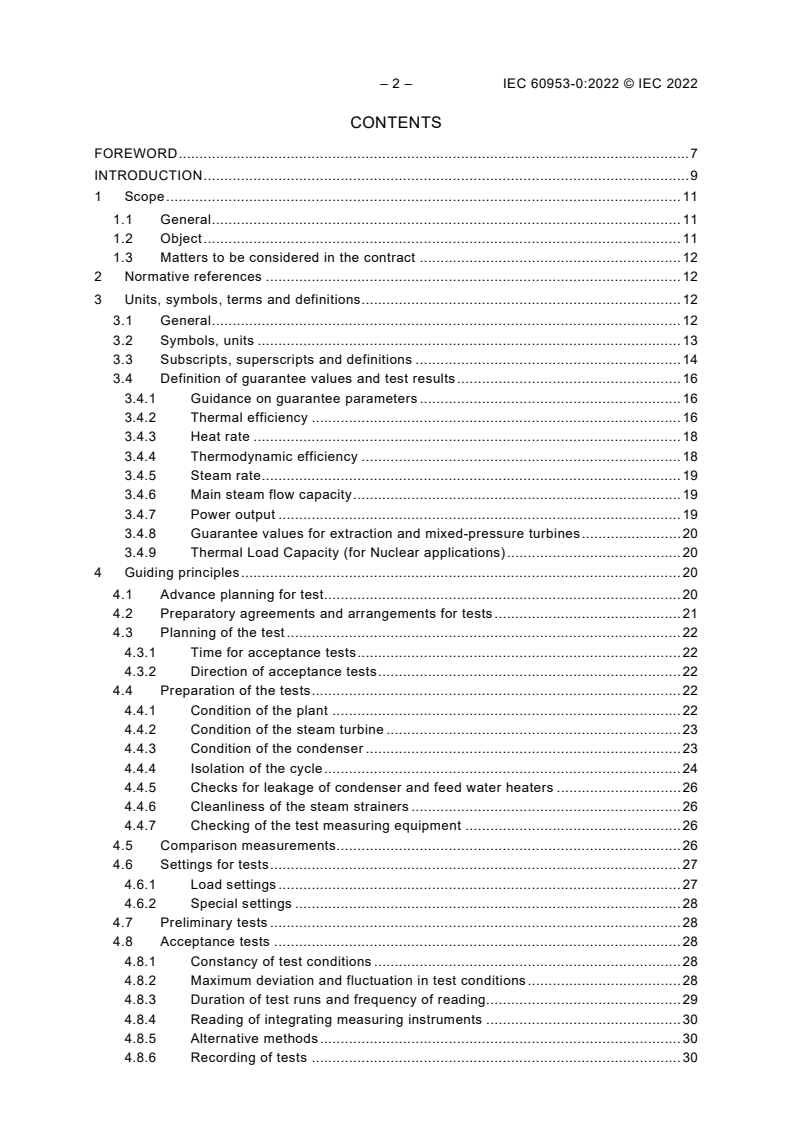
– 2 – IEC 60953-0:2022 © IEC 2022
CONTENTS
FOREWORD . 7
INTRODUCTION . 9
1 Scope . 11
1.1 General . 11
1.2 Object . 11
1.3 Matters to be considered in the contract . 12
2 Normative references . 12
3 Units, symbols, terms and definitions . 12
3.1 General . 12
3.2 Symbols, units . 13
3.3 Subscripts, superscripts and definitions . 14
3.4 Definition of guarantee values and test results . 16
3.4.1 Guidance on guarantee parameters . 16
3.4.2 Thermal efficiency . 16
3.4.3 Heat rate . 18
3.4.4 Thermodynamic efficiency . 18
3.4.5 Steam rate . 19
3.4.6 Main steam flow capacity . 19
3.4.7 Power output . 19
3.4.8 Guarantee values for extraction and mixed-pressure turbines . 20
3.4.9 Thermal Load Capacity (for Nuclear applications) . 20
4 Guiding principles . 20
4.1 Advance planning for test. 20
4.2 Preparatory agreements and arrangements for tests . 21
4.3 Planning of the test . 22
4.3.1 Time for acceptance tests . 22
4.3.2 Direction of acceptance tests . 22
4.4 Preparation of the tests . 22
4.4.1 Condition of the plant . 22
4.4.2 Condition of the steam turbine . 23
4.4.3 Condition of the condenser . 23
4.4.4 Isolation of the cycle . 24
4.4.5 Checks for leakage of condenser and feed water heaters . 26
4.4.6 Cleanliness of the steam strainers . 26
4.4.7 Checking of the test measuring equipment . 26
4.5 Comparison measurements . 26
4.6 Settings for tests . 27
4.6.1 Load settings . 27
4.6.2 Special settings . 28
4.7 Preliminary tests . 28
4.8 Acceptance tests . 28
4.8.1 Constancy of test conditions . 28
4.8.2 Maximum deviation and fluctuation in test conditions . 28
4.8.3 Duration of test runs and frequency of reading. 29
4.8.4 Reading of integrating measuring instruments . 30
4.8.5 Alternative methods . 30
4.8.6 Recording of tests . 30
4.8.7 Additional measurement . 30
4.8.8 Preliminary calculations . 30
4.8.9 Consistency and number of tests . 30
4.9 Repetition of acceptance tests . 31
5 Measuring techniques and measuring instruments . 31
5.1 Overview . 31
5.1.1 Instrument accuracy requirements . 31
5.1.2 Measuring instruments . 31
5.1.3 Measuring uncertainty . 31
5.1.4 Calibration of instruments . 32
5.1.5 Alternative instrumentation . 32
5.2 Measurement of power. 36
5.2.1 Determination of mechanical turbine output . 36
5.2.2 Measurement of boiler feed pump power . 36
5.2.3 Determination of electrical power of a turbine generator . 37
5.2.4 Measurement of electrical power . 38
5.2.5 Electrical instrument connections. 38
5.2.6 Electrical instruments . 38
5.2.7 Instrument transformers . 39
5.3 Flow measurement . 39
5.3.1 Determination of flows to be measured . 39
5.3.2 Measurement of primary flow . 39
5.3.3 Installation and location of flow measuring devices . 42
5.3.4 Calibration of primary flow devices for water flow . 43
5.3.5 Inspection of flow measuring devices . 44
5.3.6 Differential pressure measurements . 45
5.3.7 Water flow fluctuation . 45
5.3.8 Secondary flow measurements . 45
5.3.9 Occasional secondary flows. 48
5.3.10 Density of water and steam . 49
5.3.11 Determination of cooling water flow of condenser . 49
5.4 Pressure measurement (excluding condensing turbine exhaust pressure) . 50
5.4.1 Pressures to be measured . 50
5.4.2 Instruments . 50
5.4.3 Main pressure measurements . 50
5.4.4 Pressure tapping holes and connecting lines . 51
5.4.5 Shut-off valves . 52
5.4.6 Calibration of pressure measuring devices . 52
5.4.7 Atmospheric pressure . 52
5.4.8 Correction of readings . 52
5.5 Condensing turbine exhaust pressure measurement . 53
5.5.1 General . 53
5.5.2 Plane of measurement . 53
5.5.3 Pressure taps . 53
5.5.4 Manifolds . 54
5.5.5 Connecting lines . 54
5.5.6 Instruments . 54
5.5.7 Calibration . 54
5.6 Temperature measurement . 54
– 4 – IEC 60953-0:2022 © IEC 2022
5.6.1 Points of temperature measurement . 54
5.6.2 Instruments . 55
5.6.3 Main temperature measurements . 55
5.6.4 Feed train temperature measurements (including bled steam) . 55
5.6.5 Condenser cooling water temperature measurement . 56
5.6.6 Thermometer wells . 56
5.6.7 Precautions to be observed in the measurement of temperature . 57
5.7 Steam quality determination . 57
5.7.1 General . 57
5.7.2 Tracer technique . 57
5.7.3 Condensing method . 58
5.7.4 Constant rate injection method . 61
5.7.5 Extraction enthalpy determined by constant rate injection method . 62
5.7.6 Tracers and their use . 64
5.8 Time measurement . 65
5.9 Speed measurement . 65
6 Evaluation of tests . 65
6.1 Preparation of evaluation . 65
6.2 Computation of results . 66
6.2.1 Calculation of average values of instrument readings . 66
6.2.2 Correction and conversion of averaged readings . 66
6.2.3 Checking of measured data . 66
6.2.4 Thermodynamic properties of steam and water . 67
6.2.5 Calculation of test results . 68
7 Correction of test results and comparison with guarantee . 68
7.1 Guarantee values and guarantee conditions . 68
7.2 Correction of initial steam flow capacity . 68
7.3 Correction of output . 69
7.3.1 Correction of maximum output . 69
7.3.2 Correction of Output with specified initial steam flow . 69
7.4 Correction of the thermal performance . 69
7.5 Definition and application of correction values . 70
7.6 Correction methods . 70
7.6.1 General . 70
7.6.2 Correction by heat balance calculation . 71
7.6.3 Correction by use of correction curves prepared by the manufacturer . 72
7.6.4 Tests to determine correction values . 72
7.7 Variables to be considered in the correction of specific turbine cycles . 72
7.7.1 Scope of corrections . 72
7.7.2 Turbines with regenerative feed-water heating . 72
7.7.3 Turbines which have no provision for the addition or extraction of steam
after partial expansion . 74
7.7.4 Turbines with steam extraction for purposes other than feed-water
heating (extraction turbines) . 74
7.7.5 Other types of turbine . 74
7.8 Guarantee comparison . 75
7.8.1 Tolerance and weighting . 75
7.8.2 Guarantee comparison with locus curve . 75
7.8.3 Guarantee comparison with guarantee point . 76
7.8.4 Guarantee comparison for turbines with throttle governing . 76
7.8.5 Guarantee comparison for extraction turbines . 76
7.9 Deterioration of turbine performance (ageing) . 77
7.9.1 Timing to minimise deterioration . 77
7.9.2 Correction with comparison tests . 77
7.9.3 Correction without comparison tests . 77
8 Measuring uncertainty . 78
8.1 General . 78
8.2 Determination of measuring uncertainty of steam and water properties . 79
8.2.1 Pressure . 79
8.2.2 Temperature . 79
8.2.3 Enthalpy and enthalpy difference . 79
8.3 Calculation of measuring uncertainty of output . 80
8.3.1 Electrical measurement . 80
8.3.2 Mechanical measurement . 82
8.3.3 Additional uncertainty allowance because of unsteady load conditions . 82
8.4 Determination of measuring uncertainty of mass flow . 82
8.4.1 Measuring uncertainty of mass flow measurements . 82
8.4.2 Measuring uncertainty of multiple measurements of primary flow . 82
8.4.3 Uncertainty allowance for cycle imperfections . 83
8.5 Calculation of measuring uncertainty of results . 83
8.5.1 General . 83
8.5.2 Measuring uncertainty of thermal efficiency . 83
8.5.3 Measuring uncertainty of thermodynamic efficiency . 84
8.5.4 Uncertainty of corrections . 84
8.5.5 Guiding values for the measuring uncertainty of results . 85
8.6 Example uncertainty calculation . 85
Annex A (normative) Feedwater heater leakage and condenser leakage tests . 87
A.1 Feedwater heater leakage tests . 87
A.2 Condenser leakage tests . 87
Annex B (normative) Evaluation of multiple measurements, compatibility . 88
Annex C (normative) Mass flow balances . 89
C.1 General . 89
C.2 Flows for further evaluations (informative) . 90
Annex D (informative) Short-statistical definition of measuring uncertainty and error
propagation in acceptance tests . 92
Annex E (informative) Temperature variation method . 96
E.1 Description of the problem . 96
E.2 Possibility to determine the leakage flow . 96
E.3 Applied example . 98
Bibliography . 102
Figure 1 – Diagrams for interpretation of symbols and subscripts . 17
Figure 2 – Diagram showing location and type of test instrumentation (fossil fuel plant) . 33
Figure 3 – Diagram showing location and type of test instrumentation (nuclear plant) . 34
Figure 4 – USM with flow conditioner or flow straightener. . 41
Figure 5 – Throttle steam quality calculations for boiling water reactor . 60
– 6 – IEC 60953-0:2022 © IEC 2022
Figure 6 – Throttle steam quality calculations for pressurized water reactor . 61
Figure 7 – Typical installation of injection and sampling points . 63
Figure 8 – Oxygen content of sample stream . 64
Figure 9 – Guarantee comparison on locus curve . 76
Figure 10 – Correction factor for steam table tolerance . 80
Figure C.1 – Diagram of cycle for plant with steam turbine with single reheating and
five stages of regenerative feedwater heating extraction . 90
Figure E.1 – IP turbine bowl expansion line depending on different labyrinth flow rates . 97
Figure E.2 – Schematic diagram of a combined HP/IP1/IP2 turbine . 98
Figure E.3 – Result of temperature variation tests. IP2 turbine bowl efficiency as a
function of the labyrinth flow rate (sealing 2) for varying live and reheat temperatures . 101
Table 1 – Maximum deviations and fluctuations in operating conditions . 29
Table 2 – Acceptable instrumentation and uncertainties for acceptance tests . 35
Table 3 – Apportionment of unaccounted leakages . 67
Table 4 – Average deterioration by ageing . 77
Table 5 – Deterioration of thermal efficiency and power output . 77
Table 6 – Guiding values for the uncertainty of test results . 85
Table 7 – Example uncertainty calculation for reheat cycle with uncalibrated primary
flows measurements . 86
Table E.1 – Measured thermodynamic parameters and calculated IP2 turbine bowl
isentropic efficiencies . 100
INTERNATIONAL ELECTROTECHNICAL COMMISSION
____________
RULES FOR STEAM TURBINE THERMAL ACCEPTANCE TESTS –
Part 0: Wide range of accuracy for various types and sizes of turbines
FOREWORD
1) The International Electrotechnical Commission (IEC) is a worldwide organization for standardization comprising
all national electrotechnical committees (IEC National Committees). The object of IEC is to promote international
co-operation on all questions concerning standardization in the electrical and electronic fields. To this end and
in addition to other activities, IEC publishes International Standards, Technical Specifications, Technical Reports,
Publicly Available Specifications (PAS) and Guides (hereafter referred to as “IEC Publication(s)”). Their
preparation is entrusted to technical committees; any IEC National Committee interested in the subject dealt with
may participate in this preparatory work. International, governmental and non-governmental organizations liaising
with the IEC also participate in this preparation. IEC collaborates closely with the International Organization for
Standardization (ISO) in accordance with conditions determined by agreement between the two organizations.
2) The formal decisions or agreements of IEC on technical matters express, as nearly as possible, an international
consensus of opinion on the relevant subjects since each technical committee has representation from all
interested IEC National Committees.
3) IEC Publications have the form of recommendations for international use and are accepted by IEC National
Committees in that sense. While all reasonable efforts are made to ensure that the technical content of IEC
Publications is accurate, IEC cannot be held responsible for the way in which they are used or for any
misinterpretation by any end user.
4) In order to promote international uniformity, IEC National Committees undertake to apply IEC Publications
transparently to the maximum extent possible in their national and regional publications. Any divergence between
any IEC Publication and the corresponding national or regional publication shall be clearly indicated in the latter.
5) IEC itself does not provide any attestation of conformity. Independent certification bodies provide conformity
assessment services and, in some areas, access to IEC marks of conformity. IEC is not responsible for any
services carried out by independent certification bodies.
6) All users should ensure that they have the latest edition of this publication.
7) No liability shall attach to IEC or its directors, employees, servants or agents including individual experts and
members of its technical committees and IEC National Committees for any personal injury, property damage or
other damage of any nature whatsoever, whether direct or indirect, or for costs (including legal fees) and
expenses arising out of the publication, use of, or reliance upon, this IEC Publication or any other IEC
Publications.
8) Attention is drawn to the Normative references cited in this publication. Use of the referenced publications is
indispensable for the correct application of this publication.
9) Attention is drawn to the possibility that some of the elements of this IEC Publication may be the subject of patent
rights. IEC shall not be held responsible for identifying any or all such patent rights.
IEC 60953-0 has been prepared by subcommittee WG 11/MT 14: Thermal Acceptance Test, of
IEC technical committee 5: Steam Turbines. It is an International Standard.
This first edition cancels and replaces IEC 60953-2, published in 1990. This edition constitutes
a technical revision.This edition includes the following significant technical changes with
respect to the previous edition:
a) IEC 60953-2:1990 has been used as the basis to develop IEC 60953-0;
b) Outdated measuring techniques have been updated and the corresponding reduction of the
expected test result measuring uncertainty indicated;
c) Guarantee of power output at specified steam flow has been included;
d) A proposal for assignment of unaccounted for leakages has been included;
e) Correction methods and guarantee comparisons are updated;
f) Various appendices deleted:
– Appendix B (flow nozzle)
– Appendix E (generalized correction curves)
– Appendix G (power measurement uncertainty)
– 8 – IEC 60953-0:2022 © IEC 2022
g) Annex added:
– Annex E (Temperature variation method) taken over from IEC 60953-3:2002,Annex L
The text of thisInternational Standard is based on the following documents:
Draft Report on voting
5/248/FDIS 5/250/RVD
Full information on the voting for its approval can be found in the report on voting indicated in
the above table.
A list of all parts in the IEC 60953 series, published under the general title Rules for steam
turbine thermal acceptance tests, can be found on the IEC website.
The language used for the development of thisInternational Standard is English.
This document was drafted in accordance with ISO/IEC Directives, Part 2, and developed in
accordance with ISO/IEC Directives, Part 1 and ISO/IEC Directives, IEC Supplement,available
at www.iec.ch/members_experts/refdocs. The main document types developed by IEC are
described in greater detail at www.iec.ch/standardsdev/publications.
The committee has decided that the contents of this document will remain unchanged until the
stability dateindicated on the IEC website under webstore.iec.ch in the data related to the
specific document. At this date, the document will be
• reconfirmed,
• withdrawn,
• replaced by a revised edition, or
• amended.
IMPORTANT – The "colour inside" logo on the cover page of this document indicates that it
contains colours which are considered to be useful for the correct understanding of its
contents. Users should therefore print this document using a colour printer.
INTRODUCTION
The continuing development of measuring techniques, the increasing capacity of steam turbines
and increasing variety of steam turbine configurations has necessitated a revision of
IEC 60953:1990.
Since all the needs of the power industry could not be satisfied by one single performance test
standard covering the requirements for all of the steam turbine configurations and accuracy,
the revision to this standard is based upon one reference standard and various supplementary
parts as indicated below:
1) Basic philosophy and figures on uncertainty
IEC 60953-0 provides for acceptance tests of steam turbines of various types and capacities
with corresponding measuring uncertainty, it is based upon the Method B of IEC 60953-
2:1990. Additional and alternative guidance will be given for specific steam turbine
applications in the supplementary standards where it is required.
Instrumentation and measuring procedures are chosen accordingly from a scope specified
in the standard series which is centred mainly on standardized instrumentation and
procedures, but may extend up to high accuracy provisions requiring calibration of flow
measuring devices. The resulting measuring uncertainty of the test result is then determined
by calculating methods presented in the standard series and normally, if not stated
otherwise in the contract, taken into account in the comparison between test result and
guarantee value. The total cost of an acceptance test can therefore be maintained in
relationship with the economic value of the guarantee values to be ascertained.
When good-standardized instrumentation and procedures are applied in a test, the
measuring uncertainty given in Table 6 can be achieved. The parties to the test should reach
agreement on the measuring uncertainty desired for the acceptance tests.
2) Guiding principles
The requirements concerning the preparation and conditions of the test and especially such
conditions of the test as duration, deviations and constancy of test conditions are defined.
– 10 – IEC 60953-0:2022 © IEC 2022
The test should be conducted preferably within eight weeks after first synchronisation. It is
the intent during this period to minimize performance deterioration and risk of damage to
the turbine.
Enthalpy drop tests should be made during this period to monitor HP and IP turbine section
performance. However, these tests do not provide LP section performance and for this
reason it is imperative to conduct the acceptance tests as soon as practicable.
Adjustment of the heat rate and power output test results for the effects of aging preferably
by use of start-up enthalpy drop efficiency tests or by application of a standard allowance
according to 7.9 is to be applied unless otherwise agreed in the contract.
3) Instruments and methods of measurement
a) Measurement instruments (for electrical power, pressure, temperature)
The measuring instruments used should be individually calibrated shortly before the test.
b) Flow measurement devices
For the measurement of main flows, uncalibrated or calibrated standardized flow
measuring devices may be used.
Typically uncalibrated standardized flow measuring devices are used, however
calibration is recommended where a reduction of overall measuring uncertainty is
desirable. Double or multiple measurement of primary flow is recommended for the
reduction of measuring uncertainty and a method for checking the compatibility is
described.
4) Evaluation of tests
The preparatory work for the evaluation and calculation of the test results is covered.
Detailed methods for calculation of measuring uncertainty values of measured variables and
tests results are given.
5) Correction of test results and comparison with guarantees
The correction of test results to guarantee conditions is covered. The measuring uncertainty
of the result is taken into account in the guarantee comparison.
6) Proposals for application
Since the acceptance test method to be applied has to be considered in the details of the
plant design, it should be stated as early as possible, preferably in the turbine contract,
which method will be used.
This standard series can be applied to steam turbines of any type and any power. The
desired measuring uncertainty should be decided upon sufficiently early, so that the
necessary provisions can be included in the plant.
If the guarantee includes the complete power plant or large parts thereof, the relevant parts
of this standard series can be applied for an acceptance test in accordance with the
definition of the guarantee value.
RULES FOR STEAM TURBINE THERMAL ACCEPTANCE TESTS –
Part 0: Wide range of accuracy for various types and sizes of turbines
1 Scope
1.1 General
The rules given in this document are applicable to thermal acceptance tests covering a wide
range of accuracy on steam turbines of every type, rating and application. Only the relevant
portion of these rules will apply to any individual case.
The rules provide for the testing of turbines, whether operating with either superheated or
saturated steam. They include measurements and procedures required to determine specific
enthalpy within the moisture region and describe precautions necessary to permit testing while
respecting radiological safety rules in nuclear plants.
Uniform rules for the preparation, carrying out, evaluation, comparison with guarantee and
calculation of measuring uncertainty of acceptance tests are defined in this standard. Details
of the conditions under which the acceptance test can take place are included.
Should any complex or special case arise which is not covered by these rules, appropriate
agreement is to be reached by manufacturer and purchaser before the contract is signed.
1.2 Object
The purpose of the thermal acceptance tests of steam turbines and turbine cycles described in
this document is to verify guarantees given by the manufacturer of the equipment concerning:
Efficiency guarantees
a) Thermal efficiency;
b) Heat rate;
c) Thermodynamic efficiency;
d) Steam rate;
e) Power output.
Capacity guarantees
a) Main steam flow capacity;
b) Maximum power output at specified steam conditions according to IEC 60045-1 (other than
steam flow);
c) Nuclear: thermal load capacity of the steam turbine under defined conditions.
The guarantees with their provisions are formulated completely and without contradictions
(see 3.4). The acceptance tests may also include such measurements as are necessary for
corrections according to the conditions of the guarantee and checking of the results.
– 12 – IEC 60953-0:2022 © IEC 2022
1.3 Matters to be considered in the contract
Some matters in these rules are to be considered at an early stage. Such matters are dealt with
in the following subclauses:
Subclause
1.1 (paragraph 4)
1.2 (paragraph 2)
4.1 (paragraph 3 and 4)
4.3.2 (paragraph 1)
7.6
7.8
7.9 (paragraph 1)
2 Normative references
The following documents are referred to in the text in such a way that some or all of their content
constitutes requirements of this document. For dated references, only the edition cited applies.
For undated references, the latest edition of the referenced document (including any
amendments) applies.
ISO/IEC Guide 98, Uncertainty of measurement
IEC 60045-1, Steam turbines – Part 1: Specifications
ISO 5167 (all parts), Measurement of fluid flow by means of pressure differential devices
inserted in circular cross-section conduits running full.
ISO 12242, Measurement of fluid flow in conduits – ultrasonic transit-time meters for liquids
ISO 18888, Gas turbine combined cycle power plants –Thermal performance tests
ANSI/IEEE C57.13, IEEE Standard requirements for instrument transformers
3 Units, symbols, terms and definitions
For the purposes of this document, the following terms and definitions apply.
ISO and IEC maintain terminological databases for use in standardization at the following
addresses:
• IEC Electropedia: availabl
...