

IEC TR 60522-2:2020
(Main)Medical electrical equipment - Diagnostics X-rays - Part 2: Guidance and rationale on quality equivalent filtration and permanent filtration
General Information
- Abstract
IEC TR 60522-2:2020 provides guidance on quality equivalent filtration and permanent filtration with regards to the requirements of IEC 60522-1 and its modifications versus IEC 60522:1999.
- Status
- Published
- Publication Date
- 28-Oct-2020
- Technical Committee
- SC 62B - Medical imaging equipment, software, and systems
- Current Stage
- PPUB - Publication issued
- Start Date
- 29-Oct-2020
- Completion Date
- 13-Oct-2020
Overview
IEC TR 60522-2:2020 - Medical electrical equipment - Diagnostic X‑rays - Part 2 - provides guidance and the technical rationale for determining Quality Equivalent Filtration (QEF) and permanent filtration in diagnostic X‑ray equipment. It supports and explains the requirements in IEC 60522‑1, clarifies differences versus the 1999 edition (IEC 60522:1999), and documents the analyses used to derive new approaches for assessing filtration in radiography and mammography.
Key Topics
- Quality Equivalent Filtration (QEF): rationale and methods for stating QEF and required accuracy when comparing filter materials and thicknesses.
- Permanent filtration: guidance for characterizing fixed filters within X‑ray tube assemblies and reporting methodology.
- Influence of high voltage and filter material atomic number: how tube voltage (kV), K‑ and L‑edges, and filter Z affect spectra and filtration equivalence.
- Additivity and combination rules: discussion of limits and pitfalls when adding QEF contributions from multiple filters and when IEC 1999 approaches were inconsistent.
- Alignment and geometry: effects of reference axis alignment, target angle and angular misalignment on QEF/permanent filtration.
- High voltage requirements: stability, ripple, and sensitivity near absorption edges that impact filtration determination.
- Radiation beam simulation and validation: use of simulation tools (based on SRS‑78 and NIST X‑ray mass attenuation data) to compute half‑value layers and validate against laboratory measurements.
- Statement and reporting: recommended content and accuracy for declaring QEF and permanent filtration for compliance and documentation.
Applications
IEC TR 60522‑2 is practical for:
- Design and development of diagnostic X‑ray tube assemblies and imaging systems (radiography, mammography).
- Test laboratories performing filtration, half‑value layer (HVL) and spectral characterization.
- Medical physicists and clinical engineers conducting acceptance testing, QA and regulatory compliance.
- Manufacturers preparing conformity documentation to IEC 60522‑1 requirements.
- Regulators and certification bodies evaluating filtration claims and radiation quality.
Practical benefits include improved consistency in reporting filtration, better understanding of voltage‑ and material‑dependent effects on spectra, and validated simulation approaches to reduce time and cost of experimental tests.
Users
- X‑ray system and tube manufacturers
- Medical device test labs and calibration facilities
- Medical physicists, clinical engineers, QA personnel
- Regulatory authorities and conformity assessment bodies
Related Standards
- IEC 60522‑1 (main requirements for diagnostic X‑rays)
- IEC 60522:1999 (previous edition - discussed and compared)
- Reference tools cited: SRS‑78 simulation approach and NIST X‑ray mass attenuation coefficients
Keywords: IEC TR 60522‑2:2020, Quality Equivalent Filtration, permanent filtration, diagnostic X‑rays, medical electrical equipment, QEF, filtration, radiography, mammography, half‑value layer, X‑ray spectrum.
Get Certified
Connect with accredited certification bodies for this standard

BSI Group
BSI (British Standards Institution) is the business standards company that helps organizations make excellence a habit.

TÜV Rheinland
TÜV Rheinland is a leading international provider of technical services.

TÜV SÜD
TÜV SÜD is a trusted partner of choice for safety, security and sustainability solutions.
Sponsored listings
Frequently Asked Questions
IEC TR 60522-2:2020 is a technical report published by the International Electrotechnical Commission (IEC). Its full title is "Medical electrical equipment - Diagnostics X-rays - Part 2: Guidance and rationale on quality equivalent filtration and permanent filtration". This standard covers: IEC TR 60522-2:2020 provides guidance on quality equivalent filtration and permanent filtration with regards to the requirements of IEC 60522-1 and its modifications versus IEC 60522:1999.
IEC TR 60522-2:2020 provides guidance on quality equivalent filtration and permanent filtration with regards to the requirements of IEC 60522-1 and its modifications versus IEC 60522:1999.
IEC TR 60522-2:2020 is classified under the following ICS (International Classification for Standards) categories: 11.040.50 - Radiographic equipment. The ICS classification helps identify the subject area and facilitates finding related standards.
IEC TR 60522-2:2020 is available in PDF format for immediate download after purchase. The document can be added to your cart and obtained through the secure checkout process. Digital delivery ensures instant access to the complete standard document.
Standards Content (Sample)
IEC TR 60522-2 ®
Edition 1.0 2020-10
TECHNICAL
REPORT
colour
inside
Medical electrical equipment – Diagnostic X-rays –
Part 2: Guidance and rationale on quality equivalent filtration and permanent
filtration
All rights reserved. Unless otherwise specified, no part of this publication may be reproduced or utilized in any form
or by any means, electronic or mechanical, including photocopying and microfilm, without permission in writing from
either IEC or IEC's member National Committee in the country of the requester. If you have any questions about IEC
copyright or have an enquiry about obtaining additional rights to this publication, please contact the address below or
your local IEC member National Committee for further information.
IEC Central Office Tel.: +41 22 919 02 11
3, rue de Varembé info@iec.ch
CH-1211 Geneva 20 www.iec.ch
Switzerland
About the IEC
The International Electrotechnical Commission (IEC) is the leading global organization that prepares and publishes
International Standards for all electrical, electronic and related technologies.
About IEC publications
The technical content of IEC publications is kept under constant review by the IEC. Please make sure that you have the
latest edition, a corrigendum or an amendment might have been published.
IEC publications search - webstore.iec.ch/advsearchform Electropedia - www.electropedia.org
The advanced search enables to find IEC publications by a The world's leading online dictionary on electrotechnology,
variety of criteria (reference number, text, technical containing more than 22 000 terminological entries in English
committee,…). It also gives information on projects, replaced and French, with equivalent terms in 16 additional languages.
and withdrawn publications. Also known as the International Electrotechnical Vocabulary
(IEV) online.
IEC Just Published - webstore.iec.ch/justpublished
Stay up to date on all new IEC publications. Just Published IEC Glossary - std.iec.ch/glossary
details all new publications released. Available online and once 67 000 electrotechnical terminology entries in English and
a month by email. French extracted from the Terms and Definitions clause of IEC
publications issued since 2002. Some entries have been
IEC Customer Service Centre - webstore.iec.ch/csc collected from earlier publications of IEC TC 37, 77, 86 and
If you wish to give us your feedback on this publication or need CISPR.
further assistance, please contact the Customer Service
Centre: sales@iec.ch.
IEC TR 60522-2 ®
Edition 1.0 2020-10
TECHNICAL
REPORT
colour
inside
Medical electrical equipment – Diagnostic X-rays –
Part 2: Guidance and rationale on quality equivalent filtration and permanent
filtration
INTERNATIONAL
ELECTROTECHNICAL
COMMISSION
ICS 11.040.50 ISBN 978-2-8322-8880-1
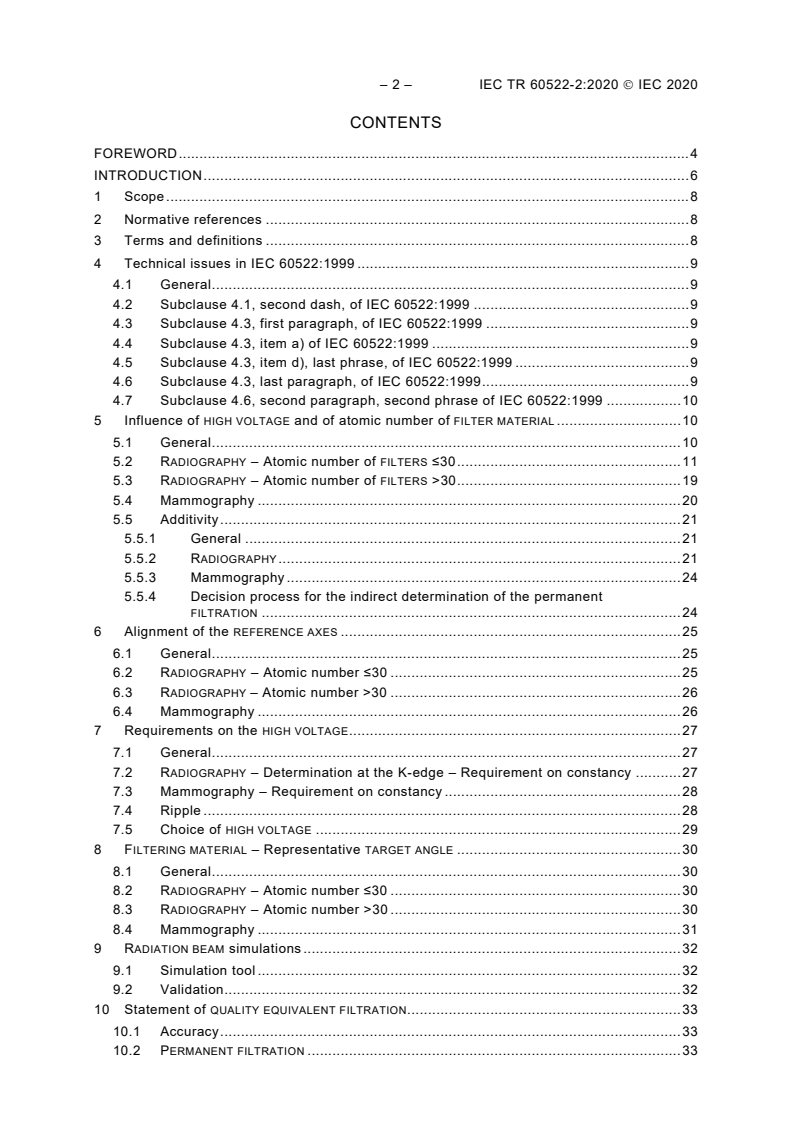
– 2 – IEC TR 60522-2:2020 IEC 2020
CONTENTS
FOREWORD . 4
INTRODUCTION . 6
1 Scope . 8
2 Normative references . 8
3 Terms and definitions . 8
4 Technical issues in IEC 60522:1999 . 9
4.1 General . 9
4.2 Subclause 4.1, second dash, of IEC 60522:1999 . 9
4.3 Subclause 4.3, first paragraph, of IEC 60522:1999 . 9
4.4 Subclause 4.3, item a) of IEC 60522:1999 . 9
4.5 Subclause 4.3, item d), last phrase, of IEC 60522:1999 . 9
4.6 Subclause 4.3, last paragraph, of IEC 60522:1999 . 9
4.7 Subclause 4.6, second paragraph, second phrase of IEC 60522:1999 . 10
5 Influence of HIGH VOLTAGE and of atomic number of FILTER MATERIAL . 10
5.1 General . 10
5.2 RADIOGRAPHY – Atomic number of FILTERS ≤30 . 11
5.3 RADIOGRAPHY – Atomic number of FILTERS >30 . 19
5.4 Mammography . 20
5.5 Additivity . 21
5.5.1 General . 21
5.5.2 RADIOGRAPHY . 21
5.5.3 Mammography . 24
5.5.4 Decision process for the indirect determination of the permanent
FILTRATION . 24
6 Alignment of the REFERENCE AXES . 25
6.1 General . 25
6.2 RADIOGRAPHY – Atomic number ≤30 . 25
6.3 RADIOGRAPHY – Atomic number >30 . 26
6.4 Mammography . 26
7 Requirements on the HIGH VOLTAGE . 27
7.1 General . 27
7.2 RADIOGRAPHY – Determination at the K-edge – Requirement on constancy . 27
7.3 Mammography – Requirement on constancy . 28
7.4 Ripple . 28
7.5 Choice of HIGH VOLTAGE . 29
8 FILTERING MATERIAL – Representative TARGET ANGLE . 30
8.1 General . 30
8.2 RADIOGRAPHY – Atomic number ≤30 . 30
8.3 RADIOGRAPHY – Atomic number >30 . 30
8.4 Mammography . 31
9 RADIATION BEAM simulations . 32
9.1 Simulation tool . 32
9.2 Validation . 32
10 Statement of QUALITY EQUIVALENT FILTRATION. 33
10.1 Accuracy . 33
10.2 PERMANENT FILTRATION . 33
Bibliography . 34
Figure 1 – Typical FILTER materials for mammography and RADIOGRAPHY . 11
Figure 2 – QUALITY EQUIVALENT FILTRATION of elements as a function of HIGH VOLTAGE . 12
Data adapted from reference [4]. Axes logarithmic . 13
Figure 3 – Mass X-ray attenuation coefficients (μ/ρ) vs. photon energy . 13
Figure 4 – Energetic location of discontinuities of the absorption coefficients (vertical
axis) of elements vs. their atomic number, characteristic lines, L- and K-edge energies . 14
Figure 5 – QEF of 0,1 mm Cu FILTER vs. thickness of an additional Al FILTER (at HIGH
of 75 kV) . 15
VOLTAGE
Figure 6 – QUALITY EQUIVALENT FILTRATION of elements with 1,0 mm Al pre-FILTRATION
as a function of HIGH VOLTAGE (W TARGET with TARGET ANGLE 10°, thickness according
to Figure 2) . 16
Figure 7 – QEF of 0,1 mm Cu as determined with various pre-FILTRATION materials as a
function of HIGH VOLTAGE . 17
Figure 8 – X-RAY spectra (12 ° W TARGET, 100 kV HIGH VOLTAGE) for FILTER materials
Cu and Al with the same QEF . 18
Figure 9 – X-RAY spectra from a 12° W TARGET with 1,0 mm additional FILTRATION . 19
Figure 10 – QEF of a 0,025 mm W FILTER as a function of HIGH VOLTAGE . 20
Figure 11 – Four typical examples of PERMANENT FILTRATION of mammographic X-RAY
TUBE ASSEMBLIES as a function of HIGH VOLTAGE . 21
Figure 12 – Inconsistent results from addition of the qefs according to IEC 60522:1999. . 23
Figure 13 – Example of failing additivity concept of IEC 60522:1999 in mammography . 24
Figure 14 – Indirect determination of PERMANENT FILTRATION . 25
Figure 15 – Dependency of the QEF of a 0,025 mm W FILTER on the TARGET ANGLE. 31
Figure 16 – QEF for a range of practical TARGET ANGLES in mammography . 32
Table 1 – QEF-variation of 0,1 mm Cu FILTER with Al pre-FILTRATION . 16
Table 2 – Representative combinations of mammography TARGETS and FILTERS. 20
Table 3 – Sample comparison of concepts of addition: IEC 60522:1999 . 22
Table 4 – Sample comparison of concepts of addition: IEC 60522-1 . 22
Table 5 – PERMANENT FILTRATION per order of the FILTERS – comparison of concepts . 23
Table 6 – Impact of angular misalignment on PERMANENT FILTRATION . 26
Table 7 – Impact of angular misalignment on PERMANENT FILTRATION . 26
Table 8 – Impact of angular misalignment on PERMANENT FILTRATION . 26
Table 9 – Impact of HIGH VOLTAGE shift (close to K-edge) on PERMANENT FILTRATION . 27
Table 10 – Impact of HIGH VOLTAGE shift (distant from K-edge) on PERMANENT
............................................................................................................................. 27
FILTRATION
Table 11 – Impact of shift of HIGH VOLTAGE on PERMANENT FILTRATION . 28
Table 12 – Sensitivity for VOLTAGE RIPPLE . 29
Table 13 – Influence on QEF of low-Z FILTRATION and of TARGET ANGLE . 30
Table 14 – Comparison of simulated and measured PERMANENT FILTRATION . 33
– 4 – IEC TR 60522-2:2020 IEC 2020
INTERNATIONAL ELECTROTECHNICAL COMMISSION
____________
MEDICAL ELECTRICAL EQUIPMENT – DIAGNOSTIC X-RAYS –
Part 2: Guidance and rationale on quality equivalent
filtration and permanent filtration
FOREWORD
1) The International Electrotechnical Commission (IEC) is a worldwide organization for standardization comprising
all national electrotechnical committees (IEC National Committees). The object of IEC is to promote international
co-operation on all questions concerning standardization in the electrical and electronic fields. To this end and
in addition to other activities, IEC publishes International Standards, Technical Specifications, Technical Reports,
Publicly Available Specifications (PAS) and Guides (hereafter referred to as “IEC Publication(s)”). Their
preparation is entrusted to technical committees; any IEC National Committee interested in the subject dealt with
may participate in this preparatory work. International, governmental and non-governmental organizations liaising
with the IEC also participate in this preparation. IEC collaborates closely with the International Organization for
Standardization (ISO) in accordance with conditions determined by agreement between the two organizations.
2) The formal decisions or agreements of IEC on technical matters express, as nearly as possible, an international
consensus of opinion on the relevant subjects since each technical committee has representation from all
interested IEC National Committees.
3) IEC Publications have the form of recommendations for international use and are accepted by IEC National
Committees in that sense. While all reasonable efforts are made to ensure that the technical content of IEC
Publications is accurate, IEC cannot be held responsible for the way in which they are used or for any
misinterpretation by any end user.
4) In order to promote international uniformity, IEC National Committees undertake to apply IEC Publications
transparently to the maximum extent possible in their national and regional publications. Any divergence between
any IEC Publication and the corresponding national or regional publication shall be clearly indicated in the latter.
5) IEC itself does not provide any attestation of conformity. Independent certification bodies provide conformity
assessment services and, in some areas, access to IEC marks of conformity. IEC is not responsible for any
services carried out by independent certification bodies.
6) All users should ensure that they have the latest edition of this publication.
7) No liability shall attach to IEC or its directors, employees, servants or agents including individual experts and
members of its technical committees and IEC National Committees for any personal injury, property damage or
other damage of any nature whatsoever, whether direct or indirect, or for costs (including legal fees) and
expenses arising out of the publication, use of, or reliance upon, this IEC Publication or any other IEC
Publications.
8) Attention is drawn to the Normative references cited in this publication. Use of the referenced publications is
indispensable for the correct application of this publication.
9) Attention is drawn to the possibility that some of the elements of this IEC Publication may be the subject of patent
rights. IEC shall not be held responsible for identifying any or all such patent rights.
IEC TR 60522-2 has been prepared by subcommittee 62B: Diagnostic imaging equipment, of
IEC technical committee 62: Electrical equipment in medical practice. It is a Technical Report.
The text of this Technical Report is based on the following documents:
Draft Report on voting
62B/1136/DTR 62B/1159/RVDTR
Full information on the voting for its approval can be found in the report on voting indicated in
the above table.
The language used for the development of this Technical Report is English.
This document was drafted in accordance with ISO/IEC Directives, Part 2, and developed in
accordance with ISO/IEC Directives, Part 1 and ISO/IEC Directives, IEC Supplement, available
at www.iec.ch/members_experts/refdocs. The main document types developed by IEC are
described in greater detail at www.iec.ch/standardsdev/publications.
A list of all parts in the IEC 60522 series, published under the general title Medical electrical
equipment – Diagnostic X-rays, can be found on the IEC website.
In this document, the following print types are used:
– requirements and definitions: roman type;
– informative material appearing outside of tables, such as notes, examples and references: in smaller type.
Normative text of tables is also in a smaller type;
– TERMS DEFINED IN CLAUSE 3 OF THIS DOCUMENT OR LISTED IN THE INDEX: SMALL CAPITALS.
The committee has decided that the contents of this document will remain unchanged until the
stability date indicated on the IEC website under "http://webstore.iec.ch" in the data related to
the specific document. At this date, the document will be
• reconfirmed,
• withdrawn,
• replaced by a revised edition, or
• amended.
IMPORTANT – The 'colour inside' logo on the cover page of this publication indicates
that it contains colours which are considered to be useful for the correct understanding
of its contents. Users should therefore print this document using a colour printer.
– 6 – IEC TR 60522-2:2020 IEC 2020
INTRODUCTION
This document supports IEC 60522-1.
The purpose of this document is to identify those items which are substantially modified in
nd
IEC 60522-1 versus the 2 Edition of IEC 60522, published in 1999, as well as to elucidate the
technical analyses which led to the many new rationales and new approaches for the
determination of the QUALITY EQUIVALENT FILTRATION (abbreviated, where appropriate, like in
figures and tables, by “QEF”).
The review of IEC 60522:1999 pointed to several technical issues, as discussed in Clause 4.
These issues have been investigated with the help of a RADIATION BEAM HALF-VALUE LAYER
simulation tool, based on the SRS-78 code (see [2] ) and the NIST X-ray mass ATTENUATION
COEFFICIENTS [4]. On this basis, HALF-VALUE LAYER values can reliably be obtained (see [3]).
(For further confirmation of the tool’s accuracy, the tool has been validated against laboratory
measurements, with good results – see 9.2).
With this tool, the properties of the RADIATION BEAM can be analysed as a function of the TARGET
material, TARGET ANGLE, HIGH VOLTAGE and FILTER material.
It appears then that the following statements in the IEC 60522:1999 are not always true:
1) on the concept of adding individual values of QEF to obtain the total QEF value, i.e. the
concept of “additivity” (see 5.5 for details);
RADIOGRAPHY, and
2) on the relevance of the K-edge for
3) on the method for determining the PERMANENT FILTRATION on the basis of a composite sample
of the materials.
Further, it appears that the method of choice for the determination depends on the class of
FILTER material and HIGH VOLTAGE. Two ranges of HIGH VOLTAGE are discerned:
1) up to 50 kV;
2) from 50 to 150 kV.
In this document, for ease of use, the term “RADIOGRAPHY” is used for applications within the
HIGH VOLTAGE range 50 kV to 150 kV, although strictly speaking the defined term “RADIOGRAPHY”
does not limit the HIGH VOLTAGE. So “RADIOGRAPHY”, i.e. if it is not written in small capitals in
order to discern it from the IEC defined term, thus covers applications in the scope of [6]
IEC 60601-2-43 (INTERVENTIONAL PROCEDURES), [7] IEC 60601-2-44 (CT), [9] IEC 60601-2-54
(RADIOGRAPHY and RADIOSCOPY), [10] IEC 60601-2-63 and [11] IEC 60601-2-65 (dental
applications).
RADIOGRAPHY, three groups of FILTER materials are discerned, see a) to c).
For
The term “mammography” is used in this document, for applications up to 50 kV HIGH VOLTAGE.
(If mammographic applications go beyond 50 kV, then these are considered to fall within
RADIOGRAPHY).
For RADIOGRAPHY, three groups of FILTER materials are discerned, see a) to c).
a) atomic number not larger than 26 e.g. the materials Cr (Z=22), Ti (Z=24) and Fe (Z=26);
these materials may FILTER like aluminium, so they are designated in this document as “Al-
like”;
_____________
Numbers in square brackets refer to the Bibliography.
b) atomic number larger than 26, but not larger than 30; in combination with the materials of
the former group, i.e. “atomic number not larger than 26”, these materials may also act “Al-
like”. An important example in this group of materials is copper (Z=29);
c) atomic number larger than 30.
Due attention is given to relatively new FILTERS (Au, W, Ta, Ag, Sn) as applied in RADIOGRAPHY
and in mammography.
Recommendations are given for the HIGH VOLTAGE to be used per type of application, HIGH
VOLTAGE stability, VOLTAGE RIPPLE; for the alignment of the X-RAY TUBE ASSEMBLIES for the
determination of the PERMANENT FILTRATION and for the choice of a representative TARGET ANGLE
for the determination of the QUALITY EQUIVALENT FILTRATION of FILTERING MATERIAL.
The results of this document are based on the analyses of error-propagation of many
parameters (see e.g. Clauses 6, 7, 8 and Table 1; see also 10.1). In general, the prediction of
the total error of a QEF determination is beyond the scope of this document – as each
measurement system will be designed with its own balance in parameters and their accuracy.
It is thus left up to the manufacturers to analyse the total error of their measurement system,
while using, where appropriate, the error-propagation as analysed in this document.
– 8 – IEC TR 60522-2:2020 IEC 2020
MEDICAL ELECTRICAL EQUIPMENT – DIAGNOSTIC X-RAYS –
Part 2: Guidance and rationale on quality equivalent
filtration and permanent filtration
1 Scope
This document provides guidance on quality equivalent filtration and permanent filtration with
regards to the requirements of IEC 60522-1 and its modifications versus IEC 60522:1999.
2 Normative references
The following documents are referred to in the text in such a way that some or all of their content
constitutes requirements of this document. For dated references, only the edition cited applies.
For undated references, the latest edition of the referenced document (including any
amendments) applies.
IEC 60522:1999, Determination of the permanent filtration of X-ray tube assemblies
IEC 60522-1:2020, Medical electrical equipment – Diagnostic X-rays – Part 1: Determination of
quality equivalent filtration and permanent filtration
IEC 60601-1:2005, Medical electrical equipment - Part 1: General requirements for basic safety
and essential performance
IEC 60601-1:2005/AMD1:2012
IEC 60601-1:2005/AMD2:2020
IEC 60601-1-3:2008, Medical electrical equipment – Part 1-3: General requirements for basic
safety and essential performance – Collateral Standard: Radiation protection in diagnostic X-
ray equipment
IEC 60601-1-3:2008/AMD1:2013
IEC 60613:2010, Electrical and loading characteristics of X-ray tube assemblies for medical
diagnosis
IEC TR 60788:2004, Medical electrical equipment – Glossary of defined terms
3 Terms and definitions
For the purposes of this document, the terms and definitions given in IEC 60601-1:2005,
IEC 60601-1:2005/AMD1:2012 and IEC 60601-1:2005/AMD2:2020, IEC 60601-1-3:2008 and
IEC 60601-1-3:2008/AMD1:2013, IEC 60613:2010, IEC 60522-1:2020, and
IEC TR 60788:2004 apply.
4 Technical issues in IEC 60522:1999
4.1 General
While reviewing the processes described in IEC 60522:1999, several technical issues appear
to require further analysis:
4.2 Subclause 4.1, second dash, of IEC 60522:1999
Text:
for the absence of any components of the PERMANENT FILTRATION missing from the sample and
normally located between the sample and the FOCAL SPOT>.
Issue: At this stage it is not clear how the “adjustment” should be obtained. It might be explained
in IEC 60522:1999 as discussed in 4.6.
4.3 Subclause 4.3, first paragraph, of IEC 60522:1999
Text:
material as the X-RAY TUBE ASSEMBLY under test at an X-RAY TUBE VOLTAGE with a PERCENTAGE
RIPPLE not exceeding 10 .>.
Issue: A ripple of up to 10 % seems quite lenient – it might not be valid for all situations.
4.4 Subclause 4.3, item a) of IEC 60522:1999
Text:
<… for X-RAY TUBE ASSEMBLIES in which the PERMANENT FILTRATION contains a material with a K-
edge absorption energy at 19 keV or above, use an X-RAY TUBE VOLTAGE corresponding to the
K-edge energy of the material, for example 20 kV for molybdenum with a K-edge at 19,99 keV;
otherwise …>
Issues: A HIGH VOLTAGE of 20 kV is less relevant for newer mammography systems, which
operate over a wider X-RAY TUBE VOLTAGE range than was typical in the past. Further, the
determination is performed at the K-edge energy, whereas 4.5 of IEC 60522:1999 suggests the
contrary. .
4.5 Subclause 4.3, item d), last phrase, of IEC 60522:1999
Text:
<… for X-RAY TUBE ASSEMBLIES with a NOMINAL X-RAY TUBE VOLTAGE exceeding 65 kV, 75 kV or
approximately half the NOMINAL X-RAY TUBE VOLTAGE, whichever is the greater. It is desirable to
avoid testing close to the absorption edge of tungsten …>.
Issue: It is unclear why testing close to the absorption edge of tungsten is “not desirable”,
particularly so because in this situation there is very limited flux at the “absorption edge of
tungsten”.
4.6 Subclause 4.3, last paragraph, of IEC 60522:1999
Text:
a beryllium window). For testing with a sample of a single material, add an appropriate thickness
of the reference material between the material under test and the FOCAL SPOT. This is to
compensate for the effect on the RADIATION QUALITY at the ENTRANCE SURFACE of the sample of
omitting any layers of material forming part of the actual PERMANENT FILTRATION.>.
– 10 – IEC TR 60522-2:2020 IEC 2020
Issues: It is unclear how the “thickness of reference material” is determined. It might be that the
“actual layer forming part of the actual PERMANENT FILTRATION” shall be placed between the
sample and the FOCAL SPOT.
4.7 Subclause 4.6, second paragraph, second phrase of IEC 60522:1999
As to the addition of the values of the QUALITY EQUIVALENT FILTRATION (QEF), the following text:
FILTRATION, the result is also the value of the PERMANENT FILTRATION for the X-RAY TUBE
concerned. Alternatively, add the values obtained (with the same reference material
ASSEMBLY
and primary beam conditions) for the QUALITY EQUIVALENT FILTRATION of samples representing
all the different single materials forming part of the PERMANENT FILTRATION.>.
In view of the various dependencies of the QEF on HIGH VOLTAGE for many of the practical
materials, there is doubt whether “addition” is a valid concept.
5 Influence of HIGH VOLTAGE and of atomic number of FILTER MATERIAL
5.1 General
IEC 60601-1-3 focusses on “classical” RADIOGRAPHY, i.e. the 50 kV to 150 kV HIGH VOLTAGE
range – see Table 3 of IEC 60601-1-3:2008, which covers this range (and in a Note indicates
extrapolation.>). Consequently, this analysis starts with the 50 kV to 150 kV HIGH VOLTAGE
range, in 5.2 and 5.3 of this document. Mammography is treated in 5.4 of this document.
The typical FILTER materials for these two applications are indicated in Figure 1.
Figure 1 – Typical FILTER materials for mammography and RADIOGRAPHY
5.2 RADIOGRAPHY – Atomic number of FILTERS ≤30
Except for the reference material aluminium (aluminum, Al), the QEF depends on HIGH VOLTAGE.
To illustrate this dependency, the method of determination “according to IEC 60522:1999”, i.e.
an X-RAY TUBE ASSEMBLY with minimal PERMANENT FILTRATION (Be-window) is used to draw
Figure 2. The materials indicated could represent the PERMANENT FILTRATION of an X-RAY TUBE
ASSEMBLY, or the QUALITY EQUIVALENT FILTRATION of an ADDED FILTER.
Regular FILTER materials in the radiographic range are Al, Ti and Cu. Figure 2 depicts the
QUALITY EQUIVALENT FILTRATION for these and other materials with intermediate and higher
atomic number as a function of the HIGH VOLTAGE. For this example X-RAYS are generated from
a tungsten TARGET with TARGET ANGLE 10°. No pre-FILTRATION is applied. The thicknesses of the
FILTERS are normalized at 125 kV and chosen such that the individual FILTERs have the same
QUALITY EQUIVALENT FILTRATION at the reference HIGH VOLTAGE 125 kV. In this case, for example,
FILTER shall have a thickness of 0,1 mm.
the Cu
– 12 – IEC TR 60522-2:2020 IEC 2020
Figure 2 – QUALITY EQUIVALENT FILTRATION of elements as a function of HIGH VOLTAGE
Figure 2 shows how, under realistic conditions, the QUALITY EQUIVALENT FILTRATION depends on
the HIGH VOLTAGE, except for the reference Al (Z=13). The discrepancy is relatively small for
atomic numbers Z up to 26 (Fe). But, the effect is large and growing with Z for Ni (Z=28), Cu
(Z=29), Zn (Z=30) and Mo (Z=42). The reason for this is the discontinuity of the ATTENUATION
of these materials at their K-edges. Those discontinuities appear within or close
COEFFICIENTS
to the relevant range of photon energies, which has a significant influence, see Figure 3.
NOTE 1 Mo is normally not used in RADIOGRAPHY – it has been added here because Mo is a telling example of a
FILTER material with considerably higher atomic number than 30.
Given the fact that the reference material is aluminium, the effect of HIGH VOLTAGE on QEF of a
different material will be small if the ATTENUATION COEFFICIENT, which is a function of the of
photon energy of the other material in question, has a similar slope in a double logarithmic plot
as that of aluminium for the relevant range of HIGH VOLTAGE. Such materials are called “Al-like”
in this document. Figure 3 depicts the dependency of mass ATTENUATION (μ/ρ) on photon energy
for typical materials. Data were adapted from reference [4]. µ denotes the ATTENUATION
COEFFICIENT per unity length in the Lambert-Beer law and ρ the mass density of the attenuating
material. The functions for “Al-like” materials can be sufficiently well transformed into each other
by vertical shift in the double logarithmic graph, which means, by multiplication with a constant
factor. In the monotonous low energy portions of the functions, where photoelectric absorption
dominates over scattering, and for Z<30, the attenuation coefficient (μ/ρ) scales with about
1/Z .
Data adapted from reference [4]. Axes logarithmic
Figure 3 – Mass X-ray attenuation coefficients (μ/ρ) vs. photon energy
A material can only behave “Al-like”, if its K-edge does not fall into the relevant range of photon
energies, (and, of course, lack other discontinuities like L-edges) see Figure 3 and Figure 4.
Figure 3 depicts K-edges and attenuation coefficients of the reference material Al, and Ti, Mo,
W and Cu. Observe the K-edge of Cu at 8,993 keV (encircled), which is close to the lower end
of the spectrum relevant for diagnostic medical imaging.
– 14 – IEC TR 60522-2:2020 IEC 2020
SOURCE: Data adapted from Figure 2.13 of reference [5].
Figure 4 – Energetic location of discontinuities of the absorption coefficients (vertical
axis) of elements vs. their atomic number, characteristic lines, L- and K-edge energies
Cu, Mo, and W do not behave “Al-like”.
NOTE 2 Other than for Al and Ti, the ATTENUATION COEFFICIENT of Cu comprises its K-edge at 8,993 keV, see
above. Such low energy photons can become important for non-diagnostic X-RAY sources with very little ADDITIONAL
FILTRATION.
NOTE 3 Typically, the Cu K-edge low energy radiation is irrelevant for medical diagnostic image generation.
Moreover, as such low energy photons are potentially hazardous as they tend to enhance the patient skin dose, X-
RAY sources comprising Cu as a FILTER are usually also equipped with an Al-FILTER in addition.
The dependency on HIGH VOLTAGE appears to be the larger the higher Z is. In other words, using
the IEC 60522:1999 method of determination, an unambiguous scalar QUALITY EQUIVALENT
FILTRATION of a FILTER does not exist. Rather, the resulting value should be described as a
function of the HIGH VOLTAGE, especially for the practical material Cu and for material with higher
Z.
However, in a practical radiographic system, there will often be additional low-Z material in the
beam. This may be glass, oil or Al in the X-RAY port of an X-RAY TUBE ASSEMBLY. This additional
FILTER material may delimit the output spectrum such that the effect, which the K-edge of Cu
imprints, becomes irrelevant, see explanations to Figure 8 and Figure 9 below. If the beam also
passes such additional low-Z material, then the peculiarities of the ATTENUATION COEFFICIENT
for low HIGH VOLTAGES are considerably damped. The result can be that in such a case the
QUALITY EQUIVALENT FILTRATION of such higher Z materials, including Zn (Z=30), then also hardly
depends on HIGH VOLTAGE. Similarly, the QUALITY EQUIVALENT FILTRATION of such material will
then hardly change if more Al is added.
For illustration, Figure 5 shows a simulation of the QEF of a 0,1 mm Cu FILTER combined with
an additional Al FILTER with varying thickness of up to 2,5 mm.
Figure 5 – QEF of 0,1 mm Cu FILTER vs. thickness
of an additional Al FILTER (at HIGH VOLTAGE of 75 kV)
Remarks:
a) The QUALITY EQUIVALENT FILTRATION of a Cu FILTER depends indeed on the existence of
other FILTERS in the beam, notably the presence of an Al FILTER. This effect has
consequences for the suitability of the concept of additivity, and for the determination of
the QUALITY EQUIVALENT FILTRATION, which is further discussed in 5.5.
b) For thickness 0,3 mm Al and higher, the QUALITY EQUIVALENT FILTRATION of the Cu FILTER
approaches to the asymptotic value of 3,5 mm Al. This value is indeed close to the first
order approximate value (i.e. ATTENUATION is proportional to thickness, to Z and to
density; so for Cu relative to Al: 0,1 multiplied by [29/13] , multiplied by [8,94/2,7], equals
3,68).
The dependency on HIGH VOLTAGE for the cases in Figure 2, with an additional 1,0 mm Al FILTER,
is given in Figure 6. As expected, the dependence on HIGH VOLTAGE is small.
– 16 – IEC TR 60522-2:2020 IEC 2020
Figure 6 – QUALITY EQUIVALENT FILTRATION of elements with 1,0 mm Al pre-FILTRATION
as a function of HIGH VOLTAGE (W TARGET with TARGET ANGLE 10°,
thickness according to Figure 2)
NOTE 4 Considerable dependence on the HIGH VOLTAGE remains for the Mo FILTER, normally used in mammography.
Other than for Cu, additional Al-FILTRATION does not render materials like Mo and W to behave “Al-like”.
A similar, but larger, dependency is found for a thinner (0,5 mm Al) FILTER. Using a 0,3 mm Al
FILTER, the dependency is considerably greater (13,5 % change between 50 kV and 150 kV).
Data on the influence of pre-FILTRATION by Al are summarized in Table 1. The lower limit for
FILTRATION by Al, which for practical purposes makes the QUALITY EQUIVALENT FILTRATION of Cu
practically independent of the HIGH VOLTAGE, is set at 0,5 mm Al.
Table 1 – QEF-variation of 0,1 mm Cu FILTER with Al pre-FILTRATION
Al thickness QEF-variation of 0,1 mm Cu
over range 50 kV to 150 kV
mm
%
0,3 13,5
0,5 6,0
1,0 4,3
2,5 2,8
In view of the relatively small dependence on HIGH VOLTAGE in Figure 2 for materials Ti (Z=22),
Cr (Z=24), and Fe (Z=26), it is expected that these materials have a similar effect as Al, i.e.
they behave “Al-like”. This is indeed the case, see Figure 7, which shows the effect of
FILTRATION by these materials (each having a thickness corresponding to 0,5 mm Al QUALITY
EQUIVALENT FILTRATION) on the QUALITY EQUIVALENT FILTRATION of an 0,1 mm Cu FILTER: again
HIGH VOLTAGE results. The graphs coincide, except for the unfiltered
only a small dependence on
case.
Figure 7 – QEF of 0,1 mm Cu as determined with various pre-FILTRATION materials
as a function of HIGH VOLTAGE
Remarks:
a) The statement, that the lower limit of FILTRATION by Al, which for practical purposes makes
the QUALITY EQUIVALENT FILTRATION of Cu practically independent of the HIGH VOLTAGE, is set
at 0,5 mm Al, is related to Table 1. It can thus be more generally formulated as: The lower
limit of the FILTRATION which for practical purposes makes the QUALITY EQUIVALENT
FILTRATION of Cu and Zn practically independent of the HIGH VOLTAGE, is set at a QUALITY
EQUIVALENT FILTRATION of 0,5 mm Al produced by materials with Z≤26 in the beam.
b) With “Al-like” FILTRATION for the cases above, the QUALITY EQUIVALENT FILTRATION will also
hardly depend on the TARGET ANGLE, see 8.2.
c) For those cases above, for which the QUALITY EQUIVALENT FILTRATION hardly depends on the
HIGH VOLTAGE, there is in principle no need to indicate the HIGH VOLTAGE in the statement of
PERMANENT FILTRATION, see IEC 60522-1; see also 10.2.
– 18 – IEC TR 60522-2:2020 IEC 2020
The effect of additional “Al-like” FILTRATION can also be understood by its effect on the RADIATION
BEAM spectrum. This is illustrated in Figure 8, which compares X-RAY spectra from a 12° W
TARGET without pre-FILTRATION for FILTER materials which have the same QEF at HIGH VOLTAGE
100 kV, (i.e. 0,1 mm Cu vs. 2,5 mm Al). The pronounced intensity peak right below the K-edge
of Cu at about 9 keV results in significant discrepancy between the intensity-normalized spectra,
FILTRATION is applied. The figure compares the spectrum after passing through its quality
if no Al
equivalent thickness of Al for 100 kV HIGH VOLTAGE, in this case 2,5 mm Al, and a spectrum
normalized to equal total intensity. The normalized Al-spectrum does not match the Cu-
spectrum.
Figure 8 – X-RAY spectra (12 ° W TARGET, 100 kV HIGH VOLTAGE)
for FILTER materials Cu and Al with the same QEF
ADDITIONAL FILTRATION with 1,0 mm Al from a 12° W TARGET without pre-FILTRATION is simulated
for the comparison in Figure 9. It shows spectra behind 0,1 mm Cu resp. 3,5 mm Al with
additional 1,0 mm Al FILTRATION. There is an almost perfect match between the normalized Cu-
and the Al-spectra. So, one can indeed state in this case that “the QUALITY EQUIVALENT
FILTRATION of 0,1 mm Cu is effectively 3,5 mm Al – for the range of 50 kV to 150 kV”.
Figure 9 – X-RAY spectra from a 12° W TARGET with 1,0 mm additional FILTRATION
5.3 RADIOGRAPHY – Atomic number of FILTERS >30
For special purposes, higher Z FILTERS like Sn-, Ta-, W- and Au FILTERS are applied (Figure 1).
As an example, for the QUALITY EQUIVALENT FILTRATION for this class of FILTERS, the QUALITY
of a 0,025 mm W FILTER has been calculated as a function of HIGH
EQUIVALENT FILTRATION
VOLTAGE, for various TARGET ANGLES – see Figure 10. (The influence of TARGET ANGLE is further
analysed in 8.3).
– 20 – IEC TR 60522-2:2020 IEC 2020
Parameter: target angle
Figure 10 – QEF of a 0,025 mm W FILTER as a function of HIGH VOLTAGE
Conclusion: The QUALITY EQUIVALENT FILTRATION depends considerably on RADIATION QUALITY,
hence on HIGH VOLTAGE and on TARGET ANGLE.
5.4 Mammography
The HIGH VOLTAGE in mammography ranges from about 25 kV up to 50 kV. Typically, Mo and
Rh TARGETS are used in combination with Mo and Rh FILTERS. For digital imaging also W
TARGETS, and Ag, Ti, and Al FILTERS are employed. With a W TARGET, generally a greater HIGH
VOLTAGE is applied. See Table 2 for the practical configurations which have been analysed,
Table 2 – Representative combinations of mammography TARGETS and FILTERS
TARGET material Mo W W W W Mo Rh Rh
FILTER 1 material Mo Ag Ag Ag Ti Cu Cu Rh
FILTER 1 thickness
0,030 0,050 0,025 0,025 1,00 0,30 0,30 0,025
(mm)
FILTER 2 material Al Al Al
FILTER 2 thickness
0,35 0,30 0,30
(mm)
The PERMANENT FILTRATION has been determined as a function of HIGH VOLTAGE for the
appropriate range of HIGH VOLTAGE. For the results, see four typical examples in Figure 11. The
labels at the arrows indicate the maximum change of the QUALITY EQUIVALENT FILTRATION and its
sensitivity per kV. These data are used in 7.4.
Conclusion: For mammography the QUALITY EQUIVALENT FILTRATION depends considerably on
HIGH VOLTAGE, see also Table 12.
Figure 11 – Four typical examples of PERMANENT FILTRATION
of mammographic X-RAY TUBE ASSEMBLIES as a function of HIGH VOLTAGE
5.5 Additivity
5.5.1 General
For a stack of materials, IEC 60522:1999 instructs to sum the QUALITY EQUIVALENT FILTRATION
of the individual materials of the stack (see 4.7). Also, 7.4 of IEC 60601-1-3:2008 instructs such
an addition: < … by adding the values of QUALITY EQUIVALENT FILTRATION from each irremovable
layer … >. However, below is shown that such addition does not always yield the right result.
5.5.2 RADIOGRAPHY
For analysis, the QUALITY EQUIVALENT FILTRATION of a stack of materials is considered consisting
of Fe, Ni, and Cu. Table 3, produced with the method of straight-forward addition, shows that
the addition of the QUALITY EQUIVALENT FILTRATIONS gives a wrong result (7,4 mm Al), i.e. a result
which is 26 % lower than the QUALITY EQUIVALENT FILTRATION of the stack (10,1 mm Al).
– 22 – IEC TR 60522-2:2020 IEC 2020
Table 3 – Sample comparison of concepts of addition: IEC 60522:1999
HIGH VOLTAGE 75 kV; QEF according to IEC 60522:1999
Material Fe Ni Cu
Z 26 28 29
0,13 0,10 0,10
Thickness (mm)
QEF 3,04 2,90 1,43
Sum of QEFS of individual materials 7,4 mm Al
QEF of the stack of materials 10,1 mm Al
Summing up the individual QEFS is wrong, because in this case the determination of the QUALITY
EQUIVALENT FILTRATION of Cu in the stack differs considerably from the value determined for an
isolated Cu FILTER (compare Figur
...