

IEC TS 62578:2015
(Main)Power electronics systems and equipment - Operation conditions and characteristics of active infeed converter (AIC) applications including design recommendations for their emission values below 150 kHz
General Information
- Abstract
IEC TS 62578:2015 describes the operation conditions and typical characteristics of active infeed converters (AIC) of all technologies and topologies which can be connected between the electrical power supply network (lines) a.c. side and a constant current or voltage type d.c. side and which can convert electrical power (active and reactive) in both directions (generative or regenerative). The following is excluded from the scope:
- Requirements for the design, development or further functionality of active infeed applications.
- Probability of interactions or influences of the AIC with other equipment caused by parasitic elements in an installation or caused by poor electronic design as well as their mitigations.
- "Overhead line" power supply networks because of lack of information (measurements) of their three phase impedances. This edition includes the following significant technical changes with respect to the previous edition:
a) IEC TS 62578, in its revised version includes observed values out of practical applications for emission values below 150 kHz.
b) Therefore the document has been extended compared to the first edition, several detailed analysis results are given in the extended Annexes.
c) Design recommendations have been derived from the international working group by an assessment of the power supply impedances between 2 kHz and 9 kHz, a comprehensive analysis of the withstand capability of power capacitors against harmonic currents injected by AIC, immunity tests of equipment and considerations about shifted resonances in the power supply network with increased population of undamped filter capacitors.
- Status
- Published
- Publication Date
- 14-Apr-2015
- Technical Committee
- TC 22 - Power electronic systems and equipment
- Drafting Committee
- MT 8 - TC 22/MT 8
- Current Stage
- PPUB - Publication issued
- Start Date
- 15-Apr-2015
- Completion Date
- 30-Apr-2015
Buy Documents
IEC TS 62578:2015 - Power electronics systems and equipment - Operation conditions and characteristics of active infeed converter (AIC) applications including design recommendations for their emission values below 150 kHz Released:4/15/2015
Overview
IEC TS 62578:2015 is a technical specification developed by the International Electrotechnical Commission (IEC) focusing on power electronics systems, specifically active infeed converters (AIC). This standard outlines the operating conditions and typical characteristics of AICs, which are used to manage electrical power flow between alternating current (AC) power supply networks and direct current (DC) loads or sources. The document addresses all AIC technologies and topologies capable of bidirectional power conversion (active and reactive power) and provides key design recommendations for controlling emission values below 150 kHz.
This standard is essential for manufacturers, engineers, and designers working with power electronics systems, ensuring reliable operation and electromagnetic compatibility (EMC) of AICs, while enabling optimal power conversion performance.
Key Topics
- Active Infeed Converter Characteristics: Detailed descriptions of PWM (Pulse Width Modulation) AICs including voltage source and current source converter types, basic topologies, and equivalent circuit models.
- Operation Conditions: Understanding general system characteristics, control methods, power ratings under sinusoidal and harmonic conditions, and dynamic performance requirements.
- Electromagnetic Compatibility (EMC): Comprehensive EMC considerations covering emissions below 150 kHz, methods for mitigating distortion, immunity testing, EMI filters, and handling leakage currents.
- Emission Values and Testing: Inclusion of practical emission data from field applications, along with recommended design strategies to maintain emission limits, particularly between 2 kHz and 9 kHz.
- Network Interaction and Power Quality: Analysis of power supply network impedances, impact on industrial equipment, and power factor correction techniques for improved grid integration.
- Design Recommendations: Guidelines derived from international expertise to improve the withstand capability of power capacitors against harmonic currents and avoid resonance issues caused by filter capacitor populations.
- Topology-Specific Characteristics: In-depth evaluation of two-level, three-level, and multi-level PWM voltage source converters along with pulse chopper and current source topologies.
- Annexes with Practical Examples: Supplementary annexes provide real-world case studies, control method explanations, waveform illustrations, and harmonic load data to assist practical implementation.
Applications
IEC TS 62578:2015 serves diverse industries and applications including:
- Renewable Energy Systems: Managing power conversion in solar inverters, wind turbine converters, and energy storage interfacing.
- Industrial Automation: Ensuring reliable operation of AICs in motor drives, variable speed drives, and power supplies.
- Power Grid Integration: Facilitating bidirectional power flows for smart grids, microgrids, and regenerative loads.
- Electric Vehicles and Charging Stations: Supporting efficient control of converters for battery charging and discharge with minimal emission impact.
- Electromagnetic Interference-sensitive Environments: Reducing emission disturbance in sensitive installations such as hospitals and communication centers.
- Design and Testing Labs: Providing reference data and test methodologies for product development and certification of compliant power electronic devices.
Related Standards
- IEC 61000 Series: EMC standards that complement IEC TS 62578 by specifying emission and immunity test techniques for power electronic equipment.
- IEC 61800 Series: Standards for adjustable speed electrical power drive systems, detailing requirements that overlap with converter functionalities.
- IEC 62109: Safety standards for power converters, ensuring protection alongside operational performance.
- IEEE 519: Guidance on harmonic control in power systems, relevant for understanding harmonic emission limits and mitigation.
- ISO/IEC Electropedia: A comprehensive terminology resource providing consistent definitions related to active infeed converters and power electronics.
By adhering to IEC TS 62578:2015, manufacturers and system designers can optimize active infeed converter performance, ensure electromagnetic compatibility, and support reliable power system integration. This enhances overall power quality and reduces operational risks in modern electrical networks where power electronics play an increasingly pivotal role.
Relations
- Effective Date
- 10-Feb-2026
- Effective Date
- 10-Feb-2026
- Effective Date
- 10-Feb-2026
- Effective Date
- 10-Feb-2026
- Effective Date
- 05-Sep-2023
Buy Documents
IEC TS 62578:2015 - Power electronics systems and equipment - Operation conditions and characteristics of active infeed converter (AIC) applications including design recommendations for their emission values below 150 kHz Released:4/15/2015
Get Certified
Connect with accredited certification bodies for this standard

IMQ S.p.A. (Certification)
Italian electrical product certification.

SLG Prüf- und Zertifizierungs GmbH
German testing and certification body.

UL Solutions
Global safety science company with testing, inspection and certification.
Sponsored listings
Frequently Asked Questions
IEC TS 62578:2015 is a technical specification published by the International Electrotechnical Commission (IEC). Its full title is "Power electronics systems and equipment - Operation conditions and characteristics of active infeed converter (AIC) applications including design recommendations for their emission values below 150 kHz". This standard covers: IEC TS 62578:2015 describes the operation conditions and typical characteristics of active infeed converters (AIC) of all technologies and topologies which can be connected between the electrical power supply network (lines) a.c. side and a constant current or voltage type d.c. side and which can convert electrical power (active and reactive) in both directions (generative or regenerative). The following is excluded from the scope: - Requirements for the design, development or further functionality of active infeed applications. - Probability of interactions or influences of the AIC with other equipment caused by parasitic elements in an installation or caused by poor electronic design as well as their mitigations. - "Overhead line" power supply networks because of lack of information (measurements) of their three phase impedances. This edition includes the following significant technical changes with respect to the previous edition: a) IEC TS 62578, in its revised version includes observed values out of practical applications for emission values below 150 kHz. b) Therefore the document has been extended compared to the first edition, several detailed analysis results are given in the extended Annexes. c) Design recommendations have been derived from the international working group by an assessment of the power supply impedances between 2 kHz and 9 kHz, a comprehensive analysis of the withstand capability of power capacitors against harmonic currents injected by AIC, immunity tests of equipment and considerations about shifted resonances in the power supply network with increased population of undamped filter capacitors.
IEC TS 62578:2015 describes the operation conditions and typical characteristics of active infeed converters (AIC) of all technologies and topologies which can be connected between the electrical power supply network (lines) a.c. side and a constant current or voltage type d.c. side and which can convert electrical power (active and reactive) in both directions (generative or regenerative). The following is excluded from the scope: - Requirements for the design, development or further functionality of active infeed applications. - Probability of interactions or influences of the AIC with other equipment caused by parasitic elements in an installation or caused by poor electronic design as well as their mitigations. - "Overhead line" power supply networks because of lack of information (measurements) of their three phase impedances. This edition includes the following significant technical changes with respect to the previous edition: a) IEC TS 62578, in its revised version includes observed values out of practical applications for emission values below 150 kHz. b) Therefore the document has been extended compared to the first edition, several detailed analysis results are given in the extended Annexes. c) Design recommendations have been derived from the international working group by an assessment of the power supply impedances between 2 kHz and 9 kHz, a comprehensive analysis of the withstand capability of power capacitors against harmonic currents injected by AIC, immunity tests of equipment and considerations about shifted resonances in the power supply network with increased population of undamped filter capacitors.
IEC TS 62578:2015 is classified under the following ICS (International Classification for Standards) categories: 29.200 - Rectifiers. Convertors. Stabilized power supply; 33.180.20 - Fibre optic interconnecting devices. The ICS classification helps identify the subject area and facilitates finding related standards.
IEC TS 62578:2015 has the following relationships with other standards: It is inter standard links to CLC IEC/TS 60034-25:2024, EN IEC 61800-2:2021, EN IEC 61800-1:2021, EN 61800-9-2:2017, IEC TS 62578:2009. Understanding these relationships helps ensure you are using the most current and applicable version of the standard.
IEC TS 62578:2015 is available in PDF format for immediate download after purchase. The document can be added to your cart and obtained through the secure checkout process. Digital delivery ensures instant access to the complete standard document.
Standards Content (Sample)
IEC TS 62578 ®
Edition 2.0 2015-04
TECHNICAL
SPECIFICATION
SPECIFICATION
TECHNIQUE
colour
inside
Power electronics systems and equipment – Operation conditions and
characteristics of active infeed converter (AIC) applications including design
recommendations for their emission values below 150 kHz
Systèmes et équipements électroniques de puissance – Conditions de
fonctionnement et caractéristiques des convertisseurs à alimentation active
(AIC), y compris les recommandations de conception pour leurs valeurs
d'émission inférieures à 150 kHz
All rights reserved. Unless otherwise specified, no part of this publication may be reproduced or utilized in any form
or by any means, electronic or mechanical, including photocopying and microfilm, without permission in writing from
either IEC or IEC's member National Committee in the country of the requester. If you have any questions about IEC
copyright or have an enquiry about obtaining additional rights to this publication, please contact the address below or
your local IEC member National Committee for further information.
Droits de reproduction réservés. Sauf indication contraire, aucune partie de cette publication ne peut être reproduite
ni utilisée sous quelque forme que ce soit et par aucun procédé, électronique ou mécanique, y compris la photocopie
et les microfilms, sans l'accord écrit de l'IEC ou du Comité national de l'IEC du pays du demandeur. Si vous avez des
questions sur le copyright de l'IEC ou si vous désirez obtenir des droits supplémentaires sur cette publication, utilisez
les coordonnées ci-après ou contactez le Comité national de l'IEC de votre pays de résidence.
IEC Central Office Tel.: +41 22 919 02 11
3, rue de Varembé Fax: +41 22 919 03 00
CH-1211 Geneva 20 info@iec.ch
Switzerland www.iec.ch
About the IEC
The International Electrotechnical Commission (IEC) is the leading global organization that prepares and publishes
International Standards for all electrical, electronic and related technologies.
About IEC publications
The technical content of IEC publications is kept under constant review by the IEC. Please make sure that you have the
latest edition, a corrigenda or an amendment might have been published.
IEC Catalogue - webstore.iec.ch/catalogue Electropedia - www.electropedia.org
The stand-alone application for consulting the entire The world's leading online dictionary of electronic and
bibliographical information on IEC International Standards, electrical terms containing more than 30 000 terms and
Technical Specifications, Technical Reports and other definitions in English and French, with equivalent terms in 15
documents. Available for PC, Mac OS, Android Tablets and additional languages. Also known as the International
iPad. Electrotechnical Vocabulary (IEV) online.
IEC publications search - www.iec.ch/searchpub IEC Glossary - std.iec.ch/glossary
The advanced search enables to find IEC publications by a More than 60 000 electrotechnical terminology entries in
variety of criteria (reference number, text, technical English and French extracted from the Terms and Definitions
committee,…). It also gives information on projects, replaced clause of IEC publications issued since 2002. Some entries
and withdrawn publications. have been collected from earlier publications of IEC TC 37,
77, 86 and CISPR.
IEC Just Published - webstore.iec.ch/justpublished
Stay up to date on all new IEC publications. Just Published IEC Customer Service Centre - webstore.iec.ch/csc
details all new publications released. Available online and If you wish to give us your feedback on this publication or
also once a month by email. need further assistance, please contact the Customer Service
Centre: csc@iec.ch.
A propos de l'IEC
La Commission Electrotechnique Internationale (IEC) est la première organisation mondiale qui élabore et publie des
Normes internationales pour tout ce qui a trait à l'électricité, à l'électronique et aux technologies apparentées.
A propos des publications IEC
Le contenu technique des publications IEC est constamment revu. Veuillez vous assurer que vous possédez l’édition la
plus récente, un corrigendum ou amendement peut avoir été publié.
Catalogue IEC - webstore.iec.ch/catalogue Electropedia - www.electropedia.org
Application autonome pour consulter tous les renseignements
Le premier dictionnaire en ligne de termes électroniques et
bibliographiques sur les Normes internationales,
électriques. Il contient plus de 30 000 termes et définitions en
Spécifications techniques, Rapports techniques et autres
anglais et en français, ainsi que les termes équivalents dans
documents de l'IEC. Disponible pour PC, Mac OS, tablettes
15 langues additionnelles. Egalement appelé Vocabulaire
Android et iPad.
Electrotechnique International (IEV) en ligne.
Recherche de publications IEC - www.iec.ch/searchpub
Glossaire IEC - std.iec.ch/glossary
Plus de 60 000 entrées terminologiques électrotechniques, en
La recherche avancée permet de trouver des publications IEC
en utilisant différents critères (numéro de référence, texte, anglais et en français, extraites des articles Termes et
comité d’études,…). Elle donne aussi des informations sur les Définitions des publications IEC parues depuis 2002. Plus
projets et les publications remplacées ou retirées. certaines entrées antérieures extraites des publications des
CE 37, 77, 86 et CISPR de l'IEC.
IEC Just Published - webstore.iec.ch/justpublished
Service Clients - webstore.iec.ch/csc
Restez informé sur les nouvelles publications IEC. Just
Published détaille les nouvelles publications parues. Si vous désirez nous donner des commentaires sur cette
Disponible en ligne et aussi une fois par mois par email. publication ou si vous avez des questions contactez-nous:
csc@iec.ch.
IEC TS 62578 ®
Edition 2.0 2015-04
TECHNICAL
SPECIFICATION
SPECIFICATION
TECHNIQUE
colour
inside
Power electronics systems and equipment – Operation conditions and
characteristics of active infeed converter (AIC) applications including design
recommendations for their emission values below 150 kHz
Systèmes et équipements électroniques de puissance – Conditions de
fonctionnement et caractéristiques des convertisseurs à alimentation active
(AIC), y compris les recommandations de conception pour leurs valeurs
d'émission inférieures à 150 kHz
INTERNATIONAL
ELECTROTECHNICAL
COMMISSION
COMMISSION
ELECTROTECHNIQUE
INTERNATIONALE
ICS 29.200 ISBN 978-2-8322-2585-1
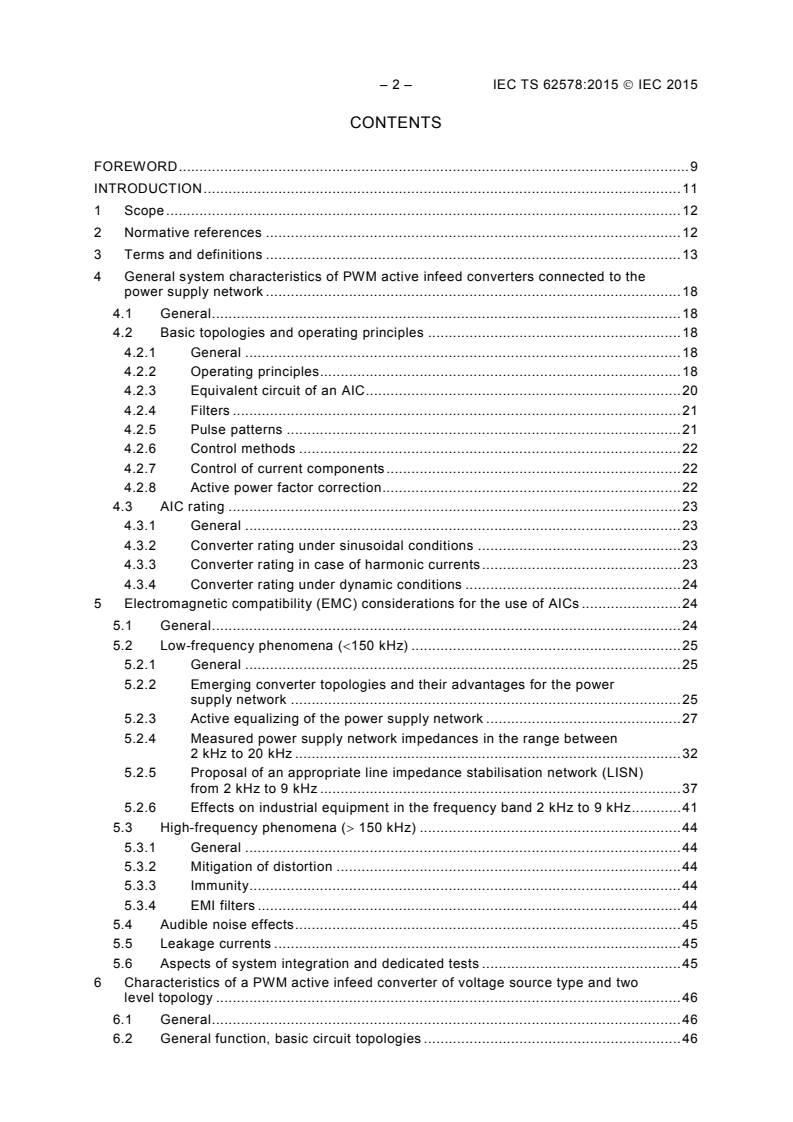
– 2 – IEC TS 62578:2015 IEC 2015
CONTENTS
FOREWORD . 9
INTRODUCTION . 11
1 Scope . 12
2 Normative references . 12
3 Terms and definitions . 13
4 General system characteristics of PWM active infeed converters connected to the
power supply network . 18
4.1 General . 18
4.2 Basic topologies and operating principles . 18
4.2.1 General . 18
4.2.2 Operating principles . 18
4.2.3 Equivalent circuit of an AIC . 20
4.2.4 Filters . 21
4.2.5 Pulse patterns . 21
4.2.6 Control methods . 22
4.2.7 Control of current components . 22
4.2.8 Active power factor correction . 22
4.3 AIC rating . 23
4.3.1 General . 23
4.3.2 Converter rating under sinusoidal conditions . 23
4.3.3 Converter rating in case of harmonic currents . 23
4.3.4 Converter rating under dynamic conditions . 24
5 Electromagnetic compatibility (EMC) considerations for the use of AICs . 24
5.1 General . 24
5.2 Low-frequency phenomena (<150 kHz) . 25
5.2.1 General . 25
5.2.2 Emerging converter topologies and their advantages for the power
supply network . 25
5.2.3 Active equalizing of the power supply network . 27
5.2.4 Measured power supply network impedances in the range between
2 kHz to 20 kHz . 32
5.2.5 Proposal of an appropriate line impedance stabilisation network (LISN)
from 2 kHz to 9 kHz . 37
5.2.6 Effects on industrial equipment in the frequency band 2 kHz to 9 kHz . 41
5.3 High-frequency phenomena (> 150 kHz) . 44
5.3.1 General . 44
5.3.2 Mitigation of distortion . 44
5.3.3 Immunity . 44
5.3.4 EMI filters . 44
5.4 Audible noise effects . 45
5.5 Leakage currents . 45
5.6 Aspects of system integration and dedicated tests . 45
6 Characteristics of a PWM active infeed converter of voltage source type and two
level topology . 46
6.1 General . 46
6.2 General function, basic circuit topologies . 46
6.3 Power control . 49
6.4 Dynamic performance . 50
6.5 Desired non-sinusoidal line currents . 50
6.6 Undesired non-sinusoidal line currents. 50
6.7 Availability and system aspects . 51
6.8 Operation in active filter mode . 52
7 Characteristics of a PWM active infeed converter of voltage source type and three
level topology . 52
7.1 General function, basic circuit topologies . 52
7.2 Power control . 53
7.3 Dynamic performance . 53
7.4 Undesired non-sinusoidal line currents. 54
7.5 Availability and system aspects . 54
8 Characteristics of a PWM Active Infeed Converter of Voltage Source Type and
Multi Level Topology . 55
8.1 General function, basic circuit topologies . 55
8.2 Power control . 56
8.3 Dynamic performance . 57
8.4 Power supply network distortion . 57
8.5 Availability and system aspects . 57
9 Characteristics of a F3E AIC of the Voltage Source Type . 58
9.1 General function, basic circuit topologies . 58
9.2 Power control and line side filter . 59
9.3 Dynamic performance . 61
9.4 Harmonic current . 61
10 Characteristics of an AIC of Voltage Source Type in Pulse Chopper Topology . 62
10.1 General . 62
10.2 General function, basic circuit topologies . 62
10.3 Desired non-sinusoidal line current . 63
10.4 Undesired non-sinusoidal line current . 63
10.5 Reliability . 63
10.6 Performance . 64
10.7 Availability and system aspects . 64
11 Characteristics of a two level PWM AIC of current source type (CSC) . 64
11.1 General . 64
11.2 General function, basic converter connections . 64
11.3 Power control . 66
11.4 Dynamic performance . 67
11.5 Line current distortion . 68
11.6 Operation in active filter mode . 68
11.7 Availability and system aspects . 68
Annex A (informative) . 69
A.1 Control methods for AICs in VSC (Voltage Source Converter) topology . 69
A.1.1 General . 69
A.1.2 Considerations of control methods . 69
A.1.3 Short-circuit ride through functionality for decentralized power infeed
with AIC . 70
A.1.4 Fault ride through mode . 70
– 4 – IEC TS 62578:2015 IEC 2015
A.2 Examples of practical realized AIC applications . 72
A.2.1 AIC of current source type (CSC). 72
A.2.2 Active infeed converter with commutation on the d.c. side (reactive
power converter). 74
A.3 Details concerning two level and multi-level AICs in VSC Topology. 76
A.3.1 Properties of active infeed converters (PWM) with different number of
levels . 76
A.3.2 Examples of typical waveforms of AICs . 77
A.3.3 Construction and realization . 78
A.4 Basic transfer rules between voltage and current distortion of an AIC . 78
A.5 Examples of the influence of AICs to the voltage quality . 79
A.6 Withstand capability of power capacitors towards distortion in the range of
2 kHz to 9 kHz . 80
A.6.1 General . 80
A.6.2 Catalogue information about permissible harmonic load . 82
A.6.3 Frequency boundaries for permissible distortion levels . 82
A.6.4 Frequency spectrum of active infeed converters . 83
A.6.5 Conclusion . 84
A.7 Impact of additional AIC filter measures in the range of 2 kHz to 9 kHz . 85
A.7.1 General . 85
A.7.2 Example of a PDS constellation (AIC and CSI) . 86
A.7.3 Conclusion . 88
A.8 Example of the power supply network impedance measurement . 89
A.8.1 General . 89
A.8.2 Basic principle of measurement . 89
A.8.3 Harmonic component injection methods for measurement . 90
A.8.4 Harmonic current generation by disturbing device . 90
A.8.5 References based on current injection by disturbance (Method A) . 90
A.8.6 References based on sinusoidal single frequency injection (Method B) . 92
Annex B (informative) . 94
B.1 Basic considerations for design recommendations of AICs in the range of
2 kHz to 9 kHz . 94
B.1.1 Overview . 94
B.1.2 General . 94
B.1.3 Withstand capability of power capacitors connected to the power
supply network and recommendation for the compatibility in the
frequency range 2 kHz to 9 kHz . 95
B.1.4 Basic conditions for setting the capacitor withstand capability curve . 95
B.1.5 Matching of AIC converters (2-Level PWM) to different power supply
network conditions without overloading the power capacitor burden. 97
B.1.6 Considerations in regard to medium voltage power supply networks . 99
B.1.7 AIC filtering considerations . 100
B.1.8 AIC appropriate technical and economical amount . 100
B.1.9 Frequency range from 2 kHz to 9 kHz . 101
B.2 Design recommendations for conducted emission of low voltage AICs in the
reasonable context of higher frequencies between 9 kHz and 150 kHz. 102
B.2.1 General . 102
B.2.2 Data collection results . 103
B.2.3 Conclusions . 105
Bibliography . 107
Figure 1 – AIC in VSC topology, basic structure . 19
Figure 2 – AIC in CSC topology, basic structure . 19
Figure 3 – Equivalent circuit for the interaction of the power supply network with an AIC . 20
Figure 4 – Voltage and current vectors of line and converter at fundamental frequency
for different load conditions . 23
Figure 5 – The basic issues of EMC as tools of economics . 24
Figure 6 – Typical power supply network current i (t) and voltage u (t) of a phase
L LN
controlled converter with d.c. output and inductive smoothing . 26
Figure 7 – Typical power supply network current i (t) and voltage u (t) of an
L LN
uncontrolled converter with d.c. output and capacitive smoothing . 26
Figure 8 – Typical power supply network current i (t) and voltage u (t) of an AIC
L LN
realized by a PWM Converter with capacitive smoothing without additional filters . 26
Figure 9 – Example of attainable active and reactive power of the AIC (VSC-type) at
different line to line voltages in per unit (with 10 % combined transformer and filter
inductor short-circuit voltage, X/R ratio = 10/1, d.c. voltage = 6,5 kV) . 27
Figure 10 – Principle of compensating given harmonics in the power supply system by
using an AIC and suitable control simultaneously . 28
Figure 11 – Typical Voltage Distortion in the Line-to-Line and Line-to-Neutral Voltage
generated by an AIC without additional filters (u in % and t in degrees) . 29
Figure 12 – Basic characteristic of the relative voltage distortion (59th harmonic) of
one AIC operated at a pulse frequency of 3 kHz versus R with the line impedance
SCe
according to 5.2.4 . 30
Figure 13 – Basic characteristic of the relative current emission (59th harmonic) of one
AIC at a pulse frequency of 3 kHz versus R with the line impedance according to
SCe
5.2.4 . 31
Figure 14 – Single phase electric circuit of the three commonly used differential mode
passive line filter topologies for VSC and one example for passive damping . 31
Figure 15 – Example of the attenuation of the VSC line to line voltage to the line to line
voltage at the IPC with state of the art differential mode passive line filter topologies . 32
Figure 16 – Connection of the power supply network impedance measurement
equipment . 33
Figure 17 – Example of the measured impedance of a low-voltage transformer under
no load condition S = 630 kVA, u = 6,08 % . 34
k
Figure 18 – Measured variation of the power supply network impedance over the
course of a day at one location . 34
Figure 19 – Power supply network impedance with partly negative imaginary part . 35
Figure 20 – Distribution of power system impedance (measured between phase and
neutral conductor) in low-voltage systems versus frequency . 35
Figure 21 – Statistical distribution of positive-sequence impedance versus frequency in
low-voltage power supply networks . 37
Figure 22 – Equivalent circuit describing the power supply network impedance . 38
Figure 23 – Circuit topology for power system simulation . 38
Figure 24 – Approximated and measured 50 % impedance curve . 39
Figure 25 – Single phase circuit topology according to IEC 61000-4-7+ used for line
impedance stabilisation network . 40
Figure 26 – Three-phase circuit topology for the line impedance stabilisation network . 41
Figure 27 – Impedance variation in the 90 % curve of the LISN described in Figure 26 . 41
Figure 28 – PDS with large d.c. capacitance . 43
– 6 – IEC TS 62578:2015 IEC 2015
Figure 29 – PDS with large capacitance and line inductor . 43
Figure 30 – PDS with a large d.c. capacitance and inductors in the d.c. link . 43
Figure 31 – Basic EMI filter topology . 45
Figure 32 – Block diagram of a PDS with high frequency EMI filter system . 45
Figure 33 – Basic illustration of a topology of a two level PWM voltage source AIC. 47
Figure 34 – Typical waveforms of voltages u / U and voltage u / U
S1N LN, 1 S12 LN, 1
at pulse frequency of 4 kHz. 48
Figure 35 – Typical waveforms of the common mode voltage u / U at pulse
CM LN,1
frequency of 4 kHz. Power supply frequency is 50Hz . 48
Figure 36 – Waveform of the current i / I at pulse frequency of 4 kHz, relative
L1 equ
impedance of u = 6 % . 49
SCV,equ
Figure 37 – Block diagram of a two level PWM AIC . 49
Figure 38 – Distortion of the current i of reactance X , pulse frequency: 4 kHz,
L1 equ
relative reactance of u = 6 % . 51
SCV,equ
Figure 39 – Typical voltages u / U and u / U at pulse frequency of
L1N LN, 1 L12 LN, 1
4 kHz, relative reactance u = 6 %, R = 100 . 51
SCV,equ SCe
Figure 40 – Basic topology of a three level AIC. For a Power Drive System (PDS) the
same topology may be used also on the load side . 52
Figure 41 – Typical curve shape of the phase-to-phase voltage of a three level PWM
converter . 53
Figure 42 – Example of a sudden load change of a 13 MW three level converter where
the current control achieves a response time within 5 ms . 54
Figure 43 – Typical topology of a flying capacitor (FC) four level AIC using IGBTs . 55
Figure 44 – Typical curve shape of the phase-to-phase voltage of a multi-(four)-
level AIC . 56
Figure 45 – Distorting frequencies and amplitudes in the line voltage (measured
directly at the bridge terminals in Figure 25 and the line current of a multilevel (four)
AIC (transformer with 10 % short-circuit voltage) . 57
Figure 46 – Topology of a F3E AIC . 58
Figure 47 – Line side filter and equivalent circuit for the F3E-converter behaviour for
the power supply network . 59
Figure 48 – Current transfer function together with R = 100 and R = 750 and a
SCe SCe
line side filter: G(f) = i / i . 59
L1 conv
Figure 49 – PWM – voltage distortion over power supply network impedance for F3E-
infeed including power supply network side filter . 60
Figure 50 – Input current spectrum of a 75kW-F3E-converter . 61
Figure 51 – Harmonic spectrum of the input current of an F3E-converter
with R = 100 . 61
SCe
Figure 52 – An illustration of a distortion effect caused by a single phase converter
with capacitive load . 62
Figure 53 – a.c. to a.c. AIC pulse chopper, basic circuit . 63
Figure 54 – Illustration of a converter topology for a current source AIC . 65
Figure 55 – Typical waveforms of currents and voltages of a current source AIC with
high switching frequency . 66
Figure 56 – Typical block diagram of a current source PWM AIC . 67
Figure 57 – Current source AIC used as an active filter to compensate the harmonic
currents generated by a nonlinear load . 67
Figure 58 – Step response (reference value and actual value) of current source AIC
with low switching frequency [33] . 68
Figure A.1 – Principle sketch for combined voltage- and current-injecting modulation
example for phase leg R . 71
Figure A.2 – Example for controlled phase current during a voltage dip at the power
supply network using hysteresis plus PWM control . 72
Figure A.3 – Typical waveforms of electrical power supply network current and voltage
for a current source AIC with low switching frequency [33] . 72
Figure A.4 – Currents and voltages in a (semiconductor) valve device of an AIC and a
machine side converter both of the current source with low pulse frequency [33] . 73
Figure A.5 – Total harmonic distortion of electrical power supply network and motor
current [33] remains always below 8 % (triangles in straight line) in this application . 73
Figure A.6 – Basic topology of an AIC with commutation on the d.c. side (six pulse
variant) . 74
Figure A.7 – Dynamic performance of a reactive power converter . 75
Figure A.8 – Line side current for a twelve pulse Reactive Power Converter in a
capacitive and inductive operation mode (u = 15 %) . 75
SCV,equ
Figure A.9 – The origin of the current waveform of a RPC by the line voltage
(sinusoidal) and the converter voltage (rectangular) . 76
Figure A.10 – Two level topology with nominal voltage of maximum 1 200 V and
timescale of 5 ms/div . 77
Figure A.11 – Three level topology with nominal voltage of maximum 2 400 V and
timescale of 5 ms/div . 77
Figure A.12 – Four level topology with nominal voltage of maximum 3 300 V and
timescale of 5 ms/div . 78
Figure A.13 – General influence of significant characteristics to the voltage distortion
and current distortion . 79
Figure A.14 – Measured reduction of voltage distortion when four AICs are connected
to the power supply network . 80
Figure A.15 – Excerpts from a catalogue information of a power capacitor
manufacturer; 760 V AC; (rated voltage: 690 V AC) for temperature calculation . 81
Figure A.16 – Reactive power and losses of a power capacitor supplied by a source
with constant reference voltage and variable frequency (R = f(h)) . 82
cp
Figure A.17 – Apparent power and losses of a typical power capacitor at different
voltage distortion levels and the critical frequency boundaries (at singular frequency)
where the temperature rise reaches substantial values (vertical arrows) . 83
Figure A.18 – Voltage spectrum of an AIC and the impact of a line impedance
reduction to the temperature of the capacitor (from 10 K to 0,44 K) and the composition
of the spectrum . 84
Figure A.19 – A wind turbine plant and a mine winder drive connected on the same
power line . 86
Figure A.20 – Power supply network configuration for the plant of Figure A.19 with
allocated measurement points . 86
Figure A.21 – Regular current of the CSI (AIC-filter disabled) and amplification of the
current in case of resonance caused by the AIC-filter circuit (when AIC filter is
enabled) . 87
Figure A.22 – Basic principle of impedance measurement. 89
Figure A.23 – Harmonic current generation by disturbing device . 90
Figure A.24 – Measurement by switching a resistor . 91
Figure A.25 – Measurement by a capacitor bank . 91
Figure A.26 – A 6,6 kV power supply network impedance measurement system for
islanding detection by injecting interharmonics . 92
– 8 – IEC TS 62578:2015 IEC 2015
Figure B.1 – Withstand capability level towards harmonic voltages in the power supply
network in view of permissible temperature rise within capacitors if the voltage
distortion is determined either by one predominating frequency (upper line) or if the
distortion is predominantly determined by a harmonic spectrum, caused by several
parallel operated AICs (2-Level PWM) (lower line) . 96
Figure B.2 – Harmonic voltage spectrum of one 2-Level PWM AIC with acceptable
temperature increase of a power capacitor not exceeding 10 K . 97
Figure B.3 – Maximum voltage distortion of a spectrum, caused by several AICs
(single phase topologies) . 98
Figure B.4 – Maximum voltage distortion of a spectrum, caused by several AICs (three
phases topologies) . 98
Figure B.5 – Spreadsheet of matching single phase AICs (2-level) to different power
supply network conditions in order to apply the power capacitor limit curves . 99
Figure B.6 – Spreadsheet of matching three phases AICs (2-level) to different power
supply network conditions in order to apply the power capacitor limit curves . 99
Figure B.7 – Illustration of the typical power supply network resonance frequency by
increasing AIC filtering population, versus the voltage distortion level . 100
Figure B.8 – Sketch of the typical size/cost of an AIC application versus switching
frequency of the AIC . 101
Figure B.9 – Illustration of the probability of overload and stress problems for the
power supply network and the equipment connected thereto, depending on stipulated
distortion levels fixed in miscellaneous assumptions . 101
Figure B.10 – Results of the data collection versus the maximum values proposed in
the IEC TS 62578 for products rated above 75 kVA . 103
Figure B.11 – Results of the data collection versus the maximum values proposed in
the IEC TS 62578 for products rated below 75 kVA . 104
Figure B.12 – Results of the data collection versus the maximum values proposed in
the IEC TS 62578 for products rated above 75 kVA . 104
Figure B.13 – Recommended maximum emission values for AIC of different categories
in the range from 9 kHz up to 150 kHz . 105
Table 1 – Parameters of line impedance stabilisation network for different power
system impedance curves . 39
Table 2 – Parameters of the LISN described in Figure 25 and Figure 26 . 40
Table A.1 – Condition state 1: positive current limit reached, transistor T1 is switch-off
to reduce the current . 71
Table A.2 – Condition state 2: negative current limit reached, transistor T2 is switch-off
to reduce the current . 71
Table A.3 – Condition state 0: current in phase R within tolerance range, pure voltage
injection active (e.g. with PWM) . 71
Table A.4 – Comparison of different PWM AICs of VSC topology . 76
Table A.5 – Voltage distortion on both power lines (II and III) without and with filter circuit
(the filter had been designed to achieve 0,2 % distortion level on the MV-power line) . 87
Table A.6 – Current distribution within the network described for specific frequencies
and on allocated measurement points as pointed out in Figure A.20 . 88
Table B.1 – AIC design recommendation for a maximum distortion factor in the
frequency range from 2 to 9 kHz . 102
Table B.2 – Recommended maximum emission values for AIC of different categories in
the range from 9 kHz up to 150 kHz . 106
INTERNATIONAL ELECTROTECHNICAL COMMISSION
____________
POWER ELECTRONICS SYSTEMS AND EQUIPMENT –
Operation conditions and characteristics of active
infeed converter (AIC) applications including design
recommendations for their emission values below 150 kHz
FOREWORD
1) The International Electrotechnical Commission (IEC) is a worldwide organization for standardization comprising
all national electrotechnical committees (IEC National Committees). The object of IEC is to promote
international co-operation on all questions concerning standardization in the electrical and electronic fields
...