

IEC/IEEE 61869-21:2025
(Main)Instrument transformers - Part 21: Uncertainty evaluation in the accuracy test of instrument transformers
General Information
- Abstract
IEC/IEEE 61869-21:2025 provides the requirements, the methods and the guidelines to be applied on the evaluation of uncertainty in testing the accuracy of instrument transformers (IT) with an analogue or a digital secondary signal for measuring, protection and control purposes, with rated frequencies from 15 Hz to 400 Hz.
This document covers the uncertainty evaluation in testing the accuracy of IT (including on-site testing of accuracy) independently of the technology used (either inductive or non-inductive).
This document reports on how to take into account the sources of uncertainty in the setups for accuracy and how to combine their effects in order to evaluate the uncertainty in the test results.
- Status
- Published
- Publication Date
- 14-Dec-2025
- Technical Committee
- TC 38 - Instrument Transformers
- Drafting Committee
- JWG 55 - TC 38/JWG 55
- Current Stage
- PPUB - Publication issued
- Start Date
- 15-Dec-2025
- Completion Date
- 07-Nov-2025
Overview
IEC/IEEE 61869-21:2025 - "Instrument transformers - Part 21: Uncertainty evaluation in the accuracy test of instrument transformers" - defines requirements, methods and guidance for evaluating measurement uncertainty when testing the accuracy of instrument transformers (ITs). It applies to ITs with analogue or digital secondary signals used for measuring, protection and control at rated frequencies from 15 Hz to 400 Hz, and is independent of technology (inductive or non‑inductive). The standard explains how to identify uncertainty sources in test setups and how to combine their effects to produce a defensible uncertainty budget for accuracy test results, including on‑site testing.
Key topics and requirements
- Scope and applicability: ITs with analogue or digital outputs; lab and on‑site accuracy verification; 15 Hz–400 Hz rated frequencies.
- Sources of uncertainty: reference IT, comparator, burden, voltage/current source, and setup‑specific contributions.
- Requirements for test equipment: minimum characteristics and performance expectations for reference ITs, comparators and burdens used in accuracy tests.
- Measurement model and uncertainty budget: preparation of measurement equations, identification and quantification of input quantities, and combination of uncertainty contributions.
- Procedures and methods: guidance on data acquisition (sampling frequency, time intervals), connections, demagnetization of inductive CTs, application of Type A (statistical) methods, and special applications.
- On‑site testing guidance: objectives, intervals, additional uncertainty sources and adaptations for reduced‑amplitude tests.
- Informative annexes: example uncertainty calculations and linearly‑reduced test approaches for on‑site verification.
Practical applications and users
Who will use this standard:
- Test laboratories performing type and routine accuracy tests of CTs and VTs.
- Calibration houses developing uncertainty budgets and calibration certificates.
- Field engineers and utilities conducting on‑site verification and acceptance testing.
- Manufacturers of instrument transformers and digital comparators preparing test procedures and technical documentation. Practical benefits:
- Provides a consistent, traceable approach to quantify and report uncertainty in IT accuracy tests.
- Improves comparability of results across labs and field checks.
- Supports conformance assessment, procurement specifications, and risk‑based decision making for protection and metering systems.
Related standards
- Other parts of the IEC 61869 series (Instrument transformers) for performance and testing requirements.
- Measurement and calibration best practices and guides for constructing uncertainty budgets (refer to national/international metrology guides).
Keywords: IEC/IEEE 61869-21:2025, instrument transformers, uncertainty evaluation, accuracy test, on‑site testing, comparator, reference IT, burden, measurement uncertainty, digital comparators.
Get Certified
Connect with accredited certification bodies for this standard

BSMI (Bureau of Standards, Metrology and Inspection)
Taiwan's standards and inspection authority.
Sponsored listings
Frequently Asked Questions
IEC/IEEE 61869-21:2025 is a standard published by the International Electrotechnical Commission (IEC). Its full title is "Instrument transformers - Part 21: Uncertainty evaluation in the accuracy test of instrument transformers". This standard covers: IEC/IEEE 61869-21:2025 provides the requirements, the methods and the guidelines to be applied on the evaluation of uncertainty in testing the accuracy of instrument transformers (IT) with an analogue or a digital secondary signal for measuring, protection and control purposes, with rated frequencies from 15 Hz to 400 Hz. This document covers the uncertainty evaluation in testing the accuracy of IT (including on-site testing of accuracy) independently of the technology used (either inductive or non-inductive). This document reports on how to take into account the sources of uncertainty in the setups for accuracy and how to combine their effects in order to evaluate the uncertainty in the test results.
IEC/IEEE 61869-21:2025 provides the requirements, the methods and the guidelines to be applied on the evaluation of uncertainty in testing the accuracy of instrument transformers (IT) with an analogue or a digital secondary signal for measuring, protection and control purposes, with rated frequencies from 15 Hz to 400 Hz. This document covers the uncertainty evaluation in testing the accuracy of IT (including on-site testing of accuracy) independently of the technology used (either inductive or non-inductive). This document reports on how to take into account the sources of uncertainty in the setups for accuracy and how to combine their effects in order to evaluate the uncertainty in the test results.
IEC/IEEE 61869-21:2025 is classified under the following ICS (International Classification for Standards) categories: 17.220.20 - Measurement of electrical and magnetic quantities. The ICS classification helps identify the subject area and facilitates finding related standards.
IEC/IEEE 61869-21:2025 is available in PDF format for immediate download after purchase. The document can be added to your cart and obtained through the secure checkout process. Digital delivery ensures instant access to the complete standard document.
Standards Content (Sample)
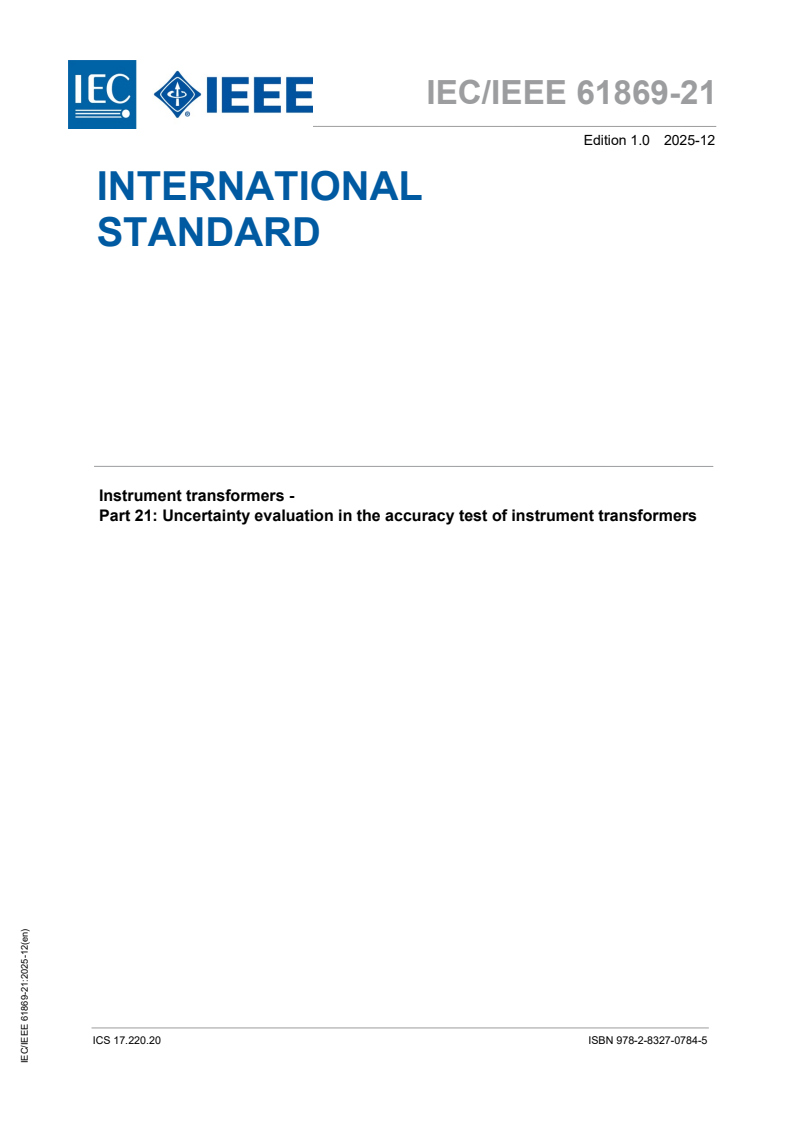
IEC/IEEE 61869-21 ®
Edition 1.0 2025-12
INTERNATIONAL
STANDARD
Instrument transformers -
Part 21: Uncertainty evaluation in the accuracy test of instrument transformers
ICS 17.220.20 ISBN 978-2-8327-0784-5
All rights reserved. Unless otherwise specified, no part of this publication may be reproduced or utilized in any form or
by any means, electronic or mechanical, including photocopying and microfilm, without permission in writing being
secured. Requests for permission to reproduce should be addressed to either IEC at the address below or IEC’s
member Natio nal Committee in the country of the requester or from IEEE.
IEC Secretariat Institute of Electrical and Electronics Engineers, Inc.
3, rue de Varembé 3 Park Avenue
CH-1211 Geneva 20 New York, NY 10016-5997
Switzerland United States of America
Tel.: +41 22 919 02 11 stds.ipr@ieee.org
info@iec.ch www.ieee.org
www.iec.ch
About the IEC
The International Electrotechnical Commission (IEC) is the leading global organization that prepares and publishes
International Standards for all electrical, electronic and related technologies.
About the IEEE
IEEE is the world’s largest professional association dedicated to advancing technological innovation and excellence for the
benefit of humanity. IEEE and its members inspire a global community through its highly cited publications, conferences,
technology standards, and professional and educational activities.
About IEC/IEEE publications
The technical content of IEC/IEEE publications is kept under constant review by the IEC and IEEE. Please make sure that
you have the latest edition, a corrigendum or an amendment might have been published.
IEC publications search - webstore.iec.ch/advsearchform IEC Products & Services Portal - products.iec.ch
The advanced search enables to find IEC publications by a Discover our powerful search engine and read freely all the
variety of criteria (reference number, text, technical publications previews, graphical symbols and the glossary. With a
committee, …). It also gives information on projects, replaced subscription you will always have access to up to date content
and withdrawn publications. tailored to your needs.
IEC Just Published - webstore.iec.ch/justpublished
Electropedia - www.electropedia.org
Stay up to date on all new IEC publications. Just Published
The world's leading online dictionary on electrotechnology,
details all new publications released. Available online and
containing more than 22 500 terminological entries in English and
once a month by email.
French, with equivalent terms in 25 additional languages. Also
known as the International Electrotechnical Vocabulary (IEV)
IEC Customer Service Centre - webstore.iec.ch/csc
online.
If you wish to give us your feedback on this publication or need
further assistance, please contact the Customer Service
Centre: sales@iec.ch.
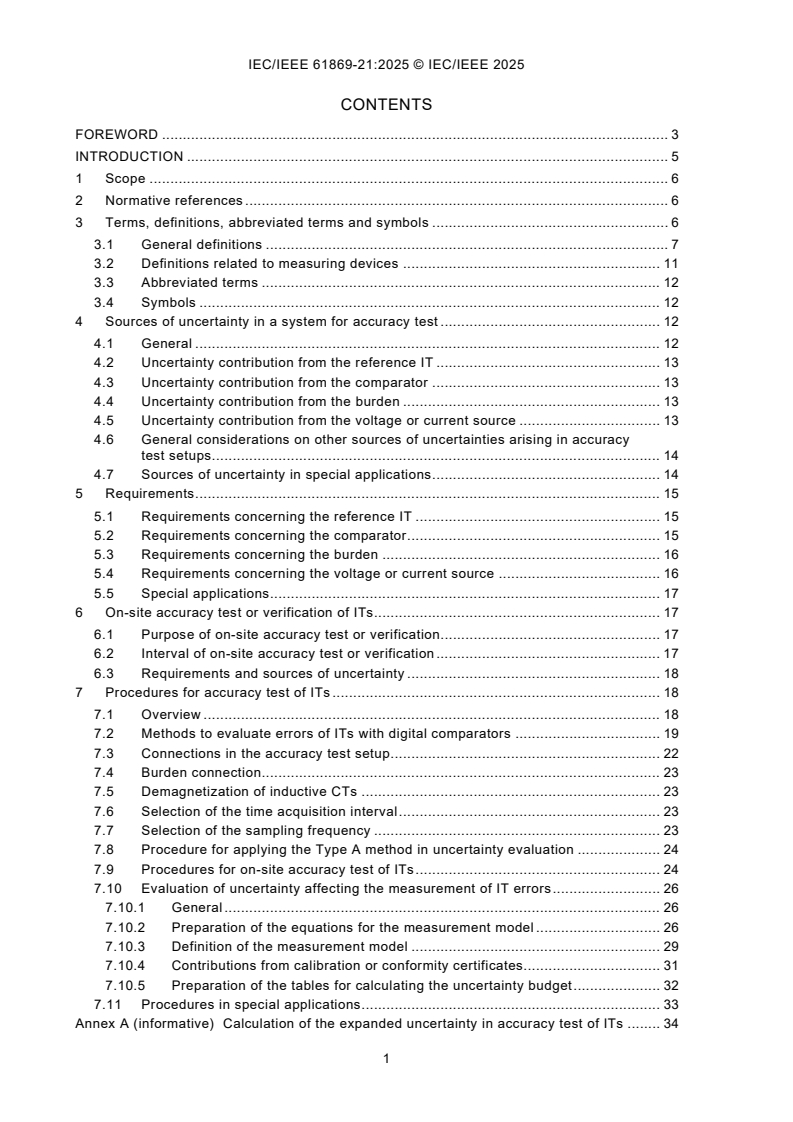
CONTENTS
FOREWORD . 3
INTRODUCTION . 5
1 Scope . 6
2 Normative references . 6
3 Terms, definitions, abbreviated terms and symbols . 6
3.1 General definitions . 7
3.2 Definitions related to measuring devices . 11
3.3 Abbreviated terms . 12
3.4 Symbols . 12
4 Sources of uncertainty in a system for accuracy test . 12
4.1 General . 12
4.2 Uncertainty contribution from the reference IT . 13
4.3 Uncertainty contribution from the comparator . 13
4.4 Uncertainty contribution from the burden . 13
4.5 Uncertainty contribution from the voltage or current source . 13
4.6 General considerations on other sources of uncertainties arising in accuracy
test setups. 14
4.7 Sources of uncertainty in special applications . 14
5 Requirements . 15
5.1 Requirements concerning the reference IT . 15
5.2 Requirements concerning the comparator . 15
5.3 Requirements concerning the burden . 16
5.4 Requirements concerning the voltage or current source . 16
5.5 Special applications . 17
6 On-site accuracy test or verification of ITs. 17
6.1 Purpose of on-site accuracy test or verification . 17
6.2 Interval of on-site accuracy test or verification . 17
6.3 Requirements and sources of uncertainty . 18
7 Procedures for accuracy test of ITs . 18
7.1 Overview . 18
7.2 Methods to evaluate errors of ITs with digital comparators . 19
7.3 Connections in the accuracy test setup. 22
7.4 Burden connection. 23
7.5 Demagnetization of inductive CTs . 23
7.6 Selection of the time acquisition interval . 23
7.7 Selection of the sampling frequency . 23
7.8 Procedure for applying the Type A method in uncertainty evaluation . 24
7.9 Procedures for on-site accuracy test of ITs . 24
7.10 Evaluation of uncertainty affecting the measurement of IT errors . 26
7.10.1 General . 26
7.10.2 Preparation of the equations for the measurement model . 26
7.10.3 Definition of the measurement model . 29
7.10.4 Contributions from calibration or conformity certificates. 31
7.10.5 Preparation of the tables for calculating the uncertainty budget . 32
7.11 Procedures in special applications . 33
Annex A (informative) Calculation of the expanded uncertainty in accuracy test of ITs . 34
A.1 Example of calculation of an uncertainty budget . 34
A.1.1 General . 34
A.1.2 Contributions from calibration certificates . 34
A.1.3 Setup- and DUT-specific contributions . 34
A.1.4 Fluctuations of the comparator readings . 36
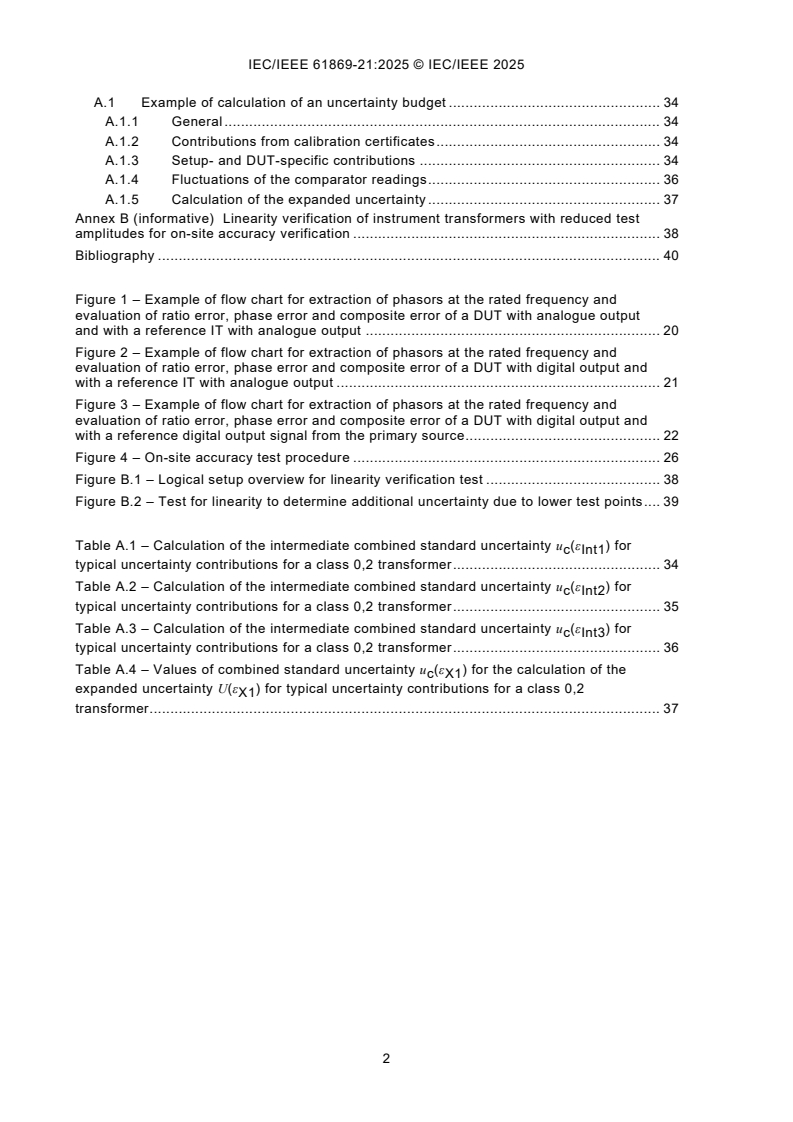
A.1.5 Calculation of the expanded uncertainty . 37
Annex B (informative) Linearity verification of instrument transformers with reduced test
amplitudes for on-site accuracy verification . 38
Bibliography . 40
Figure 1 – Example of flow chart for extraction of phasors at the rated frequency and
evaluation of ratio error, phase error and composite error of a DUT with analogue output
and with a reference IT with analogue output . 20
Figure 2 – Example of flow chart for extraction of phasors at the rated frequency and
evaluation of ratio error, phase error and composite error of a DUT with digital output and
with a reference IT with analogue output . 21
Figure 3 – Example of flow chart for extraction of phasors at the rated frequency and
evaluation of ratio error, phase error and composite error of a DUT with digital output and
with a reference digital output signal from the primary source . 22
Figure 4 – On-site accuracy test procedure . 26
Figure B.1 – Logical setup overview for linearity verification test . 38
Figure B.2 – Test for linearity to determine additional uncertainty due to lower test points . 39
Table A.1 – Calculation of the intermediate combined standard uncertainty u (ε ) for
c Int1
typical uncertainty contributions for a class 0,2 transformer . 34
Table A.2 – Calculation of the intermediate combined standard uncertainty u (ε ) for
c Int2
typical uncertainty contributions for a class 0,2 transformer . 35
Table A.3 – Calculation of the intermediate combined standard uncertainty u (ε ) for
c Int3
typical uncertainty contributions for a class 0,2 transformer . 36
Table A.4 – Values of combined standard uncertainty u (ε ) for the calculation of the
c X1
expanded uncertainty U(ε ) for typical uncertainty contributions for a class 0,2
X1
transformer . 37
Instrument transformers -
Part 21: Uncertainty evaluation in the accuracy test of instrument
transformers
FOREWORD
1) The International Electrotechnical Commission (IEC) is a worldwide organization for standardization comprising all
national electrotechnical committees (IEC National Committees). The object of IEC is to promote international co-
operation on all questions concerning standardization in the electrical and electronic fields. To this end and in addition
to other activities, IEC publishes International Standards, Technical Specifications, Technical Reports, Publicly
Available Specifications (PAS) and Guides (hereafter referred to as “IEC Publication(s)”). Their preparation is
entrusted to technical committees; any IEC National Committee interested in the subject dealt with may participate
in this preparatory work. International, governmental and non-governmental organizations liaising with the IEC also
participate in this preparation.
ISO (the International Organization for Standardization) is a worldwide federation of national standards bodies (ISO
member bodies). The work of preparing International Standards is normally carried out through ISO technical
committees. Each member body interested in a subject for which a technical committee has been established has
the right to be represented on that committee. International organizations, governmental and non-governmental, in
liaison with ISO, also take part in the work. ISO collaborates closely with the International Electrotechnical
Commission (IEC) on all matters of electrotechnical standardization.
IEEE Standards documents are developed within IEEE Societies and subcommittees of IEEE Standards Association
(IEEE SA) Board of Governors. IEEE develops its standards through an accredited consensus development process,
which brings together volunteers representing varied viewpoints and interests to achieve the final product. IEEE
standards are documents developed by volunteers with scientific, academic, and industry-based expertise in
technical working groups. Volunteers involved in technical working groups are not necessarily members of IEEE or
IEEE SA and participate without compensation from IEEE. While IEEE administers the process and establishes rules
to promote fairness in the consensus development process, IEEE does not independently evaluate, test, or verify the
accuracy of any of the information or the soundness of any judgments contained in its standards.
IEC collaborates closely with ISO and IEEE in accordance with conditions determined by agreement between the
organizations. This Triple Logo International Standard was jointly developed by the IEC, ISO and IEEE under the
terms of that agreement.
2) The formal decisions of IEC on technical matters express, as nearly as possible, an international consensus of
opinion on the relevant subjects since each technical committee has representation from all interested IEC National
Committees. The formal decisions of IEEE on technical matters, once consensus within IEEE Societies and
Standards Coordinating Committees has been reached, is determined by a balanced ballot of materially interested
parties who indicate interest in reviewing the proposed standard. Final approval of the IEEE standards document is
given by the IEEE Standards Association (IEEE SA) Standards Board.
3) IEC/IEEE Publications have the form of recommendations for international use and are accepted by IEC National
Committees/IEEE Societies in that sense. While all reasonable efforts are made to ensure that the technical content
of IEC/IEEE Publications is accurate, IEC or IEEE cannot be held responsible for the way in which they are used or
for any misinterpretation by any end user.
4) In order to promote international uniformity, IEC National Committees undertake to apply IEC Publications (including
IEC/IEEE Publications) transparently to the maximum extent possible in their national and regional publications. Any
divergence between any IEC/IEEE Publication and the corresponding national or regional publication shall be clearly
indicated in the latter.
5) IEC and IEEE do not provide any attestation of conformity. Independent certification bodies provide conformity
assessment services and, in some areas, access to IEC marks of conformity. IEC and IEEE are not responsible for
any services carried out by independent certification bodies.
6) All users should ensure that they have the latest edition of this publication.
7) No liability shall attach to IEC or IEEE or their directors, employees, servants or agents including individual experts
and members of technical committees and IEC National Committees, or volunteers of IEEE Societies and the
Standards Coordinating Committees of the IEEE Standards Association (IEEE SA) Standards Board, for any personal
injury, property damage or other damage of any nature whatsoever, whether direct or indirect, or for costs (including
legal fees) and expenses arising out of the publication, use of, or reliance upon, this IEC/IEEE Publication or any
other IEC or IEEE Publications.
8) Attention is drawn to the normative references cited in this publication. Use of the referenced publications is
indispensable for the correct application of this publication.
9) Attention is drawn to the possibility that implementation of this IEC/IEEE Publication may require use of material
covered by patent rights. By publication of this standard, no position is taken with respect to the existence or validity
of any patent rights in connection therewith. IEC or IEEE shall not be held responsible for identifying Essential Patent
Claims for which a license may be required, for conducting inquiries into the legal validity or scope of Patent Claims
or determining whether any licensing terms or conditions provided in connection with submission of a Letter of
Assurance, if any, or in any licensing agreements are reasonable or non-discriminatory. Users of this standard are
expressly advised that determination of the validity of any patent rights, and the risk of infringement of such rights,
is entirely their own responsibility.
IEC/IEEE 61869-21 was prepared by IEC Technical Committee 38: Instrument transformers, in
cooperation with IEEE IMS Instrumentation and Measurement Society TC-39 Measurements in
Power Systems, under the IEC/IEEE Dual Logo Agreement between IEC and IEEE. It is an
International Standard.
This document is published as an IEC/IEEE Dual Logo standard.
The text of this International Standard is based on the following IEC documents:
Draft Report on voting
38/829/FDIS 38/835/RVD
Full information on the voting for its approval can be found in the report on voting indicated in the
above table.
The language used for the development of this International Standard is English.
This document was drafted in accordance with the rules given in the ISO/IEC Directives, Part 2,
available at www.iec.ch/members_experts/refdocs. The main document types developed by IEC
are described in greater detail at www.iec.ch/publications/.
A list of all parts in the IEC 61869 series, published under the general title Instrument transformers,
can be found on the IEC website.
The IEC Technical Committee and IEEE Technical Committee have decided that the contents of
this document will remain unchanged until the stability date indicated on the IEC website under
webstore.iec.ch in the data related to the specific document. At this date, the document will be
– reconfirmed,
– withdrawn, or
– revised.
INTRODUCTION
Accuracy is a crucial feature of instrument transformers (ITs) in most cases and applications: its
assessment is required since a very long time by the relevant International Standards, which also
establish the conventional accuracy requirements in terms of accuracy classes limits.
This document aims at a) providing information on the main sources of uncertainties arising in the
setup used to test the accuracy of ITs and that must be taken into account in the evaluation of
measurement uncertainty; b) defining the procedures to be implemented for testing the accuracy
of ITs, depending on the type of IT (i.e. either with an analogue or a digital secondary signal) and
assessing the conformity to the requirements reported in the product standards (conformity
assessment); c) defining the procedure for evaluating the uncertainty contributions in testing the
accuracy of ITs.
1 Scope
This part of IEC 61869 provides the requirements, the methods and the guidelines to be applied
on the evaluation of uncertainty in testing the accuracy of instrument transformers (IT) with an
analogue or a digital secondary signal for measuring, protection and control purposes, with rated
frequencies from 15 Hz to 400 Hz.
This document covers the uncertainty evaluation in testing the accuracy of IT (including on-site
testing of accuracy) independently of the technology used (either inductive or non-inductive).
This document reports on how to take into account the sources of uncertainty in the setups for
accuracy and how to combine their effects in order to evaluate the uncertainty in the test results.
Metrological traceability to the International System of Units (SI) will always be assumed for both
reference devices and devices under test.
2 Normative references
The following documents are referred to in the text in such a way that some or all of their content
constitutes requirements of this document. For dated references, only the edition cited applies.
For undated references, the latest edition of the referenced document (including any amendments)
applies.
IEC 61869 (all parts), Instrument transformers
IEC 61869-9, Instrument transformers - Part 9: Digital interface for instrument transformers
IEC 61869-99:2022, Instrument transformers - Part 99: Glossary
IEEE C57.13-2016, IEEE Standard Requirements for Instrument Transformers
JCGM 100:2008 or ISO/IEC Guide 98-3:2008, Evaluation of measurement data - Guide to the
expression of uncertainty in measurement (GUM)
3 Terms, definitions, abbreviated terms and symbols
For the purposes of this document, the terms and definitions given in IEC 61869-99 and the
following apply.
ISO and IEC maintain terminology databases for use in standardization at the following addresses:
– IEC Electropedia: available at https://www.electropedia.org/
– ISO Online browsing platform: available at https://www.iso.org/obp
– IEEE Standards Dictionary Online: available at: https://dictionary.ieee.org
3.1 General definitions
3.1.1
measurement
process of experimentally obtaining one or more quantity values that can reasonably be attributed
to a quantity
Note 1 to entry: Measurement does not apply to nominal properties.
Note 2 to entry: Measurement implies comparison of quantities or counting of entities.
Note 3 to entry: Measurement presupposes a description of the quantity commensurate with the intended use of a
measurement result, a measurement procedure, and a calibrated measuring system operating according to the specified
measurement procedure, including the measurement conditions.
[SOURCE: JCGM 200:2012, 2.1]
3.1.2
measurand
quantity intended to be measured
Note 1 to entry: The measurement, including the measuring system and the conditions under which the measurement
is carried out, might change the phenomenon, body, or substance such that the quantity being measured may differ from
the measurand as defined. In this case, adequate correction is necessary.
[SOURCE: JCGM 200:2012, 2.3, modified – Notes 1, 2 and 4 to entry have been omitted, along
with the examples.]
3.1.3
measurement method
generic description of a logical organization of operations used in a measurement
Note 1 to entry: Measurement methods may be qualified in various ways such as:
– substitution measurement method,
– differential measurement method, and
– null measurement method.
[SOURCE: JCGM 200:2012, 2.5, modified – The admitted term "method of measurement" has been
omitted, as well as the last two dashed list items in the note.]
3.1.4
measurement procedure
detailed description of a measurement according to one or more measurement principles and to a
given measurement method, based on a measurement model and including any calculation to
obtain a measurement result
Note 1 to entry: A measurement procedure is usually documented in sufficient detail to enable an operator to perform
a measurement.
Note 2 to entry: A measurement procedure can include a statement concerning a target measurement uncertainty.
[SOURCE: JCGM 200:2012, 2.6, modified – Note 3 to entry has been omitted.]
3.1.5
measurement result
set of quantity values being attributed to a measurand together with any other available relevant
information
Note 1 to entry: A measurement result is generally expressed as a single measured quantity value and a measurement
uncertainty.
[SOURCE: JCGM 200:2012, 2.9, modified – The admitted term "result of measurement" has been
omitted, along with Notes 1 and 3 to entry and the second sentence of Note 2 to entry.]
3.1.6
measurement uncertainty
non-negative parameter characterizing the dispersion of the quantity values being attributed to a
measurand, based on the information used
Note 1 to entry: Measurement uncertainty comprises, in general, many components. Some of these may be evaluated
by Type A evaluation of measurement uncertainty from the statistical distribution of the quantity values from series of
measurements and can be characterized by standard deviations. The other components, which may be evaluated by
Type B evaluation of measurement uncertainty, can also be characterized by standard deviations, evaluated from
probability density functions based on experience or other information.
[SOURCE: JCGM 200:2012, 2.26, modified – Synonyms have been omitted, along with Notes 1, 2
and 4 to entry.]
3.1.7
Type A evaluation of measurement uncertainty
evaluation of a component of measurement uncertainty by a statistical analysis of measured
quantity values, obtained under defined measurement conditions
Note 1 to entry: For information about statistical analysis, see e.g. JCGM 100:2008 (GUM).
[SOURCE: JCGM 200:2012, 2.28, modified – Synonyms have been omitted, along with Notes 1
and 3 to entry, the reference to the GUM has been modified.]
3.1.8
Type B evaluation of measurement uncertainty
evaluation of a component of measurement uncertainty determined by means other than a Type A
evaluation of measurement uncertainty
EXAMPLES Evaluation based on information
– associated with authoritative published quantity values;
– associated with the quantity value of a certified reference material;
– obtained from a calibration certificate;
– about drift;
– obtained from the accuracy class of a verified measuring instrument;
– obtained from limits deduced through personal experience.
[SOURCE: JCGM 200:2012, 2.29, modified – Note 1 to entry has been omitted.]
3.1.9
standard measurement uncertainty
standard uncertainty
u
measurement uncertainty expressed as a standard deviation
Note 1 to entry: The term "standard measurement uncertainty" is usually shortened as "standard uncertainty".
[SOURCE: JCGM 200:2012, 2.30, modified – Symbol has been added, a synonym has been
omitted, Note 1 to entry added.]
3.1.10
combined standard measurement uncertainty
combined standard uncertainty
u
c
standard measurement uncertainty that is obtained using the individual standard measurement
uncertainties associated with the input quantities in a measurement model
Note 1 to entry: The term "standard measurement uncertainty" is usually shortened as "standard uncertainty".
[SOURCE: JCGM 200:2012, 2.31, modified – Symbol has been added, Note 1 to entry has been
replaced.]
3.1.11
uncertainty budget
statement of a measurement uncertainty, of the components of that measurement uncertainty, and
of their calculation and combination
Note 1 to entry: An uncertainty budget should include the measurement model, estimates, and measurement
uncertainties associated with the quantities in the measurement model, covariances, type of applied probability density
functions, degrees of freedom, type of evaluation of measurement uncertainty, and any coverage factor.
[SOURCE: JCGM 200:2012, 2.33]
3.1.12
expanded measurement uncertainty
expanded uncertainty
U
product of a combined standard measurement uncertainty and a factor larger than the number one
Note 1 to entry: The factor depends upon the type of probability distribution of the output quantity in a measurement
model and on the selected coverage probability.
Note 2 to entry: Expanded measurement uncertainty is termed "overall uncertainty" in some documents (see also the
GUM) and simply "uncertainty" in IEC documents.
Note 3 to entry: The expanded measurement uncertainty term is usually shortened in expanded uncertainty.
[SOURCE: JCGM 200:2012, 2.35, modified – Note 2 to entry regarding the term "factor" has been
omitted, Note 3 to entry has been added.]
3.1.13
coverage interval
interval containing the set of true quantity values of a measurand with a stated probability, based
on the information available
Note 1 to entry: A coverage interval can be derived from an expanded measurement uncertainty (see JCGM 100:2008,
2.3.5).
[SOURCE: JCGM 200:2012, 2.36, modified – Notes 1 and 2 to entry have been omitted, the
reference to the GUM has been modified.]
3.1.14
coverage probability
probability that the set of true quantity values of a measurand is contained within a specified
coverage interval
Note 1 to entry: The coverage probability is also termed "level of confidence" in the GUM.
[SOURCE: JCGM 200:2012, 2.37, modified – Note 1 to entry has been omitted.]
3.1.15
coverage factor
k
number larger than one by which a combined standard measurement uncertainty is multiplied to
obtain an expanded measurement uncertainty
[SOURCE: JCGM 200:2012, 2.38, modified – Note 1 to entry has been omitted and the symbol has
been added.]
3.1.16
measurement model
mathematical relation among all quantities known to be involved in a measurement
Note 1 to entry: A general form of a measurement model is the equation h(Y, X , …, X ) = 0, where Y, the output quantity
1 n
in the measurement model, is the measurand, the quantity value of which is to be inferred from information about input
, …, X .
quantities in the measurement model X
1 n
[SOURCE: JCGM 200:2012, 2.48, modified – Synonyms and Note 2 to entry have been omitted.]
3.1.17
calibration
operation that, under specified conditions, in a first step, establishes a relation between the
quantity values with measurement uncertainties provided by measurement standards and
corresponding indications with associated measurement uncertainties and, in a second step, uses
this information to establish a relation for obtaining a measurement result from an indication
Note 1 to entry: A calibration may be expressed by a statement, calibration function, calibration diagram, calibration
curve, or calibration table. In some cases, it may consist of an additive or multiplicative correction of the indication with
associated measurement uncertainty.
Note 2 to entry: Calibration should not be confused with adjustment of a measuring system, often mistakenly called
"self-calibration", nor with verification of calibration.
Note 3 to entry: In the definition, the term "indication" for instrument transformers has to be understood as secondary
signal value.
[SOURCE: JCGM 200:2012, 2.39, modified – Note 3 to entry has been omitted and a new Note 3
has been added.]
3.1.18
laboratory calibration
calibration performed in the factory test laboratory or in an external calibration laboratory
Note 1 to entry: The laboratory calibration ensures defined environmental conditions and power source control.
3.1.19
accuracy
quality which characterizes the ability of a measuring instrument to provide an indicated value
close to a true value of the measurand
[SOURCE: IEC 60050-311:2001, 311-06-08, modified – Notes to entry have been omitted.]
3.1.20
accuracy test
test in which the results of error measurement are compared with the accuracy class limits
3.1.21
metrological traceability
property of a measurement result whereby the result can be related to a reference through a
documented unbroken chain of calibrations, each contributing to the measurement uncertainty
[SOURCE: JCGM 200:2012, 2.41, modified – Notes to entry have been omitted.]
3.1.22
verification
set of operations which is used to check whether the indications, under specified conditions,
correspond with a given set of known measurands within the limits of a predetermined calibration
diagram
Note 1 to entry: Verification should not be confused with calibration. Not every verification is a calibration.
[SOURCE: IEC 60050-311:2001, 311-01-13, modified – Notes to entry have been omitted, a new
Note 1 to entry has been added.]
3.2 Definitions related to measuring devices
3.2.1
measuring instrument
device used for making measurements, alone or in conjunction with one or more supplementary
devices
[SOURCE: JCGM 200:2012, 3.1, modified – Notes to entry have been omitted.]
3.2.2
measuring system
set of one or more measuring instruments and often other devices assembled and adapted to give
information used to generate measured quantity values within specified intervals for quantities of
specified kinds
[SOURCE: JCGM 200:2012, 3.2, modified – Reference to reagent and supply has been deleted
from the definition.]
3.2.3
reference IT
IT intended to be used for IT accuracy test, which ensures the metrological traceability of the test
Note 1 to entry: A reference IT could not fully fulfil the IEC 61869 series' provisions if its use is limited to accuracy test
purposes.
Note 2 to entry: Sometimes, manufacturers of reference ITs declare an accuracy specification not standardized in
accordance with IEC 61869.
3.2.4
comparator
device which, by comparison, provides information on the difference between the values of two
quantities
Note 1 to entry: A comparator for ITs can compare analogue vs. analogue, or analogue vs. digital, or digital vs. digital
input information.
[SOURCE: IEC 60050-312:2001, 312-02-42, modified – Note 1 to entry has been added.]
3.2.5
indication
quantity value provided by a measuring instrument or a measuring system
[SOURCE: JCGM 200:2012, 4.1, modified – Notes to entry have been omitted.]
3.3 Abbreviated terms
ADC analogue-to-digital converter
CT current transformer
DFT discrete Fourier transform
DUT device under test
GUM Guide to the expression of uncertainty in measurement, also designated by its references
JCGM 100:2008 or ISO/IEC Guide 98-3:2008
IT instrument transformer
LPCT low-power current transformer
LPIT low-power instrument transformer
PLL phase locked loop
RMS root-mean-square
SCC signal conditioning circuit
THD total harmonic distortion
VT voltage transformer
3.4 Symbols
k coverage factor (3.1.15)
K rated transformation ratio (IEC 61869-99:2022, 3.5.5)
r
U expanded measurement uncertainty (3.1.12)
u standard measurement uncertainty (3.1.9)
standard uncertainty evaluated by means of the Type A method
u
A
u standard uncertainty evaluated by means of the Type B method
B
u combined standard measurement uncertainty (3.1.10)
c
ε ratio error (IEC 61869-99:2022, 3.5.6)
ϕ phase error (IEC 61869-99:2022, 3.5.8)
e
ε ratio error of a specific IT (can be the reference IT, the DUT or a signal conditioning
IT
circuit)
ϕ phase error of a specific IT (can be the reference IT, the DUT or a signal conditioning
e,IT
circuit)
ε ratio error of the comparator
CP
ϕ phase error of the comparator
e,CP
ε composite error (IEC 61869-99:2022, 3.5.9)
c
4 Sources of uncertainty in a system for accuracy test
4.1 General
The following subclauses list and describe the sources of uncertainty that mainly affect the
accuracy test results.
4.2 Uncertainty contribution from the reference IT
– The manufacturer of the reference IT shall declare the reference conditions to be respected by
the laboratory where the reference IT shall be used. The manufacturer shall be able to
demonstrate, by design and test results, the compliance of the reference IT with its error
specifications within its declared reference conditions.
– The calibration laboratory shall be able to prove that the reference IT is used in compliance
with its specified reference conditions.
– The manufacturer of the reference IT shall declare the primary conductor arrangement with
reference to rotation or change of position. If no requirements are given, the accuracy
specifications of the reference IT depending on the rotation or change of position of the primary
conductor shall be preserved.
4.3 Uncertainty contribution from the comparator
Contributions to the overall uncertainty from random measurement errors of the accuracy test
setup due to the comparator shall be evaluated as well, in order to define a correct number of
repeated measurements that shall be performed during the accuracy test procedure of the DUT in
accordance with the Type A evaluation of the standard uncertainty associated with the results of
the accuracy test process as specified in the GUM. The procedure for setting the suitable number
of repeated measurements is reported in Subclause 7.8. Moreover, in case the comparator is used
for accuracy test verification of an IT with digital output, special care has to be given to the time
synchronization of the comparator.
4.4 Uncertainty contribution from the burden
The value of the burden shall be in accordance with the rated values specified in the product
standard of the DUT.
The input impedance of the comparator and the resistance of the cables (in case the output
conductor is not included in the DUT) are part of the burden and shall be considered accordingly.
The burden shall be able to be adjusted according to the final assessment of the accuracy test
setup. In particular, its value should be adjusted depending on the cable length and cross-section
used for connecting to the ITs. In some circumstances, an external resistor is added to the burden
for accuracy test of ITs for reaching specific burden values. In such cases, the resistance of the
external resistor shall be reported in the calibration certificate of the burden.
4.5 Uncertainty contribution from the voltage or current source
The main sources of uncertainty due to the voltage/current source are:
– frequency instability;
– amplitude instability;
– noise and distortion;
– DC offset.
4.6 General considerations on other sources of uncertainties arising in accuracy test
setups
Possible further sources of uncertainty in the accuracy test process are listed and discussed below.
The operator shall be aware of such sources of uncertainty and act in order to make their effects
negligible or to take them into account in the measurement model. In Clause 7, the related
procedures are reported.
– If the accuracy test setup is not realized in order to have only one ground star point where all
ground conductors from different devices are connected to it, then ground potentials due to
return currents from devices in the setup can arise and raise the ground-reference potential
and be, in turn, wrongly processed by the comparator.
– The length of the conductors and cabling connecting the IT to the comparator (mainly in the
case of accuracy test of LPITs) can represent another source of uncertainty. In fact, conductors
act as receiving antennas of noise and surrounding disturbances, affecting then the signal
quality. Such a phenomenon gains in importance as the length of the conductors increases and
when conductors form a loop.
– In the case of accuracy test of window-type CTs with multiple turns of the primary cable around
the coil, the arrangement of the turns can represent another source of uncertainty.
– In the case of accuracy test of window-type CTs, a different position of the primary cable with
respect to the centre of the window can represent another source of uncertainty.
– For accuracy test setups for digital output ITs, different delay or bad-quality time reference to
the devices is another source of uncertainty. This can occur when cables for digital
transmission are not properly chosen in terms of bandwidth or length. This turns into a change
in the time reference clock signal waveform and, then, in a misinterpretation of data from the
receiving devices.
– Another source of uncertainty is represented by the delay of signal conversion devices, like
optical-to-electrical or vice versa.
– Connection between components made by dissimilar metals can lead to the rise of local
potentials, often dependent on the temperature (Seebeck and Thomson effects). Such
potentials can represent another source of uncertainty.
– The supply circuit connection points represent another source of uncertainty. In fact, in the
event that they are not well fastened and mainly in the case of high currents, high temperatures
can arise locally. This can affect the signal stability and repeatability of measurements over
time.
– Stray fields from the voltage or current source equipment can influence the IT behaviour.
– The use of the mains voltage and current source as primary source can give raise to two main
effects: spectral leakage and aliasing. The former arises when the comparator does not
process an integer number of periods of the signals. This usually occurs when the primary
quantity (voltage/current) is not periodic due to disturbances, off-nominal frequency or too
large-amplitude noise added. Intermodulation effects due to ground loops and through
couplings lead to primary quantities with unstable rated frequencies. If the comparator performs
the Fourier transforms for elaborating quantities at the rated frequency, the spectral leakage
effect can seriously compromise the quality of the measurements. The latter effect (aliasing)
occurs when the signal includes frequency components beyond half of the sampling frequency
of the comparator (in the case of digital comparators). Usually, anti-aliasing filters are present
in the signal conditioning circuits of comparators for filtering out such components. However,
the efficacy of such filters is related to the amplitude of those components (for instance the
amplified noise in the output voltage of a Rogowski-based LPCT) and, as a consequence, the
noise at high frequency cannot be fully eliminated.
4.7 Sources of uncertainty in special applications
In special applications, a detailed analysis shall be carried out to establish how to best satisfy the
requirements of ISO/IEC 17025, namely traceability and validity. Based on this analysis, deviations
from Subclauses 4.2 to 4.6 may be permissible or required.
EXAMPLE An example of a special application is a primary calibration at a national metrology institute.
5 Requirements
5.1 Requirements concerning the reference IT
The reference IT shall be selected in order to feature ratio and phase errors at least one order of
magnitude lower than the ratio and phase errors corresponding to the target accuracy class of the
DUT.
EXAMPLE When testing the accuracy of a class 0,5 VT, the ratio and phase errors of the reference VT must be known
with an uncertainty not higher than 0,05 % and 2,0′ (0,06 crad) in the voltage range from 80 % to 120 % of the rated
voltage of the DUT.
In the case of an accuracy test of a DUT with accuracy cla
...