

IEC GUIDE 111-1:2023
(Main)Electric equipment for high-voltage substations - Common recommendations for product and system standards - Part 1: AC (alternating current)
General Information
- Abstract
IEC Guide 111-1:2023 is a horizontal publication which gives guidance for the harmonization of product and system standards for HV substations (higher than 1 kV). It addresses AC equipment which is found in high-voltage (HV) substations in most cases.
This document contains recommendations for common specifications for all HV substation product and system standards, each of which is augmented by the technical background specific to each technical committee, which naturally retains freedom in its technical choices.
This document is applicable when developing product and systems standards for HV power electronic equipment for the AC part of the substation.
This first edition of IEC Guide 111-1, together with IEC Guide 111-2, cancels and replaces the second edition of IEC Guide 111 published in 2004.
The main changes with respect to the previous edition are as follows:
IEC Guide 111 is revised into two parts – Part 1 for AC and Part 2 for DC (Part 2 to be prepared);
the scope of the document has been expanded to cover electric equipment in AC high-voltage substations;
new definitions have been included;
normal conditions have been revised;
a general revision of other clauses.
- Status
- Published
- Publication Date
- 23-Jan-2023
- Technical Committee
- IEC/TC - IEC/TC
- Current Stage
- PPUB - Publication issued
- Start Date
- 24-Jan-2023
- Completion Date
- 23-Jan-2023
Overview
IEC GUIDE 111-1:2023, published by the International Electrotechnical Commission (IEC), provides standardized guidance for electric equipment used in high-voltage (HV) AC substations, specifically equipment operating above 1 kV. This first edition, part of a two-part series that separates AC and DC equipment standards, replaces the second edition from 2004 and expands its scope to include updated definitions, environmental conditions, and general revisions.
The document offers horizontal guidance for harmonizing product and system standards related to HV substations, addressing power electronic components and other AC equipment typically found in such installations. It balances common recommendations with flexibility for technical committees to incorporate specific technical requirements.
Key Topics
- Scope and Application: Clear definitions for equipment ratings, environmental conditions, and design requirements applicable to all AC equipment in HV substations over 1 kV.
- Environmental Conditions: Revised normal and special conditions covering temperature, humidity, altitude, corrosive atmosphere, and other factors impacting equipment design and longevity.
- Design and Construction: Recommendations on earthing, marking, enclosure protection (against solid objects, water ingress, and mechanical impact), creepage distances, fire hazard mitigation, noise levels, and electromagnetic compatibility (EMC).
- Ratings: Detailed guidance on highest system voltage, rated voltage, insulation levels, frequency, and current ratings including short-time withstand and peak current.
- Testing Framework: Requirements for type, routine, special, sample, and commissioning tests to validate dielectric properties, temperature rise, EMC performance, mechanical stress, and environmental resilience.
- Safety Considerations: Electrical, thermal, and mechanical safety aspects; connection protocols to other equipment ensuring operator and system protection.
- Environmental Impact: Evaluation of product standards’ effects on the natural environment in design and operational phases.
- Documentation and Identification: Specifications for electronic nameplates and test specimen identification to support traceability and compliance.
Applications
IEC GUIDE 111-1:2023 is essential for manufacturers, design engineers, testing laboratories, and system integrators involved in high-voltage substations employing alternating current (AC) electric equipment. Practical uses include:
- Developing or updating product and system standards for HV AC substations.
- Designing HV substation equipment with robust environmental and safety compliance.
- Preparing type tests and routine inspections ensuring equipment reliability under normal and special conditions.
- Harmonizing technical documentation, nameplates, and labels for easy identification and traceability of electrical equipment.
- Enhancing compatibility between equipment from different manufacturers, improving system integration and operational safety.
- Supporting environmental responsibility in HV substation product standards.
Related Standards
IEC GUIDE 111-1:2023 works alongside other IEC publications to ensure comprehensive coverage of HV substations and power systems, including:
- IEC GUIDE 111-2: Pending part covering DC equipment in HV substations, complementing this AC-focused guidance.
- IEC 60071 Series: Insulation coordination standards crucial for determining voltage ratings and insulation requirements.
- IEC 62271 Series: High-voltage switchgear and controlgear standards often referenced for detailed equipment specifications.
- IEC 61000 Series: Electromagnetic compatibility (EMC) standards supporting EMC requirements described in the guide.
- IEC 61850 Series: Communication networks and systems in substations, relevant for equipment interface specifications and electronic nameplates.
- IEC 60068 Series: Environmental testing standards that align with environmental condition recommendations in this guide.
Following IEC GUIDE 111-1:2023 ensures harmonized, safe, and reliable development of high-voltage AC substation equipment, supporting international standardization and operational excellence within the electrical power industry.
Relations
- Effective Date
- 05-Sep-2023
Get Certified
Connect with accredited certification bodies for this standard

IMQ S.p.A. (Certification)
Italian electrical product certification.

SLG Prüf- und Zertifizierungs GmbH
German testing and certification body.

UL Solutions
Global safety science company with testing, inspection and certification.
Sponsored listings
Frequently Asked Questions
IEC GUIDE 111-1:2023 is a guide published by the International Electrotechnical Commission (IEC). Its full title is "Electric equipment for high-voltage substations - Common recommendations for product and system standards - Part 1: AC (alternating current)". This standard covers: IEC Guide 111-1:2023 is a horizontal publication which gives guidance for the harmonization of product and system standards for HV substations (higher than 1 kV). It addresses AC equipment which is found in high-voltage (HV) substations in most cases. This document contains recommendations for common specifications for all HV substation product and system standards, each of which is augmented by the technical background specific to each technical committee, which naturally retains freedom in its technical choices. This document is applicable when developing product and systems standards for HV power electronic equipment for the AC part of the substation. This first edition of IEC Guide 111-1, together with IEC Guide 111-2, cancels and replaces the second edition of IEC Guide 111 published in 2004. The main changes with respect to the previous edition are as follows: IEC Guide 111 is revised into two parts – Part 1 for AC and Part 2 for DC (Part 2 to be prepared); the scope of the document has been expanded to cover electric equipment in AC high-voltage substations; new definitions have been included; normal conditions have been revised; a general revision of other clauses.
IEC Guide 111-1:2023 is a horizontal publication which gives guidance for the harmonization of product and system standards for HV substations (higher than 1 kV). It addresses AC equipment which is found in high-voltage (HV) substations in most cases. This document contains recommendations for common specifications for all HV substation product and system standards, each of which is augmented by the technical background specific to each technical committee, which naturally retains freedom in its technical choices. This document is applicable when developing product and systems standards for HV power electronic equipment for the AC part of the substation. This first edition of IEC Guide 111-1, together with IEC Guide 111-2, cancels and replaces the second edition of IEC Guide 111 published in 2004. The main changes with respect to the previous edition are as follows: IEC Guide 111 is revised into two parts – Part 1 for AC and Part 2 for DC (Part 2 to be prepared); the scope of the document has been expanded to cover electric equipment in AC high-voltage substations; new definitions have been included; normal conditions have been revised; a general revision of other clauses.
IEC GUIDE 111-1:2023 is classified under the following ICS (International Classification for Standards) categories: 29.020 - Electrical engineering in general; 29.240.10 - Substations. Surge arresters. The ICS classification helps identify the subject area and facilitates finding related standards.
IEC GUIDE 111-1:2023 has the following relationships with other standards: It is inter standard links to IEC GUIDE 111:2004. Understanding these relationships helps ensure you are using the most current and applicable version of the standard.
IEC GUIDE 111-1:2023 is available in PDF format for immediate download after purchase. The document can be added to your cart and obtained through the secure checkout process. Digital delivery ensures instant access to the complete standard document.
Standards Content (Sample)
IEC GUIDE 111-1 ®
Edition 1.0 2023-01
GUIDE
GUIDE
Electric equipment for high-voltage substations – Common recommendations
for product and system standards –
Part 1: AC (alternating current)
Matériels électriques pour postes haute tension – Recommandations communes
pour les normes de produits et de réseaux –
Partie 1: AC (courant alternatif)
All rights reserved. Unless otherwise specified, no part of this publication may be reproduced or utilized in any form
or by any means, electronic or mechanical, including photocopying and microfilm, without permission in writing from
either IEC or IEC's member National Committee in the country of the requester. If you have any questions about IEC
copyright or have an enquiry about obtaining additional rights to this publication, please contact the address below or
your local IEC member National Committee for further information.
Droits de reproduction réservés. Sauf indication contraire, aucune partie de cette publication ne peut être reproduite
ni utilisée sous quelque forme que ce soit et par aucun procédé, électronique ou mécanique, y compris la photocopie
et les microfilms, sans l'accord écrit de l'IEC ou du Comité national de l'IEC du pays du demandeur. Si vous avez des
questions sur le copyright de l'IEC ou si vous désirez obtenir des droits supplémentaires sur cette publication, utilisez
les coordonnées ci-après ou contactez le Comité national de l'IEC de votre pays de résidence.
IEC Secretariat Tel.: +41 22 919 02 11
3, rue de Varembé info@iec.ch
CH-1211 Geneva 20 www.iec.ch
Switzerland
About the IEC
The International Electrotechnical Commission (IEC) is the leading global organization that prepares and publishes
International Standards for all electrical, electronic and related technologies.
About IEC publications
The technical content of IEC publications is kept under constant review by the IEC. Please make sure that you have the
latest edition, a corrigendum or an amendment might have been published.
IEC publications search - webstore.iec.ch/advsearchform IEC Products & Services Portal - products.iec.ch
The advanced search enables to find IEC publications by a Discover our powerful search engine and read freely all the
variety of criteria (reference number, text, technical publications previews. With a subscription you will always
committee, …). It also gives information on projects, replaced have access to up to date content tailored to your needs.
and withdrawn publications.
Electropedia - www.electropedia.org
IEC Just Published - webstore.iec.ch/justpublished
The world's leading online dictionary on electrotechnology,
Stay up to date on all new IEC publications. Just Published
containing more than 22 300 terminological entries in English
details all new publications released. Available online and
and French, with equivalent terms in 19 additional languages.
once a month by email.
Also known as the International Electrotechnical Vocabulary
(IEV) online.
IEC Customer Service Centre - webstore.iec.ch/csc
If you wish to give us your feedback on this publication or
need further assistance, please contact the Customer Service
Centre: sales@iec.ch.
A propos de l'IEC
La Commission Electrotechnique Internationale (IEC) est la première organisation mondiale qui élabore et publie des
Normes internationales pour tout ce qui a trait à l'électricité, à l'électronique et aux technologies apparentées.
A propos des publications IEC
Le contenu technique des publications IEC est constamment revu. Veuillez vous assurer que vous possédez l’édition la
plus récente, un corrigendum ou amendement peut avoir été publié.
Recherche de publications IEC - IEC Products & Services Portal - products.iec.ch
webstore.iec.ch/advsearchform Découvrez notre puissant moteur de recherche et consultez
La recherche avancée permet de trouver des publications IEC gratuitement tous les aperçus des publications. Avec un
en utilisant différents critères (numéro de référence, texte, abonnement, vous aurez toujours accès à un contenu à jour
comité d’études, …). Elle donne aussi des informations sur adapté à vos besoins.
les projets et les publications remplacées ou retirées.
Electropedia - www.electropedia.org
IEC Just Published - webstore.iec.ch/justpublished
Le premier dictionnaire d'électrotechnologie en ligne au
Restez informé sur les nouvelles publications IEC. Just
monde, avec plus de 22 300 articles terminologiques en
Published détaille les nouvelles publications parues.
anglais et en français, ainsi que les termes équivalents dans
Disponible en ligne et une fois par mois par email.
19 langues additionnelles. Egalement appelé Vocabulaire
Electrotechnique International (IEV) en ligne.
Service Clients - webstore.iec.ch/csc
Si vous désirez nous donner des commentaires sur cette
publication ou si vous avez des questions contactez-nous:
sales@iec.ch.
IEC GUIDE 111-1 ®
Edition 1.0 2023-01
GUIDE
GUIDE
Electric equipment for high-voltage substations – Common recommendations
for product and system standards –
Part 1: AC (alternating current)
Matériels électriques pour postes haute tension – Recommandations communes
pour les normes de produits et de réseaux –
Partie 1: AC (courant alternatif)
INTERNATIONAL
ELECTROTECHNICAL
COMMISSION
COMMISSION
ELECTROTECHNIQUE
INTERNATIONALE
ICS 29.020; 29.240.10 ISBN 978-2-8322-6306-8
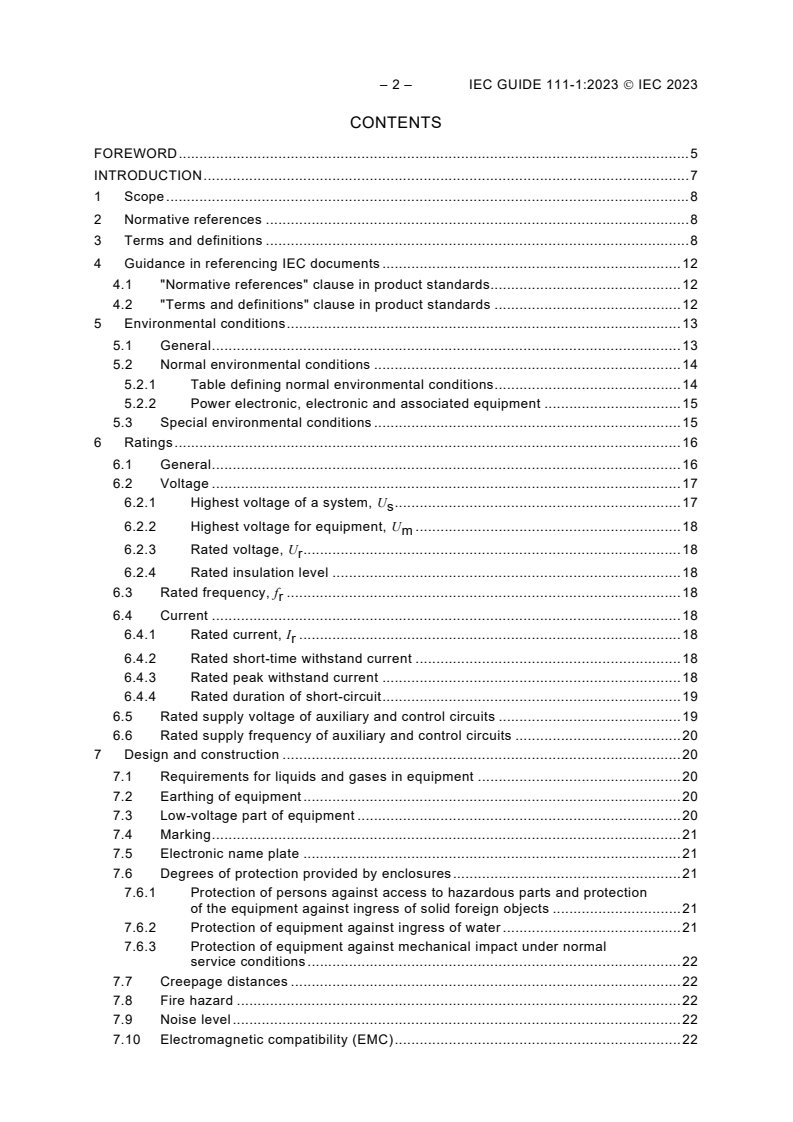
– 2 – IEC GUIDE 111-1:2023 IEC 2023
CONTENTS
FOREWORD . 5
INTRODUCTION . 7
1 Scope . 8
2 Normative references . 8
3 Terms and definitions . 8
4 Guidance in referencing IEC documents . 12
4.1 "Normative references" clause in product standards. 12
4.2 "Terms and definitions" clause in product standards . 12
5 Environmental conditions . 13
5.1 General . 13
5.2 Normal environmental conditions . 14
5.2.1 Table defining normal environmental conditions . 14
5.2.2 Power electronic, electronic and associated equipment . 15
5.3 Special environmental conditions . 15
6 Ratings . 16
6.1 General . 16
6.2 Voltage . 17
6.2.1 Highest voltage of a system, U . 17
s
6.2.2 Highest voltage for equipment, U . 18
m
6.2.3 Rated voltage, U . 18
r
6.2.4 Rated insulation level . 18
6.3 Rated frequency, f . 18
r
6.4 Current . 18
6.4.1 Rated current, I . 18
r
6.4.2 Rated short-time withstand current . 18
6.4.3 Rated peak withstand current . 18
6.4.4 Rated duration of short-circuit . 19
6.5 Rated supply voltage of auxiliary and control circuits . 19
6.6 Rated supply frequency of auxiliary and control circuits . 20
7 Design and construction . 20
7.1 Requirements for liquids and gases in equipment . 20
7.2 Earthing of equipment . 20
7.3 Low-voltage part of equipment . 20
7.4 Marking . 21
7.5 Electronic name plate . 21
7.6 Degrees of protection provided by enclosures . 21
7.6.1 Protection of persons against access to hazardous parts and protection
of the equipment against ingress of solid foreign objects . 21
7.6.2 Protection of equipment against ingress of water . 21
7.6.3 Protection of equipment against mechanical impact under normal
service conditions . 22
7.7 Creepage distances . 22
7.8 Fire hazard . 22
7.9 Noise level . 22
7.10 Electromagnetic compatibility (EMC) . 22
7.10.1 General . 22
7.10.2 Emissions . 23
7.10.3 Immunity . 23
7.11 Mechanical stresses on terminals . 24
7.12 Interfaces . 24
8 Tests . 24
8.1 General . 24
8.1.1 Overview . 24
8.1.2 Types of test . 24
8.1.3 Sequencing and grouping of tests . 25
8.1.4 Information for identification of specimens . 25
8.1.5 Information to be included in type-test reports . 25
8.2 Type tests . 25
8.2.1 Overview . 25
8.2.2 Dielectric tests . 25
8.2.3 Temperature-rise tests . 25
8.2.4 Verification of protection . 25
8.2.5 Electromagnetic compatibility (EMC) tests . 25
8.2.6 Emission tests on LV parts of equipment . 26
8.2.7 Mechanical stresses on terminals . 26
8.2.8 Impact of environmental stresses on products . 26
8.3 Routine tests. 26
8.4 Special tests . 26
8.5 Sample tests . 26
8.6 Commissioning tests . 26
9 Rules for transport, storage, erection, operation and maintenance . 27
10 Safety . 27
10.1 General . 27
10.2 Electrical aspects . 28
10.3 Thermal and mechanical aspects . 28
10.3.1 General . 28
10.3.2 Mechanical aspects . 28
10.3.3 Thermal aspects . 28
10.4 Connection to other equipment . 28
11 Effects of product standards on the natural environment . 29
Annex A (normative) Identification of test specimens . 30
Annex B (normative) Electronic nameplate . 31
B.1 General . 31
B.2 Device name plate (DPL) . 32
Bibliography . 34
Table 1 – Normal environmental conditions . 14
Table 2 – Normal environmental conditions - power electronic, electronic and
associated equipment . 15
Table 3 – Special environmental conditions . 16
Table 4 – DC supply voltage . 19
Table 5 – Auxiliary contact classes . 20
– 4 – IEC GUIDE 111-1:2023 IEC 2023
Table A.1 – List of drawings to be submitted by manufacturer . 30
Table B.1 – Nameplate data objects of equipment interface logical nodes. 31
Table B.2 – Attributes of DPL . 32
Table B.3 – Common data classes (CDCs) for settings . 32
Table B.4 – Attributes of VSD . 33
INTERNATIONAL ELECTROTECHNICAL COMMISSION
____________
ELECTRIC EQUIPMENT FOR HIGH-VOLTAGE SUBSTATIONS – COMMON
RECOMMENDATIONS FOR PRODUCT AND SYSTEM STANDARDS –
Part 1: AC (alternating current)
FOREWORD
1) The International Electrotechnical Commission (IEC) is a worldwide organization for standardization comprising
all national electrotechnical committees (IEC National Committees). The object of IEC is to promote
international co-operation on all questions concerning standardization in the electrical and electronic fields. To
this end and in addition to other activities, IEC publishes International Standards, Technical Specifications,
Technical Reports, Publicly Available Specifications (PAS) and Guides (hereafter referred to as "IEC
Publication(s)"). Their preparation is entrusted to technical committees; any IEC National Committee interested
in the subject dealt with may participate in this preparatory work. International, governmental and non-
governmental organizations liaising with the IEC also participate in this preparation. IEC collaborates closely
with the International Organization for Standardization (ISO) in accordance with conditions determined by
agreement between the two organizations.
2) The formal decisions or agreements of IEC on technical matters express, as nearly as possible, an international
consensus of opinion on the relevant subjects since each technical committee has representation from all
interested IEC National Committees.
3) IEC Publications have the form of recommendations for international use and are accepted by IEC National
Committees in that sense. While all reasonable efforts are made to ensure that the technical content of IEC
Publications is accurate, IEC cannot be held responsible for the way in which they are used or for any
misinterpretation by any end user.
4) In order to promote international uniformity, IEC National Committees undertake to apply IEC Publications
transparently to the maximum extent possible in their national and regional publications. Any divergence
between any IEC Publication and the corresponding national or regional publication shall be clearly indicated in
the latter.
5) IEC itself does not provide any attestation of conformity. Independent certification bodies provide conformity
assessment services and, in some areas, access to IEC marks of conformity. IEC is not responsible for any
services carried out by independent certification bodies.
6) All users should ensure that they have the latest edition of this publication.
7) No liability shall attach to IEC or its directors, employees, servants or agents including individual experts and
members of its technical committees and IEC National Committees for any personal injury, property damage or
other damage of any nature whatsoever, whether direct or indirect, or for costs (including legal fees) and
expenses arising out of the publication, use of, or reliance upon, this IEC Publication or any other IEC
Publications.
8) Attention is drawn to the Normative references cited in this publication. Use of the referenced publications is
indispensable for the correct application of this publication.
9) Attention is drawn to the possibility that some of the elements of this IEC Publication may be the subject of
patent rights. IEC shall not be held responsible for identifying any or all such patent rights.
This first edition of IEC Guide 111-1 has been prepared, in accordance with
ISO/IEC Directives, Part 1, Annex A, by the IEC Advisory Committee on Transmission and
Distribution (ACTAD).
This first edition of IEC Guide 111-1, together with IEC Guide 111-2, cancels and replaces the
second edition of IEC Guide 111 published in 2004.
The main changes with respect to the previous edition are as follows:
a) IEC Guide 111 is revised into two parts – Part 1 for AC and Part 2 for DC (Part 2 to be
prepared);
b) the scope of the document has been expanded to cover electric equipment in AC high-
voltage substations;
c) new definitions have been included;
d) normal conditions have been revised;
– 6 – IEC GUIDE 111-1:2023 IEC 2023
e) a general revision of other clauses.
The text of this IEC Guide is based on the following documents:
Draft Report on voting
SMBNC/25/DV SMBNC/28/RV
Full information on the voting for the approval of this IEC Guide can be found in the report on
voting indicated in the above table.
The language used for the development of this Guide is English.
This document was drafted in accordance with ISO/IEC Directives, Part 2, and developed in
accordance with ISO/IEC Directives, Part 1 and ISO/IEC Directives, IEC Supplement,
available at www.iec.ch/members_experts/refdocs. The main document types developed by
IEC are described in greater detail at www.iec.ch/standardsdev/publications.
INTRODUCTION
This document is for use by IEC technical committees (TCs) involved in high-voltage (HV)
substation systems, such as:
TC 8, TC 13, TC 14, TC 17, TC 20, TC 22, TC 32, TC 33, TC 36, TC 37, TC 38, TC 57, TC 95,
TC 99, TC 115, TC 122, TC 123.
It is of paramount importance that the IEC, through this document, ensures consistency and
avoids discrepancies between standards within one system. A few discrepancies can be
justified in certain cases according to the specificity of a given product or situation.
The cost of over-standardization of a component compared to utilization of the nearest linked
under-standardized component should be considered. The supplementary cost does not in
any way increase the reliability of the system as a whole.
Since the same external stresses (climatic, electrical, and mechanical) apply to all the
components of the substations, the consistency of their technical features is vital.
The same essential requirements for safety, environmental impact, end of life, availability and
integration of systems are applicable. All product standards for a single system need to fulfil
these requirements with the same degree of responsibility.
The aim of this document is to provide common rules for HV substation equipment.
– 8 – IEC GUIDE 111-1:2023 IEC 2023
ELECTRIC EQUIPMENT FOR HIGH-VOLTAGE SUBSTATIONS –
COMMON RECOMMENDATIONS FOR PRODUCT AND SYSTEM
STANDARDS –
Part 1: AC (alternating current)
1 Scope
This part of IEC Guide 111 is a horizontal publication which gives guidance for the
harmonization of product and system standards for HV substations (higher than 1 kV). It
addresses AC equipment which is found in high-voltage (HV) substations in most cases.
This document contains recommendations for common specifications for all HV substation
product and system standards, each of which is augmented by the technical background
specific to each technical committee, which naturally retains freedom in its technical choices.
This document is applicable when developing product and systems standards for HV power
electronic equipment for the AC part of the substation.
NOTE 1 IEC Guide 111-2 relating to DC (direct current) is under development. Once published, IEC Guide 111-2
will be applicable when developing product and systems standards for the HVDC part of the substation.
NOTE 2 The IEC Standardization Management Board (SMB) has decided that Guides such as this one can have
mandatory requirements which shall be followed by all IEC committees developing technical work that falls within
the scope of the Guide, as well as guidance which may or may not be followed. The mandatory requirements in this
Guide are identified by the use of "shall". Statements that are only for guidance are identified by using the verb
"should". (See ISO/IEC Directives, IEC Supplement Part 1, A.1.1.)
2 Normative references
There are no normative references in this document.
3 Terms and definitions
For the purposes of this document, the following terms and definitions apply.
ISO and IEC maintain terminological databases for use in standardization at the following
addresses:
• IEC Electropedia: available at https://www.electropedia.org/
• ISO Online browsing platform: available at https://www.iso.org/obp
3.1
highest voltage of a system
U
s
highest value of operating voltage which occurs under normal operating conditions at any time
and at any point in the system
Note 1 to entry: Transient overvoltages, due e.g. to switching operations, and abnormal temporary variations of
voltage, are not taken into account.
Note 2 to entry: The highest voltage of a system is considered as the phase-to-phase operating voltage (RMS
value).
[SOURCE: IEC 60050-601:1985, 601-01-23, modified – The symbol U and Note 2 to entry
s
have been added.]
3.2
highest voltage for equipment
U
m
greatest value of line-to-line voltage (RMS value) for which the equipment is designed in
respect of its insulation as well as other characteristics which relate to this voltage in the
relevant equipment standards under normal service conditions
[SOURCE: IEC 60050-614:2016, 614-03-01, modified – The symbol U has been added.]
m
3.3
rated voltage
U
r
voltage value assigned by a manufacturer or other entity for a specified
operating condition of a component, device or equipment
Note 1 to entry: The value for the rated voltage of high-voltage equipment is generally assigned from the list of
highest voltages for equipment in Tables 3, 4 and 5 of IEC 60038:2009.
Note 2 to entry: The value for the rated voltage of low voltage equipment is generally assigned from the list of
nominal voltages in Tables 1 and 6 of IEC 60038:2009.
Note 3 to entry: Equipment may have more than one rated voltage value or may have a rated voltage range.
[SOURCE: IEC 60050-614:2016, 614-03-09, modified – The symbol U has been added.]
r
3.4
electric equipment
item used for such purposes as generation, conversion, transmission, distribution or utilization
of electric energy, such as electric machines, transformers, switchgear and controlgear,
measuring instruments, protective devices, wiring systems, current-using equipment
[SOURCE: IEC 60050-826:2004, 826-16-01]
3.5
rated value
value of a quantity used for specification purposes, established for a specified set of operating
conditions of a component, device, equipment, or system
[SOURCE: IEC 60050-151:2001, 151-16-08]
3.6
rated insulation level
test voltages, under specified conditions, that the insulation is designed to withstand
Note 1 to entry: These test voltages can be for instance:
a) rated lightning impulse and short duration power frequency withstand voltages;
b) rated lightning and switching impulse withstand voltages (phase-to-earth).
[SOURCE: IEC 60050-421:1990, 421-09-02]
3.7
rated frequency
f
r
frequency at which the equipment is designed to operate
– 10 – IEC GUIDE 111-1:2023 IEC 2023
Note 1 to entry: The standard values of the rated frequency are 50 Hz and 60 Hz.
[SOURCE: IEC 60050-421:1990, 421-04-03, modified – "transformer or reactor" has been
replaced with "equipment", the symbol f and Note 1 to entry have been added.]
r
3.8
rated current
I
r
RMS value of the current which equipment is designed to carry continuously under specified
conditions of use and behaviour
Note 1 to entry: Rated currents for temporary or for intermittent duty are subject to agreement between
manufacturer and user.
Note 2 to entry: In the area of transformers, rated power is used and not rated current.
3.9
high voltage
HV
set of voltage levels in excess of low voltage
Note 1 to entry: High voltage (HV) covers nominal voltages above low voltage (1,0 kV AC and 1,5 kV DC nominal)
and includes medium voltage (MV), extra high voltage (EHV) and ultra high voltage (UHV).
3.10
high voltage
set of upper voltage levels used in power systems for bulk transmission of
electricity
3.11
high voltage
highest of two or more voltages in an apparatus or installation
3.12
low voltage
LV
set of voltage levels used for the distribution of electricity where the nominal
voltage is generally accepted to be up to 1 000 V for alternating current and 1 500 V for direct
current
3.13
low voltage
lowest of two or more voltages in an apparatus or installation
3.14
medium voltage
MV
subcategory of high voltage applicable to electricity distribution in the voltage range in excess
of low voltage to the upper range of electricity distribution voltages, typically up to 52 kV AC
Note 1 to entry: The upper value of distribution voltage depends on local circumstances and history or common
usage.
3.15
extra high voltage
EHV
subcategory of high voltage applicable to electricity transmission having a highest voltage for
equipment exceeding 245 kV AC and up to 800 kV AC
3.16
ultra high voltage
UHV
subcategory of high voltage applicable to electricity transmission having a highest voltage for
equipment exceeding 800 kV AC
3.17
earthing circuit
conductors, connections, and the conducting parts of earthing devices or of
the metal frame, intended to connect the high-voltage conductive parts of an assembly to the
earthing point provided
Note 1 to entry: The earthing circuit can include short-circuiting circuits between poles and phase-to-earth circuits
from each pole to the earthing point and/or from the short-circuiting point of phase-to-earth circuits to the earthing
point provided.
[SOURCE: IEC 62271-200:2021, 3.5.107]
3.18
earthing system
grounding system (US)
arrangement of electric connections and devices involved necessary to earth equipment or a
system separately or jointly
[SOURCE: IEC 61936-1:2021, 3.7.6]
3.19
required withstand voltage
U
rw
test voltage that the insulation must withstand in a standard withstand voltage test to ensure
that the insulation will meet the performance criterion when subjected to a given class of
overvoltages in actual service conditions and for the whole service duration
Note 1 to entry: The required withstand voltage has the shape of the co-ordination withstand voltage, and is
specified with reference to all the conditions of the standard withstand voltage test selected to verify it.
[SOURCE: IEC 60071-1:2019, 3.28]
3.20
withstand voltage
U
w
)
test voltage suitably selected equal to or above the required withstand voltage (U
rw
Note 1 to entry: For AC equipment, values of withstand voltages U are standardized as per IEC 60071-1.
w
Note 2 to entry: The standard impulse shapes used for withstand tests on equipment as well as the test
procedures are defined in IEC 60060-1 and IEC 60071-1.
[SOURCE: IEC 60071-5:2014, 3.8, modified – The second sentence has been deleted in
Notes 1 and 2 to entry.]
3.21
lightning impulse withstand voltage
LIWV
withstand voltage of insulation with the shape of the standard lightning impulse
[SOURCE: IEC 60071-5:2014, 3.8.2]
– 12 – IEC GUIDE 111-1:2023 IEC 2023
3.22
switching impulse withstand voltage
SIWV
withstand voltage of insulation with the shape of the standard switching impulse
[SOURCE: IEC 60071-5:2014, 3.8.1]
4 Guidance in referencing IEC documents
4.1 "Normative references" clause in product standards
The use of horizontal publications is of the utmost importance for the harmonization process.
Strong reasons are needed to depart from the recommendations of horizontal publications
and, in all cases, it is necessary to explain the reason for any discrepancy.
Within the fields concerned, the essential horizontal documents to be taken into account and
to be mentioned in the normative references clause of each standard are the following:
• field of definitions: International Electrotechnical Vocabulary (IEV) – IEC 60050 series;
• field of voltage: IEC 60038;
• field of current: IEC 60059;
• field of insulation: IEC 60060 series, IEC 60071 series, IEC TS 60815 series and
IEC 61180;
• field of temperature rise: IEC 60216 series and IEC TR 60943;
• field of degrees of protection: IEC 60529 – although IEC 60529 defines its scope as being
limited to voltages not exceeding 72,5 kV, the use of IP classification and testing methods
according to IEC 60529 may be extended to be used also for voltages exceeding 72,5 kV;
• field of environmental conditions affecting the equipment: IEC 60664 series, IEC 60721
series, IEC 60376, IEC 60296, IEC 60867 and IEC TR 62271-300;
• field of environmental aspects if any affected by the equipment: IEC Guide 109, IEC 62474
and IEC 62271-4;
• field of electromagnetic compatibility (EMC): IEC Guide 107; horizontal publications in the
IEC 61000 series; CISPR 11, CISPR TR 18 series, CISPR 32 and CISPR 35;
• field of safety: IEC 61936-1, IEC Guide 104, IEC Guide 117, ISO/IEC Guide 51, IEC 60695
series;
• field of mechanical stresses: IEC 60865 series, IEC 62155 and IEC 62262;
• field of dependability: IEC 60300-3 series, IEC 62308;
• field of information communication: IEC/IEEE 82079-1 and IEC 62271-3.
4.2 "Terms and definitions" clause in product standards
Definitions already in the IEV should be used. If a definition already in the IEV is not
satisfactory or not clear enough, the difficulty should be referred to TC 1 and solved in
cooperation. New definitions should not be used unless absolutely necessary, i.e. no similar
definition exists in publications on a similar subject. A similar definition may be modified with
a reference to the original.
5 Environmental conditions
5.1 General
This clause should be the same for all TCs active in the area of substations. Installations,
including all devices and auxiliary equipment which form an integral part of them, should be
designed for operation under the climatic and environmental conditions listed below.
Equipment product standards should be taken into account.
Normal environmental conditions shown in Table 1 are the environmental conditions defined
for indoor and outdoor conditions in order to coordinate the application of a wide range of
diverse equipment types within a single operating environment such as an electrical
substation. The values chosen address the needs of the majority of applications worldwide
and provide a basis for the design, specification and application of standardized equipment
and installations.
Normal environmental conditions shown in Table 2 are particular environmental conditions
defined for indoor conditions or enclosed conditions associated with power electronic
equipment and other associated equipment. This range is defined in order to coordinate the
application of power electronic equipment and other associated equipment within a single
operating environment.
Technical committees may define ratings of equipment in accordance with Table 1 for general
application and Table 2 for power electronic, electronic and associated applications.
Installations shall take into account the constructive provisions to find the standardized values
in Table 1 and Table 2.
There are many cases where specification of values outside the conditions defined in Table 1
and Table 2 is necessary and justified. These are referred to as special environmental
conditions. These cases can relate to extremes of the natural environment such as higher or
lower temperatures for outdoor installations, or to the specific requirements of equipment or
sub-systems such as the need to avoid sub-zero temperatures for certain equipment. The
effects of enclosures or other factors that alter the environment within which equipment
designed for the normal environment is situated shall be considered separately.
Special environmental conditions associated with extremes of the natural environment are
summarized in Table 3 and these provide a basis for user specification of appropriate special
environmental conditions for their application(s).
Special environmental conditions associated directly with the requirements of specific
equipment types, such as a further-restricted operating temperature range, are detailed in the
appropriate equipment standards. These equipment-specific requirements typically supersede
the more general requirements for the entire electrical installation on the basis that a
specifically controlled operating environment (such as a room, building or enclosure) can be
provided. Whilst these conditions are considered special in the context of this document, they
may be considered "normal" in the context of the specific equipment under consideration. It is
common for sub-systems requiring special environmental conditions as defined in this
document, to be installed within a controlled environment within an electrical installation which
itself is defined as having normal environmental conditions.
TCs should use the phrase "environmental conditions" in preference to "service conditions".
– 14 – IEC GUIDE 111-1:2023 IEC 2023
5.2 Normal environmental conditions
5.2.1 Table defining normal environmental conditions
Table 1 – Normal environmental conditions
Indoor Outdoor
b c
Upper limit ≤ 40 °C ≤ 40 °C
Ambient air
a)
a
temperature
Lower limit ≥ −5 °C ≥ −25 °C
2 d
b) Solar radiation (clear day, noon) Negligible
≤ 1 120 W/m
c) Altitude ≤ 1 000 m ≤ 1 000 m
Very light Medium
Air pollution by dust, salt, smoke,
d)
corrosive/flammable gas, vapours
(Refer to IEC TS 60815 series) (Refer to IEC TS 60815 series)
class 1: ≤ 1 mm
e
e) - or class 10: ≤ 10 mm
Ice coating
or class 20: ≤ 20 mm
f
f) Wind speed - ≤ 34 m/s (corresponds to 700 Pa)
Relative humidity:
≤ 95 %
24 h average
g
one month average
≤ 90 %
Water vapour:
g)
24 h average < 2,2 kPa
one month average < 1,8 kPa
g
Condensation, precipitation None
h
Precipitation
Vibration (external to equipment),
h) Negligible Negligible
earth tremors
i) Electromagnetic disturbances According to IEC Guide 107 According to IEC Guide 107
a
On auxiliary equipment, such as relays and control switches, intended to be used in ambient air temperature
below −5 °C, an agreement between supplier and user is necessary.
b
As a result of heat generated by equipment, consideration needs to be given to the temperature rise of the
local environment. With some power electronic equipment, resultant ambient temperatures can rise up to
60 °C. The ambient temperature up to 60 °C takes into account the heat generated by the equipment. Where
cooling facilities are not installed, special environmental conditions apply.
c
Rapid temperature changes should be taken into account.
d
Under certain conditions of solar radiation, appropriate measures, for example, roofing, forced ventilation,
etc., may be necessary or derating may be used in order not to exceed the specified temperature rises.
Details of global solar radiation are given in IEC 60721-2-4. Ultraviolet (UV) radiation can damage some
synthetic materials. For more details see the IEC 60068 series.
e
In regions where icing can occur the resulting load on flexible conductors and on rigid busbars should be
taken into account. If local experience or statistics are not available, ice coatings of 1 mm, 10 mm or 20 mm
based on criteria given in IEC 62271-1 may be assumed. The density of the ice is assumed to be 900 kg/m
in accordance with IEC 60826.
f
Characteristics of wind are described in IEC 60721-2-2.
g
For these conditions, condensation can occasionally occur. Condensation can be expected where sudden
temperature changes occur in periods of high humidity. To avoid breakdown of insulation or corrosion of
metallic parts due to high humidity and condensation, equipment designed for such conditions and tested
accordingly should be used. Condensation can be prevented by special design of the building or housing, by
suitable ventilation and heating of the station or by the use of dehumidifying equipment. This is particularly
applicable for power electronic equipment.
h
Precipitation in the form of dew, condensation, fog, rain, snow, ice or hoar frost should be taken into
account. Precipitation characteristics for insulation are described in IEC 60060-1 and IEC 60071-1. For other
properties, precipitation characteristics are described in IEC 60721-2-2.
5.2.2 Power electronic, electronic and associated equipment
Table 2 – Normal environmental conditions - power electronic,
electronic and associated equipment
Indoor / enclosed
a
Upper limit
≤ 60 °C
Ambient air
a)
temperature
Lower limit ≥ 5 °C
b) Solar radiation (clear day, noon) Negligible
c) Altitude ≤ 1 000 m
Air pollution by dust, salt, smoke,
b
d) No significant air pollution
corrosive/flammable gas, vapours
e) Ice coating -
f) Wind speed -
Relative humidity ≤ 60 %
g)
Condensation Not allowed
Vibration (external to equipment), earth
h) Negligible
tremors
i) Electromagnetic disturbances According to IEC Guide 107
a
As a result of heat generated by equipment, consideration needs to be given to
the temperature rise of the local environment. With some power electronic
equipment, resultant ambient temperatures can rise up to 60 °C. The ambient
temperature up to 60 °C takes into account the heat generated by the
equipment. Where cooling facilities are not installed, special environmental
conditions apply.
b
Air pollution should be minimized by adequate measures like air filtering and
operation under slight overpressure. An air pollution degree of 2 (non-
conductive pollution) according to IEC 60664-1 should be achieved. Temporary
conductivity of the pollution caused by condensation is not permitted.
5.3 Special environmental conditions
When high-voltage equipment is used under conditions different from the normal
environmental conditions given in 5.2, the user's requirements should refer to the
standardized steps given in Table 3.
When special environmental conditions prevail at the location where equipment is to be put in
service, they should be specified by the user by reference to IEC 60721-1.
– 16 – IEC GUIDE 111-1:2023 IEC 2023
Table 3 – Special environmental conditions
Special Notes
...