

IEC TS 63157:2019
(Main)Photovoltaic systems - Guidelines for effective quality assurance of power conversion equipment
General Information
- Abstract
IEC TS 63157:2019 lays out recommendations for best practices for product realization, safety, customer satisfaction, and stakeholders' relationship used in the manufacture of power conversion equipment (PCE). This document captures key requirements customers would like to see completed to ensure high-quality products, specifically, that the products have the documented properties, including properties needed to give customer satisfaction with regard to the warranty.
The object of this document is to provide more confidence in the ongoing consistency of performance and reliability of certified power conversion equipment. The requirements of this document are defined with the assumption that the quality management system of the organization has already fulfilled the requirements of ISO 9001 or equivalent quality management system. These guidelines also form the basis for factory audit criteria of such sites by various certifying and auditory bodies.
This document covers manufacture of electronic power conversion equipment intended for use in terrestrial PV applications. The term PCE refers to equipment and components for electronic power conversion of electric power into another kind of electric power with respect to voltage, current and frequency. This document applies to PCE in both indoor and outdoor open-air climates as defined in IEC 60721-2-1 and IEC 60721-3-3. Such equipment may include, but is not limited to, DC-to-AC inverters, DC-to-DC converters and battery charge converters.
- Status
- Published
- Publication Date
- 27-Nov-2019
- Technical Committee
- TC 82 - Solar photovoltaic energy systems
- Drafting Committee
- WG 6 - TC 82/WG 6
- Current Stage
- PPUB - Publication issued
- Start Date
- 28-Nov-2019
- Completion Date
- 12-Dec-2019
Overview
IEC TS 63157:2019 - Photovoltaic systems: Guidelines for effective quality assurance of power conversion equipment - provides best-practice recommendations to help manufacturers and stakeholders ensure consistent performance, reliability and customer satisfaction of power conversion equipment (PCE) used in terrestrial PV applications. The Technical Specification supplements ISO 9001-style quality management with PV-specific guidance for components such as inverters, DC‑DC converters and battery charge converters, and serves as a basis for factory audit criteria and certification activities.
Key topics and technical requirements
The document focuses on practical quality-assurance elements that ensure products meet documented properties and warranty expectations. Key topics include:
- Quality management alignment: Assumes an existing ISO 9001 (or equivalent) QMS and specifies PV‑centric extensions.
- Documented information & planning: Requirements for documented processes, risk analysis, preventive actions and quality objectives.
- Design and development controls: Inputs, outputs, change control and manufacturing process design to ensure product requirements are met.
- Control of external providers: Supplier selection, control and information flow for purchased components and outsourced processes.
- Production and service provision: Identification, traceability, preservation, property protection and control of production lines.
- Monitoring, measurement and evaluation: Process monitoring, product release criteria, customer satisfaction measurement and statistical analysis.
- Nonconformity and corrective action: Detection, containment and corrective processes to reduce field failures and warranty claims.
- Factory audit criteria: Practical guidance for auditors and certifying bodies evaluating manufacturing sites and processes.
- Environmental and application scope: Applies to PCE for indoor and outdoor open‑air climates as defined by IEC 60721 climate classifications.
Practical applications
IEC TS 63157 is used to:
- Reduce field failures and warranty incidents for PV power conversion products.
- Define factory‑audit checklists and certification scopes.
- Enhance design‑for‑reliability and production process controls specific to PV electronics.
- Provide procurement and quality teams with objective criteria to evaluate suppliers and manufacturing sites.
Who should use this standard
- PCE manufacturers (inverter and converter OEMs)
- Quality managers and production engineers
- Certification bodies and auditors performing factory assessments
- Procurement and supply‑chain professionals
- System integrators and project owners seeking reliable equipment and clearer warranty expectations
Related standards
- ISO 9001 (quality management systems)
- IEC 60721‑2‑1 / IEC 60721‑3‑3 (climate classification)
- IEC TS 62941 (PV module quality assurance guidance)
- IEC TS 63049 (PV installation quality guidance)
- References to IATF 16949 concepts for manufacturing controls
Keywords: IEC TS 63157:2019, photovoltaic systems, quality assurance, power conversion equipment, PCE, inverters, DC‑DC converters, ISO 9001, factory audit, PV reliability, warranty.
Get Certified
Connect with accredited certification bodies for this standard

DNV
DNV is an independent assurance and risk management provider.

Lloyd's Register
Lloyd's Register is a global professional services organisation specialising in engineering and technology.
DNV Energy Systems
Energy and renewable energy certification.
Sponsored listings
Frequently Asked Questions
IEC TS 63157:2019 is a technical specification published by the International Electrotechnical Commission (IEC). Its full title is "Photovoltaic systems - Guidelines for effective quality assurance of power conversion equipment". This standard covers: IEC TS 63157:2019 lays out recommendations for best practices for product realization, safety, customer satisfaction, and stakeholders' relationship used in the manufacture of power conversion equipment (PCE). This document captures key requirements customers would like to see completed to ensure high-quality products, specifically, that the products have the documented properties, including properties needed to give customer satisfaction with regard to the warranty. The object of this document is to provide more confidence in the ongoing consistency of performance and reliability of certified power conversion equipment. The requirements of this document are defined with the assumption that the quality management system of the organization has already fulfilled the requirements of ISO 9001 or equivalent quality management system. These guidelines also form the basis for factory audit criteria of such sites by various certifying and auditory bodies. This document covers manufacture of electronic power conversion equipment intended for use in terrestrial PV applications. The term PCE refers to equipment and components for electronic power conversion of electric power into another kind of electric power with respect to voltage, current and frequency. This document applies to PCE in both indoor and outdoor open-air climates as defined in IEC 60721-2-1 and IEC 60721-3-3. Such equipment may include, but is not limited to, DC-to-AC inverters, DC-to-DC converters and battery charge converters.
IEC TS 63157:2019 lays out recommendations for best practices for product realization, safety, customer satisfaction, and stakeholders' relationship used in the manufacture of power conversion equipment (PCE). This document captures key requirements customers would like to see completed to ensure high-quality products, specifically, that the products have the documented properties, including properties needed to give customer satisfaction with regard to the warranty. The object of this document is to provide more confidence in the ongoing consistency of performance and reliability of certified power conversion equipment. The requirements of this document are defined with the assumption that the quality management system of the organization has already fulfilled the requirements of ISO 9001 or equivalent quality management system. These guidelines also form the basis for factory audit criteria of such sites by various certifying and auditory bodies. This document covers manufacture of electronic power conversion equipment intended for use in terrestrial PV applications. The term PCE refers to equipment and components for electronic power conversion of electric power into another kind of electric power with respect to voltage, current and frequency. This document applies to PCE in both indoor and outdoor open-air climates as defined in IEC 60721-2-1 and IEC 60721-3-3. Such equipment may include, but is not limited to, DC-to-AC inverters, DC-to-DC converters and battery charge converters.
IEC TS 63157:2019 is classified under the following ICS (International Classification for Standards) categories: 27.160 - Solar energy engineering. The ICS classification helps identify the subject area and facilitates finding related standards.
IEC TS 63157:2019 is available in PDF format for immediate download after purchase. The document can be added to your cart and obtained through the secure checkout process. Digital delivery ensures instant access to the complete standard document.
Standards Content (Sample)
IEC TS 63157 ®
Edition 1.0 2019-11
TECHNICAL
SPECIFICATION
Photovoltaic systems – Guidelines for effective quality assurance of power
conversion equipment
All rights reserved. Unless otherwise specified, no part of this publication may be reproduced or utilized in any form
or by any means, electronic or mechanical, including photocopying and microfilm, without permission in writing from
either IEC or IEC's member National Committee in the country of the requester. If you have any questions about IEC
copyright or have an enquiry about obtaining additional rights to this publication, please contact the address below or
your local IEC member National Committee for further information.
IEC Central Office Tel.: +41 22 919 02 11
3, rue de Varembé info@iec.ch
CH-1211 Geneva 20 www.iec.ch
Switzerland
About the IEC
The International Electrotechnical Commission (IEC) is the leading global organization that prepares and publishes
International Standards for all electrical, electronic and related technologies.
About IEC publications
The technical content of IEC publications is kept under constant review by the IEC. Please make sure that you have the
latest edition, a corrigendum or an amendment might have been published.
IEC publications search - webstore.iec.ch/advsearchform Electropedia - www.electropedia.org
The advanced search enables to find IEC publications by a The world's leading online dictionary on electrotechnology,
variety of criteria (reference number, text, technical containing more than 22 000 terminological entries in English
committee,…). It also gives information on projects, replaced and French, with equivalent terms in 16 additional languages.
and withdrawn publications. Also known as the International Electrotechnical Vocabulary
(IEV) online.
IEC Just Published - webstore.iec.ch/justpublished
Stay up to date on all new IEC publications. Just Published IEC Glossary - std.iec.ch/glossary
details all new publications released. Available online and once 67 000 electrotechnical terminology entries in English and
a month by email. French extracted from the Terms and Definitions clause of IEC
publications issued since 2002. Some entries have been
IEC Customer Service Centre - webstore.iec.ch/csc collected from earlier publications of IEC TC 37, 77, 86 and
If you wish to give us your feedback on this publication or need CISPR.
further assistance, please contact the Customer Service
Centre: sales@iec.ch.
IEC TS 63157 ®
Edition 1.0 2019-11
TECHNICAL
SPECIFICATION
Photovoltaic systems – Guidelines for effective quality assurance of power
conversion equipment
INTERNATIONAL
ELECTROTECHNICAL
COMMISSION
ICS 27.160 ISBN 978-2-8322-7607-5
– 2 – IEC TS 63157:2019 IEC 2019
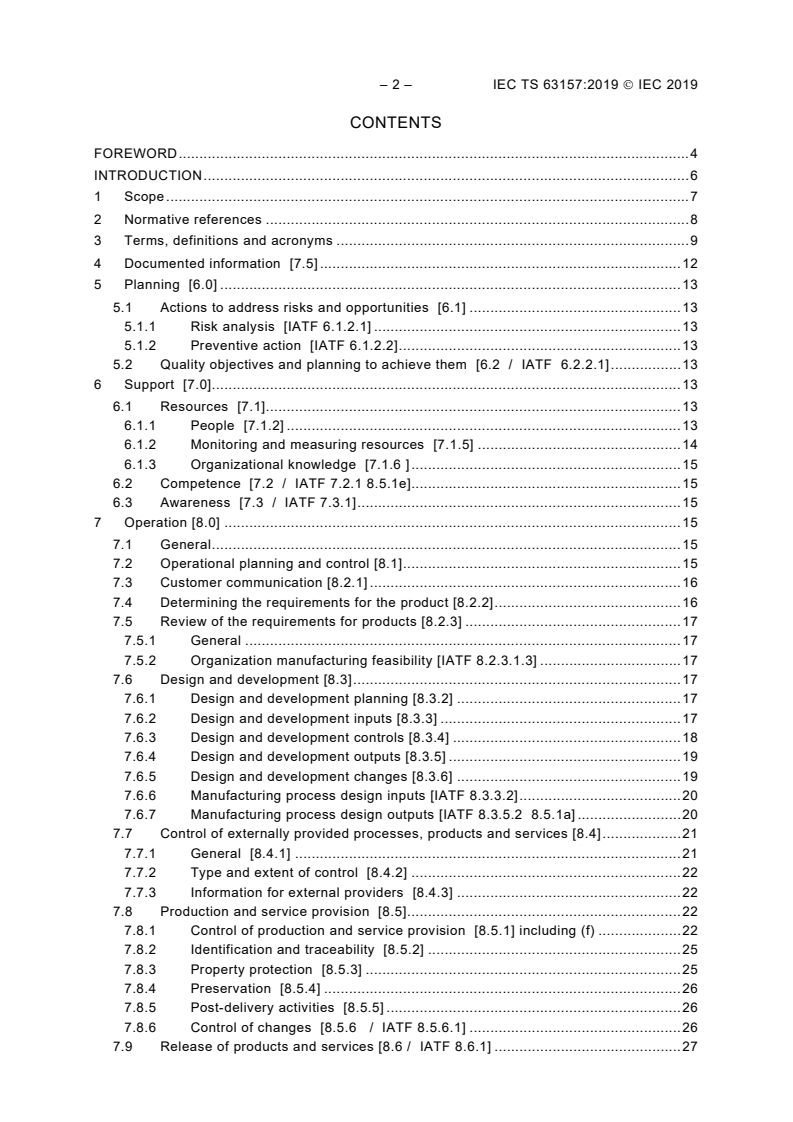
CONTENTS
FOREWORD . 4
INTRODUCTION . 6
1 Scope . 7
2 Normative references . 8
3 Terms, definitions and acronyms . 9
4 Documented information [7.5] . 12
5 Planning [6.0] . 13
5.1 Actions to address risks and opportunities [6.1] . 13
5.1.1 Risk analysis [IATF 6.1.2.1] . 13
5.1.2 Preventive action [IATF 6.1.2.2] . 13
5.2 Quality objectives and planning to achieve them [6.2 / IATF 6.2.2.1] . 13
6 Support [7.0]. 13
6.1 Resources [7.1]. 13
6.1.1 People [7.1.2] . 13
6.1.2 Monitoring and measuring resources [7.1.5] . 14
6.1.3 Organizational knowledge [7.1.6 ] . 15
6.2 Competence [7.2 / IATF 7.2.1 8.5.1e]. 15
6.3 Awareness [7.3 / IATF 7.3.1] . 15
7 Operation [8.0] . 15
7.1 General . 15
7.2 Operational planning and control [8.1] . 15
7.3 Customer communication [8.2.1] . 16
7.4 Determining the requirements for the product [8.2.2] . 16
7.5 Review of the requirements for products [8.2.3] . 17
7.5.1 General . 17
7.5.2 Organization manufacturing feasibility [IATF 8.2.3.1.3] . 17
7.6 Design and development [8.3] . 17
7.6.1 Design and development planning [8.3.2] . 17
7.6.2 Design and development inputs [8.3.3] . 17
7.6.3 Design and development controls [8.3.4] . 18
7.6.4 Design and development outputs [8.3.5] . 19
7.6.5 Design and development changes [8.3.6] . 19
7.6.6 Manufacturing process design inputs [IATF 8.3.3.2] . 20
7.6.7 Manufacturing process design outputs [IATF 8.3.5.2 8.5.1a] . 20
7.7 Control of externally provided processes, products and services [8.4] . 21
7.7.1 General [8.4.1] . 21
7.7.2 Type and extent of control [8.4.2] . 22
7.7.3 Information for external providers [8.4.3] . 22
7.8 Production and service provision [8.5] . 22
7.8.1 Control of production and service provision [8.5.1] including (f) . 22
7.8.2 Identification and traceability [8.5.2] . 25
7.8.3 Property protection [8.5.3] . 25
7.8.4 Preservation [8.5.4] . 26
7.8.5 Post-delivery activities [8.5.5] . 26
7.8.6 Control of changes [8.5.6 / IATF 8.5.6.1] . 26
7.9 Release of products and services [8.6 / IATF 8.6.1] . 27
7.9.1 General . 27
7.9.2 Statutory and regulatory conformity [IATF 8.6.5] . 27
7.9.3 Acceptance criteria [IATF 8.6.6] . 27
7.10 Control of nonconforming outputs [8.7] . 27
8 Performance evaluation [9.0] . 28
8.1 Monitoring, measurement, analysis and evaluation [9.1] . 28
8.1.1 Monitoring and measurement of a manufacturing process [IATF 9.1.1.1] . 28
8.1.2 Customer satisfaction [9.1.2] . 28
8.1.3 Analysis and evaluation [9.1.3] . 29
8.2 Internal audit [9.2] . 29
9 Improvement [10.0] . 29
9.1 Nonconformity and corrective action [10.2] . 29
9.2 Continual improvement [10.3] . 30
Annex A (informative) Correspondence between ISO 9001:2015 and IEC TS 63157 . 31
Annex B (informative) Background on approaches for quality assurance . 33
Bibliography . 34
– 4 – IEC TS 63157:2019 IEC 2019
INTERNATIONAL ELECTROTECHNICAL COMMISSION
____________
PHOTOVOLTAIC SYSTEMS – GUIDELINES FOR EFFECTIVE
QUALITY ASSURANCE OF POWER CONVERSION EQUIPMENT
FOREWORD
1) The International Electrotechnical Commission (IEC) is a worldwide organization for standardization comprising
all national electrotechnical committees (IEC National Committees). The object of IEC is to promote international
co-operation on all questions concerning standardization in the electrical and electronic fields. To this end and
in addition to other activities, IEC publishes International Standards, Technical Specifications, Technical Reports,
Publicly Available Specifications (PAS) and Guides (hereafter referred to as “IEC Publication(s)”). Their
preparation is entrusted to technical committees; any IEC National Committee interested in the subject dealt with
may participate in this preparatory work. International, governmental and non-governmental organizations liaising
with the IEC also participate in this preparation. IEC collaborates closely with the International Organization for
Standardization (ISO) in accordance with conditions determined by agreement between the two organizations.
2) The formal decisions or agreements of IEC on technical matters express, as nearly as possible, an international
consensus of opinion on the relevant subjects since each technical committee has representation from all
interested IEC National Committees.
3) IEC Publications have the form of recommendations for international use and are accepted by IEC National
Committees in that sense. While all reasonable efforts are made to ensure that the technical content of IEC
Publications is accurate, IEC cannot be held responsible for the way in which they are used or for any
misinterpretation by any end user.
4) In order to promote international uniformity, IEC National Committees undertake to apply IEC Publications
transparently to the maximum extent possible in their national and regional publications. Any divergence between
any IEC Publication and the corresponding national or regional publication shall be clearly indicated in the latter.
5) IEC itself does not provide any attestation of conformity. Independent certification bodies provide conformity
assessment services and, in some areas, access to IEC marks of conformity. IEC is not responsible for any
services carried out by independent certification bodies.
6) All users should ensure that they have the latest edition of this publication.
7) No liability shall attach to IEC or its directors, employees, servants or agents including individual experts and
members of its technical committees and IEC National Committees for any personal injury, property damage or
other damage of any nature whatsoever, whether direct or indirect, or for costs (including legal fees) and
expenses arising out of the publication, use of, or reliance upon, this IEC Publication or any other IEC Publications.
8) Attention is drawn to the Normative references cited in this publication. Use of the referenced publications is
indispensable for the correct application of this publication.
9) Attention is drawn to the possibility that some of the elements of this IEC Publication may be the subject of patent
rights. IEC shall not be held responsible for identifying any or all such patent rights.
The main task of IEC technical committees is to prepare International Standards. In exceptional
circumstances, a technical committee may propose the publication of a technical specification
when
• the required support cannot be obtained for the publication of an International Standard,
despite repeated efforts, or
• the subject is still under technical development or where, for any other reason, there is the
future but no immediate possibility of an agreement on an International Standard.
Technical specifications are subject to review within three years of publication to decide whether
they can be transformed into International Standards.
IEC TS 63157, which is a technical specification, has been prepared by IEC technical committee
82: Solar photovoltaic energy systems.
The text of this technical specification is based on the following documents:
Enquiry draft Report on voting
82/1595/DTS 82/1625A/RVDTS
Full information on the voting for the approval of this technical specification can be found in the
report on voting indicated in the above table.
This document has been drafted in accordance with the ISO/IEC Directives, Part 2.
The committee has decided that the contents of this document will remain unchanged until the
stability date indicated on the IEC website under "http://webstore.iec.ch" in the data related to
the specific document. At this date, the document will be
• reconfirmed,
• withdrawn,
• replaced by a revised edition, or
• amended.
A bilingual version of this publication may be issued at a later date.
– 6 – IEC TS 63157:2019 IEC 2019
INTRODUCTION
The fundamentals of maintaining a quality assurance system are described in ISO 9001. The
IEC Technical Committee 82 has supplemented ISO 9001 with additional technical details for
guiding creation of quality assurance systems for the manufacture of photovoltaic (PV) modules
(IEC TS 62941) and for installation of photovoltaic systems (IEC TS 63049).
Failures of PV systems are often reported to be caused by failures of the power conversion
equipment, such as inverters and DC-DC converters. This document was developed to help the
industry reduce those failures in a standardized and cost-effective way. It builds on ISO 9001
by adding technical details to be included in a quality assurance system. To facilitate the
understanding of how ISO 9001 complements this document, the related ISO 9001
clause/subclause numbers are noted in square brackets as part of each heading as well as
being tabulated in Annex A. A few references are also made to the IATF (International
Automotive Task Force) 16949 Quality Management Systems.
PHOTOVOLTAIC SYSTEMS – GUIDELINES FOR EFFECTIVE
QUALITY ASSURANCE OF POWER CONVERSION EQUIPMENT
1 Scope
This document lays out recommendations for best practices for product realization, safety,
customer satisfaction, and stakeholders' relationship used in the manufacture of power
conversion equipment (PCE).
This document captures key requirements customers would like to see completed to ensure
high-quality products, specifically, that the products have the documented properties, including
properties needed to give customer satisfaction with regard to the warranty.
The object of this document is to provide more confidence in the ongoing consistency of
performance and reliability of certified power conversion equipment. The requirements of this
document are defined with the assumption that the quality management system of the
organization has already fulfilled the requirements of ISO 9001 or equivalent quality
management system. These guidelines also form the basis for factory audit criteria of such sites
by various certifying and auditory bodies.
This document covers manufacture of electronic power conversion equipment intended for use
in terrestrial PV applications. The term PCE refers to equipment and components for electronic
power conversion of electric power into another kind of electric power with respect to voltage,
current and frequency. This document applies to PCE in both indoor and outdoor open-air
climates as defined in IEC 60721-2-1 and IEC 60721-3-3. Such equipment may include, but is
not limited to, DC-to-AC inverters, DC-to-DC converters and battery charge converters.
This document covers PCE that is used with PV arrays. The equipment may also be connected
to other DC source or load circuits such as batteries. All parts of the PCE are included (e.g.
connectors and software). This document may be used for accessories for use with PCE, except
where more appropriate standards exist.
The object of this document is to define steps for providing assurance that:
• The customers’ expectations are identified and the product is designed to meet those
expectations,
• The performance characteristics and method of meeting the customers’ expectations (e.g.
efficiency) are identified,
• The specifications are either in conformance with the related standards or mentioned by the
manufacturer on the data sheet or other product literature,
• The product has each of the properties described on the data sheet or other product
literature, and
• The product has been designed and manufactured to retain those same properties after
normal and reasonable environmental stresses experienced in the field (including worst-
case typical temperatures, thermal cycling, corrosive conditions, over voltages/currents on
DC and AC lines, transportation and installation, etc.) as well as survive stresses coming
from the grid within the promise of the warranty.
To achieve these goals, this document requires:
• Analysis to identify potential failure modes and creation of a plan to prevent these during
the time of the design lifetime,
• A documented change management control process to address raw material or
manufacturing changes arising both internal and external to the organization,
– 8 – IEC TS 63157:2019 IEC 2019
• A documented supplier quality management process with integrated performance standards
that uses continuous improvement to enhance overall product quality,
• A documented manufacturing process with workmanship standards that uses continuous
improvement to enhance product quality,
• A documented manufacturing process that includes steps that identify when the process has
gone out of control and high-level measures to follow to bring the process back in control
as specified by an out-of-control action plan (OCAP). This includes measurements that
ensure that the products have the defined properties including test results expected for
certification, standards and warranty, and
• Testing of software to ensure that it works in the anticipated situations.
2 Normative references
The following documents are referred to in the text in such a way that some or all of their content
constitutes requirements of this document. For dated references, only the edition cited applies.
For undated references, the latest edition of the referenced document (including any
amendments) applies.
IEC 60812, Failure modes and effects analysis (FMEA and FMECA)
IEC 61000-6-1:2016, Electromagnetic compatibility (EMC) – Part 6-1: Generic standards –
Immunity standard for residential, commercial and light-industrial environments
IEC 61000-6-2:2016, Electromagnetic compatibility (EMC) – Part 6-2: Generic standards –
Immunity standard for industrial environments
IEC 61000-6-3:2006, Electromagnetic compatibility (EMC) – Part 6-3: Generic standards –
Emission standard for residential, commercial and light-industrial environments
IEC 61000-6-3:2006/AMD1:2010
IEC 61000-6-4:2018, Electromagnetic compatibility (EMC) – Part 6-4: Generic standards –
Emission standard for industrial environments
IEC TS 61836, Solar photovoltaic energy systems – Terms, definitions and symbols
IEC 61850-7-420:2009, Communication networks and systems for power utility automation –
Part 7-420: Basic communication structure – Distributed energy resources logical node
IEC 62093, Balance-of-system components for photovoltaic systems – Design qualification
natural environments
IEC 62109-1, Safety of power converters for use in photovoltaic power systems – Part 1:
General requirements
IEC 62109-2, Safety of power converters for use in photovoltaic power systems – Part 2:
Particular requirements for inverters
IEC 62443 (all parts), Industrial communication networks – Network and system security
IEC 62894:2014, Photovoltaic inverters – Data sheet and name plate
IEC 62920:2017, Photovoltaic power generating systems – EMC requirements and test methods
for power conversion equipment
ISO/IEC Guide 98-3:2008, Uncertainty of measurement – Part 3: Guide to the expression of
uncertainty in measurement
ISO 4180, Packaging – Complete, filled transport packages – General rules for the compilation
of performance test schedules
ISO 9000:2015, Quality management systems – Fundamentals and vocabulary’
ISO 9001:2015, Quality management systems – Requirements
ISO 19011:2018, Guidelines for auditing management systems
IEEE 1547, IEEE Standard for Interconnection and Interoperability of Distributed Energy
Resources with Associated Electric Power Systems Interfaces
FCC Title 47 CFR Part 15, Federal Communications Commission rules and regulations, Code
of Federal Regulations, Title 47, Part 15
IPC-9592B:2012, Requirements for Power Conversion Devices for the Computer and
Telecommunications Industries
ANSI/ASQ Z1.4:2013, Sampling procedures and tables for inspection by attributes
ANSI/ASQ Z1.9:2013, Sampling Procedures and Tables for Inspection by Variables for Percent
Nonconforming
ANSI/ESD S20.20-2014, Protection of Electrical and Electronic Parts, Assemblies and
Equipment (Excluding Electrically Initiated Explosive Devices)
IATF 16949:2016, Quality Management Systems
3 Terms, definitions and acronyms
For the purposes of this document, the terms and definitions given in ISO 9000, IEC TS 61836,
and the following apply.
ISO and IEC maintain terminological databases for use in standardization at the following
addresses:
• IEC Electropedia: available at http://www.electropedia.org/
• ISO Online browsing platform: available at http://www.iso.org/obp
3.1
balance of system
BOS
parts of a PV system other than the PV array field, including switches, controls, meters, power
conditioning equipment, PV array support structure, and electricity storage components, if any
3.2
containment
action taken to protect the customer from the effect of a situation. Containment may include
correcting an existing situation or adding additional screening or retesting
Note 1 to entry: Containment may include correcting an existing situation or adding additional screening or retesting.
– 10 – IEC TS 63157:2019 IEC 2019
3.3
control plan
documented description of the systems and processes required for controlling the product and
process quality by addressing the key characteristics and engineering requirements
3.4
cost of quality
cost of not creating a quality product or service, including the cost of reworking of product that
is found to be outside of tolerance
Note 1 to entry: The cost of quality may include the cost of reworking of product that is found to be outside of
tolerance.
3.5
critical item list
list of materials, components and software that have relatively high impact in determining
product reliability
3.6
customer
all of the stakeholders and decision makers involved in the various stages of the system delivery
process, and including the end user
3.7
design for assembly, manufacturing and testing
design technique for manufacturing ease of an assortment of parts to be assembled into the
final product, focusing on minimizing the complexity of the manufacturing and assembly
processes
3.8
design lifetime
design target period during which balance-of-system (BOS) components are expected to safely
satisfy the specified performance under the specified conditions
Note 1 to entry: Specified conditions include application of use, installation environment configurations and
operation conditions of the BOS components in use. The design target period is set considering changes in
performance of BOS components due to aging degradation of parts and materials used in the stated environment.
3.9
define, measure, analyze, improve, and control
DMAIC
data-driven quality strategy for improving processes and an integral part of a Six Sigma quality
initiative
3.10
electrostatic discharge
ESD
sudden flow of electricity between two electrically charged objects caused by contact, an
electrical short, or dielectric breakdown
Note 1 to entry: Electrostatic discharge events are known to damage semiconductor devices such as diodes.
3.11
Failure Modes and Effects Analysis
FMEA
document that defines the design, process, or solution with requirements and includes potential
modes, causes and severity of effects of failure, along with an evaluation of the likelihood of
their occurrence and ease of detection.
Note 1 to entry: The FMEA provides a mechanism to prioritize the risks and take appropriate mitigation steps.
3.12
key design characteristics
characteristics of the final product that are important to customer satisfaction
3.13
organization
entity that supplies product to the customer and that has responsibility for design, production,
and after-service for the product
Note 1 to entry: The organization may subcontract some of its responsibilities for design, production, and the after-
sales service.
3.14
out of box audit
pre-shipment audit
simulation of what a customer would experience when they open the packing box
Note 1 to entry: Samples of crates or packing boxes are taken from the delivery waiting for shipment and audited
for compliance to packing, labeling instructions, documents along with the product, and finally the product itself.
Product is verified for compliance to customer requirements including visual, dimension and functional. Non-
conformances from these audits are escapes from the processes and outgoing inspection controls. These non-
conformances are analyzed and fed back to improve the processes and controls to prevent recurrence.
3.15
out of control action plan
OCAP
supporting document to an SPC (statistical process control) chart
Note 1 to entry: An OCAP is typically presented as a flowchart that guides manufacturing floor employees' reactions
to out-of-control situations. An OCAP consists of activators (which define out-of-control conditions); checkpoints
(which are likely causes for the conditions); and terminators (which contain the action that should resolve the
conditions). OCAPs should be dynamic and updated continually as and when new knowledge and information become
available. A frequently occurring OCAP activator is an indication of a systemic issue in the process.
3.16
Plan, Do, Check, Act
PDCA
four-step process for quality improvement. In the first step (Plan), a way to affect improvement
is developed. In the second step (Do), the plan is carried out, preferably on a small scale. In
the third step (Check), a study takes place between what was predicted and what was observed
in the previous step. In the last step (Act), action is taken on the causal system to affect the
desired change
3.17
performance warranty
warranty provided by the party ensuring product liability to guarantee the specified performance
of the BOS components over the specified period and under the specified conditions
3.18
Process Failure Modes and Effects Analysis
PFMEA
quality engineering approach focussed on the manufacturing process
Note 1 to entry: PVMEA is to be compared to an FMEA, which is a reliability engineering approach focussed on
usage of the product.
3.19
Product Life-Cycle Management
process of managing the entire life cycle of a product from inception, through engineering
design and manufacture, to service and disposal of manufactured products
– 12 – IEC TS 63157:2019 IEC 2019
3.20
prototype
early sample, model, or release of a product built to test a concept or process, but may not
have been produced with the intended future processes
3.21
Quality Management System
QMS
formalized system that documents the structure, responsibilities, and procedures required to
achieve effective quality management
3.22
quality plan
document, or several documents, that together specify quality standards, practices, resources,
specifications, and the sequence of activities relevant to a particular product, service, project,
or contract
3.23
repeatability
variation in measurements obtained when one measurement device is used several times by
the same person to measure the same characteristic on the same product
3.24
reproducibility
variation in measurements made by different people using the same measuring device to
measure the same characteristic on the same product
3.25
statistical capability
statistical measure of the inherent process variability of a given characteristic in comparison to
the specification limits
3.26
statistical process control
application of statistical techniques to control and monitor process
Note 1 to entry: It is used to determine the stability and predictability of a process.
3.27
supplier
provider of materials to an organization building product manufacturing and assembly
3.28
system delivery process
all stages of the system development beginning at concept and ending at site restoration
4 Documented information [7.5]
Records related to design, qualification, engineering changes, monitoring, and measurement of
manufacturing processes and products, final testing, and customer details that are necessary
to secure the warranty condition and that are defined by the organization, shall be retained for
a necessary period.
Records should also include Certificates of Conformity (CoC) and Certificates of Conformity
Analysis (CoA) of critical items identified by the organization.
5 Planning [6.0]
5.1 Actions to address risks and opportunities [6.1]
5.1.1 Risk analysis [IATF 6.1.2.1]
The organization shall evaluate product risks and document in the appropriate FMEA as defined
in IEC 60812 or equivalent. See 7.6.1. The organization shall include in its risk analysis, at a
minimum, lessons learned from prior product recalls, product audits, product stress testing, field
returns and repairs, complaints, scrap, and rework.
The organization shall retain documented information of the results of risk analysis and any
preventive actions taken to address opportunities for improvement.
5.1.2 Preventive action [IATF 6.1.2.2]
The organization shall determine and implement action(s) to eliminate the causes of potential
nonconformities in order to prevent their occurrence. Preventive actions shall be appropriate to
the severity of the potential issues.
The organization shall establish a process to lessen the impact of negative effects of risk
including the following:
a) determining potential nonconformities and their causes,
b) evaluating the need for action to prevent occurrence of nonconformities,
c) determining and implementing action needed,
d) documented information of action taken,
e) reviewing the effectiveness of the preventive action taken,
f) utilizing lessons learned to prevent recurrence in similar processes.
5.2 Quality objectives and planning to achieve them [6.2 / IATF 6.2.2.1]
The organization shall ensure that quality objectives to meet customer requirements are defined,
established, and maintained for relevant functions, processes, and levels throughout the
organization.
This should include Cost of quality parameters. The parameters should be defined and
quantified for particular equipment/device. This factor will provide further impetus to
demonstrate that quality impacts the bottom line significantly.
The results of the organization's review regarding interested parties and their relevant
requirements shall be considered when the organization establishes its annual (at a minimum)
quality objectives and related performance targets (internal and external).
6 Support [7.0]
6.1 Resources [7.1]
6.1.1 People [7.1.2]
6.1.1.1 Provision of resources for commissioning
The organization shall provide resources for training workers to inspect all aspects of the
system and to record any issues during commissioning.
– 14 – IEC TS 63157:2019 IEC 2019
6.1.1.2 Provision of resources for after sales services [IATF 10.2.5]
In addition to the basic QMS-required resource planning, the organization shall determine and
provide the resources needed to maintain the product warranty system, including provision of
after-sales service and for identifying cause of failure and any appropriate follow-up actions
such as adjustment to quality control plan or warranty recall. For repairable products, the
organization shall determine and include staffing and training of service personnel to do in-field
service and adequately plan for maintaining spare part depots and service centres to assure
the necessary quality of service for customers.
6.1.1.3 Succession planning
The organization shall plan for succession for key functions that affect customer satisfaction,
quality, reliability, safety, and performance.
6.1.1.4 Training of workers
Workers responsible for tasks that are critical for the specified operation of the PCE in either
the short term or long term shall be appropriately trained and certified for performance of that
task. These critical tasks (e.g. soldering and testing/verification) shall be identified as part of
the risk assessment or determination of product requirements.
NOTE Examples of existing standards that may aid in establishing certification procedures include IPC-A-610E-
2010, EIA/J-STD-001, and IPC/WHMA-A-620. Requirements are specified in the control plan as noted in 7.8.1.1.
6.1.2 Monitoring and measuring resources [7.1.5]
6.1.2.1 General
Monitoring and measurement equipment referenced in the control plan shall be characterized
by measurement system analysis to understand gauge capabilities (repeatability and
reproducibility).
Software shall be considered an integral part of monitoring and measuring equipment and shall
be appropriately controlled and validated. For changes that affect configuration, including
software, the organization shall revalidate monitoring and measurement equipment.
For monitoring and measurement equipment determined to be out of tolerance at the time of
calibration, corrective actions shall be taken to determine impact to the product and documented
per Clause 4.
6.1.2.2 Control of performance measurement equipment
For the equipment used to measure critical performance metrics of the product, the organization
shall maintain a control program. Records of compliance shall be maintained.
The organization shall retain all calibration certificates for electrical meters used for the rating
or a report that can be traceable to international or national measurement standards. This
information shall be traceable for each product manufactured and made available to customers
upon request.
Electrical measuring devices and the methodology used for performance rating shall have an
initial estimate of the uncertainty according to ISO/IEC Guide 98-3. The uncertainty analysis
shall be re-evaluated at least annually.
Equipment accuracy and calibration shall be verified annually at a minimum, or more frequently
if needed to maintain calibration.
During construction all equipment used should be calibrated including torque wrenches with
torque marks clearly identified
6.1.3 Organizational knowledge [7.1.6 ]
The organization shall determine necessary knowledge gained from experience, lessons
learned, success, failures, conferences, etc. and make this information available to the extent
necessary including when addressing changing needs and trends.
6.2 Competence [7.2 / IATF 7.2.1 8.5.1e]
The organization shall establish and maintain a documented process(es) for identifying training
needs including awareness and achieving competence of all personnel performing activities
affecting conformity to product and process requirements including warranty and after-sales
service. Personnel performing specific assigned tasks shall be qualified, as required, with
particular attention to the satisfaction of customer requirements.
6.3 Awareness [7.3 / IATF 7.3.1]
The organization shall maintain documented information that demonstrates that all employees
are aware of their impact on product quality and the importance of their activities in achieving,
maintaining, and improving quality, including customer requirements and the risks involved for
the customer with nonconforming product.
7 Operation [8.0]
7.1 General
The organization is required to implement a recognized basic QMS. In addition, the following
requirements shall also apply.
7.2 Operational planning and control [8.1]
In planning, the organization shall also determine the following, as appropriate:
a) Product certification requirements.
b) Product properties that align with customers’ expectations for performance including such
factors as power conversion efficiency, defined DC input voltage window, output voltage
and frequency within specifications, ability to control operating state on command or in
response to changing conditions, availability, serviceability, reparability, ability to
communicate current operating conditions through common data interfaces if part of product
specification, and other properties described or referenced below.
c) Design lifetime aligned with the stated warranty under specific conditions and a documented
method to ensure compliance to stated warranty by a combination of product reliability and
after-sales services.
d) Ability to tolerate typical variations within the operating environment.
e) Recycling requirements at the end of the product’s lifetime.
f) Quality assurance and control measures to be applied to production to meet requirements
of the applicable component standards.
g) Electrostatic discharge (ESD) safe environmental area
The organization shall identify the ESD sensitive materials and components and shall
determine an ESD safe environmental area and maintain an ESD safe environment at the
raw material storage, processing, assembly areas, and all through packaging and shipping.
NOTE A process similar to that defined in IEC 61000-4-2, ANSI/ESD S20.20, or as appropriate.
h) Packaging, storage and transportation requirements.
i) Requirements for ensuring quality assurance of components received from suppliers.
Customer requirements and references to related technical specifications, as applicable, shall
be included in the planning of product realization as a component of the quality plan.
– 16 – IEC TS 63157:2019 IEC 2019
With changing requirements from the market place and with emerging new technology in the
PV industry, the development and launch of new products should meet requirements of the
product warranty as well as customers’ needs. For products marketed to meet a local product
life-cycle management requirement, related aspects of the device manufacturing are controlled.
The product certification may depend on the application and geographies where the product will
be installed.
The recycling requirements should comply with the geographies where the product will be
installed.
7.3 Customer communication [8.2.1]
The organization shall also determine and implement effective arrangements for communicating
with customers in relation to the following:
a) Safety, workmanship warranty, output power warranty, and installation guidelines including
electrical and mechanical installation instruction.
b) Application notes detailing parameters and ranges of the designed-for operating
environment and the specific attention and care needed to secure product design lifetime
of the installed configuration, including any exclusions or preconditions.
rd
c) Relevant 3 -party qualifications and certification information.
d) The definition of cosmetic defects and associated product categories due to downgrade
associated with cosmetic defects.
e) The definition of a warrantable defect or safety critical defect and the rules or process to
manage stated defects.
f) Recommended spare parts inventory, and
g) Product recall notices with appropriate report to the supervisory authorities based on the
related law or regulations.
The identified design is summarized in a data sheet that clearly communicates to the customer
using standard terminology such as described in IEC 62894. The data sheet should identify the
relevant standards to which the component is in compliance
NOTE “Information” includes, but is not limited to, specifications, drawings, and other material, including
“installation” manuals.
7.4 Determining the requirements for the product [8.2.2]
The organization shall determine product warranty requirement and its relationship to design
lifetime under specified and intended use conditions, including temperature, humidity, dust,
voltage (consistent with datasheet specification), conditions of the grid, and weather exposure
for all components, as applicable. In addition, equipment interaction with flora, fauna, rodents
and vermin in the application environment shall be given due consideration in the requirements
of the product. The analysis of the use environment shall include transportation, storage and
installation. The organization shall ensure that all products are qualified to all relevant
performance and safety type tests.
The organization shall incorporate requirements arising from applicable previous failure
information, customer complaints, competitive analysis, supplier feedback, stress
...