

IEC 60076-11:2018
(Main)Power transformers - Part 11: Dry-type transformers
General Information
- Abstract
IEC 60076-11:2018 applies to dry-type power transformers (including auto-transformers) having values of highest voltage for equipment up to and including 72,5 kV and at least one winding operating at greater than 1,1 kV. This document does not apply to:
- gas-filled dry-type transformers where the gas is not air;
- single-phase transformers rated at less than 5 kVA;
- polyphase transformers rated at less than 15 kVA;
- instrument transformers;
- starting transformers;
- testing transformers;
- traction transformers mounted on rolling stock;
- flameproof and mining transformers;
- welding transformers;
- voltage regulating transformers;
- small power transformers in which safety is a special consideration.
Where IEC standards do not exist for the transformers mentioned above or for other special transformers, this document may be applicable as a whole or in parts. This second edition cancels and replaces the first edition published in 2004 and constitutes a technical revision. The main changes with regard to the previous edition are as follows:
- Extension of the scope up to 72,5kV
- Enclosure management in regards of the performance
- Management of the dielectric and thermal features with altitude
- New climatic classes for a better adaptation of customers’ need
- Establishment of the relation between location and environmental classes
- For fire behaviour classes, limitation at 1000kVA and process of test more robust
- Introduction of Seismic class
- Recommendations for amorphous transformers
Keywords: dry-type transformers
The contents of the corrigendum of March 2019 and the Interpretation sheet 1 of July 2020 have been included in this copy.
- Status
- Published
- Publication Date
- 14-Aug-2018
- Technical Committee
- TC 14 - Power transformers
- Drafting Committee
- MT 60076-11 - TC 14/MT 60076-11
- Current Stage
- PPUB - Publication issued
- Start Date
- 15-Aug-2018
- Completion Date
- 03-Aug-2018
Buy Documents
IEC 60076-11:2018 RLV - Power transformers - Part 11: Dry-type transformers Released:8/15/2018
IEC 60076-11:2018 - Power transformers - Part 11: Dry-type transformers Released:8/15/2018
Overview
IEC 60076-11:2018 - Power transformers Part 11: Dry-type transformers - is the international standard that defines design, rating, testing and performance requirements for dry-type power transformers (including autotransformers) with highest voltage for equipment up to and including 72.5 kV and at least one winding operating above 1.1 kV. This second edition (2018) cancels and replaces the 2004 edition and includes the March 2019 corrigendum and the July 2020 interpretation sheet. The standard does not apply to certain special or small transformer types (for example gas-filled with non-air gas, small single‑phase or polyphase units below specified kVA limits, instrument, traction, welding, mining, flameproof, testing and voltage‑regulating transformers).
Key topics and technical requirements
- Scope and exclusions: clear voltage and kVA thresholds and explicit exclusions for special transformer types.
- Ratings & identification: rated power, rated voltage/frequency, highest voltage for equipment (U), cooling and enclosure identification (IP00 vs enclosures).
- Thermal management: guaranteed temperature‑rise limits, altitude corrections, temperature‑rise test methods (resistance and superposition), and guidance on where resistance measurements should be taken.
- Dielectric & insulation: insulation levels, induced and separate-source AC withstand tests, partial discharge measurement and lightning impulse testing.
- Environmental & climatic classes: new climatic classes, environmental classes, relation between location and environmental class, and tests for outdoor units without enclosures (salt‑fog, UV).
- Fire behaviour & safety: fire behaviour classes (with special provisions up to 1000 kVA), requirements for materials and testing procedures.
- Mechanical & seismic: introduction of seismic classes and test procedures for mechanical integrity under seismic load.
- Special guidance: recommendations for amorphous‑core transformers and provisions when no dedicated IEC standard exists for special transformers.
- Testing regime: routine, type and additional/special tests, including sound level measurement, short‑circuit ability and climatic/seismic/fire tests.
- Documentation & marking: rating plate requirements, information for enquiries and orders, and installation/safety annex guidance.
Practical applications and intended users
IEC 60076-11 is intended for:
- Transformer designers and manufacturers producing dry‑type power transformers.
- Test laboratories and certification bodies performing type and routine tests.
- Utility engineers, specifiers and purchasing teams writing technical specifications.
- Installation and maintenance personnel for safe operation, mounting and environmental selection.
- OEMs and integrators selecting dry‑type transformers for indoor/outdoor, seismic or fire‑sensitive environments.
Using this standard ensures reliable performance, compliance with international test practices, and consistent selection of dry‑type transformers across industrial, commercial and power utility applications.
Related standards
- Other parts of the IEC 60076 series (power transformer family) - referenced for complementary requirements where applicable.
Relations
- Corrected By
IEC 60076-11:2018/COR1:2019 - Corrigendum 1 - Power transformers - Part 11: Dry-type transformers - Effective Date
- 05-Sep-2023
- Effective Date
- 05-Sep-2023
- Effective Date
- 05-Sep-2023
Buy Documents
IEC 60076-11:2018 RLV - Power transformers - Part 11: Dry-type transformers Released:8/15/2018
IEC 60076-11:2018 - Power transformers - Part 11: Dry-type transformers Released:8/15/2018
Get Certified
Connect with accredited certification bodies for this standard

IMQ S.p.A. (Certification)
Italian electrical product certification.

SLG Prüf- und Zertifizierungs GmbH
German testing and certification body.

UL Solutions
Global safety science company with testing, inspection and certification.
Sponsored listings
Frequently Asked Questions
IEC 60076-11:2018 is a standard published by the International Electrotechnical Commission (IEC). Its full title is "Power transformers - Part 11: Dry-type transformers". This standard covers: IEC 60076-11:2018 applies to dry-type power transformers (including auto-transformers) having values of highest voltage for equipment up to and including 72,5 kV and at least one winding operating at greater than 1,1 kV. This document does not apply to: - gas-filled dry-type transformers where the gas is not air; - single-phase transformers rated at less than 5 kVA; - polyphase transformers rated at less than 15 kVA; - instrument transformers; - starting transformers; - testing transformers; - traction transformers mounted on rolling stock; - flameproof and mining transformers; - welding transformers; - voltage regulating transformers; - small power transformers in which safety is a special consideration. Where IEC standards do not exist for the transformers mentioned above or for other special transformers, this document may be applicable as a whole or in parts. This second edition cancels and replaces the first edition published in 2004 and constitutes a technical revision. The main changes with regard to the previous edition are as follows: - Extension of the scope up to 72,5kV - Enclosure management in regards of the performance - Management of the dielectric and thermal features with altitude - New climatic classes for a better adaptation of customers’ need - Establishment of the relation between location and environmental classes - For fire behaviour classes, limitation at 1000kVA and process of test more robust - Introduction of Seismic class - Recommendations for amorphous transformers Keywords: dry-type transformers The contents of the corrigendum of March 2019 and the Interpretation sheet 1 of July 2020 have been included in this copy.
IEC 60076-11:2018 applies to dry-type power transformers (including auto-transformers) having values of highest voltage for equipment up to and including 72,5 kV and at least one winding operating at greater than 1,1 kV. This document does not apply to: - gas-filled dry-type transformers where the gas is not air; - single-phase transformers rated at less than 5 kVA; - polyphase transformers rated at less than 15 kVA; - instrument transformers; - starting transformers; - testing transformers; - traction transformers mounted on rolling stock; - flameproof and mining transformers; - welding transformers; - voltage regulating transformers; - small power transformers in which safety is a special consideration. Where IEC standards do not exist for the transformers mentioned above or for other special transformers, this document may be applicable as a whole or in parts. This second edition cancels and replaces the first edition published in 2004 and constitutes a technical revision. The main changes with regard to the previous edition are as follows: - Extension of the scope up to 72,5kV - Enclosure management in regards of the performance - Management of the dielectric and thermal features with altitude - New climatic classes for a better adaptation of customers’ need - Establishment of the relation between location and environmental classes - For fire behaviour classes, limitation at 1000kVA and process of test more robust - Introduction of Seismic class - Recommendations for amorphous transformers Keywords: dry-type transformers The contents of the corrigendum of March 2019 and the Interpretation sheet 1 of July 2020 have been included in this copy.
IEC 60076-11:2018 is classified under the following ICS (International Classification for Standards) categories: 29.180 - Transformers. Reactors. The ICS classification helps identify the subject area and facilitates finding related standards.
IEC 60076-11:2018 has the following relationships with other standards: It is inter standard links to IEC 60076-11:2018/COR1:2019, IEC 60076-11:2004, IEC 60076-11:2018/ISH1:2020. Understanding these relationships helps ensure you are using the most current and applicable version of the standard.
IEC 60076-11:2018 is available in PDF format for immediate download after purchase. The document can be added to your cart and obtained through the secure checkout process. Digital delivery ensures instant access to the complete standard document.
Standards Content (Sample)
IEC 60076-11 ®
Edition 2.0 2018-08
REDLINE VERSION
INTERNATIONAL
STANDARD
colour
inside
Power transformers –
Part 11: Dry-type transformers
IEC IEC 60076-11:2018-08 RLV(en)
All rights reserved. Unless otherwise specified, no part of this publication may be reproduced or utilized in any form
or by any means, electronic or mechanical, including photocopying and microfilm, without permission in writing from
either IEC or IEC's member National Committee in the country of the requester. If you have any questions about IEC
copyright or have an enquiry about obtaining additional rights to this publication, please contact the address below or
your local IEC member National Committee for further information.
IEC Central Office Tel.: +41 22 919 02 11
3, rue de Varembé info@iec.ch
CH-1211 Geneva 20 www.iec.ch
Switzerland
About the IEC
The International Electrotechnical Commission (IEC) is the leading global organization that prepares and publishes
International Standards for all electrical, electronic and related technologies.
About IEC publications
The technical content of IEC publications is kept under constant review by the IEC. Please make sure that you have the
latest edition, a corrigenda or an amendment might have been published.
IEC Catalogue - webstore.iec.ch/catalogue Electropedia - www.electropedia.org
The stand-alone application for consulting the entire The world's leading online dictionary of electronic and
bibliographical information on IEC International Standards, electrical terms containing 21 000 terms and definitions in
Technical Specifications, Technical Reports and other English and French, with equivalent terms in 16 additional
documents. Available for PC, Mac OS, Android Tablets and languages. Also known as the International Electrotechnical
iPad. Vocabulary (IEV) online.
IEC publications search - webstore.iec.ch/advsearchform IEC Glossary - std.iec.ch/glossary
The advanced search enables to find IEC publications by a 67 000 electrotechnical terminology entries in English and
variety of criteria (reference number, text, technical French extracted from the Terms and Definitions clause of
committee,…). It also gives information on projects, replaced IEC publications issued since 2002. Some entries have been
and withdrawn publications. collected from earlier publications of IEC TC 37, 77, 86 and
CISPR.
IEC Just Published - webstore.iec.ch/justpublished
Stay up to date on all new IEC publications. Just Published IEC Customer Service Centre - webstore.iec.ch/csc
details all new publications released. Available online and If you wish to give us your feedback on this publication or
also once a month by email. need further assistance, please contact the Customer Service
Centre: sales@iec.ch.
IEC 60076-11 ®
Edition 2.0 2018-08
REDLINE VERSION
INTERNATIONAL
STANDARD
colour
inside
Power transformers –
Part 11: Dry-type transformers
INTERNATIONAL
ELECTROTECHNICAL
COMMISSION
ICS 29.180 ISBN 978-2-8322-5967-2
© IEC 2020
INTERNATIONAL ELECTROTECHNICAL COMMISSION
____________
IEC 60076-11
Edition 2.0 2018-08
POWER TRANSFORMERS –
Part 11: Dry-type transformers
INTERPRETATION SHEET 1
This interpretation sheet has been prepared by IEC technical committee 14: Power
transformers.
The text of this interpretation sheet is based on the following documents:
DISH Report on voting
14/1052/DISH 14/1054/RVDISH
Full information on the voting for the approval of this interpretation sheet can be found in the
report on voting indicated in the above table.
___________
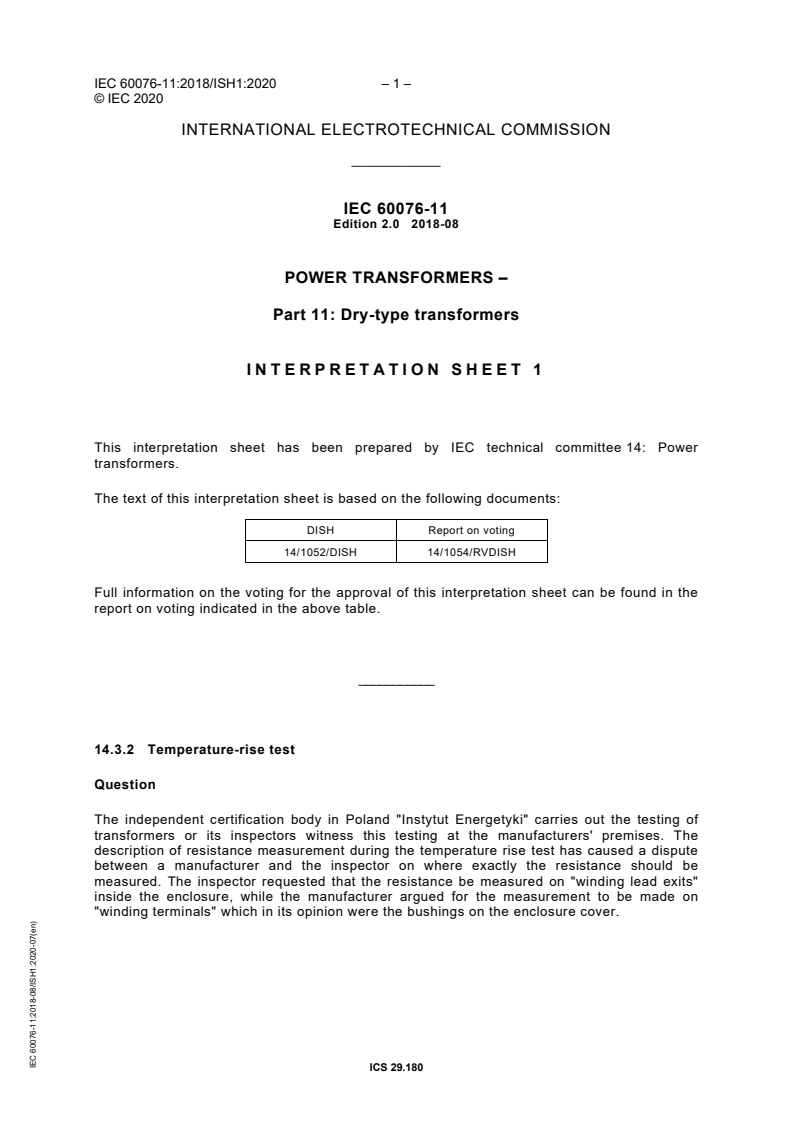
14.3.2 Temperature-rise test
Question
The independent certification body in Poland "Instytut Energetyki" carries out the testing of
transformers or its inspectors witness this testing at the manufacturers' premises. The
description of resistance measurement during the temperature rise test has caused a dispute
between a manufacturer and the inspector on where exactly the resistance should be
measured. The inspector requested that the resistance be measured on "winding lead exits"
inside the enclosure, while the manufacturer argued for the measurement to be made on
"winding terminals" which in its opinion were the bushings on the enclosure cover.
ICS 29.180
– 2 – IEC 60076-11:2018/ISH1:2020
© IEC 2020
Subclause 14.3.2.1 General, states:
The winding temperature rise shall be established by the rise in resistance method or
by superposition method. For the determination of the average winding temperature
rise the measured temperatures of the cooling air or of the water intake of the cooling
equipment shall be used.
For three-phase transformers, the resistance measurements shall be made between
the central and an outer phase line terminals.
NOTE When the temperature rise is performed it is advisable to measure the windings resistance close to the
windings.
Where should the measurements be made?
Interpretation
Testing of the winding resistance at transformer terminals (bushings) includes leadwork or
busbars and often also multiple connections. Because of this, the tested winding resistance
and its change due to heating is affected by the resistance of all these leads and connections.
Consequently, the derived winding temperature rise if measured at the transformer terminals
could be lower than if the winding resistance were tested directly on the winding lead exits.
That is why the standard suggests (in the NOTE) that measurement of the windings'
resistance be carried out close to the windings. That way, the accuracy of the indirect winding
temperature measurement by resistance is higher.
In the case of dry-type transformers without enclosures, it is possible to have access close to
the winding lead exits and not only to the transformer line terminals. Therefore,
measurements shall normally be made at such locations.
On the other hand, if the dry-type transformer is equipped with an enclosure, the resistance
measurement close to the winding lead exits requires opening the enclosure to have access
to carry out the test (hence, affecting the normal cooling efficiency of the unit). Nevertheless,
the advice to measure the resistance normally close to the winding lead exits holds. Limiting
the enclosure opening by using special through elements for the cabling and/or by closing the
required opening by temporary means as well as possible will minimize the impact on the
normal cooling efficiency.
– 2 – IEC 60076-11:2018 RLV © IEC 2018
CONTENTS
FOREWORD . 6
1 Scope . 8
2 Normative references. 8
3 Terms and definitions . 9
4 Service conditions . 10
4.1 General . 10
4.2 Normal service conditions . 10
4.3 Electromagnetic compatibility (EMC) . 12
5 Rating and general requirements . 12
5.1 General . 12
5.2 Rated power . 12
5.2.1 General . 12
5.2.2 Operation Definition of the rated power with fans cooling or heat
exchangers . 13
5.2.3 Transformer IP00 (without enclosure) . 13
5.2.4 Operation in an Transformer with enclosure . 13
5.2.5 Preferred values of rated power . 14
5.2.6 Loading beyond rated power . 14
5.3 Provision for unusual service conditions . 14
5.4 Transportation and storage conditions . 15
5.4.1 Transport limitation . 15
5.4.2 Transport acceleration . 15
5.4.3 Temperature and environment conditions for transport and storage . 15
5.5 Rated voltage and rated frequency . 15
5.5.1 Rated voltage . 15
5.5.2 Rated frequency . 16
5.6 Operation at higher than rated voltage . 16
5.7 Highest voltage for equipment U and dielectric tests levels . 16
m
5.8 Identification according to cooling method . 16
5.8.1 General . 16
5.8.2 Identification symbols . 16
5.8.3 Arrangement of symbols . 17
5.9 Guaranteed temperature rise at rated conditions . 17
5.10 Additional information required for enquiry . 17
5.11 Sound level . 17
5.12 Components and materials . 17
6 Tappings . 17
7 Connections . 18
8 Ability to withstand short circuit . 18
9 Rating plate . 18
9.1 Rating plate fitted to the transformer . 18
9.2 Rating plate fitted to the transformer enclosure . 19
10 Temperature-rise limits . 19
10.1 Normal temperature-rise limits . 19
10.2 Reduced temperature rises for transformers designed for high cooling air
medium temperatures or special air cooling medium conditions . 20
10.3 High altitude temperature rise correction . 20
11 Insulation levels . 21
11.1 General . 21
11.2 Transformers for use at high altitudes . 22
12 Climatic, environmental and fire behaviour classes . 23
12.1 Climatic classes . 23
12.2 Environmental classes . 24
12.2.1 Transformers for indoor application with or without enclosure and for
outdoor application with enclosure . 24
12.2.2 Dry-type transformers without enclosure for outdoor application . 25
12.3 Fire behaviour classes . 25
12.4 Test criteria for climatic, environmental and fire behaviour classes . 25
13 Seismic . 26
13.1 General . 26
13.2 General seismic class approach . 27
13.2.1 Generalities . 27
13.2.2 The standard amplitude method . 27
13.2.3 The calculated amplitude method . 28
14 Test . 29
14.1 General requirements for tests . 29
14.2 Routine tests . 30
14.2.1 Measurement of winding resistance . 30
14.2.2 Measurement of voltage ratio and check of phase displacement . 30
14.2.3 Measurement of short-circuit impedance and load loss . 30
14.2.4 Measurement of no-load loss and current . 31
14.2.5 Separate-source AC withstand voltage test Applied voltage test (AV) . 31
14.2.6 Induced AC withstand voltage test Induced voltage withstand test(IVW) . 31
14.2.7 Partial discharge measurement . 31
14.3 Type tests . 33
14.3.1 Full wave lightning impulse test (LI) . 33
14.3.2 Temperature-rise test . 34
14.4 Additional procedure test (Special tests) . 38
14.4.1 Partial discharge measurement for transformers operated under a
single phase line-to-earth fault condition . 38
14.4.2 Measurement of sound level . 38
14.4.3 Short-circuit test. 39
14.4.4 Climatic tests . 39
Thermal shock test for C1 class transformers .
Thermal shock test for C2 class transformers .
14.4.5 Environmental test . 41
14.4.6 Fire behaviour test . 44
14.4.7 Seismic test . 51
14.4.8 Special test for transformers equipped with amorphous core . 52
15 Tolerances . 53
16 Protection against direct contact . 53
17 Degrees of protection provided by enclosures . 53
– 4 – IEC 60076-11:2018 RLV © IEC 2018
18 Earthing terminal . 53
19 Information required with enquiry and order . 53
Annex A (informative) Installation and safety of dry-type transformers . 54
A.1 Manuals . 54
A.2 Installation . 54
A.2.1 General . 54
A.2.2 Intrinsic safety . 54
A.2.3 Installation precautions . 55
A.2.4 Installation design . 55
Annex B (informative) Environmental test for evaluation of outdoor transformers
without enclosure . 56
B.1 General . 56
B.2 Salt-fog and UV-radiation chamber test . 56
B.2.1 Test description . 56
B.2.2 Acceptance criteria: . 58
B.3 Core and clamp coating test . 58
B.3.1 Test description . 58
B.3.2 Acceptance criteria . 58
B.4 Field test . 58
B.4.1 Test description . 58
B.4.2 Acceptance criteria . 59
Annex C (normative) Cooling of transformer in naturally ventilated room . 60
C.1 Assumptions . 60
C.2 Data for the calculation of ventilation . 61
C.3 Output . 61
C.4 Numerical application for a 1 000 kVA transformer . 62
Annex D (normative) Calculation of the losses with different reference temperatures
and/or winding material . 63
Bibliography . 66
Figure 1 – Basic measuring circuit for the partial discharge test for a single-phase
transformer . 32
Figure 2 – Basic measuring circuit for the partial discharge test for a three-phase
transformer . 32
Figure 3 – Voltage application for routine partial discharge test . 33
Figure 4 – Example of back-to-back method – Single phase . 36
Figure 5 – Example of back-to-back method – Three-phase . 37
Figure 6 – Voltage application for special partial discharge test . 38
Figure 7 – Test chamber . 47
Figure 8 – Test chamber details . 48
Figure B.1 – Salt fog multi-parameter ageing cycle . 57
Figure C.1 – Heat dissipation in a natural ventilated room . 60
Table – Insulation levels based on European practice .
Table – Insulation levels based on North American practice .
Table 1 – Letter symbols . 16
Table 2 – Winding temperature-rise limits . 20
Table 3 – Test voltage levels . 22
Table 4 – Applied voltage level correction factor . 23
Table 5 – Sequence of tests . 26
Table 6 – Approximate acceleration level and performance level . 28
Table 7 – Ground acceleration level (AG) . 28
Table 8 – Recommended super elevation factors (K) . 29
Table 9 – Direction factors (D) . 29
Table 10 – Climatic class features . 39
Table 11 – Environmental classes . 43
Table 12 – Dimension of the chamber . 46
Table B.1 – Outdoor environmental classes . 56
– 6 – IEC 60076-11:2018 RLV © IEC 2018
INTERNATIONAL ELECTROTECHNICAL COMMISSION
____________
POWER TRANSFORMERS –
Part 11: Dry-type transformers
FOREWORD
1) The International Electrotechnical Commission (IEC) is a worldwide organization for standardization comprising
all national electrotechnical committees (IEC National Committees). The object of IEC is to promote
international co-operation on all questions concerning standardization in the electrical and electronic fields. To
this end and in addition to other activities, IEC publishes International Standards, Technical Specifications,
Technical Reports, Publicly Available Specifications (PAS) and Guides (hereafter referred to as “IEC
Publication(s)”). Their preparation is entrusted to technical committees; any IEC National Committee interested
in the subject dealt with may participate in this preparatory work. International, governmental and non-
governmental organizations liaising with the IEC also participate in this preparation. IEC collaborates closely
with the International Organization for Standardization (ISO) in accordance with conditions determined by
agreement between the two organizations.
2) The formal decisions or agreements of IEC on technical matters express, as nearly as possible, an international
consensus of opinion on the relevant subjects since each technical committee has representation from all
interested IEC National Committees.
3) IEC Publications have the form of recommendations for international use and are accepted by IEC National
Committees in that sense. While all reasonable efforts are made to ensure that the technical content of IEC
Publications is accurate, IEC cannot be held responsible for the way in which they are used or for any
misinterpretation by any end user.
4) In order to promote international uniformity, IEC National Committees undertake to apply IEC Publications
transparently to the maximum extent possible in their national and regional publications. Any divergence
between any IEC Publication and the corresponding national or regional publication shall be clearly indicated in
the latter.
5) IEC itself does not provide any attestation of conformity. Independent certification bodies provide conformity
assessment services and, in some areas, access to IEC marks of conformity. IEC is not responsible for any
services carried out by independent certification bodies.
6) All users should ensure that they have the latest edition of this publication.
7) No liability shall attach to IEC or its directors, employees, servants or agents including individual experts and
members of its technical committees and IEC National Committees for any personal injury, property damage or
other damage of any nature whatsoever, whether direct or indirect, or for costs (including legal fees) and
expenses arising out of the publication, use of, or reliance upon, this IEC Publication or any other IEC
Publications.
8) Attention is drawn to the Normative references cited in this publication. Use of the referenced publications is
indispensable for the correct application of this publication.
9) Attention is drawn to the possibility that some of the elements of this IEC Publication may be the subject of
patent rights. IEC shall not be held responsible for identifying any or all such patent rights.
This redline version of the official IEC Standard allows the user to identify the changes
made to the previous edition. A vertical bar appears in the margin wherever a change
has been made. Additions are in green text, deletions are in strikethrough red text.
International Standard IEC 60076-11 has been prepared by IEC technical committee 14:
Power transformers.
This second edition cancels and replaces the first edition published in 2004 and constitutes a
technical revision.
The main changes with regard to the previous edition are as follows:
Extension of the scope up to 72,5kV
Enclosure management in regards of the performance
Management of the dielectric and thermal features with altitude
New climatic classes for a better adaptation of customers’ need
Establishment of the relation between location and environmental classes
For fire behaviour classes, limitation at 1 000 kVA and process of test more robust
Introduction of Seismic class
Recommendations for amorphous transformers
The text of this International Standard is based on the following documents:
FDIS Report on voting
14/964/FDIS 14/972/RVD
Full information on the voting for the approval of this International Standard can be found in
the report on voting indicated in the above table.
This document has been drafted in accordance with the ISO/IEC Directives, Part 2.
A list of all parts in the IEC 60076 series, published under the general title Power
transformers, can be found on the IEC website.
The committee has decided that the contents of this document will remain unchanged until the
stability date indicated on the IEC website under "http://webstore.iec.ch" in the data related to
the specific document. At this date, the document will be
reconfirmed,
withdrawn,
replaced by a revised edition, or
amended.
The contents of the corrigendum of March 2019 and the Interpretation sheet 1 of July 2020
have been included in this copy.
IMPORTANT – The 'colour inside' logo on the cover page of this publication indicates
that it contains colours which are considered to be useful for the correct
understanding of its contents. Users should therefore print this document using a
colour printer.
– 8 – IEC 60076-11:2018 RLV © IEC 2018
POWER TRANSFORMERS –
Part 11: Dry-type transformers
1 Scope
This part of IEC 60076 applies to dry-type power transformers (including auto-transformers)
having values of highest voltage for equipment up to and including 36 72,5 kV and at least
one winding operating at greater than 1,1 kV. The standard applies to all construction
technologies.
This document does not apply to:
• gas-filled dry-type transformers where the gas is not air;
• single-phase transformers rated at less than 5 kVA;
• polyphase transformers rated at less than 15 kVA;
• instrument transformers (see IEC 60044 and IEC 60186);
• starting transformers;
• testing transformers;
• traction transformers mounted on rolling stock;
• flameproof and mining transformers;
• welding transformers;
• voltage regulating transformers;
• small power transformers in which safety is a special consideration.
Where IEC standards do not exist for the transformers mentioned above or for other special
transformers, this document may be applicable as a whole or in parts.
2 Normative references
The following documents are referred to in the text in such a way that some or all of their
content constitutes requirements of this document. For dated references, only the edition
cited applies. For undated references, the latest edition of the referenced document (including
any amendments) applies.
IEC 60050 (all parts), International electrotechnical vocabulary (IEV)
IEC 60068-3-3, Environmental testing – Part 3-3: Guidance – Seismic test methods for
equipments
IEC 60071 (all parts), Insulation co-ordination
IEC 60071-1, Insulation co-ordination – Part 1: Definitions, principles and rules
IEC 60071-2, Insulation co-ordination – Part 2: Application guidelines
IEC 60076-1:1993 2011, Power transformers – Part 1: General
Amendment 1 (1999)
IEC 60076-2, Power transformers – Part 2: Temperature rise for liquid-immersed transformers
IEC 60076-3:2013, Power transformers – Part 3: Insulation levels, dielectric tests and external
clearances in air
IEC 60076-5, Power transformers – Part 5: Ability to withstand short-circuit
IEC 60076-10, Power transformers – Part 10: Determination of sound levels
IEC 60076-12:2008, Power transformers – Part 12: Loading guide for dry-type power
transformers
IEC 60085, Electrical insulation – Thermal evaluation and classification of electrical insulation
designation
IEC 60270, High-voltage test techniques – Partial discharge measurements
IEC 60332-3-10, Tests on electric cables under fire conditions – Part 3-10: Test for vertical
flame spread of vertically-mounted bunched wires or cables – Apparatus
IEC 60529, Degrees of protection provided by enclosures (IP Code)
IEC 60721-3-4, Classification of environmental conditions – Part 3: Classification of groups of
environmental parameters and their severities – Section 4: Stationary use at non-
weatherprotected locations
IEC TS 60815-1, Selection and dimensioning of high-voltage insulators intended for use in
polluted conditions – Part 1: Definitions, information and general principles
IEC 60905:1987, Loading guide for dry-type power transformers
IEC 61330, High-voltage/low voltage prefabricated substations
IEC 61378-1, Converter transformers – Part 1: Transformers for industrial applications
IEC 62271-202, High-voltage switchgear and controlgear – Part 202: High-voltage/low-voltage
prefabricated substation
ISO 12944-6, Paints and varnishes – Corrosion protection of steel structures by protective
paint systems – Part 6: Laboratory performance test methods
3 Terms and definitions
For the purposes of this document, the following terms and definitions apply.
ISO and IEC maintain terminological databases for use in standardization at the following
addresses:
• IEC Electropedia: available at http://www.electropedia.org/
• ISO Online browsing platform: available at http://www.iso.org/obp
3.1
dry-type transformer
transformer of which the magnetic circuit and windings are not immersed in an insulating
liquid
– 10 – IEC 60076-11:2018 RLV © IEC 2018
3.2
totally enclosed dry-type transformer
transformer in an un-pressurised enclosure cooled by the circulation of the internal air having
no intentional exchange with external air
3.3
enclosed dry-type transformer
transformer in a ventilated enclosure cooled by the circulation of the external air
3.4
non-enclosed dry-type transformer
transformer supplied without a protective enclosure cooled by natural or forced air ventilation
4 Service conditions
4.1 General
The requirements of IEC 60076-1 apply to dry-type transformers only in so far as they are
referred to in this document.
4.2 Normal service conditions
4.2.1 General
Unless otherwise stated, the service conditions in 4.2.2 to 4.2.6 apply. When transformers are
required to operate outside the normal service conditions, de-rating in accordance with 11.2
and/or 11.3 applies.
a) Altitude:
A height above sea level not exceeding 1 000 m. See IEC 60076-1.
b) Temperature of cooling air and water:
The temperature of cooling air not exceeding:
40 °C at any time;
30 °C monthly average of the hottest month;
20 °C yearly average.
and not below:
–25 °C in the case of outdoor transformers;
–5 °C in the case of indoor transformers.
where the monthly and yearly averages are as defined in 3.12 of IEC 60076-1.
See IEC 60076-1.
For water cooled transformers, specification of the water (temperature, water flow, etc.)
has to be defined by agreement between manufacturer and purchaser if the temperature
of the water is different from that specified in IEC 60076-1 and IEC 60076-2
NOTE Liquids other than water can be used as a cooling medium then all technical data of the liquid has to
be defined by agreement between manufacturer and purchaser.
c) Wave-shape of supply voltage:
A supply voltage of which the waveshape is approximately sinusoidal.
NOTE This requirement is normally not critical in public supply systems but may have to be considered in
installations with considerable converter loading. In such cases, there is a conventional rule that the deformation
shall neither exceed 5 % total harmonic content nor 1 % even harmonic content, see IEC 61000-2-4. Also note the
importance of current harmonics for load loss and temperature rise, see IEC 61378-1.
A sinusoidal supply voltage with a total harmonic content not exceeding 5 % and an even
harmonic content not exceeding 1 %.
The purchaser shall specify the magnitude and frequency of any harmonic voltages
present in the supply that exceed these limits.
The manufacturer should take into account these harmonics in determination of additional
core losses and also regarding the saturation of the core.
d) Load current harmonic content:
At the enquiry stage the purchaser shall specify the magnitude and frequency of each of
the harmonic current components generated by the load.
The manufacturer shall consider the additional losses caused by harmonic currents in
calculating the temperature rise of the windings and the effects on the other metallic parts
of the transformer.
The manufacturer shall calculate the additional loss by using the method of IEC 61378-1
or by using a method like finite element by agreement between manufacturer and
purchaser.
If the total harmonic content of the load current exceeds 5 %, then the extra losses due to
these harmonic currents shall be taken into account by increasing the test current for the
temperature rise test. The temperature rise with these losses shall not exceed the
corresponding limit specified in Table 2 when tested in accordance with 14.3.2.
e) Symmetry of polyphase three-phase supply voltages:
For three-phase transformers, a set of three-phase supply voltages which are approximately
symmetrical.
See IEC 60076-1.
f) Installation environment:
This standard defines specific classes for environment:
1) for climatic conditions;
2) for humidity and pollution;
3) for fire behaviour;
4) for seismic disturbance;
5) environmental conditions within the following definitions according to IEC 60721-3-4:
i) biological conditions 4B1;
ii) chemically active substances 4C2;
iii) mechanically active substances 4S3;
iv) mechanical conditions 4M4.
g) For transformers intended to be installed indoors, some of these environmental conditions
might not be applicable.
h) Inrush current:
System inrush current limitations, if any, (maximum value, duration) shall be given at the
enquiry stage by the purchaser.
i) Frequency of energization:
If frequency of energization is greater than 24 times a year, then purchaser shall specify
the number of energizations per year at the enquiry stage.
j) Protection from water and liquids:
– 12 – IEC 60076-11:2018 RLV © IEC 2018
The transformer shall be protected against dripping water or flooding by water and other
liquids.
k) Special electrical and environmental conditions around the transformer:
IEC 60076-3 recommends general minimum clearances between transformer live parts
and conductive parts in the installation.
Any part of the installation made of insulation material becomes conductive when
moistened with rain water, salt water or other conductive liquids. Partial discharges in the
surroundings of the transformer can decrease the dielectric strength of the air.
Therefore the clearances between these installations parts and the live parts of the
transformer shall meet the clearances recommended in IEC 60076-3.
NOTE An agreement between purchaser and manufacturer is needed to reduce the clearances between
transformer live parts and conductive parts in the installation.
l) Level of vibration:
Vibrations of the structure where the transformer is to be installed shall be taken into
account when designing the transformer and special consideration shall be given in the
stress transferred to connection terminals.
The purchaser shall specify vibration spectrum at the enquiry stage. The procedure of
vibration test, if any, should be agreed at enquiry stage between purchaser and
manufacturer.
m) Corrosion protection:
Depending on the type of the installation, the purchaser should choose a protection class
defined in ISO 12944 or as agreed between purchaser and manufacturer.
n) Maintenance
The user shall follow the manufacturer guide line for maintenance and specially avoid an
accumulation of dust or pollution on the transformer by a regular cleaning.
4.2.6 Humidity
The relative humidity of the surrounding air shall be less than 93 %. No drops of water shall
be present on the surface of the coils.
4.3 Electromagnetic compatibility (EMC)
Transformers shall be considered as passive elements in respect to emission and immunity to
electromagnetic disturbances.
5 Rating and general requirements
5.1 General
The manufacturer shall assign ratings to the transformer, which shall be marked on the rating
plate, see Clause 9. These ratings shall be such that the transformer can deliver its rated
current under steady loading conditions without exceeding the limits of temperature rise
specified in Clause 10, assuming that the applied primary voltage is equal to the rated voltage
and that the supply is at rated frequency.
5.2 Rated power
5.2.1 General
The rated power refers to continuous loading. This is a reference value for guarantees and
tests concerning load losses, temperature rises and short-circuit impedance.
NOTE A two-winding transformer has only one value of rated power, identical for both windings. When the
transformer has rated voltage applied to the primary winding, and rated current flows through the terminals of that
winding, the transformer receives the relevant rated power for both windings.
The rated power corresponds to continuous duty; nevertheless, dry-type transformers
complying with this standard can be overloaded and guidance on overloads is given in
IEC 60905 IEC 60076-12.
5.2.2 Operation Definition of the rated power with fans cooling or heat exchangers
The transformer shall have an assigned rated power for each winding which shall be marked
on the rating plate. The transformer shall be fully rated when supplied in an enclosure. The
rated power refers to continuous loading. This is a reference value for guarantees and tests
concerning load losses and temperature rises and short-circuit impedance.
If different values of apparent power are assigned under different circumstances, for example
with different methods of cooling, the highest of these values is the rated power.
When additional cooling by means of fans is provided, the nominal rated power rating with
and without fans shall be subject to agreement between purchaser and supplier.
The rating plate shall indicate both the power rating without fans and the maximum power
rating with fan cooling.
5.2.3 Transformer IP00 (without enclosure)
The transformer shall have an assigned rated power for each winding which shall be marked
on the rating plate.
5.2.4 Operation in an Transformer with enclosure
For operation in an enclosure that is not provided or later provided by the manufacturer of the
transformer, see Annex D of IEC 61330 and IEC 60905.
This subclause defines rated power and the distance between enclosures and live parts when
the transformer is equipped with an enclosure.
Two cases are defined:
a) The transformer in an enclosure is manufactured, tested in the enclosure and then
delivered on site:
• The clearances between the live parts and the enclosure shall be defined by the
manufacturer. The dielectric tests shall be performed with the enclosure as a routine
test.
• If the clearance between the live part and the enclosure meets the requirement of
IEC 60076-3 the dielectric routine test shall be performed either with enclosure or
without enclosure.
• It is permitted to disassemble the enclosure for transp
...
IEC 60076-11 ®
Edition 2.0 2018-08
INTERNATIONAL
STANDARD
NORME
INTERNATIONALE
colour
inside
Power transformers –
Part 11: Dry-type transformers
Transformateurs de puissance –
Partie 11: Transformateurs de type sec
All rights reserved. Unless otherwise specified, no part of this publication may be reproduced or utilized in any form
or by any means, electronic or mechanical, including photocopying and microfilm, without permission in writing from
either IEC or IEC's member National Committee in the country of the requester. If you have any questions about IEC
copyright or have an enquiry about obtaining additional rights to this publication, please contact the address below or
your local IEC member National Committee for further information.
Droits de reproduction réservés. Sauf indication contraire, aucune partie de cette publication ne peut être reproduite
ni utilisée sous quelque forme que ce soit et par aucun procédé, électronique ou mécanique, y compris la photocopie
et les microfilms, sans l'accord écrit de l'IEC ou du Comité national de l'IEC du pays du demandeur. Si vous avez des
questions sur le copyright de l'IEC ou si vous désirez obtenir des droits supplémentaires sur cette publication, utilisez
les coordonnées ci-après ou contactez le Comité national de l'IEC de votre pays de résidence.
IEC Central Office Tel.: +41 22 919 02 11
3, rue de Varembé info@iec.ch
CH-1211 Geneva 20 www.iec.ch
Switzerland
About the IEC
The International Electrotechnical Commission (IEC) is the leading global organization that prepares and publishes
International Standards for all electrical, electronic and related technologies.
About IEC publications
The technical content of IEC publications is kept under constant review by the IEC. Please make sure that you have the
latest edition, a corrigenda or an amendment might have been published.
IEC Catalogue - webstore.iec.ch/catalogue Electropedia - www.electropedia.org
The stand-alone application for consulting the entire The world's leading online dictionary of electronic and
bibliographical information on IEC International Standards, electrical terms containing 21 000 terms and definitions in
Technical Specifications, Technical Reports and other English and French, with equivalent terms in 16 additional
documents. Available for PC, Mac OS, Android Tablets and languages. Also known as the International Electrotechnical
iPad. Vocabulary (IEV) online.
IEC publications search - webstore.iec.ch/advsearchform IEC Glossary - std.iec.ch/glossary
The advanced search enables to find IEC publications by a 67 000 electrotechnical terminology entries in English and
variety of criteria (reference number, text, technical French extracted from the Terms and Definitions clause of
committee,…). It also gives information on projects, replaced IEC publications issued since 2002. Some entries have been
and withdrawn publications. collected from earlier publications of IEC TC 37, 77, 86 and
CISPR.
IEC Just Published - webstore.iec.ch/justpublished
Stay up to date on all new IEC publications. Just Published IEC Customer Service Centre - webstore.iec.ch/csc
details all new publications released. Available online and If you wish to give us your feedback on this publication or
also once a month by email. need further assistance, please contact the Customer Service
Centre: sales@iec.ch.
A propos de l'IEC
La Commission Electrotechnique Internationale (IEC) est la première organisation mondiale qui élabore et publie des
Normes internationales pour tout ce qui a trait à l'électricité, à l'électronique et aux technologies apparentées.
A propos des publications IEC
Le contenu technique des publications IEC est constamment revu. Veuillez vous assurer que vous possédez l’édition la
plus récente, un corrigendum ou amendement peut avoir été publié.
Catalogue IEC - webstore.iec.ch/catalogue Electropedia - www.electropedia.org
Application autonome pour consulter tous les renseignements
Le premier dictionnaire en ligne de termes électroniques et
bibliographiques sur les Normes internationales,
électriques. Il contient 21 000 termes et définitions en anglais
Spécifications techniques, Rapports techniques et autres
et en français, ainsi que les termes équivalents dans 16
documents de l'IEC. Disponible pour PC, Mac OS, tablettes
langues additionnelles. Egalement appelé Vocabulaire
Android et iPad.
Electrotechnique International (IEV) en ligne.
Recherche de publications IEC -
Glossaire IEC - std.iec.ch/glossary
webstore.iec.ch/advsearchform
67 000 entrées terminologiques électrotechniques, en anglais
La recherche avancée permet de trouver des publications IEC et en français, extraites des articles Termes et Définitions des
en utilisant différents critères (numéro de référence, texte, publications IEC parues depuis 2002. Plus certaines entrées
comité d’études,…). Elle donne aussi des informations sur les antérieures extraites des publications des CE 37, 77, 86 et
projets et les publications remplacées ou retirées. CISPR de l'IEC.
IEC Just Published - webstore.iec.ch/justpublished Service Clients - webstore.iec.ch/csc
Restez informé sur les nouvelles publications IEC. Just Si vous désirez nous donner des commentaires sur cette
Published détaille les nouvelles publications parues. publication ou si vous avez des questions contactez-nous:
Disponible en ligne et aussi une fois par mois par email. sales@iec.ch.
IEC 60076-11 ®
Edition 2.0 2018-08
INTERNATIONAL
STANDARD
NORME
INTERNATIONALE
colour
inside
Power transformers –
Part 11: Dry-type transformers
Transformateurs de puissance –
Partie 11: Transformateurs de type sec
INTERNATIONAL
ELECTROTECHNICAL
COMMISSION
COMMISSION
ELECTROTECHNIQUE
INTERNATIONALE
ICS 29.180 ISBN 978-2-8322-5910-8
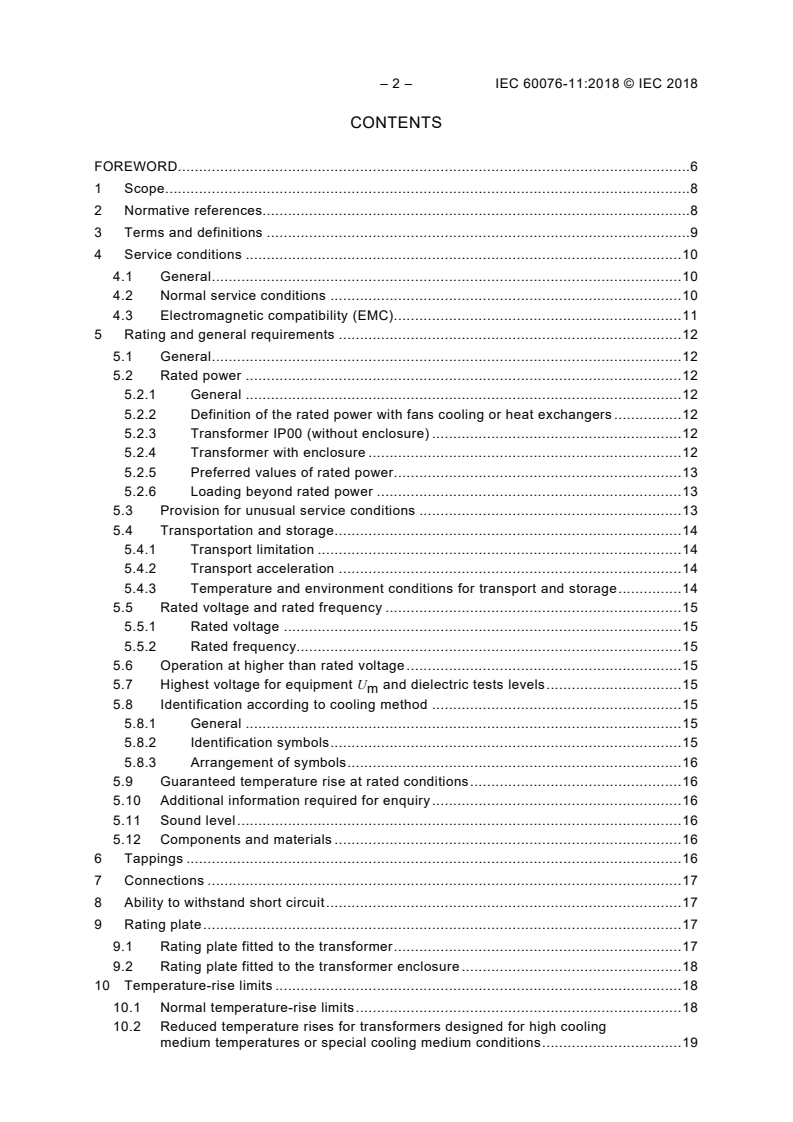
– 2 – IEC 60076-11:2018 © IEC 2018
CONTENTS
FOREWORD . 6
1 Scope . 8
2 Normative references. 8
3 Terms and definitions . 9
4 Service conditions . 10
4.1 General . 10
4.2 Normal service conditions . 10
4.3 Electromagnetic compatibility (EMC) . 11
5 Rating and general requirements . 12
5.1 General . 12
5.2 Rated power . 12
5.2.1 General . 12
5.2.2 Definition of the rated power with fans cooling or heat exchangers . 12
5.2.3 Transformer IP00 (without enclosure) . 12
5.2.4 Transformer with enclosure . 12
5.2.5 Preferred values of rated power . 13
5.2.6 Loading beyond rated power . 13
5.3 Provision for unusual service conditions . 13
5.4 Transportation and storage . 14
5.4.1 Transport limitation . 14
5.4.2 Transport acceleration . 14
5.4.3 Temperature and environment conditions for transport and storage . 14
5.5 Rated voltage and rated frequency . 15
5.5.1 Rated voltage . 15
5.5.2 Rated frequency . 15
5.6 Operation at higher than rated voltage . 15
5.7 Highest voltage for equipment U and dielectric tests levels . 15
m
5.8 Identification according to cooling method . 15
5.8.1 General . 15
5.8.2 Identification symbols . 15
5.8.3 Arrangement of symbols . 16
5.9 Guaranteed temperature rise at rated conditions . 16
5.10 Additional information required for enquiry . 16
5.11 Sound level . 16
5.12 Components and materials . 16
6 Tappings . 16
7 Connections . 17
8 Ability to withstand short circuit . 17
9 Rating plate . 17
9.1 Rating plate fitted to the transformer . 17
9.2 Rating plate fitted to the transformer enclosure . 18
10 Temperature-rise limits . 18
10.1 Normal temperature-rise limits . 18
10.2 Reduced temperature rises for transformers designed for high cooling
medium temperatures or special cooling medium conditions . 19
10.3 High altitude temperature rise correction . 19
11 Insulation levels . 19
11.1 General . 19
11.2 Transformers for use at high altitudes . 20
12 Climatic, environmental and fire behaviour classes . 21
12.1 Climatic classes . 21
12.2 Environmental classes . 21
12.2.1 Transformers for indoor application with or without enclosure and for
outdoor application with enclosure . 21
12.2.2 Dry-type transformers without enclosure for outdoor application . 22
12.3 Fire behaviour classes . 22
12.4 Test criteria for climatic, environmental and fire behaviour classes . 23
13 Seismic . 23
13.1 General . 23
13.2 General seismic class approach . 24
13.2.1 Generalities . 24
13.2.2 The standard amplitude method . 24
13.2.3 The calculated amplitude method . 25
14 Test . 26
14.1 General requirements for tests . 26
14.2 Routine tests . 27
14.2.1 Measurement of winding resistance . 27
14.2.2 Measurement of voltage ratio and check of phase displacement . 27
14.2.3 Measurement of short-circuit impedance and load loss . 27
14.2.4 Measurement of no-load loss and current . 28
14.2.5 Applied voltage test (AV) . 28
14.2.6 Induced voltage withstand test (IVW) . 28
14.2.7 Partial discharge measurement . 28
14.3 Type tests . 30
14.3.1 Full wave lightning impulse test (LI) . 30
14.3.2 Temperature-rise test . 31
14.4 Special tests . 34
14.4.1 Partial discharge measurement for transformers operated under a
single phase line-to-earth fault condition . 34
14.4.2 Measurement of sound level . 35
14.4.3 Short-circuit test. 35
14.4.4 Climatic tests . 35
14.4.5 Environmental test . 37
14.4.6 Fire behaviour test . 39
14.4.7 Seismic test . 45
14.4.8 Special test for transformers equipped with amorphous core . 46
15 Tolerances . 46
16 Protection against direct contact . 47
17 Degrees of protection provided by enclosures . 47
18 Earthing terminal . 47
19 Information required with enquiry and order . 47
Annex A (informative) Installation and safety of dry-type transformers . 48
A.1 Manuals . 48
– 4 – IEC 60076-11:2018 © IEC 2018
A.2 Installation . 48
A.2.1 General . 48
A.2.2 Intrinsic safety . 48
A.2.3 Installation precautions . 48
A.2.4 Installation design . 49
Annex B (informative) Environmental test for evaluation of outdoor transformers
without enclosure . 50
B.1 General . 50
B.2 Salt-fog and UV-radiation chamber test . 50
B.2.1 Test description . 50
B.2.2 Acceptance criteria: . 52
B.3 Core and clamp coating test . 52
B.3.1 Test description . 52
B.3.2 Acceptance criteria . 52
B.4 Field test . 52
B.4.1 Test description . 52
B.4.2 Acceptance criteria . 53
Annex C (normative) Cooling of transformer in naturally ventilated room . 54
C.1 Assumptions . 54
C.2 Data for the calculation of ventilation . 55
C.3 Output . 55
C.4 Numerical application for a 1 000 kVA transformer . 56
Annex D (normative) Calculation of the losses with different reference temperatures
and/or winding material . 57
Bibliography . 60
Figure 1 – Basic measuring circuit for the partial discharge test for a single-phase
transformer . 29
Figure 2 – Basic measuring circuit for the partial discharge test for a three-phase
transformer . 29
Figure 3 – Voltage application for routine partial discharge test . 30
Figure 4 – Example of back-to-back method – Single phase . 33
Figure 5 – Example of back-to-back method – Three-phase . 33
Figure 6 – Voltage application for special partial discharge test . 35
Figure 7 – Test chamber . 41
Figure 8 – Test chamber details . 42
Figure B.1 – Salt fog multi-parameter ageing cycle . 51
Figure C.1 – Heat dissipation in a natural ventilated room . 54
Table 1 – Letter symbols . 15
Table 2 – Winding temperature-rise limits . 18
Table 3 – Test voltage levels . 19
Table 4 – Applied voltage level correction factor . 20
Table 5 – Sequence of tests . 23
Table 6 – Approximate acceleration level and performance level . 25
Table 7 – Ground acceleration level (AG) . 26
Table 8 – Recommended super elevation factors (K) . 26
Table 9 – Direction factors (D) . 26
Table 10 – Climatic class features . 35
Table 11 – Environmental classes . 38
Table 12 – Dimension of the chamber . 40
Table B.1 – Outdoor environmental classes . 50
– 6 – IEC 60076-11:2018 © IEC 2018
INTERNATIONAL ELECTROTECHNICAL COMMISSION
____________
POWER TRANSFORMERS –
Part 11: Dry-type transformers
FOREWORD
1) The International Electrotechnical Commission (IEC) is a worldwide organization for standardization comprising
all national electrotechnical committees (IEC National Committees). The object of IEC is to promote
international co-operation on all questions concerning standardization in the electrical and electronic fields. To
this end and in addition to other activities, IEC publishes International Standards, Technical Specifications,
Technical Reports, Publicly Available Specifications (PAS) and Guides (hereafter referred to as “IEC
Publication(s)”). Their preparation is entrusted to technical committees; any IEC National Committee interested
in the subject dealt with may participate in this preparatory work. International, governmental and non-
governmental organizations liaising with the IEC also participate in this preparation. IEC collaborates closely
with the International Organization for Standardization (ISO) in accordance with conditions determined by
agreement between the two organizations.
2) The formal decisions or agreements of IEC on technical matters express, as nearly as possible, an international
consensus of opinion on the relevant subjects since each technical committee has representation from all
interested IEC National Committees.
3) IEC Publications have the form of recommendations for international use and are accepted by IEC National
Committees in that sense. While all reasonable efforts are made to ensure that the technical content of IEC
Publications is accurate, IEC cannot be held responsible for the way in which they are used or for any
misinterpretation by any end user.
4) In order to promote international uniformity, IEC National Committees undertake to apply IEC Publications
transparently to the maximum extent possible in their national and regional publications. Any divergence
between any IEC Publication and the corresponding national or regional publication shall be clearly indicated in
the latter.
5) IEC itself does not provide any attestation of conformity. Independent certification bodies provide conformity
assessment services and, in some areas, access to IEC marks of conformity. IEC is not responsible for any
services carried out by independent certification bodies.
6) All users should ensure that they have the latest edition of this publication.
7) No liability shall attach to IEC or its directors, employees, servants or agents including individual experts and
members of its technical committees and IEC National Committees for any personal injury, property damage or
other damage of any nature whatsoever, whether direct or indirect, or for costs (including legal fees) and
expenses arising out of the publication, use of, or reliance upon, this IEC Publication or any other IEC
Publications.
8) Attention is drawn to the Normative references cited in this publication. Use of the referenced publications is
indispensable for the correct application of this publication.
9) Attention is drawn to the possibility that some of the elements of this IEC Publication may be the subject of
patent rights. IEC shall not be held responsible for identifying any or all such patent rights.
International Standard IEC 60076-11 has been prepared by IEC technical committee 14:
Power transformers.
This second edition cancels and replaces the first edition published in 2004 and constitutes a
technical revision.
The main changes with regard to the previous edition are as follows:
• Extension of the scope up to 72,5kV
• Enclosure management in regards of the performance
• Management of the dielectric and thermal features with altitude
• New climatic classes for a better adaptation of customers’ need
• Establishment of the relation between location and environmental classes
• For fire behaviour classes, limitation at 1 000 kVA and process of test more robust
• Introduction of Seismic class
• Recommendations for amorphous transformers
The text of this International Standard is based on the following documents:
FDIS Report on voting
14/964/FDIS 14/972/RVD
Full information on the voting for the approval of this International Standard can be found in
the report on voting indicated in the above table.
This document has been drafted in accordance with the ISO/IEC Directives, Part 2.
A list of all parts in the IEC 60076 series, published under the general title Power
transformers, can be found on the IEC website.
The committee has decided that the contents of this document will remain unchanged until the
stability date indicated on the IEC website under "http://webstore.iec.ch" in the data related to
the specific document. At this date, the document will be
• reconfirmed,
• withdrawn,
• replaced by a revised edition, or
• amended.
The contents of the corrigendum of March 2019 have been included in this copy.
IMPORTANT – The 'colour inside' logo on the cover page of this publication indicates
considered to be useful for the correct
that it contains colours which are
understanding of its contents. Users should therefore print this document using a
colour printer.
– 8 – IEC 60076-11:2018 © IEC 2018
POWER TRANSFORMERS –
Part 11: Dry-type transformers
1 Scope
This part of IEC 60076 applies to dry-type power transformers (including auto-transformers)
having values of highest voltage for equipment up to and including 72,5 kV and at least one
winding operating at greater than 1,1 kV.
This document does not apply to:
• gas-filled dry-type transformers where the gas is not air;
• single-phase transformers rated at less than 5 kVA;
• polyphase transformers rated at less than 15 kVA;
• instrument transformers;
• starting transformers;
• testing transformers;
• traction transformers mounted on rolling stock;
• flameproof and mining transformers;
• welding transformers;
• voltage regulating transformers;
• small power transformers in which safety is a special consideration.
Where IEC standards do not exist for the transformers mentioned above or for other special
transformers, this document may be applicable as a whole or in parts.
2 Normative references
The following documents are referred to in the text in such a way that some or all of their
content constitutes requirements of this document. For dated references, only the edition
cited applies. For undated references, the latest edition of the referenced document (including
any amendments) applies.
IEC 60068-3-3, Environmental testing – Part 3-3: Guidance – Seismic test methods for
equipments
IEC 60071-1, Insulation co-ordination – Part 1: Definitions, principles and rules
IEC 60071-2, Insulation co-ordination – Part 2: Application guidelines
IEC 60076-1:2011, Power transformers – Part 1: General
IEC 60076-2, Power transformers – Part 2: Temperature rise for liquid-immersed transformers
IEC 60076-3:2013, Power transformers – Part 3: Insulation levels, dielectric tests and external
clearances in air
IEC 60076-5, Power transformers – Part 5: Ability to withstand short circuit
IEC 60076-10, Power transformers – Part 10: Determination of sound levels
IEC 60076-12:2008, Power transformers – Part 12: Loading guide for dry-type power
transformers
IEC 60085, Electrical insulation – Thermal evaluation and designation
IEC 60270, High-voltage test techniques – Partial discharge measurements
IEC 60332-3-10, Tests on electric cables under fire conditions – Part 3-10: Test for vertical
flame spread of vertically-mounted bunched wires or cables – Apparatus
IEC 60529, Degrees of protection provided by enclosures (IP Code)
IEC 60721-3-4, Classification of environmental conditions – Part 3: Classification of groups of
environmental parameters and their severities – Section 4: Stationary use at non-
weatherprotected locations
IEC TS 60815-1, Selection and dimensioning of high-voltage insulators intended for use in
polluted conditions – Part 1: Definitions, information and general principles
IEC 61378-1, Converter transformers – Part 1: Transformers for industrial applications
IEC 62271-202, High-voltage switchgear and controlgear – Part 202: High-voltage/low-voltage
prefabricated substation
ISO 12944-6, Paints and varnishes – Corrosion protection of steel structures by protective
paint systems – Part 6: Laboratory performance test methods
3 Terms and definitions
For the purposes of this document, the following terms and definitions apply.
ISO and IEC maintain terminological databases for use in standardization at the following
addresses:
• IEC Electropedia: available at http://www.electropedia.org/
• ISO Online browsing platform: available at http://www.iso.org/obp
3.1
dry-type transformer
transformer of which the magnetic circuit and windings are not immersed in an insulating
liquid
3.2
totally enclosed dry-type transformer
transformer in an un-pressurised enclosure cooled by the circulation of the internal air having
no intentional exchange with external air
3.3
enclosed dry-type transformer
transformer in a ventilated enclosure cooled by the circulation of the external air
– 10 – IEC 60076-11:2018 © IEC 2018
3.4
non-enclosed dry-type transformer
transformer supplied without a protective enclosure cooled by natural or forced air ventilation
4 Service conditions
4.1 General
The requirements of IEC 60076-1 apply to dry-type transformers only in so far as they are
referred to in this document.
4.2 Normal service conditions
a) Altitude:
See IEC 60076-1.
b) Temperature of cooling air and water:
See IEC 60076-1.
For water cooled transformers, specification of the water (temperature, water flow, etc.)
has to be defined by agreement between manufacturer and purchaser if the temperature
of the water is different from that specified in IEC 60076-1 and IEC 60076-2
NOTE Liquids other than water can be used as a cooling medium then all technical data of the liquid has to
be defined by agreement between manufacturer and purchaser
c) Wave-shape of supply voltage:
A sinusoidal supply voltage with a total harmonic content not exceeding 5 % and an even
harmonic content not exceeding 1 %.
The purchaser shall specify the magnitude and frequency of any harmonic voltages
present in the supply that exceed these limits.
The manufacturer should take into account these harmonics in determination of additional
core losses and also regarding the saturation of the core.
d) Load current harmonic content:
At the enquiry stage the purchaser shall specify the magnitude and frequency of each of
the harmonic current components generated by the load.
The manufacturer shall consider the additional losses caused by harmonic currents in
calculating the temperature rise of the windings and the effects on the other metallic parts
of the transformer.
The manufacturer shall calculate the additional loss by using the method of IEC 61378-1
or by using a method like finite element by agreement between manufacturer and
purchaser.
If the total harmonic content of the load current exceeds 5 %, then the extra losses due to
these harmonic currents shall be taken into account by increasing the test current for the
temperature rise test. The temperature rise with these losses shall not exceed the
corresponding limit specified in Table 2 when tested in accordance with 14.3.2.
e) Symmetry of three-phase supply voltages:
See IEC 60076-1.
f) Installation environment:
This standard defines specific classes for environment:
1) for climatic conditions;
2) for humidity and pollution;
3) for fire behaviour;
4) for seismic disturbance;
5) environmental conditions within the following definitions according to IEC 60721-3-4:
i) biological conditions 4B1;
ii) chemically active substances 4C2;
iii) mechanically active substances 4S3;
iv) mechanical conditions 4M4.
g) For transformers intended to be installed indoors, some of these environmental conditions
might not be applicable.
h) Inrush current:
System inrush current limitations, if any, (maximum value, duration) shall be given at the
enquiry stage by the purchaser.
i) Frequency of energization:
If frequency of energization is greater than 24 times a year, then purchaser shall specify
the number of energizations per year at the enquiry stage.
j) Protection from water and liquids:
The transformer shall be protected against dripping water or flooding by water and other
liquids.
k) Special electrical and environmental conditions around the transformer:
IEC 60076-3 recommends general minimum clearances between transformer live parts
and conductive parts in the installation.
Any part of the installation made of insulation material becomes conductive when
moistened with rain water, salt water or other conductive liquids. Partial discharges in the
surroundings of the transformer can decrease the dielectric strength of the air.
Therefore the clearances between these installations parts and the live parts of the
transformer shall meet the clearances recommended in IEC 60076-3.
NOTE An agreement between purchaser and manufacturer is needed to reduce the clearances between
transformer live parts and conductive parts in the installation.
l) Level of vibration:
Vibrations of the structure where the transformer is to be installed shall be taken into
account when designing the transformer and special consideration shall be given in the
stress transferred to connection terminals.
The purchaser shall specify vibration spectrum at the enquiry stage. The procedure of
vibration test, if any, should be agreed at enquiry stage between purchaser and
manufacturer.
m) Corrosion protection:
Depending on the type of the installation, the purchaser should choose a protection class
defined in ISO 12944 or as agreed between purchaser and manufacturer.
n) Maintenance
The user shall follow the manufacturer guide line for maintenance and specially avoid an
accumulation of dust or pollution on the transformer by a regular cleaning.
4.3 Electromagnetic compatibility (EMC)
Transformers shall be considered as passive elements in respect to emission and immunity to
electromagnetic disturbances.
– 12 – IEC 60076-11:2018 © IEC 2018
5 Rating and general requirements
5.1 General
The manufacturer shall assign ratings to the transformer, which shall be marked on the rating
plate, see Clause 9. These ratings shall be such that the transformer can deliver its rated
current under steady loading conditions without exceeding the limits of temperature rise
specified in Clause 10, assuming that the applied primary voltage is equal to the rated voltage
and that the supply is at rated frequency.
5.2 Rated power
5.2.1 General
The rated power refers to continuous loading. This is a reference value for guarantees and
tests concerning load losses, temperature rises and short-circuit impedance.
NOTE A two-winding transformer has only one value of rated power, identical for both windings. When the
transformer has rated voltage applied to the primary winding, and rated current flows through the terminals of that
winding, the transformer receives the relevant rated power for both windings.
The rated power corresponds to continuous duty; nevertheless, dry-type transformers
complying with this standard can be overloaded and guidance on overloads is given in
IEC 60076-12.
5.2.2 Definition of the rated power with fans cooling or heat exchangers
The transformer shall have an assigned rated power for each winding which shall be marked
on the rating plate. The rated power refers to continuous loading. This is a reference value for
guarantees and tests concerning load losses and temperature rises.
If different values of apparent power are assigned under different circumstances, for example
with different methods of cooling, the highest of these values is the rated power.
When additional cooling by means of fans is provided, the rated power without fans shall be
subject to agreement between purchaser and supplier.
5.2.3 Transformer IP00 (without enclosure)
The transformer shall have an assigned rated power for each winding which shall be marked
on the rating plate.
5.2.4 Transformer with enclosure
This subclause defines rated power and the distance between enclosures and live parts when
the transformer is equipped with an enclosure.
Two cases are defined:
a) The transformer in an enclosure is manufactured, tested in the enclosure and then
delivered on site:
• The clearances between the live parts and the enclosure shall be defined by the
manufacturer. The dielectric tests shall be performed with the enclosure as a routine
test.
• If the clearance between the live part and the enclosure meets the requirement of
IEC 60076-3 the dielectric routine test shall be performed either with enclosure or
without enclosure.
• It is permitted to disassemble the enclosure for transportation reasons. In this case the
dis-assembled clearances between the live parts and the enclosure shall meet the
requirements of IEC 60076-3.
• There shall be no reduction (de-rating) of the rated power.
b) Transformer and enclosure are delivered on site separately, or later:
• There are two methods to determine the thermal performance of enclosure:
– The de-rating of the rated power is determined by IEC 62271-202. Then the
thermal class of enclosure shall be declared by the manufacturer of the enclosure
(seller of the package).
– The enclosure is calculated using Annex C of this document.
• The clearance between the live part and the enclosure shall meet the requirement of
IEC 60076-3.
• Enclosure shall have a rating plate and the manufacturer of the enclosure or seller of
the package is responsible for determining the rated power of the transformer with the
enclosure.
5.2.5 Preferred values of rated power
The preferred values shall be in accordance with IEC 60076-1 starting from 50 kVA.
5.2.6 Loading beyond rated power
The loading guides for dry-type transformers in IEC 60076-12 and the requirements in
IEC 60076-1 shall apply.
5.3 Provision for unusual service conditions
The purchaser shall identify in his enquiry any service conditions not covered by the normal
service conditions in 4.2. Examples of such conditions are:
• high or low ambient temperature outside the limits prescribed in 4.2;
• restricted ventilation;
• altitude in excess of the limit prescribed in 4.2;
• damaging fumes and vapours;
• steam;
• humidity in excess of the limit prescribed in 4.2;
• dripping water;
• salt spray;
• conductive pollution;
• excessive and abrasive dust;
• high harmonic content of the load current prescribed in 4.2;
• distortion of the supply voltage waveform prescribed in 4.2;
• fast transient overvoltage over the limits prescribed in 11.1;
• associated power factor correction and method of capacitor switching to limit inrush
current;
• superimposed DC current;
• seismic qualification which would otherwise require special considerations in the design;
• extreme mechanical shock and vibrations;
• transport and storage conditions not covered by the normal condition described in 5.7;
– 14 – IEC 60076-11:2018 © IEC 2018
• solar radiation;
• regular frequent energization in excess of 24 times per year;
• regular frequents short-circuits;
• V/Hz in excess of IEC 60076-1;
• if a generator step-up transformer is intended to be used in back-feed mode when not
connected to the generator without protection on the lower voltage side;
• corrosion protection, according to the type of installation;
• environment (see 4.2), the purchaser should choose classes of protection in ISO12944 or
by agreement between purchaser and manufacturer;
• load rejection conditions for generator transformers more severe than those given in
IEC 60076-1.
Transformer specification for operation under such abnormal conditions shall be subject to
agreement between the manufacturer and purchaser.
Supplementary requirements, within defined limits, for the rating and testing of transformers
designed for other than normal service conditions listed in 4.2, such as high temperature of
cooling air or altitude above 1 000 m, are given in 10.2 and 10.3.
5.4 Transportation and storage
5.4.1 Transport limitation
If transport size or weight limits apply, these shall be stated in the enquiry.
If any other special conditions apply during transportation, they shall be stated in the enquiry.
5.4.2 Transport acce
...