

IEC 62769-115-2:2020
(Main)Field device integration (FDI) - Part 115-2: Profiles - Modbus-RTU
General Information
- Abstract
IEC 62769-115-2:2020 defines the protocol-specific definitions (PSDs) as defined in IEC 62769-7 on generic protocol extensions for the Modbus® -RTU protocol in accordance with CPF 15 in IEC 61784 2.
- Status
- Published
- Publication Date
- 24-Sep-2020
- Technical Committee
- SC 65E - Devices and integration in enterprise systems
- Drafting Committee
- WG 7 - TC 65/SC 65E/WG 7
- Current Stage
- PPUB - Publication issued
- Start Date
- 25-Sep-2020
- Completion Date
- 09-Oct-2020
Overview
IEC 62769-115-2:2020 is an international standard developed by the International Electrotechnical Commission (IEC) that specifies protocol-specific definitions (PSDs) for Field Device Integration (FDI) with the Modbus-RTU protocol. This standard extends IEC 62769-7 on generic protocol extensions, focusing specifically on Modbus® RTU, a widely used serial communication protocol in industrial automation. The document aligns with CPF 15 in IEC 61784-2, ensuring interoperability and standardized integration of Modbus-RTU devices within enterprise systems.
Modbus-RTU is a serial communication method commonly used in industrial environments to connect field devices such as sensors, actuators, and controllers. IEC 62769-115-2:2020 provides definitions and guidelines to facilitate seamless integration, data exchange, and configuration between Modbus-RTU devices and FDI clients, promoting efficient device management and system interoperability.
Key Topics
Protocol-Specific Definitions (PSDs)
The standard defines PSDs tailored for Modbus-RTU that build on the generic extensions established in IEC 62769-7, enabling detailed descriptions and interactions with Modbus devices through standardized parameters.Communication Profiles and Headers
The document details the composition of EDD (Electronic Device Description) command headers, specifying attributes such as FUNCTION, SUBFUNCTION, READ_ADDRESS, WRITE_ADDRESS, and respective counts. These define how Modbus functions are invoked and address ranges are accessed or written.EDDL Syntax and Conventions
The standard uses the Electronic Device Description Language (EDDL) syntax for defining commands and device characteristics. It specifies proper formatting, capitalization rules, and attribute naming conventions used within the FDI framework.Device Identification and Attributes
Protocol fields cover manufacturer identification, device model, device revision, serial number, and tagging, facilitating comprehensive device profiling and asset management.Error Handling and Function Calls
Illustrated examples demonstrate both successful function calls and error responses within Modbus-RTU communication, guiding implementers on handling various device interactions.
Applications
IEC 62769-115-2:2020 is critical for industries utilizing Modbus-RTU field devices who aim to incorporate these devices into unified automation systems leveraging Field Device Integration technology. Practical applications include:
Industrial Automation and Control Systems
Enabling configuration, monitoring, and control of Modbus-RTU devices through standardized FDI clients for enhanced operational efficiency.Process Instrumentation and Monitoring
Assuring consistent device data exchange in process plants, including oil and gas, chemical manufacturing, and power generation.System Integration and Asset Management
Streamlining integration of Modbus devices into broader enterprise systems for better lifecycle management and diagnostics.Interoperability and Vendor Neutrality
Facilitating seamless interoperability between devices from multiple manufacturers by standardizing communication and data representation protocols.Remote Device Management
Supporting remote commissioning, diagnostics, and maintenance through uniform device descriptions and communication methods.
Related Standards
Users implementing IEC 62769-115-2:2020 should also consider the following key standards and technical specifications for a comprehensive FDI integration framework:
IEC 62769 Series
Covers Field Device Integration architecture, information models, client-server interfaces, and communication packages.IEC 61784-2
Defines Fieldbus communication profiles, including CPF 15 specific to Modbus-RTU.IEC 61804 Series
Details Function Blocks and Electronic Device Description Language (EDDL) used for device description.IEC 62541-100
OPC Unified Architecture (UA) Device Interface for industrial automation interoperability.Modbus Specifications by Modbus.org
Including MOD06 and MOD12, which outline the Modbus serial line and application protocol for serial communications.
By adhering to IEC 62769-115-2:2020 and its complementary standards, organizations can ensure robust, standardized, and interoperable integration of Modbus-RTU devices within modern industrial automation ecosystems.
Keywords: IEC 62769-115-2, Field Device Integration, FDI, Modbus-RTU, protocol-specific definitions, PSD, EDDL, IEC 61784-2, industrial automation, serial communication, device integration, Modbus protocol, FDI communication packages, Modbus function, device profiling, interoperability, OPC UA.
Get Certified
Connect with accredited certification bodies for this standard

BSI Group
BSI (British Standards Institution) is the business standards company that helps organizations make excellence a habit.

DVS-ZERT GmbH
German welding certification society.
CARES (UK Certification Authority for Reinforcing Steels)
UK certification for reinforcing steels and construction.
Sponsored listings
Frequently Asked Questions
IEC 62769-115-2:2020 is a standard published by the International Electrotechnical Commission (IEC). Its full title is "Field device integration (FDI) - Part 115-2: Profiles - Modbus-RTU". This standard covers: IEC 62769-115-2:2020 defines the protocol-specific definitions (PSDs) as defined in IEC 62769-7 on generic protocol extensions for the Modbus® -RTU protocol in accordance with CPF 15 in IEC 61784 2.
IEC 62769-115-2:2020 defines the protocol-specific definitions (PSDs) as defined in IEC 62769-7 on generic protocol extensions for the Modbus® -RTU protocol in accordance with CPF 15 in IEC 61784 2.
IEC 62769-115-2:2020 is classified under the following ICS (International Classification for Standards) categories: 25.040.40 - Industrial process measurement and control; 35.100.05 - Multilayer applications. The ICS classification helps identify the subject area and facilitates finding related standards.
IEC 62769-115-2:2020 is available in PDF format for immediate download after purchase. The document can be added to your cart and obtained through the secure checkout process. Digital delivery ensures instant access to the complete standard document.
Standards Content (Sample)
IEC 62769-115-2 ®
Edition 1.0 2020-09
INTERNATIONAL
STANDARD
NORME
INTERNATIONALE
Field device integration (FDI) –
Part 115-2: Profiles – Modbus-RTU
Intégration des appareils de terrain (FDI) –
Partie 115-2: Profils – Modbus-RTU
All rights reserved. Unless otherwise specified, no part of this publication may be reproduced or utilized in any form
or by any means, electronic or mechanical, including photocopying and microfilm, without permission in writing from
either IEC or IEC's member National Committee in the country of the requester. If you have any questions about IEC
copyright or have an enquiry about obtaining additional rights to this publication, please contact the address below or
your local IEC member National Committee for further information.
Droits de reproduction réservés. Sauf indication contraire, aucune partie de cette publication ne peut être reproduite
ni utilisée sous quelque forme que ce soit et par aucun procédé, électronique ou mécanique, y compris la photocopie
et les microfilms, sans l'accord écrit de l'IEC ou du Comité national de l'IEC du pays du demandeur. Si vous avez des
questions sur le copyright de l'IEC ou si vous désirez obtenir des droits supplémentaires sur cette publication, utilisez
les coordonnées ci-après ou contactez le Comité national de l'IEC de votre pays de résidence.
IEC Central Office Tel.: +41 22 919 02 11
3, rue de Varembé info@iec.ch
CH-1211 Geneva 20 www.iec.ch
Switzerland
About the IEC
The International Electrotechnical Commission (IEC) is the leading global organization that prepares and publishes
International Standards for all electrical, electronic and related technologies.
About IEC publications
The technical content of IEC publications is kept under constant review by the IEC. Please make sure that you have the
latest edition, a corrigendum or an amendment might have been published.
IEC publications search - webstore.iec.ch/advsearchform Electropedia - www.electropedia.org
The advanced search enables to find IEC publications by a The world's leading online dictionary on electrotechnology,
variety of criteria (reference number, text, technical containing more than 22 000 terminological entries in English
committee,…). It also gives information on projects, replaced and French, with equivalent terms in 16 additional languages.
and withdrawn publications. Also known as the International Electrotechnical Vocabulary
(IEV) online.
IEC Just Published - webstore.iec.ch/justpublished
Stay up to date on all new IEC publications. Just Published IEC Glossary - std.iec.ch/glossary
details all new publications released. Available online and 67 000 electrotechnical terminology entries in English and
once a month by email. French extracted from the Terms and Definitions clause of
IEC publications issued since 2002. Some entries have been
IEC Customer Service Centre - webstore.iec.ch/csc collected from earlier publications of IEC TC 37, 77, 86 and
If you wish to give us your feedback on this publication or CISPR.
need further assistance, please contact the Customer Service
Centre: sales@iec.ch.
A propos de l'IEC
La Commission Electrotechnique Internationale (IEC) est la première organisation mondiale qui élabore et publie des
Normes internationales pour tout ce qui a trait à l'électricité, à l'électronique et aux technologies apparentées.
A propos des publications IEC
Le contenu technique des publications IEC est constamment revu. Veuillez vous assurer que vous possédez l’édition la
plus récente, un corrigendum ou amendement peut avoir été publié.
Recherche de publications IEC - Electropedia - www.electropedia.org
webstore.iec.ch/advsearchform Le premier dictionnaire d'électrotechnologie en ligne au
La recherche avancée permet de trouver des publications IEC monde, avec plus de 22 000 articles terminologiques en
en utilisant différents critères (numéro de référence, texte, anglais et en français, ainsi que les termes équivalents dans
comité d’études,…). Elle donne aussi des informations sur les 16 langues additionnelles. Egalement appelé Vocabulaire
projets et les publications remplacées ou retirées. Electrotechnique International (IEV) en ligne.
IEC Just Published - webstore.iec.ch/justpublished Glossaire IEC - std.iec.ch/glossary
Restez informé sur les nouvelles publications IEC. Just 67 000 entrées terminologiques électrotechniques, en anglais
Published détaille les nouvelles publications parues. et en français, extraites des articles Termes et Définitions des
Disponible en ligne et une fois par mois par email. publications IEC parues depuis 2002. Plus certaines entrées
antérieures extraites des publications des CE 37, 77, 86 et
Service Clients - webstore.iec.ch/csc CISPR de l'IEC.
Si vous désirez nous donner des commentaires sur cette
publication ou si vous avez des questions contactez-nous:
sales@iec.ch.
IEC 62769-115-2 ®
Edition 1.0 2020-09
INTERNATIONAL
STANDARD
NORME
INTERNATIONALE
Field device integration (FDI) –
Part 115-2: Profiles – Modbus-RTU
Intégration des appareils de terrain (FDI) –
Partie 115-2: Profils – Modbus-RTU
INTERNATIONAL
ELECTROTECHNICAL
COMMISSION
COMMISSION
ELECTROTECHNIQUE
INTERNATIONALE
ICS 25.040.40; 35.100.05 ISBN 978-2-8322-8859-7
– 2 – IEC 62769-115-2:2020 © IEC 2020
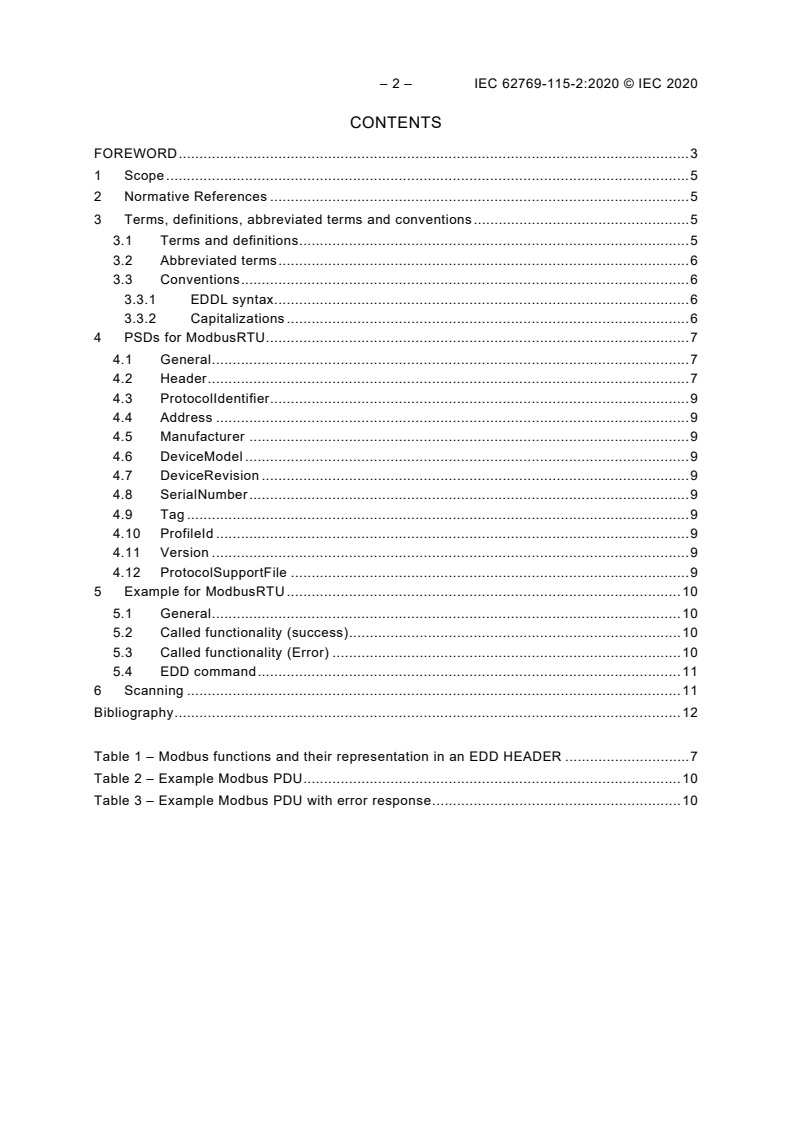
CONTENTS
FOREWORD . 3
1 Scope . 5
2 Normative References . 5
3 Terms, definitions, abbreviated terms and conventions . 5
3.1 Terms and definitions . 5
3.2 Abbreviated terms . 6
3.3 Conventions . 6
3.3.1 EDDL syntax. 6
3.3.2 Capitalizations . 6
4 PSDs for ModbusRTU . 7
4.1 General . 7
4.2 Header . 7
4.3 ProtocolIdentifier . 9
4.4 Address . 9
4.5 Manufacturer . 9
4.6 DeviceModel . 9
4.7 DeviceRevision . 9
4.8 SerialNumber . 9
4.9 Tag . 9
4.10 ProfileId . 9
4.11 Version . 9
4.12 ProtocolSupportFile . 9
5 Example for ModbusRTU . 10
5.1 General . 10
5.2 Called functionality (success) . 10
5.3 Called functionality (Error) . 10
5.4 EDD command . 11
6 Scanning . 11
Bibliography . 12
Table 1 – Modbus functions and their representation in an EDD HEADER . 7
Table 2 – Example Modbus PDU . 10
Table 3 – Example Modbus PDU with error response . 10
INTERNATIONAL ELECTROTECHNICAL COMMISSION
____________
FIELD DEVICE INTEGRATION (FDI) –
Part 115-2: Profiles – Modbus-RTU
FOREWORD
1) The International Electrotechnical Commission (IEC) is a worldwide organization for standardization comprising
all national electrotechnical committees (IEC National Committees). The object of IEC is to promote
international co-operation on all questions concerning standardization in the electrical and electronic fields. To
this end and in addition to other activities, IEC publishes International Standards, Technical Specifications,
Technical Reports, Publicly Available Specifications (PAS) and Guides (hereafter referred to as "IEC
Publication(s)"). Their preparation is entrusted to technical committees; any IEC National Committee interested
in the subject dealt with may participate in this preparatory work. International, governmental and non-
governmental organizations liaising with the IEC also participate in this preparation. IEC collaborates closely
with the International Organization for Standardization (ISO) in accordance with conditions determined by
agreement between the two organizations.
2) The formal decisions or agreements of IEC on technical matters express, as nearly as possible, an international
consensus of opinion on the relevant subjects since each technical committee has representation from all
interested IEC National Committees.
3) IEC Publications have the form of recommendations for international use and are accepted by IEC National
Committees in that sense. While all reasonable efforts are made to ensure that the technical content of IEC
Publications is accurate, IEC cannot be held responsible for the way in which they are used or for any
misinterpretation by any end user.
4) In order to promote international uniformity, IEC National Committees undertake to apply IEC Publications
transparently to the maximum extent possible in their national and regional publications. Any divergence
between any IEC Publication and the corresponding national or regional publication shall be clearly indicated in
the latter.
5) IEC itself does not provide any attestation of conformity. Independent certification bodies provide conformity
assessment services and, in some areas, access to IEC marks of conformity. IEC is not responsible for any
services carried out by independent certification bodies.
6) All users should ensure that they have the latest edition of this publication.
7) No liability shall attach to IEC or its directors, employees, servants or agents including individual experts and
members of its technical committees and IEC National Committees for any personal injury, property damage or
other damage of any nature whatsoever, whether direct or indirect, or for costs (including legal fees) and
expenses arising out of the publication, use of, or reliance upon, this IEC Publication or any other IEC
Publications.
8) Attention is drawn to the Normative references cited in this publication. Use of the referenced publications is
indispensable for the correct application of this publication.
9) Attention is drawn to the possibility that some of the elements of this IEC Publication may be the subject of
patent rights. IEC shall not be held responsible for identifying any or all such patent rights.
International Standard IEC 62769-115-2 has been prepared by subcommittee 65E: Devices
and integration in enterprise systems, of IEC technical committee 65: Industrial-process
measurement, control and automation.
FCG_TS62769-115-2_Profiles_PSD ModbusRTU_1.1.0.4, a specification of the FieldComm
Group, PROFIBUS Nutzerorganisation e. V., OPC Foundation and FDT Group, has served as
a basis for the elaboration of this standard.
The text of this International Standard is based on the following documents:
FDIS Report on voting
65E/740/FDIS 65E/744/RVD
Full information on the voting for the approval of this International Standard can be found in
the report on voting indicated in the above table.
– 4 – IEC 62769-115-2:2020 © IEC 2020
This document has been drafted in accordance with the ISO/IEC Directives, Part 2.
A list of all parts in the IEC 62769 series, published under the general title Field Device
Integration (FDI), can be found on the IEC website.
The committee has decided that the contents of this document will remain unchanged until the
stability date indicated on the IEC website under "http://webstore.iec.ch" in the data related to
the specific document. At this date, the document will be
• reconfirmed,
• withdrawn,
• replaced by a revised edition, or
• amended.
FIELD DEVICE INTEGRATION (FDI) –
Part 115-2: Profiles – Modbus-RTU
1 Scope
This part of IEC 62769 defines the protocol-specific definitions (PSDs) as defined in
IEC 62769-7 on generic protocol extensions for the Modbus® -RTU protocol in accordance
with CPF 15 in IEC 61784-2.
2 Normative References
The following documents are referred to in the text in such a way that some or all of their
content constitutes requirements of this document. For dated references, only the edition
cited applies. For undated references, the latest edition of the referenced document (including
any amendments) applies.
IEC 61784-1, Industrial communication networks – Profiles – Part 1: Fieldbus profiles
IEC 61804 (all parts), Function blocks (FB) for process control and Electronic Device
Description Language (EDDL)
IEC 62541-100, OPC Unified Architecture – Part 100: Device Interface
IEC 62769-2, Field Device Integration (FDI) – Part 2: FDI Client
IEC 62769-4, Field Device Integration (FDI) – Part 4: FDI Packages
IEC 62769-5, Field Device Integration (FDI) – Part 5: FDI Information Model
IEC 62769-7, Field Device Integration (FDI) – Part 7: FDI Communication Devices
MOD06, Modbus.org: MODBUS over serial line specification and implementation guide V1.02
MOD12, Modbus.org: MODBUS APPLICATION PROTOCOL SPECIFICATION, V1.1b3
3 Terms, definitions, abbreviated terms and conventions
3.1 Terms and definitions
For the purposes of this document, the terms and definitions given in IEC 61784-1, the
IEC 61804 series, IEC 62541-100, IEC 62769-4, IEC 62769-5, and IEC 62769-7 apply.
___________
Modbus is the trademark of a product supplied by Schneider Electric USA, INC. This information is given for the
convenience of users of this document and does not constitute an endorsement by IEC of the product named.
Equivalent products may be used if they can be shown to lead to the same results.
– 6 – IEC 62769-115-2:2020 © IEC 2020
ISO and IEC maintain terminological databases for use in standardization at the following
addresses:
• IEC Electropedia: available at http://www.electropedia.org/
• ISO Online browsing platform: available at http://www.iso.org/obp
3.2 Abbreviated terms
For the purposes of this specification, the following abbreviated terms apply.
EDD electronic device description
EDDL Electronic Device Description Language (see IEC 61804)
FDI™ Field Device Integration
FCG FieldComm Group
XML Extensible Markup Language (see REC-xml-2081126)
3.3 Conventions
3.3.1 EDDL syntax
This document specifies content for the EDD component that is part of FDI Communication
Packages. The specification content using EDDL syntax uses the font Courier New. The
EDDL syntax is used for method signature, variable, data structure and component
declarations.
3.3.2 Capitalizations
The IEC 62769 series uses capitalized terms to emphasize that these terms have an FDI-
specific meaning.
Some of these terms use an initialism as a prefix, for example:
• FDI Client, or
• FDI Server.
Some of these terms are compound terms such as:
• Communication Servers, or
• Profile Package.
Parameter names or attributes are concatenated into a single term, where the original terms
start in this term with a capital letter, such as:
• ProtocolSupportFile or
• ProtocolType.
Parameter names or attributes can also be constructed by using an underscore character to
concatenate two or more terms, such as:
• DEVICE_REV or
• DEVICE_MODEL
___________
Field Device Integration (FDI) is the trademark of a product supplied by FieldComm Group. This information is
given for the convenience of users of this document and does not constitute an endorsement by IEC of the
product named. Equivalent products may be used if they can be shown to lead to the same results.
4 PSDs for ModbusRTU
4.1 General
Clause 4 defines the protocol-specific definitions for Modbus-RTU, which is the Modbus over
serial line protocol using the transmission method RTU (remote terminal unit) in accordance
with MOD06.
4.2 Header
The HEADER string used to define EDD commands contains the information about what
Modbus function is called and what is addressed by the function. It shall contain the attribute
FUNCTION and may, depending on the FUNCTION, contain the attribute SUBFUNCTION,
READ_ADDRESS, READ_COUNT, WRITE_ADDRESS and WRITE_COUNT. The syntax is
= "" per attribute; attributes are separated by a space. The value is
provided as a decimal value, not as a hexadecimal value. For example, to read the device
identification (function 43 (0x2B) and sub-function 14 (0x0E)), the HEADER string is
"FUNCTION=\"43\" SUBFUNCTION=\"14\"".
NOTE The character \ is used as an escape character that allows " in the HEADER string.
The values for READ_ADDRESS, READ_COUNT, WRITE_ADDRESS, WRITE_COUNT are
restricted to numeric values between 0 and 65 535. Table 1 specifies the allowed Modbus
FUNCTION values and the usage of the attributes, as well as the used EDD COMMAND
OPERATION.
Table 1 – Modbus functions and their representation in an EDD HEADER
Read coils 01 - Starting Quantity - - R - Coil status
address of coils
Read 02 - Starting Quantity - - R - Input
discrete address of inputs status
inputs
Read holding 03 - Starting Quantity - - R - Reg. value
registers address of
registers
Read input 04 Starting Quantity - - R - Input
registers address of input register
registers
Write single 05 - - - Output - W Output Output
coil address value value
Write single 06 - - - Reg. W Register Register
register address value value
Read 07 - - - - - R - Output
exception data
status
b)
Diagnostics 08 2 - - - - R, C Data Data
Get comm 11 - - - - - R - Status +
event counter Event
count
Functionality
FUNCTION
SUBFUNCTION
(Byte)
READ_ADDRESS
READ_COUNT
WRITE_ADDRESS
WRITE_COUNT
Operation (in
a)
EDD)
Request (in EDD)
Response (in EDD)
– 8 – IEC 62769-115-2:2020 © IEC 2020
Get comm 12 - - - - - R - Status +
event log Event
count +
Message
count +
Events
Write Starting Quantity Output
15 - - - W -
multiple coils address of outputs values
Write 16 - - - Starting Quantity W Register -
multiple address of value
registers registers
Report server 17 - - - - - R - Server ID
ID + Run
indicator
status +
Additional
data
Read file 20 - - - - - R Sub- Sub-
record Req … Req …
Write file 21 - - - - - W Sub- Sub-
record Req … Req …
Mask write 22 - - - Ref. - W And_Mask -
register address +
Or_Mask
c)
Read/write 23 - Read Quantity Write Write R, W, C Write Read
multiple starting to read starting starting register register
registers address address quality value value
Read FIFO 24 - FIFO - - - R - FIFO
queue pointer Count +
address FIFO
value
register
Read device 43 14 Read - - - R - Conformit
identification device ID y level +
code + More
Object follows +
d)
Next
ID
object ID
+ Number
of objects
+ List of
object ID,
Object
length,
Object
value
a)
R = READ, W = WRITE, C = COMMAND
b)
Depending on the SUBFUNCTION, either READ or COMMAND (e.g. for 01 – Restart communication options)
c)
Depending on whether the function EDD has to choose between READ, WRITE, or COMMAND, since this
function allows independent READ and WRITE operations.
d)
Those two-byte values need to be combined to get a numeric value. For example, when Read device ID code
0x04 is chosen together with ObjectId 0x00 the value is 0x0400 = 1 024.
Functionality
FUNCTION
SUBFUNCTION
(Byte)
READ_ADDRESS
READ_COUNT
WRITE_ADDRESS
WRITE_COUNT
Operation (in
a)
EDD)
Request (in EDD)
Response (in EDD)
Table 1 also identifies what data shall be provided in the REQUEST of an EDD command. The
CRC information is never included in the REQUEST or RESPONSE and needs to be handled
by the communication infrastructure (FDI Gateway or FDI Communication Server). Also,
length information (e.g. byte count) is excluded from REQUEST or RESPONSE and needs to
be handled by the communication infrastructure.
4.3 ProtocolIdentifier
ProtocolIdentifier for ModbusRTU shall be "urn:fdipsd:ModbusRTU".
4.4 Address
Address shall be a value between 1 and 247. It shall be represented in the string as a decimal
number without leading zeros (e.g. using the regular expression
"(1\d?\d?)|((24[0-7]?)|(2[0-3]\d?)|2\d?)|([1-9]\d?)". Address maps to the slave
node address in accordance with MOD06. SetAddress is not supported.
4.5 Manufacturer
Manufacturer is mapped to VendorName (ObjectId 0x00) received with Function 43 in
Modbus. For FDI Gateways, the EDD data type EUC of length 256 shall be used and therefore
the length of the string is limited to 256. For devices providing a longer string, the end of the
string is truncated.
4.6 DeviceModel
DeviceModel is mapped to ProductCode (ObjectId 0x01) received with Function 43 in Modbus.
For FDI Gateways, the EDD data type EUC of length 256 shall be used and therefore the
length of the string is limited to 256. For devices providing a longer string, the end of the
string is truncated.
4.7 DeviceRevision
Modbus contains a place to manage a device revision in MajorMinorRevision (ObjectId 0x02)
received with Function 43. As this is an ASCII string, there is no mapping defined to
DeviceRevision and DeviceRevision shall not be used.
4.8 SerialNumber
No mapping is defined for SerialNumber and SerialNumber shall not be used.
4.9 Tag
No mapping is defined for Tag and Tag shall not be used.
4.10 ProfileId
No mapping is defined for ProfileId and ProfileId shall not be used.
4.11 Version
The ModbusRTU Protocol Version 1.02 shall be mapped to Version "1.02.00".
4.12 ProtocolSupportFile
There shall be no use of ProtocolSupportFiles.
– 10 – IEC 62769-115-2:2020 © IEC 2020
5 Example for ModbusRTU
5.1 General
In order to illustrate how the PSDs can be used to create EDDs for ModbusRTU, Subclauses
5.2 to 5.4 give the definition of an EDD command and the corresponding resulting Modbus
Serial Line PDU is provided, as well as a successful return and an error returned, and how
this affects the EDD.
5.2 Called functionality (success)
To illustrate the usage of EDD commands, the case should be considered of an EDD
developer who wants to read some data from the Modbus device in the input registers.
Via a scan, the FDI application has already identified the device address as 1. So the actual
PDU that should be generated is 0x 01 04 00 08 00 01 C2 95 (reading Input Register 9) and
the response would be 0x 01 04 02 00 0A D3 20 (value 10) (see also Table 2).
Table 2 – Example Modbus PDU
Request Response
Field Hex Field Hex
Device Address 01 Device Address 01
Function 04 Function 04
Starting Address Hi 00 Byte Count 02
Starting Address Lo 08 Input Req. 9 Hi 00
Quantity of Input Req. Hi 00 Input Register 9 Lo 0A
Quantity of Input Req. Lo 01 CRC Hi D3
CRC Hi C2 CRC Lo 20
CRC Lo 95
5.3 Called functionality (Error)
To illustrate a failed communication, an error case is also shown in Table 3. So the same
request as described in 5.2 could also lead to an error response 0x 01 84 04 73 63 indicating
a "SERVER DEVICE FAILURE" in accordance with MOD12.
Table 3 – Example Modbus PDU with error response
Request Response
Field Hex Field Hex
Device Address 01 Device Address 01
Function 04 Error Code 84
Starting Address Hi 00 Exception Code 04
Starting Address Lo 08 CRC Hi 73
Quantity of Input Req. Hi 00 CRC Lo 63
Quantity of Input Req. Lo 01
CRC Hi C2
CRC Lo 95
5.4 EDD command
In the following, an EDD command to generate such a Modbus communication is defined.
COMMAND ReadRegister9
{
OPERATION READ;
HEADER "FUNCTION=\"4\" READ_ADDRESS=\"8\" READ_COUNT=\"1\"";
//Function 04 – Read Input Registers
TRANSACTION
{
REQUEST
{
}
REPLY
{
VariableA // Variable of type Int(2), receiving value of Register 09
}
}
RESPONSE_CODES
{
0, SUCCESS, "No Errors";
1, MISC_ERROR, "ILLEGAL FUNCTION";
2, DATA_ENTRY_ERROR, "ILLEGAL DATA ADDRESS";
3, DATA_ENTRY_ERROR, "ILLEGAL DATA VALUE";
4, MISC_ERROR, "SERVER DEVICE ERROR";
}
}
The address is managed by the EDD application outside the EDD and needs to be put into the
PDU by the communication infrastructure (FDI Communication Server or FDI Gateway).
The Modbus function information as well as the starting address and the quantity of registers
is put into the HEADER attribute.
The CRC information is not defined in the EDD command and needs to be added by the
communication infrastructure (FDI Gateway or FDI Communication Server) managing the
ModbusRTU communication.
A successful response is put into the VariableA, as defined in the REPLY, and the response
code 0 is used. The CRC information is not provided but checked by the communication
infrastructure and handled as a communication error.
In the case of an error, the exception code is put into the RESPONSE_CODES. Identical to a
successful response, the CRC information is not provided but handled as in the success case.
Remark concerning the byte order: in ModbusRTU, the byte order is in general Big-Endian in
accordance with MOD12, so no transformation needs to be done by the communication
infrastructure.
6 Scanning
In order to scan for ModbusRTU devices and receive information about the type of devi
...