

IEC 60079-14:2002
(Main)Electrical apparatus for explosive gas atmospheres - Part 14: Electrical installations in hazardous areas (other than mines)
General Information
- Abstract
This part of IEC 60079 contains the specific requirements for the design, selection and erection of electrical installations in explosive gas atmospheres. These requirements are in addition to the requirements for installations in non-hazardous areas. This standard applies to all electrical equipment and installations in hazardous areas whether permanent, temporary, portable, transportable or hand-held. It applies to installations at all voltages. This standard does not apply to - electrical installations in mines susceptible to firedamp; - electrical installations in areas where the hazard is due to combustible dusts or fibres; - inherently explosive situations, for example explosives manufacturing and processing; - rooms used for medical purposes.
- Status
- Published
- Publication Date
- 23-Oct-2002
- Technical Committee
- SC 31J - Classification of hazardous areas and installation requirements
- Current Stage
- DELPUB - Deleted Publication
- Start Date
- 13-Dec-2007
- Completion Date
- 28-Aug-2026
Buy Documents
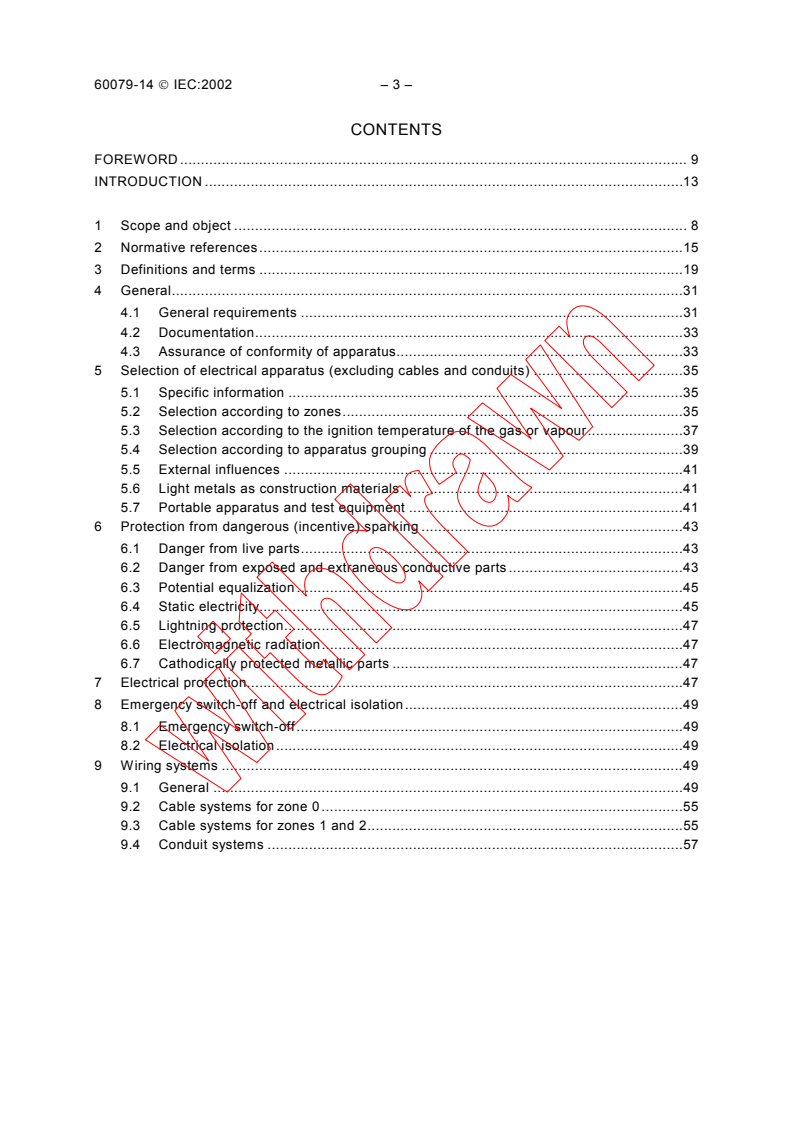
IEC 60079-14:2002 - Electrical apparatus for explosive gas atmospheres - Part 14: Electrical installations in hazardous areas (other than mines) Released:10/24/2002
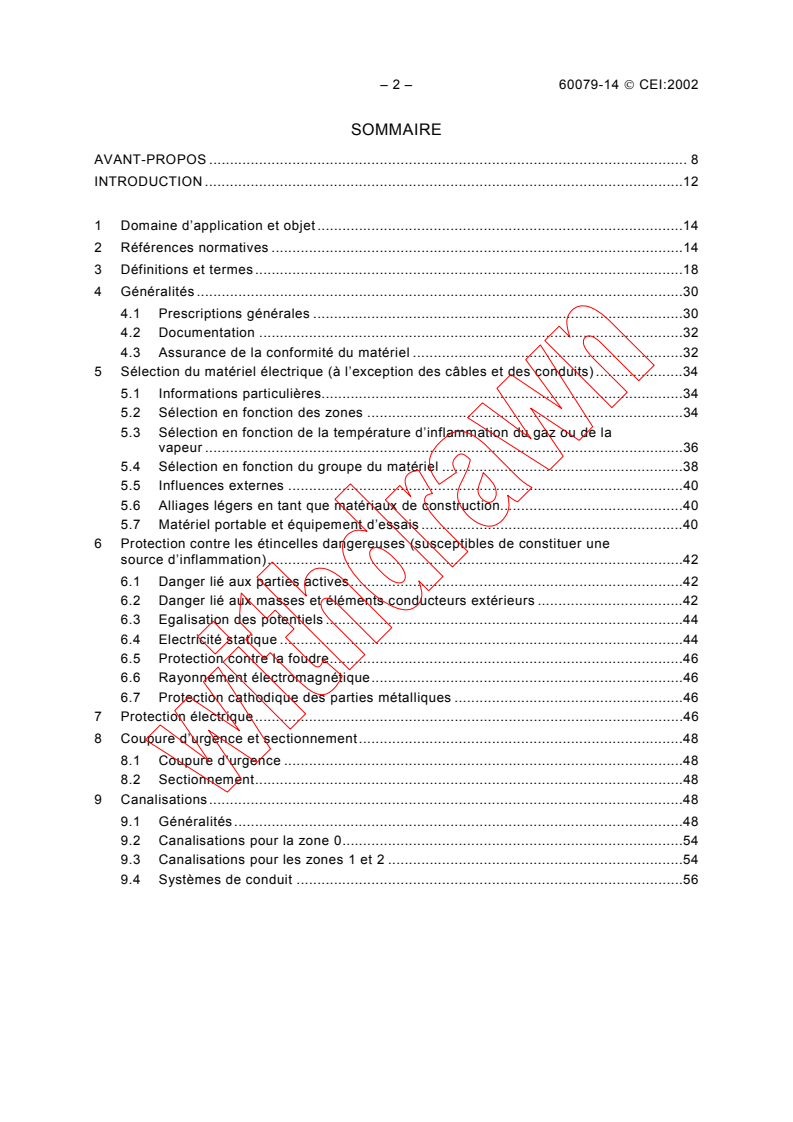
IEC 60079-14:2002 - Matériel électrique pour atmospheres explosives gazeuses - Partie 14: Installations électriques dans les emplacements dangereux (autres que les mines) Released:10/24/2002
IEC 60079-14:2002 - Electrical apparatus for explosive gas atmospheres - Part 14: Electrical installations in hazardous areas (other than mines) Released:10/24/2002
Overview
IEC 60079-14:2002 - "Electrical apparatus for explosive gas atmospheres - Part 14: Electrical installations in hazardous areas (other than mines)" provides specific requirements for the design, selection and erection of electrical installations in explosive gas atmospheres. It covers installations that are permanent, temporary, portable, transportable or hand‑held, and applies across all voltages. The standard is supplementary to general electrical installation standards and to the IEC series for equipment construction and protection types.
This part does not apply to electrical installations in mines susceptible to firedamp, areas where the hazard is due to combustible dusts or fibres, inherently explosive manufacturing (e.g., explosives processing) or rooms used for medical purposes.
Key topics and requirements
The standard addresses practical and technical requirements including:
- Hazard zoning and selection of apparatus - guidance for choosing equipment based on zone classification (zone 0, 1, 2) and gas/vapour characteristics.
- Types of protection - installation requirements for protection concepts such as flameproof (“d”), increased safety (“e”), intrinsic safety (“i”), pressurization (“p”) and equipment intended only for zone 2.
- Wiring systems and cable selection - rules for cable systems, conduit systems and cable entries suitable for hazardous areas.
- Protection against ignition sources - measures for preventing dangerous sparking, hot surfaces, static electricity, lightning and electromagnetic influences.
- Electrical protection and isolation - emergency switch‑off, electrical isolation and earthing/potential equalization requirements.
- Intrinsic safety and circuit verification - special installation and verification procedures for intrinsically safe circuits and associated apparatus.
- Pressurization, purging and analyzer houses - requirements for pressurized enclosures and action on loss of pressurization.
- Documentation, conformity and maintenance - documentation, conformity assurance and reference to inspection and repair standards.
The standard contains figures, tables and annexes to assist with selection, verification of intrinsically safe circuits and determination of cable parameters.
Applications and users
IEC 60079-14 is used by:
- Electrical design engineers and contractors specifying and installing systems in petrochemical plants, refineries, offshore platforms, chemical processing, gas distribution and other facilities handling flammable gases or vapours.
- Safety and compliance engineers preparing hazardous area assessments and zone classifications.
- Inspection and maintenance personnel, certification bodies and regulatory authorities verifying installations against international best practice.
Related standards
Commonly used alongside:
- IEC 60079-0 (general requirements for explosive atmospheres)
- IEC 60079-10 (classification of hazardous areas)
- IEC 60079-17 / 60079-19 (inspection, maintenance, repair)
- IEC 60364 (electrical installation practice)
- IEC 60529 / IEC 60034-5 (degrees of protection and motor enclosures)
IEC 60079-14 is essential for safe, compliant electrical installations in hazardous gas atmospheres and supports risk reduction by specifying practical selection and installation measures.
Relations
- Referred By
EN ISO 21049:2004 - Pumps - Shaft sealing systems for centrifugal and rotary pumps (ISO 21049:2004) - Effective Date
- 25-Aug-2026
- Effective Date
- 25-Aug-2026
- Effective Date
- 25-Aug-2026
- Effective Date
- 25-Aug-2026
- Effective Date
- 10-Feb-2026
- Effective Date
- 05-Sep-2023
- Effective Date
- 05-Sep-2023
Buy Documents
IEC 60079-14:2002 - Electrical apparatus for explosive gas atmospheres - Part 14: Electrical installations in hazardous areas (other than mines) Released:10/24/2002
IEC 60079-14:2002 - Matériel électrique pour atmospheres explosives gazeuses - Partie 14: Installations électriques dans les emplacements dangereux (autres que les mines) Released:10/24/2002
IEC 60079-14:2002 - Electrical apparatus for explosive gas atmospheres - Part 14: Electrical installations in hazardous areas (other than mines) Released:10/24/2002
Get Certified
Connect with accredited certification bodies for this standard

IMQ S.p.A. (Certification)
Italian electrical product certification.

SLG Prüf- und Zertifizierungs GmbH
German testing and certification body.

UL Solutions
Global safety science company with testing, inspection and certification.
Sponsored listings
Frequently Asked Questions
IEC 60079-14:2002 is a standard published by the International Electrotechnical Commission (IEC). Its full title is "Electrical apparatus for explosive gas atmospheres - Part 14: Electrical installations in hazardous areas (other than mines)". This standard covers: This part of IEC 60079 contains the specific requirements for the design, selection and erection of electrical installations in explosive gas atmospheres. These requirements are in addition to the requirements for installations in non-hazardous areas. This standard applies to all electrical equipment and installations in hazardous areas whether permanent, temporary, portable, transportable or hand-held. It applies to installations at all voltages. This standard does not apply to - electrical installations in mines susceptible to firedamp; - electrical installations in areas where the hazard is due to combustible dusts or fibres; - inherently explosive situations, for example explosives manufacturing and processing; - rooms used for medical purposes.
This part of IEC 60079 contains the specific requirements for the design, selection and erection of electrical installations in explosive gas atmospheres. These requirements are in addition to the requirements for installations in non-hazardous areas. This standard applies to all electrical equipment and installations in hazardous areas whether permanent, temporary, portable, transportable or hand-held. It applies to installations at all voltages. This standard does not apply to - electrical installations in mines susceptible to firedamp; - electrical installations in areas where the hazard is due to combustible dusts or fibres; - inherently explosive situations, for example explosives manufacturing and processing; - rooms used for medical purposes.
IEC 60079-14:2002 is classified under the following ICS (International Classification for Standards) categories: 29.260.20 - Electrical apparatus for explosive atmospheres. The ICS classification helps identify the subject area and facilitates finding related standards.
IEC 60079-14:2002 has the following relationships with other standards: It is inter standard links to EN ISO 21049:2004, EN ISO 10438-1:2007, EN ISO 13705:2006, EN ISO 13710:2004, EN 61800-2:2015, IEC 60079-14:1996, IEC 60079-14:2007. Understanding these relationships helps ensure you are using the most current and applicable version of the standard.
IEC 60079-14:2002 is available in PDF format for immediate download after purchase. The document can be added to your cart and obtained through the secure checkout process. Digital delivery ensures instant access to the complete standard document.
Standards Content (Sample)
INTERNATIONAL IEC
STANDARD
60079-14
Third edition
2002-10
Electrical apparatus for explosive
gas atmospheres –
Part 14:
Electrical installations in hazardous areas
(other than mines)
This English-language version is derived from the original
bilingual publication by leaving out all French-language
pages. Missing page numbers correspond to the French-
language pages.
Reference number
Publication numbering
As from 1 January 1997 all IEC publications are issued with a designation in the
60000 series. For example, IEC 34-1 is now referred to as IEC 60034-1.
Consolidated editions
The IEC is now publishing consolidated versions of its publications. For example,
edition numbers 1.0, 1.1 and 1.2 refer, respectively, to the base publication, the base
publication incorporating amendment 1 and the base publication incorporating
amendments 1 and 2.
Further information on IEC publications
The technical content of IEC publications is kept under constant review by the IEC,
thus ensuring that the content reflects current technology. Information relating to this
publication, including its validity, is available in the IEC Catalogue of publications
(see below) in addition to new editions, amendments and corrigenda. Information on
the subjects under consideration and work in progress undertaken by the technical
committee which has prepared this publication, as well as the list of publications
issued, is also available from the following:
• IEC Web Site (www.iec.ch)
• Catalogue of IEC publications
The on-line catalogue on the IEC web site (www.iec.ch/searchpub) enables you to
search by a variety of criteria including text searches, technical committees and
date of publication. On-line information is also available on recently issued
publications, withdrawn and replaced publications, as well as corrigenda.
• IEC Just Published
This summary of recently issued publications (www.iec.ch/online_news/ justpub) is
also available by email. Please contact the Customer Service Centre (see below)
for further information.
• Customer Service Centre
If you have any questions regarding this publication or need further assistance,
please contact the Customer Service Centre:
Email: custserv@iec.ch
Tel: +41 22 919 02 11
Fax: +41 22 919 03 00
INTERNATIONAL IEC
STANDARD
60079-14
Third edition
2002-10
Electrical apparatus for explosive
gas atmospheres –
Part 14:
Electrical installations in hazardous areas
(other than mines)
IEC 2002 Copyright - all rights reserved
No part of this publication may be reproduced or utilized in any form or by any means, electronic or mechanical,
including photocopying and microfilm, without permission in writing from the publisher.
International Electrotechnical Commission, 3, rue de Varembé, PO Box 131, CH-1211 Geneva 20, Switzerland
Telephone: +41 22 919 02 11 Telefax: +41 22 919 03 00 E-mail: inmail@iec.ch Web: www.iec.ch
PRICE CODE
XB
Commission Electrotechnique Internationale
International Electrotechnical Commission
Международная Электротехническая Комиссия
For price, see current catalogue
60079-14 IEC:2002 – 3 –
CONTENTS
FOREWORD . 9
INTRODUCTION .13
1 Scope and object . 8
2 Normative references.15
3 Definitions and terms .19
4 General.31
4.1 General requirements .31
4.2 Documentation.33
4.3 Assurance of conformity of apparatus.33
5 Selection of electrical apparatus (excluding cables and conduits) .35
5.1 Specific information .35
5.2 Selection according to zones.35
5.3 Selection according to the ignition temperature of the gas or vapour.37
5.4 Selection according to apparatus grouping .39
5.5 External influences .41
5.6 Light metals as construction materials.41
5.7 Portable apparatus and test equipment .41
6 Protection from dangerous (incentive) sparking .43
6.1 Danger from live parts.43
6.2 Danger from exposed and extraneous conductive parts .43
6.3 Potential equalization .45
6.4 Static electricity.45
6.5 Lightning protection.47
6.6 Electromagnetic radiation.47
6.7 Cathodically protected metallic parts .47
7 Electrical protection.47
8 Emergency switch-off and electrical isolation.49
8.1 Emergency switch-off.49
8.2 Electrical isolation.49
9 Wiring systems .49
9.1 General .49
9.2 Cable systems for zone 0.55
9.3 Cable systems for zones 1 and 2.55
9.4 Conduit systems .57
60079-14 IEC:2002 – 5 –
10 Additional requirements for type of protection “d” – Flameproof enclosures.59
10.1 General .59
10.2 Solid obstacles .59
10.3 Protection of flameproof joints.59
10.4 Cable entry systems.61
10.5 Motors supplied at varying frequency and voltage.63
10.6 Conduit systems .65
11 Additional requirements for type of protection “e” – Increased safety.67
11.1 Degree of protection of enclosures (IEC 60034-5 and IEC 60529).67
11.2 Cage induction motors – Thermal protection in operation.67
11.3 Wiring systems .71
11.4 Resistance heating devices.73
11.5 Cage rotor and high voltage machines.73
12 Additional requirements for type of protection “i” – Intrinsic safety.73
12.1 Introductory remark.73
12.2 Installations for zones 1 and 2.75
12.3 Installations for zone 0 .91
12.4 Special applications .93
13 Additional requirements for type of protection “p” – Pressurized apparatus.95
13.1 Ducting .95
13.2 Action to be taken on failure of pressurization .97
13.3 Multiple pressurized enclosures with a common safety device .101
13.4 Purging.101
13.5 Pressurized rooms and analyser houses .103
14 Additional requirements for apparatus suitable only for use in zone 2.103
14.1 Degree of protection of enclosures (IEC 60034-5 and IEC 60529).103
14.2 Energy-limited apparatus and circuits .103
14.3 Wiring systems .105
14.4 Motors supplied at varying frequency and voltage.105
15 Personal electrical apparatus .107
Annex A (normative) Verification of intrinsically safe circuits with more than one
associated apparatus with linear current/voltage characteristics .109
Annex B (informative) Methods of determining the maximum system voltages and
currents in intrinsically safe circuits with more than one associated apparatus with
linear current/voltage characteristics (as required by annex A) .111
Annex C (informative) Determination of cable parameters.117
Bibliography .121
60079-14 IEC:2002 – 7 –
Figure 1 – Selection chart for cable entry devices into flameproof enclosures for cables
complying with item b) of 10.4.2.63
Figure 2 – Earthing of conducting screens .79
Figure B.1 – Series connection – Summation of voltage .113
Figure B.2 – Parallel connection – Summation of currents.113
Figure B.3 – Series and parallel connections – Summations of voltages and summations
of currents.115
Table 1 – Relationship between the temperature classes, surface temperatures and
ignition temperature.39
Table 2 – Relationship between gas/vapour subdivision and apparatus subgroup .39
Table 3 – Minimum distance of obstruction from the flameproof flange joints related to
the gas/vapour Subgroup of the hazardous area .59
Table 4 – Assessment for T4 classification according to component size and ambient
temperature.91
Table 5 – Use of spark and particle barriers.97
Table 6 – Action to be taken when the pressurization with the protective gas fails for
electrical apparatus without an internal source of release.99
60079-14 IEC:2002 – 9 –
INTERNATIONAL ELECTROTECHNICAL COMMISSION
___________
ELECTRICAL APPARATUS FOR EXPLOSIVE GAS ATMOSPHERES –
Part 14: Electrical installations in hazardous areas
(other than mines)
FOREWORD
1) The IEC (International Electrotechnical Commission) is a worldwide organization for standardization comprising
all national electrotechnical committees (IEC National Committees). The object of the IEC is to promote
international co-operation on all questions concerning standardization in the electrical and electronic fields. To
this end and in addition to other activities, the IEC publishes International Standards. Their preparation is
entrusted to technical committees; any IEC National Committee interested in the subject dealt with may
participate in this preparatory work. International, governmental and non-governmental organizations liaising
with the IEC also participate in this preparation. The IEC collaborates closely with the International Organization
for Standardization (ISO) in accordance with conditions determined by agreement between the two
organizations.
2) The formal decisions or agreements of the IEC on technical matters express, as nearly as possible, an
international consensus of opinion on the relevant subjects since each technical committee has representation
from all interested National Committees.
3) The documents produced have the form of recommendations for international use and are published in the form
of standards, technical specifications, technical reports or guides and they are accepted by the National
Committees in that sense.
4) In order to promote international unification, IEC National Committees undertake to apply IEC International
Standards transparently to the maximum extent possible in their national and regional standards. Any
divergence between the IEC Standard and the corresponding national or regional standard shall be clearly
indicated in the latter.
5) The IEC provides no marking procedure to indicate its approval and cannot be rendered responsible for any
equipment declared to be in conformity with one of its standards.
6) Attention is drawn to the possibility that some of the elements of this International Standard may be the subject
of patent rights. The IEC shall not be held responsible for identifying any or all such patent rights.
International Standard IEC 60079-14 has been prepared by subcommittee 31J: Classification of
hazardous areas and installation requirements, of IEC technical committee 31: Electrical
apparatus for explosive atmospheres.
This third edition cancels and replaces the second edition published in 1996, and constitutes a
technical revision.
The text of this standard is based on the following documents:
FDIS Report on voting
31J/86/FDIS 31J/87/RVD
Full information on the voting for the approval of this standard can be found in the report on
voting indicated in the above table.
This publication has been drafted in accordance with the ISO/IEC Directives, Part 3.
This standard is to be read in conjunction with IEC 60079-0 and with the standards for the
specific types of protection listed in the scope.
Annex A forms an integral part of this standard.
Annexes B and C are for information only.
60079-14 IEC:2002 – 11 –
The committee has decided that the contents of this publication will remain unchanged until
2007. At this date, the publication will be
• reconfirmed;
• withdrawn;
• replaced by a revised edition, or
• amended.
60079-14 IEC:2002 – 13 –
INTRODUCTION
When electrical apparatus is to be installed in areas where dangerous concentrations and
quantities of flammable gases, vapours, mists, ignitable fibres or dusts may be present in the
atmosphere, protective measures are applied to reduce the likelihood of explosion due to
ignition by arcs, sparks or hot surfaces, produced either in normal operation or under specified
fault conditions.
This part of IEC 60079 is supplementary to other relevant IEC standards, for example IEC
60364 as regards electrical installation requirements, and also refers to IEC 60079-0 and its
associated standards for the construction, testing and marking requirements of suitable
electrical apparatus.
By careful design of the electrical installation, it is frequently possible to locate much of the
electrical apparatus in less hazardous or non-hazardous areas.
For an explosion to occur, an explosive atmosphere and a source of ignition need to co-exist.
Protective measures aim to reduce to an acceptable level the likelihood that the electrical
installation could become a source of ignition.
It has been found practical to classify hazardous areas into zones according to the likelihood of
an explosive gas atmosphere being present (see IEC 60079-10). Such classification allows
appropriate types of protection to be specified for each zone.
Several types of protection are now available for electrical apparatus in hazardous areas (see
IEC 60079-0), and this standard gives the specific requirements for design, selection and
erection of electrical installations in explosive gas atmospheres.
This standard is based on the assumption that electrical apparatus is correctly installed, tested,
maintained and used in accordance with its specified characteristics.
Inspection, maintenance and repair aspects also form an important part of hazardous area
installations and the user’s attention is drawn to IEC 60079-17 and IEC 60079-19 for further
information concerning these aspects.
In any industrial installation, irrespective of size, there may be numerous sources of ignition
apart from those associated with electrical apparatus. Precautions may be necessary to ensure
safety, but guidance on this aspect is outside the scope of this standard.
60079-14 IEC:2002 – 15 –
ELECTRICAL APPARATUS FOR EXPLOSIVE GAS ATMOSPHERES –
Part 14: Electrical installations in hazardous areas
(other than mines)
1 Scope
This part of IEC 60079 contains the specific requirements for the design, selection and erection
of electrical installations in explosive gas atmospheres.
These requirements are in addition to the requirements for installations in non-hazardous
areas.
This standard applies to all electrical equipment and installations in hazardous areas whether
permanent, temporary, portable, transportable or hand-held.
It applies to installations at all voltages.
This standard does not apply to
– electrical installations in mines susceptible to firedamp;
NOTE This standard may apply to electrical installations in mines where explosive gas atmospheres other
than firedamp may be formed and to electrical installations in the surface installation of mines.
– electrical installations in areas where the hazard is due to combustible dusts or fibres;
– inherently explosive situations, for example explosives manufacturing and processing;
– rooms used for medical purposes.
2 Normative references
The following referenced documents are indispensable for the application of this document. For
dated references, only the edition cited applies. For undated references, the latest edition of
the referenced document (including any amendments) applies.
IEC 60034-5:2000, Rotating electrical machines – Part 5: Degrees of protection provided by the
integral design of rotating electrical machines (IP code) – Classification
IEC 60034-17:2002, Rotating electrical machines – Part 17: Cage induction motors when fed
from converters – Application guide
IEC 60050(426):1990, International Electrotechnical Vocabulary (IEV) – Chapter 426: Electrical
apparatus for explosive atmospheres
IEC 60060-1:1989, High-voltage test techniques – Part 1: General definitions and test
requirements
IEC 60079-0:1998, Electrical apparatus for explosive gas atmospheres – Part 0: General
requirements
60079-14 IEC:2002 – 17 –
IEC 60079-1:2001, Electrical apparatus for explosive gas atmospheres – Part 1: Flameproof
enclosures “d”
IEC 60079-2:2001, Electrical apparatus for explosive gas atmospheres – Part 2: Pressurized
enclosures “p”
IEC 60079-5:1997, Electrical apparatus for explosive gas atmospheres – Part 5: Powder-
filling “q”
IEC 60079-6:1995, Electrical apparatus for explosive gas atmospheres – Part 6: Oil-
immersion “o”
IEC 60079-7:2001, Electrical apparatus for explosive gas atmospheres – Part 7: Increased
safety “e”
IEC 60079-10:1995, Electrical apparatus for explosive gas atmospheres – Part 10:
Classification of hazardous areas
IEC 60079-11:1999, Electrical apparatus for explosive gas atmospheres – Part 11: Intrinsic
safety “i”
IEC 60079-13:1982, Electrical apparatus for explosive gas atmospheres – Part 13:
Construction and use of rooms or buildings protected by pressurization
IEC 60079-15:2001, Electrical apparatus for explosive gas atmospheres – Part 15: Type of
protection “n”
IEC 60079-16:1990, Electrical apparatus for explosive gas atmospheres – Part 16: Artificial
ventilation for the protection of analyser(s) houses
IEC 60079-17:1996, Electrical apparatus for explosive gas atmospheres – Part 17: Inspection
and maintenance of electrical installations in hazardous areas (other than mines)
IEC 60079-18:1992, Electrical apparatus for explosive gas atmospheres – Part 18:
Encapsulation “m”
IEC 60079-19:1993, Electrical apparatus for explosive gas atmospheres – Part 19: Repair and
overhaul for apparatus used in explosive atmospheres (other than mines or explosives)
IEC 60332-1:1993, Tests on electric cables under fire conditions – Part 1: Test on a single
vertical insulated wire or cable
IEC 60364-4-41:2001, Electrical installations of buildings – Part 4-41: Protection for safety –
Protection against electric shock
IEC 60529: 1989, Degrees of protection provided by enclosure (IP code)
IEC 60614-2-1:1982, Specification for conduits for electrical installations – Part 2: Particular
specifications for conduits – Section One: Metal conduits
IEC 60614-2-5: 1992, Specification for conduits for electrical installations – Part 2: Particular
specifications for conduits – Section 5: Flexible conduits
60079-14 IEC:2002 – 19 –
IEC 60742:1983, Isolating transformers and safety isolating transformers – Requirements
IEC 61024-1:1990, Protection of structures against lightning – Part 1: General principles
IEC 61024-1-1:1993, Protection of structures against lightning – Part 1: General principles –
Section 1: Guide A: Selection of protection levels for lightning protection systems
IEC 61285:1994, Industrial process control – Safety of analyser houses
ISO 10807:1994, Pipework – Corrugated flexible metallic hose assemblies for the protection of
electric cables in explosive atmospheres
3 Definitions and terms
For the purposes of this part of IEC 60079, the following definitions, in addition to those given
in IEC 60050(426), apply.
3.1 Hazardous areas
3.1.1
explosive atmosphere
mixture with air, under atmospheric conditions, of flammable substances in the form of gas,
vapour, mist or dust, in which after ignition, combustion spreads throughout the unconsumed
mixture
3.1.2
explosive gas atmosphere
mixture with air, under atmospheric conditions, of flammable substances in the form of gas or
vapour, in which after ignition, combustion spreads throughout the unconsumed mixture
3.1.3
hazardous area
area in which an explosive gas atmosphere is present, or may be expected to be present, in
quantities such as to require special precautions for the construction, installation and use of
apparatus
NOTE For the purposes of this standard, an area is a three-dimensional region or space.
3.1.4
non-hazardous area
area in which an explosive gas atmosphere is not expected to be present in quantities such as
to require special precautions for the construction, installation and use of apparatus
3.1.5
normal operation
operation of apparatus conforming electrically and mechanically with its design specification
and used within the limits specified by the manufacturer
NOTE The limits specified by the manufacturer may include persistent operational conditions such as stalled
rotors, failed lamps and overloads.
60079-14 IEC:2002 – 21 –
3.1.6
competent body
individual or organization which can demonstrate appropriate technical knowledge and relevant
skills to make the necessary assessments of the safety aspect under consideration
3.1.7
group (of an electrical apparatus for explosive atmospheres)
classification of electrical apparatus related to the explosive atmosphere for which it is to be
used
NOTE Electrical apparatus for use in explosive gas atmospheres is divided into two groups:
– group I: electrical apparatus for mines susceptible to firedamp;
– group II: (which can be divided into subgroups): electrical apparatus for places with an explosive gas
atmosphere, other than mines susceptible to firedamp (see 5.4).
3.1.8
maximum surface temperature
highest temperature which is attained in service under the most adverse operating conditions
(but within recognized tolerances) by any part or surface of the electrical apparatus, which
would be able to produce an ignition of the surrounding explosive atmosphere
NOTE 1 The most adverse conditions include recognized overloads and fault conditions recognized in the specific
standard for the type of protection concerned.
NOTE 2 The relevant surface temperature may be internal and/or external depending upon the type of protection
concerned.
3.1.9
sealing ring
ring used in a cable or conduit entry to ensure sealing between the entry and the cable or
conduit
3.1.10
type of protection
specific measures applied to electrical apparatus to avoid ignition of a surrounding explosive
atmosphere
3.2 Flameproof enclosure
3.2.1
flameproof enclosure “d”
type of protection in which the parts which can ignite an explosive atmosphere are placed in an
enclosure which can withstand the pressure developed during an internal explosion of an
explosive mixture and which prevents the transmission of the explosion to the explosive
atmosphere surrounding the enclosure
3.2.2
pressure-piling
condition resulting from the ignition of pre-compressed gases in compartments or subdivisions
other than those in which ignition was initiated
NOTE This may lead to a higher maximum pressure than would otherwise be expected.
60079-14 IEC:2002 – 23 –
3.3 Increased safety
3.3.1
increased safety “e”
type of protection applied to electrical apparatus in which additional measures are applied so
as to give increased security against the possibility of excessive temperatures and of the
occurrence of arcs and sparks in normal service or under specified abnormal conditions
3.3.2
initial starting current I
A
highest r.m.s. value of current absorbed by an a.c. motor at rest when supplied at the rated
voltage and frequency
3.3.3
starting current ratio I /I
A N
ratio between initial starting current I and rated current I
A N
3.3.4
time t
E
time taken for an a.c. rotor or stator winding, when carrying the initial starting current I , to be
A
heated up to the limiting temperature from the temperature reached in rated service at the
maximum ambient temperature
3.4 Intrinsic safety – general
3.4.1
intrinsic safety “i”
type of protection based upon the restriction of electrical energy within apparatus and of
interconnecting wiring exposed to an explosive atmosphere to a level below that which can
cause ignition by either sparking or heating effects
NOTE Because of the method by which intrinsic safety is achieved, it is necessary to ensure that not only the
electrical apparatus exposed to the explosive atmosphere but also other electrical apparatus with which it is
interconnected is suitably constructed.
3.4.2
intrinsically safe apparatus
electrical apparatus in which all the circuits are intrinsically safe
NOTE Intrinsically safe apparatus should conform to IEC 60079-11, category “ia” or “ib”.
3.4.3
galvanic isolation
arrangement within an item of intrinsically safe apparatus such that a signal is transferred from
the apparatus input to the apparatus output without any direct electrical connection between
the two
NOTE Galvanic isolation frequently utilizes either magnetic (transformer or relay) or opto-coupled elements.
3.4.4
associated apparatus
electrical apparatus in which the circuits or parts of circuits are not all necessarily intrinsically
safe but which contains circuits that can affect the safety of the intrinsically safe circuits
associated with it
NOTE The associated apparatus is normally the interface between an intrinsically safe circuit and a non-
intrinsically safe circuit and is frequently located in the non-hazardous area. The associated apparatus may be, for
example, shunt diode safety barriers or galvanic isolators.
60079-14 IEC:2002 – 25 –
3.4.5
simple apparatus
electrical component or combination of components of simple construction with well-defined
electrical parameters which is compatible with the intrinsic safety of the circuit in which it is
used
NOTE The following apparatus is considered to be simple apparatus:
a) passive components, e.g. switches, junction boxes, resistors and simple semi-conductor devices;
b) sources of stored energy with well-defined parameters, e.g. capacitors or inductors, whose values are
considered when determining the overall safety of the system;
c) sources of generated energy, e.g. thermocouples and photocells, which do not generate more than 1,5 V,
100 mA and 25 mW. Any inductance or capacitance present in these sources of energy are considered as in b)
above.
3.4.6
intrinsically safe circuit
circuit in which all the apparatus is either intrinsically safe apparatus or simple apparatus
NOTE The circuit may also contain associated apparatus.
3.4.7
intrinsically safe electrical system
assembly of interconnected items of electrical apparatus, described in a descriptive system
document, in which the circuits or parts of circuits intended to be used in an explosive
atmosphere are intrinsically safe
3.4.8
intrinsically safe sub-circuit
part of an intrinsically safe circuit which is galvanically isolated from another part or other parts
of the same intrinsically safe circuit
3.5 Intrinsic safety parameters
3.5.1
maximum external capacitance (C )
o
maximum capacitance in an intrinsically safe circuit that can be connected to the connection
facilities of the apparatus without invalidating intrinsic safety
3.5.2
maximum external inductance (L )
o
maximum value of inductance in an intrinsically safe circuit that can be connected to the
connection facilities of the apparatus without invalidating intrinsic safety
3.5.3
maximum external inductance to resistance ratio (L /R )
o o
ratio of inductance (L ) to resistance (R ) of any external circuit connected to the connection
o o
facilities of the electrical apparatus without invalidating intrinsic safety
3.5.4
maximum input current (I )
i
maximum current (peak a.c. or d.c.) that can be applied to the connection facilities for
intrinsically safe circuits without invalidating intrinsic safety
60079-14 IEC:2002 – 27 –
3.5.5
maximum input power (P )
i
maximum input power in an intrinsically safe circuit that can be dissipated within an apparatus
when it is connected to an external source without invalidating intrinsic safety
3.5.6
maximum input voltage (U )
i
maximum voltage (peak a.c. or d.c.) that can be applied to the connection facilities for
intrinsically safe circuits without invalidating intrinsic safety
3.5.7
maximum internal capacitance (C )
i
total equivalent internal capacitance of the apparatus which is considered as appearing across
the connection facilities of the apparatus
3.5.8
maximum internal inductance (L )
i
total equivalent internal inductance of the apparatus which is considered as appearing at the
connection facilities of the apparatus
3.5.9
maximum internal inductance to resistance ratio (L /R )
i i
ratio of inductance (L) to resistance (R) which is considered as appearing at the external
i i
connection facilities of the electrical apparatus
3.5.10
maximum output current (I )
o
maximum current (peak a.c. or d.c.) in an intrinsically safe circuit that can be taken from the
connection facilities of the apparatus
3.5.11
maximum output power (P )
o
maximum electrical power in an intrinsically safe circuit that can be taken from the apparatus
3.5.12
maximum output voltage (U )
o
maximum output voltage (peak a.c. or d.c.) in an intrinsically safe circuit that can appear under
open-circuit conditions at the connection facilities of the apparatus at any applied voltage up to
the maximum voltage, including U and U
m i
NOTE 1 Where there is more than one applied voltage, the maximum output voltage is that occurring under the
most onerous combination of applied voltages.
NOTE 2 U is sometimes used to denote the output working voltage of a shunt diode safety barrier.
z
3.5.13
maximum r.m.s. a.c. or d.c. voltage (U )
m
maximum voltage that can be applied to the non-intrinsically safe connection facilities of
associated apparatus without invalidating intrinsic safety
60079-14 IEC:2002 – 29 –
3.6 Pressurization
3.6.1
pressurization “p”
technique of guarding against the ingress of the external atmosphere into an enclosure by
maintaining a protective gas therein at a pressure above that of the external atmosphere
3.6.2
continuous dilution (flow)
continuous supply of a protective gas, after purging, at such a rate that the concentration of a
flammable substance inside the pressurized enclosure is maintained at a value outside the
explosive limits at any potential ignition source (that is, outside the dilution area)
NOTE The dilution area is an area in the vicinity of an internal source of release where the concentration of a
flammable substance is not diluted to a safe concentration.
3.6.3
leakage compensation
flow of protective gas sufficient to compensate for any leakage from the pressurized enclosure
and its ducts
3.6.4
static pressurization
maintenance of an overpressure within a pressurized enclosure without the addition of
protective gas in the hazardous area
3.7 Zone 2 protection
3.7.1
type of protection “n”
type of protection applied to electrical apparatus such that, in normal operation and in certain
specified abnormal conditions, it is not capable of igniting a surrounding explosive atmosphere
NOTE 1 Additionally, the requirements of the apparatus standard are intended to ensure that a fault capable of
causing ignition is not likely to occur.
NOTE 2 An example of a specified abnormal condition is a luminaire with a failed lamp.
3.8 Electrical supply systems
3.8.1
protective extra-low voltage (PELV)
extra-low voltage system which is not electrically separated from earth but which otherwise
satisfies the requirements for SELV
NOTE A 50 V centre-tapped earth system is a PELV system.
3.8.2
safety extra-low voltage (SELV)
extra-low voltage system (i.e. normally not exceeding 50 V a.c. or 120 V ripple-free d.c.) which
is electrically separated from earth and from other systems in such a way that a single fault
cannot give rise to an electric shock
NOTE A 50 V earth free system is a SELV system.
60079-14 IEC:2002 – 31 –
4 General
4.1 General requirements
Electrical installations in hazardous areas shall also comply with the appropriate requirements
for installations in non-hazardous areas. However the requirements for non-hazardous areas
may be insufficient for installations in hazardous areas.
NOTE 1 Electrical apparatus and materials should be installed and used within their electrical ratings for power,
voltage, current, frequency, duty and such other characteristics where non-conformity might jeopardize the safety of
the installation. In particular, care should be taken to ensure that the voltage and frequency are appropriate to the
supply system with which the apparatus is used and that the temperature classification has been established for the
correct voltage, frequency, etc.
In order to facilitate the selection of appropriate electrical apparatus and the design of suitable
electrical installations, hazardous areas are divided into zones 0, 1 and 2 according to
IEC 60079-10.
Electrical apparatus should, as far as is reasonably practicable, be located in non-hazardous
areas. Where it is not possible to do this, it should be located in the least hazardous area
practicable.
All electrical apparatus and wiring in hazardous areas shall be selected and installed in
accordance with clauses 5 to 9 inclusive and the additional requirements for the particular type
of protection (clauses 10 to 14).
Apparatus shall be installed in accordance with its documentation. Care should be taken to
ensure that replaceable items, such as lamps, are of the correct type and rating. On completion
of the erection, initial inspection of the apparatus and installation shall be carried out in
accordance with IEC 60079-17.
NOTE 2 If luminaires with fluorescent tubes are used, then the area should be confirmed to be free from group IIC
gas/vapour before tubes are transported through the area or changed, unless suitable precautions are taken to
prevent tubes being broken. Low-pressure sodium lamps should not be used in any hazardous area owing to the
risk of ignition from the free sodium from a broken lamp.
Installations should be designed and apparatus and materials installed with a view to providing
ease of access for inspection and maintenance (IEC 60079-17).
Apparatus and systems used in exceptional circumstances, for example research,
development, pilot plant and other new project work, need not meet the requirements of
clauses 5 to 9, provided that the installation is in use for limited periods only, is under the
supervision of specially trained personnel and one or more of the following conditions, as
appropriate, are met:
– measures are taken to ensure that an explosive gas atmosphere does not occur; or
– measures are taken to ensure that this apparatus is disconnected on the occurrence of an
explosive gas atmosphere, in which case ignition after disconnection, e.g. due to heated
parts, shall be prevented also; or
– measures are taken to ensure that persons and the environment are not endangered by
fires or explosions in the experimental plant.
60079-14 IEC:2002 – 33 –
In addition, the measures to be taken are laid down in writing by persons who
– shall be familiar with the requirements for this, and any other relevant standards and code
of practice concerning the use of electrical apparatus and systems for use in hazardous
areas,
– have access to all information necessary to carry out the assessment.
4.2 Documentation
In order to correctly install or extend an existing installation, the following information,
additional to that required for non-hazardous areas, is required, where applicable:
– area classification documents (see IEC 60079-10);
– instructions for erection and connection;
– documents for electrical apparatus with special conditions, e.g. for apparatus with
certificate numbers which have the suffix “X” or other suffix;
– descriptive system document for the intrinsically safe system (see 12.2.5);
– manufacturer's/qualified person's declaration;
NOTE The manufacturer’s/qualified person’s declaration is applicable to situations where uncertified
apparatus (other than simple apparatus in intrinsically safe circuits) is used.
– necessary information to ensure correct installation of the apparatus provided in a form
which is suitable to the personnel responsible for this activity;
– information necessary for inspection, e.g. list and location of apparatus, spares, technical
information (see IEC 60079-17);
– details of any relevant calculation, e.g. for purging rates for instruments or analyser houses;
– if repairs are to be carried out by the user or a repairer, information necessary for the repair
of the electrical apparatus (see IEC 60079-19).
4.3 Assurance of conformity of apparatus
4.3.1 Use of certified apparatus
The use of certified apparatus provides the necessary assurance that apparatus meets the
requirements of the appropriate standard.
4.3.2 Use of uncertified apparatus
Apart from
− simple apparatus used within an intrinsically safe circuit, or
− apparatus covered by 5.2.3.b), c) or d),
the use of uncertified apparatus should be restricted to exceptional circumstances, e.g.
research, development, pilot plant and other new project work where suitable certified
apparatus is not obtainable. In such circumstances the users of this apparatus should obtain
a document of conformity.
NOTE A document of conformity shows that the apparatus has been examined and, where necessary, tested by
a competent body (who may be the user) and has been found to conform to the requirements of the appropriate
standard for the particular type of protection.
60079-14 IEC:2002 – 35 –
5 Selection of electrical apparatus (excluding cables and conduits)
5.1 Specific information
In order to select the appropriate electrical apparatus for hazardous areas, the following
information is required:
– classification of the hazardous area;
– temperature class or ignition temperature of the gas or vapour involved according to 5.3;
– where applicable, gas or vapour classification in relation to the group or subgroup of the
electrical apparatus according to 5.4;
NOTE Of the types of protection listed in IEC 60079-0, the apparatus subgroup is only required for protection
types “d” (flameproof enclosures) and “i” (intrinsic safety). The apparatus subgroup is also required for certain
apparatus with protection types “n” or “o” (oil immersion) (see 5.4).
– external influences and ambient temperature.
5.2 Selection according to zones
5.2.1 Apparatus for use in zone 0
Electrical apparatus and circuits can be used in zone 0 if they are in accordance with
IEC 60079-11 (category “ia” – intrinsic safety) and with the requirements of 12.3 (see also
5.2.4).
Apparatus that conforms to IEC 60079-26 may also be used in zone 0.
5.2.2 Apparatus for use in zone 1
Electrical apparatus can be used in zone 1 if it is constructed in accordance with the
requirements for zone 0 or one or more of the following types of protection (see also 5.2.4):
Flameproof enclo
...
NORME CEI
INTERNATIONALE
60079-14
Troisième édition
2002-10
Matériel électrique pour atmosphères
explosives gazeuses –
Partie 14:
Installations électriques dans les emplacements
dangereux (autres que les mines)
Cette version française découle de la publication d’origine
bilingue dont les pages anglaises ont été supprimées.
Les numéros de page manquants sont ceux des pages
supprimées.
Numéro de référence
CEI 60079-14:2002(F)
Numérotation des publications
Depuis le 1er janvier 1997, les publications de la CEI sont numérotées à partir de
60000. Ainsi, la CEI 34-1 devient la CEI 60034-1.
Editions consolidées
Les versions consolidées de certaines publications de la CEI incorporant les
amendements sont disponibles. Par exemple, les numéros d’édition 1.0, 1.1 et 1.2
indiquent respectivement la publication de base, la publication de base incorporant
l’amendement 1, et la publication de base incorporant les amendements 1 et 2
Informations supplémentaires sur les publications de la CEI
Le contenu technique des publications de la CEI est constamment revu par la CEI
afin qu'il reflète l'état actuel de la technique. Des renseignements relatifs à cette
publication, y compris sa validité, sont disponibles dans le Catalogue des
publications de la CEI (voir ci-dessous) en plus des nouvelles éditions, amende-
ments et corrigenda. Des informations sur les sujets à l’étude et l’avancement des
travaux entrepris par le comité d’études qui a élaboré cette publication, ainsi que la
liste des publications parues, sont également disponibles par l’intermédiaire de:
• Site web de la CEI (www.iec.ch)
• Catalogue des publications de la CEI
Le catalogue en ligne sur le site web de la CEI (www.iec.ch/searchpub) vous permet
de faire des recherches en utilisant de nombreux critères, comprenant des
recherches textuelles, par comité d’études ou date de publication. Des informations
en ligne sont également disponibles sur les nouvelles publications, les publications
remplacées ou retirées, ainsi que sur les corrigenda.
• IEC Just Published
Ce résumé des dernières publications parues (www.iec.ch/online_news/justpub)
est aussi disponible par courrier électronique. Veuillez prendre contact avec le
Service client (voir ci-dessous) pour plus d’informations.
• Service clients
Si vous avez des questions au sujet de cette publication ou avez besoin de
renseignements supplémentaires, prenez contact avec le Service clients:
Email: custserv@iec.ch
Tél: +41 22 919 02 11
Fax: +41 22 919 03 00
NORME CEI
INTERNATIONALE
60079-14
Troisième édition
2002-10
Matériel électrique pour atmosphères
explosives gazeuses –
Partie 14:
Installations électriques dans les emplacements
dangereux (autres que les mines)
IEC 2002 Droits de reproduction réservés
Aucune partie de cette publication ne peut être reproduite ni utilisée sous quelque forme que ce soit et par aucun
procédé, électronique ou mécanique, y compris la photocopie et les microfilms, sans l'accord écrit de l'éditeur.
International Electrotechnical Commission, 3, rue de Varembé, PO Box 131, CH-1211 Geneva 20, Switzerland
Telephone: +41 22 919 02 11 Telefax: +41 22 919 03 00 E-mail: inmail@iec.ch Web: www.iec.ch
CODE PRIX
XB
Commission Electrotechnique Internationale
International Electrotechnical Commission
Международная Электротехническая Комиссия
Pour prix, voir catalogue en vigueur
– 2 – 60079-14 CEI:2002
SOMMAIRE
AVANT-PROPOS . 8
INTRODUCTION .12
1 Domaine d’application et objet .14
2 Références normatives .14
3 Définitions et termes.18
4 Généralités .30
4.1 Prescriptions générales .30
4.2 Documentation .32
4.3 Assurance de la conformité du matériel .32
5 Sélection du matériel électrique (à l’exception des câbles et des conduits) .34
5.1 Informations particulières.34
5.2 Sélection en fonction des zones .34
5.3 Sélection en fonction de la température d’inflammation du gaz ou de la
vapeur .36
5.4 Sélection en fonction du groupe du matériel .38
5.5 Influences externes .40
5.6 Alliages légers en tant que matériaux de construction.40
5.7 Matériel portable et équipement d’essais .40
6 Protection contre les étincelles dangereuses (susceptibles de constituer une
source d’inflammation).42
6.1 Danger lié aux parties actives.42
6.2 Danger lié aux masses et éléments conducteurs extérieurs .42
6.3 Egalisation des potentiels .44
6.4 Electricité statique .44
6.5 Protection contre la foudre.46
6.6 Rayonnement électromagnétique.46
6.7 Protection cathodique des parties métalliques .46
7 Protection électrique.46
8 Coupure d’urgence et sectionnement.48
8.1 Coupure d’urgence .48
8.2 Sectionnement.48
9 Canalisations.48
9.1 Généralités.48
9.2 Canalisations pour la zone 0.54
9.3 Canalisations pour les zones 1 et 2 .54
9.4 Systèmes de conduit .56
– 4 – 60079-14 CEI:2002
10 Prescriptions supplémentaires relatives au mode de protection «d» – Enveloppes
antidéflagrantes .58
10.1 Généralités.58
10.2 Obstacles solides .58
10.3 Protection des joints antidéflagrants .58
10.4 Systèmes d’entrées de câbles .60
10.5 Moteurs alimentés à fréquence et tension variables.64
10.6 Systèmes de conduits.64
11 Prescriptions supplémentaires relatives au mode de protection «e» – Sécurité
augmentée.66
11.1 Degré de protection des enveloppes (CEI 60034-5 et CEI 60529).66
11.2 Moteurs à induction à cage – Protection thermique en service.66
11.3 Systèmes de câbles.70
11.4 Dispositifs de chauffage par résistance.72
11.5 Machines à rotors à cage et à haute tension.72
12 Prescriptions supplémentaires relatives au mode de protection «i»- Sécurité
intrinsèque.72
12.1 Remarques préliminaires .72
12.2 Installations pour les zones 1 et 2.74
12.3 Installations destinées à la zone 0 .90
12.4 Applications spéciales .92
13 Prescriptions supplémentaires relatives au mode de protection «p» – Surpression
interne .94
13.1 Conduites .94
13.2 Actions à entreprendre en cas de panne de la pressurisation .96
13.3 Enveloppes à surpression interne multiples avec dispositif de sécurité
commun.100
13.4 Balayage .100
13.5 Salles à surpression interne et bâtiments pour analyseur(s) .102
14 Prescriptions supplémentaires relatives au matériel uniquement destiné à être
utilisé en zone 2 .102
14.1 Degré de protection des enveloppes (CEI 60034-5 et CEI 60529).102
14.2 Matériels et circuits à énergie limitée.102
14.3 Canalisations.104
14.4 Moteurs alimentés à tension et fréquence variables.104
15 Matériel électrique personnel.106
Annexe A (normative) Vérification des circuits de sécurité intrinsèque utilisés avec
plusieurs matériels associés possédant des caractéristiques courant/tension linéaires .108
Annexe B (informative) Méthodes de détermination des tensions et des courants
maximaux du système dans les circuits de sécurité intrinsèque utilisés avec plusieurs
matériels associés possédant des caractéristiques linéaires de courant/tension
(comme prescrit à l’annexe A).110
Annexe C (informative) Détermination des paramètres des câbles .116
Bibliographie .120
– 6 – 60079-14 CEI:2002
Figure 1 – Diagramme de sélection des dispositifs d’entrée de câbles utilisés en
conjonction avec les enveloppes antidéflagrantes, pour câbles conformes au point b)
de 10.4.2.62
Figure 2 – Mise à la terre des écrans conducteurs .78
Figure B.1 – Connexion série – Somme des tensions.112
Figure B.2 – Connexion parallèle – Somme des courants.112
Figure B.3 – Connexions série et parallèle – Somme des tensions et somme des
courants.114
Tableau 1 – Relation entre les classes de température, les températures de surface et
les températures d’inflammation.38
Tableau 2 – Relation entre la subdivision de gaz/vapeur et le sous-groupe de matériel.38
Tableau 3 – Distance minimale d’obstruction concernant la bride antidéflagrante,
suivant les sous-groupes de gaz/vapeur présents dans l’emplacement dangereux .58
Tableau 4 – Evaluation de la classification T4 selon la taille du composant et la
température ambiante .90
Tableau 5 – Utilisation de barrières contre les étincelles et les particules .96
Tableau 6 – Action à entreprendre lorsque la pressurisation à l’aide du gaz de
protection est défaillante sur un matériel électrique sans source d’émission interne.98
– 8 – 60079-14 CEI:2002
COMMISSION ÉLECTROTECHNIQUE INTERNATIONALE
___________
MATÉRIEL ÉLECTRIQUE POUR ATMOSPHÈRES EXPLOSIVES GAZEUSES –
Partie 14: Installations électriques dans les emplacements dangereux
(autres que les mines)
AVANT-PROPOS
1) La CEI (Commission Électrotechnique Internationale) est une organisation mondiale de normalisation
composée de l'ensemble des comités électrotechniques nationaux (Comités nationaux de la CEI). La CEI a
pour objet de favoriser la coopération internationale pour toutes les questions de normalisation dans les
domaines de l'électricité et de l'électronique. A cet effet, la CEI, entre autres activités, publie des Normes
internationales. Leur élaboration est confiée à des comités d'études, aux travaux desquels tout Comité national
intéressé par le sujet traité peut participer. Les organisations internationales, gouvernementales et non
gouvernementales, en liaison avec la CEI, participent également aux travaux. La CEI collabore étroitement
avec l'Organisation Internationale de Normalisation (ISO), selon des conditions fixées par accord entre les
deux organisations.
2) Les décisions ou accords officiels de la CEI concernant les questions techniques représentent, dans la mesure
du possible, un accord international sur les sujets étudiés, étant donné que les Comités nationaux intéressés
sont représentés dans chaque comité d’études.
3) Les documents produits se présentent sous la forme de recommandations internationales. Ils sont publiés
comme normes, spécifications techniques, rapports techniques ou guides et agréés comme tels par les
Comités nationaux.
4) Dans le but d'encourager l'unification internationale, les Comités nationaux de la CEI s'engagent à appliquer de
façon transparente, dans toute la mesure possible, les Normes internationales de la CEI dans leurs normes
nationales et régionales. Toute divergence entre la norme de la CEI et la norme nationale ou régionale
correspondante doit être indiquée en termes clairs dans cette dernière.
5) La CEI n’a fixé aucune procédure concernant le marquage comme indication d’approbation et sa responsabilité
n’est pas engagée quand un matériel est déclaré conforme à l’une de ses normes.
6) L’attention est attirée sur le fait que certains des éléments de la présente Norme internationale peuvent faire
l’objet de droits de propriété intellectuelle ou de droits analogues. La CEI ne saurait être tenue pour
responsable de ne pas avoir identifié de tels droits de propriété et de ne pas avoir signalé leur existence.
La Norme internationale CEI 60079-14 a été établie par le sous-comité 31J: Classification des
emplacements dangereux et règles d’installation, du comité d’études 31 de la CEI: Matériel
électrique pour atmosphères explosives.
Cette troisième édition annule et remplace la deuxième édition parue en 1996, et constitue
une révision technique.
Le texte de cette norme est issu des documents suivants:
FDIS Rapport de vote
31J/86/FDIS 31J/87/RVD
Le rapport de vote indiqué dans le tableau ci-dessus donne toute information sur le vote ayant
abouti à l'approbation de cette norme.
Cette publication a été rédigée selon les Directives ISO/CEI, Partie 3.
Cette norme doit être lue conjointement avec la CEI 60079-0 et les normes pour les types
spécifiques de protection indiquées dans le domaine d'application.
L’annexe A fait partie intégrante de cette norme.
Les annexes B et C sont données uniquement à titre d’information.
– 10 – 60079-14 CEI:2002
Le comité a décidé que le contenu de cette publication ne sera pas modifié avant 2007.
A cette date, la publication sera
• reconduite;
• supprimée;
• remplacée par une édition révisée, ou
• amendée.
– 12 – 60079-14 CEI:2002
INTRODUCTION
Lorsque du matériel électrique est installé dans des emplacements où des concentrations et
quantités dangereuses de gaz, vapeurs, brouillards, fibres ou poussières inflammables
peuvent être présentes dans l’atmosphère, des mesures de protection sont appliquées pour
réduire la probabilité d’explosion provenant d’une inflammation par des arcs, étincelles ou
surfaces chaudes, soit en service normal, soit dans des conditions de défaut spécifiées.
La présente partie de la CEI 60079 complète les autres normes appropriées de la CEI, par
exemple la CEI 60364, en ce qui concerne les règles d’installation relatives à l’électricité, et
fait également référence à la CEI 60079-0 pour les règles de construction, d’essai et de
marquage des matériels électriques appropriés.
Par une conception soignée de l’installation électrique, il est fréquemment possible de mettre
une grande partie du matériel électrique dans des emplacements moins dangereux ou non
dangereux.
Pour qu’une explosion survienne, il faut qu’une atmosphère explosive et une source
d’inflammation coexistent. Les mesures de protection ont pour but de réduire, à un niveau
acceptable, la probabilité pour l’installation électrique de devenir une source d’inflammation.
Il a été trouvé pratique de classer les emplacements dangereux en zones suivant la
probabilité d’y trouver une atmosphère explosive gazeuse (voir la CEI 60079-10). Un tel
classement permet de spécifier des modes de protection appropriés à chaque zone.
Différents modes de protection sont maintenant disponibles pour le matériel électrique installé
dans des emplacements dangereux (voir la CEI 60079-0), et la présente norme fournit les
règles spécifiques pour la conception, le choix et la réalisation des installations électriques
dans des atmosphères explosives.
La présente norme est basée sur l’hypothèse que le matériel électrique est correctement
installé, essayé, entretenu et utilisé conformément à ses caractéristiques spécifiées.
L’inspection, l’entretien et la réparation constituent des aspects importants pour les instal-
lations dans des emplacements dangereux et l’attention des utilisateurs est attirée sur la
CEI 60079-17 et la CEI 60079-19 pour avoir des informations complémentaires sur ces
aspects.
Dans toute installation industrielle, il peut y avoir, indépendamment de son importance, de
nombreuses sources d’inflammation autres que celles qui sont associées au matériel
électrique. Des précautions peuvent être nécessaires pour assurer la sécurité, mais des
directives à ce sujet sont en dehors du domaine d’application de la présente norme.
– 14 – 60079-14 CEI:2002
MATÉRIEL ÉLECTRIQUE POUR ATMOSPHÈRES EXPLOSIVES GAZEUSES –
Partie 14: Installations électriques dans les emplacements dangereux
(autres que les mines)
1 Domaine d’application
La présente partie de la CEI 60079 contient les règles particulières de conception, de sélec-
tion et de montage applicables aux installations électriques situées dans des atmosphères
explosives gazeuses.
Ces règles complètent celles relatives aux installations dans les emplacements non
dangereux.
La présente norme s’applique à tous les équipements et à toutes les installations électriques
situés dans des emplacements dangereux, que ces installations soient permanentes, tempo-
raires, portables, déplaçables ou portatives.
Elle s’applique à toutes les installations, quelle que soit la tension utilisée.
La présente norme ne s’applique pas aux
– installations électriques situées dans des mines grisouteuses;
NOTE Cette norme peut s’appliquer aux installations électriques situées dans des mines générant la
formation d’atmosphères explosibles sous forme de gaz autre que du grisou, et aux installations électriques
situées dans les sites de surface des mines.
– installations électriques situées dans des emplacements dans lesquels le danger est dû
à des poussières ou à des fibres inflammables;
– situations intrinsèquement explosives, par exemple, fabrication et traitement d’explosifs;
– salles utilisées à des fins médicales.
2 Références normatives
Les documents de référence suivants sont indispensables pour l'application du présent
document. Pour les références datées, seule l'édition citée s'applique. Pour les références
non datées, la dernière édition du document de référence s'applique (y compris les éventuels
amendements).
CEI 60034-5:2000, Machines électriques tournantes – Partie 5: Degrés de protection procurés
par la conception intégrale des machines électriques tournantes (code IP) – Classification
CEI 60034-17:2002, Machines électriques tournantes – Partie 17: Moteurs à induction à cage
alimentés par convertisseurs – Guide d’application
CEI 60050(426):1990, Vocabulaire Electrotechnique International (VEI) – Chapitre 426:
Matériel électrique pour atmosphères explosives
CEI 60060-1:1989, Techniques des essais à haute tension – Partie 1: Définitions et prescrip-
tions générales relatives aux essais
CEI 60079-0:1998, Matériel électrique pour atmosphères explosives gazeuses – Partie 0:
Règles générales
– 16 – 60079-14 CEI:2002
CEI 60079-1:2001, Matériel électrique pour atmosphères explosives gazeuses – Partie 1:
Enveloppes antidéflagrantes «d»
CEI 60079-2:2001, Matériel électrique pour atmosphères explosives gazeuses – Partie 2:
Enveloppes à surpression interne «p»
CEI 60079-5:1997, Matériel électrique pour atmosphères explosives gazeuses – Partie 5:
Remplissage pulvérulent «q»
CEI 60079-6:1995, Matériel électrique pour atmosphères explosives gazeuses – Partie 6:
Immersion dans l’huile «o»
CEI 60079-7:2001, Matériel électrique pour atmosphères explosives gazeuses – Partie 7:
Sécurité augmentée «e»
CEI 60079-10:1995, Matériel électrique pour atmosphères explosives gazeuses – Partie 10:
Classement des régions dangereuses
CEI 60079-11:1999, Matériel électrique pour atmosphères explosives gazeuses – Partie 11:
Sécurité intrinsèque «i»
CEI 60079-13:1982, Matériel électrique pour atmosphères explosives gazeuses – Partie 13:
Construction et exploitation de salles ou bâtiments protégés par surpression interne
CEI 60079-15:2001, Matériel électrique pour atmosphères explosives gazeuses – Partie 15:
Mode de protection «n»
CEI 60079-16:1990, Matériel électrique pour atmosphères explosives gazeuses – Partie 16:
Ventilation artificielle pour la protection des bâtiments pour analyseur(s)
CEI 60079-17:1996, Matériel électrique pour atmosphères explosives gazeuses – Partie 17:
Inspection et entretien des installations électriques dans les emplacements dangereux (autres
que les mines)
CEI 60079-18:1992, Matériel électrique pour atmosphères explosives gazeuses – Partie 18:
Encapsulage «m»
CEI 60079-19:1993, Matériel électrique pour atmosphères explosives gazeuses – Partie 19:
Réparation et révision du matériel utilisé en atmosphères explosives (autre que celui utilisé
dans les mines ou pour la fabrication des explosifs)
CEI 60332-1:1993, Essais des câbles électriques soumis au feu – Partie 1: Essais sur un
conducteur ou câble isolé vertical
CEI 60364-4-41:2001, Installations électriques des bâtiments – Partie 4-41 – Protection pour
assurer la sécurité – Protection contre les chocs électriques
CEI 60529:1989, Degrés de protection procurés par les enveloppes (Code IP)
CEI 60614-2-1:1982, Spécifications pour les conduits pour installations électriques – Partie 2:
Spécifications particulières pour les conduits – Section 1: Conduits métalliques
CEI 60614-2-5: 1992,Spécifications pour les conduits pour installations électriques – Partie 2:
Spécifications particulières pour les conduits – Section 5: Conduits souples
– 18 – 60079-14 CEI:2002
CEI 60742:1983, Transformateurs de séparation des circuits et transformateurs de sécurité –
Règles
CEI 61024-1:1990, Protection des structures contre la foudre – Partie 1: Principes généraux
CEI 61024-1-1:1993, Protection des structures contre la foudre – Partie 1: Principes généraux
– Section 1: Guide A: Choix des niveaux de protection pour les installations de protection
contre la foudre
CEI 61285:1994, Commande des processus industriels – Sécurité des bâtiments pour
analyseurs
ISO 10807:1994, Tuyauteries – Tuyauteries métalliques flexibles onduleuses destinées à la
protection de câbles électriques dans les atmosphères explosives
3 Termes et définitions
Pour les besoins de la présente partie de la CEI 60079, les définitions suivantes s’appliquent,
en plus de celles données dans la CEI 60050(426).
3.1 Emplacements dangereux
3.1.1
atmosphère explosive
mélange avec l’air, dans les conditions atmosphériques, de substances inflammables sous
forme de gaz, vapeur, brouillard ou poussière dans lequel, après inflammation, la combustion
se propage à l’ensemble du mélange non brûlé
3.1.2
atmosphère explosive gazeuse
mélange avec l’air, dans les conditions atmosphériques, de substances inflammables sous
forme de gaz ou vapeur dans lequel, après inflammation, la combustion se propage à
l’ensemble du mélange non brûlé
3.1.3
emplacement dangereux
emplacement dans lequel une atmosphère explosive gazeuse est présente, ou dans lequel on
peut s’attendre qu’elle soit présente, en quantités suffisante pour nécessiter des précautions
particulières en matière de construction, d’installation et d’utilisation de matériel
NOTE Pour l’application de cette norme, un emplacement est une région ou un espace tridimensionnel.
3.1.4
emplacement non dangereux
emplacement dans lequel on ne s’attend pas à ce qu’une atmosphère explosive gazeuse soit
présente en quantités suffisantes pour nécessiter des précautions particulières en matière de
construction, d’installation et d’utilisation de matériel
3.1.5
fonctionnement normal
fonctionnement du matériel conforme électriquement et mécaniquement à ses spécifications
de conception, et utilisé dans les limites spécifiées par le constructeur
NOTE Les limites spécifiées par le constructeur peuvent inclure des conditions de fonctionnement persistantes
telles que des rotors bloqués, des lampes grillées et des surcharges.
– 20 – 60079-14 CEI:2002
3.1.6
organisme compétent
individu ou organisme faisant preuve de connaissances techniques appropriées et d’une
expertise importante pour pouvoir faire les analyses nécessaires aux aspects de sécurité
3.1.7
groupe (d’un matériel électrique pour atmosphères explosives)
classement du matériel électrique relatif à l’atmosphère explosive dans laquelle il est destiné
à être utilisé
NOTE Les matériels électriques destinés à être utilisés dans des atmosphères explosives gazeuses sont divisés
en deux groupes:
− groupe I: matériels électriques susceptibles d’être exposés au grisou;
− groupe II: (qui peut être divisé en sous-groupes) matériels électriques pour des lieux en atmosphère explosive
gazeuse autres que des mines grisouteuses (voir 5.4).
3.1.8
température maximale de surface
température la plus élevée, atteinte en service dans les conditions les plus défavorables de
fonctionnement (mais dans les limites des tolérances reconnues) par toute partie ou toute
surface du matériel électrique susceptible de provoquer une inflammation de l’atmosphère
explosive environnante
NOTE 1 Les conditions les plus défavorables recouvrent les surcharges reconnues et les conditions anormales
reconnues dans la norme spécifique relative au mode de protection concerné.
NOTE 2 La température de surface à prendre en considération peut être mesurée à l’intérieur et/ou à l’extérieur
en fonction du mode de protection.
3.1.9
bague d’étanchéité
bague utilisée dans le dispositif d’entrée d’un câble ou d’un conduit pour assurer l’étanchéité
entre l’entrée et le câble ou le conduit
3.1.10
mode de protection
mesures spécifiques appliquées au matériel électrique en vue d’éviter l’inflammation d’une
atmosphère explosive environnante par un tel matériel
3.2 Enveloppe antidéflagrante
3.2.1
enveloppe antidéflagrante «d»
mode de protection dans lequel les parties pouvant allumer une explosion sont placées dans
une enveloppe capable de supporter la pression engendrée au cours d’une explosion interne
d’un mélange explosif et qui empêche la transmission de l’explosion à l’atmosphère explosive
entourant l’enveloppe
3.2.2
phénomène de précompression
circonstance suscitée par l’allumage de gaz précomprimés dans des compartiments ou des
subdivisions autres que ceux dans lesquels l’allumage a été initié
NOTE Cela peut conduire à une pression maximale supérieure à celle à laquelle on pourrait s’attendre autrement.
– 22 – 60079-14 CEI:2002
3.3 Sécurité augmentée
3.3.1
sécurité augmentée «e»
mode de protection appliqué à un matériel électrique dans lequel des mesures sont prises
pour prévenir avec un haut degré de sécurité la possibilité de températures excessives et
l’apparition d’arcs ou d’étincelles en service normal ou sous des conditions anormales
spécifiées
3.3.2
courant initial de démarrage I
A
valeur efficace la plus élevée du courant absorbée par un moteur à courant alternatif au repos
lorsqu’il est alimenté sous sa tension assignée et à sa fréquence assignée
3.3.3
rapport du courant de démarrage I /I
A N
rapport du courant initial de démarrage I et du courant assigné I
A N
3.3.4
durée t
E
temps nécessaire pour qu’un enroulement rotorique ou statorique alimenté en courant
alternatif atteigne, sous son courant initial de démarrage I , la température limite en partant
A
de la température d’équilibre au régime assigné et à la température ambiante maximale
3.4 Sécurité intrinsèque – généralités
3.4.1
sécurité intrinsèque «i»
mode de protection basé sur la limitation de l’énergie électrique dans le matériel et dans les
connexions placés dans une atmosphère explosive à un niveau inférieur à celui pouvant être
la cause d’une inflammation tant par étincelle que par effet thermique
NOTE Compte tenu de la manière dont la sécurité intrinsèque est réalisée, il est nécessaire de s’assurer que non
seulement le matériel électrique exposé à une atmosphère explosive mais également les autres matériels
électriques qui sont interconnectés avec lui sont construits de manière appropriée.
3.4.2
matériel de sécurité intrinsèque
matériel électrique dans lequel tous les circuits sont de sécurité intrinsèque
NOTE Il convient que le matériel de sécurité intrinsèque soit conforme à la CEI 60079-11 catégorie «ia» ou «ib».
3.4.3
isolation galvanique
dispositif à l’intérieur d’un matériel de sécurité intrinsèque empêchant toute liaison électrique
directe dans le matériel entre l’entrée et la sortie du signal
NOTE L’isolation galvanique utilise souvent, soit le magnétisme (transformateur ou relais), soit des opto-
coupleurs.
3.4.4
matériel associé
matériel électrique dans lequel les circuits ou des parties de circuits ne sont pas néces-
sairement de sécurité intrinsèque, mais qui contient des circuits qui peuvent affecter la
sécurité des circuits de sécurité intrinsèque qui lui sont associés
NOTE Le matériel associé est normalement l’interface entre un circuit de sécurité intrinsèque et un circuit non de
sécurité intrinsèque et se trouve fréquemment placé dans un emplacement non dangereux. Le matériel associé
peut être, par exemple, une barrière de sécurité à diodes ou une isolation galvanique.
– 24 – 60079-14 CEI:2002
3.4.5
matériel simple
composant ou combinaison de composants électriques de construction simple impliquant des
paramètres électriques bien définis, compatible avec la sécurité intrinsèque du circuit dans
lequel il est utilisé
NOTE Sont considérés comme matériels simples, les matériels suivants:
a) des composants passifs, par exemple, des commutateurs, des boîtiers de jonction, des résistances et des
dispositifs semiconducteurs simples;
b) des sources d’énergie emmagasinée impliquant des paramètres bien définis, par exemple, des condensateurs
ou des bobines d’inductance dont les valeurs sont prises en compte quand on détermine la sécurité globale du
système;
c) des sources d’énergie générée, par exemple, des couples thermoélectriques et des cellules photoélectriques
ne générant pas plus de 1,5 V, 100 mA et 25 mW. Tout condensateur ou bobine d’inductance présent dans ces
sources d’énergie est pris en compte comme spécifié au b) ci-dessus.
3.4.6
circuit de sécurité intrinsèque
circuit dans lequel tout le matériel est, soit un matériel de sécurité intrinsèque, soit un
matériel simple
NOTE Le circuit peut aussi comprendre du matériel associé.
3.4.7
système de sécurité intrinsèque
association de matériels électriques interconnectés, décrite dans un document descriptif de
système, dans lequel les circuits ou les parties de circuits, destinés à être utilisés en
atmosphère explosive, sont de sécurité intrinsèque
3.4.8
sous-circuit de sécurité intrinsèque
partie d’un circuit de sécurité intrinsèque galvaniquement isolée d’une autre partie ou d’autres
parties du même circuit de sécurité intrinsèque
3.5 Paramètres de sécurité intrinsèque
3.5.1
capacité externe maximale (C )
o
capacité maximale dans un circuit de sécurité intrinsèque, pouvant être raccordée aux
éléments de raccordement du matériel sans invalider la sécurité intrinsèque
3.5.2
inductance externe maximale (L )
o
valeur maximale de l’inductance dans un circuit de sécurité intrinsèque, pouvant être
raccordée aux éléments de raccordement du matériel sans invalider la sécurité intrinsèque
3.5.3
rapport entre l’inductance externe maximale et la résistance (L /R )
o o
rapport entre l’inductance (L ) et la résistance (R ) de tout circuit externe branché aux
o o
éléments de raccordement du matériel électrique sans invalider la sécurité intrinsèque
3.5.4
courant d’entrée maximal (I )
i
courant maximal (courant de crête alternatif ou continu) pouvant être appliqué aux éléments
de raccordement pour circuits de sécurité intrinsèque sans invalider la sécurité intrinsèque
– 26 – 60079-14 CEI:2002
3.5.5
puissance d’entrée maximale (P )
i
puissance d’entrée maximale dans un circuit de sécurité intrinsèque, pouvant être dissipé
dans un matériel lors du branchement de ce dernier à une source externe sans invalider la
sécurité intrinsèque
3.5.6
tension d’entrée maximale (U )
i
tension maximale (tension de crête alternative ou continue) pouvant être appliquée aux
éléments de raccordement pour circuits de sécurité intrinsèque sans invalider la sécurité
intrinsèque
3.5.7
capacité interne maximale (C )
i
capacité interne équivalente totale du matériel, considérée comme apparaissant à travers les
éléments de raccordement du matériel
3.5.8
inductance interne maximale (L )
i
inductance interne équivalente totale du matériel, considérée comme apparaissant au niveau
des éléments de raccordement du matériel
3.5.9
rapport entre l’inductance interne maximale et la résistance (L /R )
i i
rapport entre l’inductance (L ) et la résistance (R ) qui est considéré apparaître au niveau des
i i
éléments de raccordement externes du matériel électrique
3.5.10
courant de sortie maximal (I )
o
courant maximal (courant de crête alternatif ou continu) dans un circuit de sécurité intrin-
sèque, pouvant être obtenu au niveau des éléments de raccordement
3.5.11
puissance de sortie maximale (P )
o
puissance électrique maximale dans un circuit de sécurité intrinsèque, pouvant être obtenu du
matériel
3.5.12
tension de sortie maximale (U )
o
tension de sortie maximale (tension de crête alternative ou continue) dans un circuit de
sécurité intrinsèque, pouvant apparaître dans des conditions de circuit ouvert survenant au
niveau des éléments de raccordement du matériel, quelle que soit la tension appliquée dans
la limite de la tension maximale, U et U comprises
m i
NOTE 1 En cas de plusieurs tensions appliquées, la tension de sortie maximale est celle qui découle de la
combinaison la plus pénalisante des tensions appliquées.
NOTE 2 La tension de travail d’une barrière de sécurité à diodes est parfois désignée par U .
z
3.5.13
tension alternative ou continue efficace maximale (U )
m
tension maximale pouvant être appliquée sans invalider la sécurité intrinsèque aux éléments
de raccordement qui ne sont pas de sécurité intrinsèque des matériels associés
– 28 – 60079-14 CEI:2002
3.6 Surpression interne
3.6.1
surpression interne «p»
technique qui consiste à empêcher la pénétration de l’atmosphère extérieure à l’intérieur de
l’appareil, en maintenant à l’intérieur de l’enveloppe un gaz de protection à une pression
supérieure à celle de l’atmosphère extérieure
3.6.2
dilution continue (flux)
alimentation permanente en gaz de protection, après balayage, afin de maintenir à l’intérieur
de l’enveloppe la concentration des substances inflammables à l’extérieur des limites
d’explosivité pour toute source d’inflammation potentielle (c'est-à-dire à l’extérieur de la zone
de dilution)
NOTE La zone de dilution est une zone à proximité d’une source interne de dégagement où la concentration
d’une substance inflammable n’a pas encore été abaissée à une teneur sûre.
3.6.3
compensation des fuites
alimentation en gaz de protection suffisante pour compenser toute fuite de l’enveloppe et de
ses canalisations
3.6.4
surpression statique
maintien d’une surpression dans l’enveloppe sans addition de gaz de protection dans
l’emplacement dangereux
3.7 Protection pour la zone 2
3.7.1
mode de protection «n»
mode de protection appliqué à un matériel électrique de manière qu’en fonctionnement
normal et dans certaines conditions anormales spécifiées il ne puisse enflammer une
atmosphère explosive environnante
NOTE 1 De plus, les exigences de la norme relative à ce matériel ont pour but de s’assurer qu’un défaut capable
de provoquer une inflammation ne peut se présenter de façon vraisemblable.
NOTE 2 Comme exemple d’une condition anormale spécifiée on peut citer un luminaire avec une ampoule
cassée.
3.8 Systèmes d’alimentation électriques
3.8.1
très basse tension fonctionnelle (TBTF)
système à très basse tension non séparé électriquement de la terre mais qui satisfait par
ailleurs aux exigences de la TBTS
NOTE Un système à 50 V mis à la terre au point milieu est un système TBTP.
3.8.2
très basse tension de sécurité (TBTS)
système à très basse tension (par exemple inférieure à 50 V en courant alternatif ou 120 V en
courant continu lisse) séparé électriquement de la terre et des autres systèmes de sorte qu’un
défaut simple ne puisse conduire à un choc électrique
NOTE Un système à 50 V non mis à la terre est un système TBTS.
– 30 – 60079-14 CEI:2002
4 Généralités
4.1 Prescriptions générales
Les installations électriques dans les emplacements dangereux doivent satisfaire également
aux prescriptions relatives aux installations dans les emplacements non dangereux. Les
prescriptions relatives aux emplacements non dangereux peuvent toutefois ne pas suffire
pour les emplacements dangereux.
NOTE 1 Il convient d’installer et d’utiliser les matériels et appareils électriques à l’intérieur de leur domaine de
puissance, de tension, de courant, de fréquence, de service et toutes autres caractéristiques dont la non-
conformité pourrait compromettre la sécurité de l’installation. Il convient en particulier de faire attention à ce que la
tension et la fréquence conviennent au système d’alimentation auquel le matériel est raccordé et que la classe de
température ait été établi sur des bases correctes de tension, de fréquence, etc.
Pour faciliter la sélection de matériels électriques appropriés et la conception d’installa-
tions électriques adéquates, les emplacements dangereux sont divisées en zones 0, 1 et 2
conformément à la CEI 60079-10.
Il convient que le matériel électrique soit, dans la mesure de ce qui est raisonnablement
praticable, situé dans des emplacements non dangereux. Lorsque cela n’est pas possible, il
est recommandé de le placer dans la zone présentant le moins de danger possible.
Tous les matériels et dispositifs de câblage électriques utilisés dans des emplacements
dangereux doivent être sélectionnés en conformité avec les dispositions des articles 5 à 9
inclus et en conformité avec les prescriptions supplémentaires concernant le mode de
protection concerné (articles 10 à 14).
Le matériel doit être installé en conformité avec les spécifications indiquées dans sa docu-
mentation. Il convient de s’assurer que les éléments remplaçables, tels que les lampes,
possèdent le type et les caractéristiques assignées correctes. Au terme du montage, on
doit procéder à une inspection initiale du matériel et de l’installation conformément à la
CEI 60079-17.
NOTE 2 Si des luminaires comportant des tubes fluorescents sont utilisés, il est nécessaire de s’assurer que
l’emplacement est exempt de tout gaz ou vapeur du groupe IIC avant de transporter ou de changer les tubes dans
cet emplacement, sauf si l’on prend les précautions appropriées pour empêcher que les tubes soient brisés. Il est
recommandé de ne pas utiliser de lampe au sodium basse pression dans aucun emplacement dangereux, en
raison du risque d’inflammation pouvant être généré par le sodium qui peut s’échapper d’une lampe brisée.
Il convient que les installations soient conçues et que les matériels et appareils soient
installés de façon à être facilement accessibles en vue de l’inspection et de l’entretien (voir la
CEI 60079-17).
Les matériels et les systèmes utilisés dans des circonstances exceptionnelles, par exemple,
pour des opérations de recherche, de développement, dans des sites pilotes ou pour d’autres
travaux liés à des projets nouveaux, n’ont pas nécessairement besoin de répondre aux
prescriptions des articles 5 à 9, à condition que l’installation soit utilisée uniquement pendant
des périodes limitées, soit placée sous la supervision de personnels spécialement formé
...
NORME CEI
INTERNATIONALE IEC
60079-14
INTERNATIONAL
Troisième édition
STANDARD
Third edition
2002-10
Matériel électrique pour atmosphères
explosives gazeuses –
Partie 14:
Installations électriques dans les emplacements
dangereux (autres que les mines)
Electrical apparatus for explosive
gas atmospheres –
Part 14:
Electrical installations in hazardous areas
(other than mines)
Numéro de référence
Reference number
CEI/IEC 60079-14:2002
Numérotation des publications Publication numbering
Depuis le 1er janvier 1997, les publications de la CEI As from 1 January 1997 all IEC publications are
sont numérotées à partir de 60000. Ainsi, la CEI 34-1 issued with a designation in the 60000 series. For
devient la CEI 60034-1. example, IEC 34-1 is now referred to as IEC 60034-1.
Editions consolidées Consolidated editions
Les versions consolidées de certaines publications de la The IEC is now publishing consolidated versions of its
CEI incorporant les amendements sont disponibles. Par publications. For example, edition numbers 1.0, 1.1
exemple, les numéros d’édition 1.0, 1.1 et 1.2 indiquent and 1.2 refer, respectively, to the base publication,
respectivement la publication de base, la publication de the base publication incorporating amendment 1 and
base incorporant l’amendement 1, et la publication de the base publication incorporating amendments 1
base incorporant les amendements 1 et 2. and 2.
Informations supplémentaires Further information on IEC publications
sur les publications de la CEI
Le contenu technique des publications de la CEI est The technical content of IEC publications is kept
constamment revu par la CEI afin qu'il reflète l'état under constant review by the IEC, thus ensuring that
actuel de la technique. Des renseignements relatifs à the content reflects current technology. Information
cette publication, y compris sa validité, sont dispo- relating to this publication, including its validity, is
nibles dans le Catalogue des publications de la CEI available in the IEC Catalogue of publications
(voir ci-dessous) en plus des nouvelles éditions, (see below) in addition to new editions, amendments
amendements et corrigenda. Des informations sur les and corrigenda. Information on the subjects under
sujets à l’étude et l’avancement des travaux entrepris consideration and work in progress undertaken by the
par le comité d’études qui a élaboré cette publication, technical committee which has prepared this
ainsi que la liste des publications parues, sont publication, as well as the list of publications issued,
également disponibles par l’intermédiaire de: is also available from the following:
• Site web de la CEI (www.iec.ch) • IEC Web Site (www.iec.ch)
• Catalogue des publications de la CEI • Catalogue of IEC publications
Le catalogue en ligne sur le site web de la CEI The on-line catalogue on the IEC web site
(http://www.iec.ch/searchpub/cur_fut.htm) vous permet (http://www.iec.ch/searchpub/cur_fut.htm) enables
de faire des recherches en utilisant de nombreux you to search by a variety of criteria including text
critères, comprenant des recherches textuelles, par searches, technical committees and date of
comité d’études ou date de publication. Des publication. On-line information is also available
informations en ligne sont également disponibles sur on recently issued publications, withdrawn and
les nouvelles publications, les publications rempla- replaced publications, as well as corrigenda.
cées ou retirées, ainsi que sur les corrigenda.
• IEC Just Published • IEC Just Published
Ce résumé des dernières publications parues This summary of recently issued publications
(http://www.iec.ch/online_news/justpub/jp_entry.htm) (http://www.iec.ch/online_news/justpub/jp_entry.htm)
est aussi disponible par courrier électronique. is also available by email. Please contact the
Veuillez prendre contact avec le Service client Customer Service Centre (see below) for further
(voir ci-dessous) pour plus d’informations. information.
• Service clients • Customer Service Centre
Si vous avez des questions au sujet de cette If you have any questions regarding this
publication ou avez besoin de renseignements publication or need further assistance, please
supplémentaires, prenez contact avec le Service contact the Customer Service Centre:
clients:
Email: custserv@iec.ch Email: custserv@iec.ch
Tél: +41 22 919 02 11 Tel: +41 22 919 02 11
Fax: +41 22 919 03 00 Fax: +41 22 919 03 00
.
NORME CEI
INTERNATIONALE IEC
60079-14
INTERNATIONAL
Troisième édition
STANDARD
Third edition
2002-10
Matériel électrique pour atmosphères
explosives gazeuses –
Partie 14:
Installations électriques dans les emplacements
dangereux (autres que les mines)
Electrical apparatus for explosive
gas atmospheres –
Part 14:
Electrical installations in hazardous areas
(other than mines)
IEC 2002 Droits de reproduction réservés Copyright - all rights reserved
Aucune partie de cette publication ne peut être reproduite ni No part of this publication may be reproduced or utilized in any
utilisée sous quelque forme que ce soit et par aucun procédé, form or by any means, electronic or mechanical, including
électronique ou mécanique, y compris la photocopie et les photocopying and microfilm, without permission in writing from
microfilms, sans l'accord écrit de l'éditeur. the publisher.
International Electrotechnical Commission, 3, rue de Varembé, PO Box 131, CH-1211 Geneva 20, Switzerland
Telephone: +41 22 919 02 11 Telefax: +41 22 919 03 00 E-mail: inmail@iec.ch Web: www.iec.ch
CODE PRIX
XB
Commission Electrotechnique Internationale PRICE CODE
International Electrotechnical Commission
Международная Электротехническая Комиссия
Pour prix, voir catalogue en vigueur
For price, see current catalogue
– 2 – 60079-14 CEI:2002
SOMMAIRE
AVANT-PROPOS . 8
INTRODUCTION .12
1 Domaine d’application et objet .14
2 Références normatives .14
3 Définitions et termes.18
4 Généralités .30
4.1 Prescriptions générales .30
4.2 Documentation .32
4.3 Assurance de la conformité du matériel .32
5 Sélection du matériel électrique (à l’exception des câbles et des conduits) .34
5.1 Informations particulières.34
5.2 Sélection en fonction des zones .34
5.3 Sélection en fonction de la température d’inflammation du gaz ou de la
vapeur .36
5.4 Sélection en fonction du groupe du matériel .38
5.5 Influences externes .40
5.6 Alliages légers en tant que matériaux de construction.40
5.7 Matériel portable et équipement d’essais .40
6 Protection contre les étincelles dangereuses (susceptibles de constituer une
source d’inflammation).42
6.1 Danger lié aux parties actives.42
6.2 Danger lié aux masses et éléments conducteurs extérieurs .42
6.3 Egalisation des potentiels .44
6.4 Electricité statique .44
6.5 Protection contre la foudre.46
6.6 Rayonnement électromagnétique.46
6.7 Protection cathodique des parties métalliques .46
7 Protection électrique.46
8 Coupure d’urgence et sectionnement.48
8.1 Coupure d’urgence .48
8.2 Sectionnement.48
9 Canalisations.48
9.1 Généralités.48
9.2 Canalisations pour la zone 0.54
9.3 Canalisations pour les zones 1 et 2 .54
9.4 Systèmes de conduit .56
60079-14 IEC:2002 – 3 –
CONTENTS
FOREWORD . 9
INTRODUCTION .13
1 Scope and object . 8
2 Normative references.15
3 Definitions and terms .19
4 General.31
4.1 General requirements .31
4.2 Documentation.33
4.3 Assurance of conformity of apparatus.33
5 Selection of electrical apparatus (excluding cables and conduits) .35
5.1 Specific information .35
5.2 Selection according to zones.35
5.3 Selection according to the ignition temperature of the gas or vapour.37
5.4 Selection according to apparatus grouping .39
5.5 External influences .41
5.6 Light metals as construction materials.41
5.7 Portable apparatus and test equipment .41
6 Protection from dangerous (incentive) sparking .43
6.1 Danger from live parts.43
6.2 Danger from exposed and extraneous conductive parts .43
6.3 Potential equalization .45
6.4 Static electricity.45
6.5 Lightning protection.47
6.6 Electromagnetic radiation.47
6.7 Cathodically protected metallic parts .47
7 Electrical protection.47
8 Emergency switch-off and electrical isolation.49
8.1 Emergency switch-off.49
8.2 Electrical isolation.49
9 Wiring systems .49
9.1 General .49
9.2 Cable systems for zone 0.55
9.3 Cable systems for zones 1 and 2.55
9.4 Conduit systems .57
– 4 – 60079-14 CEI:2002
10 Prescriptions supplémentaires relatives au mode de protection «d» – Enveloppes
antidéflagrantes .58
10.1 Généralités.58
10.2 Obstacles solides .58
10.3 Protection des joints antidéflagrants .58
10.4 Systèmes d’entrées de câbles .60
10.5 Moteurs alimentés à fréquence et tension variables.64
10.6 Systèmes de conduits.64
11 Prescriptions supplémentaires relatives au mode de protection «e» – Sécurité
augmentée.66
11.1 Degré de protection des enveloppes (CEI 60034-5 et CEI 60529).66
11.2 Moteurs à induction à cage – Protection thermique en service.66
11.3 Systèmes de câbles.70
11.4 Dispositifs de chauffage par résistance.72
11.5 Machines à rotors à cage et à haute tension.72
12 Prescriptions supplémentaires relatives au mode de protection «i»- Sécurité
intrinsèque.72
12.1 Remarques préliminaires .72
12.2 Installations pour les zones 1 et 2.74
12.3 Installations destinées à la zone 0 .90
12.4 Applications spéciales .92
13 Prescriptions supplémentaires relatives au mode de protection «p» – Surpression
interne .94
13.1 Conduites .94
13.2 Actions à entreprendre en cas de panne de la pressurisation .96
13.3 Enveloppes à surpression interne multiples avec dispositif de sécurité
commun.100
13.4 Balayage .100
13.5 Salles à surpression interne et bâtiments pour analyseur(s) .102
14 Prescriptions supplémentaires relatives au matériel uniquement destiné à être
utilisé en zone 2 .102
14.1 Degré de protection des enveloppes (CEI 60034-5 et CEI 60529).102
14.2 Matériels et circuits à énergie limitée.102
14.3 Canalisations.104
14.4 Moteurs alimentés à tension et fréquence variables.104
15 Matériel électrique personnel.106
Annexe A (normative) Vérification des circuits de sécurité intrinsèque utilisés avec
plusieurs matériels associés possédant des caractéristiques courant/tension linéaires .108
Annexe B (informative) Méthodes de détermination des tensions et des courants
maximaux du système dans les circuits de sécurité intrinsèque utilisés avec plusieurs
matériels associés possédant des caractéristiques linéaires de courant/tension
(comme prescrit à l’annexe A).110
Annexe C (informative) Détermination des paramètres des câbles .116
Bibliographie .120
60079-14 IEC:2002 – 5 –
10 Additional requirements for type of protection “d” – Flameproof enclosures.59
10.1 General .59
10.2 Solid obstacles .59
10.3 Protection of flameproof joints.59
10.4 Cable entry systems.61
10.5 Motors supplied at varying frequency and voltage.63
10.6 Conduit systems .65
11 Additional requirements for type of protection “e” – Increased safety.67
11.1 Degree of protection of enclosures (IEC 60034-5 and IEC 60529).67
11.2 Cage induction motors – Thermal protection in operation.67
11.3 Wiring systems .71
11.4 Resistance heating devices.73
11.5 Cage rotor and high voltage machines.73
12 Additional requirements for type of protection “i” – Intrinsic safety.73
12.1 Introductory remark.73
12.2 Installations for zones 1 and 2.75
12.3 Installations for zone 0 .91
12.4 Special applications .93
13 Additional requirements for type of protection “p” – Pressurized apparatus.95
13.1 Ducting .95
13.2 Action to be taken on failure of pressurization .97
13.3 Multiple pressurized enclosures with a common safety device .101
13.4 Purging.101
13.5 Pressurized rooms and analyser houses .103
14 Additional requirements for apparatus suitable only for use in zone 2.103
14.1 Degree of protection of enclosures (IEC 60034-5 and IEC 60529).103
14.2 Energy-limited apparatus and circuits .103
14.3 Wiring systems .105
14.4 Motors supplied at varying frequency and voltage.105
15 Personal electrical apparatus .107
Annex A (normative) Verification of intrinsically safe circuits with more than one
associated apparatus with linear current/voltage characteristics .109
Annex B (informative) Methods of determining the maximum system voltages and
currents in intrinsically safe circuits with more than one associated apparatus with
linear current/voltage characteristics (as required by annex A) .111
Annex C (informative) Determination of cable parameters.117
Bibliography .121
– 6 – 60079-14 CEI:2002
Figure 1 – Diagramme de sélection des dispositifs d’entrée de câbles utilisés en
conjonction avec les enveloppes antidéflagrantes, pour câbles conformes au point b)
de 10.4.2.62
Figure 2 – Mise à la terre des écrans conducteurs .78
Figure B.1 – Connexion série – Somme des tensions.112
Figure B.2 – Connexion parallèle – Somme des courants.112
Figure B.3 – Connexions série et parallèle – Somme des tensions et somme des
courants.114
Tableau 1 – Relation entre les classes de température, les températures de surface et
les températures d’inflammation.38
Tableau 2 – Relation entre la subdivision de gaz/vapeur et le sous-groupe de matériel.38
Tableau 3 – Distance minimale d’obstruction concernant la bride antidéflagrante,
suivant les sous-groupes de gaz/vapeur présents dans l’emplacement dangereux .58
Tableau 4 – Evaluation de la classification T4 selon la taille du composant et la
température ambiante .90
Tableau 5 – Utilisation de barrières contre les étincelles et les particules .96
Tableau 6 – Action à entreprendre lorsque la pressurisation à l’aide du gaz de
protection est défaillante sur un matériel électrique sans source d’émission interne.98
60079-14 IEC:2002 – 7 –
Figure 1 – Selection chart for cable entry devices into flameproof enclosures for cables
complying with item b) of 10.4.2.63
Figure 2 – Earthing of conducting screens .79
Figure B.1 – Series connection – Summation of voltage .113
Figure B.2 – Parallel connection – Summation of currents.113
Figure B.3 – Series and parallel connections – Summations of voltages and summations
of currents.115
Table 1 – Relationship between the temperature classes, surface temperatures and
ignition temperature.39
Table 2 – Relationship between gas/vapour subdivision and apparatus subgroup .39
Table 3 – Minimum distance of obstruction from the flameproof flange joints related to
the gas/vapour Subgroup of the hazardous area .59
Table 4 – Assessment for T4 classification according to component size and ambient
temperature.91
Table 5 – Use of spark and particle barriers.97
Table 6 – Action to be taken when the pressurization with the protective gas fails for
electrical apparatus without an internal source of release.99
– 8 – 60079-14 CEI:2002
COMMISSION ÉLECTROTECHNIQUE INTERNATIONALE
___________
MATÉRIEL ÉLECTRIQUE POUR ATMOSPHÈRES EXPLOSIVES GAZEUSES –
Partie 14: Installations électriques dans les emplacements dangereux
(autres que les mines)
AVANT-PROPOS
1) La CEI (Commission Électrotechnique Internationale) est une organisation mondiale de normalisation
composée de l'ensemble des comités électrotechniques nationaux (Comités nationaux de la CEI). La CEI a
pour objet de favoriser la coopération internationale pour toutes les questions de normalisation dans les
domaines de l'électricité et de l'électronique. A cet effet, la CEI, entre autres activités, publie des Normes
internationales. Leur élaboration est confiée à des comités d'études, aux travaux desquels tout Comité national
intéressé par le sujet traité peut participer. Les organisations internationales, gouvernementales et non
gouvernementales, en liaison avec la CEI, participent également aux travaux. La CEI collabore étroitement
avec l'Organisation Internationale de Normalisation (ISO), selon des conditions fixées par accord entre les
deux organisations.
2) Les décisions ou accords officiels de la CEI concernant les questions techniques représentent, dans la mesure
du possible, un accord international sur les sujets étudiés, étant donné que les Comités nationaux intéressés
sont représentés dans chaque comité d’études.
3) Les documents produits se présentent sous la forme de recommandations internationales. Ils sont publiés
comme normes, spécifications techniques, rapports techniques ou guides et agréés comme tels par les
Comités nationaux.
4) Dans le but d'encourager l'unification internationale, les Comités nationaux de la CEI s'engagent à appliquer de
façon transparente, dans toute la mesure possible, les Normes internationales de la CEI dans leurs normes
nationales et régionales. Toute divergence entre la norme de la CEI et la norme nationale ou régionale
correspondante doit être indiquée en termes clairs dans cette dernière.
5) La CEI n’a fixé aucune procédure concernant le marquage comme indication d’approbation et sa responsabilité
n’est pas engagée quand un matériel est déclaré conforme à l’une de ses normes.
6) L’attention est attirée sur le fait que certains des éléments de la présente Norme internationale peuvent faire
l’objet de droits de propriété intellectuelle ou de droits analogues. La CEI ne saurait être tenue pour
responsable de ne pas avoir identifié de tels droits de propriété et de ne pas avoir signalé leur existence.
La Norme internationale CEI 60079-14 a été établie par le sous-comité 31J: Classification des
emplacements dangereux et règles d’installation, du comité d’études 31 de la CEI: Matériel
électrique pour atmosphères explosives.
Cette troisième édition annule et remplace la deuxième édition parue en 1996, et constitue
une révision technique.
Le texte de cette norme est issu des documents suivants:
FDIS Rapport de vote
31J/86/FDIS 31J/87/RVD
Le rapport de vote indiqué dans le tableau ci-dessus donne toute information sur le vote ayant
abouti à l'approbation de cette norme.
Cette publication a été rédigée selon les Directives ISO/CEI, Partie 3.
Cette norme doit être lue conjointement avec la CEI 60079-0 et les normes pour les types
spécifiques de protection indiquées dans le domaine d'application.
L’annexe A fait partie intégrante de cette norme.
Les annexes B et C sont données uniquement à titre d’information.
60079-14 IEC:2002 – 9 –
INTERNATIONAL ELECTROTECHNICAL COMMISSION
___________
ELECTRICAL APPARATUS FOR EXPLOSIVE GAS ATMOSPHERES –
Part 14: Electrical installations in hazardous areas
(other than mines)
FOREWORD
1) The IEC (International Electrotechnical Commission) is a worldwide organization for standardization comprising
all national electrotechnical committees (IEC National Committees). The object of the IEC is to promote
international co-operation on all questions concerning standardization in the electrical and electronic fields. To
this end and in addition to other activities, the IEC publishes International Standards. Their preparation is
entrusted to technical committees; any IEC National Committee interested in the subject dealt with may
participate in this preparatory work. International, governmental and non-governmental organizations liaising
with the IEC also participate in this preparation. The IEC collaborates closely with the International Organization
for Standardization (ISO) in accordance with conditions determined by agreement between the two
organizations.
2) The formal decisions or agreements of the IEC on technical matters express, as nearly as possible, an
international consensus of opinion on the relevant subjects since each technical committee has representation
from all interested National Committees.
3) The documents produced have the form of recommendations for international use and are published in the form
of standards, technical specifications, technical reports or guides and they are accepted by the National
Committees in that sense.
4) In order to promote international unification, IEC National Committees undertake to apply IEC International
Standards transparently to the maximum extent possible in their national and regional standards. Any
divergence between the IEC Standard and the corresponding national or regional standard shall be clearly
indicated in the latter.
5) The IEC provides no marking procedure to indicate its approval and cannot be rendered responsible for any
equipment declared to be in conformity with one of its standards.
6) Attention is drawn to the possibility that some of the elements of this International Standard may be the subject
of patent rights. The IEC shall not be held responsible for identifying any or all such patent rights.
International Standard IEC 60079-14 has been prepared by subcommittee 31J: Classification of
hazardous areas and installation requirements, of IEC technical committee 31: Electrical
apparatus for explosive atmospheres.
This third edition cancels and replaces the second edition published in 1996, and constitutes a
technical revision.
The text of this standard is based on the following documents:
FDIS Report on voting
31J/86/FDIS 31J/87/RVD
Full information on the voting for the approval of this standard can be found in the report on
voting indicated in the above table.
This publication has been drafted in accordance with the ISO/IEC Directives, Part 3.
This standard is to be read in conjunction with IEC 60079-0 and with the standards for the
specific types of protection listed in the scope.
Annex A forms an integral part of this standard.
Annexes B and C are for information only.
– 10 – 60079-14 CEI:2002
Le comité a décidé que le contenu de cette publication ne sera pas modifié avant 2007.
A cette date, la publication sera
• reconduite;
• supprimée;
• remplacée par une édition révisée, ou
• amendée.
60079-14 IEC:2002 – 11 –
The committee has decided that the contents of this publication will remain unchanged until
2007. At this date, the publication will be
• reconfirmed;
• withdrawn;
• replaced by a revised edition, or
• amended.
– 12 – 60079-14 CEI:2002
INTRODUCTION
Lorsque du matériel électrique est installé dans des emplacements où des concentrations et
quantités dangereuses de gaz, vapeurs, brouillards, fibres ou poussières inflammables
peuvent être présentes dans l’atmosphère, des mesures de protection sont appliquées pour
réduire la probabilité d’explosion provenant d’une inflammation par des arcs, étincelles ou
surfaces chaudes, soit en service normal, soit dans des conditions de défaut spécifiées.
La présente partie de la CEI 60079 complète les autres normes appropriées de la CEI, par
exemple la CEI 60364, en ce qui concerne les règles d’installation relatives à l’électricité, et
fait également référence à la CEI 60079-0 pour les règles de construction, d’essai et de
marquage des matériels électriques appropriés.
Par une conception soignée de l’installation électrique, il est fréquemment possible de mettre
une grande partie du matériel électrique dans des emplacements moins dangereux ou non
dangereux.
Pour qu’une explosion survienne, il faut qu’une atmosphère explosive et une source
d’inflammation coexistent. Les mesures de protection ont pour but de réduire, à un niveau
acceptable, la probabilité pour l’installation électrique de devenir une source d’inflammation.
Il a été trouvé pratique de classer les emplacements dangereux en zones suivant la
probabilité d’y trouver une atmosphère explosive gazeuse (voir la CEI 60079-10). Un tel
classement permet de spécifier des modes de protection appropriés à chaque zone.
Différents modes de protection sont maintenant disponibles pour le matériel électrique installé
dans des emplacements dangereux (voir la CEI 60079-0), et la présente norme fournit les
règles spécifiques pour la conception, le choix et la réalisation des installations électriques
dans des atmosphères explosives.
La présente norme est basée sur l’hypothèse que le matériel électrique est correctement
installé, essayé, entretenu et utilisé conformément à ses caractéristiques spécifiées.
L’inspection, l’entretien et la réparation constituent des aspects importants pour les instal-
lations dans des emplacements dangereux et l’attention des utilisateurs est attirée sur la
CEI 60079-17 et la CEI 60079-19 pour avoir des informations complémentaires sur ces
aspects.
Dans toute installation industrielle, il peut y avoir, indépendamment de son importance, de
nombreuses sources d’inflammation autres que celles qui sont associées au matériel
électrique. Des précautions peuvent être nécessaires pour assurer la sécurité, mais des
directives à ce sujet sont en dehors du domaine d’application de la présente norme.
60079-14 IEC:2002 – 13 –
INTRODUCTION
When electrical apparatus is to be installed in areas where dangerous concentrations and
quantities of flammable gases, vapours, mists, ignitable fibres or dusts may be present in the
atmosphere, protective measures are applied to reduce the likelihood of explosion due to
ignition by arcs, sparks or hot surfaces, produced either in normal operation or under specified
fault conditions.
This part of IEC 60079 is supplementary to other relevant IEC standards, for example IEC
60364 as regards electrical installation requirements, and also refers to IEC 60079-0 and its
associated standards for the construction, testing and marking requirements of suitable
electrical apparatus.
By careful design of the electrical installation, it is frequently possible to locate much of the
electrical apparatus in less hazardous or non-hazardous areas.
For an explosion to occur, an explosive atmosphere and a source of ignition need to co-exist.
Protective measures aim to reduce to an acceptable level the likelihood that the electrical
installation could become a source of ignition.
It has been found practical to classify hazardous areas into zones according to the likelihood of
an explosive gas atmosphere being present (see IEC 60079-10). Such classification allows
appropriate types of protection to be specified for each zone.
Several types of protection are now available for electrical apparatus in hazardous areas (see
IEC 60079-0), and this standard gives the specific requirements for design, selection and
erection of electrical installations in explosive gas atmospheres.
This standard is based on the assumption that electrical apparatus is correctly installed, tested,
maintained and used in accordance with its specified characteristics.
Inspection, maintenance and repair aspects also form an important part of hazardous area
installations and the user’s attention is drawn to IEC 60079-17 and IEC 60079-19 for further
information concerning these aspects.
In any industrial installation, irrespective of size, there may be numerous sources of ignition
apart from those associated with electrical apparatus. Precautions may be necessary to ensure
safety, but guidance on this aspect is outside the scope of this standard.
– 14 – 60079-14 CEI:2002
MATÉRIEL ÉLECTRIQUE POUR ATMOSPHÈRES EXPLOSIVES GAZEUSES –
Partie 14: Installations électriques dans les emplacements dangereux
(autres que les mines)
1 Domaine d’application
La présente partie de la CEI 60079 contient les règles particulières de conception, de sélec-
tion et de montage applicables aux installations électriques situées dans des atmosphères
explosives gazeuses.
Ces règles complètent celles relatives aux installations dans les emplacements non
dangereux.
La présente norme s’applique à tous les équipements et à toutes les installations électriques
situés dans des emplacements dangereux, que ces installations soient permanentes, tempo-
raires, portables, déplaçables ou portatives.
Elle s’applique à toutes les installations, quelle que soit la tension utilisée.
La présente norme ne s’applique pas aux
– installations électriques situées dans des mines grisouteuses;
NOTE Cette norme peut s’appliquer aux installations électriques situées dans des mines générant la
formation d’atmosphères explosibles sous forme de gaz autre que du grisou, et aux installations électriques
situées dans les sites de surface des mines.
– installations électriques situées dans des emplacements dans lesquels le danger est dû
à des poussières ou à des fibres inflammables;
– situations intrinsèquement explosives, par exemple, fabrication et traitement d’explosifs;
– salles utilisées à des fins médicales.
2 Références normatives
Les documents de référence suivants sont indispensables pour l'application du présent
document. Pour les références datées, seule l'édition citée s'applique. Pour les références
non datées, la dernière édition du document de référence s'applique (y compris les éventuels
amendements).
CEI 60034-5:2000, Machines électriques tournantes – Partie 5: Degrés de protection procurés
par la conception intégrale des machines électriques tournantes (code IP) – Classification
CEI 60034-17:2002, Machines électriques tournantes – Partie 17: Moteurs à induction à cage
alimentés par convertisseurs – Guide d’application
CEI 60050(426):1990, Vocabulaire Electrotechnique International (VEI) – Chapitre 426:
Matériel électrique pour atmosphères explosives
CEI 60060-1:1989, Techniques des essais à haute tension – Partie 1: Définitions et prescrip-
tions générales relatives aux essais
CEI 60079-0:1998, Matériel électrique pour atmosphères explosives gazeuses – Partie 0:
Règles générales
60079-14 IEC:2002 – 15 –
ELECTRICAL APPARATUS FOR EXPLOSIVE GAS ATMOSPHERES –
Part 14: Electrical installations in hazardous areas
(other than mines)
1 Scope
This part of IEC 60079 contains the specific requirements for the design, selection and erection
of electrical installations in explosive gas atmospheres.
These requirements are in addition to the requirements for installations in non-hazardous
areas.
This standard applies to all electrical equipment and installations in hazardous areas whether
permanent, temporary, portable, transportable or hand-held.
It applies to installations at all voltages.
This standard does not apply to
– electrical installations in mines susceptible to firedamp;
NOTE This standard may apply to electrical installations in mines where explosive gas atmospheres other
than firedamp may be formed and to electrical installations in the surface installation of mines.
– electrical installations in areas where the hazard is due to combustible dusts or fibres;
– inherently explosive situations, for example explosives manufacturing and processing;
– rooms used for medical purposes.
2 Normative references
The following referenced documents are indispensable for the application of this document. For
dated references, only the edition cited applies. For undated references, the latest edition of
the referenced document (including any amendments) applies.
IEC 60034-5:2000, Rotating electrical machines – Part 5: Degrees of protection provided by the
integral design of rotating electrical machines (IP code) – Classification
IEC 60034-17:2002, Rotating electrical machines – Part 17: Cage induction motors when fed
from converters – Application guide
IEC 60050(426):1990, International Electrotechnical Vocabulary (IEV) – Chapter 426: Electrical
apparatus for explosive atmospheres
IEC 60060-1:1989, High-voltage test techniques – Part 1: General definitions and test
requirements
IEC 60079-0:1998, Electrical apparatus for explosive gas atmospheres – Part 0: General
requirements
– 16 – 60079-14 CEI:2002
CEI 60079-1:2001, Matériel électrique pour atmosphères explosives gazeuses – Partie 1:
Enveloppes antidéflagrantes «d»
CEI 60079-2:2001, Matériel él
...