

IEC 62605:2021
(Main)Multimedia systems and equipment - Multimedia e-publishing and e-books - Interchange format for e-dictionaries
General Information
- Abstract
IEC 62605:2021 specifies the interchange format for e-dictionaries among publishers, content creators and manufacturers.
This document does not address the following aspects:
• data formats for reading devices;
• elements necessary for final print reproduction only;
• rendering issues related to physical devices;
• security issues such as DRM for documents.
IEC 62605:2021 cancels and replaces the second edition published in 2016. This edition constitutes a technical revision.
This edition includes the following significant technical changes with respect to the previous edition:
The format described in Annex B was significantly enhanced in the following ways:
a) elements to enhance uses of data (e.g. web-related usage);
b) attribute for accessibility-related functions;
c) attributes for more detailed markup for data reusability.
- Status
- Published
- Publication Date
- 29-Aug-2021
- Technical Committee
- TA 10 - Multimedia e-publishing and e-book technologies
- Drafting Committee
- MT 62605 - TC 100/TA 1/MT 62605
- Current Stage
- PPUB - Publication issued
- Start Date
- 30-Aug-2021
- Completion Date
- 16-Jul-2021
Overview
IEC 62605:2021 - "Multimedia systems and equipment - Multimedia e-publishing and e-books - Interchange format for e-dictionaries" - is an international standard that specifies an XML-based interchange format for e-dictionaries to be shared among publishers, content creators and manufacturers. This third edition (2021) cancels and replaces the 2016 edition and constitutes a technical revision that enhances data reuse, web-related usage and accessibility support.
Scope highlights
- Defines file formats and semantics for e-dictionary interchange (Annex A: XMDF‑LeXML; Annex B: LeXML).
- Focused on content interchange, not on device-specific rendering, printing-only elements, reading-device data formats, or security/DRM.
Key topics and technical requirements
- Interchange format structure: XML schemas and element/attribute sets that express dictionary structure, headwords, subheadwords, examples, pronunciations and inline formatting.
- Annex A (XMDF‑LeXML): normative definitions for file structure, identifiers (Page_ID, Object_ID, Char_ID), filenames, character types, coordinates, color, date/time, localization and RELAX NG specification.
- Annex B (LeXML): detailed elements for content structure and inline markup (headword elements, pronunciation, part‑of‑speech, examples, media and typesetting); provided in DTD syntax.
- Semantics and metadata: standardized semantics for search tables, content modules, object instances and adaptation/localization options.
- Accessibility & reusability: new attributes for accessibility-related functions and detailed markup to improve data reuse and web integration.
- Exclusions explicitly stated: the standard does not cover device rendering, final-print-only elements, reading-device formats or DRM/security mechanisms.
Practical applications and who uses it
IEC 62605 is primarily aimed at professionals who need robust, interoperable dictionary content exchange:
- Publishers and lexicographers preparing dictionary XML for distribution
- Content-conversion vendors converting print or legacy dictionaries into structured e-dictionary formats
- E-book and dictionary software manufacturers implementing import/export capabilities
- Localization and digital accessibility teams ensuring semantic and accessible dictionary content across platforms
- Archives and libraries requiring standardized interchange for long-term preservation
Typical uses include exchanging rich dictionary data between production teams and device makers, enabling search/interactivity in e-books, supporting multilingual and media-rich dictionaries, and improving cross-platform content reuse.
Related standards and keywords
- Related to broader e-publishing standards and XML-based content interchange (e.g., EPUB and other e-book metadata/content standards).
- SEO keywords: IEC 62605, e-dictionaries interchange format, LeXML, XMDF-LeXML, e-publishing standard, e-books dictionary format, dictionary XML, accessibility metadata, content reuse.
Relations
- Effective Date
- 05-Sep-2023
Get Certified
Connect with accredited certification bodies for this standard

BSI Group
BSI (British Standards Institution) is the business standards company that helps organizations make excellence a habit.

NYCE
Mexican standards and certification body.

ANCE
Mexican certification and testing association.
Sponsored listings
Frequently Asked Questions
IEC 62605:2021 is a standard published by the International Electrotechnical Commission (IEC). Its full title is "Multimedia systems and equipment - Multimedia e-publishing and e-books - Interchange format for e-dictionaries". This standard covers: IEC 62605:2021 specifies the interchange format for e-dictionaries among publishers, content creators and manufacturers. This document does not address the following aspects: • data formats for reading devices; • elements necessary for final print reproduction only; • rendering issues related to physical devices; • security issues such as DRM for documents. IEC 62605:2021 cancels and replaces the second edition published in 2016. This edition constitutes a technical revision. This edition includes the following significant technical changes with respect to the previous edition: The format described in Annex B was significantly enhanced in the following ways: a) elements to enhance uses of data (e.g. web-related usage); b) attribute for accessibility-related functions; c) attributes for more detailed markup for data reusability.
IEC 62605:2021 specifies the interchange format for e-dictionaries among publishers, content creators and manufacturers. This document does not address the following aspects: • data formats for reading devices; • elements necessary for final print reproduction only; • rendering issues related to physical devices; • security issues such as DRM for documents. IEC 62605:2021 cancels and replaces the second edition published in 2016. This edition constitutes a technical revision. This edition includes the following significant technical changes with respect to the previous edition: The format described in Annex B was significantly enhanced in the following ways: a) elements to enhance uses of data (e.g. web-related usage); b) attribute for accessibility-related functions; c) attributes for more detailed markup for data reusability.
IEC 62605:2021 is classified under the following ICS (International Classification for Standards) categories: 33.160.60 - Multimedia systems and teleconferencing equipment; 35.240.20 - IT applications in office work; 35.240.30 - IT applications in information, documentation and publishing. The ICS classification helps identify the subject area and facilitates finding related standards.
IEC 62605:2021 has the following relationships with other standards: It is inter standard links to IEC 62605:2016. Understanding these relationships helps ensure you are using the most current and applicable version of the standard.
IEC 62605:2021 is available in PDF format for immediate download after purchase. The document can be added to your cart and obtained through the secure checkout process. Digital delivery ensures instant access to the complete standard document.
Standards Content (Sample)
IEC 62605 ®
Edition 3.0 2021-08
INTERNATIONAL
STANDARD
Multimedia systems and equipment – Multimedia e-publishing and e-books –
Interchange format for e-dictionaries
All rights reserved. Unless otherwise specified, no part of this publication may be reproduced or utilized in any form
or by any means, electronic or mechanical, including photocopying and microfilm, without permission in writing from
either IEC or IEC's member National Committee in the country of the requester. If you have any questions about IEC
copyright or have an enquiry about obtaining additional rights to this publication, please contact the address below or
your local IEC member National Committee for further information.
IEC Central Office Tel.: +41 22 919 02 11
3, rue de Varembé info@iec.ch
CH-1211 Geneva 20 www.iec.ch
Switzerland
About the IEC
The International Electrotechnical Commission (IEC) is the leading global organization that prepares and publishes
International Standards for all electrical, electronic and related technologies.
About IEC publications
The technical content of IEC publications is kept under constant review by the IEC. Please make sure that you have the
latest edition, a corrigendum or an amendment might have been published.
IEC publications search - webstore.iec.ch/advsearchform IEC online collection - oc.iec.ch
The advanced search enables to find IEC publications by a Discover our powerful search engine and read freely all the
variety of criteria (reference number, text, technical publications previews. With a subscription you will always have
committee, …). It also gives information on projects, replaced access to up to date content tailored to your needs.
and withdrawn publications.
Electropedia - www.electropedia.org
IEC Just Published - webstore.iec.ch/justpublished
The world's leading online dictionary on electrotechnology,
Stay up to date on all new IEC publications. Just Published
containing more than 22 000 terminological entries in English
details all new publications released. Available online and once
and French, with equivalent terms in 18 additional languages.
a month by email.
Also known as the International Electrotechnical Vocabulary
(IEV) online.
IEC Customer Service Centre - webstore.iec.ch/csc
If you wish to give us your feedback on this publication or need
further assistance, please contact the Customer Service
Centre: sales@iec.ch.
IEC 62605 ®
Edition 3.0 2021-08
INTERNATIONAL
STANDARD
Multimedia systems and equipment – Multimedia e-publishing and e-books –
Interchange format for e-dictionaries
INTERNATIONAL
ELECTROTECHNICAL
COMMISSION
ICS 33.160.60; 35.240.20; 35.240.30 ISBN 978-2-8322-9917-3
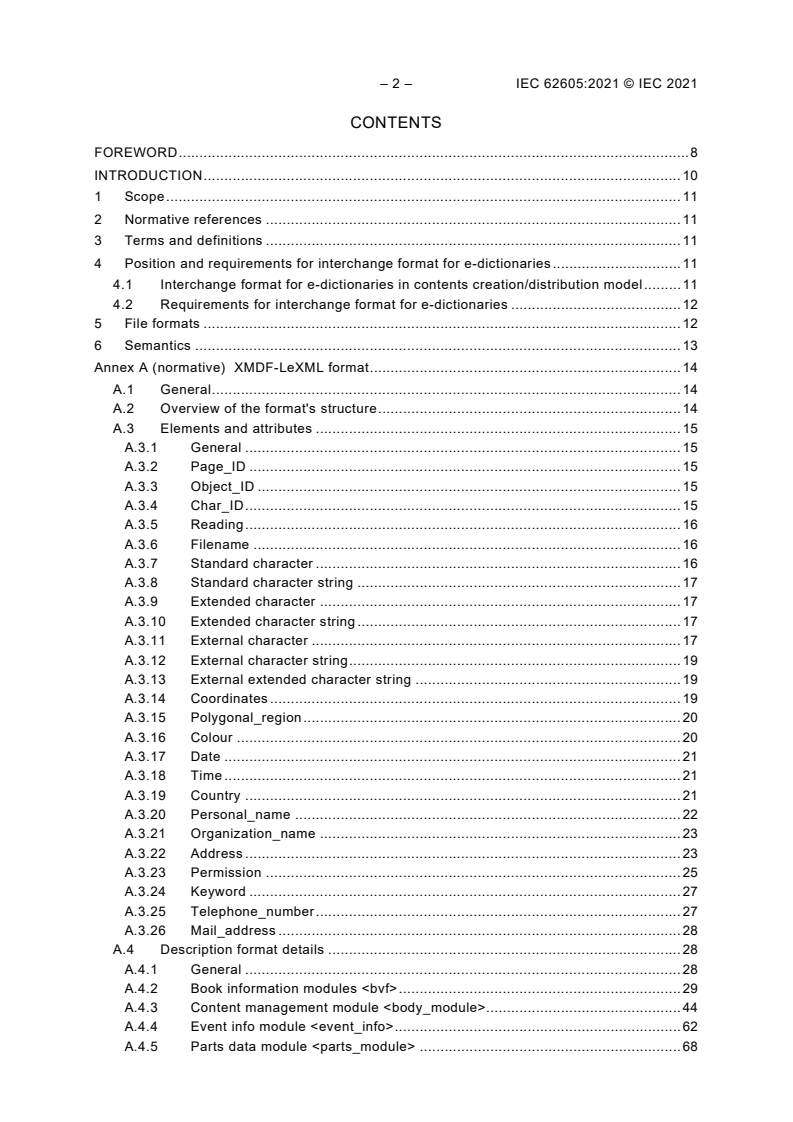
– 2 – IEC 62605:2021 © IEC 2021
CONTENTS
FOREWORD . 8
INTRODUCTION . 10
1 Scope . 11
2 Normative references . 11
3 Terms and definitions . 11
4 Position and requirements for interchange format for e-dictionaries . 11
4.1 Interchange format for e-dictionaries in contents creation/distribution model . 11
4.2 Requirements for interchange format for e-dictionaries . 12
5 File formats . 12
6 Semantics . 13
Annex A (normative) XMDF-LeXML format . 14
A.1 General . 14
A.2 Overview of the format's structure . 14
A.3 Elements and attributes . 15
A.3.1 General . 15
A.3.2 Page_ID . 15
A.3.3 Object_ID . 15
A.3.4 Char_ID . 15
A.3.5 Reading . 16
A.3.6 Filename . 16
A.3.7 Standard character . 16
A.3.8 Standard character string . 17
A.3.9 Extended character . 17
A.3.10 Extended character string . 17
A.3.11 External character . 17
A.3.12 External character string . 19
A.3.13 External extended character string . 19
A.3.14 Coordinates . 19
A.3.15 Polygonal_region . 20
A.3.16 Colour . 20
A.3.17 Date . 21
A.3.18 Time . 21
A.3.19 Country . 21
A.3.20 Personal_name . 22
A.3.21 Organization_name . 23
A.3.22 Address . 23
A.3.23 Permission . 25
A.3.24 Keyword . 27
A.3.25 Telephone_number . 27
A.3.26 Mail_address . 28
A.4 Description format details . 28
A.4.1 General . 28
A.4.2 Book information modules . 29
A.4.3 Content management module . 44
A.4.4 Event info module . 62
A.4.5 Parts data module . 68
A.4.6 Object instances . 74
A.5 Available colour names . 122
A.6 Localization . 123
A.6.1 Possible additions . 123
A.6.2 Standard characters . 123
A.6.3 Characters usable for reading . 124
A.6.4 Line breaking methods . 124
A.6.5 Sorting rules for . 125
A.6.6 Additional attributes for . 126
A.6.7 Normalization methods for . 127
A.6.8 Character encoding conversions . 128
A.7 Adaptation . 128
A.8 Specification of the XMDF-LeXML format in the RELAX NG syntax . 128
Annex B (normative) LeXML format . 151
B.1 General . 151
B.2 Elements for content structure . 151
B.2.1 Parameter entity definition . 151
B.2.2 Root elements . 152
B.2.3 headword-related elements . 155
B.2.4 Main-text related elements. 161
B.2.5 Subheadword related elements . 167
B.2.6 Other block elements . 172
B.2.7 Media related elements . 176
B.2.8 Other structural elements . 178
B.3 Inline elements . 184
B.3.1 Labels . 184
B.3.2 pronunciation/accent related elements . 187
B.3.3 Part-of-speech related and other elements . 189
B.3.4 Example-related elements . 190
B.3.5 Other dictionary-specific elements . 193
B.3.6 Text-decoration related elements . 203
B.3.7 Typesetting-related elements . 209
B.3.8 Other elements . 212
B.3.9 Kanbun-related elements . 219
B.3.10 Mathematical formula-related data structure . 223
B.4 Specification of the LeXML format in the DTD syntax . 223
Bibliography . 240
Figure 1 – Contents creation/distribution model . 11
Figure 2 – Contents creation/distribution model (modified) . 12
Figure 3 – Relationship between concepts . 12
Figure A.1 – XML tree structure . 14
Figure A.2 – Example of Page_ID . 15
Figure A.3 – Example of Object ID . 15
Figure A.4 – Examples of Char_ID . 15
Figure A.5 – Example of reading . 16
Figure A.6 – Example of filename . 16
– 4 – IEC 62605:2021 © IEC 2021
Figure A.7 – Examples of the external_char element . 19
Figure A.8 – Examples of external character string . 19
Figure A.9 – Examples of coordinates . 20
Figure A.10 – Examples of the vertex element . 20
Figure A.11 – Examples of colour . 21
Figure A.12 – Example of date . 21
Figure A.13 – Example of time . 21
Figure A.14 – Example of Country . 21
Figure A.15 – Example of the personal_name element with its descendants . 23
Figure A.16 – Example of the organization_name element . 23
Figure A.17 – Example of the address_info element with its descendants . 25
Figure A.18 – Example of the permission info element with its descendant . 26
Figure A.19 – Examples of the keyword_list element with its descendants . 27
Figure A.20 – A book XML document . 29
Figure A.21 – Example of the bvf element with its descendants . 30
Figure A.22 – Examples of the book_info element with its descendants . 43
Figure A.23 – Example of the body_module element with its descendants . 44
Figure A.24 – Example of the flow_default_attribute element . 47
Figure A.25 – Example of the flow_default_delimiter element with its descendants . 54
Figure A.26 – Example of the special_page element . 56
Figure A.27 – Example of the special_page element . 56
Figure A.28 – Example of the special_page_link element with its descendants . 57
Figure A.29 – Example of the search_table element with its descendants . 61
Figure A.30 – Example of event_info element with its descendants . 62
Figure A.31 – Example of the event element with its descendants . 63
Figure A.32 – Example of the id attribute . 64
Figure A.33 – Example of the event_info element with its descendants . 65
Figure A.34 – The object_id attribute . 66
Figure A.35 – The object_id attribute . 66
Figure A.36 – Examples of the action_play element . 67
Figure A.37 – Examples of the action_page_jump element . 68
Figure A.38 – Example of the parts_module element with its descendants . 69
Figure A.39 – Examples of the dynamic_text_object_entry element with its
descendants . 70
Figure A.40 – Example of the sound_object_entry element with its descendant . 71
Figure A.41 – Examples of the search_page_object_entry element with its descendants . 72
Figure A.42 – Example of the movie_object_entry element . 73
Figure A.43 – Example of the parts_module element with its descendants . 74
Figure A.44 – Examples of the text_data element with its descendants . 75
Figure A.45 – The valign attribute set to "middle" . 76
Figure A.46 – Example of the text_default_attribute element with its descendants . 79
Figure A.47 – Example of dropped capital . 81
Figure A.48 – Left and right margin of a paragraph . 81
Figure A.49 – Examples of the p element . 82
Figure A.50 – Example of the scrolling_text element . 83
Figure A.51 – Examples of the br element. 83
Figure A.52 – Examples of the hr element. 84
Figure A.53 – Examples of the font element . 87
Figure A.54 – Example of the mlg element and examples of how it is rendered . 89
Figure A.55 – Examples of horizontal writing in vertical text . 89
Figure A.56 – Example of the ruby element with descendants and how they are to be
typically rendered . 90
Figure A.57 – Example of the external_char_element . 91
Figure A.58 – Examples of Char_ID . 91
Figure A.59 – Examples of the mask element . 92
Figure A.60 – Example of the head element with its descendants and the meaning
element . 94
Figure A.61 – Examples of the example element with its descendants . 95
Figure A.62 – Examples of the split elements . 97
Figure A.63 – Examples of the page_break element . 98
Figure A.64 – The align attribute set to "top" . 99
Figure A.65 – The align attribute set to "middle" . 100
Figure A.66 – The align attribute set to "bottom" . 100
Figure A.67 – The align attribute set to "left" . 100
Figure A.68 – The align attribute set to "right" . 101
Figure A.69 – Examples of the object element . 102
Figure A.70 – Example of the example element with its descendant . 113
Figure A.71 – Example of the dict_data element with its descendants . 114
Figure A.72 – Example of the flip_animation element with its descendants . 116
Figure A.73 – Example of the search_page element with its descendants . 117
Figure A.74 – Example of search page object instance rendering . 117
Figure A.75 – Example of the search_page element . 118
Figure A.76 – Example of search result with search_type set to "matches_only" . 119
Figure A.77 – Example of search result with search_type set to "matches_first". 120
Figure A.78 – Examples of the key_input_region element . 121
Figure A.79 – Examples of the search_link_item and search link_title elements . 122
Figure A.80 – Example of the top_prohibit_char element . 125
Figure A.81 – Example of the end_prohibit_char element. 125
Figure A.82 – Example of the hanging_char element . 125
Figure B.1 – Examples of the split element . 153
Figure B.2 – Example of the dic-item element with its descendants . 154
Figure B.3 – Example of the dic-item element with its descendants . 155
Figure B.4 – Example of the head element . 156
Figure B.5 – Example of the head element . 156
Figure B.6 – Examples of the key element . 158
Figure B.7 – Example of the snippet element . 159
Figure B.8 – Regular reading view . 160
– 6 – IEC 62605:2021 © IEC 2021
Figure B.9 – Snippet view . 160
Figure B.10 – Examples of the meaning element . 162
Figure B.11 – Examples of the meaning-group element . 163
Figure B.12 – Examples of the example element . 164
Figure B.13 – Examples of the meaning element . 165
Figure B.14 – Examples of the meaning element . 165
Figure B.15 – Examples of the example-group element . 166
Figure B.16 – Examples of the subheadword element . 169
Figure B.17 – Examples of the subheadword elements . 171
Figure B.18 – Examples of the subheadword element . 172
Figure B.19 – Examples of the indexlist element . 174
Figure B.20 – Example of the replace element . 183
Figure B.21 – Example of the alabel element . 185
Figure B.22 – Examples of the alabel element . 185
Figure B.23 – Example of the glabel element . 185
Figure B.24 – Examples of the glabel element . 186
Figure B.25 – Example of the slabel element . 186
Figure B.26 – Examples of the slabel element . 187
Figure B.27 – Example of the accent element . 187
Figure B.28 – Examples of the ipa element . 188
Figure B.29 – Examples of the ex- elements . 193
Figure B.30 – Examples of the abbr element . 193
Figure B.31 – Examples of the article element . 194
Figure B.32 – Examples of the fullform element . 195
Figure B.33 – Examples of the primary element . 196
Figure B.34 – Example of the pro-n element . 197
Figure B.35 – Example of the pro-n element . 197
Figure B.36 – Example of the pro-n element . 197
Figure B.37 – Example of the pro-v element . 198
Figure B.38 – Example of the pro-v element . 198
Figure B.39 – Examples of the ymd element . 200
Figure B.40 – Examples of the ggk element . 202
Figure B.41 – Example of the kigo element . 203
Figure B.42 – Example of the b element . 204
Figure B.43 – Examples of the sub and sup elements . 206
Figure B.44 – Example of the ud element . 209
Figure B.45 – Examples of the nobr element . 210
Figure B.46 – Examples of the ruby, rb and rt elements . 211
Figure B.47 – Examples of the gix element . 214
Figure B.48 – Examples of the ph attribute . 216
Figure B.49 – Example of the spellout element . 217
Figure B.50 – Example of the spellout element . 218
Figure B.51 – Example of kanbun by the Ed.2 specifications. 220
Figure B.52 – Example of kanbun by the specifications of Ed.3 and thereafter . 220
Figure B.53 – Examples of the kkaeri element . 221
Figure B.54 – Examples of the kkaeri element . 221
Figure B.55 – Example of MathJax representation . 223
Table A.1 – Base characters for reading . 16
Table A.2 – Standard character set . 16
Table A.3 – Usable characters for a telephone number . 28
Table A.4 – Characters usable for email addresses . 28
Table A.5 – Characters usable for the lookup key . 60
Table A.6 – Color names . 123
Table A.7 – Examples of additional standard character sets . 124
Table A.8 – Example of additional characters usable for readings . 124
Table A.9 – Example of additional sorting rules . 126
Table A.10 – Example of additional language specific attributes for . 127
– 8 – IEC 62605:2021 © IEC 2021
INTERNATIONAL ELECTROTECHNICAL COMMISSION
____________
MULTIMEDIA SYSTEMS AND EQUIPMENT –
MULTIMEDIA E-PUBLISHING AND E-BOOKS –
INTERCHANGE FORMAT FOR E-DICTIONARIES
FOREWORD
1) The International Electrotechnical Commission (IEC) is a worldwide organization for standardization comprising
all national electrotechnical committees (IEC National Committees). The object of IEC is to promote international
co-operation on all questions concerning standardization in the electrical and electronic fields. To this end and
in addition to other activities, IEC publishes International Standards, Technical Specifications, Technical Reports,
Publicly Available Specifications (PAS) and Guides (hereafter referred to as "IEC Publication(s)"). Their
preparation is entrusted to technical committees; any IEC National Committee interested in the subject dealt with
may participate in this preparatory work. International, governmental and non-governmental organizations liaising
with the IEC also participate in this preparation. IEC collaborates closely with the International Organization for
Standardization (ISO) in accordance with conditions determined by agreement between the two organizations.
2) The formal decisions or agreements of IEC on technical matters express, as nearly as possible, an international
consensus of opinion on the relevant subjects since each technical committee has representation from all
interested IEC National Committees.
3) IEC Publications have the form of recommendations for international use and are accepted by IEC National
Committees in that sense. While all reasonable efforts are made to ensure that the technical content of IEC
Publications is accurate, IEC cannot be held responsible for the way in which they are used or for any
misinterpretation by any end user.
4) In order to promote international uniformity, IEC National Committees undertake to apply IEC Publications
transparently to the maximum extent possible in their national and regional publications. Any divergence between
any IEC Publication and the corresponding national or regional publication shall be clearly indicated in the latter.
5) IEC itself does not provide any attestation of conformity. Independent certification bodies provide conformity
assessment services and, in some areas, access to IEC marks of conformity. IEC is not responsible for any
services carried out by independent certification bodies.
6) All users should ensure that they have the latest edition of this publication.
7) No liability shall attach to IEC or its directors, employees, servants or agents including individual experts and
members of its technical committees and IEC National Committees for any personal injury, property damage or
other damage of any nature whatsoever, whether direct or indirect, or for costs (including legal fees) and
expenses arising out of the publication, use of, or reliance upon, this IEC Publication or any other IEC Publications.
8) Attention is drawn to the Normative references cited in this publication. Use of the referenced publications is
indispensable for the correct application of this publication.
International Standard IEC 62605 has been prepared by technical area 10: Multimedia e-
publishing and e-book technologies, of IEC technical committee 100: Audio, video and
multimedia systems and equipment.
This third edition cancels and replaces the second edition published in 2016. This edition
constitutes a technical revision.
This edition includes the following significant technical changes with respect to the previous
edition:
The format described in Annex B was significantly enhanced in the following ways:
a) elements to enhance uses of data (e.g. web-related usage);
b) attribute for accessibility-related functions;
c) attributes for more detailed markup for data reusability.
The text of this International Standard is based on the following documents:
FDIS Report on voting
100/3589/FDIS 100/3602/RVD
Full information on the voting for its approval can be found in the report on voting indicated in
the above table.
The language used for the development of this International Standard is English.
This document was drafted in accordance with ISO/IEC Directives, Part 2, and developed in
accordance with ISO/IEC Directives, Part 1 and ISO/IEC Directives, IEC Supplement, available
at www.iec.ch/members_experts/refdocs. The main document types developed by IEC are
described in greater detail at www.iec.ch/standardsdev/publications.
The committee has decided that the contents of this document will remain unchanged until the
stability date indicated on the IEC website under webstore.iec.ch in the data related to the
specific document. At this date, the document will be
• reconfirmed,
• withdrawn,
• replaced by a revised edition, or
• amended.
– 10 – IEC 62605:2021 © IEC 2021
INTRODUCTION
Markets for multimedia e-books and e-publishing require standardization of formats for e-book
data interchange among associated people, authors, data preparers, publishers and readers.
The formats are classified into submission format, interchange format and reader's format. The
submission format supports an interaction between authors and data preparers. The reader's
format depends on e-publishing equipment. The interchange format provides an interchange
format for data preparers and publishers and, therefore, should be e-publishing equipment
independent.
The International Electrotechnical Commission (IEC) draws attention to the fact that it is claimed
that compliance with this document may involve the use of a patent. IEC takes no position
concerning the evidence, validity, and scope of this patent right.
The holder of this patent right has assured IEC that s/he is willing to negotiate licences under
reasonable and non-discriminatory terms and conditions with applicants throughout the world.
In this respect, the statement of the holder of this patent right is registered with IEC. Information
may be obtained from the patent database available at http://patents.iec.ch.
Attention is drawn to the possibility that some of the elements of this document may be the
subject of patent rights other than those in the patent database. IEC shall not be held
responsible for identifying any or all such patent rights.
MULTIMEDIA SYSTEMS AND EQUIPMENT –
MULTIMEDIA E-PUBLISHING AND E-BOOKS –
INTERCHANGE FORMAT FOR E-DICTIONARIES
1 Scope
This document specifies the interchange format for e-dictionaries among publishers, content
creators and manufacturers.
This document does not address the following aspects:
• data formats for reading devices;
• elements necessary for final print reproduction only;
• rendering issues related to physical devices;
• security issues such as DRM for documents.
2 Normative references
The following documents are referred to in the text in such a way that some or all of their content
constitutes requirements of this document. For dated references, only the edition cited applies.
For undated references, the latest edition of the referenced document (including any
amendments) applies.
IEC TS 62229, Multimedia systems and equipment – Multimedia e-publishing and e-book –
Conceptual model for multimedia e-publishing
3 Terms and definitions
For the purposes of this document, the following terms and definitions apply.
3.1
manufacturer
organization or person that manufactures hardware and/or software of the e-book
4 Position and requirements for interchange format for e-dictionaries
4.1 Interchange format for e-dictionaries in contents creation/distribution model
The conceptual model for multimedia e-publishing (IEC TS 62229) defines a contents
creation/distribution model shown in Figure 1.
Author <--(1)--> Data preparer <--(2)--> Publisher --(3)--> Reader
IEC
Key
(1) content data in submission format
(2) content data in interchange format
(3) content data in reader's format
Figure 1 – Contents creation/distribution model
– 12 – IEC 62605:2021 © IEC 2021
It should be noted that the role of manufacturers of e-dictionary hardware and software overlaps
that of the publisher in Figure 1. Therefore, a slightly modified model will be assumed for this
International Standard, as shown in Figure 2.
Author <--(1)--> Data preparer <--(2)--> Publisher (manufacturer) --(3)--> Reader
IEC
Figure 2 – Contents creation/distribution model (modified)
This document specifies the interchange format between data preparers and publishers, i.e. a
format for (2) in Figure 2, though it may be used as a reader's format.
4.2 Requirements for interchange format for e-dictionaries
An interchange format for e-dictionaries needs to address the following.
• Description of keywords, links from the keywords to entries (link data) and the order of the
entries.
• Description of articles for each entry (entry data). This includes text, image, and other
multimedia functionalities generally required for e-books.
• Description of bibliographical data and other data. This should include the name of the
author and the publisher, the title of the content and the explanatory note. The relationship
between these concepts is visually represented in Figure 3.
• Description of contents written in various languages.
Figure 3 – Relationship between concepts
5 File formats
This document defines two XML-based formats. One is based on XMDF (as described in
IEC 62448:2017, Annex B) and LeXML . The format is hereafter called XMDF-LeXML format.
The other is based solely on LeXML 3.0. They are presented in Annex A and Annex B,
respectively.
____________
LeXML is the trade name of a product supplied by Digital ASSIST Ltd. Its original specifications are found at
http://www.d-assist.com/index.html (in Japanese). This information is given for the convenience of users of this
document and does not constitute an endorsement by IEC of the product named. Equivalent products may be
used if they can be shown to lead to the same results.
6 Semantics
Elements of the XMDF-LeXML format can be rendered in accordance with appropriate style
specifications, which are outside the scope of this document.
– 14 – IEC 62605:2021 © IEC 2021
Annex A
(normative)
XMDF-LeXML format
A.1 General
The XMDF-LeXML format is an interchange format for e-dictionaries multimedia e-book data
interchange, targeted at data preparers and publishers rather than the reader, with an emphasis
on mobile devices as a target platform. Much like HTML, this format does not split the document
in fixed pages, but determines the layout according to the viewer device's display size, the font
in use, and so on. In this annex, such contents will be referred to as "flowing content", as
opposed to "paged content".
A.2 Overview of the format's structure
Flowing contents are usually composed of several concatenated flows. This annex makes no
particular requirement concerning the way the flowing content should be split into individual
flows. This decision is left to the data preparer, to accommodate the various types of content.
For instance, a newspaper can have one flow per article, a novel one per chapter, and so on.
It is also possible not to split the content, and to have only one flow. However, it should be
noted that particularly large flows, or an extremely large number of flows, can impact on runtime
performance, depending on the specific version of the viewer in use, the available memory, and
so on.
The XML tree structure of the format is shown in Figure A.1.
Content
management
data
There may be
Root
several of flow data
Points to a file name
Object instance
Parts data Object instance
Object entry can
be repeated
several times
IEC
Figure A.1 – XML tree structure
The actual contents of each flow, in other words, what will be displayed by the viewer, is
recorded in the object instance. The object instance is registered in object_entry, and
associated with an ID number and other auxiliary data, turning it into playable/displayable data.
Flow_data determines its content by pointing at such registered objects. In addition, information
on functionalities such as page link is recorded in event_info.
The main part of Annex A is generic, and may be used for any country and language. However,
some parts may have language-specific behaviour. Localization-related issues are detailed in
Clause A.6.
A.3 Elements and attributes
A.3.1 General
The different types of values that may be used in the various elements or attributes are
explained below. The elements and attributes detailed below will be valid throughout this annex,
and will be referenced by other constructs. In the f
...