

IEC TS 61400-21-4:2025
(Main)Wind energy generation systems - Part 21-4: Measurement and assessment of electrical characteristics - Wind turbine components and subsystems
General Information
- Abstract
IEC TS 61400-21-4:2025 specifies a uniform methodology, defining measurement, testing and assessment procedures of electrical characteristics of wind turbine components and subsystems, as basis for the verification of the electrical capabilities of wind turbines and wind turbine families.
This document includes the following aspects:
- definitions of test bench, subsystems and interface;
- definitions of system requirements for the test bench to perform relevant measurements (grid strengths, short circuit power, THD, …);
- measurement procedures for quantifying the electrical characteristics;
- test and measurement procedures for verifying and validating the electrical characteristics of components and subsystems in relation to grid compliance requirements;
- procedures for the transferability of the component and subsystem test results, measured at the test bench, to WT product families;
- documentation requirements and validation procedures of components, subsystems and wind turbines.
The results of the measurements and assessments of the wind turbine components and subsystems will be used as input for the verification of electrical capabilities as described in IEC 61400-21-1 and for the validation and verification of the electrical simulation models for wind power plants (WPP) as described in IEC 61400-27.
- Status
- Published
- Publication Date
- 15-Apr-2025
- Technical Committee
- TC 88 - Wind energy generation systems
- Drafting Committee
- WG 21 - TC 88/WG 21
- Current Stage
- PPUB - Publication issued
- Start Date
- 16-Apr-2025
- Completion Date
- 14-Mar-2025
Buy Documents

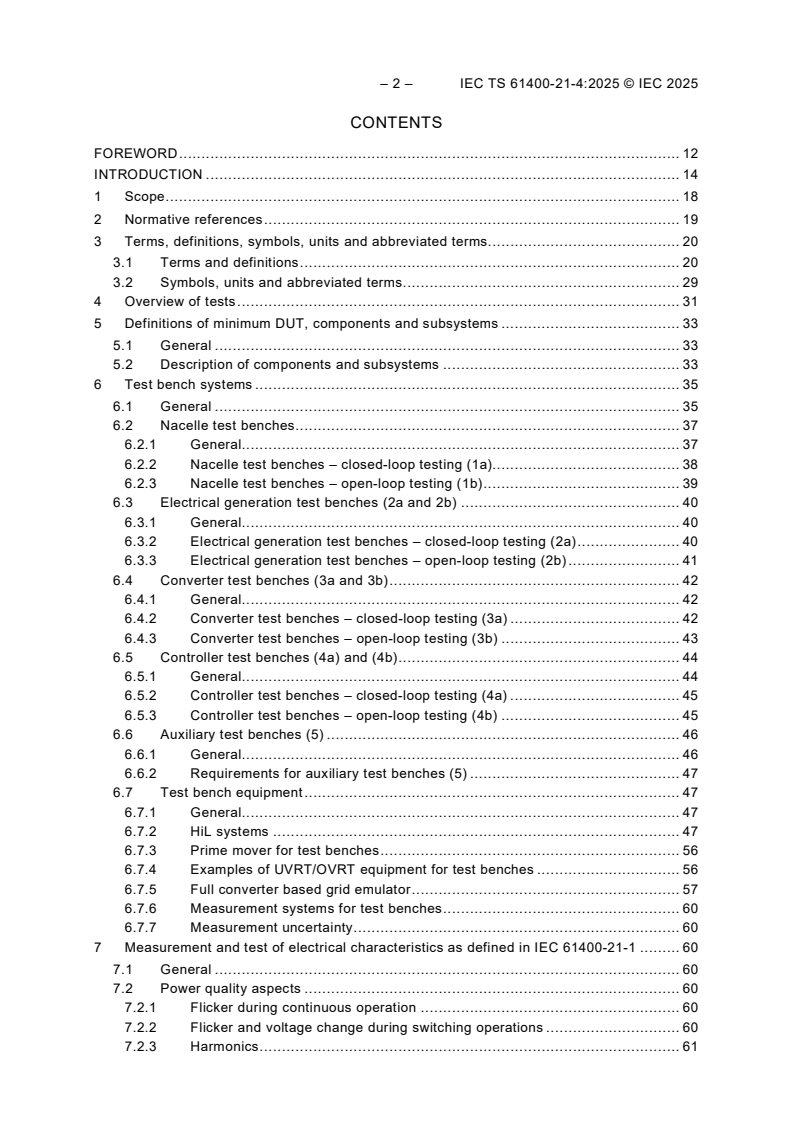
IEC TS 61400-21-4:2025 - Wind energy generation systems - Part 21-4: Measurement and assessment of electrical characteristics - Wind turbine components and subsystems Released:4/16/2025
Overview
IEC TS 61400-21-4:2025 defines a uniform methodology for the measurement, testing and assessment of electrical characteristics of wind turbine components and subsystems. It provides standardized test-bench requirements, measurement procedures and validation/documentation rules used to verify electrical capabilities of wind turbines and transfer component test results to wind turbine product families. Results feed into the verification processes of IEC 61400-21-1 and the validation of wind power plant simulation models in IEC 61400-27.
Key topics and requirements
- Test-bench definitions and system requirements
- Types: nacelle, electrical-generation, converter, controller and auxiliary test benches
- Closed-loop vs open-loop testing and HiL (Hardware-in-the-Loop) approaches
- Grid emulator and prime mover requirements
- Minimum Device Under Test (DUT) definitions and interfaces
- Measurement and assessment procedures
- Power quality: flicker, THD (total harmonic distortion), harmonics and switching transients
- Steady-state operation: active/reactive power characteristics, Q capability, unbalance factor
- Control performance: active power control, ramp-rate limits, frequency control, synthetic inertia, reactive control
- Dynamic performance: voltage fault ride-through (UVRT/OVRT) test strategies, phase jumps, RoCoF capability
- Disconnection and reconnection behaviour, grid protection test methods
- Additional controllable tests
- Impedance scans, frequency-dependent impedance measurement, island operation tests and harmonic sink/filter evaluation
- Transferability, documentation and validation
- Procedures for transferring component/subsystem test results from bench measurements to WT product families
- Reporting templates, measurement uncertainty treatment and validation workflows
Applications and who uses it
- Wind turbine manufacturers - verify component electrical behaviour, demonstrate family-level compliance
- Independent test laboratories and certification bodies - establish consistent test setups and reports for grid compliance
- Grid operators and system integrators - assess interoperability, fault ride-through and grid support capabilities
- R&D teams and simulation engineers - validate electrical models (WPP models) against bench test results
- Consultants and compliance managers - prepare documentation for grid-connection requirements
Related standards
- IEC 61400-21-1 - Verification of electrical capabilities (uses component test results)
- IEC 61400-27 - Validation of electrical simulation models for wind power plants
- TC 88 family - broader grid connection and wind energy standards
Keywords: IEC TS 61400-21-4, wind turbine components, electrical characteristics, test bench, grid compliance, power quality, fault ride-through, grid emulator, HiL, harmonics, reactive power.
Buy Documents
IEC TS 61400-21-4:2025 - Wind energy generation systems - Part 21-4: Measurement and assessment of electrical characteristics - Wind turbine components and subsystems Released:4/16/2025
Get Certified
Connect with accredited certification bodies for this standard

DNV
DNV is an independent assurance and risk management provider.

Lloyd's Register
Lloyd's Register is a global professional services organisation specialising in engineering and technology.
DNV Energy Systems
Energy and renewable energy certification.
Sponsored listings
Frequently Asked Questions
IEC TS 61400-21-4:2025 is a technical specification published by the International Electrotechnical Commission (IEC). Its full title is "Wind energy generation systems - Part 21-4: Measurement and assessment of electrical characteristics - Wind turbine components and subsystems". This standard covers: IEC TS 61400-21-4:2025 specifies a uniform methodology, defining measurement, testing and assessment procedures of electrical characteristics of wind turbine components and subsystems, as basis for the verification of the electrical capabilities of wind turbines and wind turbine families. This document includes the following aspects: - definitions of test bench, subsystems and interface; - definitions of system requirements for the test bench to perform relevant measurements (grid strengths, short circuit power, THD, …); - measurement procedures for quantifying the electrical characteristics; - test and measurement procedures for verifying and validating the electrical characteristics of components and subsystems in relation to grid compliance requirements; - procedures for the transferability of the component and subsystem test results, measured at the test bench, to WT product families; - documentation requirements and validation procedures of components, subsystems and wind turbines. The results of the measurements and assessments of the wind turbine components and subsystems will be used as input for the verification of electrical capabilities as described in IEC 61400-21-1 and for the validation and verification of the electrical simulation models for wind power plants (WPP) as described in IEC 61400-27.
IEC TS 61400-21-4:2025 specifies a uniform methodology, defining measurement, testing and assessment procedures of electrical characteristics of wind turbine components and subsystems, as basis for the verification of the electrical capabilities of wind turbines and wind turbine families. This document includes the following aspects: - definitions of test bench, subsystems and interface; - definitions of system requirements for the test bench to perform relevant measurements (grid strengths, short circuit power, THD, …); - measurement procedures for quantifying the electrical characteristics; - test and measurement procedures for verifying and validating the electrical characteristics of components and subsystems in relation to grid compliance requirements; - procedures for the transferability of the component and subsystem test results, measured at the test bench, to WT product families; - documentation requirements and validation procedures of components, subsystems and wind turbines. The results of the measurements and assessments of the wind turbine components and subsystems will be used as input for the verification of electrical capabilities as described in IEC 61400-21-1 and for the validation and verification of the electrical simulation models for wind power plants (WPP) as described in IEC 61400-27.
IEC TS 61400-21-4:2025 is classified under the following ICS (International Classification for Standards) categories: 27.180 - Wind turbine energy systems. The ICS classification helps identify the subject area and facilitates finding related standards.
IEC TS 61400-21-4:2025 is available in PDF format for immediate download after purchase. The document can be added to your cart and obtained through the secure checkout process. Digital delivery ensures instant access to the complete standard document.
Standards Content (Sample)
IEC TS 61400-21-4 ®
Edition 1.0 2025-04
TECHNICAL
SPECIFICATION
Wind energy generation systems –
Part 21-4: Measurement and assessment of electrical characteristics – Wind
turbine components and subsystems
All rights reserved. Unless otherwise specified, no part of this publication may be reproduced or utilized in any form
or by any means, electronic or mechanical, including photocopying and microfilm, without permission in writing from
either IEC or IEC's member National Committee in the country of the requester. If you have any questions about IEC
copyright or have an enquiry about obtaining additional rights to this publication, please contact the address below or
your local IEC member National Committee for further information.
IEC Secretariat Tel.: +41 22 919 02 11
3, rue de Varembé info@iec.ch
CH-1211 Geneva 20 www.iec.ch
Switzerland
About the IEC
The International Electrotechnical Commission (IEC) is the leading global organization that prepares and publishes
International Standards for all electrical, electronic and related technologies.
About IEC publications
The technical content of IEC publications is kept under constant review by the IEC. Please make sure that you have the
latest edition, a corrigendum or an amendment might have been published.
IEC publications search - webstore.iec.ch/advsearchform IEC Products & Services Portal - products.iec.ch
The advanced search enables to find IEC publications by a Discover our powerful search engine and read freely all the
variety of criteria (reference number, text, technical publications previews, graphical symbols and the glossary.
committee, …). It also gives information on projects, replaced With a subscription you will always have access to up to date
and withdrawn publications. content tailored to your needs.
IEC Just Published - webstore.iec.ch/justpublished
Electropedia - www.electropedia.org
Stay up to date on all new IEC publications. Just Published
The world's leading online dictionary on electrotechnology,
details all new publications released. Available online and once
containing more than 22 500 terminological entries in English
a month by email.
and French, with equivalent terms in 25 additional languages.
Also known as the International Electrotechnical Vocabulary
IEC Customer Service Centre - webstore.iec.ch/csc
(IEV) online.
If you wish to give us your feedback on this publication or need
further assistance, please contact the Customer Service
Centre: sales@iec.ch.
IEC TS 61400-21-4 ®
Edition 1.0 2025-04
TECHNICAL
SPECIFICATION
Wind energy generation systems –
Part 21-4: Measurement and assessment of electrical characteristics – Wind
turbine components and subsystems
INTERNATIONAL
ELECTROTECHNICAL
COMMISSION
ICS 27.180 ISBN 978-2-8327-0314-4
– 2 – IEC TS 61400-21-4:2025 © IEC 2025
CONTENTS
FOREWORD . 12
INTRODUCTION . 14
1 Scope . 18
2 Normative references . 19
3 Terms, definitions, symbols, units and abbreviated terms . 20
3.1 Terms and definitions . 20
3.2 Symbols, units and abbreviated terms . 29
4 Overview of tests . 31
5 Definitions of minimum DUT, components and subsystems . 33
5.1 General . 33
5.2 Description of components and subsystems . 33
6 Test bench systems . 35
6.1 General . 35
6.2 Nacelle test benches . 37
6.2.1 General. 37
6.2.2 Nacelle test benches – closed-loop testing (1a). 38
6.2.3 Nacelle test benches – open-loop testing (1b) . 39
6.3 Electrical generation test benches (2a and 2b) . 40
6.3.1 General. 40
6.3.2 Electrical generation test benches – closed-loop testing (2a) . 40
6.3.3 Electrical generation test benches – open-loop testing (2b) . 41
6.4 Converter test benches (3a and 3b) . 42
6.4.1 General. 42
6.4.2 Converter test benches – closed-loop testing (3a) . 42
6.4.3 Converter test benches – open-loop testing (3b) . 43
6.5 Controller test benches (4a) and (4b) . 44
6.5.1 General. 44
6.5.2 Controller test benches – closed-loop testing (4a) . 45
6.5.3 Controller test benches – open-loop testing (4b) . 45
6.6 Auxiliary test benches (5) . 46
6.6.1 General. 46
6.6.2 Requirements for auxiliary test benches (5) . 47
6.7 Test bench equipment . 47
6.7.1 General. 47
6.7.2 HiL systems . 47
6.7.3 Prime mover for test benches . 56
6.7.4 Examples of UVRT/OVRT equipment for test benches . 56
6.7.5 Full converter based grid emulator . 57
6.7.6 Measurement systems for test benches . 60
6.7.7 Measurement uncertainty . 60
7 Measurement and test of electrical characteristics as defined in IEC 61400-21-1 . 60
7.1 General . 60
7.2 Power quality aspects . 60
7.2.1 Flicker during continuous operation . 60
7.2.2 Flicker and voltage change during switching operations . 60
7.2.3 Harmonics . 61
7.3 Steady state operation . 64
7.3.1 General. 64
7.3.2 Observation of active power against wind speed . 64
7.3.3 Maximum power . 65
7.3.4 Reactive power characteristic (Q = 0) . 65
7.3.5 Reactive power capability . 66
7.3.6 Voltage dependency of PQ diagram . 67
7.3.7 Unbalance factor. 67
7.4 Control performance . 68
7.4.1 Active power control . 68
7.4.2 Active power ramp rate limitation . 70
7.4.3 Frequency control . 73
7.4.4 Synthetic inertia . 75
7.4.5 Reactive power control . 78
7.5 Dynamic performance – Voltage fault ride-through . 79
7.5.1 General. 79
7.5.2 Testing according to Strategy 1 . 79
7.5.3 Testing according to Strategy 2 . 86
7.6 Disconnection from the grid . 89
7.6.1 General. 89
7.6.2 Grid protection . 89
7.6.3 RoCoF (df/dt) protection . 90
7.6.4 Reconnection time . 91
8 Additional measurement and test of electrical characteristics under controllable
test conditions . 92
8.1 General . 92
8.2 Power quality aspects . 93
8.2.1 Flicker control . 93
8.2.2 Flicker and voltage change during switching operations . 95
8.2.3 Active filter / sink for harmonics . 96
8.2.4 Frequency dependent impedance measurement . 98
8.3 Steady state operation . 103
8.3.1 Voltage capability . 103
8.3.2 Frequency capability . 104
8.3.3 Current unbalance factor capability . 106
8.4 Control performance . 107
8.4.1 Fundamental frequency grid impedance variations . 107
8.4.2 Island operation . 109
8.5 Dynamic performance . 111
8.5.1 RoCoF – real df/dt – capability . 111
8.5.2 Phase jump . 112
Annex A (informative) Report template. 114
A.1 Overview . 114
A.2 General . 114
A.3 Measurement and test of electrical characteristics . 117
A.3.1 Power quality aspects. 117
A.3.2 Steady state operation. 130
A.3.3 Control performance . 135
A.3.4 Voltage fault ride-through . 136
– 4 – IEC TS 61400-21-4:2025 © IEC 2025
A.3.5 Disconnection from the grid. 142
A.4 Additional measurement and test of electrical characteristics . 147
A.4.1 Power quality aspects. 147
A.4.2 Steady state operation. 157
A.4.3 Control performance . 162
A.4.4 Dynamic performance . 164
Annex B (informative) General information on test strategies and subsystems
overview . 166
B.1 General . 166
B.2 Guideline test strategies – functional, capability and performance test . 166
B.3 Overview of components, subsystems and control functions . 167
Annex C (informative) Modification and replacement of components . 170
C.1 General . 170
C.2 Definition of changes . 170
C.3 Workflow replacement of component . 170
C.4 Test & measurement procedure. 174
Annex D (informative) Transferability examples . 178
D.1 Overview . 178
D.2 Introduction to the results for test bench type 1a . 178
D.2.1 General. 178
D.2.2 Power quality aspects. 178
D.2.3 Steady state operation. 179
D.2.4 Control performance . 180
D.2.5 Dynamic performance . 181
D.3 Introduction to the results for test bench type 2a . 184
D.3.1 General. 184
D.3.2 Dynamic performance . 184
D.4 Introduction to the results for test bench type 3a . 186
D.4.1 General. 186
D.4.2 Dynamic performance . 186
D.4.3 Reactive power capability . 187
D.4.4 Impedance scan . 188
Annex E (informative) Harmonic assessment . 190
Annex F (informative) Examples of FRT functionalities . 198
Annex G (informative) Variants of HiL . 201
Annex H (informative) Voltage fault types. 203
H.1 Overview . 203
H.2 Phase-to-neutral voltage for a Type C fault . 204
H.3 Phase-to-neutral voltage for a Type D fault:. 206
Annex I (informative) Summary of grid emulator requirements . 208
Annex J (informative) Grid adaptability test using grid emulator . 211
J.1 Overview . 211
J.2 Grid adaptability test setup . 211
J.3 Grid adaptability requirements . 212
Bibliography . 215
Figure 1 – Overview of TC 88 – Standards related to grid connection. 14
Figure 2 – Overview of performance-, capability- and functionality test, and their
relation to the field tests . 16
Figure 3 – Example of step response . 25
Figure 4 – Simulated equivalent circuit of the grid emulator and the DUT . 28
Figure 5 – Generic structure of WT types . 33
Figure 6 – General overview of test bench systems included in this TS, including the
logical distinction between closed-loop and open-loop testing of wind turbines . 36
Figure 7 – Hierarchy of the different test bench types . 37
Figure 8 – Example of a nacelle test bench and a Type IV WT setup for closed-loop
testing . 38
Figure 9 – Example of a nacelle test bench and a type IV WT setup for open-loop
testing . 39
Figure 10 – Example of an electrical generation test bench and a Type IV WT setup for
closed-loop testing . 40
Figure 11 – Example of an electrical generation test bench and a Type IV WT setup for
open-loop testing . 41
Figure 12 – Example of a converter test bench and a Type IV WT setup for closed-loop
testing . 42
Figure 13 – Example of a converter test bench and a Type IV WT setup for open-loop
testing . 44
Figure 14 – Example of a controller test bench for closed-loop testing . 45
Figure 15 – Illustration of a controller test bench for open-loop testing . 46
Figure 16 – Example of auxiliary test bench . 47
Figure 17 – Block diagrams of the HiL systems for different test bench types. 48
Figure 18 – Overview of the process from offline simulation models to real time
suitable models used within the HiL system and the data used for verification . 53
Figure 19 – Suggested reporting form for comparison between HiL-operated test bench
results and offline simulation results . 54
Figure 20 – Example Power Spectral Density (PSD) of power from simulation and
experiment. 55
Figure 21 – Example structure of a typical grid emulator . 57
Figure 22 – Example of active power response step . 69
Figure 23 – Active power dynamic step response . 70
Figure 24 – Example of available active power and active power in ramp rate limitation
mode. 72
Figure 25 – Example of an active power control function P = f(f), with the different
measurement points and related steps of frequency . 74
Figure 26 – Synthetic inertia – example response and definition . 76
Figure 27 – Tolerance of the positive sequence voltage for the undervoltage event with
disconnected DUT under test [16] . 80
Figure 28 – Example of an undervoltage test chart . 81
Figure 29 – Tolerance of the positive sequence voltage for the overvoltage event with
disconnected DUT . 82
Figure 30 – Example of an over voltage capability chart . 83
Figure 31 – Example FRT impedance profile . 85
Figure 32 – Variable voltage and impedance grid emulator (case a). 93
Figure 33 – Constant voltage and impedance grid emulator with controllable load
(case b) . 94
– 6 – IEC TS 61400-21-4:2025 © IEC 2025
Figure 34 – Generic topology of (a) current and (b) voltage perturbation tests[12] . 99
Figure 35 – Example of a grid emulator structure for voltage perturbation
application (1) . 99
Figure 36 – Impedance measurement test methodology for wind turbines using
perturbation tests . 100
Figure 37 – Impedance variation – example of steady state procedure & stepwise
impedance increase . 108
Figure 38 – Single line diagram of Impedance load (Z-load) connected with DUT . 109
Figure A.1 – Maximum integer harmonic voltages versus harmonic order (background
noise measurement) . 121
Figure A.2 –Maximum interharmonic voltages versus frequency (background noise
measurement) . 121
Figure A.3 –Maximum higher frequency voltage components versus frequency
(background noise measurement) . 121
th
Figure A.4 – Maximum (Option 1) or maximum of the 95 percentiles (Option 2) of
integer harmonic currents versus harmonic order . 129
th
Figure A.5 – Maximum (Option 1) or maximum of the 95 percentiles (Option 2) of
interharmonic currents versus frequency . 129
th
Figure A.6 – Maximum (Option 1) or maximum of the 95 percentiles (Option 2) of
higher frequency current components versus frequency . 129
th
Figure A.7 – Maximum (Option 1) or maximum of the 95 percentiles (Option 2) of
integer harmonic voltages versus harmonic order . 129
th
Figure A.8 – Maximum (Option 1) or maximum of the 95 percentiles (Option 2) of
interharmonic voltages versus frequency . 130
th
Figure A.9 – Maximum (Option 1) or maximum of the 95 percentiles (Option 2) of
higher frequency voltage components versus frequency . 130
Figure A.10 – Reactive power versus active power . 131
Figure A.11 – PQ diagram at nominal voltage . 132
Figure A.12 – PQ diagram at maximum voltage . 133
Figure A.13 – PQ diagram at minimum voltage . 134
Figure A.14 – IUF-P diagram . 135
Figure A.15 – Wave shape of 3-phase voltages during entrance of voltage dip/swell
when the DUT is not connected . 137
Figure A.16 – Wave shape of 3-phase voltages during clearance of voltage dip/swell
when the DUT is not connected . 137
Figure A.17 – 3-phase voltages as RMS (1 line period) during the test when the DUT is
not connected . 138
Figure A.18 – Positive sequence voltage during the test when the DUT is not
connected . 138
Figure A.19 – Negative sequence voltage during the test when the DUT is not
connected . 138
Figure A.20 – Wave shape of 3-phase voltages during entrance of the voltage dip/swell
when the DUT is connected . 140
Figure A.21 – Wave shape of 3-phase voltages during clearance of the voltage
dip/swell when the DUT is connected. 140
Figure A.22 – 3-phase voltages as RMS (1 line period) during the test when the DUT is
connected . 140
Figure A.23 – Positive and negative sequence fundamental voltage during the test
when the DUT is connected . 141
Figure A.24 – 3-phase currents as RMS (1 line period) during the test when the DUT is
connected . 141
Figure A.25 – Pos. and neg. sequence fundamental current during the test when the
DUT is connected . 141
Figure A.26 – Pos. sequence fundamental active power during the test when the DUT
is connected . 141
Figure A.27 – Pos. sequence fundamental reactive power during the test when the
DUT is connected . 141
Figure A.28 – Pos. sequence fundamental active current during the test when the DUT
is connected . 142
Figure A.29 – Pos. sequence fundamental reactive current during the test when the
DUT is connected . 142
Figure A.30 – Wind speed or available power during the test when the DUT is
connected . 142
Figure A.31 – Voltage during the reconnection test of 10 s . 146
Figure A.32 – Active power during the reconnection test of 10 s, including the recovery . 146
Figure A.33 – Time-series of measured wind speed during the reconnection
test of 10 s . 146
Figure A.34 – Voltage during the reconnection test of 60 s . 146
Figure A.35 – Active power during the reconnection test of 60 s, including the recovery . 146
Figure A.36 – Time-series of measured wind speed during the reconnection
test of 60 s . 146
Figure A.37 – Voltage during the reconnection test of 600 s . 147
Figure A.38 – Active power during the reconnection test of 600 s, including the
recovery . 147
Figure A.39 – Time-series of measured wind speed during the reconnection test of
600 s . 147
th
Figure A.40 – Maximum (Grid emulator) or Maximum of the 95 percentiles (Public
grid) of integer harmonic currents versus harmonic order without AF . 155
th
Figure A.41 – Maximum (Grid emulator) or Maximum of the 95 percentiles (Public
grid) of integer harmonic currents versus harmonic order with AF . 155
th
Figure A.42 – Maximum (Grid emulator) or Maximum of the 95 percentiles (Public
grid) of integer harmonic voltages versus harmonic order without AF . 155
th
Figure A.43 – Maximum (Grid emulator) or Maximum of the 95 percentiles (Public
grid) of integer harmonic voltages versus harmonic order with AF . 155
Figure A.44 – Voltage during the minimum voltage test . 157
Figure A.45 – Active power during the minimum voltage test . 157
Figure A.46 – Reactive power during the minimum voltage test . 158
Figure A.47 – Voltage during the nominal voltage test . 158
Figure A.48 – Active power during the nominal voltage test . 158
Figure A.49 – Reactive power during the nominal voltage test . 158
Figure A.50 – Voltage during the maximum voltage test. 158
Figure A.51 – Active power during the maximum voltage test . 159
Figure A.52 – Reactive power during the maximum voltage test . 159
Figure A.53 – Frequency during the minimum frequency test . 159
Figure A.54 – Voltage during the minimum frequency test . 159
Figure A.55 – Active power during the minimum frequency test . 160
Figure A.56 – Reactive power during the minimum frequency test . 160
Figure A.57 – Frequency during the nominal frequency test . 160
– 8 – IEC TS 61400-21-4:2025 © IEC 2025
Figure A.58 – Voltage during the nominal frequency test . 160
Figure A.59 – Active power during the nominal frequency test . 160
Figure A.60 – Reactive power during the nominal frequency test . 161
Figure A.61 – Frequency during the maximum frequency test . 161
Figure A.62 – Voltage during the maximum frequency test . 161
Figure A.63 – Active power during the maximum frequency test . 161
Figure A.64 – Reactive power during the maximum frequency test . 161
Figure A.65 – Time series of the positive sequence voltage measured at the DUT
terminals . 162
Figure A.66 – Time series of the measured positive and negative sequence current . 162
Figure A.67 – Time series of the measured active and reactive power. 163
Figure A.68 – Time series of measured frequency at the DUT . 163
Figure A.69 – Time series of positive and negative sequence voltage at the DUT . 163
Figure A.70 – Time series of positive and negative sequence current . 163
Figure A.71 – Time series of active and reactive power from the DUT . 163
Figure A.72 – Time series of measured frequency or frequency reference value . 164
Figure A.73 – Time series of positive sequence active power output . 164
Figure A.74 – Time series of measured positive and negative sequence voltage
at the DUT . 165
Figure A.75 – Time series of measured positive and negative sequence current . 165
Figure A.76 – Time series of measured active and reactive power from the DUT . 165
Figure A.77 – Instantaneous voltage and current measurements from 20 ms before the
phase jump event until min 200 ms after the event . 165
Figure B.1 – Overview of three different test strategies. 167
Figure C.1 – Flowchart of the procedure to handle a hardware or software update . 171
Figure C.2 – Illustration of a set-up on a test field, when testing a complete wind
turbine with the in- and outputs, the parameter, references, measurements, the grid
and disturbances including a certain component type A . 175
Figure C.3 – Illustration of a set-up on a test bench according to the second step in
this procedure . 176
Figure C.4 – Illustration of the above described comparison of one component A tested
in the field and on the test rig, whereas the component B is only tested on a test rig . 177
Figure D.1 – Flicker comparison under different operating conditions . 178
Figure D.2 – Comparison of maximum active power in normal operation, observed in
the field and at the test benches [14] . 179
Figure D.3 – Comparison of Reactive Power Capability Test Results [14] . 180
Figure D.4 – Static error of the active power control . 180
Figure D.5 – Reactive power controls results derived at the test bench and in the field . 181
Figure D.6 – Positive sequence voltage for a three-phase dip to 25 % U during WT
N
full load operation [14] . 182
Figure D.7 – Observed phase angle during different 2-phase voltage dips . 182
Figure D.8 – Comparison of reactive current injection during three-phase dip to 25 %
U with the WT being in full load operation [14]. 183
N
Figure D.9 – Transient voltage transition for a two-phase fault with the WT being in No-
Load operation . 183
Figure D.10 – UVRT-event: Comparison of dynamic behaviour MoWiT simulation vs.
test bench [23] . 184
Figure D.11 – complete positive (solid), negative (dash-dotted), and zero (dotted)
sequence components of the MV quantities for a symmetrical 20 % UVRT in field
(orange) and on the test bench (green): PCC voltage (a), active current (b), reactive
current (c) . 185
Figure D.12 – detailed sections of positive – (solid), negative- (dash-dotted), and zero-
(dotted) sequence components of the medium voltage quantities in case of a
asymmetrical 0 % UVRT in field (orange) and on the test bench (green): PCC voltage
(a), active current (b), reactive current (c) [24] . 185
Figure D.13 – UVRT test results . 187
Figure D.14 – Reactive power capability – comparison of test bench and field
measurements . 188
Figure D.15 – Comparison of the G-CTR and frequency domain model impedance scan . 189
Figure E.1 – Test setup . 190
Figure E.2 – Equivalent circuit of experiment setup . 191
Figure E.3 – Thevenin model of the test set-up . 191
Figure E.4 – Sample results from averaging the results of 10 combinations of 5
experiments with varying filter capacitance; v (f) and z (f) are absolute values . 193
d d
Figure E.5 – Sample results from averaging the results of 10 combinations of 5
experiments with varying filter capacitance after outlier detection; v (f) and z (f) are
d d
absolute values . 194
Figure E.6 – Sample results from averaging the results of 10 combinations of 5
experiments after filtering of the Thevenin impedance; v (f) and z (f) are absolute
d d
values . 195
Figure E.7 – Harmonic measurement and PAR calculation of a wind turbine field
measurement with asynchronous pulse pattern . 196
Figure F.1 – Example for FRT detection and voltage base determination . 198
Figure F.2 – Example for detection of threshold and dead band of current support . 198
Figure F.3 – Example for variation of fault current contribution functionality . 199
Figure F.4 – Example for current priority based on positive and negative voltage
sequence . 199
Figure F.5 – Example for current limitations functionality . 200
Figure F.6 – Example for active power ramp rates after FRT event . 200
Figure G.1 – Different HiL systems . 202
Figure H.1 – Power system fault classification according to [13] . 203
Figure H.2 – Mains phasor diagram phase-to-neutral voltage fault type C . 204
Figure H.3 – Phasor diagram phase-to-neutral voltage fault type D . 206
Figure J.1 – Recommended grid adaptability test setup . 211
Table 1 – Overview of tests according to Clause 7 . 31
Table 2 – Overview of tests according to Clause 8 . 32
Table 3 – Overview of subsystems and main functions . 34
Table 4 – Functions of the rotor and structural dynamic model and related
requirements . 50
Table 5 – Recommended rotor model used for different tests on closed-loop test
benches . 50
Table 6 – Functions of the electrical generator model and related requirements . 51
– 10 – IEC TS 61400-21-4:2025 © IEC 2025
Table 7 – List of system of required sensor, actuator and interfaces models . 52
Table 8 – Static requirements for converter-based grid emulators . 58
Table 9 – Dynamic requirements for a converter-based grid emulators . 58
Table 10 – Harmonic voltage emission limits of the grid emulator at no-load
(disconnected DUT) .
...