

IEC 60050-121:1998
(Main)International Electrotechnical Vocabulary (IEV) - Part 121: Electromagnetism
General Information
- Abstract
It has the status of a horizontal standard in accordance with IEC Guide 108.
- Status
- Published
- Publication Date
- 18-Aug-1998
- Technical Committee
- TC 1 - Terminology
- Drafting Committee
- MT 100 - TC 1/MT 100
- Current Stage
- PPUB - Publication issued
- Start Date
- 19-Aug-1998
- Completion Date
- 30-Nov-1997





Overview
IEC 60050-121:1998 is a part of the International Electrotechnical Vocabulary (IEV) published by the International Electrotechnical Commission (IEC). Specifically, Part 121 addresses the fundamental terminology and definitions associated with electromagnetism. As a horizontal standard, aligned with IEC Guide 108, this document lays the essential linguistic foundation for consistency across electrotechnical fields, aiding clear communication worldwide. The standard is multilingual, presenting terms in both French and English, and identifying equivalents in several other languages including Arabic, German, Spanish, Italian, Japanese, Polish, Portuguese, and Swedish.
Key Topics
IEC 60050-121:1998 structures its vocabulary around primary concepts in electromagnetism:
- Electromagnetic concepts and quantities: Definitions such as electric charge, Coulomb law, electric constant (permittivity of vacuum), magnetic constant (permeability of vacuum), electric field strength, magnetic induction, current density, and electric potential.
- Electromagnetic properties of materials: Standardized terms needed for describing how materials react or interact under electromagnetic fields.
- Electric conduction: Terminology related to current, current density, free charge carriers, and conductive properties.
The vocabulary covers foundational terms such as:
- Electric charge and current
- Coulomb and Lorentz forces
- Electric and magnetic fields
- Potential, potential difference, and electric tension (voltage)
- Concepts like flux, vector potential, and density (volumetric, surface, linear)
Applications
The standardized terminology in IEC 60050-121:1998 holds practical value in a range of settings:
- Technical documentation: Ensures clear, consistent language for manuals, datasheets, research papers, and regulatory documents.
- Interdisciplinary engineering projects: Facilitates smooth collaboration among electrical, electronic, and materials engineers by aligning technical language.
- International communication: Promotes precise translation and understanding of key electrotechnical concepts across different languages and regions.
- Education and training: Supports academic and vocational programs by providing authoritative definitions and usage.
- Standards development: Serves as a reference for drafting new standards in the electrotechnical sector, ensuring harmonized terminology.
Employers, academics, engineers, and translators benefit from using IEC 60050-121 to avoid ambiguity and inconsistencies, especially when dealing with cross-border projects or publications.
Related Standards
For a complete approach to electrotechnical terminology, the following standards are relevant and often referenced alongside IEC 60050-121:1998:
- IEC 60050 series (IEV): Covers vocabulary across various domains within electrotechnology.
- IEC 60027-1: Letter symbols to be used in electrical technology – General rules for symbols used in electrotechnics, referenced in discussions about terms such as voltage and current.
- ISO 31-5 / ISO 80000-6: Quantities and units – Electricity and magnetism: For internationally recognized definitions of quantities and units in electromagnetism.
- IEC Guide 108: Establishes the concept of horizontal standards within the IEC framework.
Summary
Adhering to IEC 60050-121:1998 for electromagnetism terminology helps maintain clarity, precision, and global consistency in technical communication. Its comprehensive coverage of electromagnetic concepts supports scientific, educational, industrial, and regulatory activities worldwide, making it an invaluable resource for anyone working with or translating electrotechnical information. For up-to-date and harmonized terminology in electromagnetism, referencing this vocabulary is essential.
Relations
- Effective Date
- 25-Aug-2026
- Effective Date
- 25-Aug-2026
- Effective Date
- 25-Aug-2026
- Effective Date
- 25-Aug-2026
- Effective Date
- 25-Aug-2026
- Effective Date
- 25-Aug-2026
- Effective Date
- 25-Aug-2026
- Effective Date
- 25-Aug-2026
- Effective Date
- 25-Aug-2026
- Effective Date
- 25-Aug-2026
- Effective Date
- 25-Aug-2026
- Effective Date
- 25-Aug-2026
- Effective Date
- 25-Aug-2026
- Effective Date
- 25-Aug-2026
- Effective Date
- 25-Aug-2026
Get Certified
Connect with accredited certification bodies for this standard

DNV
DNV is an independent assurance and risk management provider.

Lloyd's Register
Lloyd's Register is a global professional services organisation specialising in engineering and technology.
DNV Energy Systems
Energy and renewable energy certification.
Sponsored listings
Frequently Asked Questions
IEC 60050-121:1998 is a standard published by the International Electrotechnical Commission (IEC). Its full title is "International Electrotechnical Vocabulary (IEV) - Part 121: Electromagnetism". This standard covers: It has the status of a horizontal standard in accordance with IEC Guide 108.
It has the status of a horizontal standard in accordance with IEC Guide 108.
IEC 60050-121:1998 is classified under the following ICS (International Classification for Standards) categories: 01.040.17 - Metrology and measurement. Physical phenomena (Vocabularies); 17.220.01 - Electricity. Magnetism. General aspects; 27.040 - Gas and steam turbines. Steam engines; 29.020 - Electrical engineering in general. The ICS classification helps identify the subject area and facilitates finding related standards.
IEC 60050-121:1998 has the following relationships with other standards: It is inter standard links to EN 10106:2015, EN 4604-008:2025, EN 13477-2:2010, EN 10331:2003, EN 4604-003:2025, EN 10107:2014, EN 12198-2:2002+A1:2008, EN 10107:2022, EN 10107:2005, EN 4604-007:2025, EN 10106:2007, EN 1330-1:1998, EN 10330:2015, EN 4604-006:2025, EN 12198-3:2002+A1:2008. Understanding these relationships helps ensure you are using the most current and applicable version of the standard.
IEC 60050-121:1998 is available in PDF format for immediate download after purchase. The document can be added to your cart and obtained through the secure checkout process. Digital delivery ensures instant access to the complete standard document.
Standards Content (Sample)
2003-01.Slovenski inštitut za standardizacijo. Razmnoževanje celote ali delov tega standarda ni dovoljeno.Steam turbines - Part 1: SpecificationsTurbines à vapeur - Partie 1: SpécificationsSteam turbines - Part 1: Specifications27.040Plinske in parne turbine. Parni strojiGas and steam turbines. Steam enginesICS:Ta slovenski standard je istoveten z:IEC 60045-1SIST IEC 60045-1:2000en01-junij-2000SIST IEC 60045-1:2000SLOVENSKI
STANDARD
NORMEINTERNATIONALEINTERNATIONALSTANDARDCEIIEC45-1Première éditionFirst edition1991-05Turbines à vapeurPartie 1:SpécificationsSteam turbinesPart 1:Specifications© CEI 1991 Droits de reproduction réservés — Copyright — all rights reservedAucune partie de cette publkatbn ne pout être reproduite niutilisée sous quelque forme que ce soit et par aucun pro-cédé, électronique ou mécanique. y compris la photocopie etles microfilms, sans l'accord écrit de l'éditeur.No part of this publication may be reproduced or utilized Inany form or by any means, electronic or mechanical,k>ckdkg photocopying and microfilm, without permissionIn writing from the publisher.Bureau Central de la Commission Electrotechnique Internationale 3, rue de Varembé Genève, SuisseIEC•Commission Electrotechnique InternationaleInternational Electrotechnical CommissionMeru ayHapoaiae 3nettrporemervecKaa I{oM rcorn•CODE PRIXPRICE CODEPRICE CODEPour prix, voir catalogue en vigueurFor price, see current catalogueSIST IEC 60045-1:2000
45-1 © IEC-3-CONTENTSPageFOREWORD . 5INTRODUCTION 7Clause1 Scope and object 92 Normative references 93 Terms and definitions 94 Guarantees
235 Governing (control)
256 Operation and maintenance
317 Components
398 Foundations and buildings
439 Feed pump drives
4510 Turbine auxiliary systems 4711 Instrumentation
5312 Protection
5513 Vibration
6314 Noise
6515 Tests
6516 Delivery and installation
6717 Design information to be supplied by the purchaser
6718 Design information to be provided by the supplier
7519 Turbine plant with regenerative feed water heating
77Annex A - Electronic governors 81SIST IEC 60045-1:2000
Six Months' RuleReport on Voting5(CO)285(CO)3145-1 © IEC- 5 -INTERNATIONAL ELECTROTECHNICAL COMMISSIONSTEAM TURBINESPart 1: SpecificationsFOREWORD1)The formal decisions or agreements of the IEC on technical matters, prepared by Technical Committees onwhich all the National Committees having a special interest therein are represented, express, as nearly aspossible, an international consensus of opinion on the subjects dealt with.2)They have the form of recommendations for international use and they are accepted by the NationalCommittees in that sense.3)In order to promote international unification, the IEC expresses the wish that all National Committeesshould adopt the text of the IEC recommendation for their national rules in so far as national conditions willpermit. Any divergence between the IEC recommendation and the corresponding national rules should, asfar as possible, be clearly indicated in the latter.This part of International Standard IEC 45 has been prepared by IEC TechnicalCommittee No. 5: Steam turbines.The text of this part is based on the following documents:Full information on the voting for the approval of this part can be found in the VotingReport indicated in the above table.Annex A forms an integral part of this part of IEC 45.SIST IEC 60045-1:2000
45-1©IEC- 7 -INTRODUCTIONThe first edition of IEC 45 was issued in 1931. Subsequent revisions were made, the lastbeing in 1970. Since then, intensive development has resulted in the availability of morehighly-rated turbines.The development of turbines suitable for use with water-cooled nuclear reactors has pro-ceeded in parallel, resulting in the production of large turbines for use with steam which isinitially dry-saturated or slightly wet.The demands made upon turbine control systems have increased simultaneously with thedevelopment of new control technologies, such as electro-hydraulic systems. Increasedreliability, higher standards of dynamic performance, suitability for two-shift operation, andincreased attention to health and safety are among the aspects now requiring highstandards of achievement.It has therefore become necessary to specify a turbine in more detail than was formerlyneeded. In consequence, this part of IEC 45 has been completely re-written, and is accor-dingly more comprehensive than earlier editions.Wherever practicable, this part of IEC 45 takes into account the scope for applying tosmaller turbines developments originally intended for larger machines, without implyingthat such applications would always be necessary or advantageous.SIST IEC 60045-1:2000
45-1 O IEC-9-STEAM TURBINESPart 1: Specifications1 Scope and objectThis part of International Standard IEC 45 is applicable primarily to steam turbines drivinggenerators for electrical power services. Some of its provisions are relevant to turbines forother applications.The purpose of this part is to make an intending purchaser aware of options and alterna-tives which he may wish to consider, and to enable him to state his technical requirementsclearly to potential suppliers.2 Normative referencesThe following standards contain provisions which, through reference in this text, constituteprovisions of this part. At the time of publication, the editions indicated were valid. Allstandards are subject to revision, and parties to agreements based on this part are encou-raged to investigate the possibility of applying the most recent editions of the standardsindicated below. Members of IEC and ISO maintain registers of currently valid Inter-national Standards.IEC 651: 1979, Sound level meters.IEC 953-1: 1990, Rules for steam turbine thermal acceptance tests - Part 1: Method A.IEC 953-2: 1990, Rules for steam turbine thermal acceptance tests - Part 2: Method B.ISO 2372: 1974, Mechanical vibration of machines with operating speeds from 10 to200 rev/s. Basis for specifying evaluation standards.ISO 7919-1: 1986, Mechanical vibration of non-reciprocating machines - Measurements onrotating shafts and evaluation - Part 1: General guidelines.3 Terms and definitionsFor the purposes of this part, the following terms and definitions apply:3.1 Turbine typesuperheat turbine: A turbine whose initial steam is significantly superheated.wet-steam turbine: A turbine whose initial steam is saturated or nearly so. (Also referredto as saturated-steam turbine.)reheat turbine: A turbine from which the steam is extracted part-way through theexpansion, reheated (one or more times) and readmitted to the turbine.SIST IEC 60045-1:2000
45-1 CD IEC- 11 -non-reheat turbine: A turbine in which the steam is not reheated.mixed-pressure turbine: A turbine provided with separate inlets for steam supplied at twoor more pressures.back-pressure turbine: A turbine whose exhaust heat will be used to provide processheat, and whose exhaust is not directly connected to a condenser. The exhaust pressurewill normally be above atmospheric pressure. (Also referred to as a non-condensingturbine.)condensing turbine: A turbine whose exhaust is directly connected to a condenser. Theexhaust pressure will normally be below atmospheric pressure.regenerative-cycle turbine: A turbine from which some of the steam is extracted part-waythrough the expansion in order to heat feed water.extraction turbine: A turbine in which some of the steam is extracted part-way through theexpansion in order to provide process steam. If the turbine includes means for controlling thepressure of the extracted steam, it is called a controlled (or automatic) extraction turbine.combined cycle: A combination of boiler, steam turbine and gas turbine, in which the gasturbine exhaust normally contributes to the heat input to the steam cycle.single-line combined-cycle: A combined-cycle plant in which the steam turbine and gasturbine both drive the same generator. It is not possible to segregate the separate outputsof the steam turbine and the gas turbine; and definitions, such as those of heat rate oroutput given later in this standard, no longer apply.NOTE - The terms in 3.1 may be combined to define the features of any particular unit.3.2 Methods of initial steam admissionfull-arc: All of the governing (control) valves supply steam uniformly to the admission inletbelt of the first stage.partial-arc: The inlet belt to the first stage is divided into discrete arcs of admission,steam being supplied separately to each arc through, normally, one governing valve;governing valves operate wholly or partially in sequence.3.3 Conditionsterminal conditions: The terminal conditions for a steam turbine or turbine-generator arethe conditions imposed on the plant at their terminating points of the contract. These maytypically comprise:-initial and hot reheat steam conditions;-cold reheat pressure;-final feed water temperature;-exhaust pressure;-power output;-speed;extraction requirements.SIST IEC 60045-1:2000
45-1 ©IEC- 13 -specified or rated terminal conditions: The conditions at the terminating points of theturbine or turbine-generator contract, with which specified output and/or heat rate shall bestated and/or guaranteed. Note that some nuclear steam generators supply steam at apressure which increases as load reduces, and the turbine design must allow for this.steam conditions: The conditions which define the thermodynamic state of steam,normally (static) pressure and temperature or dryness fraction (or quality). Steam pressureshould always be quoted in absolute units, not as gauge pressure.initial steam conditions: The steam conditions at inlet to the main stop valves.maximum steam conditions: The highest steam conditions at which the turbine is requi-red to operate continuously.NOTE - The highest steam conditions should not exceed those permitted by 6.2 a) and 6.2 b).induction steam conditions: The steam conditions of any additional steam entering theturbine at any pressure lower than the initial pressure.dual steam conditions: The combination of initial and induction steam conditions appro-priate to a mixed-pressure turbine.reheat steam conditions: The steam conditions at the inlet to the reheat stop valves.(Also referred to as hot reheat steam conditions.)cold reheat steam conditions: The steam conditions at the outlet of the turbine pre-ceding the reheater.extraction steam conditions: The steam conditions at the extraction connections of theturbine, of steam extracted for feed-heating or process purposes.exhaust conditions: The steam conditions at the exhaust connection from the turbine.NOTE - Use of the word "design" in respect of any steam conditions, power output, speed, etc., should beavoided in the contract documents. This terminology should only be applied to the values used in designcalculations such as the design pressure for a pressure vessel.3.4 Speedsrated speed: The speed at which the turbine is specified to operate at its rated output.maximum continuous speed: The upper limit of the operating speed of the turbine forcontinuous service.overspeed trip setting: The speed at which the overspeed trip is set to operate.SIST IEC 60045-1:2000
45-1 ©IEC- 15 -temporary speed rise: The transient increase in turbine speed following a load rejection,with the speed governing system in operation. The rated temporary speed rise applies ifthe rated output is rejected at the rated speed.maximum transient speed: Maximum rotational speed following rejection of maximumcapability by disconnecting the generator from the electric system (with auxiliary suppliespreviously disconnected) and the speed governing (control) system in operation.permanent speed rise: The final steady-state increase in turbine speed following a loadrejection, with normal governor control.maximum speed rise: The transient increase in turbine speed following a load rejection,with the speed governing system inoperative and the overspeed trip operative. The ratedmaximum speed rise applies if the rated output is rejected at rated speed.3.5 PowersNOTE - All these powers or outputs refer to operation of the turbine at rated terminal conditions (exceptwhere stated otherwise).power: The power supplied by the turbine or its driven machine. The definition shouldstate the position of measurement and any deductions for losses or auxiliary power. (Alsoreferred to as output or load.)net power at coupling: The power at the turbine coupling, less the power supplied toturbine auxiliaries if driven separately.generator output: Power at the generator terminals, after the deduction of any externalexcitation power.maximum continuous rating (MCR). (electrical generating set): The power outputassigned to the turbine-generator by the supplier, at which the unit may be operated for anunlimited time, not exceeding the specified life, at the specified terminal conditions. This isthe rating which will normally carry a guarantee of heat rate. The governing (control)valves will not necessarily be fully open. (Also referred to as rated output, rated power, orrated load.)maximum continuous rating (MCR) (other than electrical generator drives): Thepower output assigned to the turbine by the supplier, at which the unit may be operated foran unlimited time, not exceeding the specified life, at the specified terminal conditions.This is the rating which will normally carry a guarantee of heat rate. The governing(control) valves will not necessarily be fully open. The power shall be that delivered at theturbine coupling, or the coupling of the driven machine, as may be agreed. (Also referredto as rated output, rated power, or rated load.)maximum capability: The power output that the turbine can produce with the governing(control) valves fully open and at the specified terminal conditions. (Also referred to asvalves-wide-open capability.)maximum overload capability: The maximum power output that the unit can produce withthe governing (control) valves fully open, and with the terminal conditions specified for over-toad, e.g. with final feed water heater bypassed, or with increased initial steam pressure.SIST IEC 60045-1:2000
45-1 ©IEC- 17 -most economical continuous rating (ECR): The output at which the minimum heat rateor steam rate is achieved at the specified terminal conditions.net electrical power: The generator output (with external excitation power deducted)minus the electrical auxiliary power.electrical auxiliary power: Power taken by turbine and generator auxiliaries not driven bythe turbine. This will normally include all power used for control, lubrication, generatorcooling and sealing. It may also include additional auxiliaries such as motor-driven boilerfeed pumps. The purchaser and contractor should agree on which additional auxiliariesshould be included.3.6 Steam flow rate and steam rateinitial steam flow rate: The flow rate of steam at initial conditions to the turbine, includingany steam supplied to valve stems, glands, or balance pistons, and any steam supplied toauxiliary plant such as boiler feed pump turbines, steam/steam reheaters, ejectors, etc.steam rate: The ratio of initial steam flow rate to power output.3.7 Heat rates(See also IEC 953, where the definitions are given in greater detail)heat rate: The ratio of external heat input to the cycle to power output. It is the reciprocalof thermal efficiency.guarantee heat rate: The heat rate upon which the guarantee or offer is based for astated output with the rated terminal conditions, and for the cycle described in 19.1. Anyassumption with regard to extraneous flows, make-up, heat addition or removal, shall bestated. In all cases, the formula used to define the heat rate shall be stated in thecontract.uncorrected test heat rate: The heat rate obtained by inserting test results in the formulastated in the contract.fully-corrected heat rate: The heat rate which would have been achieved during the testif the terminal conditions had been as specified, and all ancillary plant outside thesupplier's responsibility had performed exactly in accordance with its guarantee.3.8 Efficiencythermal efficiency: The reciprocal of heat rate, and therefore defined as the ratio ofpower output to external heat input to the cycle. If guaranteed, the definition of thermalefficiency shall be stated in the contract.SIST IEC 60045-1:2000
45-1 ©IEC- 19 -3.9 Operational regimes (modes)base-load operation: Operation at maximum continuous rating (MCR) or a high fraction ofthis throughout a prolonged period.two-shift operation: Operation at MCR or a high fraction of this for about 16 h or less outof 24 h per day, the remaining time being shut down.one-shift operation: Operation at MCR or a high fraction of this for about 8 h out of 24 hper day, the remaining time being shut down.load cycling: Operation alternating between high and low levels of load on a regularbasis.peak-load operation: Operation at high load for short periods, typically 1 h to 3 h, attimes of peak demand. The number of peaks per day is not implied. The remaining time isspent shut down.NOTE - Although the above definitions are of a general nature, they may be made more specific bystating whether the turbine is or is not subject to periodic shutdown, which might typically be categorizedas a 36 h shutdown or a 48 h shutdown.3.10 Methods of load variationconstant-pressure operation: Operation in which the initial steam pressure is maintainedsensibly constant, and where load is reduced by gradually closing the governing (control)valves either in parallel (full-arc admission) or in sequence (partial-arc admission).sliding-pressure operation: Operation in which load is changed by variation of the initialsteam pressure; the governing (control) valves, which operate in parallel, all remaining attheir fully-open position.modified sliding-pressure: Operation in which load changes in the range from 100 % toabout 90 % of rated output are achieved by operating all the governing (control) valves inparallel, the initial steam pressure remaining constant; below about 90 % of rated outputchanges of load are, where practicable, achieved by variations of the initial steam pres-sure, while the governing (control) valves remain near the position corresponding to 90 %of rated output.hybrid operation: Operation of a partial-arc admission machine in which load is reducedby sequential closing of the governing (control) valves to a value corresponding to theminimum allowable number of governing (control) valves remaining fully open, the initialsteam pressure remaining constant; further reduction of load is achieved by reduction ininitial steam pressure while those governing (control) valves are open remain at or neartheir fully-open position.throttle governing: The governing (control) valves operate in parallel, or nearly so,this being the normal control mode of a full-arc admission turbine in constant-pressureoperation.nozzle governing: The governing (control) valves close in sequence, this being thenormal control mode of a partial-arc admission turbine in constant-pressure operation.SIST IEC 60045-1:2000
45-1©IEC- 21 -3.11 Operational lifecalendar age: The total elapsed life of the plant, expressed in months or years, measuredfrom first synchronization.running hours: The number of hours during which the machine has been on load.3.12 Control and protectiongoverning system: The combination of devices and mechanisms which convert controlsignals into valve positions in a characteristic manner. This includes the speed governor,the speed control mechanism, the speeder device (speed changer), the unloading systemsand any steam valve operating devices.turbine-generator protection system: The overall system provided to protect the turbine-generator from faults within itself or elsewhere in the electrical transmission system.steady-state condition: A condition which has constant mean values of speed and loadwith limited random deviations.stable operation: A system is said to be stable if it achieves a steady-state conditionfollowing a speed or load disturbance.steady-state regulation (speed governing droop): Steady-state speed change expressedas a percentage of rated speed, when the load of an isolated unit is changed betweenrated load and zero load, with identical setting of the speed governing (control) system,assuming zero dead band.steady-state incremental speed regulation (incremental speed droop): The rate ofchange of the steady-state speed with respect to load at a given steady-state speed andload, assuming zero dead band. The value is the slope of the tangent to the steady-statespeed/load curve at the load under consideration.dead band of the speed governing (control) system: The total magnitude of the changein steady-state speed (expressed as a percentage of rated speed) within which there is noresultant change in the position of the governing (control) valves. The dead band is ameasure of the sensitivity of the system.maximum load inaccuracy or non-linearity: The maximum deviation in load, expressedas a percentage of rated load, of the load-speed curve from the straight line correspondingto the overall speed droop, when operating under defined conditions of control equipmentenvironment (e.g. temperature, humidity) and power supply (e.g. voltage, oil pressure).governor environmental stability: The change in load, expressed as a percentage ofrated load, resulting from a given change of any independent variable other than set pointor speed. Such variables are lapsed time, temperature, vibration, barometric pressure,supply voltage and frequency.SIST IEC 60045-1:2000
45-1 © IEC– 23 –short-term stability: The change in demanded load, expressed as a percentage of ratedload, for any fixed set point and speed over any period of 30 min for which the ambientconditions are within the defined envelope.long-term stability: The change in average demanded load, expressed as a percentageof rated load, for fixed set point and speed between two periods of 30 min at an interval of12 months. For both test periods the ambient conditions should be within the requiredenvelope, but may not necessarily be closely similar.4 Guarantees4.1 GeneralGuarantees of several kinds may be stated in the contract, for example on efficiency, heat(or steam) rate, output, or auxiliary power. Guarantees may also be required for charac-teristics such as governing (control) system functions, vibration level or noise.All guarantees with their provisions shall be stated and formulated completely and withoutambiguity.4.2 Turbine plant thermal efficiency or heat rate or steam rateThe guaranteed heat (or steam) rate is given on the assumption that the acceptance testsshall be in accordance with the provisions of IEC 953, including the need for agreement ofcorrection procedures. The contract shall state whether IEC 953-1 or IEC 953-2 will beused. The turbine plant thermal efficiency or heat rate or steam rate guarantee may, forexample, be confined to one specified load or to their weighted values at a series of loads,in accordance with the terms of the contract.Where the regenerative feed water heaters are not included in the turbine supplier'scontract, the purchaser shall preferably supply with his specification a diagram of the feedwater heating system with sufficient information to enable the heat rate guarantees of thecomplete set to be formulated. Alternatively, the supplier shall state in his tender thenumber and distribution of the feed water heaters, the feed water heater terminal tem-perature differences, and the pressure differences between the turbine and the heaters,which have been used in formulating the guarantee.Similar steps shall be taken in wet-steam turbines where either the moisture separators, orthe reheaters, or both, are not included in the turbine contract.Where regenerative feed water heaters are included, the requirements in clause 19 shallalso be applied.SIST IEC 60045-1:2000
45-1 © IEC- 25 -The turbine supplier shall be given the opportunity either of adjusting his guarantee in thecontract stage, should the performance of plant not in his supply, such as heaters, valves,piping, or pumps, differ from that on which his guarantee was based, or of applying agreedcorrections to the thermal acceptance test results.4.3 Output or steam flow capacityThe turbine shall be demonstrated to provide its rated output, or alternatively its ratedsteam flow capacity, when the terminal conditions are as specified in the contract. The testshall be carried out in accordance with the provisions of IEC 953.4.4 Auxiliary plant powerIf a guarantee is given on the power consumption of continuously running auxiliary plant, alist of such plant items shall be agreed. The power consumption of each such item shall beeither measured when the turbine is at specified output and specified terminal conditionsor agreed between the purchaser and the supplier.4.5 Steam tablesThe steam tables or formulation to be used for the guarantees and the computation of testresults shall be consistent with the International Skeleton Tables established at the SixthInternational Conference on the Properties of Steam (ICPS) in 1963, and shouldpreferably be based on the 1967 International Formulation Committee (IFC) Formulationfor Industrial Use that was approved at the seventh ICPS in 1968.They shall be agreed upon by the purchaser and the supplier, and shall be stated in thecontract.4.6 TolerancesCommercial tolerances are not within the scope of this part.4.7 AgeingAny allowance to be made for the effect on the corrected test heat rate, steam rate orthermal efficiency due to lapse of time since first synchronization shall be made with prioragreement between purchaser and supplier, and shall be in accordance with the pro-visions of IEC 953-2.5 Governing (control)5.1 Governing (control) system5.1.1 The turbine governing (control) system shall be capable of controlling the speedfrom standstill upwards. This control may be manual or otherwise.SIST IEC 60045-1:2000
45-1 ©IEC- 27 -5.1.2 For turbines driving a generator, the turbine governing (control) system shall alsobe capable of controlling:a)speed at all loads between no-load and full load inclusive, in a stable manner whenthe generator is operated isolated;b)the energy input to the interconnected system, in a stable manner, when the gen-erator is operating in parallel with other generators (see 6.1.1).5.1.3 The governor and its system shall be so constructed that failure of any componentwill not prevent the turbine from being safely shut down.5.1.4 If the governing (control) system is of the electro-hydraulic type, then the electronicequipment additionally shall comply with the requirements specified in annex A.5.1.5 The governor and the steam valve operating device shall be so designed that theinstantaneous loss of any load up to the maximum obtainable under rated conditions orthe abnormal conditions specified in 6.3.1 shall not lead to transient overspeed sufficientto cause the turbine to trip.5.2 Speed and load adjustmentsUnless otherwise stated in the contract, when operating at zero load, the speed of theturbine shall be adjustable as follows:-when driving a generator, within at least the range from 5 % below to 5 % aboverated speed;-when driving a mechanical load, within the range to be agreed.The minimum time required for speed and load adjusting devices to change the set pointfrom zero to rated load at rated speed shall not normally exceed 50 s, but may be agreedbetween purchaser and supplier. Means shall be provided for adjustment of the set points.5.3 Governor characteristicsThe speed droop and deadband characteristics required for mechanical and electro-hydraulic governing systems are as required by table 1.Numerical values are given for guidance. Special consideration shall be given to theneeds of industrial turbines and for turbines for generating purposes where the ratedoutput is more than 5 % of the system capacity.5.4 Valve testingFor industrial type turbines, and for those turbines which have a single stop valve orgoverning valve, or where the governing valves are operated by a single actuator, meansshall be provided whereby the emergency and governing valves may be partially strokedto check freedom of movement, without interrupting operation of the turbine.SIST IEC 60045-1:2000
45-1 ©IEC- 29 -For other types of turbine, the control gear shall be provided with means of full-closureon-load testing of any of the valves specified in 7.5 in turn.The supplier shall state the extent of any output restriction involved.5.5 Overspeed trip (emergency governor)5.5.1 In addition to the speed governor, the turbine and generator shall be protectedagainst excessive overspeed by a separately actuated overspeed protection system whichoperates the trip.The overspeed trip shall operate normally at a speed of 10 % in excess of rated speed,with a tolerance of 1 % of rated speed in each direction (i.e. at a speed not more than11 % nor less than 9 % in excess of rated speed).In exceptional circumstances (for example, in order to conform to the requirements of5.1.5), and by agreement, it may be necessary to provide a normal trip setting above 10 %(with the 1 % tolerance above and below the selected figure). In any case, should thespeed governor fail in the event of a sudden load rejection, the overspeed trip shouldoperate at a speed which is sufficiently low to limit the maximum overspeed to a safevalue, i.e. to prevent any damage to any part of the turbine or driven machinery; or to anyelectric motors which may remain connected to the generator following load rejection, andto the equipment which they drive. The overspeed trip settings shall be stated by thesupplier in the operating instructions.5.5.2 For industrial and other small turbines, an overspeed trip system shall be provided,independent of the governor, the operation of which shall close the emergency stop valvesand governing valves.5.5.3 For all other types of turbine, at least two entirely separate overspeed trip devicesshall be provided, functionally independent of the governor, the operation of either ofwhich shall close all the emergency stop valves and governing valves.It shall be possible, while the set is in operation at rated speed, to demonstrate the correctfunctioning of each of the overspeed trip devices while the set is protected by the seconddevice against overspeed, and without affecting the position of the main steam valves.Means shall be provided so that, when one of the overspeed devices is being tested forcorrect functioning, it shall not be possible to block or impede the second device fromoperation if called upon.5.5.4 For industrial type turbines, the overspeed trip system shall be capable of beingreset without stopping the turbine.5.5.5 For all other types of turbine, the overspeed trip mechanism shall be capable ofbeing reset when the turbine speed has decreased to a speed not lower than the ratedspeed.SIST IEC 60045-1:2000
45-1 ©IEC-31 -Table 1 - Governor droop and deadband characteristicsGovernor typeMechanicalElectrohydraulicTurbine MCR, MWUp to 2020 to 150Over 150Up to 2020 to 150Over 150Overall droop, %><3 to 5Incremental{a) range (0 to 0,9) x MCRdroop, %h b) range (0,9 to 1,0) x MCR1 Maximum. No limitJ}andMinimum = 0,4 x overall droopa) 3 to 8b) Not greater than 12Average incremental droop over the range0,9 MCR to MCR*, %greater thangreater than—>F— Not15 —>* Not10Deadband, % of rated speed0,40I0,200,100,15I0,100,06For nozzle governed (controlled) turbines employing partial arc admission, the average value of droop overthe range 90 % to 100 % of the output controlled by any nozzle group governing valve, other than the last,shall not exceed three times the overall droop.6 Operation and maintenance6.1 Normal operation6.1.1 For normal operation, the characteristics of the turbine shall be such that theturbine and driven machine can be run in parallel with any existing machines provided thelatter can run correctly in parallel with each other and possess no abnormal features eitherindividually or collectively.6.1.2 Start-ups of superheat turbines can be classified into various categories accordingto the thermal condition of the turbine at the time. The true ruling criteria are the metaltemperatures to which the various components (such as the HP inner casing) have cooled,but it is also usual to classify the starts in terms of the elapsed time after previous oper-ation; the features which follow give typical correlations, and may be taken for guidance.Typical start-up categories are:a)cold start, after a shut-down period exceeding 72 h (metal temperatures belowapproximately 40 % of their fully-load values in °C);b)warm start, after a shut-down period of between 10 h and 72 h (metal temperaturesbetween approximately 40 % and 80 % of their full-load values in °C);c)hot start, after a shut-down period of less than 10 h (metal temperatures aboveapproximately 80 % of their full-load values in °C);d) very hot restart, within 1 h after a unit trip (metal temperatures at or near theirfull-load values).SIST IEC 60045-1:2000
45-1 ©IEC- 33 -6.1.3 The purchaser shall specify the following duties for which the turbine shall be designed:a) the number of starts in each of the above categories;NOTE - In the absence of the purchaser's requirements in this respect, the supplier shall state the numberof each type of start for which the turbine is designed. A schedule, typical of a turbine intended for ultimatetwo-shift operation, may include:—100 cold starts;-700 warm starts;—3 000 hot starts.b)the number of major load cycles;c)the rate of load change required for each class of significant load cycle, taking intoaccount any limitations in other parts of the plant, such as the steam generator.NOTE - The permitted rate of load change, and the significance of a load cycle, are related to the charac-teristics of the steam generator (see 6.1.4) and to the mode of turbine operation during each load change(i.e. throttle-governing (control) or nozzle-governing (control), as well as to the particular turbine design.Rapid changes of steam temperature within the turbine, which during load changes can depend on all ofthese factors, may lead to undesirably high thermal stresses in some components, and hence to excessivereduction in their life.In addition to the major load cycles defined, further minor variations from stable conditions(i.e. increments of less than 10 % of MCR) may be accepted, and these need not be sta-ted.6.1.4 The purchaser shall provide, bona fide, the characteristics of the steam generator,to include the variation in pressure and initial and reheat temperatures with steam flowrate, for all of the start categories, load cycles and shutdown regimes envisaged.6.1.5 The purchaser shall specify whether a turbine by-pass system is to be employedand if so shall state its duties, steam conditions and flow rates, and by whom it shall besupplied.6.1.6 The purchaser shall also specify the parameters of steam available from auxiliarysources.6.2 Limits of variation of rated conditionsThe turbine shall be capable of accepting variations from the rated conditions within thelimits stated below:a) Initial pressureThe average initial pressure at the turbine inlet over any 12 months of operation shall notexceed the rated pressure. In maintaining this average, the pressure shall not exceed105 % of the rated pressure. Further accidental swings not exceeding 120 % of the ratedpressure are permitted, provided that the aggregate duration of such swings over any12 months of operation does not exceed 12 h (but see note at the end of 6.2).NOTE - See definition of rated steam conditions in 3.3.SIST IEC 60045-1:2000
45-1 ©IEC- 35 -An increase in initial pressure will normally permit the turbine to generate power in excessof its normal rating, unless action is taken through the control system to restrict the steamflow rate. The generator and associated electrical equipment may be unable to acceptsuch additional output, and undesirable stresses may also be imposed on the turbine; thepurchaser shall accordingly provide load-responsive protective means to limit the turbineoutput under such circumstances.The purchaser shall provide means to ensure that the turbine exhaust pressure before thereheater cannot exceed 125 % of the specified pressure at this point when the turbine isoperating at its rated output.b)Initial, and where applicable, reheat temperatureFor rated steam temperatures up to and including 566 °C, the permissible variations areas stated in the succeeding paragraphs. For rated temperatures in excess of 566 °C, thepermissible variations shall be the subject of agreement between the purchaser and thesupplier.The average steam temperature at any inlet to the turbine over any 12 months of oper-ation shall not exceed the rated temperature. In maintaining this average, the temperatureshall not normally exceed the rated temperature by more than 8 K. if, exceptionally, thetemperature exceeds the rated temperature by more than 8 K, the instantaneous value ofthe temperature may vary between this figure and a value of 14 K in excess of the ratedtemperature, provided that the total operating time between these two limits does notexceed 400 h during any 12 months operating period. Operation between limits of 14 Kand 28 K in excess of the rated temperature may be permitted, for brief swings of 15 minor less, provided that the total operating time between these two limits does not exceed80 h during any 12 months operating period. In no case shall the temperature exceed therated temperature by more than 28 K (see note at the end of 6.2.)Should steam be supplied to any terminal point on the turbine through two or more parallelpipes, the steam temperature in any of these pipes should not differ from that in any otherby more than 17 K, except that during fluctuations not exceeding 15 min in duration withinany four-hour period, a temperature difference not exceeding 28 K shall be admissible.The steam temperature in the hottest pipe shall not exceed the limits given in the pre-ceding paragraph.c)Back-pressure turbine exhaust pressureThe average exhaust pressure shall not exceed the specified exhaust pressure over any12 months operating period.In maintaining this average, the exhaust absolute pressure shall not exceed the ratedpressure by more than 10 % nor drop more than 20 % below it.d)Condensing turbine exhaust pressureThe turbine shall be capable of operating with any variation in exhaust arising from therange of cooling water temperature or flow specified, or alternatively the range of exhaustpressure specified. The supplier shall declare any limitations in these respects.SIST IEC 60045-1:2000
45-1 ©IEC- 37 -e)SpeedThe turbine shall, unless otherwise agreed, be capable of operating without restriction onduration or on output between 98 % and 101 % of rated speed.Operation at speeds further removed from rated speed shall not be permitted except byagreement.NOTE - The limitations placed on variations of initial pressure and initial temperature in 6.2 a) and 6.2 b)respectively are appropriate for a turbine supplied with steam from a fossil-fired boiler or other high-temperature source.For a turbine supplied with steam at or near saturated conditions, for example from anuclear reactor, the limitations to be placed on initial steam conditions shall be agreedbetween the purchaser, the reactor supplier and the turbine supplier.6.3 Abnormal operation6.3.1 The purchaser shall specify his requirements if operation is required in any of thefollowing categories:a)part of the condenser cooling section isolated;b)some or all of the feed water heaters out of service;c)overload, and how it shall be achieved;d)any other operating mode which imposes unusual conditions.6.3.2 The supplier shall state any limitations arising from specified abnormal operation.This may include such matters as structural loading or adjustment in output power, andthey shall include the permitted duration for such limitations.6.4 Installation conditions6.4.1 The purchaser shall specify whether the installation is indoors or outdoors, with orwithout a roof, and the conditions in which the turbine unit must operate, including maxi-mum and minimum temperatures, relative humidity, unusual dust problems, precipitationand wind speed (if outdoors), and other related factors.6.4.2 The purchaser shall provide any relevant data concerning seismic conditions forwhich the plant is to be designed.6.5 MaintenanceWhen requested by the purchaser, the supplier shall give information on the anticipatedfrequency and scope of maintenance for the turbine plant.6.6 Operating instructionsThe supplier shall provide operating instructions wholly relevant and free from ambiguity,which will enable the plant which he has supplied to be operated safely.The instructions shall include reference to all limitations on plant operation, and may alsoinclude the supplier's requirements for steam purity.SIST IEC 60045-1:2000
45-1 ©IEC- 39 -7 Components7.1 Materials and constructionAll materials, components, and welding used in the construction of the machine, and allpiping, mounting, fittings and ancillary apparatus shall, so far as is reasonable, meet therequirements of the appropriate national or international standards. The standards shall bespecified in the contract.7.2 Parts subject to high temperaturesa) Unstressed partsThe selection of material for parts not subjected to appreciable stresses at their operating-temperature shall be such as to avoid unacceptable deterioration of properties as a resultof:i)internal structural or constitutional changes; orii)reaction between the material and its environment.b) Stressed partsThe materials used for stressed parts shall fulfil conditions stated under a) above. Inaddition, they should be selected on the basis of experimentally determined data whichconfirm that under the conditions of stress, temperature and time in which the componentswill be used, they will not crack or deform to a greater extent than is permissible.7.3 Casings and pedestalsCasings, pedestals and supports shall be designed to withstand all normal and emergencyservice loads, allowable piping forces and moments, and movement caused by tem-perature. The casing design shall be such that thermal stresses in service are minimized.Turbine casings shall be adequately supported to maintain good alignment with the rotors.Jackscrews, lifting lugs, eyebolts, guide dowels and special tools shall be provided wherenecessary to facilitate assembly and dismantling.7.4 Rotors7.4.1 Rotors when completed shall be dynamically balanced.7.4.2 The critical speeds of the combined turbine and driven machine shall be sufficientlyremoved from the rated speed to avoid any adverse effect on the operation of the unit overthe range of speeds from 6 % below the rated speed to that obtained following a full loadrejection when the speed governing system fails to operate.Where the driven machine is not supplied by the turbine manufacturer, agreement shall bereached as to the party responsible for the critical speeds of the combined turbine anddriven machine.SIST IEC 60045-1:2000
45-1 © IEC– 41 –7.4.3 An overspeed test of each turbine rotor shall be carried out, preferably at the manu-facturer's works. The overspeed test shall be at a speed exceeding by 2 % the maximumcalculated overspeed that would occur if the speed governor failed and if the maximumoverspeed were limited by the action of the overspeed trip device only. The duration of theoverspeed test shall not exceed 10 min, and it shall only be performed once.When the normal setting of the overspeed trip is at 10 % excess speed, the overspeed testshall not be in excess of 20 % above rated speed.7.4.4 Rotors and their couplings (and gearing where used) shall be designed to withstandthose conditions imposed by generator short-circuits, or by other specified disturbanceswithin the electrical system.The purchaser shall provide protection devices to reduce or eliminate the effect on theturbo-generator of any electrical fault on the system.7.5 ValvesThe turbine shall be provided with an appropriate number of governing (control) valves.These shall be suitable for controlling the initial steam supply to the turbine over the entirespeed and load range. In addition, suitable emergency stop valve(s) shall be provided inseries with these governing valves. The valves which first receive steam shall each be pro-vided with a steam strainer located as closely as practicable, upstream of the valve. Forsmall industrial type turbines, the emergency and governing (control) functions may becombined into a single valve.On those turbines which operate with a reheat steam cycle, an appropriate number ofreheat governing (control) valves shall be provided. Suitable reheat emergency stopvalves shall be provided in series with these g
...
NORME
CEI
INTERNATIONALE
IEC
60050-121
INTERNATIONAL
Deuxième édition
STANDARD
Second edition
1998-08
Vocabulaire Electrotechnique International –
Partie 121 :
Electromagnétisme
International Electrotechnical Vocabulary –
Part 121:
Electromagnetism
Numéro de référence
Reference number
CEI/IEC 60050-121: 1998
NORME
CEI
INTERNATIONALE
IEC
60050-121
INTERNATIONAL
Deuxième édition
STANDARD
Second edition
1998-08
Vocabulaire Electrotechnique International –
Partie 121 :
Electromagnétisme
International Electrotechnical Vocabulary –
Part 121:
Electromagnetism
IEC 1998 Droits de reproduction réservés Copyright - all rights reserved
Aucune partie de cette publication ne peut être reproduite ni No part of this publication may be reproduced or utilized in
utilisée sous quelque forme que ce soit et par aucun any form or by any means, electronic or mechanical,
procédé, électronique ou mécanique, y compris la photo- including photocopying and microfilm, without permission in
copie et les microfilms, sans l'accord écrit de l'éditeur. writing from the publisher.
International Electrotechnical Commission 3, rue de Varembé Geneva, Switzerland
Telefax: +41 22 919 0300 e-mail: inmail@iec.ch IEC web site http: //www.iec.ch
CODE PRIX
Commission Electrotechnique Internationale
PRICE CODE XC
International Electrotechnical Commission
Pour prix, voir catalogue en vigueur
For price, see current catalogue
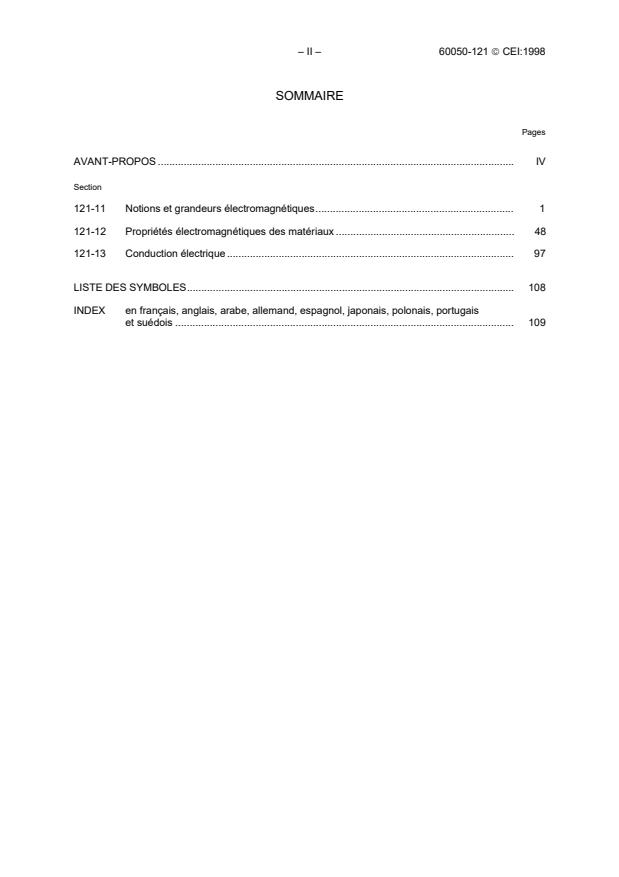
– II – 60050-121 CEI:1998
SOMMAIRE
Pages
AVANT-PROPOS . IV
Section
121-11 Notions et grandeurs électromagnétiques. 1
121-12 Propriétés électromagnétiques des matériaux . 48
121-13 Conduction électrique . 97
LISTE DES SYMBOLES. 108
INDEX en français, anglais, arabe, allemand, espagnol, japonais, polonais, portugais
et suédois . 109
60050-121 IEC:1998 – III –
CONTENTS
Page
FOREWORD . V
Section
121-11 Electromagnetic concepts and quantities . 1
121-12 Electromagnetic properties of materials . 48
121-13 Electric conduction. 97
LIST OF SYMBOLS. 108
INDEX in French, English, Arabic, German, Spanish, Japanese, Polish, Portuguese
and Swedish . 109
– IV – 60050-121 CEI:1998
COMMISSION ÉLECTROTECHNIQUE INTERNATIONALE
–––––––––––
VOCABULAIRE ÉLECTROTECHNIQUE INTERNATIONAL –
PARTIE 121 : ÉLECTROMAGNÉTISME
AVANT-PROPOS
1) La CEI (Commission Electrotechnique Internationale) est une organisation mondiale de normalisation composée
de l'ensemble des comités électrotechniques nationaux (Comités nationaux de la CEI). La CEI a pour objet de
favoriser la coopération internationale pour toutes les questions de normalisation dans les domaines de
l'électricité et de l'électronique. A cet effet, la CEI, entre autres activités, publie des Normes internationales.
Leur élaboration est confiée à des comités d'études, aux travaux desquels tout Comité national intéressé par le
sujet traité peut participer. Les organisations internationales, gouvernementales et non gouvernementales, en
liaison avec la CEI, participent également aux travaux. La CEI collabore étroitement avec l'Organisation
Internationale de Normalisation (ISO), selon des conditions fixées par accord entre les deux organisations.
2) Les décisions ou accords officiels de la CEI concernant les questions techniques représentent, dans la mesure
du possible un accord international sur les sujets étudiés, étant donné que les Comités nationaux intéressés
sont représentés dans chaque comité d’études.
3) Les documents produits se présentent sous la forme de recommandations internationales. Ils sont publiés
comme normes, rapports techniques ou guides et agréés comme tels par les Comités nationaux.
4) Dans le but d'encourager l'unification internationale, les Comités nationaux de la CEI s'engagent à appliquer de
façon transparente, dans toute la mesure possible, les Normes internationales de la CEI dans leurs normes
nationales et régionales. Toute divergence entre la norme de la CEI et la norme nationale ou régionale
correspondante doit être indiquée en termes clairs dans cette dernière.
5) La CEI n’a fixé aucune procédure concernant le marquage comme indication d’approbation et sa responsabilité
n’est pas engagée quand un matériel est déclaré conforme à l’une de ses normes.
6) L’attention est attirée sur le fait que certains des éléments de la présente Norme internationale peuvent faire
l’objet de droits de propriété intellectuelle ou de droits analogues. La CEI ne saurait être tenue pour
responsable de ne pas avoir identifié de tels droits de propriété et de ne pas avoir signalé leur existence.
La présente Norme internationale a été établie par le GT 100 du comité d'études 1 : Terminolgie.
Cette deuxième édition annule et remplace la première édition parue en 1978.
Le texte de cette norme est issu des documents suivants :
FDIS Rapport de vote
1/1653/FDIS 1/1663/RVD
Le rapport de vote indiqué dans le tableau ci-dessus donne toute information sur le vote ayant
abouti à l'approbation de cette norme.
Dans la présente partie du VEI les termes et définitions sont donnés en deux langues, le
français et l’anglais : de plus, les termes sont indiqués en arabe (ar), allemand (de), espagnol
(es), italien (it), japonais (ja), polonais (pl), portugais (pt) et suédois (sv).
60050-121 IEC:1998 – V –
INTERNATIONAL ELECTROTECHNICAL COMMISSION
––––––––––
INTERNATIONAL ELECTROTECHNICAL VOCABULARY –
PART 121: ELECTROMAGNETISM
FOREWORD
1) The IEC (International Electrotechnical Commission) is a worldwide organization for standardization comprising
all national electrotechnical committees (IEC National Committees). The object of the IEC is to promote
international co-operation on all questions concerning standardization in the electrical and electronic fields. To
this end and in addition to other activities, the IEC publishes International Standards. Their preparation is
entrusted to technical committees; any IEC National Committee interested in the subject dealt with may
participate in this preparatory work. International, governmental and non-governmental organizations liaising
with the IEC also participate in this preparation. The IEC collaborates closely with the International Organization
for Standardization (ISO) in accordance with conditions determined by agreement between the two
organizations.
2) The formal decisions or agreements of the IEC on technical matters express, as nearly as possible, an
international consensus of opinion on the relevant subjects since each technical committee has representation
from all interested National Committees.
3) The documents produced have the form of recommendations for international use and are published in the form
of standards, technical reports or guides and they are accepted by the National Committees in that sense.
4) In order to promote international unification, IEC National Committees undertake to apply IEC International
Standards transparently to the maximum extent possible in their national and regional standards. Any
divergence between the IEC Standard and the corresponding national or regional standard shall be clearly
indicated in the latter.
5) The IEC provides no marking procedure to indicate its approval and cannot be rendered responsible for any
equipment declared to be in conformity with one of its standards.
6) Attention is drawn to the possibility that some of the elements of this International Standard may be the subject
of patent rights. The IEC shall not be held responsible for identifying any or all such patent rights.
This International Standard has been prepared by WG 100 of IEC technical committee 1: Terminology.
This second edition cancels and replaces the first edition published in 1978.
The text of this standard is based on the following documents:
FDIS Report on voting
1/1653/FDIS 1/1663/RVD
Full information on the voting for the approval of this standard can be found in the report on
voting indicated in the above table.
In this IEV part, the terms and definitions are written in two languages: French and English,
and furthermore, the terms in Arabic (ar), German (de), Spanish (es), Italian (it), Japanese (ja),
Polish (pl), Portuguese (pt) and Swedish (sv) respectively are indicated.
60050-121 IEC:1998 – 1 –
SECTION 121-11 : NOTIONS ET GRANDEURS ÉLECTROMAGNÉTIQUES
SECTION 121-11: ELECTROMAGNETIC CONCEPTS AND QUANTITIES
121-11-01 charge électrique, f
(symbole : Q)
quantité d’électricité (terme désuet)
grandeur scalaire additive, associée aux particules élémentaires et à la matière
macroscopique, qui caractérise leurs interactions électromagnétiques [111-13-43]
NOTE 1 – La charge électrique est soumise à une loi de conservation.
NOTE 2 – Les charges électriques obéissent à la loi de Coulomb.
electric charge
(symbol: Q)
quantity of electricity (obsolete)
additive scalar quantity, associated with elementary particles and with macroscopic
matter that characterizes their electromagnetic interactions [111-13-43]
NOTE 1 – Electric charge is subject to a conservation law.
NOTE 2 – Electric charges obey the Coulomb law.
ar ;
de elektrische Ladung
es carga eléctrica (símbolo: Q); cantidad de electricidad (en desuso)
it carica elettrica; quantità di elettricità (termine obsoleto)
ja
pl¥adunek elektryczny
pt carga eléctrica; quantidade de electricidade (obsoleto)
sv (elektrisk) laddning
– 2 – 60050-121 CEI:1998
121-11-02 loi de Coulomb, f
loi donnant la force entre deux particules chargées, exprimée par la relation
QQ r QQ
12 21 1 2
F =⋅k ⋅ = k⋅ ⋅e
12 21
2 2
r r r
où F t la force exercée sur la particule de charge électrique Q par la particule de
es
12 1
charge électrique Q , k une constante positive, r le vecteur issu de la particule de
2 21
charge électrique Q et aboutissant à la particule de charge électrique Q , r = r la
2 1 21
distance entre particules et e le vecteur unitaire r r
21 21
NOTE – Dans le vide la constante k est égale à 14πε où ε est la constante électrique.
0 0
Coulomb law
law giving the force between two charged particles, expressed by the relation
QQ r QQ
12 21 1 2
F =⋅k ⋅ = k⋅ ⋅e
12 21
2 2
r
r r
where F is the force exerted on the particle with electric charge Q by the particle
12 1
with electric charge Q k a positive constant, r the vector from the particle with
,
2 21
electric charge Q to the particle with electric charge Q, r = r the distance
2 1 21
between particles and e the unit vector r r
21 21
NOTE – In vacuum the constant k is equal to 14πε where ε is the electric constant.
0 0
ar
de Coulombsches Gesetz
es ley de Coulomb
it legge di Coulomb
ja
pl prawo Coulomba
pt lei de Coulomb
sv Coulombs lag
60050-121 IEC:1998 – 3 –
121-11-03 constante électrique, f
permittivité du vide, f
ε
(symbole : )
constante scalaire ε reliant les grandeurs électriques et les grandeurs mécaniques,
obtenue d'après la relation
QQ
F=⋅
4πε
r
fondée sur la loi de Coulomb dans le vide, où F est la norme de la force s'exerçant
entre deux particules de charges électriques Q et Q respectivement, placées à une
1 2
distance r l'une de l'autre [705-03-01 MOD]
NOTE 1 – Dans le vide, le produit de la constante électrique par le champ électrique E est
égal à l'induction électrique D :
DE=ε
NOTE 2 – La constante électrique est liée à la constante magnétique μ et à la vitesse de la
lumière dans le vide c par la relation
εμc =1
00 0
NOTE 3 – La valeur de la constante électrique est exactement égale à
-31-
=
m kg sA 8,854 187 817.pF m
4π × 299 792 458
electric constant
permittivity of vacuum
(symbol: ε )
scalar constant ε linking the electric quantities and the mechanical quantities,
obtained from the relation
QQ
F=⋅
4πε
r
based on the Coulomb law in vacuum, where F is the magnitude of the force
between two particles with electric charges Q and Q respectively, placed at a
1 2
distance r apart [705-03-01 MOD]
NOTE 1 – In vacuum, the product of the electric constant and the electric field strength E is
equal to the electric flux density D
:
DE=ε
NOTE 2 – The electric constant is related to the magnetic constant μ and to the speed of
light in vacuum c by the relation
εμc =1
00 0
NOTE 3 – The value of the electric constant is exactly equal to
-31- 42
mkg sA= 8,.854 187 817.pF m
4π × 299 792 458
ar ;
de elektrische Feldkonstante
es constante eléctrica (símbolo: εε ); permitividad del vacío
it costante elettrica; permettività del vuoto
ja
pl sta¥a elektryczna; przenikalno elektryczna próni
pt constante eléctrica; permitividade do vazio
sv permittiviteten för vakuum; elektriska konstanten
†
– 4 – 60050-121 CEI:1998
121-11-04 électriquement neutre
qualifie une particule, un corps ou un système matériel dont la charge électrique
totale est nulle
electrically neutral
qualifies a particle, a body or a physical system in which the total electric charge is
zero
ar
de elektrisch neutral
es eléctricamente neutro
it elettricamente neutro
ja
pl oboj¿tny elektrycznie
pt electricamente neutro
sv elektriskt neutral; oladdad
121-11-05 électriquement chargé
qualifie une particule, un corps ou un système matériel dont la charge électrique
totale est différente de zéro
electrically charged
qualifies a particle, a body or a physical system in which the total electric charge is
different from zero
ar
de elektrisch geladen
es eléctricamente cargado
it elettricamente caricato
ja
pl na¥adowany elektrycznie
pt electricamente carregado
sv (elektriskt) laddad
60050-121 IEC:1998 – 5 –
121-11-06 quasi-infinitésimal
dans un système d'entités élémentaires, qualifie la longueur, l'aire ou le volume d'un
élément d'espace dont toutes les dimensions géométriques sont petites par rapport à
celles du système considéré mais suffisamment grandes pour que l'élément
d'espace contienne un grand nombre d'entités élémentaires
NOTE – Le terme « quasi-infinitésimal » est utilisé pour distinguer cette notion de celle
d'infinitésimal au sens mathématique.
quasi-infinitesimal
in a system of elementary entities, qualifies the length, the area, or the volume of an
element of space all the geometrical dimensions of which are small compared with
those of the system under consideration, but sufficiently large for the element of
space to contain a large number of elementary entities
NOTE – The term “quasi-infinitesimal” is used to distinguish this notion from that of
infinitesimal in the mathematical sense.
ar
de quasi-infinitesimal
es cuasi-infinitesimal
it quasi-infinitesimale
ja
pl kwazi infinitezymalny
pt quase infinitesimal
sv kvasiinfinitesimal
121-11-07 charge (électrique) volumique, f
(symbole : ρ )
en un point donné à l’intérieur d’un élément d’espace de volume quasi-infinitésimal
V , grandeur scalaire égale au quotient de la charge électrique totale Q située à
l'intérieur de l’élément d’espace par le volume V :
Q
ρ =
V
volumic (electric) charge
(electric) charge density
(symbol: ρ )
at a given point within a volume element of quasi-infinitesimal volume V , scalar
quantity equal to the total electric charge Q within the volume element divided by the
volume V :
Q
ρ =
V
ar ;
de volumenbezogene (elektrische) Ladung; Ladungsdichte
es densidad de carga eléctrica (símbolo: MM)
it carica (elettrica) volumica; densità di carica (elettrica)
ja
pl g¿sto (obj¿tociowa) ¥adunku (elektrycznego)
pt carga (eléctrica) volúmica
sv (volym)laddningstäthet; volumar laddning
†
– 6 – 60050-121 CEI:1998
121-11-08 charge (électrique) surfacique, f
σ
(symbole : )
en un point donné sur un élément de surface d’aire quasi-infinitésimale A, grandeur
scalaire égale au quotient de la charge électrique totale Q située sur l’élément de
surface par l’aire A :
Q
σ =
A
areic (electric) charge
surface (electric) charge density
σ
(symbol: )
at a given point on a surface element of quasi-infinitesimal area A, scalar quantity
equal to the total electric charge Q on the surface element divided by the area A:
Q
σ =
A
ar ;
de flächenbezogene (elektrische) Ladung; Ladungsbedeckung
es densidad de carga (eléctrica) superficial (símbolo: NN)
it carica (elettrica) areica; densità superficiale di carica (elettrica)
ja
pl g¿sto powierzchniowa ¥adunku (elektrycznego)
pt carga (eléctrica) areal; carga (eléctrica) areica
sv ytladdningstäthet; arear laddning
121-11-09 charge (électrique) linéique, f
(symbole : τ )
en un point donné sur un élément de ligne de longueur quasi-infinitésimale s,
grandeur scalaire égale au quotient de la charge électrique totale Q située sur
l’élément de ligne par la longueur s :
Q
τ =
s
lineic (electric) charge
linear (electric) charge density
(symbol: τ )
at a given point on a line element of quasi-infinitesimal length s , scalar quantity
equal to the total electric charge Q on the line element divided by the length s :
Q
τ =
s
ar ;
de längenbezogene (elektrische) Ladung; Ladungsbelag
es densidad de carga (eléctrica) lineal (símbolo: OO)
it carica (elettrica) lineica; densità lineare di carica (elettrica)
ja
pl g¿sto liniowa ¥adunku (elektrycznego)
pt carga (eléctrica) lineal; carga (eléctrica) lineica
sv linjeladdningstäthet; linear laddning
†
†
60050-121 IEC:1998 – 7 –
121-11-10 porteur de charge libre, m
porteur de charge capable de se mouvoir librement sous l’influence d’un champ
électrique appliqué [111-14-45]
free charge carrier
charge carrier which is able to move freely under the influence of an applied electric
field [111-14-45]
ar
de freier Ladungsträger
es portador de carga libre
it portatore libero di carica
ja
pl nonik ¥adunku swobodnego
pt portador de carga livre
sv fri laddningsbärare
121-11-11 densité de courant (électrique), f
densité de courant (de conduction), f
)
(symbole : J
en un point donné à l’intérieur d’un élément d’espace de volume quasi-infinitésimal
V , grandeur vectorielle égale au quotient, par le volume V , de la somme, étendue à
tous les porteurs de charge libres situés à l'intérieur de l’élément d’espace, des
produits de leur charge électrique par leur vitesse :
n
J = Q v
∑ i i
V
i=1
où n est le nombre de porteurs de charge libres à l'intérieur de l’élément d’espace,
Q la charge électrique du porteur de rang i et v sa vitesse.
i i
NOTE – Le flux de la densité de courant électrique J à travers une surface orientée
quelconque S est égal au courant électrique I à travers cette surface :
IA=⋅Je d
n
∫
S
où e dA est l'élément vectoriel de surface.
n
– 8 – 60050-121 CEI:1998
121-11-11 (electric) current density
(conduction) current density
areic electric current
(symbol: J )
at a given point within a volume element of quasi-infinitesimal volume V , vector
quantity equal to the sum, for all free charge carriers within the volume element, of
the products of electric charge and velocity, divided by the volume V :
n
=
J Q v
∑ i i
V
i=1
where n is the number of free carriers within the volume element, Q the electric
i
th
charge of the i carrier and v its velocity
i
NOTE – The flux of the electric current density J through any directed surface S is equal to
the electric current I through that surface:
IA=⋅ d
Je
n
∫
S
where e dA is the vector surface element.
n
ar ;
de (Leitungs-)Stromdichte
es densidad de corriente (eléctrica) (símbolo: J)
it densità di corrente (elettrica); densità di corrente (di conduzione)
ja
pl g¿sto pr”du (elektrycznego); g¿sto pr”du przewodzenia
pt densidade de corrente (eléctrica); densidade de corrente (de condução)
sv strömtäthet
† †
60050-121 IEC:1998 – 9 –
121-11-12 densité linéique de courant (électrique), f
(symbole : A)
en un point donné d’un élément de surface d’aire quasi-infinitésimale S , grandeur
vectorielle égale au quotient, par l’aire S , de la somme, étendue à tous les porteurs
de charge libres confinés sur l’élément de surface, des produits de leur charge
électrique par leur vitesse :
n
A = Q v
∑ i i
S
=1
i
où n est le nombre de porteurs de charge libres confinés sur l’élément de surface,
Q la charge électrique du porteur de rang i et v sa vitesse
i i
NOTE – Pour des porteurs de charge confinés sur une surface, l’intégrale étendue à une
courbe de cette surface joignant deux points a et b , dont l’élément différentiel est le produit
scalaire de la densité linéique de courant A et du vecteur e ds normal à la courbe dans une
n
direction spécifiée tangente à la surface et de norme égale à l’élément scalaire d’arc , est
ds
égale à la limite du quotient de la charge électrique Q traversant cette courbe dans la
direction spécifiée pendant un intervalle de temps par la durée τ de cet intervalle lorsque τ
tend vers zéro :
S
b
Q
Ae⋅=ds lim
n
∫
τ→0
τ
S
a
où s et s sont les abscisses curvilignes de a et b respectivement.
a b
lineic (electric) current
linear (electric) current density
(symbol: A)
at a given point within a surface element of quasi-infinitesimal area S , vector quantity
equal to the sum, for all free charge carriers confined to the surface element, of the
products of electric charge and velocity, divided by the area S :
n
=
A Q v
∑ i i
S
i=1
where n is the number of free carriers confined to the surface element, Q the
i
th
electric charge of the i carrier and v its velocity
i
NOTE – For charge carriers confined to a surface, the integral along a curve of this surface
joining two points a and b, the differential element of which is the scalar product of the lineic
electric current A and the vector e ds normal to the curve in a specified direction tangent to
n
the surface and of magnitude equal to the scalar line element ds, is equal to the limit of the
quotient of the electric charge Q transferred across the curve in the specified direction during
a time interval by the duration τ of this interval when τ tends to zero:
S
b
Q
Ae⋅=ds lim
n
∫
τ→0
τ
S
a
where s and s are the path coordinates for a and b, respectively.
a b
ar ;
de Strombelag
es densidad lineal de corriente (eléctrica) (símbolo: A)
it densità lineica di corrente (elettrica)
ja
pl ok¥ad pr”du
pt densidade lineal de corrente (eléctrica)
sv strömbeläggning
– 10 – 60050-121 CEI:1998
121-11-13 courant (électrique), m
courant (de conduction), m
(symbole : I )
grandeur scalaire égale au flux de la densité de courant électrique J à travers une
surface orientée donnée S :
IA=⋅Je d
n
∫
S
où e dA est l'élément vectoriel de surface
n
NOTE 1 – Le courant électrique à travers une surface est égal à la limite du quotient de la
charge électrique traversant cette surface pendant un intervalle de temps par la durée de cet
intervalle lorsque cette durée tend vers zéro.
NOTE 2 – Pour des porteurs de charge confinés sur une surface, le courant électrique est
défini à travers une courbe de cette surface (voir la note au terme « densité linéique de
courant »).
(electric) current
(conduction) current
(symbol: I )
scalar quantity equal to the flux of the electric current density J through a given
directed surface S :
IA=⋅Jed
n
∫
S
where e dA is the vector surface element
n
NOTE 1 – The electric current through a surface is equal to the limit of the quotient of the
electric charge transferred through that surface during a time interval by the duration of this
interval when this duration tends to zero.
NOTE 2 – For charge carriers confined to a surface, the electric current is defined through a
curve of this surface (see the note to term “lineic electric current”).
ar ;
de (elektrische) Stromstärke; Leitungsstromstärke
es corriente (eléctrica) (símbolo: I); corriente (de conducción)
it corrente (elettrica); corrente (di conduzione)
ja
pl pr”d (elektryczny); pr”d przewodzenia
pt corrente (eléctrica); corrente (de condução)
sv (elektrisk) ström
60050-121 IEC:1998 – 11 –
121-11-14 constante magnétique, f
perméabilité du vide, f
μ
(symbole : )
constante scalaire μ reliant les grandeurs électromagnétiques et les grandeurs
mécaniques, obtenue d'après la relation
II
F μ
0 12
=⋅
l 2π d
où Fl est la norme de la force linéique s'exerçant entre deux conducteurs
parallèles, rectilignes, de longueur infinie, de section circulaire négligeable, placés à
une distance d l'un de l'autre dans le vide et parcourus par des courants électriques
I et I
1 2
NOTE 1 – Dans le vide, le produit de la constante magnétique par le champ magnétique H
est égal à l'induction magnétique B :
BH=μ
NOTE 2 – La constante magnétique est liée à la constante électrique ε et à la vitesse de la
lumière dans le vide c par la relation
μεc =1
00 0
NOTE 3 – La valeur de la constante magnétique est égale exactement à
−−−
7 22
4πμ×=10 m kg sAH1,.256 637 0614.m
magnetic constant
permeability of vacuum
(symbol: μ )
μ
scalar constant linking the electromagnetic quantities and the mechanical
quantities, obtained from the relation
F μ II
=⋅
l 2π d
where Fl is the magnitude of the lineic force between two straight parallel conductors of
infinite length and negligible circular cross section, placed at a distance d apart in vacuum
and carrying electric currents I and I
1 2
NOTE 1 – In vacuum, the product of the magnetic constant and the magnetic field strength
H is equal to the magnetic flux density B:
BH=μ
NOTE 2 – The magnetic constant is related to the electric constant ε and to the speed of
light in vacuum c by the relation
μεc =1
00 0
NOTE 3 – The value of the magnetic constant is exactly equal to
−−7 2−2
4πμ×=10 m kg sAH1,.256 637 0614.m
ar ;
de magnetische Feldkonstante
es constante magnética (símbolo: HH); permeabilidad del vacío
it costante magnetica; permeabilità del vuoto
ja
pl sta¥a magnetyczna; przenikalno magnetyczna próni
pt constante magnética; permeabilidade do vazio
sv permeabiliteten för vakuum; magnetiska konstanten
†
– 12 – 60050-121 CEI:1998
121-11-15 filiforme
qualifie un corps en forme de filament dont la section droite en chaque point est
d'aire quasi-infinitésimale
filiform
qualifies a filament-shaped body the cross-section of which at every point is of quasi-
infinitesimal area
ar
de filiform
es filiforme
it filiforme
ja
pl filamentowy
pt filiforme
sv .
121-11-16 tube de courant, m
partie de l’espace en forme de tube dont la paroi est parallèle en chaque point à la
densité de courant électrique, de sorte que le courant électrique est le même à
travers toute section droite
tube of current
tube-shaped portion of space, the wall of which is parallel at every point to the
electric current density, so that the electric current is the same through any cross-
section
ar
de Stromröhre
es tubo de corriente
it tubo di corrente
ja
pl rurka pr”du
pt tubo de corrente
sv strömrör
60050-121 IEC:1998 – 13 –
121-11-17 élément de courant, m
en un point donné d’un tube de courant filiforme, grandeur vectorielle égale au
produit du courant électrique par l'élément vectoriel d'arc en ce point
NOTE – Un élément de courant est représenté par Idr ou par Ised où I est le courant
t
électrique et ddre= s l'élément vectoriel d'arc.
t
current element
at a given point of a filiform tube of current, vector quantity equal to the product of the
electric current and the vector line element at that point
NOTE – A current element is expressed by Idr or by Ised where I is the electric current
t
and ddre= s the vector line element.
t
ar
de Stromelement
es elemento de corriente
it elemento di corrente
ja
pl element róniczkowy (rurki) pr”du
pt elemento de corrente
sv strömelement
121-11-18 champ électrique, m
(symbole : E )
champ vectoriel E qui engendre sur toute particule chargée au repos une force F
égale au produit du champ E par la charge électrique Q de la particule :
FE=Q
electric field strength
(symbol: E )
vector field quantity E which exerts on any charged particle at rest a force F equal to
the product of E and the electric charge Q of the particle:
FE=Q
ar
de elektrische Feldstärke
es intensidad de campo eléctrico (símbolo: E)
it campo elettrico
ja
pl nat enie pola elektrycznego
pt campo eléctrico
sv elektrisk fältstyrka
¿
– 14 – 60050-121 CEI:1998
121-11-19 induction magnétique, f
(symbole : B)
champ vectoriel B qui engendre sur toute particule chargée de vitesse v une force
F égale au produit du produit vectoriel v ×B par la charge électrique Q de la
particule :
FB=×Qv
NOTE 1 – La divergence de B est nulle en tout point :
div B = 0
NOTE 2 – L’induction magnétique B est parfois appelée « champ magnétique », ce qui peut
entraîner une confusion avec le champ magnétique H .
magnetic flux density
magnetic induction
(symbol: B)
vector field quantity B which exerts on any charged particle having velocity v a force
F equal to the product of the vector product v × B and the electric charge Q of the
particle:
=×Q
FBv
NOTE 1 – The divergence of B is zero at all points:
div B = 0
NOTE 2 – The magnetic flux density B is sometimes called “magnetic field”, risking confusion
with the magnetic field strength H .
ar ;
de magnetische Flußdichte; (magnetische) Induktion (veraltet)
es inducción magnética (símbolo: B); densidad de flujo magnético
it induzione magnetica
ja
pl indukcja magnetyczna
pt indução magnética
sv magnetisk flödestäthet
60050-121 IEC:1998 – 15 –
121-11-20 force de Coulomb-Lorentz, f
force F s’exerçant sur une particule de charge électrique Q et de vitesse v , donnée
par la relation
FE=+Q()v×B
où E est le champ électrique et B l'induction magnétique
NOTE 1 – La composante Q E est la force de Coulomb.
NOTE 2 – La composante Q v × B est la force de Lorentz.
Coulomb-Lorentz force
v
force F exerted on a particle having electric charge Q and velocity , given by the
relation
FE=+Q()v×B
where E is the electric field strength and B the magnetic flux density
NOTE 1 – The component vector Q E is the Coulomb force.
NOTE 2 – The component vector Q v × B is the Lorentz force.
ar
de Coulomb-Lorentz-Kraft
es fuerza de Coulomb-Lorentz
it forza di Coulomb-Lorentz
ja
pl si¥a Coulomba-Lorentza
pt força de Coulomb-Lorentz
sv Coulomb-Lorentzkraft
– 16 – 60050-121 CEI:1998
121-11-21 flux magnétique, m
(symbole : Φ )
grandeur scalaire égale au flux de l'induction magnétique B à travers une surface
orientée donnée S :
Φ = Be⋅ dA
n
∫
S
où e dA est l'élément vectoriel de surface
n
magnetic flux
(symbol: Φ )
scalar quantity equal to the flux of the magnetic flux density B through a given
directed surface S :
Φ = Be⋅ dA
n
∫
S
where e dA is the vector surface element
n
ar
de magnetischer Fluß
es flujo magnético (símbolo: %%)
it fluso magnetico
ja
pl strumie˙ magnetyczny
pt fluxo magnético
sv magnetiskt flöde
121-11-22 quantum de flux, m
fluxoïde, m
(symbole : Φ
)
quantum de flux magnétique, égal à he2 où h est la constante de Planck et e la
charge électrique élémentaire; sa valeur est approximativement égale à
−15
2, 067830215×10 Wb
flux quantum
fluxoid quantum
(symbol: Φ
)
quantum of magnetic flux, equal to he2 where h is the Planck constant and e is the
elementary electric charge; its value is approximately equal to
−
2, 067830215×10 Wb
ar ;
de Flußquant
es cuanto de flujo (símbolo: %%)
it quanto di flusso; flussoide
ja
pl fluksoid
pt quantum de fluxo; fluxoide
sv magnetiskt flödeskvantum
60050-121 IEC:1998 – 17 –
121-11-23 potentiel vecteur magnétique, m
(symbole : A)
potentiel vecteur de l'induction magnétique
NOTE 1 – Le rotationnel du potentiel vecteur magnétique A est l'induction magnétique B :
rot AB=
NOTE 2 –Le potentiel vecteur magnétique n'est pas unique puisqu’un champ vectoriel
irrotationnel quelconque peut être ajouté à un potentiel vecteur magnétique donné sans
changer son rotationnel. En régime statique le potentiel vecteur magnétique est souvent
choisi de telle sorte que sa divergence soit nulle.
magnetic vector potential
(symbol: A)
vector potential of the magnetic flux density
NOTE 1 – The rotation of the magnetic vector potential A is the magnetic flux density B:
=
rot AB
NOTE 2 – The magnetic vector potential is not unique since any irrotational vector field
quantity can be added to a given magnetic vector potential without changing its rotation.
Under static conditions the magnetic vector potential is often chosen so that its divergence is
zero.
ar
de magnetisches Vektorpotential
es potencial vector magnético (símbolo: A)
it potenziale vettore magnetico
ja
pl potencja¥ magnetyczny wektorowy
pt potencial vector magnético
sv magnetisk vektorpotential
– 18 – 60050-121 CEI:1998
121-11-24 flux totalisé, m
(symbole : Ψ)
circulation d’un potentiel vecteur magnétique A le long d’une courbe C :
Ψ=⋅Ard
∫
C
où dr est l’élément vectoriel d’arc
NOTE 1 – Pour une courbe fermée C, le flux totalisé est égal au flux magnétique à travers
toute surface S délimitée par la courbe :
⋅= ⋅
ArddBeA
n
∫∫
C S
où B est l’induction magnétique et e dA l’élément vectoriel de surface.
n
NOTE 2 – Pour une bobine de N tours, le flux totalisé est approximativement égal à NΦ où
Φ est le flux magnétique à travers toute surface délimitée par un tour.
linked flux
Ψ
(symbol: )
scalar line integral of a magnetic vector potential A along a curve C:
Ψ=⋅
Ard
∫
C
where dr is the vector line element
NOTE 1 – For a closed curve C, the linked flux is equal to the magnetic flux through any
surface S bounded by the curve:
Ar⋅=ddB⋅eA
n
∫∫
C S
where B is the magnetic flux density and e dA the vector surface element.
n
NOTE 2 – For a coil with N turns, the linked flux is approximately equal to NΦ where Φ is
the magnetic flux through any surface bounded by one turn.
ar
de verketteter Fluß
es flujo enlazado (símbolo: >>)
it flusso concatenato
ja
pl strumie˙ skojarzony
pt fluxo totalizado
sv magnetiskt samflöde
60050-121 IEC:1998 – 19 –
121-11-25 potentiel électrique, m
(symbole : V )
∂ A
potentiel scalaire V du vecteur irrotationnel E + , où E est le champ électrique,
∂
t
A un potentiel vecteur magnétique et t le temps :
∂ A
−=grad V E+
∂
t
NOTE – Le potentiel électrique n'est pas unique puisqu’une grandeur scalaire constante
quelconque peut être ajoutée à un potentiel électrique donné sans changer son gradient.
electric potential
(symbol: V )
∂ A
+ , where E is the electric field
scalar potential V of the irrotational vector E
∂t
strength, A is a magnetic vector potential and t is the time:
∂
A
−=grad V E+
∂ t
NOTE – The electric potential is not unique since any constant scalar quantity can be added
to a given electric potential without changing its gradient.
ar
de elektrisches Potential
es potencial eléctrico (símbolo: V)
it potenziale elettrico
ja
pl potencja¥ elektryczny
pt potencial eléctrico
sv elektrisk potential
– 20 – 60050-121 CEI:1998
121-11-26 différence de potentiel (électrique), f
différence entre les potentiels électriques en deux points
NOTE – La différence de potentiel électrique VV− entre deux points ab et est égale à
ba
l'opposé de la circulation, le long d’un chemin quelconque joignant les points ab et , du
∂A
vecteur irrotationnel E + , où E est le champ électrique, A un potentiel vecteur
∂t
magnétique et t le temps :
r
b
∂
A
VV−=−E+ ⋅dr
ba
∫
∂t
r
a
où r et r sont les rayons vecteurs de et respectivement et r est l'élément vectoriel
a b d
a b
d'arc.
(electric) potential difference
difference between the electric potentials at two points
NOTE – The electric potential difference VV− between two points ab and is equal to the
ba
negative of the line integral, along any path linking points ab and , of the irrotational vector
∂ A
E + , where E is the electric field strength, A a magnetic vector potential and t the
∂t
time:
r
b
∂A
VV−=− E+ ⋅r
d
ba
∫
∂t
r
a
where r and r are the position vectors for a and b, respectively, and dr is the vector line
a b
element.
ar
de (elektrische) Potentialdifferenz
es diferencia de potencial (eléctrico)
it differenza di potenziale (elettrico)
ja
pl rónica potencja¥ów (elektrycznych)
pt diferença de potencial (eléctrico)
sv elektrisk potentialdifferens
60050-121 IEC:1998 – 21 –
121-11-27 tension (électrique), f
(symbole : U )
grandeur scalaire égale à la circulation du champ électrique E le long d'un chemin
donné reliant deux points ab et :
r
b
=⋅
U Erd
ab
∫
r
a
où r et r sont les rayons vecteurs de ab et respectivement et dr est l'élément
a b
vectoriel d'arc
NOTE 1 –Dans le cas d'un champ électrique irrotationnel, la tension électrique est
indépendante du chemin et égale à l'opposé de la différence de potentiel électrique entre les
deux points :
UV=− −V
()
ab b a
NOTE 2 – En anglais le terme « voltage » ne respecte pas le principe selon lequel le nom
d'une grandeur ne doit jamais faire référence au nom d'une unité. Le terme « voltage » est
donné dans la CEI 60027-1 :1992, Symboles littéraux à utiliser en électrotechnique –
Partie 1 : Généralités ; il n’est pas donné dans la version anglaise de l’ISO 31-5 :1992,
Grandeurs et unités – Partie 5 : Electricité et magnétisme.
(electric) tension
(symbol: U )
voltage (deprecated)
scalar quantity equal to the line integral of the electric field strength E along a
specified path linking two points ab and :
r
b
U =⋅Erd
ab
∫
r
a
where r and r are the position vectors for ab and , respectively, and dr is the
a b
vector line element
NOTE 1 –In the case of an irrotational electric field strength, the electric tension is
independent of the path and equal to the negative of the electric potential difference between
the two points:
UV=− −V
()
ab b a
NOTE 2 – In English, the term “voltage” violates the principle that a quantity name shall never
refer to any name of unit. The term “voltage” is given in IEC 60027-1:1992, Letter symbols to
be used in electrical technology – Part 1: General; it is not given in ISO 31-5:1992 (E),
Quantities and units – Part 5: Electricity and magnetism.
ar ;
de (elektrische) Spannung
es tensión (eléctrica) (símbolo: U); voltage (en desuso)
it tensione (elettrica)
ja
pl napi¿cie (elektryczne)
pt tensão (eléctrica)
sv (elektrisk) spänning
– 22 – 60050-121 CEI:1998
121-11-28 tension induite, f
grandeur scalaire égale à la circulation de la grandeur vectorielle
∂
A
−+v×B
∂t
étendue à un chemin le long duquel les porteurs de charge peuvent se déplacer, où
A et B sont respectivement un potentiel vecteur magnétique et l'induction
magnétique en un point du chemin et où v est la vitesse de déplacement de ce point
NOTE – La tension induite est égale à l’opposé de la dérivée par rapport au temps du flux
totalisé correspondant au chemin.
induced tension
scalar quantity equal to the line integral of the vector quantity
∂A
−+v×B
∂t
along a path in which charge carriers can be displaced, where A and B are
respectively a magnetic vector potential and the magnetic flux density at a point of
the path and v is the velocity with which that point is moving
NOTE – The induced tension is equal to the negative of the time derivative of the linked flux
corresponding to the path.
ar
de induzierte Spannung
es tensión inducida
it tensione indotta
ja
pl napi¿cie indukowane
pt tensão induzida
sv inducerad spänning
121-11-29 courant induit, m
courant électrique dû au déplacement de porteurs de charge sous l’effet d’une
tension induite
induced current
electric current resulting from the displacement of charge carriers due to an induced
tension
ar
de induzierter Strom
es corriente inducida
it corrente indotta
ja
pl pr”d indukowany
pt corrente induzida
sv inducerad ström
60050-121 IEC:1998 – 23 –
121-11-30 induction électromagnétique, f
phénomène selon lequel une tension induite ou un courant induit est produit
electromagnetic induction
phenomenon in which an induced tension or an induced current is produced
ar
de elektromagnetische Induktion
es inducción electromagnética
it induzione elettromagnetica
ja
pl indukcja elektromagnetyczna
pt indução electromagnética
sv elektromagnetisk induktion
121-11-31 auto-induction, f
induction propre, f
induction électromagnétique dans un tube de courant due aux variations du courant
électrique qui y circule
self-induction
electromagnetic induction in a tube of current due to variations of the electric current
in that tube
ar
de Selbstinduktion
es autoinducción
it auto-induzione
ja
pl samoindukcja
pt auto-indução
sv självinduktion
121-11-32 induction mutuelle, f
induction électromagnétique dans un tube de courant due aux variations du courant
électrique dans un autre tube de courant
mutual induction
electromagnetic induction in a tube of current due to variations of the electric current
in another tube of current
ar
de gegenseitige Induktion
es inducción mutua
it mutua induzione
ja
pl indukcja wzajemna
pt indução mútua
sv ömsesidig induktion
– 24 – 60050-121 CEI:1998
121-11-33 dipôle électrique, m
entité qui produit, en tout point à des distances suffisamment grandes par rapport à
ses dimensions géométriques, le même champ électrique que deux charges
électriques ponctuelles séparées de même valeur absolue et de signes contraires
NOTE – Cette notion est valable lorsque les variations en fonction du temps peuvent être
négligées.
electric dipole
entity which produces, at all points at distances sufficiently large compared with its
geometrical dimensions, the same electric field strength as two separate electric
point charges of the same absolute value and opposite signs
NOTE – This concept is valid when variations with time can be neglected.
ar
de elektrischer Dipol
es dipolo eléctrico
it dipolo elettrico
ja
pl dipol elektryczny
pt dipolo eléctrico
sv elektrisk dipol
121-11-34 dipôle électrique élémentaire, m
dipôle électrique où les deux charges ponctuelles sont séparées par une distance
atomique ou moléculaire
elementary electric dipole
electric dipole where the two point charges are separated by an atomic or molecular
distance
ar
de elektrischer Elementardipol
es dipolo eléctrico elemental
it dipolo elettrico elementare
ja
pl dipol elektryczny elementarny
pt dipolo eléctrico elementar
sv elektrisk elementardipol
60050-121 IEC:1998 – 25 –
121-11-35 moment électrique (1), m
(symbole : p)
pour un dipôle électrique, grandeur vectorielle de norme égale au produit de la
charge positive par la distance séparant les charges et dirigée de la charge négative
vers la charge positive
electric dipole moment (1)
(symbol: p)
for an electric dipole, vector quantity of magnitude equal to the product of the positive
charge and the distance between the charges and directed from the negative charge
to the positive charge
ar
de elektrisches Dipolmoment (1)
es momento eléctrico (1) (símbolo: p)
it momento elettrico
...