

IEC 62906-5-5:2022
(Main)Laser displays – Part 5-5: Optical measuring methods of raster-scanning retina direct projection laser displays
General Information
- Abstract
IEC 62906-5-5:2022 specifies the standard measurement conditions and optical measuring methods for raster-scanning retina direct projection laser displays with light sources such as direct-emitting lasers, optionally equipped with higher-order harmonic generation devices. The hybrid light sources using both lasers and spontaneous-emission-based light sources are not considered.
- Status
- Published
- Publication Date
- 19-Jan-2022
- Technical Committee
- TC 110 - Electronic displays
- Drafting Committee
- WG 10 - TC 110/WG 10
- Current Stage
- PPUB - Publication issued
- Start Date
- 20-Jan-2022
- Completion Date
- 11-Feb-2022



Overview
IEC 62906-5-5:2022 - "Laser displays – Part 5-5: Optical measuring methods of raster-scanning retina direct projection laser displays" defines standard measurement conditions and optical test methods for raster‑scanning retina direct projection (RS‑RDP) laser displays using direct‑emitting lasers (and optionally higher‑order harmonic generation devices). Hybrid sources that mix lasers with spontaneous‑emission light sources are excluded. The standard establishes how to measure optical power, retinal illuminance and image quality parameters in a repeatable, safety‑aware way.
Key topics and technical requirements
- Standard measuring conditions: environmental conditions, coordinate system, and setup requirements for reproducible measurements.
- Measurement points: defined optical power measurements at the exit window (measurement point 1) and at the focal point (measurement point 2), with methods to eliminate spectral cross‑effects.
- Required instruments: guidance for suitable light‑measuring devices including planar 2D image sensors and goniometric spectroradiometers.
- Image and view parameters:
- Eye‑box and its measurement geometries
- Field of view (FOV) and aspect ratio
- Effective angular image resolution with test patterns and contrast/MTF‑style evaluation
- Retinal free focus range (direct and imaging methods)
- Retinal white illuminance, luminance and chromaticity of the virtual image
- White and chromaticity nonuniformity
- Safety: laser‑safety requirements for measurement setups are included to protect operators and test equipment.
- Reporting: standardized reporting items and measurement locations to ensure consistent documentation.
Practical applications and who uses it
- Display manufacturers: validate performance, characterize beamforming and image quality of retina‑directed laser products.
- Test laboratories and QA teams: perform conformity testing, acceptance testing and comparative measurements between devices.
- R&D engineers and optical designers: quantify eye‑box, FOV, retinal illuminance and effective angular resolution early in design iterations.
- Regulatory and safety engineers: assess measurement procedures and results for safety compliance and harmonized documentation.
- Certification bodies: use the standard methods to support product claims and interoperability testing.
Benefits include repeatable performance metrics, comparable product specifications, and a framework for assessing retinal imaging characteristics specific to Maxwellian‑view RS‑RDP systems.
Related standards
- Other parts of the IEC 62906 series (Laser display devices) provide complementary guidance across laser display topics.
- The standard’s annexes offer practical models and context: Maxwellian view explanation, eyeball modelling for measurements, and comparisons of retinal illuminance with conventional displays.
Keywords: IEC 62906-5-5, laser displays, raster-scanning retina direct projection, optical measuring methods, eye-box, field of view, retinal illuminance, effective angular image resolution.
Frequently Asked Questions
IEC 62906-5-5:2022 is a standard published by the International Electrotechnical Commission (IEC). Its full title is "Laser displays – Part 5-5: Optical measuring methods of raster-scanning retina direct projection laser displays". This standard covers: IEC 62906-5-5:2022 specifies the standard measurement conditions and optical measuring methods for raster-scanning retina direct projection laser displays with light sources such as direct-emitting lasers, optionally equipped with higher-order harmonic generation devices. The hybrid light sources using both lasers and spontaneous-emission-based light sources are not considered.
IEC 62906-5-5:2022 specifies the standard measurement conditions and optical measuring methods for raster-scanning retina direct projection laser displays with light sources such as direct-emitting lasers, optionally equipped with higher-order harmonic generation devices. The hybrid light sources using both lasers and spontaneous-emission-based light sources are not considered.
IEC 62906-5-5:2022 is classified under the following ICS (International Classification for Standards) categories: 31.260 - Optoelectronics. Laser equipment. The ICS classification helps identify the subject area and facilitates finding related standards.
IEC 62906-5-5:2022 is available in PDF format for immediate download after purchase. The document can be added to your cart and obtained through the secure checkout process. Digital delivery ensures instant access to the complete standard document.
Standards Content (Sample)
IEC 62906-5-5 ®
Edition 1.0 2022-01
INTERNATIONAL
STANDARD
colour
inside
Laser displays –
Part 5-5: Optical measuring methods of raster-scanning retina direct projection
laser displays
All rights reserved. Unless otherwise specified, no part of this publication may be reproduced or utilized in any form
or by any means, electronic or mechanical, including photocopying and microfilm, without permission in writing from
either IEC or IEC's member National Committee in the country of the requester. If you have any questions about IEC
copyright or have an enquiry about obtaining additional rights to this publication, please contact the address below or
your local IEC member National Committee for further information.
IEC Secretariat Tel.: +41 22 919 02 11
3, rue de Varembé info@iec.ch
CH-1211 Geneva 20 www.iec.ch
Switzerland
About the IEC
The International Electrotechnical Commission (IEC) is the leading global organization that prepares and publishes
International Standards for all electrical, electronic and related technologies.
About IEC publications
The technical content of IEC publications is kept under constant review by the IEC. Please make sure that you have the
latest edition, a corrigendum or an amendment might have been published.
IEC publications search - webstore.iec.ch/advsearchform IEC Products & Services Portal - products.iec.ch
The advanced search enables to find IEC publications by a Discover our powerful search engine and read freely all the
variety of criteria (reference number, text, technical publications previews. With a subscription you will always
committee, …). It also gives information on projects, replaced have access to up to date content tailored to your needs.
and withdrawn publications.
Electropedia - www.electropedia.org
IEC Just Published - webstore.iec.ch/justpublished
The world's leading online dictionary on electrotechnology,
Stay up to date on all new IEC publications. Just Published
containing more than 22 300 terminological entries in English
details all new publications released. Available online and
and French, with equivalent terms in 19 additional languages.
once a month by email.
Also known as the International Electrotechnical Vocabulary
(IEV) online.
IEC Customer Service Centre - webstore.iec.ch/csc
If you wish to give us your feedback on this publication or
need further assistance, please contact the Customer Service
Centre: sales@iec.ch.
IEC 62906-5-5 ®
Edition 1.0 2022-01
INTERNATIONAL
STANDARD
colour
inside
Laser displays –
Part 5-5: Optical measuring methods of raster-scanning retina direct projection
laser displays
INTERNATIONAL
ELECTROTECHNICAL
COMMISSION
ICS 31.260 ISBN 978-2-8322-1068-6
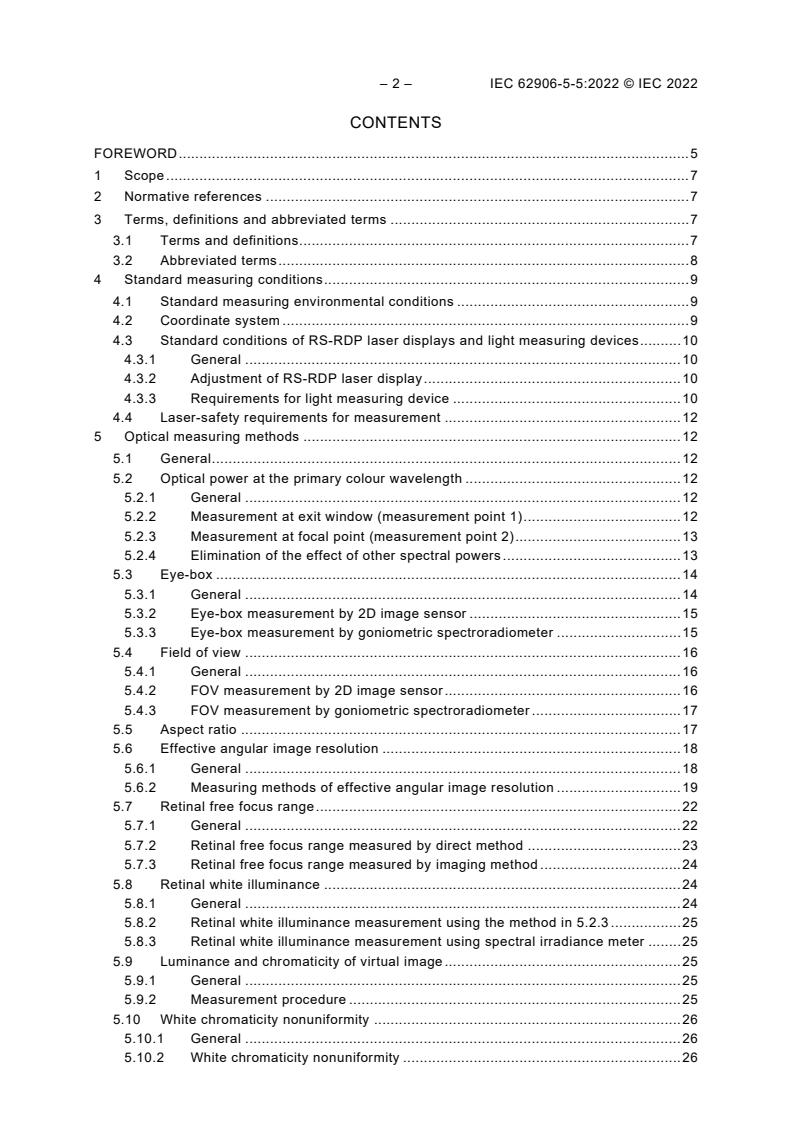
– 2 – IEC 62906-5-5:2022 © IEC 2022
CONTENTS
FOREWORD . 5
1 Scope . 7
2 Normative references . 7
3 Terms, definitions and abbreviated terms . 7
3.1 Terms and definitions . 7
3.2 Abbreviated terms . 8
4 Standard measuring conditions . 9
4.1 Standard measuring environmental conditions . 9
4.2 Coordinate system . 9
4.3 Standard conditions of RS-RDP laser displays and light measuring devices . 10
4.3.1 General . 10
4.3.2 Adjustment of RS-RDP laser display . 10
4.3.3 Requirements for light measuring device . 10
4.4 Laser-safety requirements for measurement . 12
5 Optical measuring methods . 12
5.1 General . 12
5.2 Optical power at the primary colour wavelength . 12
5.2.1 General . 12
5.2.2 Measurement at exit window (measurement point 1) . 12
5.2.3 Measurement at focal point (measurement point 2) . 13
5.2.4 Elimination of the effect of other spectral powers . 13
5.3 Eye-box . 14
5.3.1 General . 14
5.3.2 Eye-box measurement by 2D image sensor . 15
5.3.3 Eye-box measurement by goniometric spectroradiometer . 15
5.4 Field of view . 16
5.4.1 General . 16
5.4.2 FOV measurement by 2D image sensor . 16
5.4.3 FOV measurement by goniometric spectroradiometer . 17
5.5 Aspect ratio . 17
5.6 Effective angular image resolution . 18
5.6.1 General . 18
5.6.2 Measuring methods of effective angular image resolution . 19
5.7 Retinal free focus range . 22
5.7.1 General . 22
5.7.2 Retinal free focus range measured by direct method . 23
5.7.3 Retinal free focus range measured by imaging method . 24
5.8 Retinal white illuminance . 24
5.8.1 General . 24
5.8.2 Retinal white illuminance measurement using the method in 5.2.3 . 25
5.8.3 Retinal white illuminance measurement using spectral irradiance meter . 25
5.9 Luminance and chromaticity of virtual image . 25
5.9.1 General . 25
5.9.2 Measurement procedure . 25
5.10 White chromaticity nonuniformity . 26
5.10.1 General . 26
5.10.2 White chromaticity nonuniformity . 26
5.10.3 Virtual image chromaticity nonuniformity . 26
6 Report . 27
Annex A (informative) Structure of RS-RDP laser displays . 28
A.1 General . 28
A.2 Example of mechanical structure . 28
A.3 Example of fundamental electro-optical structure of RS-RDP laser display . 28
Annex B (informative) Maxwellian view of RS-RDP laser displays . 30
B.1 General . 30
B.2 Maxwellian view . 30
B.3 Pinhole image on the retina in the Maxwellian view . 31
B.4 Laser image on the retina in the Maxwellian view . 31
Annex C (informative) Eyeball model and use of planar 2D sensor for measuring
optical property . 32
C.1 Human eyeball structure, its optics and modelling for practical measurement . 32
C.2 Retinal sensor model . 36
C.3 Optical measuring method with planar 2D image sensor . 37
Annex D (informative) Comparison of retinal illuminance with other displays . 43
D.1 Projected area on retina . 43
D.2 Retinal illuminance estimation for the conventional displays using natural
viewing . 45
D.3 Retinal illuminance estimation for RS-RDP laser display using Maxwellian
viewing . 46
D.4 Comparison of retinal illuminance between RS-RDP laser displays and the
conventional displays . 46
Bibliography . 47
Figure 1 – Coordinate system and setup for planar measurements . 10
Figure 2 – Two measurement points of optical power . 14
Figure 3 – Measurement geometry of the eye-box . 16
Figure 4 – Measurement geometry of the FOV . 17
Figure 5 – Example of beam waist for Maxwellian view at the 2D image sensor plane. 18
Figure 6 – Example of measurement locations for effective angular image resolution . 19
Figure 7 – Setup for measuring effective angular image resolution and retinal free
focus range . 20
Figure 8 – Test patterns for resolution measurement . 21
Figure 9 – Example of contrast modulation plot . 22
Figure 10 – Example of the measured results of retinal free focus range. 24
Figure 11 – Nonuniformity measurement locations and box patterns . 27
Figure A.1 – Example of mechanical structure of RS-RDP laser display . 28
Figure A.2 – Example of electro-optical structure of RS-RDP laser display . 29
Figure B.1 – Maxwellian view (a) and normal viewing (b) . 30
Figure B.2 – Pinhole (a) and laser beam (b) in the Maxwellian view . 31
Figure C.1 – Cross-sectional human eyeball structure . 32
Figure C.2 – Schematic of the eye with geometrical and optical information . 33
Figure C.3 – Calculated refracted beam angle in the eye with respect to incident beam
angle for blue (465 nm), green (520 nm) and red (640 nm) . 33
Figure C.4 – Schematic eye optics . 35
– 4 – IEC 62906-5-5:2022 © IEC 2022
Figure C.5 – Example of beam spot radius calculation for the eye model as a function
of incident beam diameter . 36
Figure C.6 – Retinal sensor model with curved 2D image sensor . 37
Figure C.7 – Geometrical relationship between point A on the retina and B on the
fovea plane for the Cartesian coordinate system . 38
Figure C.8 – Cross-sectional view of the plane consisting of the z-axis and the line
segment OB in Figure C.7 . 38
Figure C.9 – Schematic diagrams of human eye . 39
Figure C.10 – Geometrical relation of points A, B, C, and D . 42
Figure D.1 – Projected area on the spherical retina . 44
Figure D.2 – Spherical cap cut off by a circular plane, 3D-view (a) and y-z cross-
section (b) . 44
Figure D.3 – Strip-shaped region S cut off by the two spherical caps . 45
v
INTERNATIONAL ELECTROTECHNICAL COMMISSION
____________
LASER DISPLAYS –
Part 5-5: Optical measuring methods of raster-scanning
retina direct projection laser displays
FOREWORD
1) The International Electrotechnical Commission (IEC) is a worldwide organization for standardization comprising
all national electrotechnical committees (IEC National Committees). The object of IEC is to promote international
co-operation on all questions concerning standardization in the electrical and electronic fields. To this end and
in addition to other activities, IEC publishes International Standards, Technical Specifications, Technical Reports,
Publicly Available Specifications (PAS) and Guides (hereafter referred to as “IEC Publication(s)”). Their
preparation is entrusted to technical committees; any IEC National Committee interested in the subject dealt with
may participate in this preparatory work. International, governmental and non-governmental organizations liaising
with the IEC also participate in this preparation. IEC collaborates closely with the International Organization for
Standardization (ISO) in accordance with conditions determined by agreement between the two organizations.
2) The formal decisions or agreements of IEC on technical matters express, as nearly as possible, an international
consensus of opinion on the relevant subjects since each technical committee has representation from all
interested IEC National Committees.
3) IEC Publications have the form of recommendations for international use and are accepted by IEC National
Committees in that sense. While all reasonable efforts are made to ensure that the technical content of IEC
Publications is accurate, IEC cannot be held responsible for the way in which they are used or for any
misinterpretation by any end user.
4) In order to promote international uniformity, IEC National Committees undertake to apply IEC Publications
transparently to the maximum extent possible in their national and regional publications. Any divergence between
any IEC Publication and the corresponding national or regional publication shall be clearly indicated in the latter.
5) IEC itself does not provide any attestation of conformity. Independent certification bodies provide conformity
assessment services and, in some areas, access to IEC marks of conformity. IEC is not responsible for any
services carried out by independent certification bodies.
6) All users should ensure that they have the latest edition of this publication.
7) No liability shall attach to IEC or its directors, employees, servants or agents including individual experts and
members of its technical committees and IEC National Committees for any personal injury, property damage or
other damage of any nature whatsoever, whether direct or indirect, or for costs (including legal fees) and
expenses arising out of the publication, use of, or reliance upon, this IEC Publication or any other IEC
Publications.
8) Attention is drawn to the Normative references cited in this publication. Use of the referenced publications is
indispensable for the correct application of this publication.
9) Attention is drawn to the possibility that some of the elements of this IEC Publication may be the subject of patent
rights. IEC shall not be held responsible for identifying any or all such patent rights.
IEC 62906-5-5 has been prepared by IEC technical committee 110: Electronic displays. It is an
International Standard.
The text of this International Standard is based on the following documents:
Draft Report on voting
110/1374/FDIS 110/1392/RVD
Full information on the voting for its approval can be found in the report on voting indicated in
the above table.
The language used for the development of this International Standard is English.
– 6 – IEC 62906-5-5:2022 © IEC 2022
This document was drafted in accordance with ISO/IEC Directives, Part 2, and developed in
accordance with ISO/IEC Directives, Part 1 and ISO/IEC Directives, IEC Supplement, available
at www.iec.ch/members_experts/refdocs. The main document types developed by IEC are
described in greater detail at www.iec.ch/standardsdev/publications.
A list of all parts of the IEC 62906 series, under the general title Laser display devices, can be
found on the IEC website.
Future standards in this series will carry the new general title as cited above. Titles of existing
standards in this series will be updated at the time of the next edition.
The committee has decided that the contents of this document will remain unchanged until the
stability date indicated on the IEC website under webstore.iec.ch in the data related to the
specific document. At this date, the document will be
• reconfirmed,
• withdrawn,
• replaced by a revised edition, or
• amended.
IMPORTANT – The "colour inside" logo on the cover page of this document indicates
that it contains colours which are considered to be useful for the correct understanding
of its contents. Users should therefore print this document using a colour printer.
LASER DISPLAYS –
Part 5-5: Optical measuring methods of raster-scanning
retina direct projection laser displays
1 Scope
This part of IEC 62906 specifies the standard measurement conditions and optical measuring
methods for raster-scanning retina direct projection laser displays with light sources such as
direct-emitting lasers, optionally equipped with higher-order harmonic generation devices. The
hybrid light sources using both lasers and spontaneous-emission-based light sources are not
considered.
2 Normative references
The following documents are referred to in the text in such a way that some or all of their content
constitutes requirements of this document. For dated references, only the edition cited applies.
For undated references, the latest edition of the referenced document (including any
amendments) applies.
IEC TR 60825-14, Safety of laser products – Part 14: A user's guide
IEC 62595-2-4:2020, Display lighting unit – Part 2-4: Electro-optical measuring methods of laser
module
IEC 63145-20-10:2019, Eyewear displays – Part 20-10: Fundamental measurement methods –
Optical properties
IEC 63145-20-20:2019, Eyewear displays – Part 20-20: Fundamental measurement methods –
Image quality
ISO/CIE 19476, Characterization of the performance of illuminance and luminance meters
CIE 233, Calibration, Characterization and Use of Array Spectroradiometers
3 Terms, definitions and abbreviated terms
3.1 Terms and definitions
For the purposes of this document, the following terms and definitions apply.
ISO and IEC maintain terminological databases for use in standardization at the following
addresses:
• IEC Electropedia: available at http://www.electropedia.org/
• ISO Online browsing platform: available at http://www.iso.org/obp
– 8 – IEC 62906-5-5:2022 © IEC 2022
3.1.1
raster-scanning retina direct projection laser display
RS-RDP laser display
laser projector projecting images by raster scanning directly on the retina which does not need
an external screen or virtual image optics for observation
Note 1 to entry: For an example, see Annex A and [1] .
3.1.2
Maxwellian view image
image projected on the retina using a method of observation in which
a converging lens forms an image of the light source in the plane of the eye’s pupil of the
observer, instead of looking at the source directly
Note 1 to entry: For an example, see Annex B.
3.1.3
effective angular image resolution
ability of raster-scanning retina direct projection displays to distinguish
details of an image, which are measured using grille patterns and expressed as line pairs per
degree
3.1.4
focal point
position of the smallest beam spot in the vicinity of the exit of the
optical system of the RS-RDP laser display
3.1.5
retinal free focus range
length along the eye-axis in which an acceptable value of effective
angular image resolution can be obtained
3.1.6
laser multi-meter
light measuring device based on non-spectrometric methods using absorption filters with linear
wavelength ramps capable of measuring centroid wavelength and optical power of laser light
sources operating in single or multiple longitudinal mode, from which the tristimulus values XYZ
are calculated to derive colorimetric and photometric quantities using the CIE colour-matching
functions
Note 1 to entry: Also defined in IEC 62595-2-4. See [2].
3.2 Abbreviated terms
CCD charge-coupled device
CMOS complementary metal oxide semiconductor
DUT device under test
FOV field of view
FWHM full width at half maximum
IPD inter-pupillary distance
IR infrared
LD laser diode
LMD light measuring device
MEMS microelectromechanical system
_____________
Numbers in square brackets refer to the Bibliography.
RGB red, green, and blue
ROI regions of interest
RS-RDP raster-scanning retina direct projection
SHG second harmonic generation
2D two-dimension, two-dimensional
3D three-dimension, three-dimensional
4 Standard measuring conditions
4.1 Standard measuring environmental conditions
Optical measurements related to RS-RDP laser displays shall be carried out under the following
standard environmental conditions:
– temperature: 25 ºC ± 3 ºC,
– relative humidity: 25 % to 85 % RH,
– atmospheric pressure: 86 kPa to 106 kPa.
When different environmental conditions are used, they shall be noted in the report. The dark
room illuminance at the focal point shall be less than 0,01 lx, or the luminance contribution from
the background in the test room reflected off the measurement space shall be less than 1/20 of
the minimum luminance output from the DUT. If the condition is not satisfied, then background
subtraction is required, and it shall be noted in the report.
4.2 Coordinate system
The measurement coordinate system is shown in Figure 1 for illuminance or irradiance
measurements. The origin of the coordinate system is placed at the focal point of the RS-RDP
laser display. In the Cartesian system, the horizontal x axis and the vertical y axis lie on a plane
(x-y plane) parallel to the line between the two eyes. The z axis is normal to the x-y plane. The
optical measurements shall be carried out on a planar sensor parallel to the x-y plane if noted.
The coordinate conversion between the retinal screen and the planar screen is shown in
Annex C.
The length from the focal point (origin) to the 2D image sensor L shall be 16,7 mm when the
f = 16,7 mm lens is applied in the measurement, reflecting the lens power of the human eye
-1
(60 m ) in air. See Annex C for details. It should be noted that the focal point usually does not
coincide exactly with the centre of the pupil and can also be inside the vitreous body.
For spectral radiance and luminance measurements, the lens is not required and the
measurement coordinate system with eye rotation described in IEC 63145-20-10 shall be used.
In that case, the entrance pupil of the LMD is centred at the focal point and the LMD is pivoted
about a point 10 mm behind the entrance pupil when scanning the field of view over the virtual
image.
– 10 – IEC 62906-5-5:2022 © IEC 2022
NOTE This is an example. Two single-axis MEMS mirrors can be also used.
Figure 1 – Coordinate system and setup for planar measurements
4.3 Standard conditions of RS-RDP laser displays and light measuring devices
4.3.1 General
Measurements shall be started after the DUT (device under test: RS-RDP laser display) and
LMD (light measuring device) have gained sufficient stability. All the LMDs shall be suitably
calibrated, and the calibration data shall be recorded. Residual infrared (IR) radiation shall be
filtered out if a photon up-conversion laser device including SHG (second harmonics
generation) is used as a light source (see IEC 62595-2-4:2020, Clause A.5).
4.3.2 Adjustment of RS-RDP laser display
The RD-RDP laser display shall be measured in the default mode unless otherwise specified.
All measurements shall be carried out in the same display mode.
4.3.3 Requirements for light measuring device
The requirements for narrow linewidth laser spectra are described in IEC 62906-5-6 [5]. The
wavelength accuracy required for a certain chromaticity accuracy is described in IEC 62595-2-4.
The LMD performance particularly used for the RS-RDP laser displays shall be as follows.
a) Laser power meter
1) power range: 10 nW to 1 mW
2) accuracy: ±5 %
3) spectral wavelength range: covering at least the R, G, B-LD wavelengths
4) spectral responsivity: calibrated for a given wavelength
5) integration time: integral multiples of frame period
b) 2D image sensor
1) type of sensor: CMOS or CCD
2) pixel size: < 10 µm
3) pixel number: > 8 mega (3 264 x 2 488) pixels
4) minimum illuminance: 0,01 lx
5) linearity error: < 2 %
over 5 % to 95 % of the LMD measurement range, particularly for the resolution
measurement.
6) AD converter: ≥ 10 bits
7) exposure time: an integer multiple of frame period
8) polarization error: < ±2 %
The 2D image sensor is used for eye-box measurement, FOV measurement, and angular
resolution measurement. For the measurement of chromaticity non-uniformity, the 2D
sensor should be used only for measuring the relative intensity distribution of
monochromatic lasers.
c) Illuminance meter (ISO/CIE 19476)
1) minimum illuminance: 0,01 lx
d) Spectral irradiance meter
1) wavelength range: covering the R, G, B-LD wavelengths
2) spectral bandwidth: ≤ 5 nm (FWHM)
3) wavelength accuracy: ± 0,3 nm
4) polarization error: < ±2 % at R, G, B-LD wavelengths
5) diameter of the measurement area, typically ≤ 4 mm
6) spectral stray light correction recommended
e) Laser multi-meter (see 3.1.6)
1) wavelength range: covering the R, G, B-LD wavelengths
2) power range: zero to the absolute maximum rating
3) wavelength accuracy: ±0,3 nm
f) Spectroradiometer (according to IEC 63145-20-10 and CIE 233)
1) wavelength range: covering the R, G, B-LD wavelengths
2) spectral bandwidth: ≤ 5 nm (FWHM)
3) polarization error: < ±2 % R, G, B-LD wavelengths
4) measurement field angle: ≤ 2°
5) entrance pupil diameter: 2 mm to 5 mm
6) wavelength accuracy: ±0,3 nm
7) spatial variation in entrance pupil response [3]: < 5 %
8) spectral stray light corrected
g) Spectral radiant flux meter (according to CIE 233)
1) integrating sphere with ≥ 4 mm diameter measurement port
2) wavelength range: covering the R, G, B-LD wavelengths
3) spectral bandwidth: ≤ 5 nm (FWHM)
4) wavelength accuracy: ±0,3 nm
5) polarization error: < ±2 % R, G, B-LD wavelengths
6) spectral stray light correction recommended
– 12 – IEC 62906-5-5:2022 © IEC 2022
h) 2D imaging LMD (according to IEC 63145-20-20)
1) entrance pupil diameter: 2 mm to 5 mm
2) at least four sensor pixels per virtual image sub-pixel
3) AD converter: ≥ 10 bits
4) exposure time: an integer multiple of frame period
5) polarization error: < ±2 %
6) includes background subtraction, flat field correction, and geometric correction
NOTE LMDs for scanning laser displays are subject to detector saturations errors (see [4]).
4.4 Laser-safety requirements for measurement
The measurement shall be carried out strictly in accordance with the requirements of
IEC TR 60825-14.
5 Optical measuring methods
5.1 General
An RS-RDP laser display is a specific type of raster-scanning projector. This document
particularly specifies the following optical measurement items:
– optical power at the primary colour wavelength
– eye-box
– field of view
– aspect ratio
– effective angular image resolution
– retinal free focus range
– retinal white illuminance
– luminance and chromaticity of virtual image
– white chromaticity non-uniformity
5.2 Optical power at the primary colour wavelength
5.2.1 General
The measurement of the optical output power of the DUT and of the optical power coupled into
an eye through the pupil is very important. It can be classified by the optical power levels of
eyewear displays. The optical power of the narrow linewidth spectrum at each R, G, B primary
colour wavelength is separately measured for the analysis of the performance of each laser
device.
The two points in Figure 2 are appropriate for measuring the optical power. One is the output
exit window (measurement point 1) which is closest to the beam spot at the MEMS mirror inside
the DUT. The other is the focal point of the power incident to the eye (measurement point 2).
The DUT shall be measured under the dark room conditions specified in 4.1.
5.2.2 Measurement at exit window (measurement point 1)
The exit window is not always accessible because the optical path can be routed inside the
DUT housing. Therefore, this measurement may be skipped if it is inaccessible. Otherwise, the
measurement shall be carried out.
A full-frame scan area at the measurement point 1 is calculated by the scan angle and the
distance from the MEMS position. Depending on the DUT design, the full-frame scan area can
be larger than the aperture of the optical power meter. In such a case, a centre pattern much
smaller than the full-frame scan area should be used to measure the optical power within the
aperture of the laser power meter. Any shapes of the centre pattern may be used if the size at
the measurement point 1 is smaller than the aperture size of the power meter.
The individual R, G, B laser powers shall be measured as follows:
a) Measure the wavelength λ with a spectrometer at the measurement point 1.
R
b) Check whether spectral output powers other than red are present or not. If present, one of
the methods specified in 5.2.4 is applied.
c) Confirm that the laser power meter collects all the optical power.
d) Display a full-screen monochromatic red colour image or a smaller centre monochromatic
red colour pattern with the maximum signal coding.
e) Measure the time-averaged optical power P for red at the measurement point 1 using a
R
laser power meter, or spectral radiance flux LMD, with ≥ 4 mm aperture without laser beam
clipping (4.3.3, a) or g)).
, λ ) and (P , λ ), respectively.
f) Repeat a) to e) for green and blue to obtain (P
G G B B
g) Convert the measured power into the full-screen power by multiplying the scaling factor of
the centre pattern and the full-screen area when the smaller centre pattern is used,
assuming that the laser power changes linearly with the scan area.
h) Report the power and the centroid wavelength for the red, green, and blue images.
5.2.3 Measurement at focal point (measurement point 2)
The individual R, G, B laser powers shall be measured as follows:
a) Measure the wavelength λ with a spectrometer at the measurement point 2.
R
b) Check whether spectral output powers other than red are present or not. If present, one of
the methods specified in 5.2.4 shall be applied.
c) Confirm that the laser power meter collects all the optical power.
d) Display a full-screen monochromatic red colour image with the maximum signal coding.
e) Measure the time-averaged optical power P at the measurement point 2 using a laser
R
power meter, or spectral radiance flux LMD, with ≥ 4 mm aperture without laser beam
clipping (4.3.3, a) or g)).
f) Repeat a) to e) for green and blue to obtain (P , λ ) and (P , λ ), respectively.
G G B B
g) Report the power and the centroid wavelength for the red, green, and blue images.
5.2.4 Elimination of the effect of other spectral powers
The optical output power at each primary colour shall be measured and reported. When there
is significant spectral output power that can affect the measured power at the intended specific
colour wavelength, it shall be eliminated using appropriate optical filters.
The extinction ratio is the optical power ratio of the measured output power P at the specific
colour wavelength to the biased level P with zero-input signal at the same wavelength. If the
unexpected spectral output power with zero-input signal significantly affects the measured data,
it shall be reported. For example, laser diodes are usually biased around the threshold current
for high-speed modulation. The bias just above the threshold current sometimes reduces the
extinction ratio because of the small output power at the bias level.
The residual IR power shall be also filtered out if a photon up-conversion laser device including
SHG is used (see 4.3.1). The IR power shall be measured and reported.
– 14 – IEC 62906-5-5:2022 © IEC 2022
NOTE The focal point is sometimes located inside the vitreous body.
Figure 2 – Two measurement points of optical power
5.3 Eye-box
5.3.1 General
The eye-box of an eyewear display is defined in IEC 63145-20-10 as "three-dimensional space
within which users place their eye so as to be able to properly see the entire virtual image
without moving the head or making any other adjustment (other than the natural rotation of the
eye)". However, the eye-box of an RS-RDP laser display has some features specific to direct
laser projection technology. For example, the scan region is a pyramid type with all scanning
lines crossing at the focal point. At the focal point, the 2D eye-box is maximized, which also
depends on the pupil diameter and scanning cross-section there, as shown in Figure 3. At the
points away from the focal point, the 2D eye-box depends on the widening scanning cross-
section, i.e., FOV. As a result, the 3D eye-box of an RS-RDP laser display takes approximately
the shape of an elliptical bicone.
The cross-section of the eye-box along the z-direction is an ellipse with the width given by
(1)
W ( z)= D−−V ( z) Hz( )
BOX p
and the height given by
(2)
H z= D−−Hz V z
( ) ( ) ( )
BOX p
where
D is the pupil diameter;
p
V(z) and H(z) represent the vertical and horizontal sizes of the scanning cross-sectional image
with respect to z. At the focal point, the value of z becomes zero (z = 0).
The volume of the eye-box V (mm ) is calculated by Formula (3), assuming the elliptical bi-
BOX
cone shape in Figure 3.
πz
22 2 2
l
V DV− (0)− H(0)⋅−D H(0)−V(0) (3)
BOX p p
{ } { }
where
z is the maximum eye-relief which is defined as the distance from the cornea of the eye to the
l
closest optical element of the DUT, or the distance between the eye point to the nearest
surface of the virtual image optics (or reference point) of the eyewear display. The above
shall be harmonised with IEC 63145-20-20:2019, 5.1.
The eye-box shall be measured by two methods, one using a 2D image sensor to capture the
scanning cross-section, the other using a goniometric method with a spectroradiometer pivoted
10 mm behind the focal point and directly measuring the virtual image. The latter method shall
follow the procedure described in IEC 63145-20-10.
5.3.2 Eye-box measurement by 2D image sensor
The DUT shall be measured under the dark room conditions specified in 4.1.
a) Display a full-screen white image.
b) Set the 2D image sensor (4.3.3, b)) at the focal point as shown in Figure 3.
c) Take the projected image on the sensor with an exposure time of several frame periods.
d) Measure the horizontal and vertical size H(0) and V(0) of the detected image at the focal
point.
e) Move the sensor along the z axis and record the z value (z ) until the detected image exceeds
l
the size of the pupil (diameter D = 5 mm (typical)).
p
5.3.3 Eye-box measurement by goniometric spectroradiometer
This method shall follow the procedure in IEC 63145-20-10:2019, 6.8, where the centre of the
LMD entrance pupil is initially aligned at the focal point of the DUT. The focal point is defined
at the origin of the Cartesian coordinate system. The LMD is focused on infinity, unless specified
otherwise. The Cartesian boundary of the eye-box is defined as the volume behind the DUT
where the full FOV can still be observed.
This method uses the FOV boundaries determined in 5.4 to measure the three-dimensional
boundary of the eye-box. At given z-axis locations, the eye-box boundary in the x-y plane is
obtained by translating the LMD until the luminance reduces to 50 % of the luminance in the
centre of the virtual image. For example, the central top edge of the eye-box would be
determined by pointing the LMD near the central top edge of the virtual image, then translating
the LMD vertically up until the luminance reduces to 50 %. The same procedure would be used
for measuring the bottom, left, right, and/or corners of the eye-box boundary. Report all the
measured eye-box boundary positions at each desired z-axis location, the FOV vertical and
horizontal angles, and the criteria used to measure the FOV.
=
– 16 – IEC 62906-5-5:2022 © IEC 2022
Figure 3 – Measurement geometry of the eye-box
5.4 Field of view
5.4.1 General
The DUT shall be measured under the dark room conditions specified in 4.1.
The field of view (FOV) shall be measured by two methods, one using a 2D image sensor to
capture the scanning cross-section, the other using a goniometric method with a
spectroradiometer pivoted 10 mm behind the focal point and directly measuring a part of the
scanning beam. The latter method shall follow the procedure described in IEC 63145-20-10
using the eye rotation method to simulate eye gaze.
5.4.2 FOV measurement by 2D image sensor
a) Display a full-screen white image.
b) Set the 2D image sensor (4.3.3, b)) at (0, 0, L) as shown in Figure 4.
c) Take the projected image on the screen with an exposure time that is a multiple of the DUT
frame period, and at least two such periods.
d) Measure the width H and height V of the projected image on the image sensor.
i i
-1
e) Calculate the horizontal field of view as: FOV = 2 tan (H / 2L).
H i
-1
f) Calculate the vertical field of view as: FOV = 2 tan (V / 2L).
V i
NOTE This method does not include the displacement of the pupil with the eye gaze.
-1
FOV = 2tan (H / 2L),
H i
-1
FOV = 2tan (V / 2L),
V i
Figure 4 – Measurement geometry of the FOV
5.4.3 FOV measurement by goniometric spectroradiometer
This method shall follow the procedure in IEC 63145-20-10:2019, 6.7, where the centre of the
LMD entrance pupil is initially aligned at the focal point of the DUT. The LMD shall be focused
at infinity, unless specified otherwise. The DUT focal point serves as the eye point and origin
of the Cartesian coordinate system and shall be aligned to the DUT following one of the
procedures in IEC 63145-20-10:2019, Annex A. The eye point aligned procedure used shall be
reported.
The luminance shall be measured over the virtual image by pivoting the LMD about a vantage
point 10 mm behind the entrance pupil when it is aligned on the optical axis. This pivot point
serves at the origin of the spherical coordinate system. The boundary of the FOV shall be
defined by the viewing directions where the luminance reduces to 50 % of the luminance at the
centre of the virtual image. At least the left, right, top, bottom, and diagonal (upper left, upper
right, lower right, lower left) viewing directions shall be reported by their vertical and horizontal
angles.
5.5 Aspect ratio
The aspect ratio shall be determined by the following two methods.
The first method is to calculate the aspect ratio as FOV / FOV using the measured results
H V
of 5.4.2.
The second method uses the central vertical and horizontal FOV results measured by the
goniometric spectroradiometer in 5.4.3. A gnomonic equatorial projection [6] is needed to
transform the vertical (θ) and horizontal (ϕ) angular coordinates describing the edge of the FOV
to a projection of that virtual image onto a virtual plane tangent to the spherical coordinates.
Therefore, the spherical coordinates (ϕ, θ) of each at each FOV edge can be transformed to
their Cartesian coordinates (x, y) on a virtual plane by the following Formula (4):
x tan(φy), tan(θ) / cos(φ)
(4)
==
– 18 – IEC 62906-5-5:2022 © IEC 2022
Assuming that the LMD coordinate system is well aligned to the centre of the DUT FOV, the
average horizontal FOV half angle ϕ = (ϕ + ϕ )/2 and the average vertical FOV half
av left right
angle θ = ( θ + θ )/2 can be used
...