

IEC 61753-042-02:2026
(Main)Fibre optic interconnecting devices and passive components - Performance standard - Part 042-02: Plug-pigtail-style and plug-receptacle-style OTDR reflecting devices for category C - Controlled environments
- Abstract
IEC 61753-042-02:2026 contains the minimum initial performance, test and measurement requirements and severities for plug-pigtail style and plug-receptacle style OTDR reflecting devices to meet the requirements of category C-Controlled environments, as specified in Annex A of IEC 61753-1. These devices are utilized for out-of-band OTDR testing of an optical fibre system. Annex B provides information concerning these devices.
This first edition cancels and replaces the first edition of IEC 61753-042-2, published in 2014, and constitutes a technical revision.
This edition includes the following significant technical changes with respect to IEC 61753‑042‑2:
a) harmonization of test requirements with the requirements specified in IEC 61753-1:2018
- Status
- Published
- Publication Date
- 16-Jun-2026
- Technical Committee
- SC 86B - Fibre optic interconnecting devices and passive components
- Drafting Committee
- WG 7 - TC 86/SC 86B/WG 7
- Current Stage
- PPUB - Publication issued
- Start Date
- 17-Jun-2026
- Completion Date
- 03-Jul-2026
Buy Documents
IEC 61753-042-02:2026 - Dispositifs d'interconnexion et composants passifs fibroniques - Norme de performance - Partie 042-02: Dispositifs de réflexion pour OTDR de modele a fiche-fibre amorce et modele a fiche-embase pour catégorie C - Environnements contrôlés
iec61753-042-02{ed1.0}en - Fibre optic interconnecting devices and passive components - Performance standard - Part 042-02: Plug-pigtail-style and plug-receptacle-style OTDR reflecting devices for category C - Controlled environments
IEC 61753-042-02:2026 is an IEC International Standard for plug-pigtail-style and plug-receptacle-style OTDR reflecting devices in category C - Controlled environments. It sets minimum initial performance, test and measurement requirements, and test severities for devices used for out-of-band OTDR testing of an optical fibre system.
What does IEC 61753-042-02:2026 specify?
IEC 61753-042-02:2026 specifies the performance verification framework for OTDR reflecting devices in controlled environments. It covers the device types, the test methods to use, the required sample sizes, and the performance checks that confirm suitability for service.
| Annex | What it covers |
|---|---|
| Annex A | Sample size for each test |
| Annex B | General information on OTDR reflecting devices |
The document is organized into scope, normative references, terms and abbreviations, test, test report, and performance requirements, followed by a normative sample-size annex and an informative annex with background information and examples.
What are the key requirements of IEC 61753-042-02:2026?
IEC 61753-042-02:2026 ties product qualification to standard IEC test methods and to the wavelength ranges used for signal transmission and OTDR operation. In practice, a manufacturer or test lab must run the named IEC 61300 procedures, use the specified fibre types, and document the results clearly.
Test setup and samples
Clause 4 requires test methods from the relevant IEC 61300 series standard unless the document says otherwise. It also requires the sample counts in Annex A, standard atmospheric conditions from IEC 61300-1, and single-mode fibres from IEC 60793-2-50 in the B-652.B, B-652.D, or B-657 categories. That means the same qualification approach can be repeated across laboratories and product variants.
Optical performance checks
Clauses 6.2 and 6.4 focus on attenuation, wavelength isolation, return loss, and polarization dependent loss (PDL). Table 1 and Table 2 set separate limits for Class A and Class B attenuation and wavelength isolation, and for return-loss grades S1, S2, T1, and T2. Practically, this tells the reader which optical behaviors must be verified for the passband and the OTDR reflection band before the device can be accepted.
Environmental and mechanical stresses
The standard requires high optical power exposure, cold, dry heat, damp heat, temperature cycling, vibration, and shock testing. For plug-pigtail-style devices, the list also includes mating durability, tensile strength of the coupling mechanism, flexing of the strain relief, fibre or cable retention, static side load for strain relief, and torsion. For plug-receptacle-style devices, the mechanical program is shorter and focuses on mating durability, tensile strength of the coupling mechanism, and shock. In practice, this shows which installation and handling stresses the device must survive.
Reporting and evidence
Clause 5 requires fully documented test reports and supporting evidence. Clause 6.1 states that reference components are not required, and Clause 6.2 allows dimensions to follow an appropriate IEC 61754 interface standard or manufacturer drawings when no IEC interface standard applies. This gives manufacturers a clear route for proving conformity without inventing their own test format.
What terms does IEC 61753-042-02:2026 define?
- OTDR reflecting device - An optical filter with two ports that passes signal wavelengths while reflecting OTDR light back toward the launch port.
- Passband wavelength range - The signal wavelength ranges used for normal transmission through the device.
- Reflection-band wavelength range - The wavelength ranges used for OTDR reflection.
- Polarization dependent loss (PDL) - The loss variation associated with polarization state.
- Fibre Bragg grating (FBG) - A filter technology named in Annex B as one possible device construction.
- Thin-film filter (TFF) - Another device construction named in Annex B.
- Optical network unit (ONU) - A network element mentioned in the description of how these devices block OTDR light from reaching the ONU.
Who uses IEC 61753-042-02:2026?
IEC 61753-042-02:2026 is used by fibre optic component manufacturers, test laboratories, quality teams, and buyers who need to verify OTDR reflecting devices for access-network or optical-fibre-system use. It is also relevant to engineers choosing test methods, documenting qualification results, or checking whether a plug-pigtail-style or plug-receptacle-style device fits a controlled environment application.
What changed in IEC 61753-042-02:2026 from the previous edition?
IEC 61753-042-02:2026 cancels and replaces IEC 61753-042-2:2014. The stated technical change is harmonization of the test requirements with IEC 61753-1:2018.
Which standards are used with IEC 61753-042-02:2026?
- IEC 61753-1 - Sets the general performance framework and category C controlled-environment context.
- IEC 61300 (all parts) and IEC 61300-1 - Provide the basic test and measurement procedures and atmospheric conditions.
- IEC 61300-2-1, -2-2, -2-4, -2-5, -2-6, -2-9, -2-14, -2-17, -2-18, -2-19, -2-22, -2-42, -2-44 - Provide the named tests for vibration, mating durability, fibre or cable retention, torsion, tensile strength, shock, high optical power, cold, dry heat, damp heat, temperature change, static side load for strain relief, and flexing of strain relief.
- IEC 61300-3-2, -3-6, -3-7 - Provide the measurement methods for PDL, return loss, and wavelength dependence of attenuation and return loss.
- IEC 60793-2-50 - Specifies the single-mode fibre categories used for the test samples.
- IEC 62074-1 and IEC TS 62627-09 - Provide related terminology for passive optical devices.
- IEC 61754 series - Provides interface standards used to check dimensions where applicable.
What does the IEC 61753-042-02:2026 document contain?
The document contains the formal scope, the normative references, the terms and abbreviated terms, the general test rules, the reporting requirement, and the performance requirement clause. It then gives detailed test requirements in tables for plug-pigtail-style and plug-receptacle-style devices, plus sample-size tables in Annex A.
Annex B adds background information on OTDR reflecting devices, including examples of device structure and device type shown in figures. The bibliography points to the related IEC, ITU-T, and IEEE references used in the broader technical context.
Relations
- Effective Date
- 08-Dec-2023
Buy Documents
IEC 61753-042-02:2026 - Dispositifs d'interconnexion et composants passifs fibroniques - Norme de performance - Partie 042-02: Dispositifs de réflexion pour OTDR de modele a fiche-fibre amorce et modele a fiche-embase pour catégorie C - Environnements contrôlés
iec61753-042-02{ed1.0}en - Fibre optic interconnecting devices and passive components - Performance standard - Part 042-02: Plug-pigtail-style and plug-receptacle-style OTDR reflecting devices for category C - Controlled environments
Get Certified
Connect with accredited certification bodies for this standard

ANCE
Mexican certification and testing association.

Intertek Slovenia
Intertek testing, inspection, and certification services in Slovenia.

LNE (Laboratoire National de Métrologie et d'Essais)
French national laboratory for metrology and testing.
Sponsored listings
Frequently Asked Questions
IEC 61753-042-02:2026 is a standard published by the International Electrotechnical Commission (IEC). Its full title is "Fibre optic interconnecting devices and passive components - Performance standard - Part 042-02: Plug-pigtail-style and plug-receptacle-style OTDR reflecting devices for category C - Controlled environments". This standard covers: IEC 61753-042-02:2026 contains the minimum initial performance, test and measurement requirements and severities for plug-pigtail style and plug-receptacle style OTDR reflecting devices to meet the requirements of category C-Controlled environments, as specified in Annex A of IEC 61753-1. These devices are utilized for out-of-band OTDR testing of an optical fibre system. Annex B provides information concerning these devices. This first edition cancels and replaces the first edition of IEC 61753-042-2, published in 2014, and constitutes a technical revision. This edition includes the following significant technical changes with respect to IEC 61753‑042‑2: a) harmonization of test requirements with the requirements specified in IEC 61753-1:2018
IEC 61753-042-02:2026 contains the minimum initial performance, test and measurement requirements and severities for plug-pigtail style and plug-receptacle style OTDR reflecting devices to meet the requirements of category C-Controlled environments, as specified in Annex A of IEC 61753-1. These devices are utilized for out-of-band OTDR testing of an optical fibre system. Annex B provides information concerning these devices. This first edition cancels and replaces the first edition of IEC 61753-042-2, published in 2014, and constitutes a technical revision. This edition includes the following significant technical changes with respect to IEC 61753‑042‑2: a) harmonization of test requirements with the requirements specified in IEC 61753-1:2018
IEC 61753-042-02:2026 is classified under the following ICS (International Classification for Standards) categories: 33.180.20 - Fibre optic interconnecting devices. The ICS classification helps identify the subject area and facilitates finding related standards.
IEC 61753-042-02:2026 has the following relationships with other standards: It is inter standard links to IEC 61753-042-2:2014. Understanding these relationships helps ensure you are using the most current and applicable version of the standard.
IEC 61753-042-02:2026 is available in PDF format for immediate download after purchase. The document can be added to your cart and obtained through the secure checkout process. Digital delivery ensures instant access to the complete standard document.
Standards Content (Sample)
IEC 61753-042-02 ®
Edition 1.0 2026-06
NORME
INTERNATIONALE
Dispositifs d'interconnexion et composants passifs fibroniques - Norme de
performance -
Partie 042-02: Dispositifs de réflexion pour OTDR de modèle à fiche-fibre amorce
et modèle à fiche-embase pour catégorie C - Environnements contrôlés
ICS 33.180.20 ISBN 978-2-8327-1310-5
Droits de reproduction réservés. Sauf indication contraire, aucune partie de cette publication ne peut être reproduite ni
utilisée sous quelque forme que ce soit et par aucun procédé, électronique ou mécanique, y compris la photocopie et
les microfilms, sans l'accord écrit de l'IEC ou du Comité national de l'IEC du pays du demandeur. Si vous avez des
questions sur le copyright de l'IEC ou si vous désirez obtenir des droits supplémentaires sur cette publication, utilisez
les coordonnées ci-après ou contactez le Comité national de l'IEC de votre pays de résidence.
IEC Secretariat Tel.: +41 22 919 02 11
3, rue de Varembé info@iec.ch
CH-1211 Geneva 20 www.iec.ch
Switzerland
A propos de l'IEC
La Commission Electrotechnique Internationale (IEC) est la première organisation mondiale qui élabore et publie des
Normes internationales pour tout ce qui a trait à l'électricité, à l'électronique et aux technologies apparentées.
A propos des publications IEC
Le contenu technique des publications IEC est constamment revu. Veuillez vous assurer que vous possédez l’édition la
plus récente, un corrigendum ou amendement peut avoir été publié.
Recherche de publications IEC - IEC Products & Services Portal - products.iec.ch
webstore.iec.ch/advsearchform Découvrez notre puissant moteur de recherche et consultez
La recherche avancée permet de trouver des publications gratuitement tous les aperçus des publications, symboles
IEC en utilisant différents critères (numéro de référence, graphiques et le glossaire. Avec un abonnement, vous aurez
texte, comité d’études, …). Elle donne aussi des toujours accès à un contenu à jour adapté à vos besoins.
informations sur les projets et les publications remplacées
ou retirées. Electropedia - www.electropedia.org
Le premier dictionnaire d'électrotechnologie en ligne au
IEC Just Published - webstore.iec.ch/justpublished monde, avec plus de 22 500 articles terminologiques en
Restez informé sur les nouvelles publications IEC. Just anglais et en français, ainsi que les termes équivalents
Published détaille les nouvelles publications parues. dans 25 langues additionnelles. Egalement appelé
Disponible en ligne et une fois par mois par email. Vocabulaire Electrotechnique International (IEV) en ligne.
Service Clients - webstore.iec.ch/csc
Si vous désirez nous donner des commentaires sur cette
publication ou si vous avez des questions contactez-
nous: sales@iec.ch.
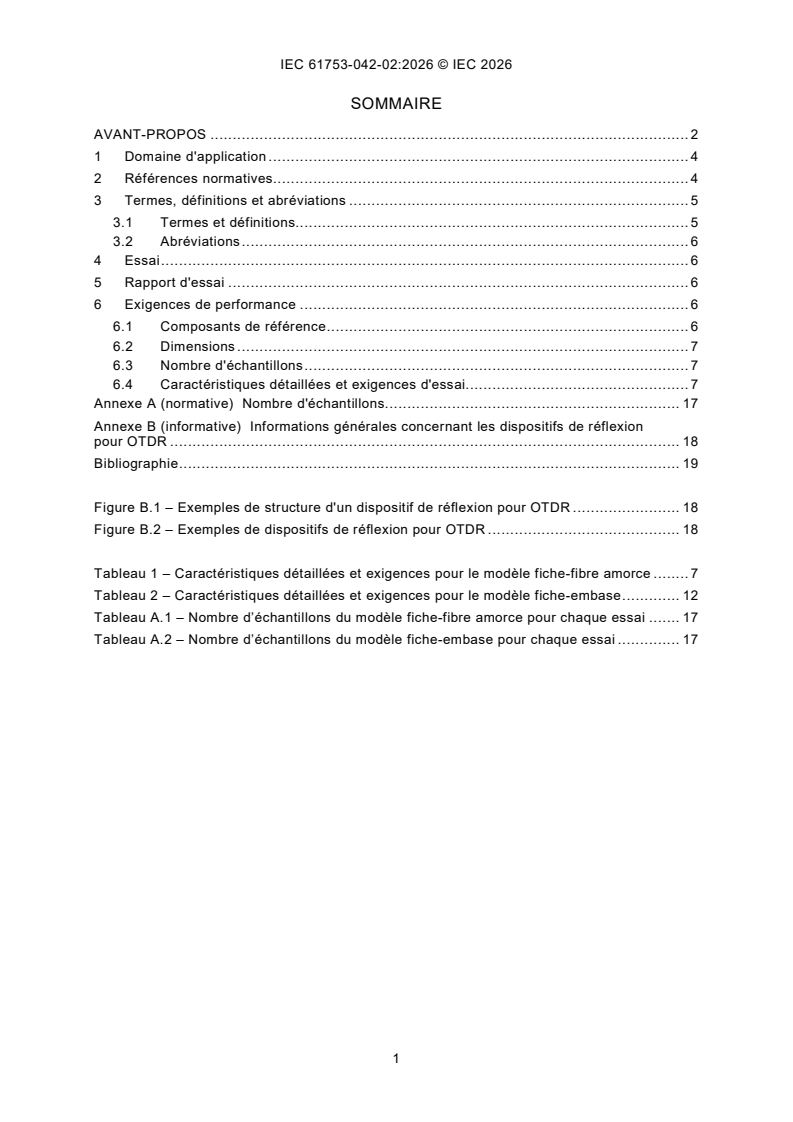
SOMMAIRE
AVANT-PROPOS . 2
1 Domaine d'application . 4
2 Références normatives . 4
3 Termes, définitions et abréviations . 5
3.1 Termes et définitions. 5
3.2 Abréviations . 6
4 Essai . 6
5 Rapport d'essai . 6
6 Exigences de performance . 6
6.1 Composants de référence . 6
6.2 Dimensions . 7
6.3 Nombre d'échantillons . 7
6.4 Caractéristiques détaillées et exigences d'essai. 7
Annexe A (normative) Nombre d'échantillons. 17
Annexe B (informative) Informations générales concernant les dispositifs de réflexion
pour OTDR . 18
Bibliographie . 19
Figure B.1 – Exemples de structure d'un dispositif de réflexion pour OTDR . 18
Figure B.2 – Exemples de dispositifs de réflexion pour OTDR . 18
Tableau 1 – Caractéristiques détaillées et exigences pour le modèle fiche-fibre amorce . 7
Tableau 2 – Caractéristiques détaillées et exigences pour le modèle fiche-embase . 12
Tableau A.1 – Nombre d’échantillons du modèle fiche-fibre amorce pour chaque essai . 17
Tableau A.2 – Nombre d’échantillons du modèle fiche-embase pour chaque essai . 17
COMMISSION ÉLECTROTECHNIQUE INTERNATIONALE
____________
Dispositifs d'interconnexion et composants
passifs fibroniques - Norme de performance -
Partie 042-02: Dispositifs de réflexion pour OTDR de modèle
à fiche-fibre amorce et modèle à fiche-embase pour catégorie C -
Environnements contrôlés
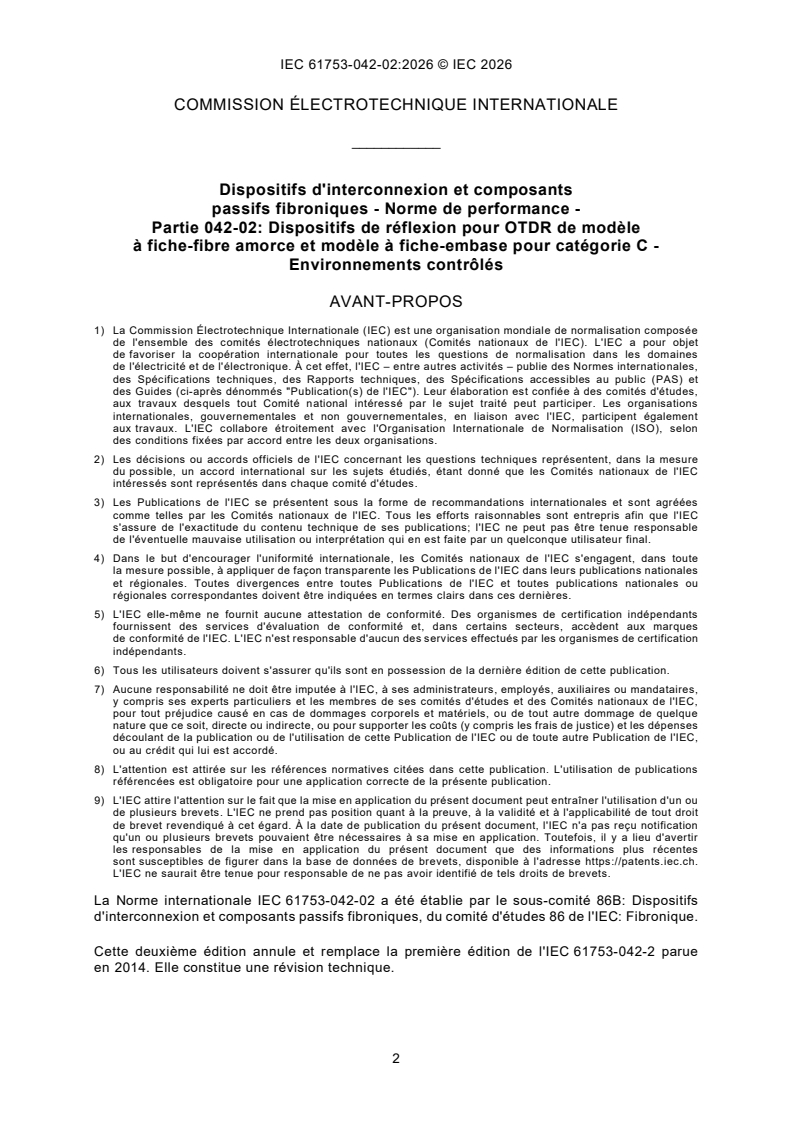
AVANT-PROPOS
1) La Commission Électrotechnique Internationale (IEC) est une organisation mondiale de normalisation composée
de l'ensemble des comités électrotechniques nationaux (Comités nationaux de l'IEC). L'IEC a pour objet
de favoriser la coopération internationale pour toutes les questions de normalisation dans les domaines
de l'électricité et de l'électronique. À cet effet, l'IEC – entre autres activités – publie des Normes internationales,
des Spécifications techniques, des Rapports techniques, des Spécifications accessibles au public (PAS) et
des Guides (ci-après dénommés "Publication(s) de l'IEC"). Leur élaboration est confiée à des comités d'études,
aux travaux desquels tout Comité national intéressé par le sujet traité peut participer. Les organisations
internationales, gouvernementales et non gouvernementales, en liaison avec l'IEC, participent également
aux travaux. L'IEC collabore étroitement avec l'Organisation Internationale de Normalisation (ISO), selon
des conditions fixées par accord entre les deux organisations.
2) Les décisions ou accords officiels de l'IEC concernant les questions techniques représentent, dans la mesure
du possible, un accord international sur les sujets étudiés, étant donné que les Comités nationaux de l'IEC
intéressés sont représentés dans chaque comité d'études.
3) Les Publications de l'IEC se présentent sous la forme de recommandations internationales et sont agréées
comme telles par les Comités nationaux de l'IEC. Tous les efforts raisonnables sont entrepris afin que l'IEC
s'assure de l'exactitude du contenu technique de ses publications; l'IEC ne peut pas être tenue responsable
de l'éventuelle mauvaise utilisation ou interprétation qui en est faite par un quelconque utilisateur final.
4) Dans le but d'encourager l'uniformité internationale, les Comités nationaux de l'IEC s'engagent, dans toute
la mesure possible, à appliquer de façon transparente les Publications de l'IEC dans leurs publications nationales
et régionales. Toutes divergences entre toutes Publications de l'IEC et toutes publications nationales ou
régionales correspondantes doivent être indiquées en termes clairs dans ces dernières.
5) L'IEC elle-même ne fournit aucune attestation de conformité. Des organismes de certification indépendants
fournissent des services d'évaluation de conformité et, dans certains secteurs, accèdent aux marques
de conformité de l'IEC. L'IEC n'est responsable d'aucun des services effectués par les organismes de certification
indépendants.
6) Tous les utilisateurs doivent s'assurer qu'ils sont en possession de la dernière édition de cette publication.
7) Aucune responsabilité ne doit être imputée à l'IEC, à ses administrateurs, employés, auxiliaires ou mandataires,
y compris ses experts particuliers et les membres de ses comités d'études et des Comités nationaux de l'IEC,
pour tout préjudice causé en cas de dommages corporels et matériels, ou de tout autre dommage de quelque
nature que ce soit, directe ou indirecte, ou pour supporter les coûts (y compris les frais de justice) et les dépenses
découlant de la publication ou de l'utilisation de cette Publication de l'IEC ou de toute autre Publication de l'IEC,
ou au crédit qui lui est accordé.
8) L'attention est attirée sur les références normatives citées dans cette publication. L'utilisation de publications
référencées est obligatoire pour une application correcte de la présente publication.
9) L'IEC attire l'attention sur le fait que la mise en application du présent document peut entraîner l'utilisation d'un ou
de plusieurs brevets. L'IEC ne prend pas position quant à la preuve, à la validité et à l'applicabilité de tout droit
de brevet revendiqué à cet égard. À la date de publication du présent document, l'IEC n'a pas reçu notification
qu'un ou plusieurs brevets pouvaient être nécessaires à sa mise en application. Toutefois, il y a lieu d'avertir
les responsables de la mise en application du présent document que des informations plus récentes
sont susceptibles de figurer dans la base de données de brevets, disponible à l'adresse https://patents.iec.ch.
L'IEC ne saurait être tenue pour responsable de ne pas avoir identifié de tels droits de brevets.
La Norme internationale IEC 61753-042-02 a été établie par le sous-comité 86B: Dispositifs
d'interconnexion et composants passifs fibroniques, du comité d'études 86 de l'IEC: Fibronique.
Cette deuxième édition annule et remplace la première édition de l'IEC 61753-042-2 parue
en 2014. Elle constitue une révision technique.
Cette édition inclut les modifications techniques significatives suivantes par rapport
à l’IEC 61753-042-2:
a) harmonisation des exigences d'essai avec les exigences spécifiées
dans l'IEC 61753-1:2018
Le texte de cette Norme internationale est issu des documents suivants:
Projet Rapport de vote
86B/5520/FDIS 86B/5242/RVD
Le rapport de vote indiqué dans le tableau ci-dessus donne toute information sur le vote ayant
abouti à son approbation.
La langue employée pour l'élaboration de cette Norme internationale est l'anglais.
Ce document a été rédigé selon les Directives ISO/IEC, Partie 2, il a été développé
selon les Directives ISO/IEC, Partie 1 et les Directives ISO/IEC, Supplément IEC, disponibles
sous www.iec.ch/members_experts/refdocs. Les principaux types de documents développés
par l'IEC sont décrits plus en détail sous www.iec.ch/publications.
Une liste de toutes les parties de la série IEC 61753, publiées sous le titre général Dispositifs
d’interconnexion et composants passifs fibroniques - Norme de performance, se trouve
sur le site web de l'IEC.
Le comité a décidé que le contenu de ce document ne sera pas modifié avant la date de stabilité
indiquée sur le site web de l'IEC sous webstore.iec.ch dans les données relatives au document
recherché. À cette date, le document sera
– reconduit,
– supprimé, ou
– révisé.
1 Domaine d'application
La présente partie de l’IEC 61753 contient les exigences et les sévérités initiales minimales
de performance, d'essai et de mesure auxquelles les dispositifs de réflexion pour OTDR
de modèle à fiche-fibre amorce et modèle à fiche-embase doivent satisfaire pour être classés
conformes aux exigences de la catégorie C-environnements contrôlés, comme cela est défini
dans l'Annexe A de l'IEC 61753-1 [1] . Ces dispositifs sont utilisés pour les essais hors bande
par OTDR d'un système fibronique.
L'Annexe B fournit des informations concernant ces dispositifs.
2 Références normatives
Les documents suivants sont cités dans le texte de sorte qu'ils constituent, pour tout ou partie
de leur contenu, des exigences du présent document. Pour les références datées,
seule l'édition citée s'applique. Pour les références non datées, la dernière édition du document
de référence s'applique (y compris les éventuels amendements).
IEC 60793-2-50, Fibres optiques - Partie 2-50: Spécifications de produits - Spécification
intermédiaire pour les fibres unimodales de classe B
IEC 61300 (toutes parties), Dispositifs d'interconnexion et composants passifs fibroniques -
Procédures fondamentales d'essais et de mesures
IEC 61300-1, Dispositifs d'interconnexion et composants passifs fibroniques - Procédures
fondamentales d'essais et de mesures - Partie 1: Généralités et recommandations
IEC 61300-2-1, Dispositifs d'interconnexion et composants passifs fibroniques - Méthodes
fondamentales d'essais et de mesures - Partie 2-1: Essais - Vibrations (sinusoïdales)
IEC 61300-2-2, Dispositifs d'interconnexion et composants passifs à fibres optiques - Méthodes
fondamentales d'essais et de mesures - Partie 2-2: Essais - Durabilité de l'accouplement
IEC 61300-2-4, Dispositifs d'interconnexion et composants passifs fibroniques - Méthodes
fondamentales d'essais et de mesures - Partie 2-4: Essais – Rétention de la fibre ou du câble
IEC 61300-2-5, Dispositifs d'interconnexion et composants passifs fibroniques - Méthodes
fondamentales d'essais et de mesures - Partie 2-5: Essais - Torsion
IEC 61300-2-6, Dispositifs d'interconnexion et composants passifs fibroniques - Méthodes
fondamentales d'essais et de mesures - Partie 2-6: Essais - Résistance à la traction du
mécanisme de couplage
IEC 61300-2-9, Dispositifs d'interconnexion et composants passifs à fibres optiques - Méthodes
fondamentales d'essais et de mesures - Partie 2-9: Essais - Chocs
IEC 61300-2-14, Dispositifs d'interconnexion et composants passifs fibroniques - Méthodes
fondamentales d'essais et de mesures - Partie 2-14: Essais – Puissance optique élevée
IEC 61300-2-17, Dispositifs d'interconnexion et composants passifs à fibres optiques -
Méthodes fondamentales d'essais et de mesures - Partie 2-17: Essais - Froid
___________
Les chiffres entre crochets renvoient à la Bibliographie.
IEC 61300-2-18, Dispositifs d'interconnexion et composants passifs fibroniques - Méthodes
fondamentales d'essais et de mesures - Partie 2-18: Essais - Chaleur sèche
IEC 61300-2-19, Dispositifs d'interconnexion et composants passifs à fibres optiques -
Méthodes fondamentales d'essais et de mesures - Partie 2-19: Essais - Chaleur humide (essai
continu)
IEC 61300-2-22, Dispositifs d'interconnexion et composants passifs fibroniques - Méthodes
fondamentales d'essais et de mesures - Partie 2-22: Essais - Variations de température
IEC 61300-2-42, Dispositifs d'interconnexion et composants passifs à fibres optiques -
Méthodes fondamentales d'essais et de mesures - Partie 2-42: Essais - Charge latérale statique
pour serre-câble
IEC 61300-2-44, Dispositifs d'interconnexion et composants passifs fibroniques - Méthodes
fondamentales d'essais et de mesures - Partie 2-44: Essais - Flexion du serre-câble des
dispositifs et composants fibroniques
IEC 61300-3-2, Dispositifs d'interconnexion et composants passifs à fibres optiques - Méthodes
fondamentales d'essais et de mesures - Partie 3-2: Examens et mesures - Perte en fonction de
la polarisation dans un dispositif pour fibres optiques unimodales
IEC 61300-3-6, Dispositifs d'interconnexion et composants passifs à fibres optiques - Méthodes
fondamentales d'essais et de mesures - Part 3-6: Examens et mesures - Affaiblissement de
réflexion
IEC 61300-3-7, Dispositifs d'interconnexion et composants passifs à fibres optiques - Méthodes
fondamentales d'essais et de mesures - Part 3-7: Examens et mesures - Affaiblissement et
affaiblissement de réflexion des composants unimodaux en fonction de la longueur d'onde
IEC 62074-1, Dispositifs d’interconnexion et composants passifs fibroniques - Dispositifs MRL
fibroniques - Partie 1: Spécification générique
IEC TS 62627-09, Fibre optic interconnecting devices and passive components - Vocabulary
for passive optical devices
3 Termes, définitions et abréviations
Pour les besoins du présent document, les termes et définitions de l’IEC 62074-1 et
de l’IEC TS 62627-09, ainsi que les suivants s'appliquent.
L'ISO et l'IEC tiennent à jour des bases de données terminologiques destinées à être utilisées
en normalisation, consultables aux adresses suivantes:
– IEC Electropedia: disponible à l'adresse https://www.electropedia.org/
– ISO Online browsing platform: disponible à l’adresse https://www.iso.org/obp
3.1 Termes et définitions
3.1.1
dispositif de réflexion pour OTDR
filtre optique comportant deux ports, dans lequel le rayonnement lumineux dans les plages
de longueurs d'onde du signal est transmis du premier port vers le second port, et
le rayonnement lumineux de l'OTDR dans la plage de longueurs d'onde de l'OTDR, injecté
dans un seul port est (partiellement) rétroréfléchi vers ce port d'injection
Note 1 à l'article: Il est utilisé pour les essais hors-bande des systèmes à fibres optiques.
3.1.2
plage de longueurs d'onde de la bande passante
plages de longueurs d'onde de 1 260 nm à 1 360 nm, 1 480 nm à 1 500 nm et 1 550 nm
à 1 560 nm
3.1.3
plage de longueurs d'onde de la bande de réflexion
plages de longueurs d'onde de 1 620 nm à 1 630 nm ou de 1 645 nm à 1 655 nm
3.2 Abréviations
FBG (Fibre Bragg grating) réseau de Bragg sur fibre
ONU (optical network unit) dispositif du réseau optique
OTDR (optical time-domain reflectometer) réflectomètre optique dans le domaine
temporel
PDL (polarisation dependent loss) perte en fonction de la polarisation
TFF (thin-film filter) filtre en couche mince
4 Essai
Sauf spécification contraire, toutes les méthodes d’essais doivent être conformes à une norme
spécifique de la série IEC 61300. Le nombre d'échantillons pour chaque essai doit être tel que
spécifié à l'Annexe A. Il est prévu d’utiliser, pour chacun des essais, des échantillons neufs,
n’ayant pas été auparavant soumis à des contraintes, mais si on le souhaite, il est aussi
possible de sélectionner les échantillons à soumettre aux essais parmi des échantillons
précédemment utilisés. Les échantillons doivent utiliser des fibres unimodales conformes
aux exigences spécifiées dans l'IEC 60793-2-50 pour les catégories B-652.B, B-652.D ou
B-657, soit sous forme de fibres sous revêtement (primaire et secondaire), soit sous forme
de câbles renforcés. Tous les mesurages doivent être effectués dans des conditions
atmosphériques normales spécifiées dans l'IEC 61300-1.
Tous les essais doivent être effectués sur la plage de longueurs d'onde de fonctionnement:
les plages de longueurs d'onde du signal de 1 260 nm à 1 360 nm, de 1 480 nm à 1 500 nm et
de 1 550 nm à 1 560 nm, et sur la plage de longueur d'onde de l'OTDR de 1 620 nm à 1 630 nm
ou de 1 645 nm à 1 655 nm.
NOTE 1 310 nm, 1 490 nm et 1 550 nm sont les longueurs d'onde nominales ou centrales, établies pour les plages
1 260 nm à 1 360 nm, 1 480 nm à 1 500 nm et 1 550 nm à 1 560 nm comme cela est défini
dans les Recommandations UIT-T G.983.3 [2], G.984.2 [3] et dans la norme IEEE 802.3-2022 [4].
5 Rapport d'essai
Des rapports d’essai bien documentés et étayés par des preuves doivent être préparés et mis
à disposition en vue de contrôles, afin de démontrer que les essais ont été effectués et
qu’ils sont satisfaisants.
6 Exigences de performance
6.1 Composants de référence
Les essais de performance du présent document n’exigent pas de recourir à des composants
de référence.
6.2 Dimensions
Les dimensions doivent être conformes à une norme d’interface IEC appropriée comme cela
est spécifié dans la série IEC 61754 ou aux dimensions données dans les dessins appropriés
du fabricant, s’il n’existe pas de norme d’interface IEC ou si elle ne peut pas être utilisée.
6.3 Nombre d'échantillons
Les nombres d'échantillons pour l'essai doivent être tels que spécifiés dans l'Annexe A,
Tableau A.1 pour le modèle fiche-fibre amorce et telles que spécifiées dans l'Annexe A,
Tableau A.2 pour le modèle fiche-embase.
6.4 Caractéristiques détaillées et exigences d'essai
Les caractéristiques détaillées et exigences d'essai sont présentées dans le Tableau 1
pour le modèle fiche-fibre amorce et dans le Tableau 2 pour le modèle fiche-embase.
Toutes les références énumérées dans la colonne "essais" du Tableau 1 et du Tableau 2
doivent être utilisées pour réaliser les essais.
Tableau 1 – Caractéristiques détaillées et exigences pour le modèle fiche-fibre amorce
N° Essais Exigences Caractéristiques détaillées
1 Affaiblissement ≤ 1,0 dB (Classe A) Longueur de la fibre
(perte d'insertion) d’injection: ≥ 2,0 m
≤ 1,5 dB (Classe B)
IEC 61300-3-7 Type de source: Non polarisée
La perte d’insertion doit
inclure la perte des
Incertitude de mesure: ≤ 0,1 dB
connecteurs.
La perte d’insertion doit être
assurée sur la plage de
longueurs d'onde de la bande
passante.
2 Isolation en ≥ 20 dB (Classe A) Longueur de la fibre
longueur d’onde d’injection: ≥ 2,0 m
≥ 40 dB (Classe B)
IEC 61300-3-7
Type de source: Non polarisée
Isolation en longueur d’onde
entre la plage de longueurs
Incertitude de mesure: ≤ 0,1 dB
d'onde de la bande passante
et la plage de longueurs
d'onde de la bande de
réflexion
N° Essais Exigences Caractéristiques détaillées
3 Affaiblissement de Classe S1: ≥ 22 dB pour
Longueur de la fibre
réflexion la(ou les) plage(s) de d’injection: ≥ 2,0 m
longueurs d'ondes du signal
IEC 61300-3-6
Type de source: Non polarisée
pour les ports d'entrée et de
sortie et ≤ 12 dB pour la
Incertitude de mesure: ≤ 0,05 dB pour RL < 1,0
plage de longueurs d'onde de
dB
l'OTDR pour le port d'entrée
uniquement.
≤ 0,2 dB pour RL < 1,5 dB
Classe S2: ≥ 22 dB pour
≤ 0,5 dB pour RL < 5 dB
la(ou les) plage(s) de
≤ 1 dB pour RL ≥ 5 dB
longueurs d'ondes du signal
pour les ports d'entrée et de
sortie et ≤ 1,5 dB pour la
plage de longueurs d'onde de
l'OTDR pour le port d'entrée
uniquement.
Classe T1: ≥ 35 dB pour
la(ou les) plage(s) de
longueurs d'ondes du signal
pour les ports d'entrée et de
sortie et ≤ 5 dB pou
...
IEC 61753-042-02 ®
Edition 1.0 2026-06
INTERNATIONAL
STANDARD
Fibre optic interconnecting devices and passive components - Performance
standard -
Part 042-02: Plug-pigtail-style and plug-receptacle-style OTDR reflecting devices
for category C - Controlled environments
ICS 33.180.20 ISBN 978-2-8327-1310-5
All rights reserved. Unless otherwise specified, no part of this publication may be reproduced or utilized in any form or
by any means, electronic or mechanical, including photocopying and microfilm, without permission in writing from either
IEC or IEC's member National Committee in the country of the requester. If you have any questions about IEC copyright
or have an enquiry about obtaining additional rights to this publication, please contact the address below or your local
IEC member National Committee for further information.
IEC Secretariat Tel.: +41 22 919 02 11
3, rue de Varembé info@iec.ch
CH-1211 Geneva 20 www.iec.ch
Switzerland
About the IEC
The International Electrotechnical Commission (IEC) is the leading global organization that prepares and publishes
International Standards for all electrical, electronic and related technologies.
About IEC publications
The technical content of IEC publications is kept under constant review by the IEC. Please make sure that you have the
latest edition, a corrigendum or an amendment might have been published.
IEC publications search - IEC Products & Services Portal - products.iec.ch
webstore.iec.ch/advsearchform Discover our powerful search engine and read freely all the
The advanced search enables to find IEC publications by a
publications previews, graphical symbols and the glossary.
variety of criteria (reference number, text, technical With a subscription you will always have access to up to date
committee, …). It also gives information on projects, content tailored to your needs.
replaced and withdrawn publications.
Electropedia - www.electropedia.org
IEC Just Published - webstore.iec.ch/justpublished The world's leading online dictionary on electrotechnology,
Stay up to date on all new IEC publications. Just Published containing more than 22 500 terminological entries in English
details all new publications released. Available online and and French, with equivalent terms in 25 additional languages.
once a month by email. Also known as the International Electrotechnical Vocabulary
(IEV) online.
IEC Customer Service Centre - webstore.iec.ch/csc
If you wish to give us your feedback on this publication or
need further assistance, please contact the Customer
Service Centre: sales@iec.ch.
CONTENTS
FOREWORD . 2
1 Scope . 4
2 Normative references . 4
3 Terms, definitions and abbreviated terms . 5
3.1 Terms and definitions . 5
3.2 Abbreviated terms. 6
4 Test . 6
5 Test report . 6
6 Performance requirements . 6
6.1 Reference components. 6
6.2 Dimensions . 6
6.3 Sample size . 6
6.4 Test details and requirements . 7
Annex A (normative) Sample size . 14
Annex B (informative) General information of OTDR reflecting devices . 15
Bibliography . 16
Figure B.1 – Examples of structure of an OTDR reflecting device . 15
Figure B.2 – Examples of an OTDR reflecting device . 15
Table 1 – Test details and requirements for plug-pigtail style . 7
Table 2 – Test details and requirements for plug-receptacle style . 11
Table A.1 – Number of plug-pigtail style samples for each test . 14
Table A.2 – Number of plug-receptacle style samples for each test . 14
INTERNATIONAL ELECTROTECHNICAL COMMISSION
____________
Fibre optic interconnecting devices and
passive components - Performance standard -
Part 042-02: Plug-pigtail-style and plug-receptacle-style OTDR reflecting
devices for category C - Controlled environments
FOREWORD
1) The International Electrotechnical Commission (IEC) is a worldwide organization for standardization comprising
all national electrotechnical committees (IEC National Committees). The object of IEC is to promote international
co-operation on all questions concerning standardization in the electrical and electronic fields. To this end and
in addition to other activities, IEC publishes International Standards, Technical Specifications, Technical Reports,
Publicly Available Specifications (PAS) and Guides (hereafter referred to as “IEC Publication(s)”). Their
preparation is entrusted to technical committees; any IEC National Committee interested in the subject dealt with
may participate in this preparatory work. International, governmental and non-governmental organizations liaising
with the IEC also participate in this preparation. IEC collaborates closely with the International Organization for
Standardization (ISO) in accordance with conditions determined by agreement between the two organizations.
2) The formal decisions or agreements of IEC on technical matters express, as nearly as possible, an international
consensus of opinion on the relevant subjects since each technical committee has representation from all
interested IEC National Committees.
3) IEC Publications have the form of recommendations for international use and are accepted by IEC National
Committees in that sense. While all reasonable efforts are made to ensure that the technical content of IEC
Publications is accurate, IEC cannot be held responsible for the way in which they are used or for any
misinterpretation by any end user.
4) In order to promote international uniformity, IEC National Committees undertake to apply IEC Publications
transparently to the maximum extent possible in their national and regional publications. Any divergence between
any IEC Publication and the corresponding national or regional publication shall be clearly indicated in the latter.
5) IEC itself does not provide any attestation of conformity. Independent certification bodies provide conformity
assessment services and, in some areas, access to IEC marks of conformity. IEC is not responsible for any
services carried out by independent certification bodies.
6) All users should ensure that they have the latest edition of this publication.
7) No liability shall attach to IEC or its directors, employees, servants or agents including individual experts and
members of its technical committees and IEC National Committees for any personal injury, property damage or
other damage of any nature whatsoever, whether direct or indirect, or for costs (including legal fees) and
expenses arising out of the publication, use of, or reliance upon, this IEC Publication or any other IEC
Publications.
8) Attention is drawn to the Normative references cited in this publication. Use of the referenced publications is
indispensable for the correct application of this publication.
9) IEC draws attention to the possibility that the implementation of this document may involve the use of (a)
patent(s). IEC takes no position concerning the evidence, validity or applicability of any claimed patent rights in
respect thereof. As of the date of publication of this document, IEC had not received notice of (a) patent(s), which
may be required to implement this document. However, implementers are cautioned that this may not represent
the latest information, which may be obtained from the patent database available at https://patents.iec.ch. IEC
shall not be held responsible for identifying any or all such patent rights.
International Standard IEC 61753-042-02 has been prepared by subcommittee 86B: Fibre optic
interconnecting devices and passive components of IEC technical committee 86: Fibre optics.
This first edition cancels and replaces the first edition of IEC 61753-042-2, published in 2014,
and constitutes a technical revision.
This edition includes the following significant technical changes with respect to
IEC 61753-042-2:
a) harmonization of test requirements with the requirements specified in IEC 61753-1:2018
The text of this International Standard is based on the following documents:
Draft Report on voting
86B/5520/FDIS 86B/5242/RVD
Full information on the voting for its approval can be found in the report on voting indicated in
the above table.
The language used for the development of this International Standard is English.
This document was drafted in accordance with ISO/IEC Directives, Part 2, and developed in
accordance with ISO/IEC Directives, Part 1 and ISO/IEC Directives, IEC Supplement, available
at www.iec.ch/members_experts/refdocs. The main document types developed by IEC are
described in greater detail at www.iec.ch/publications.
A list of all parts of IEC 61753 series, under the general title Fibre optic interconnecting devices
and passive components - Performance standard, can be found on the IEC website.
The committee has decided that the contents of this document will remain unchanged until the
stability date indicated on the IEC website under webstore.iec.ch in the data related to the
specific document. At this date, the document will be
– reconfirmed,
– withdrawn, or
– revised.
1 Scope
This part of IEC 61753 contains the minimum initial performance, test and measurement
requirements and severities for plug-pigtail style and plug-receptacle style OTDR reflecting
devices to meet the requirements of category C-Controlled environments, as specified in
Annex A of IEC 61753-1 [1] . These devices are utilized for out-of-band OTDR testing of an
optical fibre system.
Annex B provides information concerning these devices.
2 Normative references
The following documents are referred to in the text in such a way that some or all of their content
constitutes requirements of this document. For dated references, only the edition cited applies.
For undated references, the latest edition of the referenced document (including any
amendments) applies.
IEC 60793-2-50, Optical fibres - Part 2-50: Product specifications - Sectional specification for
class B single-mode fibres
IEC 61300 (all parts), Fibre optic interconnecting devices and passive components - Basic test
and measurement procedures
IEC 61300-1, Fibre optic interconnecting devices and passive components - Basic test and
measurement procedures - Part 1: General and guidance
IEC 61300-2-1, Fibre optic interconnecting devices and passive components - Basic test and
measurement procedures - Part 2-1: Tests - Vibration (sinusoidal)
IEC 61300-2-2, Fibre optic interconnecting devices and passive components - Basic test and
measurement procedures - Part 2-2: Tests - Mating durability
IEC 61300-2-4, Fibre optic interconnecting devices and passive components - Basic test and
measurement procedures - Part 2-4: Tests–Fibre or cable retention
IEC 61300-2-5, Fibre optic interconnecting devices and passive components - Basic test and
measurement procedures - Part 2-5: Tests - Torsion
IEC 61300-2-6, Fibre optic interconnecting devices and passive components - Basic test and
measurement procedures - Part 2-6: Tests - Tensile strength of coupling mechanism
IEC 61300-2-9, Fibre optic interconnecting devices and passive components - Basic test and
measurement procedures - Part 2-9: Tests - Shock
IEC 61300-2-14, Fibre optic interconnecting devices and passive components - Basic test and
measurement procedures - Part 2-14: Tests - High optical power
IEC 61300-2-17, Fibre optic interconnecting devices and passive components - Basic test and
measurement procedures - Part 2-17: Tests - Cold
IEC 61300-2-18, Fibre optic interconnecting devices and passive components - Basic test and
measurement procedures - Part 2-18: Tests - Dry heat
___________
Numbers in square brackets refer to the Bibliography.
IEC 61300-2-19, Fibre optic interconnecting devices and passive components - Basic test and
measurement procedures - Part 2-19: Tests - Damp heat (steady state)
IEC 61300-2-22, Fibre optic interconnecting devices and passive components - Basic test and
measurement procedures - Part 2-22: Tests - Change of temperature
IEC 61300-2-42, Fibre optic interconnecting devices and passive components - Basic test and
measurement procedures - Part 2-42: Tests - Static side load for strain relief
IEC 61300-2-44, Fibre optic interconnecting devices and passive components - Basic test and
measurement procedures - Part 2-44: Tests - Flexing of the strain relief of fibre optic devices
IEC 61300-3-2, Fibre optic interconnecting devices and passive components - Basic test and
measurement procedures - Part 3-2: Examination and measurements - Polarization dependent
loss in a single-mode fibre optic device
IEC 61300-3-6, Fibre optic interconnecting devices and passive components - Basic test and
measurement procedures - Part 3-6: Examination and measurements - Return loss
IEC 61300-3-7, Fibre optic interconnecting devices and passive components - Basic test and
measurement procedures - Part 3-7: Examination and measurements - Wavelength
dependence of attenuation and return loss of single mode components
IEC 62074-1, Fibre optic interconnecting devices and passive components - Fibre optic WDM
devices - Part 1: Generic specification
IEC TS 62627-09, Fibre optic interconnecting devices and passive components - Vocabulary
for passive optical devices
3 Terms, definitions and abbreviated terms
For the purposes of this document, the terms and definitions given in IEC 62074-1 and
IEC TS 62627-09 and the following apply.
ISO and IEC maintain terminology databases for use in standardization at the following
addresses:
– IEC Electropedia: available at https://www.electropedia.org/
– ISO Online browsing platform: available at https://www.iso.org/obp
3.1 Terms and definitions
3.1.1
OTDR reflecting device
optical filter that has two ports in which light in the signal wavelength ranges transmits from the
first port to the second port and OTDR light in the OTDR wavelength range launched into one
port is (partly) reflected back to that launch port
Note 1 to entry: It is used for out of band testing of optical fibre systems.
3.1.2
passband wavelength range
the wavelength ranges of 1 260 nm to 1 360 nm, 1 480 nm to 1 500 nm and 1 550 nm to
1 560 nm
3.1.3
reflection-band wavelength range
the wavelength ranges of 1 620 nm to 1 630 nm or 1 645 nm to 1 655 nm
3.2 Abbreviated terms
FBG fibre Bragg grating
ONU optical network unit
OTDR optical time-domain reflectometer
PDL polarisation dependent loss
TFF thin-film filter
4 Test
Unless otherwise specified, all test methods shall be in accordance with a specific IEC 61300
series standard. The number of samples for each test shall be as specified in Annex A. The
samples used for each test are intended to be previously unstressed new samples but may also
be selected from previously used samples if desired. The samples shall use single-mode fibres
in accordance with the requirements specified in IEC 60793-2-50 for category B-652.B, B-652.D
or B-657, either in coated fibres (primary and secondary) or reinforced cable format. All
measurements shall be carried out at standard atmospheric conditions as specified in
IEC 61300-1.
All tests shall be carried out over the operating wavelength range: the signal wavelength ranges
of 1 260 nm to 1 360 nm, 1 480 nm to 1 500 nm and 1 550 nm to 1 560 nm, and the OTDR
wavelength of 1 620 nm to 1 630 nm or 1 645 nm to 1 655 nm.
NOTE 1 310 nm, 1 490 nm and 1 550 nm are the nominal or centre wavelengths, stated for the ranges 1 260 nm to
1 360 nm, 1 480 nm to 1 500 nm and 1 550 nm to 1 560 nm as defined in ITU-T Recommendations G.983.3 [2],
G.984.2 [3] and IEEE standard 802.3-2022 [4].
5 Test report
Fully documented test reports and supporting evidence shall be prepared and be available for
inspection as evidence that the tests have been carried out and complied with.
6 Performance requirements
6.1 Reference components
The performance testing in this document does not require the use of reference components.
6.2 Dimensions
Dimensions shall comply with either an appropriate IEC interface standard as specified in the
IEC 61754 series or with those given in appropriate manufacturers drawings, where the IEC
interface standard does not exist or cannot be used.
6.3 Sample size
Sample sizes for the test shall be as specified in Annex A, Table A.1 for plug-pigtail style and
as specified in Annex A, Table A.2 for plug-receptacle style.
6.4 Test details and requirements
Test details and requirements are shown in Table 1 for plug-pigtail style and Table 2 for plug-
receptacle style. All references listed in the "tests" column in Table 1 and Table 2 shall be used
to perform the tests.
Table 1 – Test details and requirements for plug-pigtail style
No. Tests Requirements Details
1 Attenuation ≤ 1,0 dB (Class A) Launch fibre length: ≥ 2,0 m
(Insertion loss)
≤ 1,5 dB (Class B)
Source type: Unpolarized
IEC 61300-3-7
Insertion loss shall include
Measurement uncertainty: ≤ 0,1 dB
connector loss.
Insertion loss shall be met
over the passband
wavelength range.
2 Wavelength ≥ 20 dB (Class A) Launch fibre length: ≥ 2,0 m
isolation
≥ 40 dB (Class
...