

IEC 60779:2020
(Main)Installations for electroheating and electromagnetic processing - Test methods for electroslag remelting furnaces
General Information
- Abstract
IEC 60779:2020 specifies the test procedures, conditions and methods for determining the main performance parameters and operational characteristics of electroslag remelting furnaces.
Measurements and tests that are solely used for the verification of safety requirements of the installations are outside the scope of this document and are covered by IEC 60519-1 and IEC 60519-8.
This third edition cancels and replaces the second edition published in 2005. It constitutes a technical revision.
This edition includes the following significant technical changes with respect to the previous edition:
- the structure has been redrafted according to IEC 60398:2015;
- the scope and object have been redrafted;
- the terms/definitions, normative references and bibliography have been updated and completed;
- all test methods and content from IEC 60779:2005 that have been included in IEC 60398:2015 have been removed to avoid any duplication.
- Status
- Published
- Publication Date
- 15-Jun-2020
- Technical Committee
- TC 27 - Industrial electroheating and electromagnetic processing
- Drafting Committee
- MT 28 - TC 27/MT 28
- Current Stage
- PPUB - Publication issued
- Start Date
- 16-Jun-2020
- Completion Date
- 03-Jul-2020
Overview
IEC 60779:2020 is an international standard published by the International Electrotechnical Commission (IEC) that specifies test methods for electroslag remelting (ESR) furnaces. This third edition updates the previous 2005 version with the latest technical revisions, aligning the structure and scope with IEC 60398:2015. The standard focuses on procedures for assessing the main performance parameters and operational characteristics of industrial ESR furnaces used in electroheating and electromagnetic processing.
Importantly, IEC 60779:2020 excludes tests primarily related to the verification of safety requirements, which are covered by IEC 60519-1 and IEC 60519-8. The standard applies mainly to industrial ESR furnaces with a rated capacity of 50 kg or greater, utilizing various electrical power supplies such as alternating current (AC), direct current (DC), or low-frequency current.
Key Topics
- Test Procedures: Defines standardized methods and conditions for evaluating ESR furnace performance.
- Performance Parameters: Includes measurements of melting rate, electrical parameters of the secondary circuit, electrode ram motion, and power factors.
- Operational Characteristics: Covers the dynamics of electrode exchange, vacuum and pressure measurements for vacuum and pressurized furnaces, and gas composition analysis for inert atmospheres.
- Energy Efficiency: Incorporates energy efficiency assessment criteria, including annexes on numerical modeling, energy recoverability, and visual display of efficiency data.
- Scope & Limitations: Focuses strictly on performance and operational testing, excluding safety verification tests.
- Integration with IEC 60398:2015: Supplements and modifies general test provisions outlined in IEC 60398:2015, ensuring harmonized testing standards.
- Technical Updates: Removes duplications by excluding test methods covered by IEC 60398:2015 and revises terminology, references, and scope for clarity and current industry practices.
Applications
IEC 60779:2020 is essential for manufacturers, testing laboratories, and industrial users involved in the design, operation, and maintenance of electroslag remelting furnaces. Practical applications include:
- Quality Control: Assuring furnace performance meets operational benchmarks.
- Equipment Comparison: Standardized testing aids in comparative evaluation of different ESR installations.
- Process Optimization: Data from tests support improving melting efficiency and reducing energy consumption.
- Compliance and Reporting: Provides a basis for documenting furnace characteristics according to internationally recognized standards.
- Energy Management: Helps industries implement effective energy usage and conservation strategies within electroheating processes.
- Research and Development: Offers a reliable framework for testing new furnace designs or modifications for enhanced operational performance.
Related Standards
- IEC 60398:2015 - General performance test methods for electroheating and electromagnetic processing installations; closely connected and referenced in IEC 60779:2020.
- IEC 60519-1 & IEC 60519-8 - Standards covering safety requirements and verification tests related to electroheating installations, complementary to IEC 60779’s focus on performance testing.
- IEC 60519 Series - Covers safety in electroheating and electromagnetic processing, essential for full compliance with safety and operational standards.
By adhering to IEC 60779:2020, stakeholders ensure consistent assessment of electroslag remelting furnace performance, enhanced process reliability, and alignment with global electroheating standardization efforts. This leads to improved operational efficiency, safety when combined with safety standards, and facilitates international trade and regulatory acceptance.
Keywords: IEC 60779, electroslag remelting furnaces, ESR furnace testing, electroheating installations, electromagnetic processing, test methods, furnace performance parameters, energy efficiency, industrial remelting, IEC 60398, electroheating standards.
Relations
- Effective Date
- 05-Sep-2023
- Revises
IEC 60779:2005 - Industrial electroheat equipment - Test methods for electroslag remelting furnaces - Effective Date
- 05-Sep-2023
Get Certified
Connect with accredited certification bodies for this standard

DVS-ZERT GmbH
German welding certification society.
CARES (UK Certification Authority for Reinforcing Steels)
UK certification for reinforcing steels and construction.
EWF/IIW (European/International Welding Federation)
International welding personnel certification.
Sponsored listings
Frequently Asked Questions
IEC 60779:2020 is a standard published by the International Electrotechnical Commission (IEC). Its full title is "Installations for electroheating and electromagnetic processing - Test methods for electroslag remelting furnaces". This standard covers: IEC 60779:2020 specifies the test procedures, conditions and methods for determining the main performance parameters and operational characteristics of electroslag remelting furnaces. Measurements and tests that are solely used for the verification of safety requirements of the installations are outside the scope of this document and are covered by IEC 60519-1 and IEC 60519-8. This third edition cancels and replaces the second edition published in 2005. It constitutes a technical revision. This edition includes the following significant technical changes with respect to the previous edition: - the structure has been redrafted according to IEC 60398:2015; - the scope and object have been redrafted; - the terms/definitions, normative references and bibliography have been updated and completed; - all test methods and content from IEC 60779:2005 that have been included in IEC 60398:2015 have been removed to avoid any duplication.
IEC 60779:2020 specifies the test procedures, conditions and methods for determining the main performance parameters and operational characteristics of electroslag remelting furnaces. Measurements and tests that are solely used for the verification of safety requirements of the installations are outside the scope of this document and are covered by IEC 60519-1 and IEC 60519-8. This third edition cancels and replaces the second edition published in 2005. It constitutes a technical revision. This edition includes the following significant technical changes with respect to the previous edition: - the structure has been redrafted according to IEC 60398:2015; - the scope and object have been redrafted; - the terms/definitions, normative references and bibliography have been updated and completed; - all test methods and content from IEC 60779:2005 that have been included in IEC 60398:2015 have been removed to avoid any duplication.
IEC 60779:2020 is classified under the following ICS (International Classification for Standards) categories: 25.180.10 - Electric furnaces. The ICS classification helps identify the subject area and facilitates finding related standards.
IEC 60779:2020 has the following relationships with other standards: It is inter standard links to IEC 60779:2005/COR1:2008, IEC 60779:2005. Understanding these relationships helps ensure you are using the most current and applicable version of the standard.
IEC 60779:2020 is available in PDF format for immediate download after purchase. The document can be added to your cart and obtained through the secure checkout process. Digital delivery ensures instant access to the complete standard document.
Standards Content (Sample)
IEC 60779 ®
Edition 3.0 2020-06
INTERNATIONAL
STANDARD
NORME
INTERNATIONALE
Installations for electroheating and electromagnetic processing – Test methods
for electroslag remelting furnaces
Installations pour traitement électrothermique et électromagnétique – Méthodes
d'essai des fours de refusion sous laitier électroconducteur
All rights reserved. Unless otherwise specified, no part of this publication may be reproduced or utilized in any form
or by any means, electronic or mechanical, including photocopying and microfilm, without permission in writing from
either IEC or IEC's member National Committee in the country of the requester. If you have any questions about IEC
copyright or have an enquiry about obtaining additional rights to this publication, please contact the address below or
your local IEC member National Committee for further information.
Droits de reproduction réservés. Sauf indication contraire, aucune partie de cette publication ne peut être reproduite
ni utilisée sous quelque forme que ce soit et par aucun procédé, électronique ou mécanique, y compris la photocopie
et les microfilms, sans l'accord écrit de l'IEC ou du Comité national de l'IEC du pays du demandeur. Si vous avez des
questions sur le copyright de l'IEC ou si vous désirez obtenir des droits supplémentaires sur cette publication, utilisez
les coordonnées ci-après ou contactez le Comité national de l'IEC de votre pays de résidence.
IEC Central Office Tel.: +41 22 919 02 11
3, rue de Varembé info@iec.ch
CH-1211 Geneva 20 www.iec.ch
Switzerland
About the IEC
The International Electrotechnical Commission (IEC) is the leading global organization that prepares and publishes
International Standards for all electrical, electronic and related technologies.
About IEC publications
The technical content of IEC publications is kept under constant review by the IEC. Please make sure that you have the
latest edition, a corrigendum or an amendment might have been published.
IEC publications search - webstore.iec.ch/advsearchform Electropedia - www.electropedia.org
The advanced search enables to find IEC publications by a The world's leading online dictionary on electrotechnology,
variety of criteria (reference number, text, technical containing more than 22 000 terminological entries in English
committee,…). It also gives information on projects, replaced and French, with equivalent terms in 16 additional languages.
and withdrawn publications. Also known as the International Electrotechnical Vocabulary
(IEV) online.
IEC Just Published - webstore.iec.ch/justpublished
Stay up to date on all new IEC publications. Just Published IEC Glossary - std.iec.ch/glossary
details all new publications released. Available online and 67 000 electrotechnical terminology entries in English and
once a month by email. French extracted from the Terms and Definitions clause of
IEC publications issued since 2002. Some entries have been
IEC Customer Service Centre - webstore.iec.ch/csc collected from earlier publications of IEC TC 37, 77, 86 and
If you wish to give us your feedback on this publication or CISPR.
need further assistance, please contact the Customer Service
Centre: sales@iec.ch.
A propos de l'IEC
La Commission Electrotechnique Internationale (IEC) est la première organisation mondiale qui élabore et publie des
Normes internationales pour tout ce qui a trait à l'électricité, à l'électronique et aux technologies apparentées.
A propos des publications IEC
Le contenu technique des publications IEC est constamment revu. Veuillez vous assurer que vous possédez l’édition la
plus récente, un corrigendum ou amendement peut avoir été publié.
Recherche de publications IEC - Electropedia - www.electropedia.org
webstore.iec.ch/advsearchform Le premier dictionnaire d'électrotechnologie en ligne au
La recherche avancée permet de trouver des publications IEC monde, avec plus de 22 000 articles terminologiques en
en utilisant différents critères (numéro de référence, texte, anglais et en français, ainsi que les termes équivalents dans
comité d’études,…). Elle donne aussi des informations sur les 16 langues additionnelles. Egalement appelé Vocabulaire
projets et les publications remplacées ou retirées. Electrotechnique International (IEV) en ligne.
IEC Just Published - webstore.iec.ch/justpublished Glossaire IEC - std.iec.ch/glossary
Restez informé sur les nouvelles publications IEC. Just 67 000 entrées terminologiques électrotechniques, en anglais
Published détaille les nouvelles publications parues. et en français, extraites des articles Termes et Définitions des
Disponible en ligne et une fois par mois par email. publications IEC parues depuis 2002. Plus certaines entrées
antérieures extraites des publications des CE 37, 77, 86 et
Service Clients - webstore.iec.ch/csc CISPR de l'IEC.
Si vous désirez nous donner des commentaires sur cette
publication ou si vous avez des questions contactez-nous:
sales@iec.ch.
IEC 60779 ®
Edition 3.0 2020-06
INTERNATIONAL
STANDARD
NORME
INTERNATIONALE
Installations for electroheating and electromagnetic processing – Test methods
for electroslag remelting furnaces
Installations pour traitement électrothermique et électromagnétique – Méthodes
d'essai des fours de refusion sous laitier électroconducteur
INTERNATIONAL
ELECTROTECHNICAL
COMMISSION
COMMISSION
ELECTROTECHNIQUE
INTERNATIONALE
ICS 25.180.10 ISBN 978-2-8322-8447-6
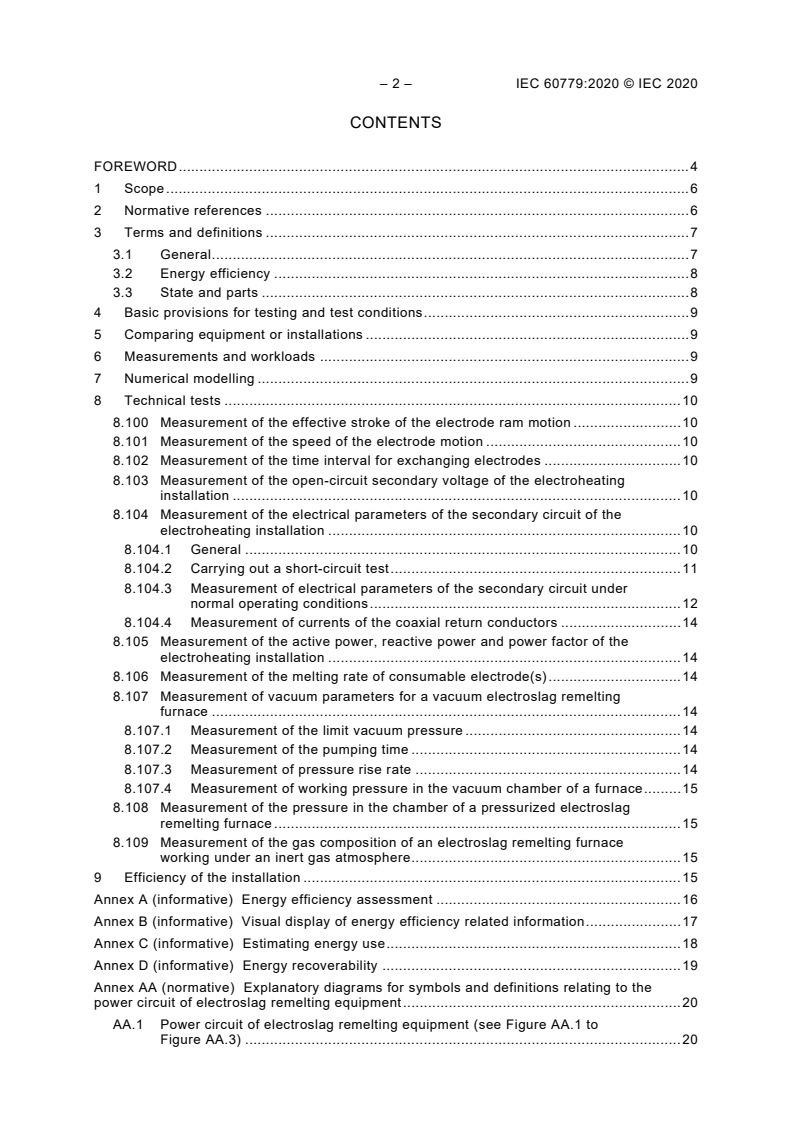
– 2 – IEC 60779:2020 © IEC 2020
CONTENTS
FOREWORD . 4
1 Scope . 6
2 Normative references . 6
3 Terms and definitions . 7
3.1 General . 7
3.2 Energy efficiency . 8
3.3 State and parts . 8
4 Basic provisions for testing and test conditions . 9
5 Comparing equipment or installations . 9
6 Measurements and workloads . 9
7 Numerical modelling . 9
8 Technical tests . 10
8.100 Measurement of the effective stroke of the electrode ram motion . 10
8.101 Measurement of the speed of the electrode motion . 10
8.102 Measurement of the time interval for exchanging electrodes . 10
8.103 Measurement of the open-circuit secondary voltage of the electroheating
installation . 10
8.104 Measurement of the electrical parameters of the secondary circuit of the
electroheating installation . 10
8.104.1 General . 10
8.104.2 Carrying out a short-circuit test . 11
8.104.3 Measurement of electrical parameters of the secondary circuit under
normal operating conditions . 12
8.104.4 Measurement of currents of the coaxial return conductors . 14
8.105 Measurement of the active power, reactive power and power factor of the
electroheating installation . 14
8.106 Measurement of the melting rate of consumable electrode(s) . 14
8.107 Measurement of vacuum parameters for a vacuum electroslag remelting
furnace . 14
8.107.1 Measurement of the limit vacuum pressure . 14
8.107.2 Measurement of the pumping time . 14
8.107.3 Measurement of pressure rise rate . 14
8.107.4 Measurement of working pressure in the vacuum chamber of a furnace . 15
8.108 Measurement of the pressure in the chamber of a pressurized electroslag
remelting furnace . 15
8.109 Measurement of the gas composition of an electroslag remelting furnace
working under an inert gas atmosphere . 15
9 Efficiency of the installation . 15
Annex A (informative) Energy efficiency assessment . 16
Annex B (informative) Visual display of energy efficiency related information . 17
Annex C (informative) Estimating energy use . 18
Annex D (informative) Energy recoverability . 19
Annex AA (normative) Explanatory diagrams for symbols and definitions relating to the
power circuit of electroslag remelting equipment . 20
AA.1 Power circuit of electroslag remelting equipment (see Figure AA.1 to
Figure AA.3) . 20
Bibliography . 23
Figure AA.1 – Example of a single-phase electroslag remelting furnace circuit . 20
Figure AA.2 – Example of a three-phase electroslag remelting furnace circuit . 21
Figure AA.3 – Example of a coaxial electroslag remelting furnace circuit . 22
– 4 – IEC 60779:2020 © IEC 2020
INTERNATIONAL ELECTROTECHNICAL COMMISSION
____________
INSTALLATIONS FOR ELECTROHEATING
AND ELECTROMAGNETIC PROCESSING –
TEST METHODS FOR ELECTROSLAG REMELTING FURNACES
FOREWORD
1) The International Electrotechnical Commission (IEC) is a worldwide organization for standardization comprising
all national electrotechnical committees (IEC National Committees). The object of IEC is to promote international
co-operation on all questions concerning standardization in the electrical and electronic fields. To this end and
in addition to other activities, IEC publishes International Standards, Technical Specifications, Technical Reports,
Publicly Available Specifications (PAS) and Guides (hereafter referred to as “IEC Publication(s)”). Their
preparation is entrusted to technical committees; any IEC National Committee interested in the subject dealt with
may participate in this preparatory work. International, governmental and non-governmental organizations liaising
with the IEC also participate in this preparation. IEC collaborates closely with the International Organization for
Standardization (ISO) in accordance with conditions determined by agreement between the two organizations.
2) The formal decisions or agreements of IEC on technical matters express, as nearly as possible, an international
consensus of opinion on the relevant subjects since each technical committee has representation from all
interested IEC National Committees.
3) IEC Publications have the form of recommendations for international use and are accepted by IEC National
Committees in that sense. While all reasonable efforts are made to ensure that the technical content of IEC
Publications is accurate, IEC cannot be held responsible for the way in which they are used or for any
misinterpretation by any end user.
4) In order to promote international uniformity, IEC National Committees undertake to apply IEC Publications
transparently to the maximum extent possible in their national and regional publications. Any divergence between
any IEC Publication and the corresponding national or regional publication shall be clearly indicated in the latter.
5) IEC itself does not provide any attestation of conformity. Independent certification bodies provide conformity
assessment services and, in some areas, access to IEC marks of conformity. IEC is not responsible for any
services carried out by independent certification bodies.
6) All users should ensure that they have the latest edition of this publication.
7) No liability shall attach to IEC or its directors, employees, servants or agents including individual experts and
members of its technical committees and IEC National Committees for any personal injury, property damage or
other damage of any nature whatsoever, whether direct or indirect, or for costs (including legal fees) and
expenses arising out of the publication, use of, or reliance upon, this IEC Publication or any other IEC Publications.
8) Attention is drawn to the Normative references cited in this publication. Use of the referenced publications is
indispensable for the correct application of this publication.
9) Attention is drawn to the possibility that some of the elements of this IEC Publication may be the subject of patent
rights. IEC shall not be held responsible for identifying any or all such patent rights.
International Standard IEC 60779 has been prepared by IEC technical committee 27: Industrial
electroheating and electromagnetic processing.
This third edition cancels and replaces the second edition published in 2005. It constitutes a
technical revision.
This edition includes the following significant technical changes with respect to the previous
edition:
– the structure has been redrafted according to IEC 60398:2015;
– the scope and object have been redrafted;
– the terms/definitions, normative references and bibliography have been updated and
completed;
– all test methods and content from IEC 60779:2005 that have been included in
IEC 60398:2015 have been removed to avoid any duplication.
The text of this International Standard is based on the following documents:
FDIS Report on voting
27/1128/FDIS 27/1130/RVD
Full information on the voting for the approval of this International Standard can be found in the
report on voting indicated in the above table.
This document has been drafted in accordance with the ISO/IEC Directives, Part 2.
This standard is to be read in conjunction with IEC 60398:2015. It supplements or modifies the
corresponding clauses of IEC 60398:2015. Where the text indicates a “modification” of,
"addition" to or a "replacement" of the relevant provision of IEC 60398:2015, these changes are
made to the relevant text of IEC 60398:2015. Where no change is necessary, the words "This
clause of IEC 60398:2015 is applicable" are used. When a particular subclause of
IEC 60398:2015 is not mentioned in this standard, that subclause applies as far as is
reasonable. When a particular subclause of IEC 60398:2015 is not applicable, the word “Void”
is used.
Additional specific provisions to those in IEC 60398:2015, given as individual clauses or
subclauses, are numbered starting from 101.
NOTE The following numbering system is used:
– subclauses, tables and figures that are numbered starting from 101 are additional to those in IEC 60398:2015;
– unless notes are in a new subclause or involve notes in IEC 60398:2015, they are numbered starting from 101,
including those in a replaced clause or subclause;
– additional annexes are lettered AA, BB, etc.
The committee has decided that the contents of this document will remain unchanged until the
stability date indicated on the IEC website under "http://webstore.iec.ch" in the data related to
the specific document. At this date, the document will be
• reconfirmed,
• withdrawn,
• replaced by a revised edition, or
• amended.
– 6 – IEC 60779:2020 © IEC 2020
INSTALLATIONS FOR ELECTROHEATING
AND ELECTROMAGNETIC PROCESSING –
TEST METHODS FOR ELECTROSLAG REMELTING FURNACES
1 Scope
Clause 1 of IEC 60398:2015 is replaced by the following.
Replacement:
This International Standard specifies the test procedures, conditions and methods for
determining the main performance parameters and operational characteristics of electroslag
remelting furnaces.
Measurements and tests that are solely used for the verification of safety requirements of the
installations are outside the scope of this document and are covered by IEC 60519-1 and
IEC 60519-8.
This document applies to industrial electroslag remelting furnaces, the rated capacity of which
is equal to, or greater than, 50 kg.
This document is applicable to industrial electroslag remelting furnaces having one or more
electrodes and having different melting power supplies, such as alternating current, direct
current, or low-frequency current.
This document includes the concept and material on energy efficiency dealing with the electrical
and processing parts of the installations, as well as the overall performance.
2 Normative references
Clause 2 of IEC 60398:2015 is applicable except as follows.
Replacement:
The following documents are referred to in the text in such a way that some or all of their content
constitutes requirements of this document. For dated references, only the edition cited applies.
For undated references, the latest edition of the referenced document (including any
amendments) applies.
Modification:
Delete the footnotes.
Additions:
IEC 60398:2015, Installations for electroheating and electromagnetic processing – General
performance test methods
IEC 60519-8, Safety in installations for electroheating and electromagnetic processing – Part 8:
Particular requirements for electroslag remelting furnaces
IEC 60676:2011, Industrial electroheating equipment – Test methods for direct arc furnaces
3 Terms and definitions
For the purposes of this document, the terms and definitions given in IEC 60398:2015 as well
as the following apply.
3.1 General
Additions:
3.1.101
electroheating installation with an electroslag remelting furnace
complete assembly of electroheating equipment and electrical and mechanical accessories
necessary for operation and utilization of an electroslag remelting furnace
3.1.102
power of an electroheating installation
apparent power S (in kVA) or active power P (in kW) measured at the input of the supply line
3.1.103
power factor of an electroheating installation
cosφ
ratio of the active power to the apparent power measured at the input of the supply line
3.1.104
on-load voltage of an electroslag remelting furnace
U
F
voltage measured between two points, which, depending on the type of a furnace, are either
the base plate, the electrode clamping device(s) bringing the melting electrical current to the
consumable electrode(s)/stub(s), or the point of common connection of the multiple return
conductors
Note 1 to entry: In case of a furnace without two electrodes corresponding to single-phase AC power supply, voltage
is measured between the base plate and the electrode clamping device(s), seeing U in Figure AA.1 and Figure AA.2.
F
Note 2 to entry: In case of a furnace with two electrodes corresponding to single-phase AC power supply, voltage
is measured between the two electrode clamping devices.
Note 3 to entry: In case of a furnace of a coaxial design for a single-phase AC power supply, the voltage is measured
between the electrode clamping device and the point of common connection of the multiple return conductors, seeing
U in Figure AA.3.
F
3.1.105
rated furnace frequency
f
n
value corresponding to the rated furnace current, if the furnace is built for a frequency range
Note 1 to entry: The rated furnace frequency is expressed in Hz.
3.1.106
rated furnace current
I
n
maximum current for continuous operation for which the furnace is designed
3.1.107
rated values of an electroslag remelting furnace
rated values, including rated furnace current I , rated furnace power P , and rated furnace
n n
frequency f , for which the furnace is designed
n
– 8 – IEC 60779:2020 © IEC 2020
3.1.108
melting rate of consumable electrode
V
m
quantity of remelted consumable electrode(s) measured in kilograms within a unit time
Note 1 to entry: The melting rate of consumable electrode is expressed as kg/min.
3.2 Energy efficiency
Addition:
3.2.101
specific energy consumption
e
ratio of the total amount of electric energy measured at the input of the supply line, which is
consumed by an electroheating installation for melting the charge in normal operating conditions
agreed upon between the manufacturer and the user, to the weight of the ingot produced
Note 1 to entry: The specific energy consumption is expressed as kWh/kg.
3.3 State and parts
Additions:
3.3.101
continuous operation of a furnace
operation during which the solid ingot is produced and solidified and the consumable electrode
is progressively added during the whole process
3.3.102
steady state of an electroslag remelting furnace
state of a furnace in which, in continuous operation, electrical and thermal parameters have
reached relatively constant values
3.3.103
mould of an electroslag remelting furnace
water-cooled non-consumable crucible which shapes the ingot to be produced by the
electroslag remelting process and which contains the molten slag
3.3.104
consumable electrode
solid part(s) in contact with the molten slag which carries the electrical current necessary for
the melting operation and is constituted of the material necessary for the formation of the ingot
3.3.105
water-cooled base plate of an electroslag remelting furnace
water-cooled plate installed at the bottom of the mould to contain liquid metal and slag at the
beginning of melting in any case, and connected to the cable(s) or busbar(s) to make sure that
the current flows through the secondary electrical circuit in the case of furnace operation with
one consumable electrode
3.3.106
furnace high-voltage switch
high-voltage switch for switching on and off, under load, the furnace transformer, in accordance
with operating requirements
3.3.107
electroslag remelting furnace transformer
transformer supplying an electroslag remelting furnace
3.3.108
secondary electrical circuit of an electroslag remelting furnace
electrical circuit which is closed by the melting power supply and may include
a) output terminals of melting power supply;
b) high-current feeder (busbars and/or cables);
c) bus switches, if required;
d) electrode clamp;
e) electrode stub;
f) consumable electrode or electrodes (depending on the connection system);
g) conductive molten slag (not included in the short-circuit test);
h) remelted ingot (not included in the case of the furnace with more than two electrodes);
i) base plate (depending on the connection system)
3.3.109
electrode clamp
metallic, water-cooled equipment for holding an electrode and supplying the current to the
electrode
3.3.110
coaxial arrangement of the electroslag remelting furnace
arrangement of more than two return conductors symmetrically positioned around the crucible
for the electroslag remelting furnace
4 Basic provisions for testing and test conditions
Clause 4 of IEC 60398:2015 is applicable.
5 Comparing equipment or installations
Clause 5 of IEC 60398:2015 is applicable.
6 Measurements and workloads
Clause 6 of IEC 60398:2015 is applicable except as follows.
6.4.3 Measurement positions
Addition:
For measurement positions of all electrical parameters of the power circuit of electroslag
remelting equipment, see Figure AA.1-Figure AA.3, being at output terminals of supply
disconnecting device for the electric consumption measurement of the power circuit, and at the
output terminals of the power distribution cabinet in shop for other electrical and mechanical
auxiliaries (see 4.3 of IEC 60398:2015).
7 Numerical modelling
Clause 7 of IEC 60398:2015 is applicable.
– 10 – IEC 60779:2020 © IEC 2020
8 Technical tests
Clause 8 of IEC 60398:2015 is applicable except as follows.
Additions:
8.100 Measurement of the effective stroke of the electrode ram motion
The effective stroke of the electrode ram motion is the distance between the upper limited
position and the lower limited position of the electrode ram where the motion stops.
The measurement shall be made with a meter ruler when the main power of the furnace is off.
8.101 Measurement of the speed of the electrode motion
The measurement shall be made with manual control of the moving system of the electrode in
two directions under the condition that the furnace is equipped with the electrode(s) of the
largest weight and length allowed by the designer.
NOTE The measurement can be made by another method, for example, using electric signal control.
The measurement of the speed of motion shall be carried out by means of a stop-watch (or
electronic time-base control), noting the distance covered by the electrode arm relative to its
fixed support.
8.102 Measurement of the time interval for exchanging electrodes
The purpose of this test is to check if the time interval for exchanging electrodes meets the
requirements agreed between the manufacturer and the user when the furnace is equipped with
two sets of electrode feed drive systems.
The time to be measured with a stop-watch is the time interval from the moment when the
secondary current becomes zero after the first electrode has melted and pulled out of the molten
slag to the moment when the next electrode is dipped into the slag pool and the secondary
current flows in the circuit.
8.103 Measurement of the open-circuit secondary voltage of the electroheating
installation
This test shall be carried out across the melting power supply terminals (see item 6
in Figure AA.1).
If the installation is provided with a regulation system, the minimum and the maximum open-
circuit secondary voltages shall be measured.
8.104 Measurement of the electrical parameters of the secondary circuit of the
electroheating installation
8.104.1 General
The purpose of this test is to check if the characteristics of the secondary circuit of the furnace
meet the requirements agreed between the manufacturer and the user.
8.104.2 Carrying out a short-circuit test
This test, which is not applicable for DC electroslag remelting furnace, shall be carried out under
the following conditions. The furnace shall be equipped with the electrode(s) of the largest
weight and length allowed by the designer. The electrical and magnetic properties of the
electrode material shall be defined beforehand. The electrode(s) shall be brought into electrical
contact with the base plate. The possible test circuit is shown in Figure AA.1. A suitable
alternative method may be used by mutual agreement between the manufacturer and the user.
The voltage supply shall be set at its minimum.
The voltage shall be increased progressively until the rated current of the furnace is achieved.
The tests are carried out at least twice. For every test, the following electrical parameters shall
be measured or calculated.
a) Active power P on the secondary side of the furnace transformer – measured with
wattmeters.
If, in some cases, it is difficult to measure P , the active power P shall be measured on the
2 1
primary side of the furnace transformer with wattmeters, and then P calculated as:
P = P − P (1)
2 1 CuT
b) I , U on the secondary side of the furnace transformer – measured with ammeters and
2 2
voltmeters, respectively.
c) Calculation of the following secondary values:
S = I U (2)
2 2 2
P
R = (3)
I
U
Z = (4)
I
2 2
X = Z − R (5)
2 2
P
cosϕ = (6)
S
where
P is the active power measured during the test on the primary side by a wattmeter;
P is the active power measured during the test on the secondary side by a wattmeter
or calculated;
P is the transformer load loss for the tap on which the test was performed (the value
CuT
is taken from the manufacturer's specification);
S is the apparent power measured during the test on the secondary side of the
transformer;
– 12 – IEC 60779:2020 © IEC 2020
I is the rated secondary transformer current when the test was performed;
U is the secondary transformer voltage when the rated secondary transformer current
is achieved;
R is the resistance of the secondary circuit;
X is the reactance of the secondary circuit;
Z is the impedance of the secondary circuit;
cosϕ is the power factor of the secondary circuit.
In the case of a furnace with a three-phase AC power supply corresponding to three consumable
electrodes, the test method should refer to 6.4 of IEC 60676:2011. The test conditions are the
same as those described in 6.4 of IEC 60676:2011.
8.104.3 Measurement of electrical parameters of the secondary circuit under normal
operating conditions
If the short-circuit test gives rise to some difficulties and brings about damage of the base plate,
it may be agreed between the manufacturer and the user that this test shall be replaced by tests
which prove that, in the normal operating conditions of the furnace, the electrical parameters of
the secondary circuit remain in the range stated by the manufacturer.
The measurement shall be carried out during continuous operation of the furnace after steady
state has been achieved while the furnace is working at its rated current (I ).
n
a) In the case of a furnace equipped with single-phase AC power supply
The tests are carried out at least twice. For every test, the following electrical parameters
shall be measured or calculated.
1) Active power P2 on the secondary side of the furnace transformer – measured with
wattmeters.
If, in some cases, it is difficult to measure P , the active power P shall be measured on
2 1
the primary side of the furnace transformer with wattmeters, and then calculated as:
P = P − P (7)
2 1 CuT
2) Current I on the secondary side of the furnace transformer – measured with ammeters,
and voltages U , U measured with voltmeters.
2 F
3) Then the following secondary values are calculated:
S = I U (8)
2 2 2
P
cosϕ = (9)
S
where
U is the on-load voltage of an electroslag remelting furnace.
F
b) In the case of a furnace equipped with a three-phase AC power supply
The possible test circuit is shown in Figure AA.2. The tests are carried out at least twice.
For every test, the following electrical parameters shall be measured or calculated.
1) Active powers P , P , P on the secondary side of the furnace transformer measured
2A 2B 2C
with wattmeters.
If, in some cases, it is difficult to measure P , P , P , the active power P , P , P
2A 2B 2C 1A 1B 1C
shall be measured on the primary side of the furnace transformer with wattmeters, and
then P , P , P calculated:
2A 2B 2C
P = P − 1/3P P = P − 1/3P P = P − 1/3P (10)
2A 1A CuT 2B 1B CuT 2C 1C CuT
2) Currents I , I , I , on the secondary side of furnace transformer measured with
2A 2B 2C
ammeters, and voltages U , U , U , U , U , U measured with voltmeters.
2A 2B 2C FA FB FC
3) Then the following secondary values are calculated:
S = U ⋅ I (11)
2µ 2µ 2µ
2 2
Q = S − P (12)
2µ 2µ 2µ
2 2
3 3
2 2 2
S = P + Q = P + Q
(13)
2Σ ∑ 2µ ∑ 2µ 2Σ 2Σ
µ=1 µ=1
P2 PPP222ABC (14)
P
2Σ
cosϕ = (15)
S
2Σ
where
P , P , P are the phase powers measured on the primary side by wattmeters;
1A 1B 1C
P , P , P are the phase powers measured on the secondary side by wattmeters
2A 2B 2C
or calculated;
P is the three-phase transformer load loss for the tap on which the test
CuT
was performed (the value is taken from the manufacturer's
specification);
µ is the phase A, B, C, respectively;
I is the rated current of each phase (µ = A, B, C) measured on the
2μ
secondary side by ammeter;
U is the phase voltages of each phase (µ = A, B, C) measured on the
2μ
secondary side by voltmeter;
is the active power of each phase (µ = A, B, C) on the secondary side;
P
2μ
Q is the reactive power of each phase (µ = A, B, C) on the secondary side;
2μ
S is the apparent power of each phase (µ = A, B, C) on the secondary
2μ
side;
P , Q ,S are the total active power, total reactive power and total apparent power
2Σ 2Σ 2Σ
on the secondary side, respectively;
U , U , U are the phase on-load voltages of an electroslag remelting furnace.
FA FB FC
– 14 – IEC 60779:2020 © IEC 2020
8.104.4 Measurement of currents of the coaxial return conductors
In the case of an electroslag remelting furnace of a coaxial design for a single phase AC supply,
the secondary current shall be measured by separately measuring the current in each of the
return conductors, respectively, and then summing the currents to derive the total current and
deriving the current difference to determine coaxiality, as shown in Figure AA.3.
8.105 Measurement of the active power, reactive power and power factor of the
electroheating installation
The test comprises measurement, at the input terminals of the power supply (see item 4 in
Figure AA.1), of the power of an electroheating installation (defined in 3.1.102) and the power
factor of an electroheating installation (defined in 3.1.103).
The measurement of the active power is made by means of a wattmeter (at least of class 1.5).
The measurement of the reactive power is made by a varmeter (at least of class 1.5).
NOTE If a suitable varmeter is not available, the reactive power can be calculated from the measured values of
current and voltage.
The measurement shall be carried out during continuous operation of the furnace after steady
state has been achieved.
The power factor is calculated from the active and reactive powers measured as mentioned
above or, when the measurement of the reactive power has not been made, from the active
power value and the value of the apparent power calculated from the measured voltage and
current values.
Attention should be paid to the fact that harmonics might affect the results of measurements.
8.106 Measurement of the melting rate of consumable electrode(s)
The measurement shall be carried out with the load cells during continuous operation of the
furnace if the furnace is equipped with a load-cell system. The test conditions and procedure
shall be agreed upon between the manufacturer and the user.
For a furnace without a load-cell system, it may be replaced by tests which prove that, in normal
operating conditions of the furnace, the melting rate of consumable electrode(s) remains in the
range stated by the manufacturer.
8.107 Measurement of vacuum parameters for a vacuum electroslag remelting
furnace
8.107.1 Measurement of the limit vacuum pressure
The test is made in the cold state with vacuum instruments installed in the vacuum system of a
furnace. The vacuum pumps are switched on until the pressure in the furnace reaches a
minimum value. The vacuum pressure should remain in the range stated by the manufacturer.
8.107.2 Measurement of the pumping time
The pumping time is the time interval during which the vacuum pressure decreases from the
atmospheric pressure to the limit value after the vacuum pumps are switched on in the above
test (see 8.107.1).
8.107.3 Measurement of pressure rise rate
The test shall be performed after all the vacuum valves in the vacuum chamber are closed and
the pumps are switched off when the above test is finished (see 8.107.1). The pressure rise
rate can be calculated as
p − p
2 1
∆p=
∆t
(16)
where
Δp is the pressure rise rate (Pa/h);
p is the pressure first recorded in the vacuum chamber (Pa);
p is the pressure secondly recorded in the vacuum chamber (Pa);
Δt is the time interval between two recording moments (h).
8.107.4 Measurement of working pressure in the vacuum chamber of a furnace
The test shall be carried out when the furnace is in the hot state during the production period.
The remelted material and the melting process shall be agreed upon between the manufacturer
and the user.
The test is made with vacuum instruments installed in the vacuum system of the furnace.
8.108 Measurement of the pressure in the chamber of a pressurized electroslag
remelting furnace
The measurement shall be carried out during continuous operation of the furnace after steady
state has been achieved.
The test is made by means of a manometer (at least of class 1.5) installed in the pressurized
system of a furnace.
8.109 Measurement of the gas composition of an electroslag remelting furnace
working under an inert gas atmosphere
The measurement shall be carried out during continuous operation of the furnace after steady
state has been achieved.
The gas sample is taken up from an outlet of the protective gas chamber and analysed by a
mass spectrometer or other method agreed between the manufacturer and the user.
9 Efficiency of the installation
Clause 9 IEC 60398:2015 is applicable.
– 16 – IEC 60779:2020 © IEC 2020
Annex A
(informative)
Energy efficiency assessment
Annex A of IEC 60398:2015 is applicable.
Annex B
(informative)
Visual display of energy efficiency related information
Annex B of IEC 60398:2015 is applicable.
– 18 – IEC 60779:2020 © IEC 2020
Annex C
(informative)
Estimating energy use
Annex C of IEC 60398:2015 is applicable.
Annex D
(informative)
Energy recoverability
Annex D of IEC 60398:2015 is applicable.
– 20 – IEC 60779:2020 © IEC 2020
Annex AA
(normative)
Explanatory diagrams for symbols and definitions relating to the power
circuit of electroslag remelting equipment
AA.1 Power circuit of electroslag remelting equipment (see Figure AA.1 to
Figure AA.3)
Key
1 high-voltage network 9 electrode clamp
2 current transformer 10 stub
3 potential transformer 11 electrode
4 AC input terminals 12 crucible
5 melting power supply 13 molten slag
6 output terminals 14 ingot
7 current transformer 15 water-cooled base plate
8 cables
NOTE Other symbols are given in 8.104.2.
Figure AA.1 – Example of a single-phase electroslag remelting furnace circuit
Key
1 high-voltage network
2 potential transformers
3 current transformers
4 input terminals
5 melting power supply
6 output terminals
7 current transformers
8 cables
9 electrode clamps
10 electrodes
11 crucible
12 molten slag
13 ingot
14 base plate
NOTE Other symbols are
given in 8.104.3.
Figure AA.2 – Example of a three-phase electroslag remelting furnace circuit
– 22 – IEC 60779:2020 © IEC 2020
Key
1 high-voltage network 9 current transformer (2 of 4 shown)
2 AC input terminals 10 return bus conductor (2 of 4 shown)
3 single-phase melting power supply 11 electrode
4 output terminals 12 crucible
5 ram drive 13 water-cooled base plate
6 sliding contact current in No. 1 of the return conductor
I
2-1
7 ram current in No. 2 of the return conductor
I
2-2
8 return current collector plate
NOTE The ram drive support and the load cell weighing system is not shown in this figure.
Figure AA.3 – Example of a coaxial electroslag remelting furnace circuit
Bibliography
The Bibliography of IEC 60398:2015 is applicable.
___________
– 24 – IEC 60779:2020 © IEC 2020
SOMMAIRE
AVANT-PROPOS . 26
1 Domaine d'application . 28
2 Références normatives . 28
3 Termes et définitions . 29
3.1 Généralités . 29
3.2 Efficacité énergétique . 30
3.3 Etats et parties . 30
4 Dispositions fondamentales relatives aux essais et conditions d'essai . 31
5 Comparaison des installations ou équipements . 31
6 Mesures et charges de travail . 31
7 Modélisation numérique . 32
8 Essais techniques . 32
8.100 Mesure de la course efficace du déplacement du vérin de l'électrode . 32
8.101 Mesure de la vitesse du déplacement de l'électrode . 32
8.102 Mesure du temps nécessaire pour l'échange d'électrodes . 32
8.103 Mesure de la tension secondaire à vide de l'installation électrothermique . 32
8.104 Mesure des paramètres électriques du circuit secondaire de l'install
...