

IEC 62933-5-3:2023
(Main)Electrical energy storage (EES) systems - Part 5-3: Safety requirements for grid-integrated EES systems – Performing unplanned modification of electrochemical based system
General Information
- Abstract
IEC 62933-5-3:2023 applies to those instances when a BESS undergoes unplanned modifications. Such modifications can involve one or more of the following:
- changes in energy storage capacity;
- changes of chemistries, design and manufacturer of the accumulation subsystem;
- changes of a subsystem component using non-OEM parts,
- changes to the mode of operation,
- changes of the installation site, or
- changes in an accumulation subsystem due to an installation of reused or repurposed batteries.
Any such modification can impair the original state of safety of the BESS.
This document complements IEC 62933-5-2, which relates to the overall safety aspects of a BESS. The requirements covered by this document are applied in addition to the requirements in IEC 62933-5-2 in accordance with each situation.
- Status
- Published
- Publication Date
- 09-Oct-2023
- Technical Committee
- TC 120 - Electrical Energy Storage (EES) systems
- Drafting Committee
- WG 5 - TC 120/WG 5
- Current Stage
- PPUB - Publication issued
- Start Date
- 10-Oct-2023
- Completion Date
- 10-Nov-2023
Buy Documents
iec62933-5-3{ed1.0}b - IEC 62933-5-3:2023 - Electrical energy storage (EES) systems - Part 5-3: Safety requirements for grid-integrated EES systems – Performing unplanned modification of electrochemical based system Released:10. 10. 2023
Overview
IEC 62933-5-3:2023 is an essential international standard issued by the International Electrotechnical Commission (IEC) that addresses safety requirements for grid-integrated electrical energy storage (EES) systems specifically when unplanned modifications occur in electrochemical-based battery energy storage systems (BESS). This part of the IEC 62933 series focuses on the safe management of unexpected changes that can affect the system’s original safety design, ensuring continued operation without compromising reliability or safety.
Unplanned modifications may include changes to energy storage capacity, battery chemistries, subsystem designs, installation locations, and the integration of reused or repurposed batteries. The standard complements IEC 62933-5-2, which covers overall safety aspects of BESS, by prescribing additional safety protocols necessary for modifications beyond the original design scope.
Key Topics
Unplanned Modification Scope: The standard covers various scenarios such as:
- Changes in energy storage capacity
- Alterations in battery chemistry, design, and manufacturer
- Replacement with non-OEM components
- Changes in operational modes
- Relocation of the installation site
- Use of reused or repurposed batteries within the accumulation subsystem
Safety in Design Phases: IEC 62933-5-3 details safety considerations at different phases:
- Redesign phase - evaluating risks of changes and validating safety controls
- Installation and commissioning - ensuring safe integration of modified components
- Operation and maintenance - ongoing monitoring and management of safety risks
Subsystem Safety: Emphasizes the importance of assessing new battery chemistries or reused batteries for degradation, residual life, and electrical performance to prevent safety hazards.
Use of Non-OEM Parts: Provides guidelines to ensure that replacement parts maintain the integrity and safety performance of the original system.
Documentation and Validation: Calls for thorough documentation, safety validation methods, and continuous monitoring to mitigate risks introduced by modifications.
Applications
IEC 62933-5-3:2023 is critical for stakeholders involved with the lifecycle management of grid-connected electrochemical energy storage systems. Key application areas include:
Utility Companies and Grid Operators: Managing safety risks when upgrading or adapting BESS installations to changing grid demands.
System Integrators and Manufacturers: Applying the standard’s requirements during maintenance, repair, or expansion of energy storage assets, especially when introducing alternative battery chemistries or reused batteries.
Maintenance and Service Organizations: Ensuring safe practices and effective monitoring during operation and maintenance of modified systems.
Renewable Energy Projects: Safeguarding battery storage components integrated into renewable energy setups when design changes occur, maintaining compliance with international safety standards.
Energy Storage Developers: Designing retrofit solutions considering the unplanned modification impact on safety and system reliability.
Related Standards
IEC 62933-5-2:2020 – Covers overall safety requirements for grid-integrated electrical energy storage systems, forming the baseline safety framework to be used alongside IEC 62933-5-3 when modifications are made.
IEC 62933 Series – Includes all parts related to electrical energy storage systems, addressing general requirements, performance, safety, and environmental aspects.
IEC 62133 – Specifies safety requirements for rechargeable batteries, relevant for evaluation when changing chemistries or incorporating reused batteries within BESS.
ISO/IEC Directives – Provide guidelines on standard development procedures, ensuring that IEC 62933-5-3 adheres to internationally recognized norms for technical standardization.
Adherence to IEC 62933-5-3:2023 ensures that unplanned modifications to BESS do not compromise safety, operational efficacy, or grid stability. This standard supports stakeholders in managing evolving technology implementations, safeguarding investments, and promoting trustworthy electrical energy storage solutions across international markets.
Buy Documents
iec62933-5-3{ed1.0}b - IEC 62933-5-3:2023 - Electrical energy storage (EES) systems - Part 5-3: Safety requirements for grid-integrated EES systems – Performing unplanned modification of electrochemical based system Released:10. 10. 2023
Get Certified
Connect with accredited certification bodies for this standard

BSI Group
BSI (British Standards Institution) is the business standards company that helps organizations make excellence a habit.

Bureau Veritas
Bureau Veritas is a world leader in laboratory testing, inspection and certification services.

DNV
DNV is an independent assurance and risk management provider.
Sponsored listings
Frequently Asked Questions
IEC 62933-5-3:2023 is a standard published by the International Electrotechnical Commission (IEC). Its full title is "Electrical energy storage (EES) systems - Part 5-3: Safety requirements for grid-integrated EES systems – Performing unplanned modification of electrochemical based system". This standard covers: IEC 62933-5-3:2023 applies to those instances when a BESS undergoes unplanned modifications. Such modifications can involve one or more of the following: - changes in energy storage capacity; - changes of chemistries, design and manufacturer of the accumulation subsystem; - changes of a subsystem component using non-OEM parts, - changes to the mode of operation, - changes of the installation site, or - changes in an accumulation subsystem due to an installation of reused or repurposed batteries. Any such modification can impair the original state of safety of the BESS. This document complements IEC 62933-5-2, which relates to the overall safety aspects of a BESS. The requirements covered by this document are applied in addition to the requirements in IEC 62933-5-2 in accordance with each situation.
IEC 62933-5-3:2023 applies to those instances when a BESS undergoes unplanned modifications. Such modifications can involve one or more of the following: - changes in energy storage capacity; - changes of chemistries, design and manufacturer of the accumulation subsystem; - changes of a subsystem component using non-OEM parts, - changes to the mode of operation, - changes of the installation site, or - changes in an accumulation subsystem due to an installation of reused or repurposed batteries. Any such modification can impair the original state of safety of the BESS. This document complements IEC 62933-5-2, which relates to the overall safety aspects of a BESS. The requirements covered by this document are applied in addition to the requirements in IEC 62933-5-2 in accordance with each situation.
IEC 62933-5-3:2023 is classified under the following ICS (International Classification for Standards) categories: 13.020.30 - Environmental impact assessment. The ICS classification helps identify the subject area and facilitates finding related standards.
IEC 62933-5-3:2023 is available in PDF format for immediate download after purchase. The document can be added to your cart and obtained through the secure checkout process. Digital delivery ensures instant access to the complete standard document.
Standards Content (Sample)
IEC 62933-5-3 ®
Edition 1.0 2023-10
INTERNATIONAL
STANDARD
NORME
INTERNATIONALE
colour
inside
Electrical energy storage (EES) systems –
Part 5-3: Safety requirements for grid-integrated EES systems – Performing
unplanned modification of electrochemical based system
Systèmes de stockage de l’énergie électrique (EES) –
Partie 5-3: Exigences de sécurité pour les systèmes EES intégrés dans un
réseau – Modification non programmée d'un système électrochimique
All rights reserved. Unless otherwise specified, no part of this publication may be reproduced or utilized in any form
or by any means, electronic or mechanical, including photocopying and microfilm, without permission in writing from
either IEC or IEC's member National Committee in the country of the requester. If you have any questions about IEC
copyright or have an enquiry about obtaining additional rights to this publication, please contact the address below or
your local IEC member National Committee for further information.
Droits de reproduction réservés. Sauf indication contraire, aucune partie de cette publication ne peut être reproduite ni
utilisée sous quelque forme que ce soit et par aucun procédé, électronique ou mécanique, y compris la photocopie et
les microfilms, sans l'accord écrit de l'IEC ou du Comité national de l'IEC du pays du demandeur. Si vous avez des
questions sur le copyright de l'IEC ou si vous désirez obtenir des droits supplémentaires sur cette publication, utilisez
les coordonnées ci-après ou contactez le Comité national de l'IEC de votre pays de résidence.
IEC Secretariat Tel.: +41 22 919 02 11
3, rue de Varembé info@iec.ch
CH-1211 Geneva 20 www.iec.ch
Switzerland
About the IEC
The International Electrotechnical Commission (IEC) is the leading global organization that prepares and publishes
International Standards for all electrical, electronic and related technologies.
About IEC publications
The technical content of IEC publications is kept under constant review by the IEC. Please make sure that you have the
latest edition, a corrigendum or an amendment might have been published.
IEC publications search - webstore.iec.ch/advsearchform IEC Products & Services Portal - products.iec.ch
The advanced search enables to find IEC publications by a Discover our powerful search engine and read freely all the
variety of criteria (reference number, text, technical publications previews. With a subscription you will always have
committee, …). It also gives information on projects, replaced access to up to date content tailored to your needs.
and withdrawn publications.
Electropedia - www.electropedia.org
IEC Just Published - webstore.iec.ch/justpublished
The world's leading online dictionary on electrotechnology,
Stay up to date on all new IEC publications. Just Published
containing more than 22 300 terminological entries in English
details all new publications released. Available online and once
and French, with equivalent terms in 19 additional languages.
a month by email.
Also known as the International Electrotechnical Vocabulary
(IEV) online.
IEC Customer Service Centre - webstore.iec.ch/csc
If you wish to give us your feedback on this publication or need
further assistance, please contact the Customer Service
Centre: sales@iec.ch.
A propos de l'IEC
La Commission Electrotechnique Internationale (IEC) est la première organisation mondiale qui élabore et publie des
Normes internationales pour tout ce qui a trait à l'électricité, à l'électronique et aux technologies apparentées.
A propos des publications IEC
Le contenu technique des publications IEC est constamment revu. Veuillez vous assurer que vous possédez l’édition la
plus récente, un corrigendum ou amendement peut avoir été publié.
Recherche de publications IEC - IEC Products & Services Portal - products.iec.ch
webstore.iec.ch/advsearchform Découvrez notre puissant moteur de recherche et consultez
La recherche avancée permet de trouver des publications IEC gratuitement tous les aperçus des publications. Avec un
en utilisant différents critères (numéro de référence, texte, abonnement, vous aurez toujours accès à un contenu à jour
comité d’études, …). Elle donne aussi des informations sur les adapté à vos besoins.
projets et les publications remplacées ou retirées.
Electropedia - www.electropedia.org
IEC Just Published - webstore.iec.ch/justpublished
Le premier dictionnaire d'électrotechnologie en ligne au monde,
Restez informé sur les nouvelles publications IEC. Just
avec plus de 22 300 articles terminologiques en anglais et en
Published détaille les nouvelles publications parues.
français, ainsi que les termes équivalents dans 19 langues
Disponible en ligne et une fois par mois par email.
additionnelles. Egalement appelé Vocabulaire
Electrotechnique International (IEV) en ligne.
Service Clients - webstore.iec.ch/csc
Si vous désirez nous donner des commentaires sur cette
publication ou si vous avez des questions contactez-nous:
sales@iec.ch.
IEC 62933-5-3 ®
Edition 1.0 2023-10
INTERNATIONAL
STANDARD
NORME
INTERNATIONALE
colour
inside
Electrical energy storage (EES) systems –
Part 5-3: Safety requirements for grid-integrated EES systems – Performing
unplanned modification of electrochemical based system
Systèmes de stockage de l’énergie électrique (EES) –
Partie 5-3: Exigences de sécurité pour les systèmes EES intégrés dans un
réseau – Modification non programmée d'un système électrochimique
INTERNATIONAL
ELECTROTECHNICAL
COMMISSION
COMMISSION
ELECTROTECHNIQUE
INTERNATIONALE
ICS 13.020.30 ISBN 978-2-8322-7615-0
– 2 – IEC 62933-5-3:2023 © IEC 2023
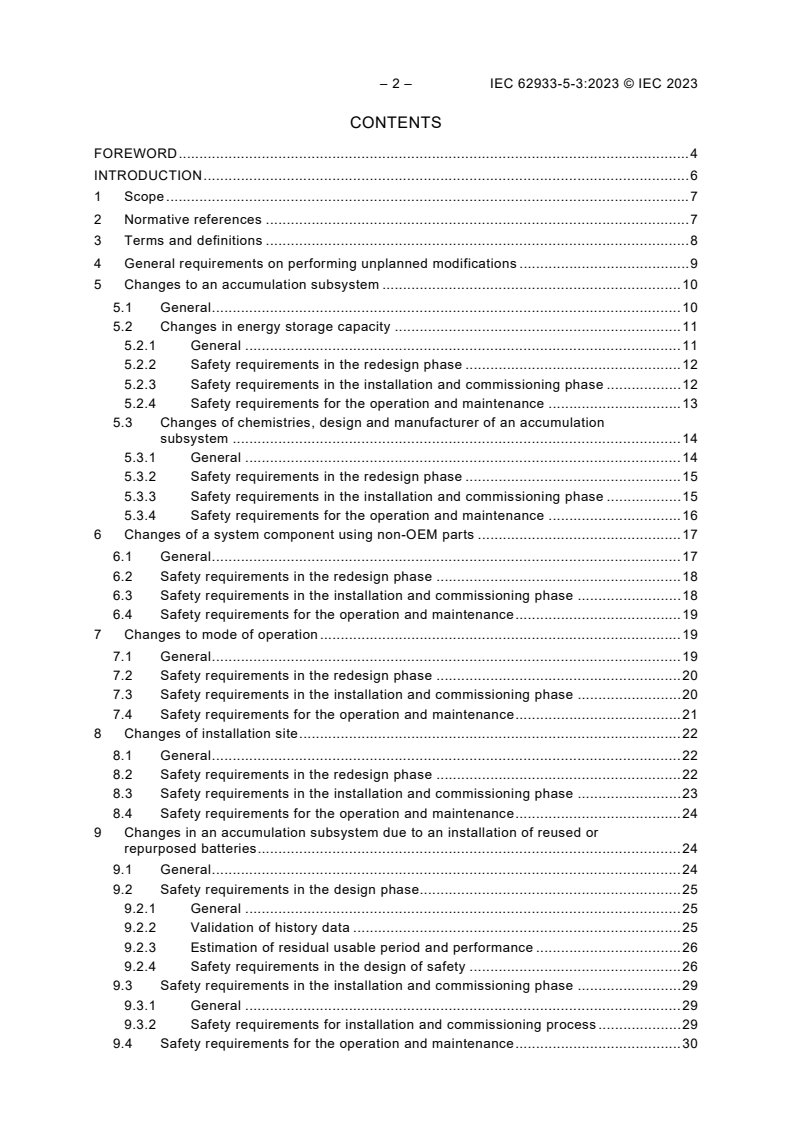
CONTENTS
FOREWORD . 4
INTRODUCTION . 6
1 Scope . 7
2 Normative references . 7
3 Terms and definitions . 8
4 General requirements on performing unplanned modifications . 9
5 Changes to an accumulation subsystem . 10
5.1 General . 10
5.2 Changes in energy storage capacity . 11
5.2.1 General . 11
5.2.2 Safety requirements in the redesign phase . 12
5.2.3 Safety requirements in the installation and commissioning phase . 12
5.2.4 Safety requirements for the operation and maintenance . 13
5.3 Changes of chemistries, design and manufacturer of an accumulation
subsystem . 14
5.3.1 General . 14
5.3.2 Safety requirements in the redesign phase . 15
5.3.3 Safety requirements in the installation and commissioning phase . 15
5.3.4 Safety requirements for the operation and maintenance . 16
6 Changes of a system component using non-OEM parts . 17
6.1 General . 17
6.2 Safety requirements in the redesign phase . 18
6.3 Safety requirements in the installation and commissioning phase . 18
6.4 Safety requirements for the operation and maintenance . 19
7 Changes to mode of operation . 19
7.1 General . 19
7.2 Safety requirements in the redesign phase . 20
7.3 Safety requirements in the installation and commissioning phase . 20
7.4 Safety requirements for the operation and maintenance . 21
8 Changes of installation site . 22
8.1 General . 22
8.2 Safety requirements in the redesign phase . 22
8.3 Safety requirements in the installation and commissioning phase . 23
8.4 Safety requirements for the operation and maintenance . 24
9 Changes in an accumulation subsystem due to an installation of reused or
repurposed batteries . 24
9.1 General . 24
9.2 Safety requirements in the design phase. 25
9.2.1 General . 25
9.2.2 Validation of history data . 25
9.2.3 Estimation of residual usable period and performance . 26
9.2.4 Safety requirements in the design of safety . 26
9.3 Safety requirements in the installation and commissioning phase . 29
9.3.1 General . 29
9.3.2 Safety requirements for installation and commissioning process . 29
9.4 Safety requirements for the operation and maintenance . 30
9.4.1 General . 30
9.4.2 Safety requirements for monitoring data . 30
9.4.3 Safety requirements for operation and maintenance process . 31
Annex A (informative) Example of a safety validation method when performing
unplanned modifications of a BESS using lithium-ion batteries . 33
A.1 General . 33
A.2 Estimation methods for deterioration of lithium-ion battery . 33
A.3 Safety estimation of BESS by deterioration estimation method . 33
Bibliography . 35
Figure 1 – Major modifications and their classification . 9
Figure 2 – Example of BESS architecture . 11
Figure 3 – Life cycle of reused or repurposed battery . 25
Figure A.1 – Example of BESS with a safety estimation function . 34
Figure A.2 – Example of a safety assessment network using an estimation function . 34
Table 1 – Examples of relevant stakeholders . 10
Table 2 – Examples of different batteries chemistry modifications and their
categorization . 14
Table 3 – Examples of subsystem and safety relevant components . 17
– 4 – IEC 62933-5-3:2023 © IEC 2023
INTERNATIONAL ELECTROTECHNICAL COMMISSION
____________
ELECTRICAL ENERGY STORAGE (EES) SYSTEMS –
Part 5-3: Safety requirements for grid-integrated EES systems –
Performing unplanned modification of electrochemical based system
FOREWORD
1) The International Electrotechnical Commission (IEC) is a worldwide organization for standardization comprising
all national electrotechnical committees (IEC National Committees). The object of IEC is to promote international
co-operation on all questions concerning standardization in the electrical and electronic fields. To this end and
in addition to other activities, IEC publishes International Standards, Technical Specifications, Technical Reports,
Publicly Available Specifications (PAS) and Guides (hereafter referred to as “IEC Publication(s)”). Their
preparation is entrusted to technical committees; any IEC National Committee interested in the subject dealt with
may participate in this preparatory work. International, governmental and non-governmental organizations liaising
with the IEC also participate in this preparation. IEC collaborates closely with the International Organization for
Standardization (ISO) in accordance with conditions determined by agreement between the two organizations.
2) The formal decisions or agreements of IEC on technical matters express, as nearly as possible, an international
consensus of opinion on the relevant subjects since each technical committee has representation from all
interested IEC National Committees.
3) IEC Publications have the form of recommendations for international use and are accepted by IEC National
Committees in that sense. While all reasonable efforts are made to ensure that the technical content of IEC
Publications is accurate, IEC cannot be held responsible for the way in which they are used or for any
misinterpretation by any end user.
4) In order to promote international uniformity, IEC National Committees undertake to apply IEC Publications
transparently to the maximum extent possible in their national and regional publications. Any divergence between
any IEC Publication and the corresponding national or regional publication shall be clearly indicated in the latter.
5) IEC itself does not provide any attestation of conformity. Independent certification bodies provide conformity
assessment services and, in some areas, access to IEC marks of conformity. IEC is not responsible for any
services carried out by independent certification bodies.
6) All users should ensure that they have the latest edition of this publication.
7) No liability shall attach to IEC or its directors, employees, servants or agents including individual experts and
members of its technical committees and IEC National Committees for any personal injury, property damage or
other damage of any nature whatsoever, whether direct or indirect, or for costs (including legal fees) and
expenses arising out of the publication, use of, or reliance upon, this IEC Publication or any other IEC
Publications.
8) Attention is drawn to the Normative references cited in this publication. Use of the referenced publications is
indispensable for the correct application of this publication.
9) IEC draws attention to the possibility that the implementation of this document may involve the use of (a)
patent(s). IEC takes no position concerning the evidence, validity or applicability of any claimed patent rights in
respect thereof. As of the date of publication of this document, IEC had not received notice of (a) patent(s), which
may be required to implement this document. However, implementers are cautioned that this may not represent
the latest information, which may be obtained from the patent database available at https://patents.iec.ch. IEC
shall not be held responsible for identifying any or all such patent rights.
IEC 62933-5-3 has been prepared by IEC technical committee 120: Electrical Energy Storage
(EES) Systems. It is an International Standard.
This International Standard is to be used in conjunction with IEC 62933-5-2:2020.
The text of this International Standard is based on the following documents:
Draft Report on voting
120/331/FDIS 120/335/RVD
Full information on the voting for its approval can be found in the report on voting indicated in
the above table.
The language used for the development of this International Standard is English.
This document was drafted in accordance with ISO/IEC Directives, Part 2, and developed in
accordance with ISO/IEC Directives, Part 1 and ISO/IEC Directives, IEC Supplement, available
at www.iec.ch/members_experts/refdocs. The main document types developed by IEC are
described in greater detail at www.iec.ch/publications.
A list of all parts in the IEC 62933 series, published under the general title Electrical energy
storage (ESS) systems, can be found on the IEC website.
The committee has decided that the contents of this document will remain unchanged until the
stability date indicated on the IEC website under webstore.iec.ch in the data related to the
specific document. At this date, the document will be
• reconfirmed,
• withdrawn, or
• revised.
IMPORTANT – The "colour inside" logo on the cover page of this document indicates
that it contains colours which are considered to be useful for the correct understanding
of its contents. Users should therefore print this document using a colour printer.
– 6 – IEC 62933-5-3:2023 © IEC 2023
INTRODUCTION
The initial design or planning cannot cover all modifications that are made to a BESS over its
lifetime. Unplanned modifications entail a careful evaluation of their potential impact on the
safety of the BESS.
This document provides safety requirements, considerations and procedures when unplanned
modifications of the BESS are carried out.
Appropriate attention is given to safety issues in the relative redesign, installation,
commissioning, operation and maintenance phases during such modification activities of the
BESS.
Unplanned modifications which are dealt with in this document are:
• changes in energy storage capacity;
• changes of chemistries, design and manufacturer of the accumulation subsystem;
• changes of a subsystem component using non-OEM parts;
• changes to the mode of operation;
• changes of the installation site;
• changes in an accumulation subsystem due to an installation of reused or repurposed
batteries.
ELECTRICAL ENERGY STORAGE (EES) SYSTEMS –
Part 5-3: Safety requirements for grid-integrated EES systems –
Performing unplanned modification of electrochemical based system
1 Scope
This part of IEC 62933 applies to those instances when a BESS undergoes unplanned
modifications. Such modifications can involve one or more of the following:
• changes in energy storage capacity;
• changes of chemistries, design and manufacturer of the accumulation subsystem;
• changes of a subsystem component using non-OEM parts,
• changes to the mode of operation,
• changes of the installation site, or
• changes in an accumulation subsystem due to an installation of reused or repurposed
batteries.
Any such modification can impair the original state of safety of the BESS.
This document complements IEC 62933-5-2, which relates to the overall safety aspects of a
BESS. The requirements covered by this document are applied in addition to the requirements
in IEC 62933-5-2 in accordance with each situation.
2 Normative references
The following documents are referred to in the text in such a way that some or all of their content
constitutes requirements of this document. For dated references, only the edition cited applies.
For undated references, the latest edition of the referenced document (including any
amendments) applies.
IEC 62619:2022, Secondary cells and batteries containing alkaline or other non-acid
electrolytes – Safety requirements for secondary lithium cells and batteries, for use in industrial
applications
IEC 62933-2-1:2017, Electrical energy storage (EES) systems – Part 2-1: Unit parameters and
testing methods – General specification
IEC 62933-5-2:2020, Electrical energy storage (EES) systems – Part 5-2: Safety requirements
for grid-integrated EES systems – Electrochemical-based systems
IEC 63330 , General requirements for repurposing of secondary batteries
IEC 63338 , General guidance on reuse and repurposing of secondary cells and batteries
___________
Under preparation. Stage at the time of publication: IEC AFDIS 63330:2023.
Under preparation. Stage at the time of publication: IEC CDV 63338:2023.
– 8 – IEC 62933-5-3:2023 © IEC 2023
3 Terms and definitions
For the purposes of this document, the following terms and definitions apply.
ISO and IEC maintain terminology databases for use in standardization at the following
addresses:
• IEC Electropedia: available at https://www.electropedia.org/
• ISO Online browsing platform: available at https://www.iso.org/obp
3.1
battery operating range
range of parameters to ensure the safe use of the accumulation subsystem
Note 1 to entry: Examples of parameters are voltage, current, temperature, SOC, SOE and so on.
3.2
critical stakeholder
stakeholder (IEV 904-01-10) related to the part or component whose modification, installation,
or removal affects the safe operation of the BESS
3.3
unplanned modification
modification that has not been intended to be carried out or planned prior to the start of
operation of the BESS
Note 1 to entry: IEC 62933-5-2:2020, 7.13.1, “Operation and maintenance” deals with a planned modification.
3.4
OEM part
part supplied to or by an original equipment manufacturer (OEM)
Note 1 to entry: OEM parts are generally used to manufacture new equipment and can also be purchased for
maintenance and repair.
Note 2 to entry: A part that is not an OEM part is called “non-OEM part”.
3.5
relocation
moving of an installation physically from its current location which requires
disconnecting from the initial point of connection (POC) and connecting it at new location to
another POC
3.6
reused battery
battery that is used again in the same application as it was used for when commissioned the
first time
3.7
repurposed battery
battery that is used again in a different application as it was used for when commissioned the
first time
3.8
residual usable period
actual or estimated remaining length of service life
3.9
safety margin
margin defined within the battery operating range considering the system
application, environmental conditions and so on for safe operation of the BESS
3.10
safe-operating range
range excluding the safety margin from the battery operating range
4 General requirements on performing unplanned modifications
The BESS, including the batteries, can be exposed to the following changes in safety conditions
during its operation:
1) changes due to changes in the surrounding environment,
2) changes due to unplanned modifications of the BESS,
3) changes due to ageing, and
4) changes due to modifications planned at the time of the initial design.
This document describes the safety measures that shall be taken for BESS in the event of items
1) and 2) above. The events of items 3) and 4) should be considered and addressed at the time
of initial design of the BESS, which is under the scope of IEC 62933-5-2.
NOTE 1 The modifications that occur in the BESS can be at the component, subsystem or system level. While the
primary focus of this document is on changes in safety and their evaluation at the system level, the process can also
require evaluation at the component or subsystem level (e.g., interactions between subsystems).
Figure 1 shows the modifications that affect safety, which are made by the subdivision of
changes in item 1) and item 2). This document deals with the modifications shown in the yellow
boxes in Figure 1.
Figure 1 – Major modifications and their classification
An unplanned modification of a BESS can result in conditions where multiple safety related
conditions are potentially affected at the same instance.
In such an event, the impact on safety of the individual modifications is to be assessed and all
the resulting risk mitigation actions are to be implemented. The detailed requirements of
assessment or measures, etc., are described in Clause 5 to Clause 9 of this document.
– 10 – IEC 62933-5-3:2023 © IEC 2023
A wide range of stakeholders are involved in the modification process. Examples of
stakeholders are shown in Table 1. The requirements described in this document shall be met
as appropriate in cooperation with the stakeholders.
NOTE 2 Responsibility for ensuring the BESS safety depends on each case and local regulations.
Table 1 – Examples of relevant stakeholders
Type of stakeholders Specific examples of stakeholders
Owner
Ownership
User
Operator
Operation
Service provider
Project manager and administrator
Overall system integrator
Engineering, procurement and construction (EPC)
Subsystem integrator
Integrator performing modification *
Component manufacturer
Component vendor
Component
Additional component manufacturer *
Additional component vendor *
Certification authority of original parts
Certification body
Certification authority of additional parts *
Local government
Local
Fire-fighting agency
NOTE The stakeholders with “*” marking can be involved in cases where there are modifications with additional
parts (e.g. Clause 5, Clause 6 and Clause 9).
5 Changes to an accumulation subsystem
5.1 General
The intention of Clause 5 is to describe safety requirements, considerations and processes to
follow for situations where changes are made to an accumulation subsystem in a BESS.
Clause 5 describes the requirements when an accumulation subsystem (see Figure 2)
undergoes unplanned modifications.
NOTE ”POC” means “point of connection”.
Figure 2 – Example of BESS architecture
The unplanned modifications of the accumulation subsystem described in Clause 5 are:
• changes in energy storage capacity;
• changes of chemistry and design of an accumulation subsystem.
5.2 Changes in energy storage capacity
5.2.1 General
Subclause 5.2 specifies the safety requirements, considerations and processes for situations
where the energy storage capacity of the electrochemical accumulation subsystem is changed.
The energy storage capacity of the BESS can be modified when batteries are removed due to
their failures or added to meet a higher energy demand or a modified operating mode.
NOTE “Energy storage capacity of the BESS” means the total energy capacity of electrochemical accumulation
subsystems.
Such changes modify the voltage versus time profile during discharge and charge and possibly
bring the batteries to voltage, temperature and SOC values that were not originally planned.
This can mean that the existing safety measures become inadequate and the safety of the
BESS can be impaired.
The possible negative consequences of capacity changes are:
a) dielectric breakdowns and loss of the electrical insulation levels resulting in dangerous
voltages on operator-accessible surfaces;
b) electric shock risks arising from changes causing malfunction of protective measures and
devices;
c) increases of the fire load level necessitating adjustment of firefighting measures and their
capabilities;
– 12 – IEC 62933-5-3:2023 © IEC 2023
d) increases in the amount of thermal energy released by the accumulation subsystem to be
handled by the heat, ventilation and air conditioning (HVAC);
e) increases of the quantity of chemicals to be handled in an emergency;
f) voltage and capacity imbalances between aged and new batteries causing accelerated
ageing;
g) management/control subsystem errors when the batteries that are added to increase
capacity have different operating conditions and are installed in the same
management/control section as existing batteries;
h) increases in the occurrence of operator and maintenance personnel mistakes;
i) decreases in available space for operator and maintenance engineer to do work properly.
The risk assessment shall be done in accordance with IEC 62933-5-2 in the first stage of
planning and before any other work, and the necessary corrective measures concerning
hardware and software shall be undertaken in accordance with the assessment results.
5.2.2 Safety requirements in the redesign phase
In order to maintain the safety level of the BESS, the following actions are required in the
redesign phase:
• The safety level of the capacity-modified BESS shall not be less than that present prior to
the modification.
• If the change of capacity results in a change of the BESS category as defined in
IEC 62933-5-2:2020, Table 1, then the appropriate safety measures shall be implemented
in the modified BESS.
• The suppliers of the existing BESS shall approve in writing the capacity modification.
• The general safety protection systems (e.g., deflagration protection, ventilation subsystem)
of the BESS shall be updated to reflect the capacity modification.
In cases where it is difficult to modify or add safety measures to an existing BESS due to space
or other restrictions, the following reinforcement of risk reduction measures shall be undertaken:
Inherently safe design: Set the conditions and parameters sufficiently to ensure the safety of
the accumulation subsystem. For example, narrow the SOC range or the operation temperature
range, etc.
Guards and protection: If the prevention of fire propagation at the accumulation subsystem level
cannot be ensured, add a protection measure against fire propagation (e.g. fireproof boards or
walls) to prevent fire propagation at the cubicle, building, or container levels.
Information for use: Use on-site labels to distinguish between the added accumulation
subsystem and existing one. Set warning devices (audible alerts, visible signals) and remote
alerts to distinguish between the added one and the existing one so that prompt and accurate
responses can be made in the event of trouble.
5.2.3 Safety requirements in the installation and commissioning phase
The modification of the capacity of the BESS entails access, by installation personnel, to
components carrying dangerous voltages or containing toxic compounds.
In order to maintain the safety of the BESS and workers, the following actions are required in
the installation and commissioning phase:
• The necessary safety measures for the workers shall be defined prior to the commencement
of work.
• All activities shall be assessed in advance for the risk due to live electrical parts that cannot
be adequately protected, and shall comply with live electrical work standards.
• All procedures shall be reviewed to ensure that all activities are carried out in an appropriate
way considering the result of risk assessment, especially from the perspective of work on
live power sources and toxic chemicals. Local regulations can apply.
• All procedures shall be reviewed to ensure that only qualified personnel with an
established chain of command and open communication channels to the BESS
operator carry out the work.
If the capacity modification is carried out without powering down the BESS, then all safety
measures listed below are required.
• The battery string to be modified or added shall stay disconnected from any live circuit until
completion of the modification.
• The battery string to be modified shall be broken down in sub-units so that each sub-unit
does not carry dangerous voltage.
NOTE The definition of “dangerous voltages” depends on local regulations.
• Appropriate protective measures shall be provided with for workers.
During installation, the following measures shall be taken:
• The BESS shall be powered down and all components carrying dangerous voltage shall be
fully insulated to the appropriate IP and insulation class level.
• The enclosure of the BESS, where the modification work is carried out, shall be free from
any toxic liquid, vapor and gas and well ventilated during any presence of installation
personnel.
• Personal protection equipment (PPE) for protection against hazards in the BESS shall be
made available to the involved personnel.
• The inspection of the correct connection and placement of sensing and monitoring devices
and also of cooling and ventilation air channels of the BESS shall be carried out in
accordance with an installation checklist prior to the reactivation.
• The BESS control software shall be verified that it implements the parameters related to the
capacity modifications.
5.2.4 Safety requirements for the operation and maintenance
The modification of the capacity of the BESS entails a modification of operating conditions,
operating procedures and maintenance activities.
• Prior to the restart of operation and to minimize risks, the following items of the capacity-
modified BESS and associated operating procedures shall be verified and documented:
– operation plan (including service life),
– operating conditions,
– monitored items (including parts, subsystem and whole system level),
– inspected items (including parts, subsystem and whole system level),
– education and training,
– emergency procedure training, and
– all hardware and software changes carried out including their sources and specifications.
• The documentations shall be reviewed by the critical stakeholders of the BESS and formally
approved.
• The revised operation and maintenance instruction document, with a clear identification of
its version and validity, shall be distributed to all stakeholders and the expired version
recalled.
– 14 – IEC 62933-5-3:2023 © IEC 2023
5.3 Changes of chemistries, design and manufacturer of an accumulation subsystem
5.3.1 General
Subclause 5.3.1 specifies the safety requirements, considerations and processes when the
chemistry and design of the electrochemical accumulation subsystem in BESS are changed.
Over its lifetime, a BESS and its batteries can be modified by replacement with or addition of
accumulation subsystems whose chemical and electrochemical make-up and design differ from
the existing ones.
If carried out without adequate precautions, such changes in the electrochemical energy
storage system can significantly impair the safety of the modified BESS.
The addition of or replacement with a different battery chemistry can involve a change in
category “C”.
The definition of "different battery chemistry" does not always depend on the definition in the
category “C” of IEC 62933-5-2. There are often multiple chemistries within a particular category
that can impact the BESS when mixed during a modification even though still falling within the
same category. Examples of different batteries chemistry modifications that do or do-not impact
their categorization are shown in Table 2.
Table 2 – Examples of different batteries chemistry
modifications and their categorization
Case No. Detail Change of category “C”
Case 1 Replacement of a part of the accumulation subsystem, which No change in category “C”
is composed of Mn-based lithium-ion batteries with NMC
(Remains in category “C-A”)
(nickel-manganese-cobalt) lithium-ion batteries
Case 2 Replacement with a battery whose model number has No change in category “C”
changed due to discontinuation
Case 3 Addition to an accumulation subsystem of a category “C-B” to Change from category “C-A” to
a category “C-A” BESS category “C-Z”
The multiplication of designs and chemistries of the accumulation subsystem present in a BESS
results in a related increase in failure scenarios and hence the necessity for implementing
multiple safety measures in parallel.
The possible negative consequences of installing an electrochemical accumulation subsystem
which has a different chemistry or design, or both, from the existing one are:
a) electric shock risks arising from malfunctions of protective measures and devices caused
by incompatibilities of new and existing accumulation subsystem;
b) a change of the fire load level necessitating adjustment of firefighting measures and their
capabilities;
c) a change of the amount of thermal energy released by the accumulation subsystem to be
handled by heat, ventilation and air conditioning (HVAC);
d) a change of the chemicals and their quantity to be handled in an emergency;
e) management/control subsystem errors when the batteries that are added to increase
capacity have different specifications and are installed in the same management/control
section as existing batteries;
f) increase in the occurrence of operator and maintenance personnel mistakes; and
g) decrease in available space for operator and maintenance engineer to do work properly.
The risk assessment shall be done in accordance with IEC 62933-5-2 in the first stage of
planning and before any other work, and the necessary corrective measures concerning
hardware and software shall be undertaken in accordance with the assessment results.
5.3.2 Safety requirements in the redesign phase
In order to maintain the safety level of the BESS, the following actions are required in the
redesign phase:
• The safety level of the chemistry and design of the accumulation subsystem’s modified
BESS shall not be less than that present prior to the modification.
• If the change of chemistry and design of the accumulation subsystem results in a change of
the BESS category as defined in IEC 62933-5-2:2020, Table 1, then the appropriate
mandated safety measures shall be implemented in the modified BESS.
• The suppliers of the existing BESS shall confirm the modification of the chemistry and
design of the accumulation subsystem in the BESS and make a judgement on whether the
modification can be performed. The modification shall not be performed unless the suppliers
approve the implementation of the modification from a safety perspective.
• When installing accumulation subsystems which have a different chemistry category “C”
from the existing one, the section where the accumulation subsystem is installed shall be
operated separately with its own and independent control and auxiliary subsystem.
• The general safety protection systems (e.g., deflagration protection, ventilation subsystem)
of the BESS shall be updated to reflect the presence of a new chemistry and design of the
accumulation subsystem.
Where it is difficult to modify or add safety measures to an existing BESS due to installation
space or other restrictions, the following additional risk reduction measures shall be
implemented:
Inherently safe design: Set the conditions and parameters sufficiently to ensure the safety of
the accumulation subsystem. For example, narrow the SOC range or the operational
temperature range, etc.
Guards and protection: If the prevention of fire propagation at the accumulation subsystem level
cannot be ensured, add a protection measure against fire propagation (e.g. fireproof boards or
walls) to prevent fire propagation at the cubicle, building, or container levels.
Information for use: Use on-site labels to distinguish between the added accumulation
subsystem and the existing one. Set warning devices (audible alerts, visible signals) and remote
alerts to distinguish between the added one and the existing one so that prompt and accurate
responses can be made in the event of trouble.
5.3.3 Safety requirements in the installation and commissioning phase
The modification of the chemistry and design of the accumulation subsystem in the BESS entails
access, by installation personnel, to components carrying dangerous voltage or containing toxic
compounds.
In order to maintain the safety of both the BESS and workers, the following actions are required
in the installation and commissioning phase:
• The necessary safety measures for the workers shall be defined prior to the commencement
of work.
• All activities shall be assessed in advance for the risk due to live electrical parts that cannot
be adequately protected, and be made in compliance with the standards related to live
electrical work.
• All procedures shall be reviewed to ensure that all activities are carried out in an
appropriate way considering the result of risk assessment, especially from the perspective
of work on live power sources and toxic chemicals. Local regulations can apply.
– 16 – IEC 62933-5-3:2023 © IEC 2023
• All procedures shall be reviewed to ensure that only qualified personnel with an
established chain of command and open communication channels to the BESS
operator carry out the work.
If the modification is carried out without powering down the BESS, then all safety measures
listed below are required.
• The battery string to be modified or added shall stay disconnected from any live circuit until
completion of the modification.
• The battery string to be modified shall be broken down into sub-units so that each sub-unit
does not carry dangerous voltages.
NOTE The definition of “dangerous voltages” depends on local regulations.
• Appropriate protective measures shall be provided with for workers.
During installation, the following measures shall be taken:
• The BESS shall be powered down and all components carrying dangerous voltages shall be
fully insulated to the appropriate IP and insulation class level.
• The enclosure of the BESS, where the modification work is carried out, shall be free from
any toxic liquid, vapor and gas and well ventilated during any presence of installation
personnel.
• Personal protection equipment (PPE) for protection against hazards in the BESS shall be
made available to the involved personnel.
• The inspection of the correct connection and placement of sensing and monitoring devices
as well as cooling and ventilation air channels of the BESS shall be carried out in
accordance with an installation checklist prior to the reactivation.
• The BESS control software shall b
...