

IEC 62849:2025
(Main)Performance evaluation methods of robots for household and similar use
General Information
- Abstract
IEC 62849:2025 provides performance testing and evaluation methods for the common features of robots for household and similar use, their physical specifications satisfying the following:
– height: maximum 1,75 m,
– dimensions: maximum 700 mm wide (to be able to fit through doorways),
– speed: maximum 1,5 m/s,
– floor supported wheeled or wheel-track robots.
This document is neither concerned with safety nor with performance requirements.
This document is applicable for indoor floor use robots.
This document is not applicable to wet and dry surface-cleaning robots or combination of such functions.
If different testing and evaluating methods are given in other standards for specific robots, these methods can be considered for priority use.
This second edition cancels and replaces the first edition published in 2016. This edition constitutes a technical revision.
This edition includes the following significant technical changes with respect to the previous edition:
a) the title has been changed to "Performance evaluation methods of robots for household and similar use";
b) the scope is more clearly defined and the physical specifications of robots for household and similar use covered by this document are clearly defined;
c) new evaluation methods for 6 performance items have been added, including obstacle avoidance, managing a ramp, lighting effects, transition overcome, threshold overcome, energy consumption of robots;
d) new structure has been introduced, which provides basic common test methods in each category and can be used by other robotics standards, including the following:
1) mobility,
2) navigation,
3) energy use,
4) effects on environment,
5) other/miscellaneous.
- Status
- Published
- Publication Date
- 23-Nov-2025
- Technical Committee
- TC 59 - Performance of household and similar electrical appliances
- Drafting Committee
- WG 16 - TC 59/WG 16
- Current Stage
- PPUB - Publication issued
- Start Date
- 24-Nov-2025
- Completion Date
- 19-Dec-2025
Buy Documents
IEC 62849:2025 - Performance evaluation methods of robots for household and similar use Released:11/24/2025
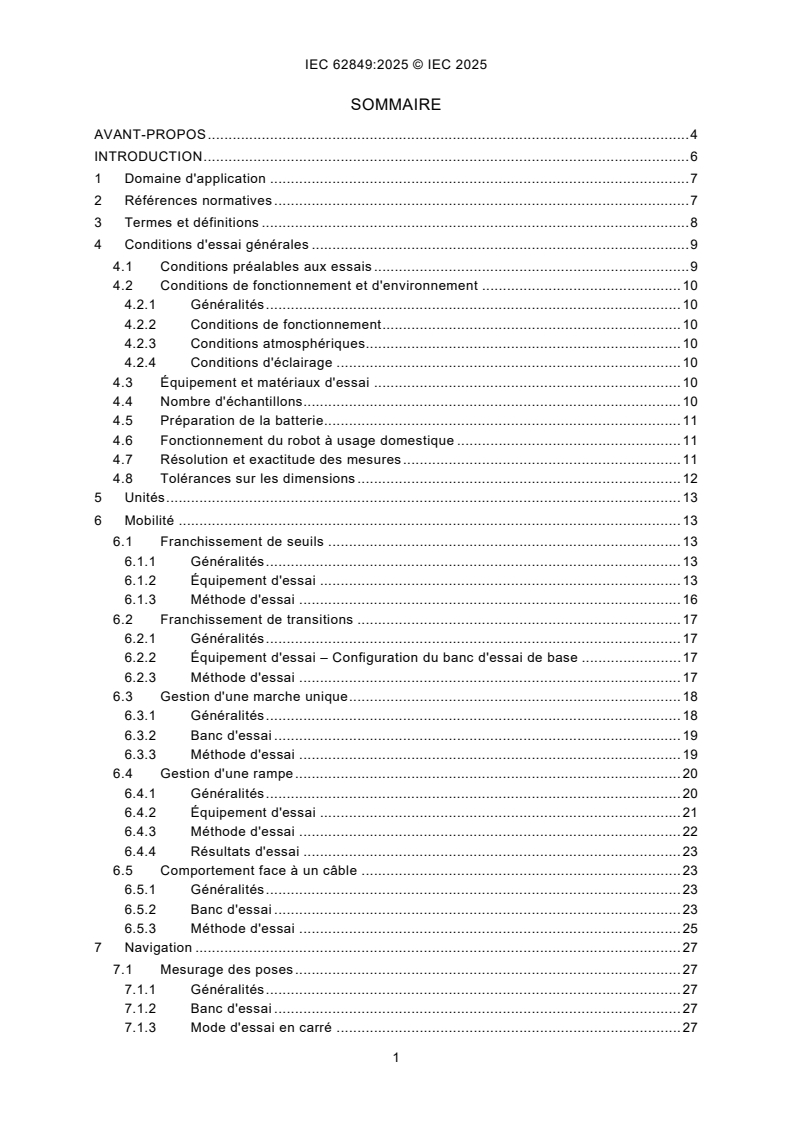
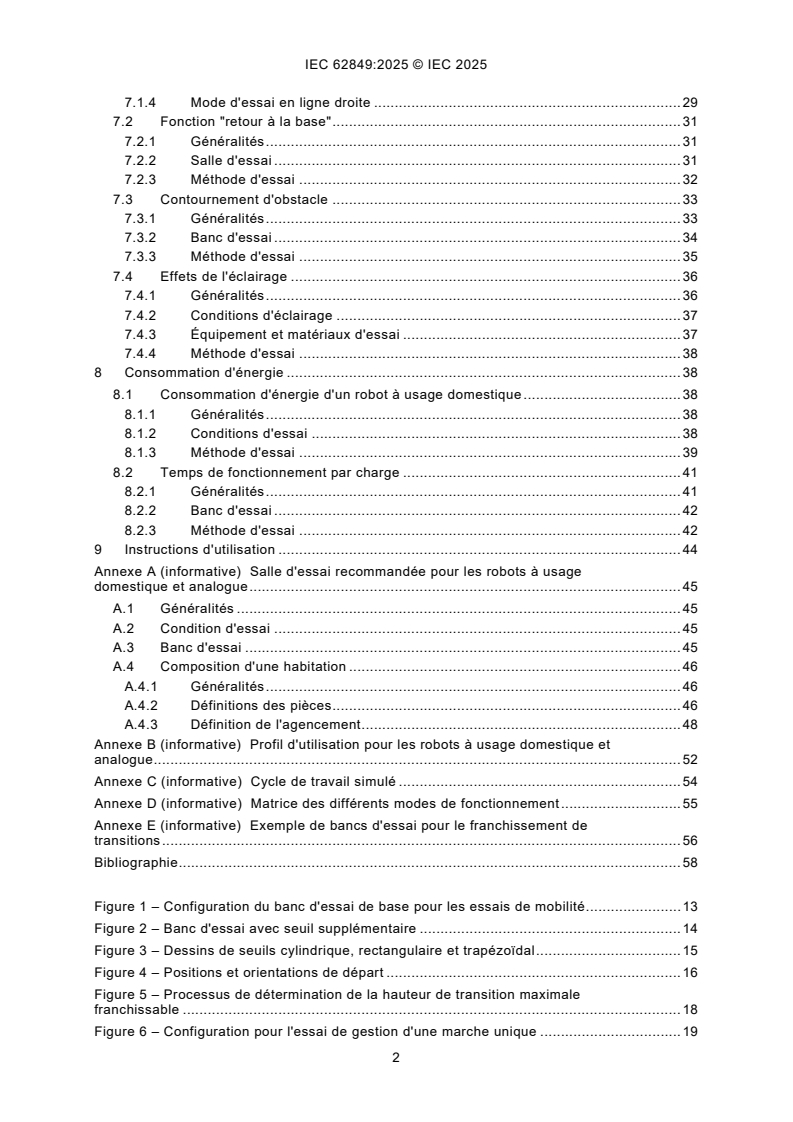
IEC 62849:2025 - Méthodes d'évaluation de l'aptitude a la fonction des robots a usage domestique et analogue Released:11/24/2025
IEC 62849:2025 - Performance evaluation methods of robots for household and similar use Released:11/24/2025
Overview
IEC 62849:2025 - Performance evaluation methods of robots for household and similar use specifies standardized test methods to evaluate common performance features of indoor, floor‑supported wheeled or wheel‑track robots intended for household and similar environments. It is a methods standard (not a safety or minimum performance requirements standard) and applies to robots with physical limits of maximum 1.75 m height, maximum 700 mm width, and maximum 1.5 m/s speed. Wet/dry surface‑cleaning robots and combinations of such cleaning functions are excluded.
This second edition (2025) replaces the 2016 edition and introduces new evaluation methods and a revised structure to support reuse by other robotics standards.
Key topics and technical content
- Scope & applicability
- Indoor floor use; wheeled or wheel‑track robots; defined size and speed limits.
- If other standards specify different methods for a specific robot type, those may take priority.
- Test category structure
- Mobility, Navigation, Energy use, Effects on environment, Other/miscellaneous - providing basic, reusable test methods.
- Mobility tests
- Threshold overcome, transition overcome, single step negotiation, ramp handling, cable traversing behavior.
- Navigation and autonomy
- Pose measurements (straight line, square), homing capability, obstacle avoidance, lighting effects on sensors/navigation.
- Energy and endurance
- Energy consumption measurement, operation time per single charge.
- Environmental and operational conditions
- Test room setups, lighting and atmospheric conditions, battery preparation, measurement resolution and tolerances.
- Supporting material
- Informative annexes for recommended test rooms, usage profiles, simulated work cycles, multi‑mode matrices and example test beds.
Practical applications and users
This standard is designed for:
- Manufacturers and product engineers - to benchmark mobility, navigation and energy performance during development and validation.
- Test laboratories and certification bodies - to perform repeatable, comparable performance evaluations.
- Procurement teams and spec writers - to define objective testable performance criteria for purchasing household robots.
- Researchers and integrators - to compare algorithms, sensor configurations and mechanical designs under consistent conditions.
- Standards developers - as a common library of test methods reusable by domain‑specific robot standards.
Use cases include product R&D, comparative benchmarking, claims validation, pre‑certification testing and performance reporting.
Related standards (note)
- IEC 62849:2025 focuses on test methods; consult other IEC/ISO standards for safety, functional requirements, or specific robot classes. Where other standards provide different test methods for a specific robot, those methods may take priority.
Relations
- Effective Date
- 05-Sep-2023
Buy Documents
IEC 62849:2025 - Performance evaluation methods of robots for household and similar use Released:11/24/2025
IEC 62849:2025 - Méthodes d'évaluation de l'aptitude a la fonction des robots a usage domestique et analogue Released:11/24/2025
IEC 62849:2025 - Performance evaluation methods of robots for household and similar use Released:11/24/2025
Frequently Asked Questions
IEC 62849:2025 is a standard published by the International Electrotechnical Commission (IEC). Its full title is "Performance evaluation methods of robots for household and similar use". This standard covers: IEC 62849:2025 provides performance testing and evaluation methods for the common features of robots for household and similar use, their physical specifications satisfying the following: – height: maximum 1,75 m, – dimensions: maximum 700 mm wide (to be able to fit through doorways), – speed: maximum 1,5 m/s, – floor supported wheeled or wheel-track robots. This document is neither concerned with safety nor with performance requirements. This document is applicable for indoor floor use robots. This document is not applicable to wet and dry surface-cleaning robots or combination of such functions. If different testing and evaluating methods are given in other standards for specific robots, these methods can be considered for priority use. This second edition cancels and replaces the first edition published in 2016. This edition constitutes a technical revision. This edition includes the following significant technical changes with respect to the previous edition: a) the title has been changed to "Performance evaluation methods of robots for household and similar use"; b) the scope is more clearly defined and the physical specifications of robots for household and similar use covered by this document are clearly defined; c) new evaluation methods for 6 performance items have been added, including obstacle avoidance, managing a ramp, lighting effects, transition overcome, threshold overcome, energy consumption of robots; d) new structure has been introduced, which provides basic common test methods in each category and can be used by other robotics standards, including the following: 1) mobility, 2) navigation, 3) energy use, 4) effects on environment, 5) other/miscellaneous.
IEC 62849:2025 provides performance testing and evaluation methods for the common features of robots for household and similar use, their physical specifications satisfying the following: – height: maximum 1,75 m, – dimensions: maximum 700 mm wide (to be able to fit through doorways), – speed: maximum 1,5 m/s, – floor supported wheeled or wheel-track robots. This document is neither concerned with safety nor with performance requirements. This document is applicable for indoor floor use robots. This document is not applicable to wet and dry surface-cleaning robots or combination of such functions. If different testing and evaluating methods are given in other standards for specific robots, these methods can be considered for priority use. This second edition cancels and replaces the first edition published in 2016. This edition constitutes a technical revision. This edition includes the following significant technical changes with respect to the previous edition: a) the title has been changed to "Performance evaluation methods of robots for household and similar use"; b) the scope is more clearly defined and the physical specifications of robots for household and similar use covered by this document are clearly defined; c) new evaluation methods for 6 performance items have been added, including obstacle avoidance, managing a ramp, lighting effects, transition overcome, threshold overcome, energy consumption of robots; d) new structure has been introduced, which provides basic common test methods in each category and can be used by other robotics standards, including the following: 1) mobility, 2) navigation, 3) energy use, 4) effects on environment, 5) other/miscellaneous.
IEC 62849:2025 is classified under the following ICS (International Classification for Standards) categories: 97.030 - Domestic electrical appliances in general. The ICS classification helps identify the subject area and facilitates finding related standards.
IEC 62849:2025 has the following relationships with other standards: It is inter standard links to IEC 62849:2016. Understanding these relationships helps ensure you are using the most current and applicable version of the standard.
IEC 62849:2025 is available in PDF format for immediate download after purchase. The document can be added to your cart and obtained through the secure checkout process. Digital delivery ensures instant access to the complete standard document.
Standards Content (Sample)
IEC 62849 ®
Edition 2.0 2025-11
INTERNATIONAL
STANDARD
Performance evaluation methods of robots for household and similar use
ICS 97.030 ISBN 978-2-8327-0879-8
All rights reserved. Unless otherwise specified, no part of this publication may be reproduced or utilized in any form or
by any means, electronic or mechanical, including photocopying and microfilm, without permission in writing from either
IEC or IEC's member National Committee in the country of the requester. If you have any questions about IEC copyright
or have an enquiry about obtaining additional rights to this publication, please contact the address below or your local
IEC member National Committee for further information.
IEC Secretariat Tel.: +41 22 919 02 11
3, rue de Varembé info@iec.ch
CH-1211 Geneva 20 www.iec.ch
Switzerland
About the IEC
The International Electrotechnical Commission (IEC) is the leading global organization that prepares and publishes
International Standards for all electrical, electronic and related technologies.
About IEC publications
The technical content of IEC publications is kept under constant review by the IEC. Please make sure that you have the
latest edition, a corrigendum or an amendment might have been published.
IEC publications search - IEC Products & Services Portal - products.iec.ch
webstore.iec.ch/advsearchform Discover our powerful search engine and read freely all the
The advanced search enables to find IEC publications by a publications previews, graphical symbols and the glossary.
variety of criteria (reference number, text, technical With a subscription you will always have access to up to date
committee, …). It also gives information on projects, content tailored to your needs.
replaced and withdrawn publications.
Electropedia - www.electropedia.org
The world's leading online dictionary on electrotechnology,
IEC Just Published - webstore.iec.ch/justpublished
Stay up to date on all new IEC publications. Just Published containing more than 22 500 terminological entries in English
details all new publications released. Available online and and French, with equivalent terms in 25 additional languages.
once a month by email. Also known as the International Electrotechnical Vocabulary
(IEV) online.
IEC Customer Service Centre - webstore.iec.ch/csc
If you wish to give us your feedback on this publication or
need further assistance, please contact the Customer
Service Centre: sales@iec.ch.
CONTENTS
FOREWORD . 4
INTRODUCTION . 6
1 Scope . 7
2 Normative references . 7
3 Terms and definitions . 8
4 General conditions for testing . 9
4.1 Conditions prior to testing . 9
4.2 Operating and environmental conditions . 10
4.2.1 General . 10
4.2.2 Operating conditions . 10
4.2.3 Atmospheric conditions . 10
4.2.4 Lighting conditions . 10
4.3 Test equipment and materials . 10
4.4 Number of samples . 10
4.5 Preparation of battery . 11
4.6 Operation of the household robot . 11
4.7 Measurement resolution and accuracy . 11
4.8 Tolerance of dimensions . 12
5 Units . 12
6 Mobility . 12
6.1 Threshold overcome . 12
6.1.1 General . 12
6.1.2 Test equipment . 13
6.1.3 Test method . 15
6.2 Transition overcome . 16
6.2.1 General . 16
6.2.2 Test equipment – Basic test bed configuration . 16
6.2.3 Test method . 16
6.3 Managing a single step . 17
6.3.1 General . 17
6.3.2 Test bed . 17
6.3.3 Test method . 18
6.4 Managing a ramp . 19
6.4.1 General . 19
6.4.2 Test equipment . 19
6.4.3 Test method . 21
6.4.4 Test results . 21
6.5 Cable traversing behaviour . 22
6.5.1 General . 22
6.5.2 Test bed . 22
6.5.3 Test method . 24
7 Navigation . 26
7.1 Pose measurements . 26
7.1.1 General . 26
7.1.2 Test bed . 26
7.1.3 Square test mode . 26
7.1.4 Straight line test mode . 28
7.2 Capability of homing function . 29
7.2.1 General . 29
7.2.2 Test room . 29
7.2.3 Test method . 30
7.3 Obstacle avoidance . 31
7.3.1 General . 31
7.3.2 Test bed . 32
7.3.3 Test method . 33
7.4 Lighting effects . 34
7.4.1 General . 34
7.4.2 Lighting conditions . 35
7.4.3 Test equipment and materials . 35
7.4.4 Test method . 36
8 Energy use . 36
8.1 Energy consumption of a household robot. 36
8.1.1 General . 36
8.1.2 Test conditions . 36
8.1.3 Test method . 37
8.2 Operation time per single charge . 39
8.2.1 General . 39
8.2.2 Test bed . 39
8.2.3 Test method . 40
9 Instructions for use . 41
Annex A (informative) Recommended robot test room for household and similar use . 42
A.1 General . 42
A.2 Test condition . 42
A.3 Test bed . 42
A.4 A compositions of multi-room . 43
A.4.1 General . 43
A.4.2 Room definitions . 43
A.4.3 Layout definitions . 44
Annex B (informative) Usage profile for robot for household and similar use . 48
Annex C (informative) Simulated work cycle . 50
Annex D (informative) Matrix of multiple operation modes . 51
Annex E (informative) Example of transition overcome test beds . 52
Bibliography . 54
Figure 1 – Basic test bed configuration for mobility testing . 13
Figure 2 – Test bed with additional threshold . 14
Figure 3 – Drawings of cylindrical, rectangular and trapezoid thresholds . 14
Figure 4 – Starting positions and orientations . 15
Figure 5 – Process to determine the maximum passable transition height . 17
Figure 6 – Managing a single step configuration . 18
Figure 7 – Starting position for managing a single step test . 19
Figure 8 – Side view (15° configuration). 20
Figure 9 – Top view (15° configuration). 20
Figure 10 – Zoom on transitions (15° configuration) . 21
Figure 11 – Wire fastening configuration . 23
Figure 12 – Floor circle marks schematic diagram . 23
Figure 13 – Floor circle marks schematic diagram with robot . 24
Figure 14 – Top view of cable traversing behaviour configuration . 24
Figure 15 – Side view of cable traversing behaviour configuration . 25
Figure 17 – Pose measurements configuration-straight line mode . 28
Figure 18 – Capability of homing function configuration . 30
Figure 19 – Obstacle avoidance configuration . 32
Figure 20 – Starting position for obstacle avoidance test . 33
Figure 21 – Illustration of pendant light . 35
Figure 22 – Operation time per single charge configuration . 40
Figure A.1 – Interconnection diagram of multi-room (alternative) . 45
Figure A.2 – Schematic of robot test room . 46
Figure E.1 – Transition formed by stacking sheets on area B . 52
Figure E.2 – Transition formed by adjusting the height of platform B . 53
Table 1 – Tolerance of linear dimension. 12
Table 2 – Tolerance of external radius and chamfer heights . 12
Table 3 – Typical thresholds and its characteristic . 13
Table 4 – Test results of the managing a ramp . 22
Table 5 – Outcome and maximum swinging distance . 26
Table 6 – Objects for pose measurement . 28
Table 7 – Overview of duration and the values that should be reported in this test . 39
Table A.1 – Dimensions of furniture . 46
Table D.1 – Combination regarding multiple operation modes . 51
INTERNATIONAL ELECTROTECHNICAL COMMISSION
____________
Performance evaluation methods of robots for household and similar use
FOREWORD
1) The International Electrotechnical Commission (IEC) is a worldwide organization for standardization comprising
all national electrotechnical committees (IEC National Committees). The object of IEC is to promote international
co-operation on all questions concerning standardization in the electrical and electronic fields. To this end and
in addition to other activities, IEC publishes International Standards, Technical Specifications, Technical Reports,
Publicly Available Specifications (PAS) and Guides (hereafter referred to as “IEC Publication(s)”). Their
preparation is entrusted to technical committees; any IEC National Committee interested in the subject dealt with
may participate in this preparatory work. International, governmental and non-governmental organizations liaising
with the IEC also participate in this preparation. IEC collaborates closely with the International Organization for
Standardization (ISO) in accordance with conditions determined by agreement between the two organizations.
2) The formal decisions or agreements of IEC on technical matters express, as nearly as possible, an international
consensus of opinion on the relevant subjects since each technical committee has representation from all
interested IEC National Committees.
3) IEC Publications have the form of recommendations for international use and are accepted by IEC National
Committees in that sense. While all reasonable efforts are made to ensure that the technical content of IEC
Publications is accurate, IEC cannot be held responsible for the way in which they are used or for any
misinterpretation by any end user.
4) In order to promote international uniformity, IEC National Committees undertake to apply IEC Publications
transparently to the maximum extent possible in their national and regional publications. Any divergence between
any IEC Publication and the corresponding national or regional publication shall be clearly indicated in the latter.
5) IEC itself does not provide any attestation of conformity. Independent certification bodies provide conformity
assessment services and, in some areas, access to IEC marks of conformity. IEC is not responsible for any
services carried out by independent certification bodies.
6) All users should ensure that they have the latest edition of this publication.
7) No liability shall attach to IEC or its directors, employees, servants or agents including individual experts and
members of its technical committees and IEC National Committees for any personal injury, property damage or
other damage of any nature whatsoever, whether direct or indirect, or for costs (including legal fees) and
expenses arising out of the publication, use of, or reliance upon, this IEC Publication or any other IEC
Publications.
8) Attention is drawn to the Normative references cited in this publication. Use of the referenced publications is
indispensable for the correct application of this publication.
9) IEC draws attention to the possibility that the implementation of this document may involve the use of (a)
patent(s). IEC takes no position concerning the evidence, validity or applicability of any claimed patent rights in
respect thereof. As of the date of publication of this document, IEC had not received notice of (a) patent(s), which
may be required to implement this document. However, implementers are cautioned that this may not represent
the latest information, which may be obtained from the patent database available at https://patents.iec.ch. IEC
shall not be held responsible for identifying any or all such patent rights.
IEC 62849 has been prepared by IEC technical committee 59: Performance of household and
similar electrical appliances. It is an International Standard.
This second edition cancels and replaces the first edition published in 2016. This edition
constitutes a technical revision.
This edition includes the following significant technical changes with respect to the previous
edition:
a) the title has been changed to "Performance evaluation methods of robots for household and
similar use";
b) the scope is more clearly defined and the physical specifications of robots for household
and similar use covered by this document are clearly defined;
c) new evaluation methods for 6 performance items have been added, including obstacle
avoidance, managing a ramp, lighting effects, transition overcome, threshold overcome,
energy consumption of robots;
d) new structure has been introduced, which provides basic common test methods in each
category and can be used by other robotics standards, including the following:
1) mobility,
2) navigation,
3) energy use,
4) effects on environment,
5) other/miscellaneous.
The text of this International Standard is based on the following documents:
Draft Report on voting
59/857/FDIS 59/860/RVD
Full information on the voting for its approval can be found in the report on voting indicated in
the above table.
The language used for the development of this International Standard is English.
This document was drafted in accordance with ISO/IEC Directives, Part 2, and developed in
accordance with ISO/IEC Directives, Part 1 and ISO/IEC Directives, IEC Supplement, available
at www.iec.ch/members_experts/refdocs. The main document types developed by IEC are
described in greater detail at www.iec.ch/publications.
In this standard, the following print types are used:
– terms defined in Clause 3: bold type.
The committee has decided that the contents of this document will remain unchanged until the
stability date indicated on the IEC website under webstore.iec.ch in the data related to the
specific document. At this date, the document will be
– reconfirmed,
– withdrawn, or
– revised.
INTRODUCTION
As stated in the Foreword, this document has made adjustments and improvements in terms of
name, scope, performance items, overall structure, etc. and will cover the generic performance
test methods of robots for household and similar use within one document.
The needs in terms of environmental effects (noise, photoelectric pollution, etc.),
other/miscellaneous (human-robot interface, facial recognition, voice recognition, information
security, reliability, AI, etc.) linked to the increasing performance and demand for robots used
outdoors will be taken into account in a future version of this document.
1 Scope
This document provides performance testing and evaluation methods for the common features
of robots for household and similar use, their physical specifications satisfying the following:
– height: maximum 1,75 m,
– dimensions: maximum 700 mm wide (to be able to fit through doorways),
– speed: maximum 1,5 m/s,
– floor supported wheeled or wheel-track robots.
This document is neither concerned with safety nor with performance requirements.
This document is applicable for indoor floor use robots.
This document is not applicable to the following products:
Wet and dry surface-cleaning robots or combination of such functions.
NOTE If different testing and evaluating methods are given in other standards for specific robots,these methods
can be considered for priority use.
2 Normative references
The following documents are referred to in the text in such a way that some or all of their content
constitutes requirements of this document. For dated references, only the edition cited applies.
For undated references, the latest edition of the referenced document (including any
amendments) applies.
IEC TS 61496-4-3, Safety of machinery - Electro-sensitive protective equipment - Part 4-3:
Particular requirements for equipment using vision based protective devices (VBPD) -
Additional requirements when using stereo vision techniques (VBPDST)
IEC TS 62885-1, Surface cleaning appliances - Part 1: General requirements on test material
and test equipment
IEC/ASTM 62885-7:2020, Surface cleaning appliances - Part 7: Dry-cleaning robots for
household or similar use - Methods for measuring the performance
IEC/ASTM 62885-7:2020/AMD1:2022
ISO 554, Standard atmospheres for conditioning and/or testing - Specifications
ISO 2768-1:1989, General tolerances - Part 1: Tolerances for linear and angular dimensions
without individual tolerance indications
ISO 13856-3, Safety of machinery - Pressure-sensitive protective devices - Part 3: General
principles for design and testing of pressure-sensitive bumpers, plates, wires and similar
devices
3 Terms and definitions
For the purposes of this document, the following terms and definitions apply.
ISO and IEC maintain terminology databases for use in standardization at the following
addresses:
– IEC Electropedia: available at https://www.electropedia.org/
– ISO Online browsing platform: available at https://www.iso.org/obp
3.1
household robot
actuated mechanism with a degree of autonomy for household and similar use to perform its
intended tasks
Note 1 to entry: Actuated mechanism includes travel and/or robot body movement.
3.2
mobile robot
robot able to travel by itself
[SOURCE: ISO 13482:2014, 3.5, modified – "under its own control" has been replaced with "by
itself"]
3.3
capability of homing function
capability of household robot to return to the docking station(s) or commanded point for
charging or after completion of the work task or called by user
3.4
pose
combination of position and orientation
3.5
automatic mode
operating mode in which the robot accomplishes its assigned mission without direct human
intervention
3.6
manual mode
operating mode in which the robot can be operated by pushbutton or joystick, for example, and
that excludes operation in automatic mode
3.7
fully charged
point charging when, according to the manufacturer's instructions, the parameters such as
voltage, current, and temperature of the battery tend to stabilize, and the indicator light or sound
prompt indicates that the product has reached its rated maximum storage capacity
3.8
fully discharged
point in use when the manufacturer's instructions state the product is completely discharged or
the robot cannot restart the operation, whichever comes first
3.9
docking station
unit that can provide manual or automatic battery charging facilities and/or AC/DC power supply
Note 1 to entry: Apart from any such function, it can also provide other facilities such as:
– communication connections,
– navigation information,
– data processing facility or other robot support functions.
Note 2 to entry: A docking station is also known as a base unit.
Note 3 to entry: For some robots, the docking station can come in the form of an external power supply.
3.10
trial
single instance of a performance measurement carried out under identical conditions that can
be repeated multiple times
3.11
run
subset of a trial where one or more factors affecting the test results is (are) changed
3.12
pose tracking system
PTS
measurement system which enables the position and orientation tracking of the robot for
household and similar use
3.13
start orientation
wheel or wheel-track alignment in the direction of forward movement at the time of operation
start
4 General conditions for testing
4.1 Conditions prior to testing
The robot shall be completely assembled and fully operational in accordance with the
manufacturer's instructions. All necessary leveling operations, alignment procedures and
functional tests shall be satisfactorily completed.
If possible, the software shall be updated to the latest available for the robot in the region of
purchase according to manufacturer's instruction.
The software version used in a test shall be reported.
If available, the manufactured date and the serial number of the samples shall be reported.
Prior to conducting any series of tests, the age, condition, and history of the product shall be
recorded.
NOTE Condition information can include model number/name, and accessories used, if available.
4.2 Operating and environmental conditions
4.2.1 General
The performance characteristics determined by the related test methods in this document are
valid only under the environmental and normal operating conditions as stipulated by the
manufacturer.
4.2.2 Operating conditions
All tests shall be carried out under conditions in which the household mobile robot is operated
in normal use; the normal operating conditions used in the tests shall be in accordance with the
manufacturer's instructions.
Performance will be affected by the installed software. Therefore, installed software shall not
be modified or changed during a set of tests.
4.2.3 Atmospheric conditions
Unless otherwise specified, the test procedures and measurements shall be carried out under
the following atmospheric conditions (in accordance with ISO 554):
– temperature: (23 ± 5) °C,
– air pressure: 86 kPa to 106 kPa,
– relative humidity: (45 ± 15) %.
Temperature and humidity conditions within the specified ranges are required for good
repeatability and reproducibility. The conditions shall be kept to avoid changes during a test.
4.2.4 Lighting conditions
Unless otherwise specified, the test procedures and measurements shall be carried out under
the following lighting conditions:
– intensity: (200 ± 50) lx,
– colour temperature: 2 000 K to 7 000 K,
– measurement shall be made at the test surface.
NOTE Lighting conditions for lighting effects test (see 7.4) are different from the general lighting condition and they
are defined in 7.4.2.
4.3 Test equipment and materials
Measurements shall be carried out on a level floor consisting of a smooth untreated laminated
pine tree plate or equivalent panel, at least 15 mm thick and of a size fit for the test.
Equipment and materials for measurements (devices, test carpets, etc.) to be used in a test
should, prior to the test, be kept for at least 16 h at standard atmospheric conditions according
to 4.2.3, if applicable for the test.
4.4 Number of samples
All measurements of performance shall be carried out on the same sample(s) of the robot with
its attachments, if any. During a set of tests, the sample robot shall not be changed.
A minimum of three samples of the same model shall be tested.
If possible, the software shall be updated to the latest available for the robot in the region of
purchase in accordance with the manufacturer's instructions.
If available, the manufacture date, the serial number, and the software version of the samples
shall be reported.
Tests carried out to simulate stresses a robot can be exposed to during normal use, possibly
causing impairment of the robot performance, can require additional samples of replaceable
parts. Such tests shall be carried out at the end of a test programme.
4.5 Preparation of battery
Any unused Li-ion battery shall be fully charged and fully discharged once prior to conducting
the first test on a household robot or similar use. Any unused other type of battery shall be
fully charged and fully discharged three times prior to conducting the first test on a
household robot or similar use. Complete discharge of the robot shall be done by performing
a normal operation following the manufacturer's instructions until the robot ceases to function.
Remove the docking station once it is in operation to ensure complete discharge.
NOTE It is understood that some robots do not allow discharge below a certain energy level for battery protection.
Complete discharge means either low battery signal without robot motion or robot stops operation without being able
to restart.
4.6 Operation of the household robot
Prior to the first test on a new household robot, it should be run in accordance with 4.5 for one
battery cycle. Prior to conducting any series of tests, the age, condition, and history of the
product shall be recorded.
Unless otherwise specified, the following applies.
– The household robot, its attachments, the docking station and any accessories shall be
used and adjusted in accordance with the manufacturer's instructions for normal operation
before a test is carried out.
– If the robot has both manual and automatic modes that are used by consumers to fit the
environment to be operated, automatic mode is recommended to be used for the tests.
– If the robot has multiple operation modes as specified in Table D.1 of Annex D (informative),
each operation mode for test shall be carried out.
– The operation mode of the robot can be selected and adjusted to perform its intended tasks
according to the manufacturer's published instructions only before the test.
– The mode and settings used for the test shall be recorded and reported.
Any safety-related device shall be allowed to operate.
4.7 Measurement resolution and accuracy
Unless specified in the test methods, the resolution and the accuracy of the measurement
device shall be as follows.
Recommended position measurement by pose tracking system:
– position resolution ≤ 1 cm,
– position accuracy ≤ 1 cm,
– orientation resolution ≤ 0,1°,
– orientation accuracy ≤ 3°,
– data acquisition rate ≥ 30 Hz.
Time measurement:
– resolution ≤ 0,1 s,
– accuracy ≤ 0,2 s.
The sampling rate of the pose tracking system shall be adequate to ensure the dynamic
position accuracies as specified above.
4.8 Tolerance of dimensions
For all dimensions which are not presented as a range and where no tolerance is specified, the
tolerance shall be determined as in Table 1 and Table 2.
Table 1 – Tolerance of linear dimension
Nominal size range Tolerance
mm mm
> 3 to ≤ 6 ± 0,5
> 6 to ≤ 30 ± 1,0
> 30 to ≤ 120 ± 1,5
> 120 to ≤ 400 ± 2,5
> 400 to ≤ 1 000 ± 4,0
> 1 000 to ≤ 2 000 ± 6,0
> 2 000 to ≤ 5 000 ± 8,0
Values are taken from ISO 2768-1:1989, Table 1.
Table 2 – Tolerance of external radius and chamfer heights
Nominal size range Tolerance
mm mm
> 0,5 to ≤ 3 ± 0,4
> 3 to ≤ 6 ± 1,0
> 6 ± 2,0
Values are taken from ISO 2768-1:1989, Table 1.
5 Units
Unless otherwise stated, all dimensions are as follows:
– length in millimeters (mm),
– angle in degrees (°),
– time in seconds (s),
– mass in kilograms (kg),
– velocity in meter per second (m/s).
6 Mobility
6.1 Threshold overcome
6.1.1 General
The purpose of this test is to measure the maximum height of various threshold shapes that a
robot can traverse.
6.1.2 Test equipment
6.1.2.1 Basic test bed configuration
The length and the width of the test bed shall be at least 4 000 mm × 2 150 mm as specified in
Figure 1. The height of the wall surrounding the test bed floor shall be at least 300 mm. The
inner side of the wall shall be untreated pine wood colour. The ceiling height of the room in
which the test is executed shall not be higher than 3 500 mm. The test floor shall be untreated
laminated pine tree plate or equivalent and its thickness shall be at least 15 mm. This box is
the basic test setup for threshold overcome test. For the different tests, additional equipment is
added, which is described separately for each test.
NOTE This basic test bed configuration is identical with the configuration specified in IEC/ASTM 62885-7:2020,
9.2.1.
Dimensions in millimetres
Figure 1 – Basic test bed configuration for mobility testing
6.1.2.2 Maximum passable threshold height − Additional equipment
In this test, the following three different types of thresholds, cylindrical, rectangular and
trapezoid (see Table 3 and Figure 3) are added to the box in Figure 1. It shall be placed in the
middle of the long side of the box as specified in Figure 2. The thresholds are made of
aluminium with unground or untreated surface. The additional threshold shall be fixed to the
travel surface so that it cannot move in any direction (e.g. rolling or bending) while bumped by
the robot. Thresholds shall be at least 2 150 mm long.
Table 3 – Typical thresholds and its characteristic
Name Face dimensions Height (h) increase
Increasing the radius of the circular face height
Cylinder Circular
(h) and width change
A rectangle of 40 mm width and variable
Height of the rectangular face increases (height
Rectangular height (h), with 3 mm radius on the top
changes, width is constant)
edges
Height (h) of trapezoid increases, with top edge
A trapezoid with top edge of 40 mm,
Trapezoid and bottom angles constant (height changes,
bottom angles of 40°
width changes)
Dimensions in millimetres
Key
T threshold
Figure 2 – Test bed with additional threshold
Dimensions in millimetres
Key
h height of threshold
Figure 3 – Drawings of cylindrical, rectangular and trapezoid thresholds
6.1.3 Test method
6.1.3.1 Automatic mode
Trials are performed with the robot starting in each of the starting positions, as shown in
Figure 4:
Dimensions in millimetre, tolerance of the angles is ± 5,0°
Key
RUT robot under test
S , S and S : starting positions 1, 2 and 3.
1 2 3
T threshold
NOTE The arrow indicates the forward direction of the household robot.
Figure 4 – Starting positions and orientations
Operation of the robot is initiated from the starting position with the start orientation in Figure 4.
If the robot stops operating and does not resume its task within 5 min from initial operation time,
or reaches the other side of the threshold within 5 min, the trial is finished. The robot moving
to the other side means that the entire body of the mobile base moves to the other side (not
including arms, etc.). If the robot has not reached the other side of the transition within 5 min
from initial operation time, the trial is stopped.
Three consecutive trials from each starting position in which the robot reaches the other side
of the threshold are required to judge that the robot can overcome a height.
Threshold height is adjusted and trials are performed to determine the tallest height of each
shape of threshold that a robot can overcome.
If the robot possesses the function to avoid climbing certain height/shapes of obstacle, it shall
be stated in the report.
6.1.3.2 Manual mode
With the robot starting as shown in Figure 4 from 1 m from the threshold and facing the
threshold, the robot is operated to move to the other side of the threshold.
The operator shall actively search for ways to make the robot pass to the other side of the
threshold. An example of a structured way to determine the maximum transition would be using
the process described in Figure 5. The initial parameter h of 17 mm is used. After 5 min, the
trial is finished.
If the robot moves to the other side in three consecutive trials from each side of the threshold,
the robot is judged to be able to pass this height of threshold.
The height is adjusted, and trials are repeated to determine the tallest height of each threshold
shape that a robot can overcome.
6.2 Transition overcome
6.2.1 General
The purpose of this test is to measure the maximum transition height that a robot can traverse
in upward and downward directions.
6.2.2 Test equipment – Basic test bed configuration
The length and the width of the test bed shall be at least 4 000 mm × 2 150 mm as specified in
Figure E.1 of Annex E (informative). The height of the wall surrounding the test bed floor shall
be at least 300 mm tall. The inner side of the wall shall be untreated pine wood colour. The
ceiling height of the room in which the test is executed shall not be higher than 3 500 mm. The
test floor shall be untreated laminated pine tree plate or equivalent and its thickness shall be at
least 15 mm. Platform A and/or platform B can be adjusted to get different height for transition
test.
6.2.3 Test method
6.2.3.1 Automatic mode
Trials are performed with the robot starting in each of the starting positions as shown in Figure 4
in upward and downward direction.
Operation of the robot is initiated from the starting position of area A. If the robot stops operating
or reaches the area B of the transition within 5 min, the run is finished. The robot moving to the
other side means that the entire body of the mobile base moves to the other side (not including
arms, etc.). If after 5 min the robot has not reached the other side of the transition, the run is
stopped.
Three consecutive trials comprising both starting positions from each starting position in which
the robot reaches the other side of the transition are required to judge that the robot has passed
a height.
Transition height is adjusted and trials are performed to determine the tallest height of
transition that a robot can overcome in upward and downward direction.
Robots can have a technology which prevents them from climbing certain heights. If this is
stated in the manufacturer's instructions, skip these heights and state them in the recorded
results. In this case, it can be necessary to deviate from the process described in Figure 5.
NOTE An example of a structured way to determine the maximum transition would be using the process described
in Figure 5. The initial parameter h of 17 mm is used.
o
Key
h initial parameter height
P pass
R result
Figure 5 – Process to determine the maximum passable transition height
6.2.3.2 Manual mode
With the robot starting as shown in Figure 4 from 1 m from the transition and facing the
transition, the robot is operated to move to the other side of the transition.
The operator shall actively search for ways to make the robot pass to the other side of the
transition. After 5 min, the trial is finished.
If the robot moves to the other side in three consecutive trials from each side of the transition,
the robot is judged to be able to pass this height of transition.
The height is adjusted, and trials are repeated to determine the highest transition that a robot
can overcome.
6.3 Managing a single step
6.3.1 General
The purpose of the test is to determine the robot's management of a single step whilst moving
during activities. The household robot shall be moving throughout the test time. Other possible
tasks (e.g. air purifying without movement) are not understood as movement and the time for
these tasks is not included to the overall test time.
NOTE The tester can restart the robot to encourage movement if necessary.
6.3.2 Test bed
The test bed is as shown in Figure 6. The test bed consists of the base and the step.
...
IEC 62849 ®
Edition 2.0 2025-11
NORME
INTERNATIONALE
Méthodes d'évaluation de l'aptitude à la fonction des robots à usage domestique
et analogue
ICS 97.030 ISBN 978-2-8327-0879-8
Droits de reproduction réservés. Sauf indication contraire, aucune partie de cette publication ne peut être reproduite ni
utilisée sous quelque forme que ce soit et par aucun procédé, électronique ou mécanique, y compris la photocopie et
les microfilms, sans l'accord écrit de l'IEC ou du Comité national de l'IEC du pays du demandeur. Si vous avez des
questions sur le copyright de l'IEC ou si vous désirez obtenir des droits supplémentaires sur cette publication, utilisez
les coordonnées ci-après ou contactez le Comité national de l'IEC de votre pays de résidence.
IEC Secretariat Tel.: +41 22 919 02 11
3, rue de Varembé info@iec.ch
CH-1211 Geneva 20 www.iec.ch
Switzerland
A propos de l'IEC
La Commission Electrotechnique Internationale (IEC) est la première organisation mondiale qui élabore et publie des
Normes internationales pour tout ce qui a trait à l'électricité, à l'électronique et aux technologies apparentées.
A propos des publications IEC
Le contenu technique des publications IEC est constamment revu. Veuillez vous assurer que vous possédez l’édition la
plus récente, un corrigendum ou amendement peut avoir été publié.
Recherche de publications IEC - IEC Products & Services Portal - products.iec.ch
webstore.iec.ch/advsearchform Découvrez notre puissant moteur de recherche et consultez
La recherche avancée permet de trouver des publications gratuitement tous les aperçus des publications, symboles
IEC en utilisant différents critères (numéro de référence, graphiques et le glossaire. Avec un abonnement, vous aurez
texte, comité d’études, …). Elle donne aussi des toujours accès à un contenu à jour adapté à vos besoins.
informations sur les projets et les publications remplacées
ou retirées. Electropedia - www.electropedia.org
Le premier dictionnaire d'électrotechnologie en ligne au
IEC Just Published - webstore.iec.ch/justpublished monde, avec plus de 22 500 articles terminologiques en
Restez informé sur les nouvelles publications IEC. Just anglais et en français, ainsi que les termes équivalents
dans 25 langues additionnelles. Egalement appelé
Published détaille les nouvelles publications parues.
Disponible en ligne et une fois par mois par email. Vocabulaire Electrotechnique International (IEV) en ligne.
Service Clients - webstore.iec.ch/csc
Si vous désirez nous donner des commentaires sur cette
publication ou si vous avez des questions contactez-
nous: sales@iec.ch.
SOMMAIRE
AVANT-PROPOS . 4
INTRODUCTION . 6
1 Domaine d'application . 7
2 Références normatives . 7
3 Termes et définitions . 8
4 Conditions d'essai générales . 9
4.1 Conditions préalables aux essais . 9
4.2 Conditions de fonctionnement et d'environnement . 10
4.2.1 Généralités . 10
4.2.2 Conditions de fonctionnement . 10
4.2.3 Conditions atmosphériques. 10
4.2.4 Conditions d'éclairage . 10
4.3 Équipement et matériaux d'essai . 10
4.4 Nombre d'échantillons . 10
4.5 Préparation de la batterie. 11
4.6 Fonctionnement du robot à usage domestique . 11
4.7 Résolution et exactitude des mesures . 11
4.8 Tolérances sur les dimensions . 12
5 Unités . 13
6 Mobilité . 13
6.1 Franchissement de seuils . 13
6.1.1 Généralités . 13
6.1.2 Équipement d'essai . 13
6.1.3 Méthode d'essai . 16
6.2 Franchissement de transitions . 17
6.2.1 Généralités . 17
6.2.2 Équipement d'essai – Configuration du banc d'essai de base . 17
6.2.3 Méthode d'essai . 17
6.3 Gestion d'une marche unique . 18
6.3.1 Généralités . 18
6.3.2 Banc d'essai . 19
6.3.3 Méthode d'essai . 19
6.4 Gestion d'une rampe . 20
6.4.1 Généralités . 20
6.4.2 Équipement d'essai . 21
6.4.3 Méthode d'essai . 22
6.4.4 Résultats d'essai . 23
6.5 Comportement face à un câble . 23
6.5.1 Généralités . 23
6.5.2 Banc d'essai . 23
6.5.3 Méthode d'essai . 25
7 Navigation . 27
7.1 Mesurage des poses . 27
7.1.1 Généralités . 27
7.1.2 Banc d'essai . 27
7.1.3 Mode d'essai en carré . 27
7.1.4 Mode d'essai en ligne droite . 29
7.2 Fonction "retour à la base" . 31
7.2.1 Généralités . 31
7.2.2 Salle d'essai . 31
7.2.3 Méthode d'essai . 32
7.3 Contournement d'obstacle . 33
7.3.1 Généralités . 33
7.3.2 Banc d'essai . 34
7.3.3 Méthode d'essai . 35
7.4 Effets de l'éclairage . 36
7.4.1 Généralités . 36
7.4.2 Conditions d'éclairage . 37
7.4.3 Équipement et matériaux d'essai . 37
7.4.4 Méthode d'essai . 38
8 Consommation d'énergie . 38
8.1 Consommation d'énergie d'un robot à usage domestique . 38
8.1.1 Généralités . 38
8.1.2 Conditions d'essai . 38
8.1.3 Méthode d'essai . 39
8.2 Temps de fonctionnement par charge . 41
8.2.1 Généralités . 41
8.2.2 Banc d'essai . 42
8.2.3 Méthode d'essai . 42
9 Instructions d'utilisation . 44
Annexe A (informative) Salle d'essai recommandée pour les robots à usage
domestique et analogue . 45
A.1 Généralités . 45
A.2 Condition d'essai . 45
A.3 Banc d'essai . 45
A.4 Composition d'une habitation . 46
A.4.1 Généralités . 46
A.4.2 Définitions des pièces . 46
A.4.3 Définition de l'agencement . 48
Annexe B (informative) Profil d'utilisation pour les robots à usage domestique et
analogue . 52
Annexe C (informative) Cycle de travail simulé . 54
Annexe D (informative) Matrice des différents modes de fonctionnement . 55
Annexe E (informative) Exemple de bancs d'essai pour le franchissement de
transitions . 56
Bibliographie . 58
Figure 1 – Configuration du banc d'essai de base pour les essais de mobilité . 13
Figure 2 – Banc d'essai avec seuil supplémentaire . 14
Figure 3 – Dessins de seuils cylindrique, rectangulaire et trapézoïdal . 15
Figure 4 – Positions et orientations de départ . 16
Figure 5 – Processus de détermination de la hauteur de transition maximale
franchissable . 18
Figure 6 – Configuration pour l'essai de gestion d'une marche unique . 19
Figure 7 – Position de départ pour l'essai de gestion d'une marche unique . 20
Figure 8 – Vue latérale (configuration à 15°) . 21
Figure 9 – Vue de dessus (configuration à 15°) . 22
Figure 10 – Vue agrandie des transitions (configuration à 15°) . 22
Figure 11 – Configuration pour la fixation du fil . 24
Figure 12 – Schéma représentant le marquage au sol des cercles . 24
Figure 13 – Schéma représentant le marquage au sol des cercles et le robot . 25
Figure 14 – Vue de dessus de la configuration pour l'essai de comportement face à un
câble . 25
Figure 15 – Vue latérale de la configuration pour l'essai de comportement face à un
câble . 26
Figure 17 – Configuration du mode en ligne droite pour le mesurage des poses . 29
Figure 18 – Configuration pour l'essai de la fonction "retour à la base" . 32
Figure 19 – Configuration pour l'essai de contournement d'obstacle . 34
Figure 20 – Position de départ pour l'essai de contournement d'obstacle . 35
Figure 21 – Dessin d'une lampe suspendue . 37
Figure 22 – Configuration pour l'essai de temps de fonctionnement par charge . 42
Figure A.1 – Schéma d'interconnexion d'une habitation (variante) . 48
Figure A.2 – Schéma de la salle d'essai pour les robots . 49
Figure E.1 – Transition créée par empilage de plaques sur la zone B . 56
Figure E.2 – Transition créée par réglage de la hauteur de la plateforme B . 57
Tableau 1 – Tolérances sur les dimensions linéaires . 12
Tableau 2 – Tolérances sur les rayons extérieurs et les hauteurs de chanfreins . 12
Tableau 3 – Seuils types et caractéristiques associées . 14
Tableau 4 – Résultats de l'essai de gestion d'une rampe . 23
Tableau 5 – Résultat et distance d'oscillation maximale . 27
Tableau 6 – Objets pour le mesurage des poses . 30
Tableau 7 – Vue d'ensemble des durées de mesure et des valeurs qu'il convient de
consigner pour cet essai . 41
Tableau A.1 – Dimensions du mobilier . 49
Tableau D.1 – Combinaison de plusieurs modes de fonctionnement . 55
COMMISSION ÉLECTROTECHNIQUE INTERNATIONALE
____________
Méthodes d'évaluation de l'aptitude à la fonction
des robots à usage domestique et analogue
AVANT-PROPOS
1) La Commission Électrotechnique Internationale (IEC) est une organisation mondiale de normalisation composée
de l'ensemble des comités électrotechniques nationaux (Comités nationaux de l'IEC). L'IEC a pour objet de
favoriser la coopération internationale pour toutes les questions de normalisation dans les domaines de
l'électricité et de l'électronique. À cet effet, l'IEC – entre autres activités – publie des Normes internationales,
des Spécifications techniques, des Rapports techniques, des Spécifications accessibles au public (PAS) et des
Guides (ci-après dénommés "Publication(s) de l'IEC"). Leur élaboration est confiée à des comités d'études, aux
travaux desquels tout Comité national intéressé par le sujet traité peut participer. Les organisations
internationales, gouvernementales et non gouvernementales, en liaison avec l'IEC, participent également aux
travaux. L'IEC collabore étroitement avec l'Organisation Internationale de Normalisation (ISO), selon des
conditions fixées par accord entre les deux organisations.
2) Les décisions ou accords officiels de l'IEC concernant les questions techniques représentent, dans la mesure du
possible, un accord international sur les sujets étudiés, étant donné que les Comités nationaux de l'IEC intéressés
sont représentés dans chaque comité d'études.
3) Les Publications de l'IEC se présentent sous la forme de recommandations internationales et sont agréées
comme telles par les Comités nationaux de l'IEC. Tous les efforts raisonnables sont entrepris afin que l'IEC
s'assure de l'exactitude du contenu technique de ses publications; l'IEC ne peut pas être tenue responsable de
l'éventuelle mauvaise utilisation ou interprétation qui en est faite par un quelconque utilisateur final.
4) Dans le but d'encourager l'uniformité internationale, les Comités nationaux de l'IEC s'engagent, dans toute la
mesure possible, à appliquer de façon transparente les Publications de l'IEC dans leurs publications nationales
et régionales. Toutes divergences entre toutes Publications de l'IEC et toutes publications nationales ou
régionales correspondantes doivent être indiquées en termes clairs dans ces dernières.
5) L'IEC elle-même ne fournit aucune attestation de conformité. Des organismes de certification indépendants
fournissent des services d'évaluation de conformité et, dans certains secteurs, accèdent aux marques de
conformité de l'IEC. L'IEC n'est responsable d'aucun des services effectués par les organismes de certification
indépendants.
6) Tous les utilisateurs doivent s'assurer qu'ils sont en possession de la dernière édition de cette publication.
7) Aucune responsabilité ne doit être imputée à l'IEC, à ses administrateurs, employés, auxiliaires ou mandataires,
y compris ses experts particuliers et les membres de ses comités d'études et des Comités nationaux de l'IEC,
pour tout préjudice causé en cas de dommages corporels et matériels, ou de tout autre dommage de quelque
nature que ce soit, directe ou indirecte, ou pour supporter les coûts (y compris les frais de justice) et les dépenses
découlant de la publication ou de l'utilisation de cette Publication de l'IEC ou de toute autre Publication de l'IEC,
ou au crédit qui lui est accordé.
8) L'attention est attirée sur les références normatives citées dans cette publication. L'utilisation de publications
référencées est obligatoire pour une application correcte de la présente publication.
9) L'IEC attire l'attention sur le fait que la mise en application du présent document peut entraîner l'utilisation d'un
ou de plusieurs brevets. L'IEC ne prend pas position quant à la preuve, à la validité et à l'applicabilité de tout
droit de brevet revendiqué à cet égard. À la date de publication du présent document, l'IEC n'avait pas reçu
notification qu'un ou plusieurs brevets pouvaient être nécessaires à sa mise en application. Toutefois, il y a lieu
d'avertir les responsables de la mise en application du présent document que des informations plus récentes
sont susceptibles de figurer dans la base de données de brevets, disponible à l'adresse https://patents.iec.ch.
L'IEC ne saurait être tenue pour responsable de ne pas avoir identifié de tels droits de brevets.
L'IEC 62849 a été établie par le comité d'études 59 de l'IEC: Aptitude à la fonction des appareils
électrodomestiques et analogues. Il s'agit d'une Norme internationale.
Cette deuxième édition annule et remplace la première édition parue en 2016. Cette édition
constitue une révision technique.
Cette édition inclut les modifications techniques majeures suivantes par rapport à l'édition
précédente:
a) le titre a été modifié, remplacé par "Méthodes d'évaluation de l'aptitude à la fonction des
robots à usage domestique et analogue";
b) le domaine d'application est défini avec plus de clarté, et les spécifications physiques des
robots à usage domestique et analogue couverts par le présent document ont été définies
de manière plus claire;
c) de nouvelles méthodes d'évaluation ont été ajoutées pour 6 éléments de performance,
notamment le contournement d'obstacle, la gestion d'une rampe, les effets de l'éclairage,
le franchissement de transitions, le franchissement de seuils et la consommation d'énergie
des robots;
d) une nouvelle structure a été introduite, qui fournit des méthodes d'essai communes de base
dans chaque catégorie pouvant être utilisées par d'autres normes sur la robotique,
notamment:
1) la mobilité;
2) la navigation;
3) la consommation d'énergie;
4) les effets sur l'environnement;
5) d'autres facteurs/éléments divers.
Le texte de cette Norme internationale est issu des documents suivants:
Projet Rapport de vote
59/857/FDIS 59/860/RVD
Le rapport de vote indiqué dans le tableau ci-dessus donne toute information sur le vote ayant
abouti à son approbation.
La langue employée pour l'élaboration de cette Norme internationale est l'anglais.
Ce document a été rédigé selon les Directives ISO/IEC, Partie 2, il a été développé selon les
Directives ISO/IEC, Partie 1 et les Directives ISO/IEC, Supplément IEC, disponibles sous
www.iec.ch/members_experts/refdocs. Les principaux types de documents développés par
l'IEC sont décrits plus en détail sous www.iec.ch/publications.
Dans la présente norme, les caractères d'imprimerie suivants sont utilisés:
– termes définis à l'Article 3: caractères gras.
Le comité a décidé que le contenu de ce document ne sera pas modifié avant la date de stabilité
indiquée sur le site web de l'IEC sous webstore.iec.ch dans les données relatives au document
recherché. À cette date, le document sera
– reconduit,
– supprimé, ou
– révisé.
INTRODUCTION
Comme cela est indiqué dans l'avant-propos, le présent document a fait l'objet d'améliorations
et d'ajustements, notamment au niveau du nom, du domaine d'application, des éléments de
performance, de la structure générale, etc. et regroupe dans un seul document les méthodes
génériques d'essai d'aptitude à la fonction destinées aux robots à usage domestique et
analogue.
Les besoins concernant les effets sur l'environnement (bruit, pollution photoélectrique, etc.) et
d'autres facteurs/éléments divers (interface homme-robot, reconnaissance faciale,
reconnaissance vocale, sécurité des informations, fiabilité, intelligence artificielle [IA], etc.) liés
à l'augmentation des performances et de la demande en matière de robots destinés à un usage
extérieur seront pris en compte dans une future version du présent document.
1 Domaine d'application
Le présent document fournit des méthodes d'évaluation et d'essai d'aptitude à la fonction pour
les caractéristiques courantes des robots à usage domestique et analogue, qui respectent les
spécifications physiques suivantes:
– hauteur: 1,75 m au maximum;
– dimensions: largeur de 700 mm au maximum (pour pouvoir franchir les portes);
– vitesse: 1,5 m/s au maximum;
– robots à roues ou à chenilles supportés par le sol.
Le présent document ne couvre ni les exigences de sécurité ni les exigences d'aptitude à la
fonction.
Le présent document s'applique aux robots destinés à un usage intérieur sur le sol.
Le présent document ne s'applique pas aux produits suivants:
robots de nettoyage des sols par voie humide et à sec, ou une combinaison de ces fonctions.
NOTE Si des méthodes d'essai et d'évaluation différentes sont prévues dans d'autres normes pour des robots
spécifiques, ces méthodes peuvent être retenues à titre prioritaire.
2 Références normatives
Les documents suivants sont cités dans le texte de sorte qu'ils constituent, pour tout ou partie
de leur contenu, des exigences du présent document. Pour les références datées, seule
l'édition citée s'applique. Pour les références non datées, la dernière édition du document de
référence s'applique (y compris les éventuels amendements).
IEC TS 61496-4-3, Safety of machinery - Electro-sensitive protective equipment - Part 4-3:
Particular requirements for equipment using vision based protective devices (VBPD) -
Additional requirements when using stereo vision techniques (VBPDST) (disponible en anglais
seulement)
IEC TS 62885-1, Surface cleaning appliances - Part 1: General requirements on test material
and test equipment (disponible en anglais seulement)
IEC/ASTM 62885-7:2020, Appareils de nettoyage des sols - Partie 7: Robots de nettoyage à
sec à usage domestique ou analogue - Méthodes de mesure de l'aptitude à la fonction
IEC/ASTM 62885-7:2020/AMD1:2022
ISO 554, Atmosphères normales de conditionnement et/ou d'essai - Spécifications
ISO 2768-1:1989, Tolérances générales - Partie 1: Tolérances pour dimensions linéaires et
angulaires non affectées de tolérances individuelles
ISO 13856-3, Sécurité des machines - Dispositifs de protection sensibles à la pression -
Partie 3: Principes généraux de conception et d'essai des pare-chocs, plaques, câbles et
dispositifs analogues sensibles à la pression
3 Termes et définitions
Pour les besoins du présent document, les termes et définitions suivants s'appliquent.
L'ISO et l'IEC tiennent à jour des bases de données terminologiques destinées à être utilisées
en normalisation, consultables aux adresses suivantes:
– IEC Electropedia: disponible à l'adresse https://www.electropedia.org/
– ISO Online browsing platform: disponible à l'adresse https://www.iso.org/obp
3.1
robot à usage domestique
mécanisme actionné avec un degré d'autonomie, destiné à un usage domestique et analogue,
pour exécuter ses tâches prévues
Note 1 à l'article: Le mécanisme actionné comprend le déplacement et/ou le mouvement du corps du robot.
3.2
robot mobile
robot capable de se déplacer par ses propres moyens
[SOURCE: ISO 13482:2014, 3.5, modifié – "sous son propre contrôle" a été remplacé par "par
ses propres moyens".]
3.3
fonction "retour à la base"
capacité d'un robot à usage domestique à retourner à la ou aux stations d'accueil ou à un
point défini à des fins de charge, ou après avoir exécuté sa tâche, ou après avoir été appelé
par l'utilisateur
3.4
pose
combinaison d'une position et d'une orientation données
3.5
mode automatique
mode de fonctionnement dans lequel le robot accomplit sa mission assignée sans intervention
humaine directe
3.6
mode manuel
mode de fonctionnement dans lequel le robot peut être mis en fonctionnement au moyen d'un
bouton poussoir ou d'une manette, par exemple, et qui exclut le mode automatique
3.7
complètement chargé
point de charge atteint lorsque, conformément aux instructions du fabricant, les paramètres tels
que la tension, le courant et la température de la batterie tendent à se stabiliser et que le voyant
lumineux ou le signal sonore indique que le produit a atteint sa capacité de stockage maximale
assignée
3.8
complètement déchargé
moment en cours d'utilisation où les instructions du fabricant précisent que le produit est
complètement déchargé ou que le robot ne peut pas reprendre l'opération, si cet événement se
produit en premier
3.9
station d'accueil
unité qui peut proposer des fonctions de charge manuelle ou automatique de la batterie et/ou
une alimentation en courant alternatif ou continu
Note 1 à l'article: Outre ces fonctions, elle peut également fournir d'autres fonctionnalités, notamment:
– connexions de communication,
– informations de navigation,
– fonctionnalité de traitement de données ou d'autres fonctions d'appui au robot.
Note 2 à l'article: Une station d'accueil est également appelée unité de base.
Note 3 à l'article: Pour certains robots, la station d'accueil peut prendre la forme d'une alimentation électrique
externe.
3.10
séquence
instance unique de mesure de l'aptitude à la fonction effectuée dans des conditions identiques,
qui peut être répétée plusieurs fois
3.11
session
sous-ensemble d'une séquence au cours duquel sont modifiés un ou plusieurs facteurs qui ont
une incidence sur les résultats d'essai
3.12
système de suivi de la pose
PTS
système de mesure qui permet de suivre la position et l'orientation des robots à usage
domestique et analogue
Note 1 à l'article: L'abréviation "PTS" est dérivée du terme anglais développé correspondant "pose tracking
system".
3.13
orientation de départ
alignement des roues ou des chenilles dans la direction de marche avant au début du
fonctionnement
4 Conditions d'essai générales
4.1 Conditions préalables aux essais
Le robot doit être entièrement monté et complètement opérationnel conformément aux
instructions du fabricant. Les opérations de nivellement, les procédures d'alignement et les
essais fonctionnels nécessaires doivent tous être exécutés de manière appropriée.
Si cela est possible, le logiciel doit être mis à jour vers la dernière version disponible pour le
robot dans le pays d'achat considéré, conformément aux instructions du fabricant.
La version du logiciel utilisée pour un essai doit être consignée.
S'ils sont disponibles, la date de fabrication et le numéro de série des échantillons doivent être
consignés.
Avant de réaliser une série d'essais, l'âge, l'état et l'historique du produit doivent être consignés.
NOTE Les informations d'état peuvent comprendre le numéro/le nom du modèle et les accessoires éventuellement
utilisés.
4.2 Conditions de fonctionnement et d'environnement
4.2.1 Généralités
Les caractéristiques de performance déterminées par les méthodes d'essai associées dans le
présent document sont valables uniquement dans les conditions d'environnement et les
conditions de fonctionnement normal, spécifiées par le fabricant.
4.2.2 Conditions de fonctionnement
Tous les essais doivent être effectués dans des conditions où le robot mobile à usage
domestique est mis en fonctionnement en utilisation normale; les conditions de fonctionnement
normal utilisées pour les essais doivent être conformes aux instructions du fabricant.
Le logiciel installé a une influence sur l'aptitude à la fonction du robot. Le logiciel installé ne
doit donc pas être modifié ni remplacé au cours d'une série d'essais.
4.2.3 Conditions atmosphériques
Sauf spécification contraire, les procédures d'essai et les mesurages doivent être effectués
dans les conditions atmosphériques suivantes (conformément à l'ISO 554):
– température: (23 ± 5) °C;
– pression atmosphérique: 86 kPa à 106 kPa;
– humidité relative: (45 ± 15) %.
Les conditions de température et d'humidité doivent être maintenues dans les plages spécifiées
pour assurer une répétabilité et une reproductibilité correctes des résultats. Les conditions
doivent être maintenues de manière à éviter toute modification lors d'un essai.
4.2.4 Conditions d'éclairage
Sauf spécification contraire, les procédures d'essai et les mesurages doivent être effectués
dans les conditions d'éclairage suivantes:
– intensité: (200 ± 50) lx;
– température de couleur: 2 000 K à 7 000 K;
– les mesurages doivent être effectués sur la surface d'essai.
NOTE Les conditions d'éclairage pour l'essai des effets de l'éclairage (voir le 7.4) sont différentes des conditions
d'éclairage générales et sont définies au 7.4.2.
4.3 Équipement et matériaux d'essai
Les mesurages doivent être effectués sur un sol plan constitué d'un panneau en pin stratifié
non traité lisse ou équivalent, d'une épaisseur au moins égale à 15 mm et de dimensions
adaptées à l'essai.
Avant d'effectuer l'essai, il convient de maintenir l'équipement et les matériaux de mesure
(dispositifs, tapis d'essai, etc.) pendant au moins 16 h dans les conditions atmosphériques
normales spécifiées au 4.2.3, selon l'essai considéré.
4.4 Nombre d'échantillons
Tous les mesurages d'aptitude à la fonction doivent être effectués sur le ou les mêmes
échantillons de robot, avec ses éléments de fixation éventuels. Au cours d'une série d'essais,
l'échantillon de robot ne doit pas être modifié.
Au moins trois échantillons du même modèle doivent être soumis à l'essai.
Si cela est possible, le logiciel doit être mis à jour vers la dernière version disponible pour le
robot dans le pays d'achat considéré, conformément aux instructions du fabricant.
Si une mise à jour est disponible, la date de fabrication, le numéro de série et la version du
logiciel des échantillons doivent être consignés.
Lorsque les essais sont réalisés afin de simuler les contraintes auxquelles peut être exposé un
robot en utilisation normale et qui sont susceptibles de compromettre l'aptitude à la fonction du
robot, des échantillons supplémentaires de pièces remplaçables peuvent être exigés. Ces
essais doivent être effectués à l'issue du programme d'essai.
4.5 Préparation de la batterie
Toute batterie Li-ion inutilisée doit être complètement chargée et complètement déchargée
une fois avant de réaliser le premier essai sur un robot à usage domestique ou analogue.
Toute batterie d'un autre type inutilisée doit être complètement chargée et complètement
déchargée une fois avant de réaliser le premier essai sur un robot à usage domestique ou
analogue. Le robot doit être déchargé complètement en exécutant une opération normale
conformément aux instructions du fabricant, jusqu'à ce que le robot cesse de fonctionner. Dès
que le robot est en fonctionnement, retirer la station d'accueil pour assurer une décharge
complète.
NOTE Pour protéger la batterie, il est courant que certains robots ne puissent pas se décharger au-dessous d'un
certain niveau d'énergie. La décharge est considérée comme étant complète lorsque le signal de la batterie est faible
et que le robot n'effectue plus de mouvements ou que le robot cesse de fonctionner et qu'il ne peut plus redémarrer.
4.6 Fonctionnement du robot à usage domestique
Avant de réaliser le premier essai sur un robot à usage domestique neuf, il convient de
procéder à un cycle de charge/décharge de sa batterie conformément au 4.5. Avant de réaliser
une série d'essais, l'âge, l'état et l'historique du produit doivent être consignés.
Sauf spécification contraire, ce qui suit s'applique.
– Le robot à usage domestique, ses éléments de fixation, la station d'accueil et tout
accessoire éventuel doivent être utilisés et réglés conformément aux instructions du
fabricant pour un fonctionnement normal avant d'engager un essai.
– Si le robot comporte un mode manuel et un mode automatique permettant aux utilisateurs
de programmer le robot en fonction de l'environnement, il est recommandé d'utiliser le mode
automatique pour les essais.
– Si le robot comporte plusieurs modes de fonctionnement, comme cela est spécifié dans le
Tableau D.1 de l'Annexe D (informative), chaque mode de fonctionnement doit être soumis
à l'essai.
– Le mode de fonctionnement du robot ne peut être sélectionné et réglé pour exécuter ses
tâches prévues conformément aux instructions du fabricant qu'avant l'essai.
– Le mode et les réglages utilisés pour l'essai doivent être enregistrés et consignés.
Les dispositifs de sécurité éventuels doivent pouvoir fonctionner.
4.7 Résolution et exactitude des mesures
Sauf spécification contraire dans les méthodes d'essai, l'appareil de mesure doit présenter les
caractéristiques de résolution et d'exactitude suivantes.
Recommandations pour le mesurage de position par le système de suivi de la pose:
– résolution pour la position ≤ 1 cm;
– exactitude pour la position ≤ 1 cm;
– résolution pour l'orientation ≤ 0,1°;
– exactitude pour l'orientation ≤ 3°;
– fréquence d'acquisition des données ≥ 30 Hz.
Mesurage du temps:
– résolution ≤ 0,1 s;
– exactitude ≤ 0,2 s.
La fréquence d'échantillonnage du système de suivi de la pose doit être suffisante pour
procurer les exactitudes de position dynamiques spécifiées ci-dessus.
4.8 Tolérances sur les dimensions
Pour toutes les dimensions qui ne sont pas représentées sous la forme d'une plage et
lorsqu'aucune tolérance n'est spécifiée, la tolérance doit être déterminée selon le Tableau 1 et
le Tableau 2.
Tableau 1 – Tolérances sur les dimensions linéaires
Plage de dimensions nominales Tolérance
mm mm
> 3 à ≤ 6 ±0,5
> 6 à ≤ 30 ±1,0
> 30 à ≤ 120 ±1,5
> 120 à ≤ 400 ±2,5
> 400 à ≤ 1 000 ±4,0
> 1 000 à ≤ 2 000 ±6,0
> 2 000 à ≤ 5 000 ±8,0
Les valeurs sont tirées de l'ISO 2768-1:1989, Tableau 1.
Tableau 2 – Tolérances sur les rayons extérieurs et les hauteurs de chanfreins
Plage de dimensions nominales Tolérance
mm mm
> 0,5 à ≤ 3 ±0,4
> 3 à ≤ 6 ±1,0
> 6 ±2,0
Les valeurs sont tirées de l'ISO 2768-1:1989, Tableau 1.
5 Unités
Sauf indication contraire, toutes les dimensions sont les suivantes:
– longueur en millimètres (mm);
– angle en degrés (°);
– temps en secondes (s);
– masse en kilogrammes (kg);
– vitesse en mètres par seconde (m/s).
6 Mobilité
6.1 Franchissement de seuils
6.1.1 Généralités
L'objet de cet essai est de mesurer la hauteur maximale des différentes formes de seuils qu'un
robot peut franchir.
6.1.2 Équipement d'essai
6.1.2.1 Configuration du banc d'essai de base
La longueur et la largeur du banc d'essai doivent mesurer au moins 4 000 mm × 2 150 mm,
comme cela est spécifié sur la Figure 1. Le mur qui entoure le sol du banc d'essai doit s'élever
sur une hauteur de 300 mm au minimum. Le côté intérieur du mur doit être en pin non traité,
couleur naturelle. La hauteur du plafond de la salle dans laquelle est effectué l'essai ne doit
pas être supérieure à 3 500 mm. Le sol d'essai doit être constitué d'un panneau en pin stratifié
non traité ou équivalent, et son épaisseur doit être au moins égale à 15 mm. Ce caisson
constitue le montage d'essai de base pour l'essai de franchissement de seuils. Un équipement
supplémentaire est ajouté pour les différents essais; cet équipement est décrit séparément pour
chaque essai.
NOTE Cette configuration du banc d'essai de base est identique à la configuration spécifiée dans
l'IEC/ASTM 62885-7:2020, 9.2.1.
Dimensions en millimètres
Figure 1 – Configuration du banc d'essai de base pour les essais de mobilité
6.1.2.2 Hauteur de seuil maximale franchissable – Équipement supplémentaire
Pour cet essai, trois types de seuils sont utilisés: cylindrique, rectangulaire et trapézoïdal (voir
le Tableau 3 et la Figure 3). Ces seuils sont ajoutés au caisson de la Figure 1. Ils doivent être
placés au centre du grand côté du caisson, comme cela est spécifié sur la Figure 2. Les seuils
sont réalisés en aluminium, la surface n'étant pas traitée ni polie. Le seuil supplémentaire doit
être fixé à la surface de déplacement de sorte que le seuil ne puisse se déplacer dans aucune
direction (par roulage ou flexion, par exemple) lorsqu'il est heurté par le robot. La longueur des
seuils doit être au moins égale à 2 150 mm.
Tableau 3 – Seuils types et caractéristiques associées
Type de seuil Dimensions de la section Augmentation de la hauteur (h)
Augmentation du rayon de la section circulaire,
Cylindrique Circulaire
hauteur (h) et largeur variables
Rectangle d'une largeur de 40 mm et de Augmentation de la hauteur de la section
Rectangulaire hauteur (h) variable, avec un congé de rectangulaire (hauteur variable, largeur
3 mm sur les bords supérieurs constante)
Augmentation de la hauteur (h) du trapèze, les
Trapèze avec côté supérieur de 40 mm et
Trapézoïdal angles supérieurs et inférieurs étant constants
angles inférieurs de 40°
(hauteur variable, largeur variable)
Dimensions en millimètres
Légende
T seuil
Figure 2 – Banc d'essai avec seuil supplémentaire
Dimensions en millimètres
Légende
h hauteur de seuil
Figure 3 – Dessins de seuils cylindrique, rectangulaire et trapézoïdal
6.1.3 Méthode d'essai
6.1.3.1 Mode automatique
Les séquences sont effectuées en démarrant le robot dans chacune des positions de départ,
comme cela est représenté sur la Figure 4:
Dimensions en millimètres, tolérance sur les angles de ±5,0°
Légende
RUT robot en essai
S , S et S positions de départ 1, 2 et 3
1 2 3
T seuil
NOTE La flèche indique la direction de marche avant du robot à usage domestique.
Figure 4 – Positions et orientations de départ
Le robot est mis en fonctionnement à partir de la position de départ avec l'orientation de départ
de la Figure 4. Si le robot cesse de fonctionner et ne reprend pas sa tâche dans les 5 min qui
suivent le temps de fonctionnement initial, ou s'il franchit l'autre côté du seuil dans les 5 min,
la séquence est terminée. Un déplacement du robot vers l'autre côté signifie que l'intégralité
du corps de la base mobile franchit l'autre côté (à l'exclusion des bras, etc.). Si le robot n'a pas
franchi l'autre côté de la transition dans les 5 min qui suivent le temps de fonctionnement initial,
la séquence est arrêtée.
Trois séquences consécutives à partir de chaque position de départ où le robot franchit l'autre
côté du seuil sont exigées pour considérer que le robot peut franchir une hauteur donnée.
La hauteur du seuil est réglée, et des séquences
...
IEC 62849 ®
Edition 2.0 2025-11
INTERNATIONAL
STANDARD
NORME
INTERNATIONALE
Performance evaluation methods of robots for household and similar use
Méthodes d'évaluation de l'aptitude à la fonction des robots à usage domestique
et analogue
ICS 97.030 ISBN 978-2-8327-0879-8
All rights reserved. Unless otherwise specified, no part of this publication may be reproduced or utilized in any form or
by any means, electronic or mechanical, including photocopying and microfilm, without permission in writing from either
IEC or IEC's member National Committee in the country of the requester. If you have any questions about IEC copyright
or have an enquiry about obtaining additional rights to this publication, please contact the address below or your local
IEC member National Committee for further information.
Droits de reproduction réservés. Sauf indication contraire, aucune partie de cette publication ne peut être reproduite ni
utilisée sous quelque forme que ce soit et par aucun procédé, électronique ou mécanique, y compris la photocopie et
les microfilms, sans l'accord écrit de l'IEC ou du Comité national de l'IEC du pays du demandeur. Si vous avez des
questions sur le copyright de l'IEC ou si vous désirez obtenir des droits supplémentaires sur cette publication, utilisez
les coordonnées ci-après ou contactez le Comité national de l'IEC de votre pays de résidence.
IEC Secretariat Tel.: +41 22 919 02 11
3, rue de Varembé info@iec.ch
CH-1211 Geneva 20 www.iec.ch
Switzerland
About the IEC
The International Electrotechnical Commission (IEC) is the leading global organization that prepares and publishes
International Standards for all electrical, electronic and related technologies.
About IEC publications
The technical content of IEC publications is kept under constant review by the IEC. Please make sure that you have the
latest edition, a corrigendum or an amendment might have been published.
IEC publications search - IEC Products & Services Portal - products.iec.ch
webstore.iec.ch/advsearchform Discover our powerful search engine and read freely all the
The advanced search enables to find IEC publications by a publications previews, graphical symbols and the glossary.
variety of criteria (reference number, text, technical With a subscription you will always have access to up to date
committee, …). It also gives information on projects, content tailored to your needs.
replaced and withdrawn publications.
Electropedia - www.electropedia.org
IEC Just Published - webstore.iec.ch/justpublished The world's leading online dictionary on electrotechnology,
Stay up to date on all new IEC publications. Just Published containing more than 22 500 terminological entries in English
details all new publications released. Available online and and French, with equivalent terms in 25 additional languages.
once a month by email. Also known as the International Electrotechnical Vocabulary
(IEV) online.
IEC Customer Service Centre - webstore.iec.ch/csc
If you wish to give us your feedback on this publication or
need further assistance, please contact the Customer
Service Centre: sales@iec.ch.
A propos de l'IEC
La Commission Electrotechnique Internationale (IEC) est la première organisation mondiale qui élabore et publie des
Normes internationales pour tout ce qui a trait à l'électricité, à l'électronique et aux technologies apparentées.
A propos des publications IEC
Le contenu technique des publications IEC est constamment revu. Veuillez vous assurer que vous possédez l’édition la
plus récente, un corrigendum ou amendement peut avoir été publié.
Recherche de publications IEC - IEC Products & Services Portal - products.iec.ch
webstore.iec.ch/advsearchform Découvrez notre puissant moteur de recherche et consultez
La recherche avancée permet de trouver des publications gratuitement tous les aperçus des publications, symboles
IEC en utilisant différents critères (numéro de référence, graphiques et le glossaire. Avec un abonnement, vous aurez
texte, comité d’études, …). Elle donne aussi des toujours accès à un contenu à jour adapté à vos besoins.
informations sur les projets et les publications remplacées
ou retirées. Electropedia - www.electropedia.org
Le premier dictionnaire d'électrotechnologie en ligne au
IEC Just Published - webstore.iec.ch/justpublished monde, avec plus de 22 500 articles terminologiques en
Restez informé sur les nouvelles publications IEC. Just anglais et en français, ainsi que les termes équivalents
Published détaille les nouvelles publications parues. dans 25 langues additionnelles. Egalement appelé
Disponible en ligne et une fois par mois par email. Vocabulaire Electrotechnique International (IEV) en ligne.
Service Clients - webstore.iec.ch/csc
Si vous désirez nous donner des commentaires sur cette
publication ou si vous avez des questions contactez-
nous: sales@iec.ch.
CONTENTS
FOREWORD . 4
INTRODUCTION . 6
1 Scope . 7
2 Normative references . 7
3 Terms and definitions . 8
4 General conditions for testing . 9
4.1 Conditions prior to testing . 9
4.2 Operating and environmental conditions . 10
4.2.1 General . 10
4.2.2 Operating conditions . 10
4.2.3 Atmospheric conditions . 10
4.2.4 Lighting conditions . 10
4.3 Test equipment and materials . 10
4.4 Number of samples . 10
4.5 Preparation of battery . 11
4.6 Operation of the household robot . 11
4.7 Measurement resolution and accuracy . 11
4.8 Tolerance of dimensions . 12
5 Units . 12
6 Mobility . 12
6.1 Threshold overcome . 12
6.1.1 General . 12
6.1.2 Test equipment . 13
6.1.3 Test method . 15
6.2 Transition overcome . 16
6.2.1 General . 16
6.2.2 Test equipment – Basic test bed configuration . 16
6.2.3 Test method . 16
6.3 Managing a single step . 17
6.3.1 General . 17
6.3.2 Test bed . 17
6.3.3 Test method . 18
6.4 Managing a ramp . 19
6.4.1 General . 19
6.4.2 Test equipment . 19
6.4.3 Test method . 21
6.4.4 Test results . 21
6.5 Cable traversing behaviour . 22
6.5.1 General . 22
6.5.2 Test bed . 22
6.5.3 Test method . 24
7 Navigation . 26
7.1 Pose measurements . 26
7.1.1 General . 26
7.1.2 Test bed . 26
7.1.3 Square test mode . 26
7.1.4 Straight line test mode . 28
7.2 Capability of homing function . 29
7.2.1 General . 29
7.2.2 Test room . 29
7.2.3 Test method . 30
7.3 Obstacle avoidance . 31
7.3.1 General . 31
7.3.2 Test bed . 32
7.3.3 Test method . 33
7.4 Lighting effects . 34
7.4.1 General . 34
7.4.2 Lighting conditions . 35
7.4.3 Test equipment and materials . 35
7.4.4 Test method . 36
8 Energy use . 36
8.1 Energy consumption of a household robot. 36
8.1.1 General . 36
8.1.2 Test conditions . 36
8.1.3 Test method . 37
8.2 Operation time per single charge . 39
8.2.1 General . 39
8.2.2 Test bed . 39
8.2.3 Test method . 40
9 Instructions for use . 41
Annex A (informative) Recommended robot test room for household and similar use . 42
A.1 General . 42
A.2 Test condition . 42
A.3 Test bed . 42
A.4 A compositions of multi-room . 43
A.4.1 General . 43
A.4.2 Room definitions . 43
A.4.3 Layout definitions . 44
Annex B (informative) Usage profile for robot for household and similar use . 48
Annex C (informative) Simulated work cycle . 50
Annex D (informative) Matrix of multiple operation modes . 51
Annex E (informative) Example of transition overcome test beds . 52
Bibliography . 54
Figure 1 – Basic test bed configuration for mobility testing . 13
Figure 2 – Test bed with additional threshold . 14
Figure 3 – Drawings of cylindrical, rectangular and trapezoid thresholds . 14
Figure 4 – Starting positions and orientations . 15
Figure 5 – Process to determine the maximum passable transition height . 17
Figure 6 – Managing a single step configuration . 18
Figure 7 – Starting position for managing a single step test . 19
Figure 8 – Side view (15° configuration). 20
Figure 9 – Top view (15° configuration). 20
Figure 10 – Zoom on transitions (15° configuration) . 21
Figure 11 – Wire fastening configuration . 23
Figure 12 – Floor circle marks schematic diagram . 23
Figure 13 – Floor circle marks schematic diagram with robot . 24
Figure 14 – Top view of cable traversing behaviour configuration . 24
Figure 15 – Side view of cable traversing behaviour configuration . 25
Figure 17 – Pose measurements configuration-straight line mode . 28
Figure 18 – Capability of homing function configuration . 30
Figure 19 – Obstacle avoidance configuration . 32
Figure 20 – Starting position for obstacle avoidance test . 33
Figure 21 – Illustration of pendant light . 35
Figure 22 – Operation time per single charge configuration . 40
Figure A.1 – Interconnection diagram of multi-room (alternative) . 45
Figure A.2 – Schematic of robot test room . 46
Figure E.1 – Transition formed by stacking sheets on area B . 52
Figure E.2 – Transition formed by adjusting the height of platform B . 53
Table 1 – Tolerance of linear dimension. 12
Table 2 – Tolerance of external radius and chamfer heights . 12
Table 3 – Typical thresholds and its characteristic . 13
Table 4 – Test results of the managing a ramp . 22
Table 5 – Outcome and maximum swinging distance . 26
Table 6 – Objects for pose measurement . 28
Table 7 – Overview of duration and the values that should be reported in this test . 39
Table A.1 – Dimensions of furniture . 46
Table D.1 – Combination regarding multiple operation modes . 51
INTERNATIONAL ELECTROTECHNICAL COMMISSION
____________
Performance evaluation methods of robots for household and similar use
FOREWORD
1) The International Electrotechnical Commission (IEC) is a worldwide organization for standardization comprising
all national electrotechnical committees (IEC National Committees). The object of IEC is to promote international
co-operation on all questions concerning standardization in the electrical and electronic fields. To this end and
in addition to other activities, IEC publishes International Standards, Technical Specifications, Technical Reports,
Publicly Available Specifications (PAS) and Guides (hereafter referred to as “IEC Publication(s)”). Their
preparation is entrusted to technical committees; any IEC National Committee interested in the subject dealt with
may participate in this preparatory work. International, governmental and non-governmental organizations liaising
with the IEC also participate in this preparation. IEC collaborates closely with the International Organization for
Standardization (ISO) in accordance with conditions determined by agreement between the two organizations.
2) The formal decisions or agreements of IEC on technical matters express, as nearly as possible, an international
consensus of opinion on the relevant subjects since each technical committee has representation from all
interested IEC National Committees.
3) IEC Publications have the form of recommendations for international use and are accepted by IEC National
Committees in that sense. While all reasonable efforts are made to ensure that the technical content of IEC
Publications is accurate, IEC cannot be held responsible for the way in which they are used or for any
misinterpretation by any end user.
4) In order to promote international uniformity, IEC National Committees undertake to apply IEC Publications
transparently to the maximum extent possible in their national and regional publications. Any divergence between
any IEC Publication and the corresponding national or regional publication shall be clearly indicated in the latter.
5) IEC itself does not provide any attestation of conformity. Independent certification bodies provide conformity
assessment services and, in some areas, access to IEC marks of conformity. IEC is not responsible for any
services carried out by independent certification bodies.
6) All users should ensure that they have the latest edition of this publication.
7) No liability shall attach to IEC or its directors, employees, servants or agents including individual experts and
members of its technical committees and IEC National Committees for any personal injury, property damage or
other damage of any nature whatsoever, whether direct or indirect, or for costs (including legal fees) and
expenses arising out of the publication, use of, or reliance upon, this IEC Publication or any other IEC
Publications.
8) Attention is drawn to the Normative references cited in this publication. Use of the referenced publications is
indispensable for the correct application of this publication.
9) IEC draws attention to the possibility that the implementation of this document may involve the use of (a)
patent(s). IEC takes no position concerning the evidence, validity or applicability of any claimed patent rights in
respect thereof. As of the date of publication of this document, IEC had not received notice of (a) patent(s), which
may be required to implement this document. However, implementers are cautioned that this may not represent
the latest information, which may be obtained from the patent database available at https://patents.iec.ch. IEC
shall not be held responsible for identifying any or all such patent rights.
IEC 62849 has been prepared by IEC technical committee 59: Performance of household and
similar electrical appliances. It is an International Standard.
This second edition cancels and replaces the first edition published in 2016. This edition
constitutes a technical revision.
This edition includes the following significant technical changes with respect to the previous
edition:
a) the title has been changed to "Performance evaluation methods of robots for household and
similar use";
b) the scope is more clearly defined and the physical specifications of robots for household
and similar use covered by this document are clearly defined;
c) new evaluation methods for 6 performance items have been added, including obstacle
avoidance, managing a ramp, lighting effects, transition overcome, threshold overcome,
energy consumption of robots;
d) new structure has been introduced, which provides basic common test methods in each
category and can be used by other robotics standards, including the following:
1) mobility,
2) navigation,
3) energy use,
4) effects on environment,
5) other/miscellaneous.
The text of this International Standard is based on the following documents:
Draft Report on voting
59/857/FDIS 59/860/RVD
Full information on the voting for its approval can be found in the report on voting indicated in
the above table.
The language used for the development of this International Standard is English.
This document was drafted in accordance with ISO/IEC Directives, Part 2, and developed in
accordance with ISO/IEC Directives, Part 1 and ISO/IEC Directives, IEC Supplement, available
at www.iec.ch/members_experts/refdocs. The main document types developed by IEC are
described in greater detail at www.iec.ch/publications.
In this standard, the following print types are used:
– terms defined in Clause 3: bold type.
The committee has decided that the contents of this document will remain unchanged until the
stability date indicated on the IEC website under webstore.iec.ch in the data related to the
specific document. At this date, the document will be
– reconfirmed,
– withdrawn, or
– revised.
INTRODUCTION
As stated in the Foreword, this document has made adjustments and improvements in terms of
name, scope, performance items, overall structure, etc. and will cover the generic performance
test methods of robots for household and similar use within one document.
The needs in terms of environmental effects (noise, photoelectric pollution, etc.),
other/miscellaneous (human-robot interface, facial recognition, voice recognition, information
security, reliability, AI, etc.) linked to the increasing performance and demand for robots used
outdoors will be taken into account in a future version of this document.
1 Scope
This document provides performance testing and evaluation methods for the common features
of robots for household and similar use, their physical specifications satisfying the following:
– height: maximum 1,75 m,
– dimensions: maximum 700 mm wide (to be able to fit through doorways),
– speed: maximum 1,5 m/s,
– floor supported wheeled or wheel-track robots.
This document is neither concerned with safety nor with performance requirements.
This document is applicable for indoor floor use robots.
This document is not applicable to the following products:
Wet and dry surface-cleaning robots or combination of such functions.
NOTE If different testing and evaluating methods are given in other standards for specific robots,these methods
can be considered for priority use.
2 Normative references
The following documents are referred to in the text in such a way that some or all of their content
constitutes requirements of this document. For dated references, only the edition cited applies.
For undated references, the latest edition of the referenced document (including any
amendments) applies.
IEC TS 61496-4-3, Safety of machinery - Electro-sensitive protective equipment - Part 4-3:
Particular requirements for equipment using vision based protective devices (VBPD) -
Additional requirements when using stereo vision techniques (VBPDST)
IEC TS 62885-1, Surface cleaning appliances - Part 1: General requirements on test material
and test equipment
IEC/ASTM 62885-7:2020, Surface cleaning appliances - Part 7: Dry-cleaning robots for
household or similar use - Methods for measuring the performance
IEC/ASTM 62885-7:2020/AMD1:2022
ISO 554, Standard atmospheres for conditioning and/or testing - Specifications
ISO 2768-1:1989, General tolerances - Part 1: Tolerances for linear and angular dimensions
without individual tolerance indications
ISO 13856-3, Safety of machinery - Pressure-sensitive protective devices - Part 3: General
principles for design and testing of pressure-sensitive bumpers, plates, wires and similar
devices
3 Terms and definitions
For the purposes of this document, the following terms and definitions apply.
ISO and IEC maintain terminology databases for use in standardization at the following
addresses:
– IEC Electropedia: available at https://www.electropedia.org/
– ISO Online browsing platform: available at https://www.iso.org/obp
3.1
household robot
actuated mechanism with a degree of autonomy for household and similar use to perform its
intended tasks
Note 1 to entry: Actuated mechanism includes travel and/or robot body movement.
3.2
mobile robot
robot able to travel by itself
[SOURCE: ISO 13482:2014, 3.5, modified – "under its own control" has been replaced with "by
itself"]
3.3
capability of homing function
capability of household robot to return to the docking station(s) or commanded point for
charging or after completion of the work task or called by user
3.4
pose
combination of position and orientation
3.5
automatic mode
operating mode in which the robot accomplishes its assigned mission without direct human
intervention
3.6
manual mode
operating mode in which the robot can be operated by pushbutton or joystick, for example, and
that excludes operation in automatic mode
3.7
fully charged
point charging when, according to the manufacturer's instructions, the parameters such as
voltage, current, and temperature of the battery tend to stabilize, and the indicator light or sound
prompt indicates that the product has reached its rated maximum storage capacity
3.8
fully discharged
point in use when the manufacturer's instructions state the product is completely discharged or
the robot cannot restart the operation, whichever comes first
3.9
docking station
unit that can provide manual or automatic battery charging facilities and/or AC/DC power supply
Note 1 to entry: Apart from any such function, it can also provide other facilities such as:
– communication connections,
– navigation information,
– data processing facility or other robot support functions.
Note 2 to entry: A docking station is also known as a base unit.
Note 3 to entry: For some robots, the docking station can come in the form of an external power supply.
3.10
trial
single instance of a performance measurement carried out under identical conditions that can
be repeated multiple times
3.11
run
subset of a trial where one or more factors affecting the test results is (are) changed
3.12
pose tracking system
PTS
measurement system which enables the position and orientation tracking of the robot for
household and similar use
3.13
start orientation
wheel or wheel-track alignment in the direction of forward movement at the time of operation
start
4 General conditions for testing
4.1 Conditions prior to testing
The robot shall be completely assembled and fully operational in accordance with the
manufacturer's instructions. All necessary leveling operations, alignment procedures and
functional tests shall be satisfactorily completed.
If possible, the software shall be updated to the latest available for the robot in the region of
purchase according to manufacturer's instruction.
The software version used in a test shall be reported.
If available, the manufactured date and the serial number of the samples shall be reported.
Prior to conducting any series of tests, the age, condition, and history of the product shall be
recorded.
NOTE Condition information can include model number/name, and accessories used, if available.
4.2 Operating and environmental conditions
4.2.1 General
The performance characteristics determined by the related test methods in this document are
valid only under the environmental and normal operating conditions as stipulated by the
manufacturer.
4.2.2 Operating conditions
All tests shall be carried out under conditions in which the household mobile robot is operated
in normal use; the normal operating conditions used in the tests shall be in accordance with the
manufacturer's instructions.
Performance will be affected by the installed software. Therefore, installed software shall not
be modified or changed during a set of tests.
4.2.3 Atmospheric conditions
Unless otherwise specified, the test procedures and measurements shall be carried out under
the following atmospheric conditions (in accordance with ISO 554):
– temperature: (23 ± 5) °C,
– air pressure: 86 kPa to 106 kPa,
– relative humidity: (45 ± 15) %.
Temperature and humidity conditions within the specified ranges are required for good
repeatability and reproducibility. The conditions shall be kept to avoid changes during a test.
4.2.4 Lighting conditions
Unless otherwise specified, the test procedures and measurements shall be carried out under
the following lighting conditions:
– intensity: (200 ± 50) lx,
– colour temperature: 2 000 K to 7 000 K,
– measurement shall be made at the test surface.
NOTE Lighting conditions for lighting effects test (see 7.4) are different from the general lighting condition and they
are defined in 7.4.2.
4.3 Test equipment and materials
Measurements shall be carried out on a level floor consisting of a smooth untreated laminated
pine tree plate or equivalent panel, at least 15 mm thick and of a size fit for the test.
Equipment and materials for measurements (devices, test carpets, etc.) to be used in a test
should, prior to the test, be kept for at least 16 h at standard atmospheric conditions according
to 4.2.3, if applicable for the test.
4.4 Number of samples
All measurements of performance shall be carried out on the same sample(s) of the robot with
its attachments, if any. During a set of tests, the sample robot shall not be changed.
A minimum of three samples of the same model shall be tested.
If possible, the software shall be updated to the latest available for the robot in the region of
purchase in accordance with the manufacturer's instructions.
If available, the manufacture date, the serial number, and the software version of the samples
shall be reported.
Tests carried out to simulate stresses a robot can be exposed to during normal use, possibly
causing impairment of the robot performance, can require additional samples of replaceable
parts. Such tests shall be carried out at the end of a test programme.
4.5 Preparation of battery
Any unused Li-ion battery shall be fully charged and fully discharged once prior to conducting
the first test on a household robot or similar use. Any unused other type of battery shall be
fully charged and fully discharged three times prior to conducting the first test on a
household robot or similar use. Complete discharge of the robot shall be done by performing
a normal operation following the manufacturer's instructions until the robot ceases to function.
Remove the docking station once it is in operation to ensure complete discharge.
NOTE It is understood that some robots do not allow discharge below a certain energy level for battery protection.
Complete discharge means either low battery signal without robot motion or robot stops operation without being able
to restart.
4.6 Operation of the household robot
Prior to the first test on a new household robot, it should be run in accordance with 4.5 for one
battery cycle. Prior to conducting any series of tests, the age, condition, and history of the
product shall be recorded.
Unless otherwise specified, the following applies.
– The household robot, its attachments, the docking station and any accessories shall be
used and adjusted in accordance with the manufacturer's instructions for normal operation
before a test is carried out.
– If the robot has both manual and automatic modes that are used by consumers to fit the
environment to be operated, automatic mode is recommended to be used for the tests.
– If the robot has multiple operation modes as specified in Table D.1 of Annex D (informative),
each operation mode for test shall be carried out.
– The operation mode of the robot can be selected and adjusted to perform its intended tasks
according to the manufacturer's published instructions only before the test.
– The mode and settings used for the test shall be recorded and reported.
Any safety-related device shall be allowed to operate.
4.7 Measurement resolution and accuracy
Unless specified in the test methods, the resolution and the accuracy of the measurement
device shall be as follows.
Recommended position measurement by pose tracking system:
– position resolution ≤ 1 cm,
– position accuracy ≤ 1 cm,
– orientation resolution ≤ 0,1°,
– orientation accuracy ≤ 3°,
– data acquisition rate ≥ 30 Hz.
Time measurement:
– resolution ≤ 0,1 s,
– accuracy ≤ 0,2 s.
The sampling rate of the pose tracking system shall be adequate to ensure the dynamic
position accuracies as specified above.
4.8 Tolerance of dimensions
For all dimensions which are not presented as a range and where no tolerance is specified, the
tolerance shall be determined as in Table 1 and Table 2.
Table 1 – Tolerance of linear dimension
Nominal size range Tolerance
mm mm
> 3 to ≤ 6 ± 0,5
> 6 to ≤ 30 ± 1,0
> 30 to ≤ 120 ± 1,5
> 120 to ≤ 400 ± 2,5
> 400 to ≤ 1 000 ± 4,0
> 1 000 to ≤ 2 000 ± 6,0
> 2 000 to ≤ 5 000 ± 8,0
Values are taken from ISO 2768-1:1989, Table 1.
Table 2 – Tolerance of external radius and chamfer heights
Nominal size range Tolerance
mm mm
> 0,5 to ≤ 3 ± 0,4
> 3 to ≤ 6 ± 1,0
> 6 ± 2,0
Values are taken from ISO 2768-1:1989, Table 1.
5 Units
Unless otherwise stated, all dimensions are as follows:
– length in millimeters (mm),
– angle in degrees (°),
– time in seconds (s),
– mass in kilograms (kg),
– velocity in meter per second (m/s).
6 Mobility
6.1 Threshold overcome
6.1.1 General
The purpose of this test is to measure the maximum height of various threshold shapes that a
robot can traverse.
6.1.2 Test equipment
6.1.2.1 Basic test bed configuration
The length and the width of the test bed shall be at least 4 000 mm × 2 150 mm as specified in
Figure 1. The height of the wall surrounding the test bed floor shall be at least 300 mm. The
inner side of the wall shall be untreated pine wood colour. The ceiling height of the room in
which the test is executed shall not be higher than 3 500 mm. The test floor shall be untreated
laminated pine tree plate or equivalent and its thickness shall be at least 15 mm. This box is
the basic test setup for threshold overcome test. For the different tests, additional equipment is
added, which is described separately for each test.
NOTE This basic test bed configuration is identical with the configuration specified in IEC/ASTM 62885-7:2020,
9.2.1.
Dimensions in millimetres
Figure 1 – Basic test bed configuration for mobility testing
6.1.2.2 Maximum passable threshold height − Additional equipment
In this test, the following three different types of thresholds, cylindrical, rectangular and
trapezoid (see Table 3 and Figure 3) are added to the box in Figure 1. It shall be placed in the
middle of the long side of the box as specified in Figure 2. The thresholds are made of
aluminium with unground or untreated surface. The additional threshold shall be fixed to the
travel surface so that it cannot move in any direction (e.g. rolling or bending) while bumped by
the robot. Thresholds shall be at least 2 150 mm long.
Table 3 – Typical thresholds and its characteristic
Name Face dimensions Height (h) increase
Increasing the radius of the circular face height
Cylinder Circular
(h) and width change
A rectangle of 40 mm width and variable
Height of the rectangular face increases (height
Rectangular height (h), with 3 mm radius on the top
changes, width is constant)
edges
Height (h) of trapezoid increases, with top edge
A trapezoid with top edge of 40 mm,
Trapezoid and bottom angles constant (height changes,
bottom angles of 40°
width changes)
Dimensions in millimetres
Key
T threshold
Figure 2 – Test bed with additional threshold
Dimensions in millimetres
Key
h height of threshold
Figure 3 – Drawings of cylindrical, rectangular and trapezoid thresholds
6.1.3 Test method
6.1.3.1 Automatic mode
Trials are performed with the robot starting in each of the starting positions, as shown in
Figure 4:
Dimensions in millimetre, tolerance of the angles is ± 5,0°
Key
RUT robot under test
S , S and S : starting positions 1, 2 and 3.
1 2 3
T threshold
NOTE The arrow indicates the forward direction of the household robot.
Figure 4 – Starting positions and orientations
Operation of the robot is initiated from the starting position with the start orientation in Figure 4.
If the robot stops operating and does not resume its task within 5 min from initial operation time,
or reaches the other side of the threshold within 5 min, the trial is finished. The robot moving
to the other side means that the entire body of the mobile base moves to the other side (not
including arms, etc.). If the robot has not reached the other side of the transition within 5 min
from initial operation time, the trial is stopped.
Three consecutive trials from each starting position in which the robot reaches the other side
of the threshold are required to judge that the robot can overcome a height.
Threshold height is adjusted and trials are performed to determine the tallest height of each
shape of threshold that a robot can overcome.
If the robot possesses the function to avoid climbing certain height/shapes of obstacle, it shall
be stated in the report.
6.1.3.2 Manual mode
With the robot starting as shown in Figure 4 from 1 m from the threshold and facing the
threshold, the robot is operated to move to the other side of the threshold.
The operator shall actively search for ways to make the robot pass to the other side of the
threshold. An example of a structured way to determine the maximum transition would be using
the process described in Figure 5. The initial parameter h of 17 mm is used. After 5 min, the
trial is finished.
If the robot moves to the other side in three consecutive trials from each side of the threshold,
the robot is judged to be able to pass this height of threshold.
The height is adjusted, and trials are repeated to determine the tallest height of each threshold
shape that a robot can overcome.
6.2 Transition overcome
6.2.1 General
The purpose of this test is to measure the maximum transition height that a robot can traverse
in upward and downward directions.
6.2.2 Test equipment – Basic test bed configuration
The length and the width of the test bed shall be at least 4 000 mm × 2 150 mm as specified in
Figure E.1 of Annex E (informative). The height of the wall surrounding the test bed floor shall
be at least 300 mm tall. The inner side of the wall shall be untreated pine wood colour. The
ceiling height of the room in which the test is executed shall not be higher than 3 500 mm. The
test floor shall be untreated laminated pine tree plate or equivalent and its thickness shall be at
least 15 mm. Platform A and/or platform B can be adjusted to get different height for transition
test.
6.2.3 Test method
6.2.3.1 Automatic mode
Trials are performed with the robot starting in each of the starting positions as shown in Figure 4
in upward and downward direction.
Operation of the robot is initiated from the starting position
...