

IEC TS 62492-1:2008
(Main)Industrial process control devices - Radiation thermometers - Part 1: Technical data for radiation thermometers
General Information
- Abstract
IEC/TS 62492-1:2008 applies to radiation thermometry. It defines the technical data, i.e. metrological data to be given in data sheets and operating instructions for radiation thermometers with one wavelength range and one measurement field, to ensure that the data and terminology are used consistently. Its purpose is to facilitate comparability and testability. Therefore, unambiguous definitions are stipulated for stating technical data under standardised measuring conditions.
- Status
- Published
- Publication Date
- 28-Apr-2008
- Technical Committee
- SC 65B - Measurement and control devices
- Drafting Committee
- WG 5 - TC 65/SC 65B/WG 5
- Current Stage
- PPUB - Publication issued
- Start Date
- 29-Apr-2008
- Completion Date
- 15-Apr-2008
Overview
IEC TS 62492-1:2008 is a technical specification developed by the International Electrotechnical Commission (IEC) for industrial process control devices, specifically focusing on radiation thermometers. This document standardizes the technical data and terminology used in data sheets and operating instructions for radiation thermometers with a single wavelength range and measurement field. Its core objective is to ensure comparability, testability, and clear communication across manufacturers and users by defining how technical data should be expressed under standardized measuring conditions.
Key Topics
IEC TS 62492-1:2008 addresses several critical areas to promote uniformity in the specification and evaluation of radiation thermometers:
- Metrological Data Definitions: Standardizes definitions for key technical and metrological parameters, enabling consistent comparison and interpretation.
- Technical Data Requirements: Specifies which technical data should be included in documentation, such as measuring temperature range, measurement uncertainty, and noise equivalent temperature difference (NETD).
- Consistent Terminology: Sets out clear terminology for common characteristics like field-of-view, emissivity setting, distance ratio, and spectral range.
- Measurement Conditions: Stipulates unambiguous reporting of measurement conditions such as ambient temperature, humidity, and measurement distances for meaningful data comparison.
- Reporting and Reproducibility: Focuses on parameters like repeatability, long-term and short-term stability, response and exposure times, and interchangeability for reliable performance comparisons.
- Environmental Influences: Requires specification of operating, storage, and transport conditions to safeguard the reliability of the thermometer in diverse environments.
Applications
Radiation thermometers are widely used in industrial process control for accurate, non-contact temperature measurement. The practical applications of IEC TS 62492-1:2008 include:
- Manufacturing Data Sheets: Enables manufacturers to present performance and feature data for radiation thermometers in a clear, standardized manner.
- Purchasing and Specification: Assists end users and procurement professionals in comparing products from different suppliers based on consistent, well-defined metrics.
- Product Compliance: Facilitates testing and conformity assessment by providing a common set of parameters and definitions for verifiable claims.
- Calibration and Maintenance: Supports testing laboratories and service providers in verifying thermometer performance against standardized benchmarks.
- Process Industries: Ensures reliable and accurate temperature measurement in sectors such as metal processing, glass manufacturing, chemical plants, and energy production, where precise temperature control is critical.
- Regulatory and Quality Audits: Serves as a reference for compliance under global quality and process standards that require traceable and documented instrument performance.
Related Standards
IEC TS 62492-1:2008 is part of a broader framework of international standards for industrial process control and metrology, and works in conjunction with:
- Guide to the Expression of Uncertainty of Measurement (GUM, 1995) - provides methodology for expressing measurement uncertainty.
- International Vocabulary of Basic and General Terms in Metrology (VIM, 1993) - harmonizes measurement terminology.
- Other Parts of IEC 62492: Future standards in this series are planned, including technical data determination and calibration procedures for radiation thermometers.
- IEC 61557 Series - covers general performance and safety criteria for measurement equipment in industrial settings.
- ISO 9001: For organizations needing consistent and testable data as part of their quality management system.
For more information and official documents, the IEC Webstore provides access to up-to-date publications and additional technical resources.
This standard is essential for all stakeholders in industrial temperature measurement, helping to drive quality, reliability, and global interoperability in the use and specification of radiation thermometers.
Get Certified
Connect with accredited certification bodies for this standard

DVS-ZERT GmbH
German welding certification society.
BSMI (Bureau of Standards, Metrology and Inspection)
Taiwan's standards and inspection authority.
CARES (UK Certification Authority for Reinforcing Steels)
UK certification for reinforcing steels and construction.
Sponsored listings
Frequently Asked Questions
IEC TS 62492-1:2008 is a technical specification published by the International Electrotechnical Commission (IEC). Its full title is "Industrial process control devices - Radiation thermometers - Part 1: Technical data for radiation thermometers". This standard covers: IEC/TS 62492-1:2008 applies to radiation thermometry. It defines the technical data, i.e. metrological data to be given in data sheets and operating instructions for radiation thermometers with one wavelength range and one measurement field, to ensure that the data and terminology are used consistently. Its purpose is to facilitate comparability and testability. Therefore, unambiguous definitions are stipulated for stating technical data under standardised measuring conditions.
IEC/TS 62492-1:2008 applies to radiation thermometry. It defines the technical data, i.e. metrological data to be given in data sheets and operating instructions for radiation thermometers with one wavelength range and one measurement field, to ensure that the data and terminology are used consistently. Its purpose is to facilitate comparability and testability. Therefore, unambiguous definitions are stipulated for stating technical data under standardised measuring conditions.
IEC TS 62492-1:2008 is classified under the following ICS (International Classification for Standards) categories: 01 - GENERALITIES. TERMINOLOGY. STANDARDIZATION. DOCUMENTATION; 17.200.20 - Temperature-measuring instruments; 25.040.40 - Industrial process measurement and control. The ICS classification helps identify the subject area and facilitates finding related standards.
IEC TS 62492-1:2008 is available in PDF format for immediate download after purchase. The document can be added to your cart and obtained through the secure checkout process. Digital delivery ensures instant access to the complete standard document.
Standards Content (Sample)
IEC/TS 62492-1
Edition 1.0 2008-04
TECHNICAL
SPECIFICATION
SPÉCIFICATION
TECHNIQUE
Industrial process control devices – Radiation thermometers –
Part 1: Technical data for radiation thermometers
Dispositifs de commande des processus industriels – Pyromètres –
Partie 1: Données techniques pour les pyromètres
IEC/TS 62492-1:2008
All rights reserved. Unless otherwise specified, no part of this publication may be reproduced or utilized in any form or by
any means, electronic or mechanical, including photocopying and microfilm, without permission in writing from either IEC or
IEC's member National Committee in the country of the requester.
If you have any questions about IEC copyright or have an enquiry about obtaining additional rights to this publication,
please contact the address below or your local IEC member National Committee for further information.
Droits de reproduction réservés. Sauf indication contraire, aucune partie de cette publication ne peut être reproduite
ni utilisée sous quelque forme que ce soit et par aucun procédé, électronique ou mécanique, y compris la photocopie
et les microfilms, sans l'accord écrit de la CEI ou du Comité national de la CEI du pays du demandeur.
Si vous avez des questions sur le copyright de la CEI ou si vous désirez obtenir des droits supplémentaires sur cette
publication, utilisez les coordonnées ci-après ou contactez le Comité national de la CEI de votre pays de résidence.
IEC Central Office
3, rue de Varembé
CH-1211 Geneva 20
Switzerland
Email: inmail@iec.ch
Web: www.iec.ch
About the IEC
The International Electrotechnical Commission (IEC) is the leading global organization that prepares and publishes
International Standards for all electrical, electronic and related technologies.
About IEC publications
The technical content of IEC publications is kept under constant review by the IEC. Please make sure that you have the
latest edition, a corrigenda or an amendment might have been published.
ƒ Catalogue of IEC publications: www.iec.ch/searchpub
The IEC on-line Catalogue enables you to search by a variety of criteria (reference number, text, technical committee,…).
It also gives information on projects, withdrawn and replaced publications.
ƒ IEC Just Published: www.iec.ch/online_news/justpub
Stay up to date on all new IEC publications. Just Published details twice a month all new publications released. Available
on-line and also by email.
ƒ Electropedia: www.electropedia.org
The world's leading online dictionary of electronic and electrical terms containing more than 20 000 terms and definitions
in English and French, with equivalent terms in additional languages. Also known as the International Electrotechnical
Vocabulary online.
ƒ Customer Service Centre: www.iec.ch/webstore/custserv
If you wish to give us your feedback on this publication or need further assistance, please visit the Customer Service
Centre FAQ or contact us:
Email: csc@iec.ch
Tel.: +41 22 919 02 11
Fax: +41 22 919 03 00
A propos de la CEI
La Commission Electrotechnique Internationale (CEI) est la première organisation mondiale qui élabore et publie des
normes internationales pour tout ce qui a trait à l'électricité, à l'électronique et aux technologies apparentées.
A propos des publications CEI
Le contenu technique des publications de la CEI est constamment revu. Veuillez vous assurer que vous possédez
l’édition la plus récente, un corrigendum ou amendement peut avoir été publié.
ƒ Catalogue des publications de la CEI: www.iec.ch/searchpub/cur_fut-f.htm
Le Catalogue en-ligne de la CEI vous permet d’effectuer des recherches en utilisant différents critères (numéro de référence,
texte, comité d’études,…). Il donne aussi des informations sur les projets et les publications retirées ou remplacées.
ƒ Just Published CEI: www.iec.ch/online_news/justpub
Restez informé sur les nouvelles publications de la CEI. Just Published détaille deux fois par mois les nouvelles
publications parues. Disponible en-ligne et aussi par email.
ƒ Electropedia: www.electropedia.org
Le premier dictionnaire en ligne au monde de termes électroniques et électriques. Il contient plus de 20 000 termes et
définitions en anglais et en français, ainsi que les termes équivalents dans les langues additionnelles. Egalement appelé
Vocabulaire Electrotechnique International en ligne.
ƒ Service Clients: www.iec.ch/webstore/custserv/custserv_entry-f.htm
Si vous désirez nous donner des commentaires sur cette publication ou si vous avez des questions, visitez le FAQ du
Service clients ou contactez-nous:
Email: csc@iec.ch
Tél.: +41 22 919 02 11
Fax: +41 22 919 03 00
IEC/TS 62492-1
Edition 1.0 2008-04
TECHNICAL
SPECIFICATION
SPÉCIFICATION
TECHNIQUE
Industrial process control devices – Radiation thermometers –
Part 1: Technical data for radiation thermometers
Dispositifs de commande des processus industriels – Pyromètres –
Partie 1: Données techniques pour les pyromètres
INTERNATIONAL
ELECTROTECHNICAL
COMMISSION
COMMISSION
ELECTROTECHNIQUE
PRICE CODE
INTERNATIONALE
S
CODE PRIX
ICS 25.040.40; 17.200.20 ISBN 2-8318-9722-X
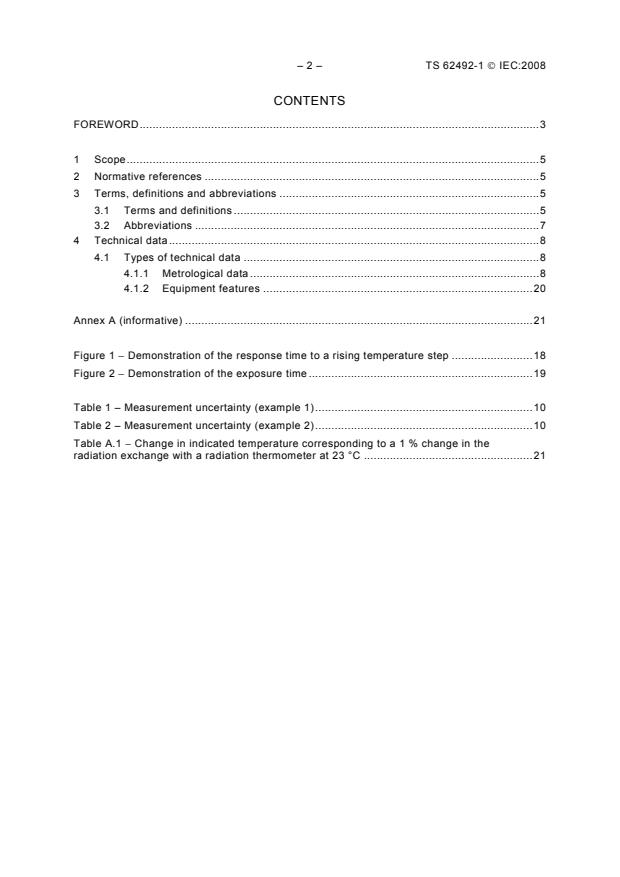
– 2 – TS 62492-1 © IEC:2008
CONTENTS
FOREWORD.3
1 Scope.5
2 Normative references .5
3 Terms, definitions and abbreviations .5
3.1 Terms and definitions .5
3.2 Abbreviations .7
4 Technical data.8
4.1 Types of technical data .8
4.1.1 Metrological data .8
4.1.2 Equipment features .20
Annex A (informative) .21
Figure 1 − Demonstration of the response time to a rising temperature step .18
Figure 2 − Demonstration of the exposure time .19
Table 1 – Measurement uncertainty (example 1).10
Table 2 – Measurement uncertainty (example 2).10
Table A.1 − Change in indicated temperature corresponding to a 1 % change in the
radiation exchange with a radiation thermometer at 23 °C .21
TS 62492-1 © IEC:2008 – 3 –
INTERNATIONAL ELECTROTECHNICAL COMMISSION
____________
INDUSTRIAL PROCESS CONTROL DEVICES –
RADIATION THERMOMETERS –
Part 1: Technical data for radiation thermometers
FOREWORD
1) The International Electrotechnical Commission (IEC) is a worldwide organization for standardization comprising
all national electrotechnical committees (IEC National Committees). The object of IEC is to promote
international co-operation on all questions concerning standardization in the electrical and electronic fields. To
this end and in addition to other activities, IEC publishes International Standards, Technical Specifications,
Technical Reports, Publicly Available Specifications (PAS) and Guides (hereafter referred to as “IEC
Publication(s)”). Their preparation is entrusted to technical committees; any IEC National Committee interested
in the subject dealt with may participate in this preparatory work. International, governmental and non-
governmental organizations liaising with the IEC also participate in this preparation. IEC collaborates closely
with the International Organization for Standardization (ISO) in accordance with conditions determined by
agreement between the two organizations.
2) The formal decisions or agreements of IEC on technical matters express, as nearly as possible, an international
consensus of opinion on the relevant subjects since each technical committee has representation from all
interested IEC National Committees.
3) IEC Publications have the form of recommendations for international use and are accepted by IEC National
Committees in that sense. While all reasonable efforts are made to ensure that the technical content of IEC
Publications is accurate, IEC cannot be held responsible for the way in which they are used or for any
misinterpretation by any end user.
4) In order to promote international uniformity, IEC National Committees undertake to apply IEC Publications
transparently to the maximum extent possible in their national and regional publications. Any divergence
between any IEC Publication and the corresponding national or regional publication shall be clearly indicated in
the latter.
5) IEC provides no marking procedure to indicate its approval and cannot be rendered responsible for any
equipment declared to be in conformity with an IEC Publication.
6) All users should ensure that they have the latest edition of this publication.
7) No liability shall attach to IEC or its directors, employees, servants or agents including individual experts and
members of its technical committees and IEC National Committees for any personal injury, property damage or
other damage of any nature whatsoever, whether direct or indirect, or for costs (including legal fees) and
expenses arising out of the publication, use of, or reliance upon, this IEC Publication or any other IEC
Publications.
8) Attention is drawn to the Normative references cited in this publication. Use of the referenced publications is
indispensable for the correct application of this publication.
9) Attention is drawn to the possibility that some of the elements of this IEC Publication may be the subject of
patent rights. IEC shall not be held responsible for identifying any or all such patent rights.
The main task of IEC technical committees is to prepare International Standards. In
exceptional circumstances, a technical committee may propose the publication of a technical
specification when
• the required support cannot be obtained for the publication of an International Standard,
despite repeated efforts, or
• the subject is still under technical development or where, for any other reason, there is the
future but no immediate possibility of an agreement on an International Standard.
Technical specifications are subject to review within three years of publication to decide
whether they can be transformed into International Standards.
IEC/TS 62492-1, which is a technical specification, has been prepared by subcommittee 65B:
Devices and process analysis, of IEC technical committee 65: Industrial-process
measurement, control and automation.
The text of this technical specification is based on the following documents:
– 4 – TS 62492-1 © IEC:2008
Enquiry draft Report on voting
65B/622/DTS 65B/649/CC
Full information on the voting for the approval of this technical specification can be found in
the report on voting indicated in the above table.
This publication has been drafted in accordance with the ISO/IEC Directives, Part 2.
This Technical Specification is one of a series of publications on radiation thermometers.
Future parts of this series are planned with the following titles:
Part 2: Determination of the technical data for radiation thermometers (under consideration);
Part 3: Calibration of radiation thermometers (under consideration).
The committee has decided that the contents of this publication will remain unchanged until
the maintenance result date indicated on the IEC web site under "http://webstore.iec.ch" in
the data related to the specific publication. At this date, the publication will be
• transformed into an International standard,
• reconfirmed,
• withdrawn,
• replaced by a revised edition, or
• amended.
TS 62492-1 © IEC:2008 – 5 –
INDUSTRIAL PROCESS CONTROL DEVICES –
RADIATION THERMOMETERS –
Part 1: Technical data for radiation thermometers
1 Scope
This Technical Specification applies to radiation thermometry. It defines the technical data,
i.e. metrological data to be given in data sheets and operating instructions for radiation
thermometers with one wavelength range and one measurement field, to ensure that the data
and terminology are used consistently.
Technical data for radiation thermometers are frequently given using terms whose meaning is
not clear and therefore open to misinterpretation. Moreover, the data are given for measuring
conditions which are not standardised. Often, influence parameters and mutual
interdependencies of technical data are not given. As a result, the user cannot easily compare
the technical design and performance data of radiation thermometers and tests for
compliance with the manufacturer’s specifications are difficult to carry out.
The purpose of this Technical Specification is to facilitate comparability and testability.
Therefore, unambiguous definitions are stipulated for stating technical data under
standardised measuring conditions.
NOTE 1 Infrared ear thermometers are excluded from this Specification.
NOTE 2 It is not compulsory for manufacturers and sellers of radiation thermometers to include all items given in
this Specification for a specific type of radiation thermometer. Only the relevant data should be stated and should
comply with this Specification.
2 Normative references
The following referenced documents are indispensable for the application of this document.
For dated references, only the edition cited applies. For undated references, the latest edition
of the referenced document (including any amendments) applies.
Guide to the Expression of Uncertainty of Measurement (1995) [BIPM, IEC, IFCC, ISO,
IUPAC, IUPAP, OIML]
International Vocabulary of Basic and General Terms in Metrology (1993) [BIPM, IEC, IFCC,
ISO, IUPAC, IUPAP, OIML]
3 Terms, definitions and abbreviations
3.1 Terms and definitions
For the purposes of this document, the following terms and definitions apply.
3.1.1
measuring temperature range
temperature range for which the radiation thermometer is designed
– 6 – TS 62492-1 © IEC:2008
3.1.2
measurement uncertainty (accuracy)
parameter, associated with the result of a measurement, that characterises the dispersion of
the values that could reasonably be attributed to the measurand
3.1.3
noise equivalent temperature difference
parameter which indicates the contribution of the measurement uncertainty in °C, which is due
to instrument noise
3.1.4
measuring distance
distance or distance range between the radiation thermometer and the target (measured
object) for which the radiation thermometer is designed
3.1.5
field-of-view
usually circular, flat surface of a measured object from which the radiation thermometer
receives radiation
3.1.6
distance ratio
ratio of the measuring distance to the diameter of the field-of-view when the target is in focus
3.1.7
size-of-source effect
difference in the radiance- or temperature reading of the radiation thermometer when
changing the size of the radiating area of the observed source
3.1.8
emissivity setting
the emissivity of a surface is the ratio between the radiation emitted from this surface and the
radiation from a blackbody at the same temperature. The emissivity describes a thermo-
physical material characteristic, which in addition to the chemical composition of the material
may also be dependent on the surface structure (rough, smooth), the emission direction as
well as on the observed wavelength and the temperature of the measured object.
In most measuring situations a radiation thermometer is used on a surface with an emissivity
significantly lower than 1. For this purpose most thermometers have the possibility of
adjusting the emissivity setting. The temperature reading is then automatically corrected
3.1.9
spectral range
parameter which gives the lower and upper limits of the wavelength range over which the
radiation thermometer operates
3.1.10
influence of the internal instrument or ambient temperature (temperature parameter)
parameter which gives the additional uncertainty of the measured temperature value
depending on the deviation of the temperature of the radiation thermometer from the value for
which the technical data is valid after warm-up time and under stable ambient conditions
3.1.11
influence of air humidity (humidity parameter)
parameter which gives the additional uncertainty of the measured temperature value
depending on the relative air humidity at a defined ambient temperature
TS 62492-1 © IEC:2008 – 7 –
3.1.12
long-term stability
reproducibility of measurements repeated over a long time period
3.1.13
short-term stability
reproducibility of measurements repeated over a short time period (several hours)
3.1.14
repeatability
twice the standard deviation of measurements repeated under the same conditions within a
very short time span (several minutes)
3.1.15
interchangeability
maximum deviation between the readings of two instruments of the same type operating
under identical conditions divided by two
3.1.16
response time
time interval between the instant of an abrupt change in the value of the input parameter
(object temperature or object radiation) and the instant from which the measured value of the
radiation thermometer (output parameter) remains within specified limits of its final value
3.1.17
exposure time
time interval necessary during which an abrupt change in the value of the input parameter
(object temperature or object radiation) has to be present, such that the output value of the
radiation thermometer reaches a given measurement value
3.1.18
warm-up time
time period needed after switching on the radiation thermometer for the radiation thermometer
to operate according to its specifications
3.1.19
operating temperature range and air humidity range
permissible temperature range and humidity range within which the radiation thermometer
may be operated. For this temperature range and humidity range the specifications are valid
3.1.20
storage and transport temperature range and air humidity range
permissible ambient temperature range and humidity range within which the radiation
thermometer may be stored and transported without suffering permanent change
3.2 Abbreviations
FWHM: Full width at half maximum
NETD: Noise equivalent temperature difference
SSE: Size-of-source effect
– 8 – TS 62492-1 © IEC:2008
4 Technical data
4.1 Types of technical data
Two types of technical data have to be distinguished: metrological data and equipment
features. The metrological data relate to the metrologically relevant values measured with a
radiation thermometer, whereas the equipment features are mainly important for operation
and convenience in the use of the equipment.
4.1.1 Metrological data
The following metrological data are used to describe the characteristics of a radiation
thermometer:
– measuring temperature range (3.1.1)
– measurement uncertainty (accuracy) (3.1.2)
– noise equivalent temperature difference (NETD) (3.1.3)
– measuring distance (3.1.4)
– field-of-view (target area, measurement field) (3.1.5)
– distance ratio (distance factor) (3.1.6)
– size-of-source effect (SSE) (3.1.7)
– emissivity setting (3.1.8)
– spectral range (3.1.9)
– temperature parameter (3.1.10)
– humidity parameter (3.1.11)
– long-term stability (3.1.12)
– short-term stability (3.1.13)
– repeatability (3.1.14)
– interchangeability (3.1.15)
– response time (3.1.16)
– exposure time (3.1.17)
– warm-up time (3.1.18)
– operating temperature range and air humidity range (3.1.19)
– storage and transport temperature range and air humidity range (3.1.20)
Relevant parameters for the particular metrological data, e.g. measuring conditions, influence
parameters and mutual interdependences shall be given.
Since several metrological data of a radiation thermometer depend on the emissivity setting of
the instrument, they shall always be given for an emissivity setting of 1, if not stated
otherwise. For radiation thermometers with an internal fixed emissivity setting different from 1,
the specifications shall be given for the standard setting of the instrument and the emissivity
value shall be stated. The measuring temperature range (3.1.1), the measurement uncertainty
(3.1.2) and the noise equivalent temperature difference (3.1.3) of a radiation thermometer
strongly depend on the emissivity setting of the radiation thermometer.
TS 62492-1 © IEC:2008 – 9 –
4.1.1.1 Measuring temperature range
4.1.1.1.1 General
The measurement uncertainty remains within the specified limits for the following temperature
range.
NOTE Sometimes it is useful to state additionally a wider “indicating temperature range” over which the
thermometer will display a temperature but its specifications are not guaranteed.
4.1.1.1.2 Examples of data
Measuring temperature range:
-50 C to 1 000 °C
or
400 °C to 2 500 °C for the emissivity range 0,1 to 1,0
4.1.1.2 Measurement uncertainty (accuracy)
4.1.1.2.1 General
The value of the measurement uncertainty shall be given together with the measurement
result (see the Guide to the Expression of Uncertainty of Measurement).
NOTE Where the measurement result M and the measurement uncertainty U are established, the value of the
measurand lies with high probability within the limits M - U and M + U. The measurement uncertainty should be
stated as U, with a confidence level of approximately 95 % (expanded uncertainty, coverage factor k = 2).
The measurement uncertainty should be quoted with respect to the International Temperature
Scale (currently ITS-90) – i.e. the uncertainty should include both the dispersion of the
instrument readings with respect to the calibration artefacts used and the uncertainty in the
traceability of these calibration artefacts to the ITS-90. Alternatively, the two contributions
may be stated separately.
The frequently-used term “accuracy” is a qualitative concept and should not be used with
numerical details. It generally signifies the closeness of the agreement between the result of a
measurement and the value of the measurand (see the International Vocabulary of Basic and
General Terms in Metrology).
4.1.1.2.2 Required parameters
The measurement uncertainty depends on the confidence level (a confidence level of
approximately 95 % should be given), the measured temperature, the ambient temperature,
the internal temperature of the radiation thermometer, the air humidity, the source diameter
and the field of view (respectively the measurement distance), therefore these parameters are
to be stated.
To simplify the uncertainty statement and make it more comparable, standardised
measurement conditions shall be used as far as possible: The measurement uncertainty shall
be stated for a confidence level of approximately 95 % and shall be valid over the complete
specified operating temperature range and air humidity range (3.1.19), if not stated otherwise.
Alternatively it shall be stated for: Confidence level approximately 95 %, ambient temperature
23 °C, relative air humidity of 50 % at 23 °C.
NOTE Radiation thermometers often cover a wide measuring temperature range and the radiance signal strongly
increases with the target temperature. Uncertainties in temperature measurement arise from drift and noise. The
noise contribution is often higher at the bottom of the temperature range and typically insignificant over most of the
temperature range. For a complete specification manufacturers should provide the measurement uncertainty
sampled across the complete measuring temperature range (3.1.1). This may be done by a table (see Table 1 and
Table 2).
– 10 – TS 62492-1 © IEC:2008
4.1.1.2.3 Examples of data
Measurement uncertainty:
0,5 °C + 0,2 % of the measured value in °C at a confidence level of approximately 95 %,
over the complete measuring temperature range, over the complete instrument operating
temperature and air humidity range, a source diameter of 60 mm (with a surrounding area
at t = 23 °C) and over the complete measuring distance
or
0,5 °C at a confidence level of approximately 95 %, a measured temperature of 100 °C, an
internal temperature of the instrument from 0 °C to 60 °C, a relative air humidity of 50 % at
23 °C, a source diameter of 60 mm (with a surrounding area at t = 23 °C) and a distance of
1 m
or
Table 1 – Measurement uncertainty (example 1)
Uncertainty
Internal
Measured Source Measuring
(95 % temperature
temperature diameter distance
confidence range Ambient conditions
°
level)
C mm m
°C °C
100 0,8 0 – 60 23 °C / 50 % RH 30 1
100 0,5 0 – 60 23 °C / 50 % RH 60 1
500 1,5 0 – 60 23 °C / 50 % RH 30 1
500 1,0 0 – 60 23 °C / 50 % RH 60 1
900 2,6 0 – 60 23 °C / 50 % RH 30 1
900 2,0 0 – 60 23 °C / 50 % RH 60 1
or
Table 2 – Measurement uncertainty (example 2)
Uncertainty
Internal
Measured Source Measuring
(95 %
temperature
temperature diameter distance
confidence range Ambient conditions
level)
°C mm m
°C
°C
100 0,5 0 – 60 60 1
23 °C / ≤ 50 % RH
100 0,6 0 – 60 23 °C / > 50 % RH 60 1
500 1,0 0 – 60 60 1
23 °C / ≤ 50 % RH
500 1,2 0 – 60 23 °C / > 50 % RH 60 1
900 2,0 0 – 60 60 1
23 °C / ≤ 50 % RH
900 2,4 0 – 60 23 °C / > 50 % RH 60 1
4.1.1.3 Noise equivalent temperature difference (NETD)
4.1.1.3.1 General
Noise occurs in all electrical equipment. A sufficiently large signal-to-noise ratio shall be
realised for each quantitative measurement. With spectral or band-pass radiation
thermometers, the signal-to-noise ratio is basically improved by increasing the response time
(integration time). The noise is highly dependent on the particular signal processing. In
TS 62492-1 © IEC:2008 – 11 –
contrast to the other metrological data, the confidence interval in this case is 68,3 %
(standard uncertainty, k = 1).
For low cost instruments the NETD may be limited by the resolution of the instrument.
The NETD is generally largest at the lowest temperature of the measuring temperature range.
For more information on the NETD the manufacturer should be contacted.
4.1.1.3.2 Required parameters
The measured temperature and the response time (3.1.16) are to be stated with the NETD.
For some instruments the NETD depends on the instrument- or ambient temperature. For
these instruments the instrument- or ambient temperature also has to be stated.
4.1.1.3.3 Examples of data
Noise equivalent temperature difference:
0,1 °C (20 °C / 0,25 s)
at a measured temperature of 20 °C and response time of t = 0,25 s
R90%
or
0,1 °C (20 °C / 100 Hz to 1 kHz)
at a measured temperature of 20 °C and after the signal has passed through a band pass
filter from 100 Hz to 1 kHz
4.1.1.4 Measuring distance
4.1.1.4.1 General
For the distance or distance range specified in 4.1.1.4.3, the specifications are valid if not
stated otherwise.
NOTE With the measuring distance the field-of-view (3.1.5) and the size-of-source effect (3.1.7) change.
Therefore the manufacturer should additionally provide a graph or equation showing the field-of-view as a function
of the measuring distance.
4.1.1.4.2 Required parameters
It has to be stated from which part of the radiation thermometer the distance to the target has
to be measured.
NOTE Stating the measuring distance from the front lens should be avoided, as it is impractical.
4.1.1.4.3 Examples of data
Measuring distance:
385 mm from the red mark on the objective tube
or
200 mm to 1 000 mm from the front edge of the objective tube
4.1.1.5 Field-of-view
4.1.1.5.1 General
Its magnitude is determined by the optical components in the radiation thermometer. As the
field-of-view is not sharply defined, it is necessary to state the diameter of the field-of-view at
– 12 – TS 62492-1 © IEC:2008
which the signal has dropped to a certain fraction of its total integrated value (hemispherical
value) (see first three examples in 4.1.1.5.3).
Other synonymous terms used for the field-of-view are target area, target size and
measurement field.
NOTE The transfer function between the measured radiation (input parameter) and temperature (output
parameter) is non-linear. As an example the change in indicated temperature corresponding to a 1 % change in the
radiation exchange with a radiation thermometer is given in Annex A. The field-of-view is therefore either defined
for the fraction of measured radiation or, for instruments which only read directly in temperature, it is necessary to
specify a change in the measured temperature in °C at a given temperature for the field-of-view in comparison to
the total integrated value (hemispherical value).
4.1.1.5.2 Required parameters
As the field-of-view value depends on the stated fraction of signal to its maximum value
(hemispherical value) and usually on the measuring distance (3.1.4), it is necessary to state
the measuring distance in addition to the fraction. The fraction value should be at least 90 %;
typical values are 90 %, 95 % and 99 %.
The relation between the field-of-view and the measuring distance should be shown by an
equation or a figure.
As an alternative, the distance ratio (3.1.6) can be used, specified as the measuring distance
divided by the diameter of the field-of-view.
For instruments which only read in temperature, it is necessary to specify with the field-of-
view the change in the measured temperature in comparison to the total integrated value at
the specified measured temperature. As a minimum these values should be given for the top,
middle and bottom of the temperature range (see fourth example in 4.1.1.5.3).
The complete information would be a graph, which shows the signal or temperature versus
source size (see size-of-source effect 3.1.7).
NOTE For some radiation thermometers, especially for high temperature instruments, it is impracticable to relate
the field-of-view to a hemispherical value. In this case it is allowed to relate the given field-of-view to a larger
source (e.g. twice as large in area as the field-of-view) (see fifth example in 4.1.1.5.3).
The area of the source must always be given. Since the field-of-view and the size-of-source
effect are strongly related see also 3.1.7.
4.1.1.5.3 Examples of data
Field-of-view:
3,4 mm diameter (90 %), measuring distance: 400 mm
or
4,0 mm diameter (95 %), measuring distance: 400 mm
or
7,0 mm diameter (99 %), measuring distance: 400 mm
or
4,0 mm diameter (1,7 °C at 100 °C, 6 °C at 400 °C, 12 °C at 700 °C), measuring distance:
400 mm
or
4,0 mm diameter (5 % increase in measured radiation when the radiation source is twice
as large in area as the field-of-view), measuring distance: 400 mm
TS 62492-1 © IEC:2008 – 13 –
4.1.1.6 Distance ratio
4.1.1.6.1 General
Another synonymous term used for the distance ratio is “distance factor”.
4.1.1.6.2 Required parameters
For variable focus instruments the distance ratio should be specified for a measuring distance
of 1 m, if this lies within the focusing range. If it does not lie within the focusing range, then a
suitable distance within the focusing range should be chosen.
4.1.1.6.3 Examples of data
Distance ratio:
120:1 (90 %), measuring distance: 1 m
or
150:1 (95 %), measuring distance: 1 200 mm
4.1.1.7 Size-of-source effect (SSE)
4.1.1.7.1 General
Imperfections in the optical components, interelement reflections and scatter lead to a blurring
of the field-of-view of a radiation thermometer. Therefore, a radiation thermometer with an
ideally sharp field-of-view profile is not realizable and in practice the signal of a radiation
thermometer is dependent of the size of the observed source (size-of-source effect). To
describe the SSE, the difference in the radiance- or temperature reading of the radiation
thermometer when changing the size of the radiating area of the observed source shall be
stated. The source must have a stable and homogenous radiance within this area (i.e. the
temperature and emissivity of the source shall not change when changing the size of the
radiating area or such changes have to be corrected). The complete information would be a
graph, which shows the signal or temperature reading versus source size (size-of-source
effect).
To simplify the SSE statement and make it more comparable, the following measurement
conditions shall be used as far as possible: The SSE is to be stated at a given measuring
distance, measured temperature and ambient temperature, when observing a target with the
area of the nominal field-of-view and twice the area of the nominal field-of-view or more than
twice the area of the nominal field-of-view. In the later case, the area should be specified.
NOTE The SSE is either defined as the relative change in the observed radiance or, for instruments which only
read in temperature, as the absolute change in the measured temperature at a given temperature, when changing
the observed target area. Since the latter definition depends on the source temperature it is necessary to state the
SSE at the top, middle and bottom temperatures of the measuring temperature range.
4.1.1.7.2 Required parameters
With the size-of-source effect it is necessary to state the measuring distance and the
measured temperature. Additionally, when relevant the ambient temperature and the
temperature of the surrounding of the source (the temperature of the source aperture) when it
is different from the ambient temperature has to be stated.
4.1.1.7.3 Examples of data
Size-of-source effect:
SSE: 4,5 % increase in radiance reading when increasing the radiating area from the
specified (nominal) field-of-view to twice the field-of-view (doubling the area of the nominal
– 14 – TS 62492-1 © IEC:2008
target area), measuring distance: 400 mm, measured temperature 500 °C, ambient
temperature 23 °C
or
SSE: 1,045 radiance ratio when increasing the radiating area from the specified (nominal)
field-of-view to twice the field-of-view, measuring distance: 400 mm, measured
temperature: 500 °C, ambient temperature: 23 °C
or
1,7 °C at 100 °C, 6 °C at 400 °C, 12 °C at 700 °C increase in temperature reading when
increasing the radiating area from the specified (nominal) field-of-view to twice the field-of-
view, measuring distance: 400 mm, ambient temperature 23 °C
4.1.1.8 Emissivity setting
4.1.1.8.1 General
For all metrological data the emissivity setting shall be 1 if not specified otherwise (see 4.1.1).
4.1.1.8.2 Required parameters
The range and the resolution of the emissivity setting shall be given. For information on the
internal emissivity correction procedure the manufacturer has to be contacted.
4.1.1.8.3 Examples of data
Emissivity setting:
0,100 to 1,000, resolution 0,001
or
0,10 to 1,00, resolution 0,01
4.1.1.9 Spectral range
4.1.1.9.1 General
The spectral range is given in μm or nm. The lower and upper wavelength limits at which the
spectral responsivity has reached 50 % of the peak responsivity are given as the spectral
range. Alternatively, a mean wavelength and full wavelength width at which the responsivity
has reached 50 % of the peak sensitivity (FWHM) are given.
NOTE For some radiation thermometers, especially for narrow band or spectral radiation thermometers, it is more
useful to give lower and upper wavelength limits at which the spectral responsivity has reached significantly less
than 50 % of the peak responsivity (e.g. 10 %). In this case the criteria for the wavelength limits have to be stated.
It is common for spectral radiation thermometers to give the mean wavelength of the spectral
range and the FWHM, and for band pass radiation thermometers to give the lower and upper
limits.
All elements of the optical system of the thermometer are to be taken into account when
determining the spectral responsivity.
TS 62492-1 © IEC:2008 – 15 –
4.1.1.9.2 Examples of data
Spectral range:
0,9 µm, FWHM 0,2 µm
or
8 µm to 14 µm
4.1.1.10 Influence of the internal instrument or ambient temperature (temperature
parameter)
4.1.1.10.1 General
The technical data of a radiation thermometer, e.g. the measurement uncertainty (3.1.2), shall
be valid over the complete operating instrument or ambient temperature range and air
humidity range (3.1.19), if not stated otherwise. If the measurement uncertainty is not valid in
the complete operating instrument or ambient temperature range, the manufacturer shall state
a temperature parameter which gives the additional measurement uncertainty when the
instrument or ambient temperature deviates from a given reference temperature.
The instrument temperature is the internal temperature of the instrument. For instruments with
no internal temperature indication the ambient temperature shall be stated instead of the
instrument temperature. The instrument temperature value (reference temperature) or
instrument temperature range for which the technical data are valid shall be stated (operating
temperature range (3.1.19)). Alternatively, the ambient temperature shall be used as the
reference temperature.
A deviation of the instrument or ambient temperature from the instrument reference
temperature value or operating temperature range for which the technical data is valid leads
to an additional measurement uncertainty. The temperature parameter gives the additional
uncertainty of the measured value depending on the deviation of the temperature of the
radiation thermometer from the value for which the technical data is valid after warm-up time
and under stable ambient conditions. It is given as the absolute or relative increase in the
uncertainty of the measured value when the instrument or ambient temperature deviates from
the reference temperature.
4.1.1.10.2 Required parameters
For many instruments the temperature parameter will depend on the target temperature. In
this case the temperature range for which the parameter applies has to be stated.
4.1.1.10.3 Examples of data
Temperature parameter:
0,2 °C/°C (25 °C, 600 °C), 0,02 °C/°C (25 °C > 700 °C)
additional uncertainty of the measured temperature where the internal temperature of the
radiation thermometer deviates from 25 °C for a target temperature of 600 °C and for
target temperatures above 700 °C
or
0,2 % of the measured value in °C/°C (23 °C)
additional relative uncertainty of the measured value where the internal temperature of the
radiation thermometer deviates from 23 °C for the complete measuring temperature range
– 16 – TS 62492-1 © IEC:2008
4.1.1.11 Influence of air humidity (humidity parameter)
4.1.1.11.1 General
The technical data of a radiation thermometer, e.g. the measurement uncertainty (3.1.2), shall
be valid over the specified measuring distance (3.1.4) and operating temperature range and
air humidity range (3.1.19), if not stated otherwise. If within the specified measurement
distance the measurement uncertainty is not valid in the complete operating air humidity
range, the manufacturer shall state a humidity parameter which gives the additional
measurement uncertainty when the air humidity deviates from a given reference humidity.
NOTE The humidity parameter depends on a variety of factors. Its measurement by the manufacturer and its
application by the user is difficult. In general, therefore, working with a humidity parameter should be avoided and
the specified measurement uncertainty should be valid over the complete specified operating air humidity and
measuring distance range.
The effect of humidity should be described in the operating instructions of the radiation
thermometer. Some radiation thermometers allow an internal correction of the influence of
humidity on the signal, when the air humidity, air temperature and measuring distance are set
by the user.
The reference air humidity is the air humidity for which the technical data are valid and shall
be stated.
A deviation of the air humidity from the reference air humidity leads to an additional
uncertainty in temperature measurement. The humidity parameter gives the additional
uncertainty of the measured temperature value depending on the relative air humidity at a
defined ambient temperature. It is given as the absolute or relative increase in uncertainty in
the measured value per percentage change in the air humidity relative to the reference
humidity.
4.1.1.11.2 Required parameters
The humidity parameter depends on the measuring distance and when stated as a
temperature shift also on the target temperature. The humidity parameter should always be
stated for a measuring distance, target temperature, reference humidity and ambient
temperature which is typical for the application of the radiation thermometer. If no target
temperature is stated, the parameter shall be valid for the whole measuring temperature
range.
4.1.1.11.3 Examples of data
Humidity parameter:
0,2 °C/% (50 %, 23 °C, 1 m, 600 °C), 0,1 °C/% (50 %, 23 °C, 1 m, < 500 °C)
additional uncertainty of the measured temperature where the relative humidity deviates
from 50 % at 23 °C for a measuring distance of 1 m for a target temperature of 600 °C and
target temperatures below 500 °C
or
0,02 % of the measured value in °C/% (45 %, 23 °C, 1 m)
additional uncertainty of the measured value where the relative humidity deviates from
45 % at 23 °C for a measuring distance of 1 m for the complete measuring temperature
range
4.1.1.12 Long-term stability
4.1.1.12.1 General
The long-term stability should be stated in °C over a time span of 90 days or over 1 year.
TS 62492-1 © IEC:2008 – 17 –
4.1.1.12.2 Required parameters
The long-term stability depends on the stability of the mechanical, electrical and optical
components of the radiation thermometer, the measured temperature and the confidence
level. The last two parameters are to be stated.
4.1.1.12.3 Example of data
Long-term stability:
± 2 °C over 90 days
at a measured temperature of 100 °C and a confidence level of approximately 95 %
or
± 3 °C over 1 year
at a measured temperature of 100 °C and a confidence level of approximately 95 %
4.1.1.13 Short-term stability
4.1.1.13.1 General
The short-term stability should be stated in a rate °C/h or as a maximum temperature
deviation within a short time span (several hours) after warm-up time.
4.1.1.13.2 Required parameters
The short-term stability depends on the measured temperature, the confidence level, the
response time (3.1.16) and the internal instrument or ambient temperature. These parameters
are to be stated.
4.1.1.13.3 Example of data
Short-term stability:
± 0,1 °C/h
at a measured temperature of 50 °C, a confidence level of approximately 95 %, a response
time of t = 1 s and an instrument temperature of 25 °C after warm-up time
R90%
or
better than 0,5 °C at a measured temperature of 50 °C, a response time of t = 1 s and
R90%
an instrument temperatur
...