

IEC 60904-4:2019
(Main)Photovoltaic devices - Part 4: Photovoltaic reference devices - Procedures for establishing calibration traceability
General Information
- Abstract
IEC 60904-4:2019 sets the requirements for calibration procedures intended to establish the traceability of photovoltaic (PV) reference devices to SI units as required by IEC 60904-2. This document applies to PV reference devices that are used to measure the irradiance of natural or simulated sunlight for the purpose of quantifying the performance of PV devices. The use of a PV reference device is required in many standards concerning PV (e.g. IEC 60904-1 and IEC 60904-3). This document has been written with single-junction PV reference devices in mind, in particular crystalline silicon, but it is sufficiently general to include other single-junction technologies. This second edition cancels and replaces the first edition published in 2009. This edition includes the following significant technical changes with respect to the previous edition:
modification of standard title;
- inclusion of working reference in traceability chain;
- update of WRR with respect to SI;
- revision of all methods and their uncertainties in annex
- harmonization of symbols and formulae with other IEC standards.
The contents of the corrigendum of September 2020 have been included in this copy.
- Status
- Published
- Publication Date
- 11-Nov-2019
- Technical Committee
- TC 82 - Solar photovoltaic energy systems
- Drafting Committee
- WG 2 - TC 82/WG 2
- Current Stage
- PPUB - Publication issued
- Start Date
- 12-Nov-2019
- Completion Date
- 15-Nov-2019
Buy Documents
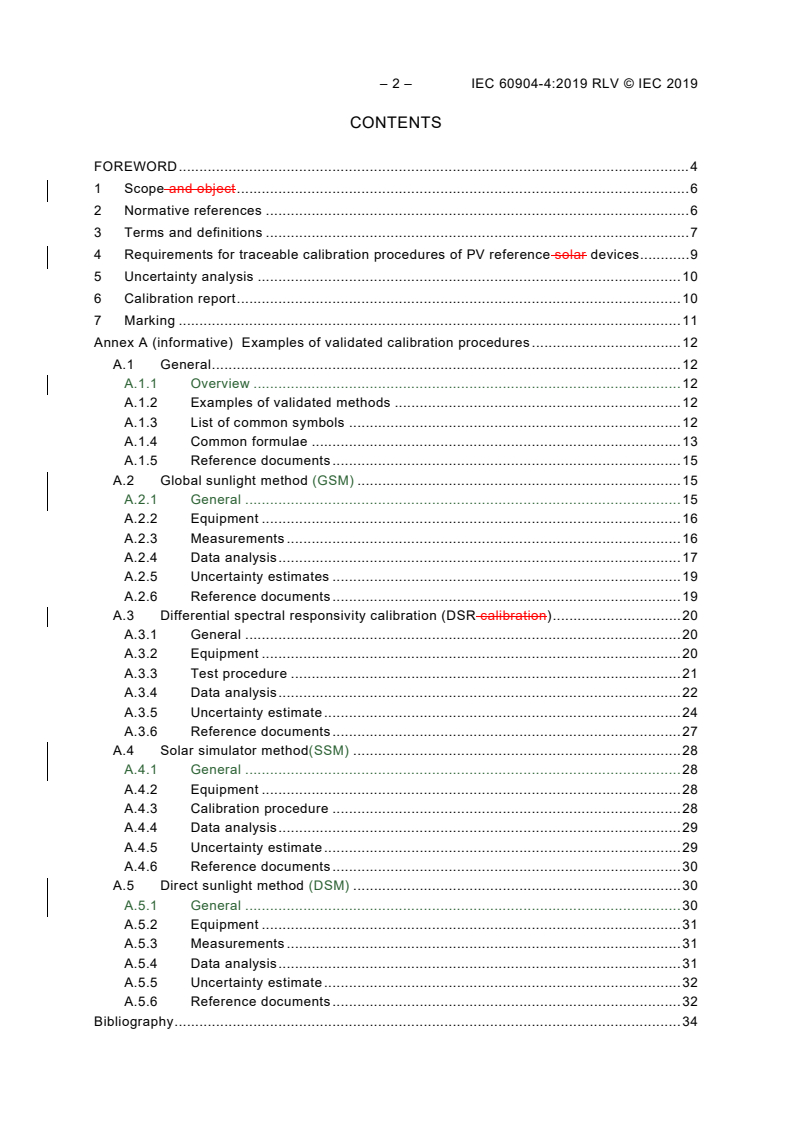
IEC 60904-4:2019 RLV - Photovoltaic devices - Part 4: Photovoltaic reference devices - Procedures for establishing calibration traceability Released:11/12/2019
IEC 60904-4:2019 - Photovoltaic devices - Part 4: Photovoltaic reference devices - Procedures for establishing calibration traceability Released:11/12/2019
Overview
IEC 60904-4:2019 - "Photovoltaic devices - Part 4: Photovoltaic reference devices - Procedures for establishing calibration traceability" specifies requirements for calibration procedures that establish the traceability of photovoltaic (PV) reference devices to SI units. The standard applies to PV reference solar devices used to measure irradiance from natural or simulated sunlight for quantifying PV device performance. Written with single‑junction technologies in mind (particularly crystalline silicon), the second edition (2019) updates the traceability chain by including a working reference, aligns WRR traceability to the SI, revises calibration methods and uncertainties, and harmonizes symbols and formulae with related IEC standards.
Key Topics and Requirements
- Calibration traceability to SI units: Procedures required to link PV reference devices through validated transfer instruments and methods back to SI.
- Scope of reference devices: Focus on single‑junction PV reference devices (e.g., crystalline silicon) but generally applicable to other single‑junction technologies.
- Inclusion of a working reference: The traceability chain now formally includes a working reference (WRR) and updates for its relation to SI.
- Annex A - Validated methods: Practical, validated calibration methods are described, including:
- Global Sunlight Method (GSM)
- Differential Spectral Responsivity calibration (DSR)
- Solar Simulator Method (SSM)
- Direct Sunlight Method (DSM)
- Uncertainty analysis: Requirements for documenting measurement uncertainties and typical uncertainty components for each method are provided.
- Calibration reporting and marking: Required contents of calibration reports and marking of reference devices to ensure traceability and transparency.
- Harmonization and normative references: Aligns with IEC 60904-1/-2/-3, ISO/IEC 17025, and the GUM for uncertainty expression.
Applications and Who Uses It
IEC 60904-4:2019 is intended for:
- Calibration laboratories and national metrology institutes establishing SI traceability for PV reference devices.
- PV test labs and certification bodies that require calibrated irradiance references for accurate IV testing and performance claims.
- Manufacturers of PV reference cells and solar simulators implementing validated calibration procedures and uncertainty budgets.
- Research institutions and field measurement teams performing irradiance measurements under natural or simulated sunlight.
Practical benefits include consistent irradiance measurement across labs, improved comparability of PV performance data, and robust uncertainty statements supporting conformity to PV measurement standards.
Related Standards
- IEC 60904-1: Measurement of PV current‑voltage characteristics
- IEC 60904-2: Requirements for reference solar PV reference devices (traceability requirement)
- IEC 60904-3: Measurement principles with reference spectral irradiance data
- ISO/IEC 17025: Competence of testing and calibration laboratories
- ISO/IEC Guide 98-3 (GUM): Uncertainty of measurement
Keywords: IEC 60904-4:2019, photovoltaic reference devices, calibration traceability, SI units, PV reference solar devices, crystalline silicon, working reference, uncertainty analysis, solar simulator, differential spectral responsivity.
Relations
- Effective Date
- 05-Sep-2023
- Effective Date
- 05-Sep-2023
Buy Documents
IEC 60904-4:2019 RLV - Photovoltaic devices - Part 4: Photovoltaic reference devices - Procedures for establishing calibration traceability Released:11/12/2019
IEC 60904-4:2019 - Photovoltaic devices - Part 4: Photovoltaic reference devices - Procedures for establishing calibration traceability Released:11/12/2019
Get Certified
Connect with accredited certification bodies for this standard

DNV
DNV is an independent assurance and risk management provider.

Lloyd's Register
Lloyd's Register is a global professional services organisation specialising in engineering and technology.
DNV Energy Systems
Energy and renewable energy certification.
Sponsored listings
Frequently Asked Questions
IEC 60904-4:2019 is a standard published by the International Electrotechnical Commission (IEC). Its full title is "Photovoltaic devices - Part 4: Photovoltaic reference devices - Procedures for establishing calibration traceability". This standard covers: IEC 60904-4:2019 sets the requirements for calibration procedures intended to establish the traceability of photovoltaic (PV) reference devices to SI units as required by IEC 60904-2. This document applies to PV reference devices that are used to measure the irradiance of natural or simulated sunlight for the purpose of quantifying the performance of PV devices. The use of a PV reference device is required in many standards concerning PV (e.g. IEC 60904-1 and IEC 60904-3). This document has been written with single-junction PV reference devices in mind, in particular crystalline silicon, but it is sufficiently general to include other single-junction technologies. This second edition cancels and replaces the first edition published in 2009. This edition includes the following significant technical changes with respect to the previous edition: modification of standard title; - inclusion of working reference in traceability chain; - update of WRR with respect to SI; - revision of all methods and their uncertainties in annex - harmonization of symbols and formulae with other IEC standards. The contents of the corrigendum of September 2020 have been included in this copy.
IEC 60904-4:2019 sets the requirements for calibration procedures intended to establish the traceability of photovoltaic (PV) reference devices to SI units as required by IEC 60904-2. This document applies to PV reference devices that are used to measure the irradiance of natural or simulated sunlight for the purpose of quantifying the performance of PV devices. The use of a PV reference device is required in many standards concerning PV (e.g. IEC 60904-1 and IEC 60904-3). This document has been written with single-junction PV reference devices in mind, in particular crystalline silicon, but it is sufficiently general to include other single-junction technologies. This second edition cancels and replaces the first edition published in 2009. This edition includes the following significant technical changes with respect to the previous edition: modification of standard title; - inclusion of working reference in traceability chain; - update of WRR with respect to SI; - revision of all methods and their uncertainties in annex - harmonization of symbols and formulae with other IEC standards. The contents of the corrigendum of September 2020 have been included in this copy.
IEC 60904-4:2019 is classified under the following ICS (International Classification for Standards) categories: 27.160 - Solar energy engineering. The ICS classification helps identify the subject area and facilitates finding related standards.
IEC 60904-4:2019 has the following relationships with other standards: It is inter standard links to IEC 60904-4:2019/COR1:2020, IEC 60904-4:2009. Understanding these relationships helps ensure you are using the most current and applicable version of the standard.
IEC 60904-4:2019 is available in PDF format for immediate download after purchase. The document can be added to your cart and obtained through the secure checkout process. Digital delivery ensures instant access to the complete standard document.
Standards Content (Sample)
IEC 60904-4 ®
Edition 2.0 2019-11
REDLINE VERSION
INTERNATIONAL
STANDARD
colour
inside
Photovoltaic devices –
Part 4: Reference solar Photovoltaic reference devices – Procedures
for establishing calibration traceability
All rights reserved. Unless otherwise specified, no part of this publication may be reproduced or utilized in any form
or by any means, electronic or mechanical, including photocopying and microfilm, without permission in writing from
either IEC or IEC's member National Committee in the country of the requester. If you have any questions about IEC
copyright or have an enquiry about obtaining additional rights to this publication, please contact the address below or
your local IEC member National Committee for further information.
IEC Central Office Tel.: +41 22 919 02 11
3, rue de Varembé info@iec.ch
CH-1211 Geneva 20 www.iec.ch
Switzerland
About the IEC
The International Electrotechnical Commission (IEC) is the leading global organization that prepares and publishes
International Standards for all electrical, electronic and related technologies.
About IEC publications
The technical content of IEC publications is kept under constant review by the IEC. Please make sure that you have the
latest edition, a corrigendum or an amendment might have been published.
IEC publications search - webstore.iec.ch/advsearchform Electropedia - www.electropedia.org
The advanced search enables to find IEC publications by a The world's leading online dictionary on electrotechnology,
variety of criteria (reference number, text, technical containing more than 22 000 terminological entries in English
committee,…). It also gives information on projects, replaced and French, with equivalent terms in 16 additional languages.
and withdrawn publications. Also known as the International Electrotechnical Vocabulary
(IEV) online.
IEC Just Published - webstore.iec.ch/justpublished
Stay up to date on all new IEC publications. Just Published IEC Glossary - std.iec.ch/glossary
details all new publications released. Available online and 67 000 electrotechnical terminology entries in English and
once a month by email. French extracted from the Terms and Definitions clause of
IEC publications issued since 2002. Some entries have been
IEC Customer Service Centre - webstore.iec.ch/csc collected from earlier publications of IEC TC 37, 77, 86 and
If you wish to give us your feedback on this publication or CISPR.
need further assistance, please contact the Customer Service
Centre: sales@iec.ch.
IEC 60904-4 ®
Edition 2.0 2019-11
REDLINE VERSION
INTERNATIONAL
STANDARD
colour
inside
Photovoltaic devices –
Part 4: Reference solar Photovoltaic reference devices – Procedures
for establishing calibration traceability
INTERNATIONAL
ELECTROTECHNICAL
COMMISSION
ICS 27.160 ISBN 978-2-8322-7608-2
– 2 – IEC 60904-4:2019 RLV © IEC 2019
CONTENTS
FOREWORD . 4
1 Scope and object . 6
2 Normative references . 6
3 Terms and definitions . 7
4 Requirements for traceable calibration procedures of PV reference solar devices . 9
5 Uncertainty analysis . 10
6 Calibration report . 10
7 Marking . 11
Annex A (informative) Examples of validated calibration procedures . 12
A.1 General . 12
A.1.1 Overview . 12
A.1.2 Examples of validated methods . 12
A.1.3 List of common symbols . 12
A.1.4 Common formulae . 13
A.1.5 Reference documents . 15
A.2 Global sunlight method (GSM) . 15
A.2.1 General . 15
A.2.2 Equipment . 16
A.2.3 Measurements . 16
A.2.4 Data analysis . 17
A.2.5 Uncertainty estimates . 19
A.2.6 Reference documents . 19
A.3 Differential spectral responsivity calibration (DSR calibration) . 20
A.3.1 General . 20
A.3.2 Equipment . 20
A.3.3 Test procedure . 21
A.3.4 Data analysis . 22
A.3.5 Uncertainty estimate . 24
A.3.6 Reference documents . 27
A.4 Solar simulator method(SSM) . 28
A.4.1 General . 28
A.4.2 Equipment . 28
A.4.3 Calibration procedure . 28
A.4.4 Data analysis . 29
A.4.5 Uncertainty estimate . 29
A.4.6 Reference documents . 30
A.5 Direct sunlight method (DSM) . 30
A.5.1 General . 30
A.5.2 Equipment . 31
A.5.3 Measurements . 31
A.5.4 Data analysis . 31
A.5.5 Uncertainty estimate . 32
A.5.6 Reference documents . 32
Bibliography . 34
Figure 1 – Schematic of most common reference instruments and transfer methods
used in the traceability chains for solar irradiance detectors . 9
Figure A.1 – Block diagram of differential spectral responsivity calibration
superimposing chopped monochromatic radiation DE(l) and DC bias radiation E . 25
b
Figure A.2 – Optical arrangement of differential spectral responsivity calibration . 27
Figure A.3 – Schematic apparatus of the solar simulator method . 30
Table 1 – Examples of reference instruments used in a traceability chain of time and
solar irradiance . 9
Table A.1 – Typical uncertainty components (k = 2) of global sunlight method . 19
Table A.2 – Typical Uncertainty components (k = 2) of differential spectral responsivity
calibration method on PV reference devices . 24
Table A.3 – Example of uncertainty components (k = 2) of a solar simulator method
calibration . 29
Table A.4 – Typical uncertainty components (k = 2) of a solar simulator method
calibration when WRR traceable cavity radiometer is used. 29
Table A.5 – Typical uncertainty components (k = 2) of a direct sunlight method using
temperature dependent spectral correction factor (Formula (A.16)), without applying
a correction factor for the WRR to SI scale . 32
– 4 – IEC 60904-4:2019 RLV © IEC 2019
INTERNATIONAL ELECTROTECHNICAL COMMISSION
____________
PHOTOVOLTAIC DEVICES –
Part 4: Reference solar Photovoltaic reference devices –
Procedures for establishing calibration traceability
FOREWORD
1) The International Electrotechnical Commission (IEC) is a worldwide organization for standardization comprising
all national electrotechnical committees (IEC National Committees). The object of IEC is to promote
international co-operation on all questions concerning standardization in the electrical and electronic fields. To
this end and in addition to other activities, IEC publishes International Standards, Technical Specifications,
Technical Reports, Publicly Available Specifications (PAS) and Guides (hereafter referred to as “IEC
Publication(s)”). Their preparation is entrusted to technical committees; any IEC National Committee interested
in the subject dealt with may participate in this preparatory work. International, governmental and non-
governmental organizations liaising with the IEC also participate in this preparation. IEC collaborates closely
with the International Organization for Standardization (ISO) in accordance with conditions determined by
agreement between the two organizations.
2) The formal decisions or agreements of IEC on technical matters express, as nearly as possible, an international
consensus of opinion on the relevant subjects since each technical committee has representation from all
interested IEC National Committees.
3) IEC Publications have the form of recommendations for international use and are accepted by IEC National
Committees in that sense. While all reasonable efforts are made to ensure that the technical content of IEC
Publications is accurate, IEC cannot be held responsible for the way in which they are used or for any
misinterpretation by any end user.
4) In order to promote international uniformity, IEC National Committees undertake to apply IEC Publications
transparently to the maximum extent possible in their national and regional publications. Any divergence
between any IEC Publication and the corresponding national or regional publication shall be clearly indicated in
the latter.
5) IEC itself does not provide any attestation of conformity. Independent certification bodies provide conformity
assessment services and, in some areas, access to IEC marks of conformity. IEC is not responsible for any
services carried out by independent certification bodies.
6) All users should ensure that they have the latest edition of this publication.
7) No liability shall attach to IEC or its directors, employees, servants or agents including individual experts and
members of its technical committees and IEC National Committees for any personal injury, property damage or
other damage of any nature whatsoever, whether direct or indirect, or for costs (including legal fees) and
expenses arising out of the publication, use of, or reliance upon, this IEC Publication or any other IEC
Publications.
8) Attention is drawn to the Normative references cited in this publication. Use of the referenced publications is
indispensable for the correct application of this publication.
9) Attention is drawn to the possibility that some of the elements of this IEC Publication may be the subject of
patent rights. IEC shall not be held responsible for identifying any or all such patent rights.
This redline version of the official IEC Standard allows the user to identify the changes
made to the previous edition. A vertical bar appears in the margin wherever a change
has been made. Additions are in green text, deletions are in strikethrough red text.
International Standard IEC 60904-4 has been prepared by IEC technical committee 82: Solar
photovoltaic energy systems.
This second edition cancels and replaces the first edition published in 2009. This edition
constitutes a technical revision.
This edition includes the following significant technical changes with respect to the previous
edition:
a) modification of standard title;
b) inclusion of working reference in traceability chain;
c) update of WRR with respect to SI;
d) revision of all methods and their uncertainties in Annex A;
e) harmonization of symbols and formulae with other IEC standards.
The text of this International Standard is based on the following documents:
FDIS Report on voting
82/1618/FDIS 82/1638/RVD
Full information on the voting for the approval of this International Standard can be found in
the report on voting indicated in the above table.
This document has been drafted in accordance with the ISO/IEC Directives, Part 2.
A list of all parts in the IEC 60904 series, published under the general title Photovoltaic
devices, can be found on the IEC website.
The committee has decided that the contents of this document will remain unchanged until the
stability date indicated on the IEC website under "http://webstore.iec.ch" in the data related to
the specific document. At this date, the document will be
reconfirmed,
withdrawn,
replaced by a revised edition, or
amended.
The contents of the corrigendum of September 2020 have been included in this copy.
IMPORTANT – The 'colour inside' logo on the cover page of this publication indicates
that it contains colours which are considered to be useful for the correct
understanding of its contents. Users should therefore print this document using a
colour printer.
– 6 – IEC 60904-4:2019 RLV © IEC 2019
PHOTOVOLTAIC DEVICES –
Part 4: Reference solar Photovoltaic reference devices –
Procedures for establishing calibration traceability
1 Scope and object
This part of IEC 60904 sets the requirements for calibration procedures intended to establish
the traceability of photovoltaic (PV) reference solar devices to SI units as required by
IEC 60904-2.
This document applies to photovoltaic (PV) reference solar devices that are used to measure
the irradiance of natural or simulated sunlight for the purpose of quantifying the performance
of PV devices. The use of a PV reference solar device is required in the application of many
standards concerning PV (e.g. IEC 60904-1 and IEC 60904-3).
This document has been written with single-junction PV reference solar devices in mind, in
particular crystalline silicon, but it is sufficiently general to include other single-junction
technologies. However, the main part of the standard is sufficiently general to include other
technologies. The methods described in Annex A, however, are limited to single junction
technologies.
2 Normative references
The following documents are referred to in the text in such a way that some or all of their
content constitutes requirements of this document. For dated references, only the edition
cited applies. For undated references, the latest edition of the referenced document (including
any amendments) applies.
IEC 60904-1, Photovoltaic devices – Part 1: Measurement of photovoltaic current-voltage
characteristics
IEC 60904-2, Photovoltaic devices – Part 2: Requirements for reference solar photovoltaic
reference devices
IEC 60904-3, Photovoltaic devices – Part 3: Measurement principles for terrestrial
photovoltaic (PV) solar devices with reference spectral irradiance data
IEC TS 61836, Solar photovoltaic energy systems – Terms, definitions and symbols
ISO/IEC 17025, General requirements for the competence of testing and calibration
laboratories
ISO 9059, Solar energy – Calibration of field pyrheliometers by comparison to a reference
pyrheliometer
ISO 9846, Solar energy – Calibration of a pyranometer using a pyrheliometer
ISO/IEC Guide 98-3: 2008, Uncertainty of measurement – Part 3: Guide to the expression of
uncertainty in measurement (GUM: 1995)
3 Terms and definitions
For the purposes of this document, the terms and definitions given in IEC TS 61836 and the
following apply.
NOTE The different reference instruments for the traceability chain of solar irradiance are defined in this clause.
Table 1 lists and compares them with those in use for time. Figure 1 shows schematically the most common
traceability chains, based on the methods described in Annex A. Typical examples for each category are listed in
Table 1, which also refers to relevant standards (where available). Figure 1 then shows schematically the most
common traceability chains linking these instruments and the relevant standards (where available). Methods for the
implementation of this document are described in Annex A.
ISO and IEC maintain terminological databases for use in standardization at the following
addresses:
• IEC Electropedia: available at http://www.electropedia.org/
• ISO Online browsing platform: available at http://www.iso.org/obp
3.1
primary standard
a device, which implements physically one of the SI units or directly related quantities.
standard that is designated or widely acknowledged as having the highest metrological
qualities and whose value is accepted without reference to other standards of the same
quantity
Note 1 to entry: The concept of a primary standard is equally valid for base quantities and derived quantities.
Note 2 to entry: A primary standard is never used directly for measurement other than for comparison with other
primary standards or secondary standards.
Note 3 to entry: Primary standards are usually maintained by national metrology institutes (NMIs) or similar
organizations entrusted with maintenance of standards for physical quantities. Often referred to also just as the
«primary», the physical implementation is selected such that long-term stability, precision accuracy and
repeatability of measurement of the quantity it represents are guaranteed to the maximum extent possible by
current technology.
Note 4 to entry: The World Radiometric Reference (WRR) as realized by the World Standard Group (WSG) of
cavity radiometers is the accepted primary standard for the measurement of solar irradiance.
3.2
secondary standard
device which, by periodical comparison with a primary standard, serves to maintain conformity
to SI units at other places than that of the primary standard
Note 1 to entry: A secondary standard does not necessarily use the same technical principles as the primary
standard, but strives to achieve similar long-term stability, precision accuracy and repeatability.
Note 2 to entry: Typical secondary standards for solar irradiance are cavity radiometers which participate
periodically (normally every 5 years) in the International Pyrheliometer Comparison (IPC) with the WSG, thereby
giving traceability to WRR. Direct traceability to SI radiometric scale can also be available for these instruments.
3.3
primary reference
the reference instrument which a laboratory uses to calibrate secondary references. It is,
compared at periodic intervals to a secondary standard
Note 1 to entry: Often primary references can be realized at much lower costs than secondary standards.
Note 2 to entry: Typically, a solar PV cell is used as a reference solar device for the measurement of natural or
simulated solar irradiance. Primary references are normally used by calibration and testing laboratories.
3.4
secondary reference
measurement device in use for daily routine measurements or to calibrate working references,
calibrated at periodic intervals to against a primary reference
– 8 – IEC 60904-4:2019 RLV © IEC 2019
Note 1 to entry: The most common secondary references for the measurement of natural or simulated solar
irradiance are solar PV cells and solar PV modules. Secondary references are normally used by calibration and
testing laboratories, but sometimes also in industrial production.
3.5
working reference
measurement device in use for daily routine measurements, calibrated at periodic intervals
against a secondary reference
Note 1 to entry: The most common working references for the measurement of natural or simulated solar
irradiance are PV cells and PV modules.
Note 2 to entry: Working references are normally used in industrial production.
3.6
traceability
requirement for any PV reference solar device, to tie its
calibration value to SI units in an unbroken and documented chain of calibration transfers
including stated uncertainties
Note 1 to entry: The WRR has been compared twice to the SI radiometric scale and shown to be within their
mutual uncertainty levels. Therefore traceability to WRR automatically provides traceability to SI units. However,
the uncertainty of the ratio WRR/SI units needs to be taken into account. The World Radiation Center (WRC)
recommends a rectangular uncertainty distribution with 0,3 % half-width. A third comparison is currently underway
and should be published in the future.
J. Romero, N.P. Fox, C. Fröhlich metrologia 28 (1991) 125-8
J. Romero, N.P. Fox, C. Fröhlich metrologia 32 (1995/1996) 523-4
The WRR has been compared several times to the SI radiometric scale. While in previous comparisons the two
scales were found to be indistinguishable within the uncertainty of the comparison, the latest comparison of scales
established that there is a systematic shift between the scales, with WRR reading 0,34 % higher irradiance than
the SI scale. The uncertainty of this shift was given as 0,18 % (k = 2). Therefore, traceability to WRR automatically
provides traceability to SI units. However, the shift between the scales may be corrected for those measurements
traceable to the WRR. The uncertainty of the scale comparison shall be included into the uncertainty budget.
Essentially there are two possibilities for those measurements traceable to SI units via the WRR. Firstly, no
correction is applied for the scale difference and a larger uncertainty of 0,3 % (rectangular distribution) shall be
used. Secondly an explicit correction of the scale difference amounting to 0,34 %. In this case the uncertainty
contribution is 0,18 % (k = 2). The value of 0,34 % for the scale difference is the latest available at time of
publication of this document. The scientific literature should be checked for possible updates of this difference and
its uncertainty. In particular, it is possible that in the future the WRR is adapted to take account of this difference
and bring it into line with SI units. In this case no further correction shall be applied.
[SOURCE: A Fehlmann, G Kopp, W Schmutz, R Winkler, W Finsterle, N Fox, metrologia 49
(2012) S34]
Table 1 – Examples of reference instruments used
in a traceability chain of time and solar irradiance
Reference
Time Solar irradiance
instrument
Primary standard Cesium atomic clock at Group of cavity radiometers constituting the World Standard
National Metrology Group (WSG) of the World Radiometric Reference (WRR)
Institute (NMI)
Cryogenic trap detector
Standard lamp
Secondary Cesium atomic clock Commercially available cavity radiometers compared regularly
standard on GPS (Global (normally every 5 years) at the International Pyrheliometer
Positioning System) Comparison (IPC)
satellites
Standard detector calibrated against a trap detector
Spectroradiometer calibrated against a standard lamp
Primary reference GPS receiver, set to Normal incidence pyrheliometer (NIP) (ISO 9059)
show time
Reference solar PV reference device (IEC 60904-2 and
IEC 60904-4)
Secondary Quartz watch Pyranometer (ISO 9846)
reference
Reference solar PV reference device (IEC 60904-2)
Working reference Pyranometer (ISO 9847)
PV reference device (IEC 60904-2)
NOTE Direct traceability of absolute radiometers to SI radiometric scale may also be available.
Figure 1 – Schematic of most common reference instruments and transfer methods
used in the traceability chains for solar irradiance detectors
4 Requirements for traceable calibration procedures of PV reference solar
devices
A traceable calibration procedure is necessary to transfer calibration from a standard or
reference measuring solar irradiance and based on a physical principle other than PV effect
– 10 – IEC 60904-4:2019 RLV © IEC 2019
(such as cavity radiometer, pyrheliometer and pyranometer) to a PV reference solar device.
The requirements for such procedures are as follows:
a) Any measurement instrument required and used in the transfer procedure shall be an
instrument with an unbroken traceability chain.
b) A documented uncertainty analysis.
c) Documented repeatability, such as measurement results of laboratory intercomparison, or
documents of laboratory quality control.
d) Inherent absolute precision accuracy, given by a limited number of intermediate transfers.
NOTE 1 Normally the transfer would be from a secondary standard to a PV reference solar cell
device constituting a primary reference.
NOTE 2 The transfer from one PV reference solar device to another is covered by
IEC 60904-2.
5 Uncertainty analysis
An uncertainty estimate according to MISC UNCERT – ED. 1.0 (1995-01)
ISO/IEC Guide 98-3: 2008 shall be provided for each traceable calibration procedure. This
estimate shall provide information on the uncertainty of the calibration procedure and
quantitative data on the following uncertainty factors for each instrument used in performing
the calibration procedure. In particular:
a) Component of uncertainty arising from random effects (Type A).
b) Component of uncertainty arising from systematic effects (Type B).
Nevertheless A full uncertainty analysis has to be performed for the implementation of the
calibration method by a particular laboratory. Annex A provides examples of the main
uncertainty components in some particular implementations. Due to the variety of methods
available, it is impossible to give a detailed guidance on how a particular uncertainty analysis
should be made. However, the following components shall be considered:
– uncertainty of all measurement instruments involved;
– offset and drift of all measurement instruments;
– uncertainty of all references used;
– uncertainty of measured device temperature;
– uncertainty introduced of deviations between actual and nominal device temperature;
– uncertainty of irradiance measurement (total and spectral irradiance);
– uncertainty introduced by deviations between actual and reference spectral irradiance;
– contributions due to repeatability and reproducibility;
– uncertainty due to instability of conditions and instruments.
6 Calibration report
The calibration report shall conform to the requirements of ISO/IEC 17025 and shall normally
include at least the following information:
a) title (e.g. ”Calibration Certificate”);
b) name and address of laboratory, and location where the tests and/or calibrations were
carried out, if different from the address of the laboratory;
c) unique identification of the report (such as serial number) and of each page, the total
number of pages and the date of issue;
d) name and address of the client placing the order;
e) description and unambiguous identification of the item(s) tested or calibrated;
f) date of receipt of calibration item(s) and date(s) of performance of test or calibration, as
appropriate;
g) calibration results and their uncertainties, including the temperature of the device at which
the calibration was performed;
h) reference to sampling procedures used by the laboratory where these are relevant to the
validity or application of the results;
i) the name(s), title(s) and signature(s) or equivalent identification of person(s) authorizing
the report;
j) where relevant, a statement to the effect that the results relate only to the items tested or
calibrated;
k) where relevant the spectral responsivity of the PV reference device;
l) where relevant the temperature coefficient of the PV reference device.
7 Marking
The calibrated PV reference solar device shall be marked with a serial number or reference
number and the following information attached or provided on an accompanying certificate:
a) date of (actual or present) calibration;
b) calibration value and its temperature coefficient (if applicable) uncertainty;
c) identification of laboratory having performed the calibration.
– 12 – IEC 60904-4:2019 RLV © IEC 2019
Annex A
(informative)
Examples of validated calibration procedures
A.1 General
A.1.1 Overview
Annex A describes examples of calibration procedures for PV reference solar cells devices as
primary reference devices, together with their stated uncertainties. These procedures serve to
establish the traceability of PV reference solar devices to SI units as required by IEC 60904-2.
Primary reference devices calibrated in accordance with these procedures serve to establish
the traceability of further PV reference solar devices, which then constitute secondary
reference devices.
As already mentioned in Clause 1, the methods in this annex are limited to PV single junction
technology. Moreover, they have currently only been validated for crystalline silicon
technology, although they should could be applicable to other technologies.
The methods have been implemented in various laboratories around the world and validated
in international intercomparisons, most notably the World Photovoltaic Scale (WPVS).
However, the description in this document is more generalized. For details of the various
implementations, the references in peer-reviewed publications are given at the end of each
procedure.
The uncertainty estimates are based on U (coverage factor k = 2) for all single components.
The combined expanded uncertainty is calculated as the square root of the sum of squares of
all components. The uncertainties provided are simplified versions (restricted to the main
components) as provided by the laboratories having implemented the procedure. These
uncertainty calculations only serve as guidelines and will have to be adapted to the particular
implementation of each procedure in a given laboratory. The uncertainties achieved by any
implementation of these methods might be considerably different. Uncertainties quoted by a
given laboratory have to be based on an explicit specific analysis and cannot be taken by
reference to the uncertainty estimates in this document.
A.1.2 Examples of validated methods
A.2 Global sunlight method (GSM)
A.3 Differential spectral responsivity calibration (DSR)
A.4 Solar simulator method (SSM)
A.5 Direct sunlight method (DSM)
A.1.3 List of common symbols
I short-circuit current of PV reference cell device
SC
T temperature of PV reference cell device
j
M irradiance correction factor (see below)
G
M temperature correction factor (see below)
T
T temperature coefficient α of the short-circuit current (IEC 60891) normalized to the
coef
short-circuit current at 25 °C and expressed in 1/ °C K
MMF mismatch factor (see below)
SMM spectral mismatch factor (IEC 60904-7)
λ wavelength
S(λ) spectral response of reference cell
s(λ) differential spectral responsivity of reference cell
s(λ) spectral responsivity of PV reference device as a function of wavelength λ
s(λ,T ) spectral responsivity of PV reference device as a function of wavelength λ and
j
temperature T
j
∂s λ,T
( )
j
partial derivative of spectral responsivity with respect to temperature as a function
∂T
of wavelength λ
s�(λ) differential spectral responsivity of PV reference device
E E (λ) spectral irradiance distribution of natural or simulated sunlight
m meas
E E (λ) standard or reference spectral irradiance distribution according to IEC 60904-3
s ref
G direct irradiance
dir
G diffuse in-plane irradiance
dif
G total in-plane irradiance
T
E G irradiance at STC (= 1 000 Wm–2)
STC STC
CV calibration value, i.e. I at STC
SC
AM air mass
–2
STC standard test conditions (1 000 Wm , 25 °C and E (λ) E (λ))
s ref
P local air pressure
P 101 300 Pa
θ solar elevation angle
A.1.4 Common formulae
The methods described in Clauses A.2, A.4 and A.5 have some common calculations, which
are detailed in A.1.4. Details of the various implementations are then described in each
subclause.
–2
The I is normally not measured at exactly 1 000 Wm , but at an irradiance level close to it.
SC
Under the assumption that the I of the reference cell varies linearly with irradiance, the
SC
following correction is made:
W
−2 m
I (1 000 Wm ) = I M = I (A.1)
SC SC G SC
G
T
STC mandate a device temperature of 25 °C, but measurements will not always be taken at
this temperature. The deviations in temperature should be accounted for in the uncertainty
budget. It is also possible to correct ISC from the measurement temperature Tj to 25 °C by
multiplying with the temperature correction factor M defined by
T
I (T )
SC j
I (25 °C) = I (T )M =
(A.2)
SC SC j T
1− T (25 °C − T )
coef j
The correction for the difference in spectral sensitivity of the reference cell to be calibrated
and the device used to measure the irradiance can be described as a MMF
– 14 – IEC 60904-4:2019 RLV © IEC 2019
4000 nm 4000 nm
S(λ) ⋅ E (λ) ⋅ dλ E (λ) ⋅ dλ
s m
∫ ∫
300 nm 300 nm
MMF = (A.3)
4000 nm 4000 nm
S(λ) ⋅ E (λ) ⋅ dλ E (λ) ⋅ dλ
m s
∫ ∫
300 nm 300 nm
NOTE The integration range is taken based on the definition of E (λ). If the measurement range, in particular that
s
of E (λ), does not cover this entire range, suitable approximation, extrapolation or modelling can be used, but
m
needs to be accounted for in the uncertainty calculation.
The calibration value CV of the reference cell is then calculated as
(A.4)
CV = I M M MMF
SC G T
–2
The I is normally not measured at exactly 1 000 Wm , but at an irradiance level close to it.
SC
Under the assumption that the I of the PV reference device varies linearly with irradiance
SC
according to IEC 60904-10, the following correction is made:
G
STC
I G IM I (A.1)
( )
SC STC SC G SC
G
T
If the irradiance measurement is traceable to the WRR, then the irradiance reading may be
corrected for the scale difference to SI units.
STC mandate a device temperature of 25 °C, but measurements will not always be taken at
this temperature. The deviations in temperature should be accounted for in the uncertainty
budget. It is also possible to correct I from the measurement temperature T to 25 °C by
SC j
multiplying with the temperature correction factor M defined by:
T
IT
( )
SC j
I 25 ℃ I TM
( )
( ) (A.2)
SC SC j T
1−−TT25 ℃
( )
coef j
The correction for the difference in spectral responsivity of the PV reference device to be
calibrated and the device used to measure the irradiance can be calculated as a spectral
mismatch SMM:
∞∞
E λ dλ E λ s λ dλ
( ) ( ) ( )
ref meas
∫∫
(A.3)
SMM =
∞∞
E (λ)dλ E (λ)s (λ)dλ
meas ref
∫∫
NOTE Formula A.3 is the same formula as in IEC 60904-7 for the case of a thermopile detector where the
spectral responsivity of the device under test is now the spectral responsivity of the PV reference device to be
calibrated.
The integration range is over all wavelengths. For E (λ) the irradiance is zero below 280 nm.
ref
This also holds normally for E (λ) in particular under natural sunlight. For practical reasons
meas
the explicit integral cannot be calculated above 4 000 nm, as E (λ) is not defined explicitly
ref
but only the integral irradiance between 4 000 nm and infinity. E (λ) is typically only
meas
measured for an even smaller wavelength range, for example up to 2 500 nm. In order to
calculate the integrals, suitable approximation (truncation of the integrals) or extension of
measured spectral irradiance data by extrapolation or modelling can be used, but has to be
accounted for in the uncertainty calculation. For example, the truncation of the integrals at
4 000 nm for the DSM will lead to an error of 0,025 %, whereas truncation at 2 500 nm to an
==
==
error of 0,116 %. These values have been determined from the direct and global spectral
irradiance as defined in IEC 60904-3.
Cavity radiometers used for irradiance measurement are assumed to detect irradiance at all
wavelengths perfectly. Possible deviations from such a perfect characteristic should be
corrected or accounted for in the measurement uncertainty.
The calibration value (CV) of the PV reference device is then calculated as:
MM
GT
CV = I (A.4)
SC
SMM
A.1.5 Reference documents
– IEC 60891: Photovoltaic devices – Procedures for temperature and irradiance corrections
to measured I-V characteristics
– IEC 60904-7: Photovoltaic devices – Part 7: Computation of the spectral mismatch
correction for measurements of photovoltaic devices
– IEC 60904-10: Photovoltaic devices – Part 10: Methods of linearity measurements
– C. R. Osterwald et al., “The results of the PEP’93 intercomparison of reference cell
calibrations and newer technology performance measurements: Final Report”,
NREL/TP-520-23477, 1998, 209 pages
– C. R. Osterwald et al., “The world photovoltaic scale: an international reference cell
calibration program”, Progress in Photovoltaics, 7, 1999, 287-297
– K. Emery, “The results of the First World Photovoltaic Scale Recalibration”,
NREL/TP-520-27942, 2000, 14 pages
– Winter el al., “The results of the Second World Photovoltaic Scale Recalibration”, Proc. of
st
the 31 IEEE PVSC , 3-7 January 2005, Orlando, Florida, USA, pp. 1011-1014
A.2 Global sunlight method (GSM)
A.2.1 General
The establishment of traceability is based on the calibration using the continuous sun-and-
shade method as described in ISO 9846. The PV reference solar cell device to be calibrated
is compared under natural sunlight with two reference radiometers, namely a pyrheliometer
measuring direct solar irradiance and a pyranometer measuring diffuse solar irradiance by
application of a continuous shade shading device under normal incidence conditions. The
total solar irradiance is determined by the sum of direct irradiance and diffuse in-plane
irradiance. As a pyrheliometer, a secondary standard is used in the form of an absolute cavity
radiometer regularly compared at 5-year intervals with the World Standard Group (WSG)
establishing the World Radiometric Reference (WRR). The calibration factor for the
photovoltaic PV reference cell device is determined from the measured short-circuit current,
scaled to 1 000 W/m and corrected for spectral mismatch (IEC 60904-7) corrected according
to Formula (A.4) based on the measured spectral irradiance of the global sunlight and the
relative spectral response responsivity of the PV reference solar cell device to be calibrated.
Under certain conditions the simplified global sunlight method is applicable. The short-circuit
current of the PV reference cell device is scaled to 1 000 W/m corrected by Formulae (A.1)
and (A.2) and then plotted versus pressure corrected geometric air mass (AM). The calibration
value is determined from a linear least square fit at AM = 1,5. A spectral mismatch correction
according to Formula (A.3) is not required and hence the measurements of the spectral
irradiance of the natural sunlight and the spectral response responsivity of the PV reference
device are not necessary. In the simplified version of the global sunlight method no explicit
spectral mismatch correction is performed and it the explicit correction according to Formula
(A.3) is replaced by conditions which should ensure that the spectral irradiance of the natural
sunlight is sufficiently close to the defined standard spectral irradiance (IEC 60904-3) that the
– 16 – IEC 60904-4:2019 RLV © IEC 2019
uncertainty component is smaller than quoted in Table A.1. Although this should be ensured
by the conditions listed in the description of the method below, it should be explicitly verified
(preferentially by using the full global sunlight method). After this validation the simplified
version can be applied as long as the boundary conditions are the same as during the
validation.
NOTE 1 The verification and validation will produce numerical values for both methods. If the
agreement between these numerical values is within the uncertainty budget of the methods,
the simplified method shall be deemed validated.
NOTE 2 The simplified procedure gives accurate results for devices with a spectral response
responsivity over a broad range of the solar spectrum for example crystalline silicon devices.
but significant errors may be introduced for narrow spectral response responsivity devices.
A.2.2 Equipment
a) A mounting platform, which can be oriented normal to the sun within an accuracy of ±0,5°
throughout the calibration run.
b) A cavity radiometer, traceable to the WRR.
c) A pyranometer, traceable to the WRR.
d) A shading device to provide shade to item c). The field angle, viewing angle and aperture
angle provided by the shade shall compensate the respective descriptive angles of the
cavity radiometer of item b).
e) A temperature controlled mounting block for the PV reference device under test capable of
maintaining the cell device temperature at (25 ± 2) °C throughout all calibration r
...
IEC 60904-4 ®
Edition 2.0 2019-11
INTERNATIONAL
STANDARD
NORME
INTERNATIONALE
colour
inside
Photovoltaic devices –
Part 4: Photovoltaic reference devices – Procedures for establishing calibration
traceability
Dispositifs photovoltaïques –
Partie 4: Dispositifs photovoltaïques de référence – Procédures pour établir
la traçabilité de l'étalonnage
All rights reserved. Unless otherwise specified, no part of this publication may be reproduced or utilized in any form
or by any means, electronic or mechanical, including photocopying and microfilm, without permission in writing from
either IEC or IEC's member National Committee in the country of the requester. If you have any questions about IEC
copyright or have an enquiry about obtaining additional rights to this publication, please contact the address below or
your local IEC member National Committee for further information.
Droits de reproduction réservés. Sauf indication contraire, aucune partie de cette publication ne peut être reproduite
ni utilisée sous quelque forme que ce soit et par aucun procédé, électronique ou mécanique, y compris la photocopie
et les microfilms, sans l'accord écrit de l'IEC ou du Comité national de l'IEC du pays du demandeur. Si vous avez des
questions sur le copyright de l'IEC ou si vous désirez obtenir des droits supplémentaires sur cette publication, utilisez
les coordonnées ci-après ou contactez le Comité national de l'IEC de votre pays de résidence.
IEC Central Office Tel.: +41 22 919 02 11
3, rue de Varembé info@iec.ch
CH-1211 Geneva 20 www.iec.ch
Switzerland
About the IEC
The International Electrotechnical Commission (IEC) is the leading global organization that prepares and publishes
International Standards for all electrical, electronic and related technologies.
About IEC publications
The technical content of IEC publications is kept under constant review by the IEC. Please make sure that you have the
latest edition, a corrigendum or an amendment might have been published.
IEC publications search - webstore.iec.ch/advsearchform Electropedia - www.electropedia.org
The advanced search enables to find IEC publications by a The world's leading online dictionary on electrotechnology,
variety of criteria (reference number, text, technical containing more than 22 000 terminological entries in English
committee,…). It also gives information on projects, replaced and French, with equivalent terms in 16 additional languages.
and withdrawn publications. Also known as the International Electrotechnical Vocabulary
(IEV) online.
IEC Just Published - webstore.iec.ch/justpublished
Stay up to date on all new IEC publications. Just Published IEC Glossary - std.iec.ch/glossary
details all new publications released. Available online and 67 000 electrotechnical terminology entries in English and
once a month by email. French extracted from the Terms and Definitions clause of
IEC publications issued since 2002. Some entries have been
IEC Customer Service Centre - webstore.iec.ch/csc collected from earlier publications of IEC TC 37, 77, 86 and
If you wish to give us your feedback on this publication or CISPR.
need further assistance, please contact the Customer Service
Centre: sales@iec.ch.
A propos de l'IEC
La Commission Electrotechnique Internationale (IEC) est la première organisation mondiale qui élabore et publie des
Normes internationales pour tout ce qui a trait à l'électricité, à l'électronique et aux technologies apparentées.
A propos des publications IEC
Le contenu technique des publications IEC est constamment revu. Veuillez vous assurer que vous possédez l’édition la
plus récente, un corrigendum ou amendement peut avoir été publié.
Recherche de publications IEC - Electropedia - www.electropedia.org
webstore.iec.ch/advsearchform Le premier dictionnaire d'électrotechnologie en ligne au
La recherche avancée permet de trouver des publications IEC monde, avec plus de 22 000 articles terminologiques en
en utilisant différents critères (numéro de référence, texte, anglais et en français, ainsi que les termes équivalents dans
comité d’études,…). Elle donne aussi des informations sur les 16 langues additionnelles. Egalement appelé Vocabulaire
projets et les publications remplacées ou retirées. Electrotechnique International (IEV) en ligne.
IEC Just Published - webstore.iec.ch/justpublished Glossaire IEC - std.iec.ch/glossary
Restez informé sur les nouvelles publications IEC. Just 67 000 entrées terminologiques électrotechniques, en anglais
Published détaille les nouvelles publications parues. et en français, extraites des articles Termes et Définitions des
Disponible en ligne et une fois par mois par email. publications IEC parues depuis 2002. Plus certaines entrées
antérieures extraites des publications des CE 37, 77, 86 et
Service Clients - webstore.iec.ch/csc CISPR de l'IEC.
Si vous désirez nous donner des commentaires sur cette
publication ou si vous avez des questions contactez-nous:
sales@iec.ch.
IEC 60904-4 ®
Edition 2.0 2019-11
INTERNATIONAL
STANDARD
NORME
INTERNATIONALE
colour
inside
Photovoltaic devices –
Part 4: Photovoltaic reference devices – Procedures for establishing calibration
traceability
Dispositifs photovoltaïques –
Partie 4: Dispositifs photovoltaïques de référence – Procédures pour établir
la traçabilité de l'étalonnage
INTERNATIONAL
ELECTROTECHNICAL
COMMISSION
COMMISSION
ELECTROTECHNIQUE
INTERNATIONALE
ICS 27.160 ISBN 978-2-8322-7531-3
– 2 – IEC 60904-4:2019 © IEC 2019
CONTENTS
FOREWORD . 4
1 Scope . 6
2 Normative references . 6
3 Terms and definitions . 6
4 Requirements for traceable calibration procedures of PV reference devices . 9
5 Uncertainty analysis . 9
6 Calibration report . 10
7 Marking . 10
Annex A (informative) Examples of validated calibration procedures . 11
A.1 General . 11
A.1.1 Overview . 11
A.1.2 Examples of validated methods . 11
A.1.3 List of common symbols . 11
A.1.4 Common formulae . 12
A.1.5 Reference documents . 13
A.2 Global sunlight method (GSM) . 13
A.2.1 General . 13
A.2.2 Equipment . 14
A.2.3 Measurements . 15
A.2.4 Data analysis . 15
A.2.5 Uncertainty estimates . 16
A.2.6 Reference documents . 17
A.3 Differential spectral responsivity calibration (DSR) . 17
A.3.1 General . 17
A.3.2 Equipment . 18
A.3.3 Test procedure . 18
A.3.4 Data analysis . 20
A.3.5 Uncertainty estimate . 20
A.3.6 Reference documents . 22
A.4 Solar simulator method (SSM) . 23
A.4.1 General . 23
A.4.2 Equipment . 23
A.4.3 Calibration procedure . 23
A.4.4 Data analysis . 24
A.4.5 Uncertainty estimate . 24
A.4.6 Reference documents . 25
A.5 Direct sunlight method (DSM) . 25
A.5.1 General . 25
A.5.2 Equipment . 26
A.5.3 Measurements . 26
A.5.4 Data analysis . 26
A.5.5 Uncertainty estimate . 27
A.5.6 Reference documents . 27
Bibliography . 28
Figure 1 – Schematic of most common reference instruments and transfer methods
used in the traceability chains for solar irradiance detectors . 9
Figure A.1 – Block diagram of differential spectral responsivity calibration
superimposing chopped monochromatic radiation DE(l) and DC bias radiation E . 21
b
Figure A.2 – Optical arrangement of differential spectral responsivity calibration . 22
Figure A.3 – Schematic apparatus of the solar simulator method . 25
Table 1 – Examples of reference instruments used in a traceability chain of solar
irradiance . 8
Table A.1 – Typical uncertainty components (k = 2) of global sunlight method . 17
Table A.2 – Uncertainty components (k = 2) of differential spectral responsivity
calibration method on PV reference devices . 21
Table A.3 – Example of uncertainty components (k = 2) of a solar simulator method
calibration . 24
Table A.4 – Typical uncertainty components (k = 2) of a solar simulator method
calibration when WRR traceable cavity radiometer is used. 24
Table A.5 – Typical uncertainty components (k = 2) of a direct sunlight method using
temperature dependent spectral correction factor (Formula (A.16)), without applying a
correction factor for the WRR to SI scale . 27
– 4 – IEC 60904-4:2019 © IEC 2019
INTERNATIONAL ELECTROTECHNICAL COMMISSION
____________
PHOTOVOLTAIC DEVICES –
Part 4: Photovoltaic reference devices –
Procedures for establishing calibration traceability
FOREWORD
1) The International Electrotechnical Commission (IEC) is a worldwide organization for standardization comprising
all national electrotechnical committees (IEC National Committees). The object of IEC is to promote
international co-operation on all questions concerning standardization in the electrical and electronic fields. To
this end and in addition to other activities, IEC publishes International Standards, Technical Specifications,
Technical Reports, Publicly Available Specifications (PAS) and Guides (hereafter referred to as “IEC
Publication(s)”). Their preparation is entrusted to technical committees; any IEC National Committee interested
in the subject dealt with may participate in this preparatory work. International, governmental and non-
governmental organizations liaising with the IEC also participate in this preparation. IEC collaborates closely
with the International Organization for Standardization (ISO) in accordance with conditions determined by
agreement between the two organizations.
2) The formal decisions or agreements of IEC on technical matters express, as nearly as possible, an international
consensus of opinion on the relevant subjects since each technical committee has representation from all
interested IEC National Committees.
3) IEC Publications have the form of recommendations for international use and are accepted by IEC National
Committees in that sense. While all reasonable efforts are made to ensure that the technical content of IEC
Publications is accurate, IEC cannot be held responsible for the way in which they are used or for any
misinterpretation by any end user.
4) In order to promote international uniformity, IEC National Committees undertake to apply IEC Publications
transparently to the maximum extent possible in their national and regional publications. Any divergence
between any IEC Publication and the corresponding national or regional publication shall be clearly indicated in
the latter.
5) IEC itself does not provide any attestation of conformity. Independent certification bodies provide conformity
assessment services and, in some areas, access to IEC marks of conformity. IEC is not responsible for any
services carried out by independent certification bodies.
6) All users should ensure that they have the latest edition of this publication.
7) No liability shall attach to IEC or its directors, employees, servants or agents including individual experts and
members of its technical committees and IEC National Committees for any personal injury, property damage or
other damage of any nature whatsoever, whether direct or indirect, or for costs (including legal fees) and
expenses arising out of the publication, use of, or reliance upon, this IEC Publication or any other IEC
Publications.
8) Attention is drawn to the Normative references cited in this publication. Use of the referenced publications is
indispensable for the correct application of this publication.
9) Attention is drawn to the possibility that some of the elements of this IEC Publication may be the subject of
patent rights. IEC shall not be held responsible for identifying any or all such patent rights.
International Standard IEC 60904-4 has been prepared by IEC technical committee 82: Solar
photovoltaic energy systems.
This second edition cancels and replaces the first edition published in 2009. This edition
constitutes a technical revision.
This edition includes the following significant technical changes with respect to the previous
edition:
a) modification of standard title;
b) inclusion of working reference in traceability chain;
c) update of WRR with respect to SI;
d) revision of all methods and their uncertainties in Annex A;
e) harmonization of symbols and formulae with other IEC standards.
The text of this International Standard is based on the following documents:
FDIS Report on voting
82/1618/FDIS 82/1638/RVD
Full information on the voting for the approval of this International Standard can be found in
the report on voting indicated in the above table.
This document has been drafted in accordance with the ISO/IEC Directives, Part 2.
A list of all parts in the IEC 60904 series, published under the general title Photovoltaic
devices, can be found on the IEC website.
The committee has decided that the contents of this document will remain unchanged until the
stability date indicated on the IEC website under "http://webstore.iec.ch" in the data related to
the specific document. At this date, the document will be
• reconfirmed,
• withdrawn,
• replaced by a revised edition, or
• amended.
IMPORTANT – The 'colour inside' logo on the cover page of this publication indicates
that it contains colours which are considered to be useful for the correct
understanding of its contents. Users should therefore print this document using a
colour printer.
– 6 – IEC 60904-4:2019 © IEC 2019
PHOTOVOLTAIC DEVICES –
Part 4: Photovoltaic reference devices –
Procedures for establishing calibration traceability
1 Scope
This part of IEC 60904 sets the requirements for calibration procedures intended to establish
the traceability of photovoltaic (PV) reference devices to SI units as required by IEC 60904-2.
This document applies to PV reference devices that are used to measure the irradiance of
natural or simulated sunlight for the purpose of quantifying the performance of PV devices.
The use of a PV reference device is required in many standards concerning PV (e.g.
IEC 60904-1 and IEC 60904-3).
This document has been written with single-junction PV reference devices in mind, in
particular crystalline silicon, but it is sufficiently general to include other single-junction
technologies.
2 Normative references
The following documents are referred to in the text in such a way that some or all of their
content constitutes requirements of this document. For dated references, only the edition
cited applies. For undated references, the latest edition of the referenced document (including
any amendments) applies.
IEC 60904-1, Photovoltaic devices – Part 1: Measurement of photovoltaic current-voltage
characteristics
IEC 60904-2, Photovoltaic devices – Part 2: Requirements for photovoltaic reference devices
IEC 60904-3, Photovoltaic devices – Part 3: Measurement principles for terrestrial
photovoltaic (PV) solar devices with reference spectral irradiance data
IEC TS 61836, Solar photovoltaic energy systems – Terms, definitions and symbols
ISO/IEC Guide 98-3: 2008, Uncertainty of measurement – Part 3: Guide to the expression of
uncertainty in measurement (GUM: 1995)
3 Terms and definitions
For the purposes of this document, the terms and definitions given in IEC TS 61836 and the
following apply.
NOTE The different reference instruments for the traceability chain of solar irradiance are defined in this clause.
Typical examples for each category are listed in Table 1, which also refers to relevant standards (where available).
Figure 1 then shows schematically the most common traceability chains linking these instruments and the relevant
standards (where available). Methods for the implementation of this document are described in Annex A.
ISO and IEC maintain terminological databases for use in standardization at the following
addresses:
• IEC Electropedia: available at http://www.electropedia.org/
• ISO Online browsing platform: available at http://www.iso.org/obp
3.1
primary standard
standard that is designated or widely acknowledged as having the highest metrological
qualities and whose value is accepted without reference to other standards of the same
quantity
Note 1 to entry: The concept of a primary standard is equally valid for base quantities and derived quantities.
Note 2 to entry: A primary standard is never used directly for measurement other than for comparison with other
primary standards or secondary standards.
Note 3 to entry: Primary standards are usually maintained by national metrology institutes (NMIs) or similar
organizations entrusted with maintenance of standards for physical quantities. Often referred to also just as the
«primary», the physical implementation is selected such that long-term stability, accuracy and repeatability of
measurement of the quantity it represents are guaranteed to the maximum extent possible by current technology.
Note 4 to entry: The World Radiometric Reference (WRR) as realized by the World Standard Group (WSG) of
cavity radiometers is the accepted primary standard for the measurement of solar irradiance.
3.2
secondary standard
device which, by periodical comparison with a primary standard, serves to maintain conformity
to SI units at other places than that of the primary standard
Note 1 to entry: A secondary standard does not necessarily use the same technical principles as the primary
standard, but strives to achieve similar long-term stability, accuracy and repeatability.
Note 2 to entry: Typical secondary standards for solar irradiance are cavity radiometers which participate
periodically (normally every 5 years) in the International Pyrheliometer Comparison (IPC) with the WSG, thereby
giving traceability to WRR. Direct traceability to SI radiometric scale can also be available for these instruments.
3.3
primary reference
instrument which a laboratory uses to calibrate secondary references, compared at periodic
intervals to a secondary standard
Note 1 to entry: Often primary references can be realized at much lower costs than secondary standards.
Note 2 to entry: Typically, a PV cell is used as a reference device for the measurement of natural or simulated
solar irradiance. Primary references are normally used by calibration and testing laboratories.
3.4
secondary reference
measurement device in use for daily routine measurements or to calibrate working references,
calibrated at periodic intervals against a primary reference
Note 1 to entry: The most common secondary references for the measurement of natural or simulated solar
irradiance are PV cells and PV modules. Secondary references are normally used by calibration and testing
laboratories, but sometimes also in industrial production.
3.5
working reference
measurement device in use for daily routine measurements, calibrated at periodic intervals
against a secondary reference
Note 1 to entry: The most common working references for the measurement of natural or simulated solar
irradiance are PV cells and PV modules.
Note 2 to entry: Working references are normally used in industrial production.
– 8 – IEC 60904-4:2019 © IEC 2019
3.6
traceability
requirement for any PV reference device, to tie its calibration
value to SI units in an unbroken and documented chain of calibration transfers including
stated uncertainties
Note 1 to entry: The WRR has been compared several times to the SI radiometric scale. While in previous
comparisons the two scales were found to be indistinguishable within the uncertainty of the comparison, the latest
comparison of scales established that there is a systematic shift between the scales, with WRR reading 0,34 %
higher irradiance than the SI scale. The uncertainty of this shift was given as 0,18 % (k = 2). Therefore, traceability
to WRR automatically provides traceability to SI units. However, the shift between the scales may be corrected for
those measurements traceable to the WRR. The uncertainty of the scale comparison shall be included into the
uncertainty budget. Essentially there are two possibilities for those measurements traceable to SI units via the
WRR. Firstly, no correction is applied for the scale difference and a larger uncertainty of 0,3 % (rectangular
distribution) shall be used. Secondly an explicit correction of the scale difference amounting to 0,34 %. In this case
the uncertainty contribution is 0,18 % (k = 2). The value of 0,34 % for the scale difference is the latest available at
time of publication of this document. The scientific literature should be checked for possible updates of this
difference and its uncertainty. In particular, it is possible that in the future the WRR is adapted to take account of
this difference and bring it into line with SI units. In this case no further correction shall be applied.
[SOURCE: A Fehlmann, G Kopp, W Schmutz, R Winkler, W Finsterle, N Fox, metrologia 49
(2012) S34]
Table 1 – Examples of reference instruments used
in a traceability chain of solar irradiance
Reference instrument Solar irradiance
Primary standard Group of cavity radiometers constituting the World Standard Group (WSG) of the
World Radiometric Reference (WRR)
Cryogenic trap detector
Standard lamp
Secondary standard Commercially available cavity radiometers compared regularly (normally every 5
years) at the International Pyrheliometer Comparison (IPC)
Standard detector calibrated against a trap detector
Spectroradiometer calibrated against a standard lamp
Primary reference Normal incidence pyrheliometer (NIP) (ISO 9059)
PV reference device (IEC 60904-2 and IEC 60904-4)
Secondary reference Pyranometer (ISO 9846)
PV reference device (IEC 60904-2)
Working reference Pyranometer (ISO 9847)
PV reference device (IEC 60904-2)
Figure 1 – Schematic of most common reference instruments and transfer methods
used in the traceability chains for solar irradiance detectors
4 Requirements for traceable calibration procedures of PV reference devices
A traceable calibration procedure is necessary to transfer calibration from a standard or
reference measuring solar irradiance and based on a physical principle other than PV effect
(such as cavity radiometer, pyrheliometer and pyranometer) to a PV reference device. The
requirements for such procedures are as follows:
a) Any measurement instrument required and used in the transfer procedure shall be an
instrument with an unbroken traceability chain.
b) A documented uncertainty analysis.
c) Documented repeatability, such as measurement results of laboratory intercomparison, or
documents of laboratory quality control.
d) Inherent absolute accuracy, given by a limited number of intermediate transfers.
Normally the transfer would be from a secondary standard to a PV reference device
constituting a primary reference.
The transfer from one PV reference device to another is covered by IEC 60904-2.
5 Uncertainty analysis
An uncertainty estimate according to ISO/IEC Guide 98-3: 2008 shall be provided for each
traceable calibration procedure. This estimate shall provide information on the uncertainty of
the calibration procedure and quantitative data on the following uncertainty factors for each
instrument used in performing the calibration procedure. In particular:
a) Component of uncertainty arising from random effects (Type A).
b) Component of uncertainty arising from systematic effects (Type B).
A full uncertainty analysis has to be performed for the implementation of the calibration
method by a particular laboratory. Annex A provides examples of the main uncertainty
components in some particular implementations. Due to the variety of methods available, it is
– 10 – IEC 60904-4:2019 © IEC 2019
impossible to give a detailed guidance on how a particular uncertainty analysis should be
made. However, the following components shall be considered:
– uncertainty of all measurement instruments involved;
– offset and drift of all measurement instruments;
– uncertainty of all references used;
– uncertainty of measured device temperature;
– uncertainty introduced of deviations between actual and nominal device temperature;
– uncertainty of irradiance measurement (total and spectral irradiance);
– uncertainty introduced by deviations between actual and reference spectral irradiance;
– contributions due to repeatability and reproducibility;
– uncertainty due to instability of conditions and instruments.
6 Calibration report
The calibration report shall include at least the following information:
a) title (e.g. ”Calibration Certificate”);
b) name and address of laboratory, and location where the calibrations were carried out, if
different from the address of the laboratory;
c) unique identification of the report (such as serial number) and of each page, the total
number of pages and the date of issue;
d) name and address of the client placing the order;
e) description and unambiguous identification of the item(s) calibrated;
f) date of receipt of calibration item(s) and date(s) of performance of calibration, as
appropriate;
g) calibration results and their uncertainties, including the temperature of the device at which
the calibration was performed;
h) reference to sampling procedures used by the laboratory where these are relevant to the
validity or application of the results;
i) the name(s), title(s) and signature(s) or equivalent identification of person(s) authorizing
the report;
j) where relevant, a statement to the effect that the results relate only to the items
calibrated;
k) where relevant the spectral responsivity of the PV reference device;
l) where relevant the temperature coefficient of the PV reference device.
7 Marking
The calibrated PV reference device shall be marked with a serial number or reference number
and the following information attached or provided on an accompanying certificate:
a) date of (actual or present) calibration;
b) calibration value and its uncertainty;
c) identification of laboratory having performed the calibration.
Annex A
(informative)
Examples of validated calibration procedures
A.1 General
A.1.1 Overview
Annex A describes examples of calibration procedures for PV reference devices as primary
reference devices, together with their stated uncertainties. These procedures serve to
establish the traceability of PV reference devices to SI units as required by IEC 60904-2.
Primary reference devices calibrated in accordance with these procedures serve to establish
the traceability of further PV reference devices, which then constitute secondary reference
devices.
As already mentioned in Clause 1, the methods in this annex are limited to PV single junction
technology. Moreover, they have currently only been validated for crystalline silicon
technology, although they could be applicable to other technologies.
The methods have been implemented in various laboratories around the world and validated
in international intercomparisons, most notably the World Photovoltaic Scale (WPVS).
However, the description in this document is more generalized. For details of the various
implementations, the references in peer-reviewed publications are given at the end of each
procedure.
The uncertainty estimates are based on U (coverage factor k = 2) for all single components.
The combined expanded uncertainty is calculated as the square root of the sum of squares of
all components. The uncertainties provided are simplified versions (restricted to the main
components) as provided by the laboratories having implemented the procedure. These
uncertainty calculations only serve as guidelines and will have to be adapted to the particular
implementation of each procedure in a given laboratory. The uncertainties achieved by any
implementation of these methods might be considerably different. Uncertainties quoted by a
given laboratory have to be based on an explicit specific analysis and cannot be taken by
reference to the uncertainty estimates in this document.
A.1.2 Examples of validated methods
A.2 Global sunlight method (GSM)
A.3 Differential spectral responsivity calibration (DSR)
A.4 Solar simulator method (SSM)
A.5 Direct sunlight method (DSM)
A.1.3 List of common symbols
I short-circuit current of PV reference device
SC
T temperature of PV reference device
j
M irradiance correction factor (see below)
G
M temperature correction factor (see below)
T
T temperature coefficient α of the short-circuit current (IEC 60891) normalized to the
coef
short-circuit current at 25 °C and expressed in 1/ K
SMM spectral mismatch factor (IEC 60904-7)
λ wavelength
s(λ) spectral responsivity of PV reference device as a function of wavelength λ
– 12 – IEC 60904-4:2019 © IEC 2019
s(λ,T ) spectral responsivity of PV reference device as a function of wavelength λ and
j
temperature T
j
∂s λ,T
( )
j
partial derivative of spectral responsivity with respect to temperature as a function
∂T
of wavelength λ
s�(λ) differential spectral responsivity of PV reference device
E (λ) spectral irradiance distribution of natural or simulated sunlight
meas
E (λ) standard or reference spectral irradiance distribution according to IEC 60904-3
ref
G direct irradiance
dir
G diffuse in-plane irradiance
dif
G total in-plane irradiance
T
G irradiance at STC (= 1 000 Wm–2)
STC
CV calibration value, i.e. I at STC
SC
AM air mass
–2
STC standard test conditions (1 000 Wm , 25 °C and E (λ))
ref
P local air pressure
P 101 300 Pa
θ solar elevation angle
A.1.4 Common formulae
The methods described in Clauses A.2, A.4 and A.5 have some common calculations, which
are detailed in A.1.4. Details of the various implementations are then described in each
subclause.
–2
The I is normally not measured at exactly 1 000 Wm , but at an irradiance level close to it.
SC
Under the assumption that the I of the PV reference device varies linearly with irradiance
SC
according to IEC 60904-10, the following correction is made:
G
STC
I G IM I (A.1)
( )
SC STC SC G SC
G
T
If the irradiance measurement is traceable to the WRR, then the irradiance reading may be
corrected for the scale difference to SI units.
STC mandate a device temperature of 25 °C, but measurements will not always be taken at
this temperature. The deviations in temperature should be accounted for in the uncertainty
budget. It is also possible to correct I from the measurement temperature T to 25 °C by
SC j
multiplying with the temperature correction factor M defined by:
T
IT
( )
SC j
I (25 ℃) I TM
( ) (A.2)
SC SC j T
1−−TT25 ℃
( )
coef j
The correction for the difference in spectral responsivity of the PV reference device to be
calibrated and the device used to measure the irradiance can be calculated as a spectral
mismatch SMM:
==
==
∞∞
E λ dλ E λ s λ dλ
( ) ( ) ( )
ref meas
∫∫
SMM= (A.3)
∞∞
E λ dλ E λ s λ dλ
( ) ( ) ( )
meas ref
∫∫
NOTE Formula A.3 is the same formula as in IEC 60904-7 for the case of a thermopile detector where the
spectral responsivity of the device under test is now the spectral responsivity of the PV reference device to be
calibrated.
The integration range is over all wavelengths. For E (λ) the irradiance is zero below 280 nm.
ref
This also holds normally for E (λ) in particular under natural sunlight. For practical reasons
meas
the explicit integral cannot be calculated above 4 000 nm, as E (λ) is not defined explicitly
ref
but only the integral irradiance between 4 000 nm and infinity. E (λ) is typically only
meas
measured for an even smaller wavelength range, for example up to 2 500 nm. In order to
calculate the integrals, suitable approximation (truncation of the integrals) or extension of
measured spectral irradiance data by extrapolation or modelling can be used, but has to be
accounted for in the uncertainty calculation. For example, the truncation of the integrals at
4 000 nm for the DSM will lead to an error of 0,025 %, whereas truncation at 2 500 nm to an
error of 0,116 %. These values have been determined from the direct and global spectral
irradiance as defined in IEC 60904-3.
Cavity radiometers used for irradiance measurement are assumed to detect irradiance at all
wavelengths perfectly. Possible deviations from such a perfect characteristic should be
corrected or accounted for in the measurement uncertainty.
The calibration value (CV) of the PV reference device is then calculated as:
MM
GT
CV= I (A.4)
SC
SMM
A.1.5 Reference documents
– IEC 60891: Photovoltaic devices – Procedures for temperature and irradiance corrections
to measured I-V characteristics
– IEC 60904-7: Photovoltaic devices – Part 7: Computation of the spectral mismatch
correction for measurements of photovoltaic devices
– IEC 60904-10: Photovoltaic devices – Part 10: Methods of linearity measurements
– C. R. Osterwald et al., “The results of the PEP’93 intercomparison of reference cell
calibrations and newer technology performance measurements: Final Report”,
NREL/TP-520-23477, 1998, 209 pages
– C. R. Osterwald et al., “The world photovoltaic scale: an international reference cell
calibration program”, Progress in Photovoltaics, 7, 1999, 287-297
– K. Emery, “The results of the First World Photovoltaic Scale Recalibration”,
NREL/TP-520-27942, 2000, 14 pages
– Winter el al., “The results of the Second World Photovoltaic Scale Recalibration”, Proc. of
st
the 31 IEEE PVSC , 3-7 January 2005, Orlando, Florida, USA, pp. 1011-1014
A.2 Global sunlight method (GSM)
A.2.1 General
The establishment of traceability is based on the calibration using the continuous sun-and-
shade method as described in ISO 9846. The PV reference device to be calibrated is
compared under natural sunlight with two reference radiometers, namely a pyrheliometer
measuring direct solar irradiance and a pyranometer measuring diffuse solar irradiance by
application of a continuous shading device under normal incidence conditions. The total solar
irradiance is determined by the sum of direct irradiance and diffuse in-plane irradiance. As a
– 14 – IEC 60904-4:2019 © IEC 2019
pyrheliometer, a secondary standard is used in the form of an absolute cavity radiometer
regularly compared with the World Standard Group (WSG) establishing the World Radiometric
Reference (WRR). The calibration factor for the PV reference device is determined from the
measured short-circuit current, corrected according to Formula (A.4) based on the measured
spectral irradiance of the global sunlight and the relative spectral responsivity of the PV
reference device to be calibrated.
Under certain conditions the simplified global sunlight method is applicable. The short-circuit
current of the PV reference device is corrected by Formulae (A.1) and (A.2) and then plotted
versus pressure corrected geometric air mass (AM). The calibration value is determined from
a linear least square fit at AM = 1,5. A correction according to Formula (A.3) is not required
and hence the measurements of the spectral irradiance of the natural sunlight and the
spectral responsivity of the PV reference device are not necessary. In the simplified version of
the global sunlight method the explicit correction according to Formula (A.3) is replaced by
conditions which should ensure that the spectral irradiance of the natural sunlight is
sufficiently close to the defined standard spectral irradiance (IEC 60904-3) that the
uncertainty component is smaller than quoted in Table A.1. Although this should be ensured
by the conditions listed in the description of the method below, it should be explicitly verified
(preferentially by using the full global sunlight method). After this validation the simplified
version can be applied as long as the boundary conditions are the same as during the
validation.
The verification and validation will produce numerical values for both methods. If the
agreement between these numerical values is within the uncertainty budget of the methods,
the simplified method shall be deemed validated. The simplified procedure gives accurate
results for devices with a spectral responsivity over a broad range of the solar spectrum for
example crystalline silicon devices, but significant errors may be introduced for narrow
spectral responsivity devices.
A.2.2 Equipment
a) A mounting platform, which can be oriented normal to the sun within an accuracy of ±0,5°
throughout the calibration run.
b) A cavity radiometer, traceable to the WRR.
c) A pyranometer, traceable to the WRR.
d) A shading device to provide shade to item c). The field angle, viewing angle and aperture
angle provided by the shade shall compensate the respective descriptive angles of the
cavity radiometer of item b).
e) A temperature controlled mounting block for the PV reference device under test capable of
maintaining the device temperature at (25 ± 2) °C throughout all calibration runs if
temperature corrections are not applied. The temperature should be stable within 0,5 °C
during the data collection interval.
f) Traceable means to measure the short-circuit current of the PV reference device to an
accuracy of ±0,1 % or better.
g) Traceable means to measure the signal of the pyranometer to an accuracy of ±0,5 % or
better.
h) Not required in simplified version: A spectroradiometer capable of measuring the spectral
irradiance of the total in-plane natural sunlight.
i) Not required in simplified version: Apparatus to determine the relative spectral
responsivity of the PV reference device according to IEC 60904-8.
j) Only required in simplified version: Means to measure the sun’s elevation to an accuracy
of ±2°. Alternatively, the elevation of the sun during the data sampling can be taken from
almanacs or computed, as long as the accuracy requirement is met for the instant of data
sampling. The latter normally requires traceable means to measure time for the
computation of air mass.
k) Only required in simplified version: A manometer to measure the local air pressure P to an
accuracy of ±250 Pa or better.
A.2.3 Measurements
A calibration according to this document shall be performed only on clear, sunny days with no
visible cloud cover within 30° of the sun.
a) Not required in simplified version: Determine the relative spectral responsivity of the PV
reference device to be calibrated according to IEC 60904-8.
b) Select the site and/or the season of the year to ensure that the sun’s elevation reaches an
angle during the course of the day which corresponds to AM = 1,5 (41,8° at P ).
c) Mount the cavity radiometer on t
...