

CISPR 16-1-1:2006
(Main)Specification for radio disturbance and immunity measuring apparatus and methods - Part 1-1: Radio disturbance and immunity measuring apparatus - Measuring apparatus
General Information
- Abstract
This part of CISPR 16 is designated a basic standard, which specifies the characteristics and performance of equipment for the measurement of radio disturbance voltages, currents and fields in the frequency range 9 kHz to 18 GHz. In addition, requirements are specified for specialized equipment for discontinuous disturbance measurements. The requirements include the measurement of broadband and narrowband types of radio disturbance. The receiver types covered include the following: a) the quasi-peak measuring receiver, b) the peak measuring receiver, c) the average measuring receiver, d) the r.m.s. measuring receiver. The requirements of this publication shall be complied with at all frequencies and for all levels of radio disturbance voltages, currents, power or field strengths within the CISPR indicating range of the measuring equipment. Methods of measurement are covered in Part 2, and further information on radio disturbance is given in Part 3 of CISPR 16. Uncertainties, statistics and limit modelling are covered in Part 4 of CISPR 16.
- Status
- Published
- Publication Date
- 15-Oct-2007
- Technical Committee
- CIS/A - Radio-interference measurements and statistical methods
- Current Stage
- DELPUB - Deleted Publication
- Start Date
- 28-Jan-2010
- Completion Date
- 28-Aug-2026
Buy Documents
CISPR 16-1-1:2006+AMD1:2006 CSV - Specification for radio disturbance and immunity measuring apparatus and methods - Part 1-1: Radio disturbance and immunity measuring apparatus - Measuring apparatus Released:11/29/2006
CISPR 16-1-1:2006 - Specification for radio disturbance and immunity measuring apparatus and methods - Part 1-1: Radio disturbance and immunity measuring apparatus - Measuring apparatus Released:3/15/2006
CISPR 16-1-1:2006+AMD1:2006 CSV - Spécifications des méthodes et des appareils de mesure des perturbations radioélectriques et de l'immunité aux perturbations radioélectriques - Partie 1-1: Appareils de mesure des perturbations radioélectriques et de l'immunité aux perturbations radioélectriques - Appareils de mesure Released:11/29/2006
CISPR 16-1-1:2006 - Spécifications des méthodes et des appareils de mesure des perturbations radioélectriques et de l'immunité aux perturbations radioélectriques - Partie 1-1: Appareils de mesure des perturbations radioélectriques et de l'immunité aux perturbations radioélectriques - Appareils de mesure Released:3/15/2006
CISPR 16-1-1:2006+AMD1:2006 CSV - Specification for radio disturbance and immunity measuring apparatus and methods - Part 1-1: Radio disturbance and immunity measuring apparatus - Measuring apparatus Released:11/29/2006
CISPR 16-1-1:2006+AMD1:2006+AMD2:2007 CSV - Specification for radio disturbance and immunity measuring apparatus and methods - Part 1-1: Radio disturbance and immunity measuring apparatus - Measuring apparatus Released:10/16/2007
CISPR 16-1-1:2006 - Specification for radio disturbance and immunity measuring apparatus and methods - Part 1-1: Radio disturbance and immunity measuring apparatus - Measuring apparatus Released:3/15/2006
Overview
CISPR 16-1-1:2006 (IEC) is a basic international standard that specifies the characteristics and performance of measuring equipment used for radio disturbance and immunity testing. It defines requirements for apparatus that measure radio disturbance voltages, currents and fields across the frequency range 9 kHz to 18 GHz, and includes provisions for both broadband and narrowband disturbances as well as specialized equipment for discontinuous disturbance measurements.
Key topics and requirements
- Equipment scope: Measurement receivers and related measuring apparatus used in EMC (electromagnetic compatibility) testing from 9 kHz to 18 GHz.
- Receiver types covered:
- Quasi‑peak measuring receiver
- Peak measuring receiver
- Average measuring receiver
- r.m.s. measuring receiver
- Performance requirements: Characteristics and limits that measuring equipment must meet across all frequencies and dynamic ranges within the CISPR indicating range.
- Disturbance types: Specifications handle both broadband and narrowband disturbances and include rules for discontinuous/distinct pulse measurements.
- Special functions: Definitions and specifications for advanced functions such as the Amplitude Probability Distribution (APD) measuring function (1 GHz to 18 GHz) and performance of disturbance analyzers.
- Normative annexes: Procedures and test methods for pulse response, pulse generator spectra, nanosecond pulse measurements, click-definition performance checks, and rationale for APD measurement.
- Relation to other CISPR parts: Measurement methods are given in CISPR 16-2, background and technical reports in CISPR 16-3, and uncertainties/statistics in CISPR 16-4.
Practical applications
- EMC test laboratories establishing or verifying compliance measurement setups.
- Manufacturers of electronic and radio equipment performing emissions testing during design and pre-compliance checks.
- Test‑equipment designers and manufacturers specifying receiver performance and calibration criteria.
- Certification bodies and regulators using standardized measuring apparatus requirements for conformity assessment.
- Engineers performing disturbance analysis, antenna/site calibration, and pulsed‑signal measurements.
Who should use this standard
- EMC engineers, test lab managers, equipment manufacturers, and certification bodies involved in EMC testing, radio disturbance measurement, and product compliance. It is essential when specifying or procuring measurement receivers or disturbance analyzers for accurate and repeatable radio‑interference measurements.
Related standards
- CISPR 16-2 (methods of measurement)
- CISPR 16-3 (technical reports)
- CISPR 16-4 (uncertainties, statistics, limit modelling)
- CISPR 11, CISPR 14-1 (product‑specific emission limits and measurement contexts)
Keywords: CISPR 16-1-1, radio disturbance, measuring apparatus, EMC testing, quasi-peak receiver, peak receiver, average receiver, r.m.s. receiver, 9 kHz to 18 GHz, disturbance analyzer.
Relations
- Effective Date
- 25-Aug-2026
- Effective Date
- 05-Sep-2023
- Effective Date
- 05-Sep-2023
- Effective Date
- 05-Sep-2023
- Effective Date
- 05-Sep-2023
- Effective Date
- 05-Sep-2023
Buy Documents
CISPR 16-1-1:2006+AMD1:2006 CSV - Specification for radio disturbance and immunity measuring apparatus and methods - Part 1-1: Radio disturbance and immunity measuring apparatus - Measuring apparatus Released:11/29/2006
CISPR 16-1-1:2006 - Specification for radio disturbance and immunity measuring apparatus and methods - Part 1-1: Radio disturbance and immunity measuring apparatus - Measuring apparatus Released:3/15/2006
CISPR 16-1-1:2006+AMD1:2006 CSV - Spécifications des méthodes et des appareils de mesure des perturbations radioélectriques et de l'immunité aux perturbations radioélectriques - Partie 1-1: Appareils de mesure des perturbations radioélectriques et de l'immunité aux perturbations radioélectriques - Appareils de mesure Released:11/29/2006
CISPR 16-1-1:2006 - Spécifications des méthodes et des appareils de mesure des perturbations radioélectriques et de l'immunité aux perturbations radioélectriques - Partie 1-1: Appareils de mesure des perturbations radioélectriques et de l'immunité aux perturbations radioélectriques - Appareils de mesure Released:3/15/2006
CISPR 16-1-1:2006+AMD1:2006 CSV - Specification for radio disturbance and immunity measuring apparatus and methods - Part 1-1: Radio disturbance and immunity measuring apparatus - Measuring apparatus Released:11/29/2006
CISPR 16-1-1:2006+AMD1:2006+AMD2:2007 CSV - Specification for radio disturbance and immunity measuring apparatus and methods - Part 1-1: Radio disturbance and immunity measuring apparatus - Measuring apparatus Released:10/16/2007
CISPR 16-1-1:2006 - Specification for radio disturbance and immunity measuring apparatus and methods - Part 1-1: Radio disturbance and immunity measuring apparatus - Measuring apparatus Released:3/15/2006
Get Certified
Connect with accredited certification bodies for this standard

ANCE
Mexican certification and testing association.

Intertek Slovenia
Intertek testing, inspection, and certification services in Slovenia.

LNE (Laboratoire National de Métrologie et d'Essais)
French national laboratory for metrology and testing.
Sponsored listings
Frequently Asked Questions
CISPR 16-1-1:2006 is a standard published by the International Electrotechnical Commission (IEC). Its full title is "Specification for radio disturbance and immunity measuring apparatus and methods - Part 1-1: Radio disturbance and immunity measuring apparatus - Measuring apparatus". This standard covers: This part of CISPR 16 is designated a basic standard, which specifies the characteristics and performance of equipment for the measurement of radio disturbance voltages, currents and fields in the frequency range 9 kHz to 18 GHz. In addition, requirements are specified for specialized equipment for discontinuous disturbance measurements. The requirements include the measurement of broadband and narrowband types of radio disturbance. The receiver types covered include the following: a) the quasi-peak measuring receiver, b) the peak measuring receiver, c) the average measuring receiver, d) the r.m.s. measuring receiver. The requirements of this publication shall be complied with at all frequencies and for all levels of radio disturbance voltages, currents, power or field strengths within the CISPR indicating range of the measuring equipment. Methods of measurement are covered in Part 2, and further information on radio disturbance is given in Part 3 of CISPR 16. Uncertainties, statistics and limit modelling are covered in Part 4 of CISPR 16.
This part of CISPR 16 is designated a basic standard, which specifies the characteristics and performance of equipment for the measurement of radio disturbance voltages, currents and fields in the frequency range 9 kHz to 18 GHz. In addition, requirements are specified for specialized equipment for discontinuous disturbance measurements. The requirements include the measurement of broadband and narrowband types of radio disturbance. The receiver types covered include the following: a) the quasi-peak measuring receiver, b) the peak measuring receiver, c) the average measuring receiver, d) the r.m.s. measuring receiver. The requirements of this publication shall be complied with at all frequencies and for all levels of radio disturbance voltages, currents, power or field strengths within the CISPR indicating range of the measuring equipment. Methods of measurement are covered in Part 2, and further information on radio disturbance is given in Part 3 of CISPR 16. Uncertainties, statistics and limit modelling are covered in Part 4 of CISPR 16.
CISPR 16-1-1:2006 is classified under the following ICS (International Classification for Standards) categories: 33.100.10 - Emission. The ICS classification helps identify the subject area and facilitates finding related standards.
CISPR 16-1-1:2006 has the following relationships with other standards: It is inter standard links to EN 13309:2010, CISPR 16-1-1:2006/AMD1:2006, CISPR 16-1-1:2006/AMD2:2007, CISPR 16-1-1:2003/AMD1:2005, CISPR 16-1-1:2003, CISPR 16-1-1:2010. Understanding these relationships helps ensure you are using the most current and applicable version of the standard.
CISPR 16-1-1:2006 is available in PDF format for immediate download after purchase. The document can be added to your cart and obtained through the secure checkout process. Digital delivery ensures instant access to the complete standard document.
Standards Content (Sample)
INTERNATIONAL
CISPR
ELECTROTECHNICAL
16-1-1
COMMISSION
Edition 2.1
2006-11
Edition 2:2006 consolidated with amendment 1:2006
INTERNATIONAL SPECIAL COMMITTEE ON RADIO INTERFERENCE
Specification for radio disturbance and immunity
measuring apparatus and methods –
Part 1-1:
Radio disturbance and immunity measuring
apparatus – Measuring apparatus
This English-language version is derived from the original
bilingual publication by leaving out all French-language
pages. Missing page numbers correspond to the French-
language pages.
Reference number
Consolidated editions
The IEC is now publishing consolidated versions of its publications. For example,
edition numbers 1.0, 1.1 and 1.2 refer, respectively, to the base publication, the
base publication incorporating amendment 1 and the base publication incorporating
amendments 1 and 2.
Further information on IEC publications
The technical content of IEC publications is kept under constant review by the IEC,
thus ensuring that the content reflects current technology. Information relating to
this publication, including its validity, is ava ilable in t he IEC Cata logue of
publications (see below) in addition to new editions, amendments and corrigenda.
Information on the subjects under consideration and work in progress und ertaken
by the technical committee which has prepared this publication, as well as the list
of publications issued, is also available from the following:
• IEC Web Site (www.iec.ch)
• Catalogue of IEC publications
The on-line catalogue on the IEC web site (www.iec.ch/searchpub) enables you
to search by a variety of criteria including text searches, technical committees
and date of publication. On-line information is also available on recently issued
publications, withdrawn and replaced publications, as well as corrigenda.
• IEC Just Published
This summary of recently issued publications (www.iec.ch/online_news/justpub)
is also available by email. Please contact the Customer Service Centre (see
below) for further information.
• Customer Service Centre
If you have any questions regarding this publication or need further assistance,
please contact the Customer Service Centre:
Email: custserv@iec.ch
Tel: +41 22 919 02 11
Fax: +41 22 919 03 00
.
INTERNATIONAL
CISPR
ELECTROTECHNICAL
16-1-1
COMMISSION
Edition 2.1
2006-11
Edition 2:2006 consolidated with amendment 1:2006
INTERNATIONAL SPECIAL COMMITTEE ON RADIO INTERFERENCE
Specification for radio disturbance and immunity
measuring apparatus and methods –
Part 1-1:
Radio disturbance and immunity measuring
apparatus – Measuring apparatus
© IEC 2006 Copyright - all rights reserved
No part of this publication may be reproduced or utilized in any form or b y any means, electronic o r mechanical,
including photocopying and microfilm, without permission in writing from the publisher.
International Electrotechnical Commission, 3, rue de Varembé, PO Box 131, CH-1211 Geneva 20, Switzerland
Telephone: +41 22 919 02 11 Telefax: +41 22 919 03 00 E-mail: inmail@iec.ch Web: www.iec.ch
PRICE CODE
Commission Electrotechnique Internationale CQ
International Electrotechnical Commission
Международная Электротехническая Комиссия
For price, see current catalogue
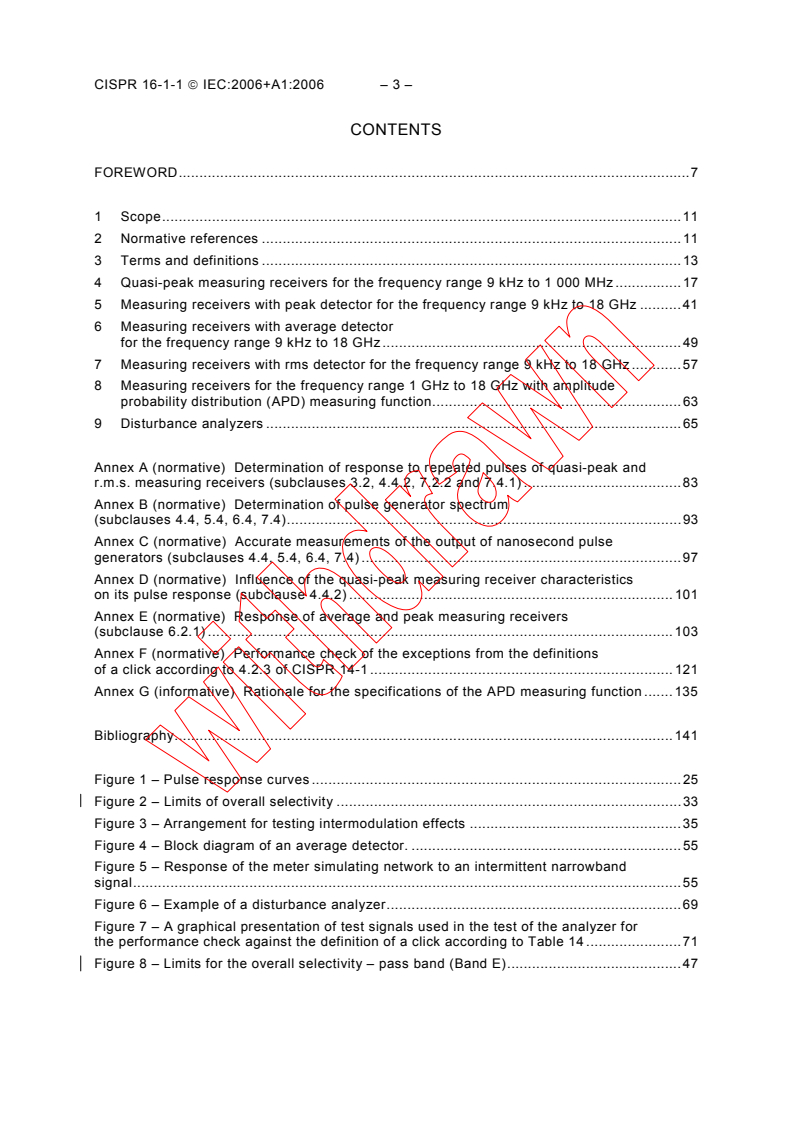
CISPR 16-1-1 © IEC:2006+A1:2006 – 3 –
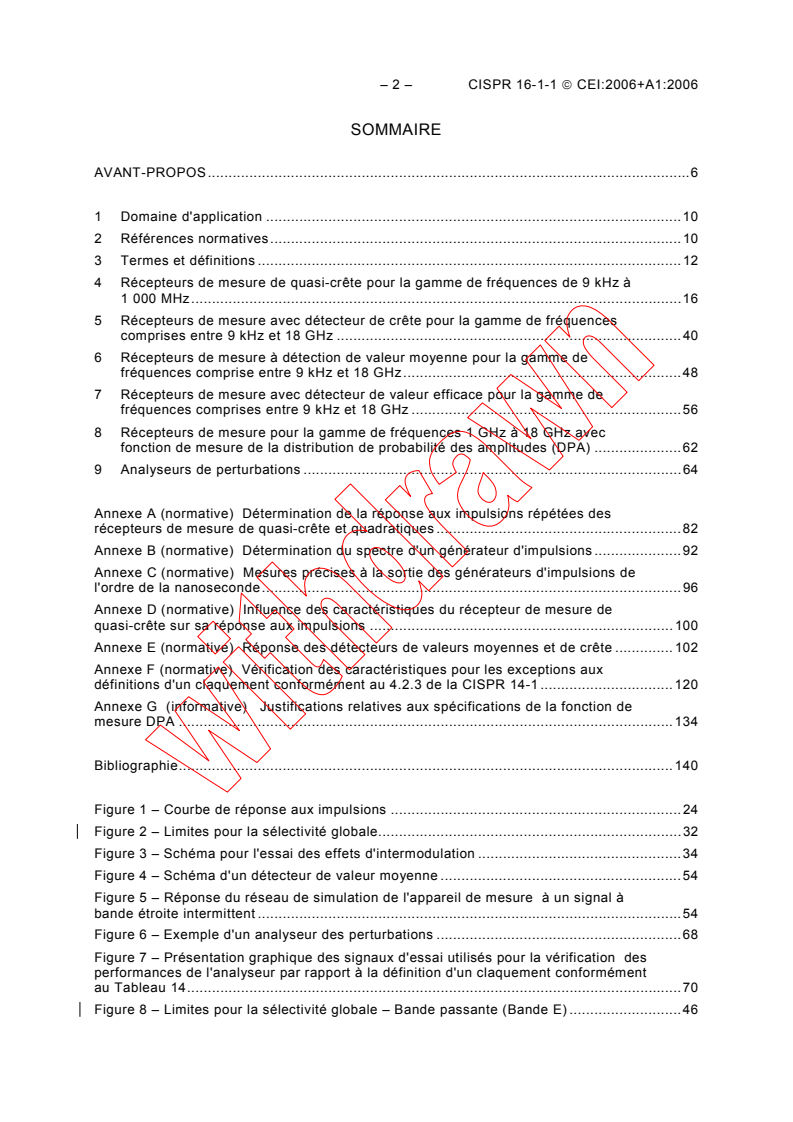
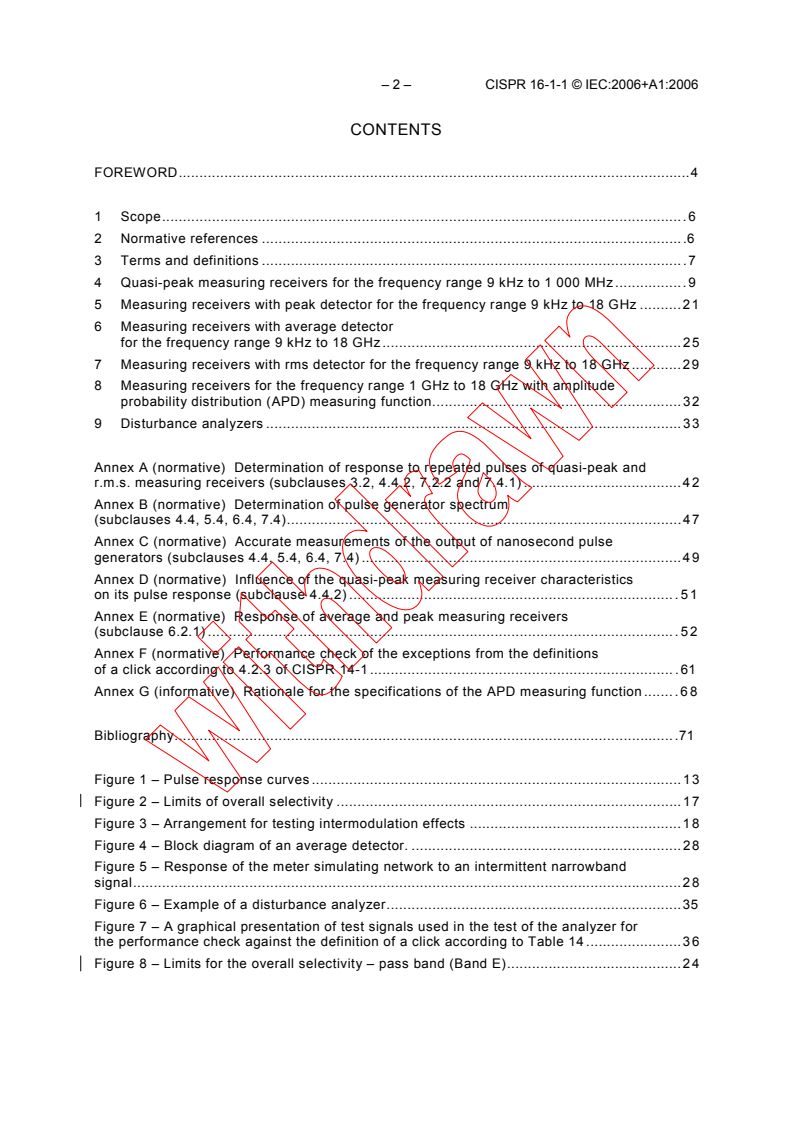
CONTENTS
FOREWORD.7
1 Scope.11
2 Normative references .11
3 Terms and definitions .13
4 Quasi-peak measuring receivers for the frequency range 9 kHz to 1 000 MHz .17
5 Measuring receivers with peak detector for the frequency range 9 kHz to 18 GHz .41
6 Measuring receivers with average detector
for the frequency range 9 kHz to 18 GHz.49
7 Measuring receivers with rms detector for the frequency range 9 kHz to 18 GHz .57
8 Measuring receivers for the frequency range 1 GHz to 18 GHz with amplitude
probability distribution (APD) measuring function.63
9 Disturbance analyzers .65
Annex A (normative) Determination of response to repeated pulses of quasi-peak and
r.m.s. measuring receivers (subclauses 3.2, 4.4.2, 7.2.2 and 7.4.1) .83
Annex B (normative) Determination of pulse generator spectrum
(subclauses 4.4, 5.4, 6.4, 7.4).93
Annex C (normative) Accurate measurements of the output of nanosecond pulse
generators (subclauses 4.4, 5.4, 6.4, 7.4) .97
Annex D (normative) Influence of the quasi-peak measuring receiver characteristics
on its pulse response (subclause 4.4.2) .101
Annex E (normative) Response of average and peak measuring receivers
(subclause 6.2.1) .103
Annex F (normative) Performance check of the exceptions from the definitions
of a click according to 4.2.3 of CISPR 14-1.121
Annex G (informative) Rationale for the specifications of the APD measuring function .135
Bibliography.141
Figure 1 – Pulse response curves .25
Figure 2 – Limits of overall selectivity .33
Figure 3 – Arrangement for testing intermodulation effects .35
Figure 4 – Block diagram of an average detector. .55
Figure 5 – Response of the meter simulating network to an intermittent narrowband
signal.55
Figure 6 – Example of a disturbance analyzer.69
Figure 7 – A graphical presentation of test signals used in the test of the analyzer for
the performance check against the definition of a click according to Table 14 .71
Figure 8 – Limits for the overall selectivity – pass band (Band E).47
CISPR 16-1-1 © IEC:2006+A1:2006 – 5 –
Figure E.1 – Correction factor for estimating the ratio B /B for other tuned circuits.105
imp 6
Figure E.2 – Pulse rectification coefficient P .109
Figure E.3 – Example (spectrum) of a pulse-modulated signal
with a pulse width of 200 ns.113
Figure E.4 – Pulse-modulated RF signal applied to a measuring receiver .115
Figure E.5 – Filtering with a B much smaller than the prf .115
imp
Figure E.6– Filtering with a B much wider than the prf.115
imp
Figure E.7 – Calculation of the impulse bandwidth .117
Figure E.8 – Example of a normalized linear selectivity function. .119
Figure F.1 – A graphical presentation of the test signals used for the performance
check of the analyzer with the additional requirements according to Table F.1.133
Figure G.1 – Block diagram of APD measurement circuit without A/D converter.137
Figure G.2 – Block diagram of APD measurement circuit with A/D converter.137
Figure G.3 – Example of display of APD measurement .139
Table 1 – Fundamental characteristics of quasi-peak receivers.17
Table 2 – Test pulse characteristics for quasi-peak measuring receivers .19
Table 3 – Pulse response of quasi-peak receivers .27
Table 4 – Bandwidth characteristics for inter-modulation test of quasi-peak measuring
receivers.37
Table 5 – VSWR requirements for receiver input impedance.41
Table 6 – Bandwidth requirements .41
Table 7 – Relative pulse response of peak and quasi-peak measuring receivers for the
same bandwidth (frequency range 9 kHz to 1 000 MHz).45
Table 8 – Bandwidth requirements .49
Table 9 – Relative pulse response of average and quasi-peak measuring receivers for
the same bandwidth (frequency range 9 kHz to 1 GHz).51
Table 10 – Maximum reading of average measuring receivers for a pulse-modulated
sine-wave input in comparison with the response to a continuous sine-wave having the
same amplitude .55
Table 11 – Bandwidth requirements .59
Table 12 – Relative pulse response of rms and quasi-peak measuring receivers .61
Table 13 – Pulse response of rms measuring receiver .61
Table 14 – Disturbance analyzer performance test – Test signals used for the check
against the definition of a click.73
Table B.1 – Pulse generator characteristics .93
Table E.1 – Carrier level for pulse-modulated signal of 1,4 nVs .111
Table F.1 – Disturbance analyzer test signals .123
CISPR 16-1-1 © IEC:2006+A1:2006 – 7 –
INTERNATIONAL ELECTROTECHNICAL COMMISSION
INTERNATIONAL SPECIAL COMMITTEE ON RADIO INTERFERENCE
___________
SPECIFICATION FOR RADIO DISTURBANCE AND IMMUNITY
MEASURING APPARATUS AND METHODS –
Part 1-1: Radio disturbance and immunity measuring apparatus –
Measuring apparatus
FOREWORD
1) The International Electrotechnical Commission (IEC) is a worldwide organization for standardization comprising
all national electrotechnical committees (IEC National Committees). The object of IEC is to promote
international co-operation on all questions concerning standardization in the electrical and electronic fields. To
this end and in addition to other activities, IEC publishes International Standards, Technical Specifications,
Technical Reports, Publicly Available Specifications (PAS) and Guides (hereafter referred to as “IEC
Publication(s)”). Their preparation is entrusted to technical committees; any IEC National Committee interested
in the subject dealt with may participate in this preparatory work. International, governmental and non-
governmental organizations liaising with the IEC also participate in this preparation. IEC collaborates closely
with the International Organization for Standardization (ISO) in accordance with conditions determined by
agreement between the two organizations.
2) The formal decisions or agreements of IEC on technical matters express, as nearly as possible, an international
consensus of opinion on the relevant subjects since each technical committee has representation from all
interested IEC National Committees.
3) IEC Publications have the form of recommendations for international use and are accepted by IEC National
Committees in that sense. While all reasonable efforts are made to ensure that the technical content of IEC
Publications is accurate, IEC cannot be held responsible for the way in which they are used or for any
misinterpretation by any end user.
4) In order to promote international uniformity, IEC National Committees undertake to apply IEC Publications
transparently to the maximum extent possible in their national and regional publications. Any divergence
between any IEC Publication and the corresponding national or regional publication shall be clearly indicated in
the latter.
5) IEC provides no marking procedure to indicate its approval and cannot be rendered responsible for any
equipment declared to be in conformity with an IEC Publication.
6) All users should ensure that they have the latest edition of this publication.
7) No liability shall attach to IEC or its directors, employees, servants or agents including individual experts and
members of its technical committees and IEC National Committees for any personal injury, property damage or
other damage of any nature whatsoever, whether direct or indirect, or for costs (including legal fees) and
expenses arising out of the publication, use of, or reliance upon, this IEC Publication or any other IEC
Publications.
8) Attention is drawn to the Normative references cited in this publication. Use of the referenced publications is
indispensable for the correct application of this publication.
9) Attention is drawn to the possibility that some of the elements of this IEC Publication may be the subject of
patent rights. IEC shall not be held responsible for identifying any or all such patent rights.
International Standard CISPR 16-1-1 has been prepared by CISPR subcommittee A: Radio
interference measurements and statistical methods.
This consolidated version of CISPR 16-1-1 consists of the second edition (2006) [documents
CISPR/A/642/FDIS and CISPR/A/651/RVD] and its amendment 1 (2006) [documents
CISPR/A/647/CDV and CISPR/A/686/RVC].
The technical content is therefore identical to the base edition and its amendment and has
been prepared for user convenience.
CISPR 16-1-1 © IEC:2006+A1:2006 – 9 –
It bears the edition number 2.1.
A vertical line in the margin shows where the base publication has been modified by
amendment 1.
This publication has been drafted in accordance with the ISO/IEC Directives, Part 2.
The CISPR 16 series, published under the general title Specification for radio disturbance and
immunity measuring apparatus and methods, consists of Parts 1, 2, 3 and 4, each of which is
further subdivided into parts:
– measurement instrumentation specifications are given in the five parts of CISPR 16-1;
– methods of measurement are covered in the four parts of CISPR 16-2;
– various reports with further information and background on CISPR and radio disturbances
in general are given in CISPR 16-3;
– information related to uncertainties, statistics and limit modelling is contained in
CISPR 16-4.
CISPR 16-1 consists of the following parts, under the general title Specification for radio
disturbance and immunity measuring apparatus and methods – Radio disturbance and
immunity measuring apparatus:
• Part 1-1: Measuring apparatus
• Part 1-2: Ancillary equipment – Conducted disturbances
• Part 1-3: Ancillary equipment – Disturbance power
• Part 1-4: Ancillary equipment – Radiated disturbances
• Part 1-5: Antenna calibration test sites for 30 MHz to 1 000 MHz
The committee has decided that the contents of the base publication and its amendments will
remain unchanged until the maintenance result date indicated on the IEC web site under
"http://webstore.iec.ch" in the data related to the specific publication. At this date,
the publication will be
• reconfirmed,
• withdrawn,
• replaced by a revised edition, or
• amended.
CISPR 16-1-1 © IEC:2006+A1:2006 – 11 –
SPECIFICATION FOR RADIO DISTURBANCE AND IMMUNITY
MEASURING APPARATUS AND METHODS –
Part 1-1: Radio disturbance and immunity measuring apparatus –
Measuring apparatus
1 Scope
This part of CISPR 16 is designated a basic standard, which specifies the characteristics and
performance of equipment for the measurement of radio disturbance voltages, currents and
fields in the frequency range 9 kHz to 18 GHz. In addition, requirements are specified for
specialized equipment for discontinuous disturbance measurements. The requirements
include the measurement of broadband and narrowband types of radio disturbance.
The receiver types covered include the following:
a) the quasi-peak measuring receiver,
b) the peak measuring receiver,
c) the average measuring receiver,
d) the r.m.s. measuring receiver.
The requirements of this publication shall be complied with at all frequencies and for all levels
of radio disturbance voltages, currents, power or field strengths within the CISPR indicating
range of the measuring equipment.
Methods of measurement are covered in Part 2, and further information on radio disturbance
is given in Part 3 of CISPR 16. Uncertainties, statistics and limit modelling are covered in
Part 4 of CISPR 16.
2 Normative references
The following referenced documents are indispensable for the application of this document.
For dated references, only the edition cited applies. For undated references, the latest edition
of the referenced document (including any amendments) applies.
IEC 60050-161:1990, International Electrotechnical Vocabulary (IEV) – Chapter 161:
Electromagnetic compatibility
Amendment 1 (1997)
Amendment 2 (1998)
CISPR 11:2003, Industrial, scientific and medical (ISM) radio-frequency equipment – Electro-
magnetic disturbance characteristics – Limits and methods of measurement
CISPR 14-1:2005, Electromagnetic compatibility – Requirements for household appliances,
electric tools and similar apparatus – Part 1: Emission
CISPR 16-1-1 © IEC:2006+A1:2006 – 13 –
CISPR 16-3:2003, Specification for radio disturbance and Immunity measuring apparatus and
methods – Part 3: CISPR technical reports
BIPM / IEC / IFCC / ISO / IUPAC / IUPAP / OIML:1993, International vocabulary of basic and
general terms in metrology
3 Terms and definitions
For the purpose of this document, the following definitions apply. Also see IEC 60050(161)
and the International vocabulary of basic and general terms in metrology.
3.1
bandwidth
B
n
the width of the overall selectivity curve of the receiver between two points at a stated
attenuation, below the midband response. The bandwidth is represented by the symbol B ,
n
where n is the stated attenuation in decibels.
3.2
impulse bandwidth
B
imp
B = A(t) / (2 G × IS)
imp max o
where
is the peak of the envelope at the IF output of the receiver with an impulse area IS
A(t)
max
applied at the receiver input;
G is the gain of the circuit at the centre frequency.
o
Specifically for two critically-coupled tuned transformers,
B = 1,05 × B = 1,31 × B
imp 6 3
where
B and B are respectively the bandwidths at the –6 dB and –3 dB points (see Clause A.2 for
6 3
further information).
3.3
impulse area
IS
the impulse area (sometimes called impulse strength, IS) is the voltage-time area of a pulse
defined by the integral:
+∞
IS = V d(t) t (expressed in μVs or dB(μVs))
∫
−∞
NOTE Spectral density (D) is related to impulse area and expressed in μV/MHz or dB(μV/MHz). For rectangular
impulses of pulse duration T at frequencies f << 1/T, the relationship D (μV/MHz) = 2 ×10 IS (μVs) applies.
3.4
electrical charge time constant
T
C
the time needed after the instantaneous application of a constant sine-wave voltage to the
stage immediately preceding the input of the detector for the output voltage of the detector to
reach 63 % of its final value
CISPR 16-1-1 © IEC:2006+A1:2006 – 15 –
NOTE This time constant is determined as follows: A sine-wave signal of constant amplitude and having a
frequency equal to the mid-band frequency of the i.f. amplifier is applied to the input of the stage immediately
preceding the detector. The indication, D, of an instrument having no inertia (e.g., a cathode-ray oscilloscope)
connected to a terminal in the d.c. amplifier circuit so as not to affect the behaviour of the detector, is noted.
The level of the signal is chosen such that the response of the stages concerned remains within the linear
operating range. A sine-wave signal of this level, applied for a limited time only and having a wave train of
rectangular envelope is gated such that the deflection registered is 0,63 D. The duration of this signal is equal to
the charge time of the detector.
3.5
electrical discharge time constant
T
D
the time needed after the instantaneous removal of a constant sine-wave voltage applied to
the stage immediately preceding the input of the detector for the output of the detector to fall
to 37 % of its initial value
NOTE The method of measurement is analogous to that for the charge time constant, but instead of a signal
being applied for a limited time, the signal is interrupted for a definite time. The time taken for the deflection to fall
to 0,37 D is the discharge time constant of the detector.
3.6
mechanical time constant of a critically damped indicating instrument
T
M
T = T / 2π
M L
where
T is the period of free oscillation of the instrument with all damping removed.
L
NOTE 1 For a critically damped instrument, the equation of motion of the system may be written as:
2 2 2
T (d α / dt ) + 2T (dα / dt) + α = ki
M M
where
α is the deflection;
i is the current through the instrument;
k is a constant.
It can be deduced from this relation that this time constant is also equal to the duration of a rectangular pulse (of
constant amplitude) that produces a deflection equal to 35 % of the steady deflection produced by a continuous
current having the same amplitude as that of the rectangular pulse.
NOTE 2 The methods of measurement and adjustment are deduced from one of the following:
a) The period of free oscillation having been adjusted to 2πT , damping is added so that αT = 0,35α .
M max
b) When the period of oscillation cannot be measured, the damping is adjusted to be just below critical such that
the overswing is not greater than 5 % and the moment of inertia of the movement is such that αT = 0,35α .
max
3.7
overload factor
the ratio of the level that corresponds to the range of practical linear function of a circuit (or a
group of circuits) to the level that corresponds to full-scale deflection of the indicating
instrument
The maximum level at which the steady-state response of a circuit (or group of circuits) does
not depart by more than 1 dB from ideal linearity defines the range of practical linear function
of the circuit (or group of circuits).
3.8
symmetric voltage
in a two-wire circuit, such as a single-phase mains supply, the symmetric voltage is the radio-
frequency disturbance voltage appearing between the two wires. This is sometimes called the
differential mode voltage. If Va is the vector voltage between one of the mains terminals and
earth and Vb is the vector voltage between the other mains terminal and earth, the symmetric
voltage is the vector difference (Va-Vb)
CISPR 16-1-1 © IEC:2006+A1:2006 – 17 –
3.9
CISPR indicating range
it is the range specified by the manufacturer which gives the maximum and the minimum
meter indications within which the receiver meets the requirements of this section of
CISPR 16
4 Quasi-peak measuring receivers for the frequency range 9 kHz to 1 000 MHz
The receiver specification depends on the frequency of operation. There is one receiver
specification covering the frequency range 9 kHz to 150 kHz (band A), one covering 150 kHz
to 30 MHz (band B), one covering 30 MHz to 300 MHz (band C), and one covering 300 MHz
to 1 000 MHz (band D).
4.1 Input impedance
The input circuit of measuring receivers shall be unbalanced. For receiver control settings
within the CISPR indicating range, the input impedance shall be nominally 50 Ω with a v.s.w.r.
not to exceed 2,0 to 1 when the RF attenuation is 0 and 1,2 to 1 when the RF attenuation is
10 dB or greater.
Symmetric input impedance in the frequency range 9 kHz to 30 MHz: to permit symmetrical
measurements a balanced input transformer is used. The preferred input impedance for the
frequency range 9 kHz to 150 kHz is 600 Ω. This symmetric input impedance may be
incorporated either in the relevant symmetrical artificial network necessary to couple to the
receiver or optionally in the measuring receiver.
4.2 Fundamental characteristics
The responses to pulses as specified in 4.4 are calculated on the basis of the measuring
receivers having the following fundamental characteristics.
Table 1 – Fundamental characteristics of quasi-peak receivers
Frequency band
Characteristics Band A Band B Bands C and D
9 kHz to 150 kHz 0,15 MHz to 30 MHz 30 MHz to 1 000 MHz
Bandwidth at the –6 dB points, 0,20 9 120
B in kHz
Detector electrical charge time 45 1 1
constant, in ms
Detector electrical discharge time 500 160 550
constant, in ms
Mechanical time constant of critically 160 160 100
damped indicating instrument, in ms
Overload factor of circuits preceding 24 30 43,5
the detector, in dB
Overload factor of the d.c. amplifier 6 12 6
between detector and indicating
instrument, in dB
NOTE 1 The definition of mechanical time constant (see 3.6) assumes that the indicating instrument is linear,
i.e., equal increments of current produce equal increments of deflection. An indicating instrument having a
different relation between current and deflection may be used provided that the instrument satisfies the
requirements of this subclause. In an electronic instrument, the mechanical time-constant may be simulated by a
circuit.
NOTE 2 No tolerance is given for the electrical and mechanical time constants. The actual values used in a
specific receiver will be determined by the design to meet the requirements in 4.4
CISPR 16-1-1 © IEC:2006+A1:2006 – 19 –
4.3 Sine-wave voltage accuracy
The accuracy of measurement of sine-wave voltages shall be better than ±2 dB when supplied
with a sine-wave signal at 50 Ω resistance source impedance.
4.4 Response to pulses
NOTE Annexes B and C describe methods for determining the output characteristics of a pulse generator for use
in testing the requirements of this subclause.
4.4.1 Amplitude relationship (absolute calibration)
The response of the measuring receiver to pulses of impulse area of a) μVs (microvolt
second) e.m.f. at 50 Ω source impedance, having a uniform spectrum up to at least b) MHz,
repeated at a frequency of c) Hz shall, for all frequencies of tuning, be equal to the response
to an unmodulated sine-wave signal at the tuned frequency having an e.m.f. of r.m.s. value
2 mV (66 dB(μV)). The source impedances of the pulse generator and the signal generator
shall both be the same. A tolerance of ±1,5 dB shall be permitted on the sine-wave voltage
level.
Table 2 – Test pulse characteristics for quasi-peak
measuring receivers
Frequency range b) MHz c) Hz
a) μVs
9 kHz to 150 kHz 13,5 0,15 25
0,15 MHz to 30 MHz 0,316 30 100
30 MHz to 300 MHz 0,044 300 100
300 MHz to 1 000 MHz 0,044 1 000 100
4.4.2 Variation with repetition frequency (relative calibration)
The response of the measuring receiver to repeated pulses shall be such that for a constant
indication on the measuring receiver, the relationship between amplitude and repetition
frequency is in accordance with Figures 1a, 1b or 1c.
CISPR 16-1-1 © IEC:2006+A1:2006 – 21 –
IEC 1290/99
Figure 1a – Pulse response curve (Band A)
CISPR 16-1-1 © IEC:2006+A1:2006 – 23 –
IEC 1291/99
Figure 1b – Pulse response curve (Band B)
IEC 1292/99
Figure 1c – Pulse response curve (Bands C and D)
CISPR 16-1-1 © IEC:2006+A1:2006 – 25 –
IEC 1293/99
Figure 1d – Theoretical pulse response curve of quasi-peak detector receivers
and average detector receiver (see 6.4.2)
Figure 1 – Pulse response curves
CISPR 16-1-1 © IEC:2006+A1:2006 – 27 –
The response curve for a particular measuring receiver shall lie between the limits defined in
the appropriate figure and quantified in Table 3.
Table 3 – Pulse response of quasi-peak receivers
Relative equivalent level in dB of pulse for stated band
Repetition
frequency
Band A Band B Band C Band D
9 kHz to 150 kHz 0,15 MHz to 30 MHz 30 MHz to 300 MHz 300 MHz to 1 000 MHz
Hz
1 000 Note 4
–4,5 ± 1,0 –8,0 ± 1,0 –8,0 ± 1,0
100 0 (ref.) 0 (ref.) 0 (ref.)
–4,0 ± 1,0
60 –3,0 ± 1,0 – – –
25 0 (ref.) – – –
20 –
+6,5 ± 1,0 +9,0 ± 1,0 +9,0 ± 1,0
10 +4,0 ± 1,0 +10,0 ± 1,5 +14,0 ± 1,5 +14,0 ± 1,5
5 – – –
+7,5 ± 1,0
2 +13,0 ± 2,0 +20,5 ± 2,0 +26,0 ± 2,0 +26,0 ± 2,0*
+17,0 ± 2,0 +22,5 ± 2,0 +28,5 ± 2,0 +28,5 ± 2,0*
Isolated pulse +19,0 ± 2,0 +23,5 ± 2,0 +31,5 ± 2,0 +31,5 ± 2,0*
NOTE 1 The influence of the receiver characteristics upon its pulse response is considered in Annex D.
NOTE 2 The relationships between the pulse responses of a quasi-peak receiver and receivers with other
detector types are given in 5.4, 6.4.1 and 7.4.1.
NOTE 3 The theoretical pulse response curves of quasi-peak and average detector receivers combined on an
absolute scale are shown in Figure 1d. The ordinate of Figure 1d shows the open-circuit impulse areas in dB(μVs)
corresponding to the open-circuit sine-wave voltage of 66 dB(μV) r.m.s. The indication on a measuring receiver
with an input matched to the calibrating generators will then be 60 dB(μV). Where the measuring bandwidth is less
than the pulse repetition frequency, the curves of Figure 1d are valid when the receiver is tuned to a discrete line
of the spectrum.
NOTE 4 It is not possible to specify a response above 100 Hz in the frequency range 9 kHz to 150 kHz because
of the overlapping of pulses in the i.f. amplifier.
NOTE 5 Annex A deals with the determination of the curve of response to repeated pulses.
NOTE 6 The pulse response is restricted due to overload at the input to the receiver at frequencies above
300 MHz. The values marked with an asterisk (*) in the table are optional and are not essential.
4.5 Selectivity
4.5.1 Overall selectivity (passband)
The curve representing the overall selectivity of the measuring receiver shall lie within the
limits shown in Figures 2a, 2b or 2c.
Selectivity shall be described by the variation with frequency of the amplitude of the input
sine-wave voltage that produces a constant indication on the measuring receiver.
NOTE For the measurement of equipment that requires higher selectivity at the transition between 130 kHz and
150 kHz (e.g. mains signalling equipment as defined in EN 50065-1/A2), a highpass filter may be added in front of
the measuring receiver to achieve the following combined selectivity of CISPR measuring receiver and highpass
filter:
CISPR 16-1-1 © IEC:2006+A1:2006 – 29 –
Frequency Relative attenuation
kHz dB
≤1
146 ≤6
≥6
≥34
≥81
The measuring receiver in conjunction with the highpass filter should fulfil the requirements of this standard.
4.5.2 Intermediate frequency rejection ratio
The ratio of the input sine-wave voltage at the intermediate frequency to that at the tuned
frequency that produces the same indication of the measuring receiver shall be not less than
40 dB. Where more than one intermediate frequency is used, this requirement shall be met at
each intermediate frequency.
4.5.3 Image frequency rejection ratio
The ratio of the input sine-wave voltage at the image frequency to that at the tuned frequency
that produces the same indication on the measuring receiver shall be not less than 40 dB.
Where more than one intermediate frequency is used, this requirement shall be met at the
image frequencies corresponding to each intermediate frequency.
CISPR 16-1-1 © IEC:2006+A1:2006 – 31 –
IEC 1294/99
Figure 2a – Limits of overall selectivity – pass-band
(see 4.5.1, 5.5, 6.5, 7.5) (Band A)
CISPR 16-1-1 © IEC:2006+A1:2006 – 33 –
Max. bandwidth
Min. bandwidth
–4 kHz/6 dB
5 kHz/6 dB
2 kHz/
1,5 dB
–1,5 dB
–2
–10 –9 –8 –7 –6 –5 –4 –3 –2 –1 0 1 2 3 4 5 6 7 8 9 10
–Δf kHz off mid-band +Δf
Figure 2b – Limits of overall selectivity –
pass band (see 4.5.1, 5.5, 6.5, 7.5) (Band B)
Max. bandwidth
Min. bandwidth
–50 kHz/6 dB
70 kHz/6 dB
20 kHz/1,5 dB
–1,5 dB
–2
–140 –120 –100 –80 –60 –40 –20 0 20 40 60 80 100 120 140
–Δf kHz off mid-band +Δf
Figure 2c – Limits of overall selectivity –
passband (see 4.5.1, 5.5, 6.5, 7.5) Bands (C and D)
Figure 2 – Limits of overall selectivity
Relative input for constant output dB
Relative input for constant output dB
CISPR 16-1-1 © IEC:2006+A1:2006 – 35 –
4.5.4 Other spurious responses
The ratio of the input sine-wave voltage at frequencies other than those specified in 4.5.2 and
4.5.3 to that at the tuned frequency that produces the same indication on the measuring
receiver shall be not less than 40 dB. Examples of the frequencies from which such spurious
responses may occur are as follows:
(1/m) (nf ± f ) and (1/k) (f )
L i o
where
m, n, k are integers;
f is the local oscillator frequency;
L
f is the intermediate frequency;
i
f is the tuned frequency.
o
NOTE Where more than one intermediate frequency is used, the frequencies f and f may refer to each of the
L i
local oscillator and intermediate frequencies used. In addition, spurious responses may occur when no input signal
is applied to the measuring receiver; for example, when harmonics of the local oscillators differ in frequency by one
of the intermediate frequencies. The requirements under this heading therefore cannot apply in these latter cases.
The effect of these spurious responses is dealt with in 4.7.2.
4.6 Limitation of intermodulation effects
The response of the measuring receiver shall not be influenced by intermodulation effects
when tested as follows.
Arrange the apparatus as shown in Figure 3. The pulse generator has a spectrum sub-
stantially uniform up to frequency 3) but at least 10 dB down at frequency 4) of the
frequencies given in Table 4. The band-stop filter has an attenuation at the test frequency of
at least 40 dB. Its bandwidth, B , relative to the maximum attenuation of the filter shall lie
between the frequencies 1) and 2) given in Table 4.
IEC 1297/99
Responses:
α = α
1a 2a
α = α – 40 dB
1b 1a
α = α – 36 dB
2b 2a
Figure 3 – Arrangement for testing intermodulation effects
CISPR 16-1-1 © IEC:2006+A1:2006 – 37 –
Table 4 – Bandwidth characteristics for intermodulation test
of quasi-peak measuring receivers
Frequency range
1) kHz 2) kHz 3) MHz 4) MHz
9 kHz to 150 kHz (band A) 0,4 4 0,15 0,3
0,15 MHz to 30 MHz (band B) 20 200 30 60
30 MHz to 300 MHz (band C) 500 2 000 300 600
300 MHz to 1 000 MHz (band D) 500 6 000 1 000 2 000
Connect the sine-wave generator output direct to the measuring receiver input and adjust for
a convenient reading. Substitute the pulse generator for the sine-wave generator and adjust
for the same reading. The pulse repetition frequency shall be 100 Hz for band A and 1 000 Hz
for the other bands.
With the pulse generator connected as described above, switching the filter into circuit shall
introduce attenuation of not less than 36 dB.
4.7 Limitation of receiver noise and internally generated spurious signals
4.7.1 Random noise
The background noise shall not introduce an error in excess of 1 dB.
NOTE The point where the background noise causes an error of 1 dB can be found by applying a signal, S, such
that the meter indication is much larger (e.g.40 dB) than the noise level N. By reducing the signal level S, the
meter indication will reach a point, S , where (S + N ) deviates by 1 dB from the linear characteristic.
1 1
4.7.2 Continuous wave
Where more than one intermediate frequency is used, the existence of spurious responses as
described in the note to 4.5.4 shall not introduce a measurement error in excess of 1 dB for
any signal input to the measuring receiver. For a measuring receiver incorporating attenuation
in the i.f. amplifier, this requirement shall be regarded as satisfied if the receiver complies
with 4.7.1 when tested as described in 4.7.1, except that the attenuation in the intermediate
stages shall be introduced after the last mixer stage.
4.8 Screening effectiveness
Screening effectiveness is a measure of the ability of the measuring receiver to operate in an
electromagnetic field without degradation. The requirement applies to receivers operating
within the "CISPR indication range" specified by the manufacturer as described in 3.9.
The screening of the receiver shall be such that when it is immersed in an ambient
electromagnetic field of 3 V/m (unmodulated) at any frequency in the range 9 kHz to
1 000 MHz, an error of not greater than 1 dB is produced at the maximum and minimum of the
CISPR indicating range as specified by the manufacturer of the receiver. In cases where a
measuring receiver is not immune to the requirement of 3 V/m, the field strength and
frequency at which the error exceeds 1 dB shall be stated by the manufacturer. The test shall
be performed as described below.
CISPR 16-1-1 © IEC:2006+A1:2006 – 39 –
The receiver is placed inside a screened enclosure. An input signal is applied to the receiver
via a 2 m long well-screened cable (e.g. semi-rigid), through a feedthrough in the enclosure
wall, to a signal generator placed outside the enclosure. The level of the input signal shall be
at the maximum and the minimum of the CISPR indication range as specified by the
manufacturer of the receiver. All other coaxial terminals of the receiver shall be terminated in
their characteristic impedance.
Only essential leads (e.g. mains and input cables) for the normal use of the measuring
receiver in its minimum configuration (excluding options such as headphones) shall be
connected during the test. The leads shall have the lengths and be arranged as in typical use.
The strength of the ambient field in the vicinity of the measuring receiver shall be measured
by a field strength monitor.
The receiver meter indication in the presence of the ambient electromagnetic field shall differ
by not more than 1 dB from the meter indication when the field is absent.
4.8.1 Limitation of radio-frequency emissions from the measuring receiver
4.8.1.1 Conducted emissions
The radio disturbance voltage at any connecting pin of external lines (not only the mains
terminals) shall not exceed the limits for class B equipment given in 5.1 of CISPR 11.
The measurement of the radio disturbance voltage is however not required on the inner
conductors of screened connections to screened equipment. The local oscillator injection
power at the measuring receiver input terminated with its characteristic impedance shall not
exceed 34 dB(pW) which is equivalent to 50 μV across 50 Ω.
4.8.1.2 Radiated emissions
The radio disturbance field strength emitted by the measuring receiver shall not exceed the
limits for class B equipment given in 5.2 of CISPR 11, for the frequency range of 9 kHz to
1 000 MHz. The limits shall also apply for frequency bands (ISM frequencies) listed in Table 1
of the same publication. In the frequency range of 1 GHz to 18 GHz, a limit of 45 dB(pW) shall
apply.
Before performing radiated and conducted emission measurements, it is essential that the
noise contributions of the test equipment do not affect the measured results (e.g. computer
control).
4.9 Facilities for connection to a discontinuous disturbance analyzer
For all bands the disturbance measuring receiver shall have both an intermediate-frequency
output and an output from the quasi-peak detector for the measurement of discontinuous
disturbance. The loading of these outputs shall have no influence on the indicating
instrument.
CISPR 16-1-1 © IEC:2006+A1:2006 – 41 –
5 Measuring receivers with peak detector
for the frequency range 9 kHz to 18 GHz
This clause specifies requirements for measuring receivers employing a peak detector when
used for the measurement of impulsive or pulse-modulated disturbance.
Spectrum analyzers, that meet the requirements of this clause can be used for compliance
measurements.
5.1 Input impedance
The input port of the measuring receivers shall be unbalanced. For receiver control settings
within the CISPR indicating range, the nominal input impedance shall be 50 Ω with a VSWR
not to exceed the values in Table 5.
Table 5 – VSWR requirements for receiver input impedance
Frequency range RF attenuation VSWR
dB
9 kHz to 1 GHz 0 2,0 to 1
9 kHz to 1 GHz ≥10 1,2 to 1
1 GHz to 18 GHz 0 3,0 to 1
1 GHz to 18 GHz ≥10 2,0 to 1
Symmetric input impedance in the frequency range 9 kHz to 30 MHz: a balanced input
transformer is to be used for symmetric (that is, ungrounded) measurements. (The preferred
input impedance is 600 Ω for the frequency range 9 kHz to 150 kHz.) Symmetric input
impedance may be incorporated either in the relevant symmetrical artificial network required
to couple to the receiver or, optionally, in the measuring receiver itself.
5.2 Fundamental characteristics
5.2.1 Bandwidth
For all types of broadband disturbance, the actual value of the bandwidth shall be stated
when the disturbance level is quoted and the bandwidth is within the values in Table 6.
Table 6 – Bandwidth requirements
Frequency range Bandwidth B Reference BW
a
9 kHz to 150 kHz (Band A) 100
...
INTERNATIONAL
CISPR
ELECTROTECHNICAL
16-1-1
COMMISSION
Second edition
2006-03
INTERNATIONAL SPECIAL COMMITTEE ON RADIO INTERFERENCE
Specification for radio disturbance and immunity
measuring apparatus and methods –
Part 1-1:
Radio disturbance and immunity measuring
apparatus – Measuring apparatus
This English-language version is derived from the original
bilingual publication by leaving out all French-language
pages. Missing page numbers correspond to the French-
language pages.
Reference number
Consolidated editions
The IEC is now publishing consolidated versions of its publications. For example,
edition numbers 1.0, 1.1 and 1.2 refer, respectively, to the base publication, the
base publication incorporating amendment 1 and the base publication incorporating
amendments 1 and 2.
Further information on IEC publications
The technical content of IEC publications is kept under constant review by the IEC,
thus ensuring that the content reflects current technology. Information relating to
this publication, including its validity, is available in the IEC Catalogue of
publications (see below) in addition to new editions, amendments and corrigenda.
Information on the subjects under consideration and work in progress undertaken
by the technical committee which has prepared this publication, as well as the list
of publications issued, is also available from the following:
• IEC Web Site (www.iec.ch)
• Catalogue of IEC publications
The on-line catalogue on the IEC web site (www.iec.ch/searchpub) enables you
to search by a variety of criteria including text searches, technical committees
and date of publication. On-line information is also available on recently issued
publications, withdrawn and replaced publications, as well as corrigenda.
• IEC Just Published
This summary of recently issued publications (www.iec.ch/online_news/justpub)
is also available by email. Please contact the Customer Service Centre (see
below) for further information.
• Customer Service Centre
If you have any questions regarding this publication or need further assistance,
please contact the Customer Service Centre:
Email: custserv@iec.ch
Tel: +41 22 919 02 11
Fax: +41 22 919 03 00
.
INTERNATIONAL
CISPR
ELECTROTECHNICAL
16-1-1
COMMISSION
Second edition
2006-03
INTERNATIONAL SPECIAL COMMITTEE ON RADIO INTERFERENCE
Specification for radio disturbance and immunity
measuring apparatus and methods –
Part 1-1:
Radio disturbance and immunity measuring
apparatus – Measuring apparatus
IEC 2006 Copyright - all rights reserved
No part of this publication may be reproduced or utilized in any form or by any means, electronic or mechanical,
including photocopying and microfilm, without permission in writing from the publisher.
International Electrotechnical Commission, 3, rue de Varembé, PO Box 131, CH-1211 Geneva 20, Switzerland
Telephone: +41 22 919 02 11 Telefax: +41 22 919 03 00 E-mail: inmail@iec.ch Web: www.iec.ch
PRICE CODE
XB
Commission Electrotechnique Internationale
International Electrotechnical Commission
МеждународнаяЭлектротехническаяКомиссия
For price, see current catalogue
CISPR 16-1-1 IEC:2006 – 3 –
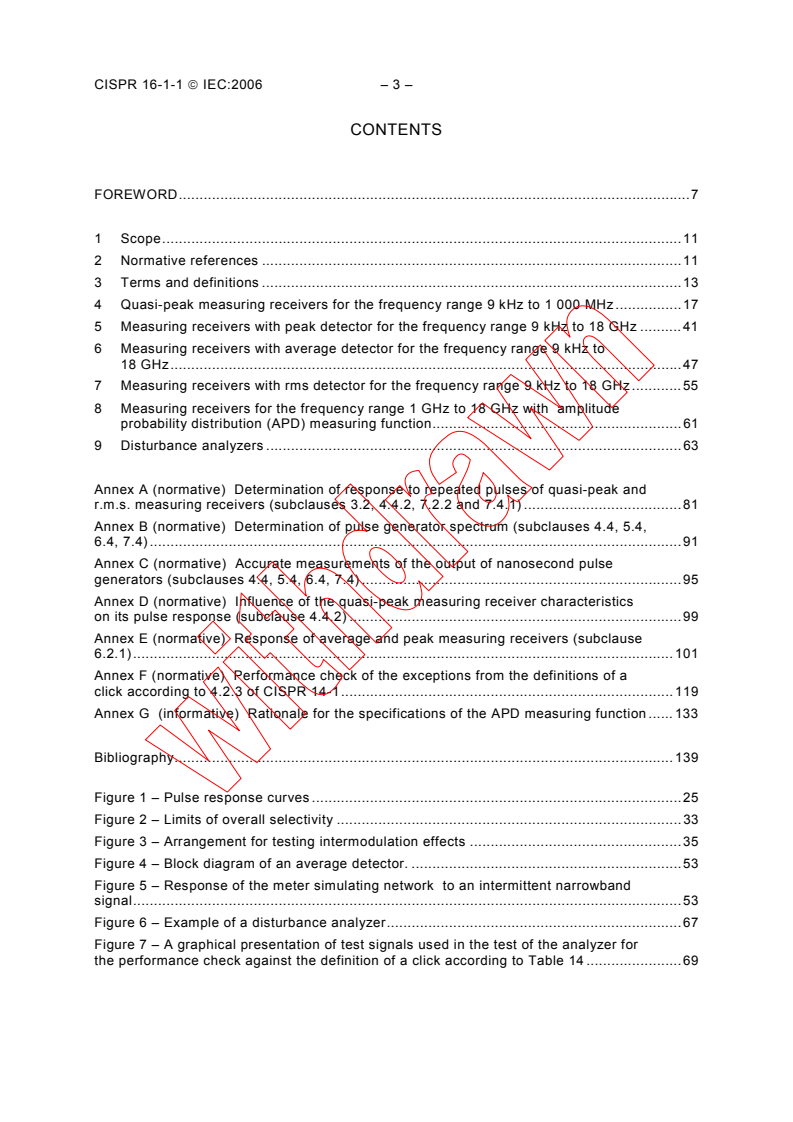
CONTENTS
FOREWORD.7
1 Scope.11
2 Normative references .11
3 Terms and definitions .13
4 Quasi-peak measuring receivers for the frequency range 9 kHz to 1 000 MHz .17
5 Measuring receivers with peak detector for the frequency range 9 kHz to 18 GHz .41
6 Measuring receivers with average detector for the frequency range 9 kHz to
18 GHz.47
7 Measuring receivers with rms detector for the frequency range 9 kHz to 18 GHz .55
8 Measuring receivers for the frequency range 1 GHz to 18 GHz with amplitude
probability distribution (APD) measuring function.61
9 Disturbance analyzers .63
Annex A (normative) Determination of response to repeated pulses of quasi-peak and
r.m.s. measuring receivers (subclauses 3.2, 4.4.2, 7.2.2 and 7.4.1) .81
Annex B (normative) Determination of pulse generator spectrum (subclauses 4.4, 5.4,
6.4, 7.4).91
Annex C (normative) Accurate measurements of the output of nanosecond pulse
generators (subclauses 4.4, 5.4, 6.4, 7.4) .95
Annex D (normative) Influence of the quasi-peak measuring receiver characteristics
on its pulse response (subclause 4.4.2) .99
Annex E (normative) Response of average and peak measuring receivers (subclause
6.2.1).101
Annex F (normative) Performance check of the exceptions from the definitions of a
click according to 4.2.3 of CISPR 14-1.119
Annex G (informative) Rationale for the specifications of the APD measuring function .133
Bibliography.139
Figure 1 – Pulse response curves .25
Figure 2 – Limits of overall selectivity .33
Figure 3 – Arrangement for testing intermodulation effects .35
Figure 4 – Block diagram of an average detector. .53
Figure 5 – Response of the meter simulating network to an intermittent narrowband
signal.53
Figure 6 – Example of a disturbance analyzer.67
Figure 7 – A graphical presentation of test signals used in the test of the analyzer for
the performance check against the definition of a click according to Table 14 .69
CISPR 16-1-1 IEC:2006 – 5 –
Figure E.1 – Correction factor for estimating the ratio B /B for other tuned circuits.103
imp 6
Figure E.2 – Pulse rectification coefficient P .107
Figure E.3 – Example (spectrum) of a pulse-modulated signal with a pulse width of
200 ns .111
Figure E.4 – Pulse-modulated RF signal applied to a measuring receiver .113
Figure E.5 – Filtering with a B much smaller than the prf .113
imp
Figure E.6– Filtering with a B much wider than the prf.113
imp
Figure E.7 – Calculation of the impulse bandwidth .115
Figure E.8 – Example of a normalized linear selectivity function. .117
Figure F.1 – A graphical presentation of the test signals used for the performance
check of the analyzer with the additional requirements according to Table F.1.131
Figure G.1 – Block diagram of APD measurement circuit without A/D converter.135
Figure G.2 – Block diagram of APD measurement circuit with A/D converter.135
Figure G.3 – Example of display of APD measurement .137
Table 1 – Fundamental characteristics of quasi-peak receivers.17
Table 2 – Test pulse characteristics for quasi-peak measuring receivers .19
Table 3 – Pulse response of quasi-peak receivers .27
Table 4 – Bandwidth characteristics for inter-modulation test of quasi-peak measuring
receivers.37
Table 5 – VSWR requirements for receiver input impedance.41
Table 6 – Bandwidth requirements .41
Table 7 – Relative pulse response of peak and quasi-peak measuring receivers for the
same bandwidth (frequency range 9 kHz to 1 000 MHz).45
Table 8 – Bandwidth requirements .47
Table 9 – Relative pulse response of average and quasi-peak measuring receivers for
the same bandwidth (frequency range 9 kHz to 1 GHz).49
Table 10 – Maximum reading of average measuring receivers for a pulse-modulated
sine-wave input in comparison with the response to a continuous sine-wave having
the same amplitude.53
Table 11 – Bandwidth requirements .57
Table 12 – Relative pulse response of rms and quasi-peak measuring receivers .59
Table 13 – Pulse response of rms measuring receiver .59
Table 14 – Disturbance analyzer performance test – Test signals used for the check
against the definition of a click.71
Table B.1 – Pulse generator characteristics .91
Table E.1 – Carrier level for pulse-modulated signal of 1,4 nVs .109
Table F.1 – Disturbance analyzer test signals .121
CISPR 16-1-1 IEC:2006 – 7 –
INTERNATIONAL ELECTROTECHNICAL COMMISSION
INTERNATIONAL SPECIAL COMMITTEE ON RADIO INTERFERENCE
___________
SPECIFICATION FOR RADIO DISTURBANCE AND IMMUNITY
MEASURING APPARATUS AND METHODS –
Part 1-1: Radio disturbance and immunity measuring apparatus –
Measuring apparatus
FOREWORD
1) The International Electrotechnical Commission (IEC) is a worldwide organization for standardization comprising
all national electrotechnical committees (IEC National Committees). The object of IEC is to promote
international co-operation on all questions concerning standardization in the electrical and electronic fields. To
this end and in addition to other activities, IEC publishes International Standards, Technical Specifications,
Technical Reports, Publicly Available Specifications (PAS) and Guides (hereafter referred to as “IEC
Publication(s)”). Their preparation is entrusted to technical committees; any IEC National Committee interested
in the subject dealt with may participate in this preparatory work. International, governmental and non-
governmental organizations liaising with the IEC also participate in this preparation. IEC collaborates closely
with the International Organization for Standardization (ISO) in accordance with conditions determined by
agreement between the two organizations.
2) The formal decisions or agreements of IEC on technical matters express, as nearly as possible, an international
consensus of opinion on the relevant subjects since each technical committee has representation from all
interested IEC National Committees.
3) IEC Publications have the form of recommendations for international use and are accepted by IEC National
Committees in that sense. While all reasonable efforts are made to ensure that the technical content of IEC
Publications is accurate, IEC cannot be held responsible for the way in which they are used or for any
misinterpretation by any end user.
4) In order to promote international uniformity, IEC National Committees undertake to apply IEC Publications
transparently to the maximum extent possible in their national and regional publications. Any divergence
between any IEC Publication and the corresponding national or regional publication shall be clearly indicated in
the latter.
5) IEC provides no marking procedure to indicate its approval and cannot be rendered responsible for any
equipment declared to be in conformity with an IEC Publication.
6) All users should ensure that they have the latest edition of this publication.
7) No liability shall attach to IEC or its directors, employees, servants or agents including individual experts and
members of its technical committees and IEC National Committees for any personal injury, property damage or
other damage of any nature whatsoever, whether direct or indirect, or for costs (including legal fees) and
expenses arising out of the publication, use of, or reliance upon, this IEC Publication or any other IEC
Publications.
8) Attention is drawn to the Normative references cited in this publication. Use of the referenced publications is
indispensable for the correct application of this publication.
9) Attention is drawn to the possibility that some of the elements of this IEC Publication may be the subject of
patent rights. IEC shall not be held responsible for identifying any or all such patent rights.
International Standard CISPR 16-1-1 has been prepared by CISPR subcommittee A: Radio
interference measurements and statistical methods.
This second edition of CISPR 16-1-1 cancels and replaces the first edition published in 2003
and its amendment 1 (2005). It constitutes a technical revision.
CISPR 16-1-1 IEC:2006 – 9 –
The text of this standard is based on the following documents:
FDIS Report on voting
CISPR/A/642/FDIS CISPR/A/651/RVD
Full information on the voting for the approval of this standard can be found in the report on
voting indicated in the above table.
This publication has been drafted in accordance with the ISO/IEC Directives, Part 2.
The CISPR 16 series, published under the general title Specification for radio disturbance and
immunity measuring apparatus and methods, consists of Parts 1, 2, 3 and 4, each of which is
further subdivided into parts:
– measurement instrumentation specifications are given in the five parts of CISPR 16-1;
– methods of measurement are covered in the four parts of CISPR 16-2;
– various reports with further information and background on CISPR and radio disturbances
in general are given in CISPR 16-3;
– information related to uncertainties, statistics and limit modelling is contained in
CISPR 16-4.
CISPR 16-1 consists of the following parts, under the general title Specification for radio
disturbance and immunity measuring apparatus and methods – Radio disturbance and
immunity measuring apparatus:
• Part 1-1: Measuring apparatus
• Part 1-2: Ancillary equipment – Conducted disturbances
• Part 1-3: Ancillary equipment – Disturbance power
• Part 1-4: Ancillary equipment – Radiated disturbances
• Part 1-5: Antenna calibration test sites for 30 MHz to 1 000 MHz
The committee has decided that the contents of this publication will remain unchanged until
the maintenance result date indicated on the IEC web site under "http://webstore.iec.ch" in
the data related to the specific publication. At this date, the publication will be
• reconfirmed,
• withdrawn,
• replaced by a revised edition, or
• amended.
CISPR 16-1-1 IEC:2006 – 11 –
SPECIFICATION FOR RADIO DISTURBANCE AND IMMUNITY
MEASURING APPARATUS AND METHODS –
Part 1-1: Radio disturbance and immunity measuring apparatus –
Measuring apparatus
1 Scope
This part of CISPR 16 is designated a basic standard, which specifies the characteristics and
performance of equipment for the measurement of radio disturbance voltages, currents and
fields in the frequency range 9 kHz to 18 GHz. In addition, requirements are specified for
specialized equipment for discontinuous disturbance measurements. The requirements
include the measurement of broadband and narrowband types of radio disturbance.
The receiver types covered include the following:
a) the quasi-peak measuring receiver,
b) the peak measuring receiver,
c) the average measuring receiver,
d) the r.m.s. measuring receiver.
The requirements of this publication shall be complied with at all frequencies and for all levels
of radio disturbance voltages, currents, power or field strengths within the CISPR indicating
range of the measuring equipment.
Methods of measurement are covered in Part 2, and further information on radio disturbance
is given in Part 3 of CISPR 16. Uncertainties, statistics and limit modelling are covered in
Part 4 of CISPR 16.
2 Normative references
The following referenced documents are indispensable for the application of this document.
For dated references, only the edition cited applies. For undated references, the latest edition
of the referenced document (including any amendments) applies.
IEC 60050-161:1990, International Electrotechnical Vocabulary (IEV) – Chapter 161:
Electromagnetic compatibility
Amendment 1 (1997)
Amendment 2 (1998)
CISPR 11:2003, Industrial, scientific and medical (ISM) radio-frequency equipment – Electro-
magnetic disturbance characteristics – Limits and methods of measurement
CISPR 14-1:2005, Electromagnetic compatibility – Requirements for household appliances,
electric tools and similar apparatus – Part 1: Emission
CISPR 16-1-1 IEC:2006 – 13 –
CISPR 16-3:2003, Specification for radio disturbance and Immunity measuring apparatus and
methods – Part 3: CISPR technical reports
BIPM / IEC / IFCC / ISO / IUPAC / IUPAP / OIML:1993, International vocabulary of basic and
general terms in metrology
3 Terms and definitions
For the purpose of this document, the following definitions apply. Also see IEC 60050(161)
and the International vocabulary of basic and general terms in metrology.
3.1
bandwidth
B
n
the width of the overall selectivity curve of the receiver between two points at a stated
attenuation, below the midband response. The bandwidth is represented by the symbol B ,
n
where n is the stated attenuation in decibels.
3.2
impulse bandwidth
B
imp
B = A(t) / (2 G × IS)
imp max o
where
is the peak of the envelope at the IF output of the receiver with an impulse area IS
A(t)
max
applied at the receiver input;
G is the gain of the circuit at the centre frequency.
o
Specifically for two critically-coupled tuned transformers,
B = 1,05 × B = 1,31 × B
imp 6 3
where
B and B are respectively the bandwidths at the –6 dB and –3 dB points (see Clause A.2 for
6 3
further information).
3.3
impulse area
IS
the impulse area (sometimes called impulse strength, IS) is the voltage-time area of a pulse
defined by the integral:
+∞
IS = V d(t) t (expressed in µVs or dB(µVs))
∫
−∞
NOTE Spectral density (D) is related to impulse area and expressed in µV/MHz or dB(µV/MHz). For rectangular
impulses of pulse duration T at frequencies f << 1/T, the relationship D (µV/MHz) = 2 × 10 IS (µVs) applies.
3.4
electrical charge time constant
T
C
the time needed after the instantaneous application of a constant sine-wave voltage to the
stage immediately preceding the input of the detector for the output voltage of the detector to
reach 63 % of its final value
CISPR 16-1-1 IEC:2006 – 15 –
NOTE This time constant is determined as follows: A sine-wave signal of constant amplitude and having a
frequency equal to the mid-band frequency of the i.f. amplifier is applied to the input of the stage immediately
preceding the detector. The indication, D, of an instrument having no inertia (e.g., a cathode-ray oscilloscope)
connected to a terminal in the d.c. amplifier circuit so as not to affect the behaviour of the detector, is noted.
The level of the signal is chosen such that the response of the stages concerned remains within the linear
operating range. A sine-wave signal of this level, applied for a limited time only and having a wave train of
rectangular envelope is gated such that the deflection registered is 0,63 D. The duration of this signal is equal to
the charge time of the detector.
3.5
electrical discharge time constant
T
D
the time needed after the instantaneous removal of a constant sine-wave voltage applied to
the stage immediately preceding the input of the detector for the output of the detector to fall
to 37 % of its initial value
NOTE The method of measurement is analogous to that for the charge time constant, but instead of a signal
being applied for a limited time, the signal is interrupted for a definite time. The time taken for the deflection to fall
to 0,37 D is the discharge time constant of the detector.
3.6
mechanical time constant of a critically damped indicating instrument
T
M
T = T / 2π
M L
where
T is the period of free oscillation of the instrument with all damping removed.
L
NOTE 1 For a critically damped instrument, the equation of motion of the system may be written as:
2 2 2
T (d α / dt ) + 2T (dα / dt) + α = ki
M M
where
α is the deflection;
i is the current through the instrument;
k is a constant.
It can be deduced from this relation that this time constant is also equal to the duration of a rectangular pulse (of
constant amplitude) that produces a deflection equal to 35 % of the steady deflection produced by a continuous
current having the same amplitude as that of the rectangular pulse.
NOTE 2 The methods of measurement and adjustment are deduced from one of the following:
a) The period of free oscillation having been adjusted to 2πT , damping is added so that αT = 0,35α .
M max
b) When the period of oscillation cannot be measured, the damping is adjusted to be just below critical such that
the overswing is not greater than 5 % and the moment of inertia of the movement is such that αT = 0,35α .
max
3.7
overload factor
the ratio of the level that corresponds to the range of practical linear function of a circuit (or a
group of circuits) to the level that corresponds to full-scale deflection of the indicating
instrument
The maximum level at which the steady-state response of a circuit (or group of circuits) does
not depart by more than 1 dB from ideal linearity defines the range of practical linear function
of the circuit (or group of circuits).
3.8
symmetric voltage
in a two-wire circuit, such as a single-phase mains supply, the symmetric voltage is the radio-
frequency disturbance voltage appearing between the two wires. This is sometimes called the
differential mode voltage. If Va is the vector voltage between one of the mains terminals and
earth and Vb is the vector voltage between the other mains terminal and earth, the symmetric
voltage is the vector difference (Va-Vb)
CISPR 16-1-1 IEC:2006 – 17 –
3.9
CISPR indicating range
it is the range specified by the manufacturer which gives the maximum and the minimum
meter indications within which the receiver meets the requirements of this section of
CISPR 16
4 Quasi-peak measuring receivers for the frequency range 9 kHz to 1 000 MHz
The receiver specification depends on the frequency of operation. There is one receiver
specification covering the frequency range 9 kHz to 150 kHz (band A), one covering 150 kHz
to 30 MHz (band B), one covering 30 MHz to 300 MHz (band C), and one covering 300 MHz
to 1 000 MHz (band D).
4.1 Input impedance
The input circuit of measuring receivers shall be unbalanced. For receiver control settings
within the CISPR indicating range, the input impedance shall be nominally 50 Ω with a v.s.w.r.
not to exceed 2,0 to 1 when the RF attenuation is 0 and 1,2 to 1 when the RF attenuation is
10 dB or greater.
Symmetric input impedance in the frequency range 9 kHz to 30 MHz: to permit symmetrical
measurements a balanced input transformer is used. The preferred input impedance for the
frequency range 9 kHz to 150 kHz is 600 Ω. This symmetric input impedance may be
incorporated either in the relevant symmetrical artificial network necessary to couple to the
receiver or optionally in the measuring receiver.
4.2 Fundamental characteristics
The responses to pulses as specified in 4.4 are calculated on the basis of the measuring
receivers having the following fundamental characteristics.
Table 1 – Fundamental characteristics of quasi-peak receivers
Frequency band
Characteristics Band A Band B Bands C and D
9 kHz to 150 kHz 0,15 MHz to 30 MHz 30 MHz to 1 000 MHz
Bandwidth at the –6 dB points, 0,20 9 120
B in kHz
Detector electrical charge time 45 1 1
constant, in ms
Detector electrical discharge time 500 160 550
constant, in ms
Mechanical time constant of critically 160 160 100
damped indicating instrument, in ms
Overload factor of circuits preceding 24 30 43,5
the detector, in dB
Overload factor of the d.c. amplifier 6 12 6
between detector and indicating
instrument, in dB
NOTE 1 The definition of mechanical time constant (see 3.6) assumes that the indicating instrument is linear,
i.e., equal increments of current produce equal increments of deflection. An indicating instrument having a
different relation between current and deflection may be used provided that the instrument satisfies the
requirements of this subclause. In an electronic instrument, the mechanical time-constant may be simulated by a
circuit.
NOTE 2 No tolerance is given for the electrical and mechanical time constants. The actual values used in a
specific receiver will be determined by the design to meet the requirements in 4.4
CISPR 16-1-1 IEC:2006 – 19 –
4.3 Sine-wave voltage accuracy
The accuracy of measurement of sine-wave voltages shall be better than ±2 dB when supplied
with a sine-wave signal at 50 Ω resistance source impedance.
4.4 Response to pulses
NOTE Annexes B and C describe methods for determining the output characteristics of a pulse generator for use
in testing the requirements of this subclause.
4.4.1 Amplitude relationship (absolute calibration)
The response of the measuring receiver to pulses of impulse area of a) µVs (microvolt
second) e.m.f. at 50 Ω source impedance, having a uniform spectrum up to at least b) MHz,
repeated at a frequency of c) Hz shall, for all frequencies of tuning, be equal to the response
to an unmodulated sine-wave signal at the tuned frequency having an e.m.f. of r.m.s. value
2 mV (66 dB(µV)). The source impedances of the pulse generator and the signal generator
shall both be the same. A tolerance of ±1,5 dB shall be permitted on the sine-wave voltage
level.
Table 2 – Test pulse characteristics for quasi-peak
measuring receivers
Frequency range b) MHz c) Hz
a) µVs
9 kHz to 150 kHz 13,5 0,15 25
0,15 MHz to 30 MHz 0,316 30 100
30 MHz to 300 MHz 0,044 300 100
300 MHz to 1 000 MHz 0,044 1 000 100
4.4.2 Variation with repetition frequency (relative calibration)
The response of the measuring receiver to repeated pulses shall be such that for a constant
indication on the measuring receiver, the relationship between amplitude and repetition
frequency is in accordance with Figures 1a, 1b or 1c.
CISPR 16-1-1 IEC:2006 – 21 –
IEC 1290/99
Figure 1a – Pulse response curve (Band A)
CISPR 16-1-1 IEC:2006 – 23 –
IEC 1291/99
Figure 1b – Pulse response curve (Band B)
IEC 1292/99
Figure 1c – Pulse response curve (Bands C and D)
CISPR 16-1-1 IEC:2006 – 25 –
IEC 1293/99
Figure 1d – Theoretical pulse response curve of quasi-peak detector receivers
and average detector receiver (see 6.4.2)
Figure 1 – Pulse response curves
CISPR 16-1-1 IEC:2006 – 27 –
The response curve for a particular measuring receiver shall lie between the limits defined in
the appropriate figure and quantified in Table 3.
Table 3 – Pulse response of quasi-peak receivers
Relative equivalent level in dB of pulse for stated band
Repetition
frequency
Band A Band B Band C Band D
9 kHz to 150 kHz 0,15 MHz to 30 MHz 30 MHz to 300 MHz 300 MHz to 1 000 MHz
Hz
1 000 Note 4
–4,5 ± 1,0 –8,0 ± 1,0 –8,0 ± 1,0
100 0 (ref.) 0 (ref.) 0 (ref.)
–4,0 ± 1,0
60 –3,0 ± 1,0 – – –
25 0 (ref.) – – –
20 –
+6,5 ± 1,0 +9,0 ± 1,0 +9,0 ± 1,0
10 +4,0 ± 1,0 +10,0 ± 1,5 +14,0 ± 1,5 +14,0 ± 1,5
5 – – –
+7,5 ± 1,0
2 +13,0 ± 2,0 +20,5 ± 2,0 +26,0 ± 2,0 +26,0 ± 2,0*
+17,0 ± 2,0 +22,5 ± 2,0 +28,5 ± 2,0 +28,5 ± 2,0*
Isolated pulse +19,0 ± 2,0 +23,5 ± 2,0 +31,5 ± 2,0 +31,5 ± 2,0*
NOTE 1 The influence of the receiver characteristics upon its pulse response is considered in Annex D.
NOTE 2 The relationships between the pulse responses of a quasi-peak receiver and receivers with other
detector types are given in 5.4, 6.4.1 and 7.4.1.
NOTE 3 The theoretical pulse response curves of quasi-peak and average detector receivers combined on an
absolute scale are shown in Figure 1d. The ordinate of Figure 1d shows the open-circuit impulse areas in dB(µVs)
corresponding to the open-circuit sine-wave voltage of 66 dB(µV) r.m.s. The indication on a measuring receiver
with an input matched to the calibrating generators will then be 60 dB(µV). Where the measuring bandwidth is less
than the pulse repetition frequency, the curves of Figure 1d are valid when the receiver is tuned to a discrete line
of the spectrum.
NOTE 4 It is not possible to specify a response above 100 Hz in the frequency range 9 kHz to 150 kHz because
of the overlapping of pulses in the i.f. amplifier.
NOTE 5 Annex A deals with the determination of the curve of response to repeated pulses.
NOTE 6 The pulse response is restricted due to overload at the input to the receiver at frequencies above
300 MHz. The values marked with an asterisk (*) in the table are optional and are not essential.
4.5 Selectivity
4.5.1 Overall selectivity (passband)
The curve representing the overall selectivity of the measuring receiver shall lie within the
limits shown in Figures 2a, 2b or 2c.
Selectivity shall be described by the variation with frequency of the amplitude of the input
sine-wave voltage that produces a constant indication on the measuring receiver.
NOTE For the measurement of equipment that requires higher selectivity at the transition between 130 kHz and
150 kHz (e.g. mains signalling equipment as defined in EN 50065-1/A2), a highpass filter may be added in front of
the measuring receiver to achieve the following combined selectivity of CISPR measuring receiver and highpass
filter:
CISPR 16-1-1 IEC:2006 – 29 –
Frequency Relative attenuation
kHz dB
≤1
146 ≤6
≥6
≥34
≥81
The measuring receiver in conjunction with the highpass filter should fulfil the requirements of this standard.
4.5.2 Intermediate frequency rejection ratio
The ratio of the input sine-wave voltage at the intermediate frequency to that at the tuned
frequency that produces the same indication of the measuring receiver shall be not less than
40 dB. Where more than one intermediate frequency is used, this requirement shall be met at
each intermediate frequency.
4.5.3 Image frequency rejection ratio
The ratio of the input sine-wave voltage at the image frequency to that at the tuned frequency
that produces the same indication on the measuring receiver shall be not less than 40 dB.
Where more than one intermediate frequency is used, this requirement shall be met at the
image frequencies corresponding to each intermediate frequency.
CISPR 16-1-1 IEC:2006 – 31 –
IEC 1294/99
Figure 2a – Limits of overall selectivity – pass-band
(see 4.5.1, 5.5, 6.5, 7.5) (Band A)
CISPR 16-1-1 IEC:2006 – 33 –
IEC 1295/99
Figure 2b – Limits of overall selectivity – pass-band (see 4.5.1, 5.5, 6.5) (Band B)
IEC 1296/99
Figure 2c – Limits of overall selectivity – pass-band (see 4.5.1, 5.5, 6.5, 7.5)
(Bands C and D)
Figure 2 – Limits of overall selectivity
CISPR 16-1-1 IEC:2006 – 35 –
4.5.4 Other spurious responses
The ratio of the input sine-wave voltage at frequencies other than those specified in 4.5.2 and
4.5.3 to that at the tuned frequency that produces the same indication on the measuring
receiver shall be not less than 40 dB. Examples of the frequencies from which such spurious
responses may occur are as follows:
(1/m) (nf ± f ) and (1/k) (f )
L i o
where
m, n, k are integers;
f is the local oscillator frequency;
L
f is the intermediate frequency;
i
f is the tuned frequency.
o
NOTE Where more than one intermediate frequency is used, the frequencies f and f may refer to each of the
L i
local oscillator and intermediate frequencies used. In addition, spurious responses may occur when no input signal
is applied to the measuring receiver; for example, when harmonics of the local oscillators differ in frequency by one
of the intermediate frequencies. The requirements under this heading therefore cannot apply in these latter cases.
The effect of these spurious responses is dealt with in 4.7.2.
4.6 Limitation of intermodulation effects
The response of the measuring receiver shall not be influenced by intermodulation effects
when tested as follows.
Arrange the apparatus as shown in Figure 3. The pulse generator has a spectrum sub-
stantially uniform up to frequency 3) but at least 10 dB down at frequency 4) of the
frequencies given in Table 4. The band-stop filter has an attenuation at the test frequency of
at least 40 dB. Its bandwidth, B , relative to the maximum attenuation of the filter shall lie
between the frequencies 1) and 2) given in Table 4.
IEC 1297/99
Responses:
α = α
1a 2a
α = α – 40 dB
1b 1a
α = α – 36 dB
2b 2a
Figure 3 – Arrangement for testing intermodulation effects
CISPR 16-1-1 IEC:2006 – 37 –
Table 4 – Bandwidth characteristics for intermodulation test
of quasi-peak measuring receivers
Frequency range
1) kHz 2) kHz 3) MHz 4) MHz
9 kHz to 150 kHz (band A) 0,4 4 0,15 0,3
0,15 MHz to 30 MHz (band B) 20 200 30 60
30 MHz to 300 MHz (band C) 500 2 000 300 600
300 MHz to 1 000 MHz (band D) 500 6 000 1 000 2 000
Connect the sine-wave generator output direct to the measuring receiver input and adjust for
a convenient reading. Substitute the pulse generator for the sine-wave generator and adjust
for the same reading. The pulse repetition frequency shall be 100 Hz for band A and 1 000 Hz
for the other bands.
With the pulse generator connected as described above, switching the filter into circuit shall
introduce attenuation of not less than 36 dB.
4.7 Limitation of receiver noise and internally generated spurious signals
4.7.1 Random noise
The background noise shall not introduce an error in excess of 1 dB.
NOTE The point where the background noise causes an error of 1 dB can be found by applying a signal, S, such
that the meter indication is much larger (e.g.40 dB) than the noise level N. By reducing the signal level S, the
meter indication will reach a point, S , where (S + N ) deviates by 1 dB from the linear characteristic.
1 1
4.7.2 Continuous wave
Where more than one intermediate frequency is used, the existence of spurious responses as
described in the note to 4.5.4 shall not introduce a measurement error in excess of 1 dB for
any signal input to the measuring receiver. For a measuring receiver incorporating attenuation
in the i.f. amplifier, this requirement shall be regarded as satisfied if the receiver complies
with 4.7.1 when tested as described in 4.7.1, except that the attenuation in the intermediate
stages shall be introduced after the last mixer stage.
4.8 Screening effectiveness
Screening effectiveness is a measure of the ability of the measuring receiver to operate in an
electromagnetic field without degradation. The requirement applies to receivers operating
within the "CISPR indication range" specified by the manufacturer as described in 3.9.
The screening of the receiver shall be such that when it is immersed in an ambient
electromagnetic field of 3 V/m (unmodulated) at any frequency in the range 9 kHz to
1 000 MHz, an error of not greater than 1 dB is produced at the maximum and minimum of the
CISPR indicating range as specified by the manufacturer of the receiver. In cases where a
measuring receiver is not immune to the requirement of 3 V/m, the field strength and
frequency at which the error exceeds 1 dB shall be stated by the manufacturer. The test shall
be performed as described below.
CISPR 16-1-1 IEC:2006 – 39 –
The receiver is placed inside a screened enclosure. An input signal is applied to the receiver
via a 2 m long well-screened cable (e.g. semi-rigid), through a feedthrough in the enclosure
wall, to a signal generator placed outside the enclosure. The level of the input signal shall be
at the maximum and the minimum of the CISPR indication range as specified by the
manufacturer of the receiver. All other coaxial terminals of the receiver shall be terminated in
their characteristic impedance.
Only essential leads (e.g. mains and input cables) for the normal use of the measuring
receiver in its minimum configuration (excluding options such as headphones) shall be
connected during the test. The leads shall have the lengths and be arranged as in typical use.
The strength of the ambient field in the vicinity of the measuring receiver shall be measured
by a field strength monitor.
The receiver meter indication in the presence of the ambient electromagnetic field shall differ
by not more than 1 dB from the meter indication when the field is absent.
4.8.1 Limitation of radio-frequency emissions from the measuring receiver
4.8.1.1 Conducted emissions
The radio disturbance voltage at any connecting pin of external lines (not only the mains
terminals) shall not exceed the limits for class B equipment given in 5.1 of CISPR 11.
The measurement of the radio disturbance voltage is however not required on the inner
conductors of screened connections to screened equipment. The local oscillator injection
power at the measuring receiver input terminated with its characteristic impedance shall not
exceed 34 dB(pW) which is equivalent to 50 µV across 50 Ω.
4.8.1.2 Radiated emissions
The radio disturbance field strength emitted by the measuring receiver shall not exceed the
limits for class B equipment given in 5.2 of CISPR 11, for the frequency range of 9 kHz to
1 000 MHz. The limits shall also apply for frequency bands (ISM frequencies) listed in Table 1
of the same publication. In the frequency range of 1 GHz to 18 GHz, a limit of 45 dB(pW) shall
apply.
Before performing radiated and conducted emission measurements, it is essential that the
noise contributions of the test equipment do not affect the measured results (e.g. computer
control).
4.9 Facilities for connection to a discontinuous disturbance analyzer
For all bands the disturbance measuring receiver shall have both an intermediate-frequency
output and an output from the quasi-peak detector for the measurement of discontinuous
disturbance. The loading of these outputs shall have no influence on the indicating
instrument.
CISPR 16-1-1 IEC:2006 – 41 –
5 Measuring receivers with peak detector for the frequency range 9 kHz to
18 GHz
This clause specifies requirements for measuring receivers employing a peak detector when
used for the measurement of impulsive or pulse-modulated disturbance.
Spectrum analyzers, that meet the requirements of this clause can be used for compliance
measurements.
5.1 Input impedance
The input port of the measuring receivers shall be unbalanced. For receiver control settings
within the CISPR indicating range, the nominal input impedance shall be 50 Ω with a VSWR
not to exceed the values in Table 5.
Table 5 – VSWR requirements for receiver input impedance
Frequency range RF attenuation VSWR
dB
9 kHz to 1 GHz 0 2,0 to 1
9 kHz to 1 GHz ≥10 1,2 to 1
1 GHz to 18 GHz 0 3,0 to 1
1 GHz to 18 GHz ≥10 2,0 to 1
Symmetric input impedance in the frequency range 9 kHz to 30 MHz: a balanced input
transformer is to be used for symmetric (that is, ungrounded) measurements. (The preferred
input impedance is 600 Ω for the frequency range 9 kHz to 150 kHz.) Symmetric input
impedance may be incorporated either in the relevant symmetrical artificial network required
to couple to the receiver or, optionally, in the measuring receiver itself.
5.2 Fundamental characteristics
5.2.1 Bandwidth
For all types of broadband disturbance, the actual value of the bandwidth shall be stated
when the disturbance level is quoted and the bandwidth is within the values in Table 6.
Table 6 – Bandwidth requirements
Frequency range Bandwidth B Reference BW
a
9 kHz to 150 kHz (Band A) 100 Hz to 300 Hz 200 Hz (B )
a
0,15 MHz to 30 MHz (Band B) 8 kHz to 10 kHz 9 kHz (B )
a
30 MHz to 1000 MHz (Bands C and D) 100 kHz to 500 kHz 120 kHz (B )
a b
1 GHz to 18 GHz (Band E) 300 kHz to 2 MHz 1 MHz (B )
imp
a
Since the response of a peak measuring receiver to non-overlapping pulses is proportional to its impulse
bandwidth, either the actual bandwidth is quoted in the result or the level may be quoted as "in a 1 MHz
bandwidth", calculated by dividing the measured value by the impulse bandwidth in MHz (see 3.2). For other
types of broadband disturbance, this procedure may introduce an error. In case of dispute, data measured with
the reference bandwidth shall take precedence.
b
The bandwi
...
COMMISSION
CISPR
ÉLECTROTECHNIQUE
16-1-1
INTERNATIONALE
Edition 2.1
2006-11
Edition 2:2006 consolidée par l’amendement 1:2006
COMITÉ INTERNATIONAL SPÉCIAL DES PERTURBATIONS RADIOÉLECTRIQUES
Spécifications des méthodes et des appareils
de mesure des perturbations radioélectriques et
de l’immunité aux perturbations radioélectriques –
Partie 1-1:
Appareils de mesure des perturbations
radioélectriques et de l’immunité aux
perturbations radioélectriques –
Appareils de mesure
Cette version française découle de la publication d’origine
bilingue dont les pages anglaises ont été supprimées.
Les numéros de page manquants sont ceux des pages
supprimées.
Numéro de référence
Editions consolidées
Les versions consolidées de certaines publications de la CEI incorporant les
amendements sont disponibles. Par exemple, les numéros d’édition 1.0, 1.1 et 1.2
indiquent respectivement la publication de base, la publication de base incorporant
l’amendement 1, et la publication de base incorporant les amendements 1 et 2
Informations supplémentaires sur les publications de la CEI
Le contenu technique des publications de la CEI est constamment revu par la CEI
afin qu'il reflète l'état actuel de la technique. Des renseignements relatifs à cette
publication, y compris sa validité, sont disponibles dans le Catalogue des
publications de la CEI (voir ci-dessous) en plus des nouvelles éditions, amende-
ments et corrigenda. Des informations sur les sujets à l’étude et l’avancement des
travaux entrepris par le comité d’études qui a élaboré cette publication, ainsi que la
liste des publications parues, sont également disponibles par l’intermédiaire de:
• Site web de la CEI (www.iec.ch)
• Catalogue des publications de la CEI
Le catalogue en ligne sur le site web de la CEI (www.iec.ch/searchpub) vous permet
de faire des recherches en utilisant de nombreux critères, comprenant des
recherches textuelles, par comité d’études ou date de publication. Des informations
en ligne sont également disponibles sur les nouvelles publications, les publications
remplacées ou retirées, ainsi que sur les corrigenda.
• IEC Just Published
Ce résumé des dernières publications parues (www.iec.ch/online_news/justpub)
est aussi disponible par courrier électronique. Veuillez prendre contact avec le
Service client (voir ci-dessous) pour plus d’informations.
• Service clients
Si vous avez des questions au sujet de cette publication ou avez besoin de
renseignements supplémentaires, prenez contact avec le Service clients:
Email: custserv@iec.ch
Tél: +41 22 919 02 11
Fax: +41 22 919 03 00
COMMISSION
CISPR
ÉLECTROTECHNIQUE
16-1-1
INTERNATIONALE
Edition 2.1
2006-11
Edition 2:2006 consolidée par l’amendement 1:2006
COMITÉ INTERNATIONAL SPÉCIAL DES PERTURBATIONS RADIOÉLECTRIQUES
Spécifications des méthodes et des appareils
de mesure des perturbations radioélectriques et
de l’immunité aux perturbations radioélectriques –
Partie 1-1:
Appareils de mesure des perturbations
radioélectriques et de l’immunité aux
perturbations radioélectriques –
Appareils de mesure
© IEC 2006 Droits de reproduction réservés
Aucune partie de cette publication ne peut être reproduite ni utilisée sous quelque forme que ce soit et par aucun
procédé, électronique ou mécanique, y compris la photocopie et les microfilms, sans l'accord écrit de l'éditeur.
International Electrotechnical Commission, 3, rue de Varembé, PO Box 131, CH-1211 Geneva 20, Switzerland
Telephone: +41 22 919 02 11 Telefax: +41 22 919 03 00 E-mail: inmail@iec.ch Web: www.iec.ch
CODE PRIX
Commission Electrotechnique Internationale CQ
International Electrotechnical Commission
Международная Электротехническая Комиссия
Pour prix, voir catalogue en vigueur
– 2 – CISPR 16-1-1 © CEI:2006+A1:2006
SOMMAIRE
AVANT-PROPOS.6
1 Domaine d'application .10
2 Références normatives.10
3 Termes et définitions .12
4 Récepteurs de mesure de quasi-crête pour la gamme de fréquences de 9 kHz à
1 000 MHz.16
5 Récepteurs de mesure avec détecteur de crête pour la gamme de fréquences
comprises entre 9 kHz et 18 GHz .40
6 Récepteurs de mesure à détection de valeur moyenne pour la gamme de
fréquences comprise entre 9 kHz et 18 GHz.48
7 Récepteurs de mesure avec détecteur de valeur efficace pour la gamme de
fréquences comprises entre 9 kHz et 18 GHz .56
8 Récepteurs de mesure pour la gamme de fréquences 1 GHz à 18 GHz avec
fonction de mesure de la distribution de probabilité des amplitudes (DPA) .62
9 Analyseurs de perturbations .64
Annexe A (normative) Détermination de la réponse aux impulsions répétées des
récepteurs de mesure de quasi-crête et quadratiques .82
Annexe B (normative) Détermination du spectre d'un générateur d'impulsions .92
Annexe C (normative) Mesures précises à la sortie des générateurs d'impulsions de
l'ordre de la nanoseconde.96
Annexe D (normative) Influence des caractéristiques du récepteur de mesure de
quasi-crête sur sa réponse aux impulsions .100
Annexe E (normative) Réponse des détecteurs de valeurs moyennes et de crête .102
Annexe F (normative) Vérification des caractéristiques pour les exceptions aux
définitions d'un claquement conformément au 4.2.3 de la CISPR 14-1 .120
Annexe G (informative) Justifications relatives aux spécifications de la fonction de
mesure DPA .134
Bibliographie.140
Figure 1 – Courbe de réponse aux impulsions .24
Figure 2 – Limites pour la sélectivité globale.32
Figure 3 – Schéma pour l'essai des effets d'intermodulation .34
Figure 4 – Schéma d'un détecteur de valeur moyenne .54
Figure 5 – Réponse du réseau de simulation de l'appareil de mesure à un signal à
bande étroite intermittent .54
Figure 6 – Exemple d'un analyseur des perturbations .68
Figure 7 – Présentation graphique des signaux d'essai utilisés pour la vérification des
performances de l'analyseur par rapport à la définition d'un claquement conformément
au Tableau 14.70
Figure 8 – Limites pour la sélectivité globale – Bande passante (Bande E) .46
– 4 – CISPR 16-1-1 © CEI:2006+A1:2006
Figure E.1 – Facteur de correction d'estimation du rapport B /B dans le cas de
imp
circuits accordés d'autres types .104
Figure E.2 – Courbe de réponse des détecteurs de crête aux impulsions P .108
Figure E.3 – Exemple (spectre) de signal modulé en impulsion avec une largeur
d’impulsion de 200 ns .112
Figure E.4 – Signal RF modulé en impulsion appliqué à un récepteur de mesure.114
Figure E.5 – Filtrage avec une B nettement inférieure à la prf .114
imp
Figure E.6 – Filtrage avec une B nettement plus large que la prf .114
imp
Figure E.7 – Calcul de la largeur de bande d'impulsion.116
Figure E.8 – Exemple de fonction de sélectivité linéaire normalisée.118
Figure F.1 – Présentation graphique des signaux d'essai utilisés pour la vérification
des performances de l'analyseur avec exigences complémentaires conformément au
Tableau F.1 .132
Figure G.1 – Schéma fonctionnel du circuit de mesure RPA sans convertisseur A/N.136
Figure G.2 – Schéma fonctionnel du circuit de mesure RPA avec convertisseur A/N.136
Figure G.3 – Exemple d’affichage de mesure de DPA .138
Tableau 1 – Caractéristiques fondamentales des récepteurs de quasi-crête .16
Tableau 2 – Caractéristiques des impulsions d'essais pour les récepteurs de mesure
de quasi-crête.18
Tableau 3 – Réponses aux impulsions des récepteurs de quasi-crête.26
Tableau 4 – Caractéristiques de largeur de bande pour l'essai d'intermodulation des
récepteurs de mesure de quasi-crête .36
Tableau 5 – Exigences relatives au ROS pour l’impédance d’entrée des récepteurs .40
Tableau 6 – Exigences pour la largeur de bande .40
Tableau 7 – Réponses comparatives aux impulsions des récepteurs de mesure de
crête et de quasi-crête pour une même largeur de bande (gamme de fréquences
comprises entre 9 kHz et 1 000 MHz) .44
Tableau 8 – Exigences pour la largeur de bande .48
Tableau 9 – Réponses comparatives aux impulsions des récepteurs de mesure de
valeur moyenne et des récepteurs de quasi-crête pour une même largeur de bande
(gamme de fréquences comprise entre 9 kHz et 1 GHz).50
Tableau 10 – Valeurs maximales de lecture des récepteurs de mesure de valeur
moyenne pour un signal d'entrée sinusoïdal modulé en impulsion comparées à la
réponse à un signal sinusoïdal non modulé de même amplitude .54
Tableau 11 – Exigences pour la largeur de bande.58
Tableau 12– Réponse comparative aux impulsions des récepteurs de mesure à
détection de valeur efficace et des récepteurs de mesure à détection de quasi-crête.60
Tableau 13 – Réponses des récepteurs de valeur efficace aux impulsions.60
Tableau 14 – Essais de performance de l’analyseur de perturbation – Signaux d’essais
utilisés pour la vérification conformément à la définition d’un claquement .72
Tableau B.1 – Caractéristiques du générateur d'impulsions .92
Tableau E.1 – Niveau de porteuse pour un signal modulé en impulsion de 1,4 nVs.110
Tableau F.1 – Signaux d’essais de l’analyseur de perturbation .122
– 6 – CISPR 16-1-1 © CEI:2006+A1:2006
COMMISSION ÉLECTROTECHNIQUE INTERNATIONALE
COMITÉ INTERNATIONAL SPÉCIAL DES PERTURBATIONS RADIOÉLECTRIQUES
___________
SPÉCIFICATIONS DES MÉTHODES ET DES APPAREILS
DE MESURE DES PERTURBATIONS RADIOÉLECTRIQUES ET
DE L'IMMUNITÉ AUX PERTURBATIONS RADIOÉLECTRIQUES –
Partie 1-1: Appareils de mesure des perturbations radioélectriques
et de l'immunité aux perturbations radioélectriques –
Appareils de mesure
AVANT-PROPOS
1) La Commission Electrotechnique Internationale (CEI) est une organisation mondiale de normalisation
composée de l'ensemble des comités électrotechniques nationaux (Comités nationaux de la CEI). La CEI a
pour objet de favoriser la coopération internationale pour toutes les questions de normalisation dans les
domaines de l'électricité et de l'électronique. A cet effet, la CEI – entre autres activités – publie des Normes
internationales, des Spécifications techniques, des Rapports techniques, des Spécifications accessibles au
public (PAS) et des Guides (ci-après dénommés "Publication(s) de la CEI"). Leur élaboration est confiée à des
comités d'études, aux travaux desquels tout Comité national intéressé par le sujet traité peut participer. Les
organisations internationales, gouvernementales et non gouvernementales, en liaison avec la CEI, participent
également aux travaux. La CEI collabore étroitement avec l'Organisation Internationale de Normalisation (ISO),
selon des conditions fixées par accord entre les deux organisations.
2) Les décisions ou accords officiels de la CEI concernant les questions techniques représentent, dans la mesure
du possible, un accord international sur les sujets étudiés, étant donné que les Comités nationaux de la CEI
intéressés sont représentés dans chaque comité d’études.
3) Les Publications de la CEI se présentent sous la forme de recommandations internationales et sont agréées
comme telles par les Comités nationaux de la CEI. Tous les efforts raisonnables sont entrepris afin que la CEI
s'assure de l'exactitude du contenu technique de ses publications; la CEI ne peut pas être tenue responsable
de l'éventuelle mauvaise utilisation ou interprétation qui en est faite par un quelconque utilisateur final.
4) Dans le but d'encourager l'uniformité internationale, les Comités nationaux de la CEI s'engagent, dans toute la
mesure possible, à appliquer de façon transparente les Publications de la CEI dans leurs publications
nationales et régionales. Toutes divergences entre toutes Publications de la CEI et toutes publications
nationales ou régionales correspondantes doivent être indiquées en termes clairs dans ces dernières.
5) La CEI n’a prévu aucune procédure de marquage valant indication d’approbation et n'engage pas sa
responsabilité pour les équipements déclarés conformes à une de ses Publications.
6) Tous les utilisateurs doivent s'assurer qu'ils sont en possession de la dernière édition de cette publication.
7) Aucune responsabilité ne doit être imputée à la CEI, à ses administrateurs, employés, auxiliaires ou
mandataires, y compris ses experts particuliers et les membres de ses comités d'études et des Comités
nationaux de la CEI, pour tout préjudice causé en cas de dommages corporels et matériels, ou de tout autre
dommage de quelque nature que ce soit, directe ou indirecte, ou pour supporter les coûts (y compris les frais
de justice) et les dépenses découlant de la publication ou de l'utilisation de cette Publication de la CEI ou de
toute autre Publication de la CEI, ou au crédit qui lui est accordé.
8) L'attention est attirée sur les références normatives citées dans cette publication. L'utilisation de publications
référencées est obligatoire pour une application correcte de la présente publication.
9) L’attention est attirée sur le fait que certains des éléments de la présente Publication de la CEI peuvent faire
l’objet de droits de propriété intellectuelle ou de droits analogues. La CEI ne saurait être tenue pour
responsable de ne pas avoir identifié de tels droits de propriété et de ne pas avoir signalé leur existence.
La Norme internationale CISPR 16-1-1 a été établie par le sous-comité A du CISPR: Mesures
des perturbations radioélectriques et méthodes statistiques.
La présente version consolidée de la CISPR 16-1-1 comprend la deuxième édition (2006)
[documents CISPR/A/642/FDIS et CISPR/A/651/RVD] et son amendement 1 (2006)
[documents CISPR/A/647/CDV et CISPR/A/686/RVC].
Le contenu technique de cette version consolidée est donc identique à celui de l'édition de
base et à son amendement; cette version a été préparée par commodité pour l'utilisateur.
– 8 – CISPR 16-1-1 © CEI:2006+A1:2006
Elle porte le numéro d'édition 2.1.
Une ligne verticale dans la marge indique où la publication de base a été modifiée par
l'amendement 1.
Cette publication a été rédigée selon les Directives ISO/CEI, Partie 2.
La série CISPR 16, publiée sous le titre général Spécifications des méthodes et des appareils
de mesure des perturbations radioélectriques et de l'immunité aux perturbations radio-
électriques comprend les Parties 1, 2, 3 et 4, elles-mêmes subdivisées en parties.
– les spécifications des appareils de mesure sont données dans les cinq parties de la
CISPR 16-1;
– les méthodes de mesure des perturbations radioélectriques sont couvertes par les quatre
parties de la CISPR 16-2;
– différents rapports avec des informations sur le contexte du CISPR et sur les
perturbations radioélectriques en général sont donnés dans la CISPR 16-3;
– la CISPR 16-4 contient des informations relatives aux incertitudes, aux statistiques et à la
modélisation des limites.
La CISPR 16-1 est constituée des cinq parties suivantes, sous le titre général Spécifications
des méthodes et des appareils de mesure des perturbations radioélectriques et de l'immunité
aux perturbations radioélectriques – Appareils de mesure des perturbations radioélectriques
et de l'immunité aux perturbations radioélectriques:
– Partie 1-1: Appareils de mesure,
– Partie 1-2: Matériels auxiliaires – Perturbations conduites,
– Partie 1-3: Matériels auxiliaires – Puissance perturbatrice,
– Partie 1-4: Matériels auxiliaires – Perturbations rayonnées,
– Partie 1-5: Emplacements d'essai pour l'étalonnage des antennes de 30 MHz à
1 000 MHz.
Le comité a décidé que le contenu de la publication de base et de ses amendements ne sera
pas modifié avant la date de maintenance indiquée sur le site web de la CEI sous
"http://webstore.iec.ch" dans les données relatives à la publication recherchée. A cette date,
la publication sera
• reconduite,
• supprimée,
• remplacée par une édition révisée, ou
• amendée.
– 10 – CISPR 16-1-1 © CEI:2006+A1:2006
SPÉCIFICATIONS DES MÉTHODES ET DES APPAREILS
DE MESURE DES PERTURBATIONS RADIOÉLECTRIQUES ET
DE L'IMMUNITÉ AUX PERTURBATIONS RADIOÉLECTRIQUES –
Partie 1-1: Appareils de mesure des perturbations radioélectriques
et de l'immunité aux perturbations radioélectriques –
Appareils de mesure
1 Domaine d'application
La présente partie de la CISPR 16 est une norme fondamentale qui spécifie les caracté-
ristiques et les performances des appareils de mesure de tensions, courants et champs
radioélectriques perturbateurs dans la gamme de fréquences de 9 kHz à 18 GHz. Les
exigences applicables aux appareils spécialisés de mesure de perturbations non continues
sont également spécifiées. Les exigences comprennent la mesure des perturbations
radioélectriques à large bande et à bande étroite.
Les récepteurs traités comprennent les types suivants:
a) récepteur de mesure de quasi-crête,
b) récepteur de mesure de crête,
c) récepteur de mesure de valeur moyenne,
d) récepteur de mesure quadratique.
Les exigences de cette publication doivent être remplies à toutes les fréquences et à tous
niveaux de tension, courant, puissance ou champ radioélectrique, dans les limites de la plage
de lecture des appareils de mesure du CISPR.
Les méthodes de mesure sont traitées dans la Partie 2, et des informations supplémentaires sur
les perturbations radioélectriques sont données dans la Partie 3 de la CISPR 16. Les incertitudes,
les statistiques et la modélisation des limites sont couvertes par la Partie 4 de la CISPR 16.
2 Références normatives
Les documents de référence suivants sont indispensables pour l'application du présent document.
Pour les références datées, seule l'édition citée s'applique. Pour les références non datées, la
dernière édition du document de référence s'applique (y compris les éventuels amendements).
CEI 60050(161):1990, Vocabulaire Electrotechnique International (VEI) – Chapitre 161:
Compatibilité électromagnétique
Amendement 1 (1997)
Amendement 2 (1998)
CISPR 11:2003, Appareils industriels, scientifiques et médicaux (ISM) à fréquence
radioélectrique – Caractéristiques de perturbations électromagnétiques – Limites et méthodes de
mesure
CISPR 14-1:2005, Compatibilité électromagnétique – Exigences pour les appareils électro-
domestiques, outillages électriques et appareils analogues – Partie 1: Émission
– 12 – CISPR 16-1-1 © CEI:2006+A1:2006
CISPR 16-3:2003, Spécifications des méthodes et des appareils de mesure des perturbations
radioélectriques et de l'immunité aux perturbations radioélectriques – Partie 3: Rapports
techniques du CISPR
BIPM / CEI / FICC / ISO / OIML / UICPA / UIPPA Vocabulaire international des termes
fondamentaux et généraux de métrologie
3 Termes et définitions
Pour les besoins du présent document, les définitions suivantes sont applicables. Voir
également les définitions de la CEI 60050(161), ainsi que le Vocabulaire international des
termes fondamentaux et généraux de métrologie.
3.1
bande passante
B
n
largeur de la courbe de sélectivité globale du récepteur entre deux points situés à un niveau
déterminé en dessous de la réponse en milieu de bande. La bande passante est représentée
par le symbole B , où n est le niveau exprimé en décibels
n
3.2
bande passante en impulsion
B
imp
B = A(t) / (2 G × IS)
imp max o
où
est la crête de l'enveloppe à la sortie en fréquence intermédiaire du récepteur
A(t)
max
lorsqu'une impulsion d'aire IS est appliquée à l'entrée du récepteur;
G est le gain du circuit à la fréquence centrale.
o
En particulier, pour deux transformateurs accordés à couplage critique,
B = 1,05 × B = 1,31 × B
imp 6 3
où
B et B sont respectivement les largeurs de bandes à –6 dB et –3 dB (voir Article A.2 pour
6 3
plus de renseignements).
3.3
aire de l'impulsion
IS
aire englobée par la tension en fonction du temps d'une impulsion, définie par l'intégrale:
+∞
IS = Vt() dt (IS est exprimée en μVs ou dB(μVs))
∫
−∞
NOTE La densité spectrale (D) est liée à l'aire de l'impulsion. Elle est exprimée en µV/MHz ou dB (μV/MHz). Pour
des impulsions rectangulaires de largeur T, aux fréquences f << 1/T, la relation D(μV/MHz) = 2 x10 IS(μVs)
s’applique.
3.4
constante de temps à la charge électrique
T
C
temps nécessaire, après l'application instantanée d'une tension sinusoïdale constante à
l'étage précédant immédiatement l'entrée du détecteur, pour que la tension de sortie du
détecteur atteigne 63 % de sa valeur finale.
– 14 – CISPR 16-1-1 © CEI:2006+A1:2006
NOTE Cette constante de temps est déterminée de la façon suivante: un signal sinusoïdal, d'amplitude constante
et de fréquence égale à la fréquence centrale de l'amplificateur à fréquence intermédiaire, est appliqué à l'entrée
de l'étage précédant immédiatement le détecteur. On note l'indication D d'un instrument sans inertie (par exemple,
un oscilloscope) branché à une borne du circuit amplificateur à courant continu de façon à ne pas affecter le
comportement du détecteur. Le niveau du signal est choisi de telle façon que la réponse des étages concernés
reste dans la plage de fonctionnement linéaire. On applique ensuite un train de signaux sinusoïdaux de même
amplitude, dont l'enveloppe est rectangulaire et dont la durée est telle que l'indication correspondante soit de
0,63 D. La durée de ce signal est égale au temps de charge du détecteur.
3.5
constante de temps à la décharge électrique
T
D
temps nécessaire, après la coupure instantanée d'une tension sinusoïdale constante
appliquée à l'étage précédant immédiatement l'entrée du détecteur, pour que l'indication à la
sortie du détecteur tombe à 37 % de sa valeur initiale.
NOTE La méthode de mesure est analogue à celle de la constante de temps à la charge, mais au lieu d'appliquer
un signal pendant une durée limitée, le signal est interrompu pendant une durée définie. Le temps nécessaire pour
que la déviation tombe à 0,37 D est la constante de temps à la décharge de l'appareil de mesure.
3.6
constante de temps mécanique d'un instrument de mesure réglé à l'amortissement
critique
T
M
T = T / 2π
M L
où T est la période d'oscillation libre de l'instrument en l'absence d'amortissement.
L
NOTE 1 Pour un instrument réglé à l'amortissement critique, l'équation de mouvement du système peut être écrite
de la façon suivante:
2 2 2
T (d α / dt ) + 2T (dα / dt) + α = ki
M M
où
α est la déviation;
i est le courant traversant l'instrument;
k est une constante.
On peut déduire de cette relation que cette constante de temps est aussi égale à la durée de l'impulsion
rectangulaire (d'amplitude constante) qui produit une déviation égale à 35 % de la déviation stabilisée produite par
un courant continu de même amplitude que celle de l'impulsion rectangulaire.
NOTE 2 Les méthodes de mesure et de réglage sont déduites de l'une des méthodes suivantes.
a) La période d'oscillation libre ayant été réglée à 2πT , on ajoute l'amortissement de façon à ce que αT = 0,35 α .
M max
b) Lorsque la période de l'oscillation ne peut pas être mesurée, l'amortissement est réglé de façon à être juste en
dessous de la valeur critique, afin que le dépassement ne soit pas supérieur à 5 % et que le moment d'inertie
du mouvement soit tel que αT = 0,35α .
max
3.7
réserve de linéarité
rapport du niveau correspondant à la plage de fonctionnement linéaire pratique d'un circuit
(ou d'un groupe de circuits) et du niveau correspondant à la déviation pleine échelle de
l'instrument de mesure
Le niveau maximal pour lequel la réponse stabilisée d'un circuit (ou d'un groupe de circuits)
ne s'écarte pas de plus de 1 dB de la linéarité idéale définit la plage de fonctionnement
linéaire pratique du circuit (ou du groupe de circuits).
3.8
tension symétrique
dans un circuit bifilaire, tel qu'une alimentation monophasée, la tension symétrique est la
tension de perturbation radioélectrique apparaissant entre les deux fils. Cette tension est
quelquefois appelée tension de mode différentiel. Si Va est la tension vectorielle entre une
des bornes d'alimentation et la terre et Vb la tension vectorielle entre l'autre borne
d'alimentation et la terre, la tension symétrique est la différence vectorielle (Va–Vb).
– 16 – CISPR 16-1-1 © CEI:2006+A1:2006
3.9
plage de lecture du CISPR
plage spécifiée par le fabricant, donnant les indications maximale et minimale de l'appareil de
mesure, dans laquelle le récepteur satisfait aux exigences de la présente partie de la
CISPR 16
4 Récepteurs de mesure de quasi-crête pour la gamme de fréquences
de 9 kHz à 1 000 MHz
Les spécifications du récepteur dépendent de la fréquence d'utilisation. Il existe une
spécification de récepteur couvrant la gamme de fréquences de 9 kHz à 150 kHz (bande A),
une couvrant la gamme de 150 kHz à 30 MHz (bande B), une couvrant la gamme de 30 MHz
à 300 MHz (bande C), et une couvrant la gamme de 300 MHz à 1 000 MHz (bande D).
4.1 Impédance d'entrée
Le circuit d'entrée des récepteurs de mesure doit être asymétrique. Lorsque les réglages des
commandes du récepteur sont dans la plage de lecture du CISPR, l'impédance d'entrée
nominale doit être de 50 Ω avec un ROS inférieur ou égal à 2,0 lorsque l'affaiblissement RF
est nul et 1,2 lorsque l'affaiblissement RF est de 10 dB ou plus.
Impédance d'entrée symétrique dans la gamme de fréquences de 9 kHz à 30 MHz: pour
permettre des mesures symétriques, on utilise un transformateur d'entrée symétrique.
L'impédance d'entrée préférentielle est de 600 Ω dans la gamme de 9 kHz à 150 kHz. Cette
impédance d'entrée symétrique peut être incorporée soit dans le réseau fictif symétrique
nécessaire au couplage avec le récepteur, soit dans le récepteur de mesure.
4.2 Caractéristiques fondamentales
Les réponses aux impulsions, telles que spécifiées en 4.4, sont calculées sur la base de
récepteurs de mesure ayant les caractéristiques fondamentales données au Tableau 1.
Tableau 1 – Caractéristiques fondamentales des récepteurs de quasi-crête
Bande de fréquences
Caractéristiques Bande A Bande B Bandes C et D
de 9 kHz à 150 kHz de 0,15 MHz à 30 MHz de 30 MHz à 1 000 MHz
Bande passante aux points –6 dB, 0,20 9 120
B en kHz
Constante de temps à la charge 45 1 1
électrique du détecteur, en ms
Constante de temps à la décharge 500 160 550
électrique du détecteur, en ms
Constante de temps mécanique de 160 160 100
l'instrument de mesure réglé à
l'amortissement critique, en ms
Réserve de linéarité des circuits 24 30 43,5
précédant le détecteur, en dB
Réserve de linéarité de l'amplificateur 6 12 6
à courant continu entre le détecteur
et l'appareil de mesure, en dB
NOTE 1 La définition de la constante de temps mécanique (voir 3.6) part du principe que l'appareil de mesure
est linéaire, c'est-à-dire que des incréments de courant égaux produisent des incréments de déviation égaux. Un
appareil de mesure ayant une relation courant/déviation différente peut être utilisé à condition que l'instrument
satisfasse aux exigences du présent paragraphe. Dans un appareil de mesure électronique, la constante de temps
mécanique peut être simulée par un circuit.
NOTE 2 Aucune tolérance n'est donnée pour les constantes de temps électrique et mécanique. Les valeurs
réelles utilisées dans un récepteur particulier sont déterminées à la conception, afin de satisfaire aux exigences
de 4.4.
– 18 – CISPR 16-1-1 © CEI:2006+A1:2006
4.3 Précision en tension sinusoïdale
La précision des mesures en tension sinusoïdale doit être meilleure que ±2 dB lorsque l'on
utilise un signal d'entrée sinusoïdal avec une impédance de source résistive de 50 Ω.
4.4 Réponses aux impulsions
NOTE Les Annexes B et C décrivent les méthodes de détermination des caractéristiques de sortie d'un
générateur d'impulsions destiné à être utilisé pour le contrôle des exigences du présent paragraphe.
4.4.1 Réponse en amplitude (étalonnage absolu)
La réponse du récepteur de mesure à des impulsions ayant une aire en circuit ouvert a) μVs
(microvolt-seconde) f.é.m. sous une impédance de source de 50 Ω, ayant un spectre uniforme
jusqu'à au moins b) MHz, répétées à une fréquence de c) Hz doit être, à toutes les
fréquences d'accord, égale à la réponse à un signal sinusoïdal non modulé, à la fréquence
d'accord et ayant une f.é.m. de 2 mV en valeur efficace (66 dB(μV)). Les impédances de
source du générateur d'impulsions et du générateur de signaux doivent être identiques. Une
tolérance de ±1,5 dB est autorisée sur le niveau de la tension sinusoïdale.
Tableau 2 – Caractéristiques des impulsions d'essais pour les récepteurs
de mesure de quasi-crête
Gamme de fréquence b) MHz c) Hz
a) μVs
9 kHz à 150 kHz 13,5 0,15 25
0,15 MHz à 30 MHz 0,316 30 100
30 MHz à 300 MHz 0,044 300 100
300 MHz à 1 000 MHz 0,044 1 000 100
4.4.2 Variations en fonction de la fréquence de répétition (étalonnage relatif)
La réponse du récepteur de mesure à des impulsions répétées doit être telle que pour une
indication constante du récepteur de mesure, la relation entre l'amplitude et la fréquence de
répétition soit conforme aux Figures 1a, 1b ou 1c.
– 20 – CISPR 16-1-1 © CEI:2006+A1:2006
IEC 1290/99
Figure 1a – Courbe de réponse aux impulsions (Bande A)
– 22 – CISPR 16-1-1 © CEI:2006+A1:2006
IEC 1291/99
Figure 1b – Courbe de réponse aux impulsions (Bande B)
IEC 1292/99
Figure 1c – Courbe de réponse aux impulsions (Bandes C et D)
– 24 – CISPR 16-1-1 © CEI:2006+A1:2006
IEC 1293/99
Figure 1d – Courbe de réponse théorique aux impulsions de récepteurs munis de détecteurs de quasi-crête
ou de valeur moyenne (voir 6.4.2)
Figure 1 – Courbe de réponse aux impulsions
– 26 – CISPR 16-1-1 © CEI:2006+A1:2006
La courbe de réponse d'un récepteur de mesure particulier doit être comprise dans les limites
définies dans la figure appropriée et quantifiée au Tableau 3.
Tableau 3 – Réponses aux impulsions des récepteurs de quasi-crête
Niveau relatif équivalent en dB de l'impulsion pour une bande de fréquences données
Fréquence
Bande A Bande B Bande C Bande D
de répétition
de 9 kHz à de 0,15 MHz à 30 MHz de 30 MHz à 300 MHz de 300 MHz à
Hz 150 kHz 1 000 MHz
1 000 Note 4
–4,5 ± 1,0 –8,0 ± 1,0 –8,0 ± 1,0
100 0 (ref.) 0 (ref.) 0 (ref.)
–4,0 ± 1,0
60 – – –
–3,0 ± 1,0
25 0 (ref.) – – –
20 –
+6,5 ± 1,0 +9,0 ± 1,0 +9,0 ± 1,0
10 +4,0 ± 1,0 +10,0 ± 1,5 +14,0 ± 1,5 +14,0 ± 1,5
5 – – –
+7,5 ± 1,0
2 +13,0 ± 2,0 +20,5 ± 2,0 +26,0 ± 2,0 +26,0 ± 2,0*
+17,0 ± 2,0 +22,5 ± 2,0 +28,5 ± 2,0 +28,5 ± 2,0*
Impulsion isolée +19,0 ± 2,0 +23,5 ± 2,0 +31,5 ± 2,0 +31,5 ± 2,0*
NOTE 1 L'influence des caractéristiques du récepteur sur sa réponse aux impulsions est traitée à l'Annexe D.
NOTE 2 Les relations entre les réponses aux impulsions d'un récepteur de quasi-crête et celles de récepteurs
équipés d'autres types de détecteur sont données en 5.4, 6.4.1 et 7.4.1.
NOTE 3 Les courbes de réponse théorique aux impulsions des récepteurs à détecteur de quasi-crête et de
valeur moyenne combinées sur une échelle absolue sont données en Figure 1d. L'ordonnée de la Figure 1d
indique l'aire de l'impulsion en circuit ouvert, en dB(μVs) correspondant à une f.é.m. sinusoïdale de valeur
efficace 66 dB(μV). Lorsque la largeur de bande de mesure est inférieure à la fréquence de répétition des
impulsions, les courbes de la Figure 1d sont valables lorsque le récepteur est accordé sur une raie du spectre.
NOTE 4 On ne peut pas spécifier de réponse au-dessus de 100 Hz dans la gamme de fréquences de 9 kHz à
150 kHz en raison du chevauchement des impulsions dans l'amplificateur à fréquence intermédiaire.
NOTE 5 L'Annexe A traite de la détermination de la courbe de réponse aux impulsions répétitives.
NOTE 6 La réponse aux impulsions est limitée, pour des raisons de linéarité à l'entrée du récepteur, aux
fréquences supérieures à 300 MHz. Les valeurs marquées d'un astérisque (*) dans le tableau sont optionnelles et
non essentielles.
4.5 Sélectivité
4.5.1 Sélectivité globale (bande passante)
La courbe représentant la sélectivité globale du récepteur de mesure doit être dans les limites
indiquées aux Figures 2a, 2b ou 2c.
La sélectivité doit être décrite par la variation, en fonction de la fréquence, de l'amplitude de
la tension sinusoïdale d'entrée qui produit une indication constante sur le récepteur de
mesure.
NOTE Pour la mesure des appareils nécessitant une plus grande sélectivité à la transition entre 130 kHz et
150 kHz (par exemple pour les appareils pour la transmission de signaux sur le réseau électrique basse tension
comme définis dans l’EN 50065-1/A2), un filtre passe-haut peut être ajouté avant le récepteur de mesure pour
obtenir la sélectivité combinée suivante du récepteur de mesure CISPR et du filtre passe-haut:
– 28 – CISPR 16-1-1 © CEI:2006+A1:2006
Fréquence Atténuation relative
kHz dB
≤1
146 ≤6
≥6
140 ≥34
≥81
Il convient que le récepteur de mesure avec le filtre passe-haut remplisse les exigences de cette norme.
4.5.2 Taux de réjection à la fréquence intermédiaire
Le rapport entre la tension sinusoïdale d'entrée à la fréquence intermédiaire et la tension
sinusoïdale d'entrée à la fréquence d'accord qui produit la même indication sur le récepteur
de mesure ne doit pas être inférieur à 40 dB. Lorsque l'on utilise plus d'une fréquence
intermédiaire, cette exigence doit être satisfaite pour chaque fréquence intermédiaire.
4.5.3 Taux de réjection à la fréquence conjuguée
Le rapport entre la tension sinusoïdale d'entrée à la fréquence conjuguée et la tension
sinusoïdale d'entrée à la fréquence d'accord qui produit la même indication sur le récepteur
de mesure ne doit pas être inférieur à 40 dB. Lorsque l'on utilise plus d'une fréquence
intermédiaire, cette exigence doit être satisfaite aux fréquences conjuguées correspondant à
chaque fréquence intermédiaire.
– 30 – CISPR 16-1-1 © CEI:2006+A1:2006
IEC 1294/99
Figure 2a – Limites pour la sélectivité globale – bande passante
(voir 4.5.1, 5.5, 6.5, 7.5) (Bande A)
– 32 – CISPR 16-1-1 © CEI:2006+A1:2006
Bande passante
max.
Bande passante
min.
–4 kHz/6 dB
5 kHz/6 dB
2 kHz/
1,5 dB
–1,5 dB
–2
–10 –9 –8 –7 –6 –5 –4 –3 –2 –1 0 1 2 3 4 5 6 7 8 9 10
–Δf Décalage de la bande médiane en kHz +Δf
Figure 2b – Limites de la sélectivité globale –
Bande passante (voir 4.5.1, 5.5, 6.5, 7.5) (Bande B)
Bande passante
max.
Bande passante
–50 kHz/6 dB
70 kHz/6 dB
min.
20 kHz/1,5 dB
–1,5 dB
–2
–140 –120 –100 –80 –60 –40 –20 0 20 40 60 80 100 120 140
–Δf Décalage de la bande médiane en kHz +Δf
Figure 2c – Limites de la sélectivité globale –
Bande passante (voir 4.5.1, 5.5, 6.5, 7.5) (Bandes C et D)
Figure 2 – Limites pour la sélectivité globale
Entrée relative pour une sortie constante dB
Entrée relative pour une sortie constante dB
– 34 – CISPR 16-1-1 © CEI:2006+A1:2006
4.5.4 Autres réponses parasites
Le rapport entre la tension sinusoïdale d'entrée à des fréquences autres que celles spécifiées
en 4.5.2 et 4.5.3 et la tension sinusoïdale d'entrée à la fréquence d'accord qui produit la
même indication sur le récepteur de mesure ne doit pas être inférieur à 40 dB. Des exemples
des fréquences auxquelles de telles réponses parasites peuvent se produire sont donnés
ci-dessous:
(1/m) (nf ± f ) et (1/k) (f )
L i o
où
m, n, k sont des nombres entiers;
f est la fréquence de l'oscillateur local;
L
f est la fréquence intermédiaire;
i
f est la fréquence d'accord.
o
NOTE Lorsque l'on utilise plus d'une fréquence intermédiaire, les fréquences f et f peuvent correspondre à
L i
chacune des fréquences de l'oscillateur local et des fréquences intermédiaires utilisées. De plus, des réponses
parasites peuvent se produire lorsqu'aucun signal d'entrée n'est appliqué au récepteur de mesure; par exemple,
quand les harmoniques des oscillateurs locaux présentent un écart de fréquence égal à l'une des fréquences
intermédiaires. Les exigences du présent paragraphe ne peuvent donc pas s'appliquer dans ces derniers cas. Les
effets de ces réponses parasites sont traités en 4.7.2.
4.6 Limitation des effets d'intermodulation
La réponse du récepteur de mesure ne doit pas être affectée par les effets d'intermodulation
lorsque l'on procède à l'essai suivant:
Installer l'appareil comme indiqué à la Figure 3. Le générateur d'impulsions a un spectre
essentiellement uniforme jusqu'à la fréquence 3), mais inférieur d'au moins 10 dB à la
fréquence 4) des fréquences données dans le Tableau 4. Le filtre coupe-bande a un
affaiblissement à la fréquence d'essai d'au moins 40 dB. Sa largeur de bande, B , par rapport
à l'affaiblissement maximal du filtre doit être comprise entre les fréquences 1) et 2) données
dans le Tableau 4.
IEC 1297/99
Réponses:
= α
α
1a 2a
α = α – 40 dB
1b 1a
α = α – 36 dB
2b 2a
Figure 3 – Schéma pour l'essai des effets d'intermodulation
– 36 – CISPR 16-1-1 © CEI:2006+A1:2006
Tableau 4 – Caractéristiques de largeur de bande pour l'essai d'intermodulation
des récepteurs de mesure de quasi-crête
Gamme de fréquences 1) kHz 2) kHz 3) MHz 4) MHz
9 kHz à 150 kHz (bande A) 0,4 4 0,15 0,3
0,15 MHz à 30 MHz (bande B) 20 200 30 60
30 MHz à 300 MHz (bande C) 500 2 000 300 600
300 MHz à 1 000 MHz (bande D) 500 6 000 1 000 2 000
Brancher la sortie du générateur d'onde sinusoïdale directement à l'entrée du récepteur de
mesure et le régler pour obtenir une indication convenable. Remplacer le générateur d'onde
sinusoïdale par le générateur d'impulsions et le régler pour obtenir la même indication. La
fréquence de répétition des impulsions doit être de 100 Hz pour la bande A et de 1 000 Hz
pour les autres bandes.
Le générateur d'impulsions étant branché comme indiqué ci-dessus, la mise en circuit du filtre
doit introduire un affaiblissement au moins égal à 36 dB.
4.7 Limitation du bruit du récepteur et des signaux parasites internes
4.7.1 Bruit aléatoire
Le bruit de fond ne doit pas introduire d'erreur supérieure à 1 dB.
NOTE Le point auquel le bruit de fond produit une erreur de 1 dB peut être déterminé par l’application d’un signal
S de telle sorte que l’indication de l’appareil de mesure soit largement supérieure au niveau de bruit N (par
exemple 40 dB). En réduisant le niveau du signal S, l’appareil de mesure va atteindre un point S tel que (S + N )
1 1
dévie de 1 dB par rapport à la caractéristique linéaire.
4.7.2 Onde continue
Lorsqu'on utilise plus d'une fréquence intermédiaire, l'existence de réponses parasites telles
que celles décrites dans la note de 4.5.4 ne doit pas introduire d'erreur de mesure supérieure
à 1 dB pour tout signal injecté au récepteur de mesure. Pour un récepteur de mesure
comportant un atténuateur dans l'amplificateur en fréquence intermédiaire, on considère que
cette condition est remplie si le récepteur satisfait à 4.7.1 lorsqu'on le soumet à l'essai décrit
en 4.7.1, mais l'affaiblissement doit être introduit dans les étages intermédiaires après le
dernier étage mélangeur.
4.8 Efficacité d'écran
L'efficacité d'écran est une mesure de l'aptitude d'un récepteur de mesure à fonctionner dans
un champ électromagnétique sans dégradation. L'exigence s'applique aux récepteurs
fonctionnant dans «la plage de lecture du CISPR» spécifiée par le fabricant telle que décrite
en 3.9.
Le blindage du récepteur doit être tel que, lorsque ce dernier se trouve dans un champ
électromagnétique ambiant de 3 V/m, non modulé, à n'importe quelle fréquence comprise
entre 9 kHz et 1 000 MHz, l'erreur entraînée ne doit pas dépasser 1 dB, au maximum et au
minimum de «la plage de lecture du CISPR» spécifiée par le fabricant du récepteur. Da
...
COMMISSION
CISPR
ÉLECTROTECHNIQUE
16-1-1
INTERNATIONALE
Deuxième édition
2006-03
COMITÉ INTERNATIONAL SPÉCIAL DES PERTURBATIONS RADIOÉLECTRIQUES
Spécifications des méthodes et des appareils
de mesure des perturbations radioélectriques
et de l’immunité aux perturbations
radioélectriques –
Partie 1-1:
Appareils de mesure des perturbations
radioélectriques et de l’immunité
aux perturbations radioélectriques –
Appareils de mesure
Cette version française découle de la publication d’origine
bilingue dont les pages anglaises ont été supprimées.
Les numéros de page manquants sont ceux des pages
supprimées.
Numéro de référence
Editions consolidées
Les versions consolidées de certaines publications de la CEI incorporant les
amendements sont disponibles. Par exemple, les numéros d’édition 1.0, 1.1 et 1.2
indiquent respectivement la publication de base, la publication de base incorporant
l’amendement 1, et la publication de base incorporant les amendements 1 et 2
Informations supplémentaires sur les publications de la CEI
Le contenu technique des publications de la CEI est constamment revu par la CEI
afin qu'il reflète l'état actuel de la technique. Des renseignements relatifs à cette
publication, y compris sa validité, sont disponibles dans le Catalogue des
publications de la CEI (voir ci-dessous) en plus des nouvelles éditions, amende-
ments et corrigenda. Des informations sur les sujets à l’étude et l’avancement des
travaux entrepris par le comité d’études qui a élaboré cette publication, ainsi que la
liste des publications parues, sont également disponibles par l’intermédiaire de:
• Site web de la CEI (www.iec.ch)
• Catalogue des publications de la CEI
Le catalogue en ligne sur le site web de la CEI (www.iec.ch/searchpub) vous permet
de faire des recherches en utilisant de nombreux critères, comprenant des
recherches textuelles, par comité d’études ou date de publication. Des informations
en ligne sont également disponibles sur les nouvelles publications, les publications
remplacées ou retirées, ainsi que sur les corrigenda.
• IEC Just Published
Ce résumé des dernières publications parues (www.iec.ch/online_news/justpub)
est aussi disponible par courrier électronique. Veuillez prendre contact avec le
Service client (voir ci-dessous) pour plus d’informations.
• Service clients
Si vous avez des questions au sujet de cette publication ou avez besoin de
renseignements supplémentaires, prenez contact avec le Service clients:
Email: custserv@iec.ch
Tél: +41 22 919 02 11
Fax: +41 22 919 03 00
COMMISSION
CISPR
ÉLECTROTECHNIQUE
16-1-1
INTERNATIONALE
Deuxième édition
2006-03
COMITÉ INTERNATIONAL SPÉCIAL DES PERTURBATIONS RADIOÉLECTRIQUES
Spécifications des méthodes et des appareils
de mesure des perturbations radioélectriques
et de l’immunité aux perturbations
radioélectriques –
Partie 1-1:
Appareils de mesure des perturbations
radioélectriques et de l’immunité
aux perturbations radioélectriques –
Appareils de mesure
IEC 2006 Droits de reproduction réservés
Aucune partie de cette publication ne peut être reproduite ni utilisée sous quelque forme que ce soit et par aucun
procédé, électronique ou mécanique, y compris la photocopie et les microfilms, sans l'accord écrit de l'éditeur.
International Electrotechnical Commission, 3, rue de Varembé, PO Box 131, CH-1211 Geneva 20, Switzerland
Telephone: +41 22 919 02 11 Telefax: +41 22 919 03 00 E-mail: inmail@iec.ch Web: www.iec.ch
CODE PRIX
XB
Commission Electrotechnique Internationale
International Electrotechnical Commission
МеждународнаяЭлектротехническаяКомиссия
Pour prix, voir catalogue en vigueur
– 2 – CISPR 16-1-1 CEI:2006
SOMMAIRE
AVANT-PROPOS.6
1 Domaine d'application .10
2 Références normatives.10
3 Termes et définitions .12
4 Récepteurs de mesure de quasi-crête pour la gamme de fréquences de 9 kHz à
1 000 MHz.16
5 Récepteurs de mesure avec détecteur de crête pour la gamme de fréquences
comprises entre 9 kHz et 18 GHz .40
6 Récepteurs de mesure à détection de valeur moyenne pour la gamme de
fréquences comprise entre 9 kHz et 18 GHz.46
7 Récepteurs de mesure avec détecteur de valeur efficace pour la gamme de
fréquences comprises entre 9 kHz et 18 GHz .54
8 Récepteurs de mesure pour la gamme de fréquences 1 GHz à 18 GHz avec
fonction de mesure de la distribution de probabilité des amplitudes (DPA) .60
9 Analyseurs de perturbations .62
Annexe A (normative) Détermination de la réponse aux impulsions répétées des
récepteurs de mesure de quasi-crête et quadratiques .80
Annexe B (normative) Détermination du spectre d'un générateur d'impulsions .90
Annexe C (normative) Mesures précises à la sortie des générateurs d'impulsions de
l'ordre de la nanoseconde.94
Annexe D (normative) Influence des caractéristiques du récepteur de mesure de
quasi-crête sur sa réponse aux impulsions .98
Annexe E (normative) Réponse des détecteurs de valeurs moyennes et de crête .100
Annexe F (normative) Vérification des caractéristiques pour les exceptions aux
définitions d'un claquement conformément au 4.2.3 de la CISPR 14-1 .118
Annexe G (informative) Justifications relatives aux spécifications de la fonction de
mesure DPA .132
Bibliographie.138
Figure 1 – Courbe de réponse aux impulsions .24
Figure 2 – Limites pour la sélectivité globale.32
Figure 3 – Schéma pour l'essai des effets d'intermodulation .34
Figure 4 – Schéma d'un détecteur de valeur moyenne .52
Figure 5 – Réponse du réseau de simulation de l'appareil de mesure à un signal à
bande étroite intermittent .52
Figure 6 – Exemple d'un analyseur des perturbations .66
Figure 7 – Présentation graphique des signaux d'essai utilisés pour la vérification des
performances de l'analyseur par rapport à la définition d'un claquement conformément
au Tableau 14.68
– 4 – CISPR 16-1-1 CEI:2006
Figure E.1 – Facteur de correction d'estimation du rapport B /B dans le cas de
imp
circuits accordés d'autres types .102
Figure E.2 – Courbe de réponse des détecteurs de crête aux impulsions P .106
Figure E.3 – Exemple (spectre) de signal modulé en impulsion avec une largeur
d’impulsion de 200 ns .110
Figure E.4 – Signal RF modulé en impulsion appliqué à un récepteur de mesure.112
Figure E.5 – Filtrage avec une B nettement inférieure à la prf .112
imp
Figure E.6 – Filtrage avec une B nettement plus large que la prf .112
imp
Figure E.7 – Calcul de la largeur de bande d'impulsion.114
Figure E.8 – Exemple de fonction de sélectivité linéaire normalisée.116
Figure F.1 – Présentation graphique des signaux d'essai utilisés pour la vérification
des performances de l'analyseur avec exigences complémentaires conformément au
Tableau F.1 .130
Figure G.1 – Schéma fonctionnel du circuit de mesure RPA sans convertisseur A/N.134
Figure G.2 – Schéma fonctionnel du circuit de mesure RPA avec convertisseur A/N.134
Figure G.3 – Exemple d’affichage de mesure de DPA .136
Tableau 1 – Caractéristiques fondamentales des récepteurs de quasi-crête .16
Tableau 2 – Caractéristiques des impulsions d'essais pour les récepteurs de mesure
de quasi-crête.18
Tableau 3 – Réponses aux impulsions des récepteurs de quasi-crête.26
Tableau 4 – Caractéristiques de largeur de bande pour l'essai d'intermodulation des
récepteurs de mesure de quasi-crête .36
Tableau 5 – Exigences relatives au ROS pour l’impédance d’entrée des récepteurs .40
Tableau 6 – Exigences pour la largeur de bande .40
Tableau 7 – Réponses comparatives aux impulsions des récepteurs de mesure de
crête et de quasi-crête pour une même largeur de bande (gamme de fréquences
comprises entre 9 kHz et 1 000 MHz) .44
Tableau 8 – Exigences pour la largeur de bande .46
Tableau 9 – Réponses comparatives aux impulsions des récepteurs de mesure de
valeur moyenne et des récepteurs de quasi-crête pour une même largeur de bande
(gamme de fréquences comprise entre 9 kHz et 1 GHz).48
Tableau 10 – Valeurs maximales de lecture des récepteurs de mesure de valeur
moyenne pour un signal d'entrée sinusoïdal modulé en impulsion comparées à la
réponse à un signal sinusoïdal non modulé de même amplitude .52
Tableau 11 – Exigences pour la largeur de bande.56
Tableau 12– Réponse comparative aux impulsions des récepteurs de mesure à
détection de valeur efficace et des récepteurs de mesure à détection de quasi-crête.58
Tableau 13 – Réponses des récepteurs de valeur efficace aux impulsions.58
Tableau 14 – Essais de performance de l’analyseur de perturbation – Signaux d’essais
utilisés pour la vérification conformément à la définition d’un claquement .70
Tableau B.1 – Caractéristiques du générateur d'impulsions .90
Tableau E.1 – Niveau de porteuse pour un signal modulé en impulsion de 1,4 nVs.108
Tableau F.1 – Signaux d’essais de l’analyseur de perturbation .120
– 6 – CISPR 16-1-1 CEI:2006
COMMISSION ÉLECTROTECHNIQUE INTERNATIONALE
COMITÉ INTERNATIONAL SPÉCIAL DES PERTURBATIONS RADIOÉLECTRIQUES
___________
SPÉCIFICATIONS DES MÉTHODES ET DES APPAREILS
DE MESURE DES PERTURBATIONS RADIOÉLECTRIQUES ET
DE L'IMMUNITÉ AUX PERTURBATIONS RADIOÉLECTRIQUES –
Partie 1-1: Appareils de mesure des perturbations radioélectriques
et de l'immunité aux perturbations radioélectriques –
Appareils de mesure
AVANT-PROPOS
1) La Commission Electrotechnique Internationale (CEI) est une organisation mondiale de normalisation
composée de l'ensemble des comités électrotechniques nationaux (Comités nationaux de la CEI). La CEI a
pour objet de favoriser la coopération internationale pour toutes les questions de normalisation dans les
domaines de l'électricité et de l'électronique. A cet effet, la CEI – entre autres activités – publie des Normes
internationales, des Spécifications techniques, des Rapports techniques, des Spécifications accessibles au
public (PAS) et des Guides (ci-après dénommés "Publication(s) de la CEI"). Leur élaboration est confiée à des
comités d'études, aux travaux desquels tout Comité national intéressé par le sujet traité peut participer. Les
organisations internationales, gouvernementales et non gouvernementales, en liaison avec la CEI, participent
également aux travaux. La CEI collabore étroitement avec l'Organisation Internationale de Normalisation (ISO),
selon des conditions fixées par accord entre les deux organisations.
2) Les décisions ou accords officiels de la CEI concernant les questions techniques représentent, dans la mesure
du possible, un accord international sur les sujets étudiés, étant donné que les Comités nationaux de la CEI
intéressés sont représentés dans chaque comité d’études.
3) Les Publications de la CEI se présentent sous la forme de recommandations internationales et sont agréées
comme telles par les Comités nationaux de la CEI. Tous les efforts raisonnables sont entrepris afin que la CEI
s'assure de l'exactitude du contenu technique de ses publications; la CEI ne peut pas être tenue responsable
de l'éventuelle mauvaise utilisation ou interprétation qui en est faite par un quelconque utilisateur final.
4) Dans le but d'encourager l'uniformité internationale, les Comités nationaux de la CEI s'engagent, dans toute la
mesure possible, à appliquer de façon transparente les Publications de la CEI dans leurs publications
nationales et régionales. Toutes divergences entre toutes Publications de la CEI et toutes publications
nationales ou régionales correspondantes doivent être indiquées en termes clairs dans ces dernières.
5) La CEI n’a prévu aucune procédure de marquage valant indication d’approbation et n'engage pas sa
responsabilité pour les équipements déclarés conformes à une de ses Publications.
6) Tous les utilisateurs doivent s'assurer qu'ils sont en possession de la dernière édition de cette publication.
7) Aucune responsabilité ne doit être imputée à la CEI, à ses administrateurs, employés, auxiliaires ou
mandataires, y compris ses experts particuliers et les membres de ses comités d'études et des Comités
nationaux de la CEI, pour tout préjudice causé en cas de dommages corporels et matériels, ou de tout autre
dommage de quelque nature que ce soit, directe ou indirecte, ou pour supporter les coûts (y compris les frais
de justice) et les dépenses découlant de la publication ou de l'utilisation de cette Publication de la CEI ou de
toute autre Publication de la CEI, ou au crédit qui lui est accordé.
8) L'attention est attirée sur les références normatives citées dans cette publication. L'utilisation de publications
référencées est obligatoire pour une application correcte de la présente publication.
9) L’attention est attirée sur le fait que certains des éléments de la présente Publication de la CEI peuvent faire
l’objet de droits de propriété intellectuelle ou de droits analogues. La CEI ne saurait être tenue pour
responsable de ne pas avoir identifié de tels droits de propriété et de ne pas avoir signalé leur existence.
La Norme internationale CISPR 16-1-1 a été établie par le sous-comité A du CISPR: Mesures
des perturbations radioélectriques et méthodes statistiques.
Cette deuxième édition de la CISPR 16-1-1 annule et remplace la première édition, publiée en
2003, ainsi que son amendement 1 (2005) Elle constitue une révision technique.
– 8 – CISPR 16-1-1 CEI:2006
Le texte de cette norme est issu des documents suivants:
FDIS Rapport de vote
CISPR/A/642/FDIS CISPR/A/651/RVD
Le rapport de vote indiqué dans le tableau ci-dessus donne toute information sur le vote ayant
abouti à l'approbation de cette norme.
Cette publication a été rédigée selon les Directives ISO/CEI, Partie 2.
La série CISPR 16, publiée sous le titre général Spécifications des méthodes et des appareils
de mesure des perturbations radioélectriques et de l'immunité aux perturbations radio-
électriques comprend les Parties 1, 2, 3 et 4, elles-mêmes subdivisées en parties.
– les spécifications des appareils de mesure sont données dans les cinq parties de la
CISPR 16-1;
– les méthodes de mesure des perturbations radioélectriques sont couvertes par les quatre
parties de la CISPR 16-2;
– différents rapports avec des informations sur le contexte du CISPR et sur les
perturbations radioélectriques en général sont donnés dans la CISPR 16-3;
– la CISPR 16-4 contient des informations relatives aux incertitudes, aux statistiques et à la
modélisation des limites.
La CISPR 16-1 est constituée des cinq parties suivantes, sous le titre général Spécifications
des méthodes et des appareils de mesure des perturbations radioélectriques et de l'immunité
aux perturbations radioélectriques – Appareils de mesure des perturbations radioélectriques
et de l'immunité aux perturbations radioélectriques:
– Partie 1-1: Appareils de mesure,
– Partie 1-2: Matériels auxiliaires – Perturbations conduites,
– Partie 1-3: Matériels auxiliaires – Puissance perturbatrice,
– Partie 1-4: Matériels auxiliaires – Perturbations rayonnées,
– Partie 1-5: Emplacements d'essai pour l'étalonnage des antennes de 30 MHz à
1 000 MHz.
Le comité a décidé que le contenu de cette publication ne sera pas modifié avant la date de
maintenance indiquée sur le site web de la CEI sous "http://webstore.iec.ch" dans les
données relatives à la publication recherchée. A cette date, la publication sera
• reconduite;
• supprimée;
• remplacée par une édition révisée, ou
• amendée.
– 10 – CISPR 16-1-1 CEI:2006
SPÉCIFICATIONS DES MÉTHODES ET DES APPAREILS
DE MESURE DES PERTURBATIONS RADIOÉLECTRIQUES ET
DE L'IMMUNITÉ AUX PERTURBATIONS RADIOÉLECTRIQUES –
Partie 1-1: Appareils de mesure des perturbations radioélectriques
et de l'immunité aux perturbations radioélectriques –
Appareils de mesure
1 Domaine d'application
La présente partie de la CISPR 16 est une norme fondamentale qui spécifie les caracté-
ristiques et les performances des appareils de mesure de tensions, courants et champs
radioélectriques perturbateurs dans la gamme de fréquences de 9 kHz à 18 GHz. Les
exigences applicables aux appareils spécialisés de mesure de perturbations non continues
sont également spécifiées. Les exigences comprennent la mesure des perturbations
radioélectriques à large bande et à bande étroite.
Les récepteurs traités comprennent les types suivants:
a) récepteur de mesure de quasi-crête,
b) récepteur de mesure de crête,
c) récepteur de mesure de valeur moyenne,
d) récepteur de mesure quadratique.
Les exigences de cette publication doivent être remplies à toutes les fréquences et à tous
niveaux de tension, courant, puissance ou champ radioélectrique, dans les limites de la plage
de lecture des appareils de mesure du CISPR.
Les méthodes de mesure sont traitées dans la Partie 2, et des informations supplémentaires sur
les perturbations radioélectriques sont données dans la Partie 3 de la CISPR 16. Les incertitudes,
les statistiques et la modélisation des limites sont couvertes par la Partie 4 de la CISPR 16.
2 Références normatives
Les documents de référence suivants sont indispensables pour l'application du présent document.
Pour les références datées, seule l'édition citée s'applique. Pour les références non datées, la
dernière édition du document de référence s'applique (y compris les éventuels amendements).
CEI 60050(161):1990, Vocabulaire Electrotechnique International (VEI) – Chapitre 161:
Compatibilité électromagnétique
Amendement 1 (1997)
Amendement 2 (1998)
CISPR 11:2003, Appareils industriels, scientifiques et médicaux (ISM) à fréquence
radioélectrique – Caractéristiques de perturbations électromagnétiques – Limites et méthodes de
mesure
CISPR 14-1:2005, Compatibilité électromagnétique – Exigences pour les appareils électro-
domestiques, outillages électriques et appareils analogues – Partie 1: Émission
– 12 – CISPR 16-1-1 CEI:2006
CISPR 16-3:2003, Spécifications des méthodes et des appareils de mesure des perturbations
radioélectriques et de l'immunité aux perturbations radioélectriques – Partie 3: Rapports
techniques du CISPR
BIPM / CEI / FICC / ISO / OIML / UICPA / UIPPA Vocabulaire international des termes
fondamentaux et généraux de métrologie
3 Termes et définitions
Pour les besoins du présent document, les définitions suivantes sont applicables. Voir
également les définitions de la CEI 60050(161), ainsi que le Vocabulaire international des
termes fondamentaux et généraux de métrologie.
3.1
bande passante
B
n
largeur de la courbe de sélectivité globale du récepteur entre deux points situés à un niveau
déterminé en dessous de la réponse en milieu de bande. La bande passante est représentée
par le symbole B , où n est le niveau exprimé en décibels
n
3.2
bande passante en impulsion
B
imp
B = A(t) / (2 G × IS)
imp max o
où
est la crête de l'enveloppe à la sortie en fréquence intermédiaire du récepteur
A(t)
max
lorsqu'une impulsion d'aire IS est appliquée à l'entrée du récepteur;
G est le gain du circuit à la fréquence centrale.
o
En particulier, pour deux transformateurs accordés à couplage critique,
B = 1,05 × B = 1,31 × B
imp 6 3
où
B et B sont respectivement les largeurs de bandes à –6 dB et –3 dB (voir Article A.2 pour
6 3
plus de renseignements).
3.3
aire de l'impulsion
IS
aire englobée par la tension en fonction du temps d'une impulsion, définie par l'intégrale:
+∞
IS = Vt() dt (IS est exprimée en µVs ou dB(µVs))
∫
−∞
NOTE La densité spectrale (D) est liée à l'aire de l'impulsion. Elle est exprimée en µV/MHz ou dB (µV/MHz). Pour
des impulsions rectangulaires de largeur T, aux fréquences f << 1/T, la relation D(µV/MHz) = 2 x10 IS(µVs)
s’applique.
3.4
constante de temps à la charge électrique
T
C
temps nécessaire, après l'application instantanée d'une tension sinusoïdale constante à
l'étage précédant immédiatement l'entrée du détecteur, pour que la tension de sortie du
détecteur atteigne 63 % de sa valeur finale.
– 14 – CISPR 16-1-1 CEI:2006
NOTE Cette constante de temps est déterminée de la façon suivante: un signal sinusoïdal, d'amplitude constante
et de fréquence égale à la fréquence centrale de l'amplificateur à fréquence intermédiaire, est appliqué à l'entrée
de l'étage précédant immédiatement le détecteur. On note l'indication D d'un instrument sans inertie (par exemple,
un oscilloscope) branché à une borne du circuit amplificateur à courant continu de façon à ne pas affecter le
comportement du détecteur. Le niveau du signal est choisi de telle façon que la réponse des étages concernés
reste dans la plage de fonctionnement linéaire. On applique ensuite un train de signaux sinusoïdaux de même
amplitude, dont l'enveloppe est rectangulaire et dont la durée est telle que l'indication correspondante soit de
0,63 D. La durée de ce signal est égale au temps de charge du détecteur.
3.5
constante de temps à la décharge électrique
T
D
temps nécessaire, après la coupure instantanée d'une tension sinusoïdale constante
appliquée à l'étage précédant immédiatement l'entrée du détecteur, pour que l'indication à la
sortie du détecteur tombe à 37 % de sa valeur initiale.
NOTE La méthode de mesure est analogue à celle de la constante de temps à la charge, mais au lieu d'appliquer
un signal pendant une durée limitée, le signal est interrompu pendant une durée définie. Le temps nécessaire pour
que la déviation tombe à 0,37 D est la constante de temps à la décharge de l'appareil de mesure.
3.6
constante de temps mécanique d'un instrument de mesure réglé à l'amortissement
critique
T
M
T = T / 2π
M L
où T est la période d'oscillation libre de l'instrument en l'absence d'amortissement.
L
NOTE 1 Pour un instrument réglé à l'amortissement critique, l'équation de mouvement du système peut être écrite
de la façon suivante:
2 2 2
T (d α / dt ) + 2T (dα / dt) + α = ki
M M
où
α est la déviation;
i est le courant traversant l'instrument;
k est une constante.
On peut déduire de cette relation que cette constante de temps est aussi égale à la durée de l'impulsion
rectangulaire (d'amplitude constante) qui produit une déviation égale à 35 % de la déviation stabilisée produite par
un courant continu de même amplitude que celle de l'impulsion rectangulaire.
NOTE 2 Les méthodes de mesure et de réglage sont déduites de l'une des méthodes suivantes.
a) La période d'oscillation libre ayant été réglée à 2πT , on ajoute l'amortissement de façon à ce que αT = 0,35 α .
M max
b) Lorsque la période de l'oscillation ne peut pas être mesurée, l'amortissement est réglé de façon à être juste en
dessous de la valeur critique, afin que le dépassement ne soit pas supérieur à 5 % et que le moment d'inertie
du mouvement soit tel que αT = 0,35α .
max
3.7
réserve de linéarité
rapport du niveau correspondant à la plage de fonctionnement linéaire pratique d'un circuit
(ou d'un groupe de circuits) et du niveau correspondant à la déviation pleine échelle de
l'instrument de mesure
Le niveau maximal pour lequel la réponse stabilisée d'un circuit (ou d'un groupe de circuits)
ne s'écarte pas de plus de 1 dB de la linéarité idéale définit la plage de fonctionnement
linéaire pratique du circuit (ou du groupe de circuits).
3.8
tension symétrique
dans un circuit bifilaire, tel qu'une alimentation monophasée, la tension symétrique est la
tension de perturbation radioélectrique apparaissant entre les deux fils. Cette tension est
quelquefois appelée tension de mode différentiel. Si Va est la tension vectorielle entre une
des bornes d'alimentation et la terre et Vb la tension vectorielle entre l'autre borne
d'alimentation et la terre, la tension symétrique est la différence vectorielle (Va–Vb).
– 16 – CISPR 16-1-1 CEI:2006
3.9
plage de lecture du CISPR
plage spécifiée par le fabricant, donnant les indications maximale et minimale de l'appareil de
mesure, dans laquelle le récepteur satisfait aux exigences de la présente partie de la
CISPR 16
4 Récepteurs de mesure de quasi-crête pour la gamme de fréquences
de 9 kHz à 1 000 MHz
Les spécifications du récepteur dépendent de la fréquence d'utilisation. Il existe une
spécification de récepteur couvrant la gamme de fréquences de 9 kHz à 150 kHz (bande A),
une couvrant la gamme de 150 kHz à 30 MHz (bande B), une couvrant la gamme de 30 MHz
à 300 MHz (bande C), et une couvrant la gamme de 300 MHz à 1 000 MHz (bande D).
4.1 Impédance d'entrée
Le circuit d'entrée des récepteurs de mesure doit être asymétrique. Lorsque les réglages des
commandes du récepteur sont dans la plage de lecture du CISPR, l'impédance d'entrée
nominale doit être de 50 Ω avec un ROS inférieur ou égal à 2,0 lorsque l'affaiblissement RF
est nul et 1,2 lorsque l'affaiblissement RF est de 10 dB ou plus.
Impédance d'entrée symétrique dans la gamme de fréquences de 9 kHz à 30 MHz: pour
permettre des mesures symétriques, on utilise un transformateur d'entrée symétrique.
L'impédance d'entrée préférentielle est de 600 Ω dans la gamme de 9 kHz à 150 kHz. Cette
impédance d'entrée symétrique peut être incorporée soit dans le réseau fictif symétrique
nécessaire au couplage avec le récepteur, soit dans le récepteur de mesure.
4.2 Caractéristiques fondamentales
Les réponses aux impulsions, telles que spécifiées en 4.4, sont calculées sur la base de
récepteurs de mesure ayant les caractéristiques fondamentales données au Tableau 1.
Tableau 1 – Caractéristiques fondamentales des récepteurs de quasi-crête
Bande de fréquences
Caractéristiques Bande A Bande B Bandes C et D
de 9 kHz à 150 kHz de 0,15 MHz à 30 MHz de 30 MHz à 1 000 MHz
Bande passante aux points –6 dB, 0,20 9 120
B en kHz
Constante de temps à la charge 45 1 1
électrique du détecteur, en ms
Constante de temps à la décharge 500 160 550
électrique du détecteur, en ms
Constante de temps mécanique de 160 160 100
l'instrument de mesure réglé à
l'amortissement critique, en ms
Réserve de linéarité des circuits 24 30 43,5
précédant le détecteur, en dB
Réserve de linéarité de l'amplificateur 6 12 6
à courant continu entre le détecteur
et l'appareil de mesure, en dB
NOTE 1 La définition de la constante de temps mécanique (voir 3.6) part du principe que l'appareil de mesure
est linéaire, c'est-à-dire que des incréments de courant égaux produisent des incréments de déviation égaux. Un
appareil de mesure ayant une relation courant/déviation différente peut être utilisé à condition que l'instrument
satisfasse aux exigences du présent paragraphe. Dans un appareil de mesure électronique, la constante de temps
mécanique peut être simulée par un circuit.
NOTE 2 Aucune tolérance n'est donnée pour les constantes de temps électrique et mécanique. Les valeurs
réelles utilisées dans un récepteur particulier sont déterminées à la conception, afin de satisfaire aux exigences
de 4.4.
– 18 – CISPR 16-1-1 CEI:2006
4.3 Précision en tension sinusoïdale
La précision des mesures en tension sinusoïdale doit être meilleure que ±2 dB lorsque l'on
utilise un signal d'entrée sinusoïdal avec une impédance de source résistive de 50 Ω.
4.4 Réponses aux impulsions
NOTE Les Annexes B et C décrivent les méthodes de détermination des caractéristiques de sortie d'un
générateur d'impulsions destiné à être utilisé pour le contrôle des exigences du présent paragraphe.
4.4.1 Réponse en amplitude (étalonnage absolu)
La réponse du récepteur de mesure à des impulsions ayant une aire en circuit ouvert a) µVs
(microvolt-seconde) f.é.m. sous une impédance de source de 50 Ω, ayant un spectre uniforme
jusqu'à au moins b) MHz, répétées à une fréquence de c) Hz doit être, à toutes les
fréquences d'accord, égale à la réponse à un signal sinusoïdal non modulé, à la fréquence
d'accord et ayant une f.é.m. de 2 mV en valeur efficace (66 dB(µV)). Les impédances de
source du générateur d'impulsions et du générateur de signaux doivent être identiques. Une
tolérance de ±1,5 dB est autorisée sur le niveau de la tension sinusoïdale.
Tableau 2 – Caractéristiques des impulsions d'essais pour les récepteurs
de mesure de quasi-crête
Gamme de fréquence b) MHz c) Hz
a) µVs
9 kHz à 150 kHz 13,5 0,15 25
0,15 MHz à 30 MHz 0,316 30 100
30 MHz à 300 MHz 0,044 300 100
300 MHz à 1 000 MHz 0,044 1 000 100
4.4.2 Variations en fonction de la fréquence de répétition (étalonnage relatif)
La réponse du récepteur de mesure à des impulsions répétées doit être telle que pour une
indication constante du récepteur de mesure, la relation entre l'amplitude et la fréquence de
répétition soit conforme aux Figures 1a, 1b ou 1c.
– 20 – CISPR 16-1-1 CEI:2006
IEC 1290/99
Figure 1a – Courbe de réponse aux impulsions (Bande A)
– 22 – CISPR 16-1-1 CEI:2006
IEC 1291/99
Figure 1b – Courbe de réponse aux impulsions (Bande B)
IEC 1292/99
Figure 1c – Courbe de réponse aux impulsions (Bandes C et D)
– 24 – CISPR 16-1-1 CEI:2006
IEC 1293/99
Figure 1d – Courbe de réponse théorique aux impulsions de récepteurs munis de détecteurs de quasi-crête
ou de valeur moyenne (voir 6.4.2)
Figure 1 – Courbe de réponse aux impulsions
– 26 – CISPR 16-1-1 CEI:2006
La courbe de réponse d'un récepteur de mesure particulier doit être comprise dans les limites
définies dans la figure appropriée et quantifiée au Tableau 3.
Tableau 3 – Réponses aux impulsions des récepteurs de quasi-crête
Niveau relatif équivalent en dB de l'impulsion pour une bande de fréquences données
Fréquence
Bande A Bande B Bande C Bande D
de répétition
de 9 kHz à de 0,15 MHz à 30 MHz de 30 MHz à 300 MHz de 300 MHz à
Hz 150 kHz 1 000 MHz
1 000 Note 4
–4,5 ± 1,0 –8,0 ± 1,0 –8,0 ± 1,0
100 0 (ref.) 0 (ref.) 0 (ref.)
–4,0 ± 1,0
60 – – –
–3,0 ± 1,0
25 0 (ref.) – – –
20 –
+6,5 ± 1,0 +9,0 ± 1,0 +9,0 ± 1,0
10 +4,0 ± 1,0 +10,0 ± 1,5 +14,0 ± 1,5 +14,0 ± 1,5
5 – – –
+7,5 ± 1,0
2 +13,0 ± 2,0 +20,5 ± 2,0 +26,0 ± 2,0 +26,0 ± 2,0*
+17,0 ± 2,0 +22,5 ± 2,0 +28,5 ± 2,0 +28,5 ± 2,0*
Impulsion isolée +19,0 ± 2,0 +23,5 ± 2,0 +31,5 ± 2,0 +31,5 ± 2,0*
NOTE 1 L'influence des caractéristiques du récepteur sur sa réponse aux impulsions est traitée à l'Annexe D.
NOTE 2 Les relations entre les réponses aux impulsions d'un récepteur de quasi-crête et celles de récepteurs
équipés d'autres types de détecteur sont données en 5.4, 6.4.1 et 7.4.1.
NOTE 3 Les courbes de réponse théorique aux impulsions des récepteurs à détecteur de quasi-crête et de
valeur moyenne combinées sur une échelle absolue sont données en Figure 1d. L'ordonnée de la Figure 1d
indique l'aire de l'impulsion en circuit ouvert, en dB(µVs) correspondant à une f.é.m. sinusoïdale de valeur
efficace 66 dB(µV). Lorsque la largeur de bande de mesure est inférieure à la fréquence de répétition des
impulsions, les courbes de la Figure 1d sont valables lorsque le récepteur est accordé sur une raie du spectre.
NOTE 4 On ne peut pas spécifier de réponse au-dessus de 100 Hz dans la gamme de fréquences de 9 kHz à
150 kHz en raison du chevauchement des impulsions dans l'amplificateur à fréquence intermédiaire.
NOTE 5 L'Annexe A traite de la détermination de la courbe de réponse aux impulsions répétitives.
NOTE 6 La réponse aux impulsions est limitée, pour des raisons de linéarité à l'entrée du récepteur, aux
fréquences supérieures à 300 MHz. Les valeurs marquées d'un astérisque (*) dans le tableau sont optionnelles et
non essentielles.
4.5 Sélectivité
4.5.1 Sélectivité globale (bande passante)
La courbe représentant la sélectivité globale du récepteur de mesure doit être dans les limites
indiquées aux Figures 2a, 2b ou 2c.
La sélectivité doit être décrite par la variation, en fonction de la fréquence, de l'amplitude de
la tension sinusoïdale d'entrée qui produit une indication constante sur le récepteur de
mesure.
NOTE Pour la mesure des appareils nécessitant une plus grande sélectivité à la transition entre 130 kHz et
150 kHz (par exemple pour les appareils pour la transmission de signaux sur le réseau électrique basse tension
comme définis dans l’EN 50065-1/A2), un filtre passe-haut peut être ajouté avant le récepteur de mesure pour
obtenir la sélectivité combinée suivante du récepteur de mesure CISPR et du filtre passe-haut:
– 28 – CISPR 16-1-1 CEI:2006
Fréquence Atténuation relative
kHz dB
≤1
146 ≤6
≥6
140 ≥34
≥81
Il convient que le récepteur de mesure avec le filtre passe-haut remplisse les exigences de cette norme.
4.5.2 Taux de réjection à la fréquence intermédiaire
Le rapport entre la tension sinusoïdale d'entrée à la fréquence intermédiaire et la tension
sinusoïdale d'entrée à la fréquence d'accord qui produit la même indication sur le récepteur
de mesure ne doit pas être inférieur à 40 dB. Lorsque l'on utilise plus d'une fréquence
intermédiaire, cette exigence doit être satisfaite pour chaque fréquence intermédiaire.
4.5.3 Taux de réjection à la fréquence conjuguée
Le rapport entre la tension sinusoïdale d'entrée à la fréquence conjuguée et la tension
sinusoïdale d'entrée à la fréquence d'accord qui produit la même indication sur le récepteur
de mesure ne doit pas être inférieur à 40 dB. Lorsque l'on utilise plus d'une fréquence
intermédiaire, cette exigence doit être satisfaite aux fréquences conjuguées correspondant à
chaque fréquence intermédiaire.
– 30 – CISPR 16-1-1 CEI:2006
IEC 1294/99
Figure 2a – Limites pour la sélectivité globale – bande passante
(voir 4.5.1, 5.5, 6.5, 7.5) (Bande A)
– 32 – CISPR 16-1-1 CEI:2006
IEC 1295/99
Figure 2b – Limites pour la sélectivité globale – bande passante
(voir 4.5.1, 5.5, 6.5) (Bande B)
IEC 1296/99
Figure 2c – Limites pour la sélectivité globale – bande passante
(voir 4.5.1, 5.5, 6.5, 7.5) (Bandes C et D)
Figure 2 – Limites pour la sélectivité globale
– 34 – CISPR 16-1-1 CEI:2006
4.5.4 Autres réponses parasites
Le rapport entre la tension sinusoïdale d'entrée à des fréquences autres que celles spécifiées
en 4.5.2 et 4.5.3 et la tension sinusoïdale d'entrée à la fréquence d'accord qui produit la
même indication sur le récepteur de mesure ne doit pas être inférieur à 40 dB. Des exemples
des fréquences auxquelles de telles réponses parasites peuvent se produire sont donnés
ci-dessous:
(1/m) (nf ± f ) et (1/k) (f )
L i o
où
m, n, k sont des nombres entiers;
f est la fréquence de l'oscillateur local;
L
f est la fréquence intermédiaire;
i
f est la fréquence d'accord.
o
NOTE Lorsque l'on utilise plus d'une fréquence intermédiaire, les fréquences f et f peuvent correspondre à
L i
chacune des fréquences de l'oscillateur local et des fréquences intermédiaires utilisées. De plus, des réponses
parasites peuvent se produire lorsqu'aucun signal d'entrée n'est appliqué au récepteur de mesure; par exemple,
quand les harmoniques des oscillateurs locaux présentent un écart de fréquence égal à l'une des fréquences
intermédiaires. Les exigences du présent paragraphe ne peuvent donc pas s'appliquer dans ces derniers cas. Les
effets de ces réponses parasites sont traités en 4.7.2.
4.6 Limitation des effets d'intermodulation
La réponse du récepteur de mesure ne doit pas être affectée par les effets d'intermodulation
lorsque l'on procède à l'essai suivant:
Installer l'appareil comme indiqué à la Figure 3. Le générateur d'impulsions a un spectre
essentiellement uniforme jusqu'à la fréquence 3), mais inférieur d'au moins 10 dB à la
fréquence 4) des fréquences données dans le Tableau 4. Le filtre coupe-bande a un
affaiblissement à la fréquence d'essai d'au moins 40 dB. Sa largeur de bande, B , par rapport
à l'affaiblissement maximal du filtre doit être comprise entre les fréquences 1) et 2) données
dans le Tableau 4.
IEC 1297/99
Réponses:
= α
α
1a 2a
α = α – 40 dB
1b 1a
α = α – 36 dB
2b 2a
Figure 3 – Schéma pour l'essai des effets d'intermodulation
– 36 – CISPR 16-1-1 CEI:2006
Tableau 4 – Caractéristiques de largeur de bande pour l'essai d'intermodulation
des récepteurs de mesure de quasi-crête
Gamme de fréquences 1) kHz 2) kHz 3) MHz 4) MHz
9 kHz à 150 kHz (bande A) 0,4 4 0,15 0,3
0,15 MHz à 30 MHz (bande B) 20 200 30 60
30 MHz à 300 MHz (bande C) 500 2 000 300 600
300 MHz à 1 000 MHz (bande D) 500 6 000 1 000 2 000
Brancher la sortie du générateur d'onde sinusoïdale directement à l'entrée du récepteur de
mesure et le régler pour obtenir une indication convenable. Remplacer le générateur d'onde
sinusoïdale par le générateur d'impulsions et le régler pour obtenir la même indication. La
fréquence de répétition des impulsions doit être de 100 Hz pour la bande A et de 1 000 Hz
pour les autres bandes.
Le générateur d'impulsions étant branché comme indiqué ci-dessus, la mise en circuit du filtre
doit introduire un affaiblissement au moins égal à 36 dB.
4.7 Limitation du bruit du récepteur et des signaux parasites internes
4.7.1 Bruit aléatoire
Le bruit de fond ne doit pas introduire d'erreur supérieure à 1 dB.
NOTE Le point auquel le bruit de fond produit une erreur de 1 dB peut être déterminé par l’application d’un signal
S de telle sorte que l’indication de l’appareil de mesure soit largement supérieure au niveau de bruit N (par
exemple 40 dB). En réduisant le niveau du signal S, l’appareil de mesure va atteindre un point S tel que (S + N )
1 1
dévie de 1 dB par rapport à la caractéristique linéaire.
4.7.2 Onde continue
Lorsqu'on utilise plus d'une fréquence intermédiaire, l'existence de réponses parasites telles
que celles décrites dans la note de 4.5.4 ne doit pas introduire d'erreur de mesure supérieure
à 1 dB pour tout signal injecté au récepteur de mesure. Pour un récepteur de mesure
comportant un atténuateur dans l'amplificateur en fréquence intermédiaire, on considère que
cette condition est remplie si le récepteur satisfait à 4.7.1 lorsqu'on le soumet à l'essai décrit
en 4.7.1, mais l'affaiblissement doit être introduit dans les étages intermédiaires après le
dernier étage mélangeur.
4.8 Efficacité d'écran
L'efficacité d'écran est une mesure de l'aptitude d'un récepteur de mesure à fonctionner dans
un champ électromagnétique sans dégradation. L'exigence s'applique aux récepteurs
fonctionnant dans «la plage de lecture du CISPR» spécifiée par le fabricant telle que décrite
en 3.9.
Le blindage du récepteur doit être tel que, lorsque ce dernier se trouve dans un champ
électromagnétique ambiant de 3 V/m, non modulé, à n'importe quelle fréquence comprise
entre 9 kHz et 1 000 MHz, l'erreur entraînée ne doit pas dépasser 1 dB, au maximum et au
minimum de «la plage de lecture du CISPR» spécifiée par le fabricant du récepteur. Dans les
cas où le récepteur de mesure ne satisfait pas à la condition des 3 V/m, la valeur du champ et
la fréquence auxquelles l'erreur dépasse 1 dB, doivent être indiquées par le fabricant. L'essai
doit être effectué comme décrit ci-dessous.
– 38 – CISPR 16-1-1 CEI:2006
Le récepteur est placé à l'intérieur d'une enceinte blindée. Un signal d'entrée est appliqué au
récepteur par l'intermédiaire d'un câble de 2 m bien blindé (par exemple câble semi-rigide) à
travers un connecteur de traversée monté sur la paroi de l'enveloppe et raccordé à un
générateur de signaux placé à l'extérieur de l'enveloppe. Le niveau du signal d'entrée doit
être réglé au maximum puis au minimum de la plage de lecture du CISPR, spécifiée par le
fabricant du récepteur. Toutes les autres prises coaxiales du récepteur doivent être chargées
par leur impédance caractéristique.
Seuls les
...
CISPR 16-1-1
Edition 2.1 2006-11
INTERNATIONAL
STANDARD
NORME
INTERNATIONALE
INTERNATIONAL SPECIAL COMMITTEE ON RADIO INTERFERENCE
COMITÉ INTERNATIONAL SPÉCIAL DES PERTURBATIONS RADIOÉLECTRIQUES
Specification for radio disturbance and immunity measuring apparatus and
methods –
Part 1-1: Radio disturbance and immunity measuring apparatus – Measuring
apparatus
Spécifications des méthodes et des appareils de mesure des perturbations
radioélectriques et de l'immunité aux perturbations radioélectriques –
Partie 1-1: Appareils de mesure des perturbations radioélectriques et de
l'immunité aux perturbations radioélectriques – Appareils de mesure
All rights reserved. Unless otherwise specified, no part of this publication may be reproduced or utilized in any form or by
any means, electronic or mechanical, including photocopying and microfilm, without permission in writing from either IEC or
IEC's member National Committee in the country of the requester.
If you have any questions about IEC copyright or have an enquiry about obtaining additional rights to this publication,
please contact the address below or your local IEC member National Committee for further information.
Droits de reproduction réservés. Sauf indication contraire, aucune partie de cette publication ne peut être reproduite
ni utilisée sous quelque forme que ce soit et par aucun procédé, électronique ou mécanique, y compris la photocopie
et les microfilms, sans l'accord écrit de la CEI ou du Comité national de la CEI du pays du demandeur.
Si vous avez des questions sur le copyright de la CEI ou si vous désirez obtenir des droits supplémentaires sur cette
publication, utilisez les coordonnées ci-après ou contactez le Comité national de la CEI de votre pays de résidence.
IEC Central Office
3, rue de Varembé
CH-1211 Geneva 20
Switzerland
Email: inmail@iec.ch
Web: www.iec.ch
About the IEC
The International Electrotechnical Commission (IEC) is the leading global organization that prepares and publishes
International Standards for all electrical, electronic and related technologies.
About IEC publications
The technical content of IEC publications is kept under constant review by the IEC. Please make sure that you have the
latest edition, a corrigenda or an amendment might have been published.
ƒ Catalogue of IEC publications: www.iec.ch/searchpub
The IEC on-line Catalogue enables you to search by a variety of criteria (reference number, text, technical committee,…).
It also gives information on projects, withdrawn and replaced publications.
ƒ IEC Just Published: www.iec.ch/online_news/justpub
Stay up to date on all new IEC publications. Just Published details twice a month all new publications released. Available
on-line and also by email.
ƒ Electropedia: www.electropedia.org
The world's leading online dictionary of electronic and electrical terms containing more than 20 000 terms and definitions
in English and French, with equivalent terms in additional languages. Also known as the International Electrotechnical
Vocabulary online.
ƒ Customer Service Centre: www.iec.ch/webstore/custserv
If you wish to give us your feedback on this publication or need further assistance, please visit the Customer Service
Centre FAQ or contact us:
Email: csc@iec.ch
Tel.: +41 22 919 02 11
Fax: +41 22 919 03 00
A propos de la CEI
La Commission Electrotechnique Internationale (CEI) est la première organisation mondiale qui élabore et publie des
normes internationales pour tout ce qui a trait à l'électricité, à l'électronique et aux technologies apparentées.
A propos des publications CEI
Le contenu technique des publications de la CEI est constamment revu. Veuillez vous assurer que vous possédez
l’édition la plus récente, un corrigendum ou amendement peut avoir été publié.
ƒ Catalogue des publications de la CEI: www.iec.ch/searchpub/cur_fut-f.htm
Le Catalogue en-ligne de la CEI vous permet d’effectuer des recherches en utilisant différents critères (numéro de référence,
texte, comité d’études,…). Il donne aussi des informations sur les projets et les publications retirées ou remplacées.
ƒ Just Published CEI: www.iec.ch/online_news/justpub
Restez informé sur les nouvelles publications de la CEI. Just Published détaille deux fois par mois les nouvelles
publications parues. Disponible en-ligne et aussi par email.
ƒ Electropedia: www.electropedia.org
Le premier dictionnaire en ligne au monde de termes électroniques et électriques. Il contient plus de 20 000 termes et
définitions en anglais et en français, ainsi que les termes équivalents dans les langues additionnelles. Egalement appelé
Vocabulaire Electrotechnique International en ligne.
ƒ Service Clients: www.iec.ch/webstore/custserv/custserv_entry-f.htm
Si vous désirez nous donner des commentaires sur cette publication ou si vous avez des questions, visitez le FAQ du
Service clients ou contactez-nous:
Email: csc@iec.ch
Tél.: +41 22 919 02 11
Fax: +41 22 919 03 00
CISPR 16-1-1
Edition 2.1 2006-11
INTERNATIONAL
STANDARD
NORME
INTERNATIONALE
INTERNATIONAL SPECIAL COMMITTEE ON RADIO INTERFERENCE
COMITÉ INTERNATIONAL SPÉCIAL DES PERTURBATIONS RADIOÉLECTRIQUES
Specification for radio disturbance and immunity measuring apparatus and
methods –
Part 1-1: Radio disturbance and immunity measuring apparatus – Measuring
apparatus
Spécifications des méthodes et des appareils de mesure des perturbations
radioélectriques et de l'immunité aux perturbations radioélectriques –
Partie 1-1: Appareils de mesure des perturbations radioélectriques et de
l'immunité aux perturbations radioélectriques – Appareils de mesure
INTERNATIONAL
ELECTROTECHNICAL
COMMISSION
COMMISSION
ELECTROTECHNIQUE
PRICE CODE
INTERNATIONALE
CQ
CODE PRIX
ICS 33.100.10 ISBN 2-8318-8878-6
CISPR 16-1-1 © IEC:2006+A1:2006 –– 2 – 3 – CISPR 16-1-1 © IEC:2006+A1:2006
CONTENTS
FOREWORD.4
1 Scope.6
2 Normative references .6
3 Terms and definitions .7
4 Quasi-peak measuring receivers for the frequency range 9 kHz to 1 000 MHz .9
5 Measuring receivers with peak detector for the frequency range 9 kHz to 18 GHz .21
6 Measuring receivers with average detector
for the frequency range 9 kHz to 18 GHz.25
7 Measuring receivers with rms detector for the frequency range 9 kHz to 18 GHz .29
8 Measuring receivers for the frequency range 1 GHz to 18 GHz with amplitude
probability distribution (APD) measuring function.32
9 Disturbance analyzers .33
Annex A (normative) Determination of response to repeated pulses of quasi-peak and
r.m.s. measuring receivers (subclauses 3.2, 4.4.2, 7.2.2 and 7.4.1) .42
Annex B (normative) Determination of pulse generator spectrum
(subclauses 4.4, 5.4, 6.4, 7.4).47
Annex C (normative) Accurate measurements of the output of nanosecond pulse
generators (subclauses 4.4, 5.4, 6.4, 7.4) .49
Annex D (normative) Influence of the quasi-peak measuring receiver characteristics
on its pulse response (subclause 4.4.2) .51
Annex E (normative) Response of average and peak measuring receivers
(subclause 6.2.1) .52
Annex F (normative) Performance check of the exceptions from the definitions
of a click according to 4.2.3 of CISPR 14-1.61
Annex G (informative) Rationale for the specifications of the APD measuring function .68
Bibliography.71
Figure 1 – Pulse response curves .13
Figure 2 – Limits of overall selectivity .17
Figure 3 – Arrangement for testing intermodulation effects .18
Figure 4 – Block diagram of an average detector. .28
Figure 5 – Response of the meter simulating network to an intermittent narrowband
signal.28
Figure 6 – Example of a disturbance analyzer.35
Figure 7 – A graphical presentation of test signals used in the test of the analyzer for
the performance check against the definition of a click according to Table 14 .36
Figure 8 – Limits for the overall selectivity – pass band (Band E).24
CISPR 16-1-1 © IEC:2006+A1:2006CISPR 16-1-1 © IEC:2006+A1:2006 –– 3 – 5 –
Figure E.1 – Correction factor for estimating the ratio B /B for other tuned circuits.53
imp 6
Figure E.2 – Pulse rectification coefficient P .55
Figure E.3 – Example (spectrum) of a pulse-modulated signal
with a pulse width of 200 ns.57
Figure E.4 – Pulse-modulated RF signal applied to a measuring receiver .58
Figure E.5 – Filtering with a B much smaller than the prf .58
imp
Figure E.6– Filtering with a B much wider than the prf.58
imp
Figure E.7 – Calculation of the impulse bandwidth .59
Figure E.8 – Example of a normalized linear selectivity function. .60
Figure F.1 – A graphical presentation of the test signals used for the performance
check of the analyzer with the additional requirements according to Table F.1.67
Figure G.1 – Block diagram of APD measurement circuit without A/D converter.69
Figure G.2 – Block diagram of APD measurement circuit with A/D converter.69
Figure G.3 – Example of display of APD measurement .70
Table 1 – Fundamental characteristics of quasi-peak receivers.9
Table 2 – Test pulse characteristics for quasi-peak measuring receivers .10
Table 3 – Pulse response of quasi-peak receivers .14
Table 4 – Bandwidth characteristics for inter-modulation test of quasi-peak measuring
receivers.19
Table 5 – VSWR requirements for receiver input impedance.21
Table 6 – Bandwidth requirements .21
Table 7 – Relative pulse response of peak and quasi-peak measuring receivers for the
same bandwidth (frequency range 9 kHz to 1 000 MHz).23
Table 8 – Bandwidth requirements .25
Table 9 – Relative pulse response of average and quasi-peak measuring receivers for
the same bandwidth (frequency range 9 kHz to 1 GHz).26
Table 10 – Maximum reading of average measuring receivers for a pulse-modulated
sine-wave input in comparison with the response to a continuous sine-wave having the
same amplitude .28
Table 11 – Bandwidth requirements .30
Table 12 – Relative pulse response of rms and quasi-peak measuring receivers .31
Table 13 – Pulse response of rms measuring receiver .31
Table 14 – Disturbance analyzer performance test – Test signals used for the check
against the definition of a click.37
Table B.1 – Pulse generator characteristics .47
Table E.1 – Carrier level for pulse-modulated signal of 1,4 nVs .56
Table F.1 – Disturbance analyzer test signals .62
CISPR 16-1-1 © IEC:2006+A1:2006 –– 4 – 7 – CISPR 16-1-1 © IEC:2006+A1:2006
INTERNATIONAL ELECTROTECHNICAL COMMISSION
INTERNATIONAL SPECIAL COMMITTEE ON RADIO INTERFERENCE
___________
SPECIFICATION FOR RADIO DISTURBANCE AND IMMUNITY
MEASURING APPARATUS AND METHODS –
Part 1-1: Radio disturbance and immunity measuring apparatus –
Measuring apparatus
FOREWORD
1) The International Electrotechnical Commission (IEC) is a worldwide organization for standardization comprising
all national electrotechnical committees (IEC National Committees). The object of IEC is to promote
international co-operation on all questions concerning standardization in the electrical and electronic fields. To
this end and in addition to other activities, IEC publishes International Standards, Technical Specifications,
Technical Reports, Publicly Available Specifications (PAS) and Guides (hereafter referred to as “IEC
Publication(s)”). Their preparation is entrusted to technical committees; any IEC National Committee interested
in the subject dealt with may participate in this preparatory work. International, governmental and non-
governmental organizations liaising with the IEC also participate in this preparation. IEC collaborates closely
with the International Organization for Standardization (ISO) in accordance with conditions determined by
agreement between the two organizations.
2) The formal decisions or agreements of IEC on technical matters express, as nearly as possible, an international
consensus of opinion on the relevant subjects since each technical committee has representation from all
interested IEC National Committees.
3) IEC Publications have the form of recommendations for international use and are accepted by IEC National
Committees in that sense. While all reasonable efforts are made to ensure that the technical content of IEC
Publications is accurate, IEC cannot be held responsible for the way in which they are used or for any
misinterpretation by any end user.
4) In order to promote international uniformity, IEC National Committees undertake to apply IEC Publications
transparently to the maximum extent possible in their national and regional publications. Any divergence
between any IEC Publication and the corresponding national or regional publication shall be clearly indicated in
the latter.
5) IEC provides no marking procedure to indicate its approval and cannot be rendered responsible for any
equipment declared to be in conformity with an IEC Publication.
6) All users should ensure that they have the latest edition of this publication.
7) No liability shall attach to IEC or its directors, employees, servants or agents including individual experts and
members of its technical committees and IEC National Committees for any personal injury, property damage or
other damage of any nature whatsoever, whether direct or indirect, or for costs (including legal fees) and
expenses arising out of the publication, use of, or reliance upon, this IEC Publication or any other IEC
Publications.
8) Attention is drawn to the Normative references cited in this publication. Use of the referenced publications is
indispensable for the correct application of this publication.
9) Attention is drawn to the possibility that some of the elements of this IEC Publication may be the subject of
patent rights. IEC shall not be held responsible for identifying any or all such patent rights.
International Standard CISPR 16-1-1 has been prepared by CISPR subcommittee A: Radio
interference measurements and statistical methods.
This consolidated version of CISPR 16-1-1 consists of the second edition (2006) [documents
CISPR/A/642/FDIS and CISPR/A/651/RVD] and its amendment 1 (2006) [documents
CISPR/A/647/CDV and CISPR/A/686/RVC].
The technical content is therefore identical to the base edition and its amendment and has
been prepared for user convenience.
CISPR 16-1-1 © IEC:2006+A1:2006CISPR 16-1-1 © IEC:2006+A1:2006 –– 5 – 9 –
It bears the edition number 2.1.
A vertical line in the margin shows where the base publication has been modified by
amendment 1.
This publication has been drafted in accordance with the ISO/IEC Directives, Part 2.
The CISPR 16 series, published under the general title Specification for radio disturbance and
immunity measuring apparatus and methods, consists of Parts 1, 2, 3 and 4, each of which is
further subdivided into parts:
– measurement instrumentation specifications are given in the five parts of CISPR 16-1;
– methods of measurement are covered in the four parts of CISPR 16-2;
– various reports with further information and background on CISPR and radio disturbances
in general are given in CISPR 16-3;
– information related to uncertainties, statistics and limit modelling is contained in
CISPR 16-4.
CISPR 16-1 consists of the following parts, under the general title Specification for radio
disturbance and immunity measuring apparatus and methods – Radio disturbance and
immunity measuring apparatus:
• Part 1-1: Measuring apparatus
• Part 1-2: Ancillary equipment – Conducted disturbances
• Part 1-3: Ancillary equipment – Disturbance power
• Part 1-4: Ancillary equipment – Radiated disturbances
• Part 1-5: Antenna calibration test sites for 30 MHz to 1 000 MHz
The committee has decided that the contents of the base publication and its amendments will
remain unchanged until the maintenance result date indicated on the IEC web site under
"http://webstore.iec.ch" in the data related to the specific publication. At this date,
the publication will be
• reconfirmed,
• withdrawn,
• replaced by a revised edition, or
• amended.
CISPR 16-1-1 © IEC:2006+A1:2006 –– 6 – 11 – CISPR 16-1-1 © IEC:2006+A1:2006
SPECIFICATION FOR RADIO DISTURBANCE AND IMMUNITY
MEASURING APPARATUS AND METHODS –
Part 1-1: Radio disturbance and immunity measuring apparatus –
Measuring apparatus
1 Scope
This part of CISPR 16 is designated a basic standard, which specifies the characteristics and
performance of equipment for the measurement of radio disturbance voltages, currents and
fields in the frequency range 9 kHz to 18 GHz. In addition, requirements are specified for
specialized equipment for discontinuous disturbance measurements. The requirements
include the measurement of broadband and narrowband types of radio disturbance.
The receiver types covered include the following:
a) the quasi-peak measuring receiver,
b) the peak measuring receiver,
c) the average measuring receiver,
d) the r.m.s. measuring receiver.
The requirements of this publication shall be complied with at all frequencies and for all levels
of radio disturbance voltages, currents, power or field strengths within the CISPR indicating
range of the measuring equipment.
Methods of measurement are covered in Part 2, and further information on radio disturbance
is given in Part 3 of CISPR 16. Uncertainties, statistics and limit modelling are covered in
Part 4 of CISPR 16.
2 Normative references
The following referenced documents are indispensable for the application of this document.
For dated references, only the edition cited applies. For undated references, the latest edition
of the referenced document (including any amendments) applies.
IEC 60050-161:1990, International Electrotechnical Vocabulary (IEV) – Chapter 161:
Electromagnetic compatibility
Amendment 1 (1997)
Amendment 2 (1998)
CISPR 11:2003, Industrial, scientific and medical (ISM) radio-frequency equipment – Electro-
magnetic disturbance characteristics – Limits and methods of measurement
CISPR 14-1:2005, Electromagnetic compatibility – Requirements for household appliances,
electric tools and similar apparatus – Part 1: Emission
CISPR 16-1-1 © IEC:2006+A1:2006CISPR 16-1-1 © IEC:2006+A1:2006 –– 7 – 13 –
CISPR 16-3:2003, Specification for radio disturbance and Immunity measuring apparatus and
methods – Part 3: CISPR technical reports
BIPM / IEC / IFCC / ISO / IUPAC / IUPAP / OIML:1993, International vocabulary of basic and
general terms in metrology
3 Terms and definitions
For the purpose of this document, the following definitions apply. Also see IEC 60050(161)
and the International vocabulary of basic and general terms in metrology.
3.1
bandwidth
B
n
the width of the overall selectivity curve of the receiver between two points at a stated
attenuation, below the midband response. The bandwidth is represented by the symbol B ,
n
where n is the stated attenuation in decibels.
3.2
impulse bandwidth
B
imp
B = A(t) / (2 G × IS)
imp max o
where
is the peak of the envelope at the IF output of the receiver with an impulse area IS
A(t)
max
applied at the receiver input;
G is the gain of the circuit at the centre frequency.
o
Specifically for two critically-coupled tuned transformers,
B = 1,05 × B = 1,31 × B
imp 6 3
where
B and B are respectively the bandwidths at the –6 dB and –3 dB points (see Clause A.2 for
6 3
further information).
3.3
impulse area
IS
the impulse area (sometimes called impulse strength, IS) is the voltage-time area of a pulse
defined by the integral:
+∞
IS = V d(t) t (expressed in μVs or dB(μVs))
∫
−∞
NOTE Spectral density (D) is related to impulse area and expressed in μV/MHz or dB(μV/MHz). For rectangular
impulses of pulse duration T at frequencies f << 1/T, the relationship D (μV/MHz) = 2 ×10 IS (μVs) applies.
3.4
electrical charge time constant
T
C
the time needed after the instantaneous application of a constant sine-wave voltage to the
stage immediately preceding the input of the detector for the output voltage of the detector to
reach 63 % of its final value
CISPR 16-1-1 © IEC:2006+A1:2006 –– 8 – 15 – CISPR 16-1-1 © IEC:2006+A1:2006
NOTE This time constant is determined as follows: A sine-wave signal of constant amplitude and having a
frequency equal to the mid-band frequency of the i.f. amplifier is applied to the input of the stage immediately
preceding the detector. The indication, D, of an instrument having no inertia (e.g., a cathode-ray oscilloscope)
connected to a terminal in the d.c. amplifier circuit so as not to affect the behaviour of the detector, is noted.
The level of the signal is chosen such that the response of the stages concerned remains within the linear
operating range. A sine-wave signal of this level, applied for a limited time only and having a wave train of
rectangular envelope is gated such that the deflection registered is 0,63 D. The duration of this signal is equal to
the charge time of the detector.
3.5
electrical discharge time constant
T
D
the time needed after the instantaneous removal of a constant sine-wave voltage applied to
the stage immediately preceding the input of the detector for the output of the detector to fall
to 37 % of its initial value
NOTE The method of measurement is analogous to that for the charge time constant, but instead of a signal
being applied for a limited time, the signal is interrupted for a definite time. The time taken for the deflection to fall
to 0,37 D is the discharge time constant of the detector.
3.6
mechanical time constant of a critically damped indicating instrument
T
M
T = T / 2π
M L
where
T is the period of free oscillation of the instrument with all damping removed.
L
NOTE 1 For a critically damped instrument, the equation of motion of the system may be written as:
2 2 2
T (d α / dt ) + 2T (dα / dt) + α = ki
M M
where
α is the deflection;
i is the current through the instrument;
k is a constant.
It can be deduced from this relation that this time constant is also equal to the duration of a rectangular pulse (of
constant amplitude) that produces a deflection equal to 35 % of the steady deflection produced by a continuous
current having the same amplitude as that of the rectangular pulse.
NOTE 2 The methods of measurement and adjustment are deduced from one of the following:
a) The period of free oscillation having been adjusted to 2πT , damping is added so that αT = 0,35α .
M max
b) When the period of oscillation cannot be measured, the damping is adjusted to be just below critical such that
the overswing is not greater than 5 % and the moment of inertia of the movement is such that αT = 0,35α .
max
3.7
overload factor
the ratio of the level that corresponds to the range of practical linear function of a circuit (or a
group of circuits) to the level that corresponds to full-scale deflection of the indicating
instrument
The maximum level at which the steady-state response of a circuit (or group of circuits) does
not depart by more than 1 dB from ideal linearity defines the range of practical linear function
of the circuit (or group of circuits).
3.8
symmetric voltage
in a two-wire circuit, such as a single-phase mains supply, the symmetric voltage is the radio-
frequency disturbance voltage appearing between the two wires. This is sometimes called the
differential mode voltage. If Va is the vector voltage between one of the mains terminals and
earth and Vb is the vector voltage between the other mains terminal and earth, the symmetric
voltage is the vector difference (Va-Vb)
CISPR 16-1-1 © IEC:2006+A1:2006CISPR 16-1-1 © IEC:2006+A1:2006 –– 9 – 17 –
3.9
CISPR indicating range
it is the range specified by the manufacturer which gives the maximum and the minimum
meter indications within which the receiver meets the requirements of this section of
CISPR 16
4 Quasi-peak measuring receivers for the frequency range 9 kHz to 1 000 MHz
The receiver specification depends on the frequency of operation. There is one receiver
specification covering the frequency range 9 kHz to 150 kHz (band A), one covering 150 kHz
to 30 MHz (band B), one covering 30 MHz to 300 MHz (band C), and one covering 300 MHz
to 1 000 MHz (band D).
4.1 Input impedance
The input circuit of measuring receivers shall be unbalanced. For receiver control settings
within the CISPR indicating range, the input impedance shall be nominally 50 Ω with a v.s.w.r.
not to exceed 2,0 to 1 when the RF attenuation is 0 and 1,2 to 1 when the RF attenuation is
10 dB or greater.
Symmetric input impedance in the frequency range 9 kHz to 30 MHz: to permit symmetrical
measurements a balanced input transformer is used. The preferred input impedance for the
frequency range 9 kHz to 150 kHz is 600 Ω. This symmetric input impedance may be
incorporated either in the relevant symmetrical artificial network necessary to couple to the
receiver or optionally in the measuring receiver.
4.2 Fundamental characteristics
The responses to pulses as specified in 4.4 are calculated on the basis of the measuring
receivers having the following fundamental characteristics.
Table 1 – Fundamental characteristics of quasi-peak receivers
Frequency band
Characteristics Band A Band B Bands C and D
9 kHz to 150 kHz 0,15 MHz to 30 MHz 30 MHz to 1 000 MHz
Bandwidth at the –6 dB points, 0,20 9 120
B in kHz
Detector electrical charge time 45 1 1
constant, in ms
Detector electrical discharge time 500 160 550
constant, in ms
Mechanical time constant of critically 160 160 100
damped indicating instrument, in ms
Overload factor of circuits preceding 24 30 43,5
the detector, in dB
Overload factor of the d.c. amplifier 6 12 6
between detector and indicating
instrument, in dB
NOTE 1 The definition of mechanical time constant (see 3.6) assumes that the indicating instrument is linear,
i.e., equal increments of current produce equal increments of deflection. An indicating instrument having a
different relation between current and deflection may be used provided that the instrument satisfies the
requirements of this subclause. In an electronic instrument, the mechanical time-constant may be simulated by a
circuit.
NOTE 2 No tolerance is given for the electrical and mechanical time constants. The actual values used in a
specific receiver will be determined by the design to meet the requirements in 4.4
CISPR 16-1-1 © IEC:2006+A1:2006 –– 10 – 19 – CISPR 16-1-1 © IEC:2006+A1:2006
4.3 Sine-wave voltage accuracy
The accuracy of measurement of sine-wave voltages shall be better than ±2 dB when supplied
with a sine-wave signal at 50 Ω resistance source impedance.
4.4 Response to pulses
NOTE Annexes B and C describe methods for determining the output characteristics of a pulse generator for use
in testing the requirements of this subclause.
4.4.1 Amplitude relationship (absolute calibration)
The response of the measuring receiver to pulses of impulse area of a) μVs (microvolt
second) e.m.f. at 50 Ω source impedance, having a uniform spectrum up to at least b) MHz,
repeated at a frequency of c) Hz shall, for all frequencies of tuning, be equal to the response
to an unmodulated sine-wave signal at the tuned frequency having an e.m.f. of r.m.s. value
2 mV (66 dB(μV)). The source impedances of the pulse generator and the signal generator
shall both be the same. A tolerance of ±1,5 dB shall be permitted on the sine-wave voltage
level.
Table 2 – Test pulse characteristics for quasi-peak
measuring receivers
Frequency range b) MHz c) Hz
a) μVs
9 kHz to 150 kHz 13,5 0,15 25
0,15 MHz to 30 MHz 0,316 30 100
30 MHz to 300 MHz 0,044 300 100
300 MHz to 1 000 MHz 0,044 1 000 100
4.4.2 Variation with repetition frequency (relative calibration)
The response of the measuring receiver to repeated pulses shall be such that for a constant
indication on the measuring receiver, the relationship between amplitude and repetition
frequency is in accordance with Figures 1a, 1b or 1c.
CISPR 16-1-1 © IEC:2006+A1:2006 – 21 –
CISPR 16-1-1 © IEC:2006+A1:2006 – 11 –
IEC 1290/99
Figure 1a – Pulse response curve (Band A)
CISPR 16-1-1 © IEC:2006+A1:2006 –– 12 – 23 – CISPR 16-1-1 © IEC:2006+A1:2006
IEC 1291/99
Figure 1b – Pulse response curve (Band B)
IEC 1292/99
Figure 1c – Pulse response curve (Bands C and D)
CISPR 16-1-1 © IEC:2006+A1:2006 – 25 –
CISPR 16-1-1 © IEC:2006+A1:2006 – 13 –
IEC 1293/99
Figure 1d – Theoretical pulse response curve of quasi-peak detector receivers
and average detector receiver (see 6.4.2)
Figure 1 – Pulse response curves
CISPR 16-1-1 © IEC:2006+A1:2006 –– 14 – 27 – CISPR 16-1-1 © IEC:2006+A1:2006
The response curve for a particular measuring receiver shall lie between the limits defined in
the appropriate figure and quantified in Table 3.
Table 3 – Pulse response of quasi-peak receivers
Relative equivalent level in dB of pulse for stated band
Repetition
frequency
Band A Band B Band C Band D
9 kHz to 150 kHz 0,15 MHz to 30 MHz 30 MHz to 300 MHz 300 MHz to 1 000 MHz
Hz
1 000 Note 4
–4,5 ± 1,0 –8,0 ± 1,0 –8,0 ± 1,0
100 0 (ref.) 0 (ref.) 0 (ref.)
–4,0 ± 1,0
60 –3,0 ± 1,0 – – –
25 0 (ref.) – – –
20 –
+6,5 ± 1,0 +9,0 ± 1,0 +9,0 ± 1,0
10 +4,0 ± 1,0 +10,0 ± 1,5 +14,0 ± 1,5 +14,0 ± 1,5
5 – – –
+7,5 ± 1,0
2 +13,0 ± 2,0 +20,5 ± 2,0 +26,0 ± 2,0 +26,0 ± 2,0*
+17,0 ± 2,0 +22,5 ± 2,0 +28,5 ± 2,0 +28,5 ± 2,0*
Isolated pulse +19,0 ± 2,0 +23,5 ± 2,0 +31,5 ± 2,0 +31,5 ± 2,0*
NOTE 1 The influence of the receiver characteristics upon its pulse response is considered in Annex D.
NOTE 2 The relationships between the pulse responses of a quasi-peak receiver and receivers with other
detector types are given in 5.4, 6.4.1 and 7.4.1.
NOTE 3 The theoretical pulse response curves of quasi-peak and average detector receivers combined on an
absolute scale are shown in Figure 1d. The ordinate of Figure 1d shows the open-circuit impulse areas in dB(μVs)
corresponding to the open-circuit sine-wave voltage of 66 dB(μV) r.m.s. The indication on a measuring receiver
with an input matched to the calibrating generators will then be 60 dB(μV). Where the measuring bandwidth is less
than the pulse repetition frequency, the curves of Figure 1d are valid when the receiver is tuned to a discrete line
of the spectrum.
NOTE 4 It is not possible to specify a response above 100 Hz in the frequency range 9 kHz to 150 kHz because
of the overlapping of pulses in the i.f. amplifier.
NOTE 5 Annex A deals with the determination of the curve of response to repeated pulses.
NOTE 6 The pulse response is restricted due to overload at the input to the receiver at frequencies above
300 MHz. The values marked with an asterisk (*) in the table are optional and are not essential.
4.5 Selectivity
4.5.1 Overall selectivity (passband)
The curve representing the overall selectivity of the measuring receiver shall lie within the
limits shown in Figures 2a, 2b or 2c.
Selectivity shall be described by the variation with frequency of the amplitude of the input
sine-wave voltage that produces a constant indication on the measuring receiver.
NOTE For the measurement of equipment that requires higher selectivity at the transition between 130 kHz and
150 kHz (e.g. mains signalling equipment as defined in EN 50065-1/A2), a highpass filter may be added in front of
the measuring receiver to achieve the following combined selectivity of CISPR measuring receiver and highpass
filter:
CISPR 16-1-1 © IEC:2006+A1:2006CISPR 16-1-1 © IEC:2006+A1:2006 –– 15 – 29 –
Frequency Relative attenuation
kHz dB
≤1
146 ≤6
≥6
≥34
≥81
The measuring receiver in conjunction with the highpass filter should fulfil the requirements of this standard.
4.5.2 Intermediate frequency rejection ratio
The ratio of the input sine-wave voltage at the intermediate frequency to that at the tuned
frequency that produces the same indication of the measuring receiver shall be not less than
40 dB. Where more than one intermediate frequency is used, this requirement shall be met at
each intermediate frequency.
4.5.3 Image frequency rejection ratio
The ratio of the input sine-wave voltage at the image frequency to that at the tuned frequency
that produces the same indication on the measuring receiver shall be not less than 40 dB.
Where more than one intermediate frequency is used, this requirement shall be met at the
image frequencies corresponding to each intermediate frequency.
CISPR 16-1-1 © IEC:2006+A1:2006 –– 16 – 31 – CISPR 16-1-1 © IEC:2006+A1:2006
IEC 1294/99
Figure 2a – Limits of overall selectivity – pass-band
(see 4.5.1, 5.5, 6.5, 7.5) (Band A)
CISPR 16-1-1 © IEC:2006+A1:2006CISPR 16-1-1 © IEC:2006+A1:2006 –– 17 – 33 –
Max. bandwidth
Min. bandwidth
–4 kHz/6 dB
5 kHz/6 dB
2 kHz/
1,5 dB
–1,5 dB
–2
–10 –9 –8 –7 –6 –5 –4 –3 –2 –1 0 1 2 3 4 5 6 7 8 9 10
–Δf kHz off mid-band +Δf
Figure 2b – Limits of overall selectivity –
pass band (see 4.5.1, 5.5, 6.5, 7.5) (Band B)
Max. bandwidth
Min. bandwidth
–50 kHz/6 dB
70 kHz/6 dB
20 kHz/1,5 dB
–1,5 dB
–2
–140 –120 –100 –80 –60 –40 –20 0 20 40 60 80 100 120 140
–Δf kHz off mid-band +Δf
Figure 2c – Limits of overall selectivity –
passband (see 4.5.1, 5.5, 6.5, 7.5) Bands (C and D)
Figure 2 – Limits of overall selectivity
Relative input for constant output dB
Relative input for constant output dB
CISPR 16-1-1 © IEC:2006+A1:2006 –– 18 – 35 – CISPR 16-1-1 © IEC:2006+A1:2006
4.5.4 Other spurious responses
The ratio of the input sine-wave voltage at frequencies other than those specified in 4.5.2 and
4.5.3 to that at the tuned frequency that produces the same indication on the measuring
receiver shall be not less than 40 dB. Examples of the frequencies from which such spurious
responses may occur are as follows:
(1/m) (nf ± f ) and (1/k) (f )
L i o
where
m, n, k are integers;
f is the local oscillator frequency;
L
f is the intermediate frequency;
i
f is the tuned frequency.
o
NOTE Where more than one intermediate frequency is used, the frequencies f and f may refer to each of the
L i
local oscillator and intermediate frequencies used. In addition, spurious responses may occur when no input signal
is applied to the measuring receiver; for example, when harmonics of the local oscillators differ in frequency by one
of the intermediate frequencies. The requirements under this heading therefore cannot apply in these latter cases.
The effect of these spurious responses is dealt with in 4.7.2.
4.6 Limitation of intermodulation effects
The response of the measuring receiver shall not be influenced by intermodulation effects
when tested as follows.
Arrange the apparatus as shown in Figure 3. The pulse generator has a spectrum sub-
stantially uniform up to frequency 3) but at least 10 dB down at frequency 4) of the
frequencies given in Table 4. The band-stop filter has an attenuation at the test frequency of
at least 40 dB. Its bandwidth, B , relative to the maximum attenuation of the filter shall lie
between the frequencies 1) and 2) given in Table 4.
IEC 1297/99
Responses:
α = α
1a 2a
α = α – 40 dB
1b 1a
α = α – 36 dB
2b 2a
Figure 3 – Arrangement for testing intermodulation effects
CISPR 16-1-1 © IEC:2006+A1:2006CISPR 16-1-1 © IEC:2006+A1:2006 –– 19 – 37 –
Table 4 – Bandwidth characteristics for intermodulation test
of quasi-peak measuring receivers
Frequency range
1) kHz 2) kHz 3) MHz 4) MHz
9 kHz to 150 kHz (band A) 0,4 4 0,15 0,3
0,15 MHz to 30 MHz (band B) 20 200 30 60
30 MHz to 300 MHz (band C) 500 2 000 300 600
300 MHz to 1 000 MHz (band D) 500 6 000 1 000 2 000
Connect the sine-wave generator output direct to the measuring receiver input and adjust for
a convenient reading. Substitute the pulse generator for the sine-wave generator and adjust
for the same reading. The pulse repetition frequency shall be 100 Hz for band A and 1 000 Hz
for the other bands.
With the pulse generator connected as described above, switching the filter into circuit shall
introduce attenuation of not less than 36 dB.
4.7 Limitation of receiver noise and internally generated spurious signals
4.7.1 Random noise
The background noise shall not introduce an error in excess of 1 dB.
NOTE The point where the background noise causes an error of 1 dB can be found by applying a signal, S, such
that the meter indication is much larger (e.g.40 dB) than the noise level N. By reducing the signal level S, the
meter indication will reach a point, S , where (S + N ) deviates by 1 dB from the linear characteristic.
1 1
4.7.2 Continuous wave
Where more than one intermediate frequency is used, the existence of spurious responses as
described in the note to 4.5.4 shall not introduce a measurement error in excess of 1 dB for
any signal input to the measuring receiver. For a measuring receiver incorporating attenuation
in the i.f. amplifier, this requirement shall be regarded as satisfied if the receiver complies
with 4.7.1 when tested as described in 4.7.1, except that the attenuation in the intermediate
stages shall be introduced after the last mixer stage.
4.8 Screening effectiveness
Screening effectiveness is a measure of the ability of the measuring receiver to operate in an
electromagnetic field without degradation. The requirement applies to receivers operating
within the "CISPR indication range" specified by the manufacturer as described in 3.9.
The screening of the receiver shall be such that when it is immersed in an ambient
electromagnetic field of 3 V/m (unmodulated) at any frequency in the range 9 kHz to
1 000 MHz, an error of not greater than 1 dB is produced at the maximum and minimum of the
CISPR indicating range as specified by the manufacturer of the receiver. In cases where a
measuring receiver is not immune to the requirement of 3 V/m, the field strength and
frequency at which the error exceeds 1 dB shall be stated by the manufacturer. The test shall
be performed as described below.
CISPR 16-1-1 © IEC:2006+A1:2006 –– 20 – 39 – CISPR 16-1-1 © IEC:2006+A1:2006
The receiver is placed inside a screened enclosure. An input signal is applied to the receiver
via a 2 m long well-screened cable (e.g. semi-rigid), through a feedthrough in the enclosure
wall, to a signal generator placed outside the enclosure. The level of the input signal shall be
at the maximum and the minimum of the CISPR indication range as specified by the
manufacturer of the receiver. All other coaxial terminals of the receiver shall be terminated in
their characteristic impedance.
Only essential leads (e.g. mains and input cables) for the normal use of the measuring
receiver in its minimum configuration (excluding options such as headphones) shall be
connected during the test. The leads shall have the lengths and be arranged as in typical use.
The strength of the ambient field in the vicinity of the measuring receiver shall be measured
by a field strength monitor.
The receiver meter indication in the presence of the ambient electromagnetic field shall differ
by not more than 1 dB from the meter indication when the field
...
CISPR 16-1-1
Edition 2.2 2007-10
INTERNATIONAL
STANDARD
NORME
INTERNATIONALE
INTERNATIONAL SPECIAL COMMITTEE ON RADIO INTERFERENCE
COMITÉ INTERNATIONAL SPÉCIAL DES PERTURBATIONS RADIOÉLECTRIQUES
Specification for radio disturbance and immunity measuring apparatus and
methods –
Part 1-1: Radio disturbance and immunity measuring apparatus – Measuring
apparatus
Spécifications des méthodes et des appareils de mesure des perturbations
radioélectriques et de l'immunité aux perturbations radioélectriques –
Partie 1-1: Appareils de mesure des perturbations radioélectriques et
de l'immunité aux perturbations radioélectriques – Appareils de mesure
All rights reserved. Unless otherwise specified, no part of this publication may be reproduced or utilized in any form or by
any means, electronic or mechanical, including photocopying and microfilm, without permission in writing from either IEC or
IEC's member National Committee in the country of the requester.
If you have any questions about IEC copyright or have an enquiry about obtaining additional rights to this publication,
please contact the address below or your local IEC member National Committee for further information.
Droits de reproduction réservés. Sauf indication contraire, aucune partie de cette publication ne peut être reproduite
ni utilisée sous quelque forme que ce soit et par aucun procédé, électronique ou mécanique, y compris la photocopie
et les microfilms, sans l'accord écrit de la CEI ou du Comité national de la CEI du pays du demandeur.
Si vous avez des questions sur le copyright de la CEI ou si vous désirez obtenir des droits supplémentaires sur cette
publication, utilisez les coordonnées ci-après ou contactez le Comité national de la CEI de votre pays de résidence.
IEC Central Office
3, rue de Varembé
CH-1211 Geneva 20
Switzerland
Email: inmail@iec.ch
Web: www.iec.ch
About the IEC
The International Electrotechnical Commission (IEC) is the leading global organization that prepares and publishes
International Standards for all electrical, electronic and related technologies.
About IEC publications
The technical content of IEC publications is kept under constant review by the IEC. Please make sure that you have the
latest edition, a corrigenda or an amendment might have been published.
ƒ Catalogue of IEC publications: www.iec.ch/searchpub
The IEC on-line Catalogue enables you to search by a variety of criteria (reference number, text, technical committee,…).
It also gives information on projects, withdrawn and replaced publications.
ƒ IEC Just Published: www.iec.ch/online_news/justpub
Stay up to date on all new IEC publications. Just Published details twice a month all new publications released. Available
on-line and also by email.
ƒ Electropedia: www.electropedia.org
The world's leading online dictionary of electronic and electrical terms containing more than 20 000 terms and definitions
in English and French, with equivalent terms in additional languages. Also known as the International Electrotechnical
Vocabulary online.
ƒ Customer Service Centre: www.iec.ch/webstore/custserv
If you wish to give us your feedback on this publication or need further assistance, please visit the Customer Service
Centre FAQ or contact us:
Email: csc@iec.ch
Tel.: +41 22 919 02 11
Fax: +41 22 919 03 00
A propos de la CEI
La Commission Electrotechnique Internationale (CEI) est la première organisation mondiale qui élabore et publie des
normes internationales pour tout ce qui a trait à l'électricité, à l'électronique et aux technologies apparentées.
A propos des publications CEI
Le contenu technique des publications de la CEI est constamment revu. Veuillez vous assurer que vous possédez
l’édition la plus récente, un corrigendum ou amendement peut avoir été publié.
ƒ Catalogue des publications de la CEI: www.iec.ch/searchpub/cur_fut-f.htm
Le Catalogue en-ligne de la CEI vous permet d’effectuer des recherches en utilisant différents critères (numéro de référence,
texte, comité d’études,…). Il donne aussi des informations sur les projets et les publications retirées ou remplacées.
ƒ Just Published CEI: www.iec.ch/online_news/justpub
Restez informé sur les nouvelles publications de la CEI. Just Published détaille deux fois par mois les nouvelles
publications parues. Disponible en-ligne et aussi par email.
ƒ Electropedia: www.electropedia.org
Le premier dictionnaire en ligne au monde de termes électroniques et électriques. Il contient plus de 20 000 termes et
définitions en anglais et en français, ainsi que les termes équivalents dans les langues additionnelles. Egalement appelé
Vocabulaire Electrotechnique International en ligne.
ƒ Service Clients: www.iec.ch/webstore/custserv/custserv_entry-f.htm
Si vous désirez nous donner des commentaires sur cette publication ou si vous avez des questions, visitez le FAQ du
Service clients ou contactez-nous:
Email: csc@iec.ch
Tél.: +41 22 919 02 11
Fax: +41 22 919 03 00
CISPR 16-1-1
Edition 2.2 2007-10
INTERNATIONAL
STANDARD
NORME
INTERNATIONALE
INTERNATIONAL SPECIAL COMMITTEE ON RADIO INTERFERENCE
COMITÉ INTERNATIONAL SPÉCIAL DES PERTURBATIONS RADIOÉLECTRIQUES
Specification for radio disturbance and immunity measuring apparatus and
methods –
Part 1-1: Radio disturbance and immunity measuring apparatus – Measuring
apparatus
Spécifications des méthodes et des appareils de mesure des perturbations
radioélectriques et de l'immunité aux perturbations radioélectriques –
Partie 1-1: Appareils de mesure des perturbations radioélectriques et
de l'immunité aux perturbations radioélectriques – Appareils de mesure
INTERNATIONAL
ELECTROTECHNICAL
COMMISSION
COMMISSION
ELECTROTECHNIQUE
PRICE CODE
INTERNATIONALE
CR
CODE PRIX
ICS 33.100.10 ISBN 2-8318-9288-0
– 2 – CISPR 16-1-1 © IEC:2006+A1:2006
+A2:2007
CONTENTS
FOREWORD.4
1 Scope.6
2 Normative references .6
3 Terms and definitions .7
4 Quasi-peak measuring receivers for the frequency range 9 kHz to 1 000 MHz .9
5 Measuring receivers with peak detector for the frequency range 9 kHz to 18 GHz .22
6 Measuring receivers with average detector
for the frequency range 9 kHz to 18 GHz.26
7 Measuring receivers with rms-average detector
for the frequency range 9 kHz to 18 GHz.30
8 Measuring receivers for the frequency range 1 GHz to 18 GHz
with amplitude probability distribution (APD) measuring function .35
9 Disturbance analyzers .36
Annex A (normative) Determination of response to repeated pulses of quasi-peak
and rms-average measuring receivers .45
Annex B (normative) Determination of pulse generator spectrum .50
Annex C (normative) Accurate measurements of the output of nanosecond pulse
generators .52
Annex D (normative) Influence of the quasi-peak measuring receiver characteristics
on its pulse response .54
Annex E (normative) Response of average and peak measuring receivers .55
Annex F (normative) Performance check of the exceptions from the definitions
of a click according to 4.2.3 of CISPR 14-1.64
Annex G (informative) Rationale for the specifications of the APD measuring function.71
Bibliography.74
Figure 1 – Pulse response curves .14
Figure 2 – Limits of overall selectivity .18
Figure 3 – Arrangement for testing intermodulation effects .19
Figure 4 – Block diagram of an average detector. .29
Figure 5 – Response of the meter simulating network to an intermittent
narrowband signal .29
Figure 6 – Example of a disturbance analyzer.38
Figure 7 – A graphical presentation of test signals used in the test of the analyzer
for the performance check against the definition of a click according to Table 14.39
Figure 8 – Limits for the overall selectivity – pass band (Band E).25
Figure E.1 – Correction factor for estimating the ratio B /B for other tuned circuits.56
imp 6
Figure E.2 – Pulse rectification coefficient P .58
Figure E.3 – Example (spectrum) of a pulse-modulated signal
with a pulse width of 200 ns.60
CISPR 16-1-1 © IEC:2006+A1:2006 – 3 –
+A2:2007
Figure E.4 – Pulse-modulated RF signal applied to a measuring receiver .61
Figure E.5 – Filtering with a B much smaller than the prf .61
imp
Figure E.6– Filtering with a B much wider than the prf.61
imp
Figure E.7 – Calculation of the impulse bandwidth .62
Figure E.8 – Example of a normalized linear selectivity function. .63
Figure F.1 – A graphical presentation of the test signals used for the performance
check of the analyzer with the additional requirements according to Table F.1.70
Figure G.1 – Block diagram of APD measurement circuit without A/D converter.72
Figure G.2 – Block diagram of APD measurement circuit with A/D converter.72
Figure G.3 – Example of display of APD measurement .73
Table 1 – Fundamental characteristics of quasi-peak receivers.10
Table 2 – Test pulse characteristics for quasi-peak measuring receivers .11
Table 3 – Pulse response of quasi-peak receivers .15
Table 4 – Bandwidth characteristics for intermodulation test of quasi-peak measuring
receivers.20
Table 5 – VSWR requirements for receiver input impedance.22
Table 6 – Bandwidth requirements .22
Table 7 – Relative pulse response of peak and quasi-peak measuring receivers for the
same bandwidth (frequency range 9 kHz to 1 000 MHz).24
Table 8 – Bandwidth requirements .26
Table 9 – Relative pulse response of average and quasi-peak measuring receivers for
the same bandwidth (frequency range 9 kHz to 1 GHz).27
Table 10 – Maximum reading of average measuring receivers for a pulse-modulated
sine-wave input in comparison with the response to a continuous sine-wave having the
same amplitude .29
Table 14 – Disturbance analyzer performance test – Test signals used for the check
against the definition of a click.40
Table 15 – VSWR requirements of input impedance.31
Table 16 – Bandwidth requirements .31
Table 17 – Minimum pulse repetition rate without overload .32
Table 18 – Relative pulse response of rms-average and quasi-peak measuring
receivers.33
Table 19 – Pulse response of rms-average receiver.33
Table 20 – Maximum reading of rms-average measuring receivers for a pulse-
modulated sine-wave input in comparison with the response to a continuous sine-wave
having the same amplitude .34
Table B.1 – Pulse generator characteristics .50
Table E.1 – Carrier level for pulse-modulated signal of 1,4 nVs .59
Table F.1 – Disturbance analyzer test signals .65
– 4 – CISPR 16-1-1 © IEC:2006+A1:2006
+A2:2007
INTERNATIONAL ELECTROTECHNICAL COMMISSION
INTERNATIONAL SPECIAL COMMITTEE ON RADIO INTERFERENCE
___________
SPECIFICATION FOR RADIO DISTURBANCE AND IMMUNITY
MEASURING APPARATUS AND METHODS –
Part 1-1: Radio disturbance and immunity measuring apparatus –
Measuring apparatus
FOREWORD
1) The International Electrotechnical Commission (IEC) is a worldwide organization for standardization comprising
all national electrotechnical committees (IEC National Committees). The object of IEC is to promote
international co-operation on all questions concerning standardization in the electrical and electronic fields. To
this end and in addition to other activities, IEC publishes International Standards, Technical Specifications,
Technical Reports, Publicly Available Specifications (PAS) and Guides (hereafter referred to as “IEC
Publication(s)”). Their preparation is entrusted to technical committees; any IEC National Committee interested
in the subject dealt with may participate in this preparatory work. International, governmental and non-
governmental organizations liaising with the IEC also participate in this preparation. IEC collaborates closely
with the International Organization for Standardization (ISO) in accordance with conditions determined by
agreement between the two organizations.
2) The formal decisions or agreements of IEC on technical matters express, as nearly as possible, an international
consensus of opinion on the relevant subjects since each technical committee has representation from all
interested IEC National Committees.
3) IEC Publications have the form of recommendations for international use and are accepted by IEC National
Committees in that sense. While all reasonable efforts are made to ensure that the technical content of IEC
Publications is accurate, IEC cannot be held responsible for the way in which they are used or for any
misinterpretation by any end user.
4) In order to promote international uniformity, IEC National Committees undertake to apply IEC Publications
transparently to the maximum extent possible in their national and regional publications. Any divergence
between any IEC Publication and the corresponding national or regional publication shall be clearly indicated in
the latter.
5) IEC provides no marking procedure to indicate its approval and cannot be rendered responsible for any
equipment declared to be in conformity with an IEC Publication.
6) All users should ensure that they have the latest edition of this publication.
7) No liability shall attach to IEC or its directors, employees, servants or agents including individual experts and
members of its technical committees and IEC National Committees for any personal injury, property damage or
other damage of any nature whatsoever, whether direct or indirect, or for costs (including legal fees) and
expenses arising out of the publication, use of, or reliance upon, this IEC Publication or any other IEC
Publications.
8) Attention is drawn to the Normative references cited in this publication. Use of the referenced publications is
indispensable for the correct application of this publication.
9) Attention is drawn to the possibility that some of the elements of this IEC Publication may be the subject of
patent rights. IEC shall not be held responsible for identifying any or all such patent rights.
International Standard CISPR 16-1-1 has been prepared by CISPR subcommittee A: Radio
interference measurements and statistical methods.
This consolidated version of CISPR 16-1-1 consists of the second edition (2006) [documents
CISPR/A/642/FDIS and CISPR/A/651/RVD], its amendment 1 (2006) [documents
CISPR/A/647/CDV and CISPR/A/686/RVC] and its amendment 2 (2007) [documents
CISPR/A/737/FDIS and CISPR/A/751/RVD].
The technical content is therefore identical to the base edition and its amendments and has
been prepared for user convenience.
CISPR 16-1-1 © IEC:2006+A1:2006 – 5 –
+A2:2007
It bears the edition number 2.2.
A vertical line in the margin shows where the base publication has been modified by
amendments 1 and 2.
This publication has been drafted in accordance with the ISO/IEC Directives, Part 2.
The CISPR 16 series, published under the general title Specification for radio disturbance and
immunity measuring apparatus and methods, consists of Parts 1, 2, 3 and 4, each of which is
further subdivided into parts:
– measurement instrumentation specifications are given in the five parts of CISPR 16-1;
– methods of measurement are covered in the four parts of CISPR 16-2;
– various reports with further information and background on CISPR and radio disturbances
in general are given in CISPR 16-3;
– information related to uncertainties, statistics and limit modelling is contained in
CISPR 16-4.
CISPR 16-1 consists of the following parts, under the general title Specification for radio
disturbance and immunity measuring apparatus and methods – Radio disturbance and
immunity measuring apparatus:
• Part 1-1: Measuring apparatus
• Part 1-2: Ancillary equipment – Conducted disturbances
• Part 1-3: Ancillary equipment – Disturbance power
• Part 1-4: Ancillary equipment – Radiated disturbances
• Part 1-5: Antenna calibration test sites for 30 MHz to 1 000 MHz
The committee has decided that the contents of the base publication and its amendments will
remain unchanged until the maintenance result date indicated on the IEC web site under
"http://webstore.iec.ch" in the data related to the specific publication. At this date,
the publication will be
• reconfirmed,
• withdrawn,
• replaced by a revised edition, or
• amended.
– 6 – CISPR 16-1-1 © IEC:2006+A1:2006
+A2:2007
SPECIFICATION FOR RADIO DISTURBANCE AND IMMUNITY
MEASURING APPARATUS AND METHODS –
Part 1-1: Radio disturbance and immunity measuring apparatus –
Measuring apparatus
1 Scope
This part of CISPR 16 is designated a basic standard, which specifies the characteristics and
performance of equipment for the measurement of radio disturbance voltages, currents and
fields in the frequency range 9 kHz to 18 GHz. In addition, requirements are specified for
specialized equipment for discontinuous disturbance measurements. The requirements
include the measurement of broadband and narrowband types of radio disturbance.
The receiver types covered include the following:
a) the quasi-peak measuring receiver,
b) the peak measuring receiver,
c) the average measuring receiver,
d) the rms-average measuring receiver.
The requirements of this publication shall be complied with at all frequencies and for all levels
of radio disturbance voltages, currents, power or field strengths within the CISPR indicating
range of the measuring equipment.
Methods of measurement are covered in Part 2, and further information on radio disturbance
is given in Part 3 of CISPR 16. Uncertainties, statistics and limit modelling are covered in
Part 4 of CISPR 16.
2 Normative references
The following referenced documents are indispensable for the application of this document.
For dated references, only the edition cited applies. For undated references, the latest edition
of the referenced document (including any amendments) applies.
IEC 60050-161:1990, International Electrotechnical Vocabulary (IEV) – Chapter 161:
Electromagnetic compatibility
Amendment 1 (1997)
Amendment 2 (1998)
CISPR 11:2003, Industrial, scientific and medical (ISM) radio-frequency equipment – Electro-
magnetic disturbance characteristics – Limits and methods of measurement
CISPR 14-1:2005, Electromagnetic compatibility – Requirements for household appliances,
electric tools and similar apparatus – Part 1: Emission
CISPR 16-3:2003, Specification for radio disturbance and Immunity measuring apparatus and
methods – Part 3: CISPR technical reports
BIPM / IEC / IFCC / ISO / IUPAC / IUPAP / OIML:1993, International vocabulary of basic and
general terms in metrology
CISPR 16-1-1 © IEC:2006+A1:2006 – 7 –
+A2:2007
3 Terms and definitions
For the purpose of this document, the following definitions apply. Also see IEC 60050(161)
and the International vocabulary of basic and general terms in metrology.
3.1
bandwidth
B
n
the width of the overall selectivity curve of the receiver between two points at a stated
attenuation, below the midband response. The bandwidth is represented by the symbol B ,
n
where n is the stated attenuation in decibels.
3.2
impulse bandwidth
B
imp
B = A(t) / (2 G × IS)
imp max o
where
A(t) is the peak of the envelope at the IF output of the receiver with an impulse area IS
max
applied at the receiver input;
G is the gain of the circuit at the centre frequency.
o
Specifically for two critically-coupled tuned transformers,
B = 1,05 × B = 1,31 × B
imp 6 3
where
B and B are respectively the bandwidths at the –6 dB and –3 dB points (see Clause A.2 for
6 3
further information).
3.3
impulse area
IS
the impulse area (sometimes called impulse strength, IS) is the voltage-time area of a pulse
defined by the integral:
+∞
IS = V d(t) t (expressed in μVs or dB(μVs))
∫
−∞
NOTE Spectral density (D) is related to impulse area and expressed in μV/MHz or dB(μV/MHz). For rectangular
impulses of pulse duration T at frequencies f << 1/T, the relationship D (μV/MHz) = 2 ×10 IS (μVs) applies.
3.4
electrical charge time constant
T
C
the time needed after the instantaneous application of a constant sine-wave voltage to the
stage immediately preceding the input of the detector for the output voltage of the detector to
reach 63 % of its final value
NOTE This time constant is determined as follows: A sine-wave signal of constant amplitude and having a
frequency equal to the mid-band frequency of the i.f. amplifier is applied to the input of the stage immediately
preceding the detector. The indication, D, of an instrument having no inertia (e.g., a cathode-ray oscilloscope)
connected to a terminal in the d.c. amplifier circuit so as not to affect the behaviour of the detector, is noted.
The level of the signal is chosen such that the response of the stages concerned remains within the linear
operating range. A sine-wave signal of this level, applied for a limited time only and having a wave train of
rectangular envelope is gated such that the deflection registered is 0,63 D. The duration of this signal is equal to
the charge time of the detector.
– 8 – CISPR 16-1-1 © IEC:2006+A1:2006
+A2:2007
3.5
electrical discharge time constant
T
D
the time needed after the instantaneous removal of a constant sine-wave voltage applied to
the stage immediately preceding the input of the detector for the output of the detector to fall
to 37 % of its initial value
NOTE The method of measurement is analogous to that for the charge time constant, but instead of a signal
being applied for a limited time, the signal is interrupted for a definite time. The time taken for the deflection to fall
to 0,37 D is the discharge time constant of the detector.
3.6
mechanical time constant of a critically damped indicating instrument
T
M
T = T / 2π
M L
where
T is the period of free oscillation of the instrument with all damping removed.
L
NOTE 1 For a critically damped instrument, the equation of motion of the system may be written as:
2 2 2
T (d α / dt ) + 2T (dα / dt) + α = ki
M M
where
α is the deflection;
i is the current through the instrument;
k is a constant.
It can be deduced from this relation that this time constant is also equal to the duration of a rectangular pulse (of
constant amplitude) that produces a deflection equal to 35 % of the steady deflection produced by a continuous
current having the same amplitude as that of the rectangular pulse.
NOTE 2 The methods of measurement and adjustment are deduced from one of the following:
a) The period of free oscillation having been adjusted to 2πT , damping is added so that αT = 0,35α .
M max
b) When the period of oscillation cannot be measured, the damping is adjusted to be just below critical such that
the overswing is not greater than 5 % and the moment of inertia of the movement is such that αT = 0,35α .
max
3.7
overload factor
the ratio of the level that corresponds to the range of practical linear function of a circuit (or a
group of circuits) to the level that corresponds to full-scale deflection of the indicating
instrument
The maximum level at which the steady-state response of a circuit (or group of circuits) does
not depart by more than 1 dB from ideal linearity defines the range of practical linear function
of the circuit (or group of circuits).
3.8
symmetric voltage
in a two-wire circuit, such as a single-phase mains supply, the symmetric voltage is the radio-
frequency disturbance voltage appearing between the two wires. This is sometimes called the
differential mode voltage. If Va is the vector voltage between one of the mains terminals and
Vb is the vector voltage between the other mains terminal and earth, the symmetric
earth and
voltage is the vector difference (Va-Vb)
3.9
CISPR indicating range
it is the range specified by the manufacturer which gives the maximum and the minimum
meter indications within which the receiver meets the requirements of this section of
CISPR 16
CISPR 16-1-1 © IEC:2006+A1:2006 – 9 –
+A2:2007
3.10
weighting (of e.g. impulsive disturbance)
the pulse-repetition-frequency (PRF) dependent conversion (mostly reduction) of a peak-
detected impulse voltage level to an indication that corresponds to the interference effect on
radio reception
– For the analogue receiver, the psychophysical annoyance of the interference is a
subjective quantity (audible or visual, usually not a certain number of misunderstandings
of a spoken text).
– For the digital receiver, the interference effect is an objective quantity that may be defined
by the critical bit error ratio (BER) (or bit error probability (BEP)) for which perfect error
correction can still occur or by another, objective and reproducible parameter.
3.10.1
weighting characteristic
the peak voltage level as a function of PRF for a constant effect on a specific
radiocommunication system, i.e., the disturbance is weighted by the radiocommunication
system itself
3.10.2
weighting function or weighting curve
the relationship between input peak voltage level and PRF for constant level indication of a
measuring receiver with a weighting detector, i.e. the curve of response of a measuring
receiver to repeated pulses
3.10.3
weighting factor
the value in dB of the weighting function relative to a reference PRF or relative to the peak
value
3.10.4
weighting detector
detector which provides an agreed weighting function
3.10.5
weighted disturbance measurement
measurement of disturbance using a weighting detector
4 Quasi-peak measuring receivers for the frequency range 9 kHz to 1 000 MHz
The receiver specification depends on the frequency of operation. There is one receiver
specification covering the frequency range 9 kHz to 150 kHz (band A), one covering 150 kHz
to 30 MHz (band B), one covering 30 MHz to 300 MHz (band C), and one covering 300 MHz
to 1 000 MHz (band D).
4.1 Input impedance
The input circuit of measuring receivers shall be unbalanced. For receiver control settings
within the CISPR indicating range, the input impedance shall be nominally 50 Ω with a v.s.w.r.
not to exceed 2,0 to 1 when the RF attenuation is 0 and 1,2 to 1 when the RF attenuation is
10 dB or greater.
Symmetric input impedance in the frequency range 9 kHz to 30 MHz: to permit symmetrical
measurements a balanced input transformer is used. The preferred input impedance for the
frequency range 9 kHz to 150 kHz is 600 Ω. This symmetric input impedance may be
incorporated either in the relevant symmetrical artificial network necessary to couple to the
receiver or optionally in the measuring receiver.
– 10 – CISPR 16-1-1 © IEC:2006+A1:2006
+A2:2007
4.2 Fundamental characteristics
The responses to pulses as specified in 4.4 are calculated on the basis of the measuring
receivers having the following fundamental characteristics.
Table 1 – Fundamental characteristics of quasi-peak receivers
Frequency band
Characteristics Band A Band B Bands C and D
9 kHz to 150 kHz 0,15 MHz to 30 MHz 30 MHz to 1 000 MHz
Bandwidth at the –6 dB points, 0,20 9 120
B in kHz
Detector electrical charge time 45 1 1
constant, in ms
Detector electrical discharge time 500 160 550
constant, in ms
Mechanical time constant of critically 160 160 100
damped indicating instrument, in ms
Overload factor of circuits preceding 24 30 43,5
the detector, in dB
Overload factor of the d.c. amplifier 6 12 6
between detector and indicating
instrument, in dB
NOTE 1 The definition of mechanical time constant (see 3.6) assumes that the indicating instrument is linear,
i.e., equal increments of current produce equal increments of deflection. An indicating instrument having a
different relation between current and deflection may be used provided that the instrument satisfies the
requirements of this subclause. In an electronic instrument, the mechanical time-constant may be simulated by a
circuit.
NOTE 2 No tolerance is given for the electrical and mechanical time constants. The actual values used in a
specific receiver will be determined by the design to meet the requirements in 4.4
4.3 Sine-wave voltage accuracy
The accuracy of measurement of sine-wave voltages shall be better than ±2 dB when supplied
with a sine-wave signal at 50 Ω resistance source impedance.
4.4 Response to pulses
NOTE Annexes B and C describe methods for determining the output characteristics of a pulse generator for use
in testing the requirements of this subclause.
4.4.1 Amplitude relationship (absolute calibration)
The response of the measuring receiver to pulses of impulse area of a) μVs (microvolt second)
e.m.f. at 50 Ω source impedance, having a uniform spectrum up to at least b) MHz, repeated at a
frequency of c) Hz shall, for all frequencies of tuning, be equal to the response to an unmodulated
sine-wave signal at the tuned frequency having an e.m.f. of r.m.s. value 2 mV (66 dB(μV)).
The source impedances of the pulse generator and the signal generator shall both be the same.
A tolerance of ±1,5 dB shall be permitted on the sine-wave voltage level.
CISPR 16-1-1 © IEC:2006+A1:2006 – 11 –
+A2:2007
Table 2 – Test pulse characteristics for quasi-peak
measuring receivers
Frequency range b) MHz c) Hz
a) μVs
9 kHz to 150 kHz 13,5 0,15 25
0,15 MHz to 30 MHz 0,316 30 100
30 MHz to 300 MHz 0,044 300 100
300 MHz to 1 000 MHz 0,044 1 000 100
4.4.2 Variation with repetition frequency (relative calibration)
The response of the measuring receiver to repeated pulses shall be such that for a constant
indication on the measuring receiver, the relationship between amplitude and repetition
frequency is in accordance with Figures 1a, 1b or 1c.
– 12 – CISPR 16-1-1 © IEC:2006+A1:2006
+A2:2007
IEC 1290/99
Figure 1a – Pulse response curve (Band A)
CISPR 16-1-1 © IEC:2006+A1:2006 – 13 –
+A2:2007
IEC 1291/99
Figure 1b – Pulse response curve (Band B)
IEC 1292/99
Figure 1c – Pulse response curve (Bands C and D)
– 14 – CISPR 16-1-1 © IEC:2006+A1:2006
+A2:2007
IEC 1293/99
Figure 1d – Theoretical pulse response curve of quasi-peak detector receivers
and average detector receiver (see 6.4.2)
Figure 1 – Pulse response curves
CISPR 16-1-1 © IEC:2006+A1:2006 – 15 –
+A2:2007
The response curve for a particular measuring receiver shall lie between the limits defined in
the appropriate figure and quantified in Table 3.
Table 3 – Pulse response of quasi-peak receivers
Relative equivalent level in dB of pulse for stated band
Repetition
frequency
Band A Band B Band C Band D
9 kHz to 150 kHz 0,15 MHz to 30 MHz 30 MHz to 300 MHz 300 MHz to 1 000 MHz
Hz
1 000 Note 4
–4,5 ± 1,0 –8,0 ± 1,0 –8,0 ± 1,0
100 0 (ref.) 0 (ref.) 0 (ref.)
–4,0 ± 1,0
60 –3,0 ± 1,0 – – –
25 0 (ref.) – – –
20 –
+6,5 ± 1,0 +9,0 ± 1,0 +9,0 ± 1,0
10 +4,0 ± 1,0 +10,0 ± 1,5 +14,0 ± 1,5 +14,0 ± 1,5
5 – – –
+7,5 ± 1,0
2 +13,0 ± 2,0 +20,5 ± 2,0 +26,0 ± 2,0 +26,0 ± 2,0*
+17,0 ± 2,0 +22,5 ± 2,0 +28,5 ± 2,0 +28,5 ± 2,0*
Isolated pulse +19,0 ± 2,0 +23,5 ± 2,0 +31,5 ± 2,0 +31,5 ± 2,0*
NOTE 1 The influence of the receiver characteristics upon its pulse response is considered in Annex D.
NOTE 2 The relationships between the pulse responses of a quasi-peak receiver and receivers with other
detector types are given in 5.4, 6.4.1 and 7.4.1.
NOTE 3 The theoretical pulse response curves of quasi-peak and average detector receivers combined on an
absolute scale are shown in Figure 1d. The ordinate of Figure 1d shows the open-circuit impulse areas in dB(μVs)
corresponding to the open-circuit sine-wave voltage of 66 dB(μV) r.m.s. The indication on a measuring receiver
with an input matched to the calibrating generators will then be 60 dB(μV). Where the measuring bandwidth is less
than the pulse repetition frequency, the curves of Figure 1d are valid when the receiver is tuned to a discrete line
of the spectrum.
NOTE 4 It is not possible to specify a response above 100 Hz in the frequency range 9 kHz to 150 kHz because
of the overlapping of pulses in the i.f. amplifier.
NOTE 5 Annex A deals with the determination of the curve of response to repeated pulses.
NOTE 6 The pulse response is restricted due to overload at the input to the receiver at frequencies above
300 MHz. The values marked with an asterisk (*) in the table are optional and are not essential.
4.5 Selectivity
4.5.1 Overall selectivity (passband)
The curve representing the overall selectivity of the measuring receiver shall lie within the
limits shown in Figures 2a, 2b or 2c.
Selectivity shall be described by the variation with frequency of the amplitude of the input
sine-wave voltage that produces a constant indication on the measuring receiver.
NOTE For the measurement of equipment that requires higher selectivity at the transition between 130 kHz and
150 kHz (e.g. mains signalling equipment as defined in EN 50065-1/A2), a highpass filter may be added in front of
the measuring receiver to achieve the following combined selectivity of CISPR measuring receiver and highpass
filter:
– 16 – CISPR 16-1-1 © IEC:2006+A1:2006
+A2:2007
Frequency Relative attenuation
kHz dB
≤1
146 ≤6
≥6
≥34
≥81
The measuring receiver in conjunction with the highpass filter should fulfil the requirements of this standard.
4.5.2 Intermediate frequency rejection ratio
The ratio of the input sine-wave voltage at the intermediate frequency to that at the tuned
frequency that produces the same indication of the measuring receiver shall be not less than
40 dB. Where more than one intermediate frequency is used, this requirement shall be met at
each intermediate frequency.
4.5.3 Image frequency rejection ratio
The ratio of the input sine-wave voltage at the image frequency to that at the tuned frequency
that produces the same indication on the measuring receiver shall be not less than 40 dB.
Where more than one intermediate frequency is used, this requirement shall be met at the
image frequencies corresponding to each intermediate frequency.
CISPR 16-1-1 © IEC:2006+A1:2006 – 17 –
+A2:2007
IEC 1294/99
Figure 2a – Limits of overall selectivity – pass-band
(see 4.5.1, 5.5, 6.5, 7.5) (Band A)
– 18 – CISPR 16-1-1 © IEC:2006+A1:2006
+A2:2007
Max. bandwidth
Min. bandwidth
–4 kHz/6 dB
5 kHz/6 dB
2 kHz/
1,5 dB
–1,5 dB
–2
–10 –9 –8 –7 –6 –5 –4 –3 –2 –1 0 1 2 3 4 5 6 7 8 9 10
–Δf kHz off mid-band +Δf
Figure 2b – Limits of overall selectivity –
pass band (see 4.5.1, 5.5, 6.5, 7.5) (Band B)
Max. bandwidth
Min. bandwidth
–50 kHz/6 dB
70 kHz/6 dB
20 kHz/1,5 dB
–1,5 dB
–2
–140 –120 –100 –80 –60 –40 –20 0 20 40 60 80 100 120 140
–Δf kHz off mid-band +Δf
Figure 2c – Limits of overall selectivity –
passband (see 4.5.1, 5.5, 6.5, 7.5) Bands (C and D)
Figure 2 – Limits of overall selectivity
Relative input for constant output dB
Relative input for constant output dB
CISPR 16-1-1 © IEC:2006+A1:2006 – 19 –
+A2:2007
4.5.4 Other spurious responses
The ratio of the input sine-wave voltage at frequencies other than those specified in 4.5.2 and
4.5.3 to that at the tuned frequency that produces the same indication on the measuring
receiver shall be not less than 40 dB. Examples of the frequencies from which such spurious
responses may occur are as follows:
(1/m) (nf ± f ) and (1/k) (f )
L i o
where
m, n, k are integers;
f is the local oscillator frequency;
L
f is the intermediate frequency;
i
f is the tuned frequency.
o
NOTE Where more than one intermediate frequency is used, the frequencies f and f may refer to each of the
L i
local oscillator and intermediate frequencies used. In addition, spurious responses may occur when no input signal
is applied to the measuring receiver; for example, when harmonics of the local oscillators differ in frequency by one
of the intermediate frequencies. The requirements under this heading therefore cannot apply in these latter cases.
The effect of these spurious responses is dealt with in 4.7.2.
4.6 Limitation of intermodulation effects
The response of the measuring receiver shall not be influenced by intermodulation effects
when tested as follows.
Arrange the apparatus as shown in Figure 3. The pulse generator has a spectrum sub-
stantially uniform up to frequency 3) but at least 10 dB down at frequency 4) of the
frequencies given in Table 4. The band-stop filter has an attenuation at the test frequency of
at least 40 dB. Its bandwidth, B , relative to the maximum attenuation of the filter shall lie
between the frequencies 1) and 2) given in Table 4.
IEC 1297/99
Responses:
α = α
1a 2a
α = α – 40 dB
1b 1a
α = α – 36 dB
2b 2a
Figure 3 – Arrangement for testing intermodulation effects
– 20 – CISPR 16-1-1 © IEC:2006+A1:2006
+A2:2007
Table 4 – Bandwidth characteristics for intermodulation test
of quasi-peak measuring receivers
Frequency range
1) kHz 2) kHz 3) MHz 4) MHz
9 kHz to 150 kHz (band A) 0,4 4 0,15 0,3
0,15 MHz to 30 MHz (band B) 20 200 30 60
30 MHz to 300 MHz (band C) 500 2 000 300 600
300 MHz to 1 000 MHz (band D) 500 6 000 1 000 2 000
Connect the sine-wave generator output direct to the measuring receiver input and adjust for
a convenient reading. Substitute the pulse generator for the sine-wave generator and adjust
for the same reading. The pulse repetition frequency shall be 100 Hz for band A and 1 000 Hz
for the other bands.
With the pulse generator connected as described above, switching the filter into circuit shall
introduce attenuation of not less than 36 dB.
4.7 Limitation of receiver noise and internally generated spurious signals
4.7.1 Random noise
The background noise shall not introduce an error in excess of 1 dB.
NOTE The point where the background noise causes an error of 1 dB can be found by applying a signal, S, such
that the meter indication is much larger (e.g.40 dB) than the noise level N. By reducing the signal level S, the
meter indication will reach a point, S , where (S + N ) deviates by 1 dB from the linear characteristic.
1 1
4.7.2 Continuous wave
Where more than one intermediate frequency is used, the existence of spurious responses as
described in the note to 4.5.4 shall not introduce a measurement error in excess of 1 dB for
any signal input to the measuring receiver. For a measuring receiver incorporating attenuation
in the i.f. amplifier, this requirement shall be regarded as satisfied if the receiver complies
with 4.7.1 when tested as described in 4.7.1, except that the attenuation in the intermediate
stages shall be introduced after the last mixer stage.
4.8 Screening effectiveness
Screening effectiveness is a measure of the ability of the measuring receiver to operate in an
electromagnetic field without degradation. The requirement applies to receivers operating
within the "CISPR indication range" specified by the manufacturer as described in 3.9.
The screening of the receiver shall be such that when it is immersed in an ambient
electromagnetic field of 3 V/m (unmodulated) at any frequency in the range 9 kHz to
1 000 MHz, an error of not greater than 1 dB is produced at the maximum and minimum of the
CISPR indicating range as specified by the
...
COMMISSION
CISPR
ÉLECTROTECHNIQUE
16-1-1
INTERNATIONALE
INTERNATIONAL
Deuxième édition
ELECTROTECHNICAL
Second edition
2006-03
COMMISSION
COMITÉ INTERNATIONAL SPÉCIAL DES PERTURBATIONS RADIOÉLECTRIQUES
INTERNATIONAL SPECIAL COMMITTEE ON RADIO INTERFERENCE
Spécifications des méthodes et des appareils
de mesure des perturbations radioélectriques et
de l'immunité aux perturbations radioélectriques –
Partie 1-1:
Appareils de mesure des perturbations
radioélectriques et de l'immunité aux
perturbations radioélectriques –
Appareils de mesure
Specification for radio disturbance
and immunity measuring apparatus
and methods –
Part 1-1:
Radio disturbance and immunity measuring
apparatus – Measuring apparatus
Numéro de référence
Reference number
Numérotation des publications Publication numbering
Depuis le 1er janvier 1997, les publications de la CEI As from 1 January 1997 all IEC publications are
sont numérotées à partir de 60000. Ainsi, la CEI 34-1 issued with a designation in the 60000 series. For
devient la CEI 60034-1. example, IEC 34-1 is now referred to as IEC 60034-1.
Editions consolidées Consolidated editions
Les versions consolidées de certaines publications de la The IEC is now publishing consolidated versions of its
CEI incorporant les amendements sont disponibles. Par publications. For example, edition numbers 1.0, 1.1
exemple, les numéros d’édition 1.0, 1.1 et 1.2 indiquent and 1.2 refer, respectively, to the base publication,
respectivement la publication de base, la publication de the base publication incorporating amendment 1 and
base incorporant l’amendement 1, et la publication de the base publication incorporating amendments 1
base incorporant les amendements 1 et 2. and 2.
Informations supplémentaires Further information on IEC publications
sur les publications de la CEI
Le contenu technique des publications de la CEI est The technical content of IEC publications is kept
constamment revu par la CEI afin qu'il reflète l'état under constant review by the IEC, thus ensuring that
actuel de la technique. Des renseignements relatifs à the content reflects current technology. Information
cette publication, y compris sa validité, sont dispo- relating to this publication, including its validity, is
nibles dans le Catalogue des publications de la CEI available in the IEC Catalogue of publications
(voir ci-dessous) en plus des nouvelles éditions, (see below) in addition to new editions, amendments
amendements et corrigenda. Des informations sur les and corrigenda. Information on the subjects under
sujets à l’étude et l’avancement des travaux entrepris consideration and work in progress undertaken by the
par le comité d’études qui a élaboré cette publication, technical committee which has prepared this
ainsi que la liste des publications parues, sont publication, as well as the list of publications issued,
également disponibles par l’intermédiaire de: is also available from the following:
• Site web de la CEI (www.iec.ch) • IEC Web Site (www.iec.ch)
• Catalogue des publications de la CEI • Catalogue of IEC publications
Le catalogue en ligne sur le site web de la CEI The on-line catalogue on the IEC web site
(www.iec.ch/searchpub) vous permet de faire des (www.iec.ch/searchpub) enables you to search by a
recherches en utilisant de nombreux critères, variety of criteria including text searches,
comprenant des recherches textuelles, par comité technical committees and date of publication. On-
d’études ou date de publication. Des informations en line information is also available on recently
ligne sont également disponibles sur les nouvelles issued publications, withdrawn and replaced
publications, les publications remplacées ou retirées, publications, as well as corrigenda.
ainsi que sur les corrigenda.
• IEC Just Published • IEC Just Published
Ce résumé des dernières publications parues This summary of recently issued publications
(www.iec.ch/online_news/justpub) est aussi dispo- (www.iec.ch/online_news/justpub) is also available
nible par courrier électronique. Veuillez prendre by email. Please contact the Customer Service
contact avec le Service client (voir ci-dessous) Centre (see below) for further information.
pour plus d’informations.
• Service clients • Customer Service Centre
Si vous avez des questions au sujet de cette If you have any questions regarding this
publication ou avez besoin de renseignements publication or need further assistance, please
supplémentaires, prenez contact avec le Service contact the Customer Service Centre:
clients:
Email: custserv@iec.ch Email: custserv@iec.ch
Tél: +41 22 919 02 11 Tel: +41 22 919 02 11
Fax: +41 22 919 03 00 Fax: +41 22 919 03 00
.
COMMISSION
CISPR
ÉLECTROTECHNIQUE
16-1-1
INTERNATIONALE
INTERNATIONAL
Deuxième édition
ELECTROTECHNICAL
Second edition
2006-03
COMMISSION
COMITÉ INTERNATIONAL SPÉCIAL DES PERTURBATIONS RADIOÉLECTRIQUES
INTERNATIONAL SPECIAL COMMITTEE ON RADIO INTERFERENCE
Spécifications des méthodes et des appareils
de mesure des perturbations radioélectriques et
de l'immunité aux perturbations radioélectriques –
Partie 1-1:
Appareils de mesure des perturbations
radioélectriques et de l'immunité aux
perturbations radioélectriques –
Appareils de mesure
Specification for radio disturbance
and immunity measuring apparatus
and methods –
Part 1-1:
Radio disturbance and immunity measuring
apparatus – Measuring apparatus
IEC 2006 Droits de reproduction réservés Copyright - all rights reserved
Aucune partie de cette publication ne peut être reproduite ni No part of this publication may be reproduced or utilized in any
utilisée sous quelque forme que ce soit et par aucun procédé, form or by any means, electronic or mechanical, including
électronique ou mécanique, y compris la photocopie et les photocopying and microfilm, without permission in writing from
microfilms, sans l'accord écrit de l'éditeur. the publisher.
International Electrotechnical Commission, 3, rue de Varembé, PO Box 131, CH-1211 Geneva 20, Switzerland
Telephone: +41 22 919 02 11 Telefax: +41 22 919 03 00 E-mail: inmail@iec.ch Web: www.iec.ch
CODE PRIX
XB
Commission Electrotechnique Internationale
PRICE CODE
International Electrotechnical Commission
МеждународнаяЭлектротехническаяКомиссия
Pour prix, voir catalogue en vigueur
For price, see current catalogue
– 2 – CISPR 16-1-1 CEI:2006
SOMMAIRE
AVANT-PROPOS.6
1 Domaine d'application .10
2 Références normatives.10
3 Termes et définitions .12
4 Récepteurs de mesure de quasi-crête pour la gamme de fréquences de 9 kHz à
1 000 MHz.16
5 Récepteurs de mesure avec détecteur de crête pour la gamme de fréquences
comprises entre 9 kHz et 18 GHz .40
6 Récepteurs de mesure à détection de valeur moyenne pour la gamme de
fréquences comprise entre 9 kHz et 18 GHz.46
7 Récepteurs de mesure avec détecteur de valeur efficace pour la gamme de
fréquences comprises entre 9 kHz et 18 GHz .54
8 Récepteurs de mesure pour la gamme de fréquences 1 GHz à 18 GHz avec
fonction de mesure de la distribution de probabilité des amplitudes (DPA) .60
9 Analyseurs de perturbations .62
Annexe A (normative) Détermination de la réponse aux impulsions répétées des
récepteurs de mesure de quasi-crête et quadratiques .80
Annexe B (normative) Détermination du spectre d'un générateur d'impulsions .90
Annexe C (normative) Mesures précises à la sortie des générateurs d'impulsions de
l'ordre de la nanoseconde.94
Annexe D (normative) Influence des caractéristiques du récepteur de mesure de
quasi-crête sur sa réponse aux impulsions .98
Annexe E (normative) Réponse des détecteurs de valeurs moyennes et de crête .100
Annexe F (normative) Vérification des caractéristiques pour les exceptions aux
définitions d'un claquement conformément au 4.2.3 de la CISPR 14-1 .118
Annexe G (informative) Justifications relatives aux spécifications de la fonction de
mesure DPA .132
Bibliographie.138
Figure 1 – Courbe de réponse aux impulsions .24
Figure 2 – Limites pour la sélectivité globale.32
Figure 3 – Schéma pour l'essai des effets d'intermodulation .34
Figure 4 – Schéma d'un détecteur de valeur moyenne .52
Figure 5 – Réponse du réseau de simulation de l'appareil de mesure à un signal à
bande étroite intermittent .52
Figure 6 – Exemple d'un analyseur des perturbations .66
Figure 7 – Présentation graphique des signaux d'essai utilisés pour la vérification des
performances de l'analyseur par rapport à la définition d'un claquement conformément
au Tableau 14.68
CISPR 16-1-1 IEC:2006 – 3 –
CONTENTS
FOREWORD.7
1 Scope.11
2 Normative references .11
3 Terms and definitions .13
4 Quasi-peak measuring receivers for the frequency range 9 kHz to 1 000 MHz .17
5 Measuring receivers with peak detector for the frequency range 9 kHz to 18 GHz .41
6 Measuring receivers with average detector for the frequency range 9 kHz to
18 GHz.47
7 Measuring receivers with rms detector for the frequency range 9 kHz to 18 GHz .55
8 Measuring receivers for the frequency range 1 GHz to 18 GHz with amplitude
probability distribution (APD) measuring function.61
9 Disturbance analyzers .63
Annex A (normative) Determination of response to repeated pulses of quasi-peak and
r.m.s. measuring receivers (subclauses 3.2, 4.4.2, 7.2.2 and 7.4.1) .81
Annex B (normative) Determination of pulse generator spectrum (subclauses 4.4, 5.4,
6.4, 7.4).91
Annex C (normative) Accurate measurements of the output of nanosecond pulse
generators (subclauses 4.4, 5.4, 6.4, 7.4) .95
Annex D (normative) Influence of the quasi-peak measuring receiver characteristics
on its pulse response (subclause 4.4.2) .99
Annex E (normative) Response of average and peak measuring receivers (subclause
6.2.1).101
Annex F (normative) Performance check of the exceptions from the definitions of a
click according to 4.2.3 of CISPR 14-1.119
Annex G (informative) Rationale for the specifications of the APD measuring function .133
Bibliography.139
Figure 1 – Pulse response curves .25
Figure 2 – Limits of overall selectivity .33
Figure 3 – Arrangement for testing intermodulation effects .35
Figure 4 – Block diagram of an average detector. .53
Figure 5 – Response of the meter simulating network to an intermittent narrowband
signal.53
Figure 6 – Example of a disturbance analyzer.67
Figure 7 – A graphical presentation of test signals used in the test of the analyzer for
the performance check against the definition of a click according to Table 14 .69
– 4 – CISPR 16-1-1 CEI:2006
Figure E.1 – Facteur de correction d'estimation du rapport B /B dans le cas de
imp
circuits accordés d'autres types .102
Figure E.2 – Courbe de réponse des détecteurs de crête aux impulsions P .106
Figure E.3 – Exemple (spectre) de signal modulé en impulsion avec une largeur
d’impulsion de 200 ns .110
Figure E.4 – Signal RF modulé en impulsion appliqué à un récepteur de mesure.112
Figure E.5 – Filtrage avec une B nettement inférieure à la prf .112
imp
Figure E.6 – Filtrage avec une B nettement plus large que la prf .112
imp
Figure E.7 – Calcul de la largeur de bande d'impulsion.114
Figure E.8 – Exemple de fonction de sélectivité linéaire normalisée.116
Figure F.1 – Présentation graphique des signaux d'essai utilisés pour la vérification
des performances de l'analyseur avec exigences complémentaires conformément au
Tableau F.1 .130
Figure G.1 – Schéma fonctionnel du circuit de mesure RPA sans convertisseur A/N.134
Figure G.2 – Schéma fonctionnel du circuit de mesure RPA avec convertisseur A/N.134
Figure G.3 – Exemple d’affichage de mesure de DPA .136
Tableau 1 – Caractéristiques fondamentales des récepteurs de quasi-crête .16
Tableau 2 – Caractéristiques des impulsions d'essais pour les récepteurs de mesure
de quasi-crête.18
Tableau 3 – Réponses aux impulsions des récepteurs de quasi-crête.26
Tableau 4 – Caractéristiques de largeur de bande pour l'essai d'intermodulation des
récepteurs de mesure de quasi-crête .36
Tableau 5 – Exigences relatives au ROS pour l’impédance d’entrée des récepteurs .40
Tableau 6 – Exigences pour la largeur de bande .40
Tableau 7 – Réponses comparatives aux impulsions des récepteurs de mesure de
crête et de quasi-crête pour une même largeur de bande (gamme de fréquences
comprises entre 9 kHz et 1 000 MHz) .44
Tableau 8 – Exigences pour la largeur de bande .46
Tableau 9 – Réponses comparatives aux impulsions des récepteurs de mesure de
valeur moyenne et des récepteurs de quasi-crête pour une même largeur de bande
(gamme de fréquences comprise entre 9 kHz et 1 GHz).48
Tableau 10 – Valeurs maximales de lecture des récepteurs de mesure de valeur
moyenne pour un signal d'entrée sinusoïdal modulé en impulsion comparées à la
réponse à un signal sinusoïdal non modulé de même amplitude .52
Tableau 11 – Exigences pour la largeur de bande.56
Tableau 12– Réponse comparative aux impulsions des récepteurs de mesure à
détection de valeur efficace et des récepteurs de mesure à détection de quasi-crête.58
Tableau 13 – Réponses des récepteurs de valeur efficace aux impulsions.58
Tableau 14 – Essais de performance de l’analyseur de perturbation – Signaux d’essais
utilisés pour la vérification conformément à la définition d’un claquement .70
Tableau B.1 – Caractéristiques du générateur d'impulsions .90
Tableau E.1 – Niveau de porteuse pour un signal modulé en impulsion de 1,4 nVs.108
Tableau F.1 – Signaux d’essais de l’analyseur de perturbation .120
CISPR 16-1-1 IEC:2006 – 5 –
Figure E.1 – Correction factor for estimating the ratio B /B for other tuned circuits.103
imp 6
Figure E.2 – Pulse rectification coefficient P .107
Figure E.3 – Example (spectrum) of a pulse-modulated signal with a pulse width of
200 ns .111
Figure E.4 – Pulse-modulated RF signal applied to a measuring receiver .113
Figure E.5 – Filtering with a B much smaller than the prf .113
imp
Figure E.6– Filtering with a B much wider than the prf.113
imp
Figure E.7 – Calculation of the impulse bandwidth .115
Figure E.8 – Example of a normalized linear selectivity function. .117
Figure F.1 – A graphical presentation of the test signals used for the performance
check of the analyzer with the additional requirements according to Table F.1.131
Figure G.1 – Block diagram of APD measurement circuit without A/D converter.135
Figure G.2 – Block diagram of APD measurement circuit with A/D converter.135
Figure G.3 – Example of display of APD measurement .137
Table 1 – Fundamental characteristics of quasi-peak receivers.17
Table 2 – Test pulse characteristics for quasi-peak measuring receivers .19
Table 3 – Pulse response of quasi-peak receivers .27
Table 4 – Bandwidth characteristics for inter-modulation test of quasi-peak measuring
receivers.37
Table 5 – VSWR requirements for receiver input impedance.41
Table 6 – Bandwidth requirements .41
Table 7 – Relative pulse response of peak and quasi-peak measuring receivers for the
same bandwidth (frequency range 9 kHz to 1 000 MHz).45
Table 8 – Bandwidth requirements .47
Table 9 – Relative pulse response of average and quasi-peak measuring receivers for
the same bandwidth (frequency range 9 kHz to 1 GHz).49
Table 10 – Maximum reading of average measuring receivers for a pulse-modulated
sine-wave input in comparison with the response to a continuous sine-wave having
the same amplitude.53
Table 11 – Bandwidth requirements .57
Table 12 – Relative pulse response of rms and quasi-peak measuring receivers .59
Table 13 – Pulse response of rms measuring receiver .59
Table 14 – Disturbance analyzer performance test – Test signals used for the check
against the definition of a click.71
Table B.1 – Pulse generator characteristics .91
Table E.1 – Carrier level for pulse-modulated signal of 1,4 nVs .109
Table F.1 – Disturbance analyzer test signals .121
– 6 – CISPR 16-1-1 CEI:2006
COMMISSION ÉLECTROTECHNIQUE INTERNATIONALE
COMITÉ INTERNATIONAL SPÉCIAL DES PERTURBATIONS RADIOÉLECTRIQUES
___________
SPÉCIFICATIONS DES MÉTHODES ET DES APPAREILS
DE MESURE DES PERTURBATIONS RADIOÉLECTRIQUES ET
DE L'IMMUNITÉ AUX PERTURBATIONS RADIOÉLECTRIQUES –
Partie 1-1: Appareils de mesure des perturbations radioélectriques
et de l'immunité aux perturbations radioélectriques –
Appareils de mesure
AVANT-PROPOS
1) La Commission Electrotechnique Internationale (CEI) est une organisation mondiale de normalisation
composée de l'ensemble des comités électrotechniques nationaux (Comités nationaux de la CEI). La CEI a
pour objet de favoriser la coopération internationale pour toutes les questions de normalisation dans les
domaines de l'électricité et de l'électronique. A cet effet, la CEI – entre autres activités – publie des Normes
internationales, des Spécifications techniques, des Rapports techniques, des Spécifications accessibles au
public (PAS) et des Guides (ci-après dénommés "Publication(s) de la CEI"). Leur élaboration est confiée à des
comités d'études, aux travaux desquels tout Comité national intéressé par le sujet traité peut participer. Les
organisations internationales, gouvernementales et non gouvernementales, en liaison avec la CEI, participent
également aux travaux. La CEI collabore étroitement avec l'Organisation Internationale de Normalisation (ISO),
selon des conditions fixées par accord entre les deux organisations.
2) Les décisions ou accords officiels de la CEI concernant les questions techniques représentent, dans la mesure
du possible, un accord international sur les sujets étudiés, étant donné que les Comités nationaux de la CEI
intéressés sont représentés dans chaque comité d’études.
3) Les Publications de la CEI se présentent sous la forme de recommandations internationales et sont agréées
comme telles par les Comités nationaux de la CEI. Tous les efforts raisonnables sont entrepris afin que la CEI
s'assure de l'exactitude du contenu technique de ses publications; la CEI ne peut pas être tenue responsable
de l'éventuelle mauvaise utilisation ou interprétation qui en est faite par un quelconque utilisateur final.
4) Dans le but d'encourager l'uniformité internationale, les Comités nationaux de la CEI s'engagent, dans toute la
mesure possible, à appliquer de façon transparente les Publications de la CEI dans leurs publications
nationales et régionales. Toutes divergences entre toutes Publications de la CEI et toutes publications
nationales ou régionales correspondantes doivent être indiquées en termes clairs dans ces dernières.
5) La CEI n’a prévu aucune procédure de marquage valant indication d’approbation et n'engage pas sa
responsabilité pour les équipements déclarés conformes à une de ses Publications.
6) Tous les utilisateurs doivent s'assurer qu'ils sont en possession de la dernière édition de cette publication.
7) Aucune responsabilité ne doit être imputée à la CEI, à ses administrateurs, employés, auxiliaires ou
mandataires, y compris ses experts particuliers et les membres de ses comités d'études et des Comités
nationaux de la CEI, pour tout préjudice causé en cas de dommages corporels et matériels, ou de tout autre
dommage de quelque nature que ce soit, directe ou indirecte, ou pour supporter les coûts (y compris les frais
de justice) et les dépenses découlant de la publication ou de l'utilisation de cette Publication de la CEI ou de
toute autre Publication de la CEI, ou au crédit qui lui est accordé.
8) L'attention est attirée sur les références normatives citées dans cette publication. L'utilisation de publications
référencées est obligatoire pour une application correcte de la présente publication.
9) L’attention est attirée sur le fait que certains des éléments de la présente Publication de la CEI peuvent faire
l’objet de droits de propriété intellectuelle ou de droits analogues. La CEI ne saurait être tenue pour
responsable de ne pas avoir identifié de tels droits de propriété et de ne pas avoir signalé leur existence.
La Norme internationale CISPR 16-1-1 a été établie par le sous-comité A du CISPR: Mesures
des perturbations radioélectriques et méthodes statistiques.
Cette deuxième édition de la CISPR 16-1-1 annule et remplace la première édition, publiée en
2003, ainsi que son amendement 1 (2005) Elle constitue une révision technique.
CISPR 16-1-1 IEC:2006 – 7 –
INTERNATIONAL ELECTROTECHNICAL COMMISSION
INTERNATIONAL SPECIAL COMMITTEE ON RADIO INTERFERENCE
___________
SPECIFICATION FOR RADIO DISTURBANCE AND IMMUNITY
MEASURING APPARATUS AND METHODS –
Part 1-1: Radio disturbance and immunity measuring apparatus –
Measuring apparatus
FOREWORD
1) The International Electrotechnical Commission (IEC) is a worldwide organization for standardization comprising
all national electrotechnical committees (IEC National Committees). The object of IEC is to promote
international co-operation on all questions concerning standardization in the electrical and electronic fields. To
this end and in addition to other activities, IEC publishes International Standards, Technical Specifications,
Technical Reports, Publicly Available Specifications (PAS) and Guides (hereafter referred to as “IEC
Publication(s)”). Their preparation is entrusted to technical committees; any IEC National Committee interested
in the subject dealt with may participate in this preparatory work. International, governmental and non-
governmental organizations liaising with the IEC also participate in this preparation. IEC collaborates closely
with the International Organization for Standardization (ISO) in accordance with conditions determined by
agreement between the two organizations.
2) The formal decisions or agreements of IEC on technical matters express, as nearly as possible, an international
consensus of opinion on the relevant subjects since each technical committee has representation from all
interested IEC National Committees.
3) IEC Publications have the form of recommendations for international use and are accepted by IEC National
Committees in that sense. While all reasonable efforts are made to ensure that the technical content of IEC
Publications is accurate, IEC cannot be held responsible for the way in which they are used or for any
misinterpretation by any end user.
4) In order to promote international uniformity, IEC National Committees undertake to apply IEC Publications
transparently to the maximum extent possible in their national and regional publications. Any divergence
between any IEC Publication and the corresponding national or regional publication shall be clearly indicated in
the latter.
5) IEC provides no marking procedure to indicate its approval and cannot be rendered responsible for any
equipment declared to be in conformity with an IEC Publication.
6) All users should ensure that they have the latest edition of this publication.
7) No liability shall attach to IEC or its directors, employees, servants or agents including individual experts and
members of its technical committees and IEC National Committees for any personal injury, property damage or
other damage of any nature whatsoever, whether direct or indirect, or for costs (including legal fees) and
expenses arising out of the publication, use of, or reliance upon, this IEC Publication or any other IEC
Publications.
8) Attention is drawn to the Normative references cited in this publication. Use of the referenced publications is
indispensable for the correct application of this publication.
9) Attention is drawn to the possibility that some of the elements of this IEC Publication may be the subject of
patent rights. IEC shall not be held responsible for identifying any or all such patent rights.
International Standard CISPR 16-1-1 has been prepared by CISPR subcommittee A: Radio
interference measurements and statistical methods.
This second edition of CISPR 16-1-1 cancels and replaces the first edition published in 2003
and its amendment 1 (2005). It constitutes a technical revision.
– 8 – CISPR 16-1-1 CEI:2006
Le texte de cette norme est issu des documents suivants:
FDIS Rapport de vote
CISPR/A/642/FDIS CISPR/A/651/RVD
Le rapport de vote indiqué dans le tableau ci-dessus donne toute information sur le vote ayant
abouti à l'approbation de cette norme.
Cette publication a été rédigée selon les Directives ISO/CEI, Partie 2.
La série CISPR 16, publiée sous le titre général Spécifications des méthodes et des appareils
de mesure des perturbations radioélectriques et de l'immunité aux perturbations radio-
électriques comprend les Parties 1, 2, 3 et 4, elles-mêmes subdivisées en parties.
– les spécifications des appareils de mesure sont données dans les cinq parties de la
CISPR 16-1;
– les méthodes de mesure des perturbations radioélectriques sont couvertes par les quatre
parties de la CISPR 16-2;
– différents rapports avec des informations sur le contexte du CISPR et sur les
perturbations radioélectriques en général sont donnés dans la CISPR 16-3;
– la CISPR 16-4 contient des informations relatives aux incertitudes, aux statistiques et à la
modélisation des limites.
La CISPR 16-1 est constituée des cinq parties suivantes, sous le titre général Spécifications
des méthodes et des appareils de mesure des perturbations radioélectriques et de l'immunité
aux perturbations radioélectriques – Appareils de mesure des perturbations radioélectriques
et de l'immunité aux perturbations radioélectriques:
– Partie 1-1: Appareils de mesure,
– Partie 1-2: Matériels auxiliaires – Perturbations conduites,
– Partie 1-3: Matériels auxiliaires – Puissance perturbatrice,
– Partie 1-4: Matériels auxiliaires – Perturbations rayonnées,
– Partie 1-5: Emplacements d'essai pour l'étalonnage des antennes de 30 MHz à
1 000 MHz.
Le comité a décidé que le contenu de cette publication ne sera pas modifié avant la date de
maintenance indiquée sur le site web de la CEI sous "http://webstore.iec.ch" dans les
données relatives à la publication recherchée. A cette date, la publication sera
• reconduite;
• supprimée;
• remplacée par une édition révisée, ou
• amendée.
CISPR 16-1-1 IEC:2006 – 9 –
The text of this standard is based on the following documents:
FDIS Report on voting
CISPR/A/642/FDIS CISPR/A/651/RVD
Full information on the voting for the approval of this standard can be found in the report on
voting indicated in the above table.
This publication has been drafted in accordance with the ISO/IEC Directives, Part 2.
The CISPR 16 series, published under the general title Specification for radio disturbance and
immunity measuring apparatus and methods, consists of Parts 1, 2, 3 and 4, each of which is
further subdivided into parts:
– measurement instrumentation specifications are given in the five parts of CISPR 16-1;
– methods of measurement are covered in the four parts of CISPR 16-2;
– various reports with further information and background on CISPR and radio disturbances
in general are given in CISPR 16-3;
– information related to uncertainties, statistics and limit modelling is contained in
CISPR 16-4.
CISPR 16-1 consists of the following parts, under the general title Specification for radio
disturbance and immunity measuring apparatus and methods – Radio disturbance and
immunity measuring apparatus:
• Part 1-1: Measuring apparatus
• Part 1-2: Ancillary equipment – Conducted disturbances
• Part 1-3: Ancillary equipment – Disturbance power
• Part 1-4: Ancillary equipment – Radiated disturbances
• Part 1-5: Antenna calibration test sites for 30 MHz to 1 000 MHz
The committee has decided that the contents of this publication will remain unchanged until
the maintenance result date indicated on the IEC web site under "http://webstore.iec.ch" in
the data related to the specific publication. At this date, the publication will be
• reconfirmed,
• withdrawn,
• replaced by a revised edition, or
• amended.
– 10 – CISPR 16-1-1 CEI:2006
SPÉCIFICATIONS DES MÉTHODES ET DES APPAREILS
DE MESURE DES PERTURBATIONS RADIOÉLECTRIQUES ET
DE L'IMMUNITÉ AUX PERTURBATIONS RADIOÉLECTRIQUES –
Partie 1-1: Appareils de mesure des perturbations radioélectriques
et de l'immunité aux perturbations radioélectriques –
Appareils de mesure
1 Domaine d'application
La présente partie de la CISPR 16 est une norme fondamentale qui spécifie les caracté-
ristiques et les performances des appareils de mesure de tensions, courants et champs
radioélectriques perturbateurs dans la gamme de fréquences de 9 kHz à 18 GHz. Les
exigences applicables aux appareils spécialisés de mesure de perturbations non continues
sont également spécifiées. Les exigences comprennent la mesure des perturbations
radioélectriques à large bande et à bande étroite.
Les récepteurs traités comprennent les types suivants:
a) récepteur de mesure de quasi-crête,
b) récepteur de mesure de crête,
c) récepteur de mesure de valeur moyenne,
d) récepteur de mesure quadratique.
Les exigences de cette publication doivent être remplies à toutes les fréquences et à tous
niveaux de tension, courant, puissance ou champ radioélectrique, dans les limites de la plage
de lecture des appareils de mesure du CISPR.
Les méthodes de mesure sont traitées dans la Partie 2, et des informations supplémentaires sur
les perturbations radioélectriques sont données dans la Partie 3 de la CISPR 16. Les incertitudes,
les statistiques et la modélisation des limites sont couvertes par la Partie 4 de la CISPR 16.
2 Références normatives
Les documents de référence suivants sont indispensables pour l'application du présent document.
Pour les références datées, seule l'édition citée s'applique. Pour les références non datées, la
dernière édition du document de référence s'applique (y compris les éventuels amendements).
CEI 60050(161):1990, Vocabulaire Electrotechnique International (VEI) – Chapitre 161:
Compatibilité électromagnétique
Amendement 1 (1997)
Amendement 2 (1998)
CISPR 11:2003, Appareils industriels, scientifiques et médicaux (ISM) à fréquence
radioélectrique – Caractéristiques de perturbations électromagnétiques – Limites et méthodes de
mesure
CISPR 14-1:2005, Compatibilité électromagnétique – Exigences pour les appareils électro-
domestiques, outillages électriques et appareils analogues – Partie 1: Émission
CISPR 16-1-1 IEC:2006 – 11 –
SPECIFICATION FOR RADIO DISTURBANCE AND IMMUNITY
MEASURING APPARATUS AND METHODS –
Part 1-1: Radio disturbance and immunity measuring apparatus –
Measuring apparatus
1 Scope
This part of CISPR 16 is designated a basic standard, which specifies the characteristics and
performance of equipment for the measurement of radio disturbance voltages, currents and
fields in the frequency range 9 kHz to 18 GHz. In addition, requirements are specified for
specialized equipment for discontinuous disturbance measurements. The requirements
include the measurement of broadband and narrowband types of radio disturbance.
The receiver types covered include the following:
a) the quasi-peak measuring receiver,
b) the peak measuring receiver,
c) the average measuring receiver,
d) the r.m.s. measuring receiver.
The requirements of this publication shall be complied with at all frequencies and for all levels
of radio disturbance voltages, currents, power or field strengths within the CISPR indicating
range of the measuring equipment.
Methods of measurement are covered in Part 2, and further information on radio disturbance
is given in Part 3 of CISPR 16. Uncertainties, statistics and limit modelling are covered in
Part 4 of CISPR 16.
2 Normative references
The following referenced documents are indispensable for the application of this document.
For dated references, only the edition cited applies. For undated references, the latest edition
of the referenced document (including any amendments) applies.
IEC 60050-161:1990, International Electrotechnical Vocabulary (IEV) – Chapter 161:
Electromagnetic compatibility
Amendment 1 (1997)
Amendment 2 (1998)
CISPR 11:2003, Industrial, scientific and medical (ISM) radio-frequency equipment – Electro-
magnetic disturbance characteristics – Limits and methods of measurement
CISPR 14-1:2005, Electromagnetic compatibility – Requirements for household appliances,
electric tools and similar apparatus – Part 1: Emission
– 12 – CISPR 16-1-1 CEI:2006
CISPR 16-3:2003, Spécifications des méthodes et des appareils de mesure des perturbations
radioélectriques et de l'immunité aux perturbations radioélectriques – Partie 3: Rapports
techniques du CISPR
BIPM / CEI / FICC / ISO / OIML / UICPA / UIPPA Vocabulaire international des termes
fondamentaux et généraux de métrologie
3 Termes et définitions
Pour les besoins du présent document, les définitions suivantes sont applicables. Voir
également les définitions de la CEI 60050(161), ainsi que le Vocabulaire international des
termes fondamentaux et généraux de métrologie.
3.1
bande passante
B
n
largeur de la courbe de sélectivité globale du récepteur entre deux points situés à un niveau
déterminé en dessous de la réponse en milieu de bande. La bande passante est représentée
par le symbole B , où n est le niveau exprimé en décibels
n
3.2
bande passante en impulsion
B
imp
B = A(t) / (2 G × IS)
imp max o
où
est la crête de l'enveloppe à la sortie en fréquence intermédiaire du récepteur
A(t)
max
lorsqu'une impulsion d'aire IS est appliquée à l'entrée du récepteur;
G est le gain du circuit à la fréquence centrale.
o
En particulier, pour deux transformateurs accordés à couplage critique,
B = 1,05 × B = 1,31 × B
imp 6 3
où
B et B sont respectivement les largeurs de bandes à –6 dB et –3 dB (voir Article A.2 pour
6 3
plus de renseignements).
3.3
aire de l'impulsion
IS
aire englobée par la tension en fonction du temps d'une impulsion, définie par l'intégrale:
+∞
IS = Vt() dt (IS est exprimée en µVs ou dB(µVs))
∫
−∞
NOTE La densité spectrale (D) est liée à l'aire de l'impulsion. Elle est exprimée en µV/MHz ou dB (µV/MHz). Pour
des impulsions rectangulaires de largeur T, aux fréquences f << 1/T, la relation D(µV/MHz) = 2 x10 IS(µVs)
s’applique.
3.4
constante de temps à la charge électrique
T
C
temps nécessaire, après l'application instantanée d'une tension sinusoïdale constante à
l'étage précédant immédiatement l'entrée du détecteur, pour que la tension de sortie du
détecteur atteigne 63 % de sa valeur finale.
CISPR 16-1-1 IEC:2006 – 13 –
CISPR 16-3:2003, Specification for radio disturbance and Immunity measuring apparatus and
methods – Part 3: CISPR technical reports
BIPM / IEC / IFCC / ISO / IUPAC / IUPAP / OIML:1993, International vocabulary of basic and
general terms in metrology
3 Terms and definitions
For the purpose of this document, the following definitions apply. Also see IEC 60050(161)
and the International vocabulary of basic and general terms in metrology.
3.1
bandwidth
B
n
the width of the overall selectivity curve of the receiver between two points at a stated
attenuation, below the midband response. The bandwidth is represented by the symbol B ,
n
where n is the stated attenuation in decibels.
3.2
impulse bandwidth
B
imp
B = A(t) / (2 G × IS)
imp max o
where
is the peak of the envelope at the IF output of the receiver with an impulse area IS
A(t)
max
applied at the receiver input;
G is the gain of the circuit at the centre frequency.
o
Specifically for two critically-coupled tuned transformers,
B = 1,05 × B = 1,31 × B
imp 6 3
where
B and B are respectively the bandwidths at the –6 dB and –3 dB points (see Clause A.2 for
6 3
further information).
3.3
impulse area
IS
the impulse area (sometimes called impulse strength, IS) is the voltage-time area of a pulse
defined by the integral:
+∞
IS = V d(t) t (expressed in µVs or dB(µVs))
∫
−∞
NOTE Spectral density (D) is related to impulse area and expressed in µV/MHz or dB(µV/MHz). For rectangular
impulses of pulse duration T at frequencies f << 1/T, the relationship D (µV/MHz) = 2 × 10 IS (µVs) applies.
3.4
electrical charge time constant
T
C
the time needed after the instantaneous application of a constant sine-wave voltage to the
stage immediately preceding the input of the detector for the output voltage of the detector to
reach 63 % of its final value
– 14 – CISPR 16-1-1 CEI:2006
NOTE Cette constante de temps est déterminée de la façon suivante: un signal sinusoïdal, d'amplitude constante
et de fréquence égale à la fréquence centrale de l'amplificateur à fréquence intermédiaire, est appliqué à l'entrée
...