

IEC 62722-1:2014
(Main)Luminaire performance - Part 1: General requirements
General Information
- Abstract
IEC 62722-1:2014 covers specific performance and environmental requirements for luminaires, incorporating electric light sources for operation from supply voltages up to 1 000 V. Unless otherwise detailed, performance data covered under the scope of this standard are for the luminaires in a condition representative of new manufacture, with any specified initial aging procedures completed. This first edition cancels and replaces IEC PAS 62722-1 published in 2011 and constitutes a technical revision. This edition includes the following significant technical changes with respect to IEC PAS 62722-1.
a) The inclusion of more precise requirements for the comparison of the photometric distribution shape, with the comparison method given in Annex D.
b) Further regional standards added to the schedule given in Annex A.
- Status
- Published
- Publication Date
- 02-Sep-2014
- Technical Committee
- SC 34D - Luminaires
- Drafting Committee
- WG 1 - TC 34/SC 34D/WG 1
- Current Stage
- DELPUB - Deleted Publication
- Start Date
- 14-Jun-2022
- Completion Date
- 25-Jun-2021
Overview
IEC 62722-1:2014 - Luminaire Performance: Part 1 – General Requirements is an international standard published by the International Electrotechnical Commission (IEC). This standard defines the performance and environmental requirements for luminaires intended for operation from supply voltages up to 1,000 V. IEC 62722-1:2014 serves as a foundational document for manufacturers, specifiers, and other stakeholders in the lighting industry, aiming to unify technical criteria and ensure the reliable performance of luminaires. The standard covers luminaires that incorporate electric light sources and establishes methods for providing and verifying performance data, relevant both for product development and conformity assessment.
Key Topics
Scope and Applicability
- Applies to new luminaires, tested with any specified initial aging procedures completed.
- Relevant for most types of luminaires, except certain decorative or household types and semi-luminaires.
- Additional performance requirements for specific light source technologies are addressed in the IEC 62722-2 series.
Performance Data Requirements
- Methods and tolerances for testing and presenting luminaire performance.
- Mandates specific details on electrical, photometric, and environmental data to be provided by manufacturers.
- Introduces more precise procedures for comparison of photometric distribution shapes, with measurement methods detailed in Annex D.
Photometric and Electrical Characteristics
- Details measurement of light output ratio (LOR), total luminous flux, luminous intensity distribution, and efficacy.
- Requires performance data to be measured according to international or regional standards (e.g., CIE 121, regional alternatives).
- Specifies how to measure input power, standby power, and emergency lighting charging power, as described in Annex B.
Environmental and Maintenance Considerations
- Includes requirements for materials (compliance with local environmental regulations), as well as guidance for maintenance and eventual disassembly to facilitate recycling.
- Provides pictograms to aid communication of maintenance and disposal instructions (Annex C).
Applications
IEC 62722-1:2014 brings significant practical value to several aspects of the lighting industry:
Product Development and Manufacturing
- Enables luminaire manufacturers to design products that meet internationally recognized performance criteria for quality, safety, and reliability.
- Supports the use of standardized test methods to allow for consistent product evaluation and comparison.
Lighting Design and Specification
- Lighting designers, architects, and specifiers can rely on standardized performance data to select appropriate luminaires and optimize energy efficiency for different applications.
Market Access and Regulatory Compliance
- Facilitates harmonization with local and regional standards, aiding market access across different jurisdictions.
- Provides a reference for conformity assessment, helping manufacturers demonstrate compliance with both IEC and local legislative requirements.
Sustainability and Environmental Management
- Encourages the use of environmentally responsible materials and provides guidance for end-of-life recycling, supporting broader sustainability goals in lighting projects.
Related Standards
To achieve full compliance and leverage best practices, consider the following related standards:
- IEC 60598 Series: General and particular requirements for luminaires.
- IEC 62722-2 Series: Luminaire performance – Additional requirements for specific light sources (e.g., LED, fluorescent).
- CIE 121:1996: Methods for photometric measurement of luminaires.
- Regional standards:
- EN 13032 (Europe): Photometric data measurement and presentation.
- IES LM-63, LM-75, LM-77 (North America): Photometric data file formats and measurement guidance.
- JIS C 8105-5 (Japan): Goniophotometric methods.
IEC 62722-1:2014 is essential for ensuring accurate luminaire performance data, supporting high-quality lighting outcomes, and enabling global trade and compliance within the lighting industry.
Relations
- Effective Date
- 05-Sep-2023
- Effective Date
- 05-Sep-2023
Get Certified
Connect with accredited certification bodies for this standard

IMQ S.p.A. (Certification)
Italian electrical product certification.

SLG Prüf- und Zertifizierungs GmbH
German testing and certification body.

UL Solutions
Global safety science company with testing, inspection and certification.
Sponsored listings
Frequently Asked Questions
IEC 62722-1:2014 is a standard published by the International Electrotechnical Commission (IEC). Its full title is "Luminaire performance - Part 1: General requirements". This standard covers: IEC 62722-1:2014 covers specific performance and environmental requirements for luminaires, incorporating electric light sources for operation from supply voltages up to 1 000 V. Unless otherwise detailed, performance data covered under the scope of this standard are for the luminaires in a condition representative of new manufacture, with any specified initial aging procedures completed. This first edition cancels and replaces IEC PAS 62722-1 published in 2011 and constitutes a technical revision. This edition includes the following significant technical changes with respect to IEC PAS 62722-1. a) The inclusion of more precise requirements for the comparison of the photometric distribution shape, with the comparison method given in Annex D. b) Further regional standards added to the schedule given in Annex A.
IEC 62722-1:2014 covers specific performance and environmental requirements for luminaires, incorporating electric light sources for operation from supply voltages up to 1 000 V. Unless otherwise detailed, performance data covered under the scope of this standard are for the luminaires in a condition representative of new manufacture, with any specified initial aging procedures completed. This first edition cancels and replaces IEC PAS 62722-1 published in 2011 and constitutes a technical revision. This edition includes the following significant technical changes with respect to IEC PAS 62722-1. a) The inclusion of more precise requirements for the comparison of the photometric distribution shape, with the comparison method given in Annex D. b) Further regional standards added to the schedule given in Annex A.
IEC 62722-1:2014 is classified under the following ICS (International Classification for Standards) categories: 29.140.40 - Luminaires. The ICS classification helps identify the subject area and facilitates finding related standards.
IEC 62722-1:2014 has the following relationships with other standards: It is inter standard links to IEC PAS 62722-1:2011, IEC 62722-1:2022. Understanding these relationships helps ensure you are using the most current and applicable version of the standard.
IEC 62722-1:2014 is available in PDF format for immediate download after purchase. The document can be added to your cart and obtained through the secure checkout process. Digital delivery ensures instant access to the complete standard document.
Standards Content (Sample)
IEC 62722-1 ®
Edition 1.0 2014-09
INTERNATIONAL
STANDARD
NORME
INTERNATIONALE
colour
inside
Luminaire performance –
Part 1: General requirements
Performance des luminaires –
Partie 1: Exigences générales
All rights reserved. Unless otherwise specified, no part of this publication may be reproduced or utilized in any form
or by any means, electronic or mechanical, including photocopying and microfilm, without permission in writing from
either IEC or IEC's member National Committee in the country of the requester. If you have any questions about IEC
copyright or have an enquiry about obtaining additional rights to this publication, please contact the address below or
your local IEC member National Committee for further information.
Droits de reproduction réservés. Sauf indication contraire, aucune partie de cette publication ne peut être reproduite
ni utilisée sous quelque forme que ce soit et par aucun procédé, électronique ou mécanique, y compris la photocopie
et les microfilms, sans l'accord écrit de l'IEC ou du Comité national de l'IEC du pays du demandeur. Si vous avez des
questions sur le copyright de l'IEC ou si vous désirez obtenir des droits supplémentaires sur cette publication, utilisez
les coordonnées ci-après ou contactez le Comité national de l'IEC de votre pays de résidence.
IEC Central Office Tel.: +41 22 919 02 11
3, rue de Varembé Fax: +41 22 919 03 00
CH-1211 Geneva 20 info@iec.ch
Switzerland www.iec.ch
About the IEC
The International Electrotechnical Commission (IEC) is the leading global organization that prepares and publishes
International Standards for all electrical, electronic and related technologies.
About IEC publications
The technical content of IEC publications is kept under constant review by the IEC. Please make sure that you have the
latest edition, a corrigenda or an amendment might have been published.
IEC Catalogue - webstore.iec.ch/catalogue Electropedia - www.electropedia.org
The stand-alone application for consulting the entire The world's leading online dictionary of electronic and
bibliographical information on IEC International Standards, electrical terms containing more than 30 000 terms and
Technical Specifications, Technical Reports and other definitions in English and French, with equivalent terms in 14
documents. Available for PC, Mac OS, Android Tablets and additional languages. Also known as the International
iPad. Electrotechnical Vocabulary (IEV) online.
IEC publications search - www.iec.ch/searchpub IEC Glossary - std.iec.ch/glossary
The advanced search enables to find IEC publications by a More than 55 000 electrotechnical terminology entries in
variety of criteria (reference number, text, technical English and French extracted from the Terms and Definitions
committee,…). It also gives information on projects, replaced clause of IEC publications issued since 2002. Some entries
and withdrawn publications. have been collected from earlier publications of IEC TC 37,
77, 86 and CISPR.
IEC Just Published - webstore.iec.ch/justpublished
Stay up to date on all new IEC publications. Just Published IEC Customer Service Centre - webstore.iec.ch/csc
details all new publications released. Available online and If you wish to give us your feedback on this publication or
also once a month by email. need further assistance, please contact the Customer Service
Centre: csc@iec.ch.
A propos de l'IEC
La Commission Electrotechnique Internationale (IEC) est la première organisation mondiale qui élabore et publie des
Normes internationales pour tout ce qui a trait à l'électricité, à l'électronique et aux technologies apparentées.
A propos des publications IEC
Le contenu technique des publications IEC est constamment revu. Veuillez vous assurer que vous possédez l’édition la
plus récente, un corrigendum ou amendement peut avoir été publié.
Catalogue IEC - webstore.iec.ch/catalogue Electropedia - www.electropedia.org
Application autonome pour consulter tous les renseignements
Le premier dictionnaire en ligne de termes électroniques et
bibliographiques sur les Normes internationales,
électriques. Il contient plus de 30 000 termes et définitions en
Spécifications techniques, Rapports techniques et autres
anglais et en français, ainsi que les termes équivalents dans
documents de l'IEC. Disponible pour PC, Mac OS, tablettes
14 langues additionnelles. Egalement appelé Vocabulaire
Android et iPad.
Electrotechnique International (IEV) en ligne.
Recherche de publications IEC - www.iec.ch/searchpub
Glossaire IEC - std.iec.ch/glossary
Plus de 55 000 entrées terminologiques électrotechniques, en
La recherche avancée permet de trouver des publications IEC
en utilisant différents critères (numéro de référence, texte, anglais et en français, extraites des articles Termes et
comité d’études,…). Elle donne aussi des informations sur les Définitions des publications IEC parues depuis 2002. Plus
projets et les publications remplacées ou retirées. certaines entrées antérieures extraites des publications des
CE 37, 77, 86 et CISPR de l'IEC.
IEC Just Published - webstore.iec.ch/justpublished
Service Clients - webstore.iec.ch/csc
Restez informé sur les nouvelles publications IEC. Just
Published détaille les nouvelles publications parues. Si vous désirez nous donner des commentaires sur cette
Disponible en ligne et aussi une fois par mois par email. publication ou si vous avez des questions contactez-nous:
csc@iec.ch.
IEC 62722-1 ®
Edition 1.0 2014-09
INTERNATIONAL
STANDARD
NORME
INTERNATIONALE
colour
inside
Luminaire performance –
Part 1: General requirements
Performance des luminaires –
Partie 1: Exigences générales
INTERNATIONAL
ELECTROTECHNICAL
COMMISSION
COMMISSION
ELECTROTECHNIQUE
PRICE CODE
INTERNATIONALE
CODE PRIX R
ICS 29.140.40 ISBN 978-2-8322-1848-8
– 2 – IEC 62722-1:2014 © IEC 2014
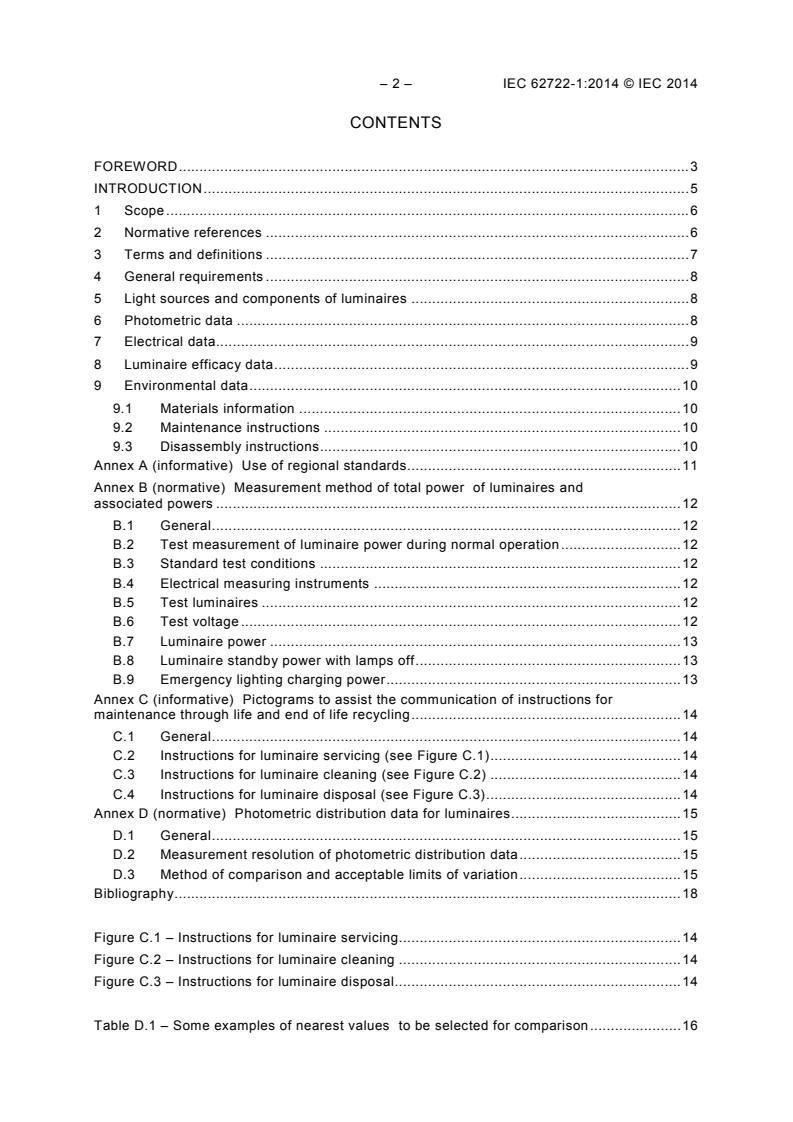
CONTENTS
FOREWORD . 3
INTRODUCTION . 5
1 Scope . 6
2 Normative references . 6
3 Terms and definitions . 7
4 General requirements . 8
5 Light sources and components of luminaires . 8
6 Photometric data . 8
7 Electrical data. 9
8 Luminaire efficacy data . 9
9 Environmental data . 10
9.1 Materials information . 10
9.2 Maintenance instructions . 10
9.3 Disassembly instructions . 10
Annex A (informative) Use of regional standards. 11
Annex B (normative) Measurement method of total power of luminaires and
associated powers . 12
B.1 General . 12
B.2 Test measurement of luminaire power during normal operation . 12
B.3 Standard test conditions . 12
B.4 Electrical measuring instruments . 12
B.5 Test luminaires . 12
B.6 Test voltage . 12
B.7 Luminaire power . 13
B.8 Luminaire standby power with lamps off . 13
B.9 Emergency lighting charging power . 13
Annex C (informative) Pictograms to assist the communication of instructions for
maintenance through life and end of life recycling . 14
C.1 General . 14
C.2 Instructions for luminaire servicing (see Figure C.1) . 14
C.3 Instructions for luminaire cleaning (see Figure C.2) . 14
C.4 Instructions for luminaire disposal (see Figure C.3) . 14
Annex D (normative) Photometric distribution data for luminaires . 15
D.1 General . 15
D.2 Measurement resolution of photometric distribution data . 15
D.3 Method of comparison and acceptable limits of variation . 15
Bibliography . 18
Figure C.1 – Instructions for luminaire servicing . 14
Figure C.2 – Instructions for luminaire cleaning . 14
Figure C.3 – Instructions for luminaire disposal . 14
Table D.1 – Some examples of nearest values to be selected for comparison . 16
INTERNATIONAL ELECTROTECHNICAL COMMISSION
____________
LUMINAIRE PERFORMANCE –
Part 1: General requirements
FOREWORD
1) The International Electrotechnical Commission (IEC) is a worldwide organization for standardization comprising
all national electrotechnical committees (IEC National Committees). The object of IEC is to promote
international co-operation on all questions concerning standardization in the electrical and electronic fields. To
this end and in addition to other activities, IEC publishes International Standards, Technical Specifications,
Technical Reports, Publicly Available Specifications (PAS) and Guides (hereafter referred to as “IEC
Publication(s)”). Their preparation is entrusted to technical committees; any IEC National Committee interested
in the subject dealt with may participate in this preparatory work. International, governmental and non-
governmental organizations liaising with the IEC also participate in this preparation. IEC collaborates closely
with the International Organization for Standardization (ISO) in accordance with conditions determined by
agreement between the two organizations.
2) The formal decisions or agreements of IEC on technical matters express, as nearly as possible, an international
consensus of opinion on the relevant subjects since each technical committee has representation from all
interested IEC National Committees.
3) IEC Publications have the form of recommendations for international use and are accepted by IEC National
Committees in that sense. While all reasonable efforts are made to ensure that the technical content of IEC
Publications is accurate, IEC cannot be held responsible for the way in which they are used or for any
misinterpretation by any end user.
4) In order to promote international uniformity, IEC National Committees undertake to apply IEC Publications
transparently to the maximum extent possible in their national and regional publications. Any divergence
between any IEC Publication and the corresponding national or regional publication shall be clearly indicated in
the latter.
5) IEC itself does not provide any attestation of conformity. Independent certification bodies provide conformity
assessment services and, in some areas, access to IEC marks of conformity. IEC is not responsible for any
services carried out by independent certification bodies.
6) All users should ensure that they have the latest edition of this publication.
7) No liability shall attach to IEC or its directors, employees, servants or agents including individual experts and
members of its technical committees and IEC National Committees for any personal injury, property damage or
other damage of any nature whatsoever, whether direct or indirect, or for costs (including legal fees) and
expenses arising out of the publication, use of, or reliance upon, this IEC Publication or any other IEC
Publications.
8) Attention is drawn to the Normative references cited in this publication. Use of the referenced publications is
indispensable for the correct application of this publication.
9) Attention is drawn to the possibility that some of the elements of this IEC Publication may be the subject of
patent rights. IEC shall not be held responsible for identifying any or all such patent rights.
International Standard IEC 62722-1 has been prepared by subcommittee 34D: Luminaires, of
IEC technical committee 34: Lamps and related equipment.
This first edition cancels and replaces IEC PAS 62722-1 published in 2011 and constitutes a
technical revision.
This edition includes the following significant technical changes with respect to
IEC PAS 62722-1.
a) The inclusion of more precise requirements for the comparison of the photometric
distribution shape, with the comparison method given in Annex D.
b) Further regional standards added to the schedule given in Annex A
– 4 – IEC 62722-1:2014 © IEC 2014
The text of this standard is based on the following documents:
FDIS Report on voting
34D/1132/FDIS 34D/1141/RVD
Full information on the voting for the approval of this standard can be found in the report on
voting indicated in the above table.
This publication has been drafted in accordance with the ISO/IEC Directives, Part 2.
A list of all the parts in the IEC 62722 series, published under the general title Luminaire
performance can be found on the IEC website.
The committee has decided that the contents of this publication will remain unchanged until
the stability date indicated on the IEC web site under "http://webstore.iec.ch" in the data
related to the specific publication. At this date, the publication will be
• reconfirmed,
• withdrawn,
• replaced by a revised edition, or
• amended.
IMPORTANT – The 'colour inside' logo on the cover page of this publication indicates
that it contains colours which are considered to be useful for the correct
understanding of its contents. Users should therefore print this document using a
colour printer.
INTRODUCTION
The first edition of a performance standard for luminaires (general requirements)
acknowledges the need for defining performance data to be provided, the presentation of this
data, the basis of its measurement, and the associated tolerances that may be reasonably
expected. Information to support responsible environmental use is also included. Part 2 of the
IEC 62722-2 series will be introduced where additional performance requirements for specific
types of light source are required.
The provisions in this standard represent the technical knowledge of experts from the fields of
the luminaire industry and associated components such as lamps and controlgear.
– 6 – IEC 62722-1:2014 © IEC 2014
LUMINAIRE PERFORMANCE –
Part 1: General requirements
1 Scope
This part of IEC 62722 covers specific performance and environmental requirements for
luminaires, incorporating electric light sources for operation from supply voltages up to
1 000 V. Unless otherwise detailed, performance data covered under the scope of this
standard are for the luminaires in a condition representative of new manufacture, with any
specified initial aging procedures completed.
IEC 62722-1 covers requirements for luminaires to support energy efficient use and
responsible environmental management to the end of life. The object of this Part 1 is to
provide a set of requirements which are considered to be generally applicable to most types
of luminaires. Where additional performance requirements for specific types of light source
are relevant, these are specified in the IEC 62722-2 series. The IEC 62722-2 series may also
cover a wider scope of performance aspects appropriate to the particular light source
technology.
NOTE The structure of these performance standards also allows for the possibility of Part 3 standards to be
introduced in the future should standardisation of performance criteria linked to specific luminaire applications be
determined as necessary (e.g. floodlighting, street lighting, etc.).
It is the intention that the requirements of this Part 1 are to be met by the provision of
information and data provided by the luminaire manufacturer (or responsible vendor).
Conformity is considered to be met by the provision of the requested information. Any
verification of data is to be conducted by the measurement requirements of this standard.
Semi-luminaires are not covered under the scope of this standard.
For some types of luminaire (e.g. decorative/household) the provision of performance data
under the scope of this standard may not be appropriate.
2 Normative references
The following documents, in whole or in part, are normatively referenced in this document and
are indispensable for its application. For dated references, only the edition cited applies. For
undated references, the latest edition of the referenced document (including any
amendments) applies.
IEC 60598-1, Luminaires – Part 1: General requirements and tests
IEC 60598-2 (all parts), Luminaires – Part 2: Particular requirements
IEC 60598-2-22, Luminaires – Part 2-22: Particular requirements – Luminaires for emergency
lighting
IEC 62722-2 (all parts), Luminaire performance – Part 2: Particular requirements
CIE 34:1977, Road lighting lantern and installation data: Photometrics, classification and
performance
CIE 43:1979, Photometry of floodlights
CIE 121:1996, The photometry and goniophotometry of luminaires
CIE 121-SP1:2009, The photometry and goniophotometry of luminaires – Supplement 1:
Luminaires for emergency lighting
NOTE Annex A provides details of regional standards the use of which are preferred in some countries.
3 Terms and definitions
For the purposes of this document, the terms and definitions given in the IEC 60598-1 as well
as the following apply.
3.1
input power
electrical power from the mains supply consumed by the luminaire including the operation of
all electrical components necessary for its intended functioning
3.2
standby power
electrical power from the mains supply consumed by the luminaire under normal operating
conditions, with the lamps switched off via a control signal
Note 1 to entry: Standby power is expressed in watts.
Note 2 to entry: For emergency lighting luminaires this does not include the emergency lighting charging power.
3.3
emergency lighting charging power
electrical power from the mains supply consumed by the charging circuit of emergency
luminaires to keep the battery charged
Note 1 to entry: Emergency lighting charging power is expressed in watts.
3.4
luminaire efficacy
ratio of the luminaires total luminous flux versus its input power at rated supply voltage,
excluding any emergency lighting charging power
Note 1 to entry: Luminaire efficacy is expressed in lumens per watt.
3.5
light output ratio
LOR
ratio of the total luminous flux of the luminaire, measured under specified practical conditions
with its own light sources and equipment, to the sum of the individual luminous fluxes of the
same light sources when operated outside the luminaire with the same equipment, under
specified conditions
Note 1 to entry: This note applies to the French language only.
3.6
rated value
quantitative value for a characteristic of a luminaire for specific operating conditions specified
in this standard, or in applicable standards, or assigned by the manufacturer or responsible
vendor
3.7
test voltage
voltage at which tests are carried out
– 8 – IEC 62722-1:2014 © IEC 2014
3.8
BLF
ballast lumen factor
ratio of the luminous flux of the light source when the ballast under test is operated at its
rated voltage, to the luminous flux of the same lamp operated with the appropriate reference
ballast supplied at its rated voltage and frequency
4 General requirements
4.1 Luminaires shall be tested complete with the light source and controlgear specified by
the manufacturer. Except where otherwise specified, the luminaire, light source and
controlgear shall be tested as new, and installed as for normal use, having regard to the
manufacturer’s installation instructions.
4.2 Luminaires shall meet the requirements of the IEC 60598-2 series standards that are
appropriate to their design.
4.3 Luminaires shall meet all requirements of this Part 1 and where applicable also the
additional requirements of the IEC 62772-2 series appropriate to the type of light source used
by the luminaire. Where detailed in the IEC 62772-2 series, alternative methods of
measurement or limits to those given in this Part 1 may be specified.
4.4 Where it is specified by this standard that data is to be provided, this data may be
supplied by the manufacturer in printed or electronic formats, via the manufacturer’s
catalogues, website, or similar, unless otherwise specified by this standard.
4.5 Luminaires for tungsten filament lamps may be photometrically rated, electrically rated
and efficacy-rated with lamps of any wattage not exceeding the marked maximum, and any
technology (e.g. halogen, self-ballasted compact fluorescent or self-ballasted LED), if these
lamps are covered by an available IEC safety standard and are shown to comply with that
standard. For these luminaires, the number of lamps, their technology and their wattage shall
be given in the luminaire manufacturer's catalogue, website or similar.
The use of an ILCOS code according to IEC 61231 is recommended. Further details may be
necessary to identify the type of lamp.
4.6 The luminaire manufacturer shall be prepared to provide information for the specific
light source used for the test.
5 Light sources and components of luminaires
Any light sources and components delivered with the luminaire shall comply with the
requirements of the IEC performance standards that are appropriate to them.
6 Photometric data
Photometric data shall be available for the luminaire and any optical attachments or
accessories that the luminaire has been specified for use with. The following photometric data
shall be provided.
a) Light output ratio (LOR) or the total luminous flux of the luminaire
NOTE 1 The relevant standard of the IEC 62722-2 series can specify which of these are to be provided.
b) Luminous intensity distribution
Photometric data shall be provided for luminaires in accordance with an established
international or regional format as appropriate for the type of luminaire, and with luminous
intensity distribution data according to the luminaire's intended application. Data shall be
available in electronic file format to facilitate its use by lighting design software.
NOTE 2 Information regarding acceptable regional standards for photometric data formats is given in Annex A.
When LOR is provided it shall be measured in accordance with CIE 121 and the light output
ratio (LOR) of the luminaire shall not be more than 10 % (relative) below the rated value.
When a total luminous flux is provided it shall be measured in accordance with CIE 121 and
shall not be more than 10 % below the rated value.
The distribution of luminous intensity, measured in accordance with CIE 121, shall generally
be in accordance with that declared by the manufacturer. The method of comparison for the
distribution shape, and limits for acceptance are given in Annex D.
The allowed photometric variations detailed are to take account of manufacturing tolerances.
When measurements are made, additional allowance for laboratory measurement uncertainty
also needs to be considered.
All photometric data shall be declared for the luminaire operating at its rated supply voltage.
For the photometric performance and measurement of emergency luminaires when operating
in emergency mode, see also IEC 60598-2-22 and CIE 121-SP1.
7 Electrical data
Electrical supply data shall be provided for the luminaire and shall include the following:
a) rated supply voltage;
b) rated input power;
c) rated standby power;
d) rated emergency lighting charging power.
Rated power values shall be rounded to the nearest whole number for 10 W and above and
shall be to two significant figures when below 10 W.
When measured at its rated supply voltage, under conditions specified by Annex B, the
electrical values shall not exceed the rated values declared by the manufacturer by more than
10 %.
8 Luminaire efficacy data
Where luminaire efficacy data is provided this shall be with reference to rated light source
performance data published by the light source manufacturer. The luminaire manufacturer
shall be prepared to provide information of the specific light source data that has been used.
Luminaire efficacy data shall be based on the rated photometric and electrical characteristics
of the luminaire. For production light source and luminaire combinations, variation in
accordance with parameters stated in IEC standards for light sources, controlgear, and
luminaire standards may occur.
NOTE Luminaire efficacy data can be derived from LOR × (Rated light source lumens × BLF)/Input power watts at
rated supply voltage.
– 10 – IEC 62722-1:2014 © IEC 2014
9 Environmental data
9.1 Materials information
The manufacturer shall ensure that materials used for the construction of the luminaire and its
components are not in breach of local regulations restricting the use of specific substances
considered to be hazardous to the user or environment.
NOTE Local regulations are those in force for the region of manufacture, sale and use of the luminaire.
9.2 Maintenance instructions
To assist good performance through life, the manufacturer shall provide details of the
recommended maintenance operations that should be carried out.
NOTE In some countries, this information is required under the scope of local regulations.
9.3 Disassembly instructions
To assist end of life recycling, the manufacturer shall provide instructions to assist the
disassembly of the luminaire and segregation of material types.
NOTE 1 In some countries, this information is required under the scope of local regulations.
NOTE 2 Symbols to assist the communication of instructions for maintenance through life and end of life recycling
are given in Annex C.
Annex A
(informative)
Use of regional standards
In some regions the use of local standards, as alternatives to those detailed in the text of this
standard may be preferred. Details of those that have been made known by national
committees are as follows:
Europe
EN 13032-1:2004 Light and lighting – Measurement and presentation of photometric
data lamps and luminaires – Part 1: Measurement and file format
EN 13032-2:2004 Light and lighting – Measurement and presentation of photometric
data lamps and luminaires – Part 2: Presentation of data for indoor
and outdoor work places
EN 13032-3:2007 Light and lighting – Measurement and presentation of photometric
data lamps and luminaires – Part 3: Presentation of data for
emergency lighting of work places
Canada, Mexico and USA
IES-LM75-01 Goniophotometer Types and Photometric Coordinates
IES-LM-63-02 Standard File Format for the Electronic Transfer of Photometric Data
and Related Information
IES-LM-58-94 Guide to Spectroradiometric Measurements
IES-LM-77-09 Intensity Distribution of Luminaires and Lamps Using Digital Screen
Imaging Photometry
ANSI/IES-RP-16-07 Nomenclature and Definitions for Illuminating Engineering
Japan
JIS C 8105-5:2011 Luminaires – Part 5: Gonio-photometric methods
– 12 – IEC 62722-1:2014 © IEC 2014
Annex B
(normative)
Measurement method of total power
of luminaires and associated powers
B.1 General
This annex provides details of the measurement for luminaire supply power, stand-by losses
and emergency lighting charging power.
Electrical measurements are to be made at the luminaire supply terminals.
For production light sources and controlgear used in luminaires, variations in accordance with
parameters stated in IEC standards may occur. Measurements of luminaire electrical
characteristics performed under the scope of this standard should be made with lamps and
controlgear that are representative of their rated values, or with corrections made to take
account for any variation from these.
B.2 Test measurement of luminaire power during normal operation
The object of the test is to measure the luminaire total input power during normal operation
with any associated stand-by losses and emergency lighting charging power at standard
reproducible conditions that are close to the conditions of service for which the luminaire is
designed. Ideally, these luminaire electrical measurements should be made during
photometric tests.
B.3 Standard test conditions
Test conditions for photometric measurements shall be in accordance with CIE 121:1996,
Clause 4.
B.4 Electrical measuring instruments
Voltmeters, ampere meters and wattmeters shall conform to the requirements for Class
Index 0,5 or better (precision grade).
B.5 Test luminaires
Tests are made on a single sample. The luminaire shall be representative of the
manufacturer’s regular product. The luminaire should be mounted in the position in which it is
designed to operate.
B.6 Test voltage
The test voltage at the supply terminals to the luminaire shall be the rated voltage. In the case
of luminaires with a voltage range, the manufacturer shall declare the value at which the test
shall be made.
B.7 Luminaire power
The luminaire power shall be the value obtained in accordance with Clauses B.1 to B.6. The
value shall include the power of all lamp(s), controlgear and other component(s), for normal
full output operating mode or at maximum light output if the luminaire includes a dimming
controlgear. Measurements shall be made at the luminaire input terminals.
B.8 Luminaire standby power with lamps off
The luminaire standby power shall be measured with the lamps off and the luminaire
operating in standby mode only if applicable. For controlled luminaires, this is the power to
the detectors, for emergency luminaires this is the steady state power for charging the
batteries. Measurements shall be made at the luminaire input terminals.
B.9 Emergency lighting charging power
For self-contained emergency luminaires, the luminaire power for maintaining the charge in
the batteries shall be measured only with batteries in fully charged condition with lamps off. If
the input power varies with time, the power is determined as the arithmetic mean value of the
total power measured over a 24 h period following full charging of the emergency lighting
batteries. Measurements shall be made at the luminaire input terminals.
– 14 – IEC 62722-1:2014 © IEC 2014
Annex C
(informative)
Pictograms to assist the communication of instructions
for maintenance through life and end of life recycling
C.1 General
The following pictograms may be used to assist the communication of instructions for
maintenance through life and end of life recycling.
NOTE For all pictograms showing a lamp, the shape of the lamp can be changed to be representative of the
actual lamp being used.
C.2 Instructions for luminaire servicing (see Figure C.1)
Replace aged Switch off Open luminaire Remove old Fit new lamp Refit optic Make
Switch off supply Insert the new
or lamp functional test
to luminaire lamp into lamp
Send to recycling
failed lamp
holder
centre
Figure C.1 – Instructions for luminaire servicing
C.3 Instructions for luminaire cleaning (see Figure C.2)
Switch off
Clean Wipe outside Wash outside Remove Clean inside Refit optic Make
Switch off
luminaire optic optic optic luminaire functional test
supply to
luminaire
Figure C.2 – Instructions for luminaire cleaning
C.4 Instructions for luminaire disposal (see Figure C.3)
Switch off Remove lamp Remove battery Remove Dispatch
Switch off supply
for disposal for disposal luminaire for materials to
to luminaire
disposal recycling plant
Figure C.3 – Instructions for luminaire disposal
Annex D
(normative)
Photometric distribution data for luminaires
D.1 General
For the photometric distribution data of luminaires, this annex provides information and
requirements for the measurement resolution, methods of comparison, and acceptable
variation to the declared data of the manufacturer.
D.2 Measurement resolution of photometric distribution data
The consistency of photometric distribution data largely depends on the number of planes C
and angles γ used for the measurement and presented as final data. The half planes C used
to measure the intensity of the light shall cover all of the space from 0° to 360° with steps of
∆C and ∆γ as specified below.
Maximum intervals between the angles of measurement shall be as follows.
a) Luminaires for general lighting and luminaires for emergency lighting: ∆C = 15°, ∆γ = 5°
b) Floodlight and spotlight luminaires: Planes V and angles H as specified in CIE 43,
depending on the type of light beam and its angular aperture, with close stepping around
the I value. The reading can also be taken using the C-γ system, provided the steps
max
are equivalent to those prescribed by CIE 43.
c) Street lighting luminaires: Planes C and angles γ as detailed by CIE 34.
D.3 Method of comparison and acceptable limits of variation
D.3.1 The photometric distribution of the luminaire shall be measured and the light intensity
is compared to the manufacturer's declared data on the main half planes (C ; C ; C ; C );
0 90 180 270
and also on the C half plane containing the maximum intensity value, C I . For distributions
max
containing peak intensity (C I ) in more than one half plane, this comparison shall be made
max
in the same C-plane.
For luminaires exhibiting axial symmetry the comparison is made only on the main half planes
(C ; C ; C ; C ).
0 90 180 270
Before any comparison it should be ensured that the declared luminaire data and measured
luminaire data have been made for the same mounting orientation of the luminaire. If this is
not the case, the distribution may be rotated as long as this does not change any intensity
values in the process. Additionally the data shall be in the same units (cd/klm or cd)
The normalised maximum intensity value (cd/klm) of each half plane (C ; C ; C ; C ; C
0 90 180 270
I ), is compared with the corresponding 5 angles γ: I and the 4 nearest intensity
max max
readings in the same C half plane.
Table D.1 provides some examples of the nearest values to be selected for comparison.
– 16 – IEC 62722-1:2014 © IEC 2014
Table D.1 – Some examples of nearest values
to be selected for comparison
Case 1 C plane Case 2 C plane Case 3 C plane
E.g. C E.g. C E.g. C
90 180 270
176 197 (186)
γ 5
(178) (135) 197
γ 10
γ 15 (186) (125) (135)
197 (98) (125)
γ 20
(135) (86) (98)
γ 25
γ 30 (125) 76 86
98 56 70
γ 35
86 50 66
γ 40
γ 45 76 40 50
56 35 20
γ 50
Peak value is given in bold text.
Nearest values used for comparison are given in brackets.
For distributions where no clear peak or multiple peaks are present, it should be ensured the
comparison of intensity values are made between the same corresponding angles.
The measured data is acceptable if the corresponding values are within ±20 % of the
manufacturer's declared data.
Possible scenarios for acceptance are as follows.
D.3.2 For each main half plane – C ; C ; C ; C
0 90 180 270
D.3.2.1 Scenario 1 – Maximum intensities occur in the same γ angle
If the I and the 4 γ intensity readings nearest I fall within the specified tolerance the
max max
verdict is PASS (checked for each half plane).
If the above verdict is not PASS this check can be repeated with the half plane C shifted
within the interval C ± ∆C. If the I and the 4 γ intensity readings nearest I fall within the
max max
specified tolerance, the verdict is PASS, otherwise the verdict is FAIL (checked for each half
plane).
D.3.2.2 Scenario 2 – Maximum intensities occur in a different γ angle
If the I and the 4 γ intensity readings nearest I fall within the specified tolerance and
max max
the γ angle shift is less than or equal to ∆γ, the verdict is PASS (checked for each half plane).
If the above verdict is not PASS, this check can be repeated with the half plane C shifted
within the interval C ± ∆C. If the I and the 4 γ intensity readings nearest I fall within the
max max
specified tolerance the verdict is PASS, otherwise the verdict is FAIL (checked for each half
plane).
NOTE ∆C is the maximum measurement step for the specific luminaire type.
D.3.3 For half plane – C I
max
D.3.3.1 Scenario 1 − Maximum intensity occurs in same C plane and same γ angle
If the I and the 4 γ intensity readings nearest I fall within the specified tolerance, the
max max
verdict is PASS, otherwise the verdict is FAIL.
D.3.3.2 Scenario 2 − Maximum intensity occurs in same C plane and different γ angle
If the I and the 4 γ intensity readings nearest I fall within the specified tolerance and
max max
the γ angle shift is less than or equal to ∆γ, the verdict is PASS, otherwise the verdict is FAIL.
D.3.3.3 Scenario 3 – Maximum intensity occurs in a different C plane and same γ angle
If the I and the 4 γ intensity readings nearest I fall within the specified tolerance and
max max
the C plane shift is less than or equal to ∆C, the verdict is PASS, otherwise the verdict is FAIL.
D.3.3.4 Scenario 4 − Maximum intensity occurs in a different C plane and different γ angle
If the I and the 4 γ intensity readings nearest I fall within the specified tolerance and
max max
the C plane shift is less than or equal to ∆C and γ angle shift is less than or equal to ∆γ, the
verdict is PASS, otherwise the verdict is FAIL.
D.3.4 Conformity
Where a PASS conclusion is reached from one of the identified scenarios for D.3.2 (C ; C ;
0 90
C ; C and D.3.3 ( C I ) the measured luminaire is considered as representative of the
180 270) max
manufacturer declared data.
The ∆ angles used for the angular shifts described in D.3.2 and D.3.3 are the maximum
intervals described for the different types of luminaire given in Clause D.2. The
manufacturer's data may have been given using closer intervals.
– 18 – IEC 62722-1:2014 © IEC 2014
Bibliography
IEC 61231, International lamp coding system (ILCOS)
EN 15193:2007, Energy performance of buildings – Energy requirements for lighting
IMQ Rules, Product Certification – Lighting Fittings and Accessories
_____________
– 20 – IEC 62722-1:2014 © IEC 2014
SOMMAIRE
AVANT-PROPOS . 21
INTRODUCTION . 23
1 Domaine d'application . 24
2 Références normatives . 24
3 Termes et définitions . 25
4 Exigences générales . 26
5 Sources lumineuses et composants des luminaires . 26
6 Données photométriques . 27
7 Données électriques . 27
8 Données d'efficacité des luminaires . 28
9 Données relatives à l'environnement . 28
9.1 Informations sur les matériaux . 28
9.2 Instructions de maintenance . 28
9.3 Instructions de démontage . 28
Annexe A (informative) Utilisation des normes régionales . 29
Annexe B (normative) Méthode de mesure de la puissance totale des luminaires et
des puissances associées. 30
B.1 Généralités . 30
B.2 Mesure d'essai de la puissance d'un luminaire en fonctionnement normal . 30
B.3 Conditions normales d'essai .
...