

IEC 60034-5:2020
(Main)Rotating electrical machines - Part 5: Degrees of protection provided by the integral design of rotating electrical machines (IP code) - Classification
General Information
- Abstract
IEC 60034-5:2020 applies to the classification of degrees of protection provided by enclosures for rotating electrical machines. It defines the requirements for protective enclosures that are in all other respects suitable for their intended use and which, from the point of view of materials and workmanship, ensure that the properties dealt with in this document are maintained under normal conditions of use. This document does not specify degrees of protection against mechanical damage of the machine, or conditions such as moisture (produced for example by condensation), corrosive dust and vapour, fungus or vermin.
This document is also applicable to explosion proof machines, but it does not specify the types of protection for use in a potentially explosive (dust, gas) environment. Those are defined in the IEC 60079 series of standards. This document gives definitions for standard degrees of protection provided by enclosures applicable to rotating electrical machines as regards the:
a. protection of persons against contacts with or approach to live parts and against contact with moving parts (other than smooth rotating shafts and the like) inside the enclosure and protection of the machine against ingress of solid foreign objects
b. protection of machines against the harmful effects due to ingress of water;
c. protection of machines against the harmful effects due to ingress of dust.
This fifth edition cancels and replaces the fourth edition, published in 2000, and its Amendment 1:2006.The main technical changes with respect to the previous edition are:
- the inclusion of an additional second numeral 9 including its test method,
- an additional note for clarification in Table 3,
- a clarification on the term open drain hole,
- a clarification on the ingress of dust in Table 4,
- pressure values given now in Pa only,
- a clarification in the scope on the applicability of this standard for (Ex) motors,
- a new Clause 3 with definitions,
The contents of the corrigendum of January 2024 have been included in this copy.
- Status
- Published
- Publication Date
- 28-Apr-2020
- Technical Committee
- TC 2 - Rotating machinery
- Drafting Committee
- WG 12 - TC 2/WG 12
- Current Stage
- PPUB - Publication issued
- Start Date
- 29-Apr-2020
- Completion Date
- 16-Apr-2020
Buy Documents
IEC 60034-5:2020 - Rotating electrical machines - Part 5: Degrees of protection provided by the integral design of rotating electrical machines (IP code) - Classification Released:4/29/2020
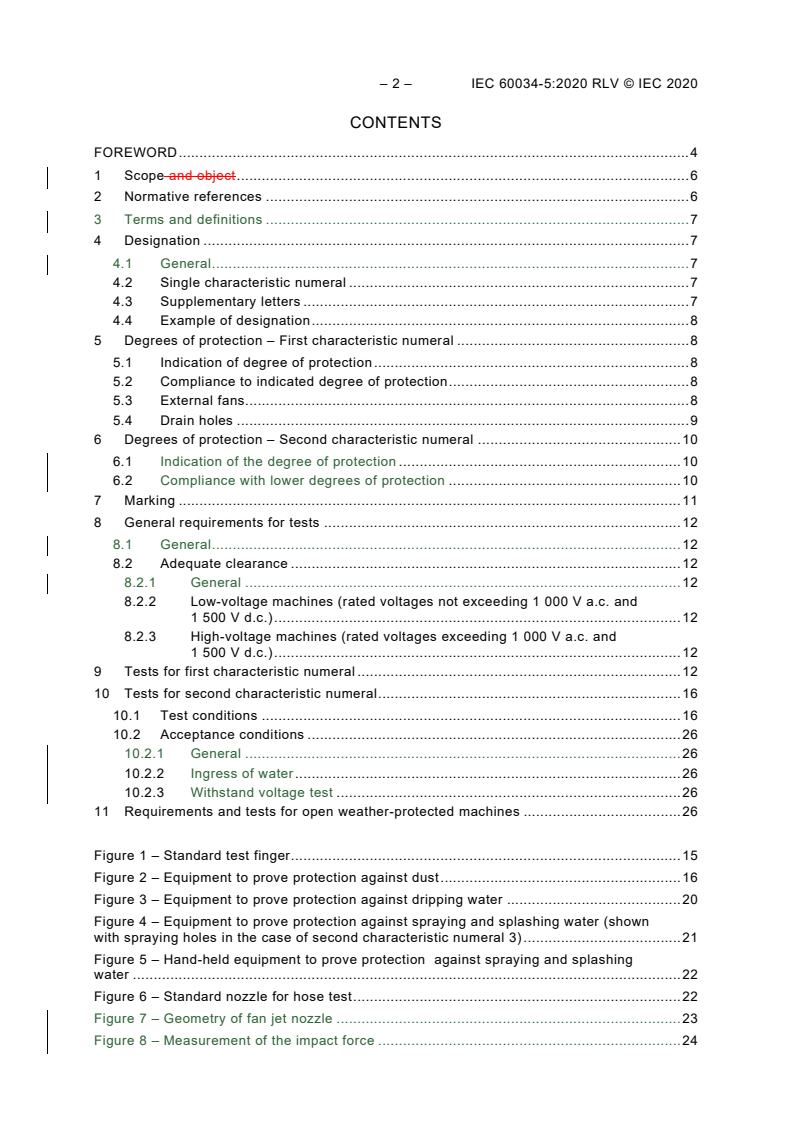
IEC 60034-5:2020 RLV - Rotating electrical machines - Part 5: Degrees of protection provided by the integral design of rotating electrical machines (IP code) - Classification Released:4/29/2020
IEC 60034-5:2020 - Rotating electrical machines - Part 5: Degrees of protection provided by the integral design of rotating electrical machines (IP code) - Classification Released:4/29/2020
Overview
IEC 60034-5:2020 defines the IP code (degrees of protection) specifically for rotating electrical machines. It provides the classification, designation and test requirements for enclosures of motors, generators and similar rotating machines, focusing on protection:
- of persons against contact with live or moving parts,
- of machines against ingress of solid foreign objects and dust,
- of machines against the harmful effects of water ingress.
This fifth edition (2020, corrigendum Jan 2024 included) updates definitions and test methods (notably adding a second-characteristic numeral 9), clarifies terms such as open drain hole, aligns pressure values in Pa, and introduces a new Clause 3 with definitions.
Key topics and requirements
- Designation and marking: Uses the IP format (letters “IP” + two characteristic numerals, plus optional supplementary letters) to communicate protection levels.
- First characteristic numeral: Protection against access to hazardous parts and ingress of solid objects (standard test finger, guards).
- Second characteristic numeral: Protection against ingress of water (dripping, spraying, splashing, jetting, immersion - and new test methods for level 9).
- Test methods and acceptance criteria: Laboratory tests and conditions to verify compliance; procedures for fans, drain holes, and open weather-protected machines.
- Scope limitations: Does not cover protection against mechanical damage, condensation, corrosive vapours, fungus, vermin or the specific types of explosion protection (see IEC 60079 series for Ex equipment).
- Applicability to explosion-proof machines: IP classification applies to Ex motors’ enclosures, but not to the explosion-protection methods themselves.
Practical applications
IEC 60034-5 is essential for:
- Motor and generator manufacturers - design and validate enclosure protection and mark products with the correct IP rating.
- Test laboratories and certification bodies - perform IP tests and issue conformity evidence.
- Specifiers, OEMs and procurement teams - select appropriate rotating machines for environments (outdoor, marine, dusty, wet, washdown).
- Electrical and mechanical designers - integrate enclosure requirements (drainage, cooling fans, sealing) into product development.
- Maintenance and safety engineers - interpret IP ratings to assess suitability and service considerations.
Using IEC 60034-5 helps ensure safety, durability and correct component selection when protecting rotating electrical machines from ingress of solids, dust and water.
Related standards
- IEC 60034 series (general rotating machine standards) - e.g., IEC 60034-1 (rating and performance), IEC 60034-6 (cooling / IC code).
- IEC 60079 series - requirements for equipment used in explosive atmospheres (Ex motors).
Relations
- Effective Date
- 22-Apr-2026
- Effective Date
- 08-Dec-2023
- Effective Date
- 05-Sep-2023
- Effective Date
- 05-Sep-2023
- Effective Date
- 05-Sep-2023
Buy Documents
IEC 60034-5:2020 - Rotating electrical machines - Part 5: Degrees of protection provided by the integral design of rotating electrical machines (IP code) - Classification Released:4/29/2020
IEC 60034-5:2020 RLV - Rotating electrical machines - Part 5: Degrees of protection provided by the integral design of rotating electrical machines (IP code) - Classification Released:4/29/2020
IEC 60034-5:2020 - Rotating electrical machines - Part 5: Degrees of protection provided by the integral design of rotating electrical machines (IP code) - Classification Released:4/29/2020
Get Certified
Connect with accredited certification bodies for this standard

IMQ S.p.A. (Certification)
Italian electrical product certification.

SLG Prüf- und Zertifizierungs GmbH
German testing and certification body.

UL Solutions
Global safety science company with testing, inspection and certification.
Sponsored listings
Frequently Asked Questions
IEC 60034-5:2020 is a standard published by the International Electrotechnical Commission (IEC). Its full title is "Rotating electrical machines - Part 5: Degrees of protection provided by the integral design of rotating electrical machines (IP code) - Classification". This standard covers: IEC 60034-5:2020 applies to the classification of degrees of protection provided by enclosures for rotating electrical machines. It defines the requirements for protective enclosures that are in all other respects suitable for their intended use and which, from the point of view of materials and workmanship, ensure that the properties dealt with in this document are maintained under normal conditions of use. This document does not specify degrees of protection against mechanical damage of the machine, or conditions such as moisture (produced for example by condensation), corrosive dust and vapour, fungus or vermin. This document is also applicable to explosion proof machines, but it does not specify the types of protection for use in a potentially explosive (dust, gas) environment. Those are defined in the IEC 60079 series of standards. This document gives definitions for standard degrees of protection provided by enclosures applicable to rotating electrical machines as regards the: a. protection of persons against contacts with or approach to live parts and against contact with moving parts (other than smooth rotating shafts and the like) inside the enclosure and protection of the machine against ingress of solid foreign objects b. protection of machines against the harmful effects due to ingress of water; c. protection of machines against the harmful effects due to ingress of dust. This fifth edition cancels and replaces the fourth edition, published in 2000, and its Amendment 1:2006.The main technical changes with respect to the previous edition are: - the inclusion of an additional second numeral 9 including its test method, - an additional note for clarification in Table 3, - a clarification on the term open drain hole, - a clarification on the ingress of dust in Table 4, - pressure values given now in Pa only, - a clarification in the scope on the applicability of this standard for (Ex) motors, - a new Clause 3 with definitions, The contents of the corrigendum of January 2024 have been included in this copy.
IEC 60034-5:2020 applies to the classification of degrees of protection provided by enclosures for rotating electrical machines. It defines the requirements for protective enclosures that are in all other respects suitable for their intended use and which, from the point of view of materials and workmanship, ensure that the properties dealt with in this document are maintained under normal conditions of use. This document does not specify degrees of protection against mechanical damage of the machine, or conditions such as moisture (produced for example by condensation), corrosive dust and vapour, fungus or vermin. This document is also applicable to explosion proof machines, but it does not specify the types of protection for use in a potentially explosive (dust, gas) environment. Those are defined in the IEC 60079 series of standards. This document gives definitions for standard degrees of protection provided by enclosures applicable to rotating electrical machines as regards the: a. protection of persons against contacts with or approach to live parts and against contact with moving parts (other than smooth rotating shafts and the like) inside the enclosure and protection of the machine against ingress of solid foreign objects b. protection of machines against the harmful effects due to ingress of water; c. protection of machines against the harmful effects due to ingress of dust. This fifth edition cancels and replaces the fourth edition, published in 2000, and its Amendment 1:2006.The main technical changes with respect to the previous edition are: - the inclusion of an additional second numeral 9 including its test method, - an additional note for clarification in Table 3, - a clarification on the term open drain hole, - a clarification on the ingress of dust in Table 4, - pressure values given now in Pa only, - a clarification in the scope on the applicability of this standard for (Ex) motors, - a new Clause 3 with definitions, The contents of the corrigendum of January 2024 have been included in this copy.
IEC 60034-5:2020 is classified under the following ICS (International Classification for Standards) categories: 29.160.01 - Rotating machinery in general. The ICS classification helps identify the subject area and facilitates finding related standards.
IEC 60034-5:2020 has the following relationships with other standards: It is inter standard links to EN ISO 8528-13:2026, IEC 60034-5:2020/COR1:2024, IEC 60034-5:2000, IEC 60034-5:2000/COR1:2001, IEC 60034-5:2000/AMD1:2006. Understanding these relationships helps ensure you are using the most current and applicable version of the standard.
IEC 60034-5:2020 is available in PDF format for immediate download after purchase. The document can be added to your cart and obtained through the secure checkout process. Digital delivery ensures instant access to the complete standard document.
Standards Content (Sample)
IEC 60034-5 ®
Edition 5.0 2020-04
INTERNATIONAL
STANDARD
Rotating electrical machines –
Part 5: Degrees of protection provided by the integral design of rotating
electrical machines (IP code) – Classification
All rights reserved. Unless otherwise specified, no part of this publication may be reproduced or utilized in any form
or by any means, electronic or mechanical, including photocopying and microfilm, without permission in writing from
either IEC or IEC's member National Committee in the country of the requester. If you have any questions about IEC
copyright or have an enquiry about obtaining additional rights to this publication, please contact the address below or
your local IEC member National Committee for further information.
IEC Central Office Tel.: +41 22 919 02 11
3, rue de Varembé info@iec.ch
CH-1211 Geneva 20 www.iec.ch
Switzerland
About the IEC
The International Electrotechnical Commission (IEC) is the leading global organization that prepares and publishes
International Standards for all electrical, electronic and related technologies.
About IEC publications
The technical content of IEC publications is kept under constant review by the IEC. Please make sure that you have the
latest edition, a corrigendum or an amendment might have been published.
IEC publications search - webstore.iec.ch/advsearchform Electropedia - www.electropedia.org
The advanced search enables to find IEC publications by a The world's leading online dictionary on electrotechnology,
variety of criteria (reference number, text, technical containing more than 22 000 terminological entries in English
committee,…). It also gives information on projects, replaced and French, with equivalent terms in 16 additional languages.
and withdrawn publications. Also known as the International Electrotechnical Vocabulary
(IEV) online.
IEC Just Published - webstore.iec.ch/justpublished
Stay up to date on all new IEC publications. Just Published IEC Glossary - std.iec.ch/glossary
details all new publications released. Available online and 67 000 electrotechnical terminology entries in English and
once a month by email. French extracted from the Terms and Definitions clause of
IEC publications issued since 2002. Some entries have been
IEC Customer Service Centre - webstore.iec.ch/csc collected from earlier publications of IEC TC 37, 77, 86 and
If you wish to give us your feedback on this publication or CISPR.
need further assistance, please contact the Customer Service
Centre: sales@iec.ch.
IEC 60034-5 ®
Edition 5.0 2020-04
INTERNATIONAL
STANDARD
Rotating electrical machines –
Part 5: Degrees of protection provided by the integral design of rotating
electrical machines (IP code) – Classification
INTERNATIONAL
ELECTROTECHNICAL
COMMISSION
ICS 29.160.01 ISBN 978-2-8322-8025-6
– 2 – IEC 60034-5:2020 © IEC 2020
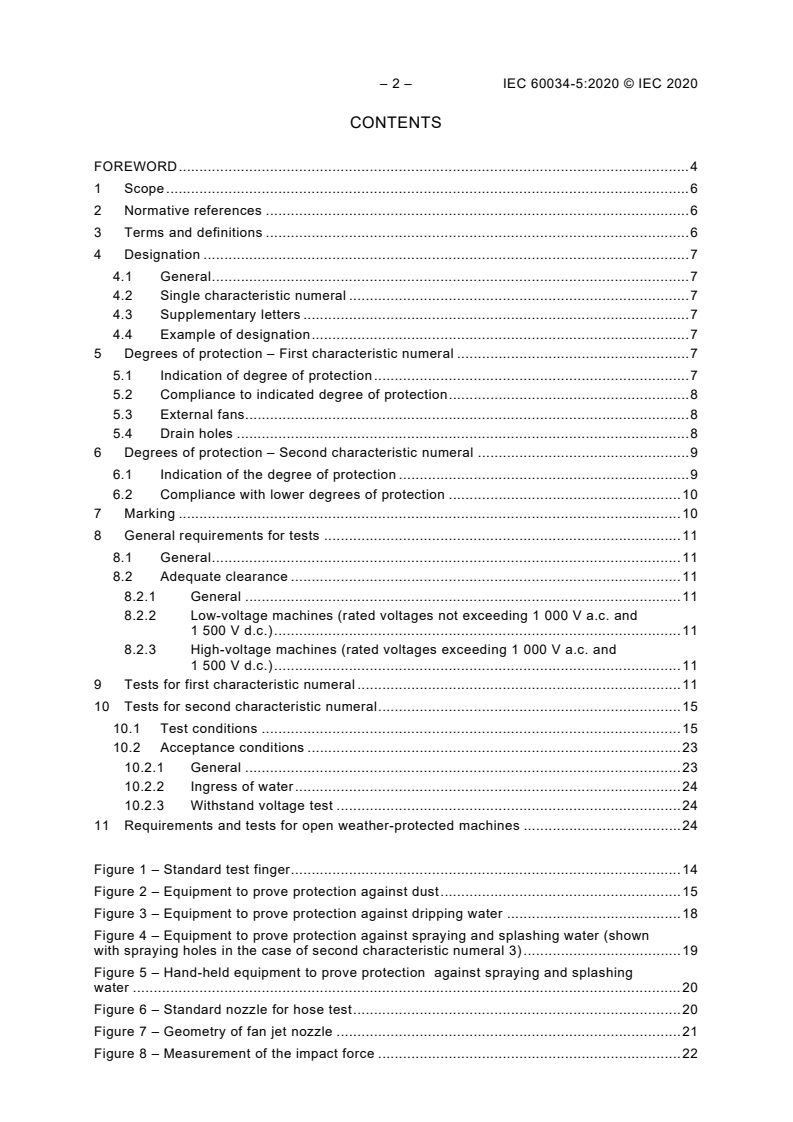
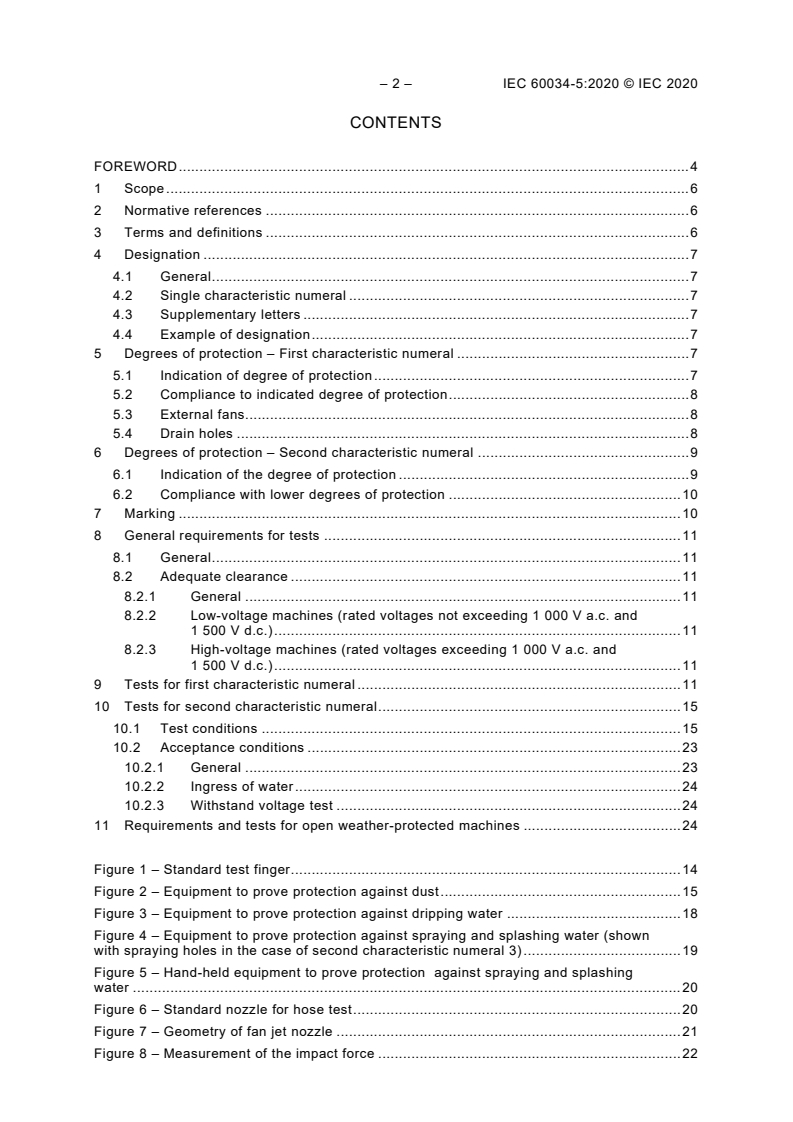
CONTENTS
FOREWORD . 4
1 Scope . 6
2 Normative references . 6
3 Terms and definitions . 6
4 Designation . 7
4.1 General . 7
4.2 Single characteristic numeral . 7
4.3 Supplementary letters . 7
4.4 Example of designation . 7
5 Degrees of protection – First characteristic numeral . 7
5.1 Indication of degree of protection . 7
5.2 Compliance to indicated degree of protection . 8
5.3 External fans. 8
5.4 Drain holes . 8
6 Degrees of protection – Second characteristic numeral . 9
6.1 Indication of the degree of protection . 9
6.2 Compliance with lower degrees of protection . 10
7 Marking . 10
8 General requirements for tests . 11
8.1 General . 11
8.2 Adequate clearance . 11
8.2.1 General . 11
8.2.2 Low-voltage machines (rated voltages not exceeding 1 000 V a.c. and
1 500 V d.c.) . 11
8.2.3 High-voltage machines (rated voltages exceeding 1 000 V a.c. and
1 500 V d.c.) . 11
9 Tests for first characteristic numeral . 11
10 Tests for second characteristic numeral . 15
10.1 Test conditions . 15
10.2 Acceptance conditions . 23
10.2.1 General . 23
10.2.2 Ingress of water . 24
10.2.3 Withstand voltage test . 24
11 Requirements and tests for open weather-protected machines . 24
Figure 1 – Standard test finger . 14
Figure 2 – Equipment to prove protection against dust . 15
Figure 3 – Equipment to prove protection against dripping water . 18
Figure 4 – Equipment to prove protection against spraying and splashing water (shown
with spraying holes in the case of second characteristic numeral 3) . 19
Figure 5 – Hand-held equipment to prove protection against spraying and splashing
water . 20
Figure 6 – Standard nozzle for hose test . 20
Figure 7 – Geometry of fan jet nozzle . 21
Figure 8 – Measurement of the impact force . 22
Figure 9 – Test set-up for determining the protection against high-pressure/steam-jet
cleaning – degree of protection against ingress of water IP X9 for small enclosures . 23
Table 1 – Test requirements for guards . 8
Table 2 – Degrees of protection indicated by the first characteristic numeral . 9
Table 3 – Degrees of protection indicated by the second characteristic numeral . 10
Table 4 – Test and acceptance conditions for first characteristic numeral . 12
Table 5 – Test conditions for second characteristic numeral . 16
– 4 – IEC 60034-5:2020 © IEC 2020
INTERNATIONAL ELECTROTECHNICAL COMMISSION
____________
ROTATING ELECTRICAL MACHINES –
Part 5: Degrees of protection provided by the integral design
of rotating electrical machines (IP code) – Classification
FOREWORD
1) The International Electrotechnical Commission (IEC) is a worldwide organization for standardization comprising
all national electrotechnical committees (IEC National Committees). The object of IEC is to promote international
co-operation on all questions concerning standardization in the electrical and electronic fields. To this end and
in addition to other activities, IEC publishes International Standards, Technical Specifications, Technical Reports,
Publicly Available Specifications (PAS) and Guides (hereafter referred to as “IEC Publication(s)”). Their
preparation is entrusted to technical committees; any IEC National Committee interested in the subject dealt with
may participate in this preparatory work. International, governmental and non-governmental organizations liaising
with the IEC also participate in this preparation. IEC collaborates closely with the International Organization for
Standardization (ISO) in accordance with conditions determined by agreement between the two organizations.
2) The formal decisions or agreements of IEC on technical matters express, as nearly as possible, an international
consensus of opinion on the relevant subjects since each technical committee has representation from all
interested IEC National Committees.
3) IEC Publications have the form of recommendations for international use and are accepted by IEC National
Committees in that sense. While all reasonable efforts are made to ensure that the technical content of IEC
Publications is accurate, IEC cannot be held responsible for the way in which they are used or for any
misinterpretation by any end user.
4) In order to promote international uniformity, IEC National Committees undertake to apply IEC Publications
transparently to the maximum extent possible in their national and regional publications. Any divergence between
any IEC Publication and the corresponding national or regional publication shall be clearly indicated in the latter.
5) IEC itself does not provide any attestation of conformity. Independent certification bodies provide conformity
assessment services and, in some areas, access to IEC marks of conformity. IEC is not responsible for any
services carried out by independent certification bodies.
6) All users should ensure that they have the latest edition of this publication.
7) No liability shall attach to IEC or its directors, employees, servants or agents including individual experts and
members of its technical committees and IEC National Committees for any personal injury, property damage or
other damage of any nature whatsoever, whether direct or indirect, or for costs (including legal fees) and
expenses arising out of the publication, use of, or reliance upon, this IEC Publication or any other IEC
Publications.
8) Attention is drawn to the Normative references cited in this publication. Use of the referenced publications is
indispensable for the correct application of this publication.
9) Attention is drawn to the possibility that some of the elements of this IEC Publication may be the subject of patent
rights. IEC shall not be held responsible for identifying any or all such patent rights.
International Standard IEC 60034-5 has been prepared by IEC technical committee 2: Rotating
machinery.
This fifth edition cancels and replaces the fourth edition, published in 2000, and its
Amendment 1:2006. This edition constitutes a technical revision.
The main technical changes with respect to the previous edition are:
• the inclusion of an additional second numeral 9 including its test method,
• an additional note for clarification in Table 3,
• a clarification on the term open drain hole,
• a clarification on the ingress of dust in Table 4,
• pressure values given now in Pa only,
• a clarification in the scope on the applicability of this standard for (Ex) motors,
• a new Clause 3 with definitions,
The text of this International Standard is based on the following documents:
CDV Report on voting
2/1960/CDV 2/1972A/RVC
Full information on the voting for the approval of this International Standard can be found in the
report on voting indicated in the above table.
This document has been drafted in accordance with the ISO/IEC Directives, Part 2.
A list of all parts in the IEC 60034 series, published under the general title Rotating electrical
machines, can be found on the IEC website.
The committee has decided that the contents of this document will remain unchanged until the
stability date indicated on the IEC website under "http://webstore.iec.ch" in the data related to
the specific document. At this date, the document will be
• reconfirmed,
• withdrawn,
• replaced by a revised edition, or
• amended.
IMPORTANT – The 'colour inside' logo on the cover page of this publication indicates
that it contains colours which are considered to be useful for the correct understanding
of its contents. Users should therefore print this document using a colour printer.
– 6 – IEC 60034-5:2020 © IEC 2020
ROTATING ELECTRICAL MACHINES –
Part 5: Degrees of protection provided by the integral design
of rotating electrical machines (IP code) – Classification
1 Scope
This part of IEC 60034 applies to the classification of degrees of protection provided by
enclosures for rotating electrical machines. It defines the requirements for protective enclosures
that are in all other respects suitable for their intended use and which, from the point of view of
materials and workmanship, ensure that the properties dealt with in this document are
maintained under normal conditions of use.
This document does not specify degrees of protection against mechanical damage of the
machine, or conditions such as moisture (produced for example by condensation), corrosive
dust and vapour, fungus or vermin.
This document is also applicable to explosion proof machines, but it does not specifiy the types
of protection for use in a potentially explosive (dust, gas) environment. Those are defined in the
IEC 60079 series of standards.
In certain applications (such as agricultural or domestic appliances), more extensive
precautions against accidental or deliberate contact may be specified.
This document gives definitions for standard degrees of protection provided by enclosures
applicable to rotating electrical machines as regards the:
a) protection of persons against contacts with or approach to live parts and against contact
with moving parts (other than smooth rotating shafts and the like) inside the enclosure and
protection of the machine against ingress of solid foreign objects;
b) protection of machines against the harmful effects due to ingress of water;
c) protection of machines against the harmful effects due to ingress of dust.
It gives designations for these protective degrees and tests to be performed to check that the
machines meet the requirements of this document.
2 Normative references
The following documents are referred to in the text in such a way that some or all of their content
constitutes requirements of this document. For dated references, only the edition cited applies.
For undated references, the latest edition of the referenced document (including any
amendments) applies.
IEC 60034-6, Rotating electrical machines – Part 6: Methods of cooling (IC code)
3 Terms and definitions
For the purposes of this document, the following terms and definitions apply.
ISO and IEC maintain terminological databases for use in standardization at the following
addresses:
• IEC Electropedia: available at http://www.electropedia.org/
• ISO Online browsing platform: available at http://www.iso.org/obp
3.1
closed machine
machine where no medium from the surrounding medium, for the purpose of cooling, passes
through the machine
[SOURCE: IEC 60050-411:1996, 411-44-17]
3.2
open machine
machine with an open cooling circuit in which the coolant is drawn directly from the surrounding
medium passing through the machine and then returning directly to the surrounding medium
[SOURCE: IEC 60050-411:1996, 411-44-16]
4 Designation
4.1 General
The designation used for the degree of protection consists of the letters IP followed by two
characteristic numerals signifying conformity with the conditions indicated in the tables of
Clauses 5 and 6 respectively.
4.2 Single characteristic numeral
When it is required to indicate a degree of protection by only one characteristic numeral, the
omitted numeral shall be replaced by the letter X, for example IPX5 or IP2X.
4.3 Supplementary letters
4.3.1 Additional information may be indicated by a supplementary letter following the second
characteristic numeral. If more than one letter is used, the alphabetic sequence shall apply.
4.3.2 In special applications (such as machines with open circuit cooling for ship deck
installation with air inlet and outlet openings closed during standstill), numerals may be followed
by a letter indicating whether the protection against harmful effects due to ingress of water was
verified or tested for the machine not running (letter S) or the machine running (letter M). In this
case, the degree of protection in either state of the machine shall be indicated, for example
IP55S/IP20M.
The absence of the letters S and M shall imply that the intended degree of protection will be
provided under all normal conditions of use.
4.3.3 For air-cooled open machines suitable for specific weather conditions and provided
with additional protective features or processes (as specified in Clause 11), the letter W may
be used.
4.4 Example of designation
IP 4 4
Characteristic letters
First characteristic numeral (see Table 2)
Second characteristic numeral (see Table 3)
5 Degrees of protection – First characteristic numeral
5.1 Indication of degree of protection
The first characteristic numeral indicates the degree of protection provided by the enclosure to
persons and to the parts of the machine inside the enclosure.
Table 2 gives, in the third column, brief details of objects which will be ‘excluded’ from the
enclosure for each of the degrees of protection represented by the first characteristic numeral.
The term ‘excluded’ implies that a part of the body, a tool or a wire held by a person, either will
not enter the machine or, if it enters, that adequate clearance will be maintained between it and
– 8 – IEC 60034-5:2020 © IEC 2020
the live parts or dangerous moving parts (smooth rotating shafts and the like are not considered
dangerous).
The third column of Table 2 also indicates the minimum size of solid foreign objects which will
be excluded.
5.2 Compliance to indicated degree of protection
Compliance of an enclosure with an indicated degree of protection implies that the enclosure
will also comply with all lower degrees of protection in Table 2. In consequence, the tests
establishing these lower degrees of protection are not required, except in case of doubt.
5.3 External fans
The blades and spokes of fans external to the enclosure shall be protected against contact by
means of guards complying with Table 1.
Table 1 – Test requirements for guards
Protection of machine Test
IP1X 50 mm sphere test
IP2X to IP6X Finger test
For the test, the rotor shall be slowly rotated, for example by hand when possible.
Smooth rotating shafts and similar parts are not considered dangerous.
5.4 Drain holes
If the machine is provided with drain holes, the following shall apply:
• drain holes intended normally to be open on site shall be kept open during testing;
• drain holes are considered as open as long as no breather(s) or plug(s), etc., are mounted
in a drain;
• if machines with protection IP3X or IP4X are intended to be run with open drain holes, the
drain holes may comply with protection IP2X;
• if machines with protection IP5X are intended to be run with open drain holes, the drain
holes shall comply with protection IP4X.
Table 2 – Degrees of protection indicated by the first characteristic numeral
Degree of protection
First
Test
characteristic
Brief description
conditions
Definition
numeral
(NOTE 1)
0 Non-protected machine No special protection No test
1 Machine protected against solid Accidental or inadvertent contact with or Table 4
(NOTE 2) objects greater than 50 mm approach to live and moving parts inside the
enclosure by a large surface of the human body,
such as a hand (but no protection against
deliberate access)
Ingress of solid objects exceeding 50 mm in
diameter
2 Machine protected against solid Contact with or approach to live or moving parts
(NOTE 2) objects greater than 12 mm inside the enclosure by fingers or similar objects
not exceeding 80 mm in length
Ingress of solid objects exceeding 12 mm in
diameter
3 Machine protected against solid Contact with or approach to live or moving parts
(NOTE 2) objects greater than 2,5 mm inside the enclosure by tools or wires exceeding
2,5 mm in diameter
Ingress of solid objects exceeding 2,5 mm in
diameter
4 Machine protected against solid Contact with or approach to live or moving parts
(NOTE 2) objects greater than 1 mm inside the enclosure by wires or strips of
thickness greater than 1 mm
Ingress of solid objects exceeding 1 mm in
diameter
5 Dust-protected machine Contact with or approach to live or moving parts
(NOTE 3) inside the enclosure
Ingress of dust is not totally prevented but dust
does not enter in sufficient quantity to interfere
with satisfactory operation of the machine
6 Dust-tight machines Ingress of dust totally prevented
NOTE 1 The brief description given in the second column of this table cannot be used to specify the type of
protection.
NOTE 2 Machines assigned a first characteristic numeral 1, 2, 3 or 4 will exclude both regularly or irregularly
shaped solid objects, provided that three normally perpendicular dimensions of the object exceed the appropriate
figure in the ‘Definition’ column.
NOTE 3 The degree of protection against dust defined by this document is a general one. When the nature of the
dust (dimensions of particles, their nature, for instance fibrous particles) is specified, test conditions can be
determined by agreement between manufacturer and user.
6 Degrees of protection – Second characteristic numeral
6.1 Indication of the degree of protection
The second characteristic numeral indicates the degree of protection provided by the enclosure
with respect to harmful effects due to ingress of water.
Table 3 gives, in the third column, details of the type of protection provided by the enclosure
for each of the degrees of protection represented by the second characteristic numeral.
An air-cooled open machine is weather-protected when its design reduces the ingress of rain,
snow and airborne particles, under specified conditions, to an amount consistent with correct
operation.
This degree of protection is designated by the letter W placed after the second characteristic
numeral.
– 10 – IEC 60034-5:2020 © IEC 2020
6.2 Compliance with lower degrees of protection
For second characteristic numerals up to and including 6, compliance of an enclosure with an
indicated degree of protection implies that the enclosure will also comply with all lower degrees
of protection in Table 3.
In consequence, the tests establishing these lower degrees of protection are not required,
except in case of doubt.
For IPX7, IPX8 and IPX9, it shall not be assumed that compliance of the enclosure implies that
the enclosure will also comply with all lower degrees of protection in Table 3.
Table 3 – Degrees of protection indicated by the second characteristic numeral
Degree of protection
Second
Test
characteristic
Brief description
conditions
Definition
numeral
(NOTE 1)
0 Non-protected machine No special protection No test
1 Machine protected against Dripping water (vertically falling drops) shall have no Table 5
dripping water harmful effect
2 Machine protected against Vertically dripping water shall have no harmful effect
dripping water when tilted when the machine is tilted at any angle up to 15°
up to 15° from its normal position
3 Machine protected against Water falling as a spray at an angle up to 60° from
spraying water the vertical shall have no harmful effect
4 Machine protected against Water splashing against the machine from any
splashing water direction shall have no harmful effect
5 Machine protected against Water projected by a nozzle against the machine
water jets from any direction shall have no harmful effect
(NOTE 3)
6 Machine protected ag
...
IEC 60034-5 ®
Edition 5.0 2020-04
REDLINE VERSION
INTERNATIONAL
STANDARD
colour
inside
Rotating electrical machines –
Part 5: Degrees of protection provided by the integral design of rotating
electrical machines (IP code) – Classification
All rights reserved. Unless otherwise specified, no part of this publication may be reproduced or utilized in any form
or by any means, electronic or mechanical, including photocopying and microfilm, without permission in writing from
either IEC or IEC's member National Committee in the country of the requester. If you have any questions about IEC
copyright or have an enquiry about obtaining additional rights to this publication, please contact the address below or
your local IEC member National Committee for further information.
IEC Central Office Tel.: +41 22 919 02 11
3, rue de Varembé info@iec.ch
CH-1211 Geneva 20 www.iec.ch
Switzerland
About the IEC
The International Electrotechnical Commission (IEC) is the leading global organization that prepares and publishes
International Standards for all electrical, electronic and related technologies.
About IEC publications
The technical content of IEC publications is kept under constant review by the IEC. Please make sure that you have the
latest edition, a corrigendum or an amendment might have been published.
IEC publications search - webstore.iec.ch/advsearchform Electropedia - www.electropedia.org
The advanced search enables to find IEC publications by a The world's leading online dictionary on electrotechnology,
variety of criteria (reference number, text, technical containing more than 22 000 terminological entries in English
committee,…). It also gives information on projects, replaced and French, with equivalent terms in 16 additional languages.
and withdrawn publications. Also known as the International Electrotechnical Vocabulary
(IEV) online.
IEC Just Published - webstore.iec.ch/justpublished
Stay up to date on all new IEC publications. Just Published IEC Glossary - std.iec.ch/glossary
details all new publications released. Available online and 67 000 electrotechnical terminology entries in English and
once a month by email. French extracted from the Terms and Definitions clause of
IEC publications issued since 2002. Some entries have been
IEC Customer Service Centre - webstore.iec.ch/csc collected from earlier publications of IEC TC 37, 77, 86 and
If you wish to give us your feedback on this publication or CISPR.
need further assistance, please contact the Customer Service
Centre: sales@iec.ch.
IEC 60034-5 ®
Edition 5.0 2020-04
REDLINE VERSION
INTERNATIONAL
STANDARD
colour
inside
Rotating electrical machines –
Part 5: Degrees of protection provided by the integral design of rotating
electrical machines (IP code) – Classification
INTERNATIONAL
ELECTROTECHNICAL
COMMISSION
ICS 29.160.01 ISBN 978-2-8322-8298-4
– 2 – IEC 60034-5:2020 RLV © IEC 2020
CONTENTS
FOREWORD . 4
1 Scope and object . 6
2 Normative references . 6
3 Terms and definitions . 7
4 Designation . 7
4.1 General . 7
4.2 Single characteristic numeral . 7
4.3 Supplementary letters . 7
4.4 Example of designation . 8
5 Degrees of protection – First characteristic numeral . 8
5.1 Indication of degree of protection . 8
5.2 Compliance to indicated degree of protection . 8
5.3 External fans. 8
5.4 Drain holes . 9
6 Degrees of protection – Second characteristic numeral . 10
6.1 Indication of the degree of protection . 10
6.2 Compliance with lower degrees of protection . 10
7 Marking . 11
8 General requirements for tests . 12
8.1 General . 12
8.2 Adequate clearance . 12
8.2.1 General . 12
8.2.2 Low-voltage machines (rated voltages not exceeding 1 000 V a.c. and
1 500 V d.c.) . 12
8.2.3 High-voltage machines (rated voltages exceeding 1 000 V a.c. and
1 500 V d.c.) . 12
9 Tests for first characteristic numeral . 12
10 Tests for second characteristic numeral . 16
10.1 Test conditions . 16
10.2 Acceptance conditions . 26
10.2.1 General . 26
10.2.2 Ingress of water . 26
10.2.3 Withstand voltage test . 26
11 Requirements and tests for open weather-protected machines . 26
Figure 1 – Standard test finger . 15
Figure 2 – Equipment to prove protection against dust . 16
Figure 3 – Equipment to prove protection against dripping water . 20
Figure 4 – Equipment to prove protection against spraying and splashing water (shown
with spraying holes in the case of second characteristic numeral 3) . 21
Figure 5 – Hand-held equipment to prove protection against spraying and splashing
water . 22
Figure 6 – Standard nozzle for hose test . 22
Figure 7 – Geometry of fan jet nozzle . 23
Figure 8 – Measurement of the impact force . 24
Figure 9 – Test set-up for determining the protection against high-pressure/steam-jet
cleaning – degree of protection against ingress of water IP X9 for small enclosures . 25
Table 1 – Test requirements for guards . 8
Table 2 – Degrees of protection indicated by the first characteristic numeral . 9
Table 3 – Degrees of protection indicated by the second characteristic numeral . 11
Table 4 – Test and acceptance conditions for first characteristic numeral . 13
Table 5 – Test conditions for second characteristic numeral . 17
– 4 – IEC 60034-5:2020 RLV © IEC 2020
INTERNATIONAL ELECTROTECHNICAL COMMISSION
____________
ROTATING ELECTRICAL MACHINES –
Part 5: Degrees of protection provided by the integral design
of rotating electrical machines (IP code) – Classification
FOREWORD
1) The International Electrotechnical Commission (IEC) is a worldwide organization for standardization comprising
all national electrotechnical committees (IEC National Committees). The object of IEC is to promote international
co-operation on all questions concerning standardization in the electrical and electronic fields. To this end and
in addition to other activities, IEC publishes International Standards, Technical Specifications, Technical Reports,
Publicly Available Specifications (PAS) and Guides (hereafter referred to as “IEC Publication(s)”). Their
preparation is entrusted to technical committees; any IEC National Committee interested in the subject dealt with
may participate in this preparatory work. International, governmental and non-governmental organizations liaising
with the IEC also participate in this preparation. IEC collaborates closely with the International Organization for
Standardization (ISO) in accordance with conditions determined by agreement between the two organizations.
2) The formal decisions or agreements of IEC on technical matters express, as nearly as possible, an international
consensus of opinion on the relevant subjects since each technical committee has representation from all
interested IEC National Committees.
3) IEC Publications have the form of recommendations for international use and are accepted by IEC National
Committees in that sense. While all reasonable efforts are made to ensure that the technical content of IEC
Publications is accurate, IEC cannot be held responsible for the way in which they are used or for any
misinterpretation by any end user.
4) In order to promote international uniformity, IEC National Committees undertake to apply IEC Publications
transparently to the maximum extent possible in their national and regional publications. Any divergence between
any IEC Publication and the corresponding national or regional publication shall be clearly indicated in the latter.
5) IEC itself does not provide any attestation of conformity. Independent certification bodies provide conformity
assessment services and, in some areas, access to IEC marks of conformity. IEC is not responsible for any
services carried out by independent certification bodies.
6) All users should ensure that they have the latest edition of this publication.
7) No liability shall attach to IEC or its directors, employees, servants or agents including individual experts and
members of its technical committees and IEC National Committees for any personal injury, property damage or
other damage of any nature whatsoever, whether direct or indirect, or for costs (including legal fees) and
expenses arising out of the publication, use of, or reliance upon, this IEC Publication or any other IEC
Publications.
8) Attention is drawn to the Normative references cited in this publication. Use of the referenced publications is
indispensable for the correct application of this publication.
9) Attention is drawn to the possibility that some of the elements of this IEC Publication may be the subject of patent
rights. IEC shall not be held responsible for identifying any or all such patent rights.
This redline version of the official IEC Standard allows the user to identify the changes
made to the previous edition. A vertical bar appears in the margin wherever a change has
been made. Additions are in green text, deletions are in strikethrough red text.
International Standard IEC 60034-5 has been prepared by IEC technical committee 2: Rotating
machinery.
This fifth edition cancels and replaces the fourth edition, published in 2000, and its
Amendment 1:2006. This edition constitutes a technical revision.
The main technical changes with respect to the previous edition are:
• the inclusion of an additional second numeral 9 including its test method,
• an additional note for clarification in Table 3,
• a clarification on the term open drain hole,
• a clarification on the ingress of dust in Table 4,
• pressure values given now in Pa only,
• a clarification in the scope on the applicability of this standard for (Ex) motors,
• a new Clause 3 with definitions,
The text of this International Standard is based on the following documents:
CDV Report on voting
2/1960/CDV 2/1972A/RVC
Full information on the voting for the approval of this International Standard can be found in the
report on voting indicated in the above table.
This document has been drafted in accordance with the ISO/IEC Directives, Part 2.
A list of all parts in the IEC 60034 series, published under the general title Rotating electrical
machines, can be found on the IEC website.
The committee has decided that the contents of this document will remain unchanged until the
stability date indicated on the IEC website under "http://webstore.iec.ch" in the data related to
the specific document. At this date, the document will be
• reconfirmed,
• withdrawn,
• replaced by a revised edition, or
• amended.
IMPORTANT – The 'colour inside' logo on the cover page of this publication indicates
that it contains colours which are considered to be useful for the correct understanding
of its contents. Users should therefore print this document using a colour printer.
The contents of the corrigendum 1 (2024-01) have been included in this copy.
– 6 – IEC 60034-5:2020 RLV © IEC 2020
ROTATING ELECTRICAL MACHINES –
Part 5: Degrees of protection provided by the integral design
of rotating electrical machines (IP code) – Classification
1 Scope and object
This part of IEC 60034 applies to the classification of degrees of protection provided by
enclosures for rotating electrical machines. It defines the requirements for protective enclosures
that are in all other respects suitable for their intended use and which, from the point of view of
materials and workmanship, ensure that the properties dealt with in this document are
maintained under normal conditions of use.
This standard does not specify:
• degrees of protection against mechanical damage of the machine, or conditions such as
moisture (produced for example by condensation), corrosive vapours, fungus or vermin;
• types of protection of machines for use in an explosive atmosphere;
• the requirements for barriers external to the enclosure which have to be provided solely for
the safety of personnel.
This document does not specify degrees of protection against mechanical damage of the
machine, or conditions such as moisture (produced for example by condensation), corrosive
dust and vapour, fungus or vermin.
This document is also applicable to explosion proof machines, but it does not specifiy the types
of protection for use in a potentially explosive (dust, gas) environment. Those are defined in the
IEC 60079 series of standards.
In certain applications (such as agricultural or domestic appliances), more extensive
precautions against accidental or deliberate contact may be specified.
This document gives definitions for standard degrees of protection provided by enclosures
applicable to rotating electrical machines as regards the:
a) protection of persons against contacts with or approach to live parts and against contact
with moving parts (other than smooth rotating shafts and the like) inside the enclosure and
protection of the machine against ingress of solid foreign objects;
b) protection of machines against the harmful effects due to ingress of water;
c) protection of machines against the harmful effects due to ingress of dust.
It gives designations for these protective degrees and tests to be performed to check that the
machines meet the requirements of this document.
2 Normative references
The following normative documents contain provisions which, through reference in this text,
constitute provisions of this part of IEC 60034. For dated references, subsequent amendments
to, or revisions of, any of these publications do not apply. However, parties to agreements
based on this part of IEC 60034 are encouraged to investigate the possibility of applying the
most recent editions of the normative documents indicated below. For undated references, the
latest edition of the normative document referred to applies. Members of IEC and ISO maintain
registers of currently valid International Standards.
The following documents are referred to in the text in such a way that some or all of their content
constitutes requirements of this document. For dated references, only the edition cited applies.
For undated references, the latest edition of the referenced document (including any
amendments) applies.
*
IEC 60034-1, Rotating electrical machines – Part 1: Rating and performance
IEC 60034-6, Rotating electrical machines – Part 6: Methods of cooling (IC code)
3 Terms and definitions
For the purposes of this document, the following terms and definitions apply.
ISO and IEC maintain terminological databases for use in standardization at the following
addresses:
• IEC Electropedia: available at http://www.electropedia.org/
• ISO Online browsing platform: available at http://www.iso.org/obp
3.1
closed machine
machine where no medium from the surrounding medium, for the purpose of cooling, passes
through the machine
[SOURCE: IEC 60050-411:1996, 411-44-17]
3.2
open machine
machine with an open cooling circuit in which the coolant is drawn directly from the surrounding
medium passing through the machine and then returning directly to the surrounding medium
[SOURCE: IEC 60050-411:1996, 411-44-16]
4 Designation
4.1 General
The designation used for the degree of protection consists of the letters IP followed by two
characteristic numerals signifying conformity with the conditions indicated in the tables of
Clauses 5 and 6 respectively.
4.2 Single characteristic numeral
When it is required to indicate a degree of protection by only one characteristic numeral, the
omitted numeral shall be replaced by the letter X, for example IPX5 or IP2X.
4.3 Supplementary letters
4.3.1 Additional information may be indicated by a supplementary letter following the second
characteristic numeral. If more than one letter is used, the alphabetic sequence shall apply.
4.3.2 In special applications (such as machines with open circuit cooling for ship deck
installation with air inlet and outlet openings closed during standstill), numerals may be followed
by a letter indicating whether the protection against harmful effects due to ingress of water was
verified or tested for the machine not running (letter S) or the machine running (letter M). In this
case, the degree of protection in either state of the machine shall be indicated, for example
IP55S/IP20M.
The absence of the letters S and M shall imply that the intended degree of protection will be
provided under all normal conditions of use.
___________
*
A consolidated edition 10.2 (1999) was issued comprising IEC 60034-1 (1996) and its amendments 1 (1997)
and 2 (1999).
– 8 – IEC 60034-5:2020 RLV © IEC 2020
4.3.3 For air-cooled open machines suitable for specific weather conditions and provided
with additional protective features or processes (as specified in Clause 11), the letter W may
be used.
4.4 Example of designation
IP 4 4
Characteristic letters
First characteristic numeral (see Table 2)
Second characteristic numeral (see Table 3)
5 Degrees of protection – First characteristic numeral
5.1 Indication of degree of protection
The first characteristic numeral indicates the degree of protection provided by the enclosure to
persons and to the parts of the machine inside the enclosure.
Table 2 gives, in the third column, brief details of objects which will be ‘excluded’ from the
enclosure for each of the degrees of protection represented by the first characteristic numeral.
The term ‘excluded’ implies that a part of the body, a tool or a wire held by a person, either will
not enter the machine or, if it enters, that adequate clearance will be maintained between it and
the live parts or dangerous moving parts (smooth rotating shafts and the like are not considered
dangerous).
The third column of Table 2 also indicates the minimum size of solid foreign objects which will
be excluded.
5.2 Compliance to indicated degree of protection
Compliance of an enclosure with an indicated degree of protection implies that the enclosure
will also comply with all lower degrees of protection in Table 2. In consequence, the tests
establishing these lower degrees of protection are not required, except in case of doubt.
5.3 External fans
The blades and spokes of fans external to the enclosure shall be protected against contact by
means of guards complying with Table 1.
Table 1 – Test requirements for guards
Protection of machine Test
IP1X 50 mm sphere test
IP2X to IP6X Finger test
For the test, the rotor shall be slowly rotated, for example by hand when possible.
Smooth rotating shafts and similar parts are not considered dangerous.
5.4 Drain holes
If the machine is provided with drain holes, the following shall apply:
• drain holes intended normally to be open on site shall be kept open during testing;
– drain holes intended normally to be closed on site shall be kept closed during testing;
• drain holes are considered as open as long as no breather(s) or plug(s), etc., are mounted
in a drain;
• if machines with protection IP3X or IP4X are intended to be run with open drain holes, the
drain holes may comply with protection IP2X;
• if machines with protection IP5X are intended to be run with open drain holes, the drain
holes shall comply with protection IP4X.
Table 2 – Degrees of protection indicated by the first characteristic numeral
Degree of protection
First
Test
characteristic
Brief description
conditions
Definition
numeral
(NOTE 1)
0 Non-protected machine No special protection No test
1 Machine protected against solid Accidental or inadvertent contact with or Table 4
(NOTE 2) objects greater than 50 mm approach to live and moving parts inside the
enclosure by a large surface of the human body,
such as a hand (but no protection against
deliberate access)
Ingress of solid objects exceeding 50 mm in
diameter
2 Machine protected against solid Contact with or approach to live or moving parts
(NOTE 2) objects greater than 12 mm inside the enclosure by fingers or similar objects
not exceeding 80 mm in length
Ingress of solid objects exceeding 12 mm in
diameter
3 Machine protected against solid Contact with or approach to live or moving parts
(NOTE 2) objects greater than 2,5 mm inside the enclosure by tools or wires exceeding
2,5 mm in diameter
Ingress of solid objects exceeding 2,5 mm in
diameter
4 Machine protected against solid Contact with or approach to live or moving parts
(NOTE 2) objects greater than 1 mm inside the enclosure by wires or strips of
thickness greater than 1 mm
Ingress of solid objects exceeding 1 mm in
diameter
5 Dust-protected machine Contact with or approach to live or moving parts
(NOTE 3) inside the enclosure
Ingress of dust is not totally prevented but dust
does not enter in sufficient quantity to interfere
with satisfactory operation of the machine
6 Dust-tight machines Ingress of dust totally prevented
NOTE 1 The brief description given in the second column of this table should not cannot be used to specify the
type of protection.
NOTE 2 Machines assigned a first characteristic numeral 1, 2, 3 or 4 will exclude both regularly or irregularly
shaped solid objects, provided that three normally perpendicular dimensions of the object exceed the appropriate
figure in the ‘Definition’ column.
NOTE 3 The degree of protection against dust defined by this document is a general one. When the nature of the
dust (dimensions of particles, their nature, for instance fibrous particles) is specified, test conditions should can be
determined by agreement between manufacturer and user.
– 10 – IEC 60034-5:2020 RLV © IEC 2020
6 Degrees of protection – Second characteristic numeral
6.1 Indication of the degree of protection
The second characteristic numeral indicates the degree of protection provided by the enclosure
with respect to harmful effects due to ingress of water.
Table 3 gives, in the third column, details of the type of protection provided by the enclosure
for each of the degrees of protection represented by the second characteristic numeral.
An air-cooled open machine is weather-protected when its design reduces the ingress of rain,
snow and airborne particles, under specified conditions, to an amount consistent with correct
operation.
This degree of protection is designated by the letter W placed after the second characteristic
numeral.
6.2 Compliance with lower degrees of protection
For second characteristic numerals up to and including 6, compliance of an enclosure with an
indicated degree of protection implies that the enclosure will also comply with all lower degrees
of protection in Table 3.
In consequence, the tests establishing these lower degrees of protection are not required,
except in case of doubt.
For IPX7, IPX8 and IPX9, it shall not be assumed that compliance of the enclosure implies that
the enclosure will also comply with all lower degrees of protection in Table 3.
Table 3 – Degrees of protection indicated by the second characteristic numeral
Degree of protection
Second
Test
characteristic
Brief description
conditions
Definition
numeral
(NOTE 1)
0 Non-protected machine No special protection No test
1 Machine protected against Dripping water (vertically falling drops) shall have no Table 5
dripping water harmful effect
2 Machine protected against Vertically dripping water shall have no harmful effect
dripping water when tilted when the machine is tilted at any angle up to 15°
up to 15° from its normal position
3 Machine protected against Water falling as a spray at an angle up to 60° from
spraying water the vertical shall have no harmful effect
4 Machine protected against Water splashing against the machine from any
splashing water direction shall have no harmful effect
5 Machine protected against Water projected by a nozzle against the machine
water jets from any direction shall have no harmful effect
(NOTE 3)
6 Machine protected against Water from heavy seas or water projected in powerful
heavy seas jets shall not enter the machine in harmful quantities
7 Machine protected against Ingress of water in the machine in a harmful quantity
the effects of immersion shall not be possible when the machine is immersed
in water under stated conditions of pressure and time
8 Machine protected against The machine is suitable for continuous submersion in
the effects of continuous water under conditions which shall be specified by
submersion the manufacturer (NOTE 2)
9 Machine protected against Water projected at high pressure and high
high pressure and high temperature against the enclosure from any direction
temperature water jets shall have no harmful effects (NOTE 3)
NOTE 1 The brief description given in the second column of this table should not cannot be used to specify the
type of protection.
NOTE 2 Normally, this means that the machine is hermetically sealed. However, with certain types of machines it
can mean that water can enter but only in such a manner that it produces no harmful effect.
NOTE 3 It is understood that protections as IPx5 or IPx9 are not equivalent to a total endurance to all weather
conditions that can be present for a long period of time. Weather-proof could be achieved by providing additional
protection.
7 Marking
It is recommended that the characteristic letters and numerals be marked on the machine
preferably on the rating plate or, if this is not practicable, on the enclosure.
When all parts of a machine do not have the same degree of protection, at least the designation
of the lowest degree shall be shown, followed, if necessary, by the higher designation with clear
reference to the part to which it applies.
NOTE Space limitations on the rating plate usually only allow the lowest IP code to be marked.
Parts or components having a higher degree of protection should then be specified in the
documentation and/or in the operating instructions.
The lower degree of protection of:
– guards for external fans (as allowed in 5.3);
– drain holes (as allowed in 5.4);
need not be specified on the rating plate or in the documentation.
Where the mounting of the machine has an influence on the degree of protection, the intended
mounting arrangements shall be indicated by the manufacturer on the rating plate or in the
instructions for mounting.
– 12 – IEC 60034-5:2020 RLV © IEC 2020
8 General requirements for tests
8.1 General
The tests specified in this document are type tests. They shall be carried out on standard
products or models of them. Where this is not feasible, verification either by an alternative test
or by examination of drawings shall be the subject of an agreement between manufacturer
and user.
Unless otherwise specified, the machine for each test shall be clean with all the parts in place
and mounted in the manner stated by the manufacturer.
In the case of both first and second characteristic numerals 1, 2, 3 and 4, a visual inspection
may, in certain obvious cases, show that the intended degree of protection is obtained. In such
cases, no test need be made. However, in case of doubt, tests shall be made as prescribed in
Clauses 9 and 10.
8.2 Adequate clearance
8.2.1 General
For the purpose of the following test clauses in this document, the term ‘adequate clearance’
has the meaning given in 8.2.2 or 8.2.3.
8.2.2 Low-voltage machines (rated voltages not exceeding 1 000 V a.c. and
1 500 V d.c.)
The test device (sphere, finger, wire, etc.) does not touch the live parts or moving parts other
than non-dangerous parts such as smooth rotating shafts.
8.2.3 High-voltage machines (rated voltages exceeding 1 000 V a.c. and 1 500 V d.c.)
When the test device is placed in the most unfavourable position, the machine shall be capable
of withstanding the dielectric test applicable to the machine.
This dielectric test requirement may be replaced by a specified clearance dimension in air which
would ensure that this test would be satisfactory under the most unfavourable electrical field
configuration.
9 Tests for first characteristic numeral
Test and acceptance conditions for the first characteristic numeral are given in Table 4.
The dust test for numerals 5 and 6 shall be performed with the shaft stationary, provided that
the difference in pressure between running and stationary (caused by fan effects) is lower than
2 kPa. If the pressure difference is greater than 2 kPa, the internal machine pressure during
the dust test shall be depressed accordingly. Alternatively, the machine may be tested with the
shaft rotating at rated speed.
Table 4 – Test and acceptance conditions for first characteristic numeral
First Test and acceptance conditions
characteristic
numeral
0 No test is required.
+0,05
The test is made with a rigid sphere of 50 mm diameter applied against the opening(s) in the
enclosure with a force of 45 N to 55 N.
The protection is satisfactory if the sphere does not pass through any opening and adequate
clearance is maintained to parts which are normally live in service or moving parts inside the
machine.
2 a) Finger test
The test is made with a metallic test finger as shown in Figure 1. Both joints of this finger
may be bent through an angle of 90° with respect to the axis of the finger, but in one and
the same direction only. The finger is pushed without undue force (not more than 10 N)
against any openings in the enclosure and, if it enters, it is placed in every possible
position.
The protection is satisfactory if adequate clearance is maintained between the test finger
and live or moving parts inside the enclosure. However, it is permissible to touch smooth
rotating shafts and similar non-dangerous parts.
For this test, the internal moving parts may be operated slowly, where this is possible.
For tests on a low-voltage machine, a low-voltage supply (of not less than 40 V) in series
with a suitable lamp may be connected between the test finger and the live parts inside the
enclosure. Conducting parts covered only with varnish or paint, or protected by oxidation or
by a similar process, shall be covered with a metal foil electrically connected to those parts
which are nor-mally live in service. The protection is satisfactory if the lamp does not light.
For high-voltage machines, adequate clearance is verified by a dielectric test, or by a
measurement of clearance distance in accordance with the principles of 8.2.3.
b) Sphere test
+0,05
12,5
The test is made with a rigid sphere of mm diameter applied to the openings of the
enclosure with a force of 27 N to 33 N.
The protection is satisfactory if the sphere does not pass through any opening and
adequate clearance is maintained to live or moving parts inside the machine.
+0,05
2,5
The test is made with a straight rigid steel wire or rod of mm diameter applied with a
force of 2,7 N to 3,3 N. The end of the wire or rod shall be free from burrs and at right angles to
its length.
The protection is satisfactory if the wire or rod cannot enter the enclosure.
+0,05
The test is made with a straight rigid steel wire of mm diameter applied with a force of
0,9 N to 1,1 N. The end of the wire shall be free from burrs and at right angles to its length.
The protection is satisfactory if the wire cannot enter the enclosure.
– 14 – IEC 60034-5:2020 RLV © IEC 2020
First Test and acceptance conditions
characteristic
numeral
5 a) Dust test
The test is made using equipment incorporating the basic principles shown in Figure 2, in
which talcum powder is maintained in suspension in a suitable closed test chamber. The
talcum powder used shall be able to pass through a square-meshed sieve having a nominal
wire diameter of 50 µm and a nominal width between wires of 75 µm. The amount of talcum
powder to be used is 2 kg/m of the test chamber volume. It shall not be used for more than
20 tests.
Electrical machines have an enclosure where the normal operating cycle of the machine
causes reductions in the air pressure within the enclosure in relation to the ambient
atmospheric pressures. These reductions may be due, for example, to thermal cycling
effects (category 1).
For this test the machine is supported inside the test chamber and the pressure inside the
machine is maintained below atmospheric pressure by a vacuum pump. If the enclosure has
a single drain hole, the suction connection shall be made to one hole specially provided for
the purpose of the test, except if the drain hole is intended normally to be closed on site
(see 5.4).
The object of the test is to draw into the machine, if possible, at least 80 times the volume
of air in the enclosure without exceeding an extraction rate of 60 volumes per hour with a
suitable depression. In no event shall the depression exceed 2 kPa (20 mbar) on the
manometer shown in Figure 2.
If an extraction rate of 40 to 60 volumes per hour is obtained, the test is stopped after 2 h.
If, with a maximum depression of 2 kPa (20 mbar), the extraction rate is less than 40
volumes per hour, the test is continued until 80 volumes have been drawn through, or a
period of 8 h has elapsed.
If it is impracticable to test the complete machine in the test chamber, one of the following
procedures shall be applied:
– testing of individually enclosed sections of the machine (terminal boxes, slip-ring
housings, etc.);
– testing of representative parts of the machine, comprising components such as doors,
ventilating openings, joints, shaft seals, etc., with the vulnerable parts of the machine,
such as terminals, slip-rings, etc., in position at the time of testing;
– testing of a smaller machine having the same full-scale design details;
– testing under conditions determined by agreement between manufacturer and user.
In the second and third cases, the volume of air to be drawn through the machine under test
is as specified for the whole machine in full scale.
The protection is satisfactory if, on inspection, talcum powder has not accumulated in a
quantity or location such that, as with any kind of ordinary dust (i.e. dust that is not
conductive, combustible, explosive or chemically corrosive), it could interfere with the
correct satisfactory operation of the machine or lead to tracking along the creepage
distances.
b) Wire test
If the machine is intended to be run with open drain hole(s), these shall be tested in the
same manner as the first characteristic numeral 4, that is, using a 1 mm diameter wire.
6 Test in accordance with 5 a).
The protection is satisfactory if, on inspection, there is no ingress of talcum powder.
Dimensions in millimetres
Key
1 Handle 4 Stop face 7 R2 ± 0,05 cylindrical
2 Guard 5 Joints 8 R4 ± 0,05 spherical
3 Insulating material 6 Chamfer all edges
Tolerances on dimensions without specific tolerance:
on angles: ( ) ° on dimensions: up to 25 mm: ( ) mm;
−10 −0,05
over 25 mm: ± 0,2 mm
Material for finger: e.g. heat-treated steel.
+10
( 90 )
Both joints of this finger may be bent through an angle of ° but in one and the same direction only.
Using the pin and groove solution is only one of the possible approaches in order to limit the bending angle to 90°.
For this reason, dimensions and tolerances of these details are not given in the drawing. The actual design shall
ensure a 90° bending angle with a 0° to +10° tolerance.
Figure 1 – Standard test finger
– 16 – IEC 60034-5:2020 RLV © IEC 2020
Key
1 Valve 5 Machine under test 9 Glass window
2 Dust filter 6 Talcum powder 10 Vibrator
3 Air flow meter 7 Guard screen 11 Circulating pump
4 Vacuum pump 8 Pressure gauge
Figure 2 – Equipment to prove protection against dust
10 Tests for second characteristic numeral
10.1 Test conditions
Test conditions for the second characteristic numeral are given in Table 5.
The test shall be conducted with fresh water. During the test, the moisture contained inside the
enclosure may be partly condensed. The dew which may thus be deposited should not be
mistaken for an ingress of water.
For the purpose of the tests, the surface area of the machine shall be calculated with an
accuracy of 10 %.
When possible, the machine shall be run at rated speed. This can be achieved by mechanical
means or by energization. If the machine is energized, adequate safety precautions shall be
taken.
Table 5 – Test conditions for second characteristic numeral
Second Test and acceptance conditions
characteristic
numeral
0 No test is required.
1 The test is made by means of an equipment, the principle of which is shown in Figure 3. The
rate of discharge shall be reasonably uniform over the whole area of the apparatus and shall
produce a rainfall of between 3 mm and 5 mm of water per minute (in the case of equipment
according to Figure 3, this corresponds to a fall in water level of 3 mm to 5 mm/min).
The machine under test is placed in its normal operating position under the dripping equipment,
the base of which shall be larger than that of the machine. Except for machines designed for
wall or ceiling mounting, the support for the enclosure under test should be smaller than the
base of the enclosure.
The machine normally fixed to a wall or ceiling is fixed in its normal position of use to a wooden
board having dimensions which are equal to those of that surface of the machine which is in
contact with the wall or ceiling when the machine is mounted as in normal use.
The duration of the test shall be 10 min.
2 The dripping equipment is the same as that specified for the second characteristic numeral 1
and is adjusted to give the same rate of discharge.
The machine is tested for 2,5 min in each of four fixed positions of tilt. These positions are 15°
either side of the vertical in two mutually perpendicular planes.
The total duration of the test shall be 10 min.
3 The test shall be made using equipment such as is shown in Figure 4, provided that the dimen-
sions and shape of the machine to be tested are such that the radius of the oscillating tube
does not exceed 1 m. Where this condition cannot be fulfilled, a hand-held spray device, as
shown in Figure 5, shall be used.
a) Conditions when using test equipment as shown in Figure 4.
The total flow rate shall be adjusted to an average rate of (0,067 to 0,074) l/min per hole
multiplied by the number of holes. The total flow rate shall be measured with a flowmeter.
The tube is provided with spray holes over an arc of 60° either side of the centre point and
shall be fixed in a vertical position. The test machine is mounted on a turntable with a
vertical axis and is located at approximately the centre point of the semicircle.
The minimum duration of the test shall be 10 min.
b) Conditions when using test equipment as shown in Figure 5.
The moving shield shall be in place for this test.
The water pressure is adjusted to give a delivery rate of (10 ± 0,5) I/min (pressure
approximately 80 kPa to 100 kPa) (0,8 bar to 1,0 bar).
The test duration shall be 1 min/m of calculated surface area of the machine (excluding any
mounting surface and cooling fin) with a minimum duration of 5 min.
4 The conditions for deciding whether the apparatus of Figure 4 or that of Figure 5 should be
used are the same as stated for the second characteristic numeral 3.
a) Using the equipment as shown in Figure 4.
The oscillating tube has holes drilled over the whole
...
IEC 60034-5 ®
Edition 5.0 2020-04
INTERNATIONAL
STANDARD
NORME
INTERNATIONALE
colour
inside
Rotating electrical machines –
Part 5: Degrees of protection provided by the integral design of rotating
electrical machines (IP code) – Classification
Machines électriques tournantes –
Partie 5: Degrés de protection procurés par la conception intégrale de machines
électriques tournantes (code IP) – Classification
All rights reserved. Unless otherwise specified, no part of this publication may be reproduced or utilized in any form
or by any means, electronic or mechanical, including photocopying and microfilm, without permission in writing from
either IEC or IEC's member National Committee in the country of the requester. If you have any questions about IEC
copyright or have an enquiry about obtaining additional rights to this publication, please contact the address below or
your local IEC member National Committee for further information.
Droits de reproduction réservés. Sauf indication contraire, aucune partie de cette publication ne peut être reproduite
ni utilisée sous quelque forme que ce soit et par aucun procédé, électronique ou mécanique, y compris la photocopie
et les microfilms, sans l'accord écrit de l'IEC ou du Comité national de l'IEC du pays du demandeur. Si vous avez des
questions sur le copyright de l'IEC ou si vous désirez obtenir des droits supplémentaires sur cette publication, utilisez
les coordonnées ci-après ou contactez le Comité national de l'IEC de votre pays de résidence.
IEC Central Office Tel.: +41 22 919 02 11
3, rue de Varembé info@iec.ch
CH-1211 Geneva 20 www.iec.ch
Switzerland
About the IEC
The International Electrotechnical Commission (IEC) is the leading global organization that prepares and publishes
International Standards for all electrical, electronic and related technologies.
About IEC publications
The technical content of IEC publications is kept under constant review by the IEC. Please make sure that you have the
latest edition, a corrigendum or an amendment might have been published.
IEC publications search - webstore.iec.ch/advsearchform Electropedia - www.electropedia.org
The advanced search enables to find IEC publications by a The world's leading online dictionary on electrotechnology,
variety of criteria (reference number, text, technical containing more than 22 000 terminological entries in English
committee,…). It also gives information on projects, replaced and French, with equivalent terms in 16 additional languages.
and withdrawn publications. Also known as the International Electrotechnical Vocabulary
(IEV) online.
IEC Just Published - webstore.iec.ch/justpublished
Stay up to date on all new IEC publications. Just Published IEC Glossary - std.iec.ch/glossary
details all new publications released. Available online and 67 000 electrotechnical terminology entries in English and
once a month by email. French extracted from the Terms and Definitions clause of
IEC publications issued since 2002. Some entries have been
IEC Customer Service Centre - webstore.iec.ch/csc collected from earlier publications of IEC TC 37, 77, 86 and
If you wish to give us your feedback on this publication or CISPR.
need further assistance, please contact the Customer Service
Centre: sales@iec.ch.
A propos de l'IEC
La Commission Electrotechnique Internationale (IEC) est la première organisation mondiale qui élabore et publie des
Normes internationales pour tout ce qui a trait à l'électricité, à l'électronique et aux technologies apparentées.
A propos des publications IEC
Le contenu technique des publications IEC est constamment revu. Veuillez vous assurer que vous possédez l’édition la
plus récente, un corrigendum ou amendement peut avoir été publié.
Recherche de publications IEC - Electropedia - www.electropedia.org
webstore.iec.ch/advsearchform Le premier dictionnaire d'électrotechnologie en ligne au
La recherche avancée permet de trouver des publications IEC monde, avec plus de 22 000 articles terminologiques en
en utilisant différents critères (numéro de référence, texte, anglais et en français, ainsi que les termes équivalents dans
comité d’études,…). Elle donne aussi des informations sur les 16 langues additionnelles. Egalement appelé Vocabulaire
projets et les publications remplacées ou retirées. Electrotechnique International (IEV) en ligne.
IEC Just Published - webstore.iec.ch/justpublished Glossaire IEC - std.iec.ch/glossary
Restez informé sur les nouvelles publications IEC. Just 67 000 entrées terminologiques électrotechniques, en anglais
Published détaille les nouvelles publications parues. et en français, extraites des articles Termes et Définitions des
Disponible en ligne et une fois par mois par email. publications IEC parues depuis 2002. Plus certaines entrées
antérieures extraites des publications des CE 37, 77, 86 et
Service Clients - webstore.iec.ch/csc CISPR de l'IEC.
Si vous désirez nous donner des commentaires sur cette
publication ou si vous avez des questions contactez-nous:
sales@iec.ch.
IEC 60034-5 ®
Edition 5.0 2020-04
INTERNATIONAL
STANDARD
NORME
INTERNATIONALE
colour
inside
Rotating electrical machines –
Part 5: Degrees of protection provided by the integral design of rotating
electrical machines (IP code) – Classification
Machines électriques tournantes –
Partie 5: Degrés de protection procurés par la conception intégrale de machines
électriques tournantes (code IP) – Classification
INTERNATIONAL
ELECTROTECHNICAL
COMMISSION
COMMISSION
ELECTROTECHNIQUE
INTERNATIONALE
ICS 29.160.01 ISBN 978-2-8322-8644-9
– 2 – IEC 60034-5:2020 © IEC 2020
CONTENTS
FOREWORD . 4
1 Scope . 6
2 Normative references . 6
3 Terms and definitions . 6
4 Designation . 7
4.1 General . 7
4.2 Single characteristic numeral . 7
4.3 Supplementary letters . 7
4.4 Example of designation . 7
5 Degrees of protection – First characteristic numeral . 7
5.1 Indication of degree of protection . 7
5.2 Compliance to indicated degree of protection . 8
5.3 External fans. 8
5.4 Drain holes . 8
6 Degrees of protection – Second characteristic numeral . 9
6.1 Indication of the degree of protection . 9
6.2 Compliance with lower degrees of protection . 10
7 Marking . 10
8 General requirements for tests . 11
8.1 General . 11
8.2 Adequate clearance . 11
8.2.1 General . 11
8.2.2 Low-voltage machines (rated voltages not exceeding 1 000 V a.c. and
1 500 V d.c.) . 11
8.2.3 High-voltage machines (rated voltages exceeding 1 000 V a.c. and
1 500 V d.c.) . 11
9 Tests for first characteristic numeral . 11
10 Tests for second characteristic numeral . 15
10.1 Test conditions . 15
10.2 Acceptance conditions . 23
10.2.1 General . 23
10.2.2 Ingress of water . 24
10.2.3 Withstand voltage test . 24
11 Requirements and tests for open weather-protected machines . 24
Figure 1 – Standard test finger . 14
Figure 2 – Equipment to prove protection against dust . 15
Figure 3 – Equipment to prove protection against dripping water . 18
Figure 4 – Equipment to prove protection against spraying and splashing water (shown
with spraying holes in the case of second characteristic numeral 3) . 19
Figure 5 – Hand-held equipment to prove protection against spraying and splashing
water . 20
Figure 6 – Standard nozzle for hose test . 20
Figure 7 – Geometry of fan jet nozzle . 21
Figure 8 – Measurement of the impact force . 22
Figure 9 – Test set-up for determining the protection against high-pressure/steam-jet
cleaning – degree of protection against ingress of water IP X9 for small enclosures . 23
Table 1 – Test requirements for guards . 8
Table 2 – Degrees of protection indicated by the first characteristic numeral . 9
Table 3 – Degrees of protection indicated by the second characteristic numeral . 10
Table 4 – Test and acceptance conditions for first characteristic numeral . 12
Table 5 – Test conditions for second characteristic numeral . 16
– 4 – IEC 60034-5:2020 © IEC 2020
INTERNATIONAL ELECTROTECHNICAL COMMISSION
____________
ROTATING ELECTRICAL MACHINES –
Part 5: Degrees of protection provided by the integral design
of rotating electrical machines (IP code) – Classification
FOREWORD
1) The International Electrotechnical Commission (IEC) is a worldwide organization for standardization comprising
all national electrotechnical committees (IEC National Committees). The object of IEC is to promote international
co-operation on all questions concerning standardization in the electrical and electronic fields. To this end and
in addition to other activities, IEC publishes International Standards, Technical Specifications, Technical Reports,
Publicly Available Specifications (PAS) and Guides (hereafter referred to as “IEC Publication(s)”). Their
preparation is entrusted to technical committees; any IEC National Committee interested in the subject dealt with
may participate in this preparatory work. International, governmental and non-governmental organizations liaising
with the IEC also participate in this preparation. IEC collaborates closely with the International Organization for
Standardization (ISO) in accordance with conditions determined by agreement between the two organizations.
2) The formal decisions or agreements of IEC on technical matters express, as nearly as possible, an international
consensus of opinion on the relevant subjects since each technical committee has representation from all
interested IEC National Committees.
3) IEC Publications have the form of recommendations for international use and are accepted by IEC National
Committees in that sense. While all reasonable efforts are made to ensure that the technical content of IEC
Publications is accurate, IEC cannot be held responsible for the way in which they are used or for any
misinterpretation by any end user.
4) In order to promote international uniformity, IEC National Committees undertake to apply IEC Publications
transparently to the maximum extent possible in their national and regional publications. Any divergence between
any IEC Publication and the corresponding national or regional publication shall be clearly indicated in the latter.
5) IEC itself does not provide any attestation of conformity. Independent certification bodies provide conformity
assessment services and, in some areas, access to IEC marks of conformity. IEC is not responsible for any
services carried out by independent certification bodies.
6) All users should ensure that they have the latest edition of this publication.
7) No liability shall attach to IEC or its directors, employees, servants or agents including individual experts and
members of its technical committees and IEC National Committees for any personal injury, property damage or
other damage of any nature whatsoever, whether direct or indirect, or for costs (including legal fees) and
expenses arising out of the publication, use of, or reliance upon, this IEC Publication or any other IEC
Publications.
8) Attention is drawn to the Normative references cited in this publication. Use of the referenced publications is
indispensable for the correct application of this publication.
9) Attention is drawn to the possibility that some of the elements of this IEC Publication may be the subject of patent
rights. IEC shall not be held responsible for identifying any or all such patent rights.
International Standard IEC 60034-5 has been prepared by IEC technical committee 2: Rotating
machinery.
This bilingual version (2020-07) corresponds to the monolingual English version, published in
2020-04.
This fifth edition cancels and replaces the fourth edition, published in 2000, and its
Amendment 1:2006. This edition constitutes a technical revision.
The main technical changes with respect to the previous edition are:
• the inclusion of an additional second numeral 9 including its test method,
• an additional note for clarification in Table 3,
• a clarification on the term open drain hole,
• a clarification on the ingress of dust in Table 4,
• pressure values given now in Pa only,
• a clarification in the scope on the applicability of this standard for (Ex) motors,
• a new Clause 3 with definitions,
The text of this International Standard is based on the following documents:
CDV Report on voting
2/1960/CDV 2/1972A/RVC
Full information on the voting for the approval of this International Standard can be found in the
report on voting indicated in the above table.
The French version of this standard has not been voted upon.
This document has been drafted in accordance with the ISO/IEC Directives, Part 2.
A list of all parts in the IEC 60034 series, published under the general title Rotating electrical
machines, can be found on the IEC website.
The committee has decided that the contents of this document will remain unchanged until the
stability date indicated on the IEC website under "http://webstore.iec.ch" in the data related to
the specific document. At this date, the document will be
• reconfirmed,
• withdrawn,
• replaced by a revised edition, or
• amended.
IMPORTANT – The 'colour inside' logo on the cover page of this publication indicates
that it contains colours which are considered to be useful for the correct understanding
of its contents. Users should therefore print this document using a colour printer.
– 6 – IEC 60034-5:2020 © IEC 2020
ROTATING ELECTRICAL MACHINES –
Part 5: Degrees of protection provided by the integral design
of rotating electrical machines (IP code) – Classification
1 Scope
This part of IEC 60034 applies to the classification of degrees of protection provided by
enclosures for rotating electrical machines. It defines the requirements for protective enclosures
that are in all other respects suitable for their intended use and which, from the point of view of
materials and workmanship, ensure that the properties dealt with in this document are
maintained under normal conditions of use.
This document does not specify degrees of protection against mechanical damage of the
machine, or conditions such as moisture (produced for example by condensation), corrosive
dust and vapour, fungus or vermin.
This document is also applicable to explosion proof machines, but it does not specifiy the types
of protection for use in a potentially explosive (dust, gas) environment. Those are defined in the
IEC 60079 series of standards.
In certain applications (such as agricultural or domestic appliances), more extensive
precautions against accidental or deliberate contact may be specified.
This document gives definitions for standard degrees of protection provided by enclosures
applicable to rotating electrical machines as regards the:
a) protection of persons against contacts with or approach to live parts and against contact
with moving parts (other than smooth rotating shafts and the like) inside the enclosure and
protection of the machine against ingress of solid foreign objects;
b) protection of machines against the harmful effects due to ingress of water;
c) protection of machines against the harmful effects due to ingress of dust.
It gives designations for these protective degrees and tests to be performed to check that the
machines meet the requirements of this document.
2 Normative references
The following documents are referred to in the text in such a way that some or all of their content
constitutes requirements of this document. For dated references, only the edition cited applies.
For undated references, the latest edition of the referenced document (including any
amendments) applies.
IEC 60034-6, Rotating electrical machines – Part 6: Methods of cooling (IC code)
3 Terms and definitions
For the purposes of this document, the following terms and definitions apply.
ISO and IEC maintain terminological databases for use in standardization at the following
addresses:
• IEC Electropedia: available at http://www.electropedia.org/
• ISO Online browsing platform: available at http://www.iso.org/obp
3.1
closed machine
machine where no medium from the surrounding medium, for the purpose of cooling, passes
through the machine
[SOURCE: IEC 60050-411:1996, 411-44-17]
3.2
open machine
machine with an open cooling circuit in which the coolant is drawn directly from the surrounding
medium passing through the machine and then returning directly to the surrounding medium
[SOURCE: IEC 60050-411:1996, 411-44-16]
4 Designation
4.1 General
The designation used for the degree of protection consists of the letters IP followed by two
characteristic numerals signifying conformity with the conditions indicated in the tables of
Clauses 5 and 6 respectively.
4.2 Single characteristic numeral
When it is required to indicate a degree of protection by only one characteristic numeral, the
omitted numeral shall be replaced by the letter X, for example IPX5 or IP2X.
4.3 Supplementary letters
4.3.1 Additional information may be indicated by a supplementary letter following the second
characteristic numeral. If more than one letter is used, the alphabetic sequence shall apply.
4.3.2 In special applications (such as machines with open circuit cooling for ship deck
installation with air inlet and outlet openings closed during standstill), numerals may be followed
by a letter indicating whether the protection against harmful effects due to ingress of water was
verified or tested for the machine not running (letter S) or the machine running (letter M). In this
case, the degree of protection in either state of the machine shall be indicated, for example
IP55S/IP20M.
The absence of the letters S and M shall imply that the intended degree of protection will be
provided under all normal conditions of use.
4.3.3 For air-cooled open machines suitable for specific weather conditions and provided
with additional protective features or processes (as specified in Clause 11), the letter W may
be used.
4.4 Example of designation
IP 4 4
Characteristic letters
First characteristic numeral (see Table 2)
Second characteristic numeral (see Table 3)
5 Degrees of protection – First characteristic numeral
5.1 Indication of degree of protection
The first characteristic numeral indicates the degree of protection provided by the enclosure to
persons and to the parts of the machine inside the enclosure.
Table 2 gives, in the third column, brief details of objects which will be ‘excluded’ from the
enclosure for each of the degrees of protection represented by the first characteristic numeral.
The term ‘excluded’ implies that a part of the body, a tool or a wire held by a person, either will
not enter the machine or, if it enters, that adequate clearance will be maintained between it and
– 8 – IEC 60034-5:2020 © IEC 2020
the live parts or dangerous moving parts (smooth rotating shafts and the like are not considered
dangerous).
The third column of Table 2 also indicates the minimum size of solid foreign objects which will
be excluded.
5.2 Compliance to indicated degree of protection
Compliance of an enclosure with an indicated degree of protection implies that the enclosure
will also comply with all lower degrees of protection in Table 2. In consequence, the tests
establishing these lower degrees of protection are not required, except in case of doubt.
5.3 External fans
The blades and spokes of fans external to the enclosure shall be protected against contact by
means of guards complying with Table 1.
Table 1 – Test requirements for guards
Protection of machine Test
IP1X 50 mm sphere test
IP2X to IP6X Finger test
For the test, the rotor shall be slowly rotated, for example by hand when possible.
Smooth rotating shafts and similar parts are not considered dangerous.
5.4 Drain holes
If the machine is provided with drain holes, the following shall apply:
• drain holes intended normally to be open on site shall be kept open during testing;
• drain holes are considered as open as long as no breather(s) or plug(s), etc., are mounted
in a drain;
• if machines with protection IP3X or IP4X are intended to be run with open drain holes, the
drain holes may comply with protection IP2X;
• if machines with protection IP5X are intended to be run with open drain holes, the drain
holes shall comply with protection IP4X.
Table 2 – Degrees of protection indicated by the first characteristic numeral
Degree of protection
First
Test
characteristic
Brief description
conditions
Definition
numeral
(NOTE 1)
0 Non-protected machine No special protection No test
1 Machine protected against solid Accidental or inadvertent contact with or Table 4
(NOTE 2) objects greater than 50 mm approach to live and moving parts inside the
enclosure by a large surface of the human body,
such as a hand (but no protection against
deliberate access)
Ingress of solid objects exceeding 50 mm in
diameter
2 Machine protected against solid Contact with or approach to live or moving parts
(NOTE 2) objects greater than 12 mm inside the enclosure by fingers or similar objects
not exceeding 80 mm in length
Ingress of solid objects exceeding 12 mm in
diameter
3 Machine protected against solid Contact with or approach to live or moving parts
(NOTE 2) objects greater than 2,5 mm inside the enclosure by tools or wires exceeding
2,5 mm in diameter
Ingress of solid objects exceeding 2,5 mm in
diameter
4 Machine protected against solid Contact with or approach to live or moving parts
(NOTE 2) objects greater than 1 mm inside the enclosure by wires or strips of
thickness greater than 1 mm
Ingress of solid objects exceeding 1 mm in
diameter
5 Dust-protected machine Contact with or approach to live or moving parts
(NOTE 3) inside the enclosure
Ingress of dust is not totally prevented but dust
does not enter in sufficient quantity to interfere
with satisfactory operation of the machine
6 Dust-tight machines Ingress of dust totally prevented
NOTE 1 The brief description given in the second column of this table cannot be used to specify the type of
protection.
NOTE 2 Machines assigned a first characteristic numeral 1, 2, 3 or 4 will exclude both regularly or irregularly
shaped solid objects, provided that three normally perpendicular dimensions of the object exceed the appropriate
figure in the ‘Definition’ column.
NOTE 3 The degree of protection against dust defined by this document is a general one. When the nature of the
dust (dimensions of particles, their nature, for instance fibrous particles) is specified, test conditions can be
determined by agreement between manufacturer and user.
6 Degrees of protection – Second characteristic numeral
6.1 Indication of the degree of protection
The second characteristic numeral indicates the degree of protection provided by the enclosure
with respect to harmful effects due to ingress of water.
Table 3 gives, in the third column, details of the type of protection provided by the enclosure
for each of the degrees of protection represented by the second characteristic numeral.
An air-cooled open machine is weather-protected when its design reduces the ingress of rain,
snow and airborne particles, under specified conditions, to an amount consistent with correct
operation.
This degree of protection is designated by the letter W placed after the second characteristic
numeral.
– 10 – IEC 60034-5:2020 © IEC 2020
6.2 Compliance with lower degrees of protection
For second characteristic numerals up to and including 6, compliance of an enclosure with an
indicated degree of protection implies that the enclosure will also comply with all lower degrees
of protection in Table 3.
In consequence, the tests establishing these lower degrees of protection are not required,
except in case of doubt.
For IPX7, IPX8 and IPX9, it shall not be assumed that compliance of the enclosure implies that
the enclosure will also comply with all lower degrees of protection in Table 3.
Table 3 – Degrees of protection indicated by the second characteristic numeral
Degree of protection
Second
Test
characteristic
Brief description
conditions
Definition
numeral
(NOTE 1)
0 Non-protected machine No special protection No test
1 Machine protected against Dripping water (vertically falling drops) shall have no Table 5
dripping water harmful effect
2 Machine protected against Vertically dripping water shall have no harmful effect
dripping water when tilted when the machine is tilted at any angle up to 15°
up to 15° from its normal position
3 Machine protected against Water falling as a spray at an angle up to 60° from
spraying water the vertical shall have no harmful effect
4 Machine protected against Water splashing against the machine from any
splashing water direction shall have no harmful effect
5 Machine protected against Water projected by a nozzle against the machine
water jets from any direction shall have no harmful effect
(NOTE 3)
6 Machine protected against Water from heavy seas or water projected in powerful
heavy seas jets shall not enter the machine in harmful quantities
7 Machine protected against Ingress of water in the machine in a harmful quantity
the effects of immersion shall not be possible when the machine is immersed
in water under stated conditions of pressure and time
8 Machine protected against The machine is suitable for continuous submersion in
the effects of continuous water under conditions which shall be specified by
submersion the manufacturer (NOTE 2)
9 Machine protected against Water projected at high pressure and high
high pressure and high temperature against the enclosure from any direction
temperature water jets shall have no harmful effects (NOTE 3)
NOTE 1 The brief description given in the second column of this table cannot be used to specify the type of
protection.
NOTE 2 Normally, this means that the machine is hermetically sealed. However, with certain types of machines it
can mean that water can enter but only in such a manner that it produces no harmful effect.
NOTE 3 It is understood that protections as IPx5 or IPx9 are not equivalent to a total endurance to all weather
conditions that can be present for a long period of time. Weather-proof could be achieved by providing additional
protection.
7 Marking
It is recommended that the characteristic letters and numerals be marked on the machine
preferably on the rating plate or, if this is not practicable, on the enclosure.
When all parts of a machine do not have the same degree of protection, at least the designation
of the lowest degree shall be shown, followed, if necessary, by the higher designation with clear
reference to the part to which it applies.
Space limitations on the rating plate usually only allow the lowest IP code to be marked. Parts
or components having a higher degree of protection should then be specified in the
documentation and/or in the operating instructions.
The lower degree of protection of:
– guards for external fans (as allowed in 5.3);
– drain holes (as allowed in 5.4);
need not be specified on the rating plate or in the documentation.
Where the mounting of the machine has an influence on the degree of protection, the intended
mounting arrangements shall be indicated by the manufacturer on the rating plate or in the
instructions for mounting.
8 General requirements for tests
8.1 General
The tests specified in this document are type tests. They shall be carried out on standard
products or models of them. Where this is not feasible, verification either by an alternative test
or by examination of drawings shall be the subject of an agreement between manufacturer
and user.
Unless otherwise specified, the machine for each test shall be clean with all the parts in place
and mounted in the manner stated by the manufacturer.
In the case of both first and second characteristic numerals 1, 2, 3 and 4, a visual inspection
may, in certain obvious cases, show that the intended degree of protection is obtained. In such
cases, no test need be made. However, in case of doubt, tests shall be made as prescribed in
Clauses 9 and 10.
8.2 Adequate clearance
8.2.1 General
For the purpose of the following test clauses in this document, the term ‘adequate clearance’
has the meaning given in 8.2.2 or 8.2.3.
8.2.2 Low-voltage machines (rated voltages not exceeding 1 000 V a.c. and
1 500 V d.c.)
The test device (sphere, finger, wire, etc.) does not touch the live parts or moving parts other
than non-dangerous parts such as smooth rotating shafts.
8.2.3 High-voltage machines (rated voltages exceeding 1 000 V a.c. and 1 500 V d.c.)
When the test device is placed in the most unfavourable position, the machine shall be capable
of withstanding the dielectric test applicable to the machine.
This dielectric test requirement may be replaced by a specified clearance dimension in air which
would ensure that this test would be satisfactory under the most unfavourable electrical field
configuration.
9 Tests for first characteristic numeral
Test and acceptance conditions for the first characteristic numeral are given in Table 4.
The dust test for numerals 5 and 6 shall be performed with the shaft stationary, provided that
the difference in pressure between running and stationary (caused by fan effects) is lower than
2 kPa. If the pressure difference is greater than 2 kPa, the internal machine pressure during
the dust test shall be depressed accordingly. Alternatively, the machine may be tested with the
shaft rotating at rated speed.
– 12 – IEC 60034-5:2020 © IEC 2020
Table 4 – Test and acceptance conditions for first characteristic numeral
First Test and acceptance conditions
characteristic
numeral
0 No test is required.
+0,05
The test is made with a rigid sphere of mm diameter applied against the opening(s) in the
enclosure with a force of 45 N to 55 N.
The protection is satisfactory if the sphere does not pass through any opening and adequate
clearance is maintained to parts which are normally live in service or moving parts inside the
machine.
2 a) Finger test
The test is made with a metallic test finger as shown in Figure 1. Both joints of this finger
may be bent through an angle of 90° with respect to the axis of the finger, but in one and
the same direction only. The finger is pushed without undue force (not more than 10 N)
against any openings in the enclosure and, if it enters, it is placed in every possible
position.
The protection is satisfactory if adequate clearance is maintained between the test finger
and live or moving parts inside the enclosure. However, it is permissible to touch smooth
rotating shafts and similar non-dangerous parts.
For this test, the internal moving parts may be operated slowly, where this is possible.
For tests on a low-voltage machine, a low-voltage supply (of not less than 40 V) in series
with a suitable lamp may be connected between the test finger and the live parts inside the
enclosure. Conducting parts covered only with varnish or paint, or protected by oxidation or
by a similar process, shall be covered with a metal foil electrically connected to those parts
which are nor-mally live in service. The protection is satisfactory if the lamp does not light.
For high-voltage machines, adequate clearance is verified by a dielectric test, or by a
measurement of clearance distance in accordance with the principles of 8.2.3.
b) Sphere test
+0,05
12,5
The test is made with a rigid sphere of 0 mm diameter applied to the openings of the
enclosure with a force of 27 N to 33 N.
The protection is satisfactory if the sphere does not pass through any opening and
adequate clearance is maintained to live or moving parts inside the machine.
+0,05
2,5
The test is made with a straight rigid steel wire or rod of 0 mm diameter applied with a
force of 2,7 N to 3,3 N. The end of the wire or rod shall be free from burrs and at right angles to
its length.
The protection is satisfactory if the wire or rod cannot enter the enclosure.
+0,05
The test is made with a straight rigid steel wire of 0 mm diameter applied with a force of
0,9 N to 1,1 N. The end of the wire shall be free from burrs and at right angles to its length.
The protection is satisfactory if the wire cannot enter the enclosure.
First Test and acceptance conditions
characteristic
numeral
5 a) Dust test
The test is made using equipment incorporating the basic principles shown in Figure 2, in
which talcum powder is maintained in suspension in a suitable closed test chamber. The
talcum powder used shall be able to pass through a square-meshed sieve having a nominal
wire diameter of 50 µm and a nominal width between wires of 75 µm. The amount of talcum
powder to be used is 2 kg/m of the test chamber volume. It shall not be used for more than
20 tests.
Electrical machines have an enclosure where the normal operating cycle of the machine
causes reductions in the air pressure within the enclosure in relation to the ambient
atmospheric pressures. These reductions may be due, for example, to thermal cycling
effects (category 1).
For this test the machine is supported inside the test chamber and the pressure inside the
machine is maintained below atmospheric pressure by a vacuum pump. If the enclosure has
a single drain hole, the suction connection shall be made to one hole specially provided for
the purpose of the test, except if the drain hole is intended normally to be closed on site
(see 5.4).
The object of the test is to draw into the machine, if possible, at least 80 times the volume
of air in the enclosure without exceeding an extraction rate of 60 volumes per hour with a
suitable depression. In no event shall the depression exceed 2 kPa on the manometer
shown in Figure 2.
If an extraction rate of 40 to 60 volumes per hour is obtained, the test is stopped after 2 h.
If, with a maximum depression of 2 kPa, the extraction rate is less than 40 volumes per
hour, the test is continued until 80 volumes have been drawn through, or a period of 8 h has
elapsed.
If it is impracticable to test the complete machine in the test chamber, one of the following
procedures shall be applied:
– testing of individually enclosed sections of the machine (terminal boxes, slip-ring
housings, etc.);
– testing of representative parts of the machine, comprising components such as doors,
ventilating openings, joints, shaft seals, etc., with the vulnerable parts of the machine,
such as terminals, slip-rings, etc., in position at the time of testing;
– testing of a smaller machine having the same full-scale design details;
– testing under conditions determined by agreement between manufacturer and user.
In the second and third cases, the volume of air to be drawn through the machine under test
is as specified for the whole machine in full scale.
The protection is satisfactory if, on inspection, talcum powder has not accumulated in a
quantity or location such that it could interfere with the satisfactory operation of the machine
or lead to tracking along the creepage distances.
b) Wire test
If the machine is intended to be run with open drain hole(s), these shall be tested in the
same manner as the first characteristic numeral 4, that is, using a 1 mm diameter wire.
6 Test in accordance with 5 a).
The protection is satisfactory if, on inspection, there is no ingress of talcum powder.
– 14 – IEC 60034-5:2020 © IEC 2020
Dimensions in millimetres
Key
1 Handle 4 Stop face 7 R2 ± 0,05 cylindrical
2 Guard 5 Joints 8 R4 ± 0,05 spherical
3 Insulating material 6 Chamfer all edges
Tolerances on dimensions without specific tolerance:
on angles: ( ) ° on dimensions: up to 25 mm: ( ) mm;
−10 −0,05
over 25 mm: ± 0,2 mm
Material for finger: e.g. heat-treated steel.
+10
( )
Both joints of this finger may be bent through an angle of 90 but in one and the same direction only.
Using the pin and groove solution is only one of the possible approaches in order to limit the bending angle to 90°.
For this reason, dimensions and tolerances of these details are not given in the drawing. The actual design shall
ensure a 90° bending angle with a 0° to +10° tolerance.
Figure 1 – Standard test finger
Key
1 Valve 5 Machine under test 9 Glass window
2 Dust filter 6 Talcum powder 10 Vibrator
3 Air flow meter 7 Guard screen 11 Circulating pump
4 Vacuum pump 8 Pressure gauge
Figure 2 – Equipment to prove protection against dust
10 Tests for second characteristic numeral
10.1 Test conditions
Test conditions for the second characteristic numeral are given in Table 5.
The test shall be conducted with fresh water. During the test, the moisture contained inside the
enclosure may be partly condensed. The dew which may thus be deposited should not be
mistaken for an ingress of water.
For the purpose of the tests, the surface area of the machine shall be calculated with an
accuracy of 10 %.
When possible, the machine shall be run at rated speed. This can be achieved by mechanical
means or by energization. If the machine is energized, adequate safety precautions shall be
taken.
– 16 – IEC 60034-5:2020 © IEC 2020
Table 5 – Test conditions for second characteristic numeral
Second Test and acceptance conditions
characteristic
numeral
0 No test is required.
1 The test is made by means of an equipment, the principle of which is shown in Figure 3. The
rate of discharge shall be reasonably uniform over the whole area of the apparatus and shall
produce a rainfall of between 3 mm and 5 mm of water per minute (in the case of equipment
according to Figure 3, this corresponds to a fall in water level of 3 mm to 5 mm/min).
The machine under test is placed in its normal operating position under the dripping equipment,
the base of which shall be larger than that of the machine. Except for machines designed for
wall or ceiling mounting, the support for the enclosure under test should be smaller than the
base of the enclosure.
The machine normally fixed to a wall or ceiling is fixed in its normal position of use to a wooden
board having dimensions which are equal to those of that surface of the machine which is in
contact with the wall or ceiling when the machine is mounted as in normal use.
The duration of the test shall be 10 min.
2 The dripping equipment is the same as that specified for the second characteristic numeral 1
and is adjusted to give the same rate of discharge.
The machine is tested for 2,5 min in each of four fixed positions of tilt. These positions are 15°
either side of the vertical in two mutually perpendicular planes.
The total duration of the test shall be 10 min.
3 The test shall be made using equipment such as is shown in Figure 4, provided that the dimen-
sions and shape of the machine to be tested are such that the radius of the oscillating tube
does not exceed 1 m. Where this condition cannot be fulfilled, a hand-held spray device, as
shown in Figure 5, shall be used.
a) Conditions when using test equipment as shown in Figure 4.
The total flow rate shall be adjusted to an average rate of (0,067 to 0,074) l/min per hole
multiplied by the number of holes. The to
...