

IEC 61892-7:2019
(Main)Mobile and fixed offshore units - Electrical installations - Part 7: Hazardous areas
General Information
- Abstract
IEC 61892-7:2019 provides requirements for hazardous area classification and selection of electrical equipment and installation in hazardous areas in mobile and fixed offshore units, including pipeline, pumping or "pigging" stations, compressor stations and single buoy moorings, used in the offshore petroleum industry for drilling, production, accommodation, processing, storage and offloading purposes.
It applies to all installations, whether permanent, temporary, transportable or personal, to AC installations and DC installations without any voltage level limitation. Referenced equipment standards may give voltage level limitations.
This document is based on the requirements of International Standards developed by IEC TC 31 regarding area classification and requirements as to installations in hazardous areas and gives additional requirements for installations on mobile and fixed offshore units.
This document specifies requirements such as those concerning
– area classification,
– electrical systems,
– selection of electrical equipment,
– cables and wiring systems,
– ventilation,
– ventilation requirement for battery compartments, and
– inspection, maintenance, repair and overhaul.
This document gives information on topics such as
– gas detection systems, and
– electrical installations in extremely low ambient temperatures.
This document does not apply to
– fixed equipment for medical purposes,
– electrical installations of tankers, and
– control of ignition sources other than those created by electrical equipment.
This fourth edition cancels and replaces the third edition published in 2014. This edition constitutes a technical revision.
This edition includes the following significant technical changes with respect to the previous edition:
a) the document has been completely rewritten. References are, to the extent possible, made to IEC 60079-14 and to other relevant standards, as appropriate, from IEC TC 31; only requirements concerning offshore installations that deviate from the general requirements for installations in hazardous areas are given;
b) requirements as to gas detection have been transferred to an informative annex;
c) requirements concerning emergency shutdown (ignition source control) have been transferred to IEC 61892-1.
- Status
- Published
- Publication Date
- 08-Apr-2019
- Drafting Committee
- MT 18 - TC 18/MT 18
- Current Stage
- PPUB - Publication issued
- Start Date
- 09-Apr-2019
- Completion Date
- 19-Apr-2019
Overview
IEC 61892-7:2019 is an international standard developed by the International Electrotechnical Commission (IEC) that sets forth comprehensive requirements for electrical installations within hazardous areas on mobile and fixed offshore units. These offshore units include drilling rigs, production platforms, pipeline and pumping stations, compressor stations, and single buoy moorings, all utilized in the petroleum industry for drilling, production, accommodation, processing, storage, and offloading operations.
This fourth edition, published in 2019, provides a technical revision of the previous 2014 edition. It emphasizes hazardous area classification, selection of electrical equipment, and safe installation practices in potentially explosive environments without voltage level limitations for both AC and DC systems. The document references IEC TC 31 standards, aligning offshore specific requirements with international electrical safety guidelines.
Key Topics
Area Classification
Covers the principles and methodology for identifying and classifying hazardous areas on offshore units, including Zones 0, 1, and 2. It addresses the sources of hazardous gas or vapor release and factors influencing zone boundaries, such as ventilation and access conditions.Electrical Systems and Equipment Selection
Outlines criteria for selecting electrical equipment and systems that prevent ignition in hazardous locations. Includes guidelines on gas detection systems, earth fault detection, and ignition source control.Cabling and Wiring Requirements
Specifies cable types, construction, connections, splicing, and conduit systems. Focus on earthing of metallic coverings and installation practices to minimize risks in hazardous areas.Types of Protection for Electrical Apparatus
Detailed additional requirements for various protection methods including flameproof enclosures ("d"), increased safety ("e"), intrinsic safety ("i"), pressurized enclosures, oil immersion, encapsulation, and optical radiation protection.Ventilation Requirements
Addresses ventilation design and procedures necessary for hazardous spaces, including special provisions for battery compartments and spaces containing electrical apparatus, ensuring the dilution or removal of hazardous gases.Inspection, Maintenance, Repair, and Overhaul
Provides guidelines for regular inspection, maintenance processes, apparatus isolation, and personnel qualifications to ensure ongoing safety and conformity with the standard.
Applications
IEC 61892-7:2019 is essential for any entity involved in the design, installation, operation, and maintenance of electrical systems in hazardous offshore environments such as:
- Offshore drilling rigs and production platforms
- Floating production, storage, and offloading units (FPSOs)
- Subsea pipeline and compressor stations
- Single buoy moorings used in offshore petroleum extraction
- Temporary or transportable offshore installations with electrical installations in hazardous areas
The standard supports safe electrical installation practices to prevent ignition of flammable gases or vapors, reducing risks of explosions and ensuring reliable offshore petroleum industry operations.
Related Standards
- IEC 60079 Series – Electrical apparatus for explosive atmospheres, referred within IEC 61892-7 for general hazardous area requirements.
- IEC 61892-1 – Covers general electrical installations and control of ignition sources on offshore units.
- IEC TC 31 Publications – Provides standards on area classification and requirements for hazardous zones.
- ISO 13702 – Control and mitigation of fires and explosions on offshore production installations.
- IEC 61892-5 – Electrical installations on mobile and fixed offshore units – Cables
Keywords: IEC 61892-7, hazardous areas, electrical installations, offshore units, explosive atmospheres, area classification, electrical equipment selection, offshore petroleum industry, offshore electrical safety, IEC standards, cable systems, ventilation requirements, gas detection systems, offshore platforms, FPSO, mobile offshore units.
Relations
- Effective Date
- 05-Sep-2023
Get Certified
Connect with accredited certification bodies for this standard

DNV
DNV is an independent assurance and risk management provider.

Lloyd's Register
Lloyd's Register is a global professional services organisation specialising in engineering and technology.

FSC International
Forest Stewardship Council certification.
Sponsored listings
Frequently Asked Questions
IEC 61892-7:2019 is a standard published by the International Electrotechnical Commission (IEC). Its full title is "Mobile and fixed offshore units - Electrical installations - Part 7: Hazardous areas". This standard covers: IEC 61892-7:2019 provides requirements for hazardous area classification and selection of electrical equipment and installation in hazardous areas in mobile and fixed offshore units, including pipeline, pumping or "pigging" stations, compressor stations and single buoy moorings, used in the offshore petroleum industry for drilling, production, accommodation, processing, storage and offloading purposes. It applies to all installations, whether permanent, temporary, transportable or personal, to AC installations and DC installations without any voltage level limitation. Referenced equipment standards may give voltage level limitations. This document is based on the requirements of International Standards developed by IEC TC 31 regarding area classification and requirements as to installations in hazardous areas and gives additional requirements for installations on mobile and fixed offshore units. This document specifies requirements such as those concerning – area classification, – electrical systems, – selection of electrical equipment, – cables and wiring systems, – ventilation, – ventilation requirement for battery compartments, and – inspection, maintenance, repair and overhaul. This document gives information on topics such as – gas detection systems, and – electrical installations in extremely low ambient temperatures. This document does not apply to – fixed equipment for medical purposes, – electrical installations of tankers, and – control of ignition sources other than those created by electrical equipment. This fourth edition cancels and replaces the third edition published in 2014. This edition constitutes a technical revision. This edition includes the following significant technical changes with respect to the previous edition: a) the document has been completely rewritten. References are, to the extent possible, made to IEC 60079-14 and to other relevant standards, as appropriate, from IEC TC 31; only requirements concerning offshore installations that deviate from the general requirements for installations in hazardous areas are given; b) requirements as to gas detection have been transferred to an informative annex; c) requirements concerning emergency shutdown (ignition source control) have been transferred to IEC 61892-1.
IEC 61892-7:2019 provides requirements for hazardous area classification and selection of electrical equipment and installation in hazardous areas in mobile and fixed offshore units, including pipeline, pumping or "pigging" stations, compressor stations and single buoy moorings, used in the offshore petroleum industry for drilling, production, accommodation, processing, storage and offloading purposes. It applies to all installations, whether permanent, temporary, transportable or personal, to AC installations and DC installations without any voltage level limitation. Referenced equipment standards may give voltage level limitations. This document is based on the requirements of International Standards developed by IEC TC 31 regarding area classification and requirements as to installations in hazardous areas and gives additional requirements for installations on mobile and fixed offshore units. This document specifies requirements such as those concerning – area classification, – electrical systems, – selection of electrical equipment, – cables and wiring systems, – ventilation, – ventilation requirement for battery compartments, and – inspection, maintenance, repair and overhaul. This document gives information on topics such as – gas detection systems, and – electrical installations in extremely low ambient temperatures. This document does not apply to – fixed equipment for medical purposes, – electrical installations of tankers, and – control of ignition sources other than those created by electrical equipment. This fourth edition cancels and replaces the third edition published in 2014. This edition constitutes a technical revision. This edition includes the following significant technical changes with respect to the previous edition: a) the document has been completely rewritten. References are, to the extent possible, made to IEC 60079-14 and to other relevant standards, as appropriate, from IEC TC 31; only requirements concerning offshore installations that deviate from the general requirements for installations in hazardous areas are given; b) requirements as to gas detection have been transferred to an informative annex; c) requirements concerning emergency shutdown (ignition source control) have been transferred to IEC 61892-1.
IEC 61892-7:2019 is classified under the following ICS (International Classification for Standards) categories: 47.020.60 - Electrical equipment of ships and of marine structures. The ICS classification helps identify the subject area and facilitates finding related standards.
IEC 61892-7:2019 has the following relationships with other standards: It is inter standard links to IEC 61892-7:2014. Understanding these relationships helps ensure you are using the most current and applicable version of the standard.
IEC 61892-7:2019 is available in PDF format for immediate download after purchase. The document can be added to your cart and obtained through the secure checkout process. Digital delivery ensures instant access to the complete standard document.
Standards Content (Sample)
IEC 61892-7 ®
Edition 4.0 2019-04
INTERNATIONAL
STANDARD
NORME
INTERNATIONALE
colour
inside
Mobile and fixed offshore units – Electrical installations –
Part 7: Hazardous areas
Unités mobiles et fixes en mer – Installations électriques –
Partie 7: Emplacements dangereux
All rights reserved. Unless otherwise specified, no part of this publication may be reproduced or utilized in any form
or by any means, electronic or mechanical, including photocopying and microfilm, without permission in writing from
either IEC or IEC's member National Committee in the country of the requester. If you have any questions about IEC
copyright or have an enquiry about obtaining additional rights to this publication, please contact the address below or
your local IEC member National Committee for further information.
Droits de reproduction réservés. Sauf indication contraire, aucune partie de cette publication ne peut être reproduite
ni utilisée sous quelque forme que ce soit et par aucun procédé, électronique ou mécanique, y compris la photocopie
et les microfilms, sans l'accord écrit de l'IEC ou du Comité national de l'IEC du pays du demandeur. Si vous avez des
questions sur le copyright de l'IEC ou si vous désirez obtenir des droits supplémentaires sur cette publication, utilisez
les coordonnées ci-après ou contactez le Comité national de l'IEC de votre pays de résidence.
IEC Central Office Tel.: +41 22 919 02 11
3, rue de Varembé info@iec.ch
CH-1211 Geneva 20 www.iec.ch
Switzerland
About the IEC
The International Electrotechnical Commission (IEC) is the leading global organization that prepares and publishes
International Standards for all electrical, electronic and related technologies.
About IEC publications
The technical content of IEC publications is kept under constant review by the IEC. Please make sure that you have the
latest edition, a corrigendum or an amendment might have been published.
IEC publications search - webstore.iec.ch/advsearchform Electropedia - www.electropedia.org
The advanced search enables to find IEC publications by a The world's leading online dictionary on electrotechnology,
variety of criteria (reference number, text, technical containing more than 22 000 terminological entries in English
committee,…). It also gives information on projects, replaced and French, with equivalent terms in 16 additional languages.
and withdrawn publications. Also known as the International Electrotechnical Vocabulary
(IEV) online.
IEC Just Published - webstore.iec.ch/justpublished
Stay up to date on all new IEC publications. Just Published IEC Glossary - std.iec.ch/glossary
details all new publications released. Available online and 67 000 electrotechnical terminology entries in English and
once a month by email. French extracted from the Terms and Definitions clause of
IEC publications issued since 2002. Some entries have been
IEC Customer Service Centre - webstore.iec.ch/csc collected from earlier publications of IEC TC 37, 77, 86 and
If you wish to give us your feedback on this publication or CISPR.
need further assistance, please contact the Customer Service
Centre: sales@iec.ch.
A propos de l'IEC
La Commission Electrotechnique Internationale (IEC) est la première organisation mondiale qui élabore et publie des
Normes internationales pour tout ce qui a trait à l'électricité, à l'électronique et aux technologies apparentées.
A propos des publications IEC
Le contenu technique des publications IEC est constamment revu. Veuillez vous assurer que vous possédez l’édition la
plus récente, un corrigendum ou amendement peut avoir été publié.
Recherche de publications IEC - Electropedia - www.electropedia.org
webstore.iec.ch/advsearchform Le premier dictionnaire d'électrotechnologie en ligne au
La recherche avancée permet de trouver des publications IEC monde, avec plus de 22 000 articles terminologiques en
en utilisant différents critères (numéro de référence, texte, anglais et en français, ainsi que les termes équivalents dans
comité d’études,…). Elle donne aussi des informations sur les 16 langues additionnelles. Egalement appelé Vocabulaire
projets et les publications remplacées ou retirées. Electrotechnique International (IEV) en ligne.
IEC Just Published - webstore.iec.ch/justpublished Glossaire IEC - std.iec.ch/glossary
Restez informé sur les nouvelles publications IEC. Just 67 000 entrées terminologiques électrotechniques, en anglais
Published détaille les nouvelles publications parues. et en français, extraites des articles Termes et Définitions des
Disponible en ligne et une fois par mois par email. publications IEC parues depuis 2002. Plus certaines entrées
antérieures extraites des publications des CE 37, 77, 86 et
Service Clients - webstore.iec.ch/csc CISPR de l'IEC.
Si vous désirez nous donner des commentaires sur cette
publication ou si vous avez des questions contactez-nous:
sales@iec.ch.
IEC 61892-7 ®
Edition 4.0 2019-04
INTERNATIONAL
STANDARD
NORME
INTERNATIONALE
colour
inside
Mobile and fixed offshore units – Electrical installations –
Part 7: Hazardous areas
Unités mobiles et fixes en mer – Installations électriques –
Partie 7: Emplacements dangereux
INTERNATIONAL
ELECTROTECHNICAL
COMMISSION
COMMISSION
ELECTROTECHNIQUE
INTERNATIONALE
ICS 47.020.60 ISBN 978-2-8322-6672-4
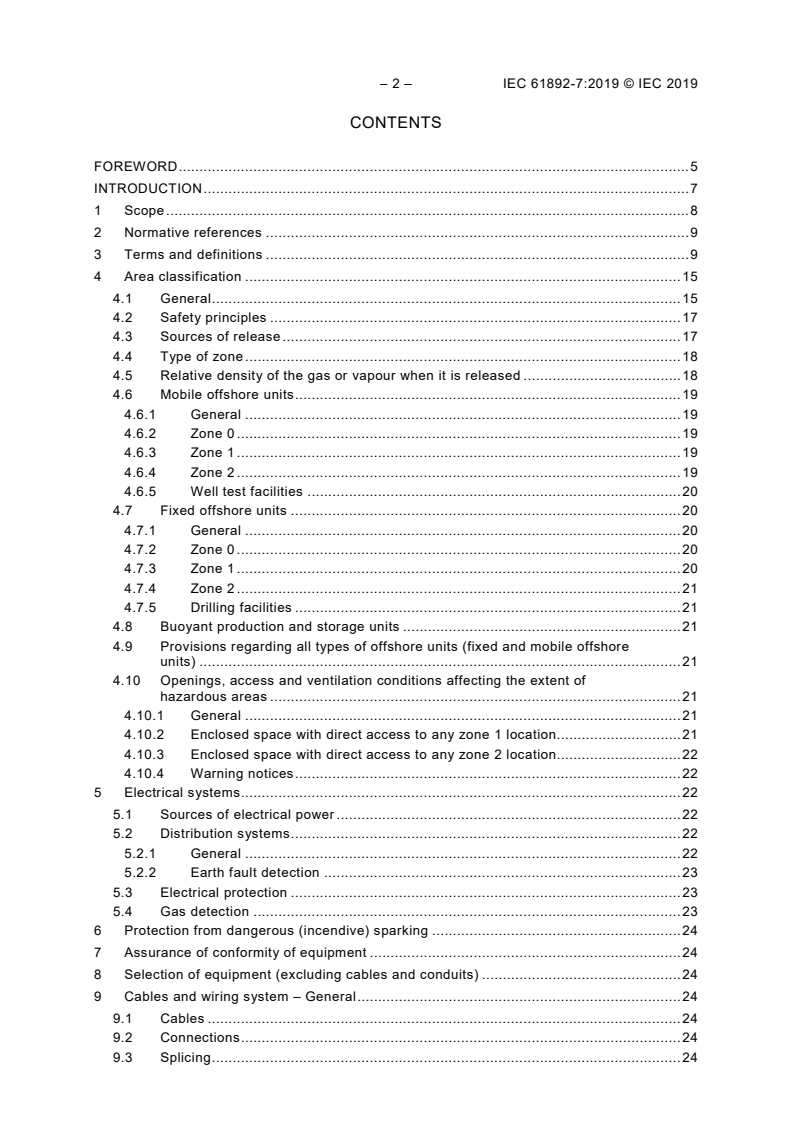
– 2 – IEC 61892-7:2019 © IEC 2019
CONTENTS
FOREWORD . 5
INTRODUCTION . 7
1 Scope . 8
2 Normative references . 9
3 Terms and definitions . 9
4 Area classification . 15
4.1 General . 15
4.2 Safety principles . 17
4.3 Sources of release . 17
4.4 Type of zone . 18
4.5 Relative density of the gas or vapour when it is released . 18
4.6 Mobile offshore units . 19
4.6.1 General . 19
4.6.2 Zone 0 . 19
4.6.3 Zone 1 . 19
4.6.4 Zone 2 . 19
4.6.5 Well test facilities . 20
4.7 Fixed offshore units . 20
4.7.1 General . 20
4.7.2 Zone 0 . 20
4.7.3 Zone 1 . 20
4.7.4 Zone 2 . 21
4.7.5 Drilling facilities . 21
4.8 Buoyant production and storage units . 21
4.9 Provisions regarding all types of offshore units (fixed and mobile offshore
units) . 21
4.10 Openings, access and ventilation conditions affecting the extent of
hazardous areas . 21
4.10.1 General . 21
4.10.2 Enclosed space with direct access to any zone 1 location . 21
4.10.3 Enclosed space with direct access to any zone 2 location . 22
4.10.4 Warning notices . 22
5 Electrical systems . 22
5.1 Sources of electrical power . 22
5.2 Distribution systems . 22
5.2.1 General . 22
5.2.2 Earth fault detection . 23
5.3 Electrical protection . 23
5.4 Gas detection . 23
6 Protection from dangerous (incendive) sparking . 24
7 Assurance of conformity of equipment . 24
8 Selection of equipment (excluding cables and conduits) . 24
9 Cables and wiring system – General . 24
9.1 Cables . 24
9.2 Connections . 24
9.3 Splicing . 24
9.4 Cable system . 25
9.4.1 Construction . 25
9.4.2 Earthing of metallic covering . 25
9.5 Conduit systems . 25
9.6 Additional requirements . 25
9.7 Installation requirements . 25
9.7.1 Circuits traversing a hazardous area . 25
9.7.2 Terminations . 26
9.7.3 Unused cores . 26
10 Cable entry systems and blanking elements . 26
10.1 General . 26
10.2 Use of drain gland/plug . 26
11 Rotating electrical machines . 26
11.1 General . 26
11.2 Ex protected permanent magnet motor . 26
12 Luminaires . 27
13 Electric heating systems . 27
14 Additional requirements for type of protection "d" – Flameproof enclosures . 27
15 Additional requirements for type of protection "e" – Increased safety . 27
16 Additional requirements for type of protection "i" – Intrinsic safety . 27
17 Additional requirements for pressurized enclosures . 27
18 Pressurized rooms . 27
19 Analyser houses . 27
20 Additional requirements for type of protection "n" . 28
21 Additional requirements for type of protection "o"– Oil immersion . 28
22 Additional requirements for type of protection "q" – Powder filling . 28
23 Additional requirements for type of protection "m" – Encapsulation . 28
24 Additional requirements for type of protection "op" – Optical radiation . 28
25 Ventilation . 28
25.1 General . 28
25.2 Ventilation of spaces containing electrical apparatus . 28
25.3 Ventilation of other hazardous spaces. 29
26 Ventilation requirements for battery compartments . 29
26.1 General . 29
26.2 Ventilation requirements . 29
26.3 Natural ventilation . 30
26.4 Forced ventilation . 30
26.5 Requirements for battery compartments for zone 2 and zone 1 . 30
26.6 Fans and ducts . 30
27 Inspection, maintenance, repair and overhaul . 31
27.1 Initial inspection . 31
27.2 Inspection and maintenance . 31
27.3 Isolation of apparatus . 31
27.4 Precautions concerning the use of ignition sources . 31
27.5 Repair and overhaul . 31
27.6 Personnel qualifications . 31
– 4 – IEC 61892-7:2019 © IEC 2019
28 Documentation . 32
Annex A (informative) Examples of sources of release – Process plant . 34
A.1 General . 34
A.2 Sources giving a continuous grade of release . 34
A.3 Sources giving a primary grade of release . 34
A.4 Sources giving a secondary grade of release . 34
Annex B (informative) Schematic approach to the classification of hazardous areas . 35
Annex C (informative) Hazardous area data sheets and symbols . 39
C.1 Hazardous area classification data sheet . 39
C.2 Symbols for hazardous area zone classification drawings . 39
Annex D (informative) Gas detection systems . 44
D.1 General . 44
D.2 Low gas alarm . 44
D.3 High gas alarm . 45
Annex E (informative) Ventilation of hazardous areas – Requirements as to ventilation . 46
Annex F (informative) Electrical installations in extremely low ambient temperatures . 47
F.1 General . 47
F.2 Explosion protected equipment . 47
Annex G (informative) Installation in explosive atmospheres – Safety signs and plates
for hazardous areas . 48
G.1 Objectives . 48
G.2 General . 48
Annex H (informative) List of electrical and electronic equipment in hazardous areas
(example of data file) – Requirements concerning data file . 50
Bibliography . 51
Figure B.1 – Schematic approach to area classification . 35
Figure B.2 – Schematic approach to area classification for continuous grade release . 36
Figure B.3 – Schematic approach to classification for primary release source . 37
Figure B.4 – Schematic approach to area classification for secondary grade release . 38
Figure C.1 – Preferred symbols for hazardous area zones . 42
Figure G.1 – Examples of an "Ex" safety warning sign for hazardous area installation . 49
Table 1 – Electrical protection . 23
Table C.1 – Hazardous area classification data sheet – Part I: Flammable substance
list and characteristics . 40
Table C.2 – Hazardous area classification data sheet – Part II: List of sources of
release . 41
INTERNATIONAL ELECTROTECHNICAL COMMISSION
____________
MOBILE AND FIXED OFFSHORE UNITS –
ELECTRICAL INSTALLATIONS –
Part 7: Hazardous areas
FOREWORD
1) The International Electrotechnical Commission (IEC) is a worldwide organization for standardization comprising
all national electrotechnical committees (IEC National Committees). The object of IEC is to promote
international co-operation on all questions concerning standardization in the electrical and electronic fields. To
this end and in addition to other activities, IEC publishes International Standards, Technical Specifications,
Technical Reports, Publicly Available Specifications (PAS) and Guides (hereafter referred to as "IEC
Publication(s)"). Their preparation is entrusted to technical committees; any IEC National Committee interested
in the subject dealt with may participate in this preparatory work. International, governmental and non-
governmental organizations liaising with the IEC also participate in this preparation. IEC collaborates closely
with the International Organization for Standardization (ISO) in accordance with conditions determined by
agreement between the two organizations.
2) The formal decisions or agreements of IEC on technical matters express, as nearly as possible, an international
consensus of opinion on the relevant subjects since each technical committee has representation from all
interested IEC National Committees.
3) IEC Publications have the form of recommendations for international use and are accepted by IEC National
Committees in that sense. While all reasonable efforts are made to ensure that the technical content of IEC
Publications is accurate, IEC cannot be held responsible for the way in which they are used or for any
misinterpretation by any end user.
4) In order to promote international uniformity, IEC National Committees undertake to apply IEC Publications
transparently to the maximum extent possible in their national and regional publications. Any divergence
between any IEC Publication and the corresponding national or regional publication shall be clearly indicated in
the latter.
5) IEC itself does not provide any attestation of conformity. Independent certification bodies provide conformity
assessment services and, in some areas, access to IEC marks of conformity. IEC is not responsible for any
services carried out by independent certification bodies.
6) All users should ensure that they have the latest edition of this publication.
7) No liability shall attach to IEC or its directors, employees, servants or agents including individual experts and
members of its technical committees and IEC National Committees for any personal injury, property damage or
other damage of any nature whatsoever, whether direct or indirect, or for costs (including legal fees) and
expenses arising out of the publication, use of, or reliance upon, this IEC Publication or any other IEC
Publications.
8) Attention is drawn to the Normative references cited in this publication. Use of the referenced publications is
indispensable for the correct application of this publication.
9) Attention is drawn to the possibility that some of the elements of this IEC Publication may be the subject of
patent rights. IEC shall not be held responsible for identifying any or all such patent rights.
International Standard IEC 61892-7 has been prepared by IEC technical committee 18:
Electrical installations of ships and of mobile and fixed offshore units.
This fourth edition cancels and replaces the third edition published in 2014. This edition
constitutes a technical revision.
This edition includes the following significant technical changes with respect to the previous
edition:
a) the document has been completely rewritten. References are, to the extent possible,
made to IEC 60079-14 and to other relevant standards, as appropriate, from IEC TC 31;
only requirements concerning offshore installations that deviate from the general
requirements for installations in hazardous areas are given;
b) requirements as to gas detection have been transferred to an informative annex;
– 6 – IEC 61892-7:2019 © IEC 2019
c) requirements concerning emergency shutdown (ignition source control) have been
transferred to IEC 61892-1.
The text of this International Standard is based on the following documents:
FDIS Report on voting
18/1655/FDIS 18/1666/RVD
Full information on the voting for the approval of this International Standard can be found in
the report on voting indicated in the above table.
This document has been drafted in accordance with the ISO/IEC Directives, Part 2.
A list of all parts in the IEC 61892 series, published under the general title Mobile and fixed
offshore units – Electrical installations, can be found on the IEC website.
The committee has decided that the contents of this document will remain unchanged until the
stability date indicated on the IEC website under "http://webstore.iec.ch" in the data related to
the specific document. At this date, the document will be
• reconfirmed,
• withdrawn,
• replaced by a revised edition, or
• amended.
IMPORTANT – The 'colour inside' logo on the cover page of this publication indicates
that it contains colours which are considered to be useful for the correct
understanding of its contents. Users should therefore print this document using a
colour printer.
INTRODUCTION
IEC 61892 forms a series of International Standards for safety in the design, selection,
installation, maintenance and use of electrical equipment for the generation, transmission,
storage, distribution and utilization of electrical energy for all purposes in offshore units which
are used for the purpose of exploration or exploitation of petroleum resources.
This part of IEC 61892 incorporates and coordinates, as far as possible, existing rules and
forms a code of interpretation, where applicable, of the requirements of the International
Maritime Organization (IMO), and constitutes a guide for future regulations which may be
prepared and a statement of practice for offshore unit owners, designers, installers and
appropriate organizations.
This document is based on solutions and methods which are in current use, but it is not
intended to impede development of new or improved techniques.
In this revision, voltage limitations have been removed. However, voltage limitations may be
given in the referenced equipment standards. The removal of voltage limitations is considered
necessary due to the interconnection of, and supply from shore to offshore units. In such
cases, transmission voltages up to 132 kV AC and 150 kV DC are used and higher voltages
are being planned.
The IEC 61892 series aims to constitute a set of International Standards for the offshore
petroleum industry, but it is not intended to prevent their use beyond petroleum installations.
– 8 – IEC 61892-7:2019 © IEC 2019
MOBILE AND FIXED OFFSHORE UNITS –
ELECTRICAL INSTALLATIONS –
Part 7: Hazardous areas
1 Scope
This part of IEC 61892 provides requirements for hazardous area classification and selection
of electrical equipment and installation in hazardous areas in mobile and fixed offshore units,
including pipeline, pumping or "pigging" stations, compressor stations and single buoy
moorings, used in the offshore petroleum industry for drilling, production, accommodation,
processing, storage and offloading purposes.
It applies to all installations, whether permanent, temporary, transportable or personal, to AC
installations and DC installations without any voltage level limitation. Referenced equipment
standards may give voltage level limitations.
This document is based on the requirements of International Standards developed by
IEC TC 31 regarding area classification and requirements as to installations in hazardous
areas and gives additional requirements for installations on mobile and fixed offshore units.
This document specifies requirements such as those concerning
– area classification,
– electrical systems,
– selection of electrical equipment,
– cables and wiring systems,
– ventilation,
– ventilation requirement for battery compartments, and
– inspection, maintenance, repair and overhaul.
This document gives information on topics such as
– gas detection systems, and
– electrical installations in extremely low ambient temperatures.
This document does not apply to
– fixed equipment for medical purposes,
– electrical installations of tankers, and
– control of ignition sources other than those created by electrical equipment.
NOTE 1 For medical rooms, IEC 60364-7-710 provides specific requirements. Requirements for tankers are given
in IEC 60092-502.
NOTE 2 Guidance on protection of non-electrical equipment can be found in ISO 80079-36, ISO 80079-37 and
IMO 2009 MODU Code, 6.7
2 Normative references
The following documents are referred to in the text in such a way that some or all of their
content constitutes requirements of this document. For dated references, only the edition
cited applies. For undated references, the latest edition of the referenced document (including
any amendments) applies.
IEC 60079-10-1:2015, Explosive atmospheres – Part 10-1: Classification of areas – Explosive
gas atmospheres
IEC 60079-13, Explosive atmospheres – Part 13: Equipment protection by pressurized room
"p" and artificially ventilated room "v"
IEC 60079-14:2013, Explosive atmospheres – Part 14: Electrical installations design,
selection and erection
IEC 60079-17, Explosive atmospheres – Part 17: Electrical installations inspection and
maintenance
IEC 60079-19, Explosive atmospheres – Part 19: Equipment repair, overhaul and reclamation
IEC 61892-1:2019, Mobile and fixed offshore units – Electrical installations – Part 1: General
requirements and conditions
IEC 61892-2:2019, Mobile and fixed offshore units – Electrical installations – Part 2: System
design
IEC 62485-2:2010, Safety requirements for secondary batteries and battery installations –
Part 2: Stationary batteries
IMO, 2009 MODU Code, Code for the Construction and Equipment of Mobile Offshore Drilling
Units, 2009, 2010 edition
3 Terms and definitions
For the purposes of this document, the terms and definitions given in IEC 61892-1,
IEC 60079-14 and the following apply.
ISO and IEC maintain terminological databases for use in standardization at the following
addresses:
• IEC Electropedia: available at http://www.electropedia.org/
• ISO Online browsing platform: available at http://www.iso.org/obp
3.1
normal operation
operation of apparatus conforming electrically and mechanically with its design specification
and used within the limits specified by the manufacturer
Note 1 to entry: Minor releases of flammable substances may be part of normal operation. For example, releases
from seals which rely on wetting by the fluid which is being pumped are considered to be minor releases.
Note 2 to entry: Failures (such as the breakdown of pump seals, flange gaskets or spillages caused by accidents)
which involve urgent repair or shutdown are not considered to be part of normal operation nor are they considered
to be catastrophic.
Note 3 to entry: Normal operation includes start-up and shutdown conditions.
– 10 – IEC 61892-7:2019 © IEC 2019
[SOURCE: IEC 60050-426:2008, 426-04-10, modified – The notes to entry have been added.]
3.2
inspection
action comprising careful scrutiny of an item carried out either without dismantling, or with the
addition of partial dismantling as required, supplemented by means such as measurement, in
order to arrive at a reliable conclusion as to the condition of an item
[SOURCE: IEC 60050-426:2008, 426-14-02]
3.3
maintenance
combination of any actions carried out to retain an item in, or restore it to, conditions in which
it is able to meet the requirements of the relevant specification and perform its required
functions
[SOURCE: IEC 60050-426:2008, 426-14-01]
3.4
terms related to area classification
3.4.1
area classification
assessed division of a facility into hazardous and non-hazardous areas, and the subdivision of
the hazardous areas into zones
3.4.2
explosive gas atmosphere
mixture with air, under atmospheric conditions, of flammable substances in the form of gas,
vapour or mist, which, after ignition, permits self-sustaining propagation
Note 1 to entry: Although a mixture which has a concentration above the upper flammable limit (UFL) is not an
explosive gas atmosphere, it can readily become so and, generally for area classification purposes, it is advisable
to consider it as an explosive atmosphere.
[SOURCE: IEC 60079-10-1:2015, 3.2, modified – The word "mist" has been added to the
definition, and Note 2 to entry has been deleted.]
3.4.3
hazardous area (on account of explosive gas atmosphere)
area in which an explosive gas atmosphere is or may be expected to be present, in quantities
such as to require special precautions for the construction, installation and use of equipment
Note 1 to entry: The interior of many items of process equipment are commonly considered as a hazardous area
even though a flammable atmosphere may not normally be present to account for the possibility of air entering the
equipment. Where specific controls such as inerting are used the interior of process equipment may not need to be
classified as a hazardous area.
[SOURCE: IEC 60079-10-1:2015, 3.3.1]
3.4.4
non-hazardous area (on account of explosive gas atmosphere)
an area in which an explosive atmosphere is not expected to be present in quantities such as
to require special precautions for the construction, installation and use of equipment
[SOURCE: IEC 60079-10-0:2015, 3.3.2]
3.5
terms related to zones
3.5.1
zone
hazardous area classification based upon the frequency of the occurrence and duration of an
explosive atmosphere
[SOURCE: IEC 60079-10-1:2015, 3.3.3]
3.5.2
zone 0
area in which an explosive gas atmosphere is present continuously or for long periods or
frequently
Note 1 to entry: Both "long" and "frequently" are terms which are intended to describe a very high likelihood of a
potentially explosive atmosphere in the area. In that respect, those items do not necessarily need to be quantified.
Note 2 to entry: The 2009 MODU Code definition is "Zone 0: in which ignitable concentrations of flammable gases
or vapours are continuously present or present for long periods".
[SOURCE: IEC 60079-10-1:2015, 3.3.4, modified – Note 2 to entry has been added.]
3.5.3
zone 1
area in which an explosive gas atmosphere is likely to occur periodically or occasionally in
normal operation
Note 1 to entry: The 2009 MODU Code definition is "Zone 1: in which ignitable concentrations of flammable gases
or vapours are likely to occur in normal operation".
[SOURCE: IEC 60079-10-1:2015, 3.3.5, modified – The note to entry has been added.]
3.5.4
zone 2
area in which an explosive gas atmosphere is not likely to occur in normal operation but, if it
does occur, it will exist for a short period only
Note 1 to entry: Indications of the frequency of the occurrence and duration may be taken from codes relating to
specific industries or applications.
Note 2 to entry: The 2009 MODU Code definition is "Zone 2: in which ignitable concentrations of flammable gases
or vapours are not likely to occur, or in which such a mixture, if it does occur, will only exist for a short time".
[SOURCE: IEC 60079-10-1:2015, 3.3.6, modified – Note 2 to entry has been added.]
3.5.5
extent of zone
distance in any direction from the source of release to where a gas/air mixture will be diluted
by air to a concentration below the lower flammable limit
[SOURCE: IEC 60079-10-1:2015, 3.3.7]
3.6
terms related to release
3.6.1
source of release
point or location from which a flammable gas, vapour, mist or liquid may be released into the
atmosphere in such a way that an explosive gas atmosphere could be formed
[SOURCE: IEC 60079-10-1:2015, 3.4.1]
– 12 – IEC 61892-7:2019 © IEC 2019
3.6.2
continuous grade of release
release which is continuous or is expected to occur frequently or for long periods
Note 1 to entry: Both “frequently” and “long” are the terms which are intended to describe a very high likelihood of
a potential release. In that respect, those terms do not necessarily need to be quantified.
[SOURCE: IEC 60079-10-1:2015, 3.4.2]
3.6.3
primary grade of release
release which can be expected to occur periodically or occasionally during normal operation
[SOURCE: IEC 60079-10-1:2015, 3.4.3]
3.6.4
secondary grade of release
release which is not expected to occur in normal operation and, if it does occur, is likely to do
so only infrequently and for short periods
[SOURCE: IEC 60079-10-1:2015, 3.4.4]
3.6.5
release rate
quantity of flammable gas or vapour emitted per unit time from the source of release
[SOURCE: IEC 60079-10-1:2015, 3.4.5, modified – The words "liquid" and "mist" have been
deleted from the definition.]
3.7
terms related to properties of materials
3.7.1
LFL
lower flammable limit
concentration of flammable gas, or vapour in air, below which an explosive gas atmosphere
will not be formed
Note 1 to entry: The terms "explosive limit" and "flammable limit" are equivalent. ISO/IEC 80079-20-1 and
IEC 60079-29-1 use the term "flammable limit" whilst all the other standards use the more widely accepted term
"explosive limit".
[SOURCE: IEC 60079-10-1:2015, 3.6.12, modified – The word "mist" has been deleted from
the term, and the note to entry has been added.]
3.7.2
relative density
relative density of a gas or a vapour
density of a gas or a vapour relative to the density of air at the same pressure and
temperature
Note 1 to entry: The relative density of air is equal to 1.
[SOURCE: IEC 60079-10-1:2015, 3.6.7, modified – The term "relative density" has been
added, and the text in parenthesis in the definition has been moved to a note to entry.]
3.7.3
flammable substance
substance which is itself flammable, or is capable of producing a flammable gas, vapour or
mist
[SOURCE: IEC 60079-10-1:2015, 3.6.1]
3.7.4
flammable liquid
liquid capable of producing a flammable vapour under any foreseeable operating conditions
Note 1 to entry: An example of foreseeable operating condition is one in which the flammable liquid is handled at
temperatures close to or above its flashpoint.
[SOURCE: IEC 60079-10-1:2015, 3.6.2, modified as follows – Note 2 to entry has been
deleted.]
3.7.5
flammable gas or vapour
gas or vapour which, when mixed with air in certain proportions, will form an explosive gas
atmosphere
[SOURCE: IEC 60079-10-1:2015, 3.6.4]
3.7.6
flashpoint
lowest liquid temperature at which, under certain standardized conditions, a liquid gives off
vapours in quantity such as to be capable of forming an ignitable vapour/air mixture
[SOURCE: IEC 60079-10-1:2015, 3.6.8]
3.7.7
boiling point
temperature of a liquid boiling at an ambient pressure of 101,3 kPa (1 013 mbar)
Note 1 to entry: The initial boiling point that should be used for liquid mixtures is to indicate the lowest value of
the boiling point for the range of liquids present, as determined in a standard laboratory distillation without
fractionation.
[SOURCE: IEC 60079-10-1:2015, 3.6.9]
3.7.8
vapour pressure
pressure exerted when a solid or liquid is in equilibrium with its own vapour
Note 1 to entry: This is also the partial pressure of the substance in the atmosphere above the liquid. It is a
function of the substance and of the temperature.
[SOURCE: IEC 60079-10-1:2015, 3.6.10]
3.7.9
ignition temperature
lowest temperature of a heated surface which, under specified
conditions, will ignite a flammable substance in the form of a gas or vapour mixture with air
Note 1 to entry: ISO/IEC 80079-20-1 standardizes a method for the determination of this temperature.
[SOURCE: IEC 60079-10-1:2015, 3.6.11, modified – The words "of an explosive gas
atmosphere" have been moved from the term to the domain, the parenthesis has been deleted
from the definition, and the note to entry has been added.]
– 14 – IEC 61892-7:2019 © IEC 2019
3.8
terms related to equipment
3.8.1
intrinsically safe circuit
circuit in which any spark or any thermal effect produced in the conditions specified in
IEC 60079-11, including normal operation and specified fault conditions, is not capable of
causing ignition of a given explosive gas atmosphere
Note 1 to entry: The circuit may also contain associated apparatus.
[SOURCE: IEC 60079-14:2013, 3.5.6, modified – The word "gas" has been added to the
definition.]
3.8.2
intrinsically safe electrical system
assembly of interconnected items of electrical equipment, described in a descriptive system
document, in which the circuits or parts of circuits intended to be used in an explosive
atmosphere are intrinsically safe
[SOURCE: IEC 60079-14:2013, 3.5.7]
3.8.3
equipment protection level
EPL
level of protection assigned to equipment based on its likelihood of becoming a source of
ignition and distinguishing the differences between explosive gas atmospheres, explosive dust
atmospheres, and the explosive atmospheres in mines susceptible to firedamp
Note 1 to entry: This note applies to the French language only.
[SOURCE: IEC 60079-0:2017, 3.33, modified – The note to entry has been added.]
3.9
terms related to area and ventilation
3.9.1
enclosed area
room or space within which, in the absence of artificial ventilation, the ventilation will be
limited and any flammable atmosphere will not be dispersed naturally
3.9.2
enclosure
walls which surround the live parts of electrical apparatus including doors, covers, cable
entries, rods, spindles and shafts, ensuring the protection of the electrical apparatus
3.9.3
air lock
compartment connecting two different environments, usually at different pressures, that
enables personnel to transfer from one environment to the other
3.9.4
ventilation
movement of air and its replacement with fresh air due to the effects of wind, temperature
gradients, or artificial means (for example, fans or extractors)
[SOURCE: IEC 60079-10-1:2015, 3.5.1]
3.9.5
gas-tight door
solid, close fitting door designed to resist the passage of gas under normal atmospheric
conditio
...