

CISPR 14-2:1997
(Main)Electromagnetic compatibility - Requirements for household appliances, electric tools and similar apparatus - Part 2: Immunity - Product family standard
General Information
- Abstract
Deals with the electromagnetic immunity of appliances and similar apparatus for household and similar purposes that use electricity, as well as electric toys and electric tools, the rated voltage of the apparatus being not more than 250 V for single-phase apparatus to be connected to phase and neutral, and 480 V for other apparatus. It specifies the immunity requirements in relation to continuous and transient, conducted and radiated electromagnetic disturbances, including electrostatic discharges, for the above-mentioned apparatus. Apparatus may incorporate motors, heating elements or their combination, may contain electric or electronic circuitry, and may be powered by the mains, by batteries, or by any other electrical power source. Immunity requirements in the frequency range 0 Hz to 400 GHz are covered.
- Status
- Published
- Publication Date
- 16-Jul-2008
- Current Stage
- DELPUB - Deleted Publication
- Start Date
- 18-Feb-2015
- Completion Date
- 28-Aug-2026
Buy Documents
CISPR 14-2:1997 - Electromagnetic compatibility - Requirements for household appliances, electric tools and similar apparatus - Part 2: Immunity - Product family standard Released:2/7/1997
CISPR 14-2:1997+AMD1:2001 CSV - Electromagnetic compatibility - Requirements for household appliances, electric tools and similar apparatus - Part 2: Immunity - Product family standard Released:11/15/2001
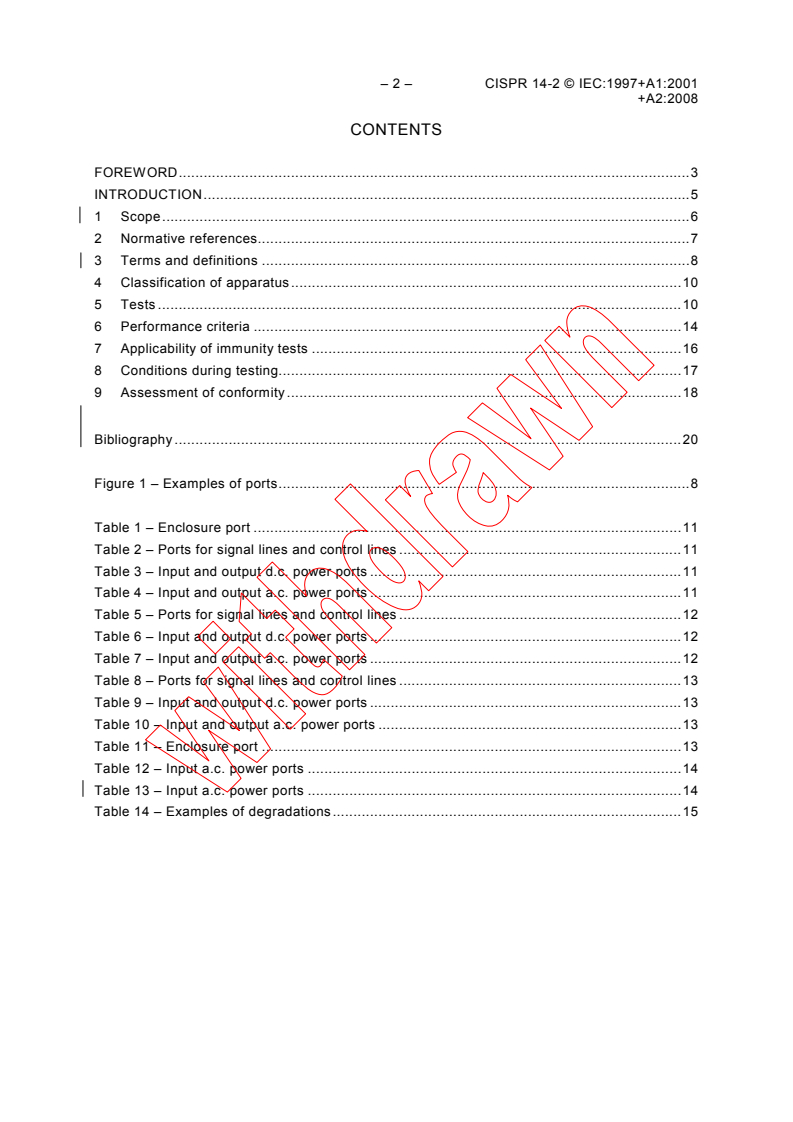
CISPR 14-2:1997+AMD1:2001+AMD2:2008 CSV - Electromagnetic compatibility - Requirements for household appliances, electric tools and similar apparatus - Part 2: Immunity - Product family standard Released:7/17/2008
Overview
CISPR 14-2:1997 is an international standard developed by the International Electrotechnical Commission (IEC) focused on electromagnetic compatibility (EMC) requirements specifically addressing the immunity of household appliances, electric tools, and similar apparatus. This standard outlines the essential immunity requirements against electromagnetic disturbances for electrical devices used primarily in household and similar environments, including electric toys and tools.
The scope covers apparatus operating at rated voltages up to 250 V for single-phase devices connected to phase and neutral, and up to 480 V for other apparatus. It ensures that devices with motors, heating elements, or electronic circuitry withstand both continuous and transient, conducted and radiated electromagnetic disturbances. Immunity testing spans an extensive frequency range from 0 Hz to 400 GHz, reflecting comprehensive protection against diverse electromagnetic environments.
Key Topics
Electromagnetic Immunity Requirements
CISPR 14-2 establishes immunity levels to protect affected equipment from electromagnetic disruptions such as:- Electrostatic discharges (ESD)
- Conducted disturbances on power and signal lines
- Radiated radio-frequency fields
- Voltage dips, short interruptions, and variations
- Transient bursts and surges
Apparatus Covered
The standard applies to:- Household appliances and similar equipment powered by mains, batteries, or other electrical sources
- Electric tools and electric toys
- Devices incorporating motors, heating elements, electronics, or combinations thereof
- Appliances with rated voltages not exceeding specified limits
Exclusions
The standard explicitly excludes:- Lighting equipment and heavy industrial apparatus
- Fixed electrical installation components (e.g., fuses and switches)
- Devices intended solely for specific electromagnetic environments or specialized uses such as medical devices, vehicle-exclusive apparatus, radio transmitters, and baby surveillance systems
Test Methods and Performance Criteria
CISPR 14-2 references internationally recognized IEC test methods including IEC 61000-4 series for immunity testing:- Electrostatic discharge immunity
- Radiated and conducted RF immunity
- Fast transient/burst and surge immunity tests
- Voltage dips and interruptions tests
It defines standard operating conditions during testing and specifies performance criteria to assess compliance.
Applications
CISPR 14-2 ensures the reliability and safety of electrically powered household products and tools in everyday environments by mitigating susceptibility to electromagnetic interference (EMI). Practical applications include:
Manufacturing and Product Design
Manufacturers use CISPR 14-2 to design and test products that meet immunity requirements, reducing failure rates in electromagnetic environments. This supports product certification and market acceptance worldwide.Quality Assurance and Compliance
Testing laboratories and certification bodies apply the standard to verify product conformity with EMC regulations, enabling compliance with both national and international mandates.Consumer Safety and Performance
By adhering to immunity criteria, products avoid malfunctions triggered by electromagnetic disturbances, enhancing user safety and customer satisfaction.Cross-industry Use
Although focused on household and similar apparatus, the standard's immunity requirements inform EMC best practices in light industrial and agricultural sectors where similar devices operate.
Related Standards
CISPR 14-2 works in conjunction with several key international standards, including:
CISPR 14-1 – Electromagnetic compatibility – Requirements for household appliances, electric tools and similar apparatus – Part 1: Emission
Focuses on controlling electromagnetic emissions rather than immunity.IEC 61000-4 Series – Testing and measurement techniques for various EMC immunity tests such as ESD, RF field immunity, electrical fast transient, surge, and voltage variation tests.
IEC 60335 – Safety of household and similar electrical appliances, covering safety aspects related to electromagnetic phenomena.
IEC 60050-161 – International Electrotechnical Vocabulary related to electromagnetic compatibility terminology.
These interconnected standards provide comprehensive EMC guidelines ensuring both immunity and emission control, essential for modern electrical and electronic product development.
Keywords: CISPR 14-2, electromagnetic compatibility, EMC immunity, household appliances, electric tools, electric toys, IEC standards, electromagnetic disturbances, immunity testing, electromagnetic interference, electrostatic discharge, conducted disturbances, radiated disturbances, product compliance, international standards.
Relations
- Effective Date
- 05-Sep-2023
- Effective Date
- 05-Sep-2023
- Effective Date
- 05-Sep-2023
Buy Documents
CISPR 14-2:1997 - Electromagnetic compatibility - Requirements for household appliances, electric tools and similar apparatus - Part 2: Immunity - Product family standard Released:2/7/1997
CISPR 14-2:1997+AMD1:2001 CSV - Electromagnetic compatibility - Requirements for household appliances, electric tools and similar apparatus - Part 2: Immunity - Product family standard Released:11/15/2001
CISPR 14-2:1997+AMD1:2001+AMD2:2008 CSV - Electromagnetic compatibility - Requirements for household appliances, electric tools and similar apparatus - Part 2: Immunity - Product family standard Released:7/17/2008
Get Certified
Connect with accredited certification bodies for this standard

ANCE
Mexican certification and testing association.

Intertek Slovenia
Intertek testing, inspection, and certification services in Slovenia.

LNE (Laboratoire National de Métrologie et d'Essais)
French national laboratory for metrology and testing.
Sponsored listings
Frequently Asked Questions
CISPR 14-2:1997 is a standard published by the International Electrotechnical Commission (IEC). Its full title is "Electromagnetic compatibility - Requirements for household appliances, electric tools and similar apparatus - Part 2: Immunity - Product family standard". This standard covers: Deals with the electromagnetic immunity of appliances and similar apparatus for household and similar purposes that use electricity, as well as electric toys and electric tools, the rated voltage of the apparatus being not more than 250 V for single-phase apparatus to be connected to phase and neutral, and 480 V for other apparatus. It specifies the immunity requirements in relation to continuous and transient, conducted and radiated electromagnetic disturbances, including electrostatic discharges, for the above-mentioned apparatus. Apparatus may incorporate motors, heating elements or their combination, may contain electric or electronic circuitry, and may be powered by the mains, by batteries, or by any other electrical power source. Immunity requirements in the frequency range 0 Hz to 400 GHz are covered.
Deals with the electromagnetic immunity of appliances and similar apparatus for household and similar purposes that use electricity, as well as electric toys and electric tools, the rated voltage of the apparatus being not more than 250 V for single-phase apparatus to be connected to phase and neutral, and 480 V for other apparatus. It specifies the immunity requirements in relation to continuous and transient, conducted and radiated electromagnetic disturbances, including electrostatic discharges, for the above-mentioned apparatus. Apparatus may incorporate motors, heating elements or their combination, may contain electric or electronic circuitry, and may be powered by the mains, by batteries, or by any other electrical power source. Immunity requirements in the frequency range 0 Hz to 400 GHz are covered.
CISPR 14-2:1997 is classified under the following ICS (International Classification for Standards) categories: 33.100.20 - Immunity. The ICS classification helps identify the subject area and facilitates finding related standards.
CISPR 14-2:1997 has the following relationships with other standards: It is inter standard links to CISPR 14-2:1997/AMD2:2008, CISPR 14-2:1997/AMD1:2001, CISPR 14-2:2015. Understanding these relationships helps ensure you are using the most current and applicable version of the standard.
CISPR 14-2:1997 is available in PDF format for immediate download after purchase. The document can be added to your cart and obtained through the secure checkout process. Digital delivery ensures instant access to the complete standard document.
Standards Content (Sample)
COMMISSION
CISPR
ÉLECTROTECHNIQUE
14-2
INTERNATIONALE
INTERNATIONAL
Première édition
First edition
ELECTROTECHNICAL
1997-02
COMMISSION
COMITÉ INTERNATIONAL SPÉCIAL DES PERTURBATIONS RADIOÉLECTRIQUES
INTERNATIONAL SPECIAL COMMITTEE ON RADIO INTERFERENCE
Compatibilité électromagnétique –
Exigences pour les appareils électrodomestiques,
outillages électriques et appareils analogues –
Partie 2:
Immunité – Norme de famille de produits
Electromagnetic compatibility –
Requirements for household appliances,
electric tools and similar apparatus –
Part 2:
Immunity – Product family standard
Numéro de référence
Reference number
CISPR 14-2: 1997
Révision de la présente publication Revision of this publication
Le contenu technique des publications de la CEI et du The technical content of IEC and CISPR publications is
CISPR est constamment revu par la Commission et par le kept under constant review by the IEC and CISPR, thus
CISPR afin qu'il reflète bien l'état actuel de la technique. ensuring that the content reflects current technology.
Des renseignements relatifs à ce travail de révision, à Information on the work of revision, the issue of revised
l’établissement des éditions révisées et aux mises à jour editions and amendments may be obtained from IEC
peuvent être obtenus auprès des Comités nationaux de National Committees and from the following IEC
la CEI et en consultatnt les documents ci-dessous: sources:
• Bulletin de la CEI • IEC Bulletin
• Annuaire de la CEI • IEC Yearbook
• Catalogue des publications de la CEI • Catalogue of IEC publications
Publié annuellement Published yearly
Terminologie utilisée dans la présente Terminology used in this publication
publication
Seuls sont définis ici les termes spéciaux se rapportant Only special terms required for the purpose of this
à la présente publication. publication are defined herein.
For general terminology, readers are referred to IEC 50:
En ce qui concerne la terminologie générale, le lecteur
International Electrotechnical Vocabulary (IEV), which is
se reportera à la CEI 50: Vocabulaire Electrotechnique
issued in the form of separate chapters each dealing
International (VEI), qui est établie sous forme de
with a specific field, the General Index being published
chapitres séparés traitant chacun d'un sujet défini,
as a separate booklet. Full details of the IEV will be
l’Index général étant publié séparément. Des détails
supplied on request.
complets sur le VEI peuvent être obtenus sur demande.
For terms on radio interference, see Chapter 902.
Pour les termes concernant les perturbations
radioélectriques, voir le chapitre 902.
Graphical and letter symbols
Symboles graphiques et littéraux
For graphical symbols, and letter symbols and signs
Pour les symboles graphiques, les symboles littéraux et
approved by the IEC for general use, readers are
les signes d'usage général approuvés par la CEI, le
referred to:
lecteur consultera:
– IEC 27: Letter symbols to be used in electrical
– la CEI 27: Symboles littéraux à utiliser en
électrotechnique; technology;
– la CEI 617: Symboles graphiques pour schémas; – IEC 617: Graphical symbols for diagrams;
The symbols and signs contained in the present
Les symboles et signes contenus dans la présente
publication ont été soit tirés de la CEI 27 ou CEI 617, publication have either been taken from IEC 27 or
IEC 617, or have been specifically approved for the
soit spécifiquement approuvés aux fins de cette
purpose of this publication.
publication.
CISPR publications
Publications du CISPR
The attention of readers is drawn to pages 3 and 4 of
L'attention du lecteur est attirée sur les pages 3 et 4 de
the cover, which list CISPR publications.
la couverture, qui énumèrent les publications du CISPR.
COMMISSION
CISPR
ÉLECTROTECHNIQUE
14-2
INTERNATIONALE
INTERNATIONAL
Première édition
First edition
ELECTROTECHNICAL
1997-02
COMMISSION
COMITÉ INTERNATIONAL SPÉCIAL DES PERTURBATIONS RADIOÉLECTRIQUES
INTERNATIONAL SPECIAL COMMITTEE ON RADIO INTERFERENCE
Compatibilité électromagnétique –
Exigences pour les appareils électrodomestiques,
outillages électriques et appareils analogues –
Partie 2:
Immunité – Norme de famille de produits
Electromagnetic compatibility –
Requirements for household appliances,
electric tools and similar apparatus –
Part 2:
Immunity – Product family standard
IEC 1997 Droits de reproduction réservés Copyright - all rights reserved
Aucune partie de cette publication ne peut être reproduite ni utilisée No part of this publication may be reproduced or utilized in
sous quelque forme que ce soit et par aucun procédé, électronique any form or by any means, electronic or mechanical, including
ou mécanique, y compris la photocopie et les microfilms, sans photocopying and microfilm, without permission in writing from
l'accord écrit de l'éditeur. the publisher.
International Electrotechnical Commission 3, rue de Varembé Geneva, Switzerland
Telefax: +41 22 919 0300 e-mail: inmail@iec.ch IEC web site http: //www.iec.ch
CODE PRIX
Commission Electrotechnique Internationale
P
PRICE CODE
International Electrotechnical Commission
Pour prix, voir catalogue en vigueur
For price, see current catalogue
– 2 – CISPR 14-2 © CEI:1997
SOMMAIRE
Pages
AVANT-PROPOS . 4
INTRODUCTION . 6
Articles
1 Domaine d'application et objet . 8
2 Références normatives . 10
3 Définitions. 12
4 Classification des appareils. 12
5 Essais. 14
6 Critères d’aptitude à la fonction. 22
7 Applicabilité des essais d'immunité . 24
8 Conditions pendant les essais. 26
9 Evaluation de la conformité . 28
10 Documentation du produit . 30
CISPR 14-2 © IEC:1997 – 3 –
CONTENTS
Page
FOREWORD. 5
INTRODUCTION . 7
Clause
1 Scope and object . 9
2 Normative references . 11
3 Definitions. 13
4 Classification of apparatus . 13
5 Tests. 15
6 Performance criteria . 23
7 Applicability of immunity tests. 25
8 Conditions during testing. 27
9 Assessment of conformity. 29
10 Product documentation . 31
– 4 – CISPR 14-2 © CEI:1997
COMMISSION ÉLECTROTECHNIQUE INTERNATIONALE
COMITÉ INTERNATIONAL SPÉCIAL DES PERTURBATIONS RADIOÉLECTRIQUES
__________
COMPATIBILITÉ ÉLECTROMAGNÉTIQUE –
EXIGENCES POUR LES APPAREILS ÉLECTRODOMESTIQUES,
OUTILLAGES ÉLECTRIQUES ET APPAREILS ANALOGUES –
Partie 2: Immunité – Norme de famille de produits
AVANT-PROPOS
1) La CEI (Commission Electrotechnique Internationale) est une organisation mondiale de normalisation composée
de l’ensemble des comités électrotechniques nationaux (Comités nationaux de la CEI). La CEI a pour objet de
favoriser la coopération internationale pour toutes les questions de normalisation dans les domaines de
l’électricité et de l’électronique. A cet effet, la CEI, entre autres activités, publie des Normes internationales. Leur
élaboration est confiée à des comités d’études, aux travaux desquels tout Comité national intéressé par le sujet
peut participer. Les organisations internationales, gouvernementales et non gouvernementales, en liaison avec la
CEI, participent également aux travaux. La CEI collabore étroitement avec l’Organisation Internationale de
Normalisation (ISO), selon des condition fixées par accord entre les deux organisations.
2) Les décisions ou accords officiels de la CEI en ce qui concerne les questions techniques, préparés par des
comités d'études où sont représentés tous les Comités nationaux s'intéressant à ces questions, expriment dans
la plus grande mesure possible un accord international sur les sujets examinés.
3) Ces décisions constituent des recommandations internationales publiées sous forme de normes, de rapports
techniques ou de guides et agréées comme telles par les Comités nationaux.
4) Dans le but d'encourager l'unification internationale, les Comités nationaux de la CEI s’engagent à appliquer de
façon transparente, dans toute la mesure du possible, les Normes internationales de la CEI dans leurs normes
nationales et régionales. Toute divergence entre la norme de la CEI et la norme nationale ou régionale
correspondante doit être indiquée en termes clairs dans cette dernière.
5) L’attention est attirée sur le fait que certains des éléments de la présente Norme internationale peuvent faire
l’objet de droits de propriété intellectuelle ou de droits analogues. La CEI ne saurait être tenue pour responsable
de ne pas avoir identifié de tels droits de propriété et de ne pas avoir signalé leur existence.
6) La CEI n'a fixé aucune procédure concernant le marquage comme indication d'approbation et sa responsabilité
n'est pas engagée quand il est déclaré qu'un matériel est conforme à l'une de ses normes.
La Norme internationale CISPR 14-2 a été établie par le sous-comité F du CISPR:
Perturbations relatives aux appareils domestiques, aux outils, aux appareils d'éclairage et
aux appareils analogues.
Le texte de cette norme du CISPR est issu des documents suivants:
FDIS Rapport de vote
CISPR/F/201/FDIS CISPR/F/206/RVD
Le rapport de vote indiqué dans le tableau ci-dessus donne toute information sur le vote
ayant abouti à l'approbation de cette norme.
CISPR 14-2 © IEC:1997 – 5 –
INTERNATIONAL ELECTROTECHNICAL COMMISSION
INTERNATIONAL SPECIAL COMMITTEE ON RADIO INTERFERENCE
________
ELECTROMAGNETIC COMPATIBILITY –
REQUIREMENTS FOR HOUSEHOLD APPLIANCES, ELECTRIC TOOLS
AND SIMILAR APPARATUS –
Part 2: Immunity – Product family standard
FOREWORD
1) The IEC (International Electrotechnical Commission) is a worldwide organization for standardization comprising
all national electrotechnical committees (IEC National Committees). The object of the IEC is to promote
international cooperation on all questions concerning standardization in the electrical and electronic fields. To
this end and in addition to other activities, the IEC publishes International Standards. Their preparation is
entrusted to technical committees; any IEC National Committee interested in the subject dealt with may
participate in this preparatory work. International, governmental and non-governmental organizations liaising
participate in this preparation. The IEC collaborates closely with the International Organization for
Standardization (ISO) in accordance with conditions determined by agreement between the two organizations.
2) The formal decisions or agreements of the IEC on technical matters, prepared by technical committees on which
all the National Committees having a special interest therein are represented, express, as nearly as possible, an
international consensus of opinion on the subjects dealt with.
3) They have the form of recommendations for international use published in the form of standards, technical
reports or guides and they are accepted by the National Committees in that sense.
4) In order to promote international unification, IEC National Committees undertake to apply IEC International
Standards transparently to the maximum extent possible in their national and regional standards. Any divergence
between the IEC Standard and the corresponding national or regional standard shall be clearly indicated in the
latter.
5) Attention is drawn to the possibility that some of the elements of this International Standard may be the subject of
patent rights. The IEC shall not be held responsible for identifying any or all such patent rights.
6) The IEC has not laid down any procedure concerning marking as an indication of approval and has no
responsibility when an item of equipment is declared to comply with one of its standards.
International Standard CISPR 14-2 has been prepared by CISPR subcommittee F:
Interference relating to household appliances, tools, lighting equipment and similar
apparatus.
The text of this CISPR standard is based on the following documents:
FDIS Report on voting
CISPR/F/201/FDIS CISPR/F/206/RVD
Full information on the voting for the approval of this standard can be found in the report on
voting indicated in the above table.
– 6 – CISPR 14-2 © CEI:1997
INTRODUCTION
La présente norme est destinée à établir des exigences uniformes concernant l'immunité
aux perturbations électromagnétiques des appareils mentionnés dans le domaine
d'application, à définir des spécifications d'essais pour cette immunité, à faire référence
aux normes fondamentales pour les méthodes d'essais et à normaliser les conditions de
fonctionnement, les critères d’aptitude à la fonction et l'interprétation des résultats.
Mots clés: Immunité, appareils électrodomestiques, appareils électriques, compatibilité électro-
magnétique.
CISPR 14-2 © IEC:1997 – 7 –
INTRODUCTION
The intention of this standard is to establish uniform requirements for the electromagnetic
immunity of the equipment mentioned in the scope, to fix test specifications of immunity, to
refer to basic standards for methods of testing, and to standardize operating conditions,
performance criteria and interpretation of results.
Keywords: Immunity, household appliances, electric apparatus, electromagnetic compatibility.
– 8 – CISPR 14-2 © CEI:1997
COMPATIBILITÉ ÉLECTROMAGNÉTIQUE –
EXIGENCES POUR LES APPAREILS ÉLECTRODOMESTIQUES,
OUTILLAGES ÉLECTRIQUES ET APPAREILS ANALOGUES –
Partie 2: Immunité – Norme de famille de produits
1 Domaine d'application et objet
1.1 La présente norme traite de l'immunité aux perturbations électromagnétiques des
appareils électrodomestiques et analogues, ainsi que des jouets électriques et des outils
électriques dont la tension assignée ne dépasse pas 250 V pour les appareils monophasés
raccordés entre phase et neutre, et 480 V pour les autres appareils.
Ces appareils peuvent comporter des moteurs, des éléments chauffants, ou leur
combinaison. Ils peuvent comporter des circuits électriques ou électroniques, et être
alimentés par le réseau, par des piles ou batteries ou par toute autre source électrique.
Les appareils qui ne sont pas destinés à un usage domestique, mais peuvent néanmoins nécessiter
un certain niveau d'immunité, tels que ceux destinés à être utilisés par des usagers non avertis dans
les magasins, l'industrie légère et les fermes, entrent dans le cadre de la présente norme dans la
mesure où ils sont couvert par le CISPR 14. Entrent également dans cette catégorie:
– les fours à micro-ondes à usage domestique et ceux à usage des collectivités;
– les foyers de cuisson et fours chauffés par des fréquences radioélectriques (appareils
de cuisson à l’induction), à zone simple ou à zone multiple;
– les appareils à rayonnement ultraviolets et infrarouges à usage individuel.
1.2 La présente norme ne s'applique pas:
– aux appareils d’éclairage;
– aux appareils conçus exclusivement pour l'industrie lourde;
– aux appareils destinés à être intégrés dans une installation électrique fixe de
bâtiments (par exemple fusibles, disjoncteurs, câbles et interrupteurs);
– aux appareils destinés à être utilisés dans des emplacements présentant des
conditions électromagnétiques particulières, telles que la présence de champs
électromagnétiques élevés (par exemple, à proximité d'une station de radiodiffusion) ou
à des endroits où des pointes se produisent sur le réseau de puissance (par exemple,
dans une station de générateur de puissance);
– aux récepteurs de radio et de télévision, aux appareils audio et vidéo et aux
instruments de musique électroniques;
– aux appareils médicaux électriques;
– aux ordinateurs individuels et matériels analogues;
– aux émetteurs radioélectriques;
– aux appareils destinés à être utilisés exclusivement à bord de véhicules.
1.3 La présente norme couvre les exigences d'immunité dans la bande de fréquences de 0 Hz
à 400 GHz.
1.4 Les effets des phénomènes électromagnétiques liés à la sécurité des appareils sont
exclus de la présente norme et sont couverts par d'autres normes, par exemple la norme CEI 335.
Le fonctionnement anormal des appareils (dû, par exemple, à des défauts simulés dans les
circuits électriques à des fins d'essais) n'est pas pris en compte.
NOTE – L'attention est attirée sur le fait que des exigences supplémentaires peuvent être nécessaires pour les
appareils destinés à être utilisés à bord de navires ou d'aéronefs.
CISPR 14-2 © IEC:1997 – 9 –
ELECTROMAGNETIC COMPATIBILITY –
REQUIREMENTS FOR HOUSEHOLD APPLIANCES, ELECTRIC TOOLS
AND SIMILAR APPARATUS –
Part 2: Immunity – Product family standard
1 Scope and object
1.1 This standard deals with the electromagnetic immunity of appliances and similar
apparatus for household and similar purposes that use electricity, as well as electric toys
and electric tools, the rated voltage of the apparatus being not more than 250 V for single-
phase apparatus to be connected to phase and neutral, and 480 V for other apparatus.
Apparatus may incorporate motors, heating elements or their combination, may contain
electric or electronic circuitry, and may be powered by the mains, by batteries, or by any
other electrical power source.
Apparatus not intended for household use, but which nevertheless may require the immunity level,
such as apparatus intended to be used by laymen in shops, in light industry and on farms, are within
the scope of this standard, as far as they are included in CISPR 14, and in addition:
– microwave ovens for domestic use and catering;
– cooking hobs and cooking ovens, heated by means of r.f. energy,
(single- and multiple-zone) induction cooking appliances;
– UV and IR radiators for personal care.
1.2 This standard does not apply to:
– equipment for lighting purposes;
– apparatus designed exclusively for heavy industrial purposes;
– apparatus intended to be part of the fixed electrical installation of buildings (such as
fuses, circuit breakers, cables and switches);
– apparatus intended to be used in locations where special electromagnetic conditions
prevail, such as the presence of high e.m. fields (for example in the vicinity of a
broadcast transmitting station), or where high pulses occur on the power network (such
as in a power generator station);
– radio and television receivers, audio and video equipment, and electronic music
instruments;
– medical electrical appliances;
– personal computers and similar equipment;
– radio transmitters;
– apparatus designed to be used exclusively in vehicles.
1.3 Immunity requirements in the frequency range 0 Hz to 400 GHz are covered.
1.4 The effects of electromagnetic phenomena relating to the safety of apparatus are
excluded from this standard and are covered by other standards, for example IEC 335.
Abnormal operation of the apparatus (such as simulated faults in the electric circuitry for
testing purposes) is not taken into consideration.
NOTE – Attention is drawn to the fact that additional requirements may be necessary for apparatus intended to
be used on board ships or aircraft.
– 10 – CISPR 14-2 © CEI:1997
1.5 L'objet de cette norme est de définir les exigences pour les essais d'immunité aux
perturbations continues et transitoires, conduites et rayonnées y compris aux décharges
électrostatiques, pour les appareils définis dans le domaine d'application.
Ces exigences représentent les exigences essentielles de compatibilité électromagnétique
concernant l'immunité.
NOTE – Dans des cas spéciaux, apparaissent des situations pour lesquelles des niveaux de perturbation
peuvent dépasser les niveaux d'essai spécifiés dans cette norme. Dans ces cas, des moyens spéciaux
d’atténuation peuvent être nécessaires.
2 Références normatives
Les documents normatifs suivants contiennent des dispositions qui, par suite de la référence qui y est
faite, constituent des dispositions valables pour la présente Norme internationale. Au moment de la
publication, les éditions indiquées étaient en vigueur. Tout document normatif est sujet à révision et
les parties prenantes aux accords fondés sur la présente Norme internationale sont invitées à
rechercher la possibilité d'appliquer les éditions les plus récentes des documents normatifs indiqués
ci-après. Les membres de la CEI et de l'ISO possèdent le registre des Normes internationales en
vigueur.
CEI 50(161): 1990, Vocabulaire Electrotechnique International (VEI) – Chapitre 161:
Compatibilité électromagnétique
CEI 1000-4-2: 1995, Compatibilité électromagnétique (CEM) – Partie 4: Techniques d'essai
et de mesure – Section 2: Essai d’immunité aux décharges électrostatiques – Publication
fondamentale en CEM
CEI 1000-4-3: 1995, Compatibilité électromagnétique (CEM) – Partie 4: Techniques d'essai
et de mesure – Section 3: Essai d'immunité aux champs électromagnétiques rayonnés aux
fréquences radioélectriques
CEI 1000-4-4: 1995, Compatibilité électromagnétique (CEM) – Partie 4: Techniques d'essai
et de mesure – Section 4: Essais d’immunité aux transitoires électriques rapides en salves –
Publication fondamentale en CEM
CEI 1000-4-5: 1995, Compatibilité électromagnétique (CEM) – Partie 4: Techniques d'essai
et de mesure – Section 5: Essai d'immunité aux ondes de choc
CEI 1000-4-6: 1996, Compatibilité électromagnétique (CEM) – Partie 4: Techniques d'essai
et de mesure – Section 6: Immunité aux perturbations conduites, induites par les champs
radioélectriques
CEI 1000-4-11: 1994, Compatibilité électromagnétique (CEM) – Partie 4: Techniques d'essai
et de mesure – Section 11: Essais d'immunité aux creux de tension, coupures brèves et
variations de tension
CISPR 11: 1990, Limites et méthodes de mesure des caractéristiques de perturbations
électromagnétiques des appareils industriels, scientifiques et médicaux (ISM) à fréquence
radioélectrique
CISPR 14: 1993, Limites et méthodes de mesure des perturbations radioélectriques
produites par les appareils électrodomestiques ou analogues comportant des moteurs ou
des dispositifs thermiques, par les outils électriques et par les appareils électriques
analogues
CISPR 16-1: 1993, Spécifications des méthodes et des appareils de mesure des
perturbations radioélectriques et de l’immunité aux perturbations radioélectriques – Partie 1:
Appareils de mesure des perturbations radioélectriques et de l’immunité aux perturbations
radioélectriques
CISPR 14-2 © IEC:1997 – 11 –
1.5 The object of this standard is to specify the immunity requirements for apparatus
defined in the scope in relation to continuous and transient, conducted and radiated
electromagnetic disturbances, including electrostatic discharges.
These requirements represent essential electromagnetic compatibility immunity
requirements.
NOTE – In special cases situations will arise where the level of disturbances may exceed the test values
specified in this standard. In these instances special mitigation measure may have to be employed.
2 Normative references
The following normative documents contain provisions which, through reference in this text,
constitute provisions of this International Standard. At the time of publication, the editions
indicated were valid. All normative documents are subject to revision, and parties to
agreements based on this International Standard are encouraged to investigate the
possibility of applying the most recent editions of the normative documents indicated below.
Members of IEC and ISO maintain registers of currently valid international standards.
IEC 50(161): 1990, International Electrotechnical Vocabulary (IEV) – Chapter 161: Electro-
magnetic compatibility
IEC 1000-4-2: 1995, Electromagnetic compatibility (EMC) – Part 4: Testing and
measurement techniques – Section 2: Electrostatic discharge immunity test – Basic EMC
publication
IEC 1000-4-3: 1995, Electromagnetic compatibility (EMC) – Part 4: Testing and
measurement techniques – Section 3: Radiated, radio-frequency, electromagnetic field
immunity test
IEC 1000-4-4: 1995, Electromagnetic compatibility (EMC) – Part 4: Testing and
measurement techniques – Section 4: Electrical fast transient/burst immunity test – Basic
EMC publication
IEC 1000-4-5: 1995, Electromagnetic compatibility (EMC) – Part 4: Testing and
measurement techniques – Section 5: Surge immunity test
IEC 1000-4-6: 1996, Electromagnetic compatibility (EMC) – Part 4: Testing and
measurement techniques – Section 6: Immunity to conducted disturbances, induced by
radio-frequency fields
IEC 1000-4-11: 1994, Electromagnetic compatibility (EMC) – Part 4: Testing and
measurement techniques – Section 11: Voltage dips, short interruptions and voltage variations
immunity tests – Basic EMC publication
CISPR 11: 1990, Limits and methods of measurement of electromagnetic disturbance
characteristics of industrial, scientific and medical (ISM) radio-frequency equipment
CISPR 14: 1993, Limits and methods of measurement of radio disturbance characteristics of
electrical motor-operated and thermal appliances for household and similar purposes,
electric tools and similar electric apparatus
CISPR 16-1: 1993, Specification for radio disturbance and immunity measuring apparatus
and methods – Part 1: Radio disturbance and immunity measuring apparatus
– 12 – CISPR 14-2 © CEI:1997
3 Définitions
Les définitions concernant la compatibilité électromagnétique (CEM) et les phénomènes
correspondants peuvent être trouvées dans la CEI 50(161) et dans les publications du CISPR
et de la CEI.
Pour les besoins de la présente norme, les définitions particulières suivantes sont utilisées:
3.1 compatibilité électromagnétique: Aptitude d’un dispositif, d’un appareil ou d’un
système à fonctionner dans son environnement électromagnétique, de façon satisfaisante et
sans produire lui-même des perturbations électromagnétiques intolérables pour ce qui se
trouve dans cet environnement.
3.2 accès: Interface particulière de l'appareil spécifié avec l'environnement électromagnétique
extérieur (voir figure 1).
Accès par l’enveloppe
Accès par l’alimentation ______ _______ Accès par les bornes de
en courant alternatif signaux
APPAREIL
Accès par l’alimentation ______ _______ Accès par les bornes de
en courant continu commande
Figure 1 – Exemples d’accès
3.3 accès par l’enveloppe: Frontière physique de l'appareil à travers laquelle les champs
électromagnétiques peuvent rayonner ou à laquelle ils peuvent se heurter.
3.4 production en série: Processus par lequel les appareils sont fabriqués en continu ou en
lots (constitués de produits identiques).
4 Classification des appareils
Les appareils couverts par la présente norme sont classés en différentes catégories. Chaque
catégorie fait l'objet d'exigences spécifiques.
4.1 Catégorie I: appareils ne comportant aucun circuit électronique de commande, par
exemple appareils à moteurs, jouets, outils, appareils chauffants et appareils électriques
analogues (tels que les appareils à rayonnement ultraviolets et infrarouges).
Les circuits électriques comportant des composants passifs (par exemple des condensateurs
ou des inductances de filtrage pour la suppression des perturbations radioélectriques, des
transformateurs raccordés au réseau et des redresseurs utilisés à la fréquence du réseau) ne
sont pas considérés comme des circuits électroniques.
Exemples: appareils comportant des composants tels que des moteurs électriques, des
interrupteurs électromécaniques, des thermostats, des accumulateurs.
4.2 Catégorie II: appareils à moteur, appareils chauffants, outils et appareils électriques
analogues alimentés par le réseau (par exemple, appareils à rayonnement ultraviolet et
infrarouge et fours à micro-ondes), comportant des circuits électroniques de commande dont la
fréquence d'horloge interne ou de l'oscillateur n'est pas supérieure à 15 MHz.
NOTE – La valeur de 15 MHz est provisoire et pourra être modifiée après une période d’expérimentation.
CISPR 14-2 © IEC:1997 – 13 –
3 Definitions
Definitions related to EMC and relevant phenomena may be found in IEC 50(161) and in IEC
and CISPR publications.
For the purposes of this standard the following particular definitions apply:
3.1 electromagnetic compatibility: The ability of a device, unit of equipment or system to
function satisfactorily in its electromagnetic environment without introducing intolerable
electromagnetic disturbances to anything in that environment.
3.2 port: Particular interface of the specified apparatus with the external electromagnetic
environment (see figure 1).
Enclosure port
AC power port ______ _______ Signal port
APPARATUS
DC power port ______ _______ Control port
Figure 1 – Examples of ports
3.3 enclosure port: The physical boundary of the apparatus through which electromagnetic
fields may radiate or impinge.
3.4 series production: The production process in which apparatus are manufactured
continuously or in batches (consisting of identical products).
4 Classification of apparatus
The apparatus covered by this standard is subdivided into categories. For each category,
specific requirements are formulated.
4.1 Category I: apparatus containing no electronic control circuitry, for example motor
operated appliances, toys, tools, heating appliances and similar electric apparatus (such as UV
and IR radiators).
Electric circuits consisting of passive components (such as radio interference suppression
capacitors or inductors, mains transformers and mains frequency rectifiers) are not considered
to be electronic control circuitry.
Examples: apparatus containing components such as electromotors, electromechanical
switches, thermostats, (rechargeable) batteries.
4.2 Category II: mains powered motor operated appliances, tools, heating appliances and
similar electric apparatus (for example – UV radiators, IR radiators and microwave ovens)
containing electronic control circuitry with no internal clock frequency or oscillator frequency
higher than 15 MHz.
NOTE – The value 15 MHz is tentative and may be modified after a period of experience.
– 14 – CISPR 14-2 © CEI:1997
4.3 Catégorie III: appareils fonctionnant sur piles ou batteries (intégrées ou externes) qui,
en usage normal, ne sont pas raccordés au réseau, comportant un circuit électronique dont
la fréquence d'horloge interne ou de l'oscillateur n'est pas supérieure à 15 MHz.
Cette catégorie comprend les appareils fournis avec des accumulateurs qui peuvent être
chargés en raccordant les appareils au réseau. Cependant, ces appareils doivent également
être soumis aux essais comme des appareils de catégorie II lorsqu'ils sont raccordés au
réseau.
4.4 Catégorie IV: tous les autres appareils entrant dans le domaine d'application de la
présente norme.
5 Essais
5.1 Décharges électrostatiques
Les essais relatifs aux décharges électrostatiques sont effectués conformément à la norme
fondamentale CEI 1000-4-2, avec les signaux d'essais et dans les conditions d'essais
figurant au tableau 1.
Tableau 1 – Accès par l’enveloppe
Phénomène d’environnement Spécification d'essai Installation d'essai
Décharge électrostatique 8 kV dans l'air CEI 1000-4-2
4 kV au contact
NOTE – La décharge au contact, de 4 kV, doit être appliquée aux parties conductrices accessibles. Les contacts
métalliques, par exemple dans les compartiments de piles ou batteries ou dans les socles de prises de courant ne sont
pas concernés par cette exigence.
La décharge au contact constitue la méthode d'essai préférentielle. 20 décharges (10 de
polarité positive et 10 de polarité négative) doivent être appliquées sur chaque partie
métallique accessible de l'enveloppe. Dans le cas d'une enveloppe non conductrice, les
décharges doivent être appliquées sur les plans de couplage horizontal ou vertical, comme
spécifié dans CEI 1000-4-2. Les décharges dans l'air doivent être utilisées lorsque les
décharges au contact ne peuvent être appliquées. Des essais sous d'autres tensions (moins
élevées) que celles mentionnées au tableau 1 ne sont pas exigés.
5.2 Transitoires rapides
Les essais relatifs aux transitoires rapides sont effectués, conformément à la norme
fondamentale CEI 1000-4-4, pendant 2 min avec une polarité positive et pendant 2 min avec une
polarité négative, selon les tableaux 2, 3 et 4.
Tableau 2 – Accès pour lignes de signaux et lignes de commande
Phénomène d’environnement Spécification d'essai Installation d'essai
Transitoires rapides en mode commun 0,5 kV (crête) CEI 1000-4-4
5/50 ns T /T
r d
Fréquence de répétition: 5 kHz
NOTE – Applicable uniquement aux accès destinés à des câbles dont la longueur totale, selon les spécifications
fonctionnelles du fabricant, peut dépasser 3 m.
CISPR 14-2 © IEC:1997 – 15 –
4.3 Category III: battery powered apparatus (with built-in batteries or external batteries),
which in normal use is not connected to the mains, containing an electronic control circuitry
with no internal clock frequency or oscillator frequency higher than 15 MHz.
This category includes apparatus provided with rechargeable batteries which can be
charged by connecting the apparatus to the mains power. However, this apparatus shall
also be tested as an apparatus in category II while it is connected to the mains network.
4.4 Category IV: all other apparatus covered by the scope of this standard.
5 Tests
5.1 Electrostatic discharge
Electrostatic discharge tests are carried out according to basic standard IEC 1000-4-2, with
test signals and conditions as given in table 1.
Table 1 – Enclosure port
Environmental phenomenon Test specification Test set-up
Electrostatic 8 kV air discharge IEC 1000-4-2
discharge 4 kV contact discharge
NOTE – The 4 kV contact discharge shall be applied to conductive accessible parts. Metallic contacts, such as in battery
compartments or in socket outlets, are excluded from this requirement.
Contact discharge is the preferred test method. 20 discharges (10 with positive and 10 with
negative polarity) shall be applied on each accessible metal part of the enclosure. In case
of a non-conductive enclosure, discharges shall be applied on the horizontal or vertical
coupling planes as specified in IEC 1000-4-2. Air discharges shall be used where contact
discharges cannot be applied. Tests with other (lower) voltages than those given in table 1
are not required.
5.2 Fast transients
Fast transient tests are carried out according to basic standard IEC 1000-4-4, for 2 minutes
with a positive polarity and for 2 minutes with a negative polarity, according to the following
tables 2, 3 and 4.
Table 2 – Ports for signal lines and control lines
Environmental phenomenon Test specifications Test set-up
Fast transients common mode 0,5 kV (peak) IEC 1000-4-4
5/50 ns T /T
r d
5 kHz repetition frequency
NOTE – Applicable only to ports interfacing with cables whose total length may exceed 3 m according to the
manufacturer's functional specification
– 16 – CISPR 14-2 © CEI:1997
Tableau 3 – Accès d’entrée et de sortie de puissance en courant continu
Phénomène d’environnement Spécification d'essai Installation d'essai
Transitoires rapides en mode commun 0,5 kV (crête) CEI 1000-4-4
5/50 ns T /T
r d
Fréquence de répétition: 5 kHz
NOTE – Ne s'applique pas aux appareils fonctionnant uniquement sur piles et batteries et qui ne peuvent pas être
raccordés au réseau pendant l’utilisation.
Un réseau de couplage/découplage doit être utilisé pour les essais aux accès de puissance
en courant continu.
Tableau 4 – Accès d’entrée et de sortie de puissance en courant alternatif
Phénomène d’environnement Spécification d'essai Installation d'essai
Transitoires rapides en mode commun 1 kV (crête) CEI 1000-4-4
5/50 ns T /T
r d
Fréquence de répétition: 5 kHz
Un réseau de couplage/découplage doit être utilisé pour les essais aux accès de puissance
en courant alternatif.
5.3 Courants injectés, de 0,15 MHz à 230 MHz
Les essais relatifs aux courants injectés sont effectués conformément à la norme fonda-
mentale CEI 1000-4-6 et aux tableaux 5, 6 et 7.
Les conditions d’essai et les installations d'essai, en particulier pour les essais entre 80
MHz et 230 MHz, doivent être clairement indiquées dans le rapport d'essai.
NOTE – L'injection de courants jusqu'à 230 MHz est appliquée indépendamment des dimensions de l’appareil en
essai.
La porteuse non modulée du signal d'essai est réglée à la valeur d'essai indiquée. Pour effectuer
l’essai, cette porteuse est, de plus, modulée comme spécifié.
Tableau 5 – Accès pour lignes de signaux et lignes de commande
Phénomène d’environnement Spécification d'essai Installation d’essai
Fréquence radio en mode commun De 0,15 MHz à 230 MHz CEI 1000-4-6
1 kHz, modulation d'amplitude: 80 % 1 V (efficace)(non modulé)
Impédance de source 150 Ω
NOTE – Applicable uniquement aux accès destinés à des câbles dont la longueur totale, selon les spécifications
fonctionnelles du fabricant, peut dépasser 3 m.
CISPR 14-2 © IEC:1997 – 17 –
Table 3 – Input and output d.c. power ports
Environmental phenomenon Test specifications Test set-up
Fast transients common mode 0,5 kV (peak) IEC 1000-4-4
5/50 ns T /T
r d
5 kHz repetition frequency
NOTE – Not applicable to battery operated appliances that cannot be connected to the mains while in use.
A coupling/decoupling network shall be applied for testing d.c. power ports.
Table 4 – Input and output a.c. power ports
Environmental phenomenon Test specifications Test set-up
Fast transients common mode 1 kV (peak) IEC 1000-4-4
5/50 ns T /T
r d
5 kHz repetition frequency
A coupling/decoupling network shall be applied for testing a.c. power ports.
5.3 Injected currents, 0,15 MHz to 230 MHz
Injected current tests are carried out according to the basic standard IEC 1000-4-6, and
according to the following tables 5, 6 and 7.
Test conditions and testing arrangements, especially for measurements from 80 MHz to 230 MHz,
shall be clearly specified in the test report.
NOTE – Current injection up to 230 MHz is applied, independent of the dimensions of the equipment under
test (EUT).
The unmodulated carrier of the test signal is adjusted to the indicated test value. To
perform the test, the carrier is in addition modulated as specified.
Table 5 – Ports for signal lines and control lines
Environmental phenomenon Test specifications Test set-up
RF current 0,15 MHz to 230 MHz IEC 1000-4-6
common mode 1 V (r.m.s.)(unmodulated)
1 kHz, 80 % AM
150 Ω source impedance
NOTE – Applicable only to ports interfacing with cables whose total length may exceed 3 m according to the
manufacturer's functional specification.
– 18 – CISPR 14-2 © CEI:1997
Tableau 6 – Accès d’entrée et de sortie de puissance en courant continu
Phénomène d’environnement Spécification d'essai Installation d’essai
Fréquence radio en mode commun De 0,15 MHz à 230 MHz CEI 1000-4-6
1 kHz, modulation d'amplitude: 80 % 1 V (efficace)(non modulé)
Impédance de source 150 Ω
NOTES
1 Ne s'applique pas aux appareils fonctionnant uniquement sur piles et batteries et qui ne peuvent pas être raccordés au
réseau pendant l’utilisation.
2 Cette exigence s’applique aux appareils fonctionnant sur batterie qui peuvent être raccordés au réseau pendant
l’usage et aux appareils fournis avec des câbles d’alimentation continue dont la longueur totale, selon les spécifications
fonctionnelles du fabricant, peut dépasser 3 m.
Un réseau de couplage/découplage doit être utilisé pour les essais aux accès de puissance
en courant continu.
Tableau 7 – Accès d’entrée et de sortie de puissance en courant alternatif
Phénomène d’environnement Spécification d'essai Installation d’essai
Fréquence radio en mode commun De 0,15 MHz à 230 MHz CEI 1000-4-6
1 kHz, modulation d'amplitude: 80 % 3 V (efficace)(non modulé)
Impédance de source: 150 Ω
Un réseau de couplage/découplage doit être utilisé pour les essais aux accès de puissance
en courant alternatif.
5.4 Courants injectés, de 0,15 MHz à 80 MHz
Les essais relatifs aux courants injectés sont effectués conformément à la norme
fondamentale CEI 1000-4-6 et aux tableaux 8, 9 et 10.
La porteuse non modulée du signal d'essai est réglée à la valeur d'essai indiquée. Pour
effectuer l’essai, cette porteuse est, de plus, modulée comme spécifié.
Tableau 8 – Accès pour lignes de signal et lignes de commande
Phénomène d’environnement Spécification d'essai Installation d’essai
Fréquence radio en mode commun de 0,15 MHz à 80 MHz CEI 1000-4-6
1 kHz, modulation d'amplitude: 80 % 1 V (efficace)(non modulé)
Impédance de source 150 Ω
NOTE – Applicable uniquement aux accès destinés à des câbles dont la longueur totale, selon les spécifications fonctionnelles
du fabricant, peut dépasser 3 m.
CISPR 14-2 © IEC:1997 – 19 –
Table 6 – Input and output d.c. power ports
Environmental phenomenon Test specifications Test set-up
RF current 0,15 MHz to 230 MHz IEC 1000-4-6
common mode 1 V (r.m.s.)(unmodulated)
1 kHz, 80 % AM
150 Ω source impedance
NOTES
1 Not applicable to battery operated appliances that cannot be connected to the mains while in use.
2 Applicable to battery operated appliances that can be connected to the mains while in use, or to appliances for which
the length of d.c. cables may exceed 3 m according to the manufacturer’s functional specification.
A coupling/decoupling network shall be applied for testing d.c. power ports
Table 7 – Input and output a.c. power ports
Environmental phenomenon Test specifications Test set-up
RF current 0,15 MHz to 230 MHz IEC 1000-4-6
common mode 1 kHz, 80 % AM 3 V (r.m.s.)(unmodulated)
150 Ω source impedance
A coupling/decoupling network shall be applied for testing a.c. power ports.
5.4 Injected currents, 0,15 MHz to 80 MHz
Injected current tests are carried out according to the basic standard IEC 1000-4-6, and according to
the following
...
CISPR 14-2
Edition 1.1 2001-11
INTERNATIONAL
STANDARD
NORME
INTERNATIONALE
INTERNATIONAL SPECIAL COMMITTEE ON RADIO INTERFERENCE
COMITÉ INTERNATIONAL SPÉCIAL DES PERTURBATIONS RADIOÉLECTRIQUES
Electromagnetic compatibility – Requirements for household appliances,
electric tools and similar apparatus –
Part 2: Immunity – Product family standard
Compatibilité électromagnétique – Exigences pour les appareils
électrodomestiques, outillages électriques et appareils analogues –
Partie 2: Immunité – Norme de famille de produits
All rights reserved. Unless otherwise specified, no part of this publication may be reproduced or utilized in any form or by
any means, electronic or mechanical, including photocopying and microfilm, without permission in writing from either IEC or
IEC's member National Committee in the country of the requester.
If you have any questions about IEC copyright or have an enquiry about obtaining additional rights to this publication,
please contact the address below or your local IEC member National Committee for further information.
Droits de reproduction réservés. Sauf indication contraire, aucune partie de cette publication ne peut être reproduite
ni utilisée sous quelque forme que ce soit et par aucun procédé, électronique ou mécanique, y compris la photocopie
et les microfilms, sans l'accord écrit de la CEI ou du Comité national de la CEI du pays du demandeur.
Si vous avez des questions sur le copyright de la CEI ou si vous désirez obtenir des droits supplémentaires sur cette
publication, utilisez les coordonnées ci-après ou contactez le Comité national de la CEI de votre pays de résidence.
IEC Central Office
3, rue de Varembé
CH-1211 Geneva 20
Switzerland
Email: inmail@iec.ch
Web: www.iec.ch
About the IEC
The International Electrotechnical Commission (IEC) is the leading global organization that prepares and publishes
International Standards for all electrical, electronic and related technologies.
About IEC publications
The technical content of IEC publications is kept under constant review by the IEC. Please make sure that you have the
latest edition, a corrigenda or an amendment might have been published.
ƒ Catalogue of IEC publications: www.iec.ch/searchpub
The IEC on-line Catalogue enables you to search by a variety of criteria (reference number, text, technical committee,…).
It also gives information on projects, withdrawn and replaced publications.
ƒ IEC Just Published: www.iec.ch/online_news/justpub
Stay up to date on all new IEC publications. Just Published details twice a month all new publications released. Available
on-line and also by email.
ƒ Electropedia: www.electropedia.org
The world's leading online dictionary of electronic and electrical terms containing more than 20 000 terms and definitions
in English and French, with equivalent terms in additional languages. Also known as the International Electrotechnical
Vocabulary online.
ƒ Customer Service Centre: www.iec.ch/webstore/custserv
If you wish to give us your feedback on this publication or need further assistance, please visit the Customer Service
Centre FAQ or contact us:
Email: csc@iec.ch
Tel.: +41 22 919 02 11
Fax: +41 22 919 03 00
A propos de la CEI
La Commission Electrotechnique Internationale (CEI) est la première organisation mondiale qui élabore et publie des
normes internationales pour tout ce qui a trait à l'électricité, à l'électronique et aux technologies apparentées.
A propos des publications CEI
Le contenu technique des publications de la CEI est constamment revu. Veuillez vous assurer que vous possédez
l’édition la plus récente, un corrigendum ou amendement peut avoir été publié.
ƒ Catalogue des publications de la CEI: www.iec.ch/searchpub/cur_fut-f.htm
Le Catalogue en-ligne de la CEI vous permet d’effectuer des recherches en utilisant différents critères (numéro de référence,
texte, comité d’études,…). Il donne aussi des informations sur les projets et les publications retirées ou remplacées.
ƒ Just Published CEI: www.iec.ch/online_news/justpub
Restez informé sur les nouvelles publications de la CEI. Just Published détaille deux fois par mois les nouvelles
publications parues. Disponible en-ligne et aussi par email.
ƒ Electropedia: www.electropedia.org
Le premier dictionnaire en ligne au monde de termes électroniques et électriques. Il contient plus de 20 000 termes et
définitions en anglais et en français, ainsi que les termes équivalents dans les langues additionnelles. Egalement appelé
Vocabulaire Electrotechnique International en ligne.
ƒ Service Clients: www.iec.ch/webstore/custserv/custserv_entry-f.htm
Si vous désirez nous donner des commentaires sur cette publication ou si vous avez des questions, visitez le FAQ du
Service clients ou contactez-nous:
Email: csc@iec.ch
Tél.: +41 22 919 02 11
Fax: +41 22 919 03 00
CISPR 14-2
Edition 1.1 2001-11
INTERNATIONAL
STANDARD
NORME
INTERNATIONALE
INTERNATIONAL SPECIAL COMMITTEE ON RADIO INTERFERENCE
COMITÉ INTERNATIONAL SPÉCIAL DES PERTURBATIONS RADIOÉLECTRIQUES
Electromagnetic compatibility – Requirements for household appliances,
electric tools and similar apparatus –
Part 2: Immunity – Product family standard
Compatibilité électromagnétique – Exigences pour les appareils
électrodomestiques, outillages électriques et appareils analogues –
Partie 2: Immunité – Norme de famille de produits
INTERNATIONAL
ELECTROTECHNICAL
COMMISSION
COMMISSION
ELECTROTECHNIQUE
PRICE CODE
INTERNATIONALE
CF
CODE PRIX
ICS 33.100.20 ISBN 2-8318-6003-2
– 2 – CISPR 14-2 © CEI:1997+A1:2001
SOMMAIRE
AVANT-PROPOS .4
INTRODUCTION.6
1 Domaine d'application et objet .8
2 Références normatives .10
3 Définitions .12
4 Classification des appareils.16
5 Essais .18
6 Critères d’aptitude à la fonction.26
7 Applicabilité des essais d'immunité .28
8 Conditions pendant les essais.32
9 Evaluation de la conformité.34
10 Documentation du produit .36
Bibliographie .38
Figure 1 – Exemples d’accès.12
Tableau 1 – Accès par l’enveloppe .18
Tableau 2 – Accès pour lignes de signaux et lignes de commande .18
Tableau 3 – Accès d’entrée et de sortie de puissance en courant continu .20
Tableau 4 – Accès d’entrée et de sortie de puissance en courant alternatif .20
Tableau 5 – Accès pour lignes de signaux et lignes de commande .20
Tableau 6 – Accès d’entrée et de sortie de puissance en courant continu .22
Tableau 7 – Accès d’entrée et de sortie de puissance en courant alternatif .22
Tableau 8 – Accès pour lignes de signal et lignes de commande .22
Tableau 9 – Accès d’entrée et de sortie de puissance en courant continu .24
Tableau 10 – Accès d’entrée et de sortie de puissance en courant alternatif .24
Tableau 11 – Accès par l’enveloppe .24
Tableau 12 – Accès d’entrée de puissance en courant alternatif .24
Tableau 13 – Accès d’entrée de puissance en courant alternatif .26
Tableau 14 – Exemples de dégradations admissibles .28
CISPR 14-2 © IEC:1997+A1:2001 – 3 –
CONTENTS
FOREWORD.5
INTRODUCTION.7
1 Scope and object .9
2 Normative references.11
3 Definitions .13
4 Classification of apparatus.17
5 Tests .19
6 Performance criteria .27
7 Applicability of immunity tests .29
8 Conditions during testing.33
9 Assessment of conformity.35
10 Product documentation .37
Bibliography .39
Figure 1 – Examples of ports.13
Table 1 – Enclosure port .19
Table 2 – Ports for signal lines and control lines .19
Table 3 – Input and output d.c. power ports .21
Table 4 – Input and output a.c. power ports .21
Table 5 – Ports for signal lines and control lines .21
Table 6 – Input and output d.c. power ports .23
Table 7 – Input and output a.c. power ports .23
Table 8 – Ports for signal lines and control lines .23
Table 9 – Input and output d.c. power ports .25
Table 10 – Input and output a.c. power ports .25
Table 11 – Enclosure port .25
Table 12 – Input a.c. power ports .25
Table 13 – Input a.c. power ports .27
Table 14 – Examples of degradations.29
– 4 – CISPR 14-2 © CEI:1997+A1:2001
COMMISSION ÉLECTROTECHNIQUE INTERNATIONALE
COMITÉ INTERNATIONAL SPÉCIAL DES PERTURBATIONS RADIOÉLECTRIQUES
__________
COMPATIBILITÉ ÉLECTROMAGNÉTIQUE –
EXIGENCES POUR LES APPAREILS ÉLECTRODOMESTIQUES,
OUTILLAGES ÉLECTRIQUES ET APPAREILS ANALOGUES –
Partie 2: Immunité – Norme de famille de produits
AVANT-PROPOS
1) La CEI (Commission Electrotechnique Internationale) est une organisation mondiale de normalisation composée
de l'ensemble des comités électrotechniques nationaux (Comités nationaux de la CEI). La CEI a pour objet de
favoriser la coopération internationale pour toutes les questions de normalisation dans les domaines de
l'électricité et de l'électronique. A cet effet, la CEI, entre autres activités, publie des Normes internationales.
Leur élaboration est confiée à des comités d'études, aux travaux desquels tout Comité national intéressé par le
sujet traité peut participer. Les organisations internationales, gouvernementales et non gouvernementales, en
liaison avec la CEI, participent également aux travaux. La CEI collabore étroitement avec l'Organisation
Internationale de Normalisation (ISO), selon des conditions fixées par accord entre les deux organisations.
2) Les décisions ou accords officiels de la CEI concernant les questions techniques représentent, dans la mesure
du possible, un accord international sur les sujets étudiés, étant donné que les Comités nationaux intéressés
sont représentés dans chaque comité d’études.
3) Les documents produits se présentent sous la forme de recommandations internationales. Ils sont publiés
comme normes, spécifications techniques, rapports techniques ou guides et agréés comme tels par les Comités
nationaux.
4) Dans le but d'encourager l'unification internationale, les Comités nationaux de la CEI s'engagent à appliquer de
façon transparente, dans toute la mesure possible, les Normes internationales de la CEI dans leurs normes
nationales et régionales. Toute divergence entre la norme de la CEI et la norme nationale ou régionale
correspondante doit être indiquée en termes clairs dans cette dernière.
5) La CEI n’a fixé aucune procédure concernant le marquage comme indication d’approbation et sa responsabilité
n’est pas engagée quand un matériel est déclaré conforme à l’une de ses normes.
6) L’attention est attirée sur le fait que certains des éléments de la présente Norme internationale peuvent faire
l’objet de droits de propriété intellectuelle ou de droits analogues. La CEI ne saurait être tenue pour
responsable de ne pas avoir identifié de tels droits de propriété et de ne pas avoir signalé leur existence.
La Norme internationale CISPR 14-2 a été établie par le sous-comité F du CISPR:
Perturbations relatives aux appareils domestiques, aux outils, aux appareils d'éclairage et aux
appareils analogues.
La présente version consolidée du CISPR 14-2 comprend la première édition (1997)
[documents CISPR/F/201/FDIS et CISPR/F/206/RVD] et son amendement 1 (2001)
[documents CISPR/F/333/FDIS et CISPR/F/340/RVD.
Le contenu technique de cette version consolidée est donc identique à celui de l'édition de
base et à son amendement; cette version a été préparée par commodité pour l'utilisateur.
Elle porte le numéro d'édition 1.1.
Une ligne verticale dans la marge indique où la publication de base a été modifiée par
l'amendement 1.
Le comité a décidé que le contenu de la publication de base et de son amendement ne sera
pas modifié avant 2004. A cette date, la publication sera
• reconduite;
• supprimée;
• remplacée par une édition révisée, ou
• amendée.
CISPR 14-2 © IEC:1997+A1:2001 – 5 –
INTERNATIONAL ELECTROTECHNICAL COMMISSION
INTERNATIONAL SPECIAL COMMITTEE ON RADIO INTERFERENCE
__________
ELECTROMAGNETIC COMPATIBILITY –
REQUIREMENTS FOR HOUSEHOLD APPLIANCES,
ELECTRIC TOOLS AND SIMILAR APPARATUS –
Part 2: Immunity – Product family standard
FOREWORD
1) The IEC (International Electrotechnical Commission) is a worldwide organization for standardization comprising
all national electrotechnical committees (IEC National Committees). The object of the IEC is to promote
international co-operation on all questions concerning standardization in the electrical and electronic fields. To
this end and in addition to other activities, the IEC publishes International Standards. Their preparation is
entrusted to technical committees; any IEC National Committee interested in the subject dealt with may
participate in this preparatory work. International, governmental and non-governmental organizations liaising
with the IEC also participate in this preparation. The IEC collaborates closely with the International Organization
for Standardization (ISO) in accordance with conditions determined by agreement between the two
organizations.
2) The formal decisions or agreements of the IEC on technical matters express, as nearly as possible, an
international consensus of opinion on the relevant subjects since each technical committee has representation
from all interested National Committees.
3) The documents produced have the form of recommendations for international use and are published in the form
of standards, technical specifications, technical reports or guides and they are accepted by the National
Committees in that sense.
4) In order to promote international unification, IEC National Committees undertake to apply IEC International
Standards transparently to the maximum extent possible in their national and regional standards. Any
divergence between the IEC Standard and the corresponding national or regional standard shall be clearly
indicated in the latter.
5) The IEC provides no marking procedure to indicate its approval and cannot be rendered responsible for any
equipment declared to be in conformity with one of its standards.
6) Attention is drawn to the possibility that some of the elements of this International Standard may be the subject
of patent rights. The IEC shall not be held responsible for identifying any or all such patent rights.
International Standard CISPR 14-2 has been prepared by CISPR subcommittee F: Interference
relating to household appliances, tools, lighting equipment and similar apparatus.
This consolidated version of CISPR 14-2 consists of the first edition (1997) [documents
CISPR/F/201/FDIS and CISPR/F/206/RVD] and its amendment 1 (2001) [documents
CISPR/F/333/FDIS and CISPR/F/340/RVD].
The technical content is therefore identical to the base edition and its amendment and has
been prepared for user convenience.
It bears the edition number 1.1.
A vertical line in the margin shows where the base publication has been modified by
amendment 1.
The committee has decided that the contents of the base publication and its amendment will
remain unchanged until 2004. At this date, the publication will be
• reconfirmed;
• withdrawn;
• replaced by a revised edition, or
• amended.
– 6 – CISPR 14-2 © CEI:1997+A1:2001
INTRODUCTION
La présente norme est destinée à établir des exigences uniformes concernant l'immunité aux
perturbations électromagnétiques des appareils mentionnés dans le domaine d'application, à
définir des spécifications d'essais pour cette immunité, à faire référence aux normes
fondamentales pour les méthodes d'essais et à normaliser les conditions de fonctionnement,
les critères d’aptitude à la fonction et l'interprétation des résultats.
Mots clés: Immunité, appareils électrodomestiques, appareils électriques, compatibilité électro-
magnétique.
CISPR 14-2 © IEC:1997+A1:2001 – 7 –
INTRODUCTION
The intention of this standard is to establish uniform requirements for the electromagnetic
immunity of the equipment mentioned in the scope, to fix test specifications of immunity,
to refer to basic standards for methods of testing, and to standardize operating conditions,
performance criteria and interpretation of results.
Keywords: Immunity, household appliances, electric apparatus, electromagnetic compatibility.
– 8 – CISPR 14-2 © CEI:1997+A1:2001
COMPATIBILITÉ ÉLECTROMAGNÉTIQUE –
EXIGENCES POUR LES APPAREILS ÉLECTRODOMESTIQUES,
OUTILLAGES ÉLECTRIQUES ET APPAREILS ANALOGUES –
Partie 2: Immunité – Norme de famille de produits
1 Domaine d'application et objet
1.1 La présente norme traite de l'immunité aux perturbations électromagnétiques des
appareils électrodomestiques et analogues, ainsi que des jouets électriques et des outils
électriques dont la tension assignée ne dépasse pas 250 V pour les appareils monophasés
raccordés entre phase et neutre, et 480 V pour les autres appareils.
Ces appareils peuvent comporter des moteurs, des éléments chauffants, ou leur combinaison.
Ils peuvent comporter des circuits électriques ou électroniques, et être alimentés par le réseau,
par transformateur, par des piles ou batteries ou par toute autre source électrique.
Les appareils qui ne sont pas destinés à un usage domestique, mais peuvent néanmoins
nécessiter un certain niveau d'immunité, tels que ceux destinés à être utilisés par des usagers
non avertis dans les magasins, l'industrie légère et les fermes, entrent dans le cadre de la
présente norme dans la mesure où ils sont couvert par le CISPR 14. Entrent également dans
cette catégorie:
– les fours à micro-ondes à usage domestique et ceux à usage des collectivités;
– les foyers de cuisson et fours chauffés par des fréquences radioélectriques (appareils de
cuisson à l’induction), à zone simple ou à zone multiple;
– les appareils à usage individuel avec dispositif à rayonnement dont la gamme s'étend des
ultraviolets aux infrarouges (ceci comprend la lumière visible).
1.2 La présente norme ne s'applique pas:
– aux appareils d’éclairage;
– aux appareils conçus exclusivement pour l'industrie lourde;
– aux appareils destinés à être intégrés dans une installation électrique fixe de bâtiments
(par exemple fusibles, disjoncteurs, câbles et interrupteurs);
– aux appareils destinés à être utilisés dans des emplacements présentant des conditions
électromagnétiques particulières, telles que la présence de champs électromagnétiques
élevés (par exemple, à proximité d'une station de radiodiffusion) ou à des endroits où des
pointes se produisent sur le réseau de puissance (par exemple, dans une station de
générateur de puissance);
– aux récepteurs de radio et de télévision, aux appareils audio et vidéo et aux instruments de
musique électroniques autres que les jouets;
– aux appareils médicaux électriques;
– aux ordinateurs individuels et matériels analogues autres que les jouets;
– aux émetteurs radioélectriques;
– aux appareils destinés à être utilisés exclusivement à bord de véhicules;
– systèmes de surveillance pour bébés.
1.3 La présente norme couvre les exigences d'immunité dans la bande de fréquences de
0 Hz à 400 GHz.
CISPR 14-2 © IEC:1997+A1:2001 – 9 –
ELECTROMAGNETIC COMPATIBILITY –
REQUIREMENTS FOR HOUSEHOLD APPLIANCES,
ELECTRIC TOOLS AND SIMILAR APPARATUS –
Part 2: Immunity – Product family standard
1 Scope and object
1.1 This standard deals with the electromagnetic immunity of appliances and similar
apparatus for household and similar purposes that use electricity, as well as electric toys and
electric tools, the rated voltage of the apparatus being not more than 250 V for single-phase
apparatus to be connected to phase and neutral, and 480 V for other apparatus.
Apparatus may incorporate motors, heating elements or their combination, may contain electric
or electronic circuitry, and may be powered by the mains, by transformer, by batteries, or by
any other electrical power source.
Apparatus not intended for household use, but which nevertheless may require the immunity
level, such as apparatus intended to be used by laymen in shops, in light industry and on
farms, are within the scope of this standard, as far as they are included in CISPR 14, and in
addition:
– microwave ovens for domestic use and catering;
– cooking hobs and cooking ovens, heated by means of r.f. energy,
(single- and multiple-zone) induction cooking appliances;
– appliances for personal care equipped with radiators in the range from UV to IR, inclusive
(this includes visible light).
1.2 This standard does not apply to:
– equipment for lighting purposes;
– apparatus designed exclusively for heavy industrial purposes;
– apparatus intended to be part of the fixed electrical installation of buildings (such as fuses,
circuit breakers, cables and switches);
– apparatus intended to be used in locations where special electromagnetic conditions
prevail, such as the presence of high e.m. fields (for example in the vicinity of a broadcast
transmitting station), or where high pulses occur on the power network (such as in a power
generator station);
– radio and television receivers, audio and video equipment, and electronic music
instruments other than toys;
– medical electrical appliances;
– personal computers and similar equipment other than toys;
– radio transmitters;
– apparatus designed to be used exclusively in vehicles;
– babies surveillance systems.
1.3 Immunity requirements in the frequency range 0 Hz to 400 GHz are covered.
– 10 – CISPR 14-2 © CEI:1997+A1:2001
1.4 Les effets des phénomènes électromagnétiques liés à la sécurité des appareils sont
exclus de la présente norme et sont couverts par d'autres normes, par exemple la norme
CEI 60335.
Le fonctionnement anormal des appareils (dû, par exemple, à des défauts simulés dans les
circuits électriques à des fins d'essais) n'est pas pris en compte.
NOTE L'attention est attirée sur le fait que des exigences supplémentaires peuvent être nécessaires pour les
appareils destinés à être utilisés à bord de navires ou d'aéronefs.
1.5 L'objet de cette norme est de définir les exigences pour les essais d'immunité aux pertur-
bations continues et transitoires, conduites et rayonnées y compris aux décharges
électrostatiques, pour les appareils définis dans le domaine d'application.
Ces exigences représentent les exigences essentielles de compatibilité électromagnétique
concernant l'immunité.
NOTE Dans des cas spéciaux, apparaissent des situations pour lesquelles des niveaux de perturbation peuvent
dépasser les niveaux d'essai spécifiés dans cette norme. Dans ces cas, des moyens spéciaux d’atténuation
peuvent être nécessaires.
2 Références normatives
Les documents normatifs suivants contiennent des dispositions qui, par suite de la référence
qui y est faite, constituent des dispositions valables pour la présente Norme internationale.
Au moment de la publication, les éditions indiquées étaient en vigueur. Tout document normatif
est sujet à révision et les parties prenantes aux accords fondés sur la présente Norme
internationale sont invitées à rechercher la possibilité d'appliquer les éditions les plus récentes
des documents normatifs indiqués ci-après. Les membres de la CEI et de l'ISO possèdent le
registre des Normes internationales en vigueur.
CEI 60050(161):1990, Vocabulaire Electrotechnique International (VEI) – Chapitre 161:
Compatibilité électromagnétique
CEI 61000-4-2:1995, Compatibilité électromagnétique (CEM) – Partie 4: Techniques d'essai et
de mesure – Section 2: Essai d’immunité aux décharges électrostatiques – Publication
fondamentale en CEM
CEI 61000-4-3:1995, Compatibilité électromagnétique (CEM) – Partie 4: Techniques d'essai et
de mesure – Section 3: Essai d'immunité aux champs électromagnétiques rayonnés aux
fréquences radioélectriques
CEI 61000-4-4:1995, Compatibilité électromagnétique (CEM) – Partie 4: Techniques d'essai et
de mesure – Section 4: Essais d’immunité aux transitoires électriques rapides en salves –
Publication fondamentale en CEM
CEI 61000-4-5:1995, Compatibilité électromagnétique (CEM) – Partie 4: Techniques d'essai et
de mesure – Section 5: Essai d'immunité aux ondes de choc
CEI 61000-4-6:1996, Compatibilité électromagnétique (CEM) – Partie 4: Techniques d'essai et
de mesure – Section 6: Immunité aux perturbations conduites, induites par les champs
radioélectriques
CEI 61000-4-11:1994, Compatibilité électromagnétique (CEM) – Partie 4: Techniques d'essai
et de mesure – Section 11: Essais d'immunité aux creux de tension, coupures brèves et
variations de tension
CISPR 11:1990, Limites et méthodes de mesure des caractéristiques de perturbations électro-
magnétiques des appareils industriels, scientifiques et médicaux (ISM) à fréquence
radioélectrique
CISPR 14-2 © IEC:1997+A1:2001 – 11 –
1.4 The effects of electromagnetic phenomena relating to the safety of apparatus are
excluded from this standard and are covered by other standards, for example IEC 60335.
Abnormal operation of the apparatus (such as simulated faults in the electric circuitry for
testing purposes) is not taken into consideration.
NOTE Attention is drawn to the fact that additional requirements may be necessary for apparatus intended to be
used on board ships or aircraft.
1.5 The object of this standard is to specify the immunity requirements for apparatus defined
in the scope in relation to continuous and transient, conducted and radiated electromagnetic
disturbances, including electrostatic discharges.
These requirements represent essential electromagnetic compatibility immunity requirements.
NOTE In special cases situations will arise where the level of disturbances may exceed the test values specified in
this standard. In these instances special mitigation measure may have to be employed.
2 Normative references
The following normative documents contain provisions which, through reference in this text,
constitute provisions of this International Standard. At the time of publication, the editions
indicated were valid. All normative documents are subject to revision, and parties to
agreements based on this International Standard are encouraged to investigate the possibility
of applying the most recent editions of the normative documents indicated below. Members of
IEC and ISO maintain registers of currently valid international standards.
IEC 60050(161):1990, International Electrotechnical Vocabulary (IEV) – Chapter 161: Electro-
magnetic compatibility
IEC 61000-4-2:1995, Electromagnetic compatibility (EMC) – Part 4: Testing and measurement
techniques – Section 2: Electrostatic discharge immunity test – Basic EMC publication
IEC 61000-4-3:1995, Electromagnetic compatibility (EMC) – Part 4: Testing and measurement
techniques – Section 3: Radiated, radio-frequency, electromagnetic field immunity test
IEC 61000-4-4:1995, Electromagnetic compatibility (EMC) – Part 4: Testing and measurement
techniques – Section 4: Electrical fast transient/burst immunity test – Basic EMC publication
IEC 61000-4-5:1995, Electromagnetic compatibility (EMC) – Part 4: Testing and measurement
techniques – Section 5: Surge immunity test
IEC 61000-4-6:1996, Electromagnetic compatibility (EMC) – Part 4: Testing and measurement
techniques – Section 6: Immunity to conducted disturbances, induced by radio-frequency fields
IEC 61000-4-11:1994, Electromagnetic compatibility (EMC) – Part 4: Testing and measurement
techniques – Section 11: Voltage dips, short interruptions and voltage variations immunity tests –
Basic EMC publication
CISPR 11:1990, Limits and methods of measurement of electromagnetic disturbance
characteristics of industrial, scientific and medical (ISM) radio-frequency equipment
– 12 – CISPR 14-2 © CEI:1997+A1:2001
CISPR 14-1:2000, Compatibilité électromagnétique – Exigences pour les appareils électro-
domestiques, outillages électriques et appareils analogues – Partie 1: Emission
CISPR 16-1:1993, Spécifications des méthodes et des appareils de mesure des perturbations
radioélectriques et de l’immunité aux perturbations radioélectriques – Partie 1: Appareils de
mesure des perturbations radioélectriques et de l’immunité aux perturbations radioélectriques
CISPR 16-2:1996, Spécification pour les appareils et méthodes de mesure des perturbations
radioélectriques et de l'immunité – Partie 2: Méthodes de mesure des perturbations radio-
électriques et de l’immunité
3 Définitions
Les définitions concernant la compatibilité électromagnétique (CEM) et les phénomènes
correspondants peuvent être trouvées dans la CEI 60050(161) et dans les publications du
CISPR et de la CEI.
Pour les besoins de la présente norme, les définitions particulières suivantes sont utilisées:
3.1
compatibilité électromagnétique
aptitude d'un dispositif, d'un appareil ou d'un système à fonctionner dans son environnement
électromagnétique, de façon satisfaisante et sans produire lui-même des perturbations
électromagnétiques intolérables pour ce qui se trouve dans cet environnement
3.2
accès
interface particulière de l'appareil spécifié avec l'environnement électromagnétique extérieur
(voir figure 1)
Accès par l’enveloppe
Accès par l’alimentation ______ _______ Accès par les bornes
en courant alternatif de signaux
APPAREIL
Accès par l’alimentation ______ _______ Accès par les bornes
en courant continu de commande
Figure 1 – Exemples d’accès
3.3
accès par l’enveloppe
frontière physique de l'appareil à travers laquelle les champs électromagnétiques peuvent
rayonner ou à laquelle ils peuvent se heurter
3.4
production en série
processus par lequel les appareils sont fabriqués en continu ou en lots (constitués de produits
identiques)
CISPR 14-2 © IEC:1997+A1:2001 – 13 –
CISPR 14-1:2000, Electromagnetic compatibility – Requirements for household appliances,
electric tools and similar apparatus – Part 1: Emission
CISPR 16-1:1993, Specification for radio disturbance and immunity measuring apparatus and
methods – Part 1: Radio disturbance and immunity measuring apparatus
CISPR 16-2:1996, Specification for radio disturbance and immunity measuring apparatus and
methods – Part 2: Methods of measurement of disturbances and immunity
3 Definitions
Definitions related to EMC and relevant phenomena may be found in IEC 60050(161) and in
IEC and CISPR publications.
For the purposes of this standard the following particular definitions apply:
3.1
electromagnetic compatibility
the ability of a device, unit of equipment or system to function satisfactorily in its electro-
magnetic environment without introducing intolerable electromagnetic disturbances to anything
in that environment
3.2
port
particular interface of the specified apparatus with the external electromagnetic environment
(see figure 1)
Enclosure port
AC power port ______ _______ Signal port
APPARATUS
DC power port ______ _______ Control port
Figure 1 – Examples of ports
3.3
enclosure port
the physical boundary of the apparatus through which electromagnetic fields may radiate or
impinge
3.4
series production
the production process in which apparatus are manufactured continuously or in batches
(consisting of identical products)
– 14 – CISPR 14-2 © CEI:1997+A1:2001
3.5
très basse tension de sécurité
tension qui ne dépasse pas 50 V courant alternatif ou 120 V courant continu lissé entre
conducteurs, ou entre la terre et un conducteur quelconque, dans un circuit isolé du réseau
d'alimentation par des moyens tels qu'un transformateur de sécurité
3.6
jouet
produit conçu ou manifestement destiné à être utilisé à des fins de jeux par des enfants de
moins de 14 ans.
Les jouets électriques peuvent comporter des moteurs, des éléments thermiques, des circuits
électroniques, ou une combinaison de ces éléments.
La tension d’alimentation de jouets est limitée à 24 V courant alternatif efficace ou courant
continu lissé et peut être obtenue à partir des piles ou accumulateurs ou à partir d'un adapteur
ou d'un transformateur de sécurité connecté à un réseau d'alimentation.
NOTE Les transformateurs, les adapteurs et les chargeurs de batteries sont considérés comme ne faisant pas
partie des jouets (voir la CEI 61558-2-7).
3.7
jouet électrique
jouet ayant au moins une fonction qui dépend de l’électricité
3.8
jouet à pile ou accumulateur
jouet qui contient ou utilise une ou plusieurs piles ou un ou plusieurs accumulateurs comme
seule source d’énergie électrique
3.9
jouet à transformateur
jouet raccordé au réseau d’alimentation par l’intermédiaire d’un transformateur pour jouet et
dont le réseau d’alimentation est la seule source d’énergie électrique
3.10
jouet à double alimentation
jouet qui peut être mis en fonctionnement, simultanément ou alternativement, comme un jouet
à pile ou accumulateur et comme un jouet à transformateur
3.11
transformateur de sécurité
transformateur dont l’enroulement primaire est séparé électriquement des enroulements
secondaires par une isolation au moins équivalente à une double isolation ou à une isolation
renforcée, et qui est destiné à alimenter un appareil ou un circuit électrique à une très basse
tension de sécurité
3.12
transformateur de sécurité pour jouet
transformateur de sécurité spécialement destiné à alimenter des jouets fonctionnant en très
basse tension de sécurité ne dépassant pas 24 V
NOTE Le transformateur peut délivrer du courant alternatif, du courant continu ou les deux.
3.13
coffret de construction
ensemble d’éléments électriques, électroniques ou mécaniques, destinés à être assemblés
pour la construction de jouets différents
CISPR 14-2 © IEC:1997+A1:2001 – 15 –
3.5
safety extra-low voltage
a voltage which does not exceed 50 V a.c. or 120 V ripple free d.c. between conductors,
or between any conductor and earth, in a circuit which is isolated from the supply mains by
such means as a safety isolating transformer
3.6
toy
product designed for, or clearly intended for use in play by children under 14 years old.
Toys may incorporate motors, heating elements, electronic circuits and their combination.
The supply voltage of a toy shall not exceed 24 V a.c. (r.m.s.) or ripple-free d.c. and may be
provided by a battery or by means of an adapter or a safety transformer connected to the
mains supply.
NOTE Transformers, converters and chargers for toys are considered not to be part of the toy (see IEC 61558-2-7).
3.7
electric toy
toy having at least one function dependent on electricity
3.8
battery toy
toy which contains or uses one or more batteries as the only source of electrical energy
3.9
transformer toy
toy which is connected to the supply mains through a transformer for toys and using the supply
mains as the only source of electrical energy
3.10
dual supply toy
toy which can be operated simultaneously or alternatively as a battery toy and a transformer toy
3.11
safety isolating transformer
transformer, the input winding of which is electrically separated from the output winding by an
insulation at least equivalent to double insulation or reinforced insulation, and which is
designed to supply an appliance or circuit at safety extra-low voltage
3.12
safety transformer for toys
safety isolating transformer specially designed to supply toys operating at safety extra-low
voltage not exceeding 24 V
NOTE Either a.c. or d.c. or both may be delivered from the transformer unit.
3.13
constructional kit
collection of electric, electronic or mechanical parts intended to be assembled as various toys
– 16 – CISPR 14-2 © CEI:1997+A1:2001
3.14
coffret d'expérience électrique
ensemble de composants électriques ou électroniques destinés à être assemblés de diverses
façons
NOTE Le but principal d’un coffret d'expérience électrique est de faciliter l’acquisition de connaissances par
l’expérimentation et la recherche. Il n’est pas destiné à la création d’un jouet ou d’un équipement pour une
utilisation courante.
3.15
jouet fonctionnel
jouet dont la tension assignée n’excède pas 24 V et qui est la reproduction d’un appareil ou
d’une installation utilisée par les adultes
NOTE Un produit dont la tension assignée excède 24 V, destiné à être utilisé par des enfants sous la surveillance
directe d’un adulte, qui est la reproduction d’un appareil ou d’une installation et qui est utilisé de la même façon est
appelé produit fonctionnel.
3.16
jeu vidéo
jouet constitué d’un écran et de moyens d’action permettant à l’enfant de jouer et d’agir sur
l’image présente à l’écran
NOTE Tous les éléments nécessaires à l’utilisation d’un jeu vidéo tels que boîtier de commande, poignée, clavier,
moniteur et connexions, sont considérés comme faisant partie du jouet.
3.17
conditions de fonctionnement normal
conditions dans lesquelles le jouet, alimenté avec l’alimentation recommandée, est utilisé pour
jouer comme prévu ou d’une façon prévisible, en gardant à l’esprit le comportement normal
des enfants
4 Classification des appareils
Les appareils couverts par la présente norme sont classés en différentes catégories. Chaque
catégorie fait l'objet d'exigences spécifiques.
4.1 Catégorie I: appareils ne comportant aucun circuit électronique de commande.
Exemples: appareils à moteur, jouets lumineux, circuits sans commandes électroniques, outils,
appareils chauffants, appareils à rayonnement ultraviolet (UV) et infrarouge (IR) et appareils
contenant des composants tels que des interrupteurs électromécaniques et des thermostats.
Les circuits électriques comportant des composants passifs (par exemple des condensateurs
ou des inductances de filtrage pour la suppression des perturbations radioélectriques, des
transformateurs raccordés au réseau et des redresseurs utilisés à la fréquence du réseau)
ne sont pas considérés comme des circuits électroniques.
4.2 Catégorie II: jouets à transformateur, jouets à double alimentation, appareils à moteur,
appareils chauffants, outils et appareils électriques analogues alimentés par le réseau
(par exemple, appareils à rayonnement ultraviolet et infrarouge et fours à micro-ondes),
comportant des circuits électroniques de commande dont la fréquence d'horloge interne ou de
l'oscillateur n'est pas supérieure à 15 MHz.
NOTE 1 La valeur de 15 MHz est provisoire et pourra être modifiée après une période d’expérimentation.
NOTE 2 Pour les jouets, des exemples sont les ordinateurs éducatifs, les orgues, les circuits avec commandes
électroniques.
CISPR 14-2 © IEC:1997+A1:2001 – 17 –
3.14
experimental kit
collection of electric or electronic components intended to be assembled in various
combinations
NOTE The main aim of an experimental set is to facilitate the acquiring of knowledge by experiment and research.
It is not intended to create a toy or equipment for practical use.
3.15
functional toy
toy with a rated voltage not exceeding 24 V and which is a model of an appliance or installation
used by adults
NOTE A product with a rated voltage exceeding 24 V, intended to be used by children under the direct supervision
of an adult and which is a model of an appliance or installation and used in the same way, is known as a
...
CISPR 14-2
Edition 1.2 2008-07
INTERNATIONAL
STANDARD
NORME
INTERNATIONALE
INTERNATIONAL SPECIAL COMMITTEE ON RADIO INTERFERENCE
COMITÉ INTERNATIONAL SPÉCIAL DES PERTURBATIONS RADIOÉLECTRIQUES
Electromagnetic compatibility – Requirements for household appliances, electric
tools and similar apparatus –
Part 2: Immunity – Product family standard
Compatibilité électromagnétique – Exigences pour les appareils
électrodomestiques, outillages électriques et appareils analogues –
Partie 2: Immunité – Norme de famille de produits
All rights reserved. Unless otherwise specified, no part of this publication may be reproduced or utilized in any form or by
any means, electronic or mechanical, including photocopying and microfilm, without permission in writing from either IEC or
IEC's member National Committee in the country of the requester.
If you have any questions about IEC copyright or have an enquiry about obtaining additional rights to this publication,
please contact the address below or your local IEC member National Committee for further information.
Droits de reproduction réservés. Sauf indication contraire, aucune partie de cette publication ne peut être reproduite
ni utilisée sous quelque forme que ce soit et par aucun procédé, électronique ou mécanique, y compris la photocopie
et les microfilms, sans l'accord écrit de la CEI ou du Comité national de la CEI du pays du demandeur.
Si vous avez des questions sur le copyright de la CEI ou si vous désirez obtenir des droits supplémentaires sur cette
publication, utilisez les coordonnées ci-après ou contactez le Comité national de la CEI de votre pays de résidence.
IEC Central Office
3, rue de Varembé
CH-1211 Geneva 20
Switzerland
Email: inmail@iec.ch
Web: www.iec.ch
About the IEC
The International Electrotechnical Commission (IEC) is the leading global organization that prepares and publishes
International Standards for all electrical, electronic and related technologies.
About IEC publications
The technical content of IEC publications is kept under constant review by the IEC. Please make sure that you have the
latest edition, a corrigenda or an amendment might have been published.
ƒ Catalogue of IEC publications: www.iec.ch/searchpub
The IEC on-line Catalogue enables you to search by a variety of criteria (reference number, text, technical committee,…).
It also gives information on projects, withdrawn and replaced publications.
ƒ IEC Just Published: www.iec.ch/online_news/justpub
Stay up to date on all new IEC publications. Just Published details twice a month all new publications released. Available
on-line and also by email.
ƒ Electropedia: www.electropedia.org
The world's leading online dictionary of electronic and electrical terms containing more than 20 000 terms and definitions
in English and French, with equivalent terms in additional languages. Also known as the International Electrotechnical
Vocabulary online.
ƒ Customer Service Centre: www.iec.ch/webstore/custserv
If you wish to give us your feedback on this publication or need further assistance, please visit the Customer Service
Centre FAQ or contact us:
Email: csc@iec.ch
Tel.: +41 22 919 02 11
Fax: +41 22 919 03 00
A propos de la CEI
La Commission Electrotechnique Internationale (CEI) est la première organisation mondiale qui élabore et publie des
normes internationales pour tout ce qui a trait à l'électricité, à l'électronique et aux technologies apparentées.
A propos des publications CEI
Le contenu technique des publications de la CEI est constamment revu. Veuillez vous assurer que vous possédez
l’édition la plus récente, un corrigendum ou amendement peut avoir été publié.
ƒ Catalogue des publications de la CEI: www.iec.ch/searchpub/cur_fut-f.htm
Le Catalogue en-ligne de la CEI vous permet d’effectuer des recherches en utilisant différents critères (numéro de référence,
texte, comité d’études,…). Il donne aussi des informations sur les projets et les publications retirées ou remplacées.
ƒ Just Published CEI: www.iec.ch/online_news/justpub
Restez informé sur les nouvelles publications de la CEI. Just Published détaille deux fois par mois les nouvelles
publications parues. Disponible en-ligne et aussi par email.
ƒ Electropedia: www.electropedia.org
Le premier dictionnaire en ligne au monde de termes électroniques et électriques. Il contient plus de 20 000 termes et
définitions en anglais et en français, ainsi que les termes équivalents dans les langues additionnelles. Egalement appelé
Vocabulaire Electrotechnique International en ligne.
ƒ Service Clients: www.iec.ch/webstore/custserv/custserv_entry-f.htm
Si vous désirez nous donner des commentaires sur cette publication ou si vous avez des questions, visitez le FAQ du
Service clients ou contactez-nous:
Email: csc@iec.ch
Tél.: +41 22 919 02 11
Fax: +41 22 919 03 00
CISPR 14-2
Edition 1.2 2008-07
INTERNATIONAL
STANDARD
NORME
INTERNATIONALE
INTERNATIONAL SPECIAL COMMITTEE ON RADIO INTERFERENCE
COMITÉ INTERNATIONAL SPÉCIAL DES PERTURBATIONS RADIOÉLECTRIQUES
Electromagnetic compatibility – Requirements for household appliances,
electric tools and similar apparatus –
Part 2: Immunity – Product family standard
Compatibilité électromagnétique – Exigences pour les appareils
électrodomestiques, outillages électriques et appareils analogues –
Partie 2: Immunité – Norme de famille de produits
INTERNATIONAL
ELECTROTECHNICAL
COMMISSION
COMMISSION
ELECTROTECHNIQUE
PRICE CODE
INTERNATIONALE
CH
CODE PRIX
ICS 33.100.20 ISBN 2-8318-9870-6
– 2 – CISPR 14-2 © IEC:1997+A1:2001
+A2:2008
CONTENTS
FOREWORD.3
INTRODUCTION.5
1 Scope.6
2 Normative references.7
3 Terms and definitions .8
4 Classification of apparatus.10
5 Tests .10
6 Performance criteria .14
7 Applicability of immunity tests .16
8 Conditions during testing.17
9 Assessment of conformity.18
Bibliography .20
Figure 1 – Examples of ports.8
Table 1 – Enclosure port .
Table 2 – Ports for signal lines and control lines .11
Table 3 – Input and output d.c. power ports .11
Table 4 – Input and output a.c. power ports .11
Table 5 – Ports for signal lines and control lines .12
Table 6 – Input and output d.c. power ports .12
Table 7 – Input and output a.c. power ports .12
Table 8 – Ports for signal lines and control lines .13
Table 9 – Input and output d.c. power ports .13
Table 10 – Input and output a.c. power ports .13
Table 11 – Enclosure port .13
Table 12 – Input a.c. power ports .14
Table 13 – Input a.c. power ports .14
Table 14 – Examples of degradations.15
CISPR 14-2 © IEC:1997+A1:2001 – 3 –
+A2:2008
INTERNATIONAL ELECTROTECHNICAL COMMISSION
INTERNATIONAL SPECIAL COMMITTEE ON RADIO INTERFERENCE
__________
ELECTROMAGNETIC COMPATIBILITY –
REQUIREMENTS FOR HOUSEHOLD APPLIANCES,
ELECTRIC TOOLS AND SIMILAR APPARATUS –
Part 2: Immunity – Product family standard
FOREWORD
1) The International Electrotechnical Commission (IEC) is a worldwide organization for standardization comprising
all national electrotechnical committees (IEC National Committees). The object of IEC is to promote
international co-operation on all questions concerning standardization in the electrical and electronic fields. To
this end and in addition to other activities, IEC publishes International Standards, Technical Specifications,
Technical Reports, Publicly Available Specifications (PAS) and Guides (hereafter referred to as “IEC
Publication(s)”). Their preparation is entrusted to technical committees; any IEC National Committee interested
in the subject dealt with may participate in this preparatory work. International, governmental and non-
governmental organizations liaising with the IEC also participate in this preparation. IEC collaborates closely
with the International Organization for Standardization (ISO) in accordance with conditions determined by
agreement between the two organizations.
2) The formal decisions or agreements of IEC on technical matters express, as nearly as possible, an international
consensus of opinion on the relevant subjects since each technical committee has representation from all
interested IEC National Committees.
3) IEC Publications have the form of recommendations for international use and are accepted by IEC National
Committees in that sense. While all reasonable efforts are made to ensure that the technical content of IEC
Publications is accurate, IEC cannot be held responsible for the way in which they are used or for any
misinterpretation by any end user.
4) In order to promote international uniformity, IEC National Committees undertake to apply IEC Publications
transparently to the maximum extent possible in their national and regional publications. Any divergence
between any IEC Publication and the corresponding national or regional publication shall be clearly indicated in
the latter.
5) IEC provides no marking procedure to indicate its approval and cannot be rendered responsible for any
equipment declared to be in conformity with an IEC Publication.
6) All users should ensure that they have the latest edition of this publication.
7) No liability shall attach to IEC or its directors, employees, servants or agents including individual experts and
members of its technical committees and IEC National Committees for any personal injury, property damage or
other damage of any nature whatsoever, whether direct or indirect, or for costs (including legal fees) and
expenses arising out of the publication, use of, or reliance upon, this IEC Publication or any other IEC
Publications.
8) Attention is drawn to the Normative references cited in this publication. Use of the referenced publications is
indispensable for the correct application of this publication.
9) Attention is drawn to the possibility that some of the elements of this IEC Publication may be the subject of
patent rights. IEC shall not be held responsible for identifying any or all such patent rights.
International Standard CISPR 14-2 has been prepared by CISPR subcommittee F: Interference
relating to household appliances, tools, lighting equipment and similar apparatus.
This consolidated version of CISPR 14-2 consists of the first edition (1997) [documents
CISPR/F/201/FDIS and CISPR/F/206/RVD], its amendment 1 (2001) [documents
CISPR/F/333/FDIS and CISPR/F/340/RVD] and its amendment 2 (2008) [documents
CISPR/F/454/CDV and CISPR/F/471/RVC].
The technical content is therefore identical to the base edition and its amendments and has
been prepared for user convenience.
It bears the edition number 1.2.
– 4 – CISPR 14-2 © IEC:1997+A1:2001
+A2:2008
A vertical line in the margin shows where the base publication has been modified by
amendments 1 and 2.
The committee has decided that the contents of the base publication and its amendments will
remain unchanged until the maintenance result date indicated on the IEC web site under
"http://webstore.iec.ch" in the data related to the specific publication. At this date,
the publication will be
• reconfirmed,
• withdrawn,
• replaced by a revised edition, or
• amended.
CISPR 14-2 © IEC:1997+A1:2001 – 5 –
+A2:2008
INTRODUCTION
The intention of this standard is to establish uniform requirements for the electromagnetic
immunity of the equipment mentioned in the scope, to fix test specifications of immunity,
to refer to basic standards for methods of testing, and to standardize operating conditions,
performance criteria and interpretation of results.
Keywords: Immunity, household appliances, electric apparatus, electromagnetic compatibility.
– 6 – CISPR 14-2 © IEC:1997+A1:2001
+A2:2008
ELECTROMAGNETIC COMPATIBILITY –
REQUIREMENTS FOR HOUSEHOLD APPLIANCES,
ELECTRIC TOOLS AND SIMILAR APPARATUS –
Part 2: Immunity – Product family standard
1 Scope
1.1 This standard deals with the electromagnetic immunity of appliances and similar
apparatus for household and similar purposes that use electricity, as well as electric toys and
electric tools, the rated voltage of the apparatus being not more than 250 V for single-phase
apparatus to be connected to phase and neutral, and 480 V for other apparatus.
Apparatus may incorporate motors, heating elements or their combination, may contain electric
or electronic circuitry, and may be powered by the mains, by transformer, by batteries, or by
any other electrical power source.
Apparatus not intended for household use, but which nevertheless may require the immunity
level, such as apparatus intended to be used by laymen in shops, in light industry and on
farms, are within the scope of this standard, as far as they are included in CISPR 14-1, and in
addition:
– microwave ovens for domestic use and catering;
– cooking hobs and cooking ovens, heated by means of r.f. energy,
(single- and multiple-zone) induction cooking appliances;
– appliances for personal care equipped with radiators in the range from UV to IR, inclusive
(this includes visible light).
1.2 This standard does not apply to:
– equipment for lighting purposes;
– apparatus designed exclusively for heavy industrial purposes;
– apparatus intended to be part of the fixed electrical installation of buildings (such as fuses,
circuit breakers, cables and switches);
– apparatus intended to be used in locations where special electromagnetic conditions
prevail, such as the presence of high e.m. fields (for example in the vicinity of a broadcast
transmitting station), or where high pulses occur on the power network (such as in a power
generator station);
– radio and television receivers, audio and video equipment, and electronic music
instruments other than toys;
– medical electrical appliances;
– personal computers and similar equipment other than toys;
– radio transmitters;
– apparatus designed to be used exclusively in vehicles;
– babies surveillance systems.
1.3 Immunity requirements in the frequency range 0 Hz to 400 GHz are covered.
CISPR 14-2 © IEC:1997+A1:2001 – 7 –
+A2:2008
1.4 The effects of electromagnetic phenomena relating to the safety of apparatus are
excluded from this standard and are covered by other standards, for example IEC 60335.
Abnormal operation of the apparatus (such as simulated faults in the electric circuitry for
testing purposes) is not taken into consideration.
NOTE Attention is drawn to the fact that additional requirements may be necessary for apparatus intended to be
used on board ships or aircraft.
1.5 The object of this standard is to specify the immunity requirements for apparatus defined
in the scope in relation to continuous and transient, conducted and radiated electromagnetic
disturbances, including electrostatic discharges.
These requirements represent essential electromagnetic compatibility immunity requirements.
NOTE In special cases situations will arise where the level of disturbances may exceed the test values specified in
this standard. In these instances special mitigation measure may have to be employed.
2 Normative references
The following referenced documents are indispensable for the application of this document. For
dated references, only the edition cited applies. For undated references, the latest edition of
the referenced document (including any amendments) applies.
IEC 60050-161, International Electrotechnical Vocabulary (IEV) – Chapter 161:
Electromagnetic compatibility
IEC 61000-4-2:1995, Electromagnetic compatibility (EMC) – Part 4-2: Testing and
measurement techniques – Electrostatic discharge immunity test
Amendment 1:1998
Amendment 2:2000
IEC 61000-4-3:2006, Electromagnetic compatibility (EMC) – Part 4-3: Testing and
measurement techniques – Radiated, radio-frequency, electromagnetic field immunity test
Amendment 1:2007
IEC 61000-4-4:2004, Electromagnetic compatibility (EMC) – Part 4-4: Testing and
measurement techniques – Electrical fast transient/burst immunity test
IEC 61000-4-5:2005, Electromagnetic compatibility (EMC) – Part 4-5: Testing and
measurement techniques – Surge immunity test
IEC 61000-4-6:2003, Electromagnetic compatibility (EMC) – Part 4-6: Testing and
measurement techniques – Immunity to conducted disturbances, induced by radio-frequency
fields
Amendment 1:2004
Amendment 2:2006
IEC 61000-4-11:2004, Electromagnetic compatibility (EMC) – Part 4-11: Testing and
measurement techniques – Voltage dips, short interruptions and voltage variations immunity tests
CISPR 14-1:2005, Electromagnetic compatibility – Requirements for household appliances,
electric tools and similar apparatus – Part 1: Emission
_________
There exists a consolidated edition 1.2 (2001) that includes edition 1 and its Amendments 1 and 2.
There exists a consolidated edition 3.1 (2008) that includes edition 3 and its Amendment 1.
There exists a consolidated edition 2.2 (2006) that includes edition 2 and its Amendments 1 and 2.
– 8 – CISPR 14-2 © IEC:1997+A1:2001
+A2:2008
3 Terms and definitions
For the purposes of this document, the terms and definitions related to EMC and related
phenomena found in IEC 60050-161, as well as the following terms and definitions apply.
For the purposes of this standard the following particular definitions apply:
3.1
electromagnetic compatibility
the ability of a device, unit of equipment or system to function satisfactorily in its electro-
magnetic environment without introducing intolerable electromagnetic disturbances to anything
in that environment
3.2
port
particular interface of the specified apparatus with the external electromagnetic environment
(see figure 1)
Enclosure port
AC power port ______ _______ Signal port
APPARATUS
DC power port ______ _______ Control port
Figure 1 – Examples of ports
3.3
enclosure port
the physical boundary of the apparatus through which electromagnetic fields may radiate or
impinge
3.4
series production
the production process in which apparatus are manufactured continuously or in batches
(consisting of identical products)
3.5
safety extra-low voltage
a voltage which does not exceed 50 V a.c. or 120 V ripple free d.c. between conductors,
or between any conductor and earth, in a circuit which is isolated from the supply mains by
such means as a safety isolating transformer
3.6
toy
product designed for, or clearly intended for use in play by children under 14 years old.
Toys may incorporate motors, heating elements, electronic circuits and their combination.
The supply voltage of a toy shall not exceed 24 V a.c. (r.m.s.) or ripple-free d.c. and may be
provided by a battery or by means of an adapter or a safety transformer connected to the
mains supply.
NOTE Transformers, converters and chargers for toys are considered not to be part of the toy (see IEC 61558-2-7).
CISPR 14-2 © IEC:1997+A1:2001 – 9 –
+A2:2008
3.7
electric toy
toy having at least one function dependent on electricity
3.8
battery toy
toy which contains or uses one or more batteries as the only source of electrical energy
3.9
transformer toy
toy which is connected to the supply mains through a transformer for toys and using the supply
mains as the only source of electrical energy
3.10
dual supply toy
toy which can be operated simultaneously or alternatively as a battery toy and a transformer toy
3.11
safety isolating transformer
transformer, the input winding of which is electrically separated from the output winding by an
insulation at least equivalent to double insulation or reinforced insulation, and which is
designed to supply an appliance or circuit at safety extra-low voltage
3.12
safety transformer for toys
safety isolating transformer specially designed to supply toys operating at safety extra-low
voltage not exceeding 24 V
NOTE Either a.c. or d.c. or both may be delivered from the transformer unit.
3.13
constructional kit
collection of electric, electronic or mechanical parts intended to be assembled as various toys
3.14
experimental kit
collection of electric or electronic components intended to be assembled in various
combinations
NOTE The main aim of an experimental set is to facilitate the acquiring of knowledge by experiment and research.
It is not intended to create a toy or equipment for practical use.
3.15
functional toy
toy with a rated voltage not exceeding 24 V and which is a model of an appliance or installation
used by adults
NOTE A product with a rated voltage exceeding 24 V, intended to be used by children under the direct supervision
of an adult and which is a model of an appliance or installation and used in the same way, is known as a functional
product.
3.16
video toy
toy consisting of a screen and activating means by which the child can play and interact with
the picture shown on the screen
NOTE All parts necessary for the operation of the video toy, such as control box, joy stick, key board, monitor and
connections, are considered to be part of the toy.
– 10 – CISPR 14-2 © IEC:1997+A1:2001
+A2:2008
3.17
normal operation of toys
condition under which the toy, connected to the recommended power supply, is played with as
intended or in a foreseeable way, bearing in mind the normal behaviour of children
3.18
clock frequency
fundamental frequency of any signal used in the device, excluding those which are solely used
inside integrated circuits (IC)
NOTE High frequencies are often generated inside of integrated circuits (IC) by phase-locked-loop (PLL) circuits
from lower clock oscillator frequencies outside the IC.
4 Classification of apparatus
The apparatus covered by this standard is subdivided into categories. For each category,
specific requirements are formulated.
4.1 Category I: apparatus containing no electronic control circuitry.
Examples: motor operated appliances, lighting toys, track sets without electronic control units,
tools, heating appliances, UV and IR radiators and apparatus containing components such as
electromechanical switches and thermostats.
Electric circuits consisting of passive components (such as radio interference suppression
capacitors or inductors, mains transformers and mains frequency rectifiers) are not considered
to be electronic control circuitry.
4.2 Category II: transformer toys, dual supply toys, mains powered motor operated appliances,
tools, heating appliances and similar electric apparatus (for example – UV radiators, IR radiators
and microwave ovens) containing electronic control circuitry with no internal clock frequency or
oscillator frequency higher than 15 MHz.
NOTE For toys, examples include educational computers, organs, track sets with electronic control units.
4.3 Category III: battery powered apparatus (with built-in batteries or external batteries),
which in normal use is not connected to the mains, containing an electronic control circuitry
with no internal clock frequency or oscillator frequency higher than 15 MHz.
This category includes apparatus provided with rechargeable batteries which can be charged
by connecting the apparatus to the mains power. However, this apparatus shall also be tested
as an apparatus in category II while it is connected to the mains network.
NOTE For toys, examples include musical soft toys, cord-controlled toys and motor-operated electronic toys.
4.4 Category IV: all other apparatus covered by the scope of this standard.
5 Tests
5.1 Electrostatic discharge
Electrostatic discharge tests are carried out according to basic standard IEC 61000-4-2, with
test signals and conditions as given in table 1.
CISPR 14-2 © IEC:1997+A1:2001 – 11 –
+A2:2008
Table 1 – Enclosure port
Environmental phenomenon Test specification Test set-up
Electrostatic discharge 8 kV air discharge IEC 61000-4-2
4 kV contact discharge
NOTE The 4 kV contact discharge shall be applied to conductive accessible parts. Metallic contacts, such as in
battery compartments or in socket outlets, are excluded from this requirement.
Contact discharge is the preferred test method. 20 discharges (10 with positive and 10 with
negative polarity) shall be applied on each accessible metal part of the enclosure. In case of a
non-conductive enclosure, discharges shall be applied on the horizontal or vertical coupling
planes as specified in IEC 61000-4-2. Air discharges shall be used where contact discharges
cannot be applied. Tests with other (lower) voltages than those given in table 1 are not
required.
5.2 Fast transients
Fast transient tests are carried out according to basic standard IEC 61000-4-4, for 2 minutes
with a positive polarity and for 2 minutes with a negative polarity, according to the following
tables 2, 3 and 4.
Table 2 – Ports for signal lines and control lines
Environmental phenomenon Test specifications Test set-up
Fast transients common mode 0,5 kV (peak) IEC 61000-4-4
5/50 ns T /T
r d
5 kHz repetition frequency
NOTE Applicable only to ports interfacing with cables whose total length may exceed 3 m according to
the manufacturer's functional specification
Table 3 – Input and output d.c. power ports
Environmental phenomenon Test specifications Test set-up
Fast transients common mode 0,5 kV (peak) IEC 61000-4-4
5/50 ns T /T
r d
5 kHz repetition frequency
NOTE Not applicable to battery operated appliances that cannot be connected to the mains while in use.
A coupling/decoupling network shall be applied for testing d.c. power ports.
Table 4 – Input and output a.c. power ports
Environmental phenomenon Test specifications Test set-up
Fast transients common mode 1 kV (peak) IEC 61000-4-4
5/50 ns T /T
r d
5 kHz repetition frequency
For extra low voltage a.c ports, this testing is only applicable to ports interfacing with cables whose total length
may exceed 3 m according to the manufacturer's functional specification.
A coupling/decoupling network shall be applied for testing a.c. power ports.
– 12 – CISPR 14-2 © IEC:1997+A1:2001
+A2:2008
5.3 Injected currents, 0,15 MHz to 230 MHz
Injected current tests are carried out according to the basic standard IEC 61000-4-6, and
according to the following tables 5, 6 and 7.
Test conditions and testing arrangements, especially for measurements from 80 MHz to 230 MHz,
shall be clearly specified in the test report.
NOTE Current injection up to 230 MHz is applied, independent of the dimensions of the equipment under
test (EUT).
The unmodulated carrier of the test signal is adjusted to the indicated test value. To perform
the test, the carrier is in addition modulated as specified.
Table 5 – Ports for signal lines and control lines
Environmental phenomenon Test specifications Test set-up
RF current common mode 0,15 MHz to 230 MHz IEC 61000-4-6
1 kHz, 80 % AM 1 V (r.m.s.) (unmodulated)
150 Ω source impedance
NOTE Applicable only to ports interfacing with cables whose total length may exceed 3 m according to
the manufacturer's functional specification.
Table 6 – Input and output d.c. power ports
Environmental phenomenon Test specifications Test set-up
RF current common mode 0,15 MHz to 230 MHz IEC 61000-4-6
1 kHz, 80 % AM 1 V (r.m.s.) (unmodulated)
150 Ω source impedance
NOTE 1 Not applicable to battery operated appliances that cannot be connected to the mains while in use.
NOTE 2 Applicable to battery operated appliances that can be connected to the mains while in use, or to
appliances for which the length of d.c. cables may exceed 3 m according to the manufacturer’s functional
specification.
A coupling/decoupling network shall be applied for testing d.c. power ports
Table 7 – Input and output a.c. power ports
Environmental phenomenon Test specifications Test set-up
RF current common mode 0,15 MHz to 230 MHz IEC 61000-4-6
1 kHz, 80 % AM 3 V (r.m.s.) (unmodulated)
150 Ω source impedance
For extra low voltage a.c ports, this testing is only applicable to ports interfacing with cables whose total length
may exceed 3 m according to the manufacturer's functional specification.
A coupling/decoupling network shall be applied for testing a.c. power ports.
5.4 Injected currents, 0,15 MHz to 80 MHz
Injected current tests are carried out according to the basic standard IEC 61000-4-6, and
according to the following tables 8, 9 and 10.
The unmodulated carrier of the test signal is adjusted to the indicated test value. To perform
the test, the carrier is in addition modulated as specified.
CISPR 14-2 © IEC:1997+A1:2001 – 13 –
+A2:2008
Table 8 – Ports for signal lines and control lines
Environmental phenomenon Test specifications Test set-up
RF current common mode 0,15 MHz to 80 MHz IEC 61000-4-6
1 kHz, 80 % AM 1 V (r.m.s.) (unmodulated)
150 Ω source impedance
NOTE Applicable only to ports interfacing with cables whose total length may exceed 3 m according to
the manufacturer's functional specification.
Table 9 – Input and output d.c. power ports
Environmental phenomenon Test specifications Test set-up
RF current common mode 0,15 MHz to 80 MHz IEC 61000-4-6
1 kHz, 80 % AM 1 V (r.m.s.) (unmodulated)
150 Ω source impedance
NOTE Not applicable to battery operated appliances that cannot be connected to the mains while in use.
A coupling/decoupling network shall be applied for testing d.c. power ports.
Table 10 – Input and output a.c. power ports
Environmental phenomenon Test specifications Test set-up
RF current common mode 0,15 MHz to 80 MHz IEC 61000-4-6
1 kHz, 80 % AM 3 V (r.m.s.) (unmodulated)
150 Ω source impedance
For extra low voltage a.c ports, this testing is only applicable to ports interfacing with cables whose total length
may exceed 3 m according to the manufacturer's functional specification.
A coupling/decoupling network shall be applied for testing a.c. power ports.
5.5 Radio frequency electromagnetic fields, 80 MHz to 1000 MHz
Radio frequency electromagnetic field tests are carried out according to basic standard
IEC 61000-4-3, and according to table 11.
The unmodulated carrier of the test signal is adjusted to the indicated test value. To perform
the test, the carrier is in addition modulated as specified.
Table 11 – Enclosure port
Environmental phenomenon Test specifications Test set-up
Radio-frequency electromagnetic 80 MHz to 1 000 MHz IEC 61000-4-3
field, 1 kHz, 80 % AM 3 V/m (r.m.s.) (unmodulated)
5.6 Surges
Surge immunity tests are carried out according to basic standard IEC 61000-4-5, and according
to table 12.
– 14 – CISPR 14-2 © IEC:1997+A1:2001
+A2:2008
Table 12 – Input a.c. power ports
Environmental phenomenon Test specifications Test set-up
Surge 1,2/50 (8/20) T /T µs IEC 61000-4-5
r d
2 kV Line-to-Earth with 12 Ω Impedance
1 kV Line-to-Line with 2 Ω Impedance
Five positive and five negative pulses shall be applied as far as applicable, successively:
– between phase and phase: 1 kV;
– between phase and neutral: 1 kV;
– between phase and protective earth: 2 kV;
– and between neutral and protective earth: 2 kV.
The positive pulses are applied 90° relative to the phase angle of the a.c. line voltage to the
equipment under test, and the negative pulses are applied 270° relative to the phase angle of
the a.c. line voltage to the equipment under test. Tests with other (lower) voltages than those
given in Table 12 are not required.
Tests with other (lower) voltages than those given in table 12 are not required.
5.7 Voltage dips and interruptions
Tests concerning voltage dips and interruptions are carried out according to basic standard
IEC 61000-4-11, and according to the following table 13.
Table 13 – Input a.c. power ports
Test level
Durations for voltage dips Test set-up
Environmental
phenomena
in % U
T
50 Hz 60 Hz
100 0 0,5 cycle 0,5 cycle IEC 61000-4-11
Voltage dips
60 40 10 cycles 12 cycles Voltage change shall
in % U
T
occur at zero crossing
30 70 25 cycles 30 cycles
U is the rated voltage of the equipment under test.
T
6 Performance criteria
A functional description and a definition of performance criteria, during or as a consequence
of the EMC testing, shall be provided by the manufacturer and noted in the test report, based
on the following criteria.
Performance criterion A: The apparatus shall continue to operate as intended during the test.
No degradation of performance or loss of function is allowed below a performance level
(or permissible loss of performance) specified by the manufacturer, when the apparatus is
used as intended. If the minimum performance level or the permissible performance loss is not
specified by the manufacturer, then either of these may be derived from the product description
and documentation, and from what the user may reasonably expect from the apparatus if used
as intended.
CISPR 14-2 © IEC:1997+A1:2001 – 15 –
+A2:2008
Performance criterion B: The apparatus shall continue to operate as intended after the test.
No degradation of performance or loss of function is allowed below a performance level
(or permissible loss of performance) specified by the manufacturer, when the apparatus is
used as intended. During the test, degradation of performance is allowed, however. No change
of actual operating state or stored data is allowed. If the minimum performance level or the
permissible performance loss is not specified by the manufacturer, then either of these may be
derived from the product description and documentation, and from what the user may
reasonably expect from the apparatus if used as intended.
Performance criterion C: Temporary loss of function is allowed, provided the function is self-
recoverable or can be restored by the operation of the controls, or by any operation specified
in the instructions for use.
The following table 14 serves as a guide to formulate the permissible degradation of the
equipment under test (EUT) caused by electromagnetic stress. Not all functions of the appa-
ratus need to be tested. The selection, the specification of functions, and the permissible
degradation is left to the responsibility of the manufacturer.
Table 14 – Examples of degradations
Criteria
Functions
(non-exhaustive)
2) 3) 3)
A
B C1 C2
1)
Motor speed – + –
10 %
1)
Torque 10 % – + –
1)
Movement 10 % – + –
1)
Power (consumption, input) – + –
10 %
Switching (change of state) – – + –
1)
Heating – + –
10 %
1)
Timing (programme, delay, duty cycle) 10 % – + –
4)
Stand-by – – –
5) 5)
Data storage – –
6) 7)
Sensor functions (signal transmission) – –
6) 7)
Indicators (visual and acoustic) – –
6) 7)
Audio function – –
6) 7)
Illumination – –
– No change allowed.
+ Change allowed.
1)
Values are exclusive of the measurement accuracy.
2)
For criterion B, measurement or verification is performed during the stable operations of the Equipment
Under Test before and after the application of the specified phenomenon.
3)
For criterion C, distinction is made between
C1: before resetting and
C2: after resetting.
4)
Switching-off is allowed, switching-on is not allowed.
5)
Loss or change of data is allowed.
6)
Lower performance as specified by the manufacturer is allowed, but no loss of correct function.
7)
Loss of correct functions allowed.
– 16 – CISPR 14-2 © IEC:1997+A1:2001
+A2:2008
7 Applicability of immunity tests
7.1 General
7.1.1 The immunity tests for apparatus covered by this standard are given in clause 5 on a
port by port basis. The tests are specified for each port concerned.
Tests are applied to the relevant ports of the apparatus according to tables 1 to 13.
Tests shall be carried out on those ports which are accessible during normal operation of the
equipment.
The tests shall be carried out as single tests in sequence. The sequence of testing is optional.
The description of the test, the test generator, the test methods, and the test set-up are given
in basic standards which are referred to in the tables. The content of these basic standards are
not repeated here; however, modifications or additional information needed for the practical
application of the tests are given in this standard.
7.1.2 It may be determined from consideration of the electrical characteristics and usage of a
particular apparatus that some of the tests are inappropriate, and therefore unnecessary.
In such cases it is required that the decision not to test be recorded in the test report.
7.1.3 Regardless of their category, experimental kits intended for education and play are
deemed to fulfil the immunity requirements, and are not tested.
7.2 Application of tests for the different categories of apparatus
7.2.1 Category I
Category I apparatus is deemed to fulfil the relevant immunity requirements without testing.
7.2.2 Category II
Category II apparatus shall fulfil the following requirements:
– electrostatic discharge with performance criterion B (5.1);
– fast transients with performance criterion B (5.2);
– injected currents up to 230 MHz with performance criterion A (5.3);
– surges with performance criterion B (5.6);
– voltage dips and interruptions with performance criterion C (5.7).
7.2.3 Category III
Category III apparatus shall fulfil the following requirements:
– electrostatic discharge with performance criterion B (5.1);
A performance criterion C could be applied to toys not using score or data entered by the
user. Examples are musical soft toys, sounding toys, etc.
– radio frequency electromagnetic fields, with performance criterion A.
This test is only applicable to the ride on toys operating with electronic devices.
CISPR 14-2 © IEC:1997+A1:2001 – 17 –
+A2:2008
7.2.4 Category IV
Category IV apparatus shall fulfil the following requirements:
– electrostatic discharge with performance criterion B (5.1);
– fast transients with performance criterion B (5.2);
– injected currents up to 80 MHz with performance criterion A (5.4);
– radiofrequency EM fields with performance criterion A (5.5);
– surges with performance criterion B (5.6);
– voltage dips and interruptions with performance criterion C (5.7).
8 Conditions during testing
8.1 Unless otherwise specified, the tests shall be made while the apparatus is operated as
intended by the manufacturer, in the most susceptible operating mode consistent with normal
use.
Tests shall be carried out under the conditions specified in CISPR 14 where applicable.
The tests shall be carried out within the specified or typical environmental range for the
apparatus, and at its rated supply voltage and frequency. If the apparatus can be set at
different levels (for example speed, temperature), a setting below maximum shall be used,
preferably at approximately 50 % level.
Microwave ovens, cooking ovens, hobs and induction cooking appliances shall be tested,
loaded with 1 l ± 0,5 l tapwater; long lasting tests may be interrupted to refill the load.
During the tests, toys are operated under normal operation. Transformer toys are tested with
the transformer supplied with the toy. If the toy is supplied without a transformer, it shall be
tested with an appropriate transformer.
In case of associated devices (for example, video toy cartridges) sold separately to be used
with different appliances, the associated device shall be tested with at least one appropriate
representative hosting appliance, selected by the manufacturer of the associated device, in
order to check conformity of the associated device for all appliances with which it is intended to
operate. The hosting appliance shall be representative of series produced appliances and shall
be typical.
However, the manufacturer's specification of test configuration, conditions and performances
takes precedence.
8.2 Where applicable, the configuration of the EUT shall be varied to achieve maximum
susceptibility. If the apparatus can be connected to auxiliary apparatus, then the apparatus
shall be tested while connected to the minimum configuration of auxiliary apparatus necessary
to exercise all existing ports.
8.3 The tests concerning ESD, transients, surges and voltage interruptions are carried out
during each mode of operation of the EUT (or phase as part of the mode of operation) selected
for the test.
8.4 The tests concerning e.m. fields and current injection are carried out during the scan
time while, at random, the selected modes of the EUT are set into operation.
8.5 For manual selection of the mode of operation, the test may be interrupted, or care
should be taken that the operator does not influence the test results.
– 18 – CISPR 14-2 © IEC:1997+A1:2001
+A2:2008
8.6 In case of an EUT with an automatic cycling programme, the scan time shall be started at
random. Where a single cycle lasts longer than the scan time, the test shall be repeated until
the cycle is finished.
8.7 The configuration and mode of operation during the tests shall be precisely noted in the
test report.
NOTE Care shoul
...