

IEC 60311:2002
(Main)Electric irons for household or similar use - Methods for measuring performance
General Information
- Abstract
IEC 60311:2002 states and defines the principal performance characteristics of electric dry irons, steam irons, spray irons,and steam irons with seperate water reservoir or boiler/generator not exceeding 5L in capacity, for household or similar use.
- Status
- Published
- Publication Date
- 13-Oct-2009
- Technical Committee
- SC 59L - Small household appliances
- Drafting Committee
- MT 1 - TC 59/SC 59L/MT 1
- Current Stage
- DELPUB - Deleted Publication
- Start Date
- 16-Dec-2016
- Completion Date
- 28-Aug-2026
Buy Documents
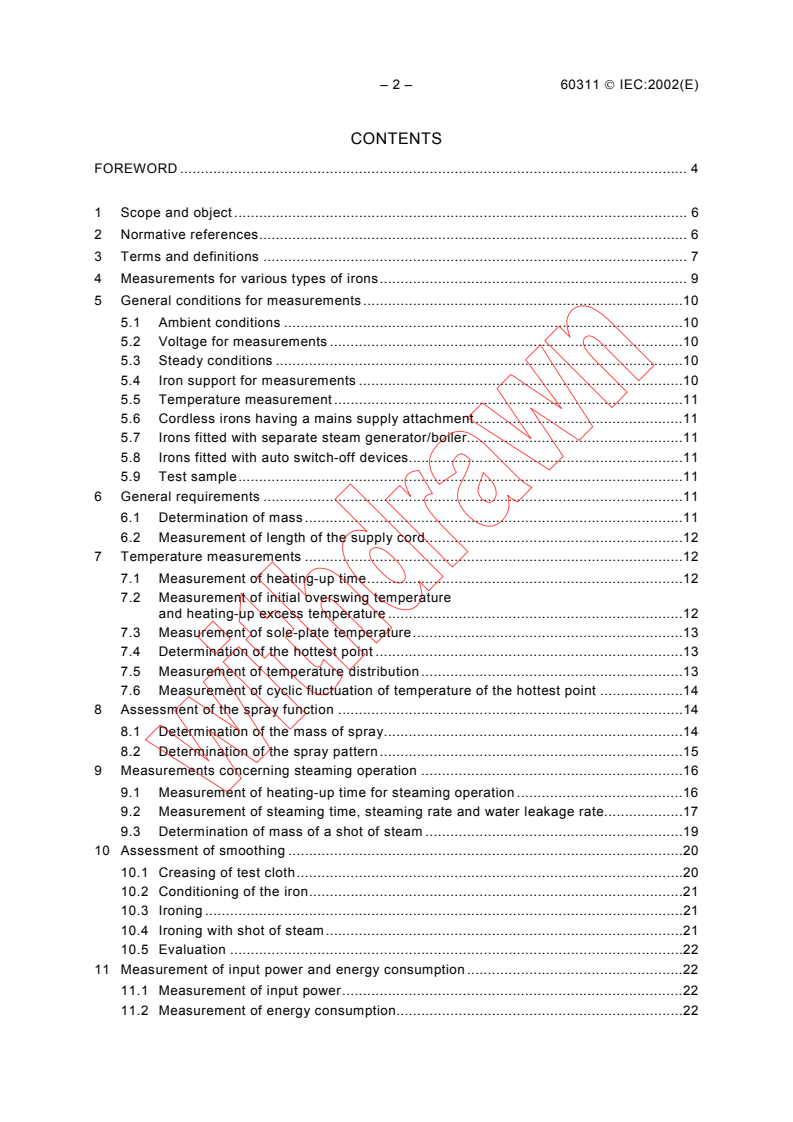
IEC 60311:2002 - Electric irons for household or similar use - Methods for measuring performance Released:9/27/2002
IEC 60311:2002+AMD1:2005 CSV - Electric irons for household or similar use - Methods for measuring performance Released:2/21/2006
IEC 60311:2002+AMD1:2005+AMD2:2009 CSV - Electric irons for household or similar use - Methods for measuring performance Released:10/14/2009
IEC 60311:2002 - Electric irons for household or similar use - Methods for measuring performance Released:9/27/2002

IEC 60311:2002+AMD1:2005+AMD2:2009 CSV - Electric irons for household or similar use - Methods for measuring performance Released:10/14/2009
Overview - IEC 60311:2002 (with Amendments A1:2005, A2:2009)
IEC 60311 specifies standardized methods for measuring the performance of electric irons for household or similar use. It defines the principal performance characteristics and test procedures for a range of irons - dry irons, steam irons, vented steam irons (with motor pump), spray irons, and steam irons with separate water reservoir or boiler/generator (≤ 5 L). The standard describes how to measure features that affect ironing quality (for example sole‑plate temperature and steam output). It is a methods standard focused on performance measurement rather than safety requirements.
Key topics and technical requirements
IEC 60311 sets out detailed measurement methods and general test conditions, including:
- Test scope and sample preparation (types of irons covered, test samples)
- Ambient and electrical conditions for measurements (voltage, steady conditions)
- Temperature measurements: heating‑up time, initial overswing, sole‑plate temperature distribution, hottest point, and cyclic temperature fluctuation
- Spray function assessment: mass of spray and spray pattern
- Steaming operation: heating‑up for steaming, steaming time and rate, water leakage, and mass of a shot of steam
- Smoothing (ironing) assessment: creasing of test cloth, conditioning, ironing procedures and evaluation
- Input power and energy consumption measurements and ironing efficiency
- Sole‑plate performance: smoothness, scratch resistance, and adhesion of PTFE or similar coatings
- Thermostatic stability: heating test, drop test, and thermostat drift
- Durability and hard‑water steaming tests, plus instructions for use and point‑of‑sale information
- Normative annexes (e.g., ironing board and cotton cloth specifications) and informative annexes for special steam appliances
Applications and who uses it
IEC 60311 is used by:
- Manufacturers and product designers to validate performance claims and optimize sole‑plate temperature control, steam delivery and spray functions
- Test laboratories and certification bodies for repeatable performance testing and comparative benchmarking
- Quality assurance teams for production testing and R&D teams during product development
- Retailers and consumer organizations to verify advertised features and prepare point‑of‑sale information
- Regulators and standards committees when aligning national requirements with international measurement methods
Related standards
- Consolidated edition includes amendments A1 (2005) and A2 (2009).
- For safety aspects, consult the relevant IEC safety standards for household appliances (for example the IEC 60335 series).
Keywords: IEC 60311, electric irons, performance testing, sole‑plate temperature, steaming operation, spray function, measurement methods, household irons.
Relations
- Effective Date
- 05-Sep-2023
- Effective Date
- 05-Sep-2023
- Effective Date
- 05-Sep-2023
- Revises
IEC 60311:1995 - Electric irons for household or similar use - Methods of measurement of performance - Effective Date
- 05-Sep-2023
- Revised
IEC 60311:2016 - Electric irons for household or similar use - Methods for measuring performance - Effective Date
- 05-Sep-2023
- Effective Date
- 05-Sep-2023
Buy Documents
IEC 60311:2002 - Electric irons for household or similar use - Methods for measuring performance Released:9/27/2002
IEC 60311:2002+AMD1:2005 CSV - Electric irons for household or similar use - Methods for measuring performance Released:2/21/2006
IEC 60311:2002+AMD1:2005+AMD2:2009 CSV - Electric irons for household or similar use - Methods for measuring performance Released:10/14/2009
IEC 60311:2002 - Electric irons for household or similar use - Methods for measuring performance Released:9/27/2002
IEC 60311:2002+AMD1:2005+AMD2:2009 CSV - Electric irons for household or similar use - Methods for measuring performance Released:10/14/2009
Frequently Asked Questions
IEC 60311:2002 is a standard published by the International Electrotechnical Commission (IEC). Its full title is "Electric irons for household or similar use - Methods for measuring performance". This standard covers: IEC 60311:2002 states and defines the principal performance characteristics of electric dry irons, steam irons, spray irons,and steam irons with seperate water reservoir or boiler/generator not exceeding 5L in capacity, for household or similar use.
IEC 60311:2002 states and defines the principal performance characteristics of electric dry irons, steam irons, spray irons,and steam irons with seperate water reservoir or boiler/generator not exceeding 5L in capacity, for household or similar use.
IEC 60311:2002 is classified under the following ICS (International Classification for Standards) categories: 97.060 - Laundry appliances. The ICS classification helps identify the subject area and facilitates finding related standards.
IEC 60311:2002 has the following relationships with other standards: It is inter standard links to IEC 60311:2002/AMD1:2005, IEC 60311:2002/AMD2:2009, IEC 60311:1995/AMD1:1997, IEC 60311:1995, IEC 60311:2016, IEC 60311:1995/AMD2:1999. Understanding these relationships helps ensure you are using the most current and applicable version of the standard.
IEC 60311:2002 is available in PDF format for immediate download after purchase. The document can be added to your cart and obtained through the secure checkout process. Digital delivery ensures instant access to the complete standard document.
Standards Content (Sample)
INTERNATIONAL IEC
STANDARD
Fourth edition
2002-09
Electric irons for household or similar use –
Methods for measuring performance
Fers à repasser électriques pour usage domestique
ou analogue –
Méthodes de mesure de l'aptitude à la fonction
Reference number
Publication numbering
As from 1 January 1997 all IEC publications are issued with a designation in the
60000 series. For example, IEC 34-1 is now referred to as IEC 60034-1.
Consolidated editions
The IEC is now publishing consolidated versions of its publications. For example,
edition numbers 1.0, 1.1 and 1.2 refer, respectively, to the base publication, the
base publication incorporating amendment 1 and the base publication incorporating
amendments 1 and 2.
Further information on IEC publications
The technical content of IEC publications is kept under constant review by the IEC,
thus ensuring that the content reflects current technology. Information relating to
this publication, including its validity, is available in the IEC Catalogue of
publications (see below) in addition to new editions, amendments and corrigenda.
Information on the subjects under consideration and work in progress undertaken
by the technical committee which has prepared this publication, as well as the list
of publications issued, is also available from the following:
• IEC Web Site (www.iec.ch)
• Catalogue of IEC publications
The on-line catalogue on the IEC web site (http://www.iec.ch/searchpub/cur_fut.htm)
enables you to search by a variety of criteria including text searches, technical
committees and date of publication. On-line information is also available on
recently issued publications, withdrawn and replaced publications, as well as
corrigenda.
• IEC Just Published
This summary of recently issued publications (http://www.iec.ch/online_news/
justpub/jp_entry.htm) is also available by email. Please contact the Customer
Service Centre (see below) for further information.
• Customer Service Centre
If you have any questions regarding this publication or need further assistance,
please contact the Customer Service Centre:
Email: custserv@iec.ch
Tel: +41 22 919 02 11
Fax: +41 22 919 03 00
INTERNATIONAL IEC
STANDARD
Fourth edition
2002-09
Electric irons for household or similar use –
Methods for measuring performance
Fers à repasser électriques pour usage domestique
ou analogue –
Méthodes de mesure de l'aptitude à la fonction
IEC 2002 Copyright - all rights reserved
No part of this publication may be reproduced or utilized in any form or by any means, electronic or
mechanical, including photocopying and microfilm, without permission in writing from the publisher.
International Electrotechnical Commission, 3, rue de Varembé, PO Box 131, CH-1211 Geneva 20, Switzerland
Telephone: +41 22 919 02 11 Telefax: +41 22 919 03 00 E-mail: inmail@iec.ch Web: www.iec.ch
PRICE CODE
Commission Electrotechnique Internationale
X
International Electrotechnical Commission
Международная Электротехническая Комиссия
For price, see current catalogue
– 2 – 60311 IEC:2002(E)
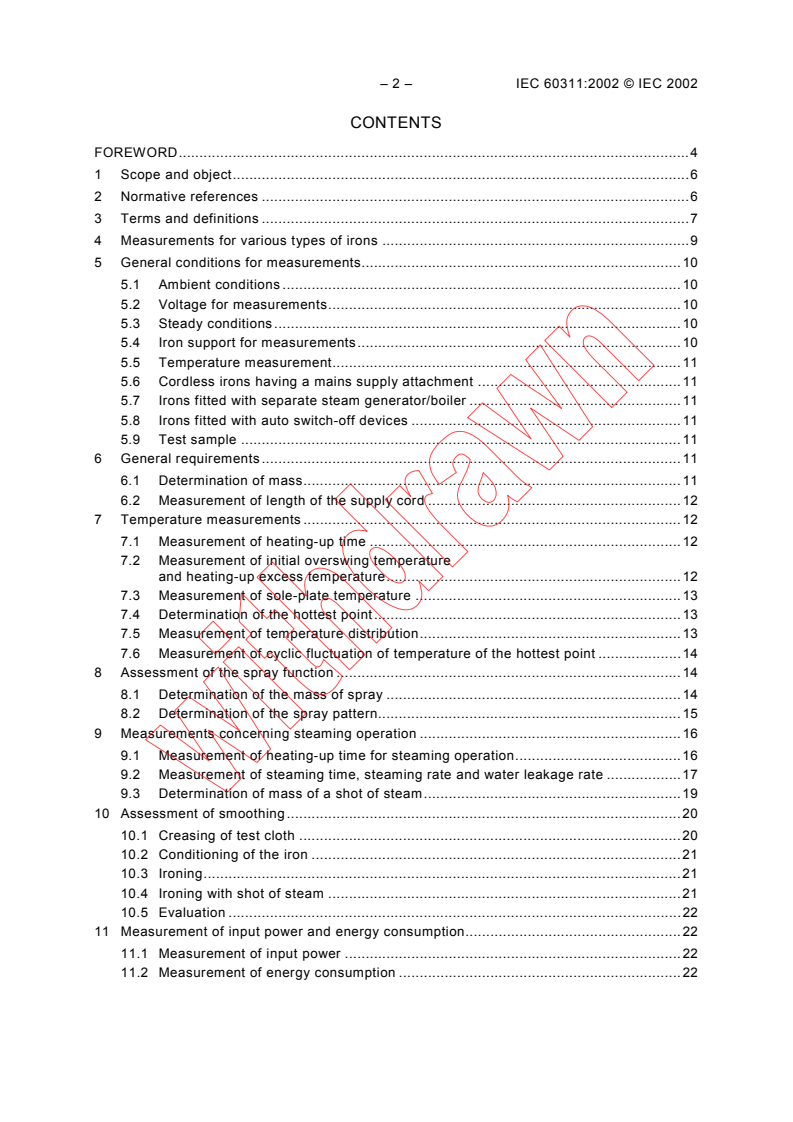
CONTENTS
FOREWORD . 4
1 Scope and object . 6
2 Normative references. 6
3 Terms and definitions . 7
4 Measurements for various types of irons. 9
5 General conditions for measurements.10
5.1 Ambient conditions .10
5.2 Voltage for measurements .10
5.3 Steady conditions .10
5.4 Iron support for measurements .10
5.5 Temperature measurement.11
5.6 Cordless irons having a mains supply attachment.11
5.7 Irons fitted with separate steam generator/boiler.11
5.8 Irons fitted with auto switch-off devices.11
5.9 Test sample.11
6 General requirements .11
6.1 Determination of mass .11
6.2 Measurement of length of the supply cord.12
7 Temperature measurements .12
7.1 Measurement of heating-up time.12
7.2 Measurement of initial overswing temperature
and heating-up excess temperature .12
7.3 Measurement of sole-plate temperature.13
7.4 Determination of the hottest point .13
7.5 Measurement of temperature distribution .13
7.6 Measurement of cyclic fluctuation of temperature of the hottest point .14
8 Assessment of the spray function .14
8.1 Determination of the mass of spray.14
8.2 Determination of the spray pattern.15
9 Measurements concerning steaming operation .16
9.1 Measurement of heating-up time for steaming operation .16
9.2 Measurement of steaming time, steaming rate and water leakage rate.17
9.3 Determination of mass of a shot of steam .19
10 Assessment of smoothing .20
10.1 Creasing of test cloth.20
10.2 Conditioning of the iron.21
10.3 Ironing .21
10.4 Ironing with shot of steam.21
10.5 Evaluation .22
11 Measurement of input power and energy consumption .22
11.1 Measurement of input power.22
11.2 Measurement of energy consumption.22
60311 © IEC:2002(E) – 3 –
12 Assessment of sole-plate.22
12.1 Determination of smoothness of the sole-plate.22
12.2 Measurement of scratch resistance of sole-plate .23
12.3 Determination of adhesion of polytetrafluorethylene (PTFE) coating
or similar coating on sole-plate .25
13 Measurement of thermostatic stability.25
13.1 Heating test .25
13.2 Drop test.26
13.3 Determination of drift of thermostat.26
14 Determination of total steaming time for hard water .26
15 Instruction for use.27
16 Information at the point of sale.28
Annex A (informative) Measurement of steaming time, steaming rate and water
leakage rate for pressurized steam irons or instantaneous steam irons .43
Annex B (normative) Ironing board.44
Annex C (normative) Cotton cloth.47
Annex D (informative) Classification of electric irons .48
Figure 1 – Arrangement for measuring the sole-plate temperature .29
Figure 2 – Variation of sole-plate temperature after switching-on .30
Figure 3 – Determination of spray pattern .31
Figure 4 – Test apparatus .32
Figure 5 – Creasing tool.33
Figure 6 – Wrapping rod and pencil.33
Figure 7 – Circular and rectangular blocks .34
Figure 8 – Conditioning of the iron .34
Figure 9 – Ironing.35
Figure 10 – Evaluation .35
Figure 12 – Test apparatus for smoothness of sole-plate .38
Figure 13 -- Scratch .39
Figure 14 – Positions of cutting area .40
Figure 15 – Apparatus for drop test .41
Figure 16 – Test apparatus for total steaming time.42
Figure A.1 – Measurements concerning steaming operation.43
Figure B.1 – Example of construction of the ironing board.46
Table 1 – Measurements of various types of irons. 9-10
Table 2 – Classes of scratch resistance .24
– 4 – 60311 IEC:2002(E)
INTERNATIONAL ELECTROTECHNICAL COMMISSION
____________
ELECTRIC IRONS FOR HOUSEHOLD
OR SIMILAR USE –
METHODS FOR MEASURING PERFORMANCE
FOREWORD
1) The IEC (International Electrotechnical Commission) is a worldwide organization for standardization comprising
all national electrotechnical committees (IEC National Committees). The object of the IEC is to promote
international co-operation on all questions concerning standardization in the electrical and electronic fields. To
this end and in addition to other activities, the IEC publishes International Standards. Their preparation is
entrusted to technical committees; any IEC National Committee interested in the subject dealt with may
participate in this preparatory work. International, governmental and non-governmental organizations liaising
with the IEC also participate in this preparation. The IEC collaborates closely with the International
Organization for Standardization (ISO) in accordance with conditions determined by agreement between the
two organizations.
2) The formal decisions or agreements of the IEC on technical matters express, as nearly as possible, an
international consensus of opinion on the relevant subjects since each technical committee has representation
from all interested National Committees.
3) The documents produced have the form of recommendations for international use and are published in the form
of standards, technical specifications, technical reports or guides and they are accepted by the National
Committees in that sense.
4) In order to promote international unification, IEC National Committees undertake to apply IEC International
Standards transparently to the maximum extent possible in their national and regional standards. Any
divergence between the IEC Standard and the corresponding national or regional standard shall be clearly
indicated in the latter.
5) The IEC provides no marking procedure to indicate its approval and cannot be rendered responsible for any
equipment declared to be in conformity with one of its standards.
6) Attention is drawn to the possibility that some of the elements of this International Standard may be the subject
of patent rights. The IEC shall not be held responsible for identifying any or all such patent rights.
International Standard IEC 60311 has been prepared by subcommittee 59E: Ironing and
pressing appliances, of IEC technical committee 59: Performance of household electrical
appliances.
This fourth edition of IEC 60311 cancels and replaces the third edition published in 1995 and
its amendment 1 (1997) and amendment 2 (1999).
The text of this standard is based on the third edition, amendments 1 and 2 and the following
documents:
FDIS Report on voting
59E/148/FDIS 59E/149/RVD
Full information on the voting for the approval of this standard can be found in the report on
voting indicated in the above table.
This publication has been drafted in accordance with the ISO/IEC Directives, Part 3.
Annexes B and C form an integral part of this standard.
Annexes A and D are for information only.
60311 © IEC:2002(E) – 5 –
In this standard, the following print types are used:
— test specifications: in italic type
— notes: in small roman type
— other texts: in roman type
Words in bold in the text are defined in clause 3.
The committee has decided that the contents of this publication will remain unchanged until
February 2005. At this date, the publication will be
• reconfirmed;
• withdrawn;
• replaced by a revised edition, or
• amended.
A bilingual version of this publication may be issued at a later date.
– 6 – 60311 IEC:2002(E)
ELECTRIC IRONS FOR HOUSEHOLD
OR SIMILAR USE –
METHODS FOR MEASURING PERFORMANCE
1 Scope
This International Standard applies to electric irons for household or similar use.
The purpose of this standard is to state and define the principal performance characteristics
of electric irons for household or similar use which are of interest to the user and to describe
the standard methods for measuring these characteristics.
Electric irons covered by this standard include
− dry irons;
− steam irons;
− spray irons;
− steam irons with separate water reservoir or boiler/generator having a capacity not
exceeding 5 l.
This standard is concerned neither with safety nor with performance requirements.
NOTE The primary characteristic to be taken into account in assessing the performance of an electric iron is its
basic ability to produce a smooth finish to textile materials, without risk of scorching or other damage. lt has not
proved possible to devise a single method which will measure this characteristic in a consistently reproducible way
and measurements have therefore been included to check certain factors, such as the temperature of the sole-
plate at the mid-point, sole-plate temperature distribution, etc., which affect the basic characteristic. In evaluating
the results, it must be realized that, while a very exceptional result in any one of them may significantly affect
performance, there is considerable latitude in the combination of results which will give satisfactory ironing
performance, and too much significance should not be attached to minor differences in any one result.
2 Normative references
The following referenced documents are indispensable for the application of this document.
For dated references, only the edition cited applies. For undated references, the latest edition
of the referenced document (including any amendments) applies.
IEC 60051-1:1997, Direct acting indicating analogue electrical measuring instruments and
their accessories – Part 1: Definitions and general requirements common to all parts
IEC 60454-3-3:1998, Pressure-sensitive adhesive tapes for electrical purposes – Part 3:
Specifications for individual materials – Sheet 3: Polyester film tapes with rubber
thermoplastic adhesive
IEC 60734:2001, Household electrical applicances – Performance – Hard water for testing
ISO 105-F:1985, Textiles – Tests for colour fastness – Part F: Standard adjacent fabrics
ISO 1518:1992, Paints and varnishes – Scratch test
ISO 2409:1992, Paints and varnishes – Cross-cut test
ISO 3758:1991, Textiles – Care labelling code using symbols
ISO 3801:1977, Textiles – Woven fabrics – Determination of mass per unit length and mass
per unit area
60311 © IEC:2002(E) – 7 –
ISO 6330:2000, Textiles – Domestic washing and drying procedures for textile testing
ISO 7211-2:1984, Textiles – Woven fabrics – Construction – Methods of analysis – Part 2:
Determination of number of threads per unit length
ISO 9073-2: 1995, Textiles – Test methods for nonwovens – Part 2: Determination of
thickness
ISO 13934-1:1999, Textiles – Tensile properties of fabrics – Part 1: Determination of
maximum force and elongation at maximum force using the strip method
3 Terms and definitions
For the purposes of this standard the following definitions apply.
3.1
electric iron
portable appliance, which has an electrically heated sole-plate and is used for ironing textile
materials
NOTE In this standard, "electric iron" is referred to as "iron".
3.2
thermostatic iron
iron fitted with a thermostat, the setting of which can be adjusted manually to alter the sole-
plate temperature over a range and maintain it within certain limits
3.3
electric iron with non-self-resetting thermal cut-out
iron fitted with a non-self-resetting thermal cut-out, such as a fusible link, for the purpose of
disconnecting the heating element if the iron attains excessive temperature
3.4
dry iron
iron having neither means to produce and supply steam nor to spray water onto textile
materials while ironing
3.5
steam iron
iron having means to produce and supply steam to textile materials while ironing.
It can be provided with means to supply a shot of steam
3.5.1
shot-of-steam iron
iron provided with means to supply a shot of steam to textile materials while ironing
3.5.2
shot of steam
single emission of an increased volume of steam from the sole-plate for a short duration
3.5.3
vented steam iron
steam iron in which steam is produced when the water contacts the sole-plate, the water
reservoir being at atmospheric pressure.
NOTE The water reservoir may be incorporated in the iron or connected by a hose to the iron.
– 8 – 60311 IEC:2002(E)
3.5.4
pressurized steam iron
steam iron in which steam is produced in a boiler at a pressure exceeding 50 kPa
NOTE The boiler may be incorporated in the iron or connected by a hose to the iron.
3.5.5
instantaneous steam iron
steam iron in which small quantities of water are pumped from the water reservoir and in
which steam is produced when the water contacts the walls of the boiler/generator, the water
reservoir being at atmospheric pressure
NOTE The water reservoir and the boiler are connected to the iron by a tube.
3.6
spray iron
iron provided with means to spray water onto textile materials while ironing
3.7
rated voltage
3.7.1
rated voltage
voltage assigned to the iron by the manufacturer
3.7.2
rated voltage range
range of voltage assigned to the iron by the manufacturer, expressed in terms of its lower and
upper limits
3.8
rated input
input power of the iron under normal operating conditions assigned by the manufacturer
3.9
sole-plate
flat surface of the iron, which is heated electrically and pressed against textile materials while
ironing
3.10
mid-point
point of the sole-plate in the geometrical centre of the centre-line of the sole-plate.
If this point is on a steam outlet, a groove or a cover, the nearest point of the sole-plate on
the centre-line as is practicable is chosen
3.11
upright position
vertical still position for a heel-standing iron or normal resting position according to the
manufacturer's instructions for other than a heel-standing iron
3.12
cordless iron
3.12.1
cordless iron
iron which is connected to the supply mains only when placed on its stand
60311 © IEC:2002(E) – 9 –
3.12.2
cordless iron having a mains supply attachment
cordless iron which is provided, in addition, with a detachable part to which the supply cord is
fixed, and which can be connected to the supply mains directly during ironing
3.13
auto switch-off device
device provided by the manufacturer to interrupt the heating element if the iron is not moved
for a stated period of time
4 Measurements for various types of irons
The performance of the iron is determined by the measurements indicated in table 1. Relevant
measurements for various types of irons are indicated in table 1 by x.
Measurements are performed in the order given in table 1.
Table 1 – Measurements of various types of irons
Thermo- Cordless
Thermostatic
static steam irons
dry irons with
Thermo- Thermo- irons with having
Item of non-self- Cordless
static dry static steam non-self a mains
measurement resetting irons
irons irons resetting supply
thermal
thermal attach-
cut out
cut out ment
6.1 (Determination of mass) x x x x x x
6.2 (Measurement of length
xx x x x x
of the supply cord)
7.1 (Measurement of
xx x x x x
heating-up time)
7.2 (Measurement of initial
overswing temperature
xx x x x x
and heating-up excess
temperature)
7.3 (Measurement of sole-
xx x x x x
plate temperature)
7.4 (Determination of the
xx x x x x
hottest point)
7.5 (Measurement of
xx x x x x
temperature distribution)
7.6 (Measurement of cyclic
fluctuation of
xx x x x x
temperature of the
hottest point)
8 (Assessment of spray
(x) (x) (x) (x) (x) (x)
function)
9.1 (Measurement of
heating-up time for xx x x x x
steaming operation)
9.2 (Measurement of
xx x
steaming time)
9.2 (Measurement of
xx x x
steaming rate)
9.3 (Determination of mass
(x) (x) (x) (x)
of a shot of steam)
10 (Assessment of
xx x x x x
smoothing)
10.4 (Ironing with shot
(x) (x) (x) (x)
of steam)
– 10 – 60311 IEC:2002(E)
Thermo- Cordless
Thermostatic
static steam irons
dry irons with
Thermo- Thermo- irons with having
non-self- Cordless
Item of measurement static dry static steam non-self a mains
resetting irons
irons irons resetting supply
thermal
thermal attach-
cut out
cut out ment
11.1 (Measurement of
xx x x x x
input power)
11.2 (Measurement of energy
xx x x x x
consumption)
12.1 (Determination
of smoothness of xx x x x x
the sole-plate)
12.2 (Measurement of scratch
xx x x x x
resistance of sole-plate)
12.3 (Determination of
adhesion of polytetra-
fluorethylene (PTFE) xx x x x x
coating or similar coating
on sole-plate)
13 (Measurement of
xx x x x x
thermostatic stability)
14 (Determination of total
steaming time for xx x
hard water)
NOTE 1 Measurements for the spray iron are determined according to the table, whether it is of thermo-
static type, steam or shot-of-steam-producing type, cordless iron type, or cordless iron having mains supply
attachment type.
For the non-steam-producing spray irons, the measurements for dry irons are applied.
Steam and spray irons are tested with water container empty.
NOTE 2 (x) means if applicable.
NOTE 3 Reporting the data should be made according to the testing authorities.
5 General conditions for measurements
Unless otherwise specified, the measurements are conducted under the following conditions.
5.1 Ambient conditions
The measurements are conducted at an ambient temperature of 20 °C ± 5 °C, and the place
for the measurements shall be free from any draughts.
5.2 Voltage for measurements
The voltage to be applied to the iron under measurement is that required to give the rated
input under steady conditions. If an input power range is marked on the iron, the voltage is
that required to give the mean of the input power range.
5.3 Steady conditions
The steady conditions for measurements are considered to be reached 30 min after switching-
on of the iron or when the thermostat has operated four times, if this occurs earlier.
5.4 Iron support for measurements
The iron is placed on the three pointed metallic supports while under measurement. The three
pointed supports are constructed so that they support the sole-plate of the iron horizontally at
least 100 mm above the base surface on which the iron is placed.
For cordless irons, the iron is placed on its stand.
60311 © IEC:2002(E) – 11 –
5.5 Temperature measurement
The temperature of the iron is measured by a fine-wire thermocouple, the wire diameter of
which shall not exceed 0,3 mm.
Accuracy of the measuring instrument shall be better than, or equal to, class 1 in IEC 60051-1.
A movable silver disk, having a diameter of 10 mm and a thickness of 1 mm, rests on the top
of a pointed ceramic tube which contains the thermocouple wires in two separate bores. An
example of the arrangement is shown in figure 1.
The centre of the silver disk is pressed on to the sole-plate of the iron by applying a force of
at least 1 N. In order to improve the heat transfer between the silver disk and the sole-plate,
silicone grease or heat transfer paste can be used.
For the measurement of cordless irons, except cordless irons having a mains supply attach-
ment, a thermocouple with silver disk as shown in figure1 is attached to the sole-plate directly.
5.6 Cordless irons having a mains supply attachment
Cordless irons having a mains supply attachment are tested as conventional irons.
5.7 Irons fitted with separate steam generator/boiler
Irons fitted with separate steam generator/boiler have to be kept in ironing mode under
measurements.
5.8 Irons fitted with auto switch-off devices
Irons fitted with auto switch-off devices have to be kept in ironing mode under measurements.
5.9 Test sample
A new sample is used for the test of clause 13.
6 General requirements
6.1 Determination of mass
For all types of irons without separate water reservoir or boiler/generator, the mass is
measured without the supply cord. The supply cord is removed from the iron by disconnection
from the terminals or by removing the connector.
For steam irons with a separate water reservoir or boiler/generator, the mass is measured in
two steps:
− the total mass of the system, not filled up with water, and
− the iron with the interconnection hose.
The mass is expressed in grams, rounded off to one decimal place.
For cordless irons, the mass is measured without its stand.
– 12 – 60311 IEC:2002(E)
6.2 Measurement of length of the supply cord
The length of the supply cord of irons without separate water reservoir or boiler/generator is
measured from the inlet point of the iron or connector to the inlet point of the plug including
any cord guards.
The length is expressed in meters, rounded off to the nearest 50 mm.
7 Temperature measurements
7.1 Measurement of heating-up time
The iron is placed on the three metallic supports; for cordless irons, the iron is placed on its
stand (see 5.4), and the thermocouple is attached at the mid-point of the sole-plate.
Starting from ambient temperature, the iron is heated up with the voltage specified in 5.2, the
thermostat, if any, set at the highest temperature.
The time necessary for the temperature to exceed the ambient temperature by 180 K is
measured, and is expressed in minutes and seconds.
7.2 Measurement of initial overswing temperature
and heating-up excess temperature
The iron is placed on the three metallic supports, for cordless irons, the iron is placed on its
stand (see 5.4), and a thermocouple is attached at the mid-point of the sole-plate.
The iron is switched on, with the voltage specified in 5.2.
Using a recording-type instrument, the time and temperature are measured at the mid-point
with the thermostat set at the 1 dot marking position and at the highest position over five
successive cycles to produce a graph of the type shown in figure 2.
The thermostat is first set to the 1 dot marking position. If there is no dot marking, the
thermostat is so adjusted as to obtain an average temperature of the sole-plate as close as
possible to 95 °C under steady conditions.
After the first measurement, the iron is allowed to cool to room temperature (20 °C ± 5 °C);
then the sole-plate temperature is measured again at the highest setting position of the
thermostat.
From the graph the following are determined:
a) the initial overswing temperature, which is the first peak temperature between the first and
second cut-outs of the thermostat;
b) the mean peak temperature, which is the mean value of the last three peak temperatures;
c) the heating-up excess temperature, which is the difference between the initial overswing
temperature and the mean peak temperature.
60311 © IEC:2002(E) – 13 –
7.3 Measurement of sole-plate temperature
The iron is placed on the three metallic supports; for cordless irons, the iron is placed on its
stand (see 5.4), and a thermocouple is attached at the mid-point of the sole-plate. The iron is
switched on and, for each setting of the thermostat, the highest and the lowest temperatures
are measured during five successive cycles of temperature variation after the iron has
reached steady conditions. The mean value of the five highest and five lowest temperatures is
the sole-plate temperature for the setting.
For irons having thermostat settings which are indicated by a sector, the setting is to be at the
centre of the range.
The adjustment of the thermostat control to obtain the required setting is to be made in the
direction of increasing temperature.
NOTE 1 The measurements of 7.2, 7.3 and 7.6 may all be carried out at the same time.
NOTE 2 ISO 3758 has introduced textile care markings for maximum ironing temperatures. The textile care
labelling of the ISO standard is indicated by one, two and three dots placed within an iron symbol. This standard
takes those recommendations into account but to obtain improved ironing results the temperatures have been
adjusted as shown in the following table.
Sole-plate temperature T
Marking Material, for example
°C
Acetate, elastane, polyamide,
• (1 dot) 70 < T < 120
polypropylene
Cupro, polyester, silk, triacetate,
• • (2 dots) 100 < T < 160
viscose, wool
• • • (3 dots) 140 < T < 210 Cotton, linen
With the thermostat set to the middle of each of these dot markings the sole-plate temperatures are measured
after steady conditions have been reached.
The sole-plate temperature for the setting (T ) is the average of the five highest temperatures (T ) and the five
a
lowest temperatures (T ) of the mid-point of the sole-plate during five successive cycles of temperature
b
variation.
7.4 Determination of the hottest point
The iron is placed on the three metallic supports; for cordless irons, the iron is placed on
its stand (see 5.4), and is heated up with the voltage specified in 5.2 with the thermostat
set at the highest position. Immediately after the thermostat has operated twice, the iron
is placed for several seconds on a sheet of white paper spread over flannel cloth, which
covers a wooden board. After removal of the iron, darkening of the paper indicates the
temperature distribution over the sole-plate. The hottest point is determined as the centre
of the darkest area.
NOTE Positive phototype paper, which is unexposed and developed, white tracing paper or white blotting paper
is recommended as the white paper for this measurement.
7.5 Measurement of temperature distribution
The iron is placed on the three metallic supports; for cordless irons, the iron is placed on its stand
(see 5.4); a thermocouple is attached at each of the following four points of the sole-plate:
a) the hottest point determined in 7.4;
b) the mid-point of the sole-plate;
c) the point on the longitudinal centre line 20 mm from the tip of the sole-plate;
d) the point on the longitudinal centre line 20 mm from the back end of the sole-plate.
– 14 – 60311 IEC:2002(E)
For a thermostatic iron, the thermostat is set so that the temperature at the mid-point
is maintained at approximately 150 °C under steady conditions, and the measurement is
performed after the iron has reached steady conditions. For other iron types, the temperature
at the mid-point is maintained at approximately 150 °C for at least 15 min by switching the
supply on and off before taking temperature measurements.
Using a recording-type instrument, the varying temperature is recorded for 10 min and the
average temperature for the 10 min is determined for each of the four points. The mean of the
four average temperatures is then determined, and the difference between each average
temperature and the mean temperature is also calculated. The four temperature differences
are recorded as the indication of the temperature distribution over the sole-plate.
7.6 Measurement of cyclic fluctuation of temperature of the hottest point
The procedure for the temperature measurement is the same as in 7.2, except that highest
and lowest temperatures of each cycle are measured for five successive cycles after the iron
has reached steady conditions. The mean value for the highest temperatures and that for the
lowest temperatures are determined. One-half of the difference between the mean values is
the cyclic fluctuation of the temperature of the hottest point and is expressed in ± Celsius
degrees.
NOTE This measurement may be combined with the measurements in 7.2.
8 Assessment of the spray function
8.1 Determination of the mass of spray
8.1.1 Determination of the mass of spray for irons with manual spray pumps
The water container is filled with distilled water at a temperature of 20 °C ± 2 °C, to the
capacity specified by the manufacturer.
The spraying system is prepared by operating the spray device several times.
of the iron including the power supply cord is determined on a balance having
The mass W
an accuracy of at least 0,1 g.
The iron is placed on a horizontal plane and the spray device is operated 50 times at intervals
of 5 s.
The mass W of the iron including the power supply cord is then measured.
NOTE The iron is not connected to the supply and the steam setting is at dry position, if any.
The mass of spray M for each operation is calculated as follows:
W – W
1 2
M =
The result of the test is expressed as the mass of spray per operation in grams.
8.1.2 Determination of the mass of spray for irons with means for continuous spray
The water container is filled with distilled water at a temperature of 20 °C ± 2 °C, to the water
capacity specified by the manufacturer.
The spraying system is prepared by operating the spray device for 3 s.
The mass W of the iron including the power supply cord is determined on a balance having
an accuracy of at least 0,1 g.
60311 © IEC:2002(E) – 15 –
The iron is placed on a horizontal plane and the spray device is operated for 20 s
continuously.
The mass W of the iron including the power supply cord is then measured.
The mass of spray for continuous operation M is then calculated as follows:
SC
M = 3 (W – W ) [g/min]
SC 1 2
8.2 Determination of the spray pattern
The water container is filled with distilled water at a temperature of 20 °C ± 2 °C to the
capacity specified by the manufacturer.
The spraying system is prepared by operating the spray device several times.
The iron is placed in a horizontal position on a flat under-layer. A piece of cotton cloth having
dimensions of 500 mm × 500 mm is placed in front of the tip of the iron.
NOTE The iron is not connected to the supply and the steam setting is at dry position, if any.
The cloth has the following specifications:
− non-starched cotton textile, washed and dried according to ISO 6330, clause 5 and 6.3 –
procedure C (dry flat);
− threads 25 ± 2 per centimetre in warp and weft having a yarn of 30 ± 2 tex, plain weave 1/1;
− mass per square meter: 170 g ± 10 g.
In order to indicate the effect of water, the cloth may be impregnated by using a 10 % solution
of cobalt chloride (CoCl2).
After impregnation the cloth is dried in a cabinet provided with air circulation at a temperature
of 100 °C ± 10 °C.
The cloth is placed flat and after drying is smoothed using an iron with a sole-plate
temperature of approximately 120 °C.
The dry impregnated cloth is coloured blue and turns light pink when wet.
The spray device is then operated once and the spray pattern evaluated in accordance with
figure 3.
The spray device of irons featuring continuous spray is operated for 1 s.
The following dimensions are measured:
− the distance between iron tip and the beginning of spray pattern (A1);
− the distance between the centre-line of the iron and the centre-line of the spray pattern (A2);
− the width of the spray pattern (B);
− the length of the spray pattern (L);
− the area of the concentrated spray pattern (A).
The test is carried out three times and the average of the results calculated.
– 16 – 60311 IEC:2002(E)
It is noted if the spray pattern is concentrated in one area or if there are areas without any spray.
When evaluating different irons, a visual comparison can be made of the cloths.
9 Measurements concerning steaming operation
9.1 Measurement of heating-up time for steaming operation
9.1.1 For vented steam irons
For vented steam irons, the water reservoir is filled with distilled water having a temperature
of 20 °C ± 2 °C up to the capacity specified by the manufacturer and then the iron is placed
on its stand or in its upright position. The thermostat is set to the maximum setting indicated
for steam ironing.
For irons with a separate water reservoir, the reservoir is filled up to the capacity specified by
the manufacturer.
The iron is connected to the supply and immediately after the thermostat has switched off for
the second time, the steam control is operated to give the maximum flow rate. If there is no
signal lamp, the second opening of the thermostat is determined with a measuring apparatus.
The iron is then suspended with the sole-plate in a horizontal position with a tolerance of ±1°
by means of a balance having an accuracy of at least ±0,1 g, as shown in figure 4a.
A container of known mass within ±0,1 g is placed under the sole-plate at a distance of
approximately 200 mm in order to collect any water which may flow out of the iron during the
test. In order to avoid condensing steam collecting in the container, a slow-running fan may
be used to blow the steam away.
The total mass of the iron is measured at intervals of 1 min, from the instant after switching-off of
the signal lamp and steaming operation. The steaming rate is measured for 1 min and
calculated in g/min and then introduced in a graph as a function of time. The heating-up time
is the time between the connection to the mains and the instant when the steaming flow
reaches 5 g/min.
The test is repeated but with the thermostat set to the minimum setting for steam ironing.
The heating-up time is expressed in seconds for both the maximum and minimum thermostat
setting for steam ironing.
This measurement is not carried out on
− irons provided with a shut-off device which automatically switches off the supply mains,
when the iron is not moved;
− irons constructed so that steaming is irregular when the iron is in a rest position.
NOTE Some irons may need a preliminary preparation. In this case, before the test is carried out, the iron is
prepared according to the instructions.
9.1.2 For pressurized steam irons or instantaneous steam irons
For pressurized steam irons or instantaneous steam irons, the boiler is filled with distilled
water having a temperature of 20 °C ± 2 °C up to the rated capacity and then placed
on its stand.
The thermostat of the iron is set to the maximum setting indicated for steam operation and
when applicable any maximum temperature pressure setting of the boiler.
60311 © IEC:2002(E) – 17 –
The iron is connected to the supply and the following times t and t are recorded where
1 2
t is the time necessary for the iron to reach the temperature rise of 160 K;
t is the time necessary for the heating up process of the boiler.
The test is repeated, but with the thermostat of the iron set to the minimum setting indicated
for steam operation and, if applicable, any minimum temperature or pressure setting.
The heating-up time is recorded, in minutes and seconds, for both the minimum and maximum
thermostat setting for the steam ironing.
The heating-up time is recorded as the greater of the two values t and t .
1 2
This measurement is not carried out on
− irons constructed so that steaming is irregular when the iron is in a rest position.
NOTE Some irons may need a preliminary preparation. In this case, before the test is carried out, the iron is
prepared according to the instructions.
9.2 Measurement of steaming time, steaming rate and water leakage rate
9.2.1 For vented steam irons
For vented steam irons, without separate water reservoir, the test described in 9.1, at the
maximum setting of the thermostat, is continued until 90 % of the water poured into the iron
has evaporated.
The steaming time is the time between the end of the heating-up time for steaming operation
and when 90 % of the water has evaporated. This time is stated in minutes and seconds.
The container referred to in 9.1.1 is weighed again and the mass of the water which has
leaked from the iron without being evaporated is determined.
For cordless irons, the measurement is carried out for 20 s without power supply and
repeated again without power supply until 90 % of the water capacity of the container has
evaporated.
The steaming rate S is calculated as follows:
R
W – W – W
1 2 3
S =
R
t
where
W is the mass of the iron and water at the end of the heating-up time;
W is the mass of the iron and water after 90 % evaporation;
W is the mass of the water which has leaked without being evaporated.
t is the steaming time, in minutes.
The water leakage rate L is calculated as follows:
R
W
L =
R
t
The steaming rate and leakage rate are expressed in grams per minute.
– 18 – 60311
...
IEC 60311
Edition 4.1 2006-02
INTERNATIONAL
STANDARD
Electric irons for household or similar use – Methods for measuring performance
All rights reserved. Unless otherwise specified, no part of this publication may be reproduced or utilized in any form
or by any means, electronic or mechanical, including photocopying and microfilm, without permission in writing from
either IEC or IEC's member National Committee in the country of the requester.
If you have any questions about IEC copyright or have an enquiry about obtaining additional rights to this publication,
please contact the address below or your local IEC member National Committee for further information.
IEC Central Office
3, rue de Varembé
CH-1211 Geneva 20
Switzerland
Email: inmail@iec.ch
Web: www.iec.ch
About the IEC
The International Electrotechnical Commission (IEC) is the leading global organization that prepares and publishes
International Standards for all electrical, electronic and related technologies.
About IEC publications
The technical content of IEC publications is kept under constant review by the IEC. Please make sure that you have the
latest edition, a corrigenda or an amendment might have been published.
ƒ Catalogue of IEC publications: www.iec.ch/searchpub
The IEC on-line Catalogue enables you to search by a variety of criteria (reference number, text, technical committee,…).
It also gives information on projects, withdrawn and replaced publications.
ƒ IEC Just Published: www.iec.ch/online_news/justpub
Stay up to date on all new IEC publications. Just Published details twice a month all new publications released. Available
on-line and also by email.
ƒ Electropedia: www.electropedia.org
The world's leading online dictionary of electronic and electrical terms containing more than 20 000 terms and definitions
in English and French, with equivalent terms in additional languages. Also known as the International Electrotechnical
Vocabulary online.
ƒ Customer Service Centre: www.iec.ch/webstore/custserv
If you wish to give us your feedback on this publication or need further assistance, please visit the Customer Service
Centre FAQ or contact us:
Email: csc@iec.ch
Tel.: +41 22 919 02 11
Fax: +41 22 919 03 00
IEC 60311
Edition 4.1 2006-02
INTERNATIONAL
STANDARD
Electric irons for household or similar use – Methods for measuring performance
INTERNATIONAL
ELECTROTECHNICAL
COMMISSION
PRICE CODE
CN
ICS 97.060 ISBN 2-8318-8477-2
– 2 – 60311 IEC:2002+A1:2005(E)
CONTENTS
FOREWORD.4
1 Scope.6
2 Normative references .6
3 Terms and definitions .7
4 Measurements for various types of irons .9
5 General conditions for measurements.10
5.1 Ambient conditions .10
5.2 Voltage for measurements.10
5.3 Steady conditions.11
5.4 Iron support for measurements.11
5.5 Temperature measurement.11
5.6 Cordless irons having a mains supply attachment .11
5.7 Irons fitted with separate steam generator/boiler .11
5.8 Irons fitted with auto switch-off devices .11
5.9 Test sample .11
5.10 Irons with additives.11
6 General requirements .12
6.1 Determination of mass.12
6.2 Measurement of length of the supply cord .12
7 Temperature measurements .12
7.1 Measurement of heating-up time .12
7.2 Measurement of initial overswing temperature
and heating-up excess temperature.12
7.3 Measurement of sole-plate temperature .13
7.4 Determination of the hottest point.13
7.5 Measurement of temperature distribution.14
7.6 Measurement of cyclic fluctuation of temperature of the hottest point .14
8 Assessment of the spray function .14
8.1 Determination of the mass of spray .14
8.2 Determination of the spray pattern.15
9 Measurements concerning steaming operation .16
9.1 Measurement of heating-up time for steaming operation.16
9.2 Measurement of steaming time, steaming rate and water leakage rate .17
9.3 Determination of mass of a shot of steam.19
10 Assessment of smoothing.20
10.1 Creasing of test cloth .20
10.2 Conditioning of the iron .21
10.3 Ironing.21
10.4 Ironing with shot of steam .22
10.5 Evaluation .22
11 Measurement of input power and energy consumption.23
11.1 Measurement of input power .23
11.2 Measurement of energy consumption .23
11.3 Ironing efficiency .24
60311 © IEC:2002+A1:2005(E) – 3 –
12 Assessment of sole-plate.24
12.1 Determination of smoothness of the sole-plate .24
12.2 Measurement of scratch resistance of sole-plate .25
12.3 Determination of adhesion of polytetrafluorethylene (PTFE) coating
or similar coating on sole-plate.27
13 Measurement of thermostatic stability.28
13.1 Heating test.28
13.2 Drop test .28
13.3 Determination of drift of thermostat .28
14 Determination of total steaming time for hard water .28
15 Instruction for use.30
16 Information at the point of sale .30
Annex A (informative) Measurement of steaming time, steaming rate
and water leakage rate for pressurized steam irons or instantaneous steam irons .44
Annex B (normative) Ironing board .45
Annex C (normative) Cotton cloth .48
Annex D (informative) Classification of electric irons .49
Figure 1 – Arrangement for measuring the sole-plate temperature .31
Figure 2 – Variation of sole-plate temperature after switching-on .32
Figure 3 – Determination of spray pattern .33
Figure 4 – Test apparatus .34
Figure 5 – Creasing tool.35
Figure 6 – Wrapping rod and pencil .35
Figure 7 – Circular and rectangular blocks.36
Figure 8 – Conditioning of the iron .36
Figure 9 – Ironing .37
Figure 10 – Evaluation .37
Figure 11 – Comparison charts .39
Figure 12 – Test apparatus for smoothness of sole-plate .40
Figure 13 – Scratch .41
Figure 14 – Positions of cutting area.42
Figure 15 – Apparatus for drop test.43
Figure 16 – Test apparatus for total steaming time .43
Figure A.1 – Measurements concerning steaming operation.44
Figure B.1 – Example of construction of the ironing-board .47
Table 1 – Measurements of various types of irons .9
Table 2 – Classes of scratch resistance.26
– 4 – 60311 © IEC:2002+A1:2005(E)
INTERNATIONAL ELECTROTECHNICAL COMMISSION
____________
ELECTRIC IRONS FOR HOUSEHOLD
OR SIMILAR USE –
METHODS FOR MEASURING PERFORMANCE
FOREWORD
1) The International Electrotechnical Commission (IEC) is a worldwide organization for standardization comprising
all national electrotechnical committees (IEC National Committees). The object of IEC is to promote
international co-operation on all questions concerning standardization in the electrical and electronic fields. To
this end and in addition to other activities, IEC publishes International Standards, Technical Specifications,
Technical Reports, Publicly Available Specifications (PAS) and Guides (hereafter referred to as “IEC
Publication(s)”). Their preparation is entrusted to technical committees; any IEC National Committee interested
in the subject dealt with may participate in this preparatory work. International, governmental and non-
governmental organizations liaising with the IEC also participate in this preparation. IEC collaborates closely
with the International Organization for Standardization (ISO) in accordance with conditions determined by
agreement between the two organizations.
2) The formal decisions or agreements of IEC on technical matters express, as nearly as possible, an international
consensus of opinion on the relevant subjects since each technical committee has representation from all
interested IEC National Committees.
3) IEC Publications have the form of recommendations for international use and are accepted by IEC National
Committees in that sense. While all reasonable efforts are made to ensure that the technical content of IEC
Publications is accurate, IEC cannot be held responsible for the way in which they are used or for any
misinterpretation by any end user.
4) In order to promote international uniformity, IEC National Committees undertake to apply IEC Publications
transparently to the maximum extent possible in their national and regional publications. Any divergence
between any IEC Publication and the corresponding national or regional publication shall be clearly indicated in
the latter.
5) IEC provides no marking procedure to indicate its approval and cannot be rendered responsible for any
equipment declared to be in conformity with an IEC Publication.
6) All users should ensure that they have the latest edition of this publication.
7) No liability shall attach to IEC or its directors, employees, servants or agents including individual experts and
members of its technical committees and IEC National Committees for any personal injury, property damage or
other damage of any nature whatsoever, whether direct or indirect, or for costs (including legal fees) and
expenses arising out of the publication, use of, or reliance upon, this IEC Publication or any other IEC
Publications.
8) Attention is drawn to the Normative references cited in this publication. Use of the referenced publications is
indispensable for the correct application of this publication.
9) Attention is drawn to the possibility that some of the elements of this IEC Publication may be the subject of
patent rights. IEC shall not be held responsible for identifying any or all such patent rights.
International Standard IEC 60311 has been prepared by subcommittee 59E: Ironing and
pressing appliances, of IEC technical committee 59: Performance of household electrical
appliances.
This consolidated version of IEC 60311 consists of the fourth edition (2002) [documents
59E/148/FDIS and 59E/149/RVD] and its amendment 1 (2005) [documents 59L/22/FDIS and
59L/24/RVD].
The technical content is therefore identical to the base edition and its amendment and has
been prepared for user convenience.
It bears the edition number 4.1.
A vertical line in the margin shows where the base publication has been modified by
amendment 1.
Annexes B and C form an integral part of this standard.
Annexes A and D are for information only.
60311 © IEC:2002+A1:2005(E) – 5 –
In this standard, the following print types are used:
– test specifications: in italic type
– notes: in small roman type
– other texts: in roman type
Words in bold in the text are defined in clause 3.
The committee has decided that the contents of the base publication and its amendments will
remain unchanged until the maintenance result date indicated on the IEC web site under
"http://webstore.iec.ch" in the data related to the specific publication. At this date,
the publication will be
• reconfirmed,
• withdrawn,
• replaced by a revised edition, or
• amended.
A bilingual version of this publication may be issued at a later date.
– 6 – 60311 IEC:2002+A1:2005(E)
ELECTRIC IRONS FOR HOUSEHOLD
OR SIMILAR USE –
METHODS FOR MEASURING PERFORMANCE
1 Scope
This International Standard applies to electric irons for household or similar use.
The purpose of this standard is to state and define the principal performance characteristics
of electric irons for household or similar use which are of interest to the user and to describe
the standard methods for measuring these characteristics.
Electric irons covered by this standard include
− dry irons;
− steam irons;
− vented steam irons with motor pump;
− spray irons;
− steam irons with separate water reservoir or boiler/generator having a capacity not
exceeding 5 l.
This standard is concerned neither with safety nor with performance requirements.
NOTE The primary characteristic to be taken into account in assessing the performance of an electric iron is its
basic ability to produce a smooth finish to textile materials, without risk of scorching or other damage. lt has not
proved possible to devise a single method which will measure this characteristic in a consistently reproducible way
and measurements have therefore been included to check certain factors, such as the temperature of the sole-
plate at the mid-point, sole-plate temperature distribution, etc., which affect the basic characteristic. In evaluating
the results, it must be realized that, while a very exceptional result in any one of them may significantly affect
performance, there is considerable latitude in the combination of results which will give satisfactory ironing
performance, and too much significance should not be attached to minor differences in any one result.
2 Normative references
The following referenced documents are indispensable for the application of this document.
For dated references, only the edition cited applies. For undated references, the latest edition
of the referenced document (including any amendments) applies.
IEC 60051-1:1997, Direct acting indicating analogue electrical measuring instruments and
their accessories – Part 1: Definitions and general requirements common to all parts
IEC 60454-3-3:1998, Pressure-sensitive adhesive tapes for electrical purposes – Part 3:
Specifications for individual materials – Sheet 3: Polyester film tapes with rubber
thermoplastic adhesive
IEC 60734:2001, Household electrical applicances – Performance – Hard water for testing
ISO 105-F:1985, Textiles – Tests for colour fastness – Part F: Standard adjacent fabrics
ISO 1518:1992, Paints and varnishes – Scratch test
ISO 2409:1992, Paints and varnishes – Cross-cut test
ISO 3758:1991, Textiles – Care labelling code using symbols
60311 © IEC:2002+A1:2005(E) – 7 –
ISO 3801:1977, Textiles – Woven fabrics – Determination of mass per unit length and mass
per unit area
ISO 6330:2000, Textiles – Domestic washing and drying procedures for textile testing
ISO 7211-2:1984, Textiles – Woven fabrics – Construction – Methods of analysis – Part 2:
Determination of number of threads per unit length
ISO 9073-2: 1995, Textiles – Test methods for nonwovens – Part 2: Determination of
thickness
ISO 13934-1:1999, Textiles – Tensile properties of fabrics – Part 1: Determination of
maximum force and elongation at maximum force using the strip method
3 Terms and definitions
For the purposes of this standard the following definitions apply.
3.1
electric iron
portable appliance, which has an electrically heated sole-plate and is used for ironing textile
materials
NOTE In this standard, "electric iron" is referred to as "iron".
3.2
thermostatic iron
iron fitted with a thermostat, the setting of which can be adjusted manually to alter the sole-
plate temperature over a range and maintain it within certain limits
3.3
electric iron with non-self-resetting thermal cut-out
iron fitted with a non-self-resetting thermal cut-out, such as a fusible link, for the purpose of
disconnecting the heating element if the iron attains excessive temperature
3.4
dry iron
iron having neither means to produce and supply steam nor to spray water onto textile
materials while ironing
3.5
steam iron
iron having means to produce and supply steam to textile materials while ironing.
It can be provided with means to supply a shot of steam
3.5.1
shot-of-steam iron
iron provided with means to supply a shot of steam to textile materials while ironing
3.5.2
shot of steam
single emission of an increased volume of steam from the sole-plate for a short duration
3.5.3
vented steam iron
steam iron in which steam is produced when the water contacts the sole-plate, the water
reservoir being at atmospheric pressure.
NOTE The water reservoir may be incorporated in the iron or connected by a hose to the iron.
– 8 – 60311 IEC:2002+A1:2005(E)
3.5.4
pressurized steam iron
steam iron in which steam is produced in a boiler at a pressure exceeding 50 kPa
NOTE The boiler may be incorporated in the iron or connected by a hose to the iron.
3.5.5
instantaneous steam iron
steam iron in which small quantities of water are pumped from the water reservoir and in
which steam is produced when the water contacts the walls of the boiler/generator, the water
reservoir being at atmospheric pressure
NOTE The water reservoir and the boiler are connected to the iron by a tube.
3.5.6
vented steam iron with motor pump
vented steam iron in which the water is pumped from the internal water reservoir to the steam
chamber by means of an (electric) motor pump
3.6
spray iron
iron provided with means to spray water onto textile materials while ironing
3.7
rated voltage
3.7.1
rated voltage
voltage assigned to the iron by the manufacturer
3.7.2
rated voltage range
range of voltage assigned to the iron by the manufacturer, expressed in terms of its lower and
upper limits
3.8
rated input
input power of the iron under normal operating conditions assigned by the manufacturer
3.9
sole-plate
flat surface of the iron, which is heated electrically and pressed against textile materials while
ironing
3.10
mid-point
point of the sole-plate in the geometrical centre of the centre-line of the sole-plate.
If this point is on a steam outlet, a groove or a cover, the nearest point of the sole-plate on
the centre-line as is practicable is chosen
3.11
upright position
vertical still position for a heel-standing iron or normal resting position according to the
manufacturer's instructions for other than a heel-standing iron
60311 © IEC:2002+A1:2005(E) – 9 –
3.12
cordless iron
3.12.1
cordless iron
iron which is connected to the supply mains only when placed on its stand
3.12.2
cordless iron having a mains supply attachment
cordless iron which is provided, in addition, with a detachable part to which the supply cord is
fixed, and which can be connected to the supply mains directly during ironing
3.13
auto switch-off device
device provided by the manufacturer to interrupt the heating element if the iron is not moved
for a stated period of time
4 Measurements for various types of irons
The performance of the iron is determined by the measurements indicated in Table 1.
Relevant measurements for various types of irons are indicated in Table 1 by x.
Measurements are performed in the order given in Table 1.
Table 1 – Measurements of various types of irons
Thermo-
Cordless
Thermostatic
Thermostatic static
irons
steam irons
dry irons with steam
Thermo- having
Item of
and vented
non-self- irons with Cordless
static dry a mains
measurement
steam irons
resetting non-self irons
irons supply
with a motor
thermal resetting
attach-
pump
cut out thermal
ment
cut out
6.1 (Determination of mass) x x x x x x
6.2 (Measurement of length
x x x x x x
of the supply cord)
7.1 (Measurement of
x x x x x x
heating-up time)
7.2 (Measurement of initial
overswing temperature
x x x x x x
and heating-up excess
temperature)
7.3 (Measurement of sole-
x x x x x x
plate temperature)
7.4 (Determination of the
x x x x x x
hottest point)
7.5 (Measurement of
x x x x x x
temperature distribution)
7.6 (Measurement of cyclic
fluctuation of
x x x x x x
temperature of the
hottest point)
8 (Assessment of spray
(x) (x) (x) (x) (x) (x)
function)
9.1 (Measurement of
heating-up time for x x x x x x
steaming operation)
9.2 (Measurement of
x x x
steaming time)
– 10 – 60311 IEC:2002+A1:2005(E)
Thermo-
Cordless
Thermostatic
Thermostatic static
irons
steam irons
dry irons with steam
Thermo- having
and vented
non-self- irons with Cordless
static dry a mains
Item of measurement
steam irons
resetting non-self irons
irons supply
with a motor
thermal resetting
attach-
pump
cut out thermal
ment
cut out
9.2 (Measurement of
x x x x
steaming rate)
9.3 (Determination of mass
(x) (x) (x) (x)
of a shot of steam)
10 (Assessment of
x x x x x x
smoothing)
10.4 (Ironing with shot
(x) (x) (x) (x)
of steam)
11.1 (Measurement of
x x x x x x
input power)
11.2 (Measurement of energy
x x x x x x
consumption)
12.1 (Determination
x x x x x x
of smoothness of
the sole-plate)
12.2 (Measurement of scratch
x x x x x x
resistance of sole-plate)
12.3 (Determination of
adhesion of polytetra-
fluorethylene (PTFE) x x x x x x
coating or similar coating
on sole-plate)
13 (Measurement of
x x x x x x
thermostatic stability)
14 (Determination of total
steaming time for x x x
hard water)
NOTE 1 Measurements for the spray iron are determined according to the table, whether it is of thermo-
static type, steam or shot-of-steam-producing type, cordless iron type, or cordless iron having mains supply
attachment type.
For the non-steam-producing spray irons, the measurements for dry irons are applied.
Steam and spray irons are tested with water container empty.
NOTE 2 (x) means if applicable.
NOTE 3 Reporting the data should be made according to the testing authorities.
5 General conditions for measurements
Unless otherwise specified, the measurements are conducted under the following conditions.
5.1 Ambient conditions
The measurements are conducted at an ambient temperature of 20 °C ± 5 °C, and the place
for the measurements shall be free from any draughts.
5.2 Voltage for measurements
The voltage to be applied to the iron under measurement is that required to give the rated
input under steady conditions. If an input power range is marked on the iron, the voltage is
that required to give the mean of the input power range.
60311 © IEC:2002+A1:2005(E) – 11 –
5.3 Steady conditions
The steady conditions for measurements are considered to be reached 30 min after switching-
on of the iron or when the thermostat has operated four times, if this occurs earlier.
5.4 Iron support for measurements
The iron is placed on the three pointed metallic supports while under measurement. The three
pointed supports are constructed so that they support the sole-plate of the iron horizontally at
least 100 mm above the base surface on which the iron is placed.
For cordless irons, the iron is placed on its stand.
5.5 Temperature measurement
The temperature of the iron is measured by a fine-wire thermocouple, the wire diameter of
which shall not exceed 0,3 mm.
Accuracy of the measuring instrument shall be better than, or equal to, class 1 in IEC 60051-1.
A movable silver disk, having a diameter of 10 mm and a thickness of 1 mm, rests on the top
of a pointed ceramic tube which contains the thermocouple wires in two separate bores. An
example of the arrangement is shown in Figure 1.
The centre of the silver disk is pressed on to the sole-plate of the iron by applying a force of
at least 1 N. In order to improve the heat transfer between the silver disk and the sole-plate,
silicone grease or heat transfer paste can be used.
For the measurement of cordless irons, except cordless irons having a mains supply attach-
ment, a thermocouple with silver disk as shown in Figure1 is attached to the sole-plate directly.
5.6 Cordless irons having a mains supply attachment
Cordless irons having a mains supply attachment are tested as conventional irons.
5.7 Irons fitted with separate steam generator/boiler
Irons fitted with separate steam generator/boiler have to be kept in ironing mode under
measurements.
5.8 Irons fitted with auto switch-off devices
Irons fitted with auto switch-off devices have to be kept in ironing mode under measurements.
5.9 Test sample
A new sample is used for the test of clause 13.
5.10 Irons with additives
If the manufacturer requires the use of specific additives as an integral part of the functioning
of the iron, then the iron shall be tested using the additives.
– 12 – 60311 IEC:2002+A1:2005(E)
6 General requirements
6.1 Determination of mass
For all types of irons without separate water reservoir or boiler/generator, the mass is
measured without the supply cord. The supply cord is removed from the iron by disconnection
from the terminals or by removing the connector.
For steam irons with a separate water reservoir or boiler/generator, the mass is measured in
two steps:
− the total mass of the system, not filled up with water, and
− the iron with the interconnection hose.
The mass is expressed in grams, rounded off to one decimal place.
For cordless irons, the mass is measured without its stand.
6.2 Measurement of length of the supply cord
The length of the supply cord of irons without separate water reservoir or boiler/generator is
measured from the inlet point of the iron or connector to the inlet point of the plug including
any cord guards.
The length is expressed in meters, rounded off to the nearest 50 mm.
7 Temperature measurements
7.1 Measurement of heating-up time
The iron is placed on the three metallic supports; for cordless irons, the iron is placed on its
stand (see 5.4), and the thermocouple is attached at the mid-point of the sole-plate.
Starting from ambient temperature, the iron is heated up with the voltage specified in 5.2, the
thermostat, if any, set at the highest temperature.
The time necessary for the temperature to exceed the ambient temperature by 180 K is
measured, and is expressed in minutes and seconds.
7.2 Measurement of initial overswing temperature
and heating-up excess temperature
The iron is placed on the three metallic supports, for cordless irons, the iron is placed on its
stand (see 5.4), and a thermocouple is attached at the mid-point of the sole-plate.
The iron is switched on, with the voltage specified in 5.2.
Using a recording-type instrument, the time and temperature are measured at the mid-point
with the thermostat set at the 1 dot marking position and at the highest position over five
successive cycles to produce a graph of the type shown in Figure 2.
The thermostat is first set to the 1 dot marking position. If there is no dot marking, the
thermostat is so adjusted as to obtain an average temperature of the sole-plate as close as
possible to 95 °C under steady conditions.
60311 © IEC:2002+A1:2005(E) – 13 –
After the first measurement, the iron is allowed to cool to room temperature (20 °C ± 5 °C);
then the sole-plate temperature is measured again at the highest setting position of the
thermostat.
From the graph the following are determined:
a) the initial overswing temperature, which is the first peak temperature between the first and
second cut-outs of the thermostat;
b) the mean peak temperature, which is the mean value of the last three peak temperatures;
c) the heating-up excess temperature, which is the difference between the initial overswing
temperature and the mean peak temperature.
7.3 Measurement of sole-plate temperature
The iron is placed on the three metallic supports; for cordless irons, the iron is placed on its
stand (see 5.4), and a thermocouple is attached at the mid-point of the sole-plate. The iron is
switched on and, for each setting of the thermostat, the highest and the lowest temperatures
are measured during five successive cycles of temperature variation after the iron has
reached steady conditions. The mean value of the five highest and five lowest temperatures is
the sole-plate temperature for the setting.
For irons having thermostat settings which are indicated by a sector, the setting is to be at the
centre of the range.
The adjustment of the thermostat control to obtain the required setting is to be made in the
direction of increasing temperature.
NOTE 1 The measurements of 7.2, 7.3 and 7.6 may all be carried out at the same time.
NOTE 2 ISO 3758 has introduced textile care markings for maximum ironing temperatures. The textile care
labelling of the ISO standard is indicated by one, two and three dots placed within an iron symbol. This standard
takes those recommendations into account but to obtain improved ironing results the temperatures have been
adjusted as shown in the following table.
Sole-plate temperature T
Marking Material, for example
°C
Acetate, elastane, polyamide,
• (1 dot) 70 < T < 120
polypropylene
Cupro, polyester, silk, triacetate,
• • (2 dots) 100 < T < 160
viscose, wool
• • • (3 dots) 140 < T < 210
Cotton, linen
With the thermostat set to the middle of each of these dot markings the sole-plate temperatures are measured
after steady conditions have been reached.
The sole-plate temperature for the setting (T ) is the average of the five highest temperatures (T ) and the five
a
lowest temperatures (T ) of the mid-point of the sole-plate during five successive cycles of temperature
b
variation.
7.4 Determination of the hottest point
The iron is placed on the three metallic supports; for cordless irons, the iron is placed on
its stand (see 5.4), and is heated up with the voltage specified in 5.2 with the thermostat
set at the highest position. Immediately after the thermostat has operated twice, the iron
is placed for several seconds on a sheet of white paper spread over flannel cloth, which
covers a wooden board. After removal of the iron, darkening of the paper indicates the
temperature distribution over the sole-plate. The hottest point is determined as the centre
of the darkest area.
NOTE Positive phototype paper, which is unexposed and developed, white tracing paper or white blotting paper
is recommended as the white paper for this measurement.
– 14 – 60311 IEC:2002+A1:2005(E)
7.5 Measurement of temperature distribution
The iron is placed on the three metallic supports; for cordless irons, the iron is placed on its stand
(see 5.4); a thermocouple is attached at each of the following four points of the sole-plate:
a) the hottest point determined in 7.4;
b) the mid-point of the sole-plate;
c) the point on the longitudinal centre line 20 mm from the tip of the sole-plate;
d) the point on the longitudinal centre line 20 mm from the back end of the sole-plate.
For a thermostatic iron, the thermostat is set so that the temperature at the mid-point
is maintained at approximately 150 °C under steady conditions, and the measurement is
performed after the iron has reached steady conditions. For other iron types, the temperature
at the mid-point is maintained at approximately 150 °C for at least 15 min by switching the
supply on and off before taking temperature measurements.
Using a recording-type instrument, the varying temperature is recorded for 10 min and the
average temperature for the 10 min is determined for each of the four points. The mean of the
four average temperatures is then determined, and the difference between each average
temperature and the mean temperature is also calculated. The four temperature differences
are recorded as the indication of the temperature distribution over the sole-plate.
7.6 Measurement of cyclic fluctuation of temperature of the hottest point
The procedure for the temperature measurement is the same as in 7.2, except that highest and
lowest temperatures of each cycle are measured for five successive cycles after the iron has
reached steady conditions. The mean value for the highest temperatures and that for the lowest
temperatures are determined. One-half of the difference between the mean values is the cyclic
fluctuation of the temperature of the hottest point and is expressed in ± Celsius degrees.
NOTE This measurement may be combined with the measurements in 7.2.
8 Assessment of the spray function
8.1 Determination of the mass of spray
8.1.1 Determination of the mass of spray for irons with manual spray pumps
The water container is filled with distilled water at a temperature of 20 °C ± 2 °C, to the
capacity specified by the manufacturer.
The spraying system is prepared by operating the spray device several times.
The mass W of the iron including the power supply cord is determined on a balance having
an accuracy of at least 0,1 g.
The iron is placed on a horizontal plane and the spray device is operated 50 times at intervals
of 5 s.
The mass W of the iron including the power supply cord is then measured.
NOTE The iron is not connected to the supply and the steam setting is at dry position, if any.
The mass of spray M for each operation is calculated as follows:
W – W
1 2
M =
The result of the test is expressed as the mass of spray per operation in grams.
60311 © IEC:2002+A1:2005(E) – 15 –
8.1.2 Determination of the mass of spray for irons with means for continuous spray
The water container is filled with distilled water at a temperature of 20 °C ± 2 °C, to the water
capacity specified by the manufacturer.
The spraying system is prepared by operating the spray device for 3 s.
The mass W of the iron including the power supply cord is determined on a balance having
an accuracy of at least 0,1 g.
The iron is placed on a horizontal plane and the spray device is operated for 20 s
continuously.
The mass W of the iron including the power supply cord is then measured.
The mass of spray for continuous operation M is then calculated as follows:
SC
M = 3 (W – W ) [g/min]
SC
1 2
8.2 Determination of the spray pattern
The water container is filled with distilled water at a temperature of 20 °C ± 2 °C to the
capacity specified by the manufacturer.
The spraying system is prepared by operating the spray device several times.
The iron is placed in a horizontal position on a flat under-layer. A piece of cotton cloth having
dimensions of 500 mm × 500 mm is placed in front of the tip of the iron.
NOTE The iron is not connected to the supply and the steam setting is at dry position, if any.
The cloth has the following specifications:
− non-starched cotton textile, washed and dried according to ISO 6330, clause 5 and 6.3 –
procedure C (dry flat);
− threads 25 ± 2 per centimetre in warp and weft having a yarn of 30 ± 2 tex, plain weave 1/1;
− mass per square meter: 170 g ± 10 g.
In order to indicate the effect of water, the cloth may be impregnated by using a 10 % solution
of cobalt chloride (CoCl2).
After impregnation the cloth is dried in a cabinet provided with air circulation at a temperature
of 100 °C ± 10 °C.
The cloth is placed flat and after drying is smoothed using an iron with a sole-plate
temperature of approximately 120 °C.
The dry impregnated cloth is coloured blue and turns light pink when wet.
The spray device is then operated once and the spray pattern evaluated in accordance with
Figure 3.
The spray device of irons featuring continuous spray is operated for 1 s.
– 16 – 60311 IEC:2002+A1:2005(E)
The following dimensions are measured:
− the distance between iron tip and the beginning of spray pattern (A1);
− the distance between the centre-line of the iron and the centre-line of the spray pattern (A2);
− the width of the spray pattern (B);
− the length of the spray pattern (L);
− the area of the concentrated spray pattern (A).
The test is carried out three times and the average of the results calculated.
It is noted if the spray pattern is concentrated in one area or if there are areas without any spray.
When evaluating different irons, a visual comparison can be made of the cloths.
9 Measurements concerning steaming operation
9.1 Measurement of heating-up time for steaming operation
9.1.1 For vented steam irons
For vented steam irons, the water reservoir is filled with distilled water having a temperature
of 20 °C ± 2 °C up to the capacity specified by the manufacturer and then the iron is placed
on its stand or in its upright position. The thermostat is set to the maximum setting indicated
for steam ironing.
For irons with a separate water reservoir, the reservoir is filled up to the capacity specified by
the manufacturer.
The iron is connected to the supply and immediately after the thermostat has switched off for
the second time, the steam control is operated to give the maximum flow rate. If there is no
signal lamp, the second opening of the thermostat is determined with a measuring apparatus.
The iron is then suspended with the sole-plate in a horizontal position with a tolerance of ±1°
by means of a balance having an accuracy of at least ±0,1 g, as shown in Figure 4a.
A container of known mass within ±0,1 g is placed under the sole-plate at a distance of
approximately 200 mm in order to collect any water which may flow out of the iron during the
test. In order to avoid condensing steam collecting in the container, a slow-running fan may
be used to blow the steam away.
The total mass of the iron is measured at intervals of 1 min, from the instant after switching-off of
the signal lamp and steaming operation. The steaming rate is measured for 1 min and
calculated in g/min and then introduced in a graph as a function of time. The heating-up time
is the time between the connection to the mains and the instant when the steaming flow
reaches 5 g/min.
The test is repeated but with the thermostat set to the minimum setting for steam ironing.
The heating-up time is expressed in seconds for both the maximum and minimum thermostat
setting for steam ironing.
60311 © IEC:2002+A1:2005(E) – 17 –
This measurement is not carried out on
− irons provided with a shut-off device which automatically switches off the supply mains,
when the iron is not moved;
− irons constructed so that steaming is irregular when the iron is in a rest position.
NOTE Some irons may need a preliminary preparation. In this case, before the test is carried out, the iron is
prepared according to the instructions.
9.1.2 For pressurized steam irons or instantaneous steam irons
For pressurized steam irons or instantaneous steam irons, the boiler is filled with distilled
water having a temperature of 20 °C ± 2 °C up to the rated capacity and then placed
on its stand.
The thermostat of the iron is set to the maximum setting indicated for steam operation and
when applicable any maximum temperature pressure sett
...
IEC 60311 ®
Edition 4.2 2009-10
INTERNATIONAL
STANDARD
colour
inside
Electric irons for household or similar use – Methods for measuring performance
All rights reserved. Unless otherwise specified, no part of this publication may be reproduced or utilized in any form
or by any means, electronic or mechanical, including photocopying and microfilm, without permission in writing from
either IEC or IEC's member National Committee in the country of the requester.
If you have any questions about IEC copyright or have an enquiry about obtaining additional rights to this publication,
please contact the address below or your local IEC member National Committee for further information.
IEC Central Office
3, rue de Varembé
CH-1211 Geneva 20
Switzerland
Email: inmail@iec.ch
Web: www.iec.ch
About the IEC
The International Electrotechnical Commission (IEC) is the leading global organization that prepares and publishes
International Standards for all electrical, electronic and related technologies.
About IEC publications
The technical content of IEC publications is kept under constant review by the IEC. Please make sure that you have the
latest edition, a corrigenda or an amendment might have been published.
ƒ Catalogue of IEC publications: www.iec.ch/searchpub
The IEC on-line Catalogue enables you to search by a variety of criteria (reference number, text, technical committee,…).
It also gives information on projects, withdrawn and replaced publications.
ƒ IEC Just Published: www.iec.ch/online_news/justpub
Stay up to date on all new IEC publications. Just Published details twice a month all new publications released. Available
on-line and also by email.
ƒ Electropedia: www.electropedia.org
The world's leading online dictionary of electronic and electrical terms containing more than 20 000 terms and definitions
in English and French, with equivalent terms in additional languages. Also known as the International Electrotechnical
Vocabulary online.
ƒ Customer Service Centre: www.iec.ch/webstore/custserv
If you wish to give us your feedback on this publication or need further assistance, please visit the Customer Service
Centre FAQ or contact us:
Email: csc@iec.ch
Tel.: +41 22 919 02 11
Fax: +41 22 919 03 00
IEC 60311 ®
Edition 4.2 2009-10
INTERNATIONAL
STANDARD
colour
inside
Electric irons for household or similar use – Methods for measuring performance
INTERNATIONAL
ELECTROTECHNICAL
COMMISSION
PRICE CODE
CQ
ICS 97.060 ISBN 978-2-88910-102-3
– 2 – 60311 © IEC:2002+A1:2005
+A2:2009(E)
CONTENTS
FOREWORD.4
1 Scope.6
2 Normative references .6
3 Terms and definitions .7
4 Measurements for various types of irons .9
5 General conditions for measurements.10
5.1 Ambient conditions .10
5.2 Voltage for measurements.10
5.3 Steady conditions.11
5.4 Iron support for measurements.11
5.5 Temperature measurement.11
5.6 Cordless irons having a mains supply attachment .11
5.7 Irons fitted with separate steam generator/boiler .11
5.8 Irons fitted with auto switch-off devices .11
5.9 Test sample .11
5.10 Irons with additives.11
6 General requirements .12
6.1 Determination of mass.12
6.2 Measurement of length of the supply cord .12
7 Temperature measurements .12
7.1 Measurement of heating-up time .12
7.2 Measurement of initial overswing temperature and heating-up excess
temperature.12
7.3 Measurement of sole-plate temperature .13
7.4 Determination of the hottest point.13
7.5 Measurement of temperature distribution.14
7.6 Measurement of cyclic fluctuation of temperature of the hottest point .14
8 Assessment of the spray function .14
8.1 Determination of the mass of spray .14
8.2 Determination of the spray pattern.15
9 Measurements concerning steaming operation .16
9.1 Measurement of heating-up time for steaming operation.16
9.2 Measurement of steaming time, steaming rate and water leakage rate .17
9.3 Determination of mass of a shot of steam.19
10 Assessment of smoothing.20
10.1 Creasing of test cloth .20
10.2 Conditioning of the iron .21
10.3 Ironing.21
10.4 Ironing with shot of steam .22
10.5 Evaluation .22
11 Measurement of input power and energy consumption.23
11.1 Measurement of input power .23
11.2 Measurement of energy consumption .23
11.3 Ironing efficiency .24
60311 © IEC:2002+A1:2005 – 3 –
+A2:2009(E)
12 Assessment of sole-plate.24
12.1 Determination of smoothness of the sole-plate .24
12.2 Measurement of scratch resistance of sole-plate .25
12.3 Determination of adhesion of polytetrafluorethylene
(PTFE) coating or similar coating on sole-plate .27
13 Measurement of thermostatic stability.28
13.1 Heating test.28
13.2 Drop test .28
13.3 Determination of drift of thermostat .28
14 Determination of total steaming time for hard water .29
14.1 For non-pressurised steam irons .29
14.2 For pressurised steam irons or instantaneous steam irons .30
15 Instruction for use.31
16 Information at the point of sale .31
Annex A (informative) Measurement of steaming time, steaming rate and water
leakage rate for pressurized steam irons or instantaneous steam irons.45
Annex B (normative) Ironing board.46
Annex C (normative) Cotton cloth .49
Annex D (informative) Classification of electric irons.50
Figure 1 – Arrangement for measuring the sole-plate temperature .32
Figure 2 – Variation of sole-plate temperature after switching-on .32
Figure 3 – Determination of spray pattern .34
Figure 4 – Test apparatus .35
Figure 5 – Creasing tool.36
Figure 6 – Wrapping rod and pencil .36
Figure 7 – Circular and rectangular blocks.37
Figure 8 – Conditioning of the iron .37
Figure 9 – Ironing .38
Figure 10 – Evaluation .38
Figure 11 – Comparison charts .39
Figure 12 – Test apparatus for smoothness of sole-plate .41
Figure 13 – Scratch .42
Figure 14 – Positions of cutting area.43
Figure 15 – Apparatus for drop test.44
Figure 16 – Test apparatus for total steaming time .44
Figure A.1 – Measurements concerning steaming operation.45
Figure B.1 – Example of construction of the ironing-board .48
Table 1 – Measurements of various types of irons .9
Table 2 – Classes of scratch resistance.26
– 4 – 60311 © IEC:2002+A1:2005
+A2:2009(E)
INTERNATIONAL ELECTROTECHNICAL COMMISSION
____________
ELECTRIC IRONS FOR HOUSEHOLD
OR SIMILAR USE –
METHODS FOR MEASURING PERFORMANCE
FOREWORD
1) The International Electrotechnical Commission (IEC) is a worldwide organization for standardization comprising
all national electrotechnical committees (IEC National Committees). The object of IEC is to promote
international co-operation on all questions concerning standardization in the electrical and electronic fields. To
this end and in addition to other activities, IEC publishes International Standards, Technical Specifications,
Technical Reports, Publicly Available Specifications (PAS) and Guides (hereafter referred to as “IEC
Publication(s)”). Their preparation is entrusted to technical committees; any IEC National Committee interested
in the subject dealt with may participate in this preparatory work. International, governmental and non-
governmental organizations liaising with the IEC also participate in this preparation. IEC collaborates closely
with the International Organization for Standardization (ISO) in accordance with conditions determined by
agreement between the two organizations.
2) The formal decisions or agreements of IEC on technical matters express, as nearly as possible, an international
consensus of opinion on the relevant subjects since each technical committee has representation from all
interested IEC National Committees.
3) IEC Publications have the form of recommendations for international use and are accepted by IEC National
Committees in that sense. While all reasonable efforts are made to ensure that the technical content of IEC
Publications is accurate, IEC cannot be held responsible for the way in which they are used or for any
misinterpretation by any end user.
4) In order to promote international uniformity, IEC National Committees undertake to apply IEC Publications
transparently to the maximum extent possible in their national and regional publications. Any divergence
between any IEC Publication and the corresponding national or regional publication shall be clearly indicated in
the latter.
5) IEC itself does not provide any attestation of conformity. Independent certification bodies provide conformity
assessment services and, in some areas, access to IEC marks of conformity. IEC is not responsible for any
services carried out by independent certification bodies.
6) All users should ensure that they have the latest edition of this publication.
7) No liability shall attach to IEC or its directors, employees, servants or agents including individual experts and
members of its technical committees and IEC National Committees for any personal injury, property damage or
other damage of any nature whatsoever, whether direct or indirect, or for costs (including legal fees) and
expenses arising out of the publication, use of, or reliance upon, this IEC Publication or any other IEC
Publications.
8) Attention is drawn to the Normative references cited in this publication. Use of the referenced publications is
indispensable for the correct application of this publication.
9) Attention is drawn to the possibility that some of the elements of this IEC Publication may be the subject of
patent rights. IEC shall not be held responsible for identifying any or all such patent rights.
International Standard IEC 60311 has been prepared by subcommittee 59E: Ironing and
pressing appliances, of IEC technical committee 59: Performance of household electrical
appliances.
This consolidated version of IEC 60311 consists of the fourth edition (2002) [documents
59E/148/FDIS and 59E/149/RVD], its amendment 1 (2005) [documents 59L/22/FDIS and
59L/24/RVD] and its amendment 2 (2009) [documents 59L/67/FDIS and 59L/68/RVD].
The technical content is therefore identical to the base edition and its amendments and has
been prepared for user convenience.
It bears the edition number 4.2.
A vertical line in the margin shows where the base publication has been modified by
amendments 1 and 2.
Annexes B and C form an integral part of this standard.
60311 © IEC:2002+A1:2005 – 5 –
+A2:2009(E)
Annexes A and D are for information only.
In this standard, the following print types are used:
– test specifications: in italic type
– notes: in small roman type
– other texts: in roman type
Words in bold in the text are defined in clause 3.
The committee has decided that the contents of the base publication and its amendments will
remain unchanged until the maintenance result date indicated on the IEC web site under
"http://webstore.iec.ch" in the data related to the specific publication. At this date,
the publication will be
• reconfirmed,
• withdrawn,
• replaced by a revised edition, or
• amended.
A bilingual version of this publication may be issued at a later date.
IMPORTANT – The “colour inside” logo on the cover page of this publication indicates
that it contains colours which are considered to be useful for the correct understanding
of its contents. Users should therefore print this publication using a colour printer.
– 6 – 60311 © IEC:2002+A1:2005
+A2:2009(E)
ELECTRIC IRONS FOR HOUSEHOLD
OR SIMILAR USE –
METHODS FOR MEASURING PERFORMANCE
1 Scope
This International Standard applies to electric irons for household or similar use.
The purpose of this standard is to state and define the principal performance characteristics
of electric irons for household or similar use which are of interest to the user and to describe
the standard methods for measuring these characteristics.
Electric irons covered by this standard include
− dry irons;
− steam irons;
− vented steam irons with motor pump;
− spray irons;
− steam irons with separate water reservoir or boiler/generator having a capacity not
exceeding 5 l.
This standard is concerned neither with safety nor with performance requirements.
NOTE The primary characteristic to be taken into account in assessing the performance of an electric iron is its
basic ability to produce a smooth finish to textile materials, without risk of scorching or other damage. lt has not
proved possible to devise a single method which will measure this characteristic in a consistently reproducible way
and measurements have therefore been included to check certain factors, such as the temperature of the sole-
plate at the mid-point, sole-plate temperature distribution, etc., which affect the basic characteristic. In evaluating
the results, it must be realized that, while a very exceptional result in any one of them may significantly affect
performance, there is considerable latitude in the combination of results which will give satisfactory ironing
performance, and too much significance should not be attached to minor differences in any one result.
2 Normative references
The following referenced documents are indispensable for the application of this document.
For dated references, only the edition cited applies. For undated references, the latest edition
of the referenced document (including any amendments) applies.
IEC 60051-1:1997, Direct acting indicating analogue electrical measuring instruments and
their accessories – Part 1: Definitions and general requirements common to all parts
IEC 60454-3-3:1998, Pressure-sensitive adhesive tapes for electrical purposes – Part 3:
Specifications for individual materials – Sheet 3: Polyester film tapes with rubber
thermoplastic adhesive
IEC 60734:2001, Household electrical applicances – Performance – Hard water for testing
ISO 105-F:1985, Textiles – Tests for colour fastness – Part F: Standard adjacent fabrics
ISO 1518:1992, Paints and varnishes – Scratch test
ISO 2409:1992, Paints and varnishes – Cross-cut test
ISO 3758:1991, Textiles – Care labelling code using symbols
ISO 3801:1977, Textiles – Woven fabrics – Determination of mass per unit length and mass
per unit area
60311 © IEC:2002+A1:2005 – 7 –
+A2:2009(E)
ISO 6330:2000, Textiles – Domestic washing and drying procedures for textile testing
ISO 7211-2:1984, Textiles – Woven fabrics – Construction – Methods of analysis – Part 2:
Determination of number of threads per unit length
ISO 9073-2: 1995, Textiles – Test methods for nonwovens – Part 2: Determination of thickness
ISO 13934-1:1999, Textiles – Tensile properties of fabrics – Part 1: Determination of
maximum force and elongation at maximum force using the strip method
3 Terms and definitions
For the purposes of this standard the following definitions apply.
3.1
electric iron
portable appliance, which has an electrically heated sole-plate and is used for ironing textile
materials
NOTE In this standard, "electric iron" is referred to as "iron".
3.2
thermostatic iron
iron fitted with a thermostat, the setting of which can be adjusted manually to alter the sole-
plate temperature over a range and maintain it within certain limits
3.3
electric iron with non-self-resetting thermal cut-out
iron fitted with a non-self-resetting thermal cut-out, such as a fusible link, for the purpose of
disconnecting the heating element if the iron attains excessive temperature
3.4
dry iron
iron having neither means to produce and supply steam nor to spray water onto textile
materials while ironing
3.5
steam iron
iron having means to produce and supply steam to textile materials while ironing.
It can be provided with means to supply a shot of steam
3.5.1
shot-of-steam iron
iron provided with means to supply a shot of steam to textile materials while ironing
3.5.2
shot of steam
single emission of an increased volume of steam from the sole-plate for a short duration
3.5.3
vented steam iron
steam iron in which steam is produced when the water contacts the sole-plate, the water
reservoir being at atmospheric pressure.
NOTE The water reservoir may be incorporated in the iron or connected by a hose to the iron.
3.5.4
pressurized steam iron
steam iron in which steam is produced in a boiler at a pressure exceeding 50 kPa
NOTE The boiler may be incorporated in the iron or connected by a hose to the iron.
– 8 – 60311 © IEC:2002+A1:2005
+A2:2009(E)
3.5.5
instantaneous steam iron
steam iron in which small quantities of water are pumped from the water reservoir and in
which steam is produced when the water contacts the walls of the boiler/generator, the water
reservoir being at atmospheric pressure
NOTE The water reservoir and the boiler are connected to the iron by a tube.
3.5.6
vented steam iron with motor pump
vented steam iron in which the water is pumped from the internal water reservoir to the steam
chamber by means of an (electric) motor pump
3.6
spray iron
iron provided with means to spray water onto textile materials while ironing
3.7
rated voltage
3.7.1
rated voltage
voltage assigned to the iron by the manufacturer
3.7.2
rated voltage range
range of voltage assigned to the iron by the manufacturer, expressed in terms of its lower and
upper limits
3.8
rated input
input power of the iron under normal operating conditions assigned by the manufacturer
3.9
sole-plate
flat surface of the iron, which is heated electrically and pressed against textile materials while
ironing
3.10
mid-point
point of the sole-plate in the geometrical centre of the centre-line of the sole-plate.
If this point is on a steam outlet, a groove or a cover, the nearest point of the sole-plate on
the centre-line as is practicable is chosen
3.11
upright position
vertical still position for a heel-standing iron or normal resting position according to the
manufacturer's instructions for other than a heel-standing iron
3.12
cordless iron
3.12.1
cordless iron
iron which is connected to the supply mains only when placed on its stand
60311 © IEC:2002+A1:2005 – 9 –
+A2:2009(E)
3.12.2
cordless iron having a mains supply attachment
cordless iron which is provided, in addition, with a detachable part to which the supply cord is
fixed, and which can be connected to the supply mains directly during ironing
3.13
auto switch-off device
device provided by the manufacturer to switch off the heating element if the iron is not moved
for a stated period of time and not intended to activate a 'standby mode' or any kind of 'low
power mode’
4 Measurements for various types of irons
The performance of the iron is determined by the measurements indicated in Table 1.
Relevant measurements for various types of irons are indicated in Table 1 by x.
Measurements are performed in the order given in Table 1.
Table 1 – Measurements of various types of irons
Thermo-
Cordless
Thermostatic
Thermostatic static
irons
steam irons
dry irons with steam
Thermo- having
Item of
and vented
irons with Cordless
non-self-
static dry a mains
measurement
steam irons
resetting non-self irons
irons supply
with a motor
thermal resetting
attach-
pump
cut out thermal
ment
cut out
6.1 (Determination of mass) x x x x x x
6.2 (Measurement of length
x x x x x x
of the supply cord)
7.1 (Measurement of
x x x x x x
heating-up time)
7.2 (Measurement of initial
overswing temperature
x x x x x x
and heating-up excess
temperature)
7.3 (Measurement of sole-
x x x x x x
plate temperature)
7.4 (Determination of the
x x x x x x
hottest point)
7.5 (Measurement of
x x x x x x
temperature distribution)
7.6 (Measurement of cyclic
fluctuation of
x x x x x x
temperature of the
hottest point)
8 (Assessment of spray
(x) (x) (x) (x) (x) (x)
function)
9.1 (Measurement of
heating-up time for x x x x x x
steaming operation)
9.2 (Measurement of
x x x
steaming time)
– 10 – 60311 © IEC:2002+A1:2005
+A2:2009(E)
Thermo-
Cordless
Thermostatic
Thermostatic static
irons
steam irons
dry irons with steam
Thermo- having
and vented
non-self- irons with Cordless
static dry a mains
Item of measurement
steam irons
resetting non-self irons
irons supply
with a motor
thermal resetting
attach-
pump
cut out thermal
ment
cut out
9.2 (Measurement of
x x x x
steaming rate)
9.3 (Determination of mass
(x) (x) (x) (x)
of a shot of steam)
10 (Assessment of
x x x x x x
smoothing)
10.4 (Ironing with shot
(x) (x) (x) (x)
of steam)
11.1 (Measurement of
x x x x x x
input power)
11.2 (Measurement of energy
x x x x x x
consumption)
12.1 (Determination
x x x x x x
of smoothness of
the sole-plate)
12.2 (Measurement of scratch
x x x x x x
resistance of sole-plate)
12.3 (Determination of
adhesion of polytetra-
fluorethylene (PTFE) x x x x x x
coating or similar coating
on sole-plate)
13 (Measurement of
x x x x x x
thermostatic stability)
14 (Determination of total
steaming time for x x x
hard water)
NOTE 1 Measurements for the spray iron are determined according to the table, whether it is of thermo-
static type, steam or shot-of-steam-producing type, cordless iron type, or cordless iron having mains supply
attachment type.
For the non-steam-producing spray irons, the measurements for dry irons are applied.
Steam and spray irons are tested with water container empty.
NOTE 2 (x) means if applicable.
NOTE 3 Reporting the data should be made according to the testing authorities.
5 General conditions for measurements
Unless otherwise specified, the measurements are conducted under the following conditions.
5.1 Ambient conditions
The measurements are conducted at an ambient temperature of 20 °C ± 5 °C, and the place
for the measurements shall be free from any draughts.
5.2 Voltage for measurements
The voltage to be applied to the iron under measurement is that required to give the rated
input under steady conditions. If an input power range is marked on the iron, the voltage is
that required to give the mean of the input power range.
60311 © IEC:2002+A1:2005 – 11 –
+A2:2009(E)
5.3 Steady conditions
The steady conditions for measurements are considered to be reached 30 min after switching-
on of the iron or when the thermostat has operated four times, if this occurs earlier.
5.4 Iron support for measurements
The iron is placed on the three pointed metallic supports while under measurement. The three
pointed supports are constructed so that they support the sole-plate of the iron horizontally at
least 100 mm above the base surface on which the iron is placed.
For cordless irons, the iron is placed on its stand.
5.5 Temperature measurement
The temperature of the iron is measured by a fine-wire thermocouple, the wire diameter of
which shall not exceed 0,3 mm.
Accuracy of the measuring instrument shall be better than, or equal to, class 1 in IEC 60051-1.
A movable silver disk, having a diameter of 10 mm and a thickness of 1 mm, rests on the top
of a pointed ceramic tube which contains the thermocouple wires in two separate bores. An
example of the arrangement is shown in Figure 1.
The centre of the silver disk is pressed on to the sole-plate of the iron by applying a force of
at least 1 N. In order to improve the heat transfer between the silver disk and the sole-plate,
silicone grease or heat transfer paste can be used.
For the measurement of cordless irons, except cordless irons having a mains supply attach-
ment, a thermocouple with silver disk as shown in Figure1 is attached to the sole-plate directly.
5.6 Cordless irons having a mains supply attachment
Cordless irons having a mains supply attachment are tested as conventional irons.
5.7 Irons fitted with separate steam generator/boiler
Irons fitted with separate steam generator/boiler have to be kept in ironing mode under
measurements.
5.8 Irons fitted with auto switch-off devices
Irons fitted with auto switch-off devices have to be kept in ironing mode under measurements.
5.9 Test sample
A new sample is used for the test of clause 13.
5.10 Irons with additives
If the manufacturer requires the use of specific additives as an integral part of the functioning
of the iron, then the iron shall be tested using the additives.
– 12 – 60311 © IEC:2002+A1:2005
+A2:2009(E)
6 General requirements
6.1 Determination of mass
For all types of irons without separate water reservoir or boiler/generator, the mass is
measured without the supply cord. The supply cord is removed from the iron by disconnection
from the terminals or by removing the connector.
For steam irons with a separate water reservoir or boiler/generator, the mass is measured in
two steps:
− the total mass of the system, not filled up with water, and
− the iron with the interconnection hose.
The mass is expressed in grams, rounded off to one decimal place.
For cordless irons, the mass is measured without its stand.
6.2 Measurement of length of the supply cord
The length of the supply cord of irons without separate water reservoir or boiler/generator is
measured from the inlet point of the iron or connector to the inlet point of the plug including
any cord guards.
The length is expressed in meters, rounded off to the nearest 50 mm.
7 Temperature measurements
7.1 Measurement of heating-up time
The iron is placed on the three metallic supports; for cordless irons, the iron is placed on its
stand (see 5.4), and the thermocouple is attached at the mid-point of the sole-plate.
Starting from ambient temperature, the iron is heated up with the voltage specified in 5.2, the
thermostat, if any, set at the highest temperature.
The time necessary for the temperature to exceed the ambient temperature by 180 K is
measured, and is expressed in minutes and seconds.
7.2 Measurement of initial overswing temperature
and heating-up excess temperature
The iron is placed on the three metallic supports, for cordless irons, the iron is placed on its
stand (see 5.4), and a thermocouple is attached at the mid-point of the sole-plate.
The iron is switched on, with the voltage specified in 5.2.
Using a recording-type instrument, the time and temperature are measured at the mid-point
with the thermostat set at the 1 dot marking position and at the highest position over five
successive cycles to produce a graph of the type shown in Figure 2.
The thermostat is first set to the 1 dot marking position. If there is no dot marking, the
thermostat is so adjusted as to obtain an average temperature of the sole-plate as close as
possible to 95 °C under steady conditions.
60311 © IEC:2002+A1:2005 – 13 –
+A2:2009(E)
After the first measurement, the iron is allowed to cool to room temperature (20 °C ± 5 °C);
then the sole-plate temperature is measured again at the highest setting position of the
thermostat.
From the graph the following are determined:
a) the initial overswing temperature, which is the first peak temperature between the first and
second cut-outs of the thermostat;
b) the mean peak temperature, which is the mean value of the last three peak temperatures;
c) the heating-up excess temperature, which is the difference between the initial overswing
temperature and the mean peak temperature.
7.3 Measurement of sole-plate temperature
The iron is placed on the three metallic supports; for cordless irons, the iron is placed on its
stand (see 5.4), and a thermocouple is attached at the mid-point of the sole-plate. The iron is
switched on and, for each setting of the thermostat, the highest and the lowest temperatures
are measured during five successive cycles of temperature variation after the iron has
reached steady conditions. The mean value of the five highest and five lowest temperatures is
the sole-plate temperature for the setting.
For irons having thermostat settings which are indicated by a sector, the setting is to be at the
centre of the range.
The adjustment of the thermostat control to obtain the required setting is to be made in the
direction of increasing temperature.
NOTE 1 The measurements of 7.2, 7.3 and 7.6 may all be carried out at the same time.
NOTE 2 ISO 3758 has introduced textile care markings for maximum ironing temperatures. The textile care
labelling of the ISO standard is indicated by one, two and three dots placed within an iron symbol. This standard
takes those recommendations into account but to obtain improved ironing results the temperatures have been
adjusted as shown in the following table.
Sole-plate temperature T
Marking Material, for example
°C
Acetate, elastane, polyamide,
• (1 dot) 70 < T < 120
polypropylene
Cupro, polyester, silk, triacetate,
• • (2 dots) 100 < T < 160
viscose, wool
• • • (3 dots) 140 < T < 210
Cotton, linen
With the thermostat set to the middle of each of these dot markings the sole-plate temperatures are measured
after steady conditions have been reached.
The sole-plate temperature for the setting (T ) is the average of the five highest temperatures (T ) and the five
a
lowest temperatures (T ) of the mid-point of the sole-plate during five successive cycles of temperature
b
variation.
7.4 Determination of the hottest point
The iron is placed on the three metallic supports; for cordless irons, the iron is placed on
its stand (see 5.4), and is heated up with the voltage specified in 5.2 with the thermostat
set at the highest position. Immediately after the thermostat has operated twice, the iron
is placed for several seconds on a sheet of white paper spread over flannel cloth, which
covers a wooden board. After removal of the iron, darkening of the paper indicates the
temperature distribution over the sole-plate. The hottest point is determined as the centre
of the darkest area.
NOTE Positive phototype paper, which is unexposed and developed, white tracing paper or white blotting paper
is recommended as the white paper for this measurement.
– 14 – 60311 © IEC:2002+A1:2005
+A2:2009(E)
7.5 Measurement of temperature distribution
The iron is placed on the three metallic supports; for cordless irons, the iron is placed on its stand
(see 5.4); a thermocouple is attached at each of the following four points of the sole-plate:
a) the hottest point determined in 7.4;
b) the mid-point of the sole-plate;
c) the point on the longitudinal centre line 20 mm from the tip of the sole-plate;
d) the point on the longitudinal centre line 20 mm from the back end of the sole-plate.
For a thermostatic iron, the thermostat is set so that the temperature at the mid-point
is maintained at approximately 150 °C under steady conditions, and the measurement is
performed after the iron has reached steady conditions. For other iron types, the temperature
at the mid-point is maintained at approximately 150 °C for at least 15 min by switching the
supply on and off before taking temperature measurements.
Using a recording-type instrument, the varying temperature is recorded for 10 min and the
average temperature for the 10 min is determined for each of the four points. The mean of the
four average temperatures is then determined, and the difference between each average
temperature and the mean temperature is also calculated. The four temperature differences
are recorded as the indication of the temperature distribution over the sole-plate.
7.6 Measurement of cyclic fluctuation of temperature of the hottest point
The procedure for the temperature measurement is the same as in 7.2, except that highest and
lowest temperatures of each cycle are measured for five successive cycles after the iron has
reached steady conditions. The mean value for the highest temperatures and that for the lowest
temperatures are determined. One-half of the difference between the mean values is the cyclic
fluctuation of the temperature of the hottest point and is expressed in ± Celsius degrees.
NOTE This measurement may be combined with the measurements in 7.2.
8 Assessment of the spray function
8.1 Determination of the mass of spray
8.1.1 Determination of the mass of spray for irons with manual spray pumps
The water container is filled with distilled water at a temperature of 20 °C ± 2 °C, to the
capacity specified by the manufacturer.
The spraying system is prepared by operating the spray device several times.
The mass W of the iron including the power supply cord is determined on a balance having
an accuracy of at least 0,1 g.
The iron is placed on a horizontal plane and the spray device is operated 50 times at intervals
of 5 s.
The mass W of the iron including the power supply cord is then measured.
NOTE The iron is not connected to the supply and the steam setting is at dry position, if any.
The mass of spray M for each operation is calculated as follows:
W – W
1 2
M =
The result of the test is expressed as the mass of spray per operation in grams.
60311 © IEC:2002+A1:2005 – 15 –
+A2:2009(E)
8.1.2 Determination of the mass of spray for irons with means for continuous spray
The water container is filled with distilled water at a temperature of 20 °C ± 2 °C, to the water
capacity specified by the manufacturer.
The spraying system is prepared by operating the spray device for 3 s.
The mass W of the iron including the power supply cord is determined on a balance having
an accuracy of at least 0,1 g.
The iron is placed on a horizontal plane and the spray device is operated for 20 s
continuously.
The mass W of the iron including the power supply cord is then measured.
The mass of spray for continuous operation M is then calculated as follows:
SC
M = 3 (W – W ) [g/min]
SC
1 2
8.2 Determination of the spray pattern
The water container is filled with distilled water at a temperature of 20 °C ± 2 °C to the
capacity specified by the manufacturer.
The spraying system is prepared by operating the spray device several times.
The iron is placed in a horizontal position on a flat under-layer. A piece of cotton cloth having
dimensions of 500 mm × 500 mm is placed in front of the tip of the iron.
NOTE The iron is not connected to the supply and the steam setting is at dry position, if any.
The cloth has the following specifications:
− non-starched cotton textile, washed and dried according to ISO 6330, clause 5 and 6.3 –
procedure C (dry flat);
− threads 25 ± 2 per centimetre in warp and weft having a yarn of 30 ± 2 tex, plain weave 1/1;
− mass per square meter: 170 g ± 10 g.
In order to indicate the effect of water, the cloth may be impregnated by using a 10 % solution
of cobalt chloride (CoCl2).
After impregnation the cloth is dried in a cabinet provided with air circulation at a temperature
of 100 °C ± 10 °C.
The cloth is placed flat and after drying is smoothed using an iron with a sole-plate
temperature of approximately 120 °C.
The dry impregnated cloth is coloured blue and turns light pink when wet.
The spray device is then operated once and the spray pattern evaluated in accordance with
Figure 3.
The spray device of irons featuring continuous spray is operated for 1 s.
– 16 – 60311 © IEC:2002+A1:2005
+A2:2009(E)
The following dimensions are measured:
− the distance between iron tip and the beginning of spray pattern (A1);
− the distance between the centre-line of the iron and the centre-line of the spray pattern (A2);
− the width of the spray pattern (B);
− the length of the spray pattern (L);
− the area of the concentrated spray pattern (A).
The test is carried out three times and the average of the results calculated.
It is noted if the spray pattern is concentrated in one area or if there are areas without any spray.
When evaluating different irons, a visual comparison can be made of the cloths.
9 Measurements concerning steaming operation
9.1 Measurement of heating-up time for steaming operation
9.1.1 For vented steam irons
All irons shall be given an initial preparation by steaming at least one reservoir capacity of
water under dynamic conditions.
Weigh the empty iron (W ) by means of a balance having an accuracy of at least ± 0,1 g.
For vented steam irons, the water reservoir is filled with distilled water having a temperature
of 20 °C ± 2 °C up to the capacity specified by the manufacturer and then the iron is placed
on its stand or in its upright position. The thermostat is set to the maximum setting indicated
for steam ironing.
For irons with a separate water reservoir, the reservoir is filled up to the capacity specified by
the manufacturer.
Weigh the full iron (W ).
The iron is then placed with the sole-plate in a horizontal position with a tolerance of ±1°on
the carriage, as shown in Figure 4a. A container of known mass within ±0,1 g is placed under
the sole-plate at a distance of approximately 200 mm in order to collect any water which may
flow out of the iron during the test. In order to avoid condensing steam collecting in the
container, a slow-running fan may be used to blow the steam away.
The iron is connected to the supply and immediately after the thermostat has switched off for
the second time, the steam control is operated to give the maximum flow rate. If there is no
signal lamp, the second opening of the thermostat is determined with a measuring apparatus.
The heating-up time is the time between the connection to the mains and the instant when the
steaming flow appears under the soleplate.
The test is repeated but with the thermostat set to the minimum setting for steam ironing.
The heating-up time
...
IEC 60311 ®
Edition 4.0 2002-09
INTERNATIONAL
STANDARD
NORME
INTERNATIONALE
colour
inside
Electric irons for household or similar use – Methods for measuring
performance
Fers à repasser électriques pour usage domestique ou analogue – Méthodes de
mesure de l'aptitude à la fonction
All rights reserved. Unless otherwise specified, no part of this publication may be reproduced or utilized in any form
or by any means, electronic or mechanical, including photocopying and microfilm, without permission in writing from
either IEC or IEC's member National Committee in the country of the requester. If you have any questions about IEC
copyright or have an enquiry about obtaining additional rights to this publication, please contact the address below or
your local IEC member National Committee for further information.
Droits de reproduction réservés. Sauf indication contraire, aucune partie de cette publication ne peut être reproduite
ni utilisée sous quelque forme que ce soit et par aucun procédé, électronique ou mécanique, y compris la photocopie
et les microfilms, sans l'accord écrit de l'IEC ou du Comité national de l'IEC du pays du demandeur. Si vous avez des
questions sur le copyright de l'IEC ou si vous désirez obtenir des droits supplémentaires sur cette publication, utilisez
les coordonnées ci-après ou contactez le Comité national de l'IEC de votre pays de résidence.
IEC Central Office Tel.: +41 22 919 02 11
3, rue de Varembé Fax: +41 22 919 03 00
CH-1211 Geneva 20 info@iec.ch
Switzerland www.iec.ch
About the IEC
The International Electrotechnical Commission (IEC) is the leading global organization that prepares and publishes
International Standards for all electrical, electronic and related technologies.
About IEC publications
The technical content of IEC publications is kept under constant review by the IEC. Please make sure that you have the
latest edition, a corrigenda or an amendment might have been published.
IEC Catalogue - webstore.iec.ch/catalogue Electropedia - www.electropedia.org
The stand-alone application for consulting the entire The world's leading online dictionary of electronic and
bibliographical information on IEC International Standards, electrical terms containing more than 30 000 terms and
Technical Specifications, Technical Reports and other definitions in English and French, with equivalent terms in 14
documents. Available for PC, Mac OS, Android Tablets and additional languages. Also known as the International
iPad. Electrotechnical Vocabulary (IEV) online.
IEC publications search - www.iec.ch/searchpub IEC Glossary - std.iec.ch/glossary
The advanced search enables to find IEC publications by a More than 55 000 electrotechnical terminology entries in
variety of criteria (reference number, text, technical English and French extracted from the Terms and Definitions
committee,…). It also gives information on projects, replaced clause of IEC publications issued since 2002. Some entries
and withdrawn publications. have been collected from earlier publications of IEC TC 37,
77, 86 and CISPR.
IEC Just Published - webstore.iec.ch/justpublished
Stay up to date on all new IEC publications. Just Published IEC Customer Service Centre - webstore.iec.ch/csc
details all new publications released. Available online and If you wish to give us your feedback on this publication or
also once a month by email. need further assistance, please contact the Customer Service
Centre: csc@iec.ch.
A propos de l'IEC
La Commission Electrotechnique Internationale (IEC) est la première organisation mondiale qui élabore et publie des
Normes internationales pour tout ce qui a trait à l'électricité, à l'électronique et aux technologies apparentées.
A propos des publications IEC
Le contenu technique des publications IEC est constamment revu. Veuillez vous assurer que vous possédez l’édition la
plus récente, un corrigendum ou amendement peut avoir été publié.
Catalogue IEC - webstore.iec.ch/catalogue Electropedia - www.electropedia.org
Application autonome pour consulter tous les renseignements
Le premier dictionnaire en ligne de termes électroniques et
bibliographiques sur les Normes internationales,
électriques. Il contient plus de 30 000 termes et définitions en
Spécifications techniques, Rapports techniques et autres
anglais et en français, ainsi que les termes équivalents dans
documents de l'IEC. Disponible pour PC, Mac OS, tablettes
14 langues additionnelles. Egalement appelé Vocabulaire
Android et iPad.
Electrotechnique International (IEV) en ligne.
Recherche de publications IEC - www.iec.ch/searchpub
Glossaire IEC - std.iec.ch/glossary
Plus de 55 000 entrées terminologiques électrotechniques, en
La recherche avancée permet de trouver des publications IEC
en utilisant différents critères (numéro de référence, texte, anglais et en français, extraites des articles Termes et
comité d’études,…). Elle donne aussi des informations sur les Définitions des publications IEC parues depuis 2002. Plus
projets et les publications remplacées ou retirées. certaines entrées antérieures extraites des publications des
CE 37, 77, 86 et CISPR de l'IEC.
IEC Just Published - webstore.iec.ch/justpublished
Service Clients - webstore.iec.ch/csc
Restez informé sur les nouvelles publications IEC. Just
Published détaille les nouvelles publications parues. Si vous désirez nous donner des commentaires sur cette
Disponible en ligne et aussi une fois par mois par email. publication ou si vous avez des questions contactez-nous:
csc@iec.ch.
IEC 60311 ®
Edition 4.0 2002-09
INTERNATIONAL
STANDARD
NORME
INTERNATIONALE
colour
inside
Electric irons for household or similar use – Methods for measuring
performance
Fers à repasser électriques pour usage domestique ou analogue – Méthodes de
mesure de l'aptitude à la fonction
INTERNATIONAL
ELECTROTECHNICAL
COMMISSION
COMMISSION
ELECTROTECHNIQUE
PRICE CODE
INTERNATIONALE
CODE PRIX X
ICS 97.060 ISBN 978-2-8322-1673-6
– 2 – IEC 60311:2002 © IEC 2002
CONTENTS
FOREWORD . 4
1 Scope and object . 6
2 Normative references . 6
3 Terms and definitions . 7
4 Measurements for various types of irons . 9
5 General conditions for measurements. 10
5.1 Ambient conditions . 10
5.2 Voltage for measurements . 10
5.3 Steady conditions . 10
5.4 Iron support for measurements . 10
5.5 Temperature measurement . 11
5.6 Cordless irons having a mains supply attachment . 11
5.7 Irons fitted with separate steam generator/boiler . 11
5.8 Irons fitted with auto switch-off devices . 11
5.9 Test sample . 11
6 General requirements . 11
6.1 Determination of mass . 11
6.2 Measurement of length of the supply cord . 12
7 Temperature measurements . 12
7.1 Measurement of heating-up time . 12
7.2 Measurement of initial overswing temperature
and heating-up excess temperature . 12
7.3 Measurement of sole-plate temperature . 13
7.4 Determination of the hottest point . 13
7.5 Measurement of temperature distribution . 13
7.6 Measurement of cyclic fluctuation of temperature of the hottest point . 14
8 Assessment of the spray function . 14
8.1 Determination of the mass of spray . 14
8.2 Determination of the spray pattern. 15
9 Measurements concerning steaming operation . 16
9.1 Measurement of heating-up time for steaming operation . 16
9.2 Measurement of steaming time, steaming rate and water leakage rate . 17
9.3 Determination of mass of a shot of steam . 19
10 Assessment of smoothing . 20
10.1 Creasing of test cloth . 20
10.2 Conditioning of the iron . 21
10.3 Ironing . 21
10.4 Ironing with shot of steam . 21
10.5 Evaluation . 22
11 Measurement of input power and energy consumption. 22
11.1 Measurement of input power . 22
11.2 Measurement of energy consumption . 22
– 3 – IEC 60311:2002 © IEC 2002
12 Assessment of sole-plate . 22
12.1 Determination of smoothness of the sole-plate . 22
12.2 Measurement of scratch resistance of sole-plate . 23
12.3 Determination of adhesion of polytetrafluorethylene (PTFE) coating
or similar coating on sole-plate . 25
13 Measurement of thermostatic stability . 25
13.1 Heating test . 25
13.2 Drop test . 26
13.3 Determination of drift of thermostat . 26
14 Determination of total steaming time for hard water . 26
15 Instruction for use. 27
16 Information at the point of sale . 27
Annex A (informative) Measurement of steaming time, steaming rate and water
leakage rate for pressurized steam irons or instantaneous steam irons . 42
Annex B (normative) Ironing board . 43
Annex C (normative) Cotton cloth . 46
Annex D (informative) Classification of electric irons . 47
Figure 1 – Arrangement for measuring the sole-plate temperature . 29
Figure 2 – Variation of sole-plate temperature after switching-on . 30
Figure 3 – Determination of spray pattern . 31
Figure 4 – Test apparatus . 32
Figure 5 – Creasing tool. 33
Figure 6 – Wrapping rod and pencil . 33
Figure 7 – Circular and rectangular blocks . 34
Figure 8 – Conditioning of the iron . 34
Figure 9 – Ironing . 35
Figure 10 – Evaluation . 35
Figure 12 – Test apparatus for smoothness of sole-plate . 38
Figure 13 -- Scratch . 39
Figure 14 – Positions of cutting area . 40
Figure 15 – Apparatus for drop test . 41
Figure 16 – Test apparatus for total steaming time . 41
Figure A.1 – Measurements concerning steaming operation. 42
Figure B.1 – Example of construction of the ironing board . 45
Table 1 – Measurements of various types of irons . 9-10
Table 2 – Classes of scratch resistance . 24
– 4 – IEC 60311:2002 © IEC 2002
INTERNATIONAL ELECTROTECHNICAL COMMISSION
____________
ELECTRIC IRONS FOR HOUSEHOLD
OR SIMILAR USE –
METHODS FOR MEASURING PERFORMANCE
FOREWORD
1) The IEC (International Electrotechnical Commission) is a worldwide organization for standardization comprising
all national electrotechnical committees (IEC National Committees). The object of the IEC is to promote
international co-operation on all questions concerning standardization in the electrical and electronic fields. To
this end and in addition to other activities, the IEC publishes International Standards. Their preparation is
entrusted to technical committees; any IEC National Committee interested in the subject dealt with may
participate in this preparatory work. International, governmental and non-governmental organizations liaising
with the IEC also participate in this preparation. The IEC collaborates closely with the International
Organization for Standardization (ISO) in accordance with conditions determined by agreement between the
two organizations.
2) The formal decisions or agreements of the IEC on technical matters express, as nearly as possible, an
international consensus of opinion on the relevant subjects since each technical committee has representation
from all interested National Committees.
3) The documents produced have the form of recommendations for international use and are published in the form
of standards, technical specifications, technical reports or guides and they are accepted by the National
Committees in that sense.
4) In order to promote international unification, IEC National Committees undertake to apply IEC International
Standards transparently to the maximum extent possible in their national and regional standards. Any
divergence between the IEC Standard and the corresponding national or regional standard shall be clearly
indicated in the latter.
5) The IEC provides no marking procedure to indicate its approval and cannot be rendered responsible for any
equipment declared to be in conformity with one of its standards.
6) Attention is drawn to the possibility that some of the elements of this International Standard may be the subject
of patent rights. The IEC shall not be held responsible for identifying any or all such patent rights.
International Standard IEC 60311 has been prepared by subcommittee 59E: Ironing and
pressing appliances, of IEC technical committee 59: Performance of household electrical
appliances.
This bilingual edition (2014-06) corresponds to the English version, published in 2002-09.
This fourth edition of IEC 60311 cancels and replaces the third edition published in 1995 and
its amendment 1 (1997) and amendment 2 (1999).
The text of this standard is based on the third edition, amendments 1 and 2 and the following
documents:
FDIS Report on voting
59E/148/FDIS 59E/149/RVD
Full information on the voting for the approval of this standard can be found in the report on
voting indicated in the above table.
The French version of this standard has not been voted upon.
This publication has been drafted in accordance with the ISO/IEC Directives, Part 3.
Annexes B and C form an integral part of this standard.
Annexes A and D are for information only.
– 5 – IEC 60311:2002 © IEC 2002
In this standard, the following print types are used:
— test specifications: in italic type
— notes: in small roman type
— other texts: in roman type
Words in bold in the text are defined in clause 3.
The committee has decided that the contents of this publication will remain unchanged until
February 2005. At this date, the publication will be
• reconfirmed;
• withdrawn;
• replaced by a revised edition, or
• amended.
IMPORTANT – The “colour inside” logo on the cover page of this publication indicates
that it contains colours which are considered to be useful for the correct understanding
of its contents. Users should therefore print this publication using a colour printer.
– 6 – IEC 60311:2002 © IEC 2002
ELECTRIC IRONS FOR HOUSEHOLD
OR SIMILAR USE –
METHODS FOR MEASURING PERFORMANCE
1 Scope
This International Standard applies to electric irons for household or similar use.
The purpose of this standard is to state and define the principal performance characteristics
of electric irons for household or similar use which are of interest to the user and to describe
the standard methods for measuring these characteristics.
Electric irons covered by this standard include
− dry irons;
− steam irons;
− spray irons;
− steam irons with separate water reservoir or boiler/generator having a capacity not
exceeding 5 l.
This standard is concerned neither with safety nor with performance requirements.
NOTE The primary characteristic to be taken into account in assessing the performance of an electric iron is its
basic ability to produce a smooth finish to textile materials, without risk of scorching or other damage. lt has not
proved possible to devise a single method which will measure this characteristic in a consistently reproducible way
and measurements have therefore been included to check certain factors, such as the temperature of the sole-
plate at the mid-point, sole-plate temperature distribution, etc., which affect the basic characteristic. In evaluating
the results, it must be realized that, while a very exceptional result in any one of them may significantly affect
performance, there is considerable latitude in the combination of results which will give satisfactory ironing
performance, and too much significance should not be attached to minor differences in any one result.
2 Normative references
The following referenced documents are indispensable for the application of this document.
For dated references, only the edition cited applies. For undated references, the latest edition
of the referenced document (including any amendments) applies.
IEC 60051-1:1997, Direct acting indicating analogue electrical measuring instruments and
their accessories – Part 1: Definitions and general requirements common to all parts
IEC 60454-3-3:1998, Pressure-sensitive adhesive tapes for electrical purposes – Part 3:
Specifications for individual materials – Sheet 3: Polyester film tapes with rubber
thermoplastic adhesive
IEC 60734:2001, Household electrical applicances – Performance – Hard water for testing
ISO 105-F:1985, Textiles – Tests for colour fastness – Part F: Standard adjacent fabrics
ISO 1518:1992, Paints and varnishes – Scratch test
ISO 2409:1992, Paints and varnishes – Cross-cut test
ISO 3758:1991, Textiles – Care labelling code using symbols
ISO 3801:1977, Textiles – Woven fabrics – Determination of mass per unit length and mass
per unit area
– 7 – IEC 60311:2002 © IEC 2002
ISO 6330:2000, Textiles – Domestic washing and drying procedures for textile testing
ISO 7211-2:1984, Textiles – Woven fabrics – Construction – Methods of analysis – Part 2:
Determination of number of threads per unit length
ISO 9073-2: 1995, Textiles – Test methods for nonwovens – Part 2: Determination of
thickness
ISO 13934-1:1999, Textiles – Tensile properties of fabrics – Part 1: Determination of
maximum force and elongation at maximum force using the strip method
3 Terms and definitions
For the purposes of this standard the following definitions apply.
3.1
electric iron
portable appliance, which has an electrically heated sole-plate and is used for ironing textile
materials
NOTE In this standard, "electric iron" is referred to as "iron".
3.2
thermostatic iron
iron fitted with a thermostat, the setting of which can be adjusted manually to alter the sole-
plate temperature over a range and maintain it within certain limits
3.3
electric iron with non-self-resetting thermal cut-out
iron fitted with a non-self-resetting thermal cut-out, such as a fusible link, for the purpose of
disconnecting the heating element if the iron attains excessive temperature
3.4
dry iron
iron having neither means to produce and supply steam nor to spray water onto textile
materials while ironing
3.5
steam iron
iron having means to produce and supply steam to textile materials while ironing.
It can be provided with means to supply a shot of steam
3.5.1
shot-of-steam iron
iron provided with means to supply a shot of steam to textile materials while ironing
3.5.2
shot of steam
single emission of an increased volume of steam from the sole-plate for a short duration
3.5.3
vented steam iron
steam iron in which steam is produced when the water contacts the sole-plate, the water
reservoir being at atmospheric pressure.
NOTE The water reservoir may be incorporated in the iron or connected by a hose to the iron.
– 8 – IEC 60311:2002 © IEC 2002
3.5.4
pressurized steam iron
steam iron in which steam is produced in a boiler at a pressure exceeding 50 kPa
NOTE The boiler may be incorporated in the iron or connected by a hose to the iron.
3.5.5
instantaneous steam iron
steam iron in which small quantities of water are pumped from the water reservoir and in
which steam is produced when the water contacts the walls of the boiler/generator, the water
reservoir being at atmospheric pressure
NOTE The water reservoir and the boiler are connected to the iron by a tube.
3.6
spray iron
iron provided with means to spray water onto textile materials while ironing
3.7
rated voltage
3.7.1
rated voltage
voltage assigned to the iron by the manufacturer
3.7.2
rated voltage range
range of voltage assigned to the iron by the manufacturer, expressed in terms of its lower and
upper limits
3.8
rated input
input power of the iron under normal operating conditions assigned by the manufacturer
3.9
sole-plate
flat surface of the iron, which is heated electrically and pressed against textile materials while
ironing
3.10
mid-point
point of the sole-plate in the geometrical centre of the centre-line of the sole-plate.
If this point is on a steam outlet, a groove or a cover, the nearest point of the sole-plate on
the centre-line as is practicable is chosen
3.11
upright position
vertical still position for a heel-standing iron or normal resting position according to the
manufacturer's instructions for other than a heel-standing iron
3.12
cordless iron
3.12.1
cordless iron
iron which is connected to the supply mains only when placed on its stand
– 9 – IEC 60311:2002 © IEC 2002
3.12.2
cordless iron having a mains supply attachment
cordless iron which is provided, in addition, with a detachable part to which the supply cord is
fixed, and which can be connected to the supply mains directly during ironing
3.13
auto switch-off device
device provided by the manufacturer to interrupt the heating element if the iron is not moved
for a stated period of time
4 Measurements for various types of irons
The performance of the iron is determined by the measurements indicated in table 1. Relevant
measurements for various types of irons are indicated in table 1 by x.
Measurements are performed in the order given in table 1.
Table 1 – Measurements of various types of irons
Thermo- Cordless
Thermostatic
static steam irons
dry irons with
Thermo- Thermo- irons with having
Item of non-self- Cordless
static dry static steam non-self a mains
measurement resetting irons
irons irons resetting supply
thermal
thermal attach-
cut out
cut out ment
6.1 (Determination of mass) x x x x x x
6.2 (Measurement of length
x x x x x x
of the supply cord)
7.1 (Measurement of
x x x x x x
heating-up time)
7.2 (Measurement of initial
overswing temperature
x x x x x x
and heating-up excess
temperature)
7.3 (Measurement of sole-
x x x x x x
plate temperature)
7.4 (Determination of the
x x x x x x
hottest point)
7.5 (Measurement of
x x x x x x
temperature distribution)
7.6 (Measurement of cyclic
fluctuation of
x x x x x x
temperature of the
hottest point)
8 (Assessment of spray
(x) (x) (x) (x) (x) (x)
function)
9.1 (Measurement of
heating-up time for x x x x x x
steaming operation)
9.2 (Measurement of
x x x
steaming time)
9.2 (Measurement of
x x x x
steaming rate)
9.3 (Determination of mass
(x) (x) (x) (x)
of a shot of steam)
10 (Assessment of
x x x x x x
smoothing)
10.4 (Ironing with shot
(x) (x) (x) (x)
of steam)
– 10 – IEC 60311:2002 © IEC 2002
Thermo- Cordless
Thermostatic
static steam irons
dry irons with
Thermo- Thermo- irons with having
non-self- Cordless
Item of measurement static dry static steam non-self a mains
resetting irons
irons irons resetting supply
thermal
thermal attach-
cut out
cut out ment
11.1 (Measurement of
x x x x x x
input power)
11.2 (Measurement of energy
x x x x x x
consumption)
12.1 (Determination
of smoothness of x x x x x x
the sole-plate)
12.2 (Measurement of scratch
x x x x x x
resistance of sole-plate)
12.3 (Determination of
adhesion of polytetra-
fluorethylene (PTFE) x x x x x x
coating or similar coating
on sole-plate)
13 (Measurement of
x x x x x x
thermostatic stability)
14 (Determination of total
steaming time for x x x
hard water)
NOTE 1 Measurements for the spray iron are determined according to the table, whether it is of thermo-
static type, steam or shot-of-steam-producing type, cordless iron type, or cordless iron having mains supply
attachment type.
For the non-steam-producing spray irons, the measurements for dry irons are applied.
Steam and spray irons are tested with water container empty.
NOTE 2 (x) means if applicable.
NOTE 3 Reporting the data should be made according to the testing authorities.
5 General conditions for measurements
Unless otherwise specified, the measurements are conducted under the following conditions.
5.1 Ambient conditions
The measurements are conducted at an ambient temperature of 20 °C ± 5 °C, and the place
for the measurements shall be free from any draughts.
5.2 Voltage for measurements
The voltage to be applied to the iron under measurement is that required to give the rated
input under steady conditions. If an input power range is marked on the iron, the voltage is
that required to give the mean of the input power range.
5.3 Steady conditions
The steady conditions for measurements are considered to be reached 30 min after switching-
on of the iron or when the thermostat has operated four times, if this occurs earlier.
5.4 Iron support for measurements
The iron is placed on the three pointed metallic supports while under measurement. The three
pointed supports are constructed so that they support the sole-plate of the iron horizontally at
least 100 mm above the base surface on which the iron is placed.
For cordless irons, the iron is placed on its stand.
– 11 – IEC 60311:2002 © IEC 2002
5.5 Temperature measurement
The temperature of the iron is measured by a fine-wire thermocouple, the wire diameter of
which shall not exceed 0,3 mm.
Accuracy of the measuring instrument shall be better than, or equal to, class 1 in IEC 60051-1.
A movable silver disk, having a diameter of 10 mm and a thickness of 1 mm, rests on the top
of a pointed ceramic tube which contains the thermocouple wires in two separate bores. An
example of the arrangement is shown in figure 1.
The centre of the silver disk is pressed on to the sole-plate of the iron by applying a force of
at least 1 N. In order to improve the heat transfer between the silver disk and the sole-plate,
silicone grease or heat transfer paste can be used.
For the measurement of cordless irons, except cordless irons having a mains supply attach-
ment, a thermocouple with silver disk as shown in figure1 is attached to the sole-plate directly.
5.6 Cordless irons having a mains supply attachment
Cordless irons having a mains supply attachment are tested as conventional irons.
5.7 Irons fitted with separate steam generator/boiler
Irons fitted with separate steam generator/boiler have to be kept in ironing mode under
measurements.
5.8 Irons fitted with auto switch-off devices
Irons fitted with auto switch-off devices have to be kept in ironing mode under measurements.
5.9 Test sample
A new sample is used for the test of clause 13.
6 General requirements
6.1 Determination of mass
For all types of irons without separate water reservoir or boiler/generator, the mass is
measured without the supply cord. The supply cord is removed from the iron by disconnection
from the terminals or by removing the connector.
For steam irons with a separate water reservoir or boiler/generator, the mass is measured in
two steps:
− the total mass of the system, not filled up with water, and
− the iron with the interconnection hose.
The mass is expressed in grams, rounded off to one decimal place.
For cordless irons, the mass is measured without its stand.
– 12 – IEC 60311:2002 © IEC 2002
6.2 Measurement of length of the supply cord
The length of the supply cord of irons without separate water reservoir or boiler/generator is
measured from the inlet point of the iron or connector to the inlet point of the plug including
any cord guards.
The length is expressed in meters, rounded off to the nearest 50 mm.
7 Temperature measurements
7.1 Measurement of heating-up time
The iron is placed on the three metallic supports; for cordless irons, the iron is placed on its
stand (see 5.4), and the thermocouple is attached at the mid-point of the sole-plate.
Starting from ambient temperature, the iron is heated up with the voltage specified in 5.2, the
thermostat, if any, set at the highest temperature.
The time necessary for the temperature to exceed the ambient temperature by 180 K is
measured, and is expressed in minutes and seconds.
7.2 Measurement of initial overswing temperature
and heating-up excess temperature
The iron is placed on the three metallic supports, for cordless irons, the iron is placed on its
stand (see 5.4), and a thermocouple is attached at the mid-point of the sole-plate.
The iron is switched on, with the voltage specified in 5.2.
Using a recording-type instrument, the time and temperature are measured at the mid-point
with the thermostat set at the 1 dot marking position and at the highest position over five
successive cycles to produce a graph of the type shown in figure 2.
The thermostat is first set to the 1 dot marking position. If there is no dot marking, the
thermostat is so adjusted as to obtain an average temperature of the sole-plate as close as
possible to 95 °C under steady conditions.
After the first measurement, the iron is allowed to cool to room temperature (20 °C ± 5 °C);
then the sole-plate temperature is measured again at the highest setting position of the
thermostat.
From the graph the following are determined:
a) the initial overswing temperature, which is the first peak temperature between the first and
second cut-outs of the thermostat;
b) the mean peak temperature, which is the mean value of the last three peak temperatures;
c) the heating-up excess temperature, which is the difference between the initial overswing
temperature and the mean peak temperature.
– 13 – IEC 60311:2002 © IEC 2002
7.3 Measurement of sole-plate temperature
The iron is placed on the three metallic supports; for cordless irons, the iron is placed on its
stand (see 5.4), and a thermocouple is attached at the mid-point of the sole-plate. The iron is
switched on and, for each setting of the thermostat, the highest and the lowest temperatures
are measured during five successive cycles of temperature variation after the iron has
reached steady conditions. The mean value of the five highest and five lowest temperatures is
the sole-plate temperature for the setting.
For irons having thermostat settings which are indicated by a sector, the setting is to be at the
centre of the range.
The adjustment of the thermostat control to obtain the required setting is to be made in the
direction of increasing temperature.
NOTE 1 The measurements of 7.2, 7.3 and 7.6 may all be carried out at the same time.
NOTE 2 ISO 3758 has introduced textile care markings for maximum ironing temperatures. The textile care
labelling of the ISO standard is indicated by one, two and three dots placed within an iron symbol. This standard
takes those recommendations into account but to obtain improved ironing results the temperatures have been
adjusted as shown in the following table.
Sole-plate temperature T
Marking Material, for example
°C
Acetate, elastane, polyamide,
• (1 dot) 70 < T < 120
polypropylene
Cupro, polyester, silk, triacetate,
• • (2 dots) 100 < T < 160
viscose, wool
• • • (3 dots) 140 < T < 210 Cotton, linen
With the thermostat set to the middle of each of these dot markings the sole-plate temperatures are measured
after steady conditions have been reached.
The sole-plate temperature for the setting (T ) is the average of the five highest temperatures (T ) and the five
a
lowest temperatures (T ) of the mid-point of the sole-plate during five successive cycles of temperature
b
variation.
7.4 Determination of the hottest point
The iron is placed on the three metallic supports; for cordless irons, the iron is placed on
its stand (see 5.4), and is heated up with the voltage specified in 5.2 with the thermostat
set at the highest position. Immediately after the thermostat has operated twice, the iron
is placed for several seconds on a sheet of white paper spread over flannel cloth, which
covers a wooden board. After removal of the iron, darkening of the paper indicates the
temperature distribution over the sole-plate. The hottest point is determined as the centre
of the darkest area.
NOTE Positive phototype paper, which is unexposed and developed, white tracing paper or white blotting paper
is recommended as the white paper for this measurement.
7.5 Measurement of temperature distribution
The iron is placed on the three metallic supports; for cordless irons, the iron is placed on its stand
(see 5.4); a thermocouple is attached at each of the following four points of the sole-plate:
a) the hottest point determined in 7.4;
b) the mid-point of the sole-plate;
c) the point on the longitudinal centre line 20 mm from the tip of the sole-plate;
d) the point on the longitudinal centre line 20 mm from the back end of the sole-plate.
– 14 – IEC 60311:2002 © IEC 2002
For a thermostatic iron, the thermostat is set so that the temperature at the mid-point
is maintained at approximately 150 °C under steady conditions, and the measurement is
performed after the iron has reached steady conditions. For other iron types, the temperature
at the mid-point is maintained at approximately 150 °C for at least 15 min by switching the
supply on and off before taking temperature measurements.
Using a recording-type instrument, the varying temperature is recorded for 10 min and the
average temperature for the 10 min is determined for each of the four points. The mean of the
four average temperatures is then determined, and the difference between each average
temperature and the mean temperature is also calculated. The four temperature differences
are recorded as the indication of the temperature distribution over the sole-plate.
7.6 Measurement of cyclic fluctuation of temperature of the hottest point
The procedure for the temperature measurement is the same as in 7.2, except that highest
and lowest temperatures of each cycle are measured for five successive cycles after the iron
has reached steady conditions. The mean value for the highest temperatures and that for the
lowest temperatures are determined. One-half of the difference between the mean values is
the cyclic fluctuation of the temperature of the hottest point and is expressed in ± Celsius
degrees.
NOTE This measurement may be combined with the measurements in 7.2.
8 Assessment of the spray function
8.1 Determination of the mass of spray
8.1.1 Determination of the mass of spray for irons with manual spray pumps
The water container is filled with distilled water at a temperature of 20 °C ± 2 °C, to the
capacity specified by the manufacturer.
The spraying system is prepared by operating the spray device several times.
of the iron including the power supply cord is determined on a balance having
The mass W
an accuracy of at least 0,1 g.
The iron is placed on a horizontal plane and the spray device is operated 50 times at intervals
of 5 s.
of the iron including the power supply cord is then measured.
The mass W
NOTE The iron is not connected to the supply and the steam setting is at dry position, if any.
The mass of spray M for each operation is calculated as follows:
W – W
1 2
M =
The result of the test is expressed as the mass of spray per operation in grams.
8.1.2 Determination of the mass of spray for irons with means for continuous spray
The water container is filled with distilled water at a temperature of 20 °C ± 2 °C, to the water
capacity specified by the manufacturer.
The spraying system is prepared by operating the spray device for 3 s.
The mass W of the iron including the power supply cord is determined on a balance having
an accuracy of at least 0,1 g.
– 15 – IEC 60311:2002 © IEC 2002
The iron is placed on a horizontal plane and the spray device is operated for 20 s
continuously.
The mass W of the iron including the power supply cord is then measured.
The mass of spray for continuous operation M is then calculated as follows:
SC
M = 3 (W – W ) [g/min]
SC
1 2
8.2 Determination of the spray pattern
The water container is filled with distilled water at a temperature of 20 °C ± 2 °C to the
capacity specified by the manufacturer.
The spraying system is prepared by operating the spray device several times.
The iron is placed in a horizontal position on a flat under-layer. A piece of cotton cloth having
dimensions of 500 mm × 500 mm is placed in front of the tip of the iron.
NOTE The iron is not connected to the supply and the steam setting is at dry position, if any.
The cloth has the following specifications:
− non-starched cotton textile, washed and dried according to ISO 6330, clause 5 and 6.3 –
procedure C (dry flat);
− threads 25 ± 2 per centimetre in warp and weft having a yarn of 30 ± 2 tex, plain weave 1/1;
− mass per square meter: 170 g ± 10 g.
In order to indicate the effect of water, the cloth may be impregnated by using a 10 % solution
of cobalt chloride (CoCl2).
After impregnation the cloth is dried in a cabinet provided with air circulation at a temperature
of 100 °C ± 10 °C.
The cloth is placed flat and after drying is smoothed using an iron with a sole-plate
temperature of approximately 120 °C.
The dry impregnated cloth is coloured blue and turns light pink when wet.
The spray device is then operated once and the spray pattern evaluated in accordance with
figure 3.
The spray device of irons featuring continuous spray is operated for 1 s.
The following dimensions are measured:
− the distance between iron tip and the beginning of spray pattern (A1);
− the distance between the centre-line of the iron and the centre-line of the spray pattern (A2);
− the width of the spray pattern (B);
− the length of the spray pattern (L);
− the area of the concentrated spray pattern (A).
The test is carried out three times and the average of the results calculated.
– 16 – IEC 60311:2002 © IEC 2002
It is noted if the spray pattern is concentrated in one area or if there are areas without any spray.
When evaluating different irons, a visual comparison can be made of the cloths.
9 Measurements concerning steaming operation
9.1 Measurement of heating-up time for steaming operation
9.1.1 For vented steam irons
For vented steam irons, the water reservoir is filled with distilled water having a temperature
of 20 °C ± 2 °C up to the capacity specified by t
...
IEC 60311 ®
Edition 4.2 2009-06
CONSOLIDATED
VERSION
VERSION
CONSOLIDÉE
colour
inside
Electric irons for household or similar use – Methods for measuring
performance
Fers à repasser électriques pour usage domestique ou analogue – Méthodes
de mesure de l'aptitude à la fonction
All rights reserved. Unless otherwise specified, no part of this publication may be reproduced or utilized in any form
or by any means, electronic or mechanical, including photocopying and microfilm, without permission in writing from
either IEC or IEC's member National Committee in the country of the requester. If you have any questions about IEC
copyright or have an enquiry about obtaining additional rights to this publication, please contact the address below or
your local IEC member National Committee for further information.
Droits de reproduction réservés. Sauf indication contraire, aucune partie de cette publication ne peut être reproduite
ni utilisée sous quelque forme que ce soit et par aucun procédé, électronique ou mécanique, y compris la photocopie
et les microfilms, sans l'accord écrit de l'IEC ou du Comité national de l'IEC du pays du demandeur. Si vous avez des
questions sur le copyright de l'IEC ou si vous désirez obtenir des droits supplémentaires sur cette publication, utilisez
les coordonnées ci-après ou contactez le Comité national de l'IEC de votre pays de résidence.
IEC Central Office Tel.: +41 22 919 02 11
3, rue de Varembé Fax: +41 22 919 03 00
CH-1211 Geneva 20 info@iec.ch
Switzerland www.iec.ch
About the IEC
The International Electrotechnical Commission (IEC) is the leading global organization that prepares and publishes
International Standards for all electrical, electronic and related technologies.
About IEC publications
The technical content of IEC publications is kept under constant review by the IEC. Please make sure that you have the
latest edition, a corrigenda or an amendment might have been published.
IEC Catalogue - webstore.iec.ch/catalogue Electropedia - www.electropedia.org
The stand-alone application for consulting the entire The world's leading online dictionary of electronic and
bibliographical information on IEC International Standards, electrical terms containing more than 30 000 terms and
Technical Specifications, Technical Reports and other definitions in English and French, with equivalent terms in 14
documents. Available for PC, Mac OS, Android Tablets and additional languages. Also known as the International
iPad. Electrotechnical Vocabulary (IEV) online.
IEC publications search - www.iec.ch/searchpub IEC Glossary - std.iec.ch/glossary
The advanced search enables to find IEC publications by a More than 55 000 electrotechnical terminology entries in
variety of criteria (reference number, text, technical English and French extracted from the Terms and Definitions
committee,…). It also gives information on projects, replaced clause of IEC publications issued since 2002. Some entries
and withdrawn publications. have been collected from earlier publications of IEC TC 37,
77, 86 and CISPR.
IEC Just Published - webstore.iec.ch/justpublished
Stay up to date on all new IEC publications. Just Published IEC Customer Service Centre - webstore.iec.ch/csc
details all new publications released. Available online and If you wish to give us your feedback on this publication or
also once a month by email. need further assistance, please contact the Customer Service
Centre: csc@iec.ch.
A propos de l'IEC
La Commission Electrotechnique Internationale (IEC) est la première organisation mondiale qui élabore et publie des
Normes internationales pour tout ce qui a trait à l'électricité, à l'électronique et aux technologies apparentées.
A propos des publications IEC
Le contenu technique des publications IEC est constamment revu. Veuillez vous assurer que vous possédez l’édition la
plus récente, un corrigendum ou amendement peut avoir été publié.
Catalogue IEC - webstore.iec.ch/catalogue Electropedia - www.electropedia.org
Application autonome pour consulter tous les renseignements
Le premier dictionnaire en ligne de termes électroniques et
bibliographiques sur les Normes internationales,
électriques. Il contient plus de 30 000 termes et définitions en
Spécifications techniques, Rapports techniques et autres
anglais et en français, ainsi que les termes équivalents dans
documents de l'IEC. Disponible pour PC, Mac OS, tablettes
14 langues additionnelles. Egalement appelé Vocabulaire
Android et iPad.
Electrotechnique International (IEV) en ligne.
Recherche de publications IEC - www.iec.ch/searchpub
Glossaire IEC - std.iec.ch/glossary
Plus de 55 000 entrées terminologiques électrotechniques, en
La recherche avancée permet de trouver des publications IEC
en utilisant différents critères (numéro de référence, texte, anglais et en français, extraites des articles Termes et
comité d’études,…). Elle donne aussi des informations sur les Définitions des publications IEC parues depuis 2002. Plus
projets et les publications remplacées ou retirées. certaines entrées antérieures extraites des publications des
CE 37, 77, 86 et CISPR de l'IEC.
IEC Just Published - webstore.iec.ch/justpublished
Service Clients - webstore.iec.ch/csc
Restez informé sur les nouvelles publications IEC. Just
Published détaille les nouvelles publications parues. Si vous désirez nous donner des commentaires sur cette
Disponible en ligne et aussi une fois par mois par email. publication ou si vous avez des questions contactez-nous:
csc@iec.ch.
IEC 60311 ®
Edition 4.2 2009-06
CONSOLIDATED
VERSION
VERSION
CONSOLIDÉE
colour
inside
Electric irons for household or similar use – Methods for measuring
performance
Fers à repasser électriques pour usage domestique ou analogue – Méthodes
de mesure de l'aptitude à la fonction
INTERNATIONAL
ELECTROTECHNICAL
COMMISSION
COMMISSION
ELECTROTECHNIQUE
INTERNATIONALE
ICS 97.060 ISBN 978-2-8322-1802-0
IEC 60311 ®
Edition 4.2 2009-06
REDLINE VERSION
VERSION REDLINE
colour
inside
Electric irons for household or similar use – Methods for measuring
performance
Fers à repasser électriques pour usage domestique ou analogue – Méthodes
de mesure de l'aptitude à la fonction
– 2 – IEC 60311:2002
+AMD1:2005+AMD2:2009 CSV © IEC 2009
CONTENTS
FOREWORD . 4
1 Scope and object . 6
2 Normative references . 6
3 Terms and definitions . 7
4 Measurements for various types of irons . 9
5 General conditions for measurements. 10
5.1 Ambient conditions . 10
5.2 Voltage for measurements . 10
5.3 Steady conditions . 10
5.4 Iron support for measurements . 11
5.5 Temperature measurement . 11
5.6 Cordless irons having a mains supply attachment . 11
5.7 Irons fitted with separate steam generator/boiler . 11
5.8 Irons fitted with auto switch-off devices . 11
5.9 Test sample . 11
5.10 Iron with additives . 11
6 General requirements . 11
6.1 Determination of mass . 11
6.2 Measurement of length of the supply cord . 12
7 Temperature measurements . 12
7.1 Measurement of heating-up time . 12
7.2 Measurement of initial overswing temperature
and heating-up excess temperature . 12
7.3 Measurement of sole-plate temperature . 13
7.4 Determination of the hottest point . 13
7.5 Measurement of temperature distribution . 13
7.6 Measurement of cyclic fluctuation of temperature of the hottest point . 14
8 Assessment of the spray function . 14
8.1 Determination of the mass of spray . 14
8.2 Determination of the spray pattern. 15
9 Measurements concerning steaming operation . 16
9.1 Measurement of heating-up time for steaming operation . 16
9.2 Measurement of steaming time, steaming rate and water leakage rate . 17
9.3 Determination of mass of a shot of steam . 19
10 Assessment of smoothing . 20
10.1 Creasing of test cloth . 20
10.2 Conditioning of the iron . 21
10.3 Ironing . 21
10.4 Ironing with shot of steam . 22
10.5 Evaluation . 22
11 Measurement of input power and energy consumption. 23
11.1 Measurement of input power . 23
11.2 Measurement of energy consumption . 23
11.3 Ironing efficiency . 24
+AMD1:2005+AMD2:2009 CSV © IEC 2009
12 Assessment of sole-plate . 24
12.1 Determination of smoothness of the sole-plate . 24
12.2 Measurement of scratch resistance of sole-plate . 25
12.3 Determination of adhesion of polytetrafluorethylene (PTFE) coating
or similar coating on sole-plate . 27
13 Measurement of thermostatic stability . 27
13.1 Heating test . 27
13.2 Drop test . 28
13.3 Determination of drift of thermostat . 28
14 Determination of total steaming time for hard water . 28
14.1 For non-pressurised steam irons . 28
14.2 For pressurised steam irons or instantaneous steam irons . 30
15 Instruction for use. 31
16 Information at the point of sale . 31
Annex A (informative) Measurement of steaming time, steaming rate and water
leakage rate for pressurized steam irons or instantaneous steam irons . 46
Annex B (normative) Ironing board . 47
Annex C (normative) Cotton cloth . 50
Annex D (informative) Classification of electric irons . 51
Figure 1 – Arrangement for measuring the sole-plate temperature . 32
Figure 2 – Variation of sole-plate temperature after switching-on . 30
Figure 3 – Determination of spray pattern . 34
Figure 4 – Test apparatus . 36
Figure 5 – Creasing tool. 37
Figure 6 – Wrapping rod and pencil . 37
Figure 7 – Circular and rectangular blocks . 38
Figure 8 – Conditioning of the iron . 38
Figure 9 – Ironing . 39
Figure 10 – Evaluation . 39
Figure 12 – Test apparatus for smoothness of sole-plate . 42
Figure 13 – Scratch . 43
Figure 14 – Positions of cutting area . 44
Figure 15 – Apparatus for drop test . 45
Figure 16 – Test apparatus for total steaming time . 45
Figure A.1 – Measurements concerning steaming operation. 46
Figure B.1 – Example of construction of the ironing board . 49
Table 1 – Measurements of various types of irons . 9-10
Table 2 – Classes of scratch resistance . 26
– 4 – IEC 60311:2002
+AMD1:2005+AMD2:2009 CSV © IEC 2009
INTERNATIONAL ELECTROTECHNICAL COMMISSION
____________
ELECTRIC IRONS FOR HOUSEHOLD
OR SIMILAR USE –
METHODS FOR MEASURING PERFORMANCE
FOREWORD
1) The International Electrotechnical Commission (IEC) is a worldwide organization for standardization comprising
all national electrotechnical committees (IEC National Committees). The object of IEC is to promote
international co-operation on all questions concerning standardization in the electrical and electronic fields. To
this end and in addition to other activities, IEC publishes International Standards, Technical Specifications,
Technical Reports, Publicly Available Specifications (PAS) and Guides (hereafter referred to as “IEC
Publication(s)”). Their preparation is entrusted to technical committees; any IEC National Committee interested
in the subject dealt with may participate in this preparatory work. International, governmental and non-
governmental organizations liaising with the IEC also participate in this preparation. IEC collaborates closely
with the International Organization for Standardization (ISO) in accordance with conditions determined by
agreement between the two organizations.
2) The formal decisions or agreements of IEC on technical matters express, as nearly as possible, an international
consensus of opinion on the relevant subjects since each technical committee has representation from all
interested IEC National Committees.
3) IEC Publications have the form of recommendations for international use and are accepted by IEC National
Committees in that sense. While all reasonable efforts are made to ensure that the technical content of IEC
Publications is accurate, IEC cannot be held responsible for the way in which they are used or for any
misinterpretation by any end user.
4) In order to promote international uniformity, IEC National Committees undertake to apply IEC Publications
transparently to the maximum extent possible in their national and regional publications. Any divergence
between any IEC Publication and the corresponding national or regional publication shall be clearly indicated in
the latter.
5) IEC itself does not provide any attestation of conformity. Independent certification bodies provide conformity
assessment services and, in some areas, access to IEC marks of conformity. IEC is not responsible for any
services carried out by independent certification bodies.
6) All users should ensure that they have the latest edition of this publication.
7) No liability shall attach to IEC or its directors, employees, servants or agents including individual experts and
members of its technical committees and IEC National Committees for any personal injury, property damage or
other damage of any nature whatsoever, whether direct or indirect, or for costs (including legal fees) and
expenses arising out of the publication, use of, or reliance upon, this IEC Publication or any other IEC
Publications.
8) Attention is drawn to the Normative references cited in this publication. Use of the referenced publications is
indispensable for the correct application of this publication.
9) Attention is drawn to the possibility that some of the elements of this IEC Publication may be the subject of
patent rights. IEC shall not be held responsible for identifying any or all such patent rights.
This Consolidated version of IEC 60311 bears the edition number 4.2. It consists of the
fourth edition (2002-09) [documents 59E/148/FDIS and 59E/149/RVD], its amendment 1
(2005-12) [documents 59L/22/FDIS and 59L/24/RVD] and its amendment 2 (2009-06)
[documents 59L/67/FDIS and 59L/68/RVD]. The technical content is identical to the base
edition and its amendments.
In this Redline version, a vertical line in the margin shows where the technical content
is modified by amendments 1 and 2. Additions and deletions are displayed in red, with
deletions being struck through. A separate Final version with all changes accepted is
available in this publication.
This publication has been prepared for user convenience.
+AMD1:2005+AMD2:2009 CSV © IEC 2009
International Standard IEC 60311 has been prepared by subcommittee 59E: Ironing and
pressing appliances, of IEC technical committee 59: Performance of household electrical
appliances.
The French version of this standard has not been voted upon.
This publication has been drafted in accordance with the ISO/IEC Directives, Part 3.
Annexes B and C form an integral part of this standard.
Annexes A and D are for information only.
In this standard, the following print types are used:
— test specifications: in italic type
— notes: in small roman type
— other texts: in roman type
Words in bold in the text are defined in clause 3.
The committee has decided that the contents of the base publication and its amendments will
remain unchanged until the stability date indicated on the IEC web site under
"http://webstore.iec.ch" in the data related to the specific publication. At this date, the
publication will be
• reconfirmed,
• withdrawn,
• replaced by a revised edition, or
• amended.
IMPORTANT – The “colour inside” logo on the cover page of this publication indicates
that it contains colours which are considered to be useful for the correct understanding
of its contents. Users should therefore print this publication using a colour printer.
– 6 – IEC 60311:2002
+AMD1:2005+AMD2:2009 CSV © IEC 2009
ELECTRIC IRONS FOR HOUSEHOLD
OR SIMILAR USE –
METHODS FOR MEASURING PERFORMANCE
1 Scope
This International Standard applies to electric irons for household or similar use.
The purpose of this standard is to state and define the principal performance characteristics
of electric irons for household or similar use which are of interest to the user and to describe
the standard methods for measuring these characteristics.
Electric irons covered by this standard include
− dry irons;
− steam irons;
− vented steam irons with motor pump;
− spray irons;
− steam irons with separate water reservoir or boiler/generator having a capacity not
exceeding 5 l.
This standard is concerned neither with safety nor with performance requirements.
NOTE The primary characteristic to be taken into account in assessing the performance of an electric iron is its
basic ability to produce a smooth finish to textile materials, without risk of scorching or other damage. lt has not
proved possible to devise a single method which will measure this characteristic in a consistently reproducible way
and measurements have therefore been included to check certain factors, such as the temperature of the sole-
plate at the mid-point, sole-plate temperature distribution, etc., which affect the basic characteristic. In evaluating
the results, it must be realized that, while a very exceptional result in any one of them may significantly affect
performance, there is considerable latitude in the combination of results which will give satisfactory ironing
performance, and too much significance should not be attached to minor differences in any one result.
2 Normative references
The following referenced documents are indispensable for the application of this document.
For dated references, only the edition cited applies. For undated references, the latest edition
of the referenced document (including any amendments) applies.
IEC 60051-1:1997, Direct acting indicating analogue electrical measuring instruments and
their accessories – Part 1: Definitions and general requirements common to all parts
IEC 60454-3-3:1998, Pressure-sensitive adhesive tapes for electrical purposes – Part 3:
Specifications for individual materials – Sheet 3: Polyester film tapes with rubber
thermoplastic adhesive
IEC 60734:2001, Household electrical applicances – Performance – Hard water for testing
ISO 105-F:1985, Textiles – Tests for colour fastness – Part F: Standard adjacent fabrics
ISO 1518:1992, Paints and varnishes – Scratch test
ISO 2409:1992, Paints and varnishes – Cross-cut test
ISO 3758:1991, Textiles – Care labelling code using symbols
+AMD1:2005+AMD2:2009 CSV © IEC 2009
ISO 3801:1977, Textiles – Woven fabrics – Determination of mass per unit length and mass
per unit area
ISO 6330:2000, Textiles – Domestic washing and drying procedures for textile testing
ISO 7211-2:1984, Textiles – Woven fabrics – Construction – Methods of analysis – Part 2:
Determination of number of threads per unit length
ISO 9073-2: 1995, Textiles – Test methods for nonwovens – Part 2: Determination of
thickness
ISO 13934-1:1999, Textiles – Tensile properties of fabrics – Part 1: Determination of
maximum force and elongation at maximum force using the strip method
3 Terms and definitions
For the purposes of this standard the following definitions apply.
3.1
electric iron
portable appliance, which has an electrically heated sole-plate and is used for ironing textile
materials
NOTE In this standard, "electric iron" is referred to as "iron".
3.2
thermostatic iron
iron fitted with a thermostat, the setting of which can be adjusted manually to alter the sole-
plate temperature over a range and maintain it within certain limits
3.3
electric iron with non-self-resetting thermal cut-out
iron fitted with a non-self-resetting thermal cut-out, such as a fusible link, for the purpose of
disconnecting the heating element if the iron attains excessive temperature
3.4
dry iron
iron having neither means to produce and supply steam nor to spray water onto textile
materials while ironing
3.5
steam iron
iron having means to produce and supply steam to textile materials while ironing.
It can be provided with means to supply a shot of steam
3.5.1
shot-of-steam iron
iron provided with means to supply a shot of steam to textile materials while ironing
3.5.2
shot of steam
single emission of an increased volume of steam from the sole-plate for a short duration
3.5.3
vented steam iron
steam iron in which steam is produced when the water contacts the sole-plate, the water
reservoir being at atmospheric pressure.
NOTE The water reservoir may be incorporated in the iron or connected by a hose to the iron.
– 8 – IEC 60311:2002
+AMD1:2005+AMD2:2009 CSV © IEC 2009
3.5.4
pressurized steam iron
steam iron in which steam is produced in a boiler at a pressure exceeding 50 kPa
NOTE The boiler may be incorporated in the iron or connected by a hose to the iron.
3.5.5
instantaneous steam iron
steam iron in which small quantities of water are pumped from the water reservoir and in
which steam is produced when the water contacts the walls of the boiler/generator, the water
reservoir being at atmospheric pressure
NOTE The water reservoir and the boiler are connected to the iron by a tube.
3.5.6
vented steam iron with motor pump
vented steam iron in which the water is pumped from the internal water reservoir to the steam
chamber by means of an (electric) motor pump
3.6
spray iron
iron provided with means to spray water onto textile materials while ironing
3.7
rated voltage
3.7.1
rated voltage
voltage assigned to the iron by the manufacturer
3.7.2
rated voltage range
range of voltage assigned to the iron by the manufacturer, expressed in terms of its lower and
upper limits
3.8
rated input
input power of the iron under normal operating conditions assigned by the manufacturer
3.9
sole-plate
flat surface of the iron, which is heated electrically and pressed against textile materials while
ironing
3.10
mid-point
point of the sole-plate in the geometrical centre of the centre-line of the sole-plate.
If this point is on a steam outlet, a groove or a cover, the nearest point of the sole-plate on
the centre-line as is practicable is chosen
3.11
upright position
vertical still position for a heel-standing iron or normal resting position according to the
manufacturer's instructions for other than a heel-standing iron
+AMD1:2005+AMD2:2009 CSV © IEC 2009
3.12
cordless iron
3.12.1
cordless iron
iron which is connected to the supply mains only when placed on its stand
3.12.2
cordless iron having a mains supply attachment
cordless iron which is provided, in addition, with a detachable part to which the supply cord is
fixed, and which can be connected to the supply mains directly during ironing
3.13
auto switch-off device
device provided by the manufacturer to interrupt switch off the heating element if the iron is
not moved for a stated period of time and not intended to activate a 'standby mode' or any
kind of 'low power mode’
4 Measurements for various types of irons
The performance of the iron is determined by the measurements indicated in table 1. Relevant
measurements for various types of irons are indicated in table 1 by x.
Measurements are performed in the order given in table 1.
Table 1 – Measurements of various types of irons
Thermo- Thermo- Cordless
Thermostatic
static steam static steam irons
dry irons with
Thermo- irons and irons with having
Item of non-self- Cordless
static dry vented non-self a mains
measurement resetting irons
irons steam irons resetting supply
thermal
with a motor thermal attach-
cut out
pump cut out ment
6.1 (Determination of mass) x x x x x x
6.2 (Measurement of length
x x x x x x
of the supply cord)
7.1 (Measurement of
x x x x x x
heating-up time)
7.2 (Measurement of initial
overswing temperature
x x x x x x
and heating-up excess
temperature)
7.3 (Measurement of sole-
x x x x x x
plate temperature)
7.4 (Determination of the
x x x x x x
hottest point)
7.5 (Measurement of
x x x x x x
temperature distribution)
7.6 (Measurement of cyclic
fluctuation of
x x x x x x
temperature of the
hottest point)
8 (Assessment of spray
(x) (x) (x) (x) (x) (x)
function)
9.1 (Measurement of
heating-up time for x x x x x x
steaming operation)
9.2 (Measurement of
x x x
steaming time)
9.2 (Measurement of
x x x x
steaming rate)
– 10 – IEC 60311:2002
+AMD1:2005+AMD2:2009 CSV © IEC 2009
Thermo- Thermo- Cordless
Thermostatic
static steam static steam irons
dry irons with
Thermo- irons and irons with having
Item of non-self- Cordless
static dry vented non-self a mains
measurement resetting irons
irons steam irons resetting supply
thermal
with a motor thermal attach-
cut out
pump cut out ment
9.3 (Determination of mass
(x) (x) (x) (x)
of a shot of steam)
10 (Assessment of
x x x x x x
smoothing)
10.4 (Ironing with shot
(x) (x) (x) (x)
of steam)
11.1 (Measurement of
x x x x x x
input power)
11.2 (Measurement of energy
x x x x x x
consumption)
12.1 (Determination
of smoothness of x x x x x x
the sole-plate)
12.2 (Measurement of scratch
x x x x x x
resistance of sole-plate)
12.3 (Determination of
adhesion of polytetra-
fluorethylene (PTFE) x x x x x x
coating or similar coating
on sole-plate)
13 (Measurement of
x x x x x x
thermostatic stability)
14 (Determination of total
steaming time for x x x
hard water)
NOTE 1 Measurements for the spray iron are determined according to the table, whether it is of thermo-
static type, steam or shot-of-steam-producing type, cordless iron type, or cordless iron having mains supply
attachment type.
For the non-steam-producing spray irons, the measurements for dry irons are applied.
Steam and spray irons are tested with water container empty.
NOTE 2 (x) means if applicable.
NOTE 3 Reporting the data should be made according to the testing authorities.
5 General conditions for measurements
Unless otherwise specified, the measurements are conducted under the following conditions.
5.1 Ambient conditions
The measurements are conducted at an ambient temperature of 20 °C ± 5 °C, and the place
for the measurements shall be free from any draughts.
5.2 Voltage for measurements
The voltage to be applied to the iron under measurement is that required to give the rated
input under steady conditions. If an input power range is marked on the iron, the voltage is
that required to give the mean of the input power range.
5.3 Steady conditions
The steady conditions for measurements are considered to be reached 30 min after switching-
on of the iron or when the thermostat has operated four times, if this occurs earlier.
+AMD1:2005+AMD2:2009 CSV © IEC 2009
5.4 Iron support for measurements
The iron is placed on the three pointed metallic supports while under measurement. The three
pointed supports are constructed so that they support the sole-plate of the iron horizontally at
least 100 mm above the base surface on which the iron is placed.
For cordless irons, the iron is placed on its stand.
5.5 Temperature measurement
The temperature of the iron is measured by a fine-wire thermocouple, the wire diameter of
which shall not exceed 0,3 mm.
Accuracy of the measuring instrument shall be better than, or equal to, class 1 in IEC 60051-1.
A movable silver disk, having a diameter of 10 mm and a thickness of 1 mm, rests on the top
of a pointed ceramic tube which contains the thermocouple wires in two separate bores. An
example of the arrangement is shown in figure 1.
The centre of the silver disk is pressed on to the sole-plate of the iron by applying a force of
at least 1 N. In order to improve the heat transfer between the silver disk and the sole-plate,
silicone grease or heat transfer paste can be used.
For the measurement of cordless irons, except cordless irons having a mains supply attach-
ment, a thermocouple with silver disk as shown in figure1 is attached to the sole-plate directly.
5.6 Cordless irons having a mains supply attachment
Cordless irons having a mains supply attachment are tested as conventional irons.
5.7 Irons fitted with separate steam generator/boiler
Irons fitted with separate steam generator/boiler have to be kept in ironing mode under
measurements.
5.8 Irons fitted with auto switch-off devices
Irons fitted with auto switch-off devices have to be kept in ironing mode under measurements.
5.9 Test sample
A new sample is used for the test of clause 13.
5.10 Irons with additives
If the manufacturer requires the use of specific additives as an integral part of the functioning
of the iron, then the iron shall be tested using the additives.
6 General requirements
6.1 Determination of mass
For all types of irons without separate water reservoir or boiler/generator, the mass is
measured without the supply cord. The supply cord is removed from the iron by disconnection
from the terminals or by removing the connector.
For steam irons with a separate water reservoir or boiler/generator, the mass is measured in
two steps:
– 12 – IEC 60311:2002
+AMD1:2005+AMD2:2009 CSV © IEC 2009
− the total mass of the system, not filled up with water, and
− the iron with the interconnection hose.
The mass is expressed in grams, rounded off to one decimal place.
For cordless irons, the mass is measured without its stand.
6.2 Measurement of length of the supply cord
The length of the supply cord of irons without separate water reservoir or boiler/generator is
measured from the inlet point of the iron or connector to the inlet point of the plug including
any cord guards.
The length is expressed in meters, rounded off to the nearest 50 mm.
7 Temperature measurements
7.1 Measurement of heating-up time
The iron is placed on the three metallic supports; for cordless irons, the iron is placed on its
stand (see 5.4), and the thermocouple is attached at the mid-point of the sole-plate.
Starting from ambient temperature, the iron is heated up with the voltage specified in 5.2, the
thermostat, if any, set at the highest temperature.
The time necessary for the temperature to exceed the ambient temperature by 180 K is
measured, and is expressed in minutes and seconds.
7.2 Measurement of initial overswing temperature
and heating-up excess temperature
The iron is placed on the three metallic supports, for cordless irons, the iron is placed on its
stand (see 5.4), and a thermocouple is attached at the mid-point of the sole-plate.
The iron is switched on, with the voltage specified in 5.2.
Using a recording-type instrument, the time and temperature are measured at the mid-point
with the thermostat set at the 1 dot marking position and at the highest position over five
successive cycles to produce a graph of the type shown in figure 2.
The thermostat is first set to the 1 dot marking position. If there is no dot marking, the
thermostat is so adjusted as to obtain an average temperature of the sole-plate as close as
possible to 95 °C under steady conditions.
After the first measurement, the iron is allowed to cool to room temperature (20 °C ± 5 °C);
then the sole-plate temperature is measured again at the highest setting position of the
thermostat.
From the graph the following are determined:
a) the initial overswing temperature, which is the first peak temperature between the first and
second cut-outs of the thermostat;
b) the mean peak temperature, which is the mean value of the last three peak temperatures;
c) the heating-up excess temperature, which is the difference between the initial overswing
temperature and the mean peak temperature.
+AMD1:2005+AMD2:2009 CSV © IEC 2009
7.3 Measurement of sole-plate temperature
The iron is placed on the three metallic supports; for cordless irons, the iron is placed on its
stand (see 5.4), and a thermocouple is attached at the mid-point of the sole-plate. The iron is
switched on and, for each setting of the thermostat, the highest and the lowest temperatures
are measured during five successive cycles of temperature variation after the iron has
reached steady conditions. The mean value of the five highest and five lowest temperatures is
the sole-plate temperature for the setting.
For irons having thermostat settings which are indicated by a sector, the setting is to be at the
centre of the range.
The adjustment of the thermostat control to obtain the required setting is to be made in the
direction of increasing temperature.
NOTE 1 The measurements of 7.2, 7.3 and 7.6 may all be carried out at the same time.
NOTE 2 ISO 3758 has introduced textile care markings for maximum ironing temperatures. The textile care
labelling of the ISO standard is indicated by one, two and three dots placed within an iron symbol. This standard
takes those recommendations into account but to obtain improved ironing results the temperatures have been
adjusted as shown in the following table.
Sole-plate temperature T
Marking Material, for example
°C
Acetate, elastane, polyamide,
• (1 dot) 70 < T < 120
polypropylene
Cupro, polyester, silk, triacetate,
• • (2 dots) 100 < T < 160
viscose, wool
• • • (3 dots) 140 < T < 210 Cotton, linen
With the thermostat set to the middle of each of these dot markings the sole-plate temperatures are measured
after steady conditions have been reached.
The sole-plate temperature for the setting (T ) is the average of the five highest temperatures (T ) and the five
a
lowest temperatures (T ) of the mid-point of the sole-plate during five successive cycles of temperature
b
variation.
7.4 Determination of the hottest point
The iron is placed on the three metallic supports; for cordless irons, the iron is placed on
its stand (see 5.4), and is heated up with the voltage specified in 5.2 with the thermostat
set at the highest position. Immediately after the thermostat has operated twice, the iron
is placed for several seconds on a sheet of white paper spread over flannel cloth, which
covers a wooden board. After removal of the iron, darkening of the paper indicates the
temperature distribution over the sole-plate. The hottest point is determined as the centre
of the darkest area.
NOTE Positive phototype paper, which is unexposed and developed, white tracing paper or white blotting paper
is recommended as the white paper for this measurement.
7.5 Measurement of temperature distribution
The iron is placed on the three metallic supports; for cordless irons, the iron is placed on its stand
(see 5.4); a thermocouple is attached at each of the following four points of the sole-plate:
a) the hottest point determined in 7.4;
b) the mid-point of the sole-plate;
c) the point on the longitudinal centre line 20 mm from the tip of the sole-plate;
d) the point on the longitudinal centre line 20 mm from the back end of the sole-plate.
– 14 – IEC 60311:2002
+AMD1:2005+AMD2:2009 CSV © IEC 2009
For a thermostatic iron, the thermostat is set so that the temperature at the mid-point
is maintained at approximately 150 °C under steady conditions, and the measurement is
performed after the iron has reached steady conditions. For other iron types, the temperature
at the mid-point is maintained at approximately 150 °C for at least 15 min by switching the
supply on and off before taking temperature measurements.
Using a recording-type instrument, the varying temperature is recorded for 10 min and the
average temperature for the 10 min is determined for each of the four points. The mean of the
four average temperatures is then determined, and the difference between each average
temperature and the mean temperature is also calculated. The four temperature differences
are recorded as the indication of the temperature distribution over the sole-plate.
7.6 Measurement of cyclic fluctuation of temperature of the hottest point
The procedure for the temperature measurement is the same as in 7.2, except that highest
and lowest temperatures of each cycle are measured for five successive cycles after the iron
has reached steady conditions. The mean value for the highest temperatures and that for the
lowest temperatures are determined. One-half of the difference between the mean values is
the cyclic fluctuation of the temperature of the hottest point and is expressed in ± Celsius
degrees.
NOTE This measurement may be combined with the measurements in 7.2.
8 Assessment of the spray function
8.1 Determination of the mass of spray
8.1.1 Determination of the mass of spray for irons with manual spray pumps
The water container is filled with distilled water at a temperature of 20 °C ± 2 °C, to the
capacity specified by the manufacturer.
The spraying system is prepared by operating the spray device several times.
of the iron including the power supply cord is determined on a balance having
The mass W
an accuracy of at least 0,1 g.
The iron is placed on a horizontal plane and the spray device is operated 50 times at intervals
of 5 s.
of the iron including the power supply cord is then measured.
The mass W
NOTE The iron is not connected to the supply and the steam setting is at dry position, if any.
The mass of spray M for each operation is calculated as follows:
W – W
1 2
M =
The result of the test is expressed as the mass of spray per operation in grams.
...