

IEC 61000-4-18:2006
(Main)Electromagnetic compatibility (EMC) - Part 4-18: Testing and measurement techniques - Damped oscillatory wave immunity test
General Information
- Abstract
This part of IEC 61000-4 relates to the immunity requirements and test methods for electrical and electronic equipment, under operational conditions, with regard to: a) repetitive damped oscillatory waves occurring mainly in power, control and signal cables installed in high voltage and medium voltage (HV/MV) substations; b) repetitive damped oscillatory waves occurring mainly in power, control and signal cables installed in gas insulated substations (GIS) and in some cases also air insulated substations (AIS) or in any installation due to HEMP phenomena. The object of this basic standard is to establish the immunity requirements and a common reference for evaluating in a laboratory the performance of electrical and electronic equipment intended for residential, commercial and industrial applications, as well as of equipment intended for power stations and substations, as applicable. The purpose of this standard is to define: - test voltage and current waveforms; - ranges of test levels; - test equipment; - test setup; - test procedure. The object of this standard is to establish a common reference for evaluating the immunity of electrical and electronic equipment when subjected to damped oscillatory waves. The test method documented in this part of IEC 61000 describes a consistent method to assess the immunity of an equipment or system against a defined phenomenon. It has the status of a basic EMC publication in accordance with IEC Guide 107.
- Status
- Published
- Publication Date
- 29-Mar-2011
- Technical Committee
- SC 77B - High frequency phenomena
- Drafting Committee
- WG 11 - TC 77/SC 77B/WG 11
- Current Stage
- DELPUB - Deleted Publication
- Start Date
- 16-May-2019
- Completion Date
- 08-May-2017
Buy Documents
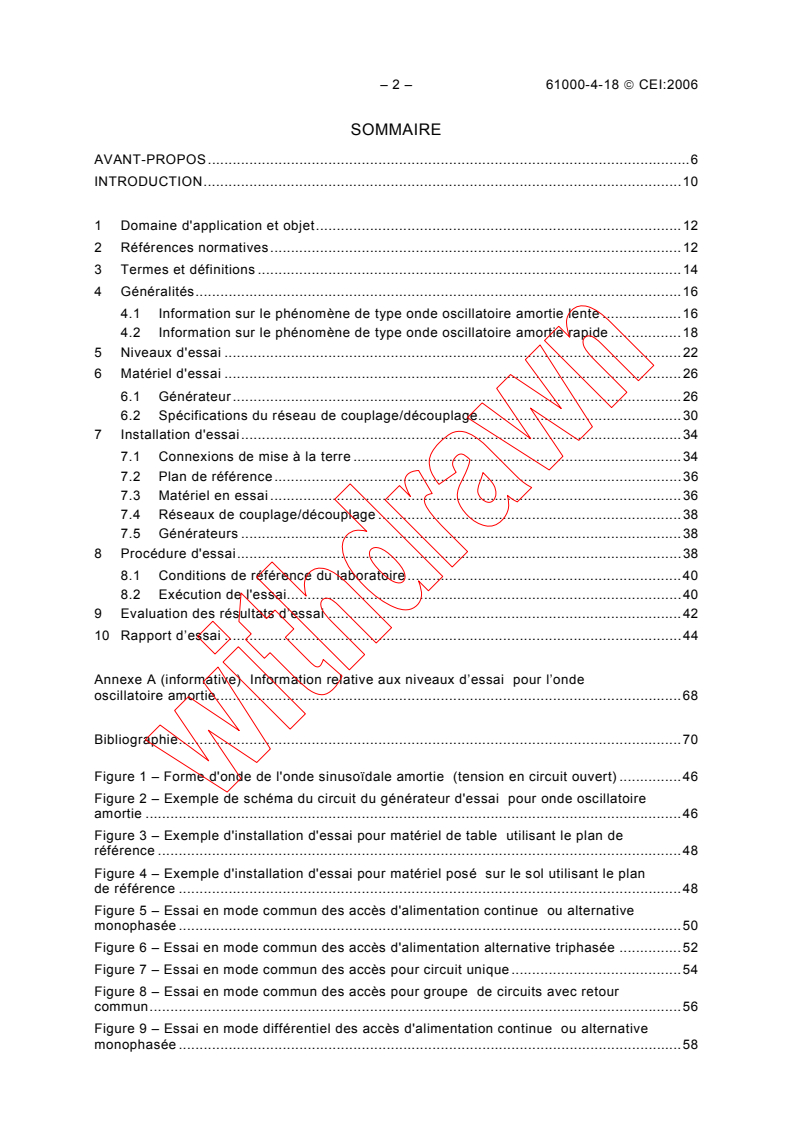
IEC 61000-4-18:2006 - Electromagnetic compatibility (EMC) - Part 4-18: Testing and measurement techniques - Damped oscillatory wave immunity test Released:11/9/2006
IEC 61000-4-18:2006+AMD1:2010 CSV - Electromagnetic compatibility (EMC) - Part 4-18: Testing and measurement techniques - Damped oscillatory wave immunity test Released:3/30/2011
Overview
IEC 61000-4-18:2006 is an international standard developed by the International Electrotechnical Commission (IEC) focusing on Electromagnetic Compatibility (EMC)-specifically, the damped oscillatory wave immunity test. This standard establishes the immunity requirements and detailed test methods for electrical and electronic equipment to withstand repetitive damped oscillatory waves. These waves primarily affect power, control, and signal cables in high voltage (HV), medium voltage (MV), gas insulated substations (GIS), and potentially air insulated substations (AIS), as well as installations exposed to high-altitude electromagnetic pulse (HEMP) phenomena.
The primary goal of IEC 61000-4-18 is to provide a common laboratory reference for testing the immunity of equipment used across residential, commercial, industrial, power stations, and substations settings. It defines test waveforms, test levels, apparatus, setup configurations, and procedures necessary for a consistent immunity evaluation.
Key Topics
Scope and Application: The standard applies to equipment exposed to damped oscillatory waves in operational conditions, focusing on HV/MV substations and GIS installations.
Test Waveforms: Defines specific voltage and current waveforms representing damped oscillatory waves, including slow and fast oscillations corresponding to relevant frequency ranges.
Test Levels: Specifies ranges of test levels applicable for slow damped oscillatory waves (such as 100 kHz or 1 MHz) and fast damped oscillatory waves (3 MHz, 10 MHz, or 30 MHz).
Test Equipment: Details requirements for the test generator and coupling/decoupling networks necessary to simulate damped oscillatory phenomena in the lab environment.
Test Setup: Covers grounding, earthing connections, test environments (ground reference plane), and the positioning of equipment under test (EUT).
Test Procedure: Outlines the execution steps, laboratory reference conditions, and techniques for applying the test signals to various input/output ports.
Evaluation and Reporting: Provides methodology for assessing the immune performance of equipment and guidelines for compiling comprehensive test reports.
Applications
IEC 61000-4-18 is essential for industries and professionals concerned with the robustness and reliability of electrical and electronic systems exposed to electromagnetic disturbances in critical infrastructure environments such as:
Power Generation and Distribution: Ensuring equipment in power stations and HV/MV substations performs reliably despite exposure to damped oscillatory disturbances.
Gas and Air Insulated Substations: Validating control and signal systems in GIS and AIS facilities to resist oscillatory pulses potentially generated by switching actions or external electromagnetic events.
Industrial Automation and Control Equipment: Verifying immunity of control systems connected through signal and power cables vulnerable to oscillatory interference.
Residential and Commercial Electronics: Applying standard test methods to equipment intended for construction environments near substation installations.
HEMP Protection: Assessing equipment resilience in environments exposed to High-altitude Electromagnetic Pulse (HEMP) phenomena.
By following IEC 61000-4-18 test guidelines, manufacturers can enhance product design to comply with international EMC requirements, reduce vulnerability to power quality disturbances, and guarantee stable operation in complex electromagnetic environments.
Related Standards
IEC 61000-4-18 is part of the broader IEC 61000 series structured to cover various EMC aspects:
- IEC 61000-4-2: Electrostatic discharge immunity test
- IEC 61000-4-3: Radiated radio-frequency electromagnetic field immunity test
- IEC 61000-4-4: Electrical fast transient/burst immunity test
- IEC 61000-4-5: Surge immunity test
- IEC 61000-4-6: Immunity to conducted disturbances induced by radio-frequency fields
For comprehensive EMC compliance, these standards should be used in conjunction with IEC 61000-4-18, ensuring electrical and electronic equipment meets immunity criteria against a wide spectrum of electromagnetic disturbances.
Keywords: IEC 61000-4-18, electromagnetic compatibility, EMC, damped oscillatory wave, immunity test, HV/MV substations, gas insulated substations, HEMP phenomena, test procedures, electrical equipment immunity, power distribution, IEC standards.
Relations
- Effective Date
- 05-Sep-2023
- Effective Date
- 05-Sep-2023
- Effective Date
- 05-Sep-2023
- Effective Date
- 05-Sep-2023
Buy Documents
IEC 61000-4-18:2006 - Electromagnetic compatibility (EMC) - Part 4-18: Testing and measurement techniques - Damped oscillatory wave immunity test Released:11/9/2006
IEC 61000-4-18:2006+AMD1:2010 CSV - Electromagnetic compatibility (EMC) - Part 4-18: Testing and measurement techniques - Damped oscillatory wave immunity test Released:3/30/2011
Get Certified
Connect with accredited certification bodies for this standard

ANCE
Mexican certification and testing association.

Intertek Slovenia
Intertek testing, inspection, and certification services in Slovenia.

LNE (Laboratoire National de Métrologie et d'Essais)
French national laboratory for metrology and testing.
Sponsored listings
Frequently Asked Questions
IEC 61000-4-18:2006 is a standard published by the International Electrotechnical Commission (IEC). Its full title is "Electromagnetic compatibility (EMC) - Part 4-18: Testing and measurement techniques - Damped oscillatory wave immunity test". This standard covers: This part of IEC 61000-4 relates to the immunity requirements and test methods for electrical and electronic equipment, under operational conditions, with regard to: a) repetitive damped oscillatory waves occurring mainly in power, control and signal cables installed in high voltage and medium voltage (HV/MV) substations; b) repetitive damped oscillatory waves occurring mainly in power, control and signal cables installed in gas insulated substations (GIS) and in some cases also air insulated substations (AIS) or in any installation due to HEMP phenomena. The object of this basic standard is to establish the immunity requirements and a common reference for evaluating in a laboratory the performance of electrical and electronic equipment intended for residential, commercial and industrial applications, as well as of equipment intended for power stations and substations, as applicable. The purpose of this standard is to define: - test voltage and current waveforms; - ranges of test levels; - test equipment; - test setup; - test procedure. The object of this standard is to establish a common reference for evaluating the immunity of electrical and electronic equipment when subjected to damped oscillatory waves. The test method documented in this part of IEC 61000 describes a consistent method to assess the immunity of an equipment or system against a defined phenomenon. It has the status of a basic EMC publication in accordance with IEC Guide 107.
This part of IEC 61000-4 relates to the immunity requirements and test methods for electrical and electronic equipment, under operational conditions, with regard to: a) repetitive damped oscillatory waves occurring mainly in power, control and signal cables installed in high voltage and medium voltage (HV/MV) substations; b) repetitive damped oscillatory waves occurring mainly in power, control and signal cables installed in gas insulated substations (GIS) and in some cases also air insulated substations (AIS) or in any installation due to HEMP phenomena. The object of this basic standard is to establish the immunity requirements and a common reference for evaluating in a laboratory the performance of electrical and electronic equipment intended for residential, commercial and industrial applications, as well as of equipment intended for power stations and substations, as applicable. The purpose of this standard is to define: - test voltage and current waveforms; - ranges of test levels; - test equipment; - test setup; - test procedure. The object of this standard is to establish a common reference for evaluating the immunity of electrical and electronic equipment when subjected to damped oscillatory waves. The test method documented in this part of IEC 61000 describes a consistent method to assess the immunity of an equipment or system against a defined phenomenon. It has the status of a basic EMC publication in accordance with IEC Guide 107.
IEC 61000-4-18:2006 is classified under the following ICS (International Classification for Standards) categories: 33.100.20 - Immunity. The ICS classification helps identify the subject area and facilitates finding related standards.
IEC 61000-4-18:2006 has the following relationships with other standards: It is inter standard links to IEC 61000-4-12:1995, IEC 61000-4-12:1995/AMD1:2000, IEC 61000-4-18:2006/AMD1:2010, IEC 61000-4-18:2019. Understanding these relationships helps ensure you are using the most current and applicable version of the standard.
IEC 61000-4-18:2006 is available in PDF format for immediate download after purchase. The document can be added to your cart and obtained through the secure checkout process. Digital delivery ensures instant access to the complete standard document.
Standards Content (Sample)
NORME CEI
INTERNATIONALE
IEC
61000-4-18
INTERNATIONAL
Première édition
STANDARD
First edition
2006-11
PUBLICATION FONDAMENTALE EN CEM
BASIC EMC PUBLICATION
Compatibilité électromagnétique (CEM) –
Partie 4-18:
Techniques d’essai et de mesure –
Essai d’immunité à l’onde oscillatoire amortie
Electromagnetic compatibility (EMC) –
Part 4-18:
Testing and measurement techniques –
Damped oscillatory wave immunity test
Numéro de référence
Reference number
CEI/IEC 61000-4-18:2006
Numérotation des publications Publication numbering
Depuis le 1er janvier 1997, les publications de la CEI As from 1 January 1997 all IEC publications are
sont numérotées à partir de 60000. Ainsi, la CEI 34-1 issued with a designation in the 60000 series. For
devient la CEI 60034-1. example, IEC 34-1 is now referred to as IEC 60034-1.
Editions consolidées Consolidated editions
Les versions consolidées de certaines publications de la The IEC is now publishing consolidated versions of its
CEI incorporant les amendements sont disponibles. Par publications. For example, edition numbers 1.0, 1.1
exemple, les numéros d’édition 1.0, 1.1 et 1.2 indiquent and 1.2 refer, respectively, to the base publication,
respectivement la publication de base, la publication de the base publication incorporating amendment 1 and
base incorporant l’amendement 1, et la publication de the base publication incorporating amendments 1
base incorporant les amendements 1 et 2. and 2.
Informations supplémentaires Further information on IEC publications
sur les publications de la CEI
Le contenu technique des publications de la CEI est The technical content of IEC publications is kept
constamment revu par la CEI afin qu'il reflète l'état under constant review by the IEC, thus ensuring that
actuel de la technique. Des renseignements relatifs à the content reflects current technology. Information
cette publication, y compris sa validité, sont dispo- relating to this publication, including its validity, is
nibles dans le Catalogue des publications de la CEI available in the IEC Catalogue of publications
(voir ci-dessous) en plus des nouvelles éditions, (see below) in addition to new editions, amendments
amendements et corrigenda. Des informations sur les and corrigenda. Information on the subjects under
sujets à l’étude et l’avancement des travaux entrepris consideration and work in progress undertaken by the
par le comité d’études qui a élaboré cette publication, technical committee which has prepared this
ainsi que la liste des publications parues, sont publication, as well as the list of publications issued,
également disponibles par l’intermédiaire de: is also available from the following:
• Site web de la CEI (www.iec.ch) • IEC Web Site (www.iec.ch)
• Catalogue des publications de la CEI • Catalogue of IEC publications
Le catalogue en ligne sur le site web de la CEI The on-line catalogue on the IEC web site
(www.iec.ch/searchpub) vous permet de faire des (www.iec.ch/searchpub) enables you to search by a
recherches en utilisant de nombreux critères, variety of criteria including text searches,
comprenant des recherches textuelles, par comité technical committees and date of publication. On-
d’études ou date de publication. Des informations en line information is also available on recently
ligne sont également disponibles sur les nouvelles issued publications, withdrawn and replaced
publications, les publications remplacées ou retirées, publications, as well as corrigenda.
ainsi que sur les corrigenda.
• IEC Just Published • IEC Just Published
Ce résumé des dernières publications parues This summary of recently issued publications
(www.iec.ch/online_news/justpub) est aussi dispo- (www.iec.ch/online_news/justpub) is also available
nible par courrier électronique. Veuillez prendre by email. Please contact the Customer Service
contact avec le Service client (voir ci-dessous) Centre (see below) for further information.
pour plus d’informations.
• Service clients • Customer Service Centre
Si vous avez des questions au sujet de cette If you have any questions regarding this
publication ou avez besoin de renseignements publication or need further assistance, please
supplémentaires, prenez contact avec le Service contact the Customer Service Centre:
clients:
Email: custserv@iec.ch Email: custserv@iec.ch
Tél: +41 22 919 02 11 Tel: +41 22 919 02 11
Fax: +41 22 919 03 00 Fax: +41 22 919 03 00
.
NORME CEI
INTERNATIONALE
IEC
61000-4-18
INTERNATIONAL
Première édition
STANDARD
First edition
2006-11
PUBLICATION FONDAMENTALE EN CEM
BASIC EMC PUBLICATION
Compatibilité électromagnétique (CEM) –
Partie 4-18:
Techniques d’essai et de mesure –
Essai d’immunité à l’onde oscillatoire amortie
Electromagnetic compatibility (EMC) –
Part 4-18:
Testing and measurement techniques –
Damped oscillatory wave immunity test
© IEC 2006 Droits de reproduction réservés ⎯ Copyright - all rights reserved
Aucune partie de cette publication ne peut être reproduite ni No part of this publication may be reproduced or utilized in any
utilisée sous quelque forme que ce soit et par aucun procédé, form or by any means, electronic or mechanical, including
électronique ou mécanique, y compris la photocopie et les photocopying and microfilm, without permission in writing from
microfilms, sans l'accord écrit de l'éditeur. the publisher.
International Electrotechnical Commission, 3, rue de Varembé, PO Box 131, CH-1211 Geneva 20, Switzerland
Telephone: +41 22 919 02 11 Telefax: +41 22 919 03 00 E-mail: inmail@iec.ch Web: www.iec.ch
CODE PRIX
W
PRICE CODE
Commission Electrotechnique Internationale
International Electrotechnical Commission
МеждународнаяЭлектротехническаяКомиссия
Pour prix, voir catalogue en vigueur
For price, see current catalogue
– 2 – 61000-4-18 © CEI:2006
SOMMAIRE
AVANT-PROPOS.6
INTRODUCTION.10
1 Domaine d'application et objet.12
2 Références normatives.12
3 Termes et définitions .14
4 Généralités.16
4.1 Information sur le phénomène de type onde oscillatoire amortie lente .16
4.2 Information sur le phénomène de type onde oscillatoire amortie rapide .18
5 Niveaux d'essai .22
6 Matériel d'essai .26
6.1 Générateur.26
6.2 Spécifications du réseau de couplage/découplage.30
7 Installation d'essai.34
7.1 Connexions de mise à la terre .34
7.2 Plan de référence.36
7.3 Matériel en essai .36
7.4 Réseaux de couplage/découplage .38
7.5 Générateurs .38
8 Procédure d'essai.38
8.1 Conditions de référence du laboratoire .40
8.2 Exécution de l'essai.40
9 Evaluation des résultats d’essai .42
10 Rapport d’essai .44
Annexe A (informative) Information relative aux niveaux d’essai pour l’onde
oscillatoire amortie.68
Bibliographie.70
Figure 1 – Forme d'onde de l'onde sinusoïdale amortie (tension en circuit ouvert) .46
Figure 2 – Exemple de schéma du circuit du générateur d'essai pour onde oscillatoire
amortie .46
Figure 3 – Exemple d'installation d'essai pour matériel de table utilisant le plan de
référence .48
Figure 4 – Exemple d'installation d'essai pour matériel posé sur le sol utilisant le plan
de référence .48
Figure 5 – Essai en mode commun des accès d'alimentation continue ou alternative
monophasée .50
Figure 6 – Essai en mode commun des accès d'alimentation alternative triphasée .52
Figure 7 – Essai en mode commun des accès pour circuit unique.54
Figure 8 – Essai en mode commun des accès pour groupe de circuits avec retour
commun.56
Figure 9 – Essai en mode différentiel des accès d'alimentation continue ou alternative
monophasée .58
61000-4-18 © IEC:2006 – 3 –
CONTENTS
FOREWORD.7
INTRODUCTION.11
1 Scope and object.13
2 Normative references .13
3 Terms and definitions .15
4 General .17
4.1 Information on the slow damped oscillatory wave phenomenon .17
4.2 Information on the fast damped oscillatory wave phenomenon .19
5 Test levels.23
6 Test equipment.27
6.1 Generator.27
6.2 Specifications of the coupling/decoupling network .31
7 Test setup .35
7.1 Earthing connections.35
7.2 Ground reference plane.37
7.3 Equipment under test .37
7.4 Coupling/decoupling networks .39
7.5 Generators .39
8 Test procedure .39
8.1 Laboratory reference conditions .41
8.2 Execution of the test.41
9 Evaluation of test results .43
10 Test report.45
Annex A (informative) Information on test levels for the damped oscillatory wave .69
Bibliography.71
Figure 1 – Waveform of the damped oscillatory wave (open circuit voltage) .47
Figure 2 – Example of schematic circuit of the test generator for the damped oscillatory
wave.47
Figure 3 – Example of test setup for table-top equipment using the ground reference plane .49
Figure 4 – Example of test setup for floor-standing equipment using the ground
reference plane.49
Figure 5 – AC/DC power supply port, single phase, line-to-ground tests .51
Figure 6 – AC power supply port, three phases, line-to-ground test .53
Figure 7 – Input/output port, single circuit, line-to-ground test.55
Figure 8 – Input/output port, group of circuits with common return, line-to-ground test .57
Figure 9 – AC/DC power supply port, single phase, line-to-line test .59
– 4 – 61000-4-18 © CEI:2006
Figure 10 – Essai en mode différentiel des accès d'alimentation alternative triphasée .60
Figure 11 – Essai en mode différentiel des accès pour circuit unique.62
Figure 12 – Essai en mode différentiel des accès pour groupe de circuits avec retour
commun.64
Figure 13 – Essai des accès communication pour signaux rapides (sortie générateur à
la terre).66
Tableau 1 – Niveaux d'essai à l'onde oscillatoire amortie lente (100 kHz ou 1 MHz) .24
Tableau 2 – Niveaux d'essai à l'onde oscillatoire amortie rapide (3 MHz, 10 MHz ou
30 MHz).24
61000-4-18 © IEC:2006 – 5 –
Figure 10 – AC power supply port, three phases, line-to-line test.61
Figure 11 – Input/output port, single circuit, line-to-line test .63
Figure 12 – Input/output port, group of circuits with common return, line-to-line test .65
Figure 13 – Test of a system with communication ports with fast operating signals
(generator output earthed) .67
Table 1 – Test levels for the slow damped oscillatory wave (100 kHz or 1 MHz) .25
Table 2 – Test levels for the fast damped oscillatory wave (3 MHz, 10 MHz or 30 MHz).25
– 6 – 61000-4-18 © CEI:2006
COMMISSION ÉLECTROTECHNIQUE INTERNATIONALE
____________
COMPATIBILITÉ ÉLECTROMAGNÉTIQUE (CEM) –
Partie 4-18: Techniques d'essai et de mesure –
Essai d'immunité à l’onde oscillatoire amortie
AVANT-PROPOS
1) La Commission Electrotechnique Internationale (CEI) est une organisation mondiale de normalisation
composée de l'ensemble des comités électrotechniques nationaux (Comités nationaux de la CEI). La CEI a
pour objet de favoriser la coopération internationale pour toutes les questions de normalisation dans les
domaines de l'électricité et de l'électronique. A cet effet, la CEI – entre autres activités – publie des Normes
internationales, des Spécifications techniques, des Rapports techniques, des Spécifications accessibles au
public (PAS) et des Guides (ci-après dénommés "Publication(s) de la CEI"). Leur élaboration est confiée à des
comités d'études, aux travaux desquels tout Comité national intéressé par le sujet traité peut participer. Les
organisations internationales, gouvernementales et non gouvernementales, en liaison avec la CEI, participent
également aux travaux. La CEI collabore étroitement avec l'Organisation Internationale de Normalisation (ISO),
selon des conditions fixées par accord entre les deux organisations.
2) Les décisions ou accords officiels de la CEI concernant les questions techniques représentent, dans la mesure
du possible, un accord international sur les sujets étudiés, étant donné que les Comités nationaux de la CEI
intéressés sont représentés dans chaque comité d’études.
3) Les Publications de la CEI se présentent sous la forme de recommandations internationales et sont agréées
comme telles par les Comités nationaux de la CEI. Tous les efforts raisonnables sont entrepris afin que la CEI
s'assure de l'exactitude du contenu technique de ses publications; la CEI ne peut pas être tenue responsable
de l'éventuelle mauvaise utilisation ou interprétation qui en est faite par un quelconque utilisateur final.
4) Dans le but d'encourager l'uniformité internationale, les Comités nationaux de la CEI s'engagent, dans toute la
mesure possible, à appliquer de façon transparente les Publications de la CEI dans leurs publications
nationales et régionales. Toutes divergences entre toutes Publications de la CEI et toutes publications
nationales ou régionales correspondantes doivent être indiquées en termes clairs dans ces dernières.
5) La CEI n’a prévu aucune procédure de marquage valant indication d’approbation et n'engage pas sa
responsabilité pour les équipements déclarés conformes à une de ses Publications.
6) Tous les utilisateurs doivent s'assurer qu'ils sont en possession de la dernière édition de cette publication.
7) Aucune responsabilité ne doit être imputée à la CEI, à ses administrateurs, employés, auxiliaires ou
mandataires, y compris ses experts particuliers et les membres de ses comités d'études et des Comités
nationaux de la CEI, pour tout préjudice causé en cas de dommages corporels et matériels, ou de tout autre
dommage de quelque nature que ce soit, directe ou indirecte, ou pour supporter les coûts (y compris les frais
de justice) et les dépenses découlant de la publication ou de l'utilisation de cette Publication de la CEI ou de
toute autre Publication de la CEI, ou au crédit qui lui est accordé.
8) L'attention est attirée sur les références normatives citées dans cette publication. L'utilisation de publications
référencées est obligatoire pour une application correcte de la présente publication.
9) L’attention est attirée sur le fait que certains des éléments de la présente Publication de la CEI peuvent faire
l’objet de droits de propriété intellectuelle ou de droits analogues. La CEI ne saurait être tenue pour
responsable de ne pas avoir identifié de tels droits de propriété et de ne pas avoir signalé leur existence.
La Norme internationale CEI 61000-4-18 a été établie par le sous-comité 77B: Phénomènes
haute fréquence, du comité d'études 77 de la CEI: Compatibilité électromagnétique.
Elle constitue la Partie 4-18 de la norme CEI 61000. Elle a le statut de publication fondamen-
tale en CEM conformément au Guide 107 de la CEI, Compatibilité électromagnétique – Guide
pour la rédaction des publications sur la compatibilité électromagnétique.
Cette première édition annule et remplace la première édition de la norme CEI 61000-4-12,
parue en 1995 et son Amendement 1 (2000) quant à son contenu relatif aux ondes
oscillatoires amorties, et constitue une révision technique en étendant la gamme des
fréquences.
61000-4-18 © IEC:2006 – 7 –
INTERNATIONAL ELECTROTECHNICAL COMMISSION
___________
ELECTROMAGNETIC COMPATIBILITY (EMC) –
Part 4-18: Testing and measurement techniques –
Damped oscillatory wave immunity test
FOREWORD
1) The International Electrotechnical Commission (IEC) is a worldwide organization for standardization comprising
all national electrotechnical committees (IEC National Committees). The object of IEC is to promote
international co-operation on all questions concerning standardization in the electrical and electronic fields. To
this end and in addition to other activities, IEC publishes International Standards, Technical Specifications,
Technical Reports, Publicly Available Specifications (PAS) and Guides (hereafter referred to as “IEC
Publication(s)”). Their preparation is entrusted to technical committees; any IEC National Committee interested
in the subject dealt with may participate in this preparatory work. International, governmental and non-
governmental organizations liaising with the IEC also participate in this preparation. IEC collaborates closely
with the International Organization for Standardization (ISO) in accordance with conditions determined by
agreement between the two organizations.
2) The formal decisions or agreements of IEC on technical matters express, as nearly as possible, an international
consensus of opinion on the relevant subjects since each technical committee has representation from all
interested IEC National Committees.
3) IEC Publications have the form of recommendations for international use and are accepted by IEC National
Committees in that sense. While all reasonable efforts are made to ensure that the technical content of IEC
Publications is accurate, IEC cannot be held responsible for the way in which they are used or for any
misinterpretation by any end user.
4) In order to promote international uniformity, IEC National Committees undertake to apply IEC Publications
transparently to the maximum extent possible in their national and regional publications. Any divergence
between any IEC Publication and the corresponding national or regional publication shall be clearly indicated in
the latter.
5) IEC provides no marking procedure to indicate its approval and cannot be rendered responsible for any
equipment declared to be in conformity with an IEC Publication.
6) All users should ensure that they have the latest edition of this publication.
7) No liability shall attach to IEC or its directors, employees, servants or agents including individual experts and
members of its technical committees and IEC National Committees for any personal injury, property damage or
other damage of any nature whatsoever, whether direct or indirect, or for costs (including legal fees) and
expenses arising out of the publication, use of, or reliance upon, this IEC Publication or any other IEC
Publications.
8) Attention is drawn to the Normative references cited in this publication. Use of the referenced publications is
indispensable for the correct application of this publication.
9) Attention is drawn to the possibility that some of the elements of this IEC Publication may be the subject of
patent rights. IEC shall not be held responsible for identifying any or all such patent rights.
International Standard IEC 61000-4-18 has been prepared by subcommittee 77B: High
frequency phenomena, of IEC technical Committee 77: Electromagnetic compatibility.
It forms Part 4-18 of IEC 61000. It has the status of a basic EMC publication in accordance
with IEC Guide 107, Electromagnetic compatibility – Guide to the drafting of electromagnetic
compatibility publications.
This first edition of the standard cancels and replaces the content regarding damped
oscillatory waves in the first edition of IEC 61000-4-12, published in 1995, and its Amendment
1 (2000), and constitutes a technical revision by extending the frequency range.
– 8 – 61000-4-18 © CEI:2006
Le texte de cette norme est issu des documents suivants:
FDIS Rapport de vote
77B/517/FDIS 77B/522/RVD
Le rapport de vote indiqué dans le tableau ci-dessus donne toute information sur le vote ayant
abouti à l'approbation de cette norme.
Cette publication a été rédigée selon les Directives ISO/CEI, Partie 2.
Le comité a décidé que le contenu de cette publication ne sera pas modifié avant la date de
maintenance indiquée sur le site web de la CEI sous «http://webstore.iec.ch» dans les
données relatives à la publication recherchée. A cette date, la publication sera
• reconduite;
• supprimée;
• remplacée par une édition révisée, ou
• amendée.
61000-4-18 © IEC:2006 – 9 –
The text of this standard is based on the following documents:
FDIS Report on voting
77B/517/FDIS 77B/522/RVD
Full information on the voting for the approval of this standard can be found in the report on
voting indicated in the above table.
This publication has been drafted in accordance with the ISO/IEC Directives, Part 2.
The committee has decided that the contents of this publication will remain unchanged until
the maintenance result date indicated on the IEC web site under "http://webstore.iec.ch" in
the data related to the specific publication. At this date, the publication will be
• reconfirmed;
• withdrawn;
• replaced by a revised edition, or
• amended.
– 10 – 61000-4-18 © CEI:2006
INTRODUCTION
La présente norme fait partie de la série des normes 61000 de la CEI, selon la répartition
suivante:
Partie 1: Généralités
Considérations générales (introduction, principes fondamentaux)
Définitions, terminologie
Partie 2: Environnement
Description de l'environnement
Classification de l'environnement
Niveaux de compatibilité
Partie 3: Limites
Limites d'émissions
Limites d'immunité (dans la mesure où elles ne tombent pas sous la responsabilité des
comités de produits)
Partie 4: Techniques d'essai et de mesure
Techniques de mesure
Techniques d'essais
Partie 5: Directives d'installation et d'atténuation
Guide d'installation
Méthodes et dispositifs d'atténuation
Partie 6: Normes génériques
Partie 9: Divers
Chaque partie est à son tour subdivisée en plusieurs parties, publiées soit comme normes
internationales soit comme spécifications techniques ou rapports techniques, dont certaines ont
déjà été publiées comme sections. D’autres seront publiées avec le numéro de partie, suivi d’un
tiret et complété d’un second numéro identifiant la subdivision (exemple: 61000-6-1).
La présente partie est une norme internationale qui donne les exigences d’immunité et les
procédures d’essai relatives aux ondes oscillatoires amorties.
61000-4-18 © IEC:2006 – 11 –
INTRODUCTION
This standard is part of the IEC 61000 series, according to the following structure:
Part 1: General
General considerations (introduction, fundamental principles)
Definitions, terminology
Part 2: Environment
Description of the environment
Classification of the environment
Compatibility levels
Part 3: Limits
Emission limits
Immunity limits (in so far as they do not fall under the responsibility of the product
committees)
Part 4: Testing and measurement techniques
Testing techniques
Part 5: Installation and mitigation guidelines
Installation guidelines
Mitigation methods and devices
Part 6: Generic standards
Part 9: Miscellaneous
Each part is further subdivided into several parts, published either as international standards
or as technical specifications or technical reports, some of which have already been published
as sections. Others will be published with the part number followed by a dash and a second
number identifying the subdivision (example: 61000-6-1).
This part is an international standard which gives immunity requirements and test procedures
related to damped oscillatory waves.
– 12 – 61000-4-18 © CEI:2006
COMPATIBILITÉ ÉLECTROMAGNÉTIQUE (CEM) –
Partie 4-18: Techniques d'essai et de mesure –
Essai d'immunité à l'onde oscillatoire amortie
1 Domaine d'application et objet
La présente partie de la CEI 61000-4 traite des exigences en matière d'immunité et des
méthodes d'essai des matériels électriques et électroniques dans leurs conditions
d'exploitation, vis-à-vis:
a) des oscillations transitoires amorties répétitives se manifestant principalement sur les
câbles d’alimentation, de commande et de signal installés dans les postes à haute et à
moyenne tension (HT/MT);
b) des ondes oscillatoires amorties répétitives se produisant principalement sur les câbles
d'alimentation, de commande et de signal implantés dans les postes métalliques sous
enveloppes à isolation gazeuse (GIS) et dans certains cas également dans des postes à
isolation par air (AIS) ou toute installation du fait des phénomènes IEM-HA.
L'objet de cette norme fondamentale est d'établir les exigences d'immunité et de constituer
une référence commune pour l'évaluation en laboratoire des performances d'équipements
électriques et électroniques destinés aux applications résidentielles, commerciales et
industrielles, ainsi que d'équipements destinés aux centrales électriques et aux postes, le cas
échéant.
NOTE Comme décrit dans le Guide 107 de la CEI, c’est une publication fondamentale en CEM pour utilisation par
les comités de produits de la CEI. Comme indiqué également dans le Guide 107, les comités de produits de la CEI
sont responsables de déterminer s’il convient d’appliquer ou non cette norme d’essai d’immunité et, si c’est le cas,
il leur incombe de déterminer les niveaux d’essai et les critères de performance appropriés. Le comité d’études 77
et ses sous-comités sont prêts à coopérer avec les comités de produits à l’évaluation de la valeur des essais
d’immunité particuliers pour leurs produits.
La présente norme a pour objet de définir les paramètres suivants:
– tension d'essai et formes d'ondes de courant;
– gammes de niveaux d'essais;
– matériel d'essai;
– installation d'essai;
– procédure d'essai.
Cette norme a pour objet d'établir une référence commune dans le but d'évaluer l’immunité
des matériels électriques et électroniques, quand ils sont soumis aux ondes oscillatoires
amorties. La méthode d'essai documentée dans cette partie de la CEI 61000 décrit une
méthode logique en vue d'évaluer l'immunité d'un équipement ou d'un système vis-à-vis d'un
phénomène donné.
2 Références normatives
Les documents de référence suivants sont indispensables pour l'application du présent
document. Pour les références datées, seule l'édition citée s'applique. Pour les références
non datées, la dernière édition du document de référence s'applique (y compris les éventuels
amendements).
61000-4-18 © IEC:2006 – 13 –
ELECTROMAGNETIC COMPATIBILITY (EMC) –
Part 4-18: Testing and measurement techniques –
Damped oscillatory wave immunity test
1 Scope and object
This part of IEC 61000-4 relates to the immunity requirements and test methods for electrical
and electronic equipment, under operational conditions, with regard to:
a) repetitive damped oscillatory waves occurring mainly in power, control and signal cables
installed in high voltage and medium voltage (HV/MV) substations;
b) repetitive damped oscillatory waves occurring mainly in power, control and signal cables
installed in gas insulated substations (GIS) and in some cases also air insulated
substations (AIS) or in any installation due to HEMP phenomena.
The object of this basic standard is to establish the immunity requirements and a common
reference for evaluating in a laboratory the performance of electrical and electronic equipment
intended for residential, commercial and industrial applications, as well as of equipment
intended for power stations and substations, as applicable.
NOTE As described in IEC guide 107, this is a basic EMC publication for use by product committees of the IEC.
As also stated in Guide 107, the IEC product committees are responsible for determining whether this immunity
test standard should be applied or not, and if applied, they are responsible for determining the appropriate test
levels and performance criteria. TC 77 and its sub-committees are prepared to co-operate with product committees
in the evaluation of the value of particular immunity tests for their products.
The purpose of this standard is to define:
– test voltage and current waveforms;
– ranges of test levels;
– test equipment;
– test setup;
– test procedure.
The object of this standard is to establish a common reference for evaluating the immunity of
electrical and electronic equipment when subjected to damped oscillatory waves. The test
method documented in this part of IEC 61000 describes a consistent method to assess the
immunity of an equipment or system against a defined phenomenon.
2 Normative references
The following referenced documents are indispensable for the application of this document.
For dated references, only the edition cited applies. For undated references, the latest edition
of the referenced document (including any amendments) applies.
– 14 – 61000-4-18 © CEI:2006
CEI 60050(161): Vocabulaire Electrotechnique International (VEI) – Chapitre 161:
Compatibilité électromagnétique
CEI 61000-4-4: Compatibilité électromagnétique (CEM) – Partie 4-4: Techniques d'essai et de
mesure – Essais d’immunité aux transitoires électriques rapides en salves
CEI 61000-6-6: Compatibilité électromagnétique (CEM) – Partie 6-6: Normes génériques –
Immunité contre l’IEMN-HA pour les appareils situés à l’intérieur des bâtiments
3 Termes et définitions
Pour les besoins du présent document, les termes et définitions donnés dans la CEI 60050-
161, dont certains sont repétés ci-après, et les termes etdéfinitions suivants s'appliquent.
NOTE Ils sont applicables aux champ restreint des transitoires oscillatoires.
3.1
poste à isolation par air
AIS
poste ne comportant que de l’appareillage à isolation par air
3.2
salve
suite d'un nombre fini d'impulsions distinctes ou oscillation de durée limitée
[VEI 161-02-07]
3.3
étalonnage
ensemble des opérations établissant, en référence à des étalons, la relation qui existe, dans
les conditions spécifiées, entre une indication et un résultat de mesure
NOTE 1 Cette définition est conçue dans l'approche « incertitude ».
NOTE 2 La relation entre les indications et les résultats de mesures peut être donnée, en principe, dans un
diagramme d'étalonnage.
[VEI 311-01-09]
3.4
couplage
interaction entre circuits avec transfert d'énergie d'un circuit dans un autre
3.5
réseau de couplage
circuit électrique destiné à transférer de l'énergie d'un circuit à un autre
3.6
réseau de découplage
circuit électrique destiné à empêcher la tension d'essai appliquée à l'EST de brouiller les
dispositifs, équipements ou systèmes non soumis à des essais
3.7
poste (sous enveloppe métallique) à isolation gazeuse
GIS
poste ne comportant que de l’appareillage sous enveloppe métallique à isolation gazeuse
[VEI 605-02-14]
61000-4-18 © IEC:2006 – 15 –
lEC 60050(161): International Electrotechnical Vocabulary (IEV) – Chapter 161: Electro-
magnetic compatibility
IEC 61000-4-4: Electromagnetic compatibility (EMC) – Part 4-4: Testing and measurement
techniques – Electrical fast transient/burst immunity test
IEC 61000-6-6: Electromagnetic compatibility (EMC) – Part 6-6: Generic standards – HEMP
immunity for indoor equipment
3 Terms and definitions
For the purposes of this document, the terms and definitions contained in lEC 60050-161,
some of which are repeated here for convenience, and the following terms and definitions
apply.
NOTE These terms are applicable to the restricted field of oscillatory transients.
3.1
air insulated substation
AIS
substation which is made up with only air insulated switchgear
3.2
burst
sequence of a limited number of distinct pulses or an oscillation of limited duration
[IEV 161-02-07]
3.3
calibration
set of operations which establishes, by reference to standards, the relationship which exists
under specified conditions, between an indication and a result of a measurement
NOTE 1 This term is based on the "uncertainty" approach.
NOTE 2 The relationship between the indications and the results of measurement can be expressed, in principle,
by a calibration diagram.
[IEV 311-01-09]
3.4
coupling
interaction between circuits, transferring energy from one circuit to another
3.5
coupling network
electrical circuit for the purpose of transferring energy from one circuit to another
3.6
decoupling network
electrical circuit for the purpose of preventing test voltages applied to the EUT (equipment
under test) from affecting other devices, equipment, or systems which are not under test
3.7
gas insulated (metal-enclosed) substation
GIS
substation which is made up with only gas insulated metal enclosed switchgear
[IEV 605-02-14]
– 16 – 61000-4-18 © CEI:2006
3.8
impulsion électromagnétique à haute altitude
impulsion électromagnétique produite par une explosion nucléaire en dehors de l’atmosphère
terrestre
NOTE Typiquement au-delà d’une altitude de 30 km
3.9
immunité (à une perturbation)
aptitude d'un dispositif, d'un appareil ou d'un système à fonctionner sans dégradation en
présence d'une perturbation électromagnétique
[VEI 161-01-20]
3.10
accès
interface de l'EST avec l'environnement électromagnétique extérieur
3.11
temps de montée
temps entre les instants auxquels la valeur instantanée d'une impulsion atteint pour la
première fois 10 %, puis 90 % de sa hauteur
[VEI 161-02-05, modifié]
3.12
transitoire (adjectif et nom)
se dit d'un phénomène qui varie entre deux régimes établis consécutifs dans un intervalle de
temps relativement court à l'échelle des temps considérée
[VEI 161-02-01]
3.13
vérification
ensemble des opérations utilisées pour vérifier le système d’essai (par exemple le générateur
d'essai et les câbles d'interconnexion) et pour démontrer que le système d’essai fonctionne à
l'intérieur des spécifications données à l'Article 6
NOTE 1 Les méthodes utilisées pour la vérification peuvent être différentes de celles utilisées pour l'étalonnage.
NOTE 2 La procédure de 6.1.3 et 6.2 est destinée à constituer des lignes directrices assurant le fonctionnement
correct du générateur d'essai et des autres dispositifs constituant l'installation d'essai, de telle sorte que la forme
d'onde prévue soit délivrée à l'EST.
[VEI 311-01-13, modifiée]
4 Généralités
Les phénomènes de type onde oscillatoire amortie sont divisés en deux parties. La première
partie est appelée l’onde oscillatoire amortie lente et comprend des oscillations entre 100 kHz
et 1 MHz. La seconde partie est appelée l’onde oscillatoire amortie rapide et comprend des
fréquences d’oscillation supérieures à 1 MHz. Les origines de ces deux types d’ondes
oscillatoires amorties sont décrites plus bas.
4.1 Information sur le phénomène de type onde oscillatoire amortie lente
Ce phénomène est représentatif des manœuvres de sectionneurs équipant des postes HT/MT
extérieurs, en particulier des manœuvres de jeux de barres HT, ainsi que des bruits de fond
en environnement industriel.
61000-4-18 © IEC:2006 – 17 –
3.8
high-altitude electromagnetic pulse
electromagnetic pulse produced by a nuclear explosion outside the earth’s atmosphere
NOTE Typically above an altitude of 30 km
3.9
immunity (to a disturbance)
the ability of a device, equipment, or system to perform without degradation in the presence of
an electromagnetic disturbance
[IEV 161-01-20]
3.10
port
particular interface of the EUT with the external electromagnetic environment
3.11
rise time
interval of time between the instants at which the instantaneous value of a pulse first reaches
10 % value and then the 90 % value
[IEV 161-02-05, modified]
3.12
transient (adjective and noun)
pertaining to or designating a phenomenon or a quantity which varies between two
consecutive steady states during a time interval short compared with the time-scale of interest
[IEV 161-02-01]
3.13
verification
set of operations which is used to check the test equipment system (e.g. the test generator
and the interconnecting cables) and to demonstrate that the test system is functioning within
the specifications given in Clause 6
NOTE 1 The methods used for verification may be different from those used for calibration.
NOTE 2 The procedure of 6.1.3 and 6.2 is meant as a guide to insure the correct operation of the test generator,
and other items making up the test setup so that the intended waveform is delivered to the EUT.
[IEV 311-01-13, modified]
4 General
The damped oscillatory wave phenomena are divided into two parts. The first part is referred
to as the slow damped oscillatory wave and includes oscillation frequencies between 100 kHz
and 1 MHz. The second part is referred to as the fast damped oscillatory wave, and it includes
oscillation frequencies above 1 MHz. The causes of these two types of damped oscillatory
waves are described below.
4.1 Information on the slow damped oscillatory wave phenomenon
This phenomenon is representative of the switching of disconnectors in HV/MV open-air
substations, and is particularly related to the switching of HV busbars, as well as to the
background disturbance in industrial plants.
– 18 – 61000-4-18 © CEI:2006
Dans les postes électriques, l'ouverture et la fermeture de sectionneurs HT entraîne des
transitoires à front raide, dont le temps de montée correspond à quelques dizaines de
nanosecondes.
L'évolution du front d'onde de la tension est marquée par des réflexions dues aux déséquilibres
des impédances caractéristiques des circuits HT concernés. La tension et le courant transitoires
qui en résultent au niveau des jeux de barres
...
IEC 61000-4-18 ®
Edition 1.1 2011-03
INTERNATIONAL
STANDARD
NORME
INTERNATIONALE
colour
inside
BASIC EMC PUBLICATION
PUBLICATION FONDAMENTALE EN CEM
Electromagnetic compatibility (EMC) –
Part 4-18: Testing and measurement techniques – Damped oscillatory wave
immunity test
Compatibilité électromagnétique (CEM) –
Partie 4-18: Techniques d’essai et de mesure – Essai d’immunité à l’onde
oscillatoire amortie
All rights reserved. Unless otherwise specified, no part of this publication may be reproduced or utilized in any form or by
any means, electronic or mechanical, including photocopying and microfilm, without permission in writing from either IEC or
IEC's member National Committee in the country of the requester.
If you have any questions about IEC copyright or have an enquiry about obtaining additional rights to this publication,
please contact the address below or your local IEC member National Committee for further information.
Droits de reproduction réservés. Sauf indication contraire, aucune partie de cette publication ne peut être reproduite
ni utilisée sous quelque forme que ce soit et par aucun procédé, électronique ou mécanique, y compris la photocopie
et les microfilms, sans l'accord écrit de la CEI ou du Comité national de la CEI du pays du demandeur.
Si vous avez des questions sur le copyright de la CEI ou si vous désirez obtenir des droits supplémentaires sur cette
publication, utilisez les coordonnées ci-après ou contactez le Comité national de la CEI de votre pays de résidence.
IEC Central Office
3, rue de Varembé
CH-1211 Geneva 20
Switzerland
Email: inmail@iec.ch
Web: www.iec.ch
About the IEC
The International Electrotechnical Commission (IEC) is the leading global organization that prepares and publishes
International Standards for all electrical, electronic and related technologies.
About IEC publications
The technical content of IEC publications is kept under constant review by the IEC. Please make sure that you have the
latest edition, a corrigenda or an amendment might have been published.
Catalogue of IEC publications: www.iec.ch/searchpub
The IEC on-line Catalogue enables you to search by a variety of criteria (reference number, text, technical committee,…).
It also gives information on projects, withdrawn and replaced publications.
IEC Just Published: www.iec.ch/online_news/justpub
Stay up to date on all new IEC publications. Just Published details twice a month all new publications released. Available
on-line and also by email.
Electropedia: www.electropedia.org
The world's leading online dictionary of electronic and electrical terms containing more than 20 000 terms and definitions
in English and French, with equivalent terms in additional languages. Also known as the International Electrotechnical
Vocabulary online.
Customer Service Centre: www.iec.ch/webstore/custserv
If you wish to give us your feedback on this publication or need further assistance, please visit the Customer Service
Centre FAQ or contact us:
Email: csc@iec.ch
Tel.: +41 22 919 02 11
Fax: +41 22 919 03 00
A propos de la CEI
La Commission Electrotechnique Internationale (CEI) est la première organisation mondiale qui élabore et publie des
normes internationales pour tout ce qui a trait à l'électricité, à l'électronique et aux technologies apparentées.
A propos des publications CEI
Le contenu technique des publications de la CEI est constamment revu. Veuillez vous assurer que vous possédez
l’édition la plus récente, un corrigendum ou amendement peut avoir été publié.
Catalogue des publications de la CEI: www.iec.ch/searchpub/cur_fut-f.htm
Le Catalogue en-ligne de la CEI vous permet d’effectuer des recherches en utilisant différents critères (numéro de référence,
texte, comité d’études,…). Il donne aussi des informations sur les projets et les publications retirées ou remplacées.
Just Published CEI: www.iec.ch/online_news/justpub
Restez informé sur les nouvelles publications de la CEI. Just Published détaille deux fois par mois les nouvelles
publications parues. Disponible en-ligne et aussi par email.
Electropedia: www.electropedia.org
Le premier dictionnaire en ligne au monde de termes électroniques et électriques. Il contient plus de 20 000 termes et
définitions en anglais et en français, ainsi que les termes équivalents dans les langues additionnelles. Egalement appelé
Vocabulaire Electrotechnique International en ligne.
Service Clients: www.iec.ch/webstore/custserv/custserv_entry-f.htm
Si vous désirez nous donner des commentaires sur cette publication ou si vous avez des questions, visitez le FAQ du
Service clients ou contactez-nous:
Email: csc@iec.ch
Tél.: +41 22 919 02 11
Fax: +41 22 919 03 00
IEC 61000-4-18 ®
Edition 1.1 2011-03
INTERNATIONAL
STANDARD
NORME
INTERNATIONALE
colour
inside
BASIC EMC PUBLICATION
PUBLICATION FONDAMENTALE EN CEM
Electromagnetic compatibility (EMC) –
Part 4-18: Testing and measurement techniques – Damped oscillatory wave
immunity test
Compatibilité électromagnétique (CEM) –
Partie 4-18: Techniques d’essai et de mesure – Essai d’immunité à l’onde
oscillatoire amortie
INTERNATIONAL
ELECTROTECHNICAL
COMMISSION
COMMISSION
ELECTROTECHNIQUE
PRICE CODE
INTERNATIONALE
CODE PRIX CM
ICS 33.100.20 ISBN 978-2-88912-414-5
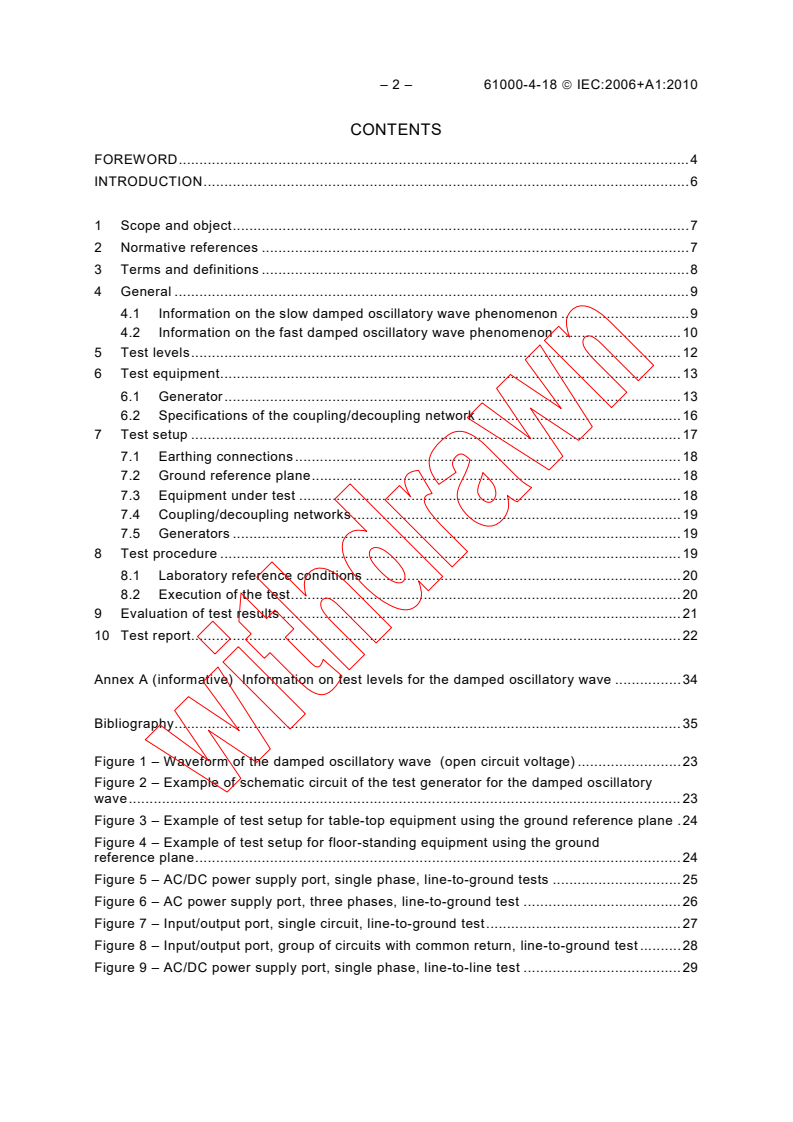
– 2 – 61000-4-18 IEC:2006+A1:2010
CONTENTS
FOREWORD . 4
INTRODUCTION . 6
1 Scope and object . 7
2 Normative references . 7
3 Terms and definitions . 8
4 General . 9
4.1 Information on the slow damped oscillatory wave phenomenon . 9
4.2 Information on the fast damped oscillatory wave phenomenon . 10
5 Test levels . 12
6 Test equipment . 13
6.1 Generator . 13
6.2 Specifications of the coupling/decoupling network . 16
7 Test setup . 17
7.1 Earthing connections . 18
7.2 Ground reference plane . 18
7.3 Equipment under test . 18
7.4 Coupling/decoupling networks . 19
7.5 Generators . 19
8 Test procedure . 19
8.1 Laboratory reference conditions . 20
8.2 Execution of the test . 20
9 Evaluation of test results . 21
10 Test report. 22
Annex A (informative) Information on test levels for the damped oscillatory wave . 34
Bibliography . 35
Figure 1 – Waveform of the damped oscillatory wave (open circuit voltage) . 23
Figure 2 – Example of schematic circuit of the test generator for the damped oscillatory
wave . 23
Figure 3 – Example of test setup for table-top equipment using the ground reference plane . 24
Figure 4 – Example of test setup for floor-standing equipment using the ground
reference plane . 24
Figure 5 – AC/DC power supply port, single phase, line-to-ground tests . 25
Figure 6 – AC power supply port, three phases, line-to-ground test . 26
Figure 7 – Input/output port, single circuit, line-to-ground test . 27
Figure 8 – Input/output port, group of circuits with common return, line-to-ground test . 28
Figure 9 – AC/DC power supply port, single phase, line-to-line test . 29
61000-4-18 IEC:2006+A1:2010 – 3 –
Figure 10 – AC power supply port, three phases, line-to-line test . 30
Figure 11 – Input/output port, single circuit, line-to-line test . 31
Figure 12 – Input/output port, group of circuits with common return, line-to-line test . 32
Figure 13 – Test of a system with communication ports with fast operating signals
(generator output earthed) . 33
Table 1 – Test levels for the slow damped oscillatory wave (100 kHz or 1 MHz) . 12
Table 2 – Test levels for the fast damped oscillatory wave (3 MHz, 10 MHz or 30 MHz) . 12
– 4 – 61000-4-18 IEC:2006+A1:2010
INTERNATIONAL ELECTROTECHNICAL COMMISSION
___________
ELECTROMAGNETIC COMPATIBILITY (EMC) –
Part 4-18: Testing and measurement techniques –
Damped oscillatory wave immunity test
FOREWORD
1) The International Electrotechnical Commission (IEC) is a worldwide organization for standardization comprising
all national electrotechnical committees (IEC National Committees). The object of IEC is to promote
international co-operation on all questions concerning standardization in the electrical and electronic fields. To
this end and in addition to other activities, IEC publishes International Standards, Technical Specifications,
Technical Reports, Publicly Available Specifications (PAS) and Guides (hereafter referred to as “IEC
Publication(s)”). Their preparation is entrusted to technical committees; any IEC National Committee interested
in the subject dealt with may participate in this preparatory work. International, governmental and non-
governmental organizations liaising with the IEC also participate in this preparation. IEC collaborates closely
with the International Organization for Standardization (ISO) in accordance with conditions determined by
agreement between the two organizations.
2) The formal decisions or agreements of IEC on technical matters express, as nearly as possible, an international
consensus of opinion on the relevant subjects since each technical committee has representation from all
interested IEC National Committees.
3) IEC Publications have the form of recommendations for international use and are accepted by IEC National
Committees in that sense. While all reasonable efforts are made to ensure that the technical content of IEC
Publications is accurate, IEC cannot be held responsible for the way in which they are used or for any
misinterpretation by any end user.
4) In order to promote international uniformity, IEC National Committees undertake to apply IEC Publications
transparently to the maximum extent possible in their national and regional publications. Any divergence
between any IEC Publication and the corresponding national or regional publication shall be clearly indicated in
the latter.
5) IEC itself does not provide any attestation of conformity. Independent certification bodies provide conformity
assessment services and, in some areas, access to IEC marks of conformity. IEC is not responsible for any
services carried out by independent certification bodies.
6) All users should ensure that they have the latest edition of this publication.
7) No liability shall attach to IEC or its directors, employees, servants or agents including individual experts and
members of its technical committees and IEC National Committees for any personal injury, property damage or
other damage of any nature whatsoever, whether direct or indirect, or for costs (including legal fees) and
expenses arising out of the publication, use of, or reliance upon, this IEC Publication or any other IEC
Publications.
8) Attention is drawn to the Normative references cited in this publication. Use of the referenced publications is
indispensable for the correct application of this publication.
9) Attention is drawn to the possibility that some of the elements of this IEC Publication may be the subject of
patent rights. IEC shall not be held responsible for identifying any or all such patent rights.
This consolidated version of IEC 61000-4-18 consists of the first edition (2006)
[documents 77B/517/FDIS and 77B/522/RVD] and its amendment 1 (2010) [documents
77B/604/CDV and 77B/633/RVC]. It bears the edition number 1.1.
The technical content is therefore identical to the base edition and its amendment and
has been prepared for user convenience. A vertical line in the margin shows where the
base publication has been modified by amendment 1. Additions and deletions are
displayed in red, with deletions being struck through.
61000-4-18 IEC:2006+A1:2010 – 5 –
International Standard IEC 61000-4-18 has been prepared by subcommittee 77B: High
frequency phenomena, of IEC technical Committee 77: Electromagnetic compatibility.
It forms Part 4-18 of IEC 61000. It has the status of a basic EMC publication in accordance
with IEC Guide 107, Electromagnetic compatibility – Guide to the drafting of electromagnetic
compatibility publications.
This publication has been drafted in accordance with the ISO/IEC Directives, Part 2.
The committee has decided that the contents of the base publication and its amendments will
remain unchanged until the stability date indicated on the IEC web site under
"http://webstore.iec.ch" in the data related to the specific publication. At this date, the
publication will be
• reconfirmed,
• withdrawn,
• replaced by a revised edition, or
• amended.
IMPORTANT – The “colour inside” logo on the cover page of this publication indicates
that it contains colours which are considered to be useful for the correct understanding
of its contents. Users should therefore print this publication using a colour printer.
– 6 – 61000-4-18 IEC:2006+A1:2010
INTRODUCTION
This standard is part of the IEC 61000 series, according to the following structure:
Part 1: General
General considerations (introduction, fundamental principles)
Definitions, terminology
Part 2: Environment
Description of the environment
Classification of the environment
Compatibility levels
Part 3: Limits
Emission limits
Immunity limits (in so far as they do not fall under the responsibility of the product
committees)
Part 4: Testing and measurement techniques
Testing techniques
Part 5: Installation and mitigation guidelines
Installation guidelines
Mitigation methods and devices
Part 6: Generic standards
Part 9: Miscellaneous
Each part is further subdivided into several parts, published either as international standards
or as technical specifications or technical reports, some of which have already been published
as sections. Others will be published with the part number followed by a dash and a second
number identifying the subdivision (example: 61000-6-1).
This part is an international standard which gives immunity requirements and test procedures
related to damped oscillatory waves.
61000-4-18 IEC:2006+A1:2010 – 7 –
ELECTROMAGNETIC COMPATIBILITY (EMC) –
Part 4-18: Testing and measurement techniques –
Damped oscillatory wave immunity test
1 Scope and object
This part of IEC 61000-4 relates to the immunity requirements and test methods for electrical
and electronic equipment, under operational conditions, with regard to:
a) repetitive damped oscillatory waves occurring mainly in power, control and signal cables
installed in high voltage and medium voltage (HV/MV) substations;
b) repetitive damped oscillatory waves occurring mainly in power, control and signal cables
installed in gas insulated substations (GIS) and in some cases also air insulated
substations (AIS) or in any installation due to HEMP phenomena.
The object of this basic standard is to establish the immunity requirements and a common
reference for evaluating in a laboratory the performance of electrical and electronic equipment
intended for residential, commercial and industrial applications, as well as of equipment
intended for power stations and substations, as applicable.
NOTE As described in IEC guide 107, this is a basic EMC publication for use by product committees of the IEC.
As also stated in Guide 107, the IEC product committees are responsible for determining whether this immunity
test standard should be applied or not, and if applied, they are responsible for determining the appropriate test
levels and performance criteria. TC 77 and its sub-committees are prepared to co-operate with product committees
in the evaluation of the value of particular immunity tests for their products.
The purpose of this standard is to define:
– test voltage and current waveforms;
– ranges of test levels;
– test equipment;
– test setup;
– test procedure.
The object of this standard is to establish a common reference for evaluating the immunity of
electrical and electronic equipment when subjected to damped oscillatory waves. The test
method documented in this part of IEC 61000 describes a consistent method to assess the
immunity of an equipment or system against a defined phenomenon.
2 Normative references
The following referenced documents are indispensable for the application of this document.
For dated references, only the edition cited applies. For undated references, the latest edition
of the referenced document (including any amendments) applies.
lEC 60050(161): International Electrotechnical Vocabulary (IEV) – Chapter 161: Electro-
magnetic compatibility
IEC 61000-4-4: Electromagnetic compatibility (EMC) – Part 4-4: Testing and measurement
techniques – Electrical fast transient/burst immunity test
IEC 61000-6-6: Electromagnetic compatibility (EMC) – Part 6-6: Generic standards – HEMP
immunity for indoor equipment
– 8 – 61000-4-18 IEC:2006+A1:2010
3 Terms and definitions
For the purposes of this document, the terms and definitions contained in lEC 60050-161,
some of which are repeated here for convenience, and the following terms and definitions
apply.
NOTE These terms are applicable to the restricted field of oscillatory transients.
3.1
air insulated substation
AIS
substation which is made up with only air insulated switchgear
3.2
burst
sequence of a limited number of distinct pulses or an oscillation of limited duration
[IEV 161-02-07]
3.3
calibration
set of operations which establishes, by reference to standards, the relationship which exists
under specified conditions, between an indication and a result of a measurement
NOTE 1 This term is based on the "uncertainty" approach.
NOTE 2 The relationship between the indications and the results of measurement can be expressed, in principle,
by a calibration diagram.
[IEV 311-01-09]
3.4
coupling
interaction between circuits, transferring energy from one circuit to another
3.5
coupling network
electrical circuit for the purpose of transferring energy from one circuit to another
3.6
decoupling network
electrical circuit for the purpose of preventing test voltages applied to the EUT (equipment
under test) from affecting other devices, equipment, or systems which are not under test
3.7
gas insulated (metal-enclosed) substation
GIS
substation which is made up with only gas insulated metal enclosed switchgear
[IEV 605-02-14]
3.8
high-altitude electromagnetic pulse
electromagnetic pulse produced by a nuclear explosion outside the earth’s atmosphere
NOTE Typically above an altitude of 30 km
61000-4-18 IEC:2006+A1:2010 – 9 –
3.9
immunity (to a disturbance)
the ability of a device, equipment, or system to perform without degradation in the presence of
an electromagnetic disturbance
[IEV 161-01-20]
3.10
port
particular interface of the EUT with the external electromagnetic environment
3.11
rise time
interval of time between the instants at which the instantaneous value of a pulse first reaches
10 % value and then the 90 % value
[IEV 161-02-05, modified]
3.12
transient (adjective and noun)
pertaining to or designating a phenomenon or a quantity which varies between two
consecutive steady states during a time interval short compared with the time-scale of interest
[IEV 161-02-01]
3.13
verification
set of operations which is used to check the test equipment system (e.g. the test generator
and the interconnecting cables) and to demonstrate that the test system is functioning within
the specifications given in Clause 6
NOTE 1 The methods used for verification may be different from those used for calibration.
NOTE 2 The procedure of 6.1.3 and 6.2 is meant as a guide to insure the correct operation of the test generator,
and other items making up the test setup so that the intended waveform is delivered to the EUT.
[IEV 311-01-13, modified]
4 General
The damped oscillatory wave phenomena are divided into two parts. The first part is referred
to as the slow damped oscillatory wave and includes oscillation frequencies between 100 kHz
and 1 MHz. The second part is referred to as the fast damped oscillatory wave, and it includes
oscillation frequencies above 1 MHz. The causes of these two types of damped oscillatory
waves are described below.
4.1 Information on the slow damped oscillatory wave phenomenon
This phenomenon is representative of the switching of disconnectors in HV/MV open-air
substations, and is particularly related to the switching of HV busbars, as well as to the
background disturbance in industrial plants.
In electrical stations, the opening and closing operations of HV disconnectors give rise to
sharp front-wave transients, with rise times of the order of some tens of nanoseconds.
The voltage front-wave has an evolution that includes reflections, due to the mismatching of
the characteristic impedance of HV circuits involved. In this respect, the resulting transient
voltage and current in HV busbars are characterized by a fundamental oscillation frequency
that depends on the length of the circuit and on the propagation time.
– 10 – 61000-4-18 IEC:2006+A1:2010
The oscillation frequency ranges from about 100 kHz to a few megahertz for open-air sub-
stations, depending on the influence of the parameters mentioned above and the length of the
busbars, which may vary from some tens of metres to hundreds of metres (400 m may occur).
In this respect, the oscillation frequency of 1 MHz may be considered representative of most
situations, but 100 kHz has been considered appropriate for large HV substations.
The repetition frequency is variable between a few hertz and a few kilohertz depending on the
distance between the switching contacts: that is, for close contacts, there is a maximum
repetition frequency, while for distances between the contacts near to the extinction of the
arc, the minimum repetition frequency, in respect of each phase, is twice the power frequency
(100/s per phase for 50 Hz and 120/s per phase for 60 Hz HV systems).
The repetition rates selected, 40/s and 400/s, represent therefore a compromise, taking into
account the different durations of the phenomena, the suitability of the different frequencies
considered and the problem related to the energy to which the circuits under test are
subjected.
In industrial plants, repetitive oscillatory transients may be generated by switching transients
and the injection of impulsive currents in power systems (networks and electrical equipment).
The systems have a local response in a frequency band well covered by the rise time and the
fundamental frequency of oscillation of the damped oscillatory wave selected for testing
purposes.
4.2 Information on the fast damped oscillatory wave phenomenon
The fast damped oscillatory wave immunity test should cover phenomena present in two
specific environments:
– substations of the power network (produced by switchgear and controlgear);
– all installations exposed to the high-altitude electromagnetic pulse (HEMP).
4.2.1 Disturbances produced by switchgear and controlgear
During opening or closing disconnector operations, between both contacts of the operated
device, a large number of restrikes take place due to the slow speed of the contacts.
Therefore, disconnector switch operations generate very fast transients, which propagate as
travelling waves in the busbars of the substation. The electrical length of the shielded
conductors and the length of the open circuit busbars determine the oscillation frequencies of
the transient overvoltages.
For air insulated substations (AIS) these transients will radiate an electromagnetic field in the
substation environment. Recent measurements have been performed in air insulated
substations using instruments with a large frequency bandwidth [1]) . These measurements
have shown that transient phenomena with frequencies higher than 1 MHz can also take place
in these substations.
For gas insulated substations (GIS), these transients propagate inside the metallic enclosure,
which contains the SF gas. Due to the skin effect, high frequency transients are confined
inside the enclosure and cause no problems. At the enclosure discontinuities however, a part
of transients is transferred to the external surface of the enclosure tube. As a consequence,
the enclosure potential rises and the current flowing on the enclosure surface radiates an
electromagnetic field in the substation environment. The transient ground potential rise is a
direct source of transient common mode currents in the secondary circuits. The radiated
electromagnetic field also induces common mode currents in the secondary circuits.
___________
1)
Figures in square brackets refer to the bibliography.
61000-4-18 IEC:2006+A1:2010 – 11 –
Measurements have shown that the maximum frequency of significant components in the spectral
density of these currents can be as high as 30 MHz to 50 MHz (see Figures 1 and 2) [2].
In Figures 1 and 2, it can be seen that several peaks occur in the current spectral density
characteristic and important spectral components are observed at frequencies of some tens of
MHz.
As summarized in [1], the frequency environment of HV substations (GIS, but also AIS) has
become more severe than it was in the past, due to a reduction in distances as a
consequence of the reduction of the overall sizes of substations, the use of gas insulated
substations (GIS) and the installation of electronic equipment nearer to switching devices.
Therefore, the oscillation frequencies of 3 MHz, 10 MHz and 30 MHz for the fast damped
oscillatory waves seem to be suitable to better take into account a more realistic environment
both in some AIS and in all GIS.
The repetition frequency is variable between a few hertz and many kilohertz depending on the
distance between the switching contacts: that is, with close contacts, there is a maximum
repetition frequency, while for distances between the contacts near to the extinction of the
arc, the minimum repetition frequency, in respect of each phase, is twice the power frequency
(100/s per phase for 50 Hz and 120/s per phase for 60 Hz HV systems).
The repetition rate selected, 5 000/s, is set to consider the higher repetition rates measured in
GIS. That rate still represents a compromise (as higher rates have been measured), taking
into account the different duration of the phenomena, the suitability of the different
frequencies considered and the problem related to the energy to which the circuits under test
are subjected.
4.2.2 Disturbances produced by the high-altitude electromagnetic pulse (HEMP)
The high-altitude electromagnetic pulse (HEMP) as presented in IEC 61000-2-9 [4] describes
an intense, plane wave electromagnetic pulsed field which has a rise time of 2,5 ns and a
pulse width of approximately 25 ns. This field interacts with exposed cables and wiring to
produce an oscillating voltage and current depending on the length of the line (see
IEC 61000-2-10 [5]). For most external lines such as power and communications, these lines
are long enough (often greater than 1 km) that the coupled currents and voltages are usually
impulsive in nature.
For wires and cables inside of a building, the incident HEMP is partially attenuated, however,
there is still enough field present to couple to short cables inside, providing a threat to
connected electronic equipment. Experiments performed in the past clearly indicate that the
HEMP fields couple to these short lines and produce high-frequency damped oscillatory
waveforms with frequencies as high as 100 MHz, although frequencies below 30 MHz are the
most usual (see IEC 61000-2-10). The damping rate of the oscillatory wave is fairly rapid due
to the presence of absorbing walls in most buildings, and a resonance quality factor Q with a
value between 10 and 20 is therefore typical.
It is also noted that short external wiring, such as those found as part of control circuits in
power substations or at power plants are also likely to couple well to the HEMP fields. These
cables will also exhibit damped oscillatory voltages in the range of 1 to 100 MHz depending
on cable length.
Given that the HEMP environment is typically only one or two pulses, any test defined would
not necessarily require a high repetition rate to replicate the incident environment. However,
due to reliability concerns with digital electronics, it is recommended that a repetition rate
similar to that recommended for switchgear and controlgear also be applied for HEMP
(5 000/s) in order to increase the probability of discovering a malfunction. This is consistent
with the fact that protection and testing to HEMP are ordinarily only performed when the
consequences of electronic system failure are serious.
– 12 – 61000-4-18 IEC:2006+A1:2010
Concerning the HEMP immunity and generic standards that have been published to date
(IEC 61000-4-25 [7] and IEC 61000-6-6), there is a need to have a basic test standard for the
fast damped oscillatory wave containing information on test levels, the generator design, and
test procedures that will permit one to carry out the tests necessary for the levels of voltages
induced by a high-altitude electromagnetic pulse (HEMP). This voltage waveform is a fast
damped sine wave that stresses the connected equipment. Although many frequencies are
possible under realistic conditions, it has been decided that this fast oscillatory wave test
should be carried out with oscillation frequencies up to 30 MHz in order to provide
consistency with the environment produced in power network substations.
5 Test levels
The preferential range of test levels for the damped oscillatory wave tests, applicable to
power, signal and control ports of the equipment, is given in Tables 1 and 2. The test level is
defined as the voltage of the first peak (maximum or minimum) in the test waveform (Pk1 in
Figure 1).
Different levels may apply to power, signal and control ports. The level(s) used for signal and
control ports shall not differ by more than one level from that used for power supply ports.
Table 1 – Test levels for the slow damped oscillatory wave (100 kHz or 1 MHz)
Level Common mode Differential mode
kV kV
1 0,5 0,25
2 1 0,5
a
3 1
4 - -
b
x x
x
a
The value is increased to 2,5 kV for substation equipment.
b
x can be any level, above, below or in-between the other levels. This level can be
given in the product standard.
Table 2 – Test levels for the fast damped oscillatory wave
(3 MHz, 10 MHz or 30 MHz)
Level Common mode
kV
1 0,5
2 1
3 2
4 4
a
x
x
a
x can be any level, above, below or in-between the
other levels. This level can be given in the product
standard.
The applicability of the damped oscillatory wave test shall refer to the product specification.
The test levels from Tables 1 and 2 should be selected on the basis of the exposure to the
primary phenomenon of the cables running in the installation. These levels are defined as an
open circuit voltage either at the output of the generator or at the output of the CDN used.
61000-4-18 IEC:2006+A1:2010 – 13 –
The immunity tests are correlated with these levels in order to establish a performance level
for the environment in which the equipment is expected to operate, taking into account the
primary phenomena and the installation practices which determine the classes of the
electromagnetic environment.
The installations to which this selection of the test levels is applicable are mainly the high-
voltage substations, as well as industrial plants provided with their own electrical plants
(transformer stations).
In HV electrical plants, the degree and length of parallelism of the cables with the busbars,
the operating voltage of these circuits, their shielding and earthing (grounding) will determine
the level of induced voltages.
In order to reduce as much as possible these variables, and taking into consideration that
equipment dedicated to this type of installation is used for a certain range of operating
voltages of the plants (for example, from 150 kV to 800 kV), the definition of the test level is
made considering mainly the equipment interconnected, its location, the quality of the cable
shielding, and its earthing (see Annex A).
6 Test equipment
6.1 Generator
The generator output shall have the capability to operate under short-circuit conditions.
A block diagram of a representative damped oscillatory wave generator is shown in Figure 2.
The test generator produces a damped oscillatory wave with the following characteristics as it
shall be applied to the EUT port. If applied via a coupling/decoupling network, the
characteristics shall be as specified at the output of that network.
The generator output shall be floating and the stray capacity unbalance of the output
terminals to earth shall be less than 20 %. This condition is necessary to test EUT control and
signal ports in differential mode. A dual output generator is necessary. The fast generator
output has a single coaxial output. Test with this generator shall be made only in common
mode.
The provisions to be taken whenever the output of the generator is not floating are given in
item b) of 8.2.
The generator shall have provisions to prevent the emission of heavy disturbances that may
be injected in the power supply network, or may influence the test results.
6.1.1 Characteristics and performance of the slow damped oscillatory wave
generator
Specifications:
– voltage rise time (T1 in Figure 1): 75 ns ± 20 %;
– voltage oscillation frequencies (Note1): 100 kHz and 1 MHz ± 10 %;
– repetition rate: 40/s for 100 kHz and 400/s for 1 MHz ± 10 %;
– decaying: (See Figure 1) Pk5 must be > 50 % of the Pk1 value
and Pk10 must be < 50 % of the Pk1 value;
– burst duration: not less than 2 s;
– output impedance, Note 2: 200 Ω;
– open circuit voltage: (Pk1 value, 250 V to 2,5 kV ± 10 %;
See Figure 1)
– 14 – 61000-4-18 IEC:2006+A1:2010
– short-circuit current (Pk1 value): 1,25 A to 12,5 A ± 20 %;
– phase relationship with the power no requirement;
frequency
– polarity of the first half-period: positive and negative.
NOTE 1 Oscillation frequency is defined as the reciprocal of the period between the first and third zero crossings
after the initial peak. This period is shown as T in Figure 1.
NOTE 2 Output impedance is calculated as open circuit voltage Pk1 divided by short circuit current Pk1.
The waveform of the slow damped oscillatory wave with peak points marked, is given in
Figure 1.
An example of a schematic circuit of the generator is given in Figure 2.
6.1.2 Characteristics and performance of the fast damped oscillatory wave generator
Specifications open circuit:
– voltage rise time (T1 in Figure 1): 5 ns ± 30 %;
– voltage oscillation frequencies (Note 1): 3 MHz, 10 MHz and 30 MHz ± 10 %;
– repetition rate: 5 000/s ± 10 %;
– decaying: (See Figure 1) Pk5 must be > 50 % of the Pk1 value
and Pk10 must be < 50 % of the Pk1 value;
– burst duration: 3 MHz: 50 ms ± 20 %
10 MHz: 15 ms ± 20%
30 MHz: 5 ms ± 20%
– burst period: 300 ms ± 20 %;
– output impedance (Note 2): 50 Ω ± 20 %;
– open circuit voltage: (Pk1 value, 250 V to 4 kV ± 10 %;
see Figure 1)
– phase relationship with the power no requirement;
frequency
– polarity of the first half-period: positive and negative.
Specifications short circuit:
– current rise time (T1 in Figure 1): 3 MHz: < 330 ns
10 MHz: < 100 ns
30 MHz: < 33 ns
– current oscillation frequencies (Note 1): 3 MHz, 10 MHz and 30 MHz ± 30 %;
– decaying: (See Figure 1) Pk5 must be > 25 % of the Pk1 value
and Pk10 must be < 25 % of the Pk1 value;
– short circuit current (Pk1 value): 5 A to 80 A ± 20 %.
NOTE 1 Oscillation frequency is defined as the reciprocal of the period between the first and third zero crossings
after the initial peak. This period is shown as T in Figure 1.
NOTE 2 Output impedance is calculated as open circuit voltage Pk1 divided by short circuit current Pk1.
The waveform of the fast damped oscillatory wave is given in Figure 1.
An example of a schematic circuit of the generator is given in Figure 2.
61000-4-18 IEC:2006+A1:2010 – 15 –
6.1.3 Impedance value
The output impedance of the slow generator has been fixed at 200 Ω although the actual
impedance of the cables (twisted pairs) is nearer to 150 Ω. The reason for which the 200 Ω
impedance has been selected is not to modify an existing general status that would involve
the technical specifications of a family of equipment, with applications mainly in high-voltage
substations.
The output impedance of the fast generator has been fixed at 50 Ω. The reason for which the
50 Ω impedance has been selected is to be consistent with the EFT/B generator as specified
in IEC 61000-4-4. 50 Ohm coaxial cable must be used to the CDN or coupler. To avoid
reflection the generator impedance must be 50 Ω.
In addition, the cables in this category of electrical and industrial plants are mostly in the
order of hundreds of meters in length, and therefore the impedance of the connections in the
field is nearer the characteristic impedance of the cables, and not less than that value.
6.1.4 Verification of the characteristics of the test generator
The verification procedure is meant as a guide to insure the correct operation of the test
generator, coupling/decoupling networks, and other items making up the test setup so that the
intended waveform is delivered to the EUT.
In order to make it possible to compare the results of different test generators, the most
essential characteristics shall be verified.
The characteristics to be verified in accordance with the parameters of 6.1.1 and 6.1.2 are the
following:
– rise time;
– oscillation frequency;
– decaying;
– burst duration;
– burst period;
– open-circuit voltage (open circuit impedance: for slow generator Z ≥ 10 kΩ;
oc
– short circuit current (Pk1 value only by using a short circuit impedance: for slow and fast
generators Z ≤ 0,1 Ω);
sc
– generator source impedance.
The verifications shall be carried out with voltage or current probes (as applicable) and with
oscilloscopes or other equivalent measurement instrumentation with a minimum bandwidth of
40 MHz for the slow damped oscillatory waves and 400 MHz for the fast damped oscillatory
waves.
For the fast damped oscillatory waves generator:
– the open circuit test load impedance is 1 000 Ω ± 2 % in parallel with ≤ 6 pF. The
resistance measurement is made at d.c. and the capacitance measurement is made using
a commercially available capacitance meter that operates at low frequencies;
– the preferred device for measuring the short-circuit current is a shunt. Its transfer
impedance should be 0,1 Ω ± 2 %. The resistance verification of the shunt is made at d.c.
and the 3 dB bandwidth at 400 MHz can be verified with an appropriate network analyser.
NOTE A short-circuit load impedance of Z = 0,102 Ω is considered as complying with the requirement of
sc
Z ≤ 0,1 Ω.
sc
– 16 – 61000-4-18 IEC:2006+A1:2010
The waveform characteristics shall be verified at the EUT port (port by port) of each CDN
used for the immunity test, or directly at the output of the test generator if no CDN is to be
used.
The waveform characteristics shall be verified directly at the output of the test generator with
open circuit and short circuit load impedances.
6.2 Specifications of the coupling/decoupling network
The coupling/decoupling network (CDN) provides both the ability to apply the test voltage in
either common (for both generators) or differential (only 100 kHz, 1 MHz) mode to the mains,
signal and control ports of the EUT (equipment under test), and prevents test voltage from
affecting any auxiliary equipment needed to perform the test. The waves shall be within the
tolerances of 6.1.1 or 6.1.2 at the EUT port of the CDN. Verifications shall be made port by
port. E.g. 3-phase CDN: L1 to PE, L2 to PE, L3 to PE, N to PE.
The coupling/decoupling network (CDN) provides both the ability to apply the test voltage in
either common (for both generators) or differential (only 100 kHz, 1 MHz) mode to the mains,
signal and control ports of the EUT (equipment under test), and prevents test voltage from
af
...