

IEC 60364-7-722:2018
(Main)Low-voltage electrical installations - Part 7-722: Requirements for special installations or locations - Supplies for electric vehicles
General Information
- Abstract
IEC 60364-7-722:2018 applies to:
• circuits intended to supply energy to electric vehicles, and
• circuits intended for feeding back electricity from electric vehicles.
Circuits covered by this document are terminated at the connecting point.
This edition includes the following significant technical changes with respect to the previous edition:
a) introduction of requirements for electrical installations incorporating wireless power transfer systems;
b) clarification of the requirements regarding the protective measure placing out of reach in order to allow the use of pantographs in areas accessible to the public;
c) introduction of requirements covering the case where the EV may operate as a source in parallel with other sources.
NOTE 1 The requirements for EV supply equipment for conductive charging and the relevant charging modes are described in IEC 61851 (all parts). The requirements for EV supply equipment for wireless power transfer are described in IEC 61980 (all parts).
NOTE 2 IEC 60364-7-722 does not cover the assessment of the risk of explosion due to the possible production of hydrogen/other flammable gases during the battery recharging phase.
- Status
- Published
- Publication Date
- 20-Sep-2018
- Technical Committee
- TC 64 - Electrical installations and protection against electric shock
- Drafting Committee
- MT 42 - TC 64/MT 42
- Current Stage
- PPUB - Publication issued
- Start Date
- 21-Sep-2018
- Completion Date
- 07-Sep-2018
Buy Documents
IEC 60364-7-722:2018 RLV - Low-voltage electrical installations - Part 7-722: Requirements for special installations or locations - Supplies for electric vehicles Released:9/21/2018
IEC 60364-7-722:2018 - Low-voltage electrical installations - Part 7-722: Requirements for special installations or locations - Supplies for electric vehicles Released:9/21/2018
Overview
IEC 60364-7-722:2018 is part of the IEC 60364 series on low-voltage electrical installations and provides particular requirements for supplies for electric vehicles (EVs). It covers circuits intended to supply energy to EVs and circuits intended to feed electricity back from EVs to the supply network, with circuits terminated at the connecting point. This edition introduced requirements for installations incorporating wireless power transfer, clarified protective measures to allow the use of pantographs in public areas, and added rules for cases where an EV may operate as a source in parallel with other sources. The standard does not address assessment of explosion risk from battery gassing.
Key topics and technical requirements
- Scope and circuit limits
- Applies to EV supply circuits and circuits for feeding back energy (vehicle-to-grid arrangements under consideration).
- Circuits are considered up to the connecting point at the EV interface.
- Protection for safety
- Measures against electric shock: automatic disconnection, electrical separation and related protective device coordination.
- Requirements related to “placing out of reach” to permit safe use of pantographs in public-access locations.
- Wireless power transfer (WPT)
- New provisions for installations that incorporate WPT systems (see also IEC 61980 series for EVSE WPT equipment).
- Parallel-source operation
- Rules for situations where an EV can act as a source in parallel with other supply sources (e.g., microgrids or V2G scenarios).
- Selection and erection of equipment
- Guidance on protective conductors, earthing arrangements, isolation, switching, and overcurrent protection.
- Verification and testing requirements for installed systems.
- EMC and voltage disturbances
- Measures against transient overvoltages, electromagnetic influences and coordination with other protective devices.
Applications and who uses it
This standard is essential for:
- Electrical designers and consulting engineers specifying EV charging infrastructure for public and private sites.
- Charging-station manufacturers and EV supply equipment (EVSE) integrators ensuring compliance at the installation interface.
- Installers, facility managers and utilities implementing safe low-voltage EV supplies, including vehicle-to-grid (V2G) capable systems.
- Safety inspectors and regulators assessing conformity with low-voltage installation requirements.
Related standards
- IEC 60364 (all parts) – general low-voltage installation rules
- IEC 61851 (all parts) – EV conductive charging equipment and charging modes
- IEC 61980 (all parts) – EV wireless power transfer (WPT) equipment
- Other referenced standards: IEC 60269, IEC 60309, IEC 61008/61009, IEC 60947 series, IEC 61557 (testing/monitoring)
IEC 60364-7-722:2018 is a practical reference for safe, standardized design and installation of low-voltage EV supplies, bridging EV charging technology and electrical installation practice.
Relations
- Effective Date
- 25-Aug-2026
- Effective Date
- 25-Aug-2026
- Effective Date
- 25-Feb-2026
- Effective Date
- 05-Sep-2023
Buy Documents
IEC 60364-7-722:2018 RLV - Low-voltage electrical installations - Part 7-722: Requirements for special installations or locations - Supplies for electric vehicles Released:9/21/2018
IEC 60364-7-722:2018 - Low-voltage electrical installations - Part 7-722: Requirements for special installations or locations - Supplies for electric vehicles Released:9/21/2018
Get Certified
Connect with accredited certification bodies for this standard

TÜV Rheinland
TÜV Rheinland is a leading international provider of technical services.

TÜV SÜD
TÜV SÜD is a trusted partner of choice for safety, security and sustainability solutions.

DEKRA Certification Inc.
DEKRA US certification services.
Sponsored listings
Frequently Asked Questions
IEC 60364-7-722:2018 is a standard published by the International Electrotechnical Commission (IEC). Its full title is "Low-voltage electrical installations - Part 7-722: Requirements for special installations or locations - Supplies for electric vehicles". This standard covers: IEC 60364-7-722:2018 applies to: • circuits intended to supply energy to electric vehicles, and • circuits intended for feeding back electricity from electric vehicles. Circuits covered by this document are terminated at the connecting point. This edition includes the following significant technical changes with respect to the previous edition: a) introduction of requirements for electrical installations incorporating wireless power transfer systems; b) clarification of the requirements regarding the protective measure placing out of reach in order to allow the use of pantographs in areas accessible to the public; c) introduction of requirements covering the case where the EV may operate as a source in parallel with other sources. NOTE 1 The requirements for EV supply equipment for conductive charging and the relevant charging modes are described in IEC 61851 (all parts). The requirements for EV supply equipment for wireless power transfer are described in IEC 61980 (all parts). NOTE 2 IEC 60364-7-722 does not cover the assessment of the risk of explosion due to the possible production of hydrogen/other flammable gases during the battery recharging phase.
IEC 60364-7-722:2018 applies to: • circuits intended to supply energy to electric vehicles, and • circuits intended for feeding back electricity from electric vehicles. Circuits covered by this document are terminated at the connecting point. This edition includes the following significant technical changes with respect to the previous edition: a) introduction of requirements for electrical installations incorporating wireless power transfer systems; b) clarification of the requirements regarding the protective measure placing out of reach in order to allow the use of pantographs in areas accessible to the public; c) introduction of requirements covering the case where the EV may operate as a source in parallel with other sources. NOTE 1 The requirements for EV supply equipment for conductive charging and the relevant charging modes are described in IEC 61851 (all parts). The requirements for EV supply equipment for wireless power transfer are described in IEC 61980 (all parts). NOTE 2 IEC 60364-7-722 does not cover the assessment of the risk of explosion due to the possible production of hydrogen/other flammable gases during the battery recharging phase.
IEC 60364-7-722:2018 is classified under the following ICS (International Classification for Standards) categories: 43.120 - Electric road vehicles; 91.140.50 - Electricity supply systems. The ICS classification helps identify the subject area and facilitates finding related standards.
IEC 60364-7-722:2018 has the following relationships with other standards: It is inter standard links to EN 12255-12:2024, EN 378-3:2016+A1:2020, EN 1473:2021, IEC 60364-7-722:2015. Understanding these relationships helps ensure you are using the most current and applicable version of the standard.
IEC 60364-7-722:2018 is available in PDF format for immediate download after purchase. The document can be added to your cart and obtained through the secure checkout process. Digital delivery ensures instant access to the complete standard document.
Standards Content (Sample)
IEC 60364-7-722 ®
Edition 2.0 2018-09
REDLINE VERSION
INTERNATIONAL
STANDARD
colour
inside
Low-voltage electrical installations –
Part 7-722: Requirements for special installations or locations – Supplies for
electric vehicles
All rights reserved. Unless otherwise specified, no part of this publication may be reproduced or utilized in any form
or by any means, electronic or mechanical, including photocopying and microfilm, without permission in writing from
either IEC or IEC's member National Committee in the country of the requester. If you have any questions about IEC
copyright or have an enquiry about obtaining additional rights to this publication, please contact the address below or
your local IEC member National Committee for further information.
IEC Central Office Tel.: +41 22 919 02 11
3, rue de Varembé info@iec.ch
CH-1211 Geneva 20 www.iec.ch
Switzerland
About the IEC
The International Electrotechnical Commission (IEC) is the leading global organization that prepares and publishes
International Standards for all electrical, electronic and related technologies.
About IEC publications
The technical content of IEC publications is kept under constant review by the IEC. Please make sure that you have the
latest edition, a corrigenda or an amendment might have been published.
IEC Catalogue - webstore.iec.ch/catalogue Electropedia - www.electropedia.org
The stand-alone application for consulting the entire The world's leading online dictionary of electronic and
bibliographical information on IEC International Standards, electrical terms containing 21 000 terms and definitions in
Technical Specifications, Technical Reports and other English and French, with equivalent terms in 16 additional
documents. Available for PC, Mac OS, Android Tablets and languages. Also known as the International Electrotechnical
iPad. Vocabulary (IEV) online.
IEC publications search - webstore.iec.ch/advsearchform IEC Glossary - std.iec.ch/glossary
The advanced search enables to find IEC publications by a 67 000 electrotechnical terminology entries in English and
variety of criteria (reference number, text, technical French extracted from the Terms and Definitions clause of
committee,…). It also gives information on projects, replaced IEC publications issued since 2002. Some entries have been
and withdrawn publications. collected from earlier publications of IEC TC 37, 77, 86 and
CISPR.
IEC Just Published - webstore.iec.ch/justpublished
Stay up to date on all new IEC publications. Just Published IEC Customer Service Centre - webstore.iec.ch/csc
details all new publications released. Available online and If you wish to give us your feedback on this publication or
also once a month by email. need further assistance, please contact the Customer Service
Centre: sales@iec.ch.
IEC 60364-7-722 ®
Edition 2.0 2018-09
REDLINE VERSION
INTERNATIONAL
STANDARD
colour
inside
Low-voltage electrical installations –
Part 7-722: Requirements for special installations or locations – Supplies for
electric vehicles
INTERNATIONAL
ELECTROTECHNICAL
COMMISSION
ICS 43.120; 91.140.50 ISBN 978-2-8322-6076-0
– 2 – IEC 60364-7-722:2018 RLV © IEC 2018
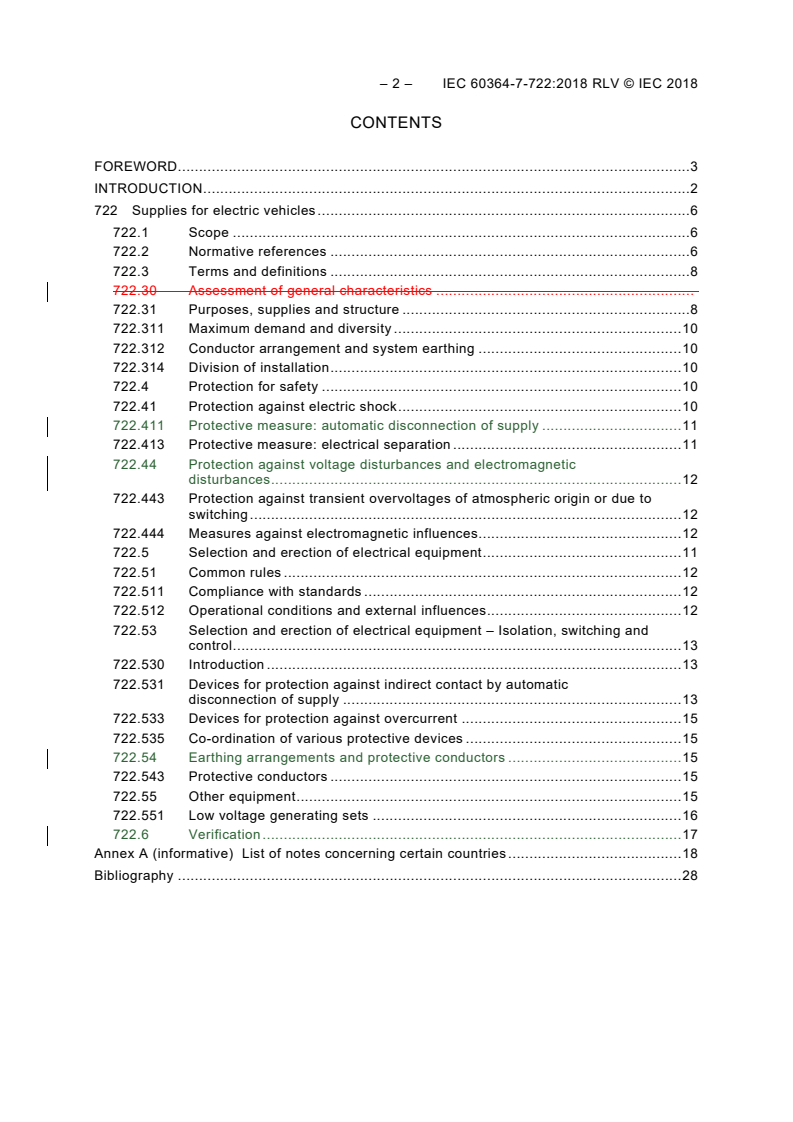
CONTENTS
FOREWORD . 3
INTRODUCTION . 2
722 Supplies for electric vehicles . 6
722.1 Scope . 6
722.2 Normative references . 6
722.3 Terms and definitions . 8
722.30 Assessment of general characteristics .
722.31 Purposes, supplies and structure . 8
722.311 Maximum demand and diversity . 10
722.312 Conductor arrangement and system earthing . 10
722.314 Division of installation . 10
722.4 Protection for safety . 10
722.41 Protection against electric shock . 10
722.411 Protective measure: automatic disconnection of supply . 11
722.413 Protective measure: electrical separation . 11
722.44 Protection against voltage disturbances and electromagnetic
disturbances . 12
722.443 Protection against transient overvoltages of atmospheric origin or due to
switching . 12
722.444 Measures against electromagnetic influences . 12
722.5 Selection and erection of electrical equipment . 11
722.51 Common rules . 12
722.511 Compliance with standards . 12
722.512 Operational conditions and external influences . 12
722.53 Selection and erection of electrical equipment – Isolation, switching and
control . 13
722.530 Introduction . 13
722.531 Devices for protection against indirect contact by automatic
disconnection of supply . 13
722.533 Devices for protection against overcurrent . 15
722.535 Co-ordination of various protective devices . 15
722.54 Earthing arrangements and protective conductors . 15
722.543 Protective conductors . 15
722.55 Other equipment . 15
722.551 Low voltage generating sets . 16
722.6 Verification . 17
Annex A (informative) List of notes concerning certain countries . 18
Bibliography . 28
INTERNATIONAL ELECTROTECHNICAL COMMISSION
____________
LOW-VOLTAGE ELECTRICAL INSTALLATIONS –
Part 7-722: Requirements for special installations or locations –
Supplies for electric vehicles
FOREWORD
1) The International Electrotechnical Commission (IEC) is a worldwide organization for standardization comprising
all national electrotechnical committees (IEC National Committees). The object of IEC is to promote
international co-operation on all questions concerning standardization in the electrical and electronic fields. To
this end and in addition to other activities, IEC publishes International Standards, Technical Specifications,
Technical Reports, Publicly Available Specifications (PAS) and Guides (hereafter referred to as “IEC
Publication(s)”). Their preparation is entrusted to technical committees; any IEC National Committee interested
in the subject dealt with may participate in this preparatory work. International, governmental and non-
governmental organizations liaising with the IEC also participate in this preparation. IEC collaborates closely
with the International Organization for Standardization (ISO) in accordance with conditions determined by
agreement between the two organizations.
2) The formal decisions or agreements of IEC on technical matters express, as nearly as possible, an international
consensus of opinion on the relevant subjects since each technical committee has representation from all
interested IEC National Committees.
3) IEC Publications have the form of recommendations for international use and are accepted by IEC National
Committees in that sense. While all reasonable efforts are made to ensure that the technical content of IEC
Publications is accurate, IEC cannot be held responsible for the way in which they are used or for any
misinterpretation by any end user.
4) In order to promote international uniformity, IEC National Committees undertake to apply IEC Publications
transparently to the maximum extent possible in their national and regional publications. Any divergence
between any IEC Publication and the corresponding national or regional publication shall be clearly indicated in
the latter.
5) IEC itself does not provide any attestation of conformity. Independent certification bodies provide conformity
assessment services and, in some areas, access to IEC marks of conformity. IEC is not responsible for any
services carried out by independent certification bodies.
6) All users should ensure that they have the latest edition of this publication.
7) No liability shall attach to IEC or its directors, employees, servants or agents including individual experts and
members of its technical committees and IEC National Committees for any personal injury, property damage or
other damage of any nature whatsoever, whether direct or indirect, or for costs (including legal fees) and
expenses arising out of the publication, use of, or reliance upon, this IEC Publication or any other IEC
Publications.
8) Attention is drawn to the Normative references cited in this publication. Use of the referenced publications is
indispensable for the correct application of this publication.
9) Attention is drawn to the possibility that some of the elements of this IEC Publication may be the subject of
patent rights. IEC shall not be held responsible for identifying any or all such patent rights.
This redline version of the official IEC Standard allows the user to identify the changes
made to the previous edition. A vertical bar appears in the margin wherever a change
has been made. Additions are in green text, deletions are in strikethrough red text.
– 4 – IEC 60364-7-722:2018 RLV © IEC 2018
International Standard IEC 60364-7-722 has been prepared by IEC technical committee 64:
Electrical installations and protection against electric shock.
This second edition cancels and replaces the first edition published in 2015. This edition
constitutes a technical revision.
This edition includes the following significant technical changes with respect to the previous
edition:
a) introduction of requirements for electrical installations incorporating wireless power
transfer systems;
b) clarification of the requirements regarding the protective measure placing out of reach in
order to allow the use of pantographs in areas accessible to the public;
c) introduction of requirements covering the case where the EV may operate as a source in
parallel with other sources.
The text of this International Standard is based on the following documents:
FDIS Report on voting
64/2285/FDIS 64/2318/RVD
Full information on the voting for the approval of this International Standard can be found in
the report on voting indicated in the above table.
This document has been drafted in accordance with the ISO/IEC Directives, Part 2.
A list of all parts in the IEC 60364 series, published under the general title Low voltage
electrical installations, can be found on the IEC website.
The reader's attention is drawn to the fact that Annex A lists all of the “in-some-country”
clauses on differing practices of a less permanent nature relating to the subject of this
standard.
The committee has decided that the contents of this document will remain unchanged until the
stability date indicated on the IEC website under "http://webstore.iec.ch" in the data related to
the specific document. At this date, the document will be
• reconfirmed,
• withdrawn,
• replaced by a revised edition, or
• amended.
IMPORTANT – The “colour inside” logo on the cover page of this publication indicates
that it contains colours which are considered to be useful for the correct understanding
of its contents. Users should therefore print this publication using a colour printer.
INTRODUCTION
For the purpose of this part of IEC 60364 (IEC 60364-7-722) the requirements of the general
Parts 1 to 6 of IEC 60364 apply.
The IEC 60364-7-7XX parts of IEC 60364 contain particular requirements for special
installations or locations which are based on the requirements of the general parts of
IEC 60364 (IEC 60364-1 to IEC 60364-6). These IEC 60364-7-7XX parts are considered in
conjunction with the requirements of the general parts.
The particular requirements of this part of IEC 60364 supplement, modify or replace certain of
the requirements of the general parts of IEC 60364 being valid at the time of publication of
this part. The absence of reference to the exclusion of a part or a clause of a general part
means that the corresponding clauses of the general part are applicable (undated reference).
Requirements of other 7XX parts being relevant for installations covered by this part also
apply. This part may therefore also supplement, modify or replace certain of these
requirements valid at the time of publication of this part.
The clause numbering of this part follows the pattern and corresponding references of
IEC 60364. The numbers following the particular number of this part are those of the
corresponding parts, or clauses of the other parts of the IEC 60364 series, valid at the time of
publication of this part, as indicated in the normative references of this document (dated
reference).
If requirements or explanations additional to those of the other parts of the IEC 60364 series
are needed, the numbering of such items appears as 722.101, 722.102, 722.103, etc.
NOTE In the case where new or amended general parts with modified numbering were
published after this part was issued, the clause numbers referring to a general part in this Part
722 may no longer align with the latest edition of the general part. Dated references should be
observed.
– 6 – IEC 60364-7-722:2018 RLV © IEC 2018
LOW-VOLTAGE ELECTRICAL INSTALLATIONS –
Part 7-722: Requirements for special installations or locations –
Supplies for electric vehicles
722 Supplies for electric vehicles
722.1 Scope
The particular requirements of this document apply to
• circuits intended to supply energy to electric vehicles, and
• circuits intended for feeding back electricity from electric vehicles into the supply network.
NOTE The requirements for feeding back electricity from electric vehicles into the supply network are under
consideration.
Inductive charging is not covered.
Circuits covered by this document are terminated at the connecting point.
NOTE 1 The requirements for EV supply equipment for conductive charging and the relevant charging modes are
described in IEC 61851 (all parts). The requirements for EV supply equipment for wireless power transfer are
described in IEC 61980 (all parts).
NOTE 2 This document does not cover the assessment of the risk of explosion due to the possible production of
hydrogen/other flammable gases during the battery recharging phase.
722.2 Normative references
The following documents are referred to in the text in such a way that some or all of their
content constitutes requirements of this document. For dated references, only the edition
cited applies. For undated references, the latest edition of the referenced document (including
any amendments) applies.
IEC 60269 (all parts), Low voltage fuses
IEC 60309-1:1999, Plugs, socket-outlets and couplers for industrial purposes – Part 1:
General requirements
IEC 60309-2, Plugs, socket-outlets and couplers for industrial purposes – Part 2: Dimensional
interchangeability requirements for pin and contact-tube accessories
IEC 60364 (all parts), Low-voltage electrical installations
IEC 60364-4-41:2005, Low-voltage electrical installations – Part 4-41: Protection for safety –
Protection against electric shock
IEC 60364-4-41:2005/AMD1:2017
IEC 60364-8-2, Low-voltage electrical installations – Part 8-2: Prosumer's low-voltage
electrical installations
____________
Under preparation. Stage at the time of publication IEC RFDIS 60364-8-2:2018.
IEC 60898 (all parts), Electrical accessories – Circuit-breakers for overcurrent protection for
household and similar installations
IEC 60947-2, Low-voltage switchgear and controlgear – Part 2: Circuit-breakers
IEC 60947-6-2, Low-voltage switchgear and controlgear – Part 6-2: Multiple function
equipment – Control and protective switching devices (or equipment) (CPS)
IEC 61008-1, Residual current circuit-breakers without integral overvoltage overcurrent
protection for household and similar uses (RCCBs) – Part 1: General rules
IEC 61009-1, Residual current operated circuit-breakers with integral overvoltage overcurrent
protection for household and similar uses (RCBOs) – Part 1: General rules
IEC 61140:2001, Protection against electric shock – Common aspects for installation and
equipment
IEC 61557-8, Electrical safety in low voltage distribution systems up to 1 000 V a.c. and
1 500 V d.c. – Equipment for testing, measuring or monitoring of protective measures – Part 8:
Insulation monitoring devices for IT systems
IEC 61557-9, Electrical safety in low voltage distribution systems up to 1 000 V a.c. and
1 500 V d.c. – Equipment for testing, measuring or monitoring of protective measures – Part 9:
Equipment insulation fault location in IT systems
IEC 61558-2-4, Safety of transformers, reactors, power supply units and similar products for
supply voltages up to 1 100 V – Part 2-4: Particular requirements and tests for isolating
transformers and power supply units incorporating isolating transformers
IEC 61851 (all parts), Electric vehicle conductive charging system
IEC 61980 (all parts), Electric vehicle wireless power transfer (WPT) systems
IEC 62196 (all parts), Plugs, socket-outlets, vehicle connectors and vehicle inlets –
Conductive charging of electric vehicles
IEC 62196-1, Plugs, socket-outlets, vehicle connectors and vehicle inlets – Conductive
charging of electric vehicles – Part 1: General requirements
IEC 62196-2, Plugs, socket-outlets, vehicle connectors and vehicle inlets – Conductive
charging of electric vehicles – Part 2: Dimensional compatibility and interchangeability
requirements for a.c. pin and contact-tube accessories
IEC 62196-3, Plugs, socket-outlets, vehicle connectors and vehicle inlets – Conductive
charging of electric vehicles – Part 3: Dimensional compatibility and interchangeability
requirements for d.c. and a.c./d.c. pin and contact-tube vehicle couplers
IEC TS 62196-4, Plugs, socket-outlets, vehicle connectors and vehicles inlet – Conductive
charging of electric vehicles – Part 4: Dimensional compatibility and interchangeability
requirements for DC pin and contact-tube accessories for class II or class III applications
IEC 62262, Degrees of protection provided by enclosures for electrical equipment against
external mechanical impacts (IK code)
____________
Under preparation. Stage at the time of publication IEC TS BPUB 62196-4:2018.
– 8 – IEC 60364-7-722:2018 RLV © IEC 2018
IEC 62423, Type F and type B residual current operated circuit-breakers with and without
integral overcurrent protection for household and similar uses
IEC 62955, Residual direct current detecting device (RDC-DD) to be used for mode 3
charging of electric vehicle
722.3 Terms and definitions
For the purposes of this document, the following terms and definitions apply.
ISO and IEC maintain terminological databases for use in standardization at the following
addresses:
• IEC Electropedia: available at http://www.electropedia.org/
• ISO Online browsing platform: available at http://www.iso.org/obp
722.3.1
electric vehicle
electric road vehicle
EV
any vehicle propelled by an electric motor drawing current from a rechargeable storage
battery or from other portable energy storage devices (rechargeable, using energy from a
source off the vehicle such as a residential or public electricity service), which is
manufactured primarily for use on public streets, roads or highways
Note 1 to entry: In ISO publications, the term “electric road vehicle” is used for “electric vehicle.”
[SOURCE: IEC 61851-1:2010, 3.8 ]
any vehicle propelled by an electric motor drawing current from a rechargeable energy
storage system (RESS), intended primarily for use on public roads
[SOURCE: ISO 17409:2015, 3.19, modified — "rechargeable energy storage system" has
been added.]
722.3.2
connecting point
point where one electric vehicle is connected to the fixed installation
Note 1 to entry: The connecting point is a socket-outlet or a vehicle connector.
Note 2 to entry: The connecting point may be part of the fixed installed electric vehicle supply equipment in
accordance with the IEC 61851 series.
terminating point in the fixed installation where energy is transferred to/from one electric
vehicle
EXAMPLE A socket-outlet, a vehicle connector or a wireless power transfer device.
Note 1 to entry: The connecting point may be part of the fixed installed EV supply equipment.
722.3.3
mode 1 charging
connection of the EV to the a.c. supply network (mains) utilizing standardized socket-outlets
not exceeding 16 A and not exceeding 250 V a.c. single-phase or 480 V a.c. three-phase, at
the supply side, and utilizing the live and protective earth conductors
[SOURCE: IEC 61851-1:2010, 6.2 "EV charging modes, mode 1 charging"]
722.3.4
mode 2 charging
connection of the EV to the a.c. supply network (mains) utilizing standardized single-phase or
three-phase socket-outlets not exceeding 32 A and not exceeding 250 V a.c. single-phase or
480 V a.c. three-phase, and utilizing the live and protective earth conductors together with a
control pilot function and system of personnel protection against electric shock (RCD)
between the EV and the plug or as a part of the in-cable control box
[SOURCE: IEC 61851-1:2010, 6.2 "EV charging modes, mode 2 charging", modified]
722.3.5
mode 3 charging
connection of the EV to the a.c. supply network (mains) utilizing dedicated electric vehicle
supply equipment where the control pilot function extends to control equipment in the electric
vehicle supply equipment permanently connected to the a.c. supply network (mains)
[SOURCE: IEC 61851-1:2010, 6.2 "EV charging modes, mode 3 charging"]
722.3.6
mode 4 charging
connection of the EV to the a.c. supply network (mains) utilizing an off-board charger where
the control pilot function extends to equipment permanently connected to the a.c. supply
[SOURCE: IEC 61851-1:2010, 6.2 "EV charging modes, mode 4 charging"]
722.3.73
demand factor
ratio, expressed as a numerical value or as a percentage, of the maximum demand of a circuit
or a group of circuits within a specified period, to the corresponding total installed load of the
circuit(s)
Note 1 to entry: In using this term, it is necessary to specify to which level of the system it relates.
[SOURCE: IEC 60050-691:1973, 691-10-05, modified – the word "circuit" has replaced the
word "installation" The term "installation" has been replaced with the term "circuit"].
722.3.4
EV charging station
stationary part of EV supply equipment connected to the supply network
[SOURCE: IEC 61851-1:2017, 3.1.5, modified — The note has been deleted.]
722.3.5
EV supply equipment
equipment or a combination of equipment, providing dedicated functions to supply electric
energy from a fixed electrical installation or supply network to an EV for the purpose of
charging
[SOURCE: IEC 61851-1:2017, 3.1.1, modified — The examples have been deleted.]
722.3.6
load control
electrical (energy) management system ensuring that the sum of load currents of dedicated
circuits does not exceed a predetermined value
– 10 – IEC 60364-7-722:2018 RLV © IEC 2018
722.30 Assessment of general characteristics
722.31 Purposes, supplies and structure
722.311 Maximum demand and diversity
Add the following:
It shall be considered that in normal use each single connecting point is used at its rated
current or at the configured maximum charging current of the charging station. The means for
configuration of the maximum charging current shall only be made by the use of a key or a
tool and only be accessible to skilled or instructed persons.
NOTE For this application the demand factor of the final circuit supplying the connecting point (e.g. the socket-
outlet) is equal to 1.
Since all the connecting points of the installation can be used simultaneously, the diversity
factor of the distribution circuit shall be taken as equal to 1 unless a load control is included in
the EV supply equipment or installed upstream or a combination of both. However, this factor
may be reduced where load control is available.
722.312 Conductor arrangement and system earthing
722.312.2.1 TN systems
Add the following:
In a TN system, the final circuit supplying a connecting point shall be a TN-S system a circuit
supplying a connecting point shall not include a PEN conductor.
722.314 Division of installation
Add the following:
722.314.101
A dedicated circuit shall be provided for the connection transfer of energy from/to the electric
vehicles.
722.4 Protection for safety
722.41 Protection against electric shock
722.410.3 General requirements
722.410.3.5
Replace the existing text by the following:
The protective measure obstacles as specified in IEC 60364-4-41:2005, Clause B.2 shall not
be applied.
The protective measure placing out of reach, as specified in IEC 60364-4-41:2005,
Clause B.3 may only be applied where an automatic connection system in accordance with
IEC 61851-23-1 is used.
____________
Under consideration.
722.410.3.6
The protective measures as specified in IEC 60364-4-41:2005 and
IEC 60364-4-41:2005/AMD1:2017, Annex C shall not be applied.
722.411 Protective measure: automatic disconnection of supply
722.411.3 Requirements for fault protection
722.411.3.3 Additional protection
Replace the existing text by the following:
Each AC connecting point shall be individually protected by a residual current device (RCD)
with a rated residual operating current not exceeding 30 mA.
NOTE This requirement implies that this RCD is not used for protecting other connecting points or current-using
equipment.
722.413 Protective measure: electrical separation
722.413.3 Requirements for fault protection
Add the following:
722.413.3.101 The circuit shall be supplied through a fixed isolating transformer complying
with IEC 61558-2-4.
NOTE In mode 4 (d.c. charging), requirements for the isolating transformer are under consideration.
722.413.3.2
Replace the requirements as follows:
The separated circuit shall be supplied through an isolating transformer complying with
IEC 61558-2-4, and the voltage of the separated circuit shall not exceed 500 V.
722.41.B Obstacles and placing out of reach
722.41.B.2 Obstacles
Replace the existing text by the following:
Protection by obstacles shall not be used.
722.41.B.3 Placing out of reach
Replace the existing text by the following:
Protection by placing out of reach shall not be used.
722.41.C.1 Non-conducting location
Replace the existing text by the following:
Protection by non-conducting location shall not be used.
722.41.C.2 Protection by earth-free local equipotential bonding
Replace the existing text by the following:
– 12 – IEC 60364-7-722:2018 RLV © IEC 2018
Protection by earth-free local equipotential bonding shall not be used.
722.41.C.3 Electrical separation for the supply of more than one item of current-
using equipment
Replace the existing text by the following:
Electrical separation shall not be used for the supply of more than one electric vehicle.
722.44 Protection against voltage disturbances and electromagnetic disturbances
722.443 Protection against transient overvoltages of atmospheric origin or due to
switching
722.443.4 Overvoltage control
Add the following after the first paragraph:
A connecting point accessible to the public is considered as part of a public service and
therefore shall be protected against transient overvoltages.
722.444 Measures against electromagnetic influences
722.444.1 General
Add the following:
722.444.1.101
The equipment for wireless power transfer shall not impair the safety and the proper
functioning of the electrical installation and shall be installed according to the manufacturer’s
instructions.
722.5 Selection and erection of electrical equipment
722.51 Common rules
722.511 Compliance with standards
Add the following:
722.511.101
For conductive power transfer, EV charging stations shall comply with the appropriate parts of
the IEC 61851 series.
722.511.102
Wireless power transfer (WPT) systems for EVs shall comply with the appropriate parts of the
IEC 61980 series.
722.512 Operational conditions and external influences
722.512.2 External influences
Add the following:
722.512.2.101 Presence of water (AD)
Where the connection point is When installed outdoors, the equipment shall be selected with
a degree of protection of at least IPX4 in order to protect against water splashes (AD4).
722.512.2.102 Presence of solid foreign bodies (AE)
Where the connecting point is When installed outdoors, the equipment shall be selected or
provided with a degree of protection of at least IP4X in order to protect against the ingress of
small objects (AE3).
722.512.2.103 Impact (AG)
Equipment installed in public areas and car park sites shall be protected against mechanical
damage (impact of medium severity AG2) considering an impact of high severity (AG3). This
protection of the equipment shall be afforded provided by one or more of the following:
– the position or location shall be selected to avoid damage by any reasonably foreseeable
impact;
– local or general mechanical protection shall be provided;
– equipment shall be installed that complies with a minimum degree of protection against
external mechanical impact of IK07 in accordance with the requirements of IEC 62262.
• by locating the equipment to avoid damage by any reasonably foreseeable impact;
• by providing local or general mechanical protection of the equipment;
• by selecting and erecting equipment with a minimum degree of protection against external
mechanical impact in accordance with the requirements of IEC 62262 of IK08.
722.53 Selection and erection of electrical equipment – Isolation, switching and
control
722.530 Introduction
722.530.3 General and common requirements
Add the following:
722.530.3.101
The requirements of this clause 722.530.3.102 and from 722.531 to 722.535.3 shall be
achieved either by the selection and erection of the appropriate equipment in the fixed
installation or by the selection of an EV charging station which incorporates the appropriate
equipment or a combination of both.
NOTE 1 The requirements for the selection and erection of devices for isolation, switching and control of the
wireless power transfer system are covered by IEC 60364-5-53.
NOTE 2 The in-cable control and protection device (IC-CPD) according to IEC 62752 is not designed for use in
fixed installations.
722.530.3.102 Insulation monitoring devices (IMD)
For circuits in IT systems that are intended to supply energy for electric vehicles, for example
by an isolating transformer or a battery system, an insulation monitoring device (IMD)
according to IEC 61557-8 shall be provided.
An IMD may not be necessary for a circuit that uses automatic disconnection of supply at the
first fault.
It is recommended to install an IMD with the following two response values:
– 14 – IEC 60364-7-722:2018 RLV © IEC 2018
– Pre-warning
If the insulation resistance falls below 300 Ω/V an optical and/or acoustical signal should
be issued to the user. An ongoing charging session may continue but a new charging
session shall not take place.
– Alarm
If the resistance falls below 100 Ω/V an optical and/or acoustical signal should be issued
to the user. The charging circuit may shut down within 10 s.
722.530.3.103 Insulation fault location system (IFLS)
722.530.3.102
For circuits described in 722.530.3.102 722.531.3.101, and if more than one electric vehicle is
supplied from the same unearthed supply, it is recommended to use an insulation fault
location system (IFLS) according to IEC 61557-9 to detect the faulty circuitry within the
shortest possible time.
722.531 Devices for protection against indirect contact by automatic disconnection of
supply
722.531.2 Residual current protective devices
Add the following:
722.531.2.101 Except for circuits using the protective measure of electrical separation, each
connecting point shall be protected by its own RCD of at least type A, having a rated residual
operating current not exceeding 30 mA.
RCDs protecting each connecting point in accordance with 722.411.3.3 shall comply at least
with the requirements of an RCD type A and shall have a rated residual operating current not
exceeding 30 mA.
Where the EV charging station is equipped with a socket-outlet or vehicle connector
complying with IEC 62196 (all parts), protective measures against DC fault current shall be
taken, except where provided by the EV charging station. The appropriate measures, for each
connection point, shall be as follows:
• the use of an RCD type B; or
• the use of an RCD type A and appropriate equipment that ensures disconnection of the
supply in case of d.c. fault current above 6 mA in conjunction with a residual direct current
detecting device (RDC-DD) complying with IEC 62955; or
• the use of an RCD type F in conjunction with a residual direct current detecting device
(RDC-DD) complying with IEC 62955.
RCDs shall comply with one of the following standards: IEC 61008-1, IEC 61009-1,
IEC 60947-2 or IEC 62423.
NOTE Requirements for the selection and erection of RCDs in the case of supplies using d.c. vehicle connectors
according to the IEC 62196 series are under consideration.
NOTE Subclause 722.531.2.101 is not applicable in case the connecting point is protected by other protective
measures against electric shock such as SELV or electric separation.
722.531.2.1.1
Replace the existing subclause, including the NOTE, as follows:
RCDs shall disconnect all live conductors.
722.531.3 Insulation monitoring devices
Add the following:
722.531.3.101
Except where a protective device is installed to interrupt the circuit in the event of a first earth
fault, an insulation monitoring device (IMD) in accordance with IEC 61557-8 shall be provided.
If the IMD is not part of the EV charging station then it is recommended that the IMD provides
the following two response values:
• Pre-warning
If the insulation resistance falls below 300 Ω/V an optical and/or acoustical signal should
be issued to the user. An ongoing charging session may continue but a new charging
session shall not take place.
• Alarm
If the resistance falls below 100 Ω/V an optical and/or acoustical signal should be issued
to the user. The charging circuit should shut down within 10 s.
722.533 Devices for protection against overcurrent
Add the following:
722.533.101
Except where EV supply equipment in accordance with IEC 61851-1 having more than one
connecting point is installed and incorporates the necessary overcurrent protective device
required by IEC 61851-1:2017, 13.1, each connecting point shall be supplied individually by a
final circuit protected by an overcurrent protective device complying with IEC 60947-2,
IEC 60947-6-2 or IEC 61009-1 or with the relevant parts of the IEC 60898 series or the
IEC 60269 series.
NOTE 1 The overcurrent protective device may be part of the switchboard, the fixed installation or the electric
vehicle supply equipment.
NOTE 2 The EV supply equipment may can have multiple connecting points.
722.535 Co-ordination of various protective devices
722.535.3 Discrimination between residual current protective devices
Replace the first paragraph as follows:
Where required for service reasons, selectivity shall be maintained between the RCD
protecting a connecting point and an RCD installed upstream.
722.54 Earthing arrangements and protective conductors
722.543 Protective conductors
Add the following:
722.543.101
Control signals on the protective conductor (PE) shall not flow into the fixed electrical
installation upstream of the EV charging station; equipment shall be selected accordingly.
NOTE 1 The requirement is to prevent such signals, and the related devices shall not impair impairing the correct
functioning of the devices installed to provide the protective measure of automatic disconnection of supply (e.g.
RCD).
– 16 – IEC 60364-7-722:2018 RLV © IEC 2018
NOTE 2 This requirement can be achieved by using a galvanic separation of the control electronics.
The requirements of 7.5.2 of IEC 61140:2001 shall apply.
NOTE 3 Temporary currents used to perform the test of the continuity of protective conductors for safety
purposes are not considered as signal currents.
722.55 Other equipment
Add the following:
722.55.101 Socket-outlets and vehicle connectors
722.55.101.1
Each connecting point shall be provided with one socket-outlet or vehicle connector complying
with an appropriate standard, e.g. IEC 60309-1 or IEC 62196-1, where interchangeability is
not required, and IEC 60309-2, IEC 62196-2 or IEC 62196-3 where interchangeability is
required. Socket-outlets with a rated current not exceeding 16 A according to the national
standard may also be used.
Where the connecting point is a socket-outlet or a vehicle connector, it shall comply with:
• IEC 60309-1 or IEC 62196-1, where interchangeability is not required, or
• IEC 60309-2, IEC 62196-2, IEC 62196-3 or IEC TS 62196-4 where interchangeability is
required, or
• the national standard for socket-outlets, provided the rated current does not exceed 16 A.
Except where electrical separation is used, each socket-outlet shall have an earthing contact
connected to the protective conductor (PE).
722.55.101.2
Every socket-outlet or vehicle connector shall be located as close as practicable to the EV
parking place to be supplied.
722.55.101.3
Portable socket-outlets are not permitted shall not be used.
722.55.101.4
One socket-outlet or vehicle connector shall supply only one electric vehicle at the same time.
722.55.102 EV charging stations
EV charging stations for public use shall be so designed as to facilitate easy access to the
charging point regardless of where the vehicle inlet is located on the electric vehicle.
722.551 Low voltage generating sets
722.551.1 Scope
722.551.1.1
Add the following dashed list item:
– electric vehicle
722.551.2 General requirements
Add the following:
722.551.2.101
Where electric vehicles are intended to feedback energy to the electric installations, the
requirements of IEC 60364-8-2 apply.
NOTE Additional requirements for circuits intended for feeding back electricity from electric vehicles are under
consideration.
722.551.7 Additional requirements for installations where the generating set may
operate in parallel with other sources including systems for distribution of
electricity to the public
722.551.7.2
Item b) is replaced by:
b) the socket-outlet or vehicle connector shall comply with IEC 62196 (all parts); and
722.6 Verification
722.6.4 Initial verification
722.6.4.1 General
722.6.4.1.1
Add the following:
The existing installation which is influenced shall also be verified with respect to compliance
with the requirements of IEC 60364 (all parts) (e.g. requirements for protection against
overcurrent due to the increase of load current).
722.6.5.1.1
Add the following:
NOTE Requirement for periodic verifications is a matter for national consideration.
____________
Under preparation. Stage at the time of publication IEC RFDIS 60364-8-2:2018.
– 18 – IEC 60364-7-722:2018 RLV © IEC 2018
Annex A
(informative)
List of notes concerning certain countries
Country Clause N° Nature Rationale (detailed Wording
(permanent or justification for the
less permanent requested country note)
according to
IEC Directives)
ES 722 Special requirements apply in In Spain, according to the
Spain. Royal Decree 1053/2014,
special requirements apply to
the electrical installations for
the supply of electric
vehicles.
FR 722 To take in account the In France, special
national regulation. requirements apply (Décret
n°2017-26 du 12 janvier
2017).
IT 722.1 This part of the standard shall In Italy, limitations to the use
be in line with the general of mode 1 and mode 2 are
rules existing in Italy for given in CEI EN 61851-1.
safety and operational
purposes.
GB 722.1 For clarification. In the UK, electrical
installations for charging
mobility scooters and similar
vehicles of 10 A and less are
excluded.
NO 722.1 As the definition of electric In Norway, the requirements
vehicle is very wide and also of this part of IEC 60364 do
seems to cover electrical not apply to circuits intended
bicycles and electrical wheel- to supply energy to electric
chairs, and that the document vehicles where the rated
is not intended for circuits charging current is less or
supplying such electrical equal to 5 A.
items, we see it necessary to
exempt circuits supplying
such items from the scope.
DE 722.3.7 722.3.3 As the demand factor is not In Germany, definition
used anymore, delete 722.3.7 722.3.3 is deleted.
definition 722.3.3
CN 722.3.4 China has a different In China for EV charging
defini
...
IEC 60364-7-722 ®
Edition 2.0 2018-09
INTERNATIONAL
STANDARD
NORME
INTERNATIONALE
Low-voltage electrical installations –
Part 7-722: Requirements for special installations or locations – Supplies for
electric vehicles
Installations électriques à basse tension –
Partie 7-722: Exigences pour les installations et emplacements spéciaux –
Alimentation des véhicules électriques
All rights reserved. Unless otherwise specified, no part of this publication may be reproduced or utilized in any form
or by any means, electronic or mechanical, including photocopying and microfilm, without permission in writing from
either IEC or IEC's member National Committee in the country of the requester. If you have any questions about IEC
copyright or have an enquiry about obtaining additional rights to this publication, please contact the address below or
your local IEC member National Committee for further information.
Droits de reproduction réservés. Sauf indication contraire, aucune partie de cette publication ne peut être reproduite
ni utilisée sous quelque forme que ce soit et par aucun procédé, électronique ou mécanique, y compris la photocopie
et les microfilms, sans l'accord écrit de l'IEC ou du Comité national de l'IEC du pays du demandeur. Si vous avez des
questions sur le copyright de l'IEC ou si vous désirez obtenir des droits supplémentaires sur cette publication, utilisez
les coordonnées ci-après ou contactez le Comité national de l'IEC de votre pays de résidence.
IEC Central Office Tel.: +41 22 919 02 11
3, rue de Varembé info@iec.ch
CH-1211 Geneva 20 www.iec.ch
Switzerland
About the IEC
The International Electrotechnical Commission (IEC) is the leading global organization that prepares and publishes
International Standards for all electrical, electronic and related technologies.
About IEC publications
The technical content of IEC publications is kept under constant review by the IEC. Please make sure that you have the
latest edition, a corrigenda or an amendment might have been published.
IEC Catalogue - webstore.iec.ch/catalogue Electropedia - www.electropedia.org
The stand-alone application for consulting the entire The world's leading online dictionary of electronic and
bibliographical information on IEC International Standards, electrical terms containing 21 000 terms and definitions in
Technical Specifications, Technical Reports and other English and French, with equivalent terms in 16 additional
documents. Available for PC, Mac OS, Android Tablets and languages. Also known as the International Electrotechnical
iPad. Vocabulary (IEV) online.
IEC publications search - webstore.iec.ch/advsearchform IEC Glossary - std.iec.ch/glossary
The advanced search enables to find IEC publications by a 67 000 electrotechnical terminology entries in English and
variety of criteria (reference number, text, technical French extracted from the Terms and Definitions clause of
committee,…). It also gives information on projects, replaced IEC publications issued since 2002. Some entries have been
and withdrawn publications. collected from earlier publications of IEC TC 37, 77, 86 and
CISPR.
IEC Just Published - webstore.iec.ch/justpublished
Stay up to date on all new IEC publications. Just Published IEC Customer Service Centre - webstore.iec.ch/csc
details all new publications released. Available online and If you wish to give us your feedback on this publication or
also once a month by email. need further assistance, please contact the Customer Service
Centre: sales@iec.ch.
A propos de l'IEC
La Commission Electrotechnique Internationale (IEC) est la première organisation mondiale qui élabore et publie des
Normes internationales pour tout ce qui a trait à l'électricité, à l'électronique et aux technologies apparentées.
A propos des publications IEC
Le contenu technique des publications IEC est constamment revu. Veuillez vous assurer que vous possédez l’édition la
plus récente, un corrigendum ou amendement peut avoir été publié.
Catalogue IEC - webstore.iec.ch/catalogue Electropedia - www.electropedia.org
Application autonome pour consulter tous les renseignements
Le premier dictionnaire en ligne de termes électroniques et
bibliographiques sur les Normes internationales,
électriques. Il contient 21 000 termes et définitions en anglais
Spécifications techniques, Rapports techniques et autres
et en français, ainsi que les termes équivalents dans 16
documents de l'IEC. Disponible pour PC, Mac OS, tablettes
langues additionnelles. Egalement appelé Vocabulaire
Android et iPad.
Electrotechnique International (IEV) en ligne.
Recherche de publications IEC -
Glossaire IEC - std.iec.ch/glossary
webstore.iec.ch/advsearchform
67 000 entrées terminologiques électrotechniques, en anglais
La recherche avancée permet de trouver des publications IEC et en français, extraites des articles Termes et Définitions des
en utilisant différents critères (numéro de référence, texte, publications IEC parues depuis 2002. Plus certaines entrées
comité d’études,…). Elle donne aussi des informations sur les antérieures extraites des publications des CE 37, 77, 86 et
projets et les publications remplacées ou retirées. CISPR de l'IEC.
IEC Just Published - webstore.iec.ch/justpublished Service Clients - webstore.iec.ch/csc
Restez informé sur les nouvelles publications IEC. Just Si vous désirez nous donner des commentaires sur cette
Published détaille les nouvelles publications parues. publication ou si vous avez des questions contactez-nous:
Disponible en ligne et aussi une fois par mois par email. sales@iec.ch.
IEC 60364-7-722 ®
Edition 2.0 2018-09
INTERNATIONAL
STANDARD
NORME
INTERNATIONALE
Low-voltage electrical installations –
Part 7-722: Requirements for special installations or locations – Supplies for
electric vehicles
Installations électriques à basse tension –
Partie 7-722: Exigences pour les installations et emplacements spéciaux –
Alimentation des véhicules électriques
INTERNATIONAL
ELECTROTECHNICAL
COMMISSION
COMMISSION
ELECTROTECHNIQUE
INTERNATIONALE
ICS 43.120; 91.140.50 ISBN 978-2-8322-6035-7
– 2 – IEC 60364-7-722:2018 © IEC 2018
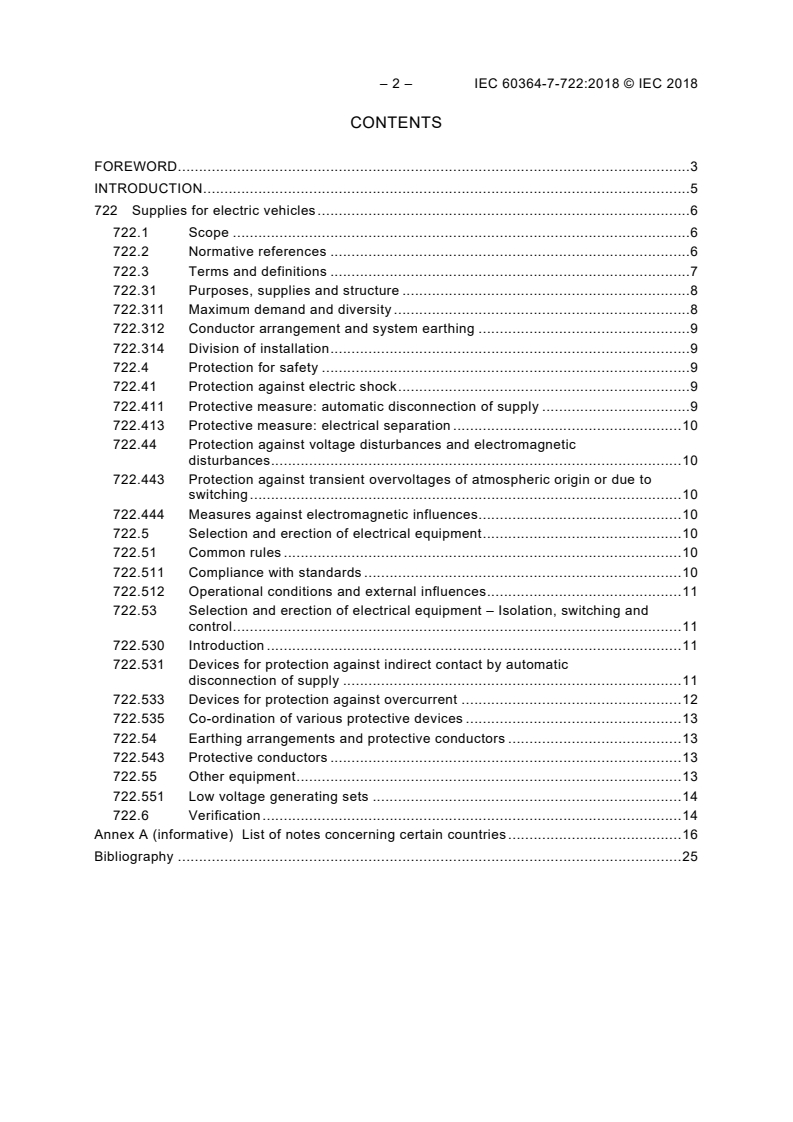
CONTENTS
FOREWORD . 3
INTRODUCTION . 5
722 Supplies for electric vehicles . 6
722.1 Scope . 6
722.2 Normative references . 6
722.3 Terms and definitions . 7
722.31 Purposes, supplies and structure . 8
722.311 Maximum demand and diversity . 8
722.312 Conductor arrangement and system earthing . 9
722.314 Division of installation . 9
722.4 Protection for safety . 9
722.41 Protection against electric shock . 9
722.411 Protective measure: automatic disconnection of supply . 9
722.413 Protective measure: electrical separation . 10
722.44 Protection against voltage disturbances and electromagnetic
disturbances . 10
722.443 Protection against transient overvoltages of atmospheric origin or due to
switching . 10
722.444 Measures against electromagnetic influences . 10
722.5 Selection and erection of electrical equipment . 10
722.51 Common rules . 10
722.511 Compliance with standards . 10
722.512 Operational conditions and external influences . 11
722.53 Selection and erection of electrical equipment – Isolation, switching and
control . 11
722.530 Introduction . 11
722.531 Devices for protection against indirect contact by automatic
disconnection of supply . 11
722.533 Devices for protection against overcurrent . 12
722.535 Co-ordination of various protective devices . 13
722.54 Earthing arrangements and protective conductors . 13
722.543 Protective conductors . 13
722.55 Other equipment . 13
722.551 Low voltage generating sets . 14
722.6 Verification . 14
Annex A (informative) List of notes concerning certain countries . 16
Bibliography . 25
INTERNATIONAL ELECTROTECHNICAL COMMISSION
____________
LOW-VOLTAGE ELECTRICAL INSTALLATIONS –
Part 7-722: Requirements for special installations or locations –
Supplies for electric vehicles
FOREWORD
1) The International Electrotechnical Commission (IEC) is a worldwide organization for standardization comprising
all national electrotechnical committees (IEC National Committees). The object of IEC is to promote
international co-operation on all questions concerning standardization in the electrical and electronic fields. To
this end and in addition to other activities, IEC publishes International Standards, Technical Specifications,
Technical Reports, Publicly Available Specifications (PAS) and Guides (hereafter referred to as “IEC
Publication(s)”). Their preparation is entrusted to technical committees; any IEC National Committee interested
in the subject dealt with may participate in this preparatory work. International, governmental and non-
governmental organizations liaising with the IEC also participate in this preparation. IEC collaborates closely
with the International Organization for Standardization (ISO) in accordance with conditions determined by
agreement between the two organizations.
2) The formal decisions or agreements of IEC on technical matters express, as nearly as possible, an international
consensus of opinion on the relevant subjects since each technical committee has representation from all
interested IEC National Committees.
3) IEC Publications have the form of recommendations for international use and are accepted by IEC National
Committees in that sense. While all reasonable efforts are made to ensure that the technical content of IEC
Publications is accurate, IEC cannot be held responsible for the way in which they are used or for any
misinterpretation by any end user.
4) In order to promote international uniformity, IEC National Committees undertake to apply IEC Publications
transparently to the maximum extent possible in their national and regional publications. Any divergence
between any IEC Publication and the corresponding national or regional publication shall be clearly indicated in
the latter.
5) IEC itself does not provide any attestation of conformity. Independent certification bodies provide conformity
assessment services and, in some areas, access to IEC marks of conformity. IEC is not responsible for any
services carried out by independent certification bodies.
6) All users should ensure that they have the latest edition of this publication.
7) No liability shall attach to IEC or its directors, employees, servants or agents including individual experts and
members of its technical committees and IEC National Committees for any personal injury, property damage or
other damage of any nature whatsoever, whether direct or indirect, or for costs (including legal fees) and
expenses arising out of the publication, use of, or reliance upon, this IEC Publication or any other IEC
Publications.
8) Attention is drawn to the Normative references cited in this publication. Use of the referenced publications is
indispensable for the correct application of this publication.
9) Attention is drawn to the possibility that some of the elements of this IEC Publication may be the subject of
patent rights. IEC shall not be held responsible for identifying any or all such patent rights.
International Standard IEC 60364-7-722 has been prepared by IEC technical committee 64:
Electrical installations and protection against electric shock.
This second edition cancels and replaces the first edition published in 2015. This edition
constitutes a technical revision.
This edition includes the following significant technical changes with respect to the previous
edition:
a) introduction of requirements for electrical installations incorporating wireless power
transfer systems;
b) clarification of the requirements regarding the protective measure placing out of reach in
order to allow the use of pantographs in areas accessible to the public;
c) introduction of requirements covering the case where the EV may operate as a source in
parallel with other sources.
– 4 – IEC 60364-7-722:2018 © IEC 2018
The text of this International Standard is based on the following documents:
FDIS Report on voting
64/2285/FDIS 64/2318/RVD
Full information on the voting for the approval of this International Standard can be found in
the report on voting indicated in the above table.
This document has been drafted in accordance with the ISO/IEC Directives, Part 2.
A list of all parts in the IEC 60364 series, published under the general title Low voltage
electrical installations, can be found on the IEC website.
The reader's attention is drawn to the fact that Annex A lists all of the “in-some-country”
clauses on differing practices of a less permanent nature relating to the subject of this
standard.
The committee has decided that the contents of this document will remain unchanged until the
stability date indicated on the IEC website under "http://webstore.iec.ch" in the data related to
the specific document. At this date, the document will be
• reconfirmed,
• withdrawn,
• replaced by a revised edition, or
• amended.
INTRODUCTION
For the purpose of this part of IEC 60364 (IEC 60364-7-722) the requirements of the general
Parts 1 to 6 of IEC 60364 apply.
The IEC 60364-7-7XX parts of IEC 60364 contain particular requirements for special
installations or locations which are based on the requirements of the general parts of
IEC 60364 (IEC 60364-1 to IEC 60364-6). These IEC 60364-7-7XX parts are considered in
conjunction with the requirements of the general parts.
The particular requirements of this part of IEC 60364 supplement, modify or replace certain of
the requirements of the general parts of IEC 60364 being valid at the time of publication of
this part. The absence of reference to the exclusion of a part or a clause of a general part
means that the corresponding clauses of the general part are applicable (undated reference).
Requirements of other 7XX parts being relevant for installations covered by this part also
apply. This part may therefore also supplement, modify or replace certain of these
requirements valid at the time of publication of this part.
The clause numbering of this part follows the pattern and corresponding references of
IEC 60364. The numbers following the particular number of this part are those of the
corresponding parts, or clauses of the other parts of the IEC 60364 series, valid at the time of
publication of this part, as indicated in the normative references of this document (dated
reference).
If requirements or explanations additional to those of the other parts of the IEC 60364 series
are needed, the numbering of such items appears as 722.101, 722.102, 722.103, etc.
In the case where new or amended general parts with modified numbering were published
after this part was issued, the clause numbers referring to a general part in this Part 722 may
no longer align with the latest edition of the general part. Dated references should be
observed.
– 6 – IEC 60364-7-722:2018 © IEC 2018
LOW-VOLTAGE ELECTRICAL INSTALLATIONS –
Part 7-722: Requirements for special installations or locations –
Supplies for electric vehicles
722 Supplies for electric vehicles
722.1 Scope
The particular requirements of this document apply to
• circuits intended to supply energy to electric vehicles, and
• circuits intended for feeding back electricity from electric vehicles.
Circuits covered by this document are terminated at the connecting point.
NOTE 1 The requirements for EV supply equipment for conductive charging and the relevant charging modes are
described in IEC 61851 (all parts). The requirements for EV supply equipment for wireless power transfer are
described in IEC 61980 (all parts).
NOTE 2 This document does not cover the assessment of the risk of explosion due to the possible production of
hydrogen/other flammable gases during the battery recharging phase.
722.2 Normative references
The following documents are referred to in the text in such a way that some or all of their
content constitutes requirements of this document. For dated references, only the edition
cited applies. For undated references, the latest edition of the referenced document (including
any amendments) applies.
IEC 60269 (all parts), Low voltage fuses
IEC 60309-1:1999, Plugs, socket-outlets and couplers for industrial purposes – Part 1:
General requirements
IEC 60309-2, Plugs, socket-outlets and couplers for industrial purposes – Part 2: Dimensional
interchangeability requirements for pin and contact-tube accessories
IEC 60364 (all parts), Low-voltage electrical installations
IEC 60364-4-41:2005, Low-voltage electrical installations – Part 4-41: Protection for safety –
Protection against electric shock
IEC 60364-4-41:2005/AMD1:2017
IEC 60364-8-2, Low-voltage electrical installations – Part 8-2: Prosumer's low-voltage
electrical installations
IEC 60898 (all parts), Electrical accessories – Circuit-breakers for overcurrent protection for
household and similar installations
IEC 60947-2, Low-voltage switchgear and controlgear – Part 2: Circuit-breakers
____________
Under preparation. Stage at the time of publication IEC RFDIS 60364-8-2:2018.
IEC 60947-6-2, Low-voltage switchgear and controlgear – Part 6-2: Multiple function
equipment – Control and protective switching devices (or equipment) (CPS)
IEC 61008-1, Residual current circuit-breakers without integral overcurrent protection for
household and similar uses (RCCBs) – Part 1: General rules
IEC 61009-1, Residual current operated circuit-breakers with integral overcurrent protection
for household and similar uses (RCBOs) – Part 1: General rules
IEC 61557-8, Electrical safety in low voltage distribution systems up to 1 000 V a.c. and
1 500 V d.c. – Equipment for testing, measuring or monitoring of protective measures – Part 8:
Insulation monitoring devices for IT systems
IEC 61558-2-4, Safety of transformers, reactors, power supply units and similar products for
supply voltages up to 1 100 V – Part 2-4: Particular requirements and tests for isolating
transformers and power supply units incorporating isolating transformers
IEC 61851 (all parts), Electric vehicle conductive charging system
IEC 61980 (all parts), Electric vehicle wireless power transfer (WPT) systems
IEC 62196 (all parts), Plugs, socket-outlets, vehicle connectors and vehicle inlets –
Conductive charging of electric vehicles
IEC 62196-1, Plugs, socket-outlets, vehicle connectors and vehicle inlets – Conductive
charging of electric vehicles – Part 1: General requirements
IEC 62196-2, Plugs, socket-outlets, vehicle connectors and vehicle inlets – Conductive
charging of electric vehicles – Part 2: Dimensional compatibility and interchangeability
requirements for a.c. pin and contact-tube accessories
IEC 62196-3, Plugs, socket-outlets, vehicle connectors and vehicle inlets – Conductive
charging of electric vehicles – Part 3: Dimensional compatibility and interchangeability
requirements for d.c. and a.c./d.c. pin and contact-tube vehicle couplers
IEC TS 62196-4, Plugs, socket-outlets, vehicle connectors and vehicles inlet – Conductive
charging of electric vehicles – Part 4: Dimensional compatibility and interchangeability
requirements for DC pin and contact-tube accessories for class II or class III applications
IEC 62262, Degrees of protection provided by enclosures for electrical equipment against
external mechanical impacts (IK code)
IEC 62423, Type F and type B residual current operated circuit-breakers with and without
integral overcurrent protection for household and similar uses
IEC 62955, Residual direct current detecting device (RDC-DD) to be used for mode 3
charging of electric vehicle
722.3 Terms and definitions
For the purposes of this document, the following terms and definitions apply.
ISO and IEC maintain terminological databases for use in standardization at the following
addresses:
____________
Under preparation. Stage at the time of publication IEC TS BPUB 62196-4:2018.
– 8 – IEC 60364-7-722:2018 © IEC 2018
• IEC Electropedia: available at http://www.electropedia.org/
• ISO Online browsing platform: available at http://www.iso.org/obp
722.3.1
electric vehicle
electric road vehicle
EV
any vehicle propelled by an electric motor drawing current from a rechargeable energy
storage system (RESS), intended primarily for use on public roads
[SOURCE: ISO 17409:2015, 3.19, modified — "rechargeable energy storage system" has
been added.]
722.3.2
connecting point
terminating point in the fixed installation where energy is transferred to/from one electric
vehicle
EXAMPLE A socket-outlet, a vehicle connector or a wireless power transfer device.
Note 1 to entry: The connecting point may be part of the fixed installed EV supply equipment.
722.3.3
demand factor
ratio, expressed as a numerical value or as a percentage, of the maximum demand of a circuit
or a group of circuits within a specified period, to the corresponding total installed load of the
circuit(s)
Note 1 to entry: In using this term, it is necessary to specify to which level of the system it relates.
[SOURCE: IEC 60050-691:1973, 691-10-05, modified — The term "installation" has been
replaced with the term "circuit".].
722.3.4
EV charging station
stationary part of EV supply equipment connected to the supply network
[SOURCE: IEC 61851-1:2017, 3.1.5, modified — The note has been deleted.]
722.3.5
EV supply equipment
equipment or a combination of equipment, providing dedicated functions to supply electric
energy from a fixed electrical installation or supply network to an EV for the purpose of
charging
[SOURCE: IEC 61851-1:2017, 3.1.1, modified — The examples have been deleted.]
722.3.6
load control
electrical (energy) management system ensuring that the sum of load currents of dedicated
circuits does not exceed a predetermined value
722.31 Purposes, supplies and structure
722.311 Maximum demand and diversity
Add the following:
It shall be considered that in normal use each single connecting point is used at its rated
current or at the configured maximum charging current of the charging station. The means for
configuration of the maximum charging current shall only be made by the use of a key or a
tool and only be accessible to skilled or instructed persons.
NOTE For this application the demand factor of the final circuit supplying the connecting point (e.g. the socket-
outlet) is equal to 1.
Since all the connecting points of the installation can be used simultaneously, the diversity
factor of the distribution circuit shall be taken as equal to 1 unless a load control is included in
the EV supply equipment or installed upstream or a combination of both.
722.312 Conductor arrangement and system earthing
722.312.2.1 TN systems
Add the following:
In a TN system, a circuit supplying a connecting point shall not include a PEN conductor.
722.314 Division of installation
Add the following:
722.314.101
A dedicated circuit shall be provided for the transfer of energy from/to the electric vehicle.
722.4 Protection for safety
722.41 Protection against electric shock
722.410.3 General requirements
722.410.3.5
Replace the existing text by the following:
The protective measure obstacles as specified in IEC 60364-4-41:2005, Clause B.2 shall not
be applied.
The protective measure placing out of reach, as specified in IEC 60364-4-41:2005,
Clause B.3 may only be applied where an automatic connection system in accordance with
IEC 61851-23-1 is used.
722.410.3.6
The protective measures as specified in IEC 60364-4-41:2005 and
IEC 60364-4-41:2005/AMD1:2017, Annex C shall not be applied.
722.411 Protective measure: automatic disconnection of supply
722.411.3 Requirements for fault protection
722.411.3.3 Additional protection
Replace the existing text by the following:
____________
Under consideration.
– 10 – IEC 60364-7-722:2018 © IEC 2018
Each AC connecting point shall be individually protected by a residual current device (RCD)
with a rated residual operating current not exceeding 30 mA.
NOTE This requirement implies that this RCD is not used for protecting other connecting points or current-using
equipment.
722.413 Protective measure: electrical separation
722.413.3 Requirements for fault protection
722.413.3.2
Replace the requirements as follows:
The separated circuit shall be supplied through an isolating transformer complying with
IEC 61558-2-4, and the voltage of the separated circuit shall not exceed 500 V.
722.44 Protection against voltage disturbances and electromagnetic disturbances
722.443 Protection against transient overvoltages of atmospheric origin or due to
switching
722.443.4 Overvoltage control
Add the following after the first paragraph:
A connecting point accessible to the public is considered as part of a public service and
therefore shall be protected against transient overvoltages.
722.444 Measures against electromagnetic influences
722.444.1 General
Add the following:
722.444.1.101
The equipment for wireless power transfer shall not impair the safety and the proper
functioning of the electrical installation and shall be installed according to the manufacturer’s
instructions.
722.5 Selection and erection of electrical equipment
722.51 Common rules
722.511 Compliance with standards
Add the following:
722.511.101
For conductive power transfer, EV charging stations shall comply with the appropriate parts of
the IEC 61851 series.
722.511.102
Wireless power transfer (WPT) systems for EVs shall comply with the appropriate parts of the
IEC 61980 series.
722.512 Operational conditions and external influences
722.512.2 External influences
Add the following:
722.512.2.101 Presence of water (AD)
When installed outdoors, the equipment shall be selected with a degree of protection of at
least IPX4 in order to protect against water splashes (AD4).
722.512.2.102 Presence of solid foreign bodies (AE)
When installed outdoors, the equipment shall be selected or provided with a degree of
protection of at least IP4X in order to protect against the ingress of small objects (AE3).
722.512.2.103 Impact (AG)
Equipment installed in public areas shall be protected against mechanical damage
considering an impact of high severity (AG3). This protection shall be provided by one or
more of the following:
• by locating the equipment to avoid damage by any reasonably foreseeable impact;
• by providing local or general mechanical protection of the equipment;
• by selecting and erecting equipment with a minimum degree of protection against external
mechanical impact in accordance with the requirements of IEC 62262 of IK08.
722.53 Selection and erection of electrical equipment – Isolation, switching and
control
722.530 Introduction
722.530.3 General and common requirements
Add the following:
722.530.3.101
The requirements of 722.530.3.102 and from 722.531 to 722.535.3 shall be achieved either by
the selection and erection of the appropriate equipment in the fixed installation or by the
selection of an EV charging station which incorporates the appropriate equipment or a
combination of both.
NOTE 1 The requirements for the selection and erection of devices for isolation, switching and control of the
wireless power transfer system are covered by IEC 60364-5-53.
NOTE 2 The in-cable control and protection device (IC-CPD) according to IEC 62752 is not designed for use in
fixed installations.
722.530.3.102
For circuits described in 722.531.3.101, and if more than one electric vehicle is supplied from
the same unearthed supply, it is recommended to use an insulation fault location system
(IFLS) according to IEC 61557-9 to detect the faulty circuitry within the shortest possible time.
722.531 Devices for protection against indirect contact by automatic disconnection of
supply
722.531.2 Residual current protective devices
Add the following:
– 12 – IEC 60364-7-722:2018 © IEC 2018
722.531.2.101
RCDs protecting each connecting point in accordance with 722.411.3.3 shall comply at least
with the requirements of an RCD type A and shall have a rated residual operating current not
exceeding 30 mA.
Where the EV charging station is equipped with a socket-outlet or vehicle connector
complying with IEC 62196 (all parts), protective measures against DC fault current shall be
taken, except where provided by the EV charging station. The appropriate measures, for each
connection point, shall be as follows:
• the use of an RCD type B; or
• the use of an RCD type A in conjunction with a residual direct current detecting device
(RDC-DD) complying with IEC 62955; or
• the use of an RCD type F in conjunction with a residual direct current detecting device
(RDC-DD) complying with IEC 62955.
RCDs shall comply with one of the following standards: IEC 61008-1, IEC 61009-1,
IEC 60947-2 or IEC 62423.
NOTE Subclause 722.531.2.101 is not applicable in case the connecting point is protected by other protective
measures against electric shock such as SELV or electric separation.
722.531.2.1.1
Replace the existing subclause, including the NOTE, as follows:
RCDs shall disconnect all live conductors.
722.531.3 Insulation monitoring devices
Add the following:
722.531.3.101
Except where a protective device is installed to interrupt the circuit in the event of a first earth
fault, an insulation monitoring device (IMD) in accordance with IEC 61557-8 shall be provided.
If the IMD is not part of the EV charging station then it is recommended that the IMD provides
the following two response values:
• Pre-warning
If the insulation resistance falls below 300 Ω/V an optical and/or acoustical signal should
be issued to the user. An ongoing charging session may continue but a new charging
session shall not take place.
• Alarm
If the resistance falls below 100 Ω/V an optical and/or acoustical signal should be issued
to the user. The charging circuit should shut down within 10 s.
722.533 Devices for protection against overcurrent
Add the following:
722.533.101
Except where EV supply equipment in accordance with IEC 61851-1 having more than one
connecting point is installed and incorporates the necessary overcurrent protective device
required by IEC 61851-1:2017, 13.1, each connecting point shall be supplied individually by a
final circuit protected by an overcurrent protective device complying with IEC 60947-2,
IEC 60947-6-2 or IEC 61009-1 or with the relevant parts of the IEC 60898 series or the
IEC 60269 series.
NOTE The EV supply equipment can have multiple connecting points.
722.535 Co-ordination of various protective devices
722.535.3 Discrimination between residual current protective devices
Replace the first paragraph as follows:
Where required for service reasons, selectivity shall be maintained between the RCD
protecting a connecting point and an RCD installed upstream.
722.54 Earthing arrangements and protective conductors
722.543 Protective conductors
Add the following:
722.543.101
Control signals on the protective conductor (PE) shall not flow into the fixed electrical
installation upstream of the EV charging station; equipment shall be selected accordingly.
NOTE 1 The requirement is to prevent such signals, and the related devices impairing the correct functioning of
the devices installed to provide the protective measure of automatic disconnection of supply (e.g. RCD).
NOTE 2 This requirement can be achieved by using a galvanic separation of the control electronics.
NOTE 3 Temporary currents used to perform the test of the continuity of protective conductors for safety
purposes are not considered as signal currents.
722.55 Other equipment
Add the following:
722.55.101 Socket-outlets and vehicle connectors
722.55.101.1
Where the connecting point is a socket-outlet or a vehicle connector, it shall comply with:
• IEC 60309-1 or IEC 62196-1, where interchangeability is not required, or
• IEC 60309-2, IEC 62196-2, IEC 62196-3 or IEC TS 62196-4 where interchangeability is
required, or
• the national standard for socket-outlets, provided the rated current does not exceed 16 A.
Except where electrical separation is used, each socket-outlet shall have an earthing contact
connected to the protective conductor (PE).
722.55.101.2
Every socket-outlet or vehicle connector shall be located as close as practicable to the EV
parking place to be supplied.
722.55.101.3
Portable socket-outlets shall not be used.
– 14 – IEC 60364-7-722:2018 © IEC 2018
722.55.101.4
One socket-outlet or vehicle connector shall supply only one electric vehicle at the same time.
722.55.102 EV charging stations
EV charging stations for public use shall be so designed as to facilitate easy access to the
charging point regardless of where the vehicle inlet is located on the electric vehicle.
722.551 Low voltage generating sets
722.551.1 Scope
722.551.1.1
Add the following dashed list item:
– electric vehicle
722.551.2 General requirements
Add the following:
722.551.2.101
Where electric vehicles are intended to feedback energy to the electric installations, the
requirements of IEC 60364-8-2 apply.
NOTE Additional requirements for circuits intended for feeding back electricity from electric vehicles are under
consideration.
722.551.7 Additional requirements for installations where the generating set may
operate in parallel with other sources including systems for distribution of
electricity to the public
722.551.7.2
Item b) is replaced by:
b) the socket-outlet or vehicle connector shall comply with IEC 62196 (all parts); and
722.6 Verification
722.6.4 Initial verification
722.6.4.1 General
722.6.4.1.1
Add the following:
The existing installation which is influenced shall also be verified with respect to compliance
with the requirements of IEC 60364 (all parts) (e.g. requirements for protection against
overcurrent due to the increase of load current).
____________
Under preparation. Stage at the time of publication IEC RFDIS 60364-8-2:2018.
722.6.5.1.1
Add the following:
NOTE Requirement for periodic verifications is a matter for national consideration.
– 16 – IEC 60364-7-722:2018 © IEC 2018
Annex A
(informative)
List of notes concerning certain countries
Country Clause N° Nature Rationale (detailed justification Wording
(permanent or for the requested country note)
less permanent
according to
IEC Directives)
ES 722 Special requirements apply in In Spain, according to the Royal
Spain. Decree 1053/2014, special
requirements apply to the
electrical installations for the
supply of electric vehicles.
FR 722 To take in account the national In France, special requirements
regulation. apply (Décret n°2017-26 du 12
janvier 2017).
IT 722.1 This part of the standard shall be In Italy, limitations to the use of
in line with the general rules mode 1 and mode 2 are given in
existing in Italy for safety and CEI EN 61851-1.
operational purposes.
GB 722.1 For clarification. In the UK, electrical installations
for charging mobility scooters
and similar vehicles of 10 A and
less are excluded.
NO 722.1 As the definition of electric In Norway, the requirements of
vehicle is very wide and also this part of IEC 60364 do not
seems to cover electrical apply to circuits intended to
bicycles and electrical wheel- supply energy to electric vehicles
chairs, and that the document is where the rated charging current
not intended for circuits is less or equal to 5 A.
supplying such electrical items,
we see it necessary to exempt
circuits supplying such items
from the scope.
DE 722.3.3 As the demand factor is not used In Germany, definition 722.3.3 is
anymore, delete definition deleted.
722.3.3.
CN 722.3.4 China has a different definition of In China for EV charging station
EV charging station. the following definition applies:
722.3.4 EV charging station
infrastructure that supplies
electric energy for the recharging
of electric vehicles, including
three or more chargers, of which
at least one off-broad charger,
and related power supplies,
monitoring devices and other
auxiliary facilities
DE 722.31 In Germany the DSO requires In Germany the following note is
symmetric load. added:
NOTE In Germany see also the
requirements of the DSO
regarding unsymmetric load.
AT 722.311 permanent To take in account the national In Austria the maximum
regulation asymmetric load connected to LV
networks of a DSO shall not
exceed 3,68 kVA.
Country Clause N° Nature Rationale (detailed justification Wording
(permanent or for the requested country note)
less permanent
according to
IEC Directives)
DE 722.311 Simplify wording to avoid In Germany the following note is
misunderstanding for electrical deleted:
installers.
NOTE For this application the
No need to introduce new demand factor of the final circuit
additional term “demand factor". supplying the connecting point
(e.g. the socket-outlet) is equal
to 1.
GB 722.312.2.1 For safety. As regulation 8(4) of the ESQCR
2002 prohibits the use of PEN
conductors in a consumer’s
installation this subclause cannot
be applied in the UK.
NO 722.314.101 In Norway, the number of In Norway the following
electrical vehicles has requirement is added:
considerably increased in recent
Where a connecting point for
years, and a number of
private use needs to be installed
connecting points has been
in an existing installation, e.g. for
established in new and existing
a dwelling or similar locations, an
installations. However, we
existing circuit may be used for
recognise that in existing
such purpose, provided the risk
installations, the installation of
is accepted by the installation
new connecting points may
owner.
easily be skipped due to high
costs in order to establish a
separate dedicated circuit for the
connection points, thus people
charge their vehicles using an
ordinary socket-outlet in an
existing circuit. The national
committee dislikes this situation
and is stressing the need for
using a charging mode 3 with a
type 2 socket-outlet. However,
we do not see any safety issue
installing an EV charging station
for private use, e.g. in dwellings
or related locations, in an
existing circuit, as long as the
installation owner is informed of
the possibility that charging may
not take place due to a fault
elsewhere in the circuit and
agrees on this.
AT 722.411.3.3 Permanent In Austria this requirement is For Austria, see the note to
mentioned under Subclause Subclause 722.415.1.
722.415.1.
AT 722.415.1 Permanent As in 722.411.3.3 obviously In Austria add a Subclause
(addition) additional protection with RCD 722.415.1 with the following text:
having a rated residual operating
722.415.1 Except for circuits
current not exceeding 30 mA is
protected by electrical separation
meant, it should be mentioned
(see 722.413.3.2), circuits
here as a requirement.
supplying connection points shall
It seems important to mention be additionally protected by
here that “true additional” RCDs having a rated residual
protection by RCD is needed for operating current not exceeding
each connection point except for 30 mA. Devices selected shall
cases in 722.413.3.2. disconnect all live conductors
including the neutral (see
722.531.2). The function of fault
protection for the circuit shall be
fulfilled separately.
– 18 – IEC 60364-7-722:2018 © IEC 2018
Country Clause N° Nature Rationale (detailed justification Wording
(permanent or for the requested country note)
less permanent
according to
IEC Directives)
FR 722.415.2 When the connecting point is In France, a new subclause is
(addition) installed outside the building, added:
some external conductive parts
722.415.2 For outdoor
and the mass of the electrical
installations, this additional
vehicles can be simultaneously
protection shall also be installed
accessible and may have
taking into account the risk of
different potential.
simultaneous access to
extraneous exposed conductive
parts.
ES 722.443.4 In Spain the protection against In Spain, according to the Royal
transient and temporary Decree 1053/2
...